benefits

Could you get Attendance Allowance?

Could You Get Attendance Allowance?

Attendance Allowance is a UK welfare benefit available to people who have reached state pension age who need help caring for themselves due to illness or disability. If you haven’t yet reached state pension age, the equivalent benefit is Personal Independence Payment or PIP. It is thought that millions of older people who would be eligible for Attendance Allowance are not currently receiving it.

I recently helped an elderly friend submit an application for Attendance Allowance, so in this post I thought I would set out how the application process works and share some tips and advice based on my (thankfully successful) experience of claiming it.

But first, let’s deal with the basics…

How Much Is It?

Attendance Allowance is paid at two different rates according to how much help and care you need.

The lower rate (currently £58.70 a week) is paid to people who need frequent care throughout the day OR night

The higher rate (currently £87.65 a week) is paid if you need frequent care throughout the day AND night, or if you are terminally ill.

Payments are normally made every four weeks direct to your bank account. The money is yours to spend as you wish to make your life a bit easier.

It is worth noting that you do not need to have someone currently caring for you in order to claim. Eligibility is based on your need for care rather than whether you are actually receiving it.

Another important point is that Attendance Allowance is not means-tested – eligibility is based purely on your care needs. Also, it is not taxable and will not normally affect your entitlement to other welfare benefits. Indeed, you may also be eligible for extra Pension Credit, Housing Benefit or Council Tax Reduction if you receive Attendance Allowance.

How Do You Apply?

Attendance Allowance is administered by the Department for Work and Pensions (DWP) rather than local councils. In Northern Ireland the Department for Communities (DfC) has responsibility for it.

The bad news is that there is a long (31 pages) and complicated application form. You can either download this from the government website or you can phone them on 0800 731 0122 and ask for a form to be sent to you. In Northern Ireland you can download the form from this site or phone the Disability and Carers Service on 0800 587 0912. You can apply yourself or someone else can apply on your behalf (with your permission, of course)..

Whether to download the application form or request it by phone needs careful consideration, as both methods have their pros and cons.

If you download the form it will be as an editable PDF. That is the option I used for my friend’s application. It has the advantage that you can complete it on screen rather than by hand. If is therefore easy to edit and amend your answers. Then when you are ready you can print it, sign it where required, and submit it. As a matter of interest, I used the free Foxit Reader program to complete and edit the form on my PC.

On the other hand, if you request a printed application form, as long as you return it within six weeks (a deadline date will be marked on the form) the benefit – if awarded – will be backdated to when the form was sent out. If you download the form from the website, it will only be backdated to the date they receive it from you. So you could lose out on several weeks’ money you might otherwise have had.

One compromise would be to request the form by phone and download it from the website as well. You can then use the downloaded version to create and edit your answers on screen. Once you have a finished version you are happy with, you can copy this manually on to the paper form and submit it within the six-week deadline.

Top Tips for Filling in the Form

Based on my experiences helping my friend – and some additional research online – here are my top ten tips for completing the Attendance Allowance application form.

1. Don’t rush at it like the proverbial bull in a china shop. If you do, you will almost certainly make mistakes and forget things. If you requested the form by phone you have six weeks to complete and return it without any financial penalty, so take advantage of this.

2. Read the notes that come with the form before you start to complete it. This will help you understand what the assessors are looking for to determine whether you are eligible for the benefit (and at what rate).

3. Keep a diary for a few days at least (ideally a week). Record in this all the occasions on which you need help and support. For example, if you need help getting dressed or washing, note down when this happens and how many times a day.

4. Be honest about your care needs when completing the form. Bear in mind, though, that Attendance Allowance is awarded to people who need help with their personal care. Washing, showering, eating, getting dressed and going to the toilet would all be things to mention if you need help with them. On the other hand, things like washing clothes, cooking, washing-up, dusting and hoovering may not be viewed in the same light. While these tasks clearly have to be performed by someone, they probably wouldn’t be regarded as personal care needs. Neither does the allowance cover mobility needs.

5. In the relevant section (Question 25) you should list any aids and adaptations you need/use. These might include bath or stair rails, a hoist, a shower seat, a commode, a walking stick, a wheelchair or walking frame, and so on. If you have eyesight problems, they could also include a magnifying glass or an extra-bright daylight bulb. You should also write about these things in the relevant ‘care needs’ questions. For example, if you use a grab rail to get in and out of the shower, you should also mention this in Question 29, ‘Do you usually have difficulty, or do you need help with washing, bathing, showering or looking after your appearance?’ Don’t worry if you end up mentioning the same thing twice (or more) over.

6. Bear in mind that you don’t have to require continuous support to receive the benefit. The term used on the form is frequent, although this isn’t defined precisely. One question (in Q38) asks how long you can safely be left unsupervised. My friend and I decided that the honest answer to this was two to three hours, although the latter would only apply with careful advance preparation. We answered 2-3 hours maximum and this appeared to be acceptable.

7. In addition, it doesn’t matter who is providing your care currently. My friend was concerned that because her husband was her primary carer, she would not be eligible for Attendance Allowance, as this would be expected from a spouse anyway. That is emphatically not the case. No matter who is caring for you – or even if nobody currently is – that will not affect your eligibility for the benefit.

8. The form gives you the opportunity (in Q49) to include a statement about your care needs from someone who knows you well. It is obviously good to include this if you can. As a close family friend I filled in this part of the form myself, but other options might include a doctor, a nurse, a care assistant, a family member, a priest or chaplain, or even a neighbour. Obviously it is important that whoever does this understands what the form is for and the sort of care needs the assessors are looking for.

9. You can also include a letter (or letters) from a medical professional backing up your need for care and support. In the case of my friend, we included a copy of a letter from her main (respiratory) consultant regarding her latest appointment. Fortuitously this also listed all her other health conditions and included a brief medical history. If you don’t have something like this available, ask your GP or consultant if they will provide something for you.

10. Remember that care needs can be psychological as well as physical. If you need support to combat loneliness and depression (or worse), you can and should mention this on the form.

Submitting the Form

Once you have completed the form, you will need to send it by post (email is not acceptable). As I completed my friend’s form online, I printed it out and put it in a clear plastic wallet, then sent this is a large padded envelope.

The address to send it in England, Wales or Scotland is Freepost DWP Attendance Allowance. The address for Northern Ireland will be on the form.

Don’t expect a quick response to your application. It is likely to be six to eight weeks before you hear anything, though you can if you wish phone to check that they have received it.

As mentioned, if your application is successful your benefit will be backdated to the date the form was received or (if you originally requested it by phone and are within the six-week deadline) the date the printed form was sent out to you.

Thankfully my friend’s application was approved without any further investigation and she is now receiving the allowance. In some cases applicants are required to attend for a personal assessment. Information about this will be sent by letter.

If you are unsuccessful in your application, you can submit an appeal. Information about how to do this will be included with the letter informing you that your application has been unsuccessful. You will need to appeal in writing to the address given in the letter. Normally you have to submit your appeal within a month of being turned down.

Other Resources

This has inevitably been a concise article, based on my experience of applying for Attendance Allowance on my friend’s behalf. If you need more information and guidance, there is plenty more online. Here are some useful websites to check out…

Government Attendance Allowance website

Which? Guide to Attendance Allowance

Citizens Advice Bureau

Age UK Guide to completing the Attendance Allowance form (PDF)

Carers UK Attendance Allowance Guide and Factsheet

In Conclusion

If you – or an elderly relative, friend or neighbour – may be eligible for Attendance Allowance, I hope this post has encouraged you to apply. The application form can appear daunting at first, but if you take your time and approach it in a calm and systematic way, it is perfectly do-able. The money is set aside for people in your situation, and it really can help make your life a little more comfortable.

I do, though, recommend enlisting some help with it if possible. Even if you are confident about completing the form, someone who knows you well may be able to suggest ways you need care and support that you might not have thought to mention yourself. And two heads are always better than one, of course! If you don’t have a suitable friend or relative, you can contact your local Citizens Advice Bureau and ask if they have someone who can assist you in completing the form.

As always, if you have any comments or questions (though bear in mind I make no claim to being an expert about Attendance Allowance!), please do leave them below as usual.


If you enjoyed this post, please link to it on your own blog or social media:
How to save money on prescriptions

How to Save Money on Prescriptions

The full cost of an NHS prescription in England is now £9. If you need regular medications, that can quickly add up to a substantial sum.

The good news, however, is that many people are entitled to free prescriptions, and others have methods open to them to save money.

Before I go into that, though, I should point out that all NHS prescriptions are now free in Scotland, Wales and Northern Ireland. So if you are lucky enough to live in one of these countries, you won’t normally be required to pay for your prescriptions.

Who Is Eligible for Free Prescriptions in England?

Here is a list of everyone eligible for free prescriptions in England, taken from the NHS website:

You can get free NHS prescriptions if, at the time the prescription is dispensed, you:

  • are 60 or over
  • are under 16
  • are 16 to 18 and in full-time education
  • are pregnant or have had a baby in the previous 12 months and have a valid maternity exemption certificate (MatEx)
  • have a specified medical condition (see below) and have a valid medical exemption certificate (MedEx)
  • have a continuing physical disability that prevents you going out without help from another person and have a valid MedEx
  • hold a valid war pension exemption certificate and the prescription is for your accepted disability
  • are an NHS inpatient

The medical conditions which qualify you for free prescriptions include cancer, diabetes (unless treated by diet only) and hyperthyroidism. For the full list, see this web page from the NHS Business Services Authority. If this applies to you, you will need to complete an application form FP92A from your GP, who will also sign it to confirm that you have the qualifying condition stated. Certificates are valid for five years, and once you have one you will be eligible for free prescriptions for any condition, not just the one through which you qualified.

You’re also entitled to free prescriptions if you or your partner (including civil partner) receive, or you’re under the age of 20 and the dependant of someone receiving:

  • Income Support
  • income-based Jobseeker’s Allowance
  • income-related Employment and Support Allowance
  • Pension Credit Guarantee Credit
  • Universal Credit and meet the criteria

Finally, you will qualify for free prescriptions if you’re entitled to or named on:

  • a valid NHS tax credit exemption certificate – if you do not have a certificate, you can show your award notice; you qualify if you get Child Tax Credits, Working Tax Credits with a disability element (or both), and have income for tax credit purposes of £15,276 or less
  • a valid NHS certificate for full help with health costs (HC2)

People named on an NHS certificate for partial help with health costs (HC3) may also get help with prescription costs.

What If You Don’t Qualify for Free Prescriptions?

If you don’t qualify for free prescriptions on any of the grounds set out above, there are still some things you can do to reduce the cost of your prescriptions.

One is to buy a Prescription Prepayment Certificate (PPC). These are available for three months or a year and entitle you to free NHS prescriptions for all conditions during this time.

At the time of writing a three-month PPC costs £29.10 and a year’s costs £104. In general, if you need more than one prescription a month and have to pay for it, a PPC will work out cheaper.

If you have a long-term condition, a one-year certificate will usually represent the best value. A person getting two prescriptions a month would save more than £100 a year by this means compared with paying for individual prescriptions. The simplest way to get a Prescription Prepayment Certificate is to apply via the NHS Prescriptions website.

Finally, it’s worth bearing in mind that some medications, especially for minor conditions, are available over the counter without a prescription. This can often work out cheaper than paying a prescription charge.

As always, if you have any comments or questions about this post, please do leave them below.

If you enjoyed this post, please link to it on your own blog or social media:
Infographic: Are you a victim of pension mis-selling?

Infographic: Are You a Victim of Pension Mis-Selling?

Today I have an eye-opening infographic for you from my friends at Edinburgh IFA about pension mis-selling.

If you watch the TV news, you may be aware that there has been a spate of stories in recent months about pension mis-selling.

In particular, some people have been persuaded to transfer valuable final salary pensions to unsuitable, often high risk, investment schemes, potentially putting their future income and security at risk. Of course, the advisers concerned typically pocket large sums in commission for this.

There is, however, some hope for victims of pension mis-selling, as the government has set up a compensation fund to help them. Here is the infographic with further information.

Mis-Sold Pensions

Thank you to Edinburgh IFA for their detailed and informative infographic.

If you think you (or a friend/relative) may have been mis-sold a pension or badly advised about a pension transfer, then – as the graphic says – you may be eligible for compensation from a £120 million fund set up for this purpose by the government. You can make a claim to the Financial Services Compensation Scheme (FSCS) or the Financial Ombudsman Service (FOS).

The FSCS only looks at complaints if an organisation has entered liquidation or administration. If – as is more likely – the organisation you wish to complain about is still trading, you will need to apply to the FOS.

You do need to act quickly, as if you are going to complain there is a time limit of six years from when the product was sold to you, or three years from when you noticed that you had been mis-sold – whichever is the later.

If you wish to complain about being mis-sold a pension, the first step is to contact the adviser (or SIPP provider) in question. They are obliged by law to have a complaints procedure and respond within eight weeks. If they don’t respond, or you are unhappy with their response, you can then file a complaint with the FOS. If they agree that you were badly advised, they can award you compensation of up to £150,000. More detailed information about the complaints procedure is available on the Edinburgh IFA website.

If you don’t feel confident going to the Pensions Ombudsman yourself, you can use a claims adviser. Edinburgh IFA say they are happy to put anyone in this position in touch with an independent financial adviser (IFA) in their area who will provide initial advice free and without obligation. Despite the company name, they offer a nationwide service (not just Edinburgh!).

Or if you don’t want to use them, any IFA specialising in pensions should also be able to help you. The website Unbiased.co.uk can locate suitable independent financial advisers in your area for you.

Either way, if you think you have been a victim of pension mis-selling, don’t bury your head in the sand. Compensation may be available if you act now. In any event, it costs nothing to find out more.

As always, if you have any comments or questions about this post, please do leave them below.

If you enjoyed this post, please link to it on your own blog or social media:
Could you benefit from the tax-free trading allowance?

Could You Benefit from the Tax-Free Trading Allowance?

Today I want to share some information about the trading allowance, a modest but useful tax-free allowance.

The trading allowance doesn’t appear to be widely known about, but can be particularly relevant for retired and semi-retired people. Though those in full-time work may also be able to benefit from it.

This allowance was introduced in the Finance Act (No. 2) 2017, which from April 2017 brought in a £1,000 trading allowance and £1,000 rental allowance. The trading allowance is likely to be the more beneficial of the two (at least, unless or until the much more generous £7,500 Rent-a-Room allowance is abolished) so in this post I will focus on that.

The trading allowance means that from April 2017 individuals with a trading income of £1,000 or less in a tax year do not need to declare or pay tax on this money. Trading income can include money from online activities such as auction trading, blogging, completing online surveys, and so on. It would also include casual work such as gardening or DIY.

So long as you earn under £1,000 a year from these activities, the good news is you don’t have to declare it to HMRC or pay income tax on it. For people who only earn small amounts of income from trading – perhaps on an ad hoc basis – that means there is no more worry about if, how or when to declare it to the authorities. I know many older people worry about whether they will get into trouble if, for example, they do a small DIY job for a neighbour and are paid £50 for it. The trading allowance can remove this source of concern.

An important point to note is that the £1,000 refers to gross income. If you intend to claim the trading allowance, you aren’t allowed to deduct any costs incurred (as of course you would in a normal self-employed business).

If you earn over £1,000 gross from trading you can still use the trading allowance if you wish. You then simply deduct £1,000 from your gross income and that will give your taxable income. Alternatively, you can choose the traditional method of deducting all business-related expenses from your gross income and paying tax (if due) on the balance. Clearly if you have a high level of expenses, the latter is likely to be the more cost-effective choice. Here are a few examples that may help make this clearer.

1. Graham is retired and supplements his pension doing part-time gardening for his neighbours, for which he earns £900 a year. This is under £1,000, so he does not have to declare this money to HMRC or pay any tax on it.

2. Jill has a part-time job working for an employer and in her spare time runs a blog, from which she makes a gross income of £1,500 a year. She has £600 of blog-related expenses. Although her net income from her blog is under £1,000, because the gross income is over this figure she is obliged to register as self-employed with HMRC. She then has the option of deducting the £1,000 trading allowance from her £1,500 gross income, giving her a taxable income of £500. Alternatively she can choose to deduct her £600 of expenses from her gross income of £1,500, leaving her with a taxable income of £900. Clearly, in this case she is better off claiming the trading allowance.

3. Mary works full-time as a shop assistant but also has a sideline buying and selling collectibles on eBay. Her gross income from her eBay trading is £2,500 and she has trading costs of £1,250. Again, as her gross income is over £1,000, she has to register with HMRC. She then has the choice of deducting the £1,000 trading allowance from her gross trading income of £2,500, giving her a taxable income of £1,500. Alternatively she can deduct the £1,250 of expenses from her £2,500 gross income, leaving her with a taxable income of £1,250. Clearly, in this case, not claiming the trading allowance is the better option.

You are allowed to decide for yourself which option is more beneficial to you each year, so it is very important to keep careful records of all your trading income and expenditure.

Note also that everyone is entitled to claim the trading allowance however much they earn as an employee (if you are already self-employed you will probably be unable to claim it, though – see below).

Bear in mind also that everyone has a tax-free annual income allowance anyway – the basic personal allowance is £11,850 in the current tax year, going up to £12,500 in 2019/20. The trading allowance is only therefore likely to be relevant in financial terms if your total taxable income from all sources exceeds this. But you will of course still have the benefit of not needing to worry about notifying HMRC or registering with them if your gross trading income is under £1,000..

As ever, there are a few other complications…

  1. You can claim the trading allowance if you have another paid job for an employer, full-time or part-time. You can’t, however, claim it if you also do freelance work for your employer.
  2. In addition, if you run a separate self-employed business, it is unlikely you will be able to claim the trading allowance as well (your accountant should be able to advise you about this – see also this useful article from Accountancy Age).
  3. There is only one trading allowance per person. Even if you have two separate sources of income from trading, for the purposes of claiming the allowance the total income from them must be lumped together. However, you can allocate the £1,000 allowance across both activities in whatever proportion you wish.
  4. Although you don’t have to declare trading income below £1,000 per tax year to HMRC, you may still have to declare it if you are receiving other welfare benefits such as Universal Credit.
  5. Only individuals can claim this allowance, not partnerships or limited companies.

Further Reading

Here are a few additional resources you may find helpful, starting with the government’s own website devoted to this allowance.

Tax-free allowances on property and trading income (HMRC)

Q&A – How trading allowance tax exemption works (FT Adviser)

What is the Trading Allowance? (Low Incomes Tax Reform Group)

Trading Allowance (Tax Aid)

A Little Boost (Tax Adviser magazine)

As always, if you have any comments or questions about this post, please do leave them below (although bear in mind that I am not a qualified financial adviser or tax expert and cannot provide personal financial advice).

If you enjoyed this post, please link to it on your own blog or social media:
SMI Change: What You Need to Know

Guest Post: SMI Change: What You Need to Know

This is a guest post by Sara Williams, who blogs about debt and credit ratings at Debt Camel. She is also an adviser at Citizens Advice.

If you get government help with some of your mortgage costs, you should have heard that this help, known as Support for Mortgage Interest (SMI), is changing from April 2018. About half the people getting SMI are pensioners who get Pension Credit. Many of the rest are disabled.

At the moment the SMI help is given as a “benefit”. But from April 2018, it will only be given as a loan that is secured on your house, so it has to be repaid when the house is sold.

This may sound very worrying. And some people are saying that it isn’t being explained very well by Serco, the firm the DWP is using to try to persuade people to sign the new loan documentation.

With only 6 weeks to go until the change, less than 5% of the people getting SMI have agreed to the new loan. And for people who don’t agree, their SMI will stop in April. This could mean people getting into mortgage arrears and ultimately having their house repossessed.

Questions people ask about the SMI change

Hundreds of comments have been left on an article I wrote about this SMI change. Here are some of the questions people are asking:

How much help will I get?

The same as now. Whatever SMI is currently paid to your mortgage lender, the same amount will be paid after April if you agree to the new loan.

But I’ll need more money each month as interest is now being added to this new loan?

You don’t have to start repaying this new loan, or the interest on it until your house is sold. So on an everyday basis, you will be in the same position as you are now.

Will the interest rate on the new loan increase?

The interest on the will be fixed to the UK Gilt rate – at the start it will be 1.7%. This is the rate at which the UK government can borrow – it will always be cheaper than most mortgage rates.

The loan is from the government, you don’t need to worry that Serco will change these rules and charge you more.

Will there be a delay before it’s paid?

If you are already getting SMI, the switch to the loan will be seamless; there won’t be any months when you aren’t helped.

If you aren’t currently getting SMI, the same waiting period of 39 weeks will apply as now.

Can I repay it if I get a new job?

Yes, you can repay the loan, or part of it, at any time. But it may be better to overpay your mortgage if you have spare money, as your mortgage rate will probably be higher than the interest rate on the SMI loan.

What other options are there?

Some options include:

  • ask friends or family to help you with your mortgage costs – this isn’t possible for many people;
  • get a lodger – but this could reduce your other benefits so get advice from Citizens Advice before deciding to do this;
  • use up your savings – but most people won’t have much and using what you have could leave you unable to afford an emergency;
  • sell the house and downsize or rent. This is a big change. It may be a good idea if your house is too large or difficult for you to manage or you have an interest-only mortgage ending soon, but you need advice on how it will affect your benefits first.

Should you agree to this?

I don’t like the change. I think it’s unfair and if people lose their homes, it could cost the government more money than it is supposed to save,

But you should make a pragmatic decision based on whether you have any better alternatives. Don’t be swayed by feelings about unfairness or politics.

Complain to your MP if you feel it’s unfair – these changes were discussed in Parliament, but they didn’t get much attention at the time – but don’t reject this loan without a better option.

The loan is cheap. Unless there are relatives who could help you, most people won’t have a good alternative. If you aren’t sure, or you have detailed questions, e.g. about what you are being asked to sign and its implications, go to your local Citizens Advice and ask for advice about the proposed loan and your finances, benefits and any other debts.


Thank you very much to Sara for a concise and informative article about the SMI change, which is clearly likely to affect some readers of this blog. If that includes you, with the new system coming in after 5 April 2018, it’s important to get to grips with the change and decide what is the best course of action for you.

If you have any comments, as always, feel free to post them below.


If you enjoyed this post, please link to it on your own blog or social media:
How to Check What Your State Pension Will Be

How to Check What Your State Pension Will Be

Today I thought I would discuss the state pension. This is a subject that concerns everyone, but may be of particular interest to readers of this blog who are approaching retirement age.

Of course, many people have one or more workplace or private pensions. However, the state pension is still a very important component of most people’s income in later life.

And unlike many workplace/private pensions, it rises automatically every year at the rate of inflation or above (under the current triple lock guarantee). That makes it increasingly valuable as you get older.

In this article I’ll be revealing how to check how much state pension you are due and when. But I’ll start with a look at the various changes to the state pension in the last few years and how they affect anyone coming up to pensionable age now.

Speaking of which, let’s start with one of the biggest changes…

Your State Pension Age

It’s unlikely to have escaped your notice that the pension age is rising. At present men can access their state pension at 65 while women get it at around 64. The age for women is in transition at the moment as it rises to equalize with men in 2018.

By 2020, the pension age for both men and women will go up to 66. Between 2026 and 2028 it is due to rise again to 67, and under current government plans it will go up again to 68 in 2037.

You can check when exactly you can start to claim the state pension by entering your date of birth and gender at this government website.

The New Flat Rate Pension

This is the other major change to the state pension in recent years.

Prior to April 2016 everyone received a basic pension (currently £122.30 a week). This was (and still is) topped up by additional state pension elements (S2P and Serps) which you accrued during your working life.

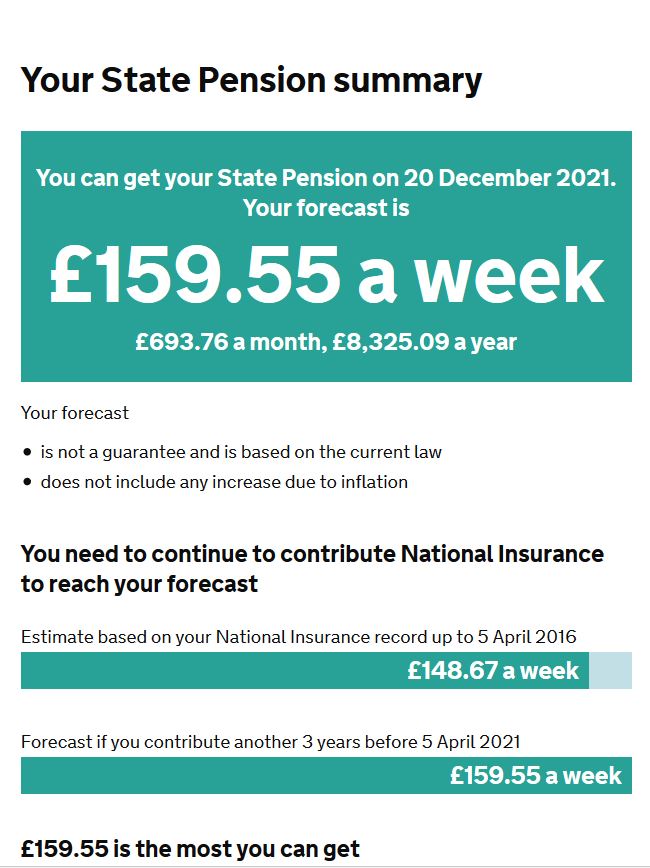
Anyone retiring from April 2016 onwards now receives a ‘flat rate’ pension currently worth £159.55 a week. If, however, you ‘contracted out’ of S2P and Serps at some point in your working life, you may get less than this. The presumption is that your contracted-out pension will provide another source of income for you, so you don’t need (or qualify for) the full flat-rate pension.

A further complication is that the government doesn’t want people who accrued large state pension entitlements under the old scheme (basic pension plus S2P and SERPS) to miss out. So when you reach pension age your entitlement under both the old and new methods of calculation will be worked out and you will receive the larger of the two. That means some people could actually qualify for more than the new flat-rate pension (£159.55 currently). If this is the case, it will be shown separately as a ‘protected payment’ on your state pension statement.

Also, to get the maximum new flat-rate pension you need to have at least 35 years of qualifying National Insurance contributions at the full (non-contracted-out) rate. If you have less than that you will get a reduced pension; and if less than 10 years, nothing at all.

In some circumstances – which I’ll discuss shortly – you may be able to pay a lump sum to fill in gaps in your record. Even if you do have 35 years or more of contributions, though, it may not entitle you to a full pension. The government website (see below) tells me I have 37 years of contributions, but because I was contracted-out for some of these years and so paying a lower rate of National Insurance I still have to contribute for another three years to get the full flat-rate pension. Here’s a screen capture of my actual statement:

State pension statement

If you’re confused by all this, I’m not surprised. The rules are complicated and still being tweaked. So to avoid any nasty surprises it’s important to check what you are due to receive as well as when you are due to do so. There is now an official website where you can access all this information in one place.

Checking Your State Pension

Anyone aged 55 or over who has lived and worked in the UK for 10 years or more (even if they are not British citizens) can now visit https://www.gov.uk/check-state-pension to get an estimate of how much state pension they will receive when they retire.

Doing this is a bit more involved than just checking your start date on the pension age site mentioned earlier. You have to sign in with proof of identity, so allow a bit of time for this. If you already have an HMRC online tax account, the good news is you can use this to log in.

Once you’ve done so, you will see a forecast of how much state pension you will get once you’re eligible to start receiving it. This is based on current figures, so if you won’t reach retirement age for a few years yet, it will of course have risen by that time.

Boosting Your State Pension

If you’re disappointed by the amount forecast, one thing you can do to boost your state pension is defer taking it. Under the new rules you will receive an extra 1% for every 9 weeks you put off claiming.

Obviously, to benefit from this overall you should be in good health. For women especially, as their life expectancy tends to be a few years longer than men, deferring your pension (if you can afford to do so) could well be a profitable option. In a way this is a form of investment, underwritten by the government.

No special action is required to defer taking your pension. You just delay claiming and it will be assumed that you wish to defer it.

Another thing you may be able to do to boost your state pension is buy extra voluntary contributions to fill in any gaps in your record. Buying a year of extra contributions (normally Class 3 National Insurance) costs around £733 and will boost your pension by around £230 or £4600 over a 20-year retirement. This can be well worth doing if, for example, you were contracted out for several years.

There are some restrictions, however. In particular, as a general rule it must be done within six years of the end of the tax year concerned. So if the gaps in your record go back further than this, it’s unlikely you will be allowed to make up the whole shortfall in this way.

There’s also the question whether paying voluntary contributions to fill gaps in your record will be cost-effective for you. There is no easy way of calculating this, and I highly recommend getting advice from an independent financial adviser specializing in pensions if you are thinking of going down this route. It’s also a good idea to contact the government’s Future Pension Centre to find out what your options are.

Finally , it should be said that while the state pension provides a baseline income (currently equivalent to around £8,300 a year), on its own it won’t stretch to many (or any) luxuries. Most people will have private or workplace pensions and perhaps other investments as well, and this will be very important if you hope to enjoy your retirement rather than merely survive it. I will look at these in more detail in future posts.

As ever, if you have any comments or questions on this post, please do leave them below.


If you enjoyed this post, please link to it on your own blog or social media: