
Volatile investment markets can be unsettling, particularly for older investors who may be more focused on preserving wealth than chasing high returns.
With ongoing geopolitical tensions, including the current conflict in the Middle East, market swings have become more pronounced. In this environment, a disciplined approach such as pound-cost averaging can help reduce risk and remove some of the stress from investing.
Table of Contents
What Is Pound-Cost Averaging?
Pound-cost averaging (often abbreviated to PCA) is a simple investment strategy that involves investing a fixed amount of money at regular intervals, regardless of what the markets are doing.
Rather than trying to “time the market” – buying at the lowest point and selling at the highest – you invest regularly over time. This means you automatically buy more units when prices are low and fewer when prices are high.
How It Works in Practice
Suppose you invest £500 a month into a stock market fund:
In month one, prices are high, so your £500 buys fewer units.
In month two, prices fall, so the same £500 buys more units.
Over time, your average purchase cost tends to smooth out.
This reduces the risk of investing a large lump sum just before a market downturn – something that can be particularly damaging in retirement or near-retirement years.
The Key Benefits
1. Reduces Market Timing Risk
Even professional investors struggle to predict short-term market movements. Pound-cost averaging removes the need to guess when to invest, helping you avoid costly mistakes.
2. Smooths Out Volatility
By spreading your investments over time, you avoid the impact of sudden market swings. This is especially valuable during periods of uncertainty.
3. Encourages Discipline
Regular investing promotes good financial habits and helps ensure you stay committed to your long-term plan.
4. Emotion-Free Investing
Market falls can tempt investors to delay investing, while market highs can encourage overconfidence. PCA removes these emotional triggers.
Why It Matters Now
Recent instability linked to the Middle East conflict has contributed to increased volatility in global markets. Energy prices, inflation expectations and investor sentiment have all been affected.
In such conditions:
Markets can rise and fall sharply in short periods.
News headlines can trigger knee-jerk reactions.
Attempting to time entry points becomes even more difficult.
Pound-cost averaging provides a structured way to keep investing without being derailed by short-term events.
Lump Sum vs Regular Investing
It’s worth noting that, historically, investing a lump sum can sometimes produce higher returns – simply because more money is invested earlier.
However, this comes with higher risk. If markets fall soon after investing, losses can be significant.
For many people – particularly cautious investors or those approaching retirement – the lower risk and smoother ride offered by pound-cost averaging may be preferable.
Who Should Consider Pound-Cost Averaging?
This approach can be particularly suitable for:
New investors building confidence
Those investing monthly from income (e.g. pensions or earnings)
Investors concerned about current market volatility
Anyone looking to reduce emotional decision-making
It is also a natural fit for tax-efficient wrappers such as ISAs and pensions, where regular contributions are common.
Practical Tips for UK Investors
Use a Stocks and Shares ISA to shelter returns from tax
Set up an automatic monthly investment to maintain discipline
Choose diversified funds (e.g. global equity funds) to spread risk
Review periodically, but avoid reacting to short-term market noise
Final Thoughts
In uncertain times, trying to outguess the market can do more harm than good. Pound-cost averaging offers a steady, disciplined approach that helps reduce risk and maintain perspective.
While no strategy can eliminate volatility entirely, investing regularly over time can make market fluctuations work in your favour rather than against you – a valuable advantage in today’s unpredictable world.
As always, please feel free to leave any comments below. I am always delighted to hear from Pounds and Sense readers.
Disclaimer: I am not a qualified financial services professional and nothing in this post should be construed as personal financial advice. You should always do your own ‘due diligence’ before investing and seek professional advice if in any doubt how best to proceed. All investing carries a risk of loss.

If you enjoyed this post, please link to it on your own blog or social media:
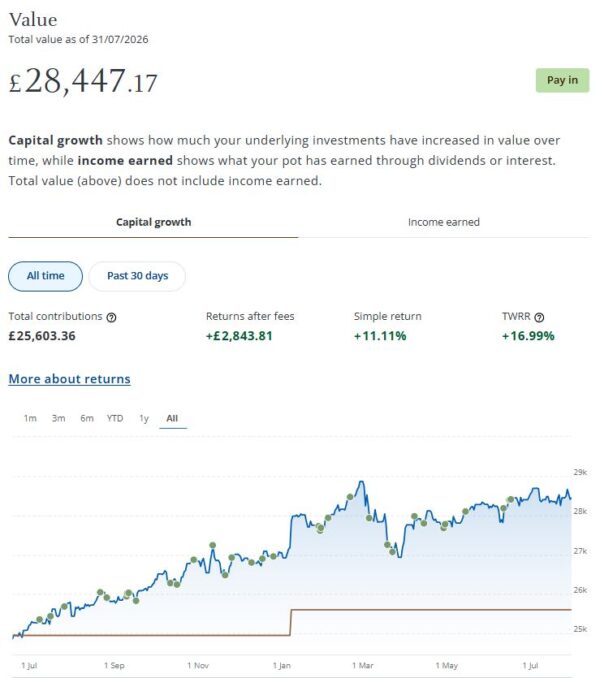
I’ll begin as usual with my JP Morgan Personal Investing (previously Nutmeg) Stocks and Shares ISA. This is the largest investment I hold other than my Bestinvest SIPP (personal pension).
As regular readers will know, in June last year I transferred most of the money in my former Nutmeg Fully Managed portfolio (just under £25,000) to a new Nutmeg Income Portfolio. I discussed this in detail in this post, but basically money in this port is invested to generate an income from share dividends and other sources. This is then paid monthly. Capital appreciation is targeted as well, but these portfolios are aimed primarily at older people (and others) who want/need their investment to generate a regular cash income.
In January my JPM Investing income portfolio generated £75.54 of income, which was duly paid in to my bank account on 24 March 2026. That means I have now received tax-free income of £273.68 in 2026 and a total of £745.14 since I opened the account in June last year. That’s about what I would have expected based on JPM’s projected annual return of just under 5% for income ports at my chosen risk level (five).
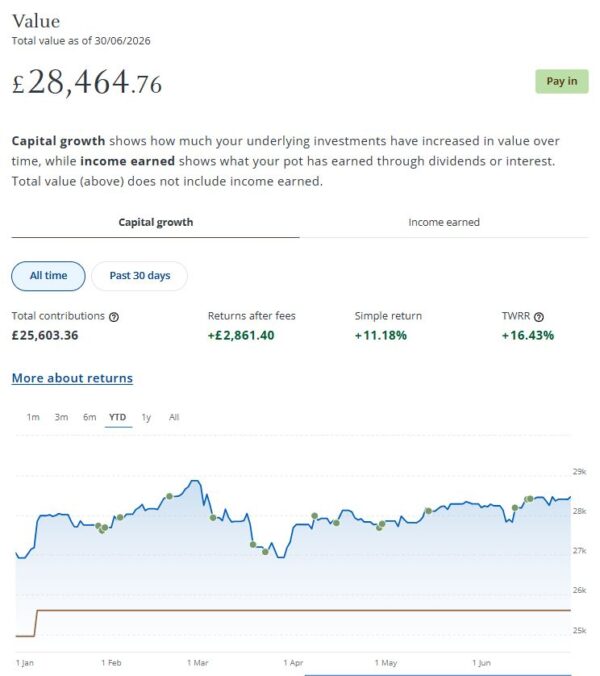
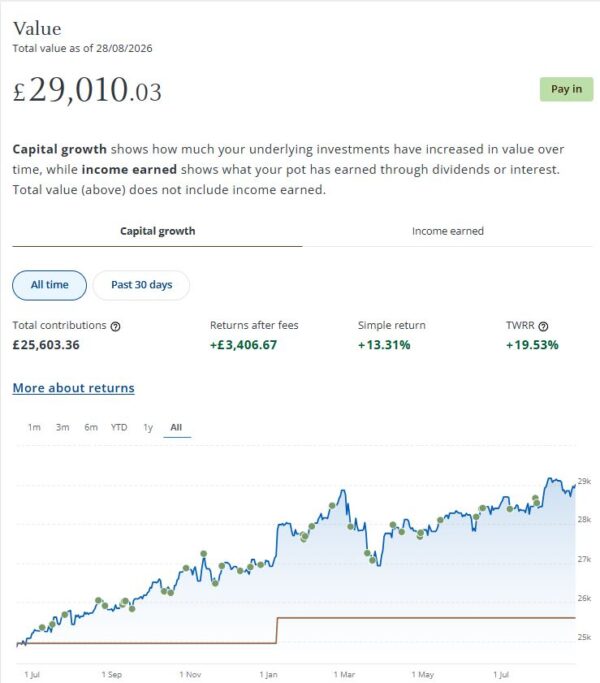
The less good news is that my income portfolio declined in value in March. It’s now worth £27,320 compared with £28,866 at the start of last month, a fall of £1,546. You don’t need to be an investment expert to know that this is mainly due to events in the Middle East. Nearly all of my share-based investments have been affected by this. Clearly it is disappointing, but as I always say, you do have to expect ups and downs when investing. As the screen capture below shows, my income port is still up by a respectable £1,716.97 (6.71%) after fees since I opened it last June.
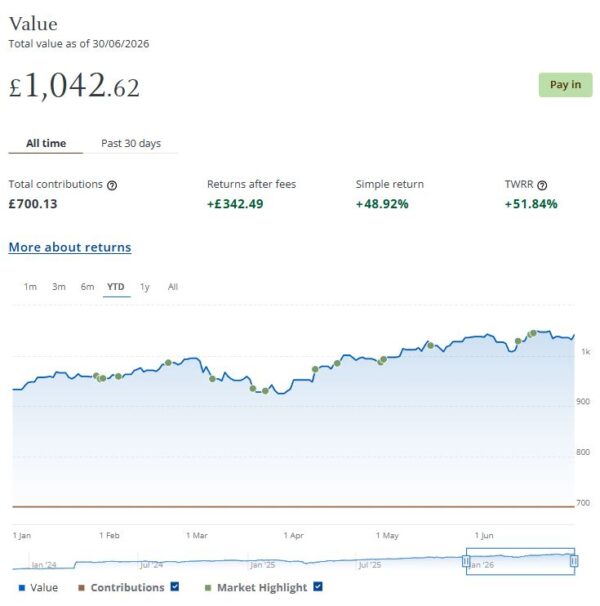
I still have a smaller, growth-oriented pot using JPM Investing’s Smart Alpha option. This is now worth £4,606 compared with £4,974 (rounded up) a month ago, a fall of £368. Here is a screen capture showing performance over the last year.
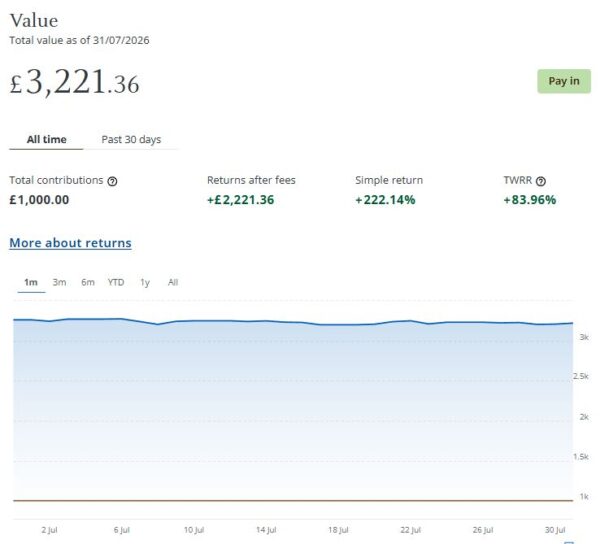
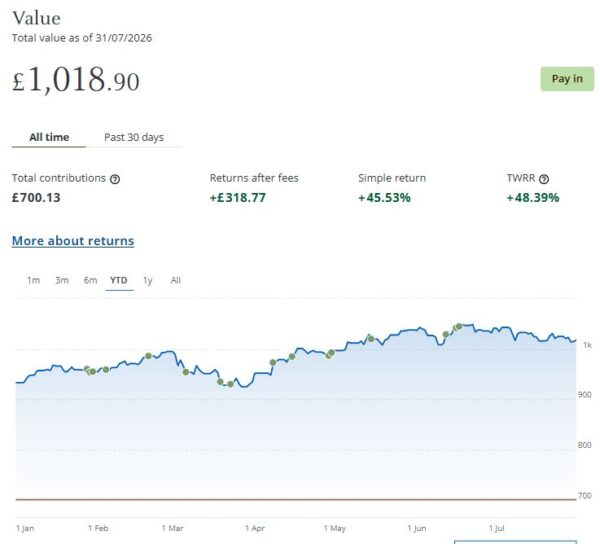
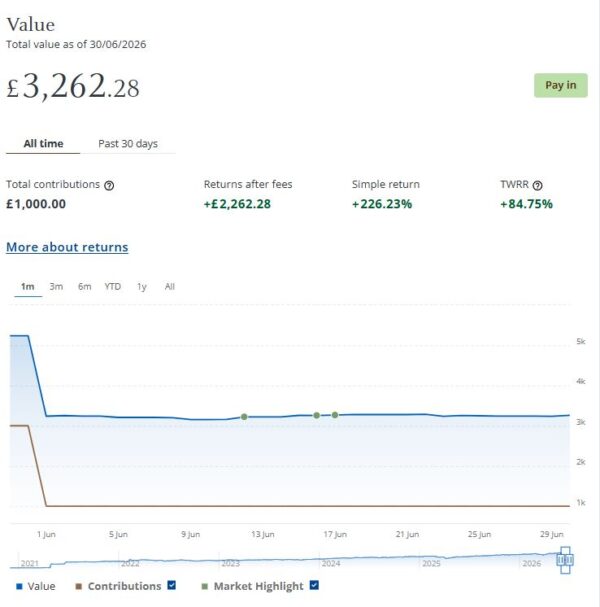
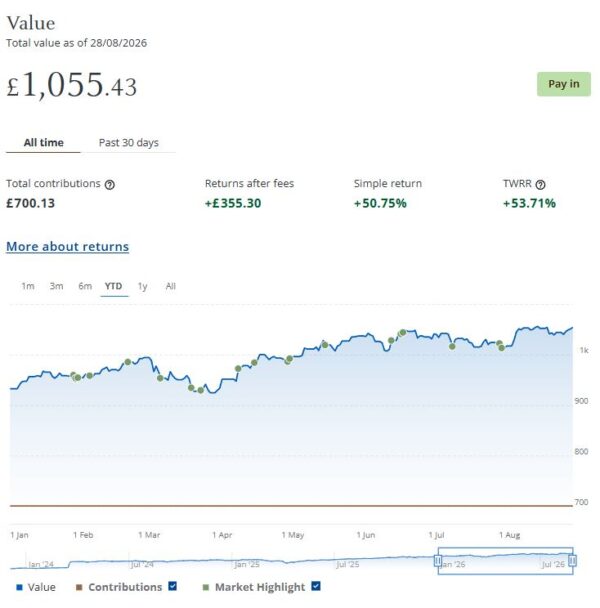
Finally, at the start of December 2023 I invested £500 in one of Nutmeg/JPM’s thematic portfolios (Resource Transformation). In March 2024 I also invested a further £200 from referral bonuses (something I no longer receive). As you can see from the one-year screen capture below, this portfolio is now worth £934 compared with £996 (rounded up) last month, a decrease of £62.
Overall in March the value of my JPM investments fell by £1,976 or 5.55%. Against that I did, of course, receive £75.54 in income from my income portfolio. In total, then, I am £1900.46 down for the month.
On a more positive note, excluding income generated, the overall value of my JPM investments is still up by £3,385 or 11.47% since the start of April 2025. If you add to this figure the £745.14 of income generated by my Income portfolio to date, that gives a total profit for the last 12 months of £4,130.14 – still not a bad return in these uncertain times.
As I said above, some volatility is always to be expected with stock market investments, but in the longer term they tend to even themselves out (and typically outperform bank savings accounts, although that is never guaranteed). In general the worst thing you can do is panic and sell up when downturns occur (as happened last month). You are then crystallizing your losses rather than giving the markets time to recover. This is something I discussed last year in this blog post. Obviously nobody knows what will happen in the Middle East, but hopefully some sort of resolution will occur soon, if only because President Trump desperately needs an exit strategy to pacify his critics back home. Once a bit more stability returns to the region, we will hopefully see world stock markets rise again. Though of course there is no guarantee about this.
You can read my full original Nutmeg/JPM review here. If you are looking for a home for your annual ISA allowance, based on my overall experience over the last nine years, they are certainly worth considering. They offer self-invested personal pensions (SIPPs), Lifetime ISAs and Junior ISAs as well.
Moving on, I also have investments with P2P property investment platform Housemartin. As discussed in this post, the company rebranded last year from Assetz Exchange.
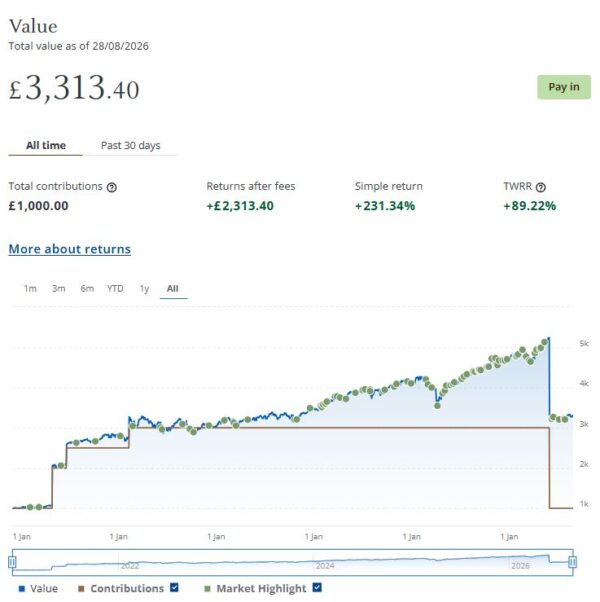
My investments with Housemartin continue to generate steady returns. Housemartin focuses on lower-risk properties (e.g. sheltered housing). I put an initial £100 into this in mid-February 2021 and another £400 in April. In June 2021 I added another £500, bringing my total investment up to £1,000.
Since I opened my account, my HM portfolio has generated a respectable £309.64 in revenue from rental income. I have made a small net loss of £20.25 on property disposals. Capital growth generally has slowed, in line with UK property values generally.
At the time of writing, 17 of ‘my’ properties are showing gains, 3 are breaking even, and the remaining 24 are showing losses. My portfolio of 44 properties is currently showing a net decrease in value of £76.05. That means that overall (rental income minus capital value decrease and loss on disposal) I am up by £213.34. That’s still a respectable return on my £1,000 and does illustrate the value of P2P property investments for diversifying your portfolio. And it doesn’t hurt that with Housemartin most projects are socially beneficial as well.
A further consideration is that property investments on Housemartin are less likely to be affected by stock market downturns, as happened in March due to the war in the Middle East. This again demonstrates the potential value of such investments for diversifying your portfolio during challenging times.
The net fall in capital value of my Housemartin investments is obviously a little disappointing. But it’s important to remember that until/unless I choose to sell the investments in question, it is largely theoretical, based on the latest price at which shares in the property concerned have changed hands. The rental income, on the other hand, is real money (which in my case I’ve reinvested in other HM projects to further diversify my portfolio).
To control risk with all my property crowdfunding investments nowadays, I invest relatively modest amounts in individual projects. This is a particular attraction of Housemartin as far as i am concerned. You can actually invest from as little as £1 per property if you really want to proceed cautiously.
As I noted in this blog post, Housemartin is particularly good if you want to compound your returns by reinvesting rental income. This effectively boosts the interest rate you are receiving. Personally, once I have accrued a minimum of £10 in rental payments, I usually reinvest this money in either a new HM project or one I have already invested in (thus increasing my holding). Over time, even if I don’t invest any more capital, this will ensure my investment with Housemartin grows at an accelerating rate and becomes more diversified as well.
In 2022 I set up an account with investment and trading platform eToro, using their popular ‘copy trader’ facility. I chose to invest $500 (then about £412) copying an experienced eToro trader called Aukie2008 (real name Mike Moest).
In January 2023 I added to this with another $500 investment in one of their thematic portfolios, Oil Worldwide. I also invested a small amount I had left over in Tesla shares.
In January this year, as Oil Worldwide hadn’t exactly been setting the world alight, I decided to switch my entire investment in this to another smart portfolio, InTheGame. This port, focusing on the computer gaming industry, has been the top performer for some time in my eToro virtual portfolio.
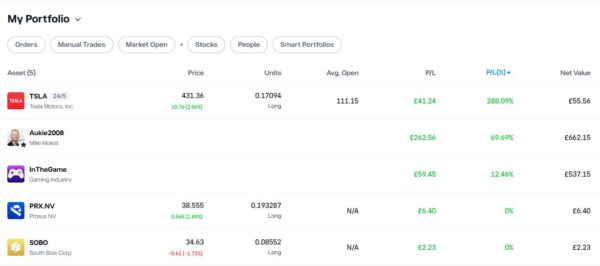
Unfortunately just as I switched away from Oil Worldwide, President Trump decided to invade Venezuela. This gave the oil industry a significant boost, which I would otherwise have benefited from. Meanwhile InTheGame has gone south, partly due to the recent fall in AI stocks along with the war in the Middle East. At the time of writing the value of my investment in this has fallen by nearly 17%. Hey ho! This does of course demonstrate that there are never any guarantees when investing and unexpected events can thwart the best-laid plans…
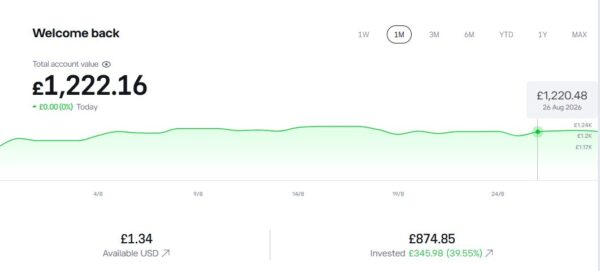
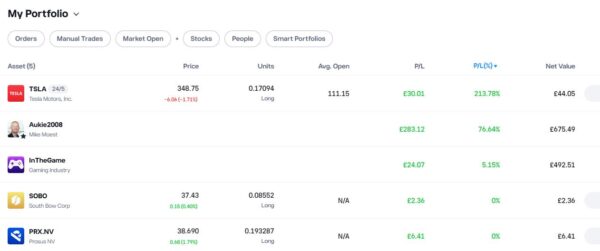
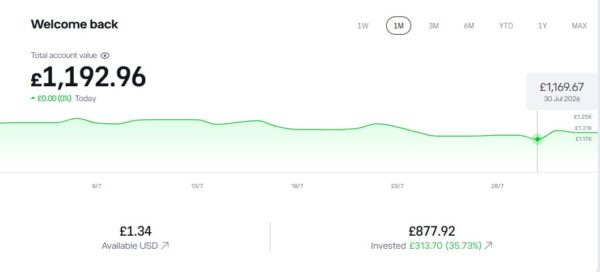
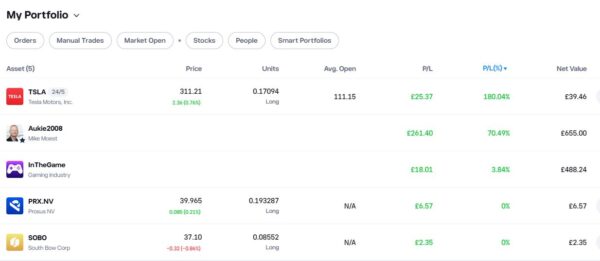
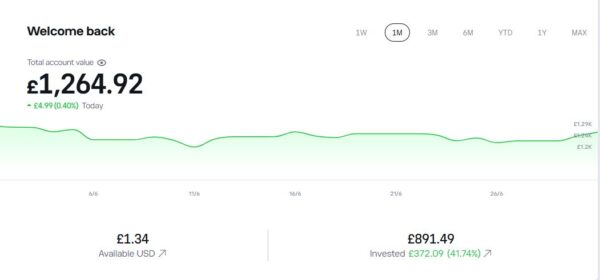
As you can see from the screen captures below, my original eToro investment (total value £888.36 in pounds sterling) is today worth £1,070.78, an overall increase of £182.42 or 20.53%.
Note: eToro now displays the value of investments in your native currency, although you can change this if you wish.
As mentioned above, my new investment in InTheGame is currently down by nearly 17%. My copy trading investment with Aukie2008 also fell in value in March, but it’s still showing an impressive overall profit of 56.36%. Of course, I have held this investment for quite a bit longer.
My Tesla shares, which I purchased as an afterthought with some spare cash I had in my account, are also down this month, but still showing an overall profit of over 234% since I bought them. If only I had put a bit more money into this!
You might also notice that I have small holdings in Prosus NV, a Dutch internet group, and South Bow, a Canadian energy infrastructure company. To be honest I don’t understand how I acquired these, but I assume they are some sort of bonus I was awarded. In any event, I am happy to have them in my portfolio.
If you would like more information about setting up an eToro account, please click on this no-obligation website link [affiliate]. Don’t forget that you also get a free $100,000 virtual portfolio, which you can use to experiment with trading and investing strategies. I have certainly earned a lot from mine.
As an experiment, at the start of April last year I put £50 into an investment ISA with Trading 212. As mentioned in my blog post about dividend investing, I put it into the (Almost) Daily Dividends Portfolio, a ready-made portfolio or ‘pie’ on Trading 212. As you can see from the screen capture below, my portfolio is now worth £59.87. That’s a decrease of £1.97 since last month but an increase of £9.87 or 19.7% over the eleven-month period since I opened it. It has even accrued a grand total of £1.08 in dividends, most of which has now been (automatically) reinvested.
I am quite impressed with how this investment has been faring, despite the small amount I put in (which means I may be missing out on some smaller dividends). If I increased my investment I would almost certainly become eligible for more dividends, and even more the longer I remain invested. If I had any spare money at the moment, I would consider doing this. Of course, I do now have an income-focused portfolio with JPM Investing as well (see above).
Moving on, I published various posts on Pounds and Sense in March. I have listed below those that are still relevant.
In Beat the Postage Stamp Price Rise, I pointed out that the cost of stamps is rising (again) on Tuesday 7 April 2026. That will be the SEVENTH rise in the price of first class stamps in just four years! Standard and large-letter stamps don’t have values printed on them and will still be valid after the April price rise comes in, so my top tip is to stock up now while stamps are still at the old price.
I also posted an updated version of Get a Free Share Worth up to £100 with Trading 212. Anyone who hasn’t done this before can get a free share worth up to £100 just by signing up for a new Trading 212 investment account via my link. The current offer closes on Tuesday 28th April 2026.
Also in March I published Are River Cruises Suitable for Solo Travellers. This was a follow-up to my earlier posts about how to save money on cruise holidays and the pros and cons of river cruises (for older travellers in particular). In this post I addressed a question asked by several readers as to whether river cruises are a good choice for solo travellers. The article sets out the pros and cons as I see them. My view, as expressed in the article, is that they can be, but it does depend on your travel style and budget.
What Is An Annuity – And Who Should Consider Buying One? discusses a subject that confuses many people. In simple terms, an annuity is a financial product that converts a lump sum of money – typically from your pension pot – into a guaranteed regular income for life (or for a fixed period). You buy an annuity from an insurance company. In return for handing over some or all of your pension savings, they promise to pay you a regular income, usually monthly, for the rest of your life. In the article I look at the pros and cons of annuities, and whom they are (and aren’t) likely to be suitable for.
How to Save Money on Travel Insurance covers a subject on many people’s minds at this time of year. Travel insurance is one of those expenses that can feel like a grudge purchase – until you need it. For UK travellers, especially older holidaymakers, having adequate cover is essential. In this article I set out some ways you may be able to save on travel insurance without compromising your safety or security. I also discuss saving money on travel insurance as an older person, and the issues that can be caused by war and civil unrest (especially relevant for destinations in or near the Middle East at the moment).
Finally, in March I published Don’t Miss Out – Use Your £20,000 ISA Allowance Before It’s Too Late! As I say in the article, the end of the tax year on 5 April 2026 is fast approaching and so is the deadline to utilize the annual tax-free Individual Savings Account (ISA) allowance. Unless you take action in the next few days, this opportunity to maximize your tax-free savings for the 2025/26 financial year will be gone for ever.
And speaking of deadlines, time is also running out to take advantage of EDF Energy‘s enhanced switching offer. Until 6 April 2026 you can get a FREE £75 (increased from £50) credited to your energy account when you switch to EDF via my link at https://edfenergy.com/quote/refer-a-friend/sunny-koala-9462. Terms and conditions apply.
I’ll close with my customary reminder that you can also follow Pounds and Sense on Facebook or Twitter (or X as it is now). Twitter/X is my number one social media platform and I post regularly there. I share the latest news and information on financial matters, and other things that interest, amuse or concern me. So if you aren’t following my PAS account on Twitter/X, you are definitely missing out!
I am also on the BlueSky social media network under the username poundsandsense.bsky.social. Twitter/X remains my primary social media platform, but I also post details of my latest blog posts, third-party articles and other financial news and resources on BlueSky for those who prefer to follow me there.
As always, if you have any comments or questions, feel free to leave them below. I am always delighted to hear from PAS readers
Disclaimer: I am not a qualified financial adviser and nothing in this blog post should be construed as personal financial advice. Everyone should do their own ‘due diligence’ before investing and seek professional advice if in any doubt how best to proceed. All investing carries a risk of loss.
Note also that posts on PAS may include affiliate links. If you click through and perform a qualifying transaction, I may receive a commission for introducing you. This will not affect the product or service you receive or the terms you are offered, but it does help support me in publishing PAS and paying my bills. Thank you!
If you enjoyed this post, please link to it on your own blog or social media:
Today I’m featuring a way you can get a free fractional share worth up to £100 by signing up (for the first time) with an online share trading platform called Trading 212.
Trading 212 is unusual in that it offers commission-free and fee-free share trading. As a special offer, until Tuesday 28th April 2026 they are offering people new to the platform a free fractional share just for signing up via a referral link (such as the links in this post). The share you will get is chosen at random, but could be worth up to £100. You can either keep this share or sell it.
Table of Contents
How to Sign Up
Signing up with Trading 212 is pretty straightforward. Just visit the Trading 212 website via any of the (referral) links in this post and follow the on-screen instructions to register. Note that you will be required to provide various items of information, including your date of birth, National Insurance number, annual income, employment status, and contact details. I understand that this is to meet their legal ‘Know Your Customer’ duty.
You will also need to indicate the type of account you want from the options available (see screen capture below).
As you will see, the four account types on Trading 212 are Invest, CFD, Stocks ISA and Cash ISA. You can apply for any or all of these if you like.
CFD stands for Contract for Difference. CFDs are quite complex financial instruments and unless you know what you’re doing I recommend giving them a miss.
If you just want the free share my suggestion would be to tick the Stocks ISA box. An ISA is, of course, a tax-exempt Individual Savings Account. As from April 2024 you can open any number of ISA accounts in a year as long as you don’t exceed your annual £20,000 allowance.
If you have already used up your entire £20,000 this year, you should choose Invest instead to open a general investment account without any tax benefits. Obviously if you don’t want a Stocks ISA with Trading 212 for any reason, you can choose this option as well.
For more information about the Trading 212 Cash ISA, see my review here. Be aware that you must open either an Invest account or a Stocks ISA account to qualify for a free share. Of course, there is nothing to stop you opening a Cash ISA account as well, but my recommendation would be to open an Invest or Stocks ISA account first.
Getting Your Free Share
There is one more step you will need to take in order to get your free share. You will need to deposit a minimum of £1 into your account. There are various ways you can do this, but i just used my debit card. There is no obligation to invest the £1 (or whatever you choose to deposit) and if you wish you can withdraw it once your free share has been credited.
The next business day you should receive an email confirming that a free fractional share has been added to your account. As mentioned above, this is allotted at random. If you’re lucky you might get one worth up to £100. Even if you get a less valuable one, though, it’s still a share for free. If you choose to keep it, it may rise in value. There may also be dividends payable in future (and credited to your account).
Selling Your Share
You can’t sell your share immediately. You have to wait three business days before doing so, but it is then just a matter of clicking the Sell button on your member’s dashboard.
The money will be credited to your Trading 212 account but you will have to wait 30 days before withdrawing it. So there may be a case for waiting to see if your share’s value goes up in that time. Of course, it could also go down!
In my case, I received a free share in the Ford Motor Company worth just under £8 at the time. Obviously this wasn’t as exciting as I might have hoped, but it was still – in effect – free money for almost no time or effort 😀
How Safe Is Trading 212?
Trading 212 is registered in England and Wales and authorized and regulated by the Financial Conduct Authority. In addition, all clients’ funds are kept separately in segregated bank accounts which are covered by the Financial Services Compensation Scheme. So even if the company itself were to go broke, any cash in your account would be protected up to a value of £120,000.
Of course, the FSCS guarantee doesn’t apply to the value of your stocks and shares, which can go down as well as up. All investments carry a risk of loss, although in the case of your free share you can never lose any more than the original cost, which was of course zero!
Referral Scheme
Any Trading 212 member can also refer new members while this offer is on. In that case, both you and the person concerned will receive one free fractional share worth up to £100. Obviously, the links in this blog post include my referral code – so if you register and get a free share, I will receive one also. Under the terms of the current offer you can get up to five free shares in this way. Five is the limit per person. Although you can still refer new members who will get a free share after this, as a referrer you won’t receive one as well. If and when the offer reopens in future, you will be able to refer more new members and get free shares again.
Final Thoughts
I first heard about Trading 212 a while ago, but wasn’t initially sure whether it was legit and here for the long term. And I thought the free share offer was, frankly, too good to be true. However, my own experiences have been entirely positive. My original free share in the Ford Motor Company was credited the next business day as promised and I received an email notifying me about it.
I can log in to my Trading 212 account any time to see how my Ford share is doing. I have also collected a few other shares from referrals. These include a share in AMD (the semiconductor company), which is currently worth an impressive £152.69, and one in Nike, which is worth £72.48. I still have my original Ford Motor Company share and it has risen in value to £8.75. I have also received several dividend payments from them. I haven’t sold any of my free shares yet but could of course do so any time I choose. I am not in any rush, as Trading 212 do not impose any platform or inactivity fees.
Although in this post I have focused on the free share offer, Trading 212 is worth considering as a share-dealing platform too. In particular, the fact that it’s fee-free and commission-free means it is well suited for people who are dipping a toe in stocks and shares investment for the first time. By contrast, the dealing fees and commissions charged by some other share-trading platforms can make small share purchases prohibitively expensive. This review by Money Savvy Daddy looks at the pros and cons of Trading 212 as a share-dealing platform in a bit more detail.
It’s also worth bearing in mind that Trading 212 pays interest on any uninvested funds in your ISA or Invest account, currently at a rate of 3.80% AER. You can also make money allowing your shares to be lent out. Rates on offer for this vary according to investor demand, with the process handled automatically by Trading 212 once authorized. You can read more about share lending on Trading 212, including the risks and safeguards provided, here.
In conclusion, I hope this post has inspired you to consider registering with Trading 212 to claim your free share. If you do, I hope you get a valuable one! Please let me know what share you receive in a comment below. And, as always, any other comments or questions are very welcome too.
Don’t forget, the current free share offer ends on Tuesday 28th April 2026.
Disclosure: The links in this post include my referral code. If you click through and register as described above, I will receive a free share (as will you). Please note also that I am not a qualified financial adviser and nothing in this post should be construed as individual financial advice. Everyone should do their own ‘due diligence’ before investing and seek advice from a qualified financial adviser if in any doubt how best to proceed. All investment carries a risk of loss (although not in the case of free shares, obviously).
This is an update of my original post about this special offer.
If you enjoyed this post, please link to it on your own blog or social media:
As we reach the end of a long, cold winter, many people’s thoughts are turning to holidays. And that makes the topic of travel insurance a lot more relevant – in these uncertain times especially.
Travel insurance is one of those expenses that can feel like a grudge purchase – until you need it. For UK travellers, especially older holidaymakers, having adequate cover is essential. The good news is that there are plenty of ways to keep costs down without cutting corners on protection.
Here are some practical strategies to help you save money on travel insurance while still getting the cover you need.
Table of Contents
Money Saving Strategies
1. Shop Around and Compare Policies
Prices can vary significantly between insurers for broadly similar cover. Using comparison sites such as Compare the Market, MoneySuperMarket, and GoCompare can quickly highlight the best-value options.
However, don’t rely solely on comparison sites. It’s also worth checking insurers directly, including Aviva and Staysure, as they sometimes offer exclusive deals.
2. Consider an Annual Multi-Trip Policy
If you take more than one trip a year, an annual (multi-trip) policy can be far cheaper than buying single-trip cover each time.
As a rough guide:
Two or three holidays a year can make an annual policy worthwhile
Frequent travellers can save substantially over time
Just ensure the policy covers the length of your longest trip, as many impose limits (e.g. 31 or 45 days per trip).
3. Only Pay for the Cover You Need
Policies often include extras that you may not require. Common add-ons include:
Gadget cover
Winter sports cover
Cruise cover
If these aren’t relevant, opt out. For example, if you’re taking a simple European city break, you likely don’t need winter sports or high-value gadget protection.
4. Check Existing Cover First
You may already have some level of travel insurance included with:
Packaged bank accounts
Credit cards
Membership organisations
For instance, some premium current accounts from Nationwide Building Society or HSBC include travel insurance as a perk.
That said, always read the small print carefully – cover levels, age limits, and exclusions may apply.
5. Increase the Excess (Carefully)
Choosing a higher excess (the amount you pay towards a claim) can reduce your premium.
For example:
£50 excess → higher premium
£150 excess → lower premium
This can be a sensible way to save money if you’re unlikely to make small claims. However, ensure the excess remains affordable if you do need to claim.
6. Be Honest About Medical Conditions
Failing to declare pre-existing medical conditions can invalidate your policy entirely.
Specialist insurers like AllClear Travel Insurance and Saga cater specifically to older travellers and those with medical histories.
While premiums may be higher, proper disclosure ensures you are fully covered – potentially saving thousands if something goes wrong.
7. Use the GHIC Card
UK residents can apply for a Global Health Insurance Card (GHIC), which provides access to state healthcare in EU countries and some others at reduced cost or sometimes free.
This won’t replace travel insurance, but it can reduce the level of medical cover you need – and may lower your premium slightly.
8. Travel Less Often? Consider Single-Trip Cover
If you only travel once a year, a single-trip policy is usually cheaper than an annual one.
You can also tailor it closely to your itinerary, ensuring you don’t pay for unnecessary cover.
9. Book Early – but Not Too Early
Buying insurance as soon as you book your trip is usually best. This ensures you’re covered for cancellation from day one.
However, prices can fluctuate, so it’s worth checking a few providers before committing rather than simply accepting the first quote offered.
Even modest savings of £10–£20 can add up over time.
Saving as an Older Traveller
Travel insurance tends to become more expensive as you get older, but there are still ways to keep costs under control without sacrificing essential cover.
One of the main issues older travellers face is higher premiums due to increased medical risk. Insurers often apply age bands, and prices can rise quite sharply once you reach your late 60s or 70s. In addition, pre-existing medical conditions – more common in later life – can further increase the cost or limit the number of insurers willing to provide cover.
Some mainstream providers also impose upper age limits, particularly on annual policies, which can restrict your options. This is where specialist insurers such as Saga and Staysure can be especially valuable, as they are geared towards older customers and often have no upper age limit.
To manage costs, it’s worth considering the following approaches:
Compare specialist providers: Companies focusing on older travellers may offer better value than standard insurers.
Tailor your cover carefully: Avoid unnecessary add-ons, but don’t skimp on medical cover, which is the most important element.
Consider single-trip policies: These can sometimes work out cheaper than annual cover for older travellers, particularly if you only take one holiday a year.
Get medical screening right: Providing accurate and detailed information can help avoid inflated premiums and ensures valid cover.
Travel within Europe where possible: Premiums are typically lower than for worldwide cover, especially when combined with a Global Health Insurance Card (GHIC).
While costs may be higher, careful shopping around and using specialist providers can make travel insurance much more affordable in retirement – allowing you to travel with confidence and peace of mind.
Travel Insurance and Wars
The ongoing conflict in parts of the Middle East is a reminder that global events can have a direct impact on your travel insurance – sometimes in ways that aren’t immediately obvious.
One key point is that most standard travel insurance policies exclude claims arising from war, military action or civil unrest. This means that disruption caused directly by the conflict – such as flight cancellations, airspace closures, or evacuations – may not be covered.
In addition, insurers often treat major conflicts as a “known event” once they are widely reported. If you buy a policy after this point, it’s unlikely to cover any claims related to that situation.
Another crucial issue is official government advice. The UK Foreign, Commonwealth & Development Office (FCDO) regularly updates its guidance for travellers. If it advises against travel to a destination (or all but essential travel), your insurance may be invalidated if you still choose to go.
Where plans are already in place, cover may depend on timing and policy wording. Some insurers will allow cancellation claims if FCDO advice changes after you have booked, but this is not guaranteed and varies between providers. Read your policy wording carefully, especially exclusions relating to war and unrest, and contact your insurer directly if travelling anywhere near affected regions.
The overall message is clear: if you are considering travel to, or even near, areas affected by conflict, proceed with caution. Insurance protection may be limited, and official advice should be taken seriously – not just for financial reasons, but for your personal safety as well.
Final Thoughts
Saving money on travel insurance isn’t about choosing the cheapest policy – it’s about finding the best value for your circumstances. For older travellers in particular, ensuring adequate medical cover should always be the priority.
By comparing providers, tailoring your cover, and making use of existing benefits, you can often reduce costs significantly without compromising on safety or protection.
As always, if you have any comments or questions about this post, please do leave them below. I am always delighted to hear from PAS readers.
If you enjoyed this post, please link to it on your own blog or social media:
As the end of the tax year on 5 April 2026 approaches, so too does the deadline to utilize the annual tax-free Individual Savings Account (ISA) allowance.
The clock is ticking, and unless you take action in the next few weeks, this opportunity to maximize your tax-free savings for the 2025/26 financial year will be gone.
ISAs are a popular choice for savers and investors alike, offering a tax-efficient way to grow your wealth. With a diverse range of options available, from cash ISAs to stocks and shares ISAs and innovative finance ISAs, individuals have the flexibility to tailor their savings strategy to suit their financial goals and risk appetite.
The current ISA allowance stands at £20,000, providing a significant opportunity to shield your savings and investments from tax. This allowance represents a generous sum that, if left unused, cannot be carried forward to future years. In essence, any portion of the £20,000 allowance that remains untapped by the upcoming deadline will be lost, representing a missed opportunity for tax-free growth.
For those who have yet to fully utilize their annual ISA allowance, now is the time to take action. Whether you’re looking to bolster your rainy-day fund with a cash ISA, seeking to invest in the stock market through a stocks and shares ISA, or diversify your investment portfolio with an IFISA, there’s no shortage of options available.
Cash ISAs offer a secure and accessible way to save, providing a tax-free environment for your savings with the added benefit of easy access to your funds when needed. Meanwhile, stocks and shares ISAs open the door to potentially higher returns by investing in a wide range of assets such as equities, bonds and funds, albeit with a higher level of risk. And an Innovative Finance ISA, or IFISA for short, allows you to invest via P2P/crowdfunding platforms, further diversifying your portfolio (though again with a higher level of risk).
With an ISA you will never incur any liability for dividend tax, capital gains tax or income tax, even if your investments perform exceptionally well. Of course, there is no guarantee this will happen, but over a longer period stock market investments have typically outperformed cash savings, often by a substantial margin.
In recent years I have invested much of my own annual ISA allowance in a stocks and shares ISA with JP Morgan Personal Investing (formerly Nutmeg). I have also invested some money in a property IFISA from Housemartin (previously Assetz Exchange). Check out the Housemartin website here [affiliate link].
Finally, for shorter-term savings, I am using the Trading 212 Cash ISA. This currently pays me an interest rate of 3.60% AER. Higher rates are typically on offer to new Trading 212 clients for their first 12 months.
Note that from April 2027 the Cash ISA allowance has been reduced from £20,000 to £12,000 per year for savers under the age of 65. Until then it remains at £20,000 a year for all savers, though.
With just a few weeks left to take advantage of this valuable tax benefit, delaying now could prove costly. By acting swiftly you can ensure that your savings and investments are positioned to grow tax-free, setting yourself up for a better financial future.
In summary, the £20,000 annual ISA allowance for the 2025/26 tax year presents a golden opportunity to maximize your tax-free savings and investments. Time is of the essence, though. Unless you act before the looming deadline of 5th April 2026, this valuable allowance will be lost forever. If you have the money available, therefore, seize the opportunity now to help secure your financial future.
As always, if you have any comments or questions about this article, please feel free to leave them below.
Disclaimer: I am not a qualified financial adviser and nothing in this blog post should be construed as personal financial advice. Everyone should do their own ‘due diligence’ before investing and seek professional advice if in any doubt how best to proceed. All investing carries a risk of loss.
If you enjoyed this post, please link to it on your own blog or social media:
If you’re approaching retirement (or have retired already), you’ve probably come across the term annuity. For some people it represents security and peace of mind. For others it feels restrictive and poor value.
So what exactly is an annuity – and who should consider buying one?
Let’s take a closer look.
Table of Contents
What Is an Annuity?
In simple terms, an annuity is a financial product that converts a lump sum of money – typically from your pension pot – into a guaranteed regular income for life or for a fixed period.
You buy an annuity from an insurance company. In return for handing over some or all of your pension savings, they promise to pay you a regular income, usually monthly, for the rest of your life.
This is most commonly done using funds built up in a defined contribution pension such as a personal pension or SIPP.
In the UK, buying an annuity used to be the default retirement option before the pension freedoms introduced by the Pension Schemes Act 2015. Today, it’s just one option among several.
How Does an Annuity Work?
Here’s a simple example:
You retire at 67.
You have £100,000 in your pension.
You use that £100,000 to buy an annuity.
The insurance company pays you, say, £6,000 a year for life.
The exact amount you receive depends on:
Your age
Your health
Current interest rates
Whether the income rises with inflation
Whether it continues to a spouse after your death
Once purchased, most annuities cannot be changed or cancelled. That’s a crucial point. You’re effectively swapping flexibility for certainty.
Different Types of Annuity
There isn’t just one type. The main options include:
1. Lifetime Annuity
Pays you a guaranteed income for the rest of your life, no matter how long you live.
2. Fixed-Term Annuity
Pays income for a set number of years (e.g. 5 or 10).
3. Level Annuity
Pays the same income every year. Starts higher, but inflation erodes its value over time.
4. Inflation-Linked Annuity
Income rises each year, often in line with inflation. Starts lower but protects purchasing power.
5. Joint-Life Annuity
Continues paying income to a spouse or partner after your death.
6. Enhanced Annuity
If you have certain medical conditions or lifestyle factors (e.g. smoking), insurers may offer a higher income because of reduced life expectancy.
The Advantages of Buying an Annuity
1. Guaranteed Income for Life
You cannot outlive your money. This removes longevity risk entirely.
2. Simplicity
Once set up, there’s nothing to manage. No investment decisions. No worrying about stock market falls.
3. Peace of Mind
For many retirees, knowing the bills are covered every month is invaluable.
The Disadvantages
1. Irreversible Decision
Once you buy most annuities, you can’t change your mind.
2. Inflation Risk
A level annuity can lose real value over time.
3. Potentially Poor Value If You Die Early
If you die shortly after purchase (and haven’t chosen guarantees or joint-life options), the insurer keeps the remaining capital.
4. Less Flexibility
You lose access to your capital.
How Do Annuities Compare With Drawdown?
Since pension freedoms were introduced, many retirees instead choose flexible-access drawdown, keeping their money invested and withdrawing income as needed.
Drawdown offers:
Flexibility
Potential for investment growth
Ability to pass on unused funds
But it also carries:
Investment risk
The possibility of running out of money
Ongoing management and decision-making
An annuity, by contrast, provides certainty but little flexibility. Of course, there is nothing to stop you dividing your pension pot between both. You can also start off using drawdown and switch some or all of your pot to an annuity later, e.g once you reach your mid-70s.
Who Should Consider Buying an Annuity?
An annuity isn’t right for everyone. But it may be suitable if:
You Want Certainty
If you value guaranteed income over flexibility, an annuity may suit you.
You Don’t Want Investment Risk
If market ups and downs worry you, locking in income could help you sleep better at night.
You Have No Other Guaranteed Income
If you don’t have a defined benefit (final salary) pension, an annuity can provide similar security.
You’re in Poor Health
An enhanced annuity may offer an attractive income rate.
You Want to Cover Essential Expenses
Some retirees use part of their pension to buy an annuity that covers core bills, leaving the rest invested for flexibility.
Who Might Not Benefit?
You may want to think carefully if:
You have a strong desire to leave a financial legacy
You are comfortable managing investments
You have significant other guaranteed income already
You are relatively young and rates are less attractive
One Important Tip: Shop Around
You are not obliged to buy an annuity from your existing pension provider.
Using the “open market option” can significantly increase your income. Different insurers offer different rates, and enhanced terms are not always automatically applied.
This is one area where independent financial advice can genuinely add value.
How Much Income Could a £100,000 Annuity Buy You?
Example: 70-Year-Old Single Man (Standard Lifetime Annuity)
Annuity Type (Single Life)
Estimated Annual Income from £100,000
Level (fixed each year)
~£8,400 per year (≈ £700/month)
Level (best-buys from comparison sites)
~£8,000–£8,500+ per year
Escalating (income grows ~3% annually)
~£6,400 in first year
Inflation-linked (RPI)
~£6,200 in first year
These are rough current illustrations – if you lock in a level annuity at age 70 with £100,000, you might expect around £8,000–£8,500 a year before tax as a starting point.
How Income Varies with Age
Age has a big impact because providers expect to pay income for fewer years the older you are:
Age When Purchased
Typical Annual Income (£100,000)
60 years
~£6,500–£7,000
65 years
~£7,300–£7,600
70 years
~£8,000–£8,400
75 years
~£9,000+
What This Means in Practice
Let’s put those figures into context:
If a 70-year-old buys a level lifetime annuity with £100,000, a payout of around £8,000 annually equates to about £667 per month before tax.
Choosing escalation or inflation protection reduces the initial income but helps protect your spending power over time. For example, a rising income might start at ~£6,400 (with 3% annual increases).
These examples are illustrative only – actual quotes vary by provider, postcode, health and product features. For a more precise quote, try an online calculator such as this independent one on the MoneyHelper website.
💡 Tip: Enhanced annuity rates may be higher if you have certain health conditions or lifestyle factors – always compare quotes across the market rather than accepting the first offer.
Quick Takeaways
Older age = higher annuity income for the same pension pot.
If you have health issues and/or an “unhealthy” lifestyle, you may get a better rate.
Level income gives the highest starting payout but won’t keep pace with inflation.
Inflation-linked or escalating options reduce initial income in exchange for rising payments.
Shopping around is crucial – you don’t have to buy from your existing pension provider.
Final Thoughts
Annuities fell out of favour after pension freedoms were introduced, but rising interest rates in recent years have made them more competitive again.
They aren’t exciting. They aren’t flexible. But for the right person, at the right time in their life, they can provide something that’s hard to put a price on: certainty.
As always with retirement planning, the best solution may not be either/or. A blended approach – part annuity, part drawdown – can often provide the best of both worlds.
If you’re approaching retirement (or there already), it’s well worth understanding how annuities work before ruling them out entirely.
As always, if you have any comments or questions about this article, please do post them below. But note that I am not a qualified financial adviser and cannot give personalized advice. You should always do your own “due diligence” before making investment decisions and seek professional advice if in any doubt how best to proceed. Personally I strongly recommend getting independent professional advice and assistance before purchasing an annuity.
If you enjoyed this post, please link to it on your own blog or social media:
My recent posts about cruise holidays and river cruises have generated quite a bit of interest among PAS readers. One asked if I could say something about the suitability of river cruises for solo travellers. I thought that was an interesting question (and one that’s relevant to me personally). So today I shall be addressing this particular topic.
River cruising has traditionally been seen as a holiday for couples or groups. But in recent years, more solo travellers – especially active retirees and budget-conscious explorers – have been asking if it’s a good fit for them too. The short answer to this is Yes – but with some important things to consider before you book.
Let’s take a look at the pros and cons…
Table of Contents
Pros of River Cruises for Solo Travellers
1. Built-In Social Opportunities
With smaller ships and communal activities like guided excursions, happy hours and shared dining, solo travellers often find it easy to strike up conversations. If you’re someone who enjoys meeting new people, river cruises can be surprisingly good in this respect.
2. Guided Excursions Take Out the Guesswork
Instead of navigating a new city on your own, excursions included in many packages let you explore in a group — perfect if you want cultural immersion without logistical stress.
3. Special Solo Cabins Are Growing
More cruise lines are introducing single-occupancy cabins (or reduced single supplements) to prevent solo travellers paying double the fare for a standard cabin. This makes solo travel more financially appealing.
4. Safety and Ease
Especially for older solo travellers, river cruising provides an added layer of comfort and security:
Onboard support staff.
Port stops often right in town centres – no long transfers.
Lectures, entertainment and shared experiences that make connecting with others easier.
👎 Cons of River Cruises for Solo Travellers
1. Single Supplements Can Be Pricey
Even with growing options for solo cabins, many river cruise packages still charge a single supplement — a surcharge for solo travellers that can significantly increase the overall cost. Always compare total price (not just headline fare).
2. Smaller Ships Mean Fewer People
If you’re a social butterfly craving variety in company, the smaller onboard population might feel a bit limited. Some people thrive on that atmosphere; others miss larger group dynamics. If there are some fellow passengers you really don’t like, on a river cruise it may be harder to avoid them.
3. Some Shore Excursions May Require Good Mobility
While many tours are gentle, some exploring old towns can involve walking on uneven cobblestones. Plan ahead if you have mobility concerns.
💡 Money-Saving Tips for Solo Cruisers
If you decide a river cruise is your kind of holiday, here’s how to make it better value…
1. Seek Out Reduced (or Zero) Single Supplements
Some operators – especially those targeting UK solo travellers – offer promotional periods with no single supplement on selected departures. Check specialist sites like RiverCruising.co.uk or GlobalRiverCruising.co.uk regularly and sign up to any email newsletters they offer.
2. Book Early
New solo cabins and low-supplement departures often sell out quickly. Booking up to a year in advance can secure better rates.
3. Compare Inclusions Carefully
A lower headline price isn’t always better. Packages that include drinks, excursions and transfers may cost more upfront but save you money overall.
4. Consider Shared Shore Excursions
If mobility isn’t an issue and you’re comfortable exploring with others, opting for group excursions rather than private tours may save money.
5. Travel Outside Peak Dates
Shoulder seasons – spring and autumn – usually come with lower prices and fewer crowds, giving you a more relaxed experience at a better price point.
6. Check for dedicated solo departures
Some operators like Riviera River Cruises occasionally run solo-only cruises with no supplement – ideal for meeting other solo voyagers.
7. Compare direct vs agent pricing
Sometimes booking directly with the cruise line is cheaper; other times a specialist agent will have better exclusive rates.
8. Fly from Regional Airports
River cruise packages often include flights. Compare prices from regional UK airports – you may find cheaper deals than London departures.
9. Use Loyalty Programmes & Travel Agents
Cruise line loyalty programmes can bring discounts, upgrades or onboard credits. Specialist cruise agents often know about promotions that aren’t publicised online.
🛳️ River Cruise Operators Friendly to Solo Travellers
1. AmaWaterways – Offers a range of solo traveler specials, including reduced single supplements (as low as 10% on select sailings) and even waived single supplement on specific ships with dedicated single occupancy cabins. It’s one of the more flexible mainstream lines for solo travellers in Europe.
2. Riviera River Cruises – This UK-focused operator has expanded its solo traveller options by eliminating the single supplement on a number of European river cruise departures (especially on the Rhine and Rhone). These sailings often have multiple cabins available with no supplement for solo bookings.
3. Avalon Waterways – Known for no single supplement on selected departures, Avalon runs dedicated sailings where solo travellers pay just the standard fare with no extra charge. These promotions are seasonal and vary by departure date and cabin category.
4. Tauck – Offers no single supplement in its lowest category cabins on European river cruises, making it a strong choice for solo travellers looking for a fully guided and inclusive experience without hefty extras.
5. Uniworld Boutique River Cruises – Frequently runs reduced or waived single supplement offers on selected sailings and cabin grades, appealing to solo travellers who want a boutique, luxury river experience.
6. Scenic – Provides significant single supplement discounts — on some sailings up to 75% off the usual extra charge — which can make luxury river cruising much more affordable for those travelling alone.
7. Emerald Cruises – Often offers solo-friendly specials including waived single supplements on select itineraries and dedicated single cabins. This gives solo cruisers the chance to book at twin-share prices for certain departures.
8. CroisiEurope – Another line regularly mentioned in travel roundups for offering single occupancy cabins or reduced single supplements on selected routes, helping solo travellers avoid paying double fares on all departures.
🧠 Final Verdict: Is River Cruising Good for Solo Travellers?
Yes – but it depends on your travel style and budget.
If you enjoy engaging with fellow travellers, appreciate guided experiences, and want a secure, stress-free way to see multiple destinations, river cruising can be a fantastic solo holiday.
Just be mindful of pricing structures like single supplements and cabin availability – and do your homework before booking.
For many UK solo travellers, the combination of cultural discovery, social opportunities and value-focused packages makes river cruising a very attractive option.
As always, if you have any comments or questions about this article, please do leave them below. And if you’ve been on a river cruise yourself (solo or otherwise), I’d love to hear what you thought and if you have any other tips for making the most of them.
If you enjoyed this post, please link to it on your own blog or social media:
A quickie today to let you know that the price of stamps is rising again on Tuesday 7 April 2026. That will be the SEVENTH rise in the price of first class stamps in just four years.
On this occasion a standard first class stamp is going up from £1.70 to £1.80, a 6% increase. The price of sending a large letter first class is going up from £3.15 to £3.30, a 5% increase.
The price of sending a standard letter by second class post is increasing from 87p to 91p (a 5% rise), One small bit of good news is that the cost of sending a large letter second class is not rising and remains at £1.55.
Standard letters can weigh up to 100g and measure a maximum of 24cm x 16.5cm x 5mm. Large letters can measure 35.3cm x 25cm x 2.5cm but still have to weigh under 100g. If they weight over 100g, higher rates apply, and if they weigh over 750g they have to go at parcel rates.
The cost of many of Royal Mail’s ‘Signed For’, ‘Special Delivery Guaranteed’ and ‘Tracked’ services will also rise from 7 April, as will the price of sending parcels first and second class. You can see a full list of prices by clicking here.
Saving Money on Stamps
So is there anything you can do to mitigate the impact of the latest price rises?
Well, my number one recommendation is to stock up now while stamps are still at the old price. Standard and large-letter stamps don’t have values printed on them and will still be valid after the April price rise comes in. If you can afford to buy (say) 100 standard first-class stamps and 100 standard second class stamps, that will save you £14 in total.
The best bet for buying stamps is – of course – your local post office. If you don’t have one near at hand, however, you can also buy in bulk from The Royal Mail Shop (minimum order £50 for free delivery)..
Amazon also sell postage stamps, though costs vary and when I checked some prices were significantly higher than at post offices. But they may be worth a look, especially if you are an Amazon Prime member.
Another option you could consider is the online auction site eBay. There can be good savings to be made here, but check reviews and ratings carefully and be wary of offers that are clearly too good to be true.
Remember, also, that older UK stamps without barcodes are no longer valid.
For more information about the price rise and all the new rates from 7 April 2026, you can see a full list of prices here
If you have any comments or questions about the above, as always, please do post them (no pun intended!) below.
If you enjoyed this post, please link to it on your own blog or social media:
I’ll begin as usual with my JP Morgan Personal Investing (previously Nutmeg) Stocks and Shares ISA. This is the largest investment I hold other than my Bestinvest SIPP (personal pension).
As regular readers will know, in June last year I transferred most of the money in my former Nutmeg Fully Managed portfolio (just under £25,000) to a new Nutmeg Income Portfolio. I discussed this in detail in this post, but basically money in this port is invested to generate an income from share dividends and other sources. This is then paid monthly. Capital appreciation is targeted as well, but these portfolios are aimed primarily at older people (and others) who want/need their investment to generate a regular cash income.
In January my JPM Investing income portfolio generated £124.25 of income, which was duly paid in to my bank account on 24 February 2026. That means I have now received a total (tax-free) income of £198.14 in 2026 and £669.60 since I opened the account in June last year. That’s about what I would have expected based on JPM’s projected annual return of just under 5% for income ports at my chosen risk level (five).
My income portfolio grew in value in February. It’s now worth £28,866 compared with £27,687 at the start of last month, a quite impressive rise of £1,179.
As the year-to-date screen capture below shows, this port has increased by £3,268 (12.74%) after fees since I opened it last June. That’s clearly good going, though I don’t suppose it will carry on like this indefinitely. Performance may have been helped a bit by the no-fees introductory offer on Nutmeg/JPM income portfolios until the end of 2025. That has of course ended now.
I still have a smaller, growth-oriented pot using JPM Investing’s Smart Alpha option. This is now worth £4,974 (rounded up) compared with £4,790 a month ago, an increase of £184. Here is a screen capture showing performance in the year to date.
Finally, at the start of December 2023 I invested £500 in one of Nutmeg/JPM’s thematic portfolios (Resource Transformation). In March 2024 I also invested a further £200 from referral bonuses (something I no longer receive). As you can see from the YTD screen capture below, this portfolio is now worth £996 (rounded up) compared with £956 last month, an increase of £40.
Overall in February I was up by £1,403 or 4.20%. In addition I did, of course, receive £124.25 in income from my income portfolio. In total, then, I am in profit for the month by £1,527.25.
Excluding income generated, the overall value of my JPM investments is up by £4,029 or 13.08% since the start of March 2025. If you add to this figure the £669.60 of income generated by my Income portfolio so far, that gives a total profit for the last 12 months of £4,698.60 – not a bad return in these uncertain times.
As I always have to say, some volatility is to be expected with stock market investments, but over the longer term they tend to even themselves out (and typically outperform bank savings accounts, although that is never guaranteed). In general the worst thing you can do is panic and sell up when downturns occur. You are then crystallizing your losses rather than giving the markets time to recover. This is something I had cause to discuss in this blog post.
You can read my full original Nutmeg/JPM review here. If you are looking for a home for your annual ISA allowance, based on my overall experience over the last nine years, they are certainly worth considering. They offer self-invested personal pensions (SIPPs), Lifetime ISAs and Junior ISAs as well.
Moving on, I also have investments with P2P property investment platform Housemartin. As discussed in this post, the company rebranded last year from Assetz Exchange.
My investments with Housemartin continue to generate steady returns. Housemartin focuses on lower-risk properties (e.g. sheltered housing). I put an initial £100 into this in mid-February 2021 and another £400 in April. In June 2021 I added another £500, bringing my total investment up to £1,000.
Since I opened my account, my HM portfolio has generated a respectable £302.22 in revenue from rental income. I have made a small net loss of £20.25 on property disposals. Capital growth generally has slowed, in line with UK property values generally.
At the time of writing, 19 of ‘my’ properties are showing gains, 4 are breaking even, and the remaining 21 are showing losses. My portfolio of 44 properties is currently showing a net decrease in value of £69.21. That means that overall (rental income minus capital value decrease and loss on disposal) I am up by £212.76. That’s still a respectable return on my £1,000 and does illustrate the value of P2P property investments for diversifying your portfolio. And it doesn’t hurt that with Housemartin most projects are socially beneficial as well.
The net fall in capital value of my Housemartin investments is obviously a little disappointing. But it’s important to remember that until/unless I choose to sell the investments in question, it is largely theoretical, based on the latest price at which shares in the property concerned have changed hands. The rental income, on the other hand, is real money (which in my case I’ve reinvested in other HM projects to further diversify my portfolio).
To control risk with all my property crowdfunding investments nowadays, I invest relatively modest amounts in individual projects. This is a particular attraction of Housemartin as far as i am concerned. You can actually invest from as little as £1 per property if you really want to proceed cautiously.
As I noted in this blog post, Housemartin is particularly good if you want to compound your returns by reinvesting rental income. This effectively boosts the interest rate you are receiving. Personally, once I have accrued a minimum of £10 in rental payments, I usually reinvest this money in either a new HM project or one I have already invested in (thus increasing my holding). Over time, even if I don’t invest any more capital, this will ensure my investment with Housemartin grows at an accelerating rate and becomes more diversified as well.
In 2022 I set up an account with investment and trading platform eToro, using their popular ‘copy trader’ facility. I chose to invest $500 (then about £412) copying an experienced eToro trader called Aukie2008 (real name Mike Moest).
In January 2023 I added to this with another $500 investment in one of their thematic portfolios, Oil Worldwide. I also invested a small amount I had left over in Tesla shares.
In January this year, as Oil Worldwide hadn’t exactly been setting the world alight, I decided to switch my entire investment in this to another smart portfolio, InTheGame. This port, focusing on the computer gaming industry, has been the top performer for some time in my eToro virtual portfolio.
Unfortunately just as I switched away from Oil Worldwide, US President Trump decided to invade Venezuela. This gave the oil industry a significant boost, which I would otherwise have benefited from. Meanwhile InTheGame hasn’t been doing particularly well, partly due to the recent downturn in AI stocks. At the time of writing the value of my investment in this has fallen by nearly 14%. Hey ho! This does of course demonstrate that there are never any guarantees when investing and unexpected events can thwart the best-laid plans…
As you can see from the screen captures below, my original eToro investment (total value £888.36 in pounds sterling) is today worth £1,091.94, an overall increase of £203.58 or 22.92%.
Note: eToro now displays the value of investments in your native currency, although you can change this if you wish.
As mentioned above, my new investment in InTheGame is currently down by nearly 14%. My copy trading investment with Aukie2008 continues to do well, however, with an impressive overall profit of 62.08%. Of course, I have held this investment for quite a bit longer.
My Tesla shares, which I purchased as an afterthought with some spare cash I had in my account, are down again this month but still showing an overall profit of over 252% since I bought them. If only I had put a bit more money into this!
You might also notice that I have small holdings in Prosus NV, a Dutch internet group, and South Bow, a Canadian energy infrastructure company. To be honest I don’t understand how I acquired these, but I assume they are some sort of bonus I was awarded. In any event, I am happy to have them in my portfolio.
If you would like more information about setting up an eToro account, please click on this no-obligation website link [affiliate]. Don’t forget that you also get a free $100,000 virtual portfolio, which you can use to experiment with trading and investing strategies. I have certainly earned a lot from mine.
As an experiment, at the start of April last year I put £50 into an investment ISA with Trading 212. As mentioned in my blog post about dividend investing, I put it into the (Almost) Daily Dividends Portfolio, a ready-made portfolio or ‘pie’ on Trading 212. As you can see from the screen capture below, my portfolio is now worth £61.84, an increase of £11.84 or 23.60% over the ten-month period. It has even accrued a grand total of 97p in dividends, most of which has now been (automatically) reinvested.
I am quite impressed with how this investment has been faring, despite the small amount I put in (which means I may be missing out on some smaller dividends). If I increased my investment I would almost certainly become eligible for more dividends, and even more the longer I remain invested. If I had any spare money at the moment, I would consider doing this. Of course, I do now have an income-focused portfolio with JPM Investing as well (see above).
Moving on, I published various posts on Pounds and Sense in February. I have listed below those that are still relevant.
In How to Save Money on Cruise Holidays I looked at a type of holiday that has become increasingly popular with older adults. They offer a relaxed way to travel, with accommodation, meals, entertainment and transport between destinations all included in one package. Cruise prices can vary significantly, however, and it’s not always obvious where good value ends and unnecessary expense begins. So in this post I set out some ways to keep cruise costs under control, while still getting the most from your time away.
I also posted an updated version of Get a Free Share Worth up to £100 with Trading 212. Anyone who hasn’t done this before can get a free share worth up to £100 just by signing up for a new Trading 212 investment account via my link. The current offer closes on Wednesday 4th March so you will need to move quickly on this now!
Also in February I published a guest post on the subject Why a Post-Nuptial Agreement Could be a Wise Financial Decision. This concerns a subject that – while it might seem unromantic – could be crucial to ensuring your financial security in later life. This article is by Richard Scott, a partner in the family team at HCR Law. In it he explains the benefit of having a post-nuptial agreement in place if, sadly, your marriage (or civil partnership) should come to an end.
I also published another guest post, on the subject of How Your Morning Coffee Might Protect Your Brain as You Age. This concerns a subject close to many people’s hearts (including mine!) – what are the benefits (and risks) of coffee drinking and how much a day is best? It may be of particular interest to older people, as the latest research indicates that the caffeine in coffee (and tea) may offer some protection from dementia. The article is by Eef Hogervorst, Professor of Biological Psychology at Loughborough University. It was originally published in The Conversation.
Is a River Cruise Right for You? was a follow-up to my earlier article about how to save money on cruise holidays. In this article I focused on river cruises, which have become a very popular option among older travellers. I explored the pros and cons of river cruising – particularly for older people – and shared some tips to help you get the best value for money on your river cruise holiday.
Finally, in Get Your Will Written Free of Charge in March, I explained how – if you and/or your partner are over 55 – you may be able to get your will written for free by taking advantage of Free Wills Month. Appointments are limited and on a first come, first served basis, so it’s important to take action on this as soon as possible. Once all available appointments are taken, the campaign will close. This may happen before the end of March.
I’ll close with a reminder that you can also follow Pounds and Sense on Facebook or Twitter (or X as it is called now). Twitter/X is my number one social media platform and I post regularly there. I share the latest news and information on financial matters, and other things that interest, amuse or concern me. So if you aren’t following my PAS account on Twitter/X, you are definitely missing out!
I am also on the BlueSky social media network under the username poundsandsense.bsky.social. Twitter/X remains my primary social media platform, but I also post details of my latest blog posts, third-party articles and other financial news and resources on BlueSky for those who prefer to follow me there.
As always, if you have any comments or questions, feel free to leave them below. I am always delighted to hear from PAS readers
Disclaimer: I am not a qualified financial adviser and nothing in this blog post should be construed as personal financial advice. Everyone should do their own ‘due diligence’ before investing and seek professional advice if in any doubt how best to proceed. All investing carries a risk of loss.
Note also that posts on PAS may include affiliate links. If you click through and perform a qualifying transaction, I may receive a commission for introducing you. This will not affect the product or service you receive or the terms you are offered, but it does help support me in publishing PAS and paying my bills. Thank you!
If you enjoyed this post, please link to it on your own blog or social media:
Free Wills Month brings together a group of well-respected charities to offer members of the public aged 55 and over the opportunity to have their wills written or updated free using participating solicitors across the UK. The next one begins on Monday 2nd March 2026.
The charities involved include the NSPCC, Dogs Trust, Help for Heroes, Mind, Stroke Association, PDSA, Royal British Legion, Alzheimers Research UK, Mencap, British Heart Foundation, Age UK, and so on. You can see all the charities involved on this web page.
The scheme covers simple wills only, including ‘mirror wills’ for couples. In the latter case, only one member of the couple has to be 55 or over. If you need a complicated will (most people don’t) you can still have this done but may have to pay a top-up fee.
I strongly believe in using a properly qualified solicitor to draw up your will. In the last few years there have been a couple of occasions when failing to do this has caused problems and delays for members of my family. An up-to-date will written by a solicitor will ensure that your wishes are respected and will avoid causing legal complications for your loved ones after you are gone.
Free Wills Month means what it says. There are no catches, although the organizers obviously hope that you will choose to leave a donation to charity in your will. There is no obligation to do this, however.
To take part in Free Wills Month click through to the website on or after March 2nd 2026. You can then pick a solicitor from the list of companies taking part and contact them to book an appointment. Appointments are limited and on a first come, first served basis, so it’s important to call as soon as possible. Once all available appointments are taken, the campaign will close. This may happen before the end of March.
Until March 2nd you can enter brief details on the Free Wills Month website and will then receive an email reminder when the scheme opens.
If you have any comments or questions about this subject, as ever, please do post them below.
This is an annual update of this post.
If you enjoyed this post, please link to it on your own blog or social media: