The article includes advice on managing your money in later life from a number of UK money bloggers, including yours truly. As a matter of interest, here are the tips I provided, both of which are quoted in the article.
What would your main advice be for an older person wanting to manage their money well?
Don’t bury your head in the sand where money matters are concerned. Keep a close eye on your income and expenditure, and always be on the lookout for ways you can maximize the former and minimize the latter.
Just one example – use a comparison service such as Uswitch.com to see if you could save money on your energy and other utility bills. By switching to cheaper suppliers you could save hundreds of pounds a year for just an hour or two spent on the computer.
What financial mistakes do you think are most common for older people and what can be done to avoid them?
Sometimes with older people pride gets in the way of asking for help and support. That’s understandable, and in its way admirable. But for older people (especially those on low incomes) there are various welfare benefits they may be able to apply for – from Pension Credit and Council Tax Reduction to Attendance Allowance and Warm Home Discount. Nobody will come knocking on your door offering them, though! You need to be proactive about researching what you may be eligible for, perhaps using an online service such as www.entitledto.co.uk. Don’t then let misguided pride prevent you from applying. This is money set aside by the state for people in your situation and can potentially make later life a lot more comfortable for you.
I hope you enjoy reading the article – here’s the link again – and find the tips (including mine!) helpful. As always, if you have any comments or questions, please do post them below.
If you enjoyed this post, please link to it on your own blog or social media:
In my last post I shared my Top Ten Time Management Techniques. Today I want to go into more detail about one of the methods I mentioned, The Pomodoro Technique. I find this a great tool for improving my time management, lowering my stress level and boosting my productivity.
The Pomodoro Technique was devised by Francesco Cirillo in the 1980s. It splits tasks into focused 25-minute sessions called ‘pomodoros’ (from the Italian word for tomato), separated by short and longer breaks.
Table of Contents
Applying the Technique
There are six basic steps to applying The Pomodoro Technique:
(1) Decide on the task to be done.
(2) Set your timer to 25 minutes.
(3) Work exclusively on the task till the timer rings.
(4) Take a five-minute break.
(5) Every four pomodoros, take a longer break of 15 to 20 minutes.
(6) Continue this cycle as required.
Obviously you will need a timer of some description for this. Cirillo himself originally used a tomato-shaped kitchen timer, which is how the technique got its name. Cirillo recommended using a mechanical timer, as he believed the physical act of setting it primed the user to start working.
The technique is quite flexible, though, and nowadays many people use timers on their computers or smartphones instead. Obviously, if your work requires the use of a computer, it can make sense to have the timer on this as well.
There are lots of free timer programs and apps you can use. Here are a few possibilities.
Marinara Timer is a web-based app, so it will work on any computer or operating system. You can keep it open in a tab on your browser. There are three different versions: a traditional Pomodoro timer, a more flexible one where you can change the session lengths, and a simple kitchen timer. It’s very flexible, and you don’t have to install anything.
Tomato-Timer is also web-based. If you want a simple, basic Pomodoro timer, this is for you. Just open the website, click the green Start button, and 25 minutes will count down. An audio alarm will sound at the end of the period. You can enable desktop notifications as well.
Clockwork Tomato is a free Android app. Just tap it and get working. At the end of 25 minutes your phone’s alarm will go off.
Arise is available from the Apple Store for iOS/OS X users. It describes itself as an anti-procrastination app. It incorporates the Pomodoro Technique among other methods.
Who Is Pomodoro For?
The technique works especially well for people who have to produce something that has to be reviewed by others. That includes designers, programmers, and (as I can testify myself) writers and bloggers.
But it can also work well for people such as support staff, who may use their 25 minutes to work through a set of tickets, then take a short break to refresh themselves and ensure they don’t get burned out.
And people who work with their hands, such as artists, gardeners and builders, can use the method to force themselves to take a step back at regular intervals to evaluate their work, take a rest, and plan what to do next.
Why Does It Work?
There are various reasons the Pomodoro Technique works so well.
It makes starting a job less daunting. At the beginning of a large project the amount to be done can appear overwhelming. This in turn creates feelings of anxiety and the urge to procrastinate. But if you divide the work up into 25-minute sessions, suddenly it appears a lot more do-able.
It helps you focus on the job in hand. For 25 minutes at a time you are working on one task and nothing else. This is much more efficient than trying to multi-task, which human beings are notoriously bad at.
Each pomodoro becomes a mini-challenge. Completing your 25-minute goal is rewarding and gives you a little boost. It means you can relax and enjoy your breaks more too, as you will feel that you have earned them. All of this can make the working day more enjoyable and less stressful.
It forces you to take regular breaks. Working in the same position (e.g. sitting at a keyboard) for long periods is bad for your health. Using the Pomodoro Technique, you can use the short and longer breaks to move around, get a drink, or even take a breath of fresh air.
More Tips
The rules of the Pomodoro Technique aren’t written in stone. If you get into a good flow, you may sometimes want to continue beyond the 25-minute limit.
Equally, you might find that 25-minute sessions are too long and you work better in 20-minute bursts. Experiment to find what works best for you.
Try to avoid getting interrupted during a pomodoro. If someone asks you a question, explain that you are in the middle of something and ask if you can get back to them in 10 minutes.
If you have to break off a pomodoro due to an unavoidable interruption, cancel it and start a new one (for a full 25 minutes) as soon as the opportunity presents itself.
The Pomodoro Technique works well for many people, but not all. Some jobs/activities clearly aren’t suitable for it, and others may not be all the time. In practice many users find they can only use it for part of the day, before other demands on their time make it impracticable. Often those periods are their most productive of the day, though!
I wish you every success applying the Pomodoro Technique. I hope it helps you manage your time better, reduce your stress level and boost your productivity!
As always, if you have any comments or questions, please do post them below.
If you enjoyed this post, please link to it on your own blog or social media:
Young or old, we all lead busy lives these days. And even those of us who are retired or semi-retired often juggle a wide range of duties and responsibilities, from part-time jobs to managing our healthcare, looking after our house and garden to babysitting the grandchildren.
Time management is something I’ve always had an interest in, and as a freelance writer I’ve produced a number of articles about in the past. So today I thought I would share some of my top tips on managing your time better…
Table of Contents
1. Know What Your Goals Are
The first essential step for better time management is knowing what you want to achieve, both in your work (if you’re still working) and your life more generally. Knowing your goals will help you plan better and focus on the things that will help you to achieve those goals.
2. Prioritize
One key principle of good time management is to do the most important things first. Every day, therefore, identify the two or three tasks that are most crucial to achieving your goals, and do them first. Once they are done, your day has already been a success. You can then move on to other things, or let them wait till tomorrow.
3. Make a ‘To Do’ List
This isn’t exactly an original idea, but it’s a powerful and important one. Either the evening before or first thing in the morning, make a list of all the things you want to achieve that day. Apply priorities to the tasks (see above) and tackle the most important first. Ticking off items from your list as you complete them is rewarding and will give you a sense of moving forward to achieving your goals.
4. Focus on One Thing at a Time
Human beings are notoriously bad at multi-tasking, so try to focus on one task at a time. A personal favourite tool for this is the Pomodoro Technique, which involves working in focused, intensive bursts with short breaks between them. Click here to read my in-depth post about the Pomodoro Technique.
5. Batch Process Routine Tasks
According to a recent study, a typical information worker who sits at a computer all day turns to their email program more than fifty times and instant messaging 77 times. If that sounds like you, one way you can boost your productivity is by ‘batch processing’ these tasks. In other words, set aside specific time-slots in the day for checking email, making phone calls, and so on, but otherwise stick to your priority tasks. Yes, people may have to wait a bit longer to get replies, but at a stroke you’ll be working far more efficiently.
6. Minimize Distractions
There are many ways you may be able to do this. One is to work from a different base where you are less likely to be interrupted. Some possibilities might include a café or coffee shop, a public library, or a meeting room that isn’t being used. Another option might be to ask your employer if you can work from home some days.
7. Have a Low-Tech Day
A further option you might try is a low-tech day. Switch off your internet connection and immediately a wide range of potential distractions will be closed to you. Unplugging your phone or putting it on voicemail will eliminate a further swathe. Obviously, you won’t be able to do this every day, but it’s well worth doing if you have an important project to complete or just a lot of work to catch up on. Even if that doesn’t apply, you should find that designating one day a week as a low-tech day greatly boosts your overall productivity.
8. Use the Four D’s
This is a great time management technique for dealing with incoming emails. The four D’s are Delete, Do, Delegate, or Defer.
To apply this method, the first time you open an email apply one of the Four D’s.
Delete: If you’re anything like me you can probably delete over half the emails you get immediately.
Do: If the email is urgent or can be completed quickly.
Delegate: If the email can be better dealt with by someone else.
Defer: Set aside time later for emails that require longer action.
The Four Ds technique is great for keeping on top of your inbox and reducing the time you waste on it. You can also apply the Four Ds to items on your To Do list generally.
9. Say ‘No’ More Often
For many of us saying no is difficult, especially to work colleagues or family members. Nonetheless, if you have to decline a request in order to focus on what is truly important to you, don’t hesitate to do so. Your time is limited and precious, so don’t waste it on things that you don’t enjoy and won’t contribute to achieving your personal goals.
A good response instead of automatically accepting requests is to say, ‘I’ll check my diary and get back to you.’ This will buy you time to think about offers and decide whether they are worth pursuing.
10. Use Waiting Time Constructively
We all have times in the day when we are waiting for something. This includes sitting in reception areas, doctors’ waiting rooms, queuing at the bank, driving or travelling on public transport, exercising, and so on.
Rather than waste this time, use it constructively. For example, you could listen to a podcast on a subject that interests you. Or just take the opportunity to reflect on your current goals and projects. These ‘down times’ can be great for stepping back and taking a broader view of your life and work. Always carry a notebook with you to record any thoughts or ideas you have at these times.
Finally, although it’s not a time management tip in itself, take care of yourself. That means getting enough sleep (experts say 7 hours a night is the minimum you should aim for) and sufficient physical exercise. None of us can be fully productive unless we pay some attention to these things, so give your mind and body what they need to refresh and replenish themselves.
I hope you find these tips helpful. If you have any comments or questions, or other time management tips to share, please do leave a comment as usual.
If you enjoyed this post, please link to it on your own blog or social media:
Today I’m focusing on self-storage. This is hugely popular in the UK, which has nearly half the self-storage sites in Europe (according to their trade body, the Self Storage Association UK).
People use self-storage for all sorts of reasons. They include moving home, when you may have to store your furniture and possessions for a short period. It also includes moving in with a partner, when you need to store some items temporarily until you decide what to do with them (do you really need two washing machines, for example).
Another common reason is people moving abroad – perhaps on a one- or two-year work contract – and needing somewhere safe to store their belongings until they return.
Self-storage can be particularly attractive to older people, such as many readers of this blog. Perhaps you’re downsizing and don’t have room for all your belongings in your new home. Or you may simply have accumulated a large number of possessions over your lifetime and need somewhere away from your home to store them, so you don’t run out of space! You might also have things that for one reason or another – e.g. their size or value – you don’t want to carry on storing at home.
As mentioned above, UK residents are fortunate to have lots of options when it comes to self-storage, and it is of course important to shop around for the best price for the service you require.
A recent study by mystery shopping company ProInsight highlighted the particular importance of shopping around for insurance, however. In particular, it highlighted the importance of not automatically choosing the insurance offered by the self-storage company itself. More about this shortly.
Table of Contents
Self-Storage Insurance
If you are going to use self-storage, contents insurance is normally compulsory. This will cover loss or damage to your stored contents caused by anything from water/oil leaks to attempted theft. Some household contents policies cover this, but the majority don’t, especially if the items will be in storage over a lengthy period.
All self-storage providers offer insurance, typically by arrangement with a particular insurance company or broker. What many people don’t realise, however, is that you can also insure your belongings separately, perhaps using an online insurance provider. As we shall see, potentially large savings can be made this way.
Mystery Shopping Research
The ProInsight study mentioned above used mystery shoppers to get quotes from 165 self-storage branches across the UK, covering 70 firms in total. They were chosen to provide a representative sample of self-storage providers, including large and small, general and specialist, business- and consumer-oriented. They included branches of all the top five self-storage companies in the UK: Safestore, Big Yellow Self Storage, Access Self Storage, Shurgard Self-Storage and Lok’nStore.
The results were eye-opening, to say the least. In all but one case, savings could be made by using a third-party online insurer. In many cases these savings were substantial. For example, a Big Yellow branch in Bromley quoted a figure of £340.20 for a policy covering £5,000 worth of goods for three months. The same risk could be insured for between £21.30 and £44.85 elsewhere.
Richard Hannan of Surewise.com, the insurance company who commissioned the ProInsight study, said: “We were amazed to find that storage companies were charging an average of three times more for the same or very similar policies. Some of the prices that were being charged were highly alarming and in fact, we struggled to find a single self-storage company that was selling insurance for less than their online competitors.
“This means 99% of people who are insuring with their storage units will make savings by spending a few minutes online, and possibly considerable savings at that.”
It follows that if you are using self-storage over a long period, you could end up paying hundreds or even thousands of pounds more in insurance costs if you stick with the cover offered by your self-storage provider.
Obviously it’s important to compare like with like, and the self-storage companies have argued in their defence that online policies don’t always offer the same level of protection as their own. However, Richard Hannan said, “We have always covered a lot of these areas, such as water and oil damage, and ‘new for old’ but our new policies which are underwritten by SAGIC, have added all these additional cover areas such as moth, subsidence or sprinkler damage to combat these messages back from the storage units. SAGIC are The Salvation Army General Insurance Corporation.”
Surewise.com
The ProInsight study mentioned above found that in many (though not all) cases, the lowest cost online insurance cover provider was Surewise.com. Their Household and Business Self-Storage Insurance covers you against loss or damage to stored contents in the event of:
Natural disasters, including lightning, earthquake, storm, flood and weight of snow
Fire and explosion
Leaking water/liquid from fixed water tanks and pipes
Theft and attempted theft, with proof of violent breaking and entering (e.g. broken lock)
Falling trees, telegraph poles and lamp posts
Collision by any vehicle or animal
Impact by aircraft and other flying devices or items dropped from flying aircraft
Rioters, violent disorders, strikes, labour disturbances, civil commotion and malicious acts
Surewise.com say they will replace or repair any stored items damaged (with repair or replacement at their discretion). They provide an instant insurance certificate when you order online. If you are thinking of using self-storage, it is well worth checking their website to see how much you could save.
Summing Up
If self-storage is something you plan to use, be sure to shop around. There are lots of options in the UK, so take some time to research the market and find out which is best for your needs.
In addition – and very importantly – DON’T just accept the insurance offered you by the self-storage company. Assuming your ordinary home contents insurance doesn’t cover you, get quotes from online insurers such as Surewise.com. The great majority of self-storage companies allow customers to use third-party insurers, and in many cases you can save large sums by doing so, especially if you plan to use self-storage long term.
If you have any comments or questions about this article, as always, please do post them below.
Disclosure: This is a sponsored post on behalf of Surewise.com, from whom I am receiving a fee.
If you enjoyed this post, please link to it on your own blog or social media:
Secrets to Saving: The Ultimate Couponing Guide is a book/ebook about saving money on your shopping by using coupons. I had heard good reports about it for a while, so decided to buy a copy for myself to find out more.
Secrets to Saving – as I’ll call it for short from now on – is written by a young man named Jordon Cox (also known as The Coupon Kid). Jordon claims it’s possible for anyone to save over £1,000 a year on their shopping by this method, with larger families obviously having the potential to save even more.
If you’re an oldie like me, the chances are you will already be familiar with couponing. In the past this typically involved cutting out coupons from newspapers and magazines and taking them to a local shop or supermarket to redeem them. The coupon might give you a discount or (if you were very lucky) a free product.
In Secrets to Saving, Jordon reveals that this method is still going strong, but even more offers are available online if you know where to look. He lists a number of websites where you can either access coupons directly or find links to sites where coupons are available. You will clearly need a computer with an internet connection and a printer to benefit from these sites, but I guess most readers of this blog will have those things anyway.
Jordon also discusses smartphone apps, which allow you to make big savings in the form of cashback on selected products. An example is the CheckoutSmart app, which regularly offers freebies from well-known brands. You just have to scan a picture of your receipt with the item in question on it (you can use your smartphone for this) and the price will be refunded to your CheckoutSmart account. From there you can transfer the money to your PayPal account. As long as you wait until you have earned £20 or more, no fees are charged for this.
Secrets to Saving also looks at advanced techniques such as ‘stacking’, where you combine offers to generate bigger discounts or even get items for free. Jordon explains that you can even make a profit in certain cases which can be set against other items in your shopping (though don’t expect to leave the store with more money than when you went in!).
Any criticisms? Only very minor ones. I found out that the link to the Money Saving Expert couponing page didn’t appear to be correct (somewhat ironic as Jordon works for them, but perhaps the URL has changed recently). Anyway, here’s a link that does work: https://www.moneysavingexpert.com/deals/
In addition, the book has a very short chapter about entering consumer competitions, which as Jordon says can combine very well with couponing. It would have been nice to see a bit more about ‘comping’, although it’s probably unfair to criticize Jordon for this, as that isn’t what Secrets to Saving is about. Maybe Jordon is saving his advice on this subject for his next book!
Overall, I was very impressed with Secrets to Saving: The Ultimate Couponing Guide. Although some of the methods I knew about already, it opened my eyes to a range of others, including some pretty weird ones (who knew that writing poems about your favourite products could be so profitable?!). As a writer myself, I was also impressed by how well written (and edited) the book was.
With its modest asking price – £10 for the print book or £2.49 for the Kindle e-book version – it shouldn’t take long to cover the cost of buying Secrets to Saving through the money you save on your shopping.
As always, if you have any comments or questions about this post, please do leave them below.
Disclosure: This post contains affiliate links. If you click through and make a purchase, I may receive a small commission for introducing you. This will not affect in any way the terms you are offered.
If you enjoyed this post, please link to it on your own blog or social media:
Today I am pleased to bring you a guest post from my fellow UK money blogger (and freelance writer) Ruth Hinds, who blogs at Ruth Makes Money.
Ruth’s post is about blogging, a subject I haven’t previously got around to covering on Pounds and Sense. But, of course, it’s a major way I make money myself these days, and it’s also an option that is both accessible and appealing to many older people.
Over to Ruth then…
Have you ever thought about starting a blog as a way to create an extra online income stream? Or do you have an existing blog that you write just for pleasure, and sometimes toy with the idea of turning it into a money-making machine?
Though I’ve been a freelance writer for the past seven years, it’s only around 12 months since I took the leap and created my own blog, dedicated to documenting my journey towards creating a full-time income online, and what’s worked for me along the way.
Whilst it’s relatively early in my blogging journey, I’m happy to admit that monetization was on my agenda from day one. As well as help people to create their own freedom away from the constraints of a traditional job, I was eager to learn the ropes quickly and add another income stream to my box of tricks.
It’s safe to say that I’ve reached that goal, and I’ve also learned a ton of valuable lessons along the way when it comes to creating a profitable blog. Here’s what you really need to know if you’re thinking about taking a similar path…
Table of Contents
1. It’s a steep learning curve, and it pays to get started ASAP
I often see people saying that they intend to monetize their blog one day in the future, but they don’t yet feel ready to make that leap. They feel that there’s more to learn, or more experience they need to get under their belts, or they just find it all a little overwhelming. Though I completely understand – because there’s certainly a lot to get your head around – I do also disagree with waiting.
You see, making money from your blog takes trial and error. There are strategies to become familiar with, tactics to master, and you’ll undoubtedly get plenty of things wrong along the way. This is why I believe that it pays to start that learning journey sooner rather than later.
There’s also a valid point here that as you build your audience, it makes sense that they’ve seen your monetization efforts from the beginning. This way, you’re being transparent from the start, and there’s not a point where your readers can suddenly bring your integrity into question.
2. You don’t need a gigantic audience to start making money
We’ve all heard about the big name bloggers who are pulling in hundreds of thousands of pounds every year, and of course, these people often have millions of followers. It’s important to recognise though that there are plenty more bloggers with relatively small readerships who are earning a decent chunk of cash along the way.
What it really comes down to is the methods that you use. I personally decided to really drill down on affiliate marketing, and put my efforts into promoting my favourite matched betting software. By creating content that explained the matched betting process, answered common questions, and gave an insight into my own successes with leveraging free bets from online bookies, I started earning commissions within my first few months as a blogger, and they’ve continued to grow throughout the year.
3. Though some monetization tactics are definitely more realistic than others!
Though I’ve had great results from affiliate marketing, there are still some blog monetization techniques that my readership is simply too small to tap into effectively. A great example of this is running adverts in the sidebar. These typically earn me about $15 per month. They’re never going to make me rich, though they do cover my hosting and domain costs.
When you’re blogging, it can seem like your to do list is never ending. There are posts to write, content to promote, social media channels to keep on top of, and the reality is that you need to selective about what you do and don’t dip your toes into. Based on my experiences, I’d definitely suggest that new bloggers get super focused, and really run with just a couple monetization techniques so they can see the best possible returns.
4. Blogging can be a great way to get started with freelance writing
When it comes to the various money-making methods that go hand in hand with blogging, the possibility of starting a freelance writing business is definitely discussed less often. Perhaps it’s because it’s more hands-on, and couldn’t be classed as passive income. Still though, it’s worth discussing because it can be highly profitable, and also hugely rewarding.
When you’re putting your writing out there online on a regular basis, other bloggers and business owners start to pay attention. They get a feel for your style, your expertise, and the value that you could bring to their own content creation processes. And of course, you’re building a portfolio that you can use to pitch for projects that catch your eye.
I built my freelance writing business without the power of my own blog behind me. With hindsight though, I can tell that I definitely missed a trick. Starting a blog is a legitimate way to start a writing career, whether that be copywriting for businesses, or even feature writing for newspapers and magazines.
5. It won’t make you rich overnight, but building a generous income is very achievable
If you’ve been around the block a few times with side hustles, then you’ll know that things take time. There are no overnight millionaires, and if something sounds too good to be true, then it probably is. And so if you’ve read income reports from big bloggers who claim to be pulling in massive amounts of money, then you may be a little bit skeptical. Is it all smoke and mirrors? Have you missed the chance to do the same? Or did they just get lucky?
What I know for sure from my year as a blogger is that it’s very possible to start earning money within your first few months, and if you commit to being in it for the longer term, the rewards are there for the taking. It takes time, and a dedication to learning the ropes, but I’m pleased to be in a position now where my blog consistently generates in excess of £800 per month. I don’t know about you, but I think that’s not too shabby for something that I only dedicate part-time hours to!
My only regret with blogging is that I didn’t start sooner. It earns me an income, it’s opened up countless opportunities, and knowing that I’m helping other people with their money-making adventures brings me a huge amount of satisfaction.
If you’re thinking about starting a blog, then why not bite the bullet and get stuck in?
Ruth blogs about genuine ways to make money online at RuthMakesMoney.com. She covers blogging, eBay reselling, and freelance writing, and loves helping people to build profitable income streams on their own terms.
Many thanks to Ruth (pictured) for an interesting and inspiring article.
I have been blogging myself for a number of years, both here at Pounds and Sense and at Entrepreneur Writer and the former My Writing Blog (now closed).
Like Ruth, I would never claim that blogging is a get-rich-quick proposition. It takes time and effort to build a successful blog, and only then will the big rewards start to come.
But blogging is also a creative and fulfilling pastime that can help keep your wits sharp and generate at least a useful sideline income. And it’s something you can fit in as and when you have the time (and energy), so again it can work well for many older people. For all these reasons – and more – I plan to cover blogging again on Pounds and Sense before too long.
As always, if you have any comments or questions, for me or for Ruth, please do post them below.
If you enjoyed this post, please link to it on your own blog or social media:
A few months ago I came across a smartphone app called MobileXpression. It offered the opportunity to generate a sideline income by sharing some details of your mobile phone usage.
The company behind MobileXpression conducts research on mobile internet use. On their website they say:
The goal of MobileXpression is to develop a better understanding of the trends and patterns affecting the mobile Internet. Just as television uses ratings to determine which programs are the highest rated and most watched, MobileXpression uses the knowledge of its members’ mobile Internet habits to determine the popularity and importance of various mobile web sites and applications. Companies can then use this market research to make informed decisions regarding their mobile marketing strategies.
In exchange for letting MobileXpression access your mobile phone data, the company offers incentives. In the US these include a range of vouchers, but as a UK user the only one I have ever been offered is for Amazon UK. Amazon gift vouchers are almost as good as cash, of course, so I am perfectly happy with this 🙂
UK users of MobileXpression receive a £5 Amazon voucher by email after using the app for just one week. After that you are allocated 2 ‘credits’ every week you remain a member. Once you have 20 you can exchange them for a £20 Amazon voucher.
This has been working well for me, and I have now accrued over £100 worth of Amazon vouchers for very little effort. The only problem occurred on one occasion when there was a delay in issuing my voucher. I raised a support ticket about this via the app, and the voucher duly arrived a few days later.
Table of Contents
Pros and Cons
Based on my experience using the app, here’s my list of pros and cons for MobileXpression.
PROS
Rewards arrive reliably.
Anyone can join (you don’t have to be a heavy mobile internet user).
Once the app is set up, there is little else to do (just log in occasionally to claim your credits).
Amazon vouchers are a good reward and can be used to fund a huge range of purchases
MobileXpression will have access to data about your smartphone usage, although they say they don’t monitor your calls.
Some people have reported that the app slows down their phone, although I haven’t noticed this myself.
Summing Up
Overall, I have been very happy with MobileXpression. Clearly nobody is going to get rich from it, but based on my experience it can provide a regular source of hassle-free, passive income in the form of Amazon vouchers.
If you have a suitable phone and aren’t too concerned about the privacy aspect of having your usage monitored, I therefore recommend giving it a go. The app is available for both Android (in Google’s Play Store) and iOS for iPhone.
If you have any comments or questions about MobileXpression, as always, please do post them below.
If you enjoyed this post, please link to it on your own blog or social media:
Today I am pleased to bring you a guest post by Araminta Robertson, who blogs at Financially Mint.
Araminta is a university student and she writes from a young person’s perspective. Today she shares some of her top tips for eating healthily on a budget.
One thing many older people have in common with students is that they need to watch the pennies. Araminta has some great advice for all of us on how to eat both frugally and healthily.
Over to Araminta then…
It’s not easy to combine healthy, cheap, delicious and quick. And yet, it is still possible. As a student, I’ve always had to figure out the best combination, and through a lot of practice I’ve realised that the methods I used could also be very useful for anyone in a similar situation.
So – here are four steps get that sweet combination of exactly what you’re looking for when you eat. Here we go:
Table of Contents
1. Plan it
The first step is to figure out your ‘magic number’; how much are you willing to spend? What is your budget for food for one month/week?
Start with that number and work your way back. Then make a list of cheap healthy food that you and your family enjoy. Some examples are:
Beans
Eggs
Tomatoes
Frozen veggies
Pepper + onions
Almonds
Lentils
Squash/pumpkin
Oats
Canned goods
Yoghurt and cheese
Quinoa
Carrots
Aubergine
Kale
Sweet potatoes and potatoes
Now you’ve got your magic budget number, some general ingredient ideas. What’s missing? A recipe. And it’s at his point that I whip out Google and simple type in ‘ingredient recipe’, so ‘carrot recipe’ for example. I do a bit of research, look for something simple and cheap to make. Some great websites to find these are BBC Good Food and All Recipes UK.
Do a bit of a rough plan – find some ingredients, do some research and pick some recipes you’d like to try out during the week. Then write down the list of ingredients you’ll need to complete that plan. It’s always fun to try some exciting recipes and do some experimenting. More on this later 😉
2. Shop it
Time to do some exploring! If you want to stick to a small budget, go to discount supermarkets such as Aldi, Asda and Lidl. Bring your ingredients and grocery list and do the shopping!
A little tip: Don’t go shopping when you’re hungry, you’ll probably end up buying unnecessary stuff
What I normally do is one big shopping day a week and then some additional stuff from time to time. Pick a day to do your shopping for the week and buy it all at once. You’ll see batching is a huge productivity booster – no need to do mini shopping trips anymore! It’s also easier to budget week by week, this way it’s easy to know how much you spent on the shopping trip.
3. Cook it
Now to the exciting part.
What prevents most people from cooking is the ‘I’m rubbish at cooking’. We were all rubbish at cooking at one point, and you get better by doing more of it. The first pie you make might be a disaster, but the tenth one will be pretty tasty.
Once again, batching: pick a day to do all the cooking for the week (I like Sundays). Make it a fun activity; include the kids, the family, the dog, even. A proper event, an afternoon where everyone gets together to prepare meals for the week. Of course, if that’s not possible then simply cook it yourself – but an event is always nice.
Have your meal plan ready and then cook and freeze stuff for the week. Soup, rice and beans can last the week – whereas meat and potatoes aren’t very good at that. As you cook more and more you’ll figure out what can be stored and what can’t, and you’ll also end up preparing some more delicious recipes.
I normally produce large quantities of rice/pasta/sauce/ and freeze it or leave it in the fridge. Then when it’s time to eat I just have to make the meat/veggies
4. Try it
The most important when improving your cheap/delicious/healthy meals is to keep experimenting (I even do fancy Money Experiments). Try new ingredients (I’ve got an interesting vegetable called a ‘swede’ in my kitchen), new recipes and new dishes. You’ll slowly get better at it. Now I consider myself an expert at making something out of scraps – stir-fry it all.
Here are some examples of cheap budget meals I like to do:
Soup – mushroom soup, pumpkin, lentil, tomato
Curry – could be vegetarian
Pie/quiche
Tacos/wraps/quesadillas
Jacket potatoes
Chili
Fried rice – literally just veggies, eggs and rice
Omelettes/scrambled eggs
Stir-fry
Also keep on the lookout for discounts, sales and chances to save a little bit of money. Here are some good websites to get started: Money Saving Expert, Super Savvy Me and CheckoutSmart.
There you go! Four steps to eating well on a budget. The hardest part is simply sticking to it and being willing to try new things. But if you make it a fun event every week, you can turn it into a family activity and be held accountable to do every week. Next thing you know you’ll be cooking fancy quiches and amazing risotto. Keep trying!
What’s your favourite recipe? Comment below!
Bio: Araminta is creator of Financially Mint, a personal finance blog for university students written by an actual student. She interviews experts, does weird experiments and a ton of research to help her and others graduate financially intelligent.
Many thanks to Araminta (pictured) for an interesting and useful post. Do check out her Financially Mint blog as well!
I guess some of my older readers may be amused by her reference to the “interesting” vegetable called a swede. Swedes are a vegetable many of us baby boomers remember well from childhood, and not always fondly! I must admit I haven’t cooked with swedes for a while, but promise to put them on my shopping list again during the winter months 😉
Like Araminta I enjoy looking for recipes on the internet, and I often use the websites she mentions, and various others. My personal tip would be to take a few moments to read the reviews and comments that are often left by people who have tried the recipes. This feedback is invaluable, especially the ideas for tweaking/improving the recipe.
As always, if you have any comments or questions about this post, for Araminta or me, please do post them below.
If you enjoyed this post, please link to it on your own blog or social media:
I’ve discussed matched betting a few times on Pounds and Sense. Despite the name it’s not gambling but a genuine way of making a risk-free sideline income.
Matched betting involves (legally) taking advantage of bookmaker special offers. By doing this you can generate a guaranteed profit for no risk, regardless of how the event/s you are betting on pan out.
Although it’s not essential to subscribe to a matched betting advisory service, if you are new to betting in particular it is highly advisable. There are various services, the best known of which include Profit Accumulator and Odds Monkey. Today, however, I want to look at a rival service called Profit Squad, which has its own unique set of tools and features, and in my view is especially suitable for people who already have some knowledge of matched betting. That being said, it also has all the advice, tools and information someone new to matched betting would require.
Profit Squad were kind enough to give me complimentary membership of their service so I could see what they have to offer. Here’s what I found…
Table of Contents
First Impressions
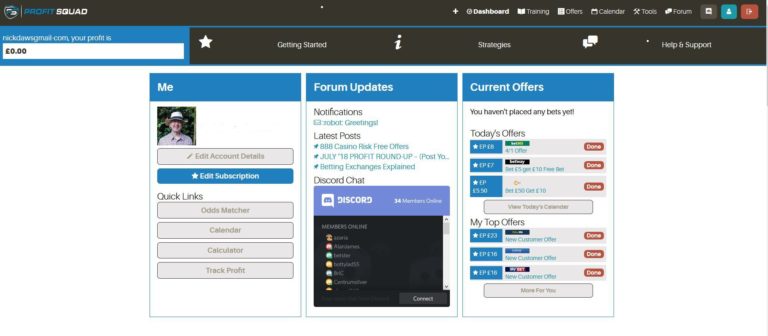
Profit Squad is now owned by the same company that runs MatchedBets.com (which I reviewed here), so you may not be surprised that there are some similarities in appearance between the sites. While MatchedBets.com has a rather garish colour scheme, however, Profit Squad (see below) is more restrained. Personally I prefer this, as it makes the site look more professional, as well as being more readable.
As you will see, the main navigation menu is at the top right of the screen. If you hover the cursor over Offers or Tools, a sub-menu will appear. It’s all quite logical and intuitive.
As with all matched betting advisory services, the site is organized into a number of sections. The main ones are listed below:
Training
Offers
Tools
Calendar
Forum
I’ll look at each of these in a bit more detail below.
Training
This is (of course) the training area of Profit Squad, and is the place where new matched bettors should start. It is neatly and attractively set out. There are 22 articles here, covering everything from how to get started in matched betting to reload offers and advanced strategies (including online casinos)..
The articles consist mainly of text and screen captures, with videos also used in some cases. I found the articles clear and well written. While I am already familiar with the basics of matched betting, I found some of the articles (e.g. on each-way dutching and how to profit from online slots) genuinely eye-opening.
Offers
This is divided into sub-sections, including:
New Customer Offers
Existing Customer Offers
Accumulator Offers
Free Bet Clubs
Horse Racing Offers
Casino Offers
Advanced Casino Offers
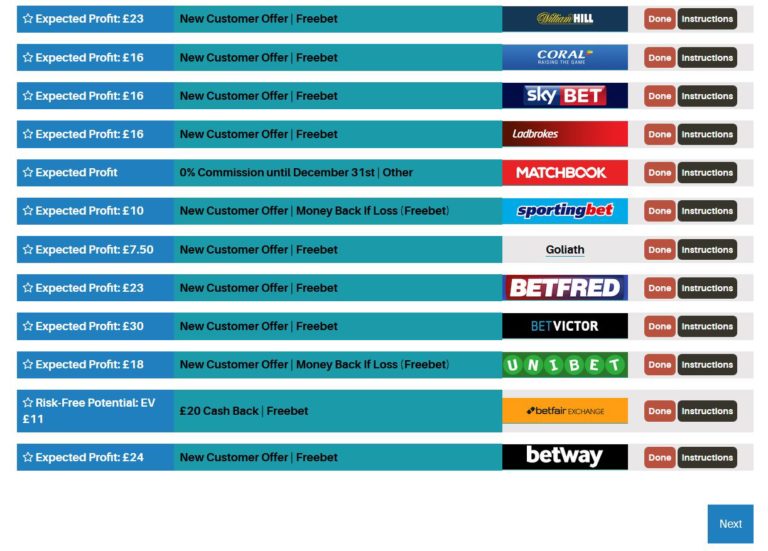
These are all pretty self-explanatory. In New Customer Offers, for example, all such offers are listed in order of expected profit, the highest first (see below).
Clicking on Instructions takes you to detailed instructions on how to apply the offer. These generally include a short video plus written instructions. Again, I thought these were very clear, and I like the way the key points of each offer are set out in checklist form at the top of the page.
Offer Calendar
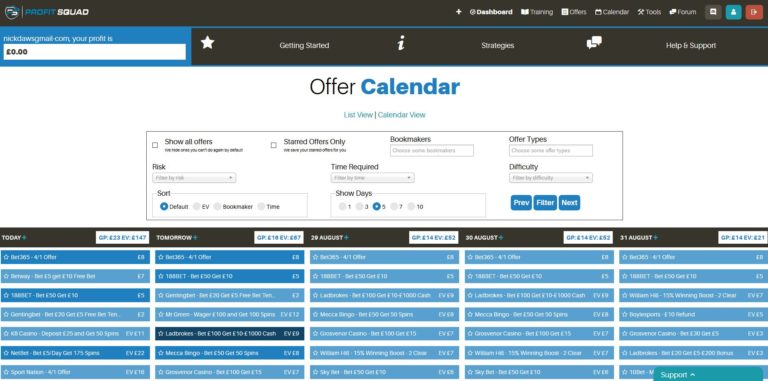
This is a feature of Profit Squad I really like. Just by visiting the Calendar page you can see all the day’s recommended offers, along with the expected profit and a link to full instructions for doing them.
Odds Matcher
Of course, every matched betting service needs an odds-matching tool, which helps you find the best bets for matched betting offers. Here’s a capture of the one provided by Profit Squad.
As you would expect, you can filter results according to sport, odds (minimum or maximum), start time, odds percentage, liquidity available at the exchange, and so on.
One feature I particularly like is that odds are shown in real time, so you don’t have to keep refreshing the screen. This also avoids the situation that can occur using other odds matching software (e.g. on Profit Accumulator) where the information frequently lags behind, so you think you have found a great match only to discover it has already gone.
Acca Backers
As mentioned in this blog post a few months ago, accumulator offers are a particular favourite of mine. These are where you take advantage of bookmakers’ offers to refund your stake if one leg of your accumulator loses. This gives punters an in-built edge and means they should enjoy steady profits so long as they back and lay appropriately.
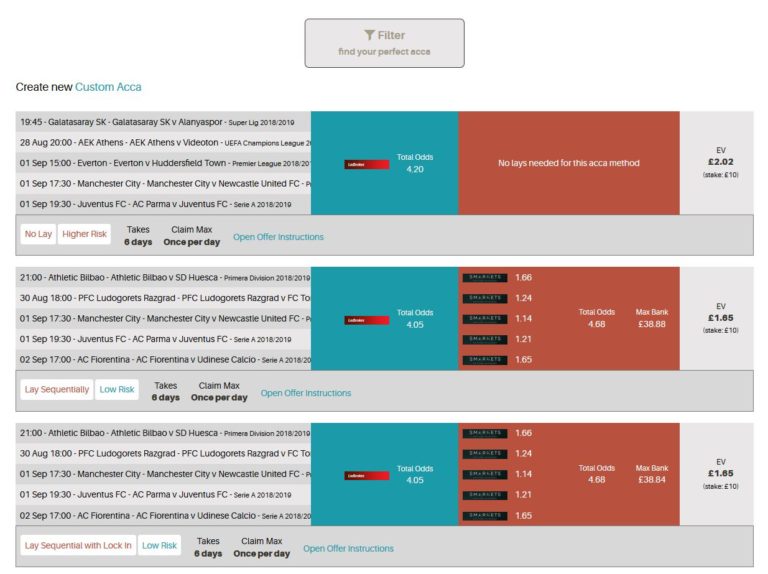
Profit Squad’s accumulator software offers four different ways to make money from accumulator offers: Lay Sequential, Lay at Start, Lay With Lock-In, and No Lay. All four methods are explained in the Training area, mentioned earlier. This is more advanced than other platforms’ accumulator tools, which typically only offer three options.
As you may have noticed, with Profit Squad by default you see all four types of offer listed according to their expected value (average profit generated). However, if you prefer one particular type of acca (e.g. Lay With Lock In, which I prefer personally) you can set the filter to show only this type.
Horse Racing Matcher
This tool is provided for use with horse racing offers, e.g. your money back if your horse is second to the SP favourite. By careful backing and laying you can generate a good return when a refund is triggered and a small qualifying loss otherwise, hopefully producing steady profits overall.
As you will see, the Horse Racing Matcher is still in Beta at the time of writing, but appears to be working well. As with the Odds Matcher and Acca Backers, the odds in this software tool automatically update when they fluctuate on betting exchange and bookmaker sites.
Calculator
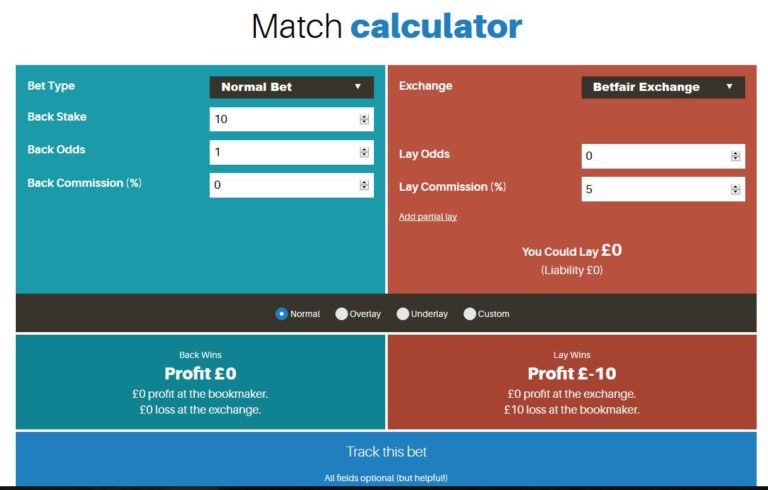
This is another standard feature on matched betting advisory service sites, but the one offered by Profit Squad is undeniably impressive. Although it looks simple at first sight (see below), it is actually a very powerful tool.
As well as standard matched betting calculations for qualifying bets and free bets, you can use it to calculate bonus on win, bonus on loss, enhanced odds as free bets, and several more. Pretty much any bonus situation is therefore covered. You can also use the calculator to work out what to do in the event of incomplete lays, and if you want to overlay or underlay a bet.
Forum
Likewise, every matched betting service needs a forum, where members can ask questions, share offers and opportunities, or just discuss anything matched betting related (or otherwise).
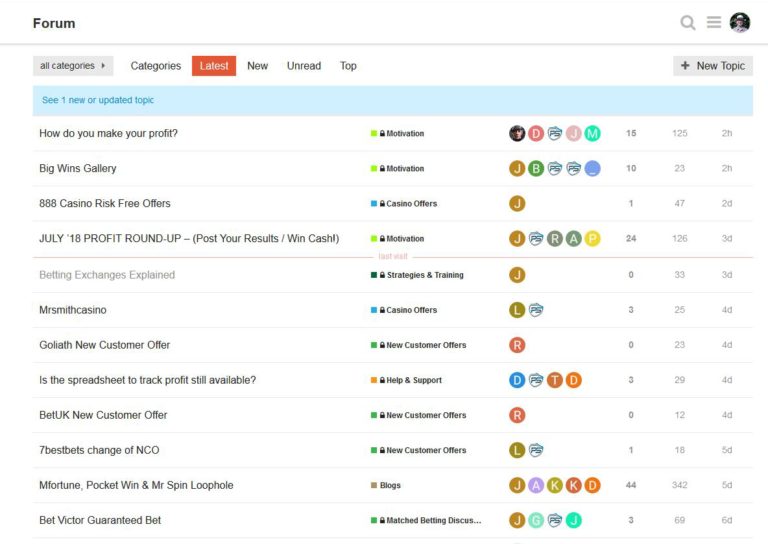
The Profit Squad forum (see below) is neatly set out and works well. It isn’t as busy as some forums, e.g. the one owned by the market-leading Profit Accumulator. There is plenty of good content, though, and staff are usually around to assist as required.
In addition to the forum, Profit Squad has a discord chatroom for members, which is great for discussing opportunities in real time.
Other Features
Profit Squad has a range of other features as well. If I tried to list them all this review would be at least double its already excessive length!
One tool I should definitely mention, however, is the Each Way Dutching Calculator. Each way dutching is a method of backing multiple or all runners in a horse race (or other event) with different bookmakers at their best prices. With suitable races this method can be more profitable than standard backing and laying, and it is also generally less hassle. Full information about how to use the Calculator is included in the training area, of course.
Another thing I should mention is that Profit Squad tracks all your betting activity automatically. It keeps a record of your profits and bet details, and displays them in your account. This makes it easy to see how you are doing overall, and does away with the need to maintain your own spreadsheets (although personally I still like to do this).
One final comment is that the site is fully mobile optimized – so if you like to bet on your smartphone, you should find using Profit Squad a pleasanter experience than with some rival services.
Pricing
Joining Profit Squad currently costs £15 a month. That is cheaper than most other matched betting advisory services, e.g. Profit Accumulator currently charge £17.99 a month. They don’t have a free trial offer like some other services, but for just £1 you can get a 14-day trial giving you full, unlimited access to the service. In many ways this is a better deal than the free limited membership offered by other services, as you can do as many bookmaker offers as you like (or can fit in) during your 14-day membership.
Closing Thoughts
Overall, I have been very impressed with Profit Squad. It offers high-quality matched betting training, and a comprehensive range of software tools, tips and information..
In my view it is particularly suitable for people who may already have some experience in matched betting, who are now looking for more advanced strategies to keep the money rolling in.
Profit Squad is particularly strong on online casino strategies, including slots, roulette and blackjack. I know from my membership of various matched betting Facebook groups that this is now a very popular approach among experienced matched bettors who have exhausted the bookmaker welcome offers. There are some risk-free casino offers, and others that may not be risk-free but have a positive ev (expected value). That means by the law of averages if you do these offers you will make a long-term profit, but will likely suffer some day-to-day losses. This is all covered in detail in the training, of course.
Profit Squad also have some of the best matched betting software tools I have seen, covering pretty much the entire range of bookmaker welcome and reload offers and more besides. About the only drawback I can see with it compared with a service such as Profit Accumulator is that the forum isn’t as active, but of course this is likely to change in future as more members join the service.
If you are thinking of giving matched betting a go – or are looking for an alternative advisory service featuring more advanced strategies – I strongly recommend checking out Profit Squad. They are adding new tools and features all the time, and joining now will ensure you have access to them at no extra cost. In any event, the 14-day trial for £1 is basically a risk-free opportunity to see everything they have to offer. Do just one risk-free offer during this time and you should cover your £1 outlay multiple times over.
As always, if you have any queries about Profit Squad or matched betting generally, please do post them below.
Disclosure: This review includes tracked affiliate links. If you click through and sign up with Profit Squad, I will receive a commission for introducing you. This will not affect the service you receive (or the price you are charged) in any way.
If you enjoyed this post, please link to it on your own blog or social media:
If you are 50 or over, you will almost certainly at least have heard of Warner Leisure Hotels. The company have 14 country and coastal resort hotels across England and Wales. They have a strict adults-only policy, and appeal mainly to an older clientele (based on my experience, the average age is late sixties or early seventies).
As well as accommodation, they offer a range of leisure activities, including day trips, quizzes, guided walks, archery and bowls, social dancing, swimming, and so forth. Most of these activities are included in the price, as is the evening entertainment.
Accommodation is generally on a half-board basis, including breakfast and evening meal. Guests typically book short stays of two to four days, often focused around a particular headline act. Some of those in the current line-up include Motown, Abba and Franki Valli tribute acts, plus the real Leo Sayer, Paul Young, Russell Watson, Alexander Armstrong, Jane Macdonald, and many others. There are also seasonal breaks, spa breaks (at the Thoresby Hall hotel), bowls breaks, and more.
I have been to two Warner Leisure Hotels, Bodelwyddan Castle in North Wales (pictured above) and Alvaston Hall in Cheshire. I thought I would therefore take the opportunity to share my impressions here for others who might be contemplating this type of short break holiday.
My Review
As my partner passed away five years ago, I went to both venues on my own. I am in my early sixties, and felt very young compared with some of the other guests!
In both cases I found the accommodation spacious and comfortable, with all the facilities you would expect at a good hotel. I was on the ground floor at both, and had a small private terrace with a metal table and chairs, which was pleasant to sit out on. Here’s a picture of the accommodation block in which I stayed at Alvaston Hall.
I thought the food was generally very good. The dining area was large and could be a bit noisy, but the waiters and waitresses did a great job of getting meals out quickly. You are allocated a table at the start of your stay and keep that for the duration. As a solo guest I was offered the opportunity to be matched with another solo male as a dining partner. I declined this, as it seemed a gamble whether I would have anything in common with them.
At Alvaston Hall the evening meal is combined with the entertainment. So, basically, you have your meal followed by a show, all the while sitting at the same table. I liked this idea in theory, but in practice I discovered it had a few drawbacks.
For one thing, if you have been allocated a table towards the back (as I was) it can be quite hard to see what is happening on the stage. In addition, for me anyway it felt a long time to be sitting in one place. Really I preferred the arrangement at Bodelwyddan Castle, where you had your meal in the restaurant then went over to the main hall for the evening entertainment (for which you could sit anywhere).
I must admit I was slightly disappointed by the entertainment programme. The evening entertainment in particular was targeted at an older clientele and I didn’t particularly relate to it, despite being no spring chicken myself!
Both hotels seemed very big on social dancing, with guests being invited to ‘take the floor for the foxtrot’ or whatever. Not my thing at all, I’m afraid. I had been hoping for something more akin to cruise ship entertainment, with song and dance shows and cabaret acts, but perhaps that was asking too much.
There were regular quizzes, though again I felt that they were often oriented towards the older guests. I did one quiz about the 1950s, a decade many of those taking part remembered well. As I was only four years old when the fifties ended, I felt at a bit of a disadvantage!
On the positive side, I went on several guided walks, which I really enjoyed. I also took full advantage of the swimming pools, and at Alvaston Hall went to an interesting demonstration of fruit and vegetable carving (see photo below).
I also enjoyed looking around Bodelwyddan Castle itself (pictured below), which is a National Trust property. Warner guests get free entry during their stay, which is a nice bonus.
Prices
As Pounds and Sense is primarily a money blog, I should say a few words about this.
I thought both the breaks I took were good value for money, bearing in mind that as well as comfortable accommodation you get breakfast and an evening meal, and a range of leisure facilities and entertainment.
When I checked just now, you could book a two-night break at Alvaston Hall for two people this weekend at prices ranging from £219.48 for a standard room up to £315.48 for a luxury suite. In my experience even ‘standard’ rooms are very comfortable, and the price above works out to just over £100 per person per night. By comparison, I have been charged well over £100 per night for bed and breakfast, with no evening meal or entertainment, in some hotels and guest houses.
If you are travelling solo (as I was) you may have to pay an under-occupancy surcharge. However, the hotels do have some single rooms, and there are also ‘no surcharge’ offers for solo travellers on some breaks. It’s definitely worth inquiring about this with the hotel you want to stay at.
Finally, I should mention that Warner Leisure Hotels often offer special deals and discounts. Once you are on their list, you can expect to be mailed regularly about these!
Summing Up
Overall, while I enjoyed my stay at these hotels, I have to say I did feel a bit young for them. The entertainment wasn’t really my cup of tea and I’m not sure it will be even when I’m ten years older. I saw one review that described Warner Leisure Hotels as ‘Butlins for old people’ and have to admit I think that’s quite apt (it’s owned by the same parent company as Butlins and Haven Holidays, incidentally). I don’t mean to sound snobby about this. When I was growing up I enjoyed regular family holidays at Butlins holiday camps and hotels. But the format does seem a little tired and old-fashioned now. In my view the company could learn a few lessons from the range of entertainment offered on cruise ships nowadays and even in tourist hotels in places like the Canary Islands.
I also think Warners could do a lot more to welcome solo guests and get them involved. At times I found staying there surprisingly lonely. Again, my experience with cruises has been that they do a much better job for solo guests, with regular meet-ups, social activities and even dedicated staff members to look after them. It would be nice if Warners did something similar. There are lots of older people who live alone, and I think the company are missing a trick by not reaching out to them.
But to be fair, I do think Warner Leisure Hotels offer an appealing combination of comfortable rooms, good food, a full activities and entertainment programme, and good value prices. I’m not planning on going again soon, but I certainly wouldn’t rule it out in future.
So those are my impressions of Warner Leisure Hotels, but what do you think? Have you stayed at one yourself, or would you even consider it? I’d love to hear your views!
For a wider range of all-inclusive holiday options in the UK and abroad, check out this article on Over 60s Discounts 🏖
Disclosure: This review includes affiliate links, so if you click through and make a purchase I will receive a commission for introducing you. This will not affect in any way the terms you are offered. Neither has it influenced in any way this review!
If you enjoyed this post, please link to it on your own blog or social media: