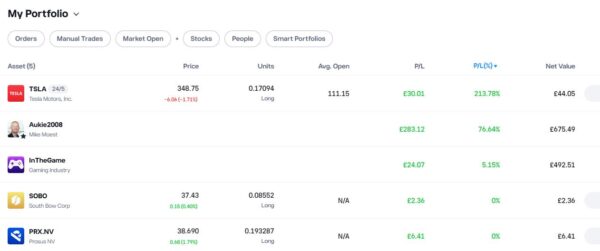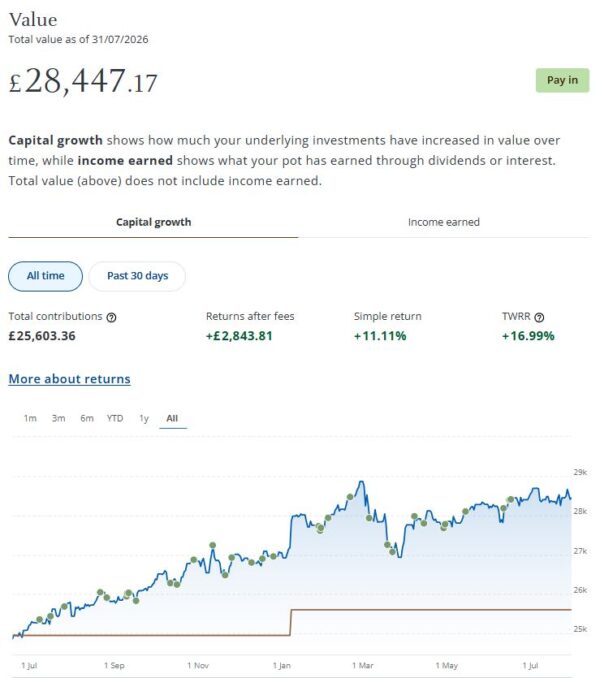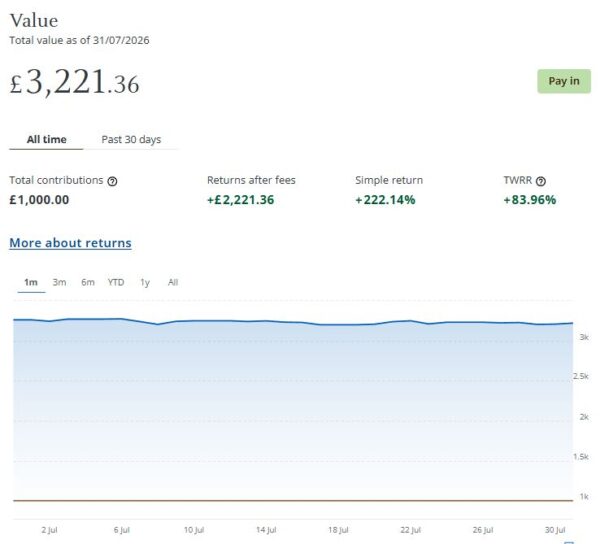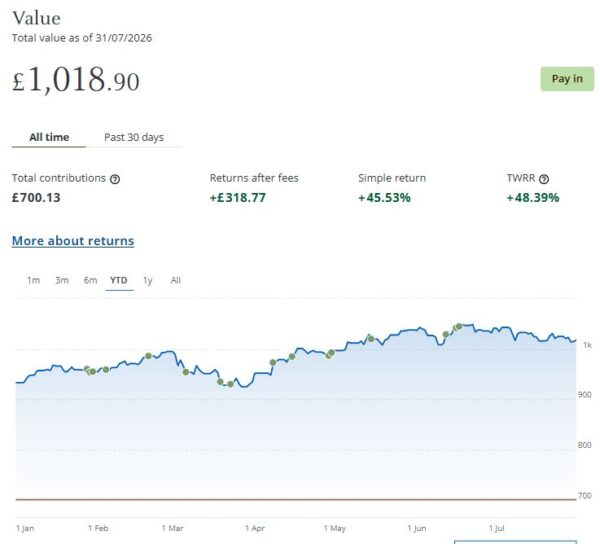

reviews

Prolific Academic - Ideal Side Hustle for Seniors

Here’s Why Prolific Academic Could Be the Ideal Side Hustle for Seniors

If you’re retired or semi-retired and looking for a flexible way to earn a little extra money from home, Prolific Academic could be just what you’re looking for.

I first wrote about Prolific a while ago in my article Make Money Helping University Researchers with Prolific Academic, and I still believe it’s one of the best side hustles around – especially for older people.

No, you’re not going to make a fortune from it. But you can earn a useful extra income in your spare time, while helping genuine academic researchers and keeping your brain active into the bargain.

What Is Prolific Academic?

Prolific Academic is an online platform that connects researchers – mainly from universities and other academic institutions – with members of the public willing to take part in research studies.

Most studies involve answering questionnaires or surveys, though some include simple games, memory tests, opinion polls, or short interactive tasks. Researchers are generally looking for honest responses from people of all ages and backgrounds, and seniors are often especially valued because they are under-represented in many studies.

Unlike some survey sites, Prolific has built a strong reputation for treating participants fairly. Studies are normally well designed, interesting and clearly explained. You can also see in advance how long each study should take and how much you’ll be paid (see below).

Flexible and Easy to Fit Around Your Life

One of the biggest advantages of Prolific for seniors is the flexibility.

There are no fixed hours, targets or commitments. You simply log in when you want to and choose from whatever studies are available. If you’re busy with holidays, family commitments, gardening, golf, volunteering, or anything else, you can ignore it for days or weeks without any problem.

Equally, if you have a quiet afternoon and fancy earning a few pounds, you can complete several studies in one sitting.

That makes Prolific ideal for retirees who want a side hustle that fits around their lifestyle rather than the other way round.

The Studies Are Often Genuinely Interesting

This is another reason I particularly like Prolific.

Many studies are linked to real academic research in subjects such as psychology, health, behaviour, finance, education, politics, memory, and technology. Some are thought-provoking and even fun.

You may be asked your opinion on current issues, to test a new app or website, or to take part in experiments exploring how people make decisions. I’ve personally found many studies surprisingly engaging.

Of course, there are occasional dull ones too – but because you can pick and choose, you’re free to skip anything that doesn’t appeal.

A Useful Extra Income Stream

Let’s keep expectations realistic: Prolific isn’t a replacement for a salary or pension.

But it can provide a worthwhile supplementary income. Rates typically work out between £8 and £12 per hour, with bonuses sometimes awarded as well. Many users earn enough to cover treats, hobbies, meals out, subscription services, or part of a holiday budget.

Payments are made without any deductions via the online payment platform PayPal. You can request a payout any time your earnings reach £6 or more. Payments are reliable and prompt, which is another reason the platform has developed such a loyal following. And because you decide how much time to devote to it, you remain completely in control.

Good for Keeping Your Brain Active

One thing many retirees discover is that mental stimulation matters just as much as physical activity.

The variety of tasks on Prolific can help keep your brain engaged and alert. Memory exercises, problem-solving tasks, reading comprehension studies, and opinion-based questionnaires all encourage active thinking.

I’m certainly not claiming Prolific is some sort of miracle anti-ageing treatment! But regularly engaging with new ideas and challenges can only be a positive thing.

The Tax Advantage for Small Earners

Another point worth mentioning is the UK government’s £1,000 Trading Allowance.

Under current HMRC rules, if your total income from casual self-employed or side-hustle activities is under £1,000 a year, you generally do not need to declare it or pay tax on it.

That means many casual Prolific users may fall comfortably within this limit.

Obviously everyone’s tax situation is different, and tax rules can change – so if you expect to earn more than this or are unsure about your position, it’s sensible to check the latest HMRC guidance or seek professional advice.

How to Sign Up

If you like the idea of earning a sideline income as a Prolific Academic member, all you need do is visit the Prolific website and click on the Get Paid to Participate box (don’t click the box to sign up as a researcher, obviously!).

An application form will then open requesting various items of information from you, most importantly the PayPal email address via which you want to be paid 💰

Final Thoughts

There are countless so-called “side hustles” being promoted online these days. Many are unrealistic, risky or simply exhausting.

Prolific is refreshingly different.

It’s flexible, straightforward, low-pressure and genuinely interesting. You can do as much or as little as you like, earn a bit of extra money, help academic research and keep mentally active at the same time.

For many seniors, that combination makes it close to the ideal side hustle.

  • Have you tried Prolific Academic yourself and would you recommend it? Or do you have another favourite side hassle you would like to share? I’d love to hear your thoughts. Please comment below as usual 🙂


If you enjoyed this post, please link to it on your own blog or social media:
My Investments Update May 2026

My Investments Update – May 2026

Here is my latest monthly update about my investments. You can read my April 2026 Investments Update here if you like.

I’ll begin as usual with my JP Morgan Personal Investing (previously NutmegStocks and Shares ISA. This is the largest investment I hold other than my Bestinvest SIPP (personal pension).

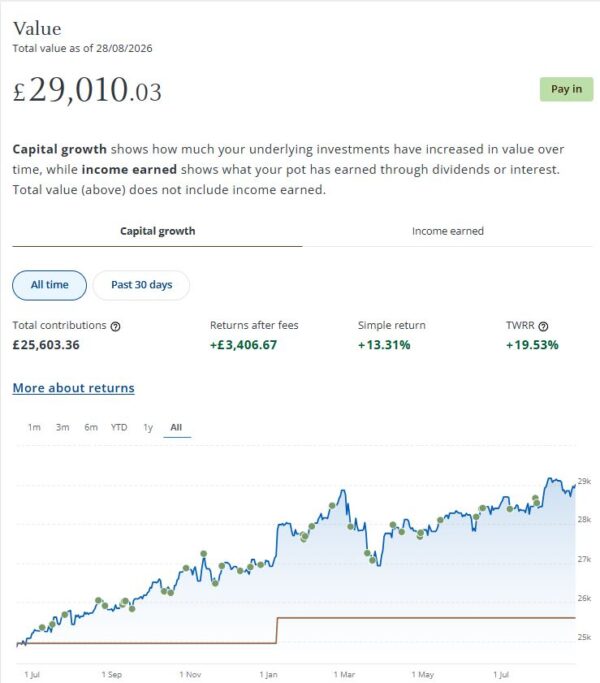
As regular readers will know, in June last year I transferred most of the money in my former Nutmeg Fully Managed portfolio (just under £25,000) to a new Nutmeg Income Portfolio. I discussed this in detail in this post, but basically money in this port is invested to generate an income from share dividends and other sources. This is then paid monthly. Capital appreciation is targeted as well, but these portfolios are aimed primarily at older people (and others) who want/need their investment to generate a regular cash income.

In April my JPM Investing income portfolio generated £66.11 of income, which was duly paid into my bank account on 24 April 2026. That means I have now received tax-free income of £339.79 in 2026 and a total of £811.25 since I opened the account in June last year. That’s a return on capital of just over 3% to date. That is – to be honest – a bit less than I would have hoped based on JPM’s original projected annual return of just under 5% for income ports at my chosen risk level (five).

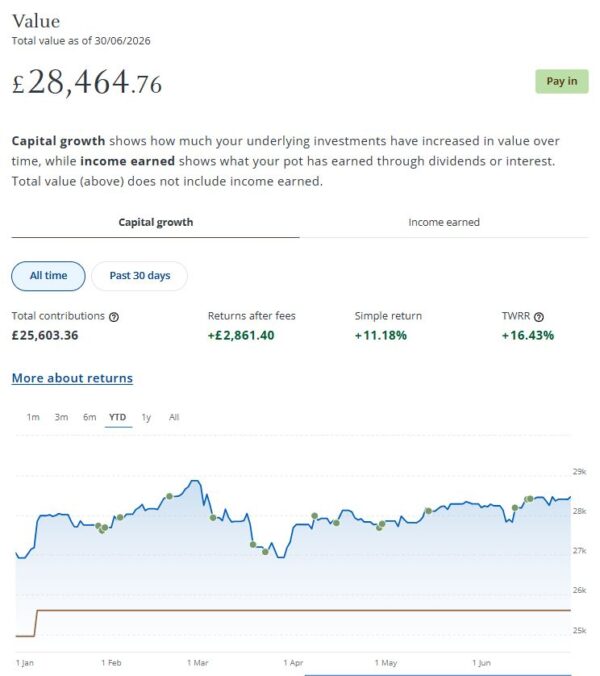
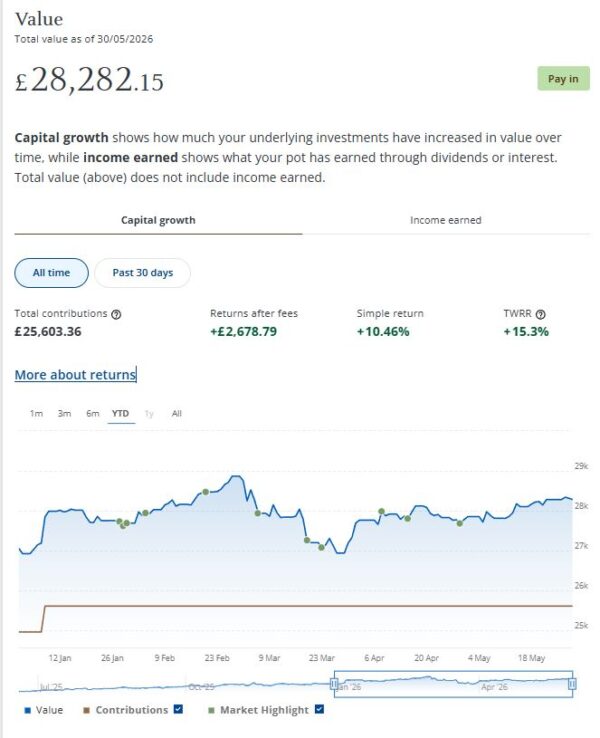
The better news is that my income portfolio increased in value in April (after its bigger fall in March). It’s now worth £27,852 compared with £27,320 at the start of last month, a rise of £532. You don’t need to be an investment expert to know that the volatility recently is due mainly to events in the Middle East. As I always say, you do have to expect ups and downs when investing. As the screen capture below shows, my income port is still up by a respectable £2,248 (8.78%) after fees since I opened it last June.

JPM Income Port May 26

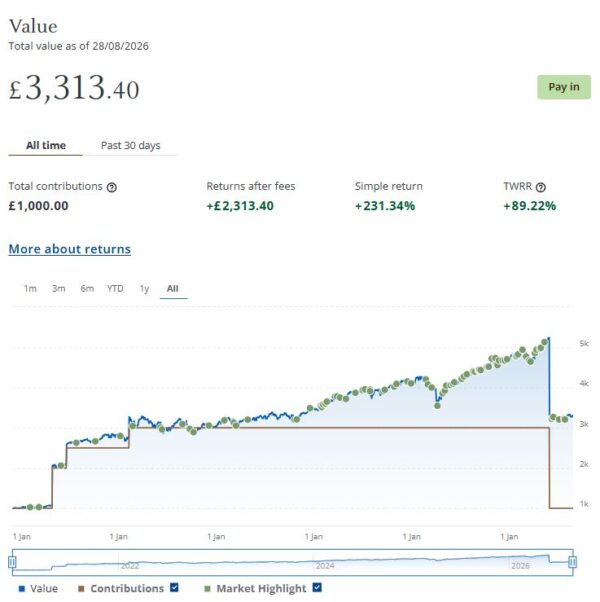
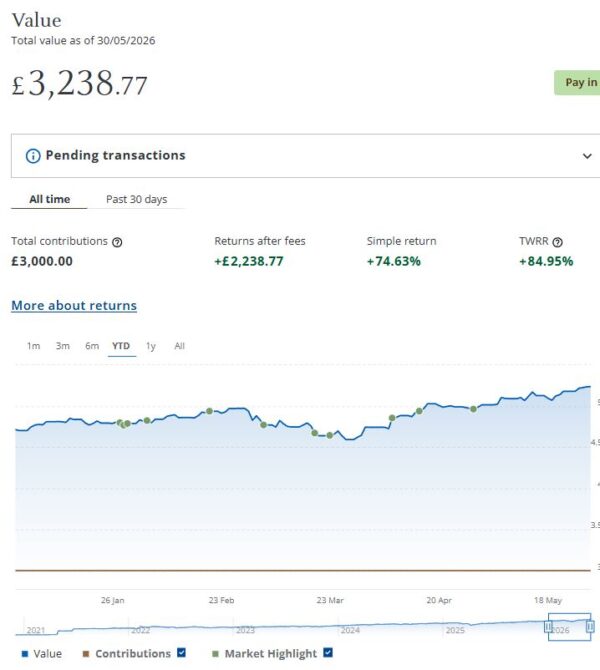
I still have a smaller, growth-oriented pot using JPM Investing’s Smart Alpha option. This is now worth £5,017 (rounded up) compared with £4,646 a month ago, a rise of £371. Here is a screen capture showing performance over the year to date.

JPM Smart Alpha May 26

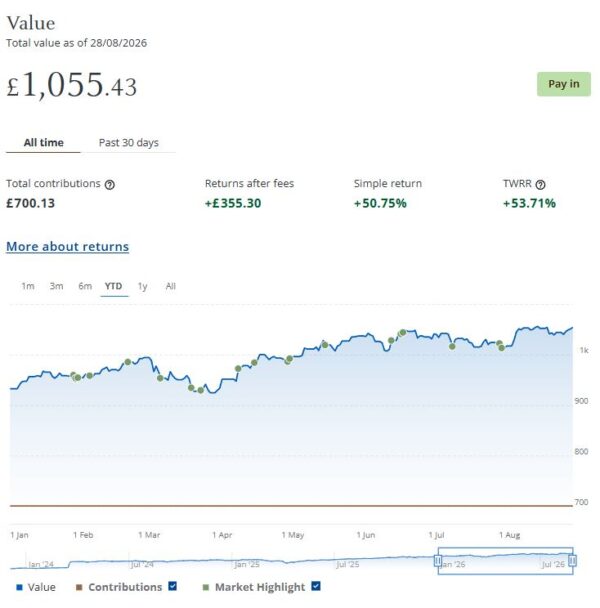
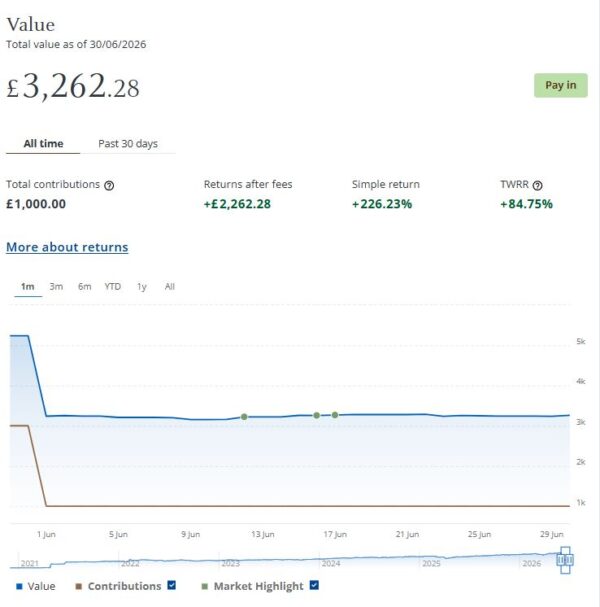
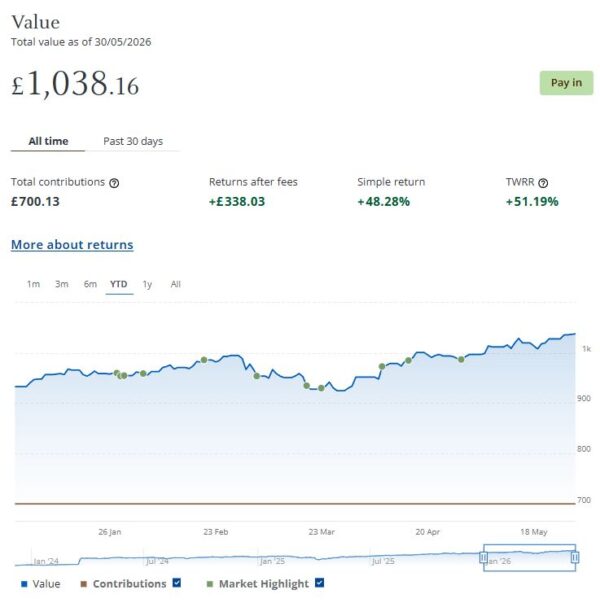
Finally, at the start of December 2023 I invested £500 in one of Nutmeg/JPM’s thematic portfolios (Resource Transformation). In March 2024 I also invested a further £200 from referral bonuses (something I no longer receive). As you can see from the YTD screen capture below, this portfolio is now worth £998 compared with £934 last month, a rise of £64.

Overall in April the value of my JPM investments rose by £967 or 3.02%. In addition I did, of course, receive £66.11 in income from my income portfolio. In total, then, I am £1,033.11 up for the month.

Excluding income generated, the overall value of my JPM investments is up by £4,630 or 15.72% since the start of May 2025. If you add to this the £811.25 of income generated by my Income portfolio to date, that gives a total profit for the last 12 months of £5,441.25 – a pretty good return in these uncertain times.

As I said above, some volatility is always to be expected with stock market investments, but in the longer term they tend to even themselves out (and typically outperform bank savings accounts, although that is never guaranteed). In general the worst thing you can do is panic and sell up when downturns occur (as happened in March). You are then crystallizing your losses rather than giving the markets time to recover. This is something I discussed last year in this blog post. Obviously nobody knows what will happen in the Middle East, but hopefully some sort of resolution will occur soon, if only because US President Trump desperately needs an exit strategy to pacify his critics back home. Once this happens, we will hopefully see world stock markets stabilize again. Though there is of course no guarantee about this.

You can read my full original Nutmeg/JPM review here. If you are looking for a home for your annual ISA allowance, based on my overall experience over the last nine years, they are certainly worth considering. They offer self-invested personal pensions (SIPPs), Lifetime ISAs and Junior ISAs as well.

Moving on, I also have investments with P2P property investment platform Housemartin. As discussed in this post, the company rebranded last year from Assetz Exchange.

My investments with Housemartin continue to generate steady returns. Housemartin focuses on lower-risk properties (e.g. sheltered housing). I put an initial £100 into this in mid-February 2021 and another £400 in April. In June 2021 I added another £500, bringing my total investment up to £1,000.

Since I opened my account, my HM portfolio has generated a respectable £315.21 in revenue from rental income. I have made a small net loss of £17.60 on property disposals. Capital growth generally has slowed, in line with UK property values generally.

At the time of writing, 17 of ‘my’ properties are showing gains, 7 are breaking even, and the remaining 20 are showing losses. My portfolio of 44 properties is currently showing a net decrease in value of £71.59. That means that overall (rental income minus capital value decrease and loss on disposal) I am up by £243.62. That’s still a respectable return on my £1,000 and does illustrate the value of P2P property investments for diversifying your portfolio. And it doesn’t hurt that with Housemartin most projects are socially beneficial as well.

  • A further consideration is that property investments on Housemartin are less likely to be affected by stock market downturns, as happened in March due to the war in the Middle East. This again demonstrates the potential value of such investments for diversifying your portfolio during challenging times.

The net fall in capital value of my Housemartin investments is obviously a little disappointing. But it’s important to remember that until/unless I choose to sell the investments in question, it is largely theoretical, based on the latest price at which shares in the property concerned have changed hands. The rental income, on the other hand, is real money (which in my case I’ve reinvested in other HM projects to further diversify my portfolio).

To control risk with all my property crowdfunding investments nowadays, I invest relatively modest amounts in individual projects. This is a particular attraction of Housemartin as far as i am concerned. You can actually invest from as little as £1 per property if you really want to proceed cautiously.

  • As I noted in this blog post, Housemartin is particularly good if you want to compound your returns by reinvesting rental income. This effectively boosts the interest rate you are receiving. Personally, once I have accrued a minimum of £10 in rental payments, I usually reinvest this money in either a new HM project or one I have already invested in (thus increasing my holding). Over time, even if I don’t invest any more capital, this will ensure my investment with Housemartin grows at an accelerating rate and becomes more diversified as well.

My investment on Housemartin is in the form of an IFISA so there won’t be any tax to pay on profits, dividends or capital gains. I’ve been impressed by my experiences with Housemartin and the returns generated so far, and intend to continue investing with them. You can read my original review of Assetz Exchange/Housemartin here and my article about the rebranding to Housemartin here. You can also sign up for an account directly via this link [affiliate].

In 2022 I set up an account with investment and trading platform eToro, using their popular ‘copy trader’ facility. I chose to invest $500 (then about £412) copying an experienced eToro trader called Aukie2008 (real name Mike Moest).

In January 2023 I added to this with another $500 investment in one of their thematic portfolios, Oil Worldwide. I also invested a small amount I had left over in Tesla shares.

In January this year, as Oil Worldwide hadn’t exactly been setting the world alight, I decided to switch my entire investment in this to another smart portfolio, InTheGame. This port, focusing on the computer gaming industry, has been the top performer for some time in my eToro virtual portfolio.

Unfortunately just as I switched away from Oil Worldwide, President Trump decided to invade Venezuela. This gave the oil industry a significant boost, which I would otherwise have benefited from. Meanwhile InTheGame went south, partly due to the war in the Middle East. At one point I was down by over 10% on this investment. Fortunately in the last few weeks InTheGame has made an impressive recovery and is now in profit by 7.91%.

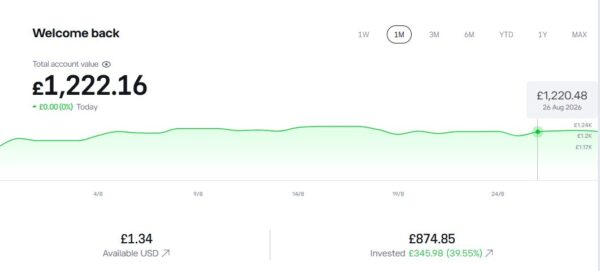
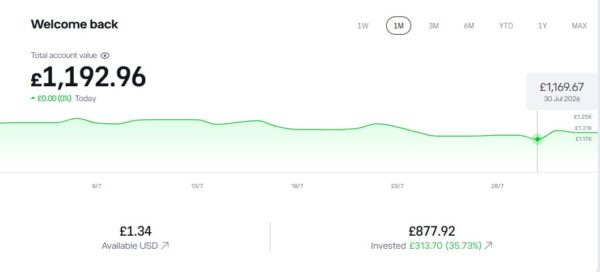
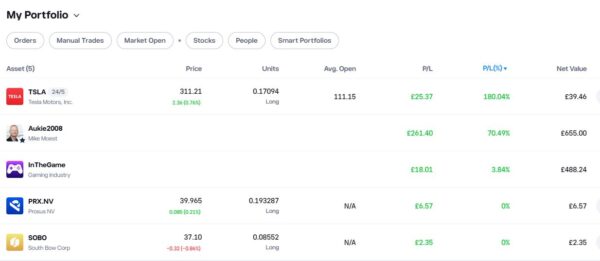
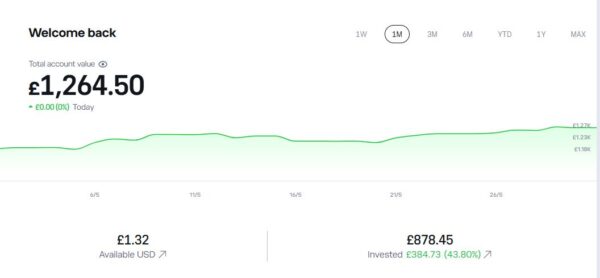
As you can see from the screen captures below, my original eToro investment (total value £888.36 in pounds sterling) is today worth £1,177.13, an overall increase of £288.77 or 25.77%.

  • Note: eToro now displays the value of investments in your native currency, although you can change this if you wish.

Etoro Home May 2026

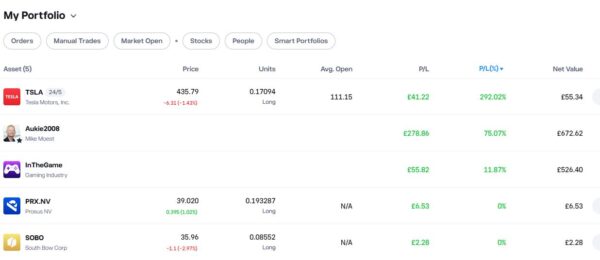
Etoro port May 2026

You can read my full review of eToro here. You may also like to check out my more in-depth look at eToro copy trading. I also discussed thematic investing with eToro using Smart Portfolios in this post.

As mentioned above, my new investment in InTheGame is currently up by 7.91%. My copy trading investment with Aukie2008 also rose in value in April and is showing an impressive overall profit of 69.10%. Of course, I have held this investment for quite a bit longer.

My Tesla shares, which I purchased as an afterthought with some spare cash I had in my account, are also up this month and showing an overall profit of over 251% since I bought them. If only I had put a bit more money into this!

You might also notice that I have small holdings in Prosus NV, a Dutch internet group, and South Bow, a Canadian energy infrastructure company. To be honest I don’t understand how I acquired these, but I assume they are some sort of bonus I was awarded. In any event, I am happy to have them in my portfolio.

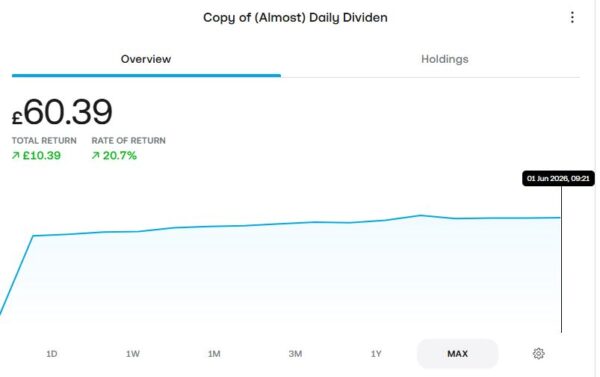
As an experiment, at the start of April 2025 I put £50 into an investment ISA with Trading 212. As mentioned in my blog post about dividend investing, I put it into the (Almost) Daily Dividends Portfolio, a ready-made portfolio or ‘pie’ on Trading 212. As you can see from the screen capture below, my portfolio is now worth £59.98. That’s a small rise of £0.12 since last month and an increase of £9.98 or 19.9% since I opened it just over a year ago. It has even accrued a grand total of £1.16 in dividends, most of which has now been (automatically) reinvested.

Trading 212 Dividends port May 26


I am quite impressed with how this investment has been faring, despite the small amount I put in (which means I may be missing out on some smaller dividends). If I increased my investment I would almost certainly become eligible for more dividends, and even more the longer I remain invested. If I had any spare money at the moment, I would consider doing this. Of course, I do now have an income-focused portfolio with JPM Investing as well (see above).


Moving on, I published various posts on Pounds and Sense in April. I have listed below those that are still relevant.

In What is the Blue Light Card – And How Can It Help You Save Money? I discussed this discount scheme for people working in the emergency services and various other public services. For a modest fee (under £2.50 a year) you can access discounts on everything from restaurants to holidays, concerts and sporting events to insurance. You may also be eligible if you are retired from a qualifying occupation. Find out more in this article.

I also posted Pound-Cost Averaging – A Smart Strategy for Investing in Turbulent Times. In this article I explained how this simple investing strategy works and why it may be particularly relevant in these turbulent times.

Finally in April I published Why Now Could Be the Ideal time to Take Advantage of Your New Tax-Free ISA Allowance. From the start of the new tax year on 6 April 2026, everyone has a new £20,000 tax-free ISA allowance. In this article I revealed why you might want to take advantage of at least some of this allowance sooner rather than later.

I’ll close with my customary reminder that you can also follow Pounds and Sense on Facebook or Twitter (or X as it is now). Twitter/X is my number one social media platform and I post regularly there. I share the latest news and information on financial matters, and other things that interest, amuse or concern me. So if you aren’t following my PAS account on Twitter/X, you are definitely missing out!

  • I am also on the BlueSky social media network under the username poundsandsense.bsky.social. Twitter/X remains my primary social media platform, but I also post details of my latest blog posts, third-party articles and other financial news and resources on BlueSky for those who prefer to follow me there.

As always, if you have any comments or questions, feel free to leave them below. I am always delighted to hear from PAS readers 🙂

Disclaimer: I am not a qualified financial adviser and nothing in this blog post should be construed as personal financial advice. Everyone should do their own ‘due diligence’ before investing and seek professional advice if in any doubt how best to proceed. All investing carries a risk of loss. 

Note also that posts on PAS may include affiliate links. If you click through and perform a qualifying transaction, I may receive a commission for introducing you. This will not affect the product or service you receive or the terms you are offered, but it does help support me in publishing PAS and paying my bills. Thank you!

If you enjoyed this post, please link to it on your own blog or social media:
My Investments Update - April 2026

My Investments Update – April 2026

Here is my latest monthly update about my investments. You can read my March 2026 Investments Update here if you like.

I’ll begin as usual with my JP Morgan Personal Investing (previously NutmegStocks and Shares ISA. This is the largest investment I hold other than my Bestinvest SIPP (personal pension).

As regular readers will know, in June last year I transferred most of the money in my former Nutmeg Fully Managed portfolio (just under £25,000) to a new Nutmeg Income Portfolio. I discussed this in detail in this post, but basically money in this port is invested to generate an income from share dividends and other sources. This is then paid monthly. Capital appreciation is targeted as well, but these portfolios are aimed primarily at older people (and others) who want/need their investment to generate a regular cash income.

In January my JPM Investing income portfolio generated £75.54 of income, which was duly paid in to my bank account on 24 March 2026. That means I have now received tax-free income of £273.68 in 2026 and a total of £745.14 since I opened the account in June last year. That’s about what I would have expected based on JPM’s projected annual return of just under 5% for income ports at my chosen risk level (five).

The less good news is that my income portfolio declined in value in March. It’s now worth £27,320 compared with £28,866 at the start of last month, a fall of £1,546. You don’t need to be an investment expert to know that this is mainly due to events in the Middle East. Nearly all of my share-based investments have been affected by this. Clearly it is disappointing, but as I always say, you do have to expect ups and downs when investing. As the screen capture below shows, my income port is still up by a respectable £1,716.97 (6.71%) after fees since I opened it last June.

JPM Income Portfolio April 2026

I still have a smaller, growth-oriented pot using JPM Investing’s Smart Alpha option. This is now worth £4,606 compared with £4,974 (rounded up) a month ago, a fall of £368. Here is a screen capture showing performance over the last year.

Nutmeg Smart Alpha port April 2026

Finally, at the start of December 2023 I invested £500 in one of Nutmeg/JPM’s thematic portfolios (Resource Transformation). In March 2024 I also invested a further £200 from referral bonuses (something I no longer receive). As you can see from the one-year screen capture below, this portfolio is now worth £934 compared with £996 (rounded up) last month, a decrease of £62.

Nutmeg THematic port April 2026

Overall in March the value of my JPM investments fell by £1,976 or 5.55%. Against that I did, of course, receive £75.54 in income from my income portfolio. In total, then, I am £1900.46 down for the month.

On a more positive note, excluding income generated, the overall value of my JPM investments is still up by £3,385 or 11.47% since the start of April 2025. If you add to this figure the £745.14 of income generated by my Income portfolio to date, that gives a total profit for the last 12 months of £4,130.14 – still not a bad return in these uncertain times.

As I said above, some volatility is always to be expected with stock market investments, but in the longer term they tend to even themselves out (and typically outperform bank savings accounts, although that is never guaranteed). In general the worst thing you can do is panic and sell up when downturns occur (as happened last month). You are then crystallizing your losses rather than giving the markets time to recover. This is something I discussed last year in this blog post. Obviously nobody knows what will happen in the Middle East, but hopefully some sort of resolution will occur soon, if only because President Trump desperately needs an exit strategy to pacify his critics back home. Once a bit more stability returns to the region, we will hopefully see world stock markets rise again. Though of course there is no guarantee about this.

You can read my full original Nutmeg/JPM review here. If you are looking for a home for your annual ISA allowance, based on my overall experience over the last nine years, they are certainly worth considering. They offer self-invested personal pensions (SIPPs), Lifetime ISAs and Junior ISAs as well.

Moving on, I also have investments with P2P property investment platform Housemartin. As discussed in this post, the company rebranded last year from Assetz Exchange.

My investments with Housemartin continue to generate steady returns. Housemartin focuses on lower-risk properties (e.g. sheltered housing). I put an initial £100 into this in mid-February 2021 and another £400 in April. In June 2021 I added another £500, bringing my total investment up to £1,000.

Since I opened my account, my HM portfolio has generated a respectable £309.64 in revenue from rental income. I have made a small net loss of £20.25 on property disposals. Capital growth generally has slowed, in line with UK property values generally.

At the time of writing, 17 of ‘my’ properties are showing gains, 3 are breaking even, and the remaining 24 are showing losses. My portfolio of 44 properties is currently showing a net decrease in value of £76.05. That means that overall (rental income minus capital value decrease and loss on disposal) I am up by £213.34. That’s still a respectable return on my £1,000 and does illustrate the value of P2P property investments for diversifying your portfolio. And it doesn’t hurt that with Housemartin most projects are socially beneficial as well.

  • A further consideration is that property investments on Housemartin are less likely to be affected by stock market downturns, as happened in March due to the war in the Middle East. This again demonstrates the potential value of such investments for diversifying your portfolio during challenging times.

The net fall in capital value of my Housemartin investments is obviously a little disappointing. But it’s important to remember that until/unless I choose to sell the investments in question, it is largely theoretical, based on the latest price at which shares in the property concerned have changed hands. The rental income, on the other hand, is real money (which in my case I’ve reinvested in other HM projects to further diversify my portfolio).

To control risk with all my property crowdfunding investments nowadays, I invest relatively modest amounts in individual projects. This is a particular attraction of Housemartin as far as i am concerned. You can actually invest from as little as £1 per property if you really want to proceed cautiously.

  • As I noted in this blog post, Housemartin is particularly good if you want to compound your returns by reinvesting rental income. This effectively boosts the interest rate you are receiving. Personally, once I have accrued a minimum of £10 in rental payments, I usually reinvest this money in either a new HM project or one I have already invested in (thus increasing my holding). Over time, even if I don’t invest any more capital, this will ensure my investment with Housemartin grows at an accelerating rate and becomes more diversified as well.

My investment on Housemartin is in the form of an IFISA so there won’t be any tax to pay on profits, dividends or capital gains. I’ve been impressed by my experiences with Housemartin and the returns generated so far, and intend to continue investing with them. You can read my original review of Assetz Exchange/Housemartin here and my article about the rebranding to Housemartin here. You can also sign up for an account directly via this link [affiliate].

In 2022 I set up an account with investment and trading platform eToro, using their popular ‘copy trader’ facility. I chose to invest $500 (then about £412) copying an experienced eToro trader called Aukie2008 (real name Mike Moest).

In January 2023 I added to this with another $500 investment in one of their thematic portfolios, Oil Worldwide. I also invested a small amount I had left over in Tesla shares.

In January this year, as Oil Worldwide hadn’t exactly been setting the world alight, I decided to switch my entire investment in this to another smart portfolio, InTheGame. This port, focusing on the computer gaming industry, has been the top performer for some time in my eToro virtual portfolio.

Unfortunately just as I switched away from Oil Worldwide, President Trump decided to invade Venezuela. This gave the oil industry a significant boost, which I would otherwise have benefited from. Meanwhile InTheGame has gone south, partly due to the recent fall in AI stocks along with the war in the Middle East. At the time of writing the value of my investment in this has fallen by nearly 17%. Hey ho! This does of course demonstrate that there are never any guarantees when investing and unexpected events can thwart the best-laid plans…

As you can see from the screen captures below, my original eToro investment (total value £888.36 in pounds sterling) is today worth £1,070.78, an overall increase of £182.42 or 20.53%.

  • Note: eToro now displays the value of investments in your native currency, although you can change this if you wish.

Etoro Home April 2026

Etoro port April 26

You can read my full review of eToro here. You may also like to check out my more in-depth look at eToro copy trading. I also discussed thematic investing with eToro using Smart Portfolios in this post.

As mentioned above, my new investment in InTheGame is currently down by nearly 17%. My copy trading investment with Aukie2008 also fell in value in March, but it’s still showing an impressive overall profit of 56.36%. Of course, I have held this investment for quite a bit longer.

My Tesla shares, which I purchased as an afterthought with some spare cash I had in my account, are also down this month, but still showing an overall profit of over 234% since I bought them. If only I had put a bit more money into this!

You might also notice that I have small holdings in Prosus NV, a Dutch internet group, and South Bow, a Canadian energy infrastructure company. To be honest I don’t understand how I acquired these, but I assume they are some sort of bonus I was awarded. In any event, I am happy to have them in my portfolio.

As an experiment, at the start of April last year I put £50 into an investment ISA with Trading 212. As mentioned in my blog post about dividend investing, I put it into the (Almost) Daily Dividends Portfolio, a ready-made portfolio or ‘pie’ on Trading 212. As you can see from the screen capture below, my portfolio is now worth £59.87. That’s a decrease of £1.97 since last month but an increase of £9.87 or 19.7% over the eleven-month period since I opened it. It has even accrued a grand total of £1.08 in dividends, most of which has now been (automatically) reinvested.

Trading 212 Dividends ISA April 26

I am quite impressed with how this investment has been faring, despite the small amount I put in (which means I may be missing out on some smaller dividends). If I increased my investment I would almost certainly become eligible for more dividends, and even more the longer I remain invested. If I had any spare money at the moment, I would consider doing this. Of course, I do now have an income-focused portfolio with JPM Investing as well (see above).


Moving on, I published various posts on Pounds and Sense in March. I have listed below those that are still relevant.

In Beat the Postage Stamp Price Rise, I pointed out that the cost of stamps is rising (again) on Tuesday 7 April 2026. That will be the SEVENTH rise in the price of first class stamps in just four years! Standard and large-letter stamps don’t have values printed on them and will still be valid after the April price rise comes in, so my top tip is to stock up now while stamps are still at the old price.

I also posted an updated version of Get a Free Share Worth up to £100 with Trading 212. Anyone who hasn’t done this before can get a free share worth up to £100 just by signing up for a new Trading 212 investment account via my link. The current offer closes on Tuesday 28th April 2026.

Also in March I published Are River Cruises Suitable for Solo Travellers. This was a follow-up to my earlier posts about how to save money on cruise holidays and the pros and cons of river cruises (for older travellers in particular). In this post I addressed a question asked by several readers as to whether river cruises are a good choice for solo travellers. The article sets out the pros and cons as I see them. My view, as expressed in the article, is that they can be, but it does depend on your travel style and budget.

What Is An Annuity – And Who Should Consider Buying One? discusses a subject that confuses many people. In simple terms, an annuity is a financial product that converts a lump sum of money – typically from your pension pot – into a guaranteed regular income for life (or for a fixed period). You buy an annuity from an insurance company. In return for handing over some or all of your pension savings, they promise to pay you a regular income, usually monthly, for the rest of your life. In the article I look at the pros and cons of annuities, and whom they are (and aren’t) likely to be suitable for.

How to Save Money on Travel Insurance covers a subject on many people’s minds at this time of year. Travel insurance is one of those expenses that can feel like a grudge purchase – until you need it. For UK travellers, especially older holidaymakers, having adequate cover is essential. In this article I set out some ways you may be able to save on travel insurance without compromising your safety or security. I also discuss saving money on travel insurance as an older person, and the issues that can be caused by war and civil unrest (especially relevant for destinations in or near the Middle East at the moment).

Finally, in March I published Don’t Miss Out – Use Your £20,000 ISA Allowance Before It’s Too Late! As I say in the article, the end of the tax year on 5 April 2026 is fast approaching and so is the deadline to utilize the annual tax-free Individual Savings Account (ISA) allowance. Unless you take action in the next few days, this opportunity to maximize your tax-free savings for the 2025/26 financial year will be gone for ever.

  • And speaking of deadlines, time is also running out to take advantage of EDF Energy‘s enhanced switching offer. Until 6 April 2026 you can get a FREE £75 (increased from £50) credited to your energy account when you switch to EDF via my link at https://edfenergy.com/quote/refer-a-friend/sunny-koala-9462. Terms and conditions apply.

I’ll close with my customary reminder that you can also follow Pounds and Sense on Facebook or Twitter (or X as it is now). Twitter/X is my number one social media platform and I post regularly there. I share the latest news and information on financial matters, and other things that interest, amuse or concern me. So if you aren’t following my PAS account on Twitter/X, you are definitely missing out!

  • I am also on the BlueSky social media network under the username poundsandsense.bsky.social. Twitter/X remains my primary social media platform, but I also post details of my latest blog posts, third-party articles and other financial news and resources on BlueSky for those who prefer to follow me there.

As always, if you have any comments or questions, feel free to leave them below. I am always delighted to hear from PAS readers 🙂

Disclaimer: I am not a qualified financial adviser and nothing in this blog post should be construed as personal financial advice. Everyone should do their own ‘due diligence’ before investing and seek professional advice if in any doubt how best to proceed. All investing carries a risk of loss. 

Note also that posts on PAS may include affiliate links. If you click through and perform a qualifying transaction, I may receive a commission for introducing you. This will not affect the product or service you receive or the terms you are offered, but it does help support me in publishing PAS and paying my bills. Thank you!

If you enjoyed this post, please link to it on your own blog or social media:
Trading 212 review

Get a Free Share Worth Up To £100 With Trading 212

Offer Reopened!

Today I’m featuring a way you can get a free fractional share worth up to £100 by signing up (for the first time) with an online share trading platform called Trading 212.

Trading 212 is unusual in that it offers commission-free and fee-free share trading. As a special offer, until Tuesday 28th April 2026 they are offering people new to the platform a free fractional share just for signing up via a referral link (such as the links in this post). The share you will get is chosen at random, but could be worth up to £100. You can either keep this share or sell it.

How to Sign Up

Signing up with Trading 212 is pretty straightforward. Just visit the Trading 212 website via any of the (referral) links in this post and follow the on-screen instructions to register. Note that you will be required to provide various items of information, including your date of birth, National Insurance number, annual income, employment status, and contact details. I understand that this is to meet their legal ‘Know Your Customer’ duty.

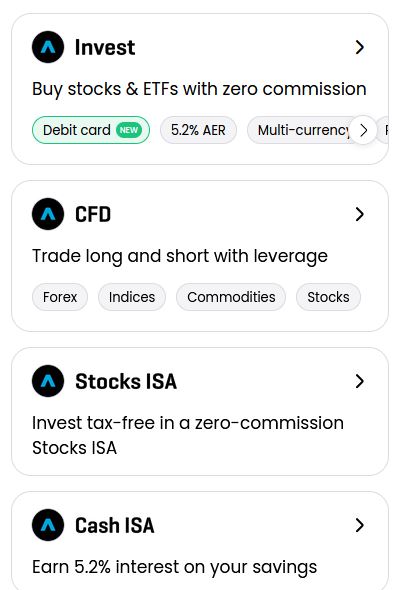
You will also need to indicate the type of account you want from the options available (see screen capture below).

Trading 212 accounts

As you will see, the four account types on Trading 212 are Invest, CFD, Stocks ISA and Cash ISA. You can apply for any or all of these if you like.

CFD stands for Contract for Difference. CFDs are quite complex financial instruments and unless you know what you’re doing I recommend giving them a miss.

If you just want the free share my suggestion would be to tick the Stocks ISA box. An ISA is, of course, a tax-exempt Individual Savings Account. As from April 2024 you can open any number of ISA accounts in a year as long as you don’t exceed your annual £20,000 allowance.

If you have already used up your entire £20,000 this year, you should choose Invest instead to open a general investment account without any tax benefits. Obviously if you don’t want a Stocks ISA with Trading 212 for any reason, you can choose this option as well.

  • For more information about the Trading 212 Cash ISA, see my review here. Be aware that you must open either an Invest account or a Stocks ISA account to qualify for a free share. Of course, there is nothing to stop you opening a Cash ISA account as well, but my recommendation would be to open an Invest or Stocks ISA account first.

Getting Your Free Share

There is one more step you will need to take in order to get your free share. You will need to deposit a minimum of £1 into your account. There are various ways you can do this, but i just used my debit card. There is no obligation to invest the £1 (or whatever you choose to deposit) and if you wish you can withdraw it once your free share has been credited.

The next business day you should receive an email confirming that a free fractional share has been added to your account. As mentioned above, this is allotted at random. If you’re lucky you might get one worth up to £100. Even if you get a less valuable one, though, it’s still a share for free. If you choose to keep it, it may rise in value. There may also be dividends payable in future (and credited to your account).

Selling Your Share

You can’t sell your share immediately. You have to wait three business days before doing so, but it is then just a matter of clicking the Sell button on your member’s dashboard.

The money will be credited to your Trading 212 account but you will have to wait 30 days before withdrawing it. So there may be a case for waiting to see if your share’s value goes up in that time. Of course, it could also go down!

In my case, I received a free share in the Ford Motor Company worth just under £8 at the time. Obviously this wasn’t as exciting as I might have hoped, but it was still – in effect – free money for almost no time or effort 😀

How Safe Is Trading 212?

Trading 212 is registered in England and Wales and authorized and regulated by the Financial Conduct Authority. In addition, all clients’ funds are kept separately in segregated bank accounts which are covered by the Financial Services Compensation Scheme. So even if the company itself were to go broke, any cash in your account would be protected up to a value of £120,000.

Of course, the FSCS guarantee doesn’t apply to the value of your stocks and shares, which can go down as well as up. All investments carry a risk of loss, although in the case of your free share you can never lose any more than the original cost, which was of course zero!

Referral Scheme

Any Trading 212 member can also refer new members while this offer is on. In that case, both you and the person concerned will receive one free fractional share worth up to £100. Obviously, the links in this blog post include my referral code – so if you register and get a free share, I will receive one also. Under the terms of the current offer you can get up to five free shares in this way. Five is the limit per person. Although you can still refer new members who will get a free share after this, as a referrer you won’t receive one as well. If and when the offer reopens in future, you will be able to refer more new members and get free shares again.

Final Thoughts

I first heard about Trading 212 a while ago, but wasn’t initially sure whether it was legit and here for the long term. And I thought the free share offer was, frankly, too good to be true. However, my own experiences have been entirely positive. My original free share in the Ford Motor Company was credited the next business day as promised and I received an email notifying me about it.

I can log in to my Trading 212 account any time to see how my Ford share is doing. I have also collected a few other shares from referrals. These include a share in AMD (the semiconductor company), which is currently worth an impressive £152.69, and one in Nike, which is worth £72.48. I still have my original Ford Motor Company share and it has risen in value to £8.75. I have also received several dividend payments from them. I haven’t sold any of my free shares yet but could of course do so any time I choose. I am not in any rush, as Trading 212 do not impose any platform or inactivity fees. 

Although in this post I have focused on the free share offer, Trading 212 is worth considering as a share-dealing platform too. In particular, the fact that it’s fee-free and commission-free means it is well suited for people who are dipping a toe in stocks and shares investment for the first time. By contrast, the dealing fees and commissions charged by some other share-trading platforms can make small share purchases prohibitively expensive. This review by Money Savvy Daddy looks at the pros and cons of Trading 212 as a share-dealing platform in a bit more detail.

In conclusion, I hope this post has inspired you to consider registering with Trading 212 to claim your free share. If you do, I hope you get a valuable one! Please let me know what share you receive in a comment below. And, as always, any other comments or questions are very welcome too.

  • Don’t forget, the current free share offer ends on Tuesday 28th April 2026.

Disclosure: The links in this post include my referral code. If you click through and register as described above, I will receive a free share (as will you). Please note also that I am not a qualified financial adviser and nothing in this post should be construed as individual financial advice. Everyone should do their own ‘due diligence’ before investing and seek advice from a qualified financial adviser if in any doubt how best to proceed. All investment carries a risk of loss (although not in the case of free shares, obviously).

This is an update of my original post about this special offer.

If you enjoyed this post, please link to it on your own blog or social media:
What is an Annuity - And Who Should Consider Buying One?

What Is an Annuity – and Who Should Consider Buying One?

If you’re approaching retirement (or have retired already), you’ve probably come across the term annuity. For some people it represents security and peace of mind. For others it feels restrictive and poor value.

So what exactly is an annuity – and who should consider buying one?

Let’s take a closer look.

What Is an Annuity?

In simple terms, an annuity is a financial product that converts a lump sum of money – typically from your pension pot – into a guaranteed regular income for life or for a fixed period.

You buy an annuity from an insurance company. In return for handing over some or all of your pension savings, they promise to pay you a regular income, usually monthly, for the rest of your life.

This is most commonly done using funds built up in a defined contribution pension such as a personal pension or SIPP.

In the UK, buying an annuity used to be the default retirement option before the pension freedoms introduced by the Pension Schemes Act 2015. Today, it’s just one option among several.

How Does an Annuity Work?

Here’s a simple example:

  • You retire at 67.

  • You have £100,000 in your pension.

  • You use that £100,000 to buy an annuity.

  • The insurance company pays you, say, £6,000 a year for life.

The exact amount you receive depends on:

  • Your age

  • Your health

  • Current interest rates

  • Whether the income rises with inflation

  • Whether it continues to a spouse after your death

Once purchased, most annuities cannot be changed or cancelled. That’s a crucial point. You’re effectively swapping flexibility for certainty.

Different Types of Annuity

There isn’t just one type. The main options include:

1. Lifetime Annuity

Pays you a guaranteed income for the rest of your life, no matter how long you live.

2. Fixed-Term Annuity

Pays income for a set number of years (e.g. 5 or 10).

3. Level Annuity

Pays the same income every year. Starts higher, but inflation erodes its value over time.

4. Inflation-Linked Annuity

Income rises each year, often in line with inflation. Starts lower but protects purchasing power.

5. Joint-Life Annuity

Continues paying income to a spouse or partner after your death.

6. Enhanced Annuity

If you have certain medical conditions or lifestyle factors (e.g. smoking), insurers may offer a higher income because of reduced life expectancy.

👍 The Advantages of Buying an Annuity

1. Guaranteed Income for Life

You cannot outlive your money. This removes longevity risk entirely.

2. Simplicity

Once set up, there’s nothing to manage. No investment decisions. No worrying about stock market falls.

3. Peace of Mind

For many retirees, knowing the bills are covered every month is invaluable.

👎 The Disadvantages

1. Irreversible Decision

Once you buy most annuities, you can’t change your mind.

2. Inflation Risk

A level annuity can lose real value over time.

3. Potentially Poor Value If You Die Early

If you die shortly after purchase (and haven’t chosen guarantees or joint-life options), the insurer keeps the remaining capital.

4. Less Flexibility

You lose access to your capital.

How Do Annuities Compare With Drawdown?

Since pension freedoms were introduced, many retirees instead choose flexible-access drawdown, keeping their money invested and withdrawing income as needed.

Drawdown offers:

  • Flexibility

  • Potential for investment growth

  • Ability to pass on unused funds

But it also carries:

  • Investment risk

  • The possibility of running out of money

  • Ongoing management and decision-making

An annuity, by contrast, provides certainty but little flexibility. Of course, there is nothing to stop you dividing your pension pot between both. You can also start off using drawdown and switch some or all of your pot to an annuity later, e.g once you reach your mid-70s.

👍 Who Should Consider Buying an Annuity?

An annuity isn’t right for everyone. But it may be suitable if:

You Want Certainty

If you value guaranteed income over flexibility, an annuity may suit you.

You Don’t Want Investment Risk

If market ups and downs worry you, locking in income could help you sleep better at night.

You Have No Other Guaranteed Income

If you don’t have a defined benefit (final salary) pension, an annuity can provide similar security.

You’re in Poor Health

An enhanced annuity may offer an attractive income rate.

You Want to Cover Essential Expenses

Some retirees use part of their pension to buy an annuity that covers core bills, leaving the rest invested for flexibility.

👎 Who Might Not Benefit?

You may want to think carefully if:

You have a strong desire to leave a financial legacy

You are comfortable managing investments

You have significant other guaranteed income already

You are relatively young and rates are less attractive

One Important Tip: Shop Around

You are not obliged to buy an annuity from your existing pension provider.

Using the “open market option” can significantly increase your income. Different insurers offer different rates, and enhanced terms are not always automatically applied.

This is one area where independent financial advice can genuinely add value.

How Much Income Could a £100,000 Annuity Buy You?

Example: 70-Year-Old Single Man (Standard Lifetime Annuity)

Annuity Type (Single Life) Estimated Annual Income from £100,000
Level (fixed each year) ~£8,400 per year (≈ £700/month)
Level (best-buys from comparison sites) ~£8,000–£8,500+ per year
Escalating (income grows ~3% annually) ~£6,400 in first year
Inflation-linked (RPI) ~£6,200 in first year

These are rough current illustrations – if you lock in a level annuity at age 70 with £100,000, you might expect around £8,000–£8,500 a year before tax as a starting point.

How Income Varies with Age

Age has a big impact because providers expect to pay income for fewer years the older you are:

Age When Purchased Typical Annual Income (£100,000)
60 years ~£6,500–£7,000
65 years ~£7,300–£7,600
70 years ~£8,000–£8,400
75 years ~£9,000+

What This Means in Practice

Let’s put those figures into context:

  • If a 70-year-old buys a level lifetime annuity with £100,000, a payout of around £8,000 annually equates to about £667 per month before tax.

  • Choosing escalation or inflation protection reduces the initial income but helps protect your spending power over time. For example, a rising income might start at ~£6,400 (with 3% annual increases).

  • These examples are illustrative only – actual quotes vary by provider, postcode, health and product features. For a more precise quote, try an online calculator such as this independent one on the MoneyHelper website.

💡 Tip: Enhanced annuity rates may be higher if you have certain health conditions or lifestyle factors – always compare quotes across the market rather than accepting the first offer.

Quick Takeaways

  • Older age = higher annuity income for the same pension pot.

  • If you have health issues and/or an “unhealthy” lifestyle, you may get a better rate.

  • Level income gives the highest starting payout but won’t keep pace with inflation.

  • Inflation-linked or escalating options reduce initial income in exchange for rising payments.

  • Shopping around is crucial – you don’t have to buy from your existing pension provider.

Final Thoughts

Annuities fell out of favour after pension freedoms were introduced, but rising interest rates in recent years have made them more competitive again.

They aren’t exciting. They aren’t flexible. But for the right person, at the right time in their life, they can provide something that’s hard to put a price on: certainty.

As always with retirement planning, the best solution may not be either/or. A blended approach – part annuity, part drawdown – can often provide the best of both worlds.

If you’re approaching retirement (or there already), it’s well worth understanding how annuities work before ruling them out entirely.

As always, if you have any comments or questions about this article, please do post them below. But note that I am not a qualified financial adviser and cannot give personalized advice. You should always do your own “due diligence” before making investment decisions and seek professional advice if in any doubt how best to proceed. Personally I strongly recommend getting independent professional advice and assistance before purchasing an annuity.


If you enjoyed this post, please link to it on your own blog or social media:
Are River Cruises Suitable for Solo Travellers

Are River Cruises Suitable for Solo Travellers?

My recent posts about cruise holidays and river cruises have generated quite a bit of interest among PAS readers. One asked if I could say something about the suitability of river cruises for solo travellers. I thought that was an interesting question (and one that’s relevant to me personally). So today I shall be addressing this particular topic.

River cruising has traditionally been seen as a holiday for couples or groups. But in recent years, more solo travellers – especially active retirees and budget-conscious explorers – have been asking if it’s a good fit for them too. The short answer to this is Yes – but with some important things to consider before you book.

Let’s take a look at the pros and cons…

👍 Pros of River Cruises for Solo Travellers

1. Built-In Social Opportunities

With smaller ships and communal activities like guided excursions, happy hours and shared dining, solo travellers often find it easy to strike up conversations. If you’re someone who enjoys meeting new people, river cruises can be surprisingly good in this respect.

2. Guided Excursions Take Out the Guesswork

Instead of navigating a new city on your own, excursions included in many packages let you explore in a group — perfect if you want cultural immersion without logistical stress.

3. Special Solo Cabins Are Growing

More cruise lines are introducing single-occupancy cabins (or reduced single supplements) to prevent solo travellers paying double the fare for a standard cabin. This makes solo travel more financially appealing.

4. Safety and Ease

Especially for older solo travellers, river cruising provides an added layer of comfort and security:

  • Onboard support staff.

  • Port stops often right in town centres – no long transfers.

  • Lectures, entertainment and shared experiences that make connecting with others easier.

👎 Cons of River Cruises for Solo Travellers

1. Single Supplements Can Be Pricey

Even with growing options for solo cabins, many river cruise packages still charge a single supplement — a surcharge for solo travellers that can significantly increase the overall cost. Always compare total price (not just headline fare).

2. Smaller Ships Mean Fewer People

If you’re a social butterfly craving variety in company, the smaller onboard population might feel a bit limited. Some people thrive on that atmosphere; others miss larger group dynamics. If there are some fellow passengers you really don’t like, on a river cruise it may be harder to avoid them.

3. Some Shore Excursions May Require Good Mobility

While many tours are gentle, some exploring old towns can involve walking on uneven cobblestones. Plan ahead if you have mobility concerns.

💡 Money-Saving Tips for Solo Cruisers

If you decide a river cruise is your kind of holiday, here’s how to make it better value…

1. Seek Out Reduced (or Zero) Single Supplements

Some operators – especially those targeting UK solo travellers – offer promotional periods with no single supplement on selected departures. Check specialist sites like RiverCruising.co.uk or GlobalRiverCruising.co.uk regularly and sign up to any email newsletters they offer.

2. Book Early

New solo cabins and low-supplement departures often sell out quickly. Booking up to a year in advance can secure better rates.

3. Compare Inclusions Carefully

A lower headline price isn’t always better. Packages that include drinks, excursions and transfers may cost more upfront but save you money overall.

4. Consider Shared Shore Excursions

If mobility isn’t an issue and you’re comfortable exploring with others, opting for group excursions rather than private tours may save money.

5. Travel Outside Peak Dates

Shoulder seasons – spring and autumn – usually come with lower prices and fewer crowds, giving you a more relaxed experience at a better price point.

6. Check for dedicated solo departures

Some operators like Riviera River Cruises occasionally run solo-only cruises with no supplement – ideal for meeting other solo voyagers.

7. Compare direct vs agent pricing

Sometimes booking directly with the cruise line is cheaper; other times a specialist agent will have better exclusive rates.

8. Fly from Regional Airports

River cruise packages often include flights. Compare prices from regional UK airports – you may find cheaper deals than London departures.

9. Use Loyalty Programmes & Travel Agents

Cruise line loyalty programmes can bring discounts, upgrades or onboard credits. Specialist cruise agents often know about promotions that aren’t publicised online.

🛳️ River Cruise Operators Friendly to Solo Travellers

1. AmaWaterways – Offers a range of solo traveler specials, including reduced single supplements (as low as 10% on select sailings) and even waived single supplement on specific ships with dedicated single occupancy cabins. It’s one of the more flexible mainstream lines for solo travellers in Europe.

2. Riviera River Cruises – This UK-focused operator has expanded its solo traveller options by eliminating the single supplement on a number of European river cruise departures (especially on the Rhine and Rhone). These sailings often have multiple cabins available with no supplement for solo bookings.

3. Avalon Waterways – Known for no single supplement on selected departures, Avalon runs dedicated sailings where solo travellers pay just the standard fare with no extra charge. These promotions are seasonal and vary by departure date and cabin category.

4. Tauck – Offers no single supplement in its lowest category cabins on European river cruises, making it a strong choice for solo travellers looking for a fully guided and inclusive experience without hefty extras.

5. Uniworld Boutique River Cruises – Frequently runs reduced or waived single supplement offers on selected sailings and cabin grades, appealing to solo travellers who want a boutique, luxury river experience.

6. Scenic – Provides significant single supplement discounts — on some sailings up to 75% off the usual extra charge — which can make luxury river cruising much more affordable for those travelling alone.

7. Emerald Cruises – Often offers solo-friendly specials including waived single supplements on select itineraries and dedicated single cabins. This gives solo cruisers the chance to book at twin-share prices for certain departures.

8. CroisiEurope – Another line regularly mentioned in travel roundups for offering single occupancy cabins or reduced single supplements on selected routes, helping solo travellers avoid paying double fares on all departures.

🧠 Final Verdict: Is River Cruising Good for Solo Travellers?

Yes – but it depends on your travel style and budget.

  • If you enjoy engaging with fellow travellers, appreciate guided experiences, and want a secure, stress-free way to see multiple destinations, river cruising can be a fantastic solo holiday.

  • Just be mindful of pricing structures like single supplements and cabin availability – and do your homework before booking.

For many UK solo travellers, the combination of cultural discovery, social opportunities and value-focused packages makes river cruising a very attractive option.

As always, if you have any comments or questions about this article, please do leave them below. And if you’ve been on a river cruise yourself (solo or otherwise), I’d love to hear what you thought and if you have any other tips for making the most of them.


If you enjoyed this post, please link to it on your own blog or social media:
My Investments Update - March 2026

My Investments Update – March 2026

Here is my latest monthly update about my investments. You can read my February 2026 Investments Update here if you like.

I’ll begin as usual with my JP Morgan Personal Investing (previously NutmegStocks and Shares ISA. This is the largest investment I hold other than my Bestinvest SIPP (personal pension).

As regular readers will know, in June last year I transferred most of the money in my former Nutmeg Fully Managed portfolio (just under £25,000) to a new Nutmeg Income Portfolio. I discussed this in detail in this post, but basically money in this port is invested to generate an income from share dividends and other sources. This is then paid monthly. Capital appreciation is targeted as well, but these portfolios are aimed primarily at older people (and others) who want/need their investment to generate a regular cash income.

In January my JPM Investing income portfolio generated £124.25 of income, which was duly paid in to my bank account on 24 February 2026. That means I have now received a total (tax-free) income of £198.14 in 2026 and £669.60 since I opened the account in June last year. That’s about what I would have expected based on JPM’s projected annual return of just under 5% for income ports at my chosen risk level (five).

My income portfolio grew in value in February. It’s now worth £28,866 compared with £27,687 at the start of last month, a quite impressive rise of £1,179.

As the year-to-date screen capture below shows, this port has increased by £3,268 (12.74%) after fees since I opened it last June. That’s clearly good going, though I don’t suppose it will carry on like this indefinitely. Performance may have been helped a bit by the no-fees introductory offer on Nutmeg/JPM income portfolios until the end of 2025. That has of course ended now.

JPM Income portfolio March 2026

I still have a smaller, growth-oriented pot using JPM Investing’s Smart Alpha option. This is now worth £4,974 (rounded up) compared with £4,790 a month ago, an increase of £184. Here is a screen capture showing performance in the year to date.

JPM Smart Alpha port March 2026

Finally, at the start of December 2023 I invested £500 in one of Nutmeg/JPM’s thematic portfolios (Resource Transformation). In March 2024 I also invested a further £200 from referral bonuses (something I no longer receive). As you can see from the YTD screen capture below, this portfolio is now worth £996 (rounded up) compared with £956 last month, an increase of £40.

JPM Thematic port March 26

Overall in February I was up by £1,403 or 4.20%. In addition I did, of course, receive £124.25 in income from my income portfolio. In total, then, I am in profit for the month by £1,527.25.

Excluding income generated, the overall value of my JPM investments is up by £4,029 or 13.08% since the start of March 2025. If you add to this figure the £669.60 of income generated by my Income portfolio so far, that gives a total profit for the last 12 months of £4,698.60 – not a bad return in these uncertain times.

As I always have to say, some volatility is to be expected with stock market investments, but over the longer term they tend to even themselves out (and typically outperform bank savings accounts, although that is never guaranteed). In general the worst thing you can do is panic and sell up when downturns occur. You are then crystallizing your losses rather than giving the markets time to recover. This is something I had cause to discuss in this blog post.

You can read my full original Nutmeg/JPM review here. If you are looking for a home for your annual ISA allowance, based on my overall experience over the last nine years, they are certainly worth considering. They offer self-invested personal pensions (SIPPs), Lifetime ISAs and Junior ISAs as well.

Moving on, I also have investments with P2P property investment platform Housemartin. As discussed in this post, the company rebranded last year from Assetz Exchange.

My investments with Housemartin continue to generate steady returns. Housemartin focuses on lower-risk properties (e.g. sheltered housing). I put an initial £100 into this in mid-February 2021 and another £400 in April. In June 2021 I added another £500, bringing my total investment up to £1,000.

Since I opened my account, my HM portfolio has generated a respectable £302.22 in revenue from rental income. I have made a small net loss of £20.25 on property disposals. Capital growth generally has slowed, in line with UK property values generally.

At the time of writing, 19 of ‘my’ properties are showing gains, 4 are breaking even, and the remaining 21 are showing losses. My portfolio of 44 properties is currently showing a net decrease in value of £69.21. That means that overall (rental income minus capital value decrease and loss on disposal) I am up by £212.76. That’s still a respectable return on my £1,000 and does illustrate the value of P2P property investments for diversifying your portfolio. And it doesn’t hurt that with Housemartin most projects are socially beneficial as well.

The net fall in capital value of my Housemartin investments is obviously a little disappointing. But it’s important to remember that until/unless I choose to sell the investments in question, it is largely theoretical, based on the latest price at which shares in the property concerned have changed hands. The rental income, on the other hand, is real money (which in my case I’ve reinvested in other HM projects to further diversify my portfolio).

To control risk with all my property crowdfunding investments nowadays, I invest relatively modest amounts in individual projects. This is a particular attraction of Housemartin as far as i am concerned. You can actually invest from as little as £1 per property if you really want to proceed cautiously.

  • As I noted in this blog post, Housemartin is particularly good if you want to compound your returns by reinvesting rental income. This effectively boosts the interest rate you are receiving. Personally, once I have accrued a minimum of £10 in rental payments, I usually reinvest this money in either a new HM project or one I have already invested in (thus increasing my holding). Over time, even if I don’t invest any more capital, this will ensure my investment with Housemartin grows at an accelerating rate and becomes more diversified as well.

My investment on Housemartin is in the form of an IFISA so there won’t be any tax to pay on profits, dividends or capital gains. I’ve been impressed by my experiences with Housemartin and the returns generated so far, and intend to continue investing with them. You can read my original review of Assetz Exchange/Housemartin here and my article about the rebranding to Housemartin here. You can also sign up for an account directly via this link [affiliate].

In 2022 I set up an account with investment and trading platform eToro, using their popular ‘copy trader’ facility. I chose to invest $500 (then about £412) copying an experienced eToro trader called Aukie2008 (real name Mike Moest).

In January 2023 I added to this with another $500 investment in one of their thematic portfolios, Oil Worldwide. I also invested a small amount I had left over in Tesla shares.

In January this year, as Oil Worldwide hadn’t exactly been setting the world alight, I decided to switch my entire investment in this to another smart portfolio, InTheGame. This port, focusing on the computer gaming industry, has been the top performer for some time in my eToro virtual portfolio.

Unfortunately just as I switched away from Oil Worldwide, US President Trump decided to invade Venezuela. This gave the oil industry a significant boost, which I would otherwise have benefited from. Meanwhile InTheGame hasn’t been doing particularly well, partly due to the recent downturn in AI stocks. At the time of writing the value of my investment in this has fallen by nearly 14%. Hey ho! This does of course demonstrate that there are never any guarantees when investing and unexpected events can thwart the best-laid plans…

As you can see from the screen captures below, my original eToro investment (total value £888.36 in pounds sterling) is today worth £1,091.94, an overall increase of £203.58 or 22.92%.

  • Note: eToro now displays the value of investments in your native currency, although you can change this if you wish.

EtoroMainMarch26


Etoro Port March 26

You can read my full review of eToro here. You may also like to check out my more in-depth look at eToro copy trading. I also discussed thematic investing with eToro using Smart Portfolios in this post.

As mentioned above, my new investment in InTheGame is currently down by nearly 14%. My copy trading investment with Aukie2008 continues to do well, however, with an impressive overall profit of 62.08%. Of course, I have held this investment for quite a bit longer.

My Tesla shares, which I purchased as an afterthought with some spare cash I had in my account, are down again this month but still showing an overall profit of over 252% since I bought them. If only I had put a bit more money into this!

You might also notice that I have small holdings in Prosus NV, a Dutch internet group, and South Bow, a Canadian energy infrastructure company. To be honest I don’t understand how I acquired these, but I assume they are some sort of bonus I was awarded. In any event, I am happy to have them in my portfolio.

As an experiment, at the start of April last year I put £50 into an investment ISA with Trading 212. As mentioned in my blog post about dividend investing, I put it into the (Almost) Daily Dividends Portfolio, a ready-made portfolio or ‘pie’ on Trading 212. As you can see from the screen capture below, my portfolio is now worth £61.84, an increase of £11.84 or 23.60% over the ten-month period. It has even accrued a grand total of 97p in dividends, most of which has now been (automatically) reinvested.

Trading 212 Dividends Account March 26

I am quite impressed with how this investment has been faring, despite the small amount I put in (which means I may be missing out on some smaller dividends). If I increased my investment I would almost certainly become eligible for more dividends, and even more the longer I remain invested. If I had any spare money at the moment, I would consider doing this. Of course, I do now have an income-focused portfolio with JPM Investing as well (see above).


Moving on, I published various posts on Pounds and Sense in February. I have listed below those that are still relevant.

In How to Save Money on Cruise Holidays I looked at a type of holiday that has become increasingly popular with older adults. They offer a relaxed way to travel, with accommodation, meals, entertainment and transport between destinations all included in one package. Cruise prices can vary significantly, however, and it’s not always obvious where good value ends and unnecessary expense begins. So in this post I set out some ways to keep cruise costs under control, while still getting the most from your time away.

I also posted an updated version of Get a Free Share Worth up to £100 with Trading 212. Anyone who hasn’t done this before can get a free share worth up to £100 just by signing up for a new Trading 212 investment account via my link. The current offer closes on Wednesday 4th March so you will need to move quickly on this now!

Also in February I published a guest post on the subject Why a Post-Nuptial Agreement Could be a Wise Financial Decision. This concerns a subject that – while it might seem unromantic – could be crucial to ensuring your financial security in later life.  This article is  by Richard Scott, a partner in the family team at HCR Law. In it he explains the benefit of having a post-nuptial agreement in place if, sadly, your marriage (or civil partnership) should come to an end.

I also published another guest post, on the subject of How Your Morning Coffee Might Protect Your Brain as You Age. This concerns a subject close to many people’s hearts (including mine!) – what are the benefits (and risks) of coffee drinking and how much a day is best? It may be of particular interest to older people, as the latest research indicates that the caffeine in coffee (and tea) may offer some protection from dementia. The article is by Eef Hogervorst, Professor of Biological Psychology at Loughborough UniversityIt was originally published in The Conversation.

Is a River Cruise Right for You? was a follow-up to my earlier article about how to save money on cruise holidays. In this article I focused on river cruises, which have become a very popular option among older travellers. I explored the pros and cons of river cruising – particularly for older people – and shared some tips to help you get the best value for money on your river cruise holiday.

Finally, in Get Your Will Written Free of Charge in March, I explained how – if you and/or your partner are over 55 – you may be able to get your will written for free by taking advantage of Free Wills Month. Appointments are limited and on a first come, first served basis, so it’s important to take action on this as soon as possible. Once all available appointments are taken, the campaign will close. This may happen before the end of March.

I’ll close with a reminder that you can also follow Pounds and Sense on Facebook or Twitter (or X as it is called now). Twitter/X is my number one social media platform and I post regularly there. I share the latest news and information on financial matters, and other things that interest, amuse or concern me. So if you aren’t following my PAS account on Twitter/X, you are definitely missing out!

  • I am also on the BlueSky social media network under the username poundsandsense.bsky.social. Twitter/X remains my primary social media platform, but I also post details of my latest blog posts, third-party articles and other financial news and resources on BlueSky for those who prefer to follow me there.

As always, if you have any comments or questions, feel free to leave them below. I am always delighted to hear from PAS readers 🙂

Disclaimer: I am not a qualified financial adviser and nothing in this blog post should be construed as personal financial advice. Everyone should do their own ‘due diligence’ before investing and seek professional advice if in any doubt how best to proceed. All investing carries a risk of loss. 

Note also that posts on PAS may include affiliate links. If you click through and perform a qualifying transaction, I may receive a commission for introducing you. This will not affect the product or service you receive or the terms you are offered, but it does help support me in publishing PAS and paying my bills. Thank you!

If you enjoyed this post, please link to it on your own blog or social media:
My Investments Update February 2026

My Investments Update – February 2026

Here is my latest monthly update about my investments. You can read my January 2026 Investments Update here if you like.

I’ll begin as usual with my JP Morgan Personal Investing (previously NutmegStocks and Shares ISA. This is the largest investment I hold other than my Bestinvest SIPP (personal pension).

As regular readers will know, in June last year I transferred most of the money in my former Nutmeg Fully Managed portfolio (just under £25,000) to a new Nutmeg Income Portfolio. I discussed this in detail in this post, but basically money in this port is invested to generate an income from share dividends and other sources. This is then paid monthly. Capital appreciation is targeted as well, but these portfolios are aimed primarily at older people (and others) who want/need their investment to generate a regular cash income.

In January my JPM Investing income portfolio generated £72.70 of income, which was duly paid in to my bank account on 24 January 2026. That means I have now received a total (tax-free) income of £544.16 to date. That’s about what I would have expected based on JPM’s projected annual return of just under 5% for income ports at my chosen risk level (five).

My income portfolio grew in value again in January. It’s now worth £27,687 compared with £27,052 at the start of last month, a rise of £635. That, does, however, include £651 transferred from what remained in my Fully Managed account (mentioned above), which I have now closed. I had kept a small amount in this for comparison purposes. But as my new Income Portfolio appeared to be generating better returns overall, I couldn’t see much point keeping it. If you subtract this, the Income Portfolio actually fell slightly in value last month by £16.

As the screen capture below shows, this port has increased by £2,083.66 (8.14%) since I opened it in June last year. That’s clearly good going, though I don’t suppose it will carry on like this indefinitely. I should maybe also mention that performance may have been helped a bit by the no-fees introductory offer on Nutmeg/JPM income portfolios until the end of 2025 (which has of course ended now).

JPM Income Port Feb 2026

I still have a smaller, growth-oriented pot using JPM Investing’s Smart Alpha option. This is now worth £4,790 (rounded up) compared with £4,714 a month ago, an increase of £76. Here is a screen capture showing performance over the last year.

JPM Smart Alpha port Feb 26

Finally, at the start of December 2023 I invested £500 in one of Nutmeg/JPM’s thematic portfolios (Resource Transformation). In March 2024 I also invested a further £200 from referral bonuses (something I no longer receive). As you can see from the screen capture below, this portfolio is now worth £956 (rounded up) compared with £934 last month, an increase of £22.

JPM Thematic Port Feb 26

Overall in January I was up by £82 or 0.33%. In addition I did, of course, receive £72.70 in income from my income portfolio. Overall, then, I am in profit for the month by £154.70.

Excluding income generated, the overall value of my JPM investments is up by £1,805 or 5.71% since the start of February 2025, so the April 2025 fall (caused largely by Trump’s tariffs) has now fully reversed. If you add to this figure the £544.16 of income generated so far, that gives a total profit for the last 12 months of £2,349.16 – not a bad return in these uncertain times.

As I always have to say, some volatility is to be expected with stock market investments, but over the longer term they tend to even themselves out (and generally perform better than bank savings accounts, although that is never guaranteed). In general the worst thing you can do is panic and sell up when downturns occur (as happened in April last year). You are then crystallizing your losses rather than giving the markets time to recover. This is something I had cause to discuss in this blog post.

You can read my full original Nutmeg/JPM review here. If you are looking for a home for your annual ISA allowance, based on my overall experience over the last nine years, they are certainly worth considering. They offer self-invested personal pensions (SIPPs), Lifetime ISAs and Junior ISAs as well.

Moving on, I also have investments with P2P property investment platform Housemartin. As discussed in this post, the company rebranded last year from Assetz Exchange.

My investments with Housemartin continue to generate steady returns. Housemartin focuses on lower-risk properties (e.g. sheltered housing). I put an initial £100 into this in mid-February 2021 and another £400 in April. In June 2021 I added another £500, bringing my total investment up to £1,000.

Since I opened my account, my HM portfolio has generated a respectable £297.72 in revenue from rental income. I have made a small net loss of £20.25 on property disposals. Capital growth generally has slowed, in line with UK property values generally.

At the time of writing, 14 of ‘my’ properties are showing gains, 7 are breaking even, and the remaining 23 are showing losses. My portfolio of 44 properties is currently showing a net decrease in value of £79.97. That means that overall (rental income minus capital value decrease and loss on disposal) I am up by £197.50. That’s still a respectable return on my £1,000 and does illustrate the value of P2P property investments for diversifying your portfolio. And it doesn’t hurt that with Housemartin most projects are socially beneficial as well.

The net fall in capital value of my Housemartin investments is obviously a little disappointing. But it’s important to remember that until/unless I choose to sell the investments in question, it is largely theoretical, based on the latest price at which shares in the property concerned have changed hands. The rental income, on the other hand, is real money (which in my case I’ve reinvested in other HM projects to further diversify my portfolio).

To control risk with all my property crowdfunding investments nowadays, I invest relatively modest amounts in individual projects. This is a particular attraction of Housemartin as far as i am concerned. You can actually invest from as little as £1 per property if you really want to proceed cautiously.

  • As I noted in this blog post, Housemartin is particularly good if you want to compound your returns by reinvesting rental income. This effectively boosts the interest rate you are receiving. Personally, once I have accrued a minimum of £10 in rental payments, I usually reinvest this money in either a new HM project or one I have already invested in (thus increasing my holding). Over time, even if I don’t invest any more capital, this will ensure my investment with Housemartin grows at an accelerating rate and becomes more diversified as well.

My investment on Housemartin is in the form of an IFISA so there won’t be any tax to pay on profits, dividends or capital gains. I’ve been impressed by my experiences with Housemartin and the returns generated so far, and intend to continue investing with them. You can read my original review of Assetz Exchange/Housemartin here and my article about the rebranding to Housemartin here. You can also sign up for an account directly via this link [affiliate].

In 2022 I set up an account with investment and trading platform eToro, using their popular ‘copy trader’ facility. I chose to invest $500 (then about £412) copying an experienced eToro trader called Aukie2008 (real name Mike Moest).

In January 2023 I added to this with another $500 investment in one of their thematic portfolios, Oil Worldwide. I also invested a small amount I had left over in Tesla shares.

Last month, as Oil Worldwide hadn’t exactly been setting the world alight, I decided to switch my entire investment in this to another smart portfolio, InTheGame. This port, focusing on the computer gaming industry, has been the top performer for some time in my eToro virtual portfolio.

Unfortunately just as I switched away from Oil Worldwide, US President Trump decided to invade Venezuela. This gave the oil industry a significant boost, which I would otherwise have benefited from. Meanwhile InTheGame hasn’t been doing particularly well. At the time of writing the value of my investment in this has fallen by over 6%. Hey ho! This does of course demonstrate that there are never any guarantees when investing and unexpected events can thwart the best-laid plans. Hopefully in the coming months things will improve again!

As you can see from the screen captures below, my original eToro investment (total value £888.36 in pounds sterling) is today worth £1,119.21, an overall increase of £230.85 or 25.99%.

  • Note: eToro now displays the value of investments in your native currency, although you can change this if you wish.

Etoro main Feb 26


Etoro port FEb 26

You can read my full review of eToro here. You may also like to check out my more in-depth look at eToro copy trading. I also discussed thematic investing with eToro using Smart Portfolios in this post. The latter also reveals why I took the somewhat contrarian step of choosing the oil industry for my first thematic investment with them.

As mentioned above, my new investment in InTheGame is currently down by over 6%. My copy trading investment with Aukie2008 continues to do well, however, with an impressive overall profit of 65.20%. Of course, I have held this investment for quite a bit longer.

My Tesla shares, which I purchased as an afterthought with some spare cash I had in my account, are down this month but still showing an overall profit of over 280% since I bought them. If only I had put a bit more money into this!

You might also notice that I have small holdings in Prosus NV, a Dutch internet group, and South Bow, a Canadian energy infrastructure company. To be honest I don’t understand how I acquired these, but I assume they are some sort of bonus I was awarded. In any event, I am happy to have them in my portfolio.

As an experiment, at the start of April last year I put £50 into an investment ISA with Trading 212. As mentioned in my blog post about dividend investing, I put it into the (Almost) Daily Dividends Portfolio, a ready-made portfolio or ‘pie’ on Trading 212. As you can see from the screen capture below, my portfolio is now worth £58.80, an increase of £8.80 or 17.60% over the ten-month period. It has even accrued a grand total of 87p in dividends!

Trading 212 Dividends ISA Feb 26

I am quite impressed with how this investment has been faring, despite the small amount I put in (which means I may be missing out on some smaller dividends). If I increased my investment I would almost certainly become eligible for more dividends, and even more the longer I remain invested. If I had any spare money at the moment, I would consider doing this. Of course, I do now have an income-focused portfolio with JPM Investing as well (see above).


Moving on, I published various posts on Pounds and Sense in January. I have listed below those that are still relevant.

In What Are Index Funds and How Can You Invest in Them? I looked at one of the most straightforward and cost-effective ways to invest in the stock market, especially for long-term savers and beginners. Index funds track a market index such as the FTSE 100, giving you broad exposure to many companies at once. This helps spread risk and keeps costs low.

I also posted What Are Investment Trusts and How Can You Invest in Them? Investment trusts are a distinctive type of investment company with some unique features; and for the right investor, they can offer real advantages. In this article, I explained what investment trusts are, how they work, and their pros and cons compared with alternatives such as ETFs and open-ended funds.

Also in January I published Planning a UK Holiday This Year? Here Are Some Ideas for you! In this article – an update of an annual post – I shared links to my blog posts about a variety of UK holiday destinations I’ve visited in the last few years, in case you might wish to consider them for short (or longer) breaks in the year ahead.

Finally, I published Make the Government Pay! How to Use Gift Aid to Redirect Your Tax Money. In this article I discussed a perfectly legal way to ensure that at least some of your tax money goes to causes you genuinely support than simply vanishing into the government’s coffers. Gift Aid is a scheme that allows charities to reclaim tax on donations made by UK taxpayers. You can of course use it to boost the value of your donations to the organizations in question – but, as my post reveals, you can even use it to reallocate some of your tax money without spending any money directly.

I’ll close with a reminder that you can also follow Pounds and Sense on Facebook or Twitter (or X as it is called now). Twitter/X is my number one social media platform and I post regularly there. I share the latest news and information on financial matters, and other things that interest, amuse or concern me. So if you aren’t following my PAS account on Twitter/X, you are definitely missing out!

  • I am also on the BlueSky social media network under the username poundsandsense.bsky.social. Twitter/X remains my primary social media platform, but I also post details of my latest blog posts, third-party articles and other financial news and resources on BlueSky for those who prefer to follow me there.

As always, if you have any comments or questions, feel free to leave them below. I am always delighted to hear from PAS readers 🙂

Disclaimer: I am not a qualified financial adviser and nothing in this blog post should be construed as personal financial advice. Everyone should do their own ‘due diligence’ before investing and seek professional advice if in any doubt how best to proceed. All investing carries a risk of loss. 

Note also that posts on PAS may include affiliate links. If you click through and perform a qualifying transaction, I may receive a commission for introducing you. This will not affect the product or service you receive or the terms you are offered, but it does help support me in publishing PAS and paying my bills. Thank you!

If you enjoyed this post, please link to it on your own blog or social media:
Make the Government Pay! How to Use Gift Aid to Redirect Your Tax Money

Make the Government Pay! How to Use Gift Aid to Redirect Your Tax Money

As more people in the UK find themselves paying income tax again – particularly retirees whose pensions, savings interest and state pension now push them over the personal allowance – it’s natural to feel frustrated about how that money is used.

While we don’t get much say over how most of our taxes are spent, there is one perfectly legal way to ensure that at least some of your tax money goes to causes you genuinely support rather than disappearing into the government’s coffers: Gift Aid.

What Is Gift Aid?

Gift Aid is a simple scheme run by HMRC that allows UK charities to reclaim tax on donations made by UK taxpayers.

When you donate to a registered charity and tick the Gift Aid box (or complete a Gift Aid declaration), the charity can claim back the basic rate of income tax you have paid on that donation.

Because the basic rate of income tax is currently 20%, this effectively means:

  • For every £1 you donate, the charity receives £1.25.

  • You don’t pay anything extra.

  • The extra 25p comes from tax you’ve already paid.

Instead of that slice of tax being “wasted” by the government, it is redirected to a charity of your choosing 👍

You Don’t Even Have to Spend Any Money

One of the least appreciated aspects of Gift Aid is that you don’t necessarily have to spend any money at all to benefit from the scheme.

Many charity shops now operate Gift Aid on donated goods. When you drop off clothes, books or household items, you’ll often be asked if you’d like to Gift Aid them.

Here’s how it works:

  • The charity sells your donated items in its shop.

  • Whatever price they achieve is treated as a donation from you.

  • The charity then claims an extra 25% from HMRC on top.

So if your donated items sell for £40, the charity can claim an additional £10 in Gift Aid – all without you spending a penny. Once again, that extra money comes from tax you’ve already paid.

Gift Aid Isn’t Just for Obvious Donations

Gift Aid can also apply to payments you might not normally think of as charitable donations.

A good example is the National Trust, along with many other heritage and conservation organisations. When you visit one of their properties, you’ll often see two admission prices:

  • standard admission

  • Gift Aid admission (typically £1 more)

By choosing the Gift Aid price:

  • You pay £1 extra.

  • The charity can claim 25% of the full admission price from HMRC.

In most cases, this means the charity receives far more than the extra £1 you pay. It’s a very tax-efficient way of supporting organisations you already enjoy visiting, and another example of how Gift Aid lets you divert tax money away from HM Treasury and towards something you personally value.

Who Can Use Gift Aid?

You can use Gift Aid if:

  • You are a UK taxpayer, and

  • You have paid at least as much income tax or capital gains tax in the tax year as the charity will claim back.

This is increasingly relevant for older people who may not have paid tax for years but now do so again because of:

  • frozen personal tax allowances

  • rising state pensions

  • workplace or private pension income

  • interest on savings exceeding the personal savings allowance

If you are paying tax, Gift Aid is something you should at least consider using.

Example 1: A Simple Donation

Let’s say you donate £100 to a charity that supports a cause you care about.

  • You give £100.

  • The charity claims £25 from HMRC.

  • Total amount the charity receives: £125.

That £25 would otherwise have gone to the government. With Gift Aid, you decide where it goes.

Example 2: Higher-Rate Taxpayers Can Benefit Too

If you’re a higher-rate taxpayer (40%), Gift Aid can be even more powerful.

Using the same £100 donation:

  • The charity still receives £125.

  • You can reclaim the difference between basic-rate and higher-rate tax via Self Assessment.

This allows you to reclaim £25 personally, reducing the effective cost of your donation to £75.

What Information Do You Have to Provide?

To claim Gift Aid, charities are required by HMRC to collect some basic information from you. This usually includes:

  • your full name

  • your home address

  • a signature or confirmation (such as ticking a box online)

This is simply to confirm that you are a UK taxpayer and that the charity is entitled to reclaim the tax. It’s a one-off process for most organisations.

Gift Aid: A Small Act of Financial Control

People often feel they have little say over how their taxes are spent. Gift Aid doesn’t change the system, but it does offer a rare opportunity to exercise a degree of choice.

By using Gift Aid:

  • You increase the value of your support for charities you believe in.

  • You don’t pay any more tax overall.

  • You ensure some of your tax money is spent on causes you actually believe in.

A Final Word of Caution

Only use Gift Aid if you really are paying enough tax to cover it. If you don’t, HMRC can ask you to make up the difference.

If your tax position changes from year to year, keep this rule in mind. And if you’re only paying small amounts of tax, keep a record of your Gift Aid donations to ensure you don’t accidentally exceed the total tax you have paid.

That said, for millions of UK taxpayers, Gift Aid is a straightforward, perfectly legitimate way to make their money – and their tax – work harder and smarter.

And for those who find themselves now paying tax again in later life, claiming Gift Aid can feel like a small but satisfying win 🙂

If you give to charity – whether in cash, goods, or entrance fees to attractions – it makes sense to make the government contribute too.

As always, if you have any comments or questions about this article, please do post them below.


If you enjoyed this post, please link to it on your own blog or social media:
UK Holiday Ideas

Planning a UK Holiday This Year? Here Are Some Ideas For You!

For many of us 2025 was another difficult year, with a cost-of-living crisis driven especially by rising gas and electricity costs.

With the festive season behind us now – and a cold and miserable start to the new year – many of us are understandably desperate for something to look forward to in the year ahead.

Some will be planning to head abroad in search of sunnier climes. But others may be deterred by the cost of going overseas and the additional hassles it may entail.

So today I thought I’d share links to my blog posts about some UK holiday destinations I’ve visited in the last few years, in case you wish to consider them for short (or longer) breaks in the year ahead. Clicking on any of the links below will open my post about the place concerned in a new tab, so you won’t have to keep clicking the Back button to return here.

The Destinations

Llandudno

Llandudno in North Wales is somewhere I’ve been visiting regularly for over ten years now (most recently in 2025, when I went twice). It’s a traditional British seaside resort with a long pier, Punch and Judy show, sweeping promenade, and plenty more (you can see the stunning Victorian seafront in the cover image). It’s very popular with both older people and young families. As well as my main review, my October 2020 Coronavirus Crisis Experience Update includes details of a short break I enjoyed there just before the Welsh government imposed another lockdown 😮

Minehead

Minehead is a North Somerset coastal town. I enjoyed a short break there in 2020 as well, at a time when lockdown rules were relaxed. It was my first visit to Minehead and I particularly enjoyed visiting the National Trust property Dunster Castle, which is just a couple of miles down the road. Sadly the West Somerset Railway which starts (or ends) in Minehead was closed due to the pandemic when I went, but I’d love to go back for a trip on this heritage steam railway sometime in the future.

Aberystwyth

Aberystwyth is in mid-Wales on the Cardigan Bay coast. I have visited it three times now, the first two staying at the Marine Hotel and the most recent at a self-catering apartment called Sea Brin. Aberystwyth is quieter and less commercialized than Llandudno (mentioned above), and the fact it’s a university town means it has quite a cosmopolitan feeling. It’s a good place to chill out, but there are plenty of interesting things to see and do as well.

Aberdovey

I visited Aberdovey for the first time in April 2023. It’s a small town on the mid-Wales coast. It’s about ten miles north of Aberystwyth and five miles south of Tywyn, the home of the Talyllyn Railway (see below). It’s a charming, laid-back place, perfect for a relaxing short break. It has a beautiful beach (with watersports for those who want them) and some great cafes and restaurants. I wouldn’t go there for the night-life, though – even the chip shop closes at 8 pm!

Hewenden Mill Cottages, Yorkshire

I had a particular reason to visit Hewenden MIll Cottages, as my sister Liz and her family live just a couple of miles down the road in Wilsden. Even if I didn’t have family connections, though, I would definitely recommend them for a short break. The accommodation consists of a number of former mill-workers’ cottages, in a beautiful woodland setting. The cottages (such as the one below, where I have stayed myself) are spacious and well equipped. From here you can visit Haworth – home of the Bronte sisters – and the Victorian model village of Saltaire. The area is also great for walking and cycling.

Hewenden Mill bungalow

Aberdunant Hall Hotel, nr Porthmadog

The Aberdunant Hall Holiday Park and Hotel (to give it its full name) is about four miles from the North Wales coastal town of Porthmadog You can stay in the hotel itself (which is quite compact) or in accommodation around the park. I stayed in what they call a Forest Pod, which is roughly the equivalent of half a caravan. It was okay for a short break but if you went as a couple the cramped conditions could put a strain on your relationship! If I went again I would book a room in the hotel or maybe one of the Woodland Escape Suites in the park. I still enjoyed my stay there, and found the location convenient for visiting a range of places including Portmeirion (where the sixties TV series The Prisoner was filmed) and the Ffestiniog Railway, which runs from Porthmadog to Baenau Ffestiniog. It’s also on the edge of Snowdonia, with lots of opportunities for walking and mountain climbing.

Lake Vyrnwy

Lake Vyrnwy is a few miles over the border from Shropshire into Wales. I went there in 2019 after watching a TV show about the history of this artificial lake, which was originally created to provide a water supply for the people of Liverpool in the 19th century (it’s now naturalised and if you weren’t aware of its history you wouldn’t know it was man-made). I stayed at the Lake Vyrnwy Hotel and Spa, which is near the dam at the western end of the lake. This was originally built to accommodate senior managers and engineers on the construction project, though it has of course been extended and modernised many times since. If you want to visit Lake Vyrnwy, it’s the best (possibly the only) option. I happened to choose a bitterly cold weekend just before Easter for my visit, which spoiled it a bit. Still, I enjoyed the beautiful scenery and some great walks. It’s probably not a place to take children, however, as there might not be enough for them to do.

The Talyllyn Railway

The Talyllyn Railway (also mentioned under Aberdovey) is a heritage steam railway in Wales. It starts in the town of Tywyn in mid-Wales, so in October 2018 I booked a short break there. To be honest there isn’t a great deal else to do in Tywyn, but it makes a good base for a day on the railway. And the railway itself takes you through some stunningly beautiful countryside. If you buy one of their very reasonably priced Day Rover tickets, you can get on and off at any station along the route. I highly recommend an hour or two at Dolgoch, which has some great walks and lovely waterfalls.

Warner Leisure Hotels

Warner Leisure Hotels have 16 country and coastal resort hotels across England and Wales. They have a strict adults-only policy, and appeal mainly to an older clientele (based on my experience, the average age is around seventy). As well as accommodation they offer a variety of leisure activities, including day trips, quizzes, guided walks, archery and bowls, social dancing, swimming, and so on. Most of these activities are included in the price, as is the evening entertainment. I have stayed at Bodelwyddan Castle in North Wales and Alvaston Hall in Cheshire. Some aspects I liked, others I wasn’t so keen on, as you can read in my review. You can also see their latest offers by clicking on the banner ad below [affiliate].


The Lake District

About five years ago I took a short break in the English Lake District. I stayed at the Waterhead Hotel, just south of Ambleside, at the north end of Lake Windermere (England’s largest lake). The hotel is located literally a few yards from the lake (hence the name, of course). If you haven’t visited the Lake District before, the area should definitely be on your ‘To Do’ list. There are many miles of beautiful countryside to explore, along with attractions such as Beatrix Potter’s house and Wray Castle. And, of course, you must buy a day ticket for the Windermere lake steamers. You can travel the length of the lake in style on these vessels, while sipping a hot chocolate (or something stronger) and listening to commentary on the scenery passing alongside. Highly recommended 🙂

The Isle of Man

I visited the Isle of Man for the first time in April 2024, staying in the island capital Douglas. I went on a heritage-railway-themed break offered by Newmarket Holidays. So naturally I had trips on the Isle of Man Steam Railway and also the Manx Electric Railway. The latter takes you from Douglas to Laxey and onward to Ramsey. Laxey is the home of the iconic Lady Isabella waterwheel, the largest working waterwheel in the world. The IOM is about the same latitude as Liverpool so obviously the weather can be variable, but I was lucky enough to get wall-to-wall sunshine during my stay. I flew to the island from Birmingham Airport which took about 45 minutes, but you can also get a ferry from Heysham or Liverpool. The Isle of Man is charming and verdant, and largely unspoiled. Definitely worth considering if you’re looking for something a little bit different for a short (or longer) holiday.

Llanbedrog

I visited Lanbedrog for the first time in July 2021. It’s a village on the Llyn (or Lleyn) Peninsula in NW Wales. I stayed at an Airbnb property, the first time I had done this (Llanbedrog doesn’t have any hotels as far as I know). It’s by the coast, roughly half way between Pwllheli (famed for its Butlins camp, now run by Haven Holidays) and trendy Abersoch. It has a beautiful sandy beach which would be perfect for families with young children (or grandchildren). I very much enjoyed my three-night stay and found it a perfect place to relax and chill out after months of lockdown. The National Trust mansion (and garden) Plas yn Rhiw is about seven miles away.

Criccieth

I stayed in Criccieth in North Wales for the first time in June 2022, although I had visited the town in the past. It’s a lovely place to relax and chill out. It has excellent road and rail connections, and there are also some high-quality tourist attractions nearby, including Portmeirion and the Ffestiniog Railway. Criccieth itself is best known for its castle which dominates the town. Although it’s a ruin, many of the walls are still standing and you can enjoy some amazing views across the bay, as far as Harlech Castle and beyond.

Lavenham

I visited Lavenham in Suffolk for the first time in August 2022. It is said to be England’s best-preserved medieval town, with over 300 listed, timber-framed houses. There are various historic buildings such as the Guildhall and Little Hall you can look around. Lavenham also boasts a variety of highly rated pubs and restaurants, and some lovely tea rooms and coffee houses as well! 🍮

Barmouth

Barmouth is a traditional Welsh seaside resort about ten miles south of Harlech. I visited in September 2022, staying at an elegant Victorian Gothic hotel called Tyr Graig Castle. Barmouth has a clean, attractive promenade and beautiful sandy beach which goes out a long way. There is plenty to do for families, including a funfair and amusement arcades. There are various restaurants and fast food outlets along the seafront. There is also a railway station with regular trains to Pwllheli in one direction and Aberystwyth and beyond in the other. Nearby attractions include Harlech Castle, Portmeirion and the Fairbourne miniature steam railway 🚂

Bath

I visited the historic city of Bath in June 2023. There is lots to see and do, although top of many people’s lists will be the stunning Roman Baths. Bath Abbey is well worth a  look too, and you can admire the beautiful Georgian architecture around the city for free! Read my top tips for anyone visiting Bath in this post, including the excellent self-catering accommodation I stayed at.

Other Resources

Here are links to a few other blog posts that may be of interest if you are planning a UK holiday this year…

Booking a Holiday With Airbnb

In recent years Airbnb has become increasingly popular for self-catering holidays. You can book anything from a spare room in someone’s home to a whole house or apartment. My recent short breaks in Lavenham and Llanbedrog (see list above) were in Airbnb properties. You can read all about the booking process in my post.

Find Your Nearest Cashpoint with the Link ATM Locator

Finding a cashpoint in an unfamiliar town (or village) can be challenging, so you might find this free app a useful resource to download. It has helped me avoid embarrassment on several occasions.

Ten Tips for First Time and Solo Cruisers

If your thoughts are turning further afield, you may be considering a cruise holiday as an option. Even if you can’t go abroad, I can testify from personal experience that a cruise of the British Isles (like these, perhaps) can be very enjoyable and enlightening. My blog post sets out a range of tips and advice that will be particularly relevant for first-time and solo cruisers.

Finally, coach holidays are another very popular option among older people especially. I don’t have much experience of this myself, but my friends at Over 60s Discounts have a great article about coach holidays for over-60s in the UK. This includes a list of popular UK destinations and details of several companies offering low-cost coach holidays.

Closing Thoughts

I hope you have enjoyed reading this post and it has given you a some ideas for UK holidays.

Obviously I am a 60-something male and nowadays usually travel on my own. So if your circumstances are different from mine, I understand that some of the destinations mentioned above might not hold as much appeal. In addition, I live in Staffordshire, so the places I go are all reasonably accessible from there.

Finally – as I noticed when reading back my list – I do have a bit of a penchant for places with heritage steam railways nearby, so please bear that in mind as well 😀

Of course, I’d love to hear your views about any of the destinations mentioned, or any other places in the UK you would recommend for a short break or longer holiday. Please leave any comments or questions below as usual.

Note: This is a fully revised update of an annual post.

  Vintage vector created by ajipebriana – www.freepik.com


If you enjoyed this post, please link to it on your own blog or social media: