Today I have a guest post for you from my friends at Suttons, a leading seeds, bulbs and horticultural products company.
There is a lot of discussion about saving money before you retire, but not nearly as much about saving afterwards.
But in reality the great majority of us have to survive on a lower income in retirement. While nobody wants to spend their golden years scrimping for every penny, saving money in retirement is important and helps us to afford things such as holidays that can enrich our lives.
So this guest post sets out some great ideas for painless ways of saving money in retirement. I hope you enjoy reading it.
For many of us, we dream of retirement. The ideal age for packing in work is 57, according to studies, with 32% of respondents planning to quit the working world at this age. However, for some, the thought of calling it a day before they’re eligible for their state pension isn’t feasible. It’s been estimated that the British public will need at least £260,000 to retire without money issues. Unfortunately, research has found that the average pot of money held by those aged between 45 and 54 is £71,240 — way off the final required total.
While this final figure sounds extremely high, there are ways to prevent overspending in your later years. Here, we take a look at some great ways to save money after you’ve retired.
Sell your clutter
We are a nation of hoarders. Whether it’s old equipment or new purchases, we don’t like to get rid. In fact, over half of the UK’s adults claim to have between one and 10 items hanging in their wardrobe which have never been worn. However, one man’s junk is another man’s treasure, right? Therefore, clear out any unnecessary clutter you may have acquired over the years.
Have a huge clear out and you’ll be surprised at how much stuff you don’t actually need if you’re ruthless. This can help to provide extra funds to go towards your retirement pot. It means that you’ll be increasing your income, and you won’t even have to make too many cuts from your lifestyle. You can sell your stuff via online auction houses such as eBay and local Facebook groups.
Grow crops
Growing produce at home has many benefits. We all know that eating fruit and vegetables is good for you due to them being full of vitamins, minerals and nutrients. However, have you ever stopped and thought about how much money you can save if you grow your own veg? If your garden is big enough, you should create a vegetable plot. This can include cabbages, lettuce, onions, sweetcorn, leeks and the likes.
You should also look into companion planting. For example, grow Swiss chard in the same space as onions, beetroot and cabbages and you’ll make the most of your space while also deterring pests. A patio garden can also grow smaller produce, including mange tout, radish and French beans.
Some of the most cost-effective vegetables you should look to grow in your garden include tomatoes. As they don’t require much space to grow, you can even place these on balconies. Usually, they take 12 weeks before they are ready for harvest and each plant can create fresh produce daily for up to six years. Based on a shopper buying one box of tomatoes per week, this can help you save £52 each year.
Potatoes are another money saver. The average Brit eats 429g of potatoes every week and the average four-pack costs £1 in a supermarket. However, for a pack of five seeds, you can grow up to 45 potatoes for as little as £1.50.
Of course, there are many other examples that can save you money, and it all tallies up when put together to make great savings.
Adjust the frequency of luxuries
You don’t have to stop enjoying yourself to save money in retirement. It’s no use retiring just to sit and be bored. However, it’s important that you plan properly and adjust your lifestyle to suit your budget. We all like the occasional blow out — whether that’s on a holiday, fine dining or on new items. However, it’s crucial to live within your means. If you were used to eating out every other night when you were in employment, chances are you won’t be able to once you’ve left the workplace. However, you shouldn’t cut it out altogether. Simply adjust the frequency you do so and you’ll still be able to have that luxury that you long for.
Set priorities
Having a budget doesn’t mean removing the items or adventures that are most important to you from your life. However, it is important to set yourself priorities. Decide what it is that you really want in your life and what are just added bonuses. Doing this can help you to prioritise your money, while ensuring you don’t miss out on what you really want in your life.
The above are all examples of how to save money once you’ve retired. Of course, there are many other opportunities for you to make the most of your retirement, but by focusing on these points, you’ll be well on your way to enjoying your relaxing time after finishing work for good.
Thank you to Suttons for an interesting and thought-provoking guest post.
I definitely agree with the advice to grow tomatoes. I have been doing this for a few years now, in growbags and/or hanging baskets. Despite my distinctly un-green fingers, they never fail to produce a bumper crop of tasty toms, and save me having to buy any from the shops for months on end. Suttons have lots of varieties of tomato seeds available. Or if you prefer you could visit a garden centre such as Dobbies and perhaps take advantage of their Over 60 Meal Deal as well!
As always, if you have any comments or questions about this article, please do post them below.
In just a few weeks (5th April 2019) it will be the end of the financial year. And that means if you want to make the most of your 2018/19 ISA allowance, you will need to take action soon.
As you may know, ISA stands for Individual Savings Account. ISAs are saving and investment products where you aren’t taxed on the interest you earn or any dividends you receive or capital gains you make. An ISA is basically a tax-free ‘wrapper’ that can be applied to a huge range of financial products.
With ISAs you don’t get any extra contribution from the government in the form of tax relief as you do with pensions. But – except in the case of the Lifetime ISA – you can withdraw your money at any time (subject to any rules about the term and notice period required) and you won’t be taxed on it.
Everyone has an annual ISA allowance, which is the maximum amount you can invest in ISAs in the year concerned. In the current financial year (2018/19) this is a generous £20,000.
There are four main ISA categories: Cash ISA, Stocks and Shares ISA, Innovative Finance ISA (IFISA) and Lifetime ISA. You can divide your £20,000 ISA allowance among these in any way you choose, but you are only allowed to invest in one ISA in each category per year. Let’s look at each type in a bit more detail…
Cash ISA
Cash ISAs are like standard savings accounts except the interest you receive doesn’t incur income tax.
Unfortunately interest rates are very low at the moment. According to price comparison sites, the best rate for an instant-access cash ISA is currently 1.45% with Virgin Money. With inflation at 1.8% (January 2019) that means even in the best paying cash ISA your money will still be losing spending power when invested this way.
What’s more, the new Personal Savings Allowance (PSA) means most people can get up to £1000 in savings interest without paying tax anyway. As a result of these things, cash ISAs have lost much of their appeal, though if interest rates rise they may become more attractive again.
It is also worth bearing in mind that money invested in a cash ISA remains tax-free year after year. So if in the years ahead interest rates on cash ISAs rise, the benefit of having one will increase as well.
Nonetheless, I have decided not to invest any of my ISA allowance in a cash ISA this year, as I have (in my view) better uses for my money. You might see this differently, of course!
Stocks and Shares ISA
Stocks and shares ISAs are a good choice for many people saving long term. Over a longer period the stock market has outperformed bank savings accounts, often by a considerable margin. You do, though, have to expect some ups and downs in the value of your investments in the short to medium term.
You can opt for a standard stocks and shares ISA offered by a wide range of financial institutions and let them choose your investments for you. Alternatively you can use self-investment platforms such as Hargreaves Lansdown or Bestinvest to choose your own investments from the wide range of shares and funds available.
IFISAs are on offer from a small but growing range of peer-to-peer (P2P) lending platforms. P2P platforms allow people to lend money to businesses and private individuals and get their money back with interest as the loans are repaid. If you invest in the form of an IFISA all the interest you receive from P2P lending is paid tax-free, otherwise it is taxed as income (though interest from P2P lending does qualify for the Personal Savings Allowance of up to £1,000 a year, mentioned above).
Peer-to-peer platforms generally offer more attractive interest rates than bank and building saving accounts (or cash ISAs) – from around 4% to 10% or more. They aren’t covered by the same guarantees as the banks and are therefore riskier, though. And if you need your money back urgently there may be delays and/or extra charges to pay.
Nonetheless, in the current climate of low-interest savings accounts and volatile stock markets, more and more people are looking to IFISAs as a home for at least some of their savings.
Some leading peer-to-peer lending platforms which offer IFISAs include Ratesetter – which I have invested in myself and reviewed in this post – and Funding Circle, which lends to businesses.
Lifetime ISA
Lifetime ISAs or LISAs are a new-ish initiative from the government to encourage younger people to save. They do have one big drawback for older people: you have to be under the age of 40 (though over 18) to open one.
LISAs are designed for two specific purposes: buying your first home and saving for retirement. How they work is that you can pay in up to £4,000 a year (lump sums or regular contributions) and the government will top this up with another 25%. As long as you open your LISA before the age of 40 you will continue to receive the bonuses on your contributions until you reach 50.
So if you pay in the maximum £4,000 in a year, the government will top this up to £5,000. If you pay in the full £4,000 every year from the age of 18 to the upper limit of 50, you will therefore get a maximum possible bonus from the government of £32,000.
LISAs are therefore somewhat different from the other types of ISA mentioned above, but nonetheless any money you invest in one comes out of your annual ISA allowance (currently £20,000). So if you pay the maximum £4,000 into a LISA this year, that comes out of your £20,000 ISA allowance, leaving you with ‘just’ £16,000 to invest in other sorts of ISA.
Your money will grow without any tax deductions in a LISA, and you can also withdraw without having to pay tax. However, there are certain restrictions. In particular, you can only use the money in your LISA for one of two purposes: paying a deposit on your first home or saving for retirement. While you can access your money for other reasons, you will then lose 25% of the total, including your own contribution and the government bonus along with any investment growth. That means in many cases you will get back less money than you put in.
The 2018/19 ISA allowance is a generous £20,000 and offers the potential to save a lot of money on tax assuming you are lucky enough to have this amount to save or invest. But, very importantly, it cannot be rolled over. So if you don’t use your 2018/19 ISA allowance by 5th April 2019 at the latest, it will be gone forever. It is therefore important to attend to this now and ensure you get as much value as possible out of this valuable tax-saving concession.
As always, if you have any comments or questions about this post, please do leave them below.
Disclosure: this post includes affiliate links. If you click through and make an investment at the website in question, I may receive a commission for introducing you. This has no effect on the terms or benefits you will receive. Please note also that I am not a professional financial adviser and cannot give personal financial advice. You should do your own ‘due diligence’ before making any investment, and seek professional advice from a qualified financial adviser if in any doubt how best to proceed. All investments carry a risk of loss.
If you enjoyed this post, please link to it on your own blog or social media:
This is a somewhat embarrassing post to write as a money blogger. However, I recently realised that I have been paying well over the odds for my home insurance for some years. And now that I have addressed the issue, I am actually quite staggered by how much money I will be saving.
To explain, I moved into my current home with my partner Jayne (now sadly deceased) in March 1995. With all the things we had to consider at the time we didn’t pay much attention to home insurance. We took out home contents insurance with Lloyds and buildings insurance with our mortgage lender Britannia. The latter had a special deal for members of the trade union Unison (which Jayne was in at the time), so we thought it must represent good value.
We paid for both policies via monthly direct debit and each year they rolled over, generally with a small increase. I always looked after our household finances but never really thought much about the home insurance. The sums weren’t huge, and I just assumed we were getting a good deal so it wasn’t worth worrying about.
Fast forward to January 2019, and Britannia wrote saying they were no longer offering buildings insurance and I would need to make alternative arrangements. At about the same time I got a letter from Lloyds saying my contents insurance was going up from £147.80 a year to £184.73 (a pretty steep increase in percentage terms). So I decided the time had come to pay my home insurance a bit more attention and see if there were any savings I could make by shopping around. And boy, there certainly were!
Doing the Sums
At the start of this year my buildings insurance premiums were £32.05 a month, which works out as £384.60 a year. Adding that to the latest quote from Lloyds of £184.73 gives a total annual home insurance bill of £569.33.
A bit of online research revealed that nowadays many people get their buildings and contents insurance in a single policy and this generally works out more economical. So I did a search for home insurance providers on Top Cashback (a website that provides money back to people buying via merchants listed on the site – see this post for more details).
To cut a long story short, I wound up buying a combined buildings and contents policy from AA Insurance, with essentially the same cover I had before, for an annual premium of just £100.25. And with that I got £42 cashback via Top Cashback, effectively reducing the price to just £58.25. That represented a massive £511.08 less than I would have been paying in total on my old home insurance policies.
The AA Insurance website said that this was a special new customer deal, so I guess they might push the price up a bit next year. But of course, now that I’ve done it once, I will definitely shop around for prices (and cashback!) again when the time comes.
So the moral of this story is not to let laziness and inertia ever stop you looking for better deals. Even with something as mundane and relatively cheap as home insurance, you may be as surprised as I was by how much money you can save!
You can search on Top Cashback for home insurance providers and price comparison services (all offering cashback) by clicking on this link (affiliate). If you aren’t already a member you will need to register to get cashback, but this is free and only takes a few moments.
As ever, if you have any comments or questions on this post, please do leave them below.
If you enjoyed this post, please link to it on your own blog or social media:
Today I am pleased to bring you a guest post from my money blogging colleague Jennifer Kempson. Jennifer blogs at https://mamafurfur.com.
In her article Jennifer sets out some strategies to ensure you have enough money to enjoy your retirement, even if it’s not too far away!
Over to Jennifer, then…
They say hindsight is a wonderful thing, and truly as we reach the later years of working life and approach retirement, we may secretly wish we had made our retirement resources a priority and regarded them as a key resource to help fulfil our passions and achieve our long-term ambitions.
Money, much like health and energy, is one resource that we will look back on and wish we had taken better care of during our younger days, so we can look forward with pleasure and excitement to when the time-freedom of retirement allows us to do whatever we dream of.
Reading this right now you may feel that it is too late for you to recover your potential financial security for your retirement, but I’m excited to share with you a few ways that you can invest in your future even when retirement is on the horizon in the next 10-15 years.
Make a plan and start seeing it happen!
Firstly, I will say that I am a firm believer in “putting your own oxygen mask on before anyone else”. And the very best investment financially or otherwise you can make for your future is to sort your own financial security as a top priority.
You absolutely need to write down your financial goals and desired experiences for your retirement, and start getting excited about this and be as specific as possible, so that you know exactly how much money you will require to make it happen.
Like time spent with our children and loved ones, if we master our relationship with money and the way we feel about it today, this will have a huge compounding effect on our short- and long-term happiness in future. I talk more about the habits and thoughts that can reshape your relationship with money in my new book, The Master Money Blueprint, which sets out the 26 timeless money principles and habits that I believe can change your financial future.
Pay off your liabilities as soon as possible
One of the most beneficial things you can do for your financial future is to become as debt-free as possible.
Make better money relationship habits starting today and commit to overpaying on everything you have as a liability against your name.
This could include your mortgage or car payments, and is especially crucial if you have credit card debts or loans. Commit to paying these down as quickly as possible and never returning to debt again.
A home with its mortgage completely paid off will provide you with safety and security in future, and when the time comes can be left to loved ones. But more important than that would be the mindset that your home is secure and safe for your happiness both now and in the future.
I like to use a great principle called The 10% Rule, mentioned in more detail in my book and on my blog at www.mamafurfur.com. This can and should be applied to every debt you have – any outstanding mortgage, car payments, loans, etc.
Commit to paying 10% over the monthly repayment required each month as a default. That small action will do two things. Firstly, you will not really notice too much discomfort. For a mortgage of, say, £400 a month, finding a further £40 could be as simple as giving up that gym membership and going for walk with friends, getting some free weights in the house, learning yoga from YouTube, and so on. It could be giving up all the unused packages from cable TV for a few months to see if you really miss it. It could be starting a small sideline business at home to make some extra money, or saving on your food and shopping purchases by eating one less takeaway a week. The choices are limitless.
That action of paying 10% more each month means you will make the equivalent of 1.2 extra payments towards reducing your debts per year. For a 25-year mortgage, for example, this could result in the debt being fully paid off in just over 22 years instead. That is a nearly three years off your home loan from a small change without causing too much stress to your day-to-day living. The second benefit is to your mindset, which is priceless – you will quickly see that money really is a resource to deploy based on your goals and long-term plans. Overpaying then becomes a joy, as much as it might be difficult to see that at the start, but the smallest actions usually do change us for the better when we let them.
An investment ISA (Individual Savings Account) allows you to save up to £20k tax free in stocks and shares every year. This type of savings account could allow you to create a passive income to supplement a pension. You can have a cash ISA and an investment ISA if you wish, as long as you don’t exceed the £20k annual total contributions allowance.
Investments in ISAs are not liable for income tax or dividends tax. Neither do you have to pay capital gains tax when you sell them. They are available from most banks and investment companies.
Like any type of investing, we need to purchase funds based on our goals, requirements for the money long term, and our tolerance for risk.
Investment returns are not guaranteed. However, generally you can expect to see a 4% return on your investments if you pick solid mutual funds (collections of stocks purchased together, spreading your money across a wide range of similar companies) such as Vanguard’s LifeStrategy 100% Equity Fund or reliable low-cost index funds such as the S&P 500. It is also not uncommon to see growth rates of an average of 9.5-10%.
At the later part of your life, if you are hoping to use the power of compound interest and the stock market to gain higher returns than a normal savings account, then I strongly advise doing as much research as you can into the funds you decide to pick.
With investments, we need to assume we are leaving them a minimum of 5-10 years before withdrawing the money, and must not let the ups and downs of the stock market test our emotions.
The value of the stocks once we purchase them is only relevant once we need to sell them, so best mindset practices say to ignore the current day value until you absolutely need them.
Another benefit of using an investment ISA is that you will have access within a few days to your money should your circumstances change and you find you need the money sooner.
I strongly recommend every adult has an investment ISA, as it is currently one of the few ways to get high-interest returns on your long-term savings. It could even allow you to build a substantial ‘pot’ that allows you to achieve complete financial freedom for you and your family in future.
I call an investment ISA a passive income source, as the money generated is created by companies returning some of their profits in dividends, and/or the value of the stocks and shares purchased going up.
We do not have to exchange our time for this income, therefore it is completely passive and grows without any effort from ourselves. The beauty of the stock market is that our money will remain active until we choose to sell our stocks, so it will continue to create more income for us in the background. We can simply withdraw a small portion of it each year to live off, and some of the increase will still remain, adding to our wealth total despite the withdrawn money.
Let’s look at some examples of what we could potentially end up with if we took out an investment ISA even with a short-term goal of accessing the money within 10 years. I will use a withdrawal rate (how much we draw from our account every year as a source of income) of 3.75%. This is regarded as a good average by most financial advisors and institutions.
Starting with no savings at all at age 50, if we contributed the maximum of £20k a year to an Investment ISA with a withdrawal rate of 3.75% a year on average and saw only a 4% return on investment, then using the power of compound interest and reinvesting any dividends or growth, we would have at age 60 a total investment pot of around £246k. If we withdraw 3.75% of this a year, as stated above, after 10 years we could withdraw £9.2k a year of interest (tax free). That would mean an extra £800+ in your pocket every month through your investment ISA savings alone.
Leave the amount until you are officially retiring at age 65, after 15 years of consistent effort and contributions, we could see approximately £411k with an income of £15k a year or £1200 in our pocket every month.
If we were to see a 10% return on investment each year, the total fund within 15 years of maxing out our contributions would be approximately £696k and an income of £65k a year tax free! That is probably more than any retirement could use up, and of course this is purely using our investments as a source of income and not including a state or employer pension. That means you could end up being able to use the interest generated from your investments each year to live off indefinitely!
Another great point to remember is that an ISA is per individual, so if you are a couple you can open one each and double your achievements together.
What better gift than your time and freedom back to use as you wish could you give yourself and your loved ones?!
If you would like to know more about the basics of the stock market, or how to use an investment ISA to retire earlier than planned, please check out my blog posts here:
Master your money and create your best life – your greatest investment in your future!
Make it a priority to learn how to master your money and use it to direct and create your best life.
Successful people in every walk of life leave clues along the way, so however you feel inspired to live your life, do it with style and use money as the tool to get there, taking your loved ones along with you for the ride.
Think of your upcoming retirement as an opportunity to explore new opportunities and even business ideas. Learn as many new skills as you can in areas that make your future life seem exciting, and watch as the world really opens up to you to design the life you always wanted in your retirement.
Here’s to a great future ahead on your terms, with money as an abundant resource to fuel it!
About the author
Jennifer Kempson, aka Mamafurfur, is a 30-something Scottish working mum with a passion to help others create the work-life balance and lifestyle they desire with time and financial freedom, sharing smarter spending, saving and lifestyle strategies.
Outside of her blog, she recently released her first book titled The Master Money Mindset: How to Master Your Money and Create a Powerful Money Mindset, sharing 26 timeless money principles that will allow you to design and shape your future using money as the resource it should be. The book is available on Amazon Kindle and as a paperback now.
Currently voted UK Money Vlogger (Youtube Creator) 2018, and finalist for the UK Blog Awards Finance Blog of the Year 2019.
Many thanks to Jennifer (right) for a valuable and thought-provoking guest post. Please do check out her blog at www.mamafurfur.com and her YouTube channel at www.youtube.com/c/mamafurfur.
I do agree with Jennifer about the value and importance of paying down your debts. Not only will this reduce the capital outstanding, even more importantly it will reduce the interest you have to pay on that capital in future. Other things being equal it’s best to pay off high-interest loans first (though check whether there are any penalties for doing this). Mortgage rates are historically low at the moment so paying extra every month won’t have as big a benefit, but of course there is still much to be said for going mortgage-free as early as possible.
I also agree with Jennifer about the value of saving as much as possible using ISAs. And for long-term saving especially, you are likely to get much better returns from investment (stocks and shares) ISAs than cash ISAs. Do just bear in mind that pension contributions are another great way of saving for retirement, and you get tax relief from the government up front on them.
Finally, I do of course appreciate that not everyone is going to be able to save £20,000 a year into their ISAs. Whatever you can find, however, putting it into ISAs (and pensions) will ensure you get the maximum benefit in years to come. And the earlier you start, the more time your savings and investments will have to weather any ups and downs in the financial markets and grow. You can read some ideas for boosting your income so you can afford to save more for retirement in the Making Money category on my blog.
As always, if you have any comments or questions about this post, please do leave them below.
If you enjoyed this post, please link to it on your own blog or social media:
Today I’m pleased to bring you a guest post on how to save money on your television watching by using free (and low-cost) services rather than expensive cable and satellite TV packages.
It’s by Or Goren, who runs Cord Busters,a UK blog for people who want to ditch their expensive cable/satellite TV bills and become – as Or calls it – cord cutters.
Over to Or, then…
We live at what many call ‘The Golden Age of TV’ – with numerous high-quality programmes (and plenty of reality TV nonsense, if that’s your cup of tea), it seems like there’s always something good to watch. But the abundance of TV comes with a high price tag – the high price tag…
Many homes treat Sky (or competing pay-TV offers like Virgin Media, BT, etc.) as if it’s the default – and only – way to watch TV. We’ve come to take those £40-50-60/month contracts for granted, and we assume it’s too much of a hassle to find other – cheaper – ways to enjoy TV.
Luckily, this golden age of TV has also brought with it new ways to watch TV, that don’t involve long-term, pricey contracts. From Freeview to Netflix, here are some of the methods you can use to still enjoy lots of good programmes – without paying too much.
Cut Your Cable TV Cord
Cord cutting is a term that crossed the pond over from the US. It basically means getting rid of your pricey cable TV (or satellite TV, in Sky’s case) plans, and moving to cheaper pay-as-you-go alternatives that usually involve TV that streams over your broadband connection.
The first step is to actually cancel your Sky (or similar) plan. If you’re still under contract, you’ll have to wait for it to end (or pay a fine) – so pay close attention to the relevant dates. In any case, it’s probably best to try some of the methods mentioned here, before you actually cancel Sky – to see if they fit your home and your lifestyle.
Freeview – 100% Free TV
The easiest and most cost-effective way to watch TV in the UK is via Freeview. It’s a joint venture of the BBC, Sky, ITV, Channel 4 and Arqiva, that provides over-the-air access to more than 100 TV and radio channels (including the BBC, ITV, Channel 4, Channel 5 and plenty of others), without ANY monthly payments.
Despite what some pay-TV companies would have you believe, you don’t need THEIR equipment to watch Freeview. You only need two things:
A TV aerial: If you don’t have one on your roof (many still do), you can use a very simple indoor aerial (a good one will cost around £10-20). How well it’ll work depends on the reception in the area where you live – you can check the estimated coverage with the Digital UK Postcode Checker.
A Freeview Receiver: If you bought your telly after 2010, it should already have a Freeview receiver built-in. So you just connect your TV to the aerial – let it scan for channels – and that’s it, you have all the Freeview channels right there, with a convenient Electronic Programme Guide that lets you see what’s on, 8 days ahead.
If, however, your telly is older, or if you want more advanced features, you can buy a dedicated Freeview box.
Some Freeview boxes are also recorders, and you can use them to record TV programmes via the electronic (on-screen) guide. Then, you can watch those recorded programmes whenever you wish, and even fast-forward the adverts. (You can see some of the Freeview boxes I recommend here.)
If Freeview reception isn’t good enough where you live, there’s also Freesat – it’s a similar service that relies on satellite dishes. If you have a Sky dish, you can – in most cases – use that same dish to watch Freesat. You’ll just need to buy a Freesat receiver – but again, there are no monthly costs for the service itself.
Internet-Based TV
If you want more TV than what Freeview has to offer – there are still cheaper alternatives to Sky. You’ve probably heard of Netflix – which is a service that streams TV programmes and movies to your telly (or your computer, or your mobile phone), using your broadband connection.
Netflix (which currently costs £7.99/m for their most popular tier) has a library of thousands of TV programmes and movies. Another competing service is Amazon Prime Video, which you can get either by being an Amazon Prime subscriber (£79/year) or by paying £5.99/month.
In order to be able to watch these internet-based streaming services on your telly, you need a device that will stream the content to it.
One option is to buy a Smart TV, which is capable of connecting to your broadband service (either via WiFi or with a cable to your router), and comes with some of the popular streaming apps, such as Netflix and Amazon.
You can also buy a dedicated streamer that connects to your telly. While some are a bit complicated and fiddly to use, the Amazon Fire TV is quite user-friendly, comes with a remote control, and can even be operated with your voice.
NOW TV – Sky, but For Less
Some people still swear by Sky TV’s programming. There’s a good reason for that – Sky has the rights to many of the hottest TV shows from America, and it’s hard to get those elsewhere.
However, there’s still a way to save money – even if you want Sky’s channels and programmes – and that’s their NOW TV service.
NOW TV was supposed to be Sky’s answer to Netflix, and indeed it’s a similar service: for a cheap monthly fee (and no long-term contract), you get access to a library of TV box-sets, movies, and even Sky Sports (depending on which plan you subscribe to).
Just like Netflix, NOW TV streams via your broadband – so you’ll either need a Smart TV that supports NOW TV, or a dedicated streamer. They also sell their own NOW TV streaming sticks.
Unlike Netflix and Amazon Prime Video, NOW TV has different “passes”, depending on the content you’re interested in: £7.99/month for the TV package, £9.99/month for the Cinema package, £2.99/month for the Kids package, and £33.99/month for Sky Sports.
Once you get over the hesitation of installing these devices, you’ll open up a whole new world of TV streaming, with premium content from all around the world. And while most of the content does incur a monthly cost, it’s still a lot cheaper than a cable-TV contract. Plus, it’s flexible – you can cancel Netflix, for example, whenever you want – and re-subscribe with the touch of a button.
Happy Cord Cutting!
Many thanks to Or for a great money-saving article. Don’t forget to check out his Cord Busters website.
I agree with everything Or says, and am pleased to reveal that I am a ‘cord cutter’ myself. I recently bought a Toshiba 32″ Smart TV, but also use an Amazon Fire TV stick and a Chromecast device (both of which I also recommend).
I have so far resisted the siren call of Netflix, but I do have Amazon Prime. I originally subscribed to this service for the free next day deliveries, but increasingly take advantage of the free films and TV shows as well. Currently I am reliving, well, not exactly my youth but my early middle age, by watching 1990/2000s cult horror series Buffy, The Vampire Slayer, after I discovered that all seven series were available free for Prime members. Incidentally, if you are interested in giving Amazon Prime a 30-day free trial without obligation, here’s a link you can follow (affiliate).
If you are currently paying up to £50 a month for a cable or pay-TV service, you could save hundreds of pounds a year by switching to free or lower-cost services such as those described in the article. So why not take the plunge and join the growing crowd of people who (like myself) have ‘cut the cord’ and are saving money every month as a result.
As always, if you have any comments or questions about this article, for me or for Or 🙂 please do post them below.
If you enjoyed this post, please link to it on your own blog or social media:
Recently I’ve received a number of promotional emails about the Windfall Bonds on offer from the Family Building Society. The emails state, “Our Windfall Bond is a Better Bet Than Premium Bonds”. So I thought I’d take a closer look to see if this claim stacks up.
The unusual feature of the FBS Windfall Bonds is that every month you can win a cash prize, just like Premium Bonds. Unlike Premium Bonds, though, interest is also paid whether you win a prize or not. Interest rates are variable and tied to the Bank of England base rate. Currently they are paying an annual rate of 0.75%.
Each month, every qualifying Bond is entered into a draw for the following set of monthly prizes:
• Ten prizes of £1,000
• Two prizes of £10,000
• One prize of £50,000
As regards your chances of winning, on the FBS website they say:
The breakdown of prizes ensures that each bond has 13 opportunities to win a prize each month – 156 over the course of a year. The more bonds you hold, the greater the chance of winning. Even with one bond, your odds of landing a windfall are 64/1 in the course of the first 12 draws.
How Do Windfall Bonds Compare with Premium Bonds?
The first thing to note is that each Windfall Bond costs £10,000, so that is the minimum investment.
By contrast, the minimum purchase for Premium Bonds is just £100, which is reducing to £25 by March 2019. Windfall Bonds aren’t therefore an option unless you have a fairly sizeable lump sum to invest.
Assuming you do, however, how do the two compare? On the FBS website they say:
Odds of 64 to one are over five times better than the odds of winning £1,000 or more in the course of a year if you invested the same amount in Premium Bonds. And unlike Premium Bonds, the Windfall Bond pays interest, plus there’s no limit to how many Windfall Bonds you can hold.
I am sure that’s true as far as it goes. However, there is a bit more to consider than that.
First of all, Premium Bonds offer lots of smaller prizes than £1,000, including £25, £50, £100 and £500. According to the probabilities calculator on Martin Lewis’s Money Saving Expert website, with £10,000 worth of premium bonds you could expect on average to win £100 in prizes per year.
By contrast, with Windfall Bonds the guaranteed return at 0.75% is just £75 a year. So if you have one of the 63 out of 64 Windfall Bonds that don’t win a prize in a year, on average you will be £25 a year worse off.
Of course, it’s hard to compare the two directly, as the £100 annual return on Premium Bonds is just an average figure. In practice you might earn more or less than this in a year. You might also earn nothing at all.
A further consideration is that Premium Bonds also pay out larger prizes, including two one million pound prizes every month. The chances of winning a life-changing sum like this are extremely low – a mind-boggling 1 in 35,926,766,878 per month for a single £1 bond – but nonetheless every month two people have to win. The top prize with a Windfall Bond is £50,000. That’s still a handy sum, of course, but at just five times the purchase price of the bond it probably won’t be life-changing.
Another thing to bear in mind is that the interest paid on Windfall Bonds is taxable – so if you have exceeded your PSA (Personal Savings Allowance) you will have to pay tax on it at your highest marginal rate. The PSA for basic rate taxpayers is £1,000 and for higher rate taxpayers £500. Additional rate taxpayers (people earning over £150,000 a year) do not receive a PSA.
Under UK law, both Premium Bond and Windfall Bond prizes are tax-free.
Finally, with Windfall Bonds once you have paid your £10,000 to purchase a Bond you cannot withdraw all or part of it unless you close your account, which takes 35 days. With Premium Bonds you can withdraw all or part of your holding at any time, and the proceeds normally go through in just a few days.
Conclusions
In my view, once you cut through the hype, there isn’t a great deal to choose between Premium Bonds and the FBS Windfall Bonds. In the end it probably boils down to your personal circumstances and your attitude to risk.
If you have at least £10,000 to invest and like the security of a guaranteed 0.75% annual interest rate (variable) plus a small – but not minuscule – chance of winning a monthly prize of £1,000 to £50,000, Windfall Bonds are certainly worth considering.
With a holding of £10,000, with Premium Bonds you will win on average £100 in prizes in a year, compared with a guaranteed £75 interest (taxable) with Windfall Bonds. With Windfall Bonds though you will have a five times better chance of winning an additional prize from £1,000 to £50,000 per year than with Premium Bonds (though you won’t have the tiny chance of winning a life-changing sum).
As mentioned earlier, there are also other considerations, such as the ease of cashing in some or all of your Premium Bonds, compared with the slower cashing in process with Windfall Bonds and inability to make partial withdrawals.
So those are my thoughts, but what do you think? Are Windfall Bonds the way to go, or would you stick with Premium Bonds? Please leave any comments or questions below!
Please see also my 2017 post about Premium Bonds, where I reveal my own experiences with them and set out my thoughts on how they compare with other methods of saving/investment.
If you enjoyed this post, please link to it on your own blog or social media:
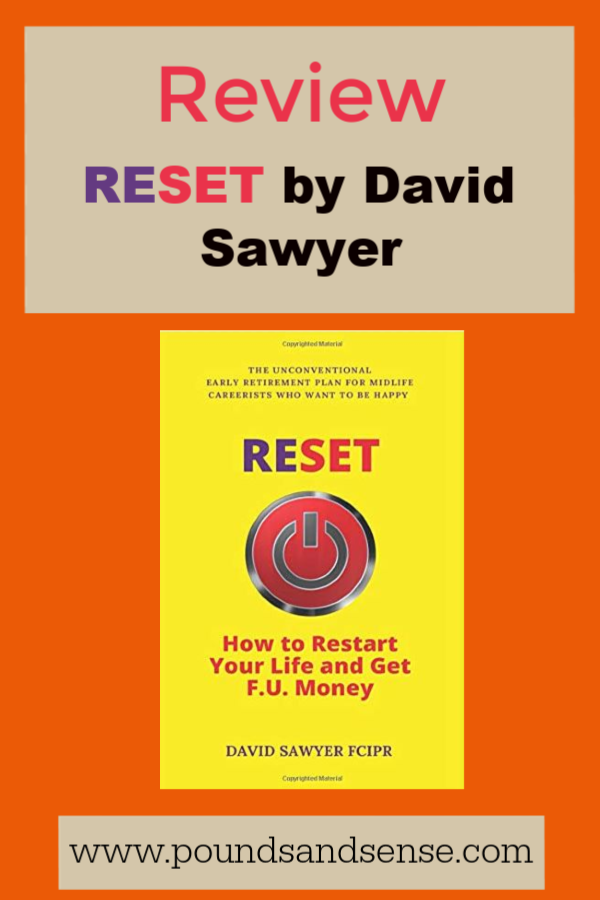
RESET is book aimed at mid-life professionals who feel as if they are in a rut and and want to get their lives back under control. I was kindly offered a review copy by the author, David Sawyer, so here are my thoughts about it…
The full title of the book is RESET: How to Restart Your Life and Get F.U. Money. By the latter, David means enough money so that you can say – er – “So long” to your employer if your job is causing you undue stress. The book does, though, emphasize that RESET doesn’t necessarily involve quitting your job, if you enjoy it and it is aligned with your personal goals and values.
RESET is available from Amazon in both hard copy and Kindle e-book versions. The printed version – which I received – amounts to quite a substantial 337 pages (plus a further 34 pages of preliminaries with Roman numbering!). The bulk of the book is arranged in six main sections, as follows:
1. What Matters to You?
2. Going Digital: How to Future-Proof Your Career
3. De-Clutter Your Life
4. Getting F.U. Money – a Plan
5. 11 Core Principles to Guide You in Work and in Life
6. 12 Do’s and Don’ts
Each section is divided into chapters. Part 4, Getting F.U. Money – a Plan, is the longest by some way and divided into 17 chapters. David is a PR professional, and as you might expect his book (which is published under the imprint of his PR company) is well written and presented.
RESET promotes, broadly speaking, the philosophy advocated by the FIRE movement. FIRE stands for Financial Independence, Retire Early. FIRE has been largely driven by some influential (mainly US-based) online bloggers.
The general idea of FIRE is that you seek to achieve financial independence at as early an age as possible, by simplifying your life, living more frugally, saving money and investing. The aim is to build up a substantial ‘pot’ of money that you can then use to buy yourself time and freedom. The ultimate aim – in many cases anyway – is to give up your job and retire early.
That doesn’t mean just joining the pipe and slippers brigade, though. It will typically involve spending more time enjoying life with loved ones, and working on projects that you enjoy and are important to you. These might involve anything from starting your own business to pursuing a hobby or interest, learning a new skill to doing voluntary work for a cause close to your heart.
As a money blogger myself I was familiar with quite a few of the concepts set out in the book, but David has done an impressive job of researching them and bringing them together in a highly accessible (and entertaining) way. As a semi-retired 62-year-old freelance writer I am not really in David’s main target readership, but I did still pick up some valuable tips and resources that I shall be using in my own life.
If you are a mid-career professional (roughly speaking between 35 and 60) and feeling stuck in a rut, this book will open your eyes to a range of strategies for regaining control of your life. You may not agree with every piece of advice David offers (I don’t share all his views about investment, for example) but you will almost certainly gain a lot of valuable, actionable tips and ideas. At the very least, it will open your eyes to a method that is increasingly being adopted by people on both sides of the Atlantic to take back control of their lives and achieve their long-term goals.
As always, if you have any questions or comments about RESET, please do post them below.
Disclosure: This post includes affiliate links. If you click through and make a purchase, I may receive a commission for introducing you. This will not affect the price you are charged or the terms you are offered.
If you enjoyed this post, please link to it on your own blog or social media:
Today I’m looking at another possible way of saving for retirement, the Lifetime ISA (or LISA for short).
LISAs were launched in April 2017 with the aim of encouraging younger people to save. Despite some rumours they might be changed or even abolished, in his budget yesterday Chancellor Philip Hammond left them untouched. That’s good news, as LISAs offer some attractive bonuses and tax advantages for savers. They do have one big drawback for older people, though – you have to be under the age of 40 (though over 18) to open one.
Of course, I know many readers of this blog are older than that – but even if you are, this saving scheme may still be relevant to your children or grandchildren. So here are the basics you need to know…
Understanding LISAs
LISAs are designed for two specific purposes: buying your first home and saving for retirement.
How they work is that you can pay in up to £4,000 a year (lump sums or regular contributions) and the government will top this up with another 25%. As long as you open your LISA before the age of 40 you will continue to receive the bonuses on your contributions until you reach 50.
So if you pay in the maximum £4,000 in a year, the government will top this up to £5,000. If you pay in the full £4,000 every year from the age of 18 to the upper limit of 50, you will therefore get a maximum possible bonus from the government of £32,000.
LISAs are available from a small but growing number of providers (see below). As with ordinary ISAs, you can choose a cash LISA or a stocks and shares LISA (though not yet an innovative finance LISA). Note that the money you invest in a LISA counts towards your annual ISA allowance, which in 2018/19 (and also it’s just been announced 2019/20) is £20,000. So if you were to invest the maximum £4,000 in a LISA this year, you would be able to invest a maximum of £20,000 – £4,000 = £16,000 in an ordinary cash ISA, stocks and shares ISA and/or IFISA.
Your money will grow without any tax deductions in a LISA, and you can also withdraw without having to pay tax (though see below for restrictions).
Where Can You Get a LISA?
There are about a dozen LISAs on the market at present. There are three cash LISAs, available from the Skipton Building Society, Nottingham Building Society and Newcastle Building Society. The latter has only just launched and pays the highest interest rate of 1.10 percent at the time of writing, paid monthly.
If you’re using a LISA to save long term for retirement, a stocks and shares LISA will probably be a better option. Providers of stocks and shares LISAs include Hargreaves Lansdown, The Share Centre, and the online-only Nutmeg. I wrote about my experiences investing in a stocks and shares ISA with Nutmeg in this blog post.
So What’s the Catch?
Unfortunately, there are several.
One is that (as mentioned above) you can only use the money in your LISA for one of two purposes – paying a deposit on your first home or saving for retirement.
While you can access your money for other reasons, you will then lose 25% of the total, including your own contribution and the government bonus along with any investment growth. That means in many cases you will get back less money than you put in. (There is one exception to this rule, which is that you can withdraw all the money without deductions if you are terminally ill with less than 12 months to live.)
Also, unless you’re buying a first home, you can’t withdraw your money without penalty until you reach the age of 60 – unlike workplace and personal pensions, which you can access unrestricted from 55 onwards.
Another drawback may be that unlike pensions, money in a LISA will count if you have to apply for any means-tested benefits. So you could be required to withdraw your LISA savings (paying the 25% penalty) and live off those until your savings are below the means-testing threshold. LISAs also count as assets in bankruptcy or divorce cases.
Pensions Versus LISAs
For most people, pensions are likely to be their first and best choice for retirement saving.
A workplace pension in particular will benefit from employer contributions as well as tax rebates from the government. That combination is hard to beat, especially if you pay tax at the higher rate. Definitely don’t opt out of your workplace pension in favour of a LISA.
Nonetheless, if you have some spare cash you can afford to save in addition to your pension, opening a LISA is worth considering. It’s also a decent option if you don’t have a workplace pension – perhaps due to being self-employed – and you don’t pay higher-rate tax.
In any event, if you want a LISA and are approaching 40, don’t hang about. You can open a LISA for as little as a pound, and can continue to make contributions and receive the government top-ups till you are 50. The money will then carry on growing in your LISA and provide a nice little nest-egg for your 60th birthday!
As always, if you have any comments or questions, please do post them below.
If you enjoyed this post, please link to it on your own blog or social media:
The article includes advice on managing your money in later life from a number of UK money bloggers, including yours truly. As a matter of interest, here are the tips I provided, both of which are quoted in the article.
What would your main advice be for an older person wanting to manage their money well?
Don’t bury your head in the sand where money matters are concerned. Keep a close eye on your income and expenditure, and always be on the lookout for ways you can maximize the former and minimize the latter.
Just one example – use a comparison service such as Uswitch.com to see if you could save money on your energy and other utility bills. By switching to cheaper suppliers you could save hundreds of pounds a year for just an hour or two spent on the computer.
What financial mistakes do you think are most common for older people and what can be done to avoid them?
Sometimes with older people pride gets in the way of asking for help and support. That’s understandable, and in its way admirable. But for older people (especially those on low incomes) there are various welfare benefits they may be able to apply for – from Pension Credit and Council Tax Reduction to Attendance Allowance and Warm Home Discount. Nobody will come knocking on your door offering them, though! You need to be proactive about researching what you may be eligible for, perhaps using an online service such as www.entitledto.co.uk. Don’t then let misguided pride prevent you from applying. This is money set aside by the state for people in your situation and can potentially make later life a lot more comfortable for you.
I hope you enjoy reading the article – here’s the link again – and find the tips (including mine!) helpful. As always, if you have any comments or questions, please do post them below.
If you enjoyed this post, please link to it on your own blog or social media:
Today I’m focusing on self-storage. This is hugely popular in the UK, which has nearly half the self-storage sites in Europe (according to their trade body, the Self Storage Association UK).
People use self-storage for all sorts of reasons. They include moving home, when you may have to store your furniture and possessions for a short period. It also includes moving in with a partner, when you need to store some items temporarily until you decide what to do with them (do you really need two washing machines, for example).
Another common reason is people moving abroad – perhaps on a one- or two-year work contract – and needing somewhere safe to store their belongings until they return.
Self-storage can be particularly attractive to older people, such as many readers of this blog. Perhaps you’re downsizing and don’t have room for all your belongings in your new home. Or you may simply have accumulated a large number of possessions over your lifetime and need somewhere away from your home to store them, so you don’t run out of space! You might also have things that for one reason or another – e.g. their size or value – you don’t want to carry on storing at home.
As mentioned above, UK residents are fortunate to have lots of options when it comes to self-storage, and it is of course important to shop around for the best price for the service you require.
A recent study by mystery shopping company ProInsight highlighted the particular importance of shopping around for insurance, however. In particular, it highlighted the importance of not automatically choosing the insurance offered by the self-storage company itself. More about this shortly.
Self-Storage Insurance
If you are going to use self-storage, contents insurance is normally compulsory. This will cover loss or damage to your stored contents caused by anything from water/oil leaks to attempted theft. Some household contents policies cover this, but the majority don’t, especially if the items will be in storage over a lengthy period.
All self-storage providers offer insurance, typically by arrangement with a particular insurance company or broker. What many people don’t realise, however, is that you can also insure your belongings separately, perhaps using an online insurance provider. As we shall see, potentially large savings can be made this way.
Mystery Shopping Research
The ProInsight study mentioned above used mystery shoppers to get quotes from 165 self-storage branches across the UK, covering 70 firms in total. They were chosen to provide a representative sample of self-storage providers, including large and small, general and specialist, business- and consumer-oriented. They included branches of all the top five self-storage companies in the UK: Safestore, Big Yellow Self Storage, Access Self Storage, Shurgard Self-Storage and Lok’nStore.
The results were eye-opening, to say the least. In all but one case, savings could be made by using a third-party online insurer. In many cases these savings were substantial. For example, a Big Yellow branch in Bromley quoted a figure of £340.20 for a policy covering £5,000 worth of goods for three months. The same risk could be insured for between £21.30 and £44.85 elsewhere.
Richard Hannan of Surewise.com, the insurance company who commissioned the ProInsight study, said: “We were amazed to find that storage companies were charging an average of three times more for the same or very similar policies. Some of the prices that were being charged were highly alarming and in fact, we struggled to find a single self-storage company that was selling insurance for less than their online competitors.
“This means 99% of people who are insuring with their storage units will make savings by spending a few minutes online, and possibly considerable savings at that.”
It follows that if you are using self-storage over a long period, you could end up paying hundreds or even thousands of pounds more in insurance costs if you stick with the cover offered by your self-storage provider.
Obviously it’s important to compare like with like, and the self-storage companies have argued in their defence that online policies don’t always offer the same level of protection as their own. However, Richard Hannan said, “We have always covered a lot of these areas, such as water and oil damage, and ‘new for old’ but our new policies which are underwritten by SAGIC, have added all these additional cover areas such as moth, subsidence or sprinkler damage to combat these messages back from the storage units. SAGIC are The Salvation Army General Insurance Corporation.”
Surewise.com
The ProInsight study mentioned above found that in many (though not all) cases, the lowest cost online insurance cover provider was Surewise.com. Their Household and Business Self-Storage Insurance covers you against loss or damage to stored contents in the event of:
Natural disasters, including lightning, earthquake, storm, flood and weight of snow
Fire and explosion
Leaking water/liquid from fixed water tanks and pipes
Theft and attempted theft, with proof of violent breaking and entering (e.g. broken lock)
Falling trees, telegraph poles and lamp posts
Collision by any vehicle or animal
Impact by aircraft and other flying devices or items dropped from flying aircraft
Rioters, violent disorders, strikes, labour disturbances, civil commotion and malicious acts
Surewise.com say they will replace or repair any stored items damaged (with repair or replacement at their discretion). They provide an instant insurance certificate when you order online. If you are thinking of using self-storage, it is well worth checking their website to see how much you could save.
Summing Up
If self-storage is something you plan to use, be sure to shop around. There are lots of options in the UK, so take some time to research the market and find out which is best for your needs.
In addition – and very importantly – DON’T just accept the insurance offered you by the self-storage company. Assuming your ordinary home contents insurance doesn’t cover you, get quotes from online insurers such as Surewise.com. The great majority of self-storage companies allow customers to use third-party insurers, and in many cases you can save large sums by doing so, especially if you plan to use self-storage long term.
If you have any comments or questions about this article, as always, please do post them below.
Disclosure: This is a sponsored post on behalf of Surewise.com, from whom I am receiving a fee.
If you enjoyed this post, please link to it on your own blog or social media: