
insurance

Protect Your Loved Ones With Bespoke Life Insurance

Protect Your Loved Ones with Bespoke Life Insurance

Life insurance isn’t the most exciting of subjects, but in these uncertain times it’s something we all need to think about.

Not everyone requires life insurance. If you are single with no dependants and/or on a very low income, it may not be necessary or appropriate for you. But if you have a partner, children or other relatives who depend on your income, you probably should have life insurance to help provide for them in the event of your death.

What Is Life Insurance?

Life insurance is a type of insurance policy that protects your loved ones financially if you die. It can help minimize the financial impact that your death could have on your family and provide peace of mind for you and them.

Most life insurance policies are designed to pay a cash sum to your loved ones if you die while covered by the policy. This can help them cope with everyday money worries such as mortgage payments, household bills and childcare costs. It may also cover funeral costs. You can take out life insurance under joint or single names, and you can pay your premiums monthly or annually.

There are two main types of life insurance: term life insurance and whole of life insurance.

Term life insurance policies run for a fixed period such as 10, 20 or 25 years. These types of policy only pay out if you die during the term of the policy. A whole-of-life policy, on the other hand, pays out no matter when you die (as long as you keep up with your premium payments, of course).

There are three different types of term life insurance. With decreasing term insurance, the amount payable on death reduces over time. This type of policy is often taken out in conjunction with a mortgage as the payout reduces over time in line with the amount needed to clear the outstanding debt.

You can also get increasing term insurance, where the payout rises each year (typically to take account of inflation) and level term insurance, where it remains the same throughout. Not surprisingly, level term and (especially) increasing term policies are more expensive than decreasing term.

What Doesn’t It Cover?

Life insurance normally pays out only on death. If you become unable to work due to an accident or illness, you won’t generally be covered.

Some life insurance policies will pay out if you receive a terminal diagnosis. This is by no means always the case, though, so it’s important to check the wording of your policy carefully.

Most life insurance policies also have some exclusions, e.g. they might not pay out if you die from alcohol or drug abuse. In addition, if you take part in risky sports, you may have to pay a higher premium. If you have a serious health problem when you take out a policy, any cause of death related to that illness may be excluded.

For the above reasons, you may also want to consider taking out critical illness cover. This covers you if you get one of the medical conditions or injuries specified in the policy. Some examples of critical illnesses that might be covered include heart attack, stroke, cancer, and chronic, life-limiting conditions such as multiple sclerosis and MND. Most policies will also consider permanent disabilities as a result of injury or illness. These policies only pay out once and then the policy ends. Some policies will make a smaller payment for less severe conditions, or if one of your children contracts one of the specified conditions. Health conditions you knew you had before you took out the insurance won’t generally be covered.

What Does It Cost?

Life insurance can be surprisingly good value. Premiums start at just a few pounds a month. Prices vary a lot, however, so it’s important to shop around and take advice as appropriate.

A variety of factors may affect the price you are quoted. They include the following:

  • your age
  • your health
  • your weight
  • your occupation
  • your lifestyle
  • whether you smoke
  • your medical history
  • your family’s medical history
  • the length of the policy
  • the amount of money you want to cover
  • whether you want decreasing, level or increasing term cover

Other things being equal, the younger and healthier you are, the cheaper your policy is likely to be. But as the list above indicates, many other factors can affect the price you are quoted. In addition, women are typically charged a little less than men, as on average they live a few years longer.

The Bespoke Option

As you can see, while life insurance is a simple concept, in practice there are many variations. It is therefore important to establish what is the most appropriate option for you and your family, and shop around to get the best price for this.

A company that can help with both these things is Bespoke Financial. They are independent insurance and mortgage brokers, and will take the time to establish your exact requirements and design a ‘bespoke’ package to suit you and your family’s needs. Their trained advisers will visit you in your home (with all necessary Covid precautions) or you can speak on the phone to them. They can arrange all types of life insurance, critical illness cover, cover for long-term illness or disability, and so on.

To get an initial personalized quote, click through to the Life Insurance page of their website and answer six quick questions. You can then discuss this with an adviser to ensure you will be getting exactly the right type and level of cover for your needs.

  • And as an added bonus for readers of my blog, you can get a free will just by asking for a quotation. You can’t say fairer than that, now can you?

As always, if you have any comments or questions on this post, please do leave them below.

Disclosure: This is a sponsored post on behalf of Bespoke Financial. If you click through one of the links and end up making a purchase, i will receive a commission for introducing you. This will not affect in any way the product or service you receive.

If you enjoyed this post, please link to it on your own blog or social media:
Hiro review

Win a £5 Amazon Voucher (or Other Mystery Prize) With Hiro

Hiro is a brand new new mobile phone app currently offering a range of incentives just for downloading it and answering a few quick questions about the smart tech you have in your home.

Hiro say that in future they plan to offer members personalized discounts on home insurance and similar products based on their home technology – from Amazon Alexa devices to smart thermostats, doorbell cameras to smart locks.

Right now, though, there is nothing to buy. They are simply looking to build a community of people who may be interested in saving money on insurance in future. And to do this they are offering gifts for downloading the app and signing up. These range from £5 Amazon gift vouchers to £5/£10 Hiro credits, and lots of other weird and wonderful things as well. Here’s how it works…

Grab Your Free Prize

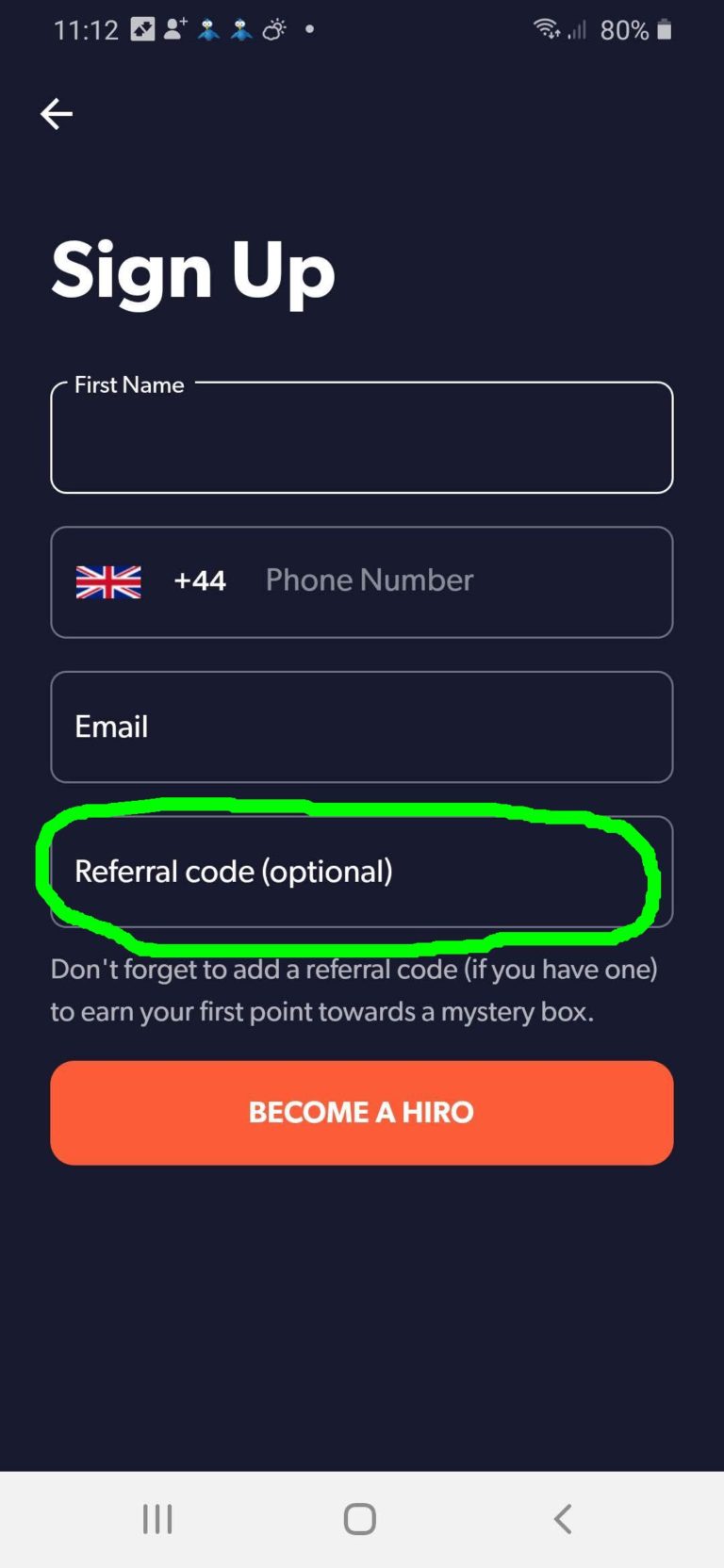
Start by downloading the Hiro app from Google Play or the Apple Store. Open the app and here is what you should see…

Hiro signup

Enter your first name, (mobile) phone number and email address in the appropriate boxes. Where it says ‘Referral code’ (highlighted above) please enter nic637, then tap on ‘Become a Hiro’.

You will then be presented with a short questionnaire about your use of smart tech in the home. When I did this, the app told me that with my modest complement I would be eligible for a 17% discount on my home insurance. That’s nice to know, though of course it won’t mean much until Hiro start selling actual insurance.

They say as well that even if you don’t currently have any smart technology, they will be making recommendations and special offers, and explaining the extra discounts the tech in question can bring you.

In addition, once you’ve answered the questions, we will BOTH be eligible for a prize (or mystery box, as they call it). Here’s the screen you should see…

Hiro prize

Just tap on the the orange box (see screen capture above) to see what you have won.

Of course, once you have signed up you will get a personalized link as well and be able to share this with friends and family. Any time someone signs up using your link, both of you will win a prize. As I said above, there is nothing to buy now and no obligation in future.

Good luck, and I hope you win something almost as exciting as a mansion full of puppies 🤣🤣🤣

As always, if you have any comments or questions about this post, please do leave them below..

Update 19th May 2020 – I have just heard that Hiro aren’t offering Amazon vouchers as prizes at the moment. Other prizes such as Hiro credits are still on offer.

If you enjoyed this post, please link to it on your own blog or social media:
Guest Post: You Must Claim PPI Before August 2019

Guest Post: You Must Claim PPI before August 2019

There are under five months left for consumers to reclaim Payment Protection Insurance (PPI). 29th August 2019 is the official cut-off date for all people to submit PPI claims to their banks. This date was chosen by the Financial Conduct Authority (FCA) to encourage those who have not yet made claims to do so.

Since the announcement of the deadline nearly two years ago, thousands of people have made successful PPI claims. With the deadline approaching, if you haven’t yet submitted a claim, you must act now before August.

Do You Have a PPI policy?

The first thing to establish is whether you had a PPI policy. Most PPI policies were sold in the 1990s alongside mortgages, loans and credit cards, but some successful cases date back to the 1980s. As a general rule, the older the policy, the harder it can be to prove you were mis-sold PPI.

You may remember being mis-sold a policy. If this is the case, you will need to find the old paperwork with evidence of this. If you can’t remember whether you had a policy, old statements and documents should be able to highlight if this is the case.

On the paperwork, PPI may be listed under a few different names. Here are just a selection of the other names for PPI (this list is not exhaustive):

  • Accident, Sickness and Unemployment (ASU)
  • Account cover
  • Loan protection
  • Payment cover

If you can’t remember whether you had a PPI policy or you can’t locate the paperwork, there are a couple of ways to find out. You can either contact the bank or lender and ask if they have a record of any PPI policies attached to your previous accounts, or you can use the services of a PPI claims company.

There is no guarantee that the bank will have a record of previous PPI policies, but if they do confirm a policy, you can then submit a PPI claim. Alternatively, a claims company can investigate any old accounts and seek to identify policies on your behalf.

Claim PPI before August

Once you find evidence of your PPI policy, it’s time to make a claim. Again, there are two different ways to submit a PPI claim. You can make a claim yourself by contacting the bank or lender that mis-sold you the policy or ask a reputable PPI claims company to do it for you.

Whether you submit a claim yourself or use a PPI claims company, you must explain how the policy was mis-sold to you. Here are just a few ways that policies were mis-sold to customers:

  • You were told it was compulsory with your credit card, loan or mortgage purchase
  • You weren’t told about the policy — it was added automatically and without your knowledge and consent
  • The terms and conditions were not explained — this includes not being asked about medical conditions and employment
  • You were promised a lower price if you bought the PPI policy

If any of these apply to you, you could be eligible for a refund. You may also be eligible for a refund if you were charged a high level of commission. Due to a landmark PPI case, individuals can claim PPI if a policy had over 50% commission and this was not disclosed — even if you knowingly bought a PPI policy. This is known as the Plevin rule and means thousands’ more people can make PPI claims.

Some banks allow you to claim PPI online by submitting a form (though you may need to also send evidence with your application). For others, you will need to write a letter and complete any relevant paperwork. Once the bank has acknowledged your claim, it should respond with an outcome within eight weeks. However, be aware that some cases can take longer, especially if they’re older or more complex.

The alternative option is to use the services of a PPI claims company. Some essential details will be required for them to act on your behalf, but they will handle all communication with the bank. If you don’t have the time or don’t want to deal with the process yourself, it can be beneficial using a claims company. Always check the fees involved and read the terms and conditions.

What if Your Claim Is Rejected?

If your claim is successful, you’ll receive notification from the bank and receive the payment shortly afterwards. If, however, the bank rejects your claim, but you think that the decision is wrong, you can refer it to the Financial Ombudsman Service (FOS). The FOS will independently review your PPI case and either uphold the decision made by the bank or decide that you are due the PPI refund. It’s important to be aware that PPI claims at the FOS can take up to two years to be resolved due to a severe backlog.

Whether you remember having PPI or not, now is the time to check. In four months, you will no longer have the chance to reclaim PPI. Act now before it’s too late.

Disclosure: This is a sponsored guest post on behalf of Canary Claims.

If you enjoyed this post, please link to it on your own blog or social media:
How I Saved £179.43 on my Home Emergency Cover

How I Saved £179.43 on my Home Emergency Cover

Stop me if you’ve heard this before, but I just realised that I have been paying well over the odds for another of my home insurance policies. This time it is my Home Emergency Cover.

To put you in the picture, soon after I moved into my current home with my now-deceased partner Jayne in March 1995, we decided to take out emergency plumbing and drainage insurance with a company called Homeserve.

We were strongly influenced at the time by a promotional leaflet enclosed with the water bill which indicated that if there was a problem with the water supply pipe from the mains, the water company wouldn’t be responsible and we could face a large bill to have it fixed.

Homeserve were offering a policy that would cover us in these circumstances and for other plumbing-related emergencies. Rightly or wrongly, we felt at the time it made sense to pay for this, especially as the company seemed to be endorsed by our water supply company (South Staffs Water).

We paid for the policy by quarterly direct debit and each year it rolled over, generally with a small increase. I looked after our household finances but never really thought much about this. The sums involved weren’t huge, and I assumed it was worth paying them for the peace of mind. As far as I can remember, we never actually made a claim on the policy.

Fast forward to 2019, and after taking stock of my buildings and contents insurance (and saving over £500 on it), I decided the time had come to put my home emergency cover under the microscope as well and see if there were any savings I could make. And again, there certainly were!

Doing the Sums

In December 2018 Homeserve said my insurance would be going up from £198 to £222 per year, working out as £55.50 per quarter (to be fair to Homeserve there was no extra charge for payment by instalments).

So I went online to see what alternatives there were for plumbing and drainage insurance. I did a search for home emergency cover providers on Top Cashback (a website that provides money back to people buying via merchants listed on the site – see this post for more details).

I could immediately see a few possibilities for saving money. Even allowing for the cashback on offer with TCB, though, the best deal I found was with another company called Home Emergency Assist. HEA offer a wide range of policies, some of which also include gas and electrics, pest removal, boiler servicing, and so on.

Obviously you have to be sure you are comparing like with like. With Homeserve I was on their Plumbing and Drainage Plus policy, which covered me for emergencies with the internal plumbing and external water supply pipes. There was a maximum limit of £4,000 per claim.

With HEA I could have bought water supply pipe and stop cock cover only, for a price (according to their website) from £1.49 a month or just under £18.00 a year. For a policy similar to Homeserve’s which also covered me for internal plumbing problems, I was quoted £42.57 a year. This is obviously a lot less than Homeserve’s price, and there was also a higher maximum limit of £5,000 per claim.

Admittedly Homeserve’s policy included zero excess, whereas the HEA quote mentioned had a £95 excess per claim. I was happy to accept that, but for the purposes of a fair comparison I checked their price for a policy with zero excess as well and this was £87.89 a year – still £134.11 cheaper than Homeserve quoted (and with a larger maximum claim limit).

So I cancelled my Homeserve policy, and (after a few more checks including reading their Trust Pilot reviews) have signed up with Home Emergency Assist instead. As I accepted the £95 excess, I shall be paying £42.57 a year, which as stated above is £179.43 less than I would have been charged by Homeserve.

I have, incidentally, nothing against Homeserve, but for me anyway their offer no longer represented value for money. Neither am I especially endorsing Home Emergency Assist. Although they offered the best price I could find for my needs, you might of course do even better by shopping around.

In any event, the real moral of this story (as I’ve said before) is not to let laziness and inertia ever stop you looking for better deals. Even with something as mundane and relatively cheap as home insurance, you may be as surprised as I was by how much money you can save.

  • You can search on Top Cashback for home insurance providers (all offering cashback) by clicking on this link (affiliate). If you aren’t already a member you will need to register to get cashback, but this is free and only takes a few moments.

As ever, if you have any comments or questions on this post, please do leave them below.

If you enjoyed this post, please link to it on your own blog or social media:
How I Saved £511.08 on my Annual Home Insurance

How I Saved £511.08 on My Annual Home Insurance

This is a somewhat embarrassing post to write as a money blogger. However, I recently realised that I have been paying well over the odds for my home insurance for some years. And now that I have addressed the issue, I am actually quite staggered by how much money I will be saving.

To explain, I moved into my current home with my partner Jayne (now sadly deceased) in March 1995. With all the things we had to consider at the time we didn’t pay much attention to home insurance. We took out home contents insurance with Lloyds and buildings insurance with our mortgage lender Britannia. The latter had a special deal for members of the trade union Unison (which Jayne was in at the time), so we thought it must represent good value.

We paid for both policies via monthly direct debit and each year they rolled over, generally with a small increase. I always looked after our household finances but never really thought much about the home insurance. The sums weren’t huge, and I just assumed we were getting a good deal so it wasn’t worth worrying about.

Fast forward to January 2019, and Britannia wrote saying they were no longer offering buildings insurance and I would need to make alternative arrangements. At about the same time I got a letter from Lloyds saying my contents insurance was going up from £147.80 a year to £184.73 (a pretty steep increase in percentage terms). So I decided the time had come to pay my home insurance a bit more attention and see if there were any savings I could make by shopping around. And boy, there certainly were!

Doing the Sums

At the start of this year my buildings insurance premiums were £32.05 a month, which works out as £384.60 a year. Adding that to the latest quote from Lloyds of £184.73 gives a total annual home insurance bill of  £569.33.

A bit of online research revealed that nowadays many people get their buildings and contents insurance in a single policy and this generally works out more economical. So I did a search for home insurance providers on Top Cashback (a website that provides money back to people buying via merchants listed on the site – see this post for more details).

To cut a long story short, I wound up buying a combined buildings and contents policy from AA Insurance, with essentially the same cover I had before, for an annual premium of just £100.25. And with that I got £42 cashback via Top Cashback, effectively reducing the price to just £58.25. That represented a massive £511.08 less than I would have been paying in total on my old home insurance policies.

The AA Insurance website said that this was a special new customer deal, so I guess they might push the price up a bit next year. But of course, now that I’ve done it once, I will definitely shop around for prices (and cashback!) again when the time comes.

So the moral of this story is not to let laziness and inertia ever stop you looking for better deals. Even with something as mundane and relatively cheap as home insurance, you may be as surprised as I was by how much money you can save!

  • You can search on Top Cashback for home insurance providers and price comparison services (all offering cashback) by clicking on this link (affiliate). If you aren’t already a member you will need to register to get cashback, but this is free and only takes a few moments.

As ever, if you have any comments or questions on this post, please do leave them below.

If you enjoyed this post, please link to it on your own blog or social media:
Why You MUST shop around when buying Self-Storage Insurance

Why You MUST Shop Around When Buying Self-Storage Insurance

Today I’m focusing on self-storage. This is hugely popular in the UK, which has nearly half the self-storage sites in Europe (according to their trade body, the Self Storage Association UK).

People use self-storage for all sorts of reasons. They include moving home, when you may have to store your furniture and possessions for a short period. It also includes moving in with a partner, when you need to store some items temporarily until you decide what to do with them (do you really need two washing machines, for example).

Another common reason is people moving abroad – perhaps on a one- or two-year work contract – and needing somewhere safe to store their belongings until they return.

Self-storage can be particularly attractive to older people, such as many readers of this blog. Perhaps you’re downsizing and don’t have room for all your belongings in your new home. Or you may simply have accumulated a large number of possessions over your lifetime and need somewhere away from your home to store them, so you don’t run out of space! You might also have things that for one reason or another – e.g. their size or value – you don’t want to carry on storing at home.

As mentioned above, UK residents are fortunate to have lots of options when it comes to self-storage, and it is of course important to shop around for the best price for the service you require.

A recent study by mystery shopping company ProInsight highlighted the particular importance of shopping around for insurance, however. In particular, it highlighted the importance of not automatically choosing the insurance offered by the self-storage company itself. More about this shortly.

Self-Storage Insurance

If you are going to use self-storage, contents insurance is normally compulsory. This will cover loss or damage to your stored contents caused by anything from water/oil leaks to attempted theft. Some household contents policies cover this, but the majority don’t, especially if the items will be in storage over a lengthy period.

All self-storage providers offer insurance, typically by arrangement with a particular insurance company or broker. What many people don’t realise, however, is that you can also insure your belongings separately, perhaps using an online insurance provider. As we shall see, potentially large savings can be made this way.

Mystery Shopping Research

The ProInsight study mentioned above used mystery shoppers to get quotes from 165 self-storage branches across the UK, covering 70 firms in total. They were chosen to provide a representative sample of self-storage providers, including large and small, general and specialist, business- and consumer-oriented. They included branches of all the top five self-storage companies in the UK:  Safestore, Big Yellow Self Storage, Access Self Storage, Shurgard Self-Storage and Lok’nStore.

The results were eye-opening, to say the least. In all but one case, savings could be made by using a third-party online insurer. In many cases these savings were substantial. For example, a Big Yellow branch in Bromley quoted a figure of £340.20 for a policy covering £5,000 worth of goods for three months. The same risk could be insured for between £21.30 and £44.85 elsewhere.

Richard Hannan of Surewise.com, the insurance company who commissioned the ProInsight study, said: “We were amazed to find that storage companies were charging an average of three times more for the same or very similar policies. Some of the prices that were being charged were highly alarming and in fact, we struggled to find a single self-storage company that was selling insurance for less than their online competitors.

“This means 99% of people who are insuring with their storage units will make savings by spending a few minutes online, and possibly considerable savings at that.”

It follows that if you are using self-storage over a long period, you could end up paying hundreds or even thousands of pounds more in insurance costs if you stick with the cover offered by your self-storage provider.

Obviously it’s important to compare like with like, and the self-storage companies have argued in their defence that online policies don’t always offer the same level of protection as their own. However, Richard Hannan said, “We have always covered a lot of these areas, such as water and oil damage, and ‘new for old’ but our new policies which are underwritten by SAGIC, have added all these additional cover areas such as moth, subsidence or sprinkler damage to combat these messages back from the storage units. SAGIC are The Salvation Army General Insurance Corporation.”

Surewise.com

The ProInsight study mentioned above found that in many (though not all) cases, the lowest cost online insurance cover provider was Surewise.com. Their Household and Business Self-Storage Insurance covers you against loss or damage to stored contents in the event of:

  • Natural disasters, including lightning, earthquake, storm, flood and weight of snow
  • Fire and explosion
  • Leaking water/liquid from fixed water tanks and pipes
  • Theft and attempted theft, with proof of violent breaking and entering (e.g. broken lock)
  • Falling trees, telegraph poles and lamp posts
  • Collision by any vehicle or animal
  • Impact by aircraft and other flying devices or items dropped from flying aircraft
  • Rioters, violent disorders, strikes, labour disturbances, civil commotion and malicious acts

Surewise.com say they will replace or repair any stored items damaged (with repair or replacement at their discretion). They provide an instant insurance certificate when you order online. If you are thinking of using self-storage, it is well worth checking their website to see how much you could save.

Summing Up

If self-storage is something you plan to use, be sure to shop around. There are lots of options in the UK, so take some time to research the market and find out which is best for your needs.

In addition – and very importantly – DON’T just accept the insurance offered you by the self-storage company. Assuming your ordinary home contents insurance doesn’t cover you, get quotes from online insurers such as Surewise.com. The great majority of self-storage companies allow customers to use third-party insurers, and in many cases you can save large sums by doing so, especially if you plan to use self-storage long term.

If you have any comments or questions about this article, as always, please do post them below.

Disclosure: This is a sponsored post on behalf of Surewise.com, from whom I am receiving a fee.

If you enjoyed this post, please link to it on your own blog or social media: