
pensions

Pension Credit

Here’s Why Older Pensioners Especially Should Apply for Pension Credit

Updated 30 July 2024

Today I’m focusing on pension credit.

According to the government’s own figures, around a third of retirees who would be entitled to this state benefit aren’t currently claiming it. That means they are potentially missing out on an important boost to their pension.

Even more significantly, it means they may be missing out on a raft of other benefits and discounts too, for which pension credit acts as a gateway. More about this shortly.

Applying for pension credit is especially crucial for people who reached retirement age before April 2016 and therefore receive the old basic state pension rather than the new (higher) one. While it may seem (and indeed be) unfair that older pensioners receive a lower rate, they do have the opportunity to claim the savings credit element of pension credit, which newer retirees don’t.

Savings credit payments can provide an extra boost to your income and entitle you to other payments and benefits as well. And, very importantly, the eligibility rules are different from guarantee credit and (in my view anyway) a bit less stringent. But if you don’t apply for pension credit, you won’t get either.

But before we get into that, let’s recap on what pension credit is.

What is Pension Credit?

Pension credit is a state benefit that comes in two parts: guarantee credit and savings credit.

Guarantee credit boosts your weekly income to £182.60 if you’re single or £278.70 if you’re a couple (figures correct from 6 April 2023). You should be eligible for guarantee credit if you have reached state pension age and your total income is less than these amounts (even if you own your own home).

If you have under £10,000 in savings and investments this will not be taken into consideration. If you have over £10,000, it will be assumed that you earn £1 a week per £500 of savings and investments. This will be added to your total income when working out your eligibility for guarantee credit.

Savings credit is only available to people who reached the state pension age before 6 April 2016. It is meant as a reward for those who have made some additional provision for their retirement. It’s worth up to £15.94 a week for a single person or £17.84 for couples (2023/24 figures). Somewhat counter-intuitively, to qualify you must have a minimum income of £174.49 a week if you’re single and £277.12 a week for a couple (again 2023/24 figures). You must also have some savings or other extra income provision (e.g. a private pension).

It’s worth adding that if you pay mortgage interest or have other housing costs, have caring responsibilities, are responsible for a child, or are severely disabled, you may be entitled to more pension credit. If you receive attendance allowance or carers credit, for example, this may boost the amount that you’re entitled to.

The rules surrounding all this are complicated, but the government has provided a free online calculator you can use to work out whether you qualify and how much you might get. This is for guidance only, however. You can’t apply via the calculator and there is no guarantee you will receive the amount it shows you.

Until recently to actually apply for pension credit you had to phone the DWP’s pension credit helpline on 0800 991234 with your Nl number, details of your income, savings and investments, and your bank account details. The person you spoke to would then then take you through the application process. This option is still available, but recently an option to apply online has been added. This is quite separate from the free online calculator mentioned above.

As I recently helped an elderly friend do this, I can confirm that the online method works well, though the questions asked don’t entirely correspond with the questions on the free online calculator. But using the latter first should give you an idea whether you are likely to qualify for pension credit and how much you might get. You can also try the effect of changing the amount of capital/income in the calculator to see if you might qualify in future even if you don’t at present (perhaps due to having too much in savings).

Additional Benefits

As well as the money – which can amount to thousands of pounds a year – if you receive pension credit you will be entitled to a range of additional discounts and benefits. These may include:

  • reduced (or free) council tax
  • housing benefit
  • free TV licence if you are over 75
  • free NHS dental treatment
  • help towards the cost of glasses
  • help with the cost of travel to hospital
  • cold weather payments
  • automatic entitlement to the Warm Home Discount
  • free home insulation and boiler grants
  • extra money if you’re a carer
  • government cost of living payments
  • Winter Fuel Payments (as from winter 2024)

Even if you only receive a small amount of pension credit, you may be eligible for any of the above. So it really is important to apply if there is any chance you may qualify. 

More About Savings Credit

As I said above, only older pensioners who retired before April 2016 can get savings credit. But potentially a lot more people in this category may be eligible for it than is the case with guarantee credit.

Whereas guarantee credit is only paid to pensioners on a low income and with limited savings, that isn’t necessarily the case with savings credit. As I noted above, to qualify for savings credit there is actually a minimum earnings limit. And you do actually need to have some savings (or other income source/s apart from the state pension) to be eligible.

The rules are complicated, so – as I said above – the best thing is to use the free online calculator. If it appears you are eligible for savings credit (or guarantee credit) it will tell you, and how much.

It should be said that if you are only awarded savings credit and not guarantee credit, you may not qualify for all of the extra benefits mentioned above (free NHS dental treatment, for example). But even if, with savings credit only, you don’t qualify for the whole of the discounts mentioned, you may at least be eligible for a partial reduction.

Closing Thoughts

To sum up, if you’re of state pension age and have a limited income or savings, you should certainly look into pension credit. Similarly, if you have elderly friends or relatives, you should check eligibility on their behalf (with their permission, of course).

As I’ve said above, this applies especially to anyone who started receiving the state pension before April 2016 and is therefore getting the old basic state pension. This is lower than the new state pension, but you may potentially be eligible for the savings credit element of pension credit (as well as guarantee credit, which anyone of state pension age can qualify for).

While savings credit is generally only a small amount, receiving it will make you eligible for a range of other discounts and benefits, including (as from winter 2024) Winter Fuel Payments. So it really is well worth checking on the free online calculator and then applying (by phone or online) if it appears you might be eligible.

Finally, you might like to know that (thankfully) my friend’s online application was successful. He got a letter a week later saying that he would be receiving pension credit (savings credit only) at a rate of about £5 a week, rising to just over £6 a week the following April. Naturally he was pleased to hear this. And he was even more pleased when he realised he would be getting the other benefits and discounts mentioned earlier as well. As an 84-year-old man who has recently lost his wife, this will certainly help make life a little more bearable for him.

As always, if you have any comments or questions about this article, please do post them below. Just bear in mind that I am not a qualified financial adviser or benefits adviser and cannot provide personal financial advice. If you require specific advice or assistance, your local Citizens Advice office would be one good place to start.

If you enjoyed this post, please link to it on your own blog or social media:
My investments update February 2023

My Investments Update – February 2023

Here is my latest monthly update about my investments. You can read my January 2023 Investments Update here if you like

I’ll begin as usual with my Nutmeg Stocks and Shares ISA. This is the largest investment I hold other than my Bestinvest SIPP (personal pension), from which I recently started withdrawing again.

As the screenshot below of performance over the last year shows, my main Nutmeg portfolio is currently valued at £20,817. Last month it stood at £19,898 so that is a rise of £919.

Nutmeg main portfolio February 2023

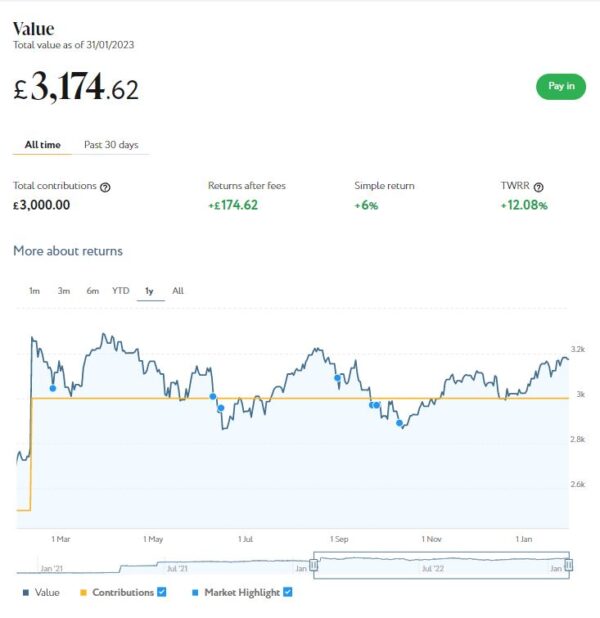
Apart from my main portfolio, I also have a second, smaller pot using Nutmeg’s Smart Alpha option. This is now worth £3,175 compared with £3,023 a month ago, a rise of £152.

Here is a screen capture showing performance over the last year. As you can see from the ochre line, I topped up this account in February 2022.

Nutmeg Smart Alpha February 2023

Clearly 2023 has started well, with the total value of my Nutmeg investments increasing by over £1,000. The strong start for equities in general in 2023 is due to various factors, including inflation rates world-wide starting to fall, the ending of most Covid restrictions in China, and a growing belief that any post-pandemic recession may not be as severe as was once thought. Of course, the war in Ukraine is still a major concern, but if that is resolved in the coming year it should give markets a further boost.

2023 is still likely to be an uncertain year for investors, with more ups and downs very much on the cards. Nonetheless, with share prices generally still below where they were a year ago, there are likely to be opportunities for investors to capitalize in the months ahead. I shall definitely be looking to invest more in Nutmeg and other equity-based platforms in the coming year.

Of course, all investing is (or should be) a long-term endeavour. Over a period of years stock market investments such as those used by Nutmeg typically produce better returns than cash accounts, often by substantial margins. But there are never any guarantees, and in in the short to medium term at least, losses are always possible.

You can read my full Nutmeg review here (including a special offer at the end for PAS readers). If you are looking for a home for your annual ISA allowance, based on my overall experience over the last six years, they are certainly worth considering. They offer self-invested personal pensions (SIPPs) as well.

Moving on, my Assetz Exchange investments continue to generate steady returns. Regular readers will know that this is a P2P property investment platform focusing on lower-risk properties (e.g. sheltered housing). I put an initial £100 into this in mid-February 2021 and another £400 in April. In June 2021 I added another £500, bringing my total investment up to £1,000.

Since I opened my account, my AE portfolio has generated a very respectable £96.79 in revenue from rental income. As I said in last month’s update, capital growth has slowed, though, in line with UK property values generally. Even so, it’s not all bad news. At the time of writing 16 of ‘my’ properties are showing gains, 7 are showing losses, and two are breaking even. My portfolio is currently showing a small net increase in value of £13.36, meaning that overall (rental income plus capital gains) I am up by £110.15. That is still a very decent rate of return on my £1,000 and does illustrate the value of P2P property investments for diversifying your portfolio. And it doesn’t hurt that with Assetz Exchange most projects are socially beneficial as well.

  • To control risk with all my property crowdfunding investments nowadays, I invest relatively modest amounts in individual projects. This is a particular attraction of AE as far as i am concerned. You can actually invest from as little as 80p per property if you really want to proceed cautiously.

My investment on Assetz Exchange is in the form of an IFISA so there won’t be any tax to pay on profits, dividends or capital gains. I’ve been impressed by my experiences with Assetz Exchange and the returns generated so far, and intend to continue investing with them. You can read my full review of Assetz Exchange here. You can also sign up for an account on Assetz Exchange directly via this link [affiliate].

Another property platform I have investments with is Kuflink. They continue to do well, with new projects launching almost every day. I currently have around £2,400 invested with them in 18 different projects (I withdrew £200 in December to help pay for Christmas). To date I have never lost any money with Kuflink, though some loan terms have been extended once or twice. On the plus side, when this happens additional interest is paid for the period in question.

My loans with Kuflink pay annual interest rates of 6 to 7.5 percent. These days I invest no more than £200 per loan (and often less). That is not because of any issues with Kuflink but more to do with losses of larger amounts on other P2P property platforms in the past. My days of putting four-figure sums into any single property investment are behind me now!

  • Nowadays I mainly opt to reinvest the monthly repayments I receive from Kuflink, which has the effect of boosting the percentage rate of return on the projects in question

Obviously a possible drawback with Kuflink and similar platforms is that your money is tied up in bricks and mortar, so not as easily accessible as cash savings or even (to some extent) shares. They do, however, have a secondary market on which you can offer any loan part for sale (as long as the loan in question is performing and not in arrears). Clearly that does depend on someone else wanting to buy it, but my experience has been that any loan parts offered are typically snapped up very quickly. So if an urgent need arises, withdrawing your money (or part of it) is unlikely to be an issue.

You can read my full Kuflink review here. They offer a variety of investment options, including a tax-free IFISA paying up to 7% interest per year with built-in automatic diversification. Alternatively you can now build your own IFISA, with most loans on the platform (including the one shown above) being IFISA-eligible.

Last year I set up an account with investment and trading platform eToro, using their popular ‘copy trader’ facility. I chose to invest $500 (then about £412) copying an experienced eToro trader called Aukie2008 (real name Mike Moest).

In January I added to this with another $500 investment in one of their thematic portfolios. I also invested a small amount I had left over in Tesla shares. My original investment of $1,022.26 is today worth $1,118.62, an increase of $96.36 or 9.63%. in these turbulent times I am very happy with that.

My eToro portfolio February 2023

In any event, I’m looking on this as a long-term investment so won’t be judging it yet. You can read my full review of eToro here. You may also like to check out my recent more in-depth look at eToro copy trading. I shall be publishing a post about my latest investment in an eToro thematic portfolio soon.

  • eToro also recently introduced the eToro Money app. This allows you to deposit money to your eToro account without paying any currency conversion fees, saving you up to £5 for every £1,000 you deposit. You can also use the app to withdraw funds from your eToro account instantly to your bank account. I tried this myself recently and was impressed with how quickly and seamlessly it worked. You can read my blog post about eToro Money here.

I had two more articles published in January on the always-excellent Mouthy Money website. One is A Three-Step Plan to Help Boost Your Finances in 2023. This article actually came out of an online presentation I did a few months ago to a club for older people. I hope you will find the ideas and advice it contains useful.

My other piece was Switch to Profit – How to Make Money Moving Your Bank Account. With the banks now starting to offer switching bonuses again to attract new customers, there are hundreds of pounds to be made by doing this. The article quotes my sister Annie, who is a serial switcher and shares some top tips based on her experiences. Many thanks, Annie!

That’s all for today. I hope you and your family are coping in these undoubtedly challenging times. Don’t forget to check out the government’s Help for Households website, which sets out various types of financial assistance you may be entitled to and is regularly updated.

As always, if you have any comments or queries, feel free to leave them below. I am always delighted to hear from PAS readers 🙂

Disclaimer: I am not a qualified financial adviser and nothing in this blog post should be construed as personal financial advice. Everyone should do their own ‘due diligence’ before investing and seek professional advice if in any doubt how best to proceed. All investing carries a risk of loss.

Note also that posts may include affiliate links. If you click through and perform a qualifying transaction, I may receive a commission for introducing you. This will not affect the product or service you receive or the terms you are offered, but it does help support me in publishing PAS and paying my bills. Thank you!

728x90

If you enjoyed this post, please link to it on your own blog or social media:
Silver Splitters - Divorce in Later Life

Silver Splitters: How to Navigate Divorce at a Later Stage in Life

Today I am pleased to bring you an expert guest post on a subject that unfortunately affects growing numbers of middle-aged and older people.

Separation and divorce can have a massive impact on your finances, so it’s important to be prepared and take advice as appropriate. Senior divorce lawyer Natalie Lester explains…


It’s always sad to see a marriage come to an end but it is particularly so when a couple have been together for 30 or 40 years. Unfortunately, divorce rates for those of retirement age are on the rise and our family law and divorce team have found a significant increase in the instructions received from those aged 55 and over.

There are several likely reasons for the increase, some of which include:

  • Life expectancy. People are living longer and many couples find they have grown apart by the time they get to their sixties and their children have left home. People often have many years ahead of them after they retire, and this can cause them to re-evaluate their life.
  • Reduced stigma. Throughout the 60s, 70s and 80s, there was a negative attitude and stigma towards divorce and divorcees. Today, we see a far more accepting attitude towards divorce in a more liberal society.
  • Female equality. In contrast to a few decades ago when women were far more likely to become housewives rather than pursue their own career ambitions, married women today often earn as much or even more than their husbands. Greater financial equality provides a greater sense of freedom so women of all ages are now more confident to end a marriage that has broken down.
  • Meeting new partners. This has become easier thanks to online dating websites and because retirees are more active in retirement., there is less fear that getting divorced will result in spending the rest of one’s life single and alone.
  • Menopause. This can be a particularly challenging time for couples and both partners can feel confused and concerned as they navigate the respective changes. Inevitably, it can highlight existing struggles, further damaging the connection between couples.

Divorcing and remarrying later in life typically involves added legal complexities. To address some of these, we have set out some top tips below:

Dividing assets on divorce after a long marriage

While it is always important that divorce settlements are divided fairly and in a mutually satisfactory manner, this issue is more crucial for older couples because after a long marriage, there is often a large matrimonial pot at stake. In addition, and in contrast to their younger counterparts, silver-splitters may be reliant on their pensions with no chance of acquiring new wealth through work. After a long marriage, assets are usually split 50/50.

The family home is often one of the most valuable assets in the matrimonial pot. There are various ways in which the court may decide to deal with this asset and it is important that you obtain legal advice to consider the options available. This will usually include selling the home and dividing the proceeds, transferring the property and buying the other spouse out or if there are multiple properties, one spouse retaining the home and the other spouse retaining another property. Court proceedings are a last resort and divorcing couples should take a constructive approach and consider all alternative dispute resolutions options to reach an agreement.

Like the family home, a couple’s pension is another key asset which needs to be divided up and the courts have extensive powers to deal with pensions upon divorce. One option (and the most common) is a pension sharing order. The order will state what percentage of your spouse’s pension pot you will receive. This share will be removed from the pension and placed into a pension in your sole name (some providers allow for internal pension transfers so that you can keep your pot within the same scheme). Pensions are a difficult area and you may need a pension expert to determine the real value of a pension pot and to advise on the various options. A good divorce lawyer will be able to advise on whether this is necessary.

Preparing for unforeseen circumstances

Loss of capacity. If one of you lacks capacity, then a litigation friend may be required. A litigation friend is someone who helps a “protected person” with their legal issues. This can be a parent, guardian, a family member or friend. If that is not possible, they will need to be represented by the Official Solicitor. The Official Solicitor acts for people who, because they lack mental capacity and cannot properly manage their own affairs, are unable to represent themselves and no other suitable person or agency is able or willing to act. It is important to consider who should step in as your litigation friend should you lose capacity to provide instructions to your lawyers. Your divorce cannot proceed until you have someone (other than your lawyer) acting on your behalf.

Wills. It is important to get a holding Will whilst you are going through the divorce process. If you were to die without a Will, the intestacy rules will kick-in. This would mean that your spouse would automatically inherit some or all of your estate. This is irrespective of the fact that you may be separated. A new Will should be drawn up once the divorce is finalised.

Protecting your wealth in new relationships including re-marriage

If a new relationship is on the horizon, it is important to think about getting a living together agreement drafted which will help protect your property should the new  relationship fail.

Likewise, If remarriage is on the cards, a prenuptial agreement should be considered because a future marriage breakdown could significantly impact your financial position and any commitments you may have to children from a previous marriage. A lawyer specialising in succession planning will also be able to advise you on how to ringfence assets you may wish to pass to your children.

It is always wise to pay extra attention to tax planning after a long marriage. We encourage our clients to speak to an accountant, who can help with tax planning early on in the process.

While there is a lot to think about when getting divorced at a later stage in life, readers should remember that with the right advice, the process can be straightforward. Where possible, we always advise our clients to keep lines of communication open with their estranged spouse and to aim for a “good” divorce. By being open about your plans and finances, you are more likely to stay on amicable terms with your spouse which will benefit your wider family including any children, no matter how grown up they are! This will also help you to move the process along, not only saving time and money on legal fees, but also enabling you both to start what can be an exciting new chapter in your lives.

Natalie Lester is senior lawyer in the family law and divorce team at Debenhams Ottaway and can be reached at nl@debenhamsottaway.co.uk


Thank you to Natalie Lester (pictured below) for a clear and informative article about this emotive topic.

Natali

As always, if you have any comments or questions about this post, please do leave them below.

If you enjoyed this post, please link to it on your own blog or social media:
Ten reasons over-50s may need an independent financial adviser

Ten Reasons Over-50s May Need an Independent Financial Adviser

I’ve mentioned several times on PAS why I believe having an independent financial adviser makes sense, even if – like me – you consider yourself reasonably money-savvy.

So today I thought I would set out some reasons over-50s (in particular) may benefit from having an independent financial adviser (IFA) or at least speaking to one.

This post has been created in association with my colleagues at Unbiased.co.uk, a well-established financial services website that can put you in touch with suitable IFAs in your area.

Reasons for Having an IFA

1. Helping Your Children Through College or University

If you have children, you will naturally want to help them complete their education safely and with a reasonable degree of comfort. Sadly the days of student grants (which I was lucky enough to benefit from in the 1970s) are well behind us now. There are various options for helping finance your children’s college or university education and a financial adviser will be able to explore these with you. They will also explain the pros and cons of the student loans system.

2 – Pension Planning

If you are over 50 you will inevitably be thinking about pension options, including when you can retire and how much income you can expect. An IFA will go through your finances with you and look at ways you may be able to boost your pension pot. From 55 onwards you can normally start to draw your pension, but you shouldn’t do this unless a financial adviser has assured you it will last you through retirement.

3. Investing

Hopefully by your fifties you will be earning a decent salary and may also have paid off your mortgage. You may also receive an inheritance or other windfall. Either way, if you find yourself with some spare cash you will want to invest it to get the best possible returns from it. An IFA will have access to all the latest information about a vast range of investment opportunities. They will guide you towards investments that are suitable for you based on your financial goals, your investment timeframe and your appetite for risk.

4. Starting Your Own Business

Especially at this time of upheaval due to Covid, many people are looking to start their own businesses in mid-life. That may be in response to redundancy or unemployment, or simply in search of a better work/life balance. An IFA can help you with the financial aspects of doing this, including raising money for tools, premises, transport and so on, or perhaps buying a franchise.

5. Emigrating or Retiring Abroad

Another way to revitalize your life may be to start afresh somewhere else, with new challenges and opportunities (and perhaps a better climate as well!). Or you may be looking to move to a favourite vacation destination to enjoy your retirement. Either way, an IFA will be happy to discuss the pros and cons with you, point out all the things you will need to take into account, and assist you with the financial arrangements.

6. Divorce

Sadly middle age sees the largest number of divorces. Your first priority here will be appointing a good solicitor to act on your behalf and protect your interests. Beyond that, though, divorce can have major ramifications for your finances. An IFA can help you assess your situation objectively and plan for a financially secure and stable future.

7. Downsizing

As the children grow up and leave home you may want to move to a smaller property – to make life simpler, save time on housework and free up money for more exciting things. An IFA can help you explore the implications of doing this and make the necessary financial arrangements.

8. Equity Release

If you don’t want to move – and are over 55 – equity release is another option for releasing funds. In recent years it has grown a lot in popularity. There are various possibilities, including home reversion plans and flexible lifetime mortgages. Most now come with a no-negative-equity guarantee, ensuring you won’t end up passing on debts to your next of kin. An IFA can go over the options with you and point out the pros and cons before you contact any providers.

9. Estate Planning

This obviously includes writing your will, but depending on your circumstances it can cover a lot of other things as well. Nobody wants to see all their money and assets falling into the hands of the taxman rather than going to their nearest and dearest. Speaking to an IFA who specializes in estate planning can give peace of mind and ensure that your loved ones are well provided for when you are no longer here yourself.

10. Helping Elderly Relatives

If you have elderly parents (or other relatives) you may find they are increasingly reliant on you for help and support. It may be up to you to arrange care for them and/or set up power of attorney so you can manage their affairs if this becomes necessary. They may also need help with estate planning (see above). An IFA can assist with all these things as well.

Getting a Free Financial Check-Up

Independent financial advisers do of course charge for their services. They are by definition unaffiliated and do not receive commission, so any recommendations they make are based solely on their client’s best interests. As I have said before on PAS, I certainly don’t begrudge paying my own financial adviser, Mike, as he has undoubtedly saved (and made) me a lot more money than he has cost me over the years.

Nonetheless, most IFAs will be happy to see you for an initial financial healthcheck free of charge. This can focus on a particular area of concern, so you could request an investments review, a pension review or a mortgage review. Alternatively, if you’re not sure which aspect of your finances needs more attention – or indeed whether you need advice at all – you could simply request a broad financial healthcheck.

Here’s what. Adrian Kidd, a financial planner at Radcliffe & Newlands, says about his approach on the Unbiased website:

‘I’d generally offer one or possibly two free consultations, taking about an hour, and these can be as specific or as broad as required. When someone books a financial healthcheck with me, I ask them to bring along all their documents relating to their finances – savings, investments, mortgages, loans, insurance, pensions, the works – so I can build up a complete picture of their affairs. I then go through these in more detail after the consultation, and follow up with an email that gives a summary of their overall financial situation.’

In these free check-ups: advisers won’t generally talk to you about products at all. The process of choosing the right products comes later, after the adviser has built up an understanding of you as a person and your financial planning needs. Only then will they recommend products, if asked to do so.

If you follow my link to the Unbiased website, you can complete a short, step-by-step questionnaire designed to identify the best type of financial adviser for your needs. You will then be shown a selection of suitable advisers in your area with contact information. They will be happy to answer any queries you may have and arrange an initial meeting without obligation.

As ever, if you have any comments or questions about this post, please do leave them below.

Disclosure: This is a sponsored post on behalf of Unbiased.co.uk. If you click through my link and end up becoming a client of a financial adviser listed on the Unbiased site, I may receive a commission for introducing you. This will not affect the service you receive or any fees you are charged if you decide to proceed further.

  • This is a fully updated version of a post originally published in 2020.

If you enjoyed this post, please link to it on your own blog or social media:
Why Does the Equity Release Industry Look Set to Boom This Year?

Why Does the Equity Release Industry Look Set to Boom This Year?

Today I have the first in a series of three collaborative posts on the subject of equity release. This one examines the growing popularity of equity release and why it looks set to boom in the year ahead.


The equity release industry saw a massive expansion in 2021, with a record-breaking sum of over £4.8 billion being unlocked by retirees across the UK. This unprecedented growth has been welcomed amid a global pandemic, as the Equity Release Council helps regulate a retirement product that has given many retirees the means to a desperately needed income in these tough economic times.

Mark Patterson, the equity release expert from EveryInvestor, joins the ranks of fellow industry authorities in predicting that 2022 is set to be another record-breaking year. Let’s take a look at what’s expected and determine if unlocking equity is a good idea over the next few months.

What Is Equity Release?

Equity release is a widely popular financial product for UK-based homeowners older than 55. In a nutshell, it gives you the opportunity to use your property’s equity but still live at home. With a third of UK retirees having less than £10,000 in retirement savings, equity release offers a lifeline to many. What’s more, the money can be used for any purpose.

According to figures from the Equity Release Council (ERC), equity release clients borrowed a total of £4.8 billion last year, a 24% rise on 2020’s figure.

Why is the Equity Release Industry Growing Amid a Tough Economy?

While many industries have crumbled in the wake of Covid 19, the equity release sector has grown tremendously. This is for several reasons, including:

  • Equity release provides financial security in a tough economic time.
  • The Equity Release Council has made the industry safe and is shifting a historically bad reputation.
  • Interest rates hit an all-time low in March 2021, and homeowners have received the best deals yet, with fixed-for-life interest rates.
  • Finally, growth inspires growth. As the industry expands, lenders offer more flexible products with bonus features, such as a free valuation or no completion fee.

What’s Predicted for 2022?

The future of equity release looks bright in 2022, and 80% of experts predict growth, with some believing this will be vastly beyond regular inflation. There are some key industry features that are likely to impact the industry (1).

First, the Equity Release Council announced on 31 January 2022 that all equity release lenders must offer the opportunity for voluntary loan and interest repayments. This announcement is welcome for potential borrowers, as voluntary repayments can vastly reduce the cost of your loan, yet there’s no obligation or risk of foreclosure.

On a slightly less positive note, equity release interest rates will rise in 2022 and should continue to do so until 2024. However, this could actually mean further industry growth. Rates are set to rise only slightly, and homeowners applying now will likely begin their equity release plans before we see any further increases.

Should I Unlock Equity from My Home at This Time?

With the market as it stands, it is a good idea to unlock equity if you’ve been planning to do so. However, it’s more complicated than just looking at the state of the industry.

Whether or not you should unlock equity from your home will depend on your personal circumstances and stage of life. What’s great is that equity release is safe; it’s overseen by the Equity Release Council and regulated by the Financial Conduct Authority (FCA).

However, to determine if it’s a good idea to unlock equity from your home, you should speak to a financial adviser. After all, seeking advice is compulsory when opting for an equity release product. The team at EveryInvestor will always encourage a whole-market financial adviser as they have an overview of the whole equity release market.

In Conclusion

Between flexible plans, the opportunity for voluntary repayments, and interest rates still low, now is a great time to release your property value through equity release. With another record-breaking year ahead of us, the industry is booming, and many more retirees are set to sign up to an equity release plan. Could you be next?

This is a collaborative post.

If you enjoyed this post, please link to it on your own blog or social media:
What's the Difference Between Income and Accumulation Funds?

What Is the Difference Between Income and Accumulation Funds?

If you invest in funds rather than individual stocks and shares, you’ll almost certainly know that in many cases you can choose between two options, income or accumulation. Today I thought I’d explain what this difference is and share a few thoughts on the subject. I will be referring to my own experiences in this regard.

But to start by answering the question in the title, the difference between income and accumulation Funds is basically as follows:

Income Funds pay any income generated by your investments as, well, income. The money will appear in your account ready for you to withdraw (or reinvest). Or it may simply be paid directly into your bank account if you prefer.

Accumulation Funds, on the other hand, use any income generated by your investments to buy more units in the fund concerned. Your holding in an accumulation fund (and its value) should therefore build over time. But you won’t typically receive any income from the fund.

You might therefore think that if you want to draw an income from your investment, an income fund is the way to go. In practice it’s not as simple as that, though. For one thing, if you want to withdraw money from an accumulation fund, you always have the option to sell some of your holding, and there can be significant advantages to proceeding this way.

I will discuss this in more detail below, focusing on my personal pension as an example. Of course, everyone’s circumstances are different, so the decisions I took (and am still taking) may not be right for you. But I hope it will give you food for thought.

Why My SIPP is Mostly in Accumulation Funds

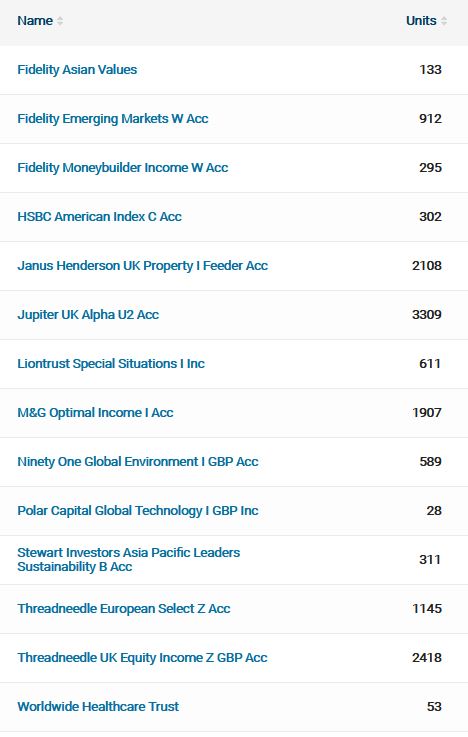
Regular readers will know that for some years I saved for my pension in the form of a SIPP (Self Invested Personal Pension). I use the Bestinvest platform for this and have always researched and chosen my investments myself. My SIPP currently has 14 funds in it. You can see a screen capture below.

SIPP Funds

As you can see, most of these are accumulation (Acc) funds with a couple of income (Inc) funds. While I was building my pot it seemed sensible to put most of my money into accumulation funds.

  • I am not by any stretch claiming that this is a ‘model portfolio’ that anyone else should emulate. I picked these funds based on recommendations I read in the press (and online) at the time, and there may well be better options now. I aimed to diversify as broadly as possible across different market sectors, geographical areas, investment types, and so on.

I put my SIPP into drawdown three years ago and now take £200 a month from it. I did consider switching to income funds at that time, but after careful thought (and research) decided against this.

The small number of income funds in my portfolio don’t typically generate enough to cover my monthly withdrawals. So each month I log in to my online dashboard and sell the necessary amount from whatever fund I pick that month. I must admit there is nothing very scientific about this. I typically just sell from funds I already have large holdings in.

Obviously having to do this every month is a minor hassle. However, in my view it has advantages as well. If you hold mainly income funds, the money they generate will vary from month to month. Sometimes there might not be enough to cover your monthly drawings, meaning you would still have to sell some funds anyway. Conversely, there might be months when more income is generated than you need, so you would end up with ‘spare’ money sitting in your account and not working for you.

Overall, then, I like having my SIPP money in accumulation funds because each month I can sell enough to cover my drawings that month, no more and no less. All the rest of the income that is generated by my accumulation funds is automatically reinvested.

Interestingly, despite the fact that my annual withdrawals amount to almost 6% of the value of my portfolio, the overall value of my SIPP has continued to grow since I put it into drawdown three years ago (see graph below). I am not convinced that would be the case if I had switched to income funds across the board.

Bestinvest SIPP July 2021

  • The standard advice is that you should withdraw no more than 4% of your portfolio each year to try to preserve its value. I have actually been taking nearly 50% more than that in the middle of a pandemic, and yet the overall value has still gone up by almost £4,000 in the last year alone. Obviously past performance is no guarantee of what may happen in future, but it is certainly food for thought.

Further Thoughts

Of course, pension funds aren’t the only sort of investment where this applies. You could, for example, be investing in a tax-free ISA, and again face the choice between income and accumulation funds. If you are aiming to build a pot, there is (of course) a strong argument for going with accumulation funds. But even if you want an income, the arguments above on behalf of accumulation funds still apply.

One further consideration is tax. If you are investing via a SIPP or ISA (or some other tax-efficient wrapper) this obviously won’t be an issue. But if you’re investing outside one of these, you do need to be aware of the tax implications.

With an income fund it’s fairly straightforward. The money you receive will count as taxable income (or taxable dividends in some cases) and be taxed accordingly.

With an accumulation fund, it’s more complicated. The income that is rolled up and reinvested is known as a ‘notional distribution’ and you will still be liable to pay tax on it at the appropriate time. This is explained in more detail in this excellent article from Shares Magazine.

As I say, investing outside a tax-efficient wrapper can be complicated, especially with accumulation funds. I would therefore recommend taking professional advice if you find yourself in this position. Ideally, though, ensure all your money is invested within a tax-free wrapper (SIPP, ISA, etc.). You won’t then have to worry about tax at all!

I hope you have found this post of interest. Whether you agree or disagree with my approach, I’d love to hear from you. Please leave any comments or questions below as usual.

Disclaimer: I am not a qualified financial adviser and nothing in this article should be construed as personal financial advice. All investment carries a risk of loss. You should always do your own ‘due diligence’ before investing, and seek professional advice if in any doubt before proceeding.

If you enjoyed this post, please link to it on your own blog or social media:
How Much Should You Draw From Your Pension Pot in Retirement?

How Much Should You Draw From Your Pension Pot in Retirement?

Today I’m addressing an issue that will be critical to many people approaching (or in) retirement. That is, how much to draw from your pension pot (and other investments) to supplement your state pension.

I’ll start by telling you about a conversation I had recently that made me think about this…

Talking to Mike

A few weeks ago I had my annual review with my financial adviser, Mike (if you want to know why a money blogger needs a financial adviser, you can read my post about this here). It was done by video call on this occasion, naturally.

One major topic of conversation was the fact that later this year (God willing) I will reach my 66th birthday and start receiving my state pension. I should qualify for the full state pension, which from April 2021 will be £179.60 a week or £9,339.20 a year.

As Mike pointed out, when you add this to my other income from this blog, my small private pension, other investments and my solar panels, this will put me in quite a strong financial position. So he recommended that at that time I reduce the amount I draw from the other investments or even stop taking anything at all and let them carry on growing year by year (financial downturns  permitting).

I could see where Mike was coming from. If I don’t actually need the money it might be sensible to leave it all where it is. For both practical and psychological reasons, however, I told him I don’t want to do that. Here are the two main reasons I gave him:

1. If I take no income from my investments, I will still be somewhat dependent on my blog for income. While I have no plans to stop running Pounds and Sense at the moment, I don’t want to have to rely on it to cover my outgoings as I grow older. Also, the income from my solar panels will end in about ten years – possibly sooner if there are any major technical issues (or I move).

2. I don’t have any particular beneficiaries I wish to leave my money to (I live alone since my partner Jayne died a few years ago and we didn’t have children). I don’t therefore see any merit in accumulating a large ‘pot’ that simply goes to benefit my sisters (much as I love them). I would rather enjoy the money while I can, while aiming to ensure that it lasts me out.

I told him my plan was therefore to reduce my withdrawals to a sensible level where my capital should be preserved and hopefully continue to grow a little. Four percent is a common rule of thumb for this, so I am looking at that as a starting point (though willing to accept Mike’s expert advice on the exact level). I plan to review this every year, based on my needs and circumstances and how my portfolio has been performing.

If I have more money coming in than I require, I don’t see that as a problem. I will spend it (maybe on a few extra holidays), save it or reinvest it, and maybe give some to charity and/or friends/relatives who are in need. As they say, you can’t take it with you, so I have decided that will be one of my guiding principles going forward!

I shared these thoughts in a subsequent email to Mike but haven’t so far received a reply from him. If I do, I’ll update this post accordingly 🙂

That Crucial Question

I am obviously not alone in facing a decision of this nature. With most people nowadays relying on a pension pot to finance retirement rather than a guaranteed lifetime pension, many of us will have to grapple with the question of how much income we should be withdrawing to supplement the state pension.

  • And yes, I know the state pension will continue as long as we need it. But while it is obviously an important source of income for most people in retirement, it is nowhere near enough to finance a comfortable retirement on its own.

Of course, none of us comes with a sell-by date. Pension planning would be so much simpler if we did. If we knew the exact date we were going to expire, we could plan our retirement precisely.

So if I knew I was going to die in five years, I could live the (moderately) high life, burn my way through my savings and investments, and leave just enough for my relatives to pay for my funeral!

On the other hand, if I knew I could look forward to another thirty years, that would of course be wonderful, but I would need to plan carefully to ensure my pot didn’t run out before I did. But as none of us knows how long we have on this planet, a long-term strategy is the only sensible option really.

The question of how much to draw from your pension pot (and other investments if any) therefore needs very careful thought. In particular, the following considerations may apply:

  • It’s clearly sensible to try to ensure that enough money will remain in your pot to see you through to deep old age (e.g. 100).
  • If you’re keen to pass on a legacy to your children (or some cause dear to your heart) you will need to be more cautious about how much you withdraw.
  • On the other hand, if you aren’t so worried about passing your wealth on, then there is no point in depriving yourself now.
  • Tolerance for risk is another factor. If you worry that the 4% rule is too chancy, you could reduce your withdrawals to 3% or less.
  • There may be other considerations too. For example, if you have a life-limiting medical condition, that may alter the equation in favour of a more bullish approach.
  • There is also the matter of whether you own your home. If so, you will have the scope to raise extra money if needed by downsizing or using equity release.
  • Tax may be an issue as well. The state pension counts as taxable income and so do most private pensions. If the total amount you draw exceeds your personal allowance, you may have to pay tax on it. This is something you might want to discuss with a financial adviser.
  • And finally, if you have a particular ambition or goal you wish to achieve during retirement (going on a world cruise, for example), you will of course need to ensure enough money is set aside to cover that when the time comes.

As mentioned above, a common rule of thumb is that to provide the best chance of preserving the value of your investments, you should limit withdrawals to no more than 4% of your capital per year. So if, for example, you have a pension pot of £50,000 and draw 4% annually from that, that would be £2,000 a year or about £167 a month. Drawing that would hopefully ensure that the value of withdrawals is on average balanced out (at least) by growth in the value of your investments.

  • Of course, the 4% rule is only a rough guide and needs reviewing regularly according to how your portfolio performs.

When pension freedoms were introduced in 2015, there was some concern that people might ‘blow’ their pension pot on a luxury car or a yacht, but actually I think the vast majority of older people are more sensible than that. Indeed, I think the opposite mistake is more common – people drawing too little and leading a life in retirement that is unnecessarily frugal rather than enjoying the money they accrued during their working lives. But in any event, this is a question we all need to think very carefully about as we attempt to chart a balanced course into retirement and old age.

So those are my thoughts on this important subject (one I know many people don’t really like to think about). But what is YOUR view? Please post any comments or questions below as usual

If you enjoyed this post, please link to it on your own blog or social media:
Review: The Good Retirement Guide

Review: The Good Retirement Guide

Today I am looking at The Good Retirement Guide, an annual guide published by Kogan Page. I bought the current 2021 edition, which was published last month.

The Good Retirement Guide 2021 is 318 pages long. The text is fairly dense but broken up by plenty of headings and bullet-point lists. There are 14 chapters and an alphabetical index at the back. The chapter titles are as follows:

  1. Are You Looking Forward to Retirement?
  2. Money and Budgeting
  3. Pensions
  4. Tax
  5. Investment
  6. Your Home
  7. Leisure Activities
  8. Starting Your Own Business
  9. Looking for Paid Work
  10. Voluntary Work
  11. Health
  12. Holidays
  13. Caring for Elderly Parents
  14. No-one is Immortal

The chapter titles are pretty self-explanatory. The book attempts to cover every aspect of making the most of your senior years. The style is clear and readable, and additional resources are signposted as appropriate.

In contrast with Sod 60! which I also reviewed recently, The Good Retirement Guide covers the financial aspects of later life in some detail. I thought the information about pensions and benefits in particular was very good and tells you most of what you need to know.

Some of the other chapters are a bit less comprehensive. The one on leisure activities, for example, lists various things you might like to do – or take up – in retirement, but the information is frequently sketchy and can verge on stating the obvious. Here is what it has to say about poetry, for example:

There is an increasing enthusiasm for poetry and poetry readings in clubs, pubs and other places of entertainment. Special local events may be advertised in your neighbourhood.

And apart from a mention for the Poetry Society and a link to their website, that is all you get on this subject 🙂

I don’t want to appear too harsh. Obviously in a wide-ranging book like this, it can be hard to judge the degree of detail appropriate to any particular topic. At least by mentioning a wide range of possibilities, the book may give you some ideas about activities you might like to pursue further in retirement.

The health-related content is a bit of a mixed bag. Some subjects are covered in reasonable depth, others less so. There is just half a page devoted to keeping fit, for example, with a further couple of paragraphs about yoga and Pilates. On the other hand, there is some good information (and advice) on health insurance, long-term care plans, and so forth. Again, this illustrates that the book’s primary focus is on the financial aspects of retirement.

One thing that did surprise me is that although this 2021 edition of The Good Retirement Guide was only published last month, there is no mention of the pandemic in it. You will search in vain for Coronavirus or Covid-19 in the index. I know there can be long lead times in publishing, but in an annual guide you might think they could have inserted a section about it somewhere. Maybe we will have to wait for the 2022 version?

Even so, a lot of the subjects discussed in the guide – holidays, for example – have been seriously impacted by the pandemic. The advice and procedures for travel abroad in particular may be very different even after the pandemic is officially over.

Final Thoughts

Overall, I thought The Good Retirement Guide 2021 was a helpful book for people approaching retirement. As I’ve said above, it has a strong emphasis on financial matters, and is well worth reading for that alone. Some of the other content is a bit hit-and-miss, and the surprising lack of any mention of the pandemic means that at times it reads like a guide to an alternate world where Covid never happened. Of course, none of us really knows what the ‘new normal’ will be in future. We can but hope it will be not too far removed from the old normal we remember and which this book – despite the 2021 in its title – basically depicts.

As always, if you have any thoughts or questions about this post, please do leave them below.

Disclosure: As with many posts on Pounds and Sense, this post includes affiliate links. If you click through and make a purchase, I may receive a modest commission for introducing you. This will not affect in any way the price you pay or the product or service you receive.

If you enjoyed this post, please link to it on your own blog or social media:
My Coronavirus Crisis Experience - December Update

My Coronavirus Crisis Experience: December Update

December is here, so it’s time for another of my monthly coronavirus crisis updates. Regular readers will know I have been posting these updates since the first lockdown started (you can read my November update here if you like).

As ever, I will start by discussing financial matters and then life more generally over the last few weeks.

Financial

I’ll begin as usual with my Nutmeg stocks and shares ISA, as I know many of you like to follow this.

As the screenshot below shows, since last month’s update my portfolio has been on a generally upward trajectory and is currently valued at £18,008. Last month it stood at £16,955, so it has gone up over £1,000 in value since then. Considering national and world events at the moment, I am more than happy with this.

As you may recall, I recently put £1,000 into a second Nutmeg pot to try out Nutmeg’s new Smart Alpha option. It is too early to comment on this yet, but I will include an update about it next time.

You can read my in-depth Nutmeg review here (including a special offer for PAS readers).

Nutmeg ISA Dec 2020

The news hasn’t been so good with my Bricklane Property ISA, which I talked about last time. As stated in in my blog review, Bricklane – not be confused with Brickowner – is a REIT (Real Estate Investment Trust). Investors’ money is pooled to purchase properties. Rental income is then distributed to investors, who also stand to benefit if the value of the REIT goes up. Last month I was down by about £80 on my £5,000 investment, but this month – as you can see from the screen capture below – the figure is over £600.

Bricklane Dec 2020

This is obviously disappointing, though not unexpected. As I said last time, the pandemic has hit property investors hard, especially investors in large commercial properties (as are most in the Bricklane portfolios). But, in addition, the current price factors in the liability of Bricklane and its investors to assess and where necessary replace exterior cladding in some buildings in light of the Grenfell Tower tragedy. I understand that almost half of the properties in the Bricklane Regional Capitals fund (in which I invested) fall into this category.

About the only good thing to be said is that right now Bricklane’s price reflects its liabilities in the worst case scenario. In particular, it has been argued that lease-owners should not bear sole responsibility for paying for this work, as the rules were only changed after Grenfell and it isn’t the owners’ fault that some properties were built to different specifications which were regarded as perfectly safe (and legal) at the time. If the government accepts that argument, in whole or in part, then Bricklane will not have to set aside large sums of money for remedial work, and the share price will rise accordingly. I have written to my MP about this, of course 🙂

As I said last time, if I was braver and had a longer investment horizon, I might look at Bricklane as a value opportunity just now. As it is, I am leaving my money where it is but won’t be investing any more with them for the foreseeable future. I am not planning to sell up as I don’t currently need the money and that would only crystallize my losses. i just hope there will be some better news on this front soon.

I also wanted to say a word about Kuflink this month. This property loan investment platform is still performing well and returning the promised monthly dividends. A couple of loan terms have been extended due to the pandemic but interest continues to be paid and I am not unduly concerned about this. I also had a couple of investments repaid after the loans in question were paid off. So I decided to reinvest in a new six-month loan to help finance the construction of a children’s day nursery in Chorley. Some details of this project from my Kuflink dashboard are shown below…

Kuflink loan

As you can see, the interest rate being paid is 6.80%. When I invested yesterday the offer had only just launched, so it’s interesting to see it is already up to almost 42% funded now. Although the loan hasn’t gone live yet, as is Kuflink’s normal practice I will received cashback equivalent to the interest on offer until it does, so I am already making money from this loan 🙂

Incidentally, I am not saying this project has any special merit compared with others on the Kuflink platform. But I decided to invest on the basis that it looks reasonably secure with a loan-to-gross-development-value ratio of 36%. And from a more personal perspective, wherever possible I like to invest in projects that will have a socially beneficial outcome, and a new children’s day nursery certainly ticks that box.

i did want to mention as well that I recently updated my full Kuflink review. You can read it here if you like. I’d particularly like to draw your attention to their new and more generous cashback offer for new investors. They are now paying cashback on new investments from as little as £500 (it used to be £1,000). And if you are looking to invest larger amounts, you can actually earn up to a maximum of £4,000 in cashback. That is one of the best cashback offers I have seen anywhere (though admittedly you will need to invest £100,000 or more to receive this!).

My two Buy2LetCars investments are still delivering the promised monthly returns without any issues. As you will remember, investors with Buy2LetCars put up the money to finance a car for a key worker such as a nurse or police officer. They then receive 36 monthly capital repayments followed by a final balancing payment of interest and capital. If you are looking for an income-producing investment with a substantial lump sum payment after three years – and you like the idea of doing a bit of good with your money too – they are well worth checking out (and likewise if you’re a key worker looking for a lease car yourself). If you’d like to learn more, you can read my review of Buy2LetCars here and my more recent article about the company here. And here is a link to Wheels4Sure, their car-leasing website.

Otherwise, there is nothing especially notable to report on the financial front this month, so let’s move on to the more personal stuff…

Personal

Since my last monthly update England has been mostly in lockdown, so I haven’t been doing anything especially exciting 🙁

I went for my latest checkup at the eye clinic at Burton Hospital in the first few days of the new lockdown. As you may remember, I was diagnosed with a perforated retina after a routine eye test at my optician’s.

I wasn’t allowed to drive, as they put drops in your eyes which blur your vision for a few hours. The trip to Burton involved a bus ride, two train journeys and a one-mile walk, so it took up a whole day. The train journeys in particular felt odd and at times almost post-apocalyptic. I was literally the only person on Lichfield Station waiting for a train to Birmingham, and had the whole carriage (and possibly train) to myself. The train to Burton was a little busier, but you do start to wonder how long the railway network can go on with such minuscule passenger numbers.

It was very quiet at the hospital too, so I was seen straight away. The doctor seemed happy with what he could see, though it’s not easy to tell when he – and everyone else – was wearing a mask. I was told I will have to go back again in January, and if everything is still okay then, they will discharge me. So I guess that’s good news, although they did say that last time as well…

During the lockdown month I aimed to go for a walk every day, and apart from a couple of days of foul weather I achieved that. I have been wearing my new music hat – described in this recent post and pictured below – and enjoying listening to my choice of music. My preferred genre is prog rock (classic and current) but I enjoy jazz and blues as well. I do just find I have to be a bit careful when walking on the narrow country lanes where I live, as with my music playing I don’t always hear cars coming up behind me. Still, I haven’t had any really close calls yet!

Music hat

I was pleased to be able to go for a swim again this week at my local David Lloyd leisure centre. It was very quiet, and all the staff, including those at reception, are now wearing masks. I suppose some people would find that reassuring. I just find it rather sad and dispiriting. Still, I really enjoyed my swim, and it was great to see a couple of members I know and exchange a few words with them. Even small social interactions like that offer a welcome morsel of normal life in these strange times.

Afterwards I ordered my usual hot drink from the centre’s coffee shop, but because I’m in a Tier 3 area I was told I couldn’t sit down to drink it. I was afraid I might be forced to take it to the freezing cold car park to consume, but was informed there was no objection to me drinking it while standing up in the centre, so long as I didn’t stay in one place for too long. You might think this is barking mad – I couldn’t possibly comment.

There has of course been some good news on the virus front in the last few weeks. As I said last time, new cases (in England anyway) are on a clear downward path. The government are of course trying to spin this as a success for lockdown, but I am sceptical about that. As I said in my November update, cases were already starting to decline pre-lockdown, so what we are seeing now is simply a continuation of that welcome trend.

It’s also interesting that the – admittedly shorter – Welsh lockdown appears to have failed totally, with cases there on the rise again. So they are now imposing even harsher restrictions, including a total ban on pubs and restaurants serving alcohol. I would therefore like to extend my sincere commiserations to Welsh readers (and especially those working in tourism or hospitality) at this time. It is a shame that the four nations of the UK couldn’t have come up with a more coherent, co-ordinated policy to combat the virus – although in my view lockdowns shouldn’t ever be a part of this due to all the collateral damage they cause.

There has been good news about vaccines this week, with the first one from Pfizer/BioNTech receiving regulatory approval in the UK and due to start rolling out next week. I am not an anti-vaxxer and will (probably) accept the vaccine when it is offered. There are, though, some reasons to be sceptical about some of the claims being made for vaccines, nicely summed up in this cautionary blog post by my old friend John ‘Platinum’ Goss. In particular, we still don’t know about any possible long-term side-effects of the vaccines. And with case numbers dropping dramatically in England, you have to wonder how much Covid will still be around in a few months’ time anyway…

In my view, this pandemic will only end when some sort of herd immunity has been achieved. That will be partly through growing numbers of people achieving immunity through contracting the virus, and in addition (hopefully) people acquiring immunity through vaccination. If that is the case, the virus will have nobody left to infect and will ultimately die out (though maybe returning occasionally in milder variants, as happens with other cold and flu viruses). That’s the best-case scenario, anyhow, and I hope it plays out that way.

  • Before leaving this topic, I would just like to include a quick shout-out for the excellent Lockdown Sceptics website. This site is updated daily and is the first thing I look at when I switch on my computer in the morning. It includes articles from a wide range of academics and other commentators, and offers a sceptical slant on official policies and announcements that is often missing in the mainstream media. Even if you don’t agree with all the views expressed, it’s well worth a read.

As for Christmas, I am expecting to have an even quieter one than usual. I don’t normally socialize a lot at this time anyway. My only remaining close family consists of my three sisters, but they are all in different parts of the country and have their own families and social circles. I have put up my lights and decorations, though, and am looking forward to receiving plenty of cards and letters. I shall also ensure I have a good stock of box-sets to watch!

Well, I guess that’s it for now. I do hope you and your loved ones are staying safe and well and looking forward to the festive season. As always, if you have any comments or questions about this post, please do leave them below.

If you enjoyed this post, please link to it on your own blog or social media:
How to save money on foreign currency transfers before or after retirement

How to Save Money on Foreign Currency Transfers Before and After Retirement

A great number of people today need to transfer currencies, or receive transfers from abroad, for many different reasons. As globalization extends, this need has become more frequent as geographical borders become less relevant.

For example, our parents couldn’t even dream about services like eBay or Alibaba, where you can buy anything and have it delivered from a dozen countries away. And the whole thing might be cheaper than buying it in your local store!

But here is where the matter of foreign currency transfers becomes important. Paying for something abroad or getting money sent to you might not be cheap. That’s because not only do you have to pay bank fees for the transaction, you also lose money on currency exchange, which is often a mandatory step in cross-border transfers.

Luckily, today there are alternative money transfer services that allow you to cut these costs. You’ll need to look into them if you require regular foreign currency exchange (FX or forex) services.

Why You Might Need to Make Foreign Currency Transfers

One reason you might need to make a large money transfer abroad is real estate. Buying property is an important part of the retirement planning process and many Britons choose to retire abroad. For example, the latest data indicates that there are about 466,000 British pensioners living in the EU. There are even more among the 5.5 million Brits living worldwide.

Even if you don’t plan on moving or buying a vacation home on some tropical beach, you might consider investing. Investing in real estate is one of the less risky methods for growing your fortune. Of course, the coronavirus crisis has heavily affected this industry. But there are still some very promising prospects for the residential housing market.

Also, today you’ll need to make international payments when booking your holiday accommodation. So, if you plan to travel at all, you’ll need to look for cheap money transfer solutions.

Anyone involved in international business also needs to make and/or accept international payments. This also includes the simple process of buying goods through one of the many e-commerce platforms.

In addition to those reasons, if you are an expat or a traveller, you’ll need to exchange money regularly. The same goes for dealing with transfers like inheritance or even accepting dividend payments from your investments.

All in all, living in the modern world makes you exposed to foreign currency exchange and transfers in many ways. Therefore, the knowledge of how to save money on these transactions is sure to be useful.

How Much Do Foreign Currency Transfers Cost in a Bank?

The cost of an international bank wire transfer is a very complicated issue. First of all, you need to understand that banks will advertise, and sometimes even show you, only the transfer fee. In the UK those range from £8 to about £40. That doesn’t seem too bad, especially for large transfers, right?

However, the truth is that banks are deceiving customers most of the time. If they were fully transparent, you would understand that what truly matters is the FX rate margin. That’s the amount that the bank charges per currency conversion on top of the mid-market exchange rate.

Simply put, high FX margins are why you lose so much money on currency conversions. Different banks use different margins and that’s why they offer different exchange rates. But if you compare the options offered by top UK banks, you’ll see that they are all very close.

Therefore, you don’t have much of a choice.

Also, there might be additional fees involved in a cross-border money transfer. The recipient bank might charge its own fees. If there are any intermediary ‘stops’ along the way, more fees will come.

All things considered, the real cost of an international money transfer can go up to 3-10% of the transfer amount. This cost will be higher for exotic currencies and transfers to remote locations. It will go down a bit for large transfers because banks might offer better terms to VIP clients.

However, the total will always be quite high.

Leading Money Transfer Service Alternatives From the UK

With bank transfer costs so high, a necessity for an alternative emerged. The solution came in the form of FX brokers and money-transfer companies. These businesses offer services similar to banks, but they have much lower overhead costs. Therefore, they are able to keep both the margins and fees very low.

In fact, many companies charge no transfer fees at all for the majority of transactions. However, they use different margins that often depend on the transfer size. Thus, you should always compare foreign currency transfers before choosing a service. This won’t be difficult as all top companies in the industry offer free quotes. They also have transparent pricing schemes.

On average, a transfer with one of these companies will cost you 1-3% of the total. Industry leaders even offer options that allow you to cut costs below 1% for large transfers.

The most notable UK-based FX companies today are TransferWise and WorldFirst. There are other notable businesses as well. However, they cannot compete with these two giants that have multi-million funding.

TransferWise

TransferWise launched not even a decade ago and it has already become a major disruptor in the banking industry. It took over the FX money transfer industry rather fast as well. The main selling point of this company was offering not merely cheap transfers but also a fixed margin scheme.

This means that TransferWise managed to offer its customers consistency and a chance to save a great deal of money. Because of the fixed margins, its services were the most affordable in the industry. The company is now valued at over $3.5 billion and it’s expanded to many countries, including the US.

WorldFirst

WorldFirst is another veteran in the FX transfer industry. This company built a solid reputation for its reliability and trustworthiness. Launched back in 2004 literally from a basement, WorldFirst became one of the industry leaders within a few years.

In 2019 this fintech business was purchased by Ant Financial of the Alibaba Group. This allowed WorldFirst to launch a major change in pricing. It had already been one of the top companies, but it could not compete with TransferWise in affordability. However, the new pricing scheme with fixed margins that go below 0.55% makes WorldFirst a cheaper alternative even to TransferWise. At the moment, there is no cheaper option for foreign currency transfers in the UK. Also, WorldFirst has a very wide reach due to its association with Alibaba, though it’s not yet available in the US.

In Conclusion: Do Your Research for Saving Money on Foreign Currency Transfers

FX money transfer companies today offer great opportunities for money saving. However, do not forget that the lowest cost doesn’t necessarily mean the best offer. These companies have a number of requirements and additional services that you should research. For example, some have a minimum transfer limit. Others offer FX hedging tools that will be essential for reducing risks for businesses and investors.

Thus, be sure to compare all options you have available and research them thoroughly. Watch out for scammers, and choose only those businesses that have a good standing in the industry.

This is a sponsored post.

If you enjoyed this post, please link to it on your own blog or social media: