I was recently offered the chance to review the Simba Orbit™ weighted blanket (see cover photo). This is a premium weighted blanket from the well-known Simba Sleep brand.
Weighted blankets are a growing trend right now. They purport to help reduce anxiety, promote relaxation and improve sleep. Naturally I was pleased to have the opportunity to test this out for myself.
The Simba Orbit™ blanket is available in various sizes and weights. I received the 15 lb (6.8 kg) single bed version. For reasons to be discussed, in my view this would also be perfectly suitable if (like me) you normally sleep on your own in a double bed.
Even though I got the lightest version, I was still quite surprised how heavy it was. It comes with a machine-washable cotton cover and I got a decent workout just putting the blanket in! The cover and the blanket itself are a rather nondescript brown. It might be nice to have a choice of colours to suit your decor. That’s only a minor criticism, though.
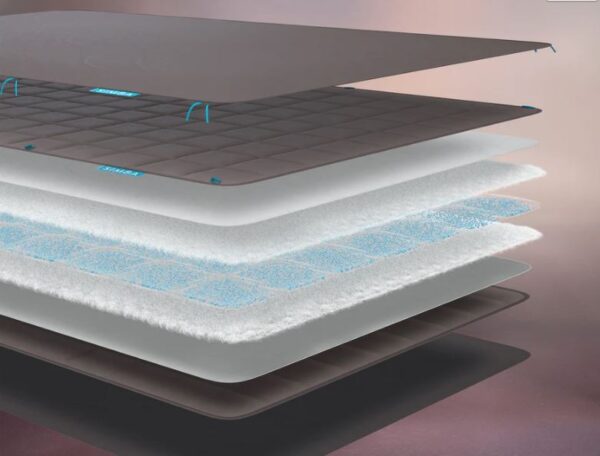
The blanket is filled with tiny weighted-glass nano-beads. These are stitched evenly into small pockets (see picture below) to prevent clumping. I can confirm that they don’t appear to move around in the night, neither do you hear any noise from them. As they say on the Simba sales page, ‘Together they form a soothing layer that rests gently over your body, giving you a feeling of light, comforting pressure.’ The blanket and cover are also designed for maximum breathability, so the blanket feels warm in winter but cool in summer.
The theory behind the Simba Orbit™ weighted blanket (and weighted blankets generally) is Deep Pressure Therapy (DPT). This is an actual, scientific thing, with academic studies to back it up.
DPT is a calming process activated through a physical stimulus – like a hug, or the application of some sort of gentle pressure across the body. Some studies have suggested that this pressure works by helping your nervous system switch off its ‘fight or flight’ system (sympathetic) and move to its ‘rest and digest’ system (parasympathetic).
Simba say the Orbit™ weighted blanket is designed to replicate that feeling of soothing pressure. They suggest thinking of it as your ‘off switch’ – a switch that helps regulate your heartbeat, relax your muscles and set your mind at rest.
My own experience confirms this. Admittedly it took a night or two to get used to, but I did then notice I was sleeping longer and deeper and feeling more refreshed when I woke up. One thing that impressed me was how the blanket stays in place and doesn’t move around or slip off the bed once it’s in position. That is why I think the single version is also suitable for people who sleep alone in a double bed. Personally I found it worked best (and felt most comfortable) if I positioned it over the lower half of my body rather than up to my neck/chest. Your experience might be different, of course.
Clearly, weighted blankets won’t be right for everyone. In particular, as SImba themselves say, they aren’t suitable for children, the elderly or anyone suffering from breathing difficulties or circulatory issues (including diabetes). In cases of pregnancy and kidney issues, you are recommended to consult your doctor before use.
If you’re stressed and anxious and finding it hard to unwind, however, then based on my experience this weighted blanket is well worth a try. You can order direct from the SImba Orbit™ weighted blanket web page while stocks last. You can get free next day delivery if you order before 2 pm on the UK mainland, with interest-free finance options also available.
As always, if you have any comments or questions about this post, please do leave them below.
Disclosure: As stated above, I received a free Simba Orbit™ weighted blanket in exchange for reviewing it here. This has not influenced my review in any way.
If you enjoyed this post, please link to it on your own blog or social media:
Today I am looking at the Warm Home Discount scheme. The 2024/25 version of this has just launched.
The WHD scheme provides people on low incomes and/or certain means-tested benefits with a discount of £150 on their electricity bill. This is a one-off payment that will be credited to your electricity account by March 2025. It won’t be paid to you in cash.
If you have a pre-payment electricity meter you can still get WHD. You may be given a voucher you can use to top up your payments. Your electricity supplier will tell you exactly how and when you will receive this.
You may be able to get the discount on your gas bill instead if your supplier provides you with both gas and electricity. You will need to ask your supplier about this.
To get the £150 discount, you need to have your name on the bill and either receive a qualifying benefit or (in Scotland) qualify under your supplier’s low-income criteria (see below).
If you live in England or Wales, you will qualify if you either:
An important thing to note is that only pensioners who receive the Guarantee element of Pension Credit will qualify automatically for the Warm Home Discount. These people are known as ‘Core Group 1’ in England and Wales and the ‘Core Group’ in Scotland. If you’re in this group you should receive a letter between October 2024 and early January 2025 telling you when and how the discount will be paid. If you don’t get a letter and think you are eligible for the core group, you should contact the Warm Home Discount helpline on 0800 030 9322.
You should also still qualify for WHD if you live in England or Wales and:
your energy supplier is part of the scheme (see below)
you get certain means-tested benefits or tax credits
your property has a high energy cost score (see below)
your name (or your partner’s) is on the bill
This is known as being in ‘Core Group 2’. The qualifying means-tested benefits are:
Housing Benefit
income-related Employment and Support Allowance (ESA)
income-based Jobseeker’s Allowance (JSA)
Income Support
the ‘Savings Credit’ part of Pension Credit
Universal Credit
You could also qualify if your household income falls below a certain threshold and you get either:
Again, you should receive a letter between October 2024 and early January 2025 telling you about the discount if you’re eligible. In most cases you are no longer required to apply for it.
Most eligible households will receive an automatic discount. Your letter will say if you need to call a helpline by 28 February 2025 to confirm your details.
If you’re eligible, your electricity supplier will apply the discount to your bill by 31 March 2025.
If you live in Scotland and don’t get the Guarantee Element of Pension Credit, you may qualify to receive WHD if:
your energy supplier is part of the scheme
you (or your partner) get certain means-tested benefits or tax credits
your name (or your partner’s) is on the bill
Your supplier may have additional criteria so you will need to check with them if you’re eligible. This is known as being in the ‘broader group’. To get the discount you’ll need to stay with your supplier until it’s paid.
As mentioned above, if you are not in Core Group 1 in England and Wales, to qualify for WHD your property must also have a high energy cost score.
The Government models the energy cost score of your property based on official data about its characteristics. These include the property type, age, and floor area. The Government uses data from the Valuation Office Agency (VOA) to model your property’s energy cost score. They may also use your property’s Energy Performance Certificate (EPC), assuming it has one. Other sources and statistical methods may also be used for the small proportion of households where data is not otherwise available.
Each year the Government will decide what constitutes a high energy cost score. It’s not straightforward for an individual to determine whether they will be eligible under this criterion. If you fill in the online eligibility checker, however, it should indicate whether or not you are likely to qualify (when I tried this for some elderly friends, it said they would ‘probably’ qualify and should wait to receive a letter).
Which Suppliers Offer Warm Home Discount?
All the large energy suppliers offer WHD and some of the lesser-known ones as well. Below is a list of suppliers copied from the government webpage devoted to Warm Home Discount. You can check your eligibility on the supplier’s website or phone them up and ask.
100Green (formerly Green Energy UK or GEUK)
Affect Energy – see Octopus Energy
Boost
British Gas
Bulb Energy – see Octopus Energy
Co-op Energy – see Octopus Energy
E – also known as E (Gas and Electricity)
Ecotricity
E.ON Next
EDF
Fuse Energy
Good Energy
Home Energy
London Power
Octopus Energy
Outfox the Market
OVO
Rebel Energy
Sainsbury’s Energy
Scottish Gas – see British Gas
ScottishPower
Shell Energy Retail
So Energy
Tomato Energy
TruEnergy
Utilita
Utility Warehouse
The government say that if the electricity supplier you were with stops trading, you may still be eligible for the Warm Home Discount. Ofgem will appoint your new supplier for you, and you should check with the new supplier to find out if you’re eligible for the discount.
If you are in the market for a new energy supplier, you may like to know that if you switch to EDF Energy you can get £50 credited to your account by clicking on my EDF referral link. I am an EDF customer myself and will also get £50 credited to my account if you do this and switch to EDF. This will not affect in any way the service you receive or the rate you are charged.
Other Winter Fuel Benefits
Two other benefits are also available to qualifying individuals.
1. People born before 23rd September 1958 and in receipt of pension credit or certain other welfare benefits are eligible for a Winter Fuel Payment. This is worth £200 or £300 per person and will be paid in November or December 2024. More information including eligibility details can be found on the official government website. As you may know, previously all state pensioners were entitled to WFP, but the new Labour government has chosen to restrict it to the poorest pensioners only.
2. In the event of a prolonged cold spell, most people receiving Pension Credit will receive Cold Weather Payments. People on Income Support, Jobseeker’s Allowance, Employment and Support Allowance (ESA) and Universal Credit may also qualify depending on their circumstances, e.g. if they have a disability and/or a disabled child living with them. You will get this payment if the average temperature in your area is recorded as, or forecast to be, zero degrees Celsius or below for seven consecutive days. You get £25 for each seven-day period of very cold weather between 1 November and 31 March. Note that people in Scotland don’t get Cold Weather Payments but might get an annual £50 Winter Heating Payment instead. This is paid regardless of weather conditions in your area.
As always, if you have any comments or questions about this post, please do leave them below.
This is the 2024 update of an annual post.
If you enjoyed this post, please link to it on your own blog or social media:
Recently my energy supplier, EDF Energy, has been sending me invitations to sign up for what it calls its ‘Sunday Saver’ challenge.
The way this works is that you sign up to shift some of your electricity usage on weekdays away from peak hours (4pm-7pm). When you hit your target (which is set individually for each user by EDF), you earn free electricity the following Sunday.
EDF say, ‘The more you shift, the more you earn – reduce your weekly peak usage by 40% and you could earn up to 16 hours of free electricity per week.’
The challenge is due to take place monthly, starting on the first Monday of each month.
At first glance you might think this is a good offer. But as I have looked into it more, my doubts have grown. Here are my main reservations…
To benefit from this scheme you have to cut your daily energy usage every weekday between 4pm and 7pm. That’s quite a long period (three hours), and coincides with when I would normally be cooking my evening meal. To have any realistic chance of cutting my energy use during this time, I would have to eat either ridiculously early or significantly later than normal. For various reasons, including my health, I prefer to eat between 6 and 7 pm and no later. So that in itself is a big ask and would impact drastically on my normal routine.
Free electricity on Sunday sounds great, but the devil is in the detail. EDF say that you will get ‘up to 16 hours’ of free electricity if you meet their targets, but are very vague about what this means in practice. Specifically, they don’t explain how your energy-saving targets are calculated, how any reduction in usage translates to free hours, or when on Sunday you will be able to use the free electricity awarded.
In addition, they say there are ‘fair usage’ limits to how much free electricity you can have. Again, they are vague about what this means in practice. The obvious way to use your free electricity would be to charge your EV, and I strongly suspect limits would be placed on this. As for me, I don’t have an EV and don’t want one, so my options for benefiting from the free electricity would be limited. I could shift use of appliances like my washing machine to Sunday but doubt if I could save more than a few kw/h this way (obviously the exact number would depend on how many free hours I was allocated, which is anyone’s guess). That means my free electricity would likely benefit me by no more than a pound or two.
Lastly, as a solar panel owner I already get some free electricity anyway. My panels obviously generate less in the winter, but during daylight hours they still produce something. That means any benefit from free electricity on Sundays will be reduced, especially if (as is likely) the free hours are in the day rather than at night.
Overall, then, I am not much enamoured of EDF’s Sunday Saver challenges and won’t be signing up. Ultimately, I am not prepared to make major changes to my day-to-day schedule in pursuit of what will likely be (in my case anyway) minuscule rewards.
Obviously some will see this differently and I wish them well. And it’s good that EDF (and other companies) are exploring ways to help customers reduce their bills. I do just think this particular one – for me anyway – is a non-starter.
I would be interested to hear any comments from people doing this challenge (or similar ones from other energy companies) as to whether they find it worthwhile, and whether the benefits really do justify the changes you are required to make.
I do still recommend EDF Energy based on my personal experiences with them. And as I’ve said before on PAS, I can offer anyone switching to EDF £50 off their bills if they use my refer-a-friend link at https://edfenergy.com/quote/refer-a-friend/sunny-koala-9462 when applying. I will also get £50 off my bill if you do this, which is duly appreciated 🙂
UPDATE 22 OCTOBER 2024 – I am indebted to the readers (especially Harry!) who have taken the time to comment on this article and address some of the points raised in my original post. Based on this I have changed my views somewhat and am considering registering for the scheme when it reopens in November. If you’re still wondering whether to take the plunge, please do take the time to read the comments as (like me) they may influence your decision. I will publish an update in due course if I proceed with it next month.
UPDATE 28 NOVEMBER 2024 – Thanks again to everyone who commented on this post. Sorry I couldn’t reply to everyone individually. You may like to know that I just added a new post about why I changed my mind and registered for the EDF ‘Sunday Saver’ Challenge and how I got on in my first month. Please see https://www.poundsandsense.com/heres-why-i-changed-my-mind-about-edf-energys-sunday-saver-challenge/
If you enjoyed this post, please link to it on your own blog or social media:
I’ll begin as usual with my Nutmeg Stocks and Shares ISA. This is the largest investment I hold other than my Bestinvest SIPP (personal pension).
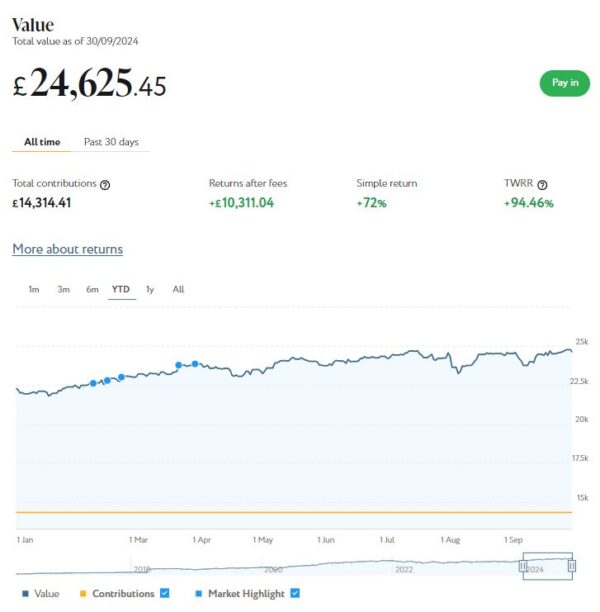
As the screenshot below for the year to date shows, my main Nutmeg portfolio is currently valued at £24,625. Last month it stood at £24,525, so that is an increase of £100.
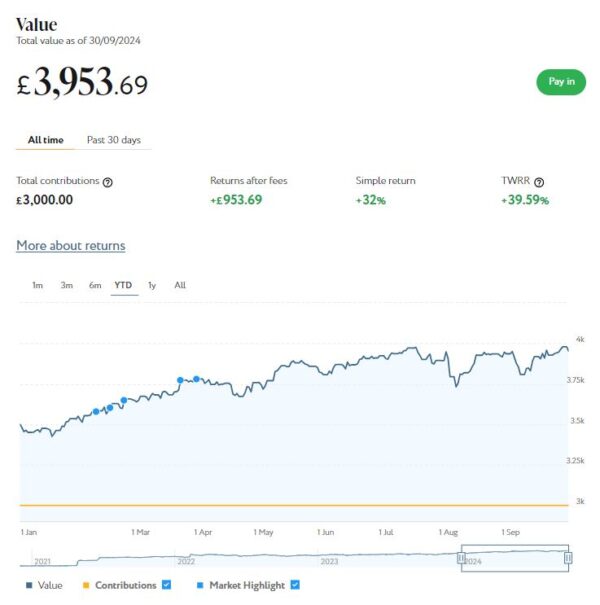
Apart from my main portfolio, I also have a second, smaller pot using Nutmeg’s Smart Alpha option. This is now worth £3,954 (rounded up) compared with £3,937 a month ago, a rise of £17. Here is a screen capture showing performance over the year to date.
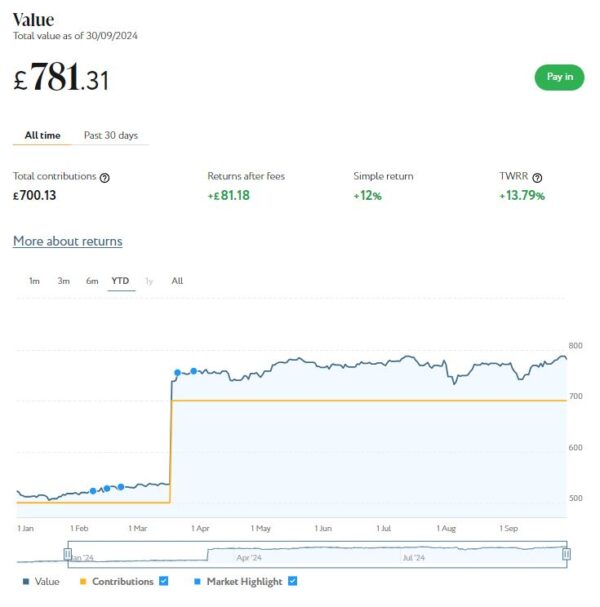
Finally, at the start of December 2023 I invested £500 in one of Nutmeg’s new thematic portfolios (Resource Transformation). In March I also invested a further £200 from ‘Refer a Friend’ bonuses. As you can see from the YTD screen capture below, this portfolio is now worth £781 compared with £772 last month, a small rise of £9.
As you can see, September was another decent though unspectacular month for my Nutmeg investments. Their overall value has risen by £126 or 0.43% since the start of September. They are also up by £3,045 or 11.57% since the start of the year.
You can read my full Nutmeg review here. If you are looking for a home for your annual ISA allowance, based on my overall experience over the last eight years, they are certainly worth considering. They offer self-invested personal pensions (SIPPs), Lifetime ISAs and Junior ISAs as well.
Note that I am no longer an affiliate for Nutmeg. That means you won’t find any affiliate links in my review (or anywhere else on PAS). And you will no longer see the no-fees-for-six-months offer I used to promote as an affiliate. However, the better news is that you can still get six months free of any management fees by registering with Nutmeg via my Refer a Friend link. I will receive a gift voucher if you do this, which is duly appreciated
Don’t forget, also, that the current tax year began on 6 April 2024 and you have a full £20,000 tax-free ISA allowance for 2024/25. In a change to the rules, you can now open any number of ISAs with different providers in the same tax year, as long as you don’t exceed your overall £20,000 allowance. So opening a stocks and shares ISA with Nutmeg won’t prevent you from also opening one with another S&S ISA provider (should you wish to) later in the financial year.
Moving on, I also have investments with the property crowdlending platform Kuflink. They continue to do well, with new projects launching every week. I currently have around £833 invested with them in 7 different projects paying interest rates averaging around 7%. I also have £40 in my Kuflink cash account.
To date I have never lost any money with Kuflink, though some loan terms have been extended once or twice. On the plus side, when this happens additional interest is paid for the period in question.
There is now an initial minimum investment of £1,000 and a minimum investment per project of £500. Kuflink say they are doing this to streamline their operation and minimize costs. I can understand that, though it does mean that the option to test the water with a small first investment has been removed. It also makes it harder for small investors (like myself) to build a well-diversified portfolio on a limited budget.
One possible way around this is to invest using Kuflink’s Auto/IFISA facility. Your money here is automatically invested across a basket of loans over a period from one to five years. Interest rates range from 7% to around 10%, depending on the length of term you choose. Full up-to-date details can be found on the Kuflink website.
You can invest tax-free in a Kuflink Auto IFISA. Or if you have already used your annual ISA allowance elsewhere, you can invest via a taxable Auto account. You can read my full Kuflink review here if you wish.
Moving on, my Assetz Exchange investments continue to generate steady returns. Regular readers will know that this is a P2P property investment platform focusing on lower-risk properties (e.g. sheltered housing). I put an initial £100 into this in mid-February 2021 and another £400 in April. In June 2021 I added another £500, bringing my total investment up to £1,000.
Since I opened my account, my AE portfolio has generated a respectable £208.97 in revenue from rental income. Capital growth has slowed, though, in line with UK property values generally.
At the time of writing, 11 of ‘my’ properties are showing gains, 5 are breaking even, and the remaining 17 are showing losses. My portfolio of 33 properties is currently showing a net decrease in value of £42.75, meaning that overall (rental income minus capital value decrease) I am up by £166.22. That’s still a decent return on my £1,000 and does illustrate the value of P2P property investments for diversifying your portfolio. And it doesn’t hurt that with Assetz Exchange most projects are socially beneficial as well.
The overall fall in capital value of my AE investments is obviously a little disappointing. But it’s important to remember that until/unless I choose to sell the investments in question, it is largely theoretical, based on the latest price at which shares in the property concerned have changed hands. The rental income, on the other hand, is real money (which in my case I’ve reinvested in other AE projects to further diversify my portfolio).
To control risk with all my property crowdfunding investments nowadays, I invest relatively modest amounts in individual projects. This is a particular attraction of AE as far as i am concerned (especially after Kuflink raised their minimum investment per project to £500). You can actually invest from as little as 80p per property if you really want to proceed cautiously.
As I noted in this recent post, Assetz Exchange is particularly good if you want to compound your returns by reinvesting rental income. This effectively boosts the interest rate you are receiving. Personally, once I have accrued a minimum of £10 in rental payments, I reinvest this money in either a new AE project or one I have already invested in (thus increasing my holding). Over time, even if I don’t invest any more capital, this will ensure my investment with AE grows at an accelerating rate and becomes more diversified as well.
My investment on Assetz Exchange is in the form of an IFISA so there won’t be any tax to pay on profits, dividends or capital gains. I’ve been impressed by my experiences with Assetz Exchange and the returns generated so far, and intend to continue investing with them. You can read my full review of Assetz Exchange here. You can also sign up for an account on Assetz Exchange directly via this link [affiliate]. Bear in mind that, as from this financial year (2024/25), you can open more than one IFISA per year.
In 2022 I set up an account with investment and trading platform eToro, using their popular ‘copy trader’ facility. I chose to invest $500 (then about £412) copying an experienced eToro trader called Aukie2008 (real name Mike Moest).
In January 2023 I added to this with another $500 investment in one of their thematic portfolios, Oil Worldwide. I also invested a small amount I had left over in Tesla shares.
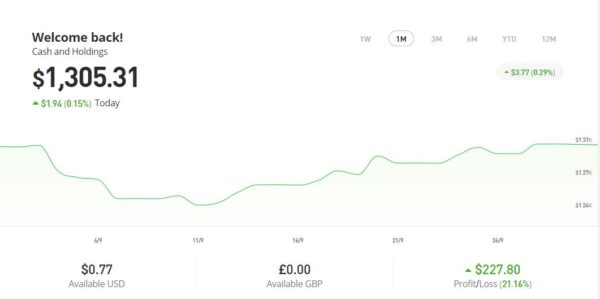
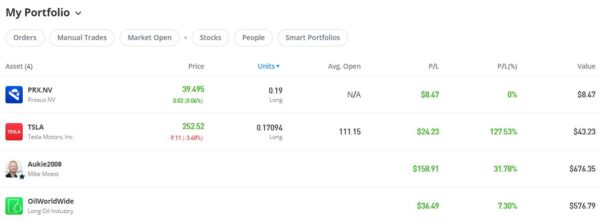
As you can see from the screen captures below, my original investment totalling $1,022.26 is today worth $1,305.31 an overall increase of $283.05 or 27.69%.
As you can see, my Oil WorldWide investment is showing 7.30% profit. That’s okay but not spectacular. Obviously my copy trading investment with Aukie2008 has been doing much better. The Oil WorldWide port was recently rebalanced by eToro, so I hope this may boost its performance. The investment team at eToro periodically rebalance all smart portfolios to ensure that the mix of investments remains aligned with the portfolio’s goals, and to take advantage of any new opportunities that may present themselves.
As a matter of interest, since I wrote the above war has effectively broken out in the Middle East. This has led to fears that oil supplies from the region will be compromised and the price of oil will rise. As a consequence of this (I assume) the value of my Oil Worldwide investment has gone up. I say this not to gloat over the tragedy that is unfolding in the area, but to highlight the fact that a diversified portfolio can often help to hedge against economic downturns resulting from world events.
You might also notice that I have a small holding in Prosus NV, a Dutch internet group. To be honest I don’t understand how I acquired this, but it may be connected to my copy trading investment with MIke Moest (who is Dutch). In any event, I am happy to have it in my portfolio as well!
eToro also offer the free eToro Money app. This allows you to deposit money to your eToro account without paying any currency conversion fees, saving you up to £5 for every £1,000 you deposit. You can also use the app to withdraw funds from your eToro account instantly to your bank account. I tried this myself and was impressed with how quickly and seamlessly it worked. You can read my blog post about eToro Money here. Note that it can also serve as a cryptocurrency wallet, allowing you to send and receive crypto from any other wallet address in the world.
I had three more articles published in September on the excellent Mouthy Money website. The first is Are Electric Boilers Better Than Heat Pumps?. As you doubtless know, the government are pushing heat pumps hard as a means of achieving their Net Zero goals. They are definitely not a one-size-fits-all solution, though. In this article I highlighted an alternative that may be more suitable for some, electric boilers. These are cheaper, smaller and quieter than heat pumps (though their running costs may be higher). You can read all about the pros and cons of heat pumps versus electric boilers in the article.
Also in September I revealed How to Get Free Stuff Online. In this article, I explained how you can get your hands on a wide range of freebies online, from samples and giveaways to promotional offers and rewards programmes – all without having to spend a single penny!
Finally, in September I discussed How to Save Money With Cashback Sites. If you ever buy anything online, you can almost certainly save by signing up with these sites. In this article I revealed how they work and set out some hints and tops for making the most of them.
As I’ve said before, Mouthy Money is a great resource for anyone interested in money-making and money-saving. From the variety of articles published in September, I particularly enjoyed Secondhand September: Good for Your Purse and the Planet by regular MM contributor Shoestring Jane. Jane writes mainly about money saving and frugal living. You can see all of her articles for Mouthy Money via this web page.
I also published (or republished) several posts on Pounds and Sense in September. Some are no longer relevant due to closing dates having passed, but I have listed the others below.
In Can You Still Make Money From Matched Betting? I discussed this tax-free money-making opportunity. As I said in the article, this is something I did for several years and earned about £3,000 from. I am not doing it nearly as much these days, for reasons explained in the article. But if you’ve never done it before, I do still highly recommend it as a way of making some quick tax-free cash. The article explains what matched betting is and how to get started.
The price of stamps is rising again on Monday 7 October 2024. That is the second price rise this year, after they also went up in April. So in How to Beat the Postage Stamp Price Rise, I revealed just how much (some) prices are rising and suggested ways to mitigate this.
In case you didn’t know, October is Free Wills Month. So in Get Your Will Written Free of Charge in October, I discussed how you can use this no-strings scheme to get your will written free at a range of participating solicitors across the UK. There are only limited slots available, so I recommend moving quickly if you want to take advantage of this opportunity.
Also in September I published How to Save Money on Your Heating Bills This Winter. As you doubtless know, gas and electricity bills have gone up considerably in the last year or two. And many older people will no longer get Winter Fuel Payments, as the new Labour government have opted to restrict this to just the very poorest pensioners (those in receipt of Pension Credit). So in this article I set out a range of ways you may be able to save money on your heating and energy bills. Following these tips could save you hundreds of pounds in the months and years ahead.
Finally, I published Amazon Big Deals Day is Almost Here. This annual event extends over two days, Tuesday 8th and Wednesday 9th October 2024. It is is a special event for Amazon Prime members only. Amazon say they will be offering members their lowest prices of the year on selected products from leading brands including Philips, Logitech, Oral-B, Braun, Tefal, Ghd, Swarovski, Bosch, Shark, and so on.
Next, some odds and ends. First up, Trading 212 recently reopened their free share offer, so I have updated my post Get a Free Share Worth Up to £100 With Trading 212. This explains how, if you haven’t done so already, you can get a free share when you open a new Invest or Stocks ISA with Trading 212. Note that opening a Cash ISA with T212 alone will not qualify you for a free share, but of course you can do both. My advice is to start by opening a Stocks ISA or (non-ISA) Invest account to qualify for your free share and apply (if you wish) for the Cash ISA after that. This new free share offer closes on 6 November 2024.
A few months ago I invested just over £1,000 in a Scottish wind farm project via a platform called Ripple Energy. The way this works is that you pay a fee towards building the wind farm, and in exchange receive lower-cost, ‘green’ electricity once the wind farm is up and running. This will continue for the life of the wind farm (an estimated 20 years). The original closing date for this was the end of May, but the date was extended and the share offer is still open at the time of writing. You can pay by 12 monthly instalments rather than a single lump sum if you like. If you’re interested in learning more, you can visit the Ripple website via my referral link. If you decide to invest, you will get a £25 bonus credited to your account when generation starts (and so will I). Note that you will need to invest a minimum of £1,000 to qualify for the £25 bonus, but you can invest from as little as £25 if you wish.
Speaking of energy, a quick reminder that if you switch to EDF Energy via my refer-a-friend link (below) you can get a FREE £50 credited to your energy account (and so will I). For more info and to sign up, click on https://edfenergy.com/quote/refer-a-friend/sunny-koala-9462
Finally, I wanted to highlight (again) the decision by the new government to abolish Winter Fuel Payments for all pensioners except those on pension credit. Like many others, I feel this is a terrible decision that will badly impact some of the poorest people in society and quite likely lead to increased deaths by hypothermia in the winter ahead (and others to follow).
it is therefore more important than ever that older people who may be eligible for pension credit apply for it. I recently updated my blog post about pension credit in light of the announcement. If you have older relatives, friends or neighbours, please encourage them to apply if they may be eligible. The application process is not as straightforward as it should be, so they may well appreciate some help with it
Even so, be aware that only the very poorest pensioners qualify for pension credit. If you get the full new state pension, even with no other source of income, you likely won’t qualify. I do therefore recommend writing to your MP and asking for this Draconian decision to be reversed. You may also like to sign one of the various petitions that have sprung up, including this one on Change.org and this one from Age UK. The former has over 100,000 signatures now and the latter over half a million.
That’s all for now. If you have any comments or queries about this update, as ever, feel free to leave them below. I am always delighted to hear from PAS readers
Disclaimer: I am not a qualified financial adviser and nothing in this blog post should be construed as personal financial advice. Everyone should do their own ‘due diligence’ before investing and seek professional advice if in any doubt how best to proceed. All investing carries a risk of loss. Note also that posts on PAS may include affiliate links. If you click through and perform a qualifying transaction, I may receive a commission for introducing you. This will not affect the product or service you receive or the terms you are offered, but it does help support me in publishing PAS and paying my bills. Thank you!
If you enjoyed this post, please link to it on your own blog or social media:





 I also published (or republished) several posts on
