
P2P Property Investment Platform Assetz Exchange Rebrands as Housemartin

P2P Property Investment Platform Assetz Exchange Rebrands as Housemartin

As regular readers of Pounds and Sense will know, I’m a fan of P2P property investment platform Assetz Exchange and have invested through them myself. AE have recently rebranded as Housemartin, so I thought I should write an update about this.

You can read my original detailed review of Assetz Exchange (as it was then) in this post. Much of this info still applies – so I won’t reproduce it all here – but certain things (as well as the name!) have changed.

Assetz Exchange began as a ‘traditional’ property crowdfunding platform, with investors coming together to buy a property.  They then shared in the rental income received – and any profit if the property was subsequently sold – in proportion to the size of their investment. When I first wrote about Assetz Exchange they offered a variety of investment opportunities, including former show homes and development projects. 

Nowadays, though, the company focuses on supported housing, working closely with charities and other organizations that assist people with physical and cognitive disabilities. These have generally proven the most reliable and hassle-free investments, so Housemartin have understandably chosen to concentrate on this.

Properties are generally let on long leases, with the charities taking responsibility for day-to-day management and maintenance. As mentioned, investors receive a share of the monthly rental received and any profits if/when the properties are sold (you can also potentially sell your holdings online at any time via the exchange, which serves as a secondary market). That puts these investments at the lower-risk end of the property investment spectrum (though there are, of course, still risks involved, and you should ensure you understand these and are comfortable with them before investing).

Assetz Exchange was originally part of the Assetz group of property investment companies that included Assetz Capital. In December 2023 Assetz announced it was withdrawing from the retail marketplace to work with institutional investors only. Partly as a consequence of this, the team behind Housemartin took the decision to part ways with the Assetz group and are no longer affiliated with them. Although they always operated separately from Assetz Capital, Housemartin is now an entirely independent P2P property investment platform. Regarding the name change, the company says:

“The name Housemartin reflects the company’s commitment to delivering robust, hassle-free, quality residential property investment opportunities that reward investors with monthly inflation-linked income. Just as the house martin bird is known for its sociability and adaptability, Housemartin aims to provide investors with an opportunity to pool funds with fellow investors to create much needed quality homes for people requiring support.”

Future Plans

In its new guise as Housemartin, the company has big plans for 2025 and further into the future. They intend to stick to their strategy of working with partners in the supported housing sector, including (for example) Golden Lane Housing, Lets For Life and Halo Housing. A typical current opportunity from the website  is shown below.
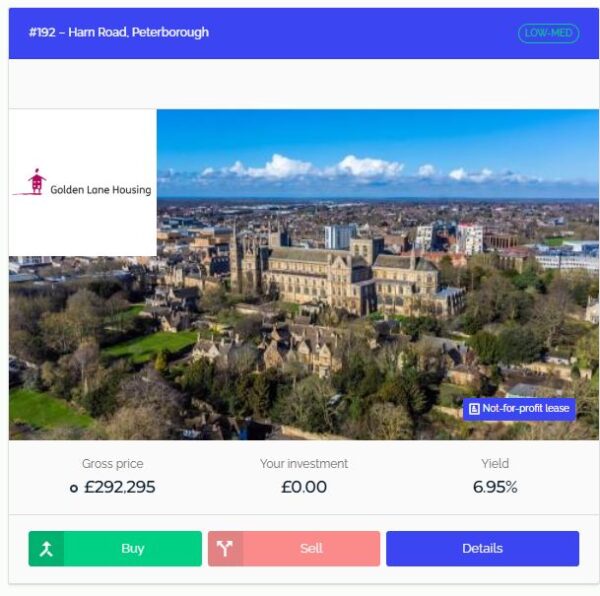
Housemartin example investtment

Peter Read, the MD of Housemartin, points out that with interest rates currently falling, this makes the returns of around 7% they can typically offer investors increasingly attractive (and of course there is the potential for capital growth as well). He also points out that rentals are raised every year in line with inflation.

Housemartin are currently launching a fundraising round on the investment platform Crowdcube. They are looking to raise additional capital which will be used to help the company expand and improve its offering. Anyone is welcome to invest via Crowdcube, though as this is a share offer it’s almost certainly riskier than investing via the platform itself, with no clearly defined exit route. Personally I do not plan to invest in Housemartin this way, but you can find out more if you wish by registering on the Crowdcube site.

My Own Experience

I put an initial £100 into the platform in mid-February 2021 and another £400 in April. In June 2021 I added another £500, bringing my total investment up to £1,000.

Since I opened my account, my portfolio has generated a respectable £227.35 in revenue from rental income. Capital growth has slowed, though, in line with UK property values generally.

At the time of writing, 12 of ‘my’ properties are showing gains, 3 are breaking even, and the remaining 20 are showing losses. My portfolio of 35 properties is currently showing a net decrease in value of £62.22, meaning that overall (rental income minus capital value decrease) I am up by £165.13. That’s still a decent return on my £1,000 and does illustrate the value of P2P property investments for diversifying your portfolio. And it doesn’t hurt that with Assetz Exchange the projects are socially beneficial as well.

The overall fall in capital value of my AE investments is obviously a bit disappointing. But it’s important to remember that until/unless I choose to sell the investments in question, it is theoretical, based on the latest price at which shares in the property concerned have changed hands. The rental income, on the other hand, is real money (which in my case I’ve reinvested in other HM projects to further diversify my portfolio).

To control risk with all my property crowdfunding investments nowadays, I invest relatively modest amounts in individual projects. This is a particular attraction of HM as far as i am concerned. You can actually invest from as little as £1 per property if you really want to proceed cautiously.

  • As I noted in this blog post, Housemartin is particularly good if you want to compound your returns by reinvesting rental income. This effectively boosts the interest rate you are getting. Personally, once I have accrued a minimum of £10 in rental payments, I reinvest this money in either a new Housemartin project or one I have already invested in (thus increasing my holding). Over time, even if I don’t invest any more capital, this will ensure my investment with HM grows at an accelerating rate and becomes more diversified as well.

My investment on Housemartin is in the form of an IFISA so there won’t be any tax to pay on profits, dividends or capital gains. I’ve been impressed by my experiences with Housemartin and the returns generated so far, and intend to continue investing with them. If you wish you can also sign up for a no-obligation account on Housemartin directly via this link [affiliate]. Bear in mind that, as from this financial year (2024/25), you can open more than one IFISA per year so long as you don’t exceed your overall £20,000 ISA allowance.

Closing Thoughts

As I said earlier, I am a fan of Housemartin and have been investing with them for several years now. I have also spoken to their MD, Peter Read, on various occasions, and always found him open and honest.

My HM investments have performed well; and as far as I’m aware no investor has ever lost money through the platform. Obviously there are never any guarantees with investing – but if you like the idea of earning higher rates of interest than available from banks while helping vulnerable people secure a much-needed roof over their heads, Housemartin is certainly worth a look.

As always, if you have any queries about this blog post or Housemartin more generally, do leave a comment as usual.

Housemartin logo

Disclosure: As stated in this post, I am an investor with Housemartin and also an affiliate for them. If you click through my link and sign up, I may receive a commission for introducing you. This will not affect in any way the service you receive or the terms you are offered. 

Please be aware also that I am not a professional financial adviser. You should always do your own ‘due diligence’ before investing and seek advice from a qualified adviser if in any doubt how best to proceed. All investing carries a risk of loss.


If you enjoyed this post, please link to it on your own blog or social media:
Here's why most over-50s need more protein in their diet

Here’s Why Most Over-50s Need More Protein in Their Diet

Today I’m discussing a subject relevant to many readers of this blog (which is of course aimed especially at people over 50).

As we age, our bodies undergo various changes that can affect our overall health and well-being. For those aged 50 and above, maintaining a balanced diet becomes increasingly important – and one nutrient that often requires special attention is protein. One recent study in South Yorkshire found that over 50% of older people weren’t eating enough protein to stay healthy.

Here’s why boosting protein intake can be crucial for those of us in our golden years.

The Role of Protein in the Body

Protein is a fundamental building block for the human body. It’s essential for repairing tissues, supporting immune function, and producing enzymes and hormones. Additionally, protein plays a key role in maintaining muscle mass, which naturally reduces with age.

Why Protein Needs Increase After 50

  1. Muscle Mass Decline: From around the age of 30, individuals begin to lose muscle mass at a rate of approximately 3-8% per decade. This rate accelerates after 60. Without adequate protein and physical activity, this loss can lead to sarcopenia, a condition characterized by severe muscle loss that impacts mobility and quality of life. Women are especially susceptible to this due to hormone changes that take place in the menopause.
  2. Bone Health: Protein is vital for maintaining strong bones. With age, the risk of osteoporosis increases, especially among postmenopausal women. Adequate protein intake, combined with calcium and vitamin D, can help reduce this risk.
  3. Reduced Appetite and Nutrient Absorption: Many over-50s experience a decrease in appetite or changes in digestion that affect how nutrients are absorbed. Ensuring sufficient protein in the diet can help counteract these challenges by providing concentrated nutrition.
  4. Immune Support: As the immune system weakens with age, protein becomes essential for producing immune cells and antibodies to fend off illnesses.

How Much Protein Do You Need?

The recommended dietary allowance (RDA) for protein is 0.8 grams per kilogram of body weight per day for adults. However, research suggests that older adults may benefit from higher intakes, around 1.0 to 1.2 grams per kilogram of body weight daily, to maintain muscle and support overall health. For example, an 80 kg individual should aim for 80-96 grams of protein per day.

Sources of Protein for Over-50s

To meet these protein needs, focus on a mix of high-quality protein sources, such as:

  • Animal Proteins: Lean meats, poultry, fish, eggs, and dairy products.
  • Plant Proteins: Beans, lentils, tofu, tempeh, nuts, seeds, and whole grains.
  • Protein Supplements: If meeting protein requirements through food alone is challenging, consider protein powders or fortified products, but consult a healthcare professional first.

Tips for Incorporating More Protein

  1. Start Your Day Right: Include protein in your breakfast with options like eggs, Greek yogurt, or a protein smoothie.
  2. Snack with a Punch: Opt for protein-rich snacks like a handful of nuts or a boiled egg.
  3. Spread It Out: Distribute your protein intake evenly across meals, to enhance muscle protein synthesis.
  4. Combine Strength Training: Pair a higher protein intake with resistance exercises to maximize muscle maintenance and growth.

Can You Have Too Much Protein?

While protein is essential, consuming excessive amounts can have drawbacks. Overloading on protein, especially from animal sources, may strain the kidneys, particularly in individuals with pre-existing kidney conditions. It can also lead to imbalanced diets if other essential nutrients are neglected.

Moderation and a focus on diverse protein sources are key to maintaining optimal health. As a rough guide, most people should aim for a maximum of 2 grams of protein per kilogram of body weight per day [source]..

The Bottom Line

For those over 50, boosting protein intake is a simple yet powerful way to support muscle health, maintain bone density, and enhance overall vitality.

By making small dietary adjustments and choosing nutrient-dense foods, you can pave the way for a healthier and more active life in your later years. If you’re unsure about how much protein you need, consult with a registered dietitian or healthcare provider to tailor a plan to your needs.

As always, if you have any comments or questions about this post, please do leave them below.

Note: This article was researched and written with the assistance of AI.


If you enjoyed this post, please link to it on your own blog or social media:
Plum 52-Week Saving Challenge

Take the Plum 52-Week Saving Challenge!

I have written about Plum a few times on Pounds and Sense. Today I am spotlighting their new Plum 52-Week Saving Challenge. This is designed to help you set aside a handy lump sum of up to £1,378 in a year, while making the whole process as quick and easy as possible 🙂

Let’s start with the basics for those who may be new to Plum, though…

What is Plum?

Plum is a smart money app designed to help you automate setting money aside for any purpose – from holidays to major purchases or simply for a ‘rainy day’ fund. It uses AI to analyze your spending and then makes suggestions about saving and investing.

NOTE: Capital is at risk if you invest. The value of investments can go down as well as up.

Plum is one of a range of apps that make use of Open Banking. This allows third-party apps to access your financial information – as long as you provide the necessary authorization, of course – and perform certain transactions on your behalf (if you choose to set up a direct debit). Plum uses Open Banking to access your financial information with your authorization. Ensure you are comfortable with this before proceeding.

Plum offers three levels of account. These are the free Plum Basic and paid-for Pro and Premium. 

The Basic account is (as stated) free of charges. Fees apply for Pro and Premium accounts. Plum Pro costs £2.99 a month and Premium costs £9.99 a month. The Pro and Premium accounts offer a wider range of features and higher interest rates in interest-bearing ‘Pockets’. It’s important to note that these are not traditional savings accounts. This is further discussed on the main Plum website.

The current challenge is specifically for people who have a Pro or Premium account 

The 52-Week Saving Challenge

The Plum 52-Week Saving Challenge is designed to help you set aside up to £1.378 in one year. Here’s how it works. 

You start by setting aside  £1 in the first week. Then each week you add £1 more than the previous week. So in the second week, you set aside £2, in the third week £3, and so on.

Week 1: £1

Week 2: £2

Week 3: £3 . . .

Week 51: £51

Week 52: £52

By the end of the challenge year, you will have set aside a total of £1,378. Before you start you can check out a special calendar in the app that shows exactly how much money you’ll be setting aside each week.

How to Get Started

As mentioned above, holders of Plum Pro or Premium accounts have access to a built-in feature that makes the whole challenge as easy and painless as possible. Just follow these few simple steps below… 

  • Open the Plum app and find the Brain.
  • Tap on the 52-week challenge to activate it.
  • You can turn it on or off like a light switch. Before you turn it on, you’ll be able to see the calendar mentioned above, which shows exactly how much money you’ll be saving each week.
  • Plum say that if they aren’t able to create a deposit for a specific week, the amount for that week won’t be skipped. They will deposit that amount the following week instead, so you won’t miss out.

Closing Thoughts

In my view the Plum 52-Week Savings Challenge represents a great opportunity to save a handy lump over a 12-month period. You could use this to pay for a well-deserved holiday or other one-off purchase, or even put it towards Christmas 2025! 

Using the app automates the whole process, making it as quick and painless as possible. But of course you can switch it off any time if your circumstances change.

As always, if you have any comments or questions about this blog post, please do leave them below.

Disclosure: This is a sponsored post. If you click through any of my links and set up an account with Plum, I may receive a modest commission for introducing you. This will not affect in any way the terms you are offered. 

Plum is the trading name of Plum Fintech Limited, which is registered with the FCA (FRN 836158) to carry out payment services activities as a Registered Account Information Service Provider, to carry out payment services activities. Plum is a distributor of Modulr FS Ltd and an agent of PayrNet Ltd for the purposes of the Plum Card. Modulr (FRN 900573) and PayrNet (FRN 900594) are regulated and authorised as Electronic Money Institutions by the FCA. Plum Money is the trading name of Saveable Ltd, which is authorised and regulated by the FCA (FRN 739214) to carry out investment and credit broking services. T&Cs apply. Visit www.withplum.com.

If you enjoyed this post, please link to it on your own blog or social media:
Dos and don'ts for divorce

Guest Post: Dos and Don’ts for Divorce in 2025

My guest post today concerns a subject none of us wants to think about, but one that can have huge financial (and other) ramifications, especially if not handled well.

Traditionally divorce lawyers see a peak in enquiries in January. Indeed, the first Monday in January is sometimes known as ‘Divorce Day’. This uptick may be partly to do with people putting off taking action till after the festive season is over. Nevertheless, divorce is undoubtedly a matter on the minds of many people at this time of year.

If – sadly – you find yourself in this position, my guest today, Simon Bassett, head of the family team at RWK Goodman, has put together some Dos and Don’ts to help ensure the process goes as smoothly as possible for you.

Over to Simon, then…

Dos and Don’ts for Divorce in 2025

Dos

  • Focus on your long-term goal – your happiness and the children’s happiness.
  • Build a support network – divorce can be a daunting process so build a support network of trusted family members and friends and consider using a therapist or divorce coach – we find that our clients who have good support make better decisions and are less likely to procrastinate.
  • Choose your solicitor carefully – like any working relationship, you need find someone you can work with and build a rapport with. Seek recommendations from friends and colleagues and if the fit doesn’t feel right, find another.
  • Try and keep the divorce amicable and out of court by using non-court methods such as mediation. Not only will this be better for your children and your own emotional health, it will also save you money in legal fees and speed up the process.
  • Sort out your paperwork – if you have your finances in order, e.g. details of all your expenditure, income and pensions, this will save you masses in divorce fees.
  • Be grateful for what you had – the end of a relationship should not be viewed as a failure. Some relationships simply run their course, so be grateful for what you had, e.g. there were many years of good times, and what the marriage produced, the children.

Don’ts

  • If you are certain your marriage has come to an end, don’t delay taking action. Things may get messy, but they will get better!
  • Look back and obsess about what went wrong.
  • Compare your divorce to other people’s – every divorce is different.
  • Don’t ignore your solicitor – if they recommend something, it will be based on many years’ experience and the advice will be specific to you and designed to achieve the best possible outcome.
  • Don’t email your solicitor every time you have a heated exchange with your ex!
  • Don’t be greedy – the courts take a very dim view of people who exaggerate what they may need post-divorce.
  • No matter how tiresome your ex is, don’t ever be negative about him/her in front of the children. Remember that you are your children’s role model.

Simon Bassett is the head of the family team at RWK Goodman and has over 30 years’ experience advising clients on divorce and other family law issues.

Many thanks to Simon for his valuable advice. Although I’ve not been in this situation myself, I have friends and relatives who have. From what I have seen, the process is far less stressful for all concerned if matters can be conducted in a civilized – and even amicable – way.

You can contact Simon and his colleagues at RWK Goodman via their website. They have offices in London, Bath, Oxford, Swindon, Bristol, Marlborough and Thame.

As always, if you have any comments or queries about this post, please do leave them below.


If you enjoyed this post, please link to it on your own blog or social media:
My Investments Update January 2025

My Investments Update – January 2025

Happy New Year! Here’s my latest monthly update about my investments. You can read my December 2024 Investments Update here if you like.

I’ll begin as usual with my Nutmeg Stocks and Shares ISA. This is the largest investment I hold other than my Bestinvest SIPP (personal pension).

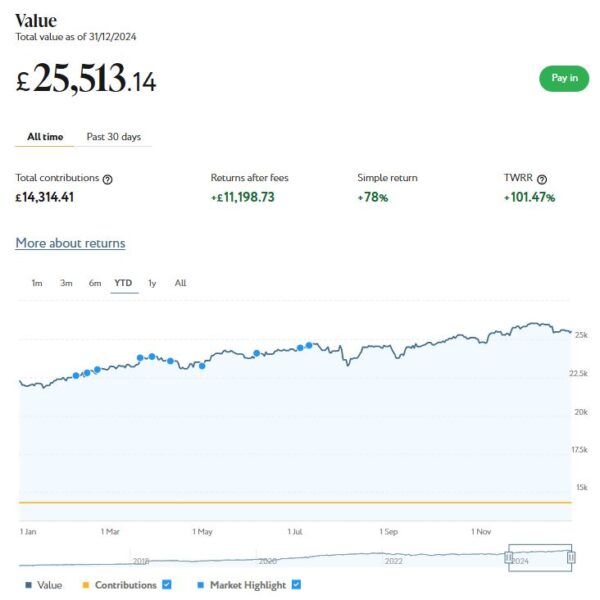
As the screenshot below for the year to date shows, my main Nutmeg portfolio is currently valued at £25,513. Last month it stood at £25,822, so that is a fall of £309.

Nutmeg main port Jan 25

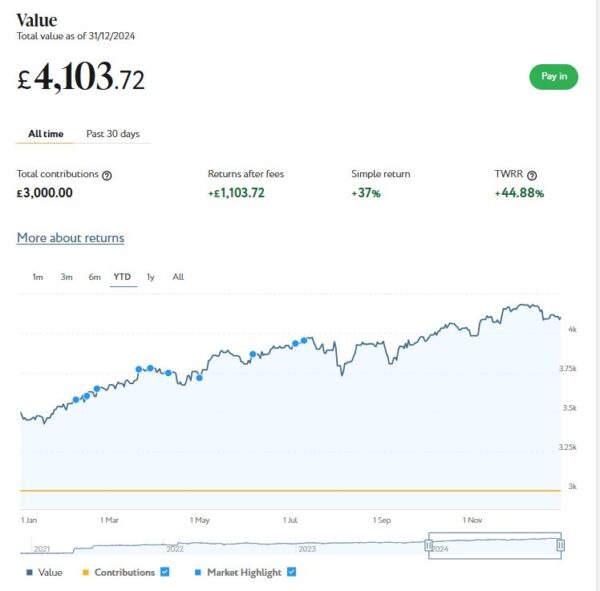
Apart from my main portfolio, I also have a second, smaller pot using Nutmeg’s Smart Alpha option. This is now worth £4,103 compared with £4,157 a month ago, a fall of £54. Here is a screen capture showing performance over the year to date.

Nutmeg SA port Jan 25

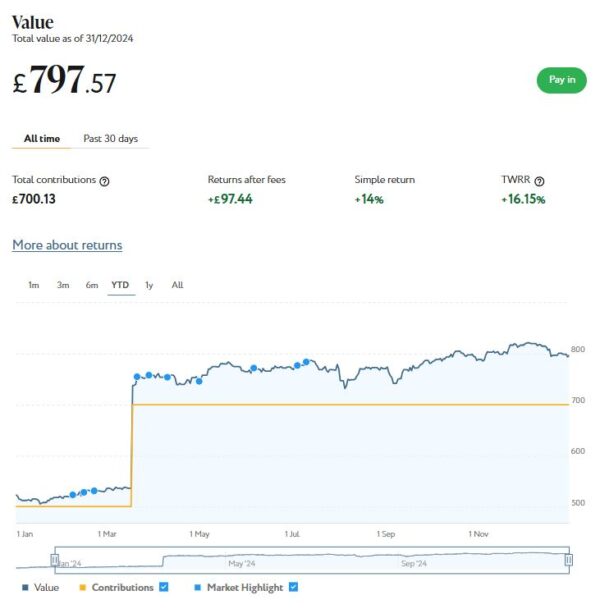
Finally, at the start of December 2023 I invested £500 in one of Nutmeg’s new thematic portfolios (Resource Transformation). In March I also invested a further £200 from referral bonuses. As you can see from the YTD screen capture below, this portfolio is now worth £798 (rounded up) compared with £818 last month, a fall of £20.

Nutmeg thematic port Jan 25

As you will note, following a very good month in November, December saw the value of my Nutmeg investments fall back somewhat. Their overall value dropped by £383 or 1.24% since the start of December. Sadly there was no sign of a Santa rally this year…

Santa sleigh

Overall, 2024 has still been a good year for my Nutmeg investments though. They are up in value by £4,098 or 15.57% since January 1st 2024.

You can read my full Nutmeg review here. If you are looking for a home for your annual ISA allowance, based on my overall experience over the last eight years, they are certainly worth considering. They offer self-invested personal pensions (SIPPs), Lifetime ISAs and Junior ISAs as well.

Moving on, I also have investments with P2P property investment platform Assetz Exchange. This has now renamed itself as Housemartin. There have been a few other changes as well, so I shall be writing a separate blog post about this soon.

My investments with Housemartin continue to generate steady returns. Housemartin focuses on lower-risk properties (e.g. sheltered housing). I put an initial £100 into this in mid-February 2021 and another £400 in April. In June 2021 I added another £500, bringing my total investment up to £1,000.

Since I opened my account, my HM portfolio has generated a respectable £225.17 in revenue from rental income. Capital growth has slowed, though, in line with UK property values generally.

At the time of writing, 14 of ‘my’ properties are showing gains, 2 are breaking even, and the remaining 18 are showing losses. My portfolio of 34 properties is currently showing a net decrease in value of £48.60, meaning that overall (rental income minus capital value decrease) I am up by £176.57. That’s still a decent return on my £1,000 and does illustrate the value of P2P property investments for diversifying your portfolio. And it doesn’t hurt that with Housemartin most projects are socially beneficial as well.

The overall fall in capital value of my Housemartin investments is obviously a little disappointing. But it’s important to remember that until/unless I choose to sell the investments in question, it is largely theoretical, based on the latest price at which shares in the property concerned have changed hands. The rental income, on the other hand, is real money (which in my case I’ve reinvested in other HM projects to further diversify my portfolio).

To control risk with all my property crowdfunding investments nowadays, I invest relatively modest amounts in individual projects. This is a particular attraction of Housemartin as far as i am concerned. You can actually invest from as little as 80p per property if you really want to proceed cautiously.

  • As I noted in this blog post, Housemartin is particularly good if you want to compound your returns by reinvesting rental income. This effectively boosts the interest rate you are receiving. Personally, once I have accrued a minimum of £10 in rental payments, I reinvest this money in either a new HM project or one I have already invested in (thus increasing my holding). Over time, even if I don’t invest any more capital, this will ensure my investment with Housemartin grows at an accelerating rate and becomes more diversified as well.

My investment on Housemartin is in the form of an IFISA so there won’t be any tax to pay on profits, dividends or capital gains. I’ve been impressed by my experiences with Housemartin and the returns generated so far, and intend to continue investing with them. You can read my full review of Assetz Exchange/Housemartin here. You can also sign up for an account directly via this link [affiliate]. Bear in mind that, as from this financial year (2024/25), you can open more than one IFISA per year.

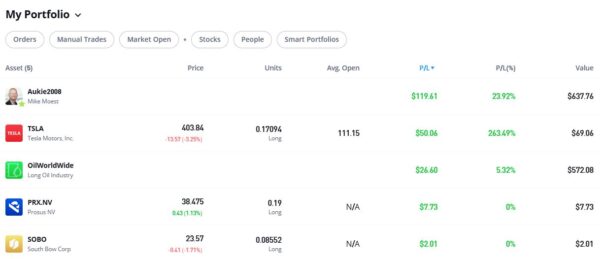
In 2022 I set up an account with investment and trading platform eToro, using their popular ‘copy trader’ facility. I chose to invest $500 (then about £412) copying an experienced eToro trader called Aukie2008 (real name Mike Moest).

In January 2023 I added to this with another $500 investment in one of their thematic portfolios, Oil Worldwide. I also invested a small amount I had left over in Tesla shares.

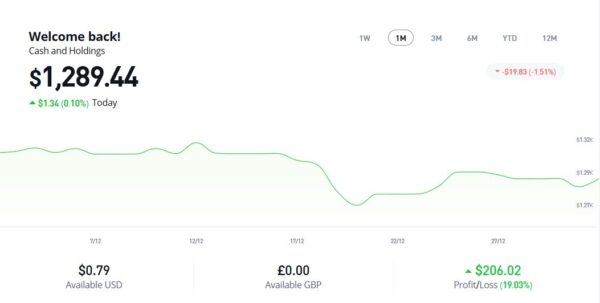
As you can see from the screen captures below, my original investment totalling $1,022.26 is today worth $1,289.44, an overall increase of $266.98 or 26.14%.

Etoro main Jan 25

Etoro port Jan 25

You can read my full review of eToro here. You may also like to check out my more in-depth look at eToro copy trading. I also discussed thematic investing with eToro using Smart Portfolios in this recent post. The latter also reveals why I took the somewhat contrarian step of choosing the oil industry for my first thematic investment with them.

As you can see, my Oil WorldWide investment is showing a modest profit of 5.32%. That’s a bit underwhelming but the portfolio has just been rebalanced by eToro, so hopefully that will improve its performance going forward. The investment team at eToro periodically rebalance all smart portfolios to ensure that the mix of investments remains aligned with the portfolio’s goals, and to take advantage of any new opportunities that may present themselves.

My copy trading investment with Aukie2008 has been doing better, with an overall 23.92% profit. To be fair, I have held the latter investment a bit longer.

My Tesla shares, which I bought as an afterthought with a bit of spare cash I had in my account, have done particularly well in recent weeks. If only I had put a bit more money into this!

You might also notice that I have small holdings in Prosus NV, a Dutch internet group, and South Bow, a Canadian energy infrastructure company. To be honest I don’t understand how I acquired these, but I assume they are some sort of bonus I have been awarded. In any event, I am happy to have them in my portfolio!

  • eToro also offer the free eToro Money app. This allows you to deposit money to your eToro account without paying any currency conversion fees, saving you up to £5 for every £1,000 you deposit. You can also use the app to withdraw funds from your eToro account instantly to your bank account. I tried this myself and was impressed with how quickly and seamlessly it worked. You can read my blog post about eToro Money here. Note that it can also serve as a cryptocurrency wallet, allowing you to send and receive crypto from any other wallet address in the world.

I had two more articles published in December on the excellent Mouthy Money website. The first is How to Save Money on Rail Fares With Split Ticketing. In this article I discussed a money-saving hack called ‘split ticketing’ that savvy travellers can use to reduce their fare costs, often by a substantial amount. Split ticketing involves breaking a journey into two or more smaller segments, purchasing separate tickets for each segment rather than one through-ticket. In my article I discussed how to apply this method and revealed my favourite split-ticketing app.

Also in December Mouthy Money published my article How to Check and Improve Your Credit Score.  In this article I shone a spotlight on a vital aspect of our financial health. Your credit score affects everything from loan approvals to mortgage rates. It’s a measure of how reliably you handle credit and debt, and lenders use it to assess risk. My article reveals everything you need to understand, check and improve your credit score.

As I’ve said before, Mouthy Money is a great resource for anyone interested in money-making and money-saving. If you haven’t checked it out yet, why not get the new year off to a good start by visiting their website. Besides a wide range of interesting articles by me and other writers, currently you can enter a free competition to win one of five copies of How to Retire by Christine Benz.

I also published several posts on Pounds and Sense in December. Some are no longer relevant, but I have listed the others below.

With flu and other seasonal viruses (although not Covid) currently surging, in Stay Healthy This Winter: The Best Supplements for Cold and Flu Season I set out eight of the best supplements to support your immune system during the colder months. This post was researched and written with the assistance of AI (ChatGPT).

And in My Top Twenty Posts of 2024 I listed the top twenty posts on Pounds and Sense in 2024, based on comments, page-views and social media shares (excluding any posts that are no longer relevant). I hope you will enjoy revisiting these posts, or seeing them for the first time if you are new to PAS.

Lastly, a reminder that you can also follow Pounds and Sense on Facebook or Twitter (or X as we have to call it now). Twitter/X is my number one social media platform and I post regularly there. I share the latest news and information on financial matters, and other things that interest, amuse or concern me. So if you aren’t following my PAS account on Twitter/X, you are definitely missing out.

  • I have also just joined the new BlueSky social media network. My username there is poundsandsense.bsky.social. For the time being at least, Twitter/X will remain my main social media platform, but I will also post details of my latest blog posts, third-party articles and other financial news and resources on BlueSky for those who prefer to follow me there.

That’s all for today. Once again, I should like to wish you a very happy and prosperous new year. As always, if you have any comments or questions, feel free to leave them below. I am always delighted to hear from PAS readers 🙂

Disclaimer: I am not a qualified financial adviser and nothing in this blog post should be construed as personal financial advice. Everyone should do their own ‘due diligence’ before investing and seek professional advice if in any doubt how best to proceed. All investing carries a risk of loss. 

Note also that posts on PAS may include affiliate links. If you click through and perform a qualifying transaction, I may receive a commission for introducing you. This will not affect the product or service you receive or the terms you are offered, but it does help support me in publishing PAS and paying my bills. Thank you!

If you enjoyed this post, please link to it on your own blog or social media: