
Investments Update April 2025

My Investments Update – April 2025

Here is my latest monthly update about my investments (slightly earlier than usual due to other commitments). You can read my March 2025 Investments Update here if you like.

I’ll begin as usual with my Nutmeg Stocks and Shares ISA. This is the largest investment I hold other than my Bestinvest SIPP (personal pension).

As the screenshot below for the year to date shows, my main Nutmeg portfolio is currently valued at £25,065. Last month it stood at £25,850, so that is a drop of £785.
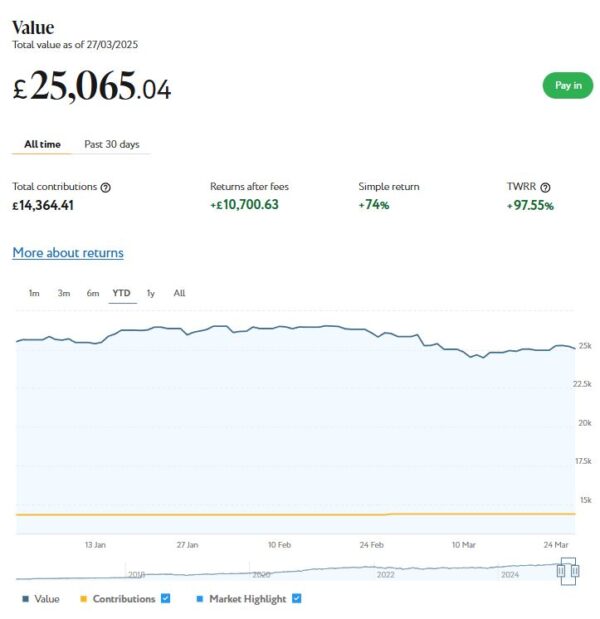
Nutmeg main port April 25

Apart from my main portfolio, I also have a second, smaller pot using Nutmeg’s Smart Alpha option. This is now worth £4,027 compared with £4,151 a month ago, a fall of £124. Here is a screen capture showing performance for the year to date.
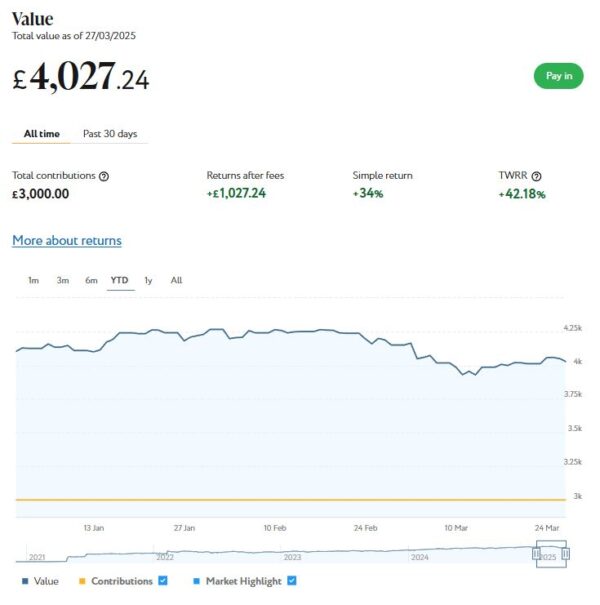
Nutmeg Smart Alpha April 25

Finally, at the start of December 2023 I invested £500 in one of Nutmeg’s new thematic portfolios (Resource Transformation). In March I also invested a further £200 from referral bonuses. As you can see from the YTD screen capture below, this portfolio is now worth £783 compared with £803 last month, a fall of £20.
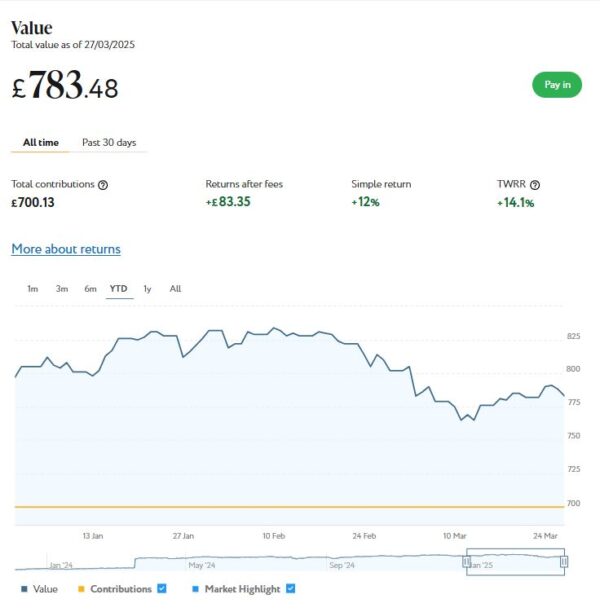
Nutmeg Thematic port April 25

As you can see, March has been another disappointing month for my Nutmeg investments. Overall I am down by £929. This is mostly due to the continuing instability in world markets, caused by the the trade tariffs imposed by US President Donald Trump and other economic and social factors.

Nonetheless, the value of my Nutmeg investments is still up £1,477 in the last twelve months. And their value has increased by £3,559 or 13.52% since the start of January 2024. So the recent falls do need to be taken in context. Ups and downs are always to be expected with stock market investments, and over time they tend to even themselves out. In general the worst thing you can do is panic and sell up when downturns occur, as you are then crystallizing your losses. Indeed, I am considering topping up some of my investments now while values are depressed. That’s just how I’m thinking, of course, and doesn’t constitute investment advice!

You can read my full Nutmeg review here. If you are looking for a home for your annual ISA allowance, based on my overall experience over the last eight years, they are certainly worth considering. They offer self-invested personal pensions (SIPPs), Lifetime ISAs and Junior ISAs as well.

Moving on, I also have investments with P2P property investment platform Assetz Exchange. As discussed in this recent post, the company recently rebranded as Housemartin.

My investments with Housemartin continue to generate steady returns. Housemartin focuses on lower-risk properties (e.g. sheltered housing). I put an initial £100 into this in mid-February 2021 and another £400 in April. In June 2021 I added another £500, bringing my total investment up to £1,000.

Since I opened my account, my HM portfolio has generated a respectable £238.70 in revenue from rental income. Capital growth has slowed, though, in line with UK property values generally.

At the time of writing, 15 of ‘my’ properties are showing gains, 2 are breaking even, and the remaining 19 are showing losses. My portfolio of 36 properties is currently showing a net decrease in value of £52.78, meaning that overall (rental income minus capital value decrease) I am up by £185.92. That’s still a decent return on my £1,000 and does illustrate the value of P2P property investments for diversifying your portfolio. And it doesn’t hurt that with Housemartin most projects are socially beneficial as well.

The overall fall in capital value of my Housemartin investments is obviously a little disappointing. But it’s important to remember that until/unless I choose to sell the investments in question, it is largely theoretical, based on the latest price at which shares in the property concerned have changed hands. The rental income, on the other hand, is real money (which in my case I’ve reinvested in other HM projects to further diversify my portfolio).

To control risk with all my property crowdfunding investments nowadays, I invest relatively modest amounts in individual projects. This is a particular attraction of Housemartin as far as i am concerned. You can actually invest from as little as £1 per property if you really want to proceed cautiously.

  • As I noted in this blog post, Housemartin is particularly good if you want to compound your returns by reinvesting rental income. This effectively boosts the interest rate you are receiving. Personally, once I have accrued a minimum of £10 in rental payments, I reinvest this money in either a new HM project or one I have already invested in (thus increasing my holding). Over time, even if I don’t invest any more capital, this will ensure my investment with Housemartin grows at an accelerating rate and becomes more diversified as well.

My investment on Housemartin is in the form of an IFISA so there won’t be any tax to pay on profits, dividends or capital gains. I’ve been impressed by my experiences with Housemartin and the returns generated so far, and intend to continue investing with them. You can read my full review of Assetz Exchange/Housemartin here and my article about the rebranding to Housemartin here. You can also sign up for an account directly via this link [affiliate].

In 2022 I set up an account with investment and trading platform eToro, using their popular ‘copy trader’ facility. I chose to invest $500 (then about £412) copying an experienced eToro trader called Aukie2008 (real name Mike Moest).

In January 2023 I added to this with another $500 investment in one of their thematic portfolios, Oil Worldwide. I also invested a small amount I had left over in Tesla shares.

As you can see from the screen captures below, my original investment (total value £888.36 in pounds sterling) is today worth £1,072.80, an overall increase of £184.44 or 20.76%.

  • Note: eToro now displays the value of investments in your native currency, although you can change this if you wish.
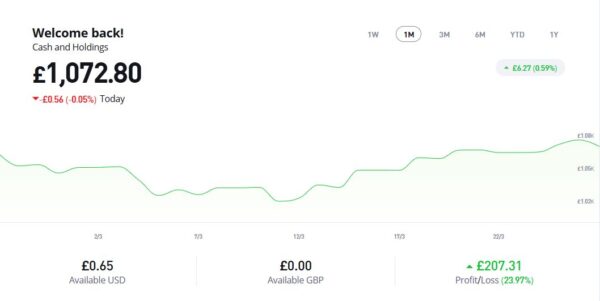
Etoro Home April 2025

Etoro port April 2025

You can read my full review of eToro here. You may also like to check out my more in-depth look at eToro copy trading. I also discussed thematic investing with eToro using Smart Portfolios in this recent post. The latter also reveals why I took the somewhat contrarian step of choosing the oil industry for my first thematic investment with them.

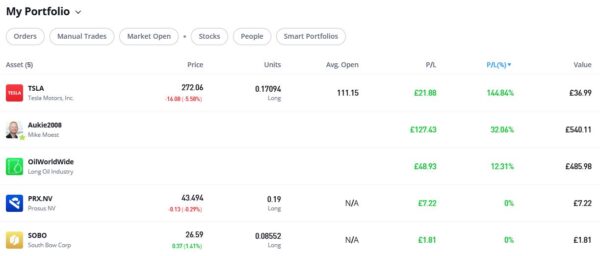
As you can see, my Oil WorldWide investment is currently showing a profit of 12.31%. That’s a welcome improvement since the portfolio was rebalanced by eToro. The investment team at eToro periodically rebalance all smart portfolios to ensure that the mix of investments remains aligned with the portfolio’s goals, and to take advantage of any new opportunities that may present themselves.

My copy trading investment with Aukie2008 has been doing better, with an overall 32.06% profit. To be fair, I have held the latter investment a bit longer.

My Tesla shares, which I bought as an afterthought with a bit of spare cash I had in my account, have done particularly well since I bought them, with an overall profit of 144.84%. If only I had put a bit more money into this!

You might also notice that I have small holdings in Prosus NV, a Dutch internet group, and South Bow, a Canadian energy infrastructure company. To be honest I don’t understand how I acquired these, but I assume they are some sort of bonus I was awarded. In any event, I am happy to have them in my portfolio!

  • eToro also offer the free eToro Money app. This allows you to deposit money to your eToro account without paying any currency conversion fees, saving you up to £5 for every £1,000 you deposit. You can also use the app to withdraw funds from your eToro account instantly to your bank account. I tried this myself and was impressed with how quickly and seamlessly it worked. You can read my blog post about eToro Money here. Note that it can also serve as a cryptocurrency wallet, allowing you to send and receive crypto from any other wallet address in the world.

If you would like more information about setting up an eToro account, please click on this no-obligation website link [affiliate]. Don’t forget that you also get a free $100,000 virtual portfolio, which you can use to experiment with trading and investing strategies. I have certainly earned a lot from mine.

Moving on, as I said last time, I am no longer writing for the Mouthy Money website, as they have decided to take their content creation in-house. From a personal perspective I am obviously disappointed about this, but I had a good run with them and wish them every success going forward. You can still read all the articles I contributed to Mouthy Money over the years by visiting my profile page on the website. How long they will keep this in place I really can’t say!

I also published several posts on Pounds and Sense in March. Some are no longer relevant, but I have listed the others below.

In Beat the Postage Stamp Price Rise!, I pointed out that stamp prices are rising again on 7th April 2025. This will actually be the the SIXTH rise in the price of first class stamps in just three years. See what prices are going up, along with my recommendations for mitigating the effects of the increases.

And in From Saving to Spending – The Retirement Mindset Shift I discussed a subject that has been on my mind recently as I enter my 70th year. This is how to negotiate the mindset shirt from saving to spending in retirement, and how (hopefully) to get the balance right.

The Pros and Cons of Investing for Dividends discusses a strategy that has been growing in popularity with older investors particularly. Dividend investing offers the potential for generating income combined with capital appreciation. In this post I examine the pros and cons of a dividend investing strategy and set out a few tips and guidelines for those new to this.

Finally, in Spotlight: The Mintos P2P European Investing Platform I take a closer look at Mintos, Europe’s largest P2P investment platform. As well as the ability to generate above-average returns by investing in loans to businesses world-wide, they have added new diversification options, including bonds, ETFs and real estate. And until the end of April they have a bonus offer for anyone investing €1,500 or above on the platform. In my blog post I look at the pros and cons of investing with Mintos and provide more details about their April bonus offer.

One other thing is that we’re currently just over a week away from the end of the 2024/25 financial year. If you still haven’t used all of your 2024/25 £20,000 tax-free ISA allowance, you have just a few days left before it’s gone. It is more important than ever to use all your tax-free allowances while you can, as the government looks set to reduce some of these allowances later in the year. See my recent blog post for more information.

I’ll close with a reminder that you can also follow Pounds and Sense on Facebook or Twitter (or X as we have to call it now). Twitter/X is my number one social media platform and I post regularly there. I share the latest news and information on financial matters, and other things that interest, amuse or concern me. So if you aren’t following my PAS account on Twitter/X, you are definitely missing out.

  • I am also on the BlueSky social media network under the username poundsandsense.bsky.social. For the time being anyway, Twitter/X will remain my primary social media platform, but I will also post details of my latest blog posts, third-party articles and other financial news and resources on BlueSky for those who prefer to follow me there.

As always, if you have any comments or questions, feel free to leave them below. I am always delighted to hear from PAS readers 🙂

Disclaimer: I am not a qualified financial adviser and nothing in this blog post should be construed as personal financial advice. Everyone should do their own ‘due diligence’ before investing and seek professional advice if in any doubt how best to proceed. All investing carries a risk of loss. 

Note also that posts on PAS may include affiliate links. If you click through and perform a qualifying transaction, I may receive a commission for introducing you. This will not affect the product or service you receive or the terms you are offered, but it does help support me in publishing PAS and paying my bills. Thank you!


If you enjoyed this post, please link to it on your own blog or social media:
The Pros and Cons of Dividend Investing

The Pros and Cons of Investing for Dividends

Today I’m looking at investing for dividends. This is an increasingly popular strategy among investors seeking to generate passive income while potentially also growing their capital. 

Dividend stocks can provide a steady income stream, but they also come with risks and considerations. So I’ll begin by looking at the pros and cons of this approach. I will set out some hints and tips for anyone who may be interested in getting started at dividend investing. I will also mention some established UK companies that have a reputation for paying regular dividends, and some online share-dealing platforms that may be suitable for anyone applying this strategy.

Let’s begin with some of the attractions of dividend investing, though…

Pros

  1. Regular Income Stream

One of the biggest benefits of dividend investing is receiving regular cash payments, typically every quarter or six months, though occasionally monthly. This can be particularly appealing for retirees or anyone seeking passive income.

  1. Potential for Long-Term Growth

Many well-established companies that pay dividends also experience share price growth. Reinvesting dividends through a dividend reinvestment plan (DRIP) can compound returns over time.

  1. Stability in Market Downturns

Dividend-paying companies are often large, well-established firms that can weather economic downturns better than smaller, high-growth companies. Investors may find these stocks less volatile.

  1. Tax Efficiency for UK Investors

UK investors benefit from the £500 dividend allowance (as of 2024/25) before dividend income is taxed. Additionally, holding dividend stocks in an ISA (Individual Savings Account) or SIPP (Self-Invested Personal Pension) shields the income from tax altogether.

  1. Indication of a Strong Business

Companies that consistently pay and grow dividends often have strong financials, stable earnings, and a track record of profitability. This can be a sign of a well-managed company.

Cons

  1. Slower Growth Compared to High-Growth Stocks

Dividend stocks are typically in mature industries, meaning they may not offer the rapid price appreciation seen in high-growth technology or small-cap stocks.

  1. Dividends Are Not Guaranteed

A company can cut or suspend its dividend payments if it faces financial trouble, as seen during economic crises. This can lead to both income loss and share price declines.

  1. Dividend Tax for Higher Earners

If your dividend income exceeds the £500 tax-free allowance, you will pay 8.75% tax (basic rate), 33.75% (higher rate), or 39.35% (additional rate) on the excess amount. This reduces overall returns compared to capital gains, which have different tax rates.

  1. Sector Concentration Risk

Many high-dividend stocks are concentrated in certain industries, such as utilities, oil, and consumer goods. This can limit diversification and expose investors to sector-specific risks.

Tips for Beginners

If you’re new to dividend investing and want to try it, here are a few tips and guidelines to get you started…

Look for Dividend Growth, Not Just High Yields – A high yield can be a red flag if unsustainable. Instead, focus on established companies with low volatility and a history of gradually increasing dividends over time.

Diversify Your Portfolio – Don’t put all your money into one or two high-dividend stocks. Consider spreading investments across different sectors and countries.

Check the Dividend Cover Ratio – This metric (earnings per share divided by dividends per share) shows whether a company can afford its dividend. A ratio above 1.5 is generally considered safe.

Use Dividend Reinvestment – Reinvesting dividends can significantly increase long-term returns through compounding. Many brokers and online share-dealing platforms offer automatic reinvestment options.

Consider Dividend-Focused Funds – If picking individual stocks feels overwhelming, dividend ETFs or investment trusts like City of London Investment Trust (CTY) and Murray Income Trust (MUT) provide diversification and professional management. Popular dividend-focused ETFs include Vanguard High Dividend Yield Trust (VYM) and iShares Select Dividend ETF (DVY), which invests in high dividend yielding US stocks.

Examples of Strong Dividend-Paying UK Companies

Here are some UK companies known for consistent dividend payments in recent years.

Unilever (ULVR) – A consumer goods giant with a strong dividend history and steady growth.

Legal & General (LGEN) – A leading financial services company offering an attractive dividend yield.

National Grid (NG) – A stable utility company known for reliable dividend payouts.

BP (BP) – A major oil company that has historically paid strong dividends, though with some fluctuations.

Diageo (DGE) – A global leader in alcoholic beverages with a track record of dividend growth.

Online Share Dealing Platforms

Here are three UK share dealing platforms that are well-suited for dividend investors looking for relatively low costs.

  1. Interactive Investor (ii)

  • Flat-fee pricing model, which can be cost-effective for those with larger portfolios.
  • Monthly plans start from £4.99, including a Stocks & Shares ISA.
  • Offers one free trade per month, with additional trades at £5.99.
  • Free regular investing option for cost-effective reinvestment of dividends.

Visit Interactive Investor

  1. IWeb Share Dealing

  • One-off account opening fee of £100, but no annual fees after that.
  • Low-cost dealing with £5 per trade.
  • Supports shares, funds, ETFs, and investment trusts.
  • No regular investing feature, but good for long-term investors who trade occasionally.

Visit IWeb Share Dealing

  1. Trading 212

  • Commission-free trading on UK and international stocks.
  • Allows fractional share investing, which is great for reinvesting dividends.
  • Offers an AutoInvest feature for automated investing and reinvesting.
  • Offers ‘pies’ (ready-made portfolios) focused specifically on dividend investing, e.g. (Almost) Daily Dividends
  • No monthly fees for basic accounts, though there are forex fees for currency conversion.

Visit Trading 212

Each of these platforms has strengths depending on your investing style. Trading 212 (a personal favourite of mine) is great for beginners and low-cost investors; Interactive Investor suits those with larger portfolios; and IWeb is a solid, no-frills option for long-term dividend investors.

Closing Thoughts

Dividend investing can be a great way to generate passive income, but it requires careful stock selection and risk management. 

By focusing on financially strong companies with sustainable dividends and using tax-efficient accounts, investors can make the most of this strategy. 

If you’re looking for a regular income from your investments combined with the potential for long-term growth, dividend investments have the potential to play a valuable role in your investing portfolio..

  • See also this guest post by my colleague Lewys Lew on his personal approach to dividend investing. Although it was published a while ago, there are still some useful tips to be gleaned from it.

PLEASE NOTE: I am not a qualified financial adviser and nothing in this article should be construed as personal financial advice. You should always do your own ‘due diligence’ before investing and seek professional advice if in any doubt how best to proceed. All investing carries a risk of loss.


If you enjoyed this post, please link to it on your own blog or social media:
From Saving to Spending - The Retirement Mindset Shift

From Saving to Spending: The Retirement Mindset Shift

Today I’m looking at a subject that may affect many readers of this blog who have recently (or not so recently) retired. It’s certainly a concern that I’ve faced myself (discussed later in the article).

For decades, many of us save diligently for retirement, carefully managing our finances to ensure what we hope will be a comfortable future. But once we finally reach retirement, a surprising challenge can emerge: shifting from a saving mentality to a spending one.

This transition can be difficult, even stressful, leading to problems such as excessive frugality, missed opportunities for enjoyment and unnecessary financial anxiety. Understanding why this happens – and how to navigate it – can help retirees make the most of their ‘golden years’.

Why Can it be Hard to Spend in Retirement?

For most of our working lives, we are conditioned to save for the future. The importance of building a pension pot, maximizing savings and preparing for the unexpected is constantly emphasized. Over time, this mindset becomes deeply ingrained, making it hard to reverse once retirement begins.

Here are some key reasons why many retirees struggle with spending…

Fear of Running Out of Money – With no regular salary coming in, retirees often worry that their savings won’t last. This fear can be worsened by rising living costs, potential healthcare expenses, and uncertainty about how long they will need their money to last.

A Lifetime Habit of Frugality – Many people have spent decades budgeting carefully, avoiding unnecessary expenses and prioritizing financial security. Suddenly being told it’s ‘okay’ to start spending feels unnatural, even reckless.

Uncertainty About the Future – Unlike a working salary, which can be replenished, a pension pot or savings account feels (and generally is) finite. Economic uncertainty, stock market fluctuations and potential care costs make it difficult for retirees to gauge how much they can safely spend.

The Problems of Excessive Frugality

While being cautious with money is clearly advisable, being overly frugal can unnecessarily reduce quality of life. Some retirees deny themselves experiences, comforts and even essentials because they feel they ‘shouldn’t’ spend. Here are some reasons why this can be problematic…

Missed Opportunities – Retirement is meant to be enjoyed, yet some people avoid holidays, hobbies or social outings because they fear dipping into their savings.

Health and Well-being Risks – Reluctance to spend on home improvements, heating or even nutritious food can have serious consequences for health and safety.

Unnecessary Financial Stress – Constantly worrying about money can take a toll on our mental well-being, even when there are sufficient funds available.

Regret Later in Life – Some realize too late that they were overly cautious and could have enjoyed their retirement more. By the time they feel comfortable spending, they may no longer be fit and healthy enough to do so.

How to Develop a Healthy Spending Mindset

Making the shift from saver to spender requires a conscious effort, but is possible with the right approach. Here are some suggested guidelines to embrace the opportunities presented by retirement whilst still maintaining financial security…

Create a Retirement Spending Plan
Just as saving required a strategy, so too does spending. Work out a realistic budget that includes essentials, discretionary spending and an emergency fund. This can provide reassurance that spending on enjoyment is both affordable and sustainable.

Think of Your Savings as a Paycheque
Rather than seeing savings as a lump sum to be preserved, treat it like an income stream. Regular withdrawals – whether from a pension or other savings – can make spending feel more structured and less daunting.

Prioritize Experiences
Research shows that spending money on experiences rather than possessions leads to greater happiness. Travel, hobbies and social activities can provide fulfilment while keeping finances under control.

Reframe Money as a Tool for Happiness
Rather than viewing savings as something to hoard, retirees can shift their perspective to see money as a resource for a fulfilling and comfortable life. This change in mindset can help ease spending anxieties.

Consider Gradual Adjustments
If spending feels uncomfortable, starting small can help. For example, try increasing your leisure budget gradually or treating yourself to one extra luxury per month. Over time, this can help you feel more at ease with enjoying your wealth.

Take Financial Advice
A professional financial adviser can help retirees feel confident about how much they can afford to spend while ensuring their money lasts. Regular reviews of pensions and investments can provide reassurance (see My Experience, below).

Give Yourself Permission to Enjoy the Rewards of Saving
Remember why you saved in the first place – to have security and enjoyment in later life. A balanced approach ensures financial stability while allowing for a fulfilling retirement.

My Experience

I have been officially retired for several years now. I still do a bit of freelance work (and run this blog) but my freelance income has tapered off. I am fortunate to have some savings and investments, the bulk of which I acquired through inheritances (though some from money I saved over the years).

As regular readers will know, although I’m a money blogger with a particular interest in such matters, I do have a personal financial adviser myself (I talked about this a while ago in this article). His name is Mike, and in my recent annual review he gently suggested that I could afford to withdraw a bit more from my investments. Essentially, he told me that I wasn’t getting any younger (I’m 70 this year) and there would be no benefit to dying with a lot of money left in my account. In some ways I found this advice encouraging, in others a bit depressing!

I do accept the gist of Mike’s advice, though. Even though I’m basically in good health, none of us knows what the future may hold. So I have promised Mike that I will think about what he has said and consider whether to draw more from my investments, while still leaving enough to cover my possible health and care needs in future. Of course, without a functioning crystal ball this isn’t an easy task, especially with the very high cost of care in the UK. But it’s important to take a balanced view and ensure you aren’t depriving yourself unnecessarily now whilst still retaining sufficient funds in case circumstances change in future.

Closing Thoughts

As I said at the start, the shift from saving to spending can be one of the biggest psychological adjustments in retirement.

Retirement is meant to be enjoyed, but many retirees find themselves trapped in a frugality mindset that stops them fully embracing the opportunities presented by this stage of life.

While financial prudence is important, excessive caution can lead to missed opportunities and unnecessary sacrifice. By shifting perspectives, planning carefully and embracing the idea that money is there to be used and enjoyed, retirees can – hopefully – strike a balance between financial security and enjoying their hard-earned wealth.

As ever, I’d love to hear any views (or tips) from readers about walking the tightrope between preserving your savings and making the most of life while you can.


If you enjoyed this post, please link to it on your own blog or social media:
Beat the Postage Stamp Price Rise

Beat the Postage Stamp Price Rise!

A quickie today to let you know that the price of stamps is rising again on Monday 7 April 2025. That will be the SIXTH rise in the price of first class stamps in just three years.

On this occasion a standard first class stamp is going up from £1.65 to £1.70, a 3% increase. The price of sending a large letter first class is going up by substantially more, from £2.60 to £3.15. That’s an increase of 55p or an inflation-busting 21%.

The price of sending a standard letter by second class post is increasing from 85p to 87p (a 2% rise), One small bit of good news is that the cost of sending a large letter second class is not rising and remains at £1.55.

Standard letters can weigh up to 100g and measure a maximum of 24cm x 16.5cm x 5mm. Large letters can measure 35.3cm x 25cm x 2.5cm but still have to weigh under 100g. If they weight over 100g, higher rates apply, and if they weigh over 750g they have to go at parcel rates.

The cost of many of Royal Mail’s ‘Signed For’, ‘Special Delivery Guaranteed’ and ‘Tracked’ services will also rise from 7 April, as will the price of sending parcels first and second class. You can see a full list of prices by clicking here (PDF).

Saving Money on Stamps

So is there anything you can do to mitigate the impact of the latest price rises?

Well, my number one recommendation is to stock up now while stamps are still at the old price. Standard and large-letter stamps don’t have values printed on them and will still be valid after the April price rise comes in. If you can afford to buy (say) 100 standard first-class stamps and 100 large letter first class stamps, that will save you an impressive £60 in total.

The best bet for buying stamps is – of course – your local post office. If you don’t have one near at hand, however, you can also buy in bulk from The Royal Mail Shop (minimum order £50 for free delivery)..

Amazon also sell postage stamps, though costs vary and when I checked some prices were significantly higher than at post offices. But they may be worth a look, especially if you are an Amazon Prime member.

Another option you could consider is the online auction site eBay. There can be good savings to be made here, but check reviews and ratings carefully and be wary of offers that are clearly too good to be true.

  • Remember, also, that older UK stamps without barcodes are no longer valid.

For more information about the price rise and all the new rates from 7 April 2025, you can access the Royal Mail April 2025 pricing guide here (PDF).

If you have any comments or questions about the above, as always, please do post them (no pun intended!) below.


If you enjoyed this post, please link to it on your own blog or social media:
My Investments Update - March 2025

My Investments Update – March 2025

Here is my latest monthly update about my investments. You can read my February 2025 Investments Update here if you like.

I’ll begin as usual with my Nutmeg Stocks and Shares ISA. This is the largest investment I hold other than my Bestinvest SIPP (personal pension).

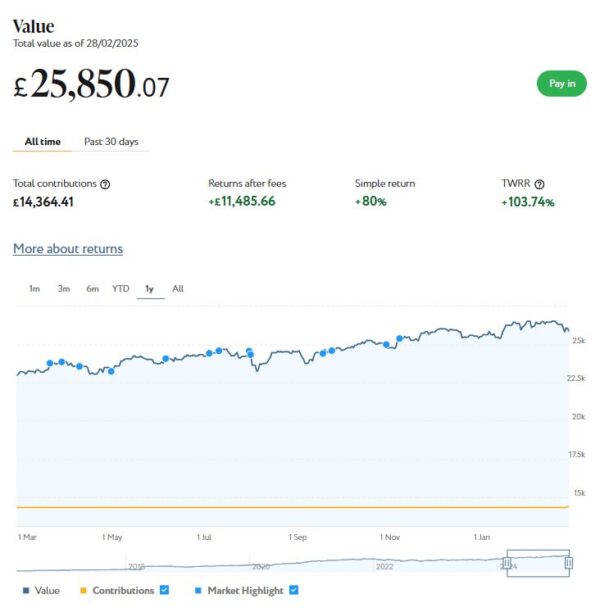
As the screenshot below for the last twelve months shows, my main Nutmeg portfolio is currently valued at £25,850. Last month it stood at £26,528, so that is a decrease of £678.

Nutmeg main port March 25

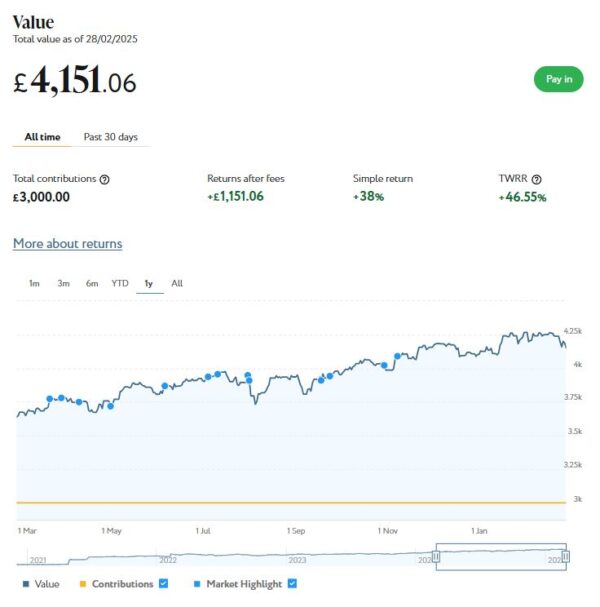
Apart from my main portfolio, I also have a second, smaller pot using Nutmeg’s Smart Alpha option. This is now worth £4,151 compared with £4,267 a month ago, a fall of £116. Here is a screen capture showing performance over the last twelve months.

Nutmeg Smart Alpha March 25

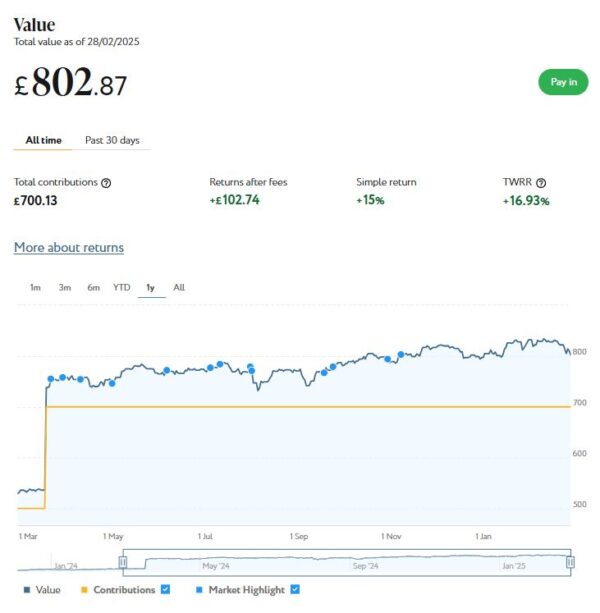
Finally, at the start of December 2023 I invested £500 in one of Nutmeg’s new thematic portfolios (Resource Transformation). In March I also invested a further £200 from referral bonuses. As you can see from the screen capture below, this portfolio is now worth £803 (rounded up) compared with £832 last month, a fall of £29.

Nutmeg Thematic Mar 25

As you can see, February has been a disappointing month for my Nutmeg investments. Overall I am down by £823. This is mostly due to a general decrease in share values in the second half of the month.

Nonetheless, the value of my Nutmeg investments is still up £390 since the start of the year. And their value has increased by £3,441 or 12.67% in the twelve months since the end of February 2024.

You can read my full Nutmeg review here. If you are looking for a home for your annual ISA allowance, based on my overall experience over the last eight years, they are certainly worth considering. They offer self-invested personal pensions (SIPPs), Lifetime ISAs and Junior ISAs as well.

Moving on, I also have investments with P2P property investment platform Assetz Exchange. As discussed in this recent post, the company recently rebranded as Housemartin.

My investments with Housemartin continue to generate steady returns. Housemartin focuses on lower-risk properties (e.g. sheltered housing). I put an initial £100 into this in mid-February 2021 and another £400 in April. In June 2021 I added another £500, bringing my total investment up to £1,000.

Since I opened my account, my HM portfolio has generated a respectable £235.31 in revenue from rental income. Capital growth has slowed, though, in line with UK property values generally.

At the time of writing, 17 of ‘my’ properties are showing gains, 1 is breaking even, and the remaining 19 are showing losses. My portfolio of 37 properties is currently showing a net decrease in value of £50.24, meaning that overall (rental income minus capital value decrease) I am up by £185.07. That’s still a decent return on my £1,000 and does illustrate the value of P2P property investments for diversifying your portfolio. And it doesn’t hurt that with Housemartin most projects are socially beneficial as well.

The overall fall in capital value of my Housemartin investments is obviously a little disappointing. But it’s important to remember that until/unless I choose to sell the investments in question, it is largely theoretical, based on the latest price at which shares in the property concerned have changed hands. The rental income, on the other hand, is real money (which in my case I’ve reinvested in other HM projects to further diversify my portfolio).

To control risk with all my property crowdfunding investments nowadays, I invest relatively modest amounts in individual projects. This is a particular attraction of Housemartin as far as i am concerned. You can actually invest from as little as £1 per property if you really want to proceed cautiously.

  • As I noted in this blog post, Housemartin is particularly good if you want to compound your returns by reinvesting rental income. This effectively boosts the interest rate you are receiving. Personally, once I have accrued a minimum of £10 in rental payments, I reinvest this money in either a new HM project or one I have already invested in (thus increasing my holding). Over time, even if I don’t invest any more capital, this will ensure my investment with Housemartin grows at an accelerating rate and becomes more diversified as well.

My investment on Housemartin is in the form of an IFISA so there won’t be any tax to pay on profits, dividends or capital gains. I’ve been impressed by my experiences with Housemartin and the returns generated so far, and intend to continue investing with them. You can read my full review of Assetz Exchange/Housemartin here. You can also sign up for an account directly via this link [affiliate]. Bear in mind that, as from the current financial year (2024/25), you can open more than one IFISA per year.

In 2022 I set up an account with investment and trading platform eToro, using their popular ‘copy trader’ facility. I chose to invest $500 (then about £412) copying an experienced eToro trader called Aukie2008 (real name Mike Moest).

In January 2023 I added to this with another $500 investment in one of their thematic portfolios, Oil Worldwide. I also invested a small amount I had left over in Tesla shares.

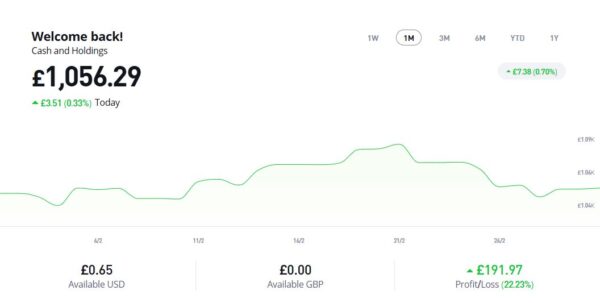
As you can see from the screen captures below, my original investment (total value £888.36 in pounds sterling) is today worth £1,056.29, an overall increase of £167.93 or 18.90%.

  • Note: eToro now displays the value of investments in your native currency, although you can change this if you wish.

eToro main March 25

eToro port Mar 25

You can read my full review of eToro here. You may also like to check out my more in-depth look at eToro copy trading. I also discussed thematic investing with eToro using Smart Portfolios in this recent post. The latter also reveals why I took the somewhat contrarian step of choosing the oil industry for my first thematic investment with them.

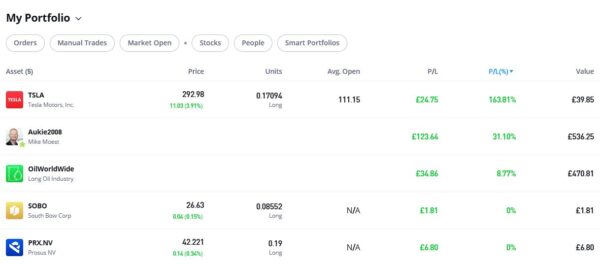
As you can see, my Oil WorldWide investment is showing a profit of 8.77%. That’s a small but nonetheless welcome improvement since the portfolio was rebalanced by eToro. The investment team at eToro periodically rebalance all smart portfolios to ensure that the mix of investments remains aligned with the portfolio’s goals, and to take advantage of any new opportunities that may present themselves.

My copy trading investment with Aukie2008 has been doing better, with an overall 31.18% profit. To be fair, I have held the latter investment a bit longer.

My Tesla shares, which I bought as an afterthought with a bit of spare cash I had in my account, have done particularly well since I bought them, with an overall profit of 163.81%. If only I had put a bit more money into this!

You might also notice that I have small holdings in Prosus NV, a Dutch internet group, and South Bow, a Canadian energy infrastructure company. To be honest I don’t understand how I acquired these, but I assume they are some sort of bonus I was awarded. In any event, I am happy to have them in my portfolio!

  • eToro also offer the free eToro Money app. This allows you to deposit money to your eToro account without paying any currency conversion fees, saving you up to £5 for every £1,000 you deposit. You can also use the app to withdraw funds from your eToro account instantly to your bank account. I tried this myself and was impressed with how quickly and seamlessly it worked. You can read my blog post about eToro Money here. Note that it can also serve as a cryptocurrency wallet, allowing you to send and receive crypto from any other wallet address in the world.

If you would like more information about setting up an eToro account, please click on this no-obligation website link [affiliate]. Don’t forget that you also get a free $100,000 virtual portfolio, which you can use to experiment with trading and investing strategies. I have certainly earned a lot from mine.

I had six more articles published in February on the excellent Mouthy Money website. The first is titled Travelling to Europe This Year? Here’s Why You Need a GHIC Card. If you’re unfamiliar with the GHIC or how it differs from the previous European Health Insurance Card (EHIC), this article reveals everything you need to know, from how to apply to why it’s so important for your travels.

Also in February Mouthy Money published How to Check Your Tax Code and Correct it if Necessary. Understanding your tax code and ensuring its accuracy can prevent you from overpaying (or underpaying) tax. In this article I explained everything you need in order to check and understand the code you have been allocated.

And in Make Extra Money Renting a Room I turned the spotlight on this traditional (but none the worse for that) method for making some extra money. If your circumstances allow it, letting a room in your home can be a great way of generating a sideline income. It will provide a regular, ongoing income stream, which could prove a lifeline in these financially challenging times. And you can choose between getting a full-time lodger or offering short-term lets. Better still, under the Rent a Room Scheme you can make up to £7,500 a year this way entirely tax free!

In What is the Trading Allowance and How Can You Profit From It? I discussed this valuable allowance for UK residents looking to earn extra income from trading or side hustles. Even if you have a full-time job already, under the Trading Allowance you can earn up to £1,000 a year without having to declare that income to the taxman or paying tax on it. Read my article for the full lowdown!

And in Could You Benefit From the Help to Save Scheme? I discussed this lesser-known government initiative which, if you’re eligible, can give your finances a valuable boost. The Help to Save scheme aims to help people on lower incomes build up their savings. Offering generous tax-free bonuses, Help to Save can provide significant benefits for qualifying individuals.

Finally, in Could a Smart Thermostat Save You Money?, I revealed how these clever devices can save you money on your energy bills. I recently had one fitted myself. In this article I reveal which I chose (and why) and share some tips based on my own experiences. My heating engineer Dave, who installed it for me, also gets an honourable mention!

As I’ve said before, Mouthy Money is a great resource for anyone interested in money-making and money-saving. From the range of articles published in February, I particularly enjoyed Where to Find the Best Money-Saving Resources in 2025 by regular MM contributor Shoestring Jane. Jane writes mainly about money saving and frugal living. You can see all of her articles for Mouthy Money via this web page.

  • The not-so-good news about Mouthy Money is that due to a change in their business strategy they will no longer be commissioning external content writers such as me and Jane. From a personal perspective I am obviously disappointed about this, but I have had a good run with them and wish them every success going forward. I will continue to follow Mouthy Money with interest and recommend PAS readers do the same. I am also available for other writing work in the personal finance sphere if anyone else should need me!

I also published several posts on Pounds and Sense in February. Some are no longer relevant, but I have listed the others below.

Debunking Common Myths About Over-50 Life Insurance is a guest post on behalf of my friends at British Seniors Insurance Services. It sets out seven common myths about life insurance for over-50s, including ‘I’m too old to get life insurance’ and ‘Life insurance for over-50s is too expensive’, and explains why these commonly-held beliefs are incorrect.

Marriage in Later Life – A Guide to the Financial and Legal Implications is another guest post, this time by my colleagues at HCR Law. In this eye-opening article, their family law specialist, Victoria Fellows, sets out some important considerations to take into account if you are thinking of marrying (or remarrying) in later life.

In How to Make Money From Stoozing, I discuss this method of making extra income by taking advantage of interest-free offer periods on credit cards. If you are well organized you can make hundreds of pounds by doing this, but there are certain pitfalls to avoid. My article sets out everything you need to know and shares some useful resources.

Don’t Miss Out! Use Your £20,000 ISA Allowance Before It’s Too Late is a reminder that the current tax year ends on 5 April 2025 – and if you don’t use your 2024/25 tax-free ISA allowance before that date, it will be gone forever. In my article I explain the main types of ISA and reveal the ones I invest in myself. I also reveal why using your ISA allowance may be especially important in the current tax year if certain rumours are to be believed.

Finally, in Get Your Will Written Free of Charge in March, I discuss Free Wills Month, which actually starts today (3rd March 2025). This event brings together a group of well-respected charities to offer members of the public aged 55 and over the chance to have their wills written (or updated) free using participating solicitors across the UK. If you don’t currently have a will, this no-obligation opportunity is well worth checking out.

I’ll close with a reminder that you can also follow Pounds and Sense on Facebook or Twitter (or X as we have to call it now). Twitter/X is my number one social media platform and I post regularly there. I share the latest news and information on financial matters, and other things that interest, amuse or concern me. So if you aren’t following my PAS account on Twitter/X, you are definitely missing out.

  • I am also on the BlueSky social media network under the username poundsandsense.bsky.social. For the time being anyway, Twitter/X will remain my primary social media platform, but I will also post details of my latest blog posts, third-party articles and other financial news and resources on BlueSky for those who prefer to follow me there.

As always, if you have any comments or questions, feel free to leave them below. I am always delighted to hear from PAS readers 🙂

Disclaimer: I am not a qualified financial adviser and nothing in this blog post should be construed as personal financial advice. Everyone should do their own ‘due diligence’ before investing and seek professional advice if in any doubt how best to proceed. All investing carries a risk of loss. 

Note also that posts on PAS may include affiliate links. If you click through and perform a qualifying transaction, I may receive a commission for introducing you. This will not affect the product or service you receive or the terms you are offered, but it does help support me in publishing PAS and paying my bills. Thank you!




If you enjoyed this post, please link to it on your own blog or social media: