
Why You Should Beware of Going All-In on Electricity

Why You Should Beware of Going ‘All-In’ on Electricity

In my update today, I’m focusing on a topic that has become of growing concern to me in recent months.

Over the past decade, UK households have been encouraged to electrify almost everything. Cars are going electric. Gas boilers are being phased out in favour of heat pumps. Even cooking is increasingly moving from gas to electricity.

On paper, this all fits with the Government’s drive towards Net Zero. But there’s a growing issue that doesn’t get discussed nearly enough: What happens if the electricity supply isn’t always there when you need it?

As we look ahead to the coming years, relying solely on electricity to power and heat your home could leave you exposed – financially and practically.

Growing Pressure on the UK’s Electricity System

Electricity demand in the UK is set to rise sharply. Two of the biggest drivers are:

  • Electric vehicles (EVs) – millions of households charging cars at home, often at similar times of day

  • Electric heat pumps – particularly air-source heat pumps, which draw large amounts of power in cold weather

At the same time, electricity generation is becoming increasingly weather-dependent. Wind and solar are growing fast, but they don’t always produce power when demand is highest – especially during cold, still winter evenings when heating demand peaks.

The National Grid has so far managed to keep the lights on, but it has done so by relying on emergency measures, reserve power contracts and public appeals to reduce usage at peak times. That’s a sign of a system under strain.

The Risk of Power Cuts Is Increasing, Not Decreasing

While widespread blackouts are still relatively rare, the risk of localised or short-term power cuts is rising.

Reasons include:

  • an ageing electricity distribution network

  • rapid increases in peak demand

  • greater reliance on intermittent renewable generation

  • delays and cost overruns in upgrading grid infrastructure

For households that depend entirely on electricity for heating, hot water and cooking, even a short power cut in winter can quickly become a serious problem.

When Electricity Goes Off, Everything Stops

If your home uses electric heating only:

  • heat pumps stop working

  • electric radiators go cold

  • immersion heaters stop producing hot water

  • induction hobs and electric ovens are unusable

By contrast, homes with non-electric power and heating options retain a degree of resilience. That resilience has real value, particularly for older people, families with young children, or anyone living in rural areas where power cuts tend to last longer.

Diversification Isn’t Just for Investments

Regular readers of Pounds and Sense will be familiar with the idea of diversification. You wouldn’t normally put all your savings into a single investment – and the same principle applies to household energy.

Having more than one way to heat your home reduces risk and gives you flexibility when prices spike or supplies are disrupted.

Alternative and Backup Heating Options to Consider

Here are some heating methods that can be used instead of, or alongside, electricity:

Gas Heating (Where Available)

Despite its declining popularity in policy circles, mains gas remains:

  • reliable

  • relatively inexpensive

  • highly controllable

  • independent of the electricity grid (for heat, though central heating boilers still need some power to operate)

A gas boiler can continue to provide warmth during electricity shortages if paired with a simple backup power source, such as a home storage battery or generator. In addition, most free-standing gas fires can operate without any need for electricity.

Wood-Burning or Multi-Fuel Stoves

A solid fuel stove can be an excellent backup heat source:

  • operates independently of electricity

  • provides direct radiant heat

  • can often heat a large living space effectively

Modern stoves are far cleaner and more efficient than older open fires, though fuel storage and local air-quality rules must be considered.

Open Fires and Solid Fuel Fires

While less efficient than stoves, open fires still provide:

  • a non-electric source of heat

  • emergency warmth during prolonged outages

They can also burn a range of fuels, depending on the fireplace and chimney setup. Again, fuel storage and local air-quality rules will need to be considered.

Oil or LPG Heating (Rural Homes)

For off-grid properties, oil or LPG systems offer:

  • independence from the electricity network for fuel supply

  • predictable heating performance in cold weather

They are often criticized on environmental grounds, but from a resilience perspective they remain useful options.

Portable Backup Options

Even smaller measures can help:

  • portable gas heaters (used safely and with ventilation)

  • camping stoves for boiling water

  • thermal storage heaters or insulated hot water tanks

These won’t heat a whole house but can make a big difference during short outages.

Balancing Net Zero with Common Sense

The Government’s rush towards Net Zero is placing enormous pressure on the UK’s energy system. Whether the huge cost and disruption caused can be justified is (in my opinion anyway) arguable. What’s in no doubt, however, is that the transition period will be messy, expensive and uncertain.

Households that move too quickly to an all-electric setup may find themselves exposed to:

  • higher running costs

  • reduced resilience

  • greater vulnerability during supply disruptions

That doesn’t mean rejecting electrification entirely – but it does mean thinking very carefully before putting all your power and heating eggs in one basket.

My Personal Situation

I live in a detached house built about 40 years ago in suburban Staffordshire. I have gas central heating and an electric cooker. I also have a free-standing gas-fire in the lounge. I have solar panels on the roof and a Givenergy home-storage battery, which I bought a couple of years ago.

When I first heard about heat pumps I did look into the possibility of getting one. I soon realised, however, that I didn’t want to go down this route. As discussed above, I didn’t like the thought of becoming too reliant on electricity, especially with the growing likelihood of power outages. Also, the heating pipes in my house are quite narrow and I have been advised that if I were to get a heat pump, the existing pipes would all have to be taken out and replaced as well. Needless to say, that would add considerably to the cost, not to mention the disruption.

In addition, heat pumps generally operate at lower temperatures than gas central heating, meaning they have to be kept on all the time to ensure the house remains at a comfortable temperature. I have also heard it said that in very cold weather they may not be able to provide adequate warmth on their own. So you really do still need a back-up heating option anyway.

With all these considerations (and others), I therefore plan to stick with my present set-up for the foreseeable future. If at some point gas boilers are banned and/or gas is cut off completely, I will obviously have to rethink this. But as I am now 70, realistically that’s unlikely to happen in my lifetime. In the improbable event that it does, I would think about switching to an electric boiler, which could be installed instead of my old gas boiler without all the pipes in the house having to be torn out and replaced. This would be a lot cheaper to buy and less disruptive than switching to a heat pump, though possibly more expensive to run. Looking to the future, other non-heat-pump alternatives are very likely to appear as well.

Obviously, all of this is just my personal opinion. You may disagree, but I thought it might be helpful to explain my thinking on these matters as they stand now.

The Bottom Line

Electric heating will undoubtedly play a major role in the UK’s future. But in my view relying on electricity alone for heating is increasingly risky.

Where possible, having an alternative or supplementary heating source provides:

  • peace of mind

  • practical resilience

  • protection against both power cuts and price shocks

As with personal finance, a bit of diversification can go a very long way.

As always, I welcome any comments or questions on this article.



If you enjoyed this post, please link to it on your own blog or social media:
New Trading 212 Offer - Get a Guaranteed £25 Cash!

New Trading 212 Offer – Get a Guaranteed £25 Cash!

This offer is now closed

If you’ve been thinking about dipping your toes into investing – or you’re just after a quick cash boost at this expensive time of year – there’s a new Trading 212 offer on the table that’s worth checking out.

There is a £25 welcome reward for new UK customers who sign up and complete a few simple steps with Trading 212. Note that this is a limited-time offer that closes on 20 January 2026.

💰 What’s the Offer?

Trading 212 is currently running a limited-time promotion in the UK where new customers can earn a £25 cash reward by:

  1. Signing up for a Trading 212 Invest account using a referral link (like mine below)

  2. Verifying your identity

  3. Depositing funds and ordering a free Trading 212 card

  4. Using the card to make 3 transactions of £5 or more each within 10 days of opening your account

Once those conditions are met, you get £25 in cash credited to your account – and you can use that money however you like!

👉 Click on my referral link!

📝 How It Works (Step by Step)

Here’s a breakdown of what you need to do if you want to take part in this offer:

📌 Step 1: Sign Up
Click through my referral link and register for a new Trading 212 Invest account (UK residents only, new users only).

📌 Step 2: Verify Your Account
Trading 212 requires standard ID checks (passport, driving licence, address details, etc.). This helps satisfy regulatory “Know Your Customer” requirements.

📌 Step 3: Deposit Funds
Add at least £1 to your Trading 212 account – although you may want to deposit a bit more so you can do Step 4 straight away as well.

📌 Step 4: Order & Use Your Card
Order the free Trading 212 card and make three transactions of £5 or more – these can be everyday purchases you’d make anyway.

📌 Step 5: Get Your £25
After you meet the criteria, your £25 reward should be credited within a few business days. (You will have to wait 30 days before you can withdraw it.)

💷 What Is the Trading 212 Card?

As part of this offer, you need to order and use the Trading 212 card. So what exactly is it?

The Trading 212 card is a free debit card (physical and virtual) linked directly to your Trading 212 Invest account. It allows you to spend money held in your account just like you would with a normal bank debit card. Here is a quick summary of how it works…

  • Linked to your Trading 212 balance
    Any uninvested cash in your Trading 212 account can be used for card payments.

  • Everyday spending
    You can use the card in shops, online, and via contactless payments, just like a standard debit card.

  • No need to invest
    You don’t have to buy shares or funds to use the card. You can simply deposit money and spend it.

  • Free to order
    There’s no charge to order the card, and it’s managed through the Trading 212 app.

  • UK and overseas use
    The card can be used abroad, making it handy for travel or online purchases from overseas retailers (although exchange rates and fees can vary, so always check the latest terms).

Even after the bonus is paid, some people choose to keep the card as a secondary spending card, while others simply withdraw their money and stop using it. There’s no obligation to keep spending with it long term.

As always, it’s worth keeping an eye on Trading 212’s terms and conditions, as card features and fees can change over time.

💡 Why This Is a Good Deal

This is a no-brainer for most people because:

  • You don’t need to invest in stocks and shares to earn the £25 – just make normal card purchases you were planning to do anyway.

  • The minimum effort required is low: three card payments within 10 days.

  • You can withdraw the bonus cash after a short delay and spend it or reinvest it however you choose.

🧠 Things to Know

  • Offers like this can end or change at any time – so if you are interested, it’s worth acting sooner rather than later.

  • This is different from Trading 212’s free share promotion, which exists separately and offers up to £100 in free shares for new users. I discussed this offer in a separate blog post. Note that the Trading 212 free share offer is not available at the time of writing and I don’t know when (or if) it will return.

  • You must use a referral link to qualify for the £25 bonus.

  • You must also open an Invest account to qualify. A Stocks ISA, Cash ISA or CFD account won’t work (though you can open any of these subsequently).

📌 Final Thoughts

If you’ve been on the fence about trying out a stock trading or investment app, this £25 welcome reward from Trading 212 is a genuinely easy way to benefit from signing up. It doesn’t require any complicated investing – you can simply earn the bonus and decide what comes next. Just be sure to follow the steps above carefully and meet all the qualifying requirements.

  • And don’t forget that this limited-time offer closes on 20 January 2026.

As always, if you have any comments or questions about this post, please do leave them below.

Disclosure: If you take up this offer via my referral link, I will also receive a cash bonus for introducing you. The £25 cash bonus is guaranteed if you follow the steps set out above. If you choose to reinvest this money, however, be aware that – as with all investing – there is a risk of loss if you put the money into equities (stocks and shares). You should always do your own “due diligence” before investing and seek advice from a qualified financial planner/adviser if in any doubt how best to proceed.

If you enjoyed this post, please link to it on your own blog or social media:
My Top 20 Posts of 2025

My Top 20 Posts of 2025

As is customary for bloggers at this time of year, here are the top twenty posts on Pounds and Sense in 2025, based on comments, page-views and social media shares. They are in no particular order. I have excluded any posts that are no longer relevant.

I hope you will enjoy revisiting these posts, or seeing them for the first time if you are new to PAS.

All posts in the list below should open in a new tab/window when you click on the link concerned.

  1. The Pros and Cons of Investing for Dividends
  2. From Saving to Spending – The Retirement Mindset Shift
  3. Guest Post: How to Publish Your Book (And Earn Royalties!)
  4. What Are ETFs and How Can You Invest in Them?
  5. How to Save Money on Rail Fares With Split Ticketing
  6. Where to Get Pension Advice
  7. How Social Tariffs Can Help You Save on Household Bills
  8. What Are Bonds and How Can You Invest in Them?
  9. The Many Benefits of Learning a Musical Instrument in Later Life
  10. How to Invest in Gold in the UK
  11. Nutmeg Launches New Income Investing Portfolios
  12. How Over-50s Can Use Vinted to Save and Make Money
  13. Could a Smart Thermostat Save You Money?
  14. Here’s Why I’m not a Fan of FIRE
  15. How Often Should You Really be Washing Your Bedding? A Microbiologist Explains
  16. How to Prepare for Winter Blackouts
  17. How to Save Money on Your Heating Bills This Winter
  18. Annuity or Drawdown? Weighing Up Your Pension Income Options After 50
  19. Why Growing Numbers of Over-50s Are Buying Park Homes
  20. What Are Money Market Funds and Who Should Invest in Them?

I’ll be taking a break from blogging over the festive period (though I’ll still be around on X/Twitter and Facebook). I’ll therefore close by wishing you a Very Merry Christmas (strikes and cost-of-living crisis permitting) and for all of us a brighter, more prosperous new year 🍾

If you have any comments or questions, of course, feel free to leave them below as usual.Xmas tree


If you enjoyed this post, please link to it on your own blog or social media:
Video calling for older people

What Are the Best Video Calling Tools for Older People?

Christmas will soon be here. But with flu and other respiratory infections at high levels – and the Covid pandemic still a fairly recent memory – many older people will be understandably cautious about how much face-to-face socialising they do at this time of year.

In addition, we’re still feeling the effects of the cost-of-living crisis. Many pensioners are cash-strapped, and rising energy costs make winter harder than ever. Add in bad weather, NHS and rail strikes, busy roads and crowded trains, and reduced face-to-face socialising becomes a real possibility, especially for older adults. Loneliness at Christmas can lead to anxiety, depression and other health issues.

While video calling isn’t a complete solution, it can be a lifeline for keeping in touch with distant friends, family, children and grandchildren – especially if travel or health concerns make meeting in person difficult.

So here’s an updated guide to the best video calling tools for older people in 2025, including what you need and the pros and cons of each option.

How to Get Started

To make video calls, you’ll need:

  • A device with a camera and microphone – like a smartphone, tablet, laptop, Chromebook or desktop with webcam.

  • A reliable internet connection – ideally wi-fi at home (video calls can use a lot of mobile data).

  • A video calling app – more on this below.

All modern smartphones (iPhones and Androids) have good-quality cameras. Tablets and laptops usually have larger screens which make conversations easier to see and more comfortable for group calls.

If you’re using a desktop, you might need a separate webcam and microphone unless your machine already has them built in.

Video Calling Tools Worth Considering

1. FaceTime (for Apple Users)

Best for: iPhone and iPad users whose family also uses Apple devices

  • Smartphones: Yes

  • Tablets: Yes

  • Windows: No

  • Mac: Yes

FaceTime remains one of the easiest options if everyone is in the Apple ecosystem. It comes pre-installed on iPhones and iPads, and calls are seamless and high quality. You can add up to 32 people in a group call.

Pros:

  • Built into Apple devices – no extra download

  • High video quality and simple interface

  • Works with newer features like scheduling links and spatial audio

Cons:

  • Only works with Apple devices

  • Not cross-platform (except via browser links in newer versions)

2. WhatsApp

Best for: Informal chats with family and small group calls

  • Smartphones: Yes

  • Tablets: Limited (WhatsApp on some tablets may not support video yet)

  • Windows/Mac: Yes (via desktop app)

WhatsApp is one of the most widely used apps in the world and is familiar to many older people already. Recent updates now allow up to 32 people on one video call, plus screen-sharing and a “speaker spotlight” to highlight whoever’s talking.

Pros:

  • Very familiar and widely adopted

  • End-to-end encryption

  • Works across devices

Cons:

  • Requires contacts to use WhatsApp too

  • Owned by Meta — some users dislike data-sharing practices

3. Messenger (Meta/Facebook)

Best for: Users who already use Facebook and want extra features

  • Smartphones: Yes

  • Tablets: Yes

  • Windows/Mac: Yes

Messenger lets you video call directly from your Facebook contacts. It’s quite straightforward and supports up to 50 people with no time limit on group calls.

Pros:

  • Connects with existing Facebook friends

  • Fun features (filters, translation tools, games)

  • Works across all major platforms

Cons:

  • Requires a Facebook account

  • Some features may feel cluttered for very simple calls

4. Zoom

Best for: Larger family gatherings or planned group events

  • Smartphones/Tablets/PC/Mac: Yes

Zoom is still widely used for large group calls and celebrations. On the free plan you can host up to 100 people, though sessions may be time-limited (often around 40–60 minutes) unless you have a paid subscription.

Pros:

  • Great for big groups (birthdays, Christmas catch-ups)

  • Works on nearly all devices

  • Easy to join via links

Cons:

  • Time limits on free accounts

  • More features than some older people need

5. Google Meet

Best for: Longer chats and group calls without app installs

  • Smartphones/Tablets: Yes

  • Windows/Mac: Yes

Google Meet is a solid everyday option with no required paid plan for basic use, up to 100 people on free accounts, and features like live captions.

Pros:

  • Good for group calls of all sizes

  • Works in a browser (no app install needed)

  • Integration with Google Calendar

Cons:

  • May feel business-oriented for casual use

6. Microsoft Teams (Replacing Skype)

Best for: People who used Skype and want a modern replacement

Note: Skype was retired in 2025 and replaced by Microsoft Teams, so new Skype recommendations are no longer relevant. Users are being encouraged to move to Windows Teams where chat history and contacts can carry over.

Pros:

  • Continued support and development

  • Group calls and chatting similar to Skype

Cons:

  • More features than some users need

  • Setup can be more complex than simpler apps like WhatsApp

Devices That Make Calling Easier for Seniors

Beyond apps, there are dedicated devices that make video calling much simpler for older people:

  • Smart displays like the Amazon Echo Show – big screens, voice commands (“Alexa, video call Mum”), and simplified controls.

  • Senior-friendly tablets (such as this one) with simplified interfaces and large buttons.

These devices are ideal for those less comfortable with standard phones or computers.

Tips for Easier Video Calling

✔ Keep software updated: The latest versions of apps are generally more reliable and secure.
✔ Use wi-fi: Video calls eat data – wi-fi helps avoid extra charges.
✔ Practice together: A short practice call before a big family chat can ease nerves.
✔ Label apps clearly: Rename icons on tablets or phones so they’re easy to find.

Closing Thoughts

Video calling isn’t just a tech trend for businesses and younger people – it’s a lifeline for older adults to stay connected, especially around busy times like Christmas.

The right setup – a good device, a reliable connection, and the right app – can make chatting over distance almost as good as being there in person.

I hope you have found this article helpful. As always, if you have any comments or questions about this post, please do leave them below.

Note: this is a fully revised update of an annual article.


If you enjoyed this post, please link to it on your own blog or social media:
Can you wear the same socks more than once?

Can You Wear the Same Socks More Than Once? A Microbiologist Explains

A few months ago I published a guest post on the subject of how often you should wash your bedding. The article generated quite a lot of interest, so today I am publishing another by the same author: Primrose Freestone, a Senior Lecturer in Clinical Microbiology at the University of Leicester.

This article was originally published in The Conversation and is republished here under a Creative Commons licence.


It’s pretty normal to wear the same pair of jeans, a jumper or even a t-shirt more than once. But what about your socks?

If you knew what really lived in your socks after even one day of wearing, you might just think twice about doing it.

Our feet are home to a microscopic rainforest of bacteria and fungi – typically containing up to 1,000 different bacterial and fungal species. The foot also has a more diverse range of fungi living on it than any other region of the human body.

The foot skin also contains one of the highest amount of sweat glands in the human body.

Most foot bacteria and fungi prefer to live in the warm, moist areas between your toes where they dine on the nutrients within your sweat and dead skin cells. The waste products produced by these microbes are the reason why feet, socks and shoes can become smelly.

For instance, the bacteria Staphylococcal hominis produces an alcohol from the sweat it consumes that makes a rotten onion smell. Staphylococcus epidermis, on the other hand, produces a compound that has a cheese smell. Corynebacterium, another member of the foot microbiome, creates an acid which is described as having a goat-like smell.

The more our feet sweat, the more nutrients available for the foot’s bacteria to eat and the stronger the odour will be. As socks can trap sweat in, this creates an even more optimal environment for odour-producing bacteria. And, these bacteria can survive on fabric for months. For instance, bacteria can survive on cotton for up to 90 days. So if you re-wear unwashed socks, you’re only allowing more bacteria to grow and thrive.

The types of microbes resident in your socks don’t just include those that normally call the foot microbiome home. They also include microbes that come from the surrounding environment – such as your floors at home or in the gym or even the ground outside.

In a study which looked at the microbial content of clothing which had only been worn once, socks had the highest microbial count compared to other types of clothing. Socks had between 8-9 million bacteria per sample, while t-shirts only had around 83,000 bacteria per sample.

Species profiling of socks shows they harbour both harmless skin bacteria, as well as potential pathogens such as Aspergillus, Candida and Cryptococcus which can cause respiratory and gut infections.

The microbes living in your socks can also transfer to any surface they come in contact with – including your shoes, bed, couch or floor. This means dirty socks could spread the fungus which causes Athlete’s foot, a contagious infection that affects the skin on and around the toes.

This is why it’s especially key that those with Athlete’s foot don’t share socks or shoes with other people, and avoid walking in just their socks or barefoot in gym locker rooms or bathrooms.

What’s living in your socks also colonises your shoes. This is why you might not want to wear the same pair of shoes for too many days in a row, so any sweat has time to fully dry between wears and to prevent further bacterial growth and odours.

Foot hygiene

To cut down on smelly feet and reduce the number of bacteria growing on your feet and in your socks, it’s a good idea to avoid wearing socks or shoes that make the feet sweat.

Washing your feet twice daily may help reduce foot odour by inhibiting bacterial growth. Foot antiperspirants can also help, as these stop the sweat – thereby inhibiting bacterial growth.

It’s also possible to buy socks which are directly antimicrobial to the foot bacteria. Antimicrobial socks, which contain heavy metals such as silver or zinc, can kill the bacteria which cause foot odour. Bamboo socks allow more air flow, which means sweat more readily evaporates – making the environment less hospitable for odour-producing bacteria.

Antimicrobial socks might therefore be exempt from the single-use rule depending on their capacity to kill bacteria and fungi and prevent sweat accumulation.

But for those who wear socks that are made out of cotton, wool or synthetic fibres, it’s best to only wear them once to prevent smelly feet and avoid foot infections.

It’s also important to make sure you’re washing your socks properly between uses. If your feet aren’t unusually smelly, it’s fine to wash them in warm water that’s between 30-40°C with a mild detergent.

However, not all bacteria and fungi will be killed using this method. So to thoroughly sanitise socks, use an enzyme-containing detergent and wash at a temperature of 60°C. The enzymes help to detach microbes from the socks while the high temperature kills them.

If a low temperature wash is unavoidable then ironing the socks with a hot steam iron (which can reach temperatures of up to 180–220°C) is more than enough kill any residual bacteria and inactivate the spores of any fungi – including the one that causes Athlete’s foot.

Drying the socks outdoors is also a good idea as the UV radiation in sunlight is antimicrobial to most sock bacteria and fungi.

While socks might be a commonly re-worn clothing item, as a microbiologist I’d say it’s best you change your socks daily to keep feet fresh and clean.The Conversation

Primrose Freestone, Senior Lecturer in Clinical Microbiology, University of Leicester

This article is republished from The Conversation under a Creative Commons license. Read the original article.

As always, if you have any comments about this article, please do post them below.


If you enjoyed this post, please link to it on your own blog or social media:
Investments Update December 2025

My Investments Update – December 2025

Here is my latest monthly update about my investments. You can read my November 2025 Investments Update here if you like.

I’ll begin as usual with my JP Morgan Personal Investing (previously Nutmeg) Stocks and Shares ISA. This is the largest investment I hold other than my Bestinvest SIPP (personal pension).

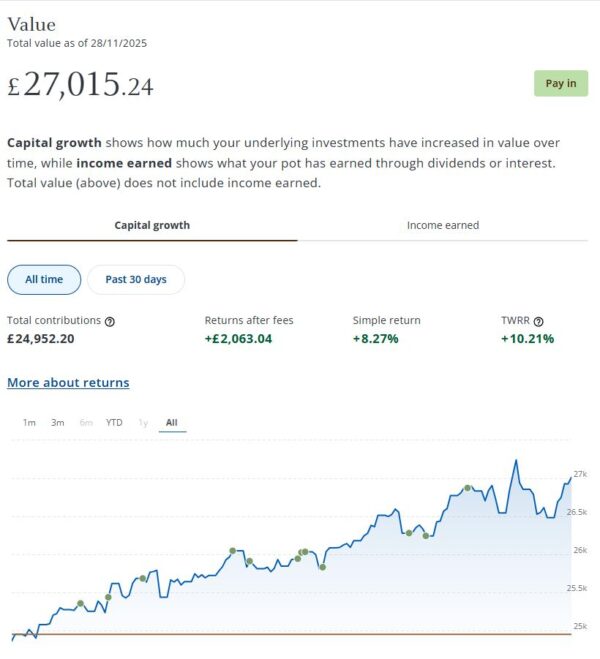
As regular readers will know, in June this year I transferred most of the money in my former Nutmeg Fully Managed portfolio (just under £25,000) to a new Nutmeg Income Portfolio. I discussed this in detail in this post, but basically money in this port is invested to generate an income from share dividends and other sources. This is then paid monthly. Capital appreciation is targeted as well, but these portfolios are aimed primarily at older people (and others) who want/need their investment to generate a regular cash income.

In November my JPM Investing income portfolio generated £119.59 of income, which was duly paid in to my bank account on 24 November 2025. That was around double the £63.96 I received in October and means I have now received a total (tax-free) income of £396.30 to date. That’s about what I would have hoped for based on JPM’s projected annual return of just under 5% for income ports at my chosen risk level (five).

My income portfolio grew in value again in November. It’s now worth £27,015 compared with £26,837 at the start of last month, a rise of £178. As the screen capture shows, the port has actually increased by £2,063.04 (8.27%) since I opened it in June this year. That’s clearly good going, though I don’t suppose it will carry on like this indefinitely. (I should maybe also mention that performance may have been helped a bit by the no-fees introductory offer on Nutmeg/JPM income portfolios until the end of 2025.)

Nutmeg Income portfolio December 2025

I still have a smaller, growth-oriented pot using JPM Investing’s Smart Alpha option. This is now worth £4,685 compared with £4,694 a month ago, a small decrease of £9. Here is a screen capture showing performance for the year to date.

Smart Alpha portfolio Dec 2025

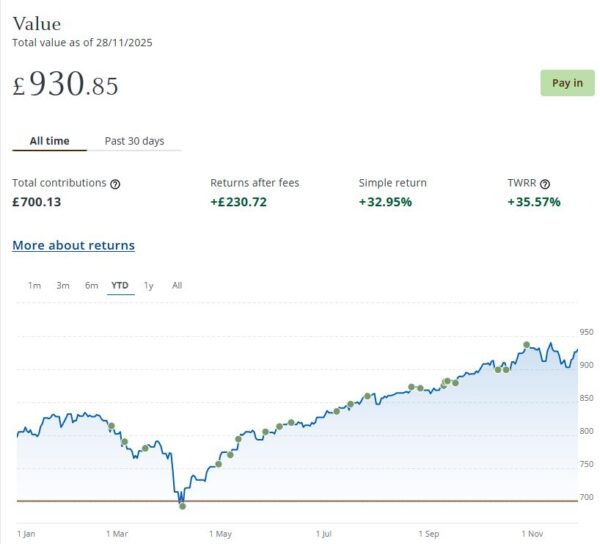
And at the start of December 2023 I invested £500 in one of Nutmeg/JPM’s thematic portfolios (Resource Transformation). In March 2024 I also invested a further £200 from referral bonuses (something I no longer receive for reasons I won’t bore you with). As you can see from the YTD screen capture below, this portfolio is now worth £931 (rounded up) compared with £932 last month, a small decrease of £1.

Thematic port Dec 2025

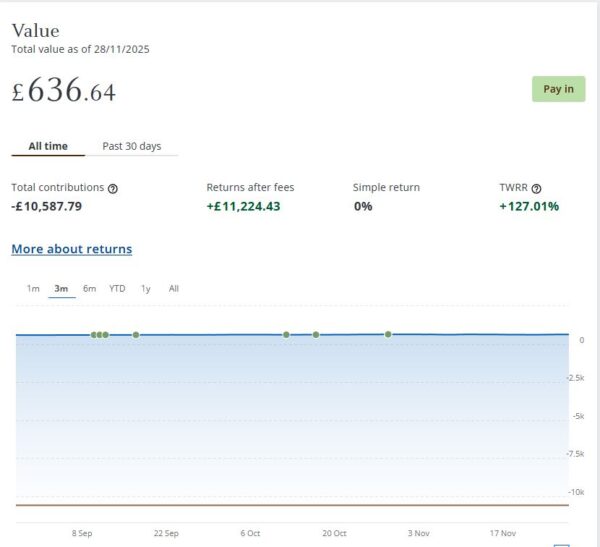
Finally, I still have a small amount left in my original Nutmeg/JPM Fully Managed portfolio. I have kept this largely for comparison purposes. This has also decreased slightly in value from £639 at the start of November to £637 (rounded up) now, a fall of £2.

Fully managed port Dec 2025

Overall in November I was up by £166 or 0.49%. In addition I did, of course, receive £119.59 in income from my income portfolio. The latter was obviously my star performer in November and ensured that I made an overall profit for the month.

Excluding income generated, the overall value of my JPM investments is up by £2,839 or 9.33% since the start of 2025, so the April 2025 fall (caused largely by Trump’s tariffs) has now fully reversed. If you add to this figure the £396.30 of income generated so far this year, that gives a total profit of £3,235.30 – not a bad return in these uncertain times.

As I always have to say, some volatility is to be expected with stock market investments, but over the longer term they tend to even themselves out (and generally perform better than bank savings accounts, although that is never guaranteed). In general the worst thing you can do is panic and sell up when downturns occur (as happened in April this year). You are then crystallizing your losses rather than giving the markets time to recover. This is something I had cause to discuss in this blog post from earlier this year.

You can read my full original Nutmeg/JPM review here. If you are looking for a home for your annual ISA allowance, based on my overall experience over the last nine years, they are certainly worth considering. They offer self-invested personal pensions (SIPPs), Lifetime ISAs and Junior ISAs as well.


Moving on, I also have investments with P2P property investment platform Assetz Exchange. As discussed in this post, the company has rebranded as Housemartin.

My investments with Housemartin continue to generate steady returns. Housemartin focuses on lower-risk properties (e.g. sheltered housing). I put an initial £100 into this in mid-February 2021 and another £400 in April. In June 2021 I added another £500, bringing my total investment up to £1,000.

Since I opened my account, my HM portfolio has generated a respectable £285.00 in revenue from rental income. I have made a small net loss of £21.68 on property disposals. Capital growth generally has slowed, in line with UK property values generally.

At the time of writing, 16 of ‘my’ properties are showing gains, 4 are breaking even, and the remaining 21 are showing losses. My portfolio of 41 properties is currently showing a net decrease in value of £54.99. That means that overall (rental income minus capital value decrease and loss on disposal) I am up by £208.33. That’s still a respectable return on my £1,000 and does illustrate the value of P2P property investments for diversifying your portfolio. And it doesn’t hurt that with Housemartin most projects are socially beneficial as well.

The net fall in capital value of my Housemartin investments is obviously a little disappointing. But it’s important to remember that until/unless I choose to sell the investments in question, it is largely theoretical, based on the latest price at which shares in the property concerned have changed hands. The rental income, on the other hand, is real money (which in my case I’ve reinvested in other HM projects to further diversify my portfolio).

To control risk with all my property crowdfunding investments nowadays, I invest relatively modest amounts in individual projects. This is a particular attraction of Housemartin as far as i am concerned. You can actually invest from as little as £1 per property if you really want to proceed cautiously.

  • As I noted in this blog post, Housemartin is particularly good if you want to compound your returns by reinvesting rental income. This effectively boosts the interest rate you are receiving. Personally, once I have accrued a minimum of £10 in rental payments, I usually reinvest this money in either a new HM project or one I have already invested in (thus increasing my holding). Over time, even if I don’t invest any more capital, this will ensure my investment with Housemartin grows at an accelerating rate and becomes more diversified as well.

My investment on Housemartin is in the form of an IFISA so there won’t be any tax to pay on profits, dividends or capital gains. I’ve been impressed by my experiences with Housemartin and the returns generated so far, and intend to continue investing with them. You can read my full review of Assetz Exchange/Housemartin here and my article about the rebranding to Housemartin here. You can also sign up for an account directly via this link [affiliate].

In 2022 I set up an account with investment and trading platform eToro, using their popular ‘copy trader’ facility. I chose to invest $500 (then about £412) copying an experienced eToro trader called Aukie2008 (real name Mike Moest).

In January 2023 I added to this with another $500 investment in one of their thematic portfolios, Oil Worldwide. I also invested a small amount I had left over in Tesla shares.

As you can see from the screen captures below, my original investment (total value £888.36 in pounds sterling) is today worth £1,168.71 an overall increase of £280.35 or 31.56%.

  • Note: eToro now displays the value of investments in your native currency, although you can change this if you wish.

Etoro Home Dec 25

Etoro port Dec 25

You can read my full review of eToro here. You may also like to check out my more in-depth look at eToro copy trading. I also discussed thematic investing with eToro using Smart Portfolios in this recent post. The latter also reveals why I took the somewhat contrarian step of choosing the oil industry for my first thematic investment with them.

As you can see, my Oil WorldWide investment is in profit, though at 12.27% it is nothing to get too excited about. My copy trading investment with Aukie2008 has been doing better, with an impressive overall profit of 61.67%. To be fair, I have held this investment a bit longer.

My Tesla shares, which I bought as an afterthought with some spare cash I had in my account, are down a little this month but still showing an overall profit of 281.91% since I bought them. If only I had put a bit more money into this!

You might also notice that I have small holdings in Prosus NV, a Dutch internet group, and South Bow, a Canadian energy infrastructure company. To be honest I don’t understand how I acquired these, but I assume they are some sort of bonus I was awarded. In any event, I am happy to have them in my portfolio.

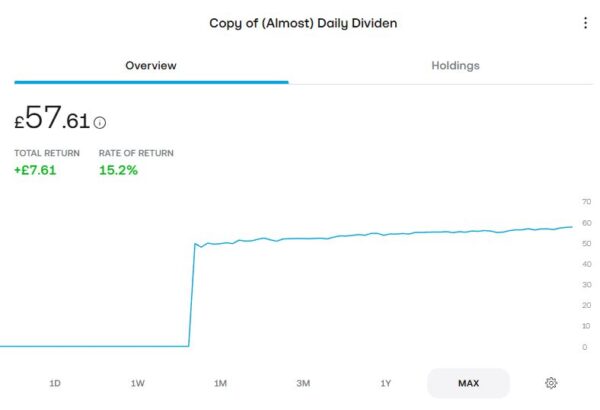
As an experiment, at the start of April this year I put £50 into an investment ISA with Trading 212. As mentioned in my recent blog post about dividend investing, I put it into the (Almost) Daily Dividends Portfolio, a ready-made portfolio or ‘pie’ on Trading 212. As you can see from the screen capture below, my portfolio is now worth £57.61, an increase of £7.61 or 15.20% over the eight-month period. It has even accrued a grand total of 67p in dividends!

Trading 212 Investment port

I am quite impressed with how this investment has been faring, despite the small amount I put in (which means I may be missing out on some smaller dividends). If I increased my investment I would almost certainly become eligible for more dividends, and even more the longer I remain invested. If I had any spare money at the moment, I would consider doing this. Of course, I do now have an income-focused portfolio with JPM Investing as well (see above).


Moving on, I published various posts on Pounds and Sense in November. I have listed below those that are still relevant.

In What Are Money Market Funds and Who Should Invest in Them? I discussed what money market funds (MMFs) are and why they are seeing a surge in interest from UK investors at the moment. I examined their pros and cons and revealed how they may be a valuable addition to your investment portfolio, especially in light of Rachel Reeves’ recent Budget.

In Should You Take a Tax-Free Lump Sum From Your Pension Now? I addressed a question many people were asking in view of rumours that the Chancellor might be about to tighten the rules. As it happens no changes were made in the Budget regarding the tax-free lump sum. The article is still relevant, though, as it sets out the pros and cons of accessing this money early, and when doing so might (or might not) be a good idea.

The popular Trading 212 Free Share Offer reopened in November, so in Get a Free Share Worth Up to £100 With Trading 212 I explained how the offer works and how (If you haven’t done it before) you can take advantage of it. You will need to get your skates on with this, as the offer closes on Tuesday 3 December.

Why Growing Numbers of Over-50s are Buying Park Homes discusses the growing popularity of park homes among older people. The article explains the crucial differences between park homes and holiday homes, and sets out some reasons more and more older people are opting to go down this route. This article was written in association with my friends at Compass Insurance, who are leading specialist providers of park home insurance.

Finally, in Twelve Great Christmas Gift Ideas for Older People (That Aren’t Socks) I set out twelve varied ideas for Christmas presents for your older friends and relatives – based on my personal experience as an older person, of course! Older folk are traditionally harder to buy gifts for – so if you’re struggling with this, hopefully you may find some inspiration here 🙂

One other thing I wanted to mention this month is that currently EDF Energy are offering an enhanced switching bonus. Until 22 December 2025 you can get a hefty £75 (usually £50) credited to your energy account if you switch your supply to them via my link at https://edfenergy.com/quote/refer-a-friend/sunny-koala-9462. I will get a bonus too, so it really is win-win all round!

  • Additionally, if you’re already an EDF customer (or sign up now) you can enter a free prize draw to win a holiday in the UK with £700 prize money! Enter at  https://www.edfenergy.com/edfstaycations. The closing date for this is 11 December 2025 – but if you switch to EDF Energy now, you still have time to enter.

I’ll close with a reminder that you can also follow Pounds and Sense on Facebook or Twitter (or X as we have to call it now). Twitter/X is my number one social media platform and I post regularly there. I share the latest news and information on financial matters, and other things that interest, amuse or concern me. So if you aren’t following my PAS account on Twitter/X, you are definitely missing out!

  • I am also on the BlueSky social media network under the username poundsandsense.bsky.social. Twitter/X remains my primary social media platform, but I also post details of my latest blog posts, third-party articles and other financial news and resources on BlueSky for those who prefer to follow me there.

As always, if you have any comments or questions, feel free to leave them below. I am always delighted to hear from PAS readers 🙂

Disclaimer: I am not a qualified financial adviser and nothing in this blog post should be construed as personal financial advice. Everyone should do their own ‘due diligence’ before investing and seek professional advice if in any doubt how best to proceed. All investing carries a risk of loss. 

Note also that posts on PAS may include affiliate links. If you click through and perform a qualifying transaction, I may receive a commission for introducing you. This will not affect the product or service you receive or the terms you are offered, but it does help support me in publishing PAS and paying my bills. Thank you!

If you enjoyed this post, please link to it on your own blog or social media: