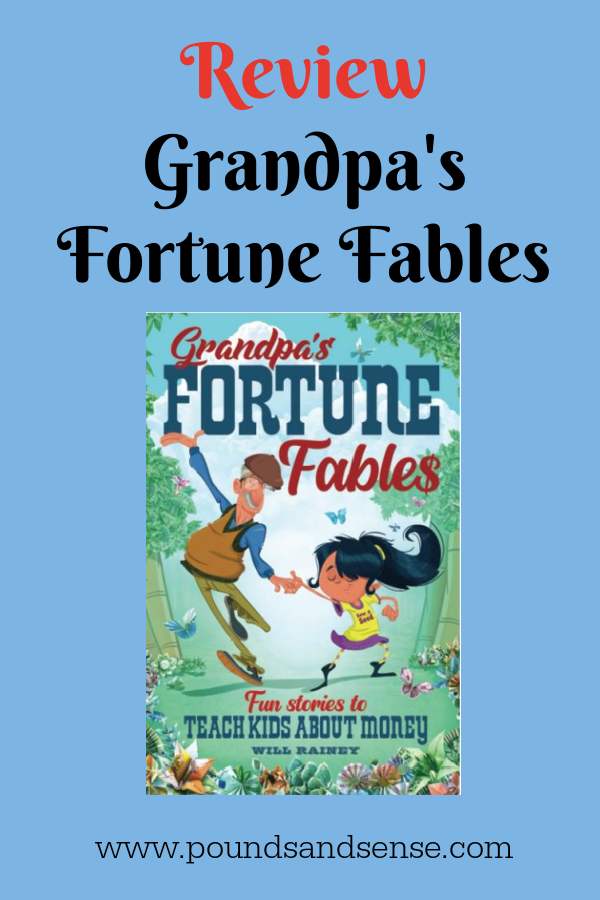
Today I am reviewing a children’s book called Grandpa’s Fortune Fables. An ebook copy of this was kindly sent to me by the author, Will Rainey.
Grandpa’s Fortune Fables contains a series of short stories, each following from the last. The central character is a 13-year-old girl called Gail. Over the course of the book she shares a number of lessons she has learned from her Grandpa about money with a boy named Boris (no relation to our PM, I’m sure!).
Boris starts off by bullying Gail, whom he calls a ‘dork’, but she stands up to him and in time they become friends. Gail shares her Grandpa Jack’s money-saving and money-making advice with Boris. He is eager to learn, as his family have always been bad with money.
We learn that Gail’s Grandpa travelled to a (mythical) far-away island, where he learned how to look after his money and became a very wealthy man. Gail has been following his advice and even at her young age is now quite wealthy herself.
Each chapter is essentially a fable illustrating one particular lesson Gail learned from her Grandpa. So one concerns the dangers of Get Rich Quick schemes, another the importance of saving and reinvesting your money, and so on. There are also chapters on the subject of paying tax (‘The Money BIrds’) and the value of donating some of your money to charity.
At the core of Grandpa’s Fortune Fables are three key principles. I hope Will won’t mind if I reproduce them below:
1. Keep one out of every ten seeds you receive 2. Plant the seeds you keep 3. Let your trees GROW
As you may gather, the fables in the book all derive ultimately from the application of these three principles.
Grandpa’s Fortune Fables is designed to teach children about saving, investing and entrepreneurship in an entertaining but informative way (and parents/grandparents may learn some useful lessons too). The stories are all very much of the here and now – even the pandemic and lockdowns get a brief mention (to illustrate how unforeseen events can impact upon specific investments). It’s all very cleverly written, with some charming cartoon-style illustrations as well (see example below).
In my view Grandpa’s Fortune Fables would make a great Christmas/birthday gift for any child aged around 8 to 12 (it could also work for younger and older children). I like how each chapter ends with questions to provoke further thought and discussion. In addition, by correctly answering the multiple-choice questions in each chapter, a letter is revealed. If the child gets all the letters right, they spell out a message which can win them a prize. This is a great idea and a good incentive for reading every chapter (not that such an incentive would likely be needed).
Grandpa’s Fortune Fables is available in print or e-book versions from Amazon (just click on any of the links in this review), or you can order it from any good bookshop. At the time of writing the price is £9.99 for the print version or £3.99 for the e-book. I note that this title is currently number one on Amazon’s best-seller list for children’s books about money and saving, which doesn’t surprise me at all.
Thanks again to Will Rainey for sending me a review copy of his excellent book. If you have any comments or questions – for me or for Will – please do post them below.
Disclosure: As mentioned above, I received a free ebook version of Grandpa’s Fortune Fables for review purposes. In addition, this review includes Amazon affiliate links. If you click through to Amazon and make a purchase, I will receive a small commission for introducing you. This will not affect the price you pay or the product/service you receive.
If you enjoyed this post, please link to it on your own blog or social media:
Many of us today do most of our shopping in supermarkets. Although of course it’s important to support local/specialist shops, supermarkets typically offer a much wider range of products at prices small stores find hard to match.
But there are still lots of ways savvy shoppers can save money on their supermarket shopping. Here are ten top tips to shave a few pounds (or more) off your shopping bills…
Make the Most of Loyalty Cards
All the big name supermarkets have these, though some (e.g. Morrisons) are switching from plastic to app-based cards. The benefits on offer vary, but typically you get points which can be exchanged for discounts and gifts. I shop mainly at Morrisons and Waitrose, as they have branches closest to me.
With Morrisons, their (now virtual) More card gives you special offers based on things you normally buy anyway. I have had some great discounts on my groceries with these offers, but you do of course need to remember to ‘swipe’ the app barcode at the checkout.
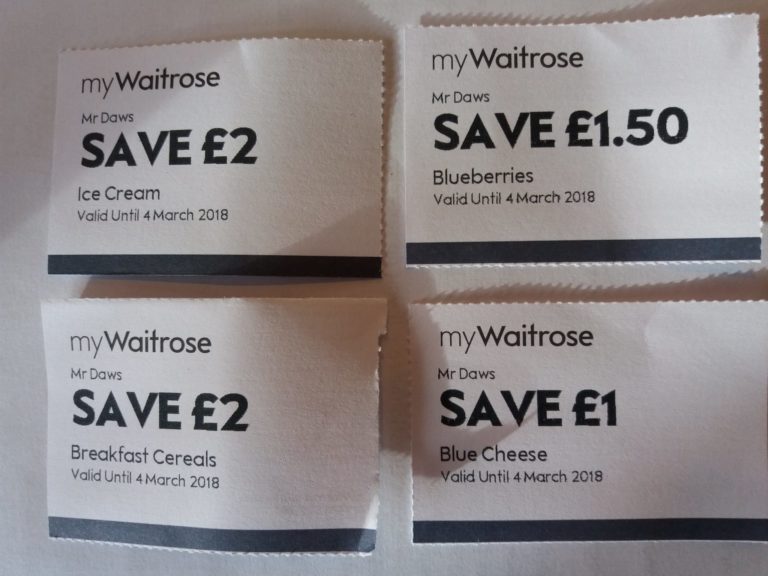
I also have a myWaitrose card. With this you can get a free newspaper with your shopping (subject to a £10 minimum spend). You can also get a free hot drink. You get vouchers sent in the post as well, such as the ones pictured below. It surprises me a bit when someone in the queue in front of me says they don’t have a myWaitrose card, but perhaps if they shop regularly at Waitrose they don’t have to worry too much about saving money 😉
Shop Late in the Day
Late in the day – ideally the hour before the store closes – is the best time to look for bargains. The shops will have stock they want to get rid of, probably because it is coming up to its ‘best before’ date. These items will often be marked down substantially, as the stores want to get at least some money for them rather than have to throw them away. Bear in mind that you can always freeze many foods if you can’t use them immediately – and in any event ‘best before’ dates aren’t set in stone.
Use Cashback Sites
I’ve talked about cashback sites like Quidco and Top Cashback on this blog before (e.g. in this post). If you shop online, you can get money back by clicking through to the retailer from the link on the cashback site. The most generous offers are generally reserved for new customers, e.g. on Top Cashback right now new Sainsbury’s online customers can get 16.5% cashback on Click and Collect orders of over £40. But even existing customers can get 5.5% cashback on Click and Collect orders of over £40 (all details correct at time of writing).
Plan Your Meals Ahead
We all lead busy lives these days. But it’s still good to devote some time to planning ahead where meals are concerned. Try to incorporate things you have in stock already, especially perishables which may not last more than a day or two. And rather than buying unusual/expensive ingredients for one dish only, see if you can find other recipes to use them up.
Batch cooking, where you make enough of a dish to last two days or more, is another great way to cut the cost of shopping. Of course, most dishes can be frozen if you can’t face having curry three days in a row!
Shop Online
Aside from the convenience of having goods delivered to your door, a big advantage of online shopping is that you will be less likely to succumb to impulse buys. Just make a list of what you need, visit the website, and add the items on your shopping list to your basket.
Admittedly you may have to pay a delivery fee, but many supermarkets now offer this free for new customers or for orders above a certain value. There are also in many cases ‘free delivery’ codes online if you search for them. And don’t forget to use cashback sites where possible as well (see above).
Search for Money Off Coupons and Vouchers
This is an old school method but it can still produce big savings. Look out for money-off vouchers in newspapers, magazines and the stores themselves. You can also search online if there are particular products you want to buy. This method can work particularly well with larger items such as dishwashers and tumble dryers [sponsored link], but it’s also worth searching for money-off vouchers for smaller/cheaper items, especially if they are things you buy regularly.
Try Own-Brand Products
All supermarkets have their own-brand products, and usually they cost less than heavily promoted consumer brands.
Many stores also have rock-bottom priced ‘Saver’ ranges. Sometimes these are not as good as more expensive branded or own-brand products. Other times, though, they are indistinguishable. For example, I now always buy Morrisons’ lowest-priced butter from their Savers range. I find it tastes just as good as the more expensive alternatives.
Use Discount Supermarkets and Stores
It’s easy to get in the habit of a weekly trip to Tesco or Sainsbury’s, but if you haven’t yet done so it’s well worth trying out discount supermarkets such as Iceland, Aldi and Lidl. They aren’t always the most attractive places to shop, but they make up for this with some amazingly low prices. Admittedly you won’t always recognize the brand names, but that doesn’t mean they aren’t high quality. Staples like bread, fruit and vegetables are often cheaper as well.
There are various apps and companies that will reward you for scanning and submitting your shopping receipts to them. One I’ve belonged to for some years now is ShopandScan. You can read more about this opportunity here.
ShopandScan pays in vouchers rather than cash, but the options include Amazon vouchers, which are of course nearly as good. I have received several thousand pounds worth of vouchers from ShopandScan since I started with them. As I say in my review, acceptance isn’t automatic, but if you apply there is every chance you will be sent an invitation within a few weeks.
Grow Your Own Food!
You can save significant sums of money by doing this. This summer I didn’t buy any tomatoes from July till mid-October, as I was eating ones I had grown myself. I highly recommend tomatoes, incidentally, not least as they are easy to grow in the garden, in a tub or hanging basket, or even on your window sill. They taste a lot better than most shop-bought varieties as well!
There are, of course, plenty of other things you can grow to save money, even if space is at a premium. Fresh herbs are one possibility, as are many types of berry (strawberries grow like weeds in my garden). I’ve also had some success with runner beans, courgettes and garlic, and salad vegetables such as chard, radishes and spring onions.
This year I also grew a pot of cut-and-come-again lettuce and was amazed by how much I got from this. It’s perfect for people who live alone like me, as you can just pick a few leaves when you want them, rather than buy a bag of salad leaves and have most of them go to waste.
I hope you’ve enjoyed this post and it has given you a few ideas for saving money on your supermarket shopping. If you have any other tips or comments, please do post them below!
If you enjoyed this post, please link to it on your own blog or social media:
Today I’m looking at a savings product that will be relevant mainly to the parents among you
A Junior ISA (sometimes abbreviated to JISA) is a savings product aimed at under-18s (and more specifically at their parents/guardians). These accounts allow money to be stashed away tax-free for a child until their 18th birthday. After this the money becomes the child’s to do with as they wish. The JISA account turns into an ordinary ISA at this time, thus retaining its tax-free status.
What Types of JISA are There?
There are two types of JISA: the Cash JISA and the Stocks and Shares JISA.
A Cash JISA is basically just a tax-free savings account. Interest is normally paid annually. According to the MoneySavingExpert website, the best-paying Cash JISA provider at the time of writing is Coventry Building Society, who are paying 4.95%. However, this is only available if you open an account in a branch or by post. If you want to open an account online, the best paying Cash JISA currently comes from Tesco Bank or NS&I, both paying 4%.
With a Stocks and Shares JISA, as the name indicates, the money is invested in the stock market. This offers the potential for greater returns, but with a higher degree of risk in the short term especially. I will say more about Stocks and Shares JISAs below.
As with adult ISAs, there is an annual limit to how much you can put into a Junior ISA. In the current (2024/25) tax year this is £9,000. You can put all of this into a Cash JISA or a Stocks and Shares JISA, or divide it between the two. You can switch providers as often as you like, but can only hold one of each type of JISA at any time.
Only a child’s parent or guardian can open a Junior ISA for them, but others including grandparents, friends, other relatives and the child him/herself can contribute. But it is important to be aware that (barring exceptional circumstances) all the money and interest in the account will be locked away until the child’s 18th birthday.
Which JISA is Best?
You won’t be surprised to hear that there is no simple answer to this.
If you want to avoid any risk of losing money, a Cash JISA is the way to go. Under the Financial Services Compensation Scheme (FSCS) the money will be completely safe so long as it’s invested with a UK-regulated provider and you have no more than £85,000 with that institution. Every year a known amount of interest will be added. The only risk you are taking is that the money won’t grow at the same rate as inflation.
On the other hand, if you are investing for at least a five-year period, there is certainly a case for putting at least some money into a Stocks and Shares JISA – and if it will be for ten years or more, the case becomes even more compelling. Over a five-year period stocks have outperformed cash in the great majority of such periods, and in almost all periods of ten years and over.
So if you are opening a JISA for a young child or infant, where the money may be invested for up to 18 years before it can be accessed, a Stocks and Shares ISA is very likely (though not guaranteed) to produce better returns than a Cash JISA. Of course, there is nothing to stop you hedging your bets and putting some money into one of each type.
What About Child Trust Funds?
Any child under the age of 18 born before January 2011 would have had a Child Trust Fund (CTF) opened for them by the government.
The government gave every child born between 1 September 2002 and 2 January 2011 a £250 voucher (£500 in the case of some low-income households). Parents could top up their child’s CTF themselves if they wished. The scheme ended in 2011 when CTFs were replaced by Junior ISAs. Unfortunately the government does not make a contribution towards these!
As with Junior ISAs, the money in a CTF could be placed in a Cash CTF or one where the money was invested in stocks and shares. Although new CTFs are no longer issued, there are many young people who still have one and will be able to access it on their 18th birthday. The first CTFs matured in September 2020, when the oldest account-holders turned 18. The last will mature in 2029. On maturity, a CTF can either be cashed in or transferred into an adult ISA.
Unfortunately the interest rates currently paid on Cash CTFs are generally very low indeed. So if your child has one, there may be a case for transferring it to a better-paying Junior ISA. Most JISA providers allow transfers from CTFs (or other JISAs), and it is certainly worth looking into this if your child has a low-interest-paying Cash CTF.
The Nutmeg Junior ISA
Regular readers of Pounds and Sense will know that I am a fan of of the Nutmeg investment platform and have a fairly large amount in an account with them. My money is invested in the form of a Stocks and Shares ISA. You can read more about this if you wish in my Nutmeg review or one of my regular investment updates such as this one.
Nutmeg do not offer a Cash JISA but they do offer a Stocks and Shares JISA. So if you are thinking of opening one of these for your child (maybe in addition to a Cash JISA) in my view they are well worth checking out.
With the Nutmeg Stocks and Shares JISA you have the same range of investment options as their adult ISA. These are discussed in detail in my Nutmeg review, but in brief they include Fully Managed, Smart Alpha, Socially Responsible and Fixed Allocation. My own investments are in the Fully Managed and Smart Alpha categories, and I am very happy with how both have been performing. But you should, of course, check the terms and conditions (and charges) carefully when deciding which is right for you.
Note that, unlike an adult ISA, in a Nutmeg JISA you cannot have different ‘pots’ within the same JISA wrapper. So you will need to pick your preferred option from one of the four mentioned, though you can change this any time later if you wish. You can also set a risk level between 1 and 10 and again you can change this at any time. You can read my recent blog post about Nutmeg risk levels here. My general advice, though, is that if you’re investing over a period of at least five years, it may pay not to be too cautious. In addition, if you choose to invest in a Nutmeg Junior ISA via my refer-a-friend link, you can get six months free of any charges.
Of course, Nutmeg are not the only providers of Junior ISAs. Some other possible options include Hargreaves Lansdown and BestInvest.
Closing Thoughts
If you are a parent or guardian, opening a Junior ISA is one of the best gifts you can give your child (or children).
The money will grow tax-free and can’t be touched until they are 18, when they can withdraw it or keep it as an ISA. It may provide a much-needed lump sum at a time when they are setting out in the world and really appreciate a financial leg-up. A JISA will also give them an early introduction to saving and investing, and form a valuable part of their financial education.
The main selling point of JISAs is, of course, their tax-free status. Admittedly this is not as big a deal with Cash JISAs as it used to be, as nowadays almost everyone has a tax-free Personal Savings Allowance of up to £1,000 and other tax-free allowances as well. As a result, interest on savings is usually paid without any deductions. So there may be no immediate tax advantage to investing in a Cash JISA if a non-JISA savings account pays better interest.
In the case of a Stocks and Shares JISA the tax-free status may be more significant, as it also gives exemption from dividend tax and capital gains tax (CGT) both of which have had their tax-free allowances slashed by the government.
Either way, though, money saved in a JISA will carry on growing tax-free forever (until it’s withdrawn) – so even if there is no immediate tax advantage, there may well be in years to come. This applies to an even greater extent if the young person stays invested on reaching maturity rather than immediately withdrawing all their money.
According to the This is Money website more parents open Cash JISAs than Stocks and Shares JISAs. As a money blogger, however, I would definitely think about opening a Stocks and Shares ISA for at least part of your child’s JISA allowance. That applies especially if it is more than ten years till their 18th birthday. As mentioned above, over almost any given ten-year period, stocks and shares have outperformed cash. And the longer timescale allows the inevitable ups and downs in the stock markets to even out. If you put all the money into a Cash JISA, by contrast, it is quite likely that the value of your child’s account will not keep up with inflation.
As always, if you have any comments or questions about this post, please do leave them below.
Disclaimer: I am not a registered financial adviser and nothing in this post should be construed as personal financial advice. Everyone’s circumstances are different and what is right for one person may not be appropriate for another. It is essential to do your own ‘due diligence’ before investing and seek help from a qualified financial services professional if in any doubt how best to proceed. All investing carries a risk of loss.
This post includes affiliate links. If you click through and make a purchase (or perform some other defined action) I may receive a fee for introducing you. This will not affect in any way the product or service you receive.
If you enjoyed this post, please link to it on your own blog or social media: