
pensions

How Over-75s Can Claim Pension Credit to Keep Their Free TV Licence

How Over-75s Can Claim Pension Credit to Keep Their Free TV Licence

As you may have heard, the BBC has now confirmed that from 1st August 2020 people over 75 in the UK will lose their automatic right to a free TV licence and have to pay the same £157.50 a year as everyone else. This was originally due to happen in June 2020, but it was postponed due to the coronavirus pandemic.

For many old people, TV is their main (or only) source of company. Suddenly having to find this quite large sum out of (in many cases) a very limited income may cause them financial difficulties or downright hardship. Some may even have to choose between watching television and paying their heating bills.

This parlous situation has arisen because the BBC say they have to make economies, and continuing to subsidise free licences for the elderly would force them to cut back drastically in other areas. Meanwhile the government, despite their pre-election promises, has shown no sign of stepping in to preserve free TV licences for over 75s (which they could perfectly well do). Although charities such as Age UK have been raising petitions and applying as much pressure as they can, it now seems certain that this change is going to happen.

So what can people in this situation – or their relatives/friends/carers – do? The BBC have allowed just one concession – the poorest over-75s can continue to receive a free TV licence if they claim and receive pension credit. So let’s look at this in a bit more detail…

Pension Credit

Pension credit is a state benefit for people above retirement age who are on a low income. It can be paid to single people or to couples. It is usually paid weekly, though you can also choose to have it paid fortnightly or monthly.

Along with attendance allowance – which I discussed in this recent post – pension credit is one of the most under-claimed benefits. According to the Department for Work and Pensions, around 40 percent of eligible people, or two in five, fail to claim it. That’s an estimated 1.5 million eligible households in the UK who are missing out.

Pension credit actually comes in two parts – guarantee credit and savings credit. Guarantee credit boosts your weekly income to £167.25 if you’re single or £255.25 if you’re a couple (all figures correct as of March 2020). You may be eligible for guarantee credit if you have reached state pension age and your total income is less than these amounts (even if you own your own home). If you have under £10,000 in savings and investments this will not be taken into consideration. If you have over £10,000, it will be assumed that you earn £1 a week per £500 of savings and investments (equivalent to an interest rate of 10.4% – if only!). This will be added to your total income when working out your eligibility.

Savings credit is meant to be a reward for those who have saved for their retirement. It’s worth up to £13.73 a week for a single person or £15.35 for couples. To qualify, you must have a minimum income of £144.38 a week if you’re single, and £229.67 a week if you’re in a couple. For every £1 by which your income exceeds this amount, you get 60p of savings credit – up to the £13.73/£15.35 maximum. If your income is less than the £144.38/£229.67 savings credit threshold, you won’t qualify. Savings Credit is only available to people who reached state pension age before 6 April 2016. Couples where only one partner reached state pension age before 6 April 2016 can also retain savings credit if the older partner had reached 65 and qualified for savings credit before that date AND they have remained continuously entitled to it ever since.

It’s worth adding that if you pay mortgage interest or have other housing costs, have caring responsibilities, are responsible for a child, or are severely disabled, you may be entitled to more pension credit. If you receive attendance allowance or carers credit, for example, this may boost the amount you’re entitled to. The rules surrounding all this are complicated, but the government has provided a free online calculator you can use to work out whether you qualify and how much you might get. This is for guidance only, however. You can’t apply via the calculator and there is no guarantee that you will receive the amount it shows you.

To actually apply you will need to phone the DWP’s Pension Credit helpline on 0800 991234. You will need your National Insurance number, information about your income, savings and investments and your bank account details. The person you speak to will then take you through the application process. This is a subject I discussed in more detail in this blog post, as I recently helped an older friend to do this successfully.

What Does Pension Credit Entitle You To?

As well as the money – which can amount to thousands of pounds a year – if you receive pension credit you will be entitled to a range of additional benefits. A free TV licence if you are over 75 is just one of them. You may also get:

  • reduced council tax (or free if you are awarded guarantee credit)
  • free NHS dental treatment
  • help towards the cost of glasses
  • help with the cost of travel to hospital
  • cold weather payments
  • automatic entitlement to the Warm Home Discount
  • help with rent
  • free home insulation and boiler grants
  • extra money if you’re a carer

Even if you only receive a small amount of pension credit, you will be eligible for all of the above. So it really is well worth applying if there is any chance you may qualify. As mentioned above, you can check first using the free online calculator here and then apply by phoning the DWP’s Pension Credit helpline on 0800 991234.

Don’t delay, as there are now just seven weeks left before the free TV licence for all over-75s becomes a cherished memory.

Equity Release to Boost Your Income

If you’re still struggling to pay the bills even with pension credit, there are other methods to help boost your income. In particular, UK homeowners are fortunate to have opportunities to unlock their property value. An equity release loan could provide the security you desire if you require the means to pay for life’s simple pleasures or cover essential costs.

What’s more, homeowners can unlock up to 65% of their property value, with no compulsory payments required during their lifetime. There’s no limit on how you can use the tax-free cash you receive, so an income lifetime mortgage could be the ideal way to pay your bills and have a bit extra for luxuries as well.

As always, if you have any comments or questions about this post, please do leave them below.

This is a revised and updated version of my original March 2020 post. 

If you enjoyed this post, please link to it on your own blog or social media:
Equity Release

Should You Use Equity Release to Unlock the Value of Your Home?

Many older people find themselves asset rich but income poor. In other words, they own valuable assets such as their home but live on a modest income.

If that applies to you, equity release is an option you may want to consider, to release some of the cash locked up in your property.

There are two key requirements for doing this. The first is that you must be 55 or over (home reversion plans are only available to over 60s).

The second is that there must be equity available in your home. That means the mortgage must be paid off or the balance outstanding must be significantly lower than the house’s current value. Of course, many older people do find themselves in this situation.

There are two main types of equity release scheme, home reversion plans and lifetime mortgages. I’ll cover each of these in turn.

Home Reversion Plans

With a home reversion plan, a company buys your home but guarantees to let you and your partner (if you have one) go on living there rent-free until you die or go into long-term care.

After this the company normally sells the house and take its profit. Your beneficiaries will not receive any proceeds from the sale or benefit from any rise in the property’s value.

Note that as the company is allowing you to stay in the house until you no longer need it, you won’t receive the full market value of your property. Home reversion plan providers will usually pay you only 30 to 60% of the value of your home. How much you are offered depends on how old you are and how long the company expects you to go on living at the property.

Lifetime Mortgages

Lifetime mortgages are similar to ordinary mortgages except no repayments have to be made until the house is sold.

You receive tax-free cash to do whatever you like with. Eventually of course this will have to be repaid with interest, and the interest rates charged are typically a little higher than standard mortgage rates. However, as you retain ownership of the property until it is sold, this cost may be partly or wholly offset by the property’s rise in value.

There are two types of lifetime mortgage, lump sum and drawdown. A lump sum lifetime mortgage is a loan secured against your home, giving you access to a one-off pot of cash. A drawdown lifetime mortgage lets you draw down cash in stages after an initial lump sum, with interest only payable on the money released. A drawdown lifetime mortgage is therefore likely to work out significantly cheaper overall than a lump sum mortgage.

In either case, how much you can borrow depends on a number of factors, including your age, the value of the property and in some circumstances your health. At 67 you can typically borrow around a quarter of the value of your home, rising to around a third in your mid-70s,

If you have certain medical conditions, you may be able to borrow a higher proportion of your property’s value or obtain a better interest rate via an ‘enhanced’ plan.

Both types of equity release scheme have their attractions, but lifetime mortgages are nowadays by far the more popular option. This is because of their greater flexibility and the fact that you retain ownership of the house and can therefore benefit from any rise in its value.

Negative Equity

With both home reversion plans and lifetime mortgages, you are protected from negative equity (i.e. the risk you or your beneficiaries will end up owing more to the scheme provider than the property is worth). Provided the company is approved by the Equity Release Council (see below), any shortfall at the end will be written off.

Opting for equity release is a major decision, however, and will clearly affect how much money will be left for your children and any other beneficiaries to inherit. It’s important therefore to discuss it with them and get their views; although in the end it is of course your money and your right to do whatever you want with it.

More Points to Consider

Here are a few more things to bear in mind before opting for equity release.

  • Consider also downsizing to a smaller property and/or moving to a less expensive part of the country. This can be a cheaper way to release funds from your home if you don’t mind the disruption. But do this sooner rather than later, since people typically become more reluctant to move as they get older.
  • As mentioned above, ensure that the company you deal with is a member of the Equity Release Council. Their members must abide by a strict code of practice, and all offer a no-negative-equity guarantee.
  • Taking cash using equity release may affect your eligibility for means-tested benefits such as pension credit. This applies especially if you take a large lump sum, as you may then exceed the qualifying limit for benefits such as pension credit and council tax reduction. With a drawdown lifetime mortgage – where you take money in chunks as required – you may be able to remain under the capital limits and therefore qualify (or continue to qualify) for these benefits.
  • Leave it for as long as you can. The later you take equity release, the less costly it is likely to prove overall.
  • If you don’t have family or others you want to leave your wealth to, cost isn’t such an issue, though. In that case there is much to be said for taking equity release to improve your quality of life and leaving the money be repaid out of your estate when you die.
  • If you have bought your house on an interest-only mortgage and don’t have the money to pay it off, equity release can be a good way to repay the loan and reduce your monthly outgoings.
  • You don’t have to do it all in one go. Lifetime mortgages in particular are very flexible, and as mentioned with a drawdown plan you can take money in chunks when you need it and interest will only accrue on what you have withdrawn so far.

Key Equity Release

While equity release can be a great way to free up cash to help you enjoy later life, taking it is a major decision with many potential ramifications. It’s therefore very important (and indeed a regulatory requirement) to get independent professional advice before proceeding.

Key Equity Release [affiliate link] are leading equity release specialists who work with a wide range of financial service providers and provide no-obligation advice on the best options in your case.

Key Equity Release only arrange lifetime mortgages, but (as mentioned above) these are now by far the most popular option for equity release, with many advantages due to their flexibility and the fact you retain ownership of your home.

All advice from Key is free of charge, and due to the pandemic is now available in full over the phone. Key’s independent adviser will discuss your options with you, including checking that you are receiving all the state benefits you may be entitled to. They will recommend based on your needs and circumstances. For example, if you want to ensure some money remains for your descendants, however long you remain in your home, they have plans to cater for that. Equally, if your priority is getting the lowest interest rate or withdrawing the largest possible amount, they can arrange this too.

Key say that they have been able to access interest rates from as low as 2.45%, and most of their customers have received a fixed annual interest rate of 3.97% or lower.

  • The company also has mainly five-star reviews on Trust Pilot (average 4.9), which you can check out via this link. This is one of the highest average feedback scores I have seen on Trust Pilot.

Closing Thoughts

If you are looking for a way to release money from your property, whether to fund specific purchases or just to make later life more comfortable, equity release is definitely worth considering. The main downside is – of course – that ultimately there will be less money to pass on to your descendants. All reputable providers, however, offer a No Negative Equity Guarantee, and some such as Key Equity Release can arrange plans where a certain amount of cash is guaranteed to remain in your estate.

Equity release interest rates are at historically low levels, and in most cases are fixed for life. If equity release is right for you – and you will need to discuss this fully with an independent adviser before proceeding – now could be the ideal time to set the ball rolling. So why not get in touch with Key Equity Release today for a no-obligation discussion?

If you have any comments or queries about this article, as always, please do post them below.

Disclosure: This is a sponsored post. If you click through a link in it and arrange an equity release plan with the company in question, I may receive a commission for introducing you. This will not affect the service you receive or the terms you are offered. Please note also that I am not a registered financial adviser and nothing in this post should be construed as individual financial advice.


If you enjoyed this post, please link to it on your own blog or social media:
Applying for pension credit

My Experience of Applying for Pension Credit

In this recent blog post I discussed how over-75s may be able to avoid losing their free TV licence by claiming pension credit.

As I said then, I have recently done this myself on behalf of an elderly couple who are friends of mine. As promised, today I’ll be sharing my experience of the telephone application process. I hope anyone thinking of doing this themselves or on behalf of elderly friends or relatives may find this helpful.

But first, let’s recap on what pension credit is…

Pension Credit

Pension credit is a state benefit for people above retirement age who are on a low income. It can be paid to single people or to couples. It is usually paid weekly, though you can also choose to have it paid fortnightly or monthly.

Along with attendance allowance – which I discussed in this recent post – pension credit is one of the most under-claimed benefits. According to the Department for Work and Pensions (DWP), around 40 percent of eligible people, or two in five, fail to claim it. That’s an estimated 1.5 million eligible households in the UK who are missing out.

Pension credit actually comes in two parts – guarantee credit and savings credit. Guarantee credit boosts your weekly income to £167.25 if you’re single or £255.25 if you’re a couple (all figures correct as of March 2020). You may be eligible for guarantee credit if you have reached state pension age and your total income is less than these amounts (even if you own your own home). If you have under £10,000 in savings and investments this will not be taken into consideration. If you have over £10,000, it will be assumed that you earn £1 a week per £500 of savings and investments (equivalent to an interest rate of 10.4%). This will be added to your total income when working out your eligibility.

Savings credit is meant to be a reward for those who have saved for their retirement. It’s worth up to £13.73 a week for a single person or £15.35 for couples. To qualify, you must have a minimum income of £144.38 a week if you’re single, and £229.67 a week if you’re in a couple. For every £1 by which your income exceeds this amount, you get 60p of savings credit – up to the £13.73/£15.35 maximum. If your income is less than the £144.38/£229.67 savings credit threshold, you won’t qualify.

While for most people pension credit won’t be a huge amount, it has the big advantage that it acts as a gateway to a range of other discounts and benefits. The free TV licence for over-75s is just one of them. Pension credit recipients may also get reduced council tax (or free if awarded guarantee credit), free NHS dental treatment, help towards the cost of glasses, help with the cost of travel to hospital, cold weather payments, automatic entitlement to the Warm Home Discount, help with rent, free home insulation and boiler grants, and more. All of this means it is well worth applying for, even if you’re not certain whether you qualify.

Checking Your Entitlement

The government is keen that anyone eligible for pension credit should claim it. To that end they recently launched a free online calculator you can use to work out whether you qualify and how much you might get.

You can use the calculator anonymously to check your entitlement (or someone else’s), either as an individual or a couple. You can’t actually apply via the calculator, though. It is just for guidance, to help you decide whether it’s worth putting in a claim.

The calculator asks a variety of questions about your circumstances and current income, including any pensions or other benefits you may receive. The latter may actually improve your chances of getting pension credit. For example, if you receive attendance allowance and/or carer’s credit (as my friends do) this can improve your chances of qualifying. When I did this on behalf of my friends, the calculator showed that they should be eligible for a payment of just over £10 a week.

As mentioned above, the results on the calculator are for guidance only, and there is no guarantee that you will receive the amount shown. However, in my friends’ case it definitely confirmed that applying would be worth doing.

Applying for Pension Credit

By far the easiest way to apply for pension credit is to phone the DWP’s Pension Credit Helpline on 0800 991234. You will need to have your National Insurance number, information about your income, savings and investments and your bank account details to hand.

If you’re applying on someone else’s behalf, the DWP like you to have the person concerned with you at the time. The call handler spoke briefly to my friend to confirm her personal details and that she was happy for me to take over the application process.

It turned out to be a two-stage procedure. Initially I spoke to a male call handler who asked a list of questions about my friends’ circumstances and their finances. This was basically the same set of questions I had answered on the online calculator. It was reasonably straightforward, and at the end he informed me that my friends did indeed appear to have a valid claim, so he was going to put me through to his colleague who would take me through the actual application.

This meant that I had to answer the same set of questions again from another DWP employee – a woman this time, as it happens. This did strike me and my friend as rather a waste of everyone’s time. We wondered why the answers I had given initially couldn’t just be passed on to the second person, but I suppose the DWP must have their reasons.

Anyway, we duly went through all the questions (and a few more) again. I would, incidentally, comment that the young woman I spoke to – who told me her name was Jenny – was extremely pleasant and helpful. At one point we went off at a tangent and started talking about our favourite cakes (well, it was tea-time by then). I felt she went out of her way to help us, and she certainly made the whole application process a lot less stressful.

After going through all the questions, Jenny said she would need information about how much exactly was in my friends’ bank accounts and when their (small) private pensions were paid in. This could have been problematic, as it involved logging in to my friends’ online bank accounts and finding this information there. But Jenny was patient and flexible about this, and in the end we found all the information she needed.

The whole process took a little over an hour. if you have to break off half-way through that is possible and you can ask for a reference number so you can complete the application another time. But I really wanted to get the whole thing done and dusted in one call, and thankfully – with Jenny’s help – we achieved that.

The Outcome

After about six weeks my friends received a letter from DWP saying their application had been successful and they had been awarded pension credit.

The amount was the same as had been shown on the online calculator. It was about £10.50 a week, going up to almost £12 in April (I’m sorry I can’t remember the exact figures). This money was savings credit rather than guarantee credit, but that makes no difference as far as the free TV licence is concerned. If you are over 75 and qualify for either type of pension credit (or both) you are entitled to a free TV licence.

We then submitted the short application form to the TV licence people, with a copy of the first page of the DWP letter confirming the award of pension credit. We haven’t heard any more since, but presumably my friends will receive their free TV licence in the coming weeks.

So that was my experience of applying for pension credit on my friends’ behalf. I hope it has encouraged you to proceed with your own application if you are considering making one. If you get to speak to the lovely Jenny in Scotland, do pass on my regards to her!

And if you have any comments or questions about this post, of course, pleased free free to leave them below as usual.

This is a fully updated repost of my March 2020 article.

If you enjoyed this post, please link to it on your own blog or social media:
So why does a money blogger need a personal financial adviser?

So Why Does a Money Blogger Need a Personal Financial Adviser?

…that’s the question I was asked recently by a Pounds and Sense reader after I mentioned in this blog post that I had a financial adviser.

Of course I replied to her directly at the time, but on reflection I thought it would be good to provide a more in-depth answer to this question on the blog.

To recap, my financial adviser is called Mike and he works for a company called Integrity Wealth Solutions. I was recommended to Mike by my accountant, and he has been advising me for over three years now.

Mike actually looks after about half of my portfolio. He advised me about this initially and set up the recommended investments on my behalf, making maximum use of my tax-free allowances. He continues to monitor my investments and makes any recommendations for adjustments as required. I see Mike once a year in person to review how things are going (both with the investments and me personally). But of course, I can also speak to him by phone (or email) any time if required.

The other half of my portfolio I look after myself, and it is fair to say it is well diversified! As regular readers of PAS will know, I have investments in property crowdfunding, P2P lending, the robo advisory platform Nutmeg, and various others.

Why then do I need Mike? Here are just some of the reasons…

1. Mike is a trained and experienced independent financial adviser/planner who works full-time in this field. I am a money blogger and obviously have a special interest in financial matters, but I have no professional training or direct work experience in this field. I can ask Mike for his professional opinion on any investment-related matters, and while I am not obliged to follow his advice I do of course take it very seriously.

2. Mike has a backup team in his office and access to specialist investment research services and software. He uses these resources to inform his advice, and also to provide in-depth reports (with snazzy-looking charts and spreadsheets!) regarding how my investments are performing.

3. As a regulated financial adviser, Mike has to follow all the correct protocols and ensure that all advice he gives follows best professional practice and is appropriate for my needs and circumstances. He cannot cut corners, invest on a whim or hunch, or let himself be distracted by the latest ‘bright shiny object’ in the investment world. I have to admit that I have been guilty of all of these things myself in the past!

4. As a professional financial adviser Mike also has access to certain investment opportunities or platforms that are not easily accessible to the general public. I won’t go into detail about this here, but it is certainly something I have had occasion to be grateful for in the current coronavirus outbreak.

5. Mike is able to provide personalized but objective advice about my finances, based on information I give him. Money and investment can be emotive subjects, and it’s great to have a sympathetic – but at the same time sensible and detached – professional advising you. I am sure Mike sometimes sighs inwardly at some of my more exotic investments, but he is always interested in what I have been doing with ‘my’ half of my portfolio and happy to offer his thoughts as appropriate.

Are there any drawbacks to having an adviser? Well, of course, you have to pay them! In the case of Mike I paid an up-front fee initially and now pay a small monthly commission. Hand on heart I can say that Mike is well worth his fee, and even in the current exceptional circumstances his charges have been more than covered by the amount by which my investments have grown.

So that is why I have a personal financial adviser. If you are fortunate enough to have money to invest, I strongly recommend you consider engaging one too.

If you would like to find out more about the service offered by Mike and his colleagues at Integrity Wealth Solutions, you can check out their website and contact them on 02476 388 911, or email them at advice@integritywealth.co.uk. They are friendly and not at all pushy, and will be delighted to talk you through the service they offer without obligation. If you do get in touch, please mention that you were recommended by Nick Daws of Pounds and Sense blog. If you end up becoming a client they have said that they will pay me a small fee to say thanks. This will help to cover my costs and ensure I am able to go on sharing tips and advice to Pounds and Sense readers.

As always, if you have any comments or questions about this post, just let me know.

If you enjoyed this post, please link to it on your own blog or social media:
AdviceBridge review

AdviceBridge: A Personalized, Affordable Retirement Planning Service

Today I’m spotlighting a pension advisory service called AdviceBridge that may be of interest to any Pounds and Sense readers who are planning for their retirement.

There is no doubt that in recent years retirement planning has become more challenging. The pension reforms introduced by George Osborne in 2015 gave people much more freedom over how and when they can access their retirement savings. There are many benefits to those reforms – and I’m a fan of them myself – but it does mean most people now have big decisions to make over how to finance their retirement.

A further factor is the decline of ‘defined benefit’ pensions. These guaranteed a certain pension usually based on how long you had worked for an employer and how much you earned during your career. The great majority of working age people nowadays have ‘defined contribution’ pensions, where you build up a pension pot over the course of your working life. This then provides you with an income (alongside the state pension and any other investments) when you retire. Anyone with a pension of this type will have important choices to make over how, when and where to save for their pension, and what to do with it once they reach retirement age. Many people who are not financial services professionals understandably struggle with this and need some expert help (I did myself).

Getting professional financial advice can be expensive – typically pension advisers in the UK charge £2,000-£3,000 up front and then 0.5% a year. But a new service called AdviceBridge promises a personalized, affordable retirement planning service. Indeed, they say they can do this for as little as a tenth of the average adviser fee, partly by running the service online and over the phone (no face-to-face meetings required).

Although it is a low-cost service, AdviceBridge is staffed by fully trained and regulated financial advisers, and the company is authorized and regulated by the Financial Conduct Authority (FCA). AdviceBridge never holds investors’ money, even when they assist in the implementation of a retirement plan. The advice they give is though covered by the Financial Services Compensation Scheme (FSCS), which means clients can claim compensation of up to £85,000 if they receive bad advice.

Who Is AdviceBridge For?

In order to keep their charges low, AdviceBridge say that at the moment they are only able to help clients who meet the following criteria:

  • You are resident and domiciled in the UK.
  • You are generally in good health.
  • You do not have any unsecured loans.
  • You are not currently contributing to pensions with safeguarded benefits such as a final salary pension.
  • You do not own any buy-to-let property or any non-standard investments.
  • You do not receive any means-tested benefits.
  • You would like to plan individually, not as a couple.

How Does It Work?

Assuming you meet the criteria above, you start by filling in an online questionnaire and completing some electronically-signed compliance documents.

As well as the usual contact information, the questionnaire covers such matters as:

  • your age
  • your employment status
  • your annual income
  • any existing private or company pensions
  • whether you will qualify for a full state pension
  • other savings and investments
  • your target retirement age
  • how much income you hope to have in retirement
  • any major outgoings in future you need to plan for
  • and so on

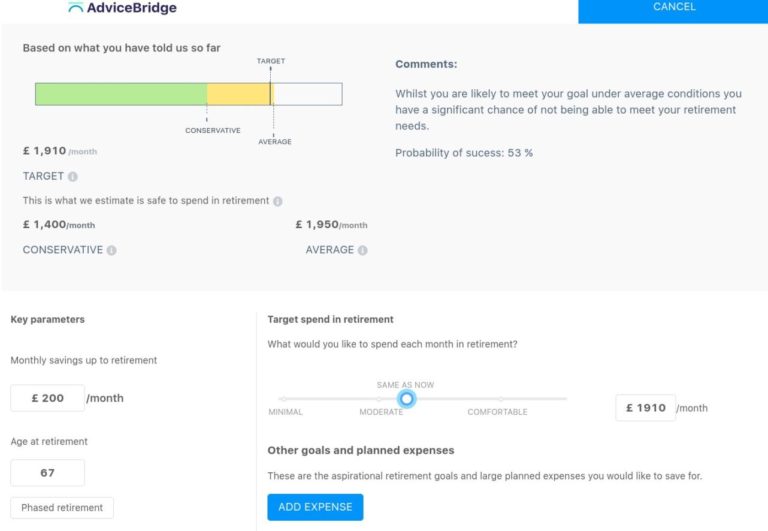
Once you have entered this information, you can create and log in to your account to see an overview of your financial situation. You can adjust the parameters in order to achieve a realistic and sustainable level of retirement income. Here is a screen capture showing part of this (an example account, not mine personally!).

AdviceBridge Example

Personalized Plan

Naturally, the above is just the first stage of the process. Once you have provided this information and set up your account, the AdviceBridge advisers will crunch the numbers and (with the aid of their specialist software) produce a personalized plan for you.

This is obviously a key document. The sample plan I saw came to 39 pages in PDF form. It was divided into three sections: About You, Our Recommendations and Advice, and Appendices.

About You sums up the information you have provided to AdviceBridge via the questionnaire. It covers your personal circumstances, your retirement savings and investments, and your progress so far towards achieving your retirement goals.

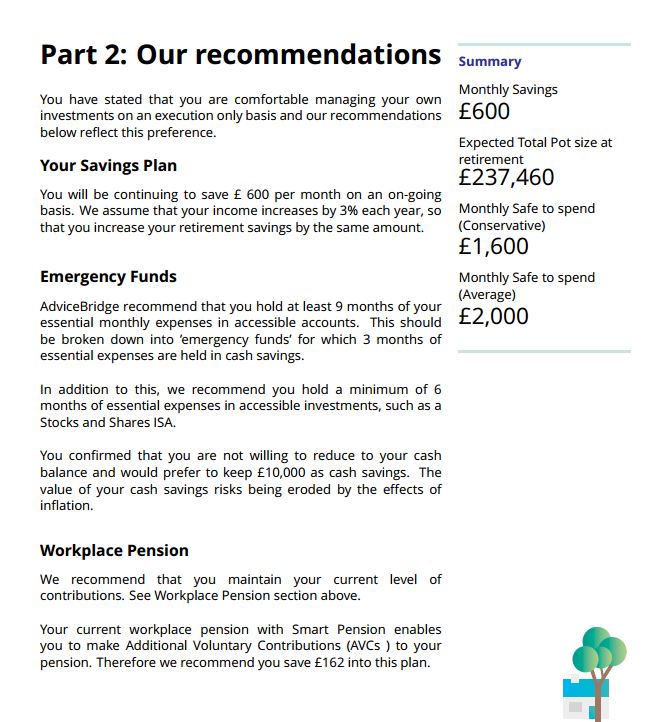
Our Recommendations and Advice is the longest section of the plan. It presents recommendations on every aspect of managing your finances for retirement, including restructuring your investment portfolio if required (with specific recommendations for low-cost personal pensions and ISAs). It also examines the likely outcome of following the recommendations, including both average and conservative projections. A sample page from this section of the plan is shown below.

Finally, the Appendices section includes a range of supplementary information, including more detail about the UK state pension, rules about annual pension allowances and taxation, your options for accessing your pension (drawdown, annuities, etc), and more.

AdviceBridge recommendations

It doesn’t end there, though. Once you have had a chance to read and digest your plan, you can arrange a call with a personal financial adviser from AdviceBridge to talk through the advice and recommendations and help you decide how to proceed. The advisers are not paid commission on product sales, so they are able to give unbiased advice about what investments may be best for you based on your specific circumstances.

So What Does It Cost?

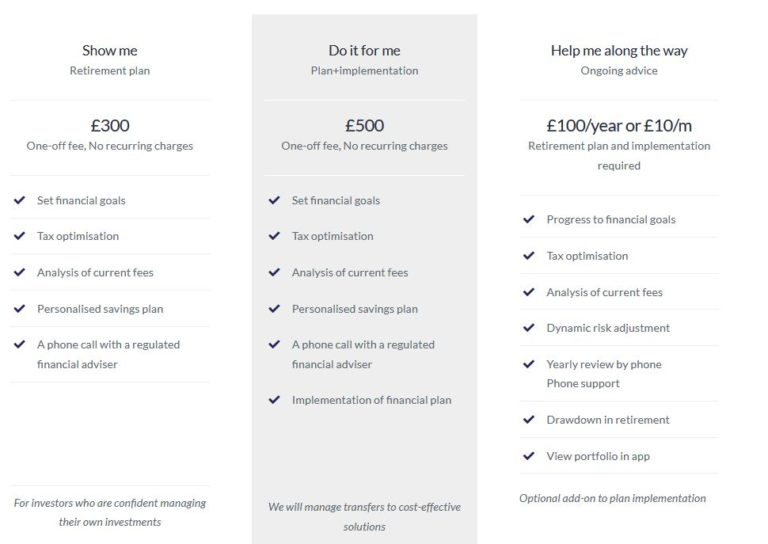
For the basic AdviceBridge service as described above, there is a one-off fee of £300 with no recurring charges. This service will suit people who are happy to arrange their own investments based on the advice given and the telephone call with an adviser.

If you want AdviceBridge to set up the recommended investments for you – to implement your financial plan, in other words – they will do this as well for an inclusive fee of £500, again with no recurring charges.

Finally, if you opt for the Plan+Implementation service and want ongoing support and assistance too, including dynamic risk adjustment, an annual telephone review, ongoing telephone support, assistance putting your pension into drawdown, and the opportunity to monitor your portfolio online using a dedicated app, AdviceBridge offer all this for an additional £100 a year or £10 a month.

All of the above is summed up in the table below which I have copied from the AdviceBridge website.

AdviceBridge plans

My Thoughts

Overall, I have been very impressed by AdviceBridge, both in terms of what they are offering and the prompt and friendly support they provided while I was writing this article. Here are some of the main things I like about their service:

  • much lower fees than traditional financial advisers
  • all fees quoted include any taxes due – what you see is what you pay
  • range of options according to how much (or little) work you want to take on yourself
  • non-commission-based advisers, so unbiased advice on what investments will suit you best
  • advisers are free to recommend across the entire range of investment opportunities
  • all digital process – no need for personal visits or face-to-face meetings
  • fully FCA authorized company and advisers
  • advice is covered up to £85,000 under the Financial Services Compensation Scheme (FSCS)
  • all personal information is securely encrypted
  • in-depth written advice and recommendations on your retirement finances backed up by telephone support

Any negatives? Well, the only real one I could find is that various groups are currently excluded from the service, e.g. buy-to-let landlords and holders of ‘non-standard investments’. I guess the latter might include me, as I have a proportion of my portfolio in P2P lending and property crowdfunding.

I do of course appreciate that to keep their service so inexpensive AdviceBridge have to streamline their service, but it is a pity if this excludes a significant proportion of people who could benefit from it. I understand that this is something that AdviceBridge keep under review and in future they may remove some of these restrictions. In the mean time, if you aren’t sure whether you are eligible, it is well worth giving them a ring or contacting them via the website to ask (without obligation).

In my opinion, if your circumstances match their criteria, AdviceBridge are well worth checking out. I particularly like their £500 Plan+Implementation service, which covers not only researching and producing a retirement plan for you but implementing it as well. I would also seriously consider paying the extra £100 a year (or £10 a month) for the ongoing service. Obviously that brings the price up a bit further, but it is still far less than you would pay a traditional financial adviser for a similar service.

As always, if you have any comments or questions about this post, please do leave them below.

Disclaimer: This is a sponsored post for which I am receiving a fixed fee (but no commission). Please note also that I am not a professional financial adviser and nothing in this post should be construed as individual financial advice. Everyone should do their own ‘due diligence’ before investing and take professional advice as appropriate. All investment carries a risk of loss.

If you enjoyed this post, please link to it on your own blog or social media:
Bricklane review

Bricklane: My Review of This Property Investment Platform

Please be aware that this is a historical post. Bricklane is now closed to new investors and is winding down. Please see the comments below for the latest updates about it.

Today I am looking at another property investment platform, Bricklane.

Unlike Kuflink and Ratesetter, both of which I have discussed previously on this blog, Bricklane is not a platform for peer-to-peer loans. Neither does it arrange crowdfunded investments in specific properties like Crowdlords and Property Partner.

Bricklane is structured as a Real Estate Investment Trust, or REIT for short. For those who don’t know, REITs are property funds that use investors’ money to buy (and manage) property and provide returns in the form of rental income plus capital appreciation.

In order to qualify as a REIT in the UK, companies have to meet certain requirements. The most important are as follows:

  • At least 75% of their profits must come from property rental.
  • At least 75% of the company’s assets must be involved in the property rental business.
  • They must pay out 90% of their rental income to investors.

In exchange for operating within these rules – and to encourage investment in UK real estate – REITs are not required to pay corporation or capital gains tax on their property investments. That helps make REITs profitable for the companies running them, and is how they are able to generate attractive returns for investors.

Normally rental income from REITs is treated as taxable income and taxed at your highest marginal rate. However, if you invest through an ISA or SIPP (Self Invested Personal Pension) no tax is due. You therefore get the best of both worlds – your money isn’t subject to taxation while invested in the REIT, and when it comes back to you in the form of income distributions and profits on sales of shares, you don’t have to pay tax on these either.

Types of Investment

You can invest in Bricklane as a stocks and shares ISA or a SIPP, or failing that in a standard investment account, where you will be liable for tax.

To maximize the benefits from investing in a REIT, I highly recommend going down the SIPP or ISA route, if you haven’t already used up this year’s allowance. As a reminder, everyone has a £20,000 annual ISA allowance (for 2019/20) and you are also only allowed to invest in one cash ISA, one stocks and shares ISA and one Innovative Finance ISA (IFISA) in any one tax year. I invested in a stocks and shares ISA with Bricklane myself.

Bricklane has two property portfolios you can invest in. These are Regional Capitals, which includes properties in Birmingham, Manchester and Leeds. and London, with a portfolio of properties in the capital. The Regional Capitals portfolio has generated a return of 19.3% since it was launched in September 2016 and the London portfolio 8.9% since its launch in July 2017 (figures from the Bricklane website).

As a Bricklane investor, you can choose to invest in either or both portfolios, in any proportion you choose. I opted to put all my money into Regional Capitals, as I believe this is where the biggest growth potential lies. In addition, rental income in this portfolio is higher, and I am also concerned about the possible impact of Brexit on London. You might see this differently, of course!

Bricklane Pros and Cons

Based on my experiences so far – and some online research – here is my list of pros and cons for the Bricklane property investment platform.

Pros

1. Fast, easy sign-up.

2. Well-designed, intuitive website.

3. Low minimum investment of £100.

4. Bricklane take care of all the work involved in buying and managing properties. You just choose which portfolio/s to invest in.

5. REIT structure offers significant tax advantages.

6. Tax-free ISA and SIPP options are available.

7. Possibility to access your money at any time (though this does depend on another investor being willing to buy your shares).

8. Customer service (in my experience anyway) is fast, friendly and helpful.

9. Charges are reasonable, comprising an initial 2% fee (though see my comment below on how you may be able to offset this) and 0.85% annual management fee.

10. Potential to profit through both capital appreciation and rental income.

11. Rental income is paid into your account every three months. You can either withdraw it or reinvest it to compound your returns.

12. Up to £1,500 cashback is available for new investors of £5,000 or more via my referral link (see below).

Cons

1. No detailed information provided about the properties your money is invested in.

2. Can’t invest in an ISA if you have already put money into another stocks and shares ISA this year.

3. 20% tax deduction from rental income at source if you don’t invest via a SIPP or ISA (and additional liability if you are a higher rate taxpayer).

4. Minimum £10,000 investment for a SIPP.

5. Returns over the last few months have been disappointing (see below)

6. No absolute guarantee you will be able to sell your shares when the time comes.

My Experiences

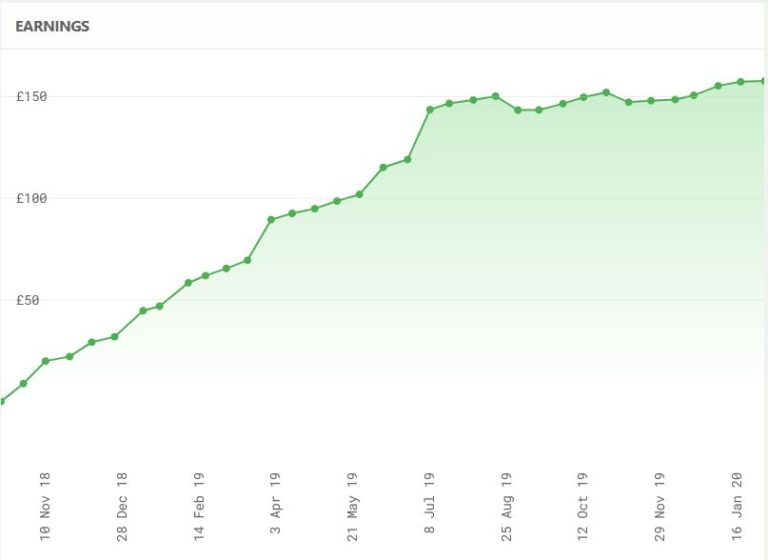
I put £5,000 into a Bricklane Stocks and Shares ISA in October 2018. As mentioned above, I chose to invest in the Regional Capitals rather than the London portfolio. The graph below – taken from my member’s page – shows the earnings generated since I opened my account.

My Bricklane Profits

As you will see, initially my investment performed pretty well. In the first nine months I made about £150, which equates to an annual interest rate of 4% (tax-free). That’s not spectacular, but it still beats most bank and building society accounts by a considerable margin. It is similar to the top rate currently on offer with P2P platform RateSetter in their Max account, although in their case you have to pay a fee equivalent to 90 days’ interest if you wish to withdraw. There is no withdrawal fee with Bricklane.

Since July/August 2019, however, returns have diminished considerably. My earnings between August 2019 and February 2020 were only just over £7, which is clearly a very low percentage rate. Of course, a large part of this is down to the depressed state of the property market caused by uncertainty over Brexit. I am hoping that now this is definitely happening – for better or for worse – my investment will get back on an upward trajectory again. Although recent results have been disappointing, at least the overall value of my portfolio hasn’t gone down (which has happened with some of my other property-related investments).

One other thing I should mention is that in October 2019 I withdrew £1,000 from my account to help fund a new central heating boiler after the old one packed in. This has therefore also reduced my returns a little. Although even if I still had the full £5,000 invested, earnings over the last few months would still have been nothing to write home about.

  • I should add that the withdrawal in question proved straightforward, although it wasn’t instant. I received the money in my bank account about a fortnight after putting in my request.

Conclusion

Clearly the performance of my Bricklane portfolio since last August has been disappointing, though overall I am still better off than I would have been if I had kept my money in a bank or building society.

I am hoping that things will start to improve in the property markets now that the Brexit issue has been resolved. There are some signs of this, although it remains to be seen whether the recovery in property prices will be sustained. For the time being, then, I am sticking with what I have in Bricklane, though I am not planning to top up my investment with them currently.

More generally, my experiences with Bricklane have been good. The sign-up process was fast and simple, and my £125 referral bonus (see below) was credited to my account instantly, completely offsetting (with a bit to spare) the initial 2% charge.

I also like the fact that any investment with Bricklane is automatically diversified across a range of properties, thus reducing volatility and risk. By contrast, with many P2P loan and property crowdfunding platforms, you invest in one loan or property at a time.

It’s also reassuring that you can ask to withdraw your money at any time – this can be an issue with property crowdfunding platforms in particular. As mentioned earlier, this does depend on someone else being willing to buy your shares, but Bricklane say that to date there hasn’t been a problem for anyone wanting to sell. As I said above, I had no issues when I wanted to release £1,000 from my own investment with them.

It is important to note that this is an investment rather than a savings account, and it does not therefore enjoy the same level of protection as bank and building society savings, which are covered (up to £85,000) by the Financial Services Compensation Scheme (FSCS).

Clearly, no-one should put all their spare cash into Bricklane (or any other investment platform). Nonetheless, in my view it is worth considering as part of a diversified portfolio. Not only are the rates of return (other than the last few months) higher than those offered by most banks and building societies, they are less affected than shares by ups and downs in the stock market. Property investments aren’t a way of hedging your equity-based investments directly, but they do help spread the risk.

In addition, the tax treatment of REITs make them a highly tax-efficient investment, especially if you can invest in the form of a SIPP or an ISA.

Welcome Offer

As an existing Bricklane investor, I can offer a special cashback deal for anyone signing up and investing on the platform via my link. If you click through this special invitation link, sign up and invest a minimum of £5,000, you will receive £125 in cashback (and I will get £100). With a £5,000 investment this bonus will cover your initial 2% charge and still leave you £25 in profit 🙂

If you invest more, you will get even more cashback, as follows:

Over £10,000 – £250

Over £20,000 – £500

Over £50,000 – £800

Over £100,000 – £1,500

Not only that, once you are an investor with Bricklane, even if you only start with £100, you will be able to offer the same cashback bonus to your friends and relatives and earn commission yourself as well. There is no limit to the number of people you can introduce through this scheme.

Obviously, this is a generous promotional offer by Bricklane and I assume it won’t be available forever. If you want to take advantage, therefore, don’t wait too long. I will remove this information if/when I hear the offer is no longer valid.

If you have any comments or questions about this Bricklane review, as always, please do leave them below.

Disclosure: this post includes affiliate links. If you click through and make an investment at the website in question, I may receive a commission for introducing you. This has no effect on the terms or benefits you will receive. Please note also that I am not a professional financial adviser. You should do your own ‘due diligence’ before making any investment, and seek professional advice from a qualified financial adviser if in any doubt how best to proceed.

Note: This is a fully revised and updated version of my original Bricklane review from October 2018

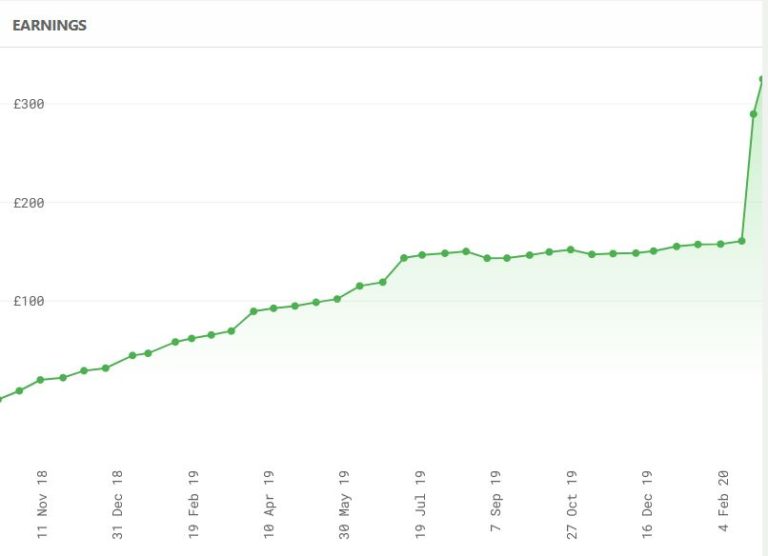
UPDATE 15 March 2020: Having said that my earnings from my Bricklane ISA over the last 6-8 months were disappointing, since the start of February they have shot up by over 100% (see below).

Bricklane March 2020

This doesn’t exactly cancel out the recent falls in my equity-based investments due to the coronavirus, but it does demonstrate the value of having a well-diversified portfolio. And I am obviously feeling more positive about Bricklane as an investment platform now 🙂

One other thing to note is that until the end of April 2020 Bricklane are waiving all investment fees for both new and existing investors. Visit the Bricklane website for more information.

If you enjoyed this post, please link to it on your own blog or social media:
Three Most Important Retirement Questions

Guest Post: The Three Most Important Retirement Questions

Today I have a guest post for you from James Mackay, a certified financial planner and regular reader of Pounds and Sense 🙂

In his article below, James addresses an issue that will be real and pressing for many readers of this blog – how to prepare for retirement and enter it successfully.

Over to James then…


If you’re starting to think about your retirement, these are three important questions that you need to ask.

1. Have You Had Enough?

It’s Sunday evening and you’re winding down after a busy weekend with friends and family. As you sit back in your favourite chair and think about the week ahead, you can’t quite get comfortable.

The thought of going back to work on Monday morning makes you feel a bit uneasy. In fact, the thought of doing it for another 5–10 years makes you feel sick!

If you’ve ever experienced this, you might be approaching the point where you’ve had enough (that’s a technical term).

The question you need to ask yourself is whether the pain of going to work outweighs the benefit. If you find yourself in this situation; where you’re emotionally, physically and mentally drained and no longer excited to perform at the highest level, it’s time to do something about it.

Having had enough doesn’t mean that it’s necessarily time to retire. It simply means that you need to change the status quo.

Maybe you’ve had enough of your current role, but you’ve got more to give in another capacity. Your years of wisdom could be very valuable in a different guise. Perhaps you’ve had enough of having a boss and are ready to go it alone. With the years of experience, it’s no surprise that over 50s are the best entrepreneurs. Or maybe you’re happy to carry on but just want a little bit more flexibility around what you do and when you do it.

These are all useful options to explore, particularly if you haven’t got enough to hang your boots up yet. Sometimes, the benefit of working for “just one more year” can make a real difference to your financial situation.

2. Do You Have Enough?

If you’ve had enough, and are ready to move onto pastures new, the next question is do you have enough?

Whenever I ask this question, people start telling me how much they’ve got saved up. But they’ve got it all wrong. It’s like trying to build a house without the seeing the floor plans. You need to start with the end goal and work back from there.

Working out if you have enough requires knowing:

  • Your monthly number – this is how much a comfortable lifestyle is going to cost.
  • Your monthly income – this is how much income you’ll receive from the State Pension, final salary pensions, buy to let properties, etc.
  • The gap – this is the difference between the two, and where your savings come in. Broadly speaking, if you’ve got 20x the gap in savings, you should be fine. Any less and you might not be quite there yet.

But, there’s more to retirement planning than just simply figuring out your ‘number’. Finding your purpose in retirement sounds wishy-washy, but without a clear purpose you’re likely to be one of the 25% of retirees who return to work.

3. Will You Have Enough to Do?

You need to ask yourself what you are going to do when you wake up on that Monday morning, free from the ties of work, and how are you going to fill your time.

If for the last 40 years you’ve been busy being busy – chances are you’re going to get pretty bored sitting around the house for 40 hours a week. I’ve seen many successful individuals retire, only to get bored and return to work within five years. The newly-found free time that retirement provides can be overwhelming for some.

Retirement is about having enough money to sleep at night and enough purpose to get up in the morning. It’s not just about the numbers, it’s about how you’re going to spend your time. Purpose will drive you in retirement, money will fund you. Try not to get those two mixed up.

The bottom line is this… retirement is the biggest transition you’re ever going to make. It’s not the sort of thing you do regularly and not the sort of thing you want to get wrong. By asking yourself these three questions, you’ll improve your chances of achieving a successful retirement.

Byline: James Mackay is a Certified Financial Planner at Frazer James. He has helped hundreds of clients to achieve financial independence and retire with confidence, clarity and purpose.

James Mackay


Many thanks to James (pictured above) for a valuable and thought-provoking post. As a semi-retired 63-year-old myself, I can identify with all of the points he raises.

Actually I think there is a strong case for phasing your retirement if possible, maybe reducing the number of days per week you work initially and/or moving to a less pressured role. This can make retirement feel more like going on an interesting journey rather than driving over a cliff!

I also think there’s a good case for continuing to do some work you enjoy during the early years of retirement at least, to boost your income, provide social interaction, and keep your mental and physical faculties sharp. Of course, voluntary work can do this as well (apart from boosting your income, which may or may not matter to you).

If you have any comments or questions about this article – for me or for James – as always, do feel free to post them below.

If you enjoyed this post, please link to it on your own blog or social media:
Why Property is an Essential Part of the Retirement Planning Jigsaw

Why Property is an Essential Part of the Retirement-Planning Jigsaw

Today I’m sharing some thoughts about the role of property in retirement planning. The post is partly inspired by recent research and insight from retirement planning specialists Just.

In association with Opinium Research, Just surveyed 4,000 adults from all over the UK to discover what they think and feel about property, including their views on owning versus renting, how property affects their attitude to their current and long-term financial plans, whether they thought of their property as a home or an investment, what impact property ownership has across the generations, and more.

When looking at those in their 50s, the research revealed that this age group turned out to be (in some respects anyway) the most pessimistic age group.

Survey Results

The survey threw up some interesting – and in some cases concerning – findings for the 50s age group. Key points arising included the following:

  • Whilst those in their 50s are building up towards retirement, half (47%) feel unprepared and hit a ‘pessimistic peak’.
  • Among homeowners who don’t feel prepared – not having enough to retire on (52%) and not having enough to do what they want (45%) is the biggest concern. Ranking these above other concerns such as debt and handing down wealth to their children.
  • 1 in 4 (23%) don’t know how to fund long term goals. And this goes up to almost half of renters (43%), compared to 16% of homeowners
  • It has become noticeably more difficult to get on the housing ladder – and this affects over a quarter (26%) of people in their 50s, who are still renting.
  • The impact on retirement is one of the biggest concerns for those now unable to buy, as property remains a core component of household wealth.
  • Even those on the property ladder are struggling to juggle their priorities and plan for the future.

You can see more information about the survey, and other findings from it, on Just’s My Home My Future website.

My Thoughts

At the age of 63 I am a little older than this age group, but I can definitely relate to these findings, both in respect of my own experiences and those of friends and relatives.

I believe that property should play an important – and arguably essential – role in every person’s retirement plans. And owning your own property puts you in a far stronger financial position than if you are renting.

One obvious reason for this is that your property can be a source of extra money if and when you need it in retirement. This can work in a variety of ways…

  1. If you own your property and have equity in it (i.e. its value its greater than any outstanding mortgage/s) you can release some of this by downsizing. By selling up and moving somewhere smaller and cheaper, you may be able to release a chunk of cash that can be used to fund major purchases and/or invested to provide you with extra income.
  2. If you don’t want to move, you may be able to use equity release to access some of the money tied up in your home. At one time equity release had a slightly dubious reputation due to the risk of going into negative equity, but nearly all lenders now offer a No Negative Equity Guarantee (NNEG) which ensures a borrower can never owe more than the value of their home. Equity release is nowadays a well accepted – and increasingly popular – method for releasing funds tied up in a property. Modern ‘lifetime mortgages’ in particular offer great flexibility for drawing down funds when you need them, with repayment only required when you die or go into long-term care.
  3. Another option for generating income from your home is to rent a room in it. Under the government’s Rent a Room scheme you can charge up to £7,500 a year in rental without having to pay tax on it. This can work well for people in family homes whose children have flown the nest.
  4. Owning a property also presents other opportunities to generate money from it. An example is renting out your driveway or garage, which I discussed a while ago in this blog post.

For more information on using your property for money, check out this page from the Just website.

My Circumstances

I am fortunate in that I own my home outright. The mortgage I took out with my late partner Jayne was paid off around ten years ago with the aid of a modest windfall. I also have various pensions and investments.

No-one can see what the future holds, but knowing that I could potentially release a substantial sum from my home if the need arises is obviously reassuring – especially in case in my old age I have to go into long-term care.

The latter is obviously a major concern for many older people. A recent report from Just revealed that 88% of people who have organised long-term care for a family member said they were shocked at how expensive care is, and 75% were surprised by how little financial support the state provides.

Further Thoughts

One thing that struck me particularly in Just’s My Home, My Future survey was the number of middle-aged (and older) people who are still renting, often through necessity rather than choice. Just found that non-homeowners in their 50s tend to be those who haven’t been able to buy their home (43%) rather than those who haven’t chosen to buy (21%).

This is clearly a concern for those affected, and for society generally. These people will be cut off from an important potential source of income in later life. If they have to go into long-term care, much of the (considerable) cost may have to be borne by their family, who may or may not have the means to do so.

A serious discussion needs to take place about how social care in Britain is funded, and specifically the balance between what is paid by the state and by the individual. Government policy in this area has been mired in confusion for years – and with the current political turmoil over Brexit it’s hard to see the situation improving any time soon.

In the meantime, it’s clearly desirable for everyone to get on the property ladder as early as they possibly can, so they are able to build up equity in their home and access the additional cash and income property can provide in later life. Whilst it remains unclear how much any of us will need to contribute to the cost of our own care, having a source of money to fund this if needed is all the more vital.

As always, if you have any comments or questions about this post, please do leave them below. I would especially like to hear your thoughts if you are 50 or over on how you plan to fund your retirement and the role you see for property in this. Check out also the #MyHomeMyFuture hashtag for more about this subject on social media.

  • For further advice on planning for retirement, I recommend checking out the government’s Pension Wise website, which includes detailed information about pension saving. If you are over 50 you can also book a free telephone or face-to-face appointment with an adviser who will go through the options with you.

Disclosure: This is a sponsored post on behalf of Just Group plc.

If you enjoyed this post, please link to it on your own blog or social media:
Infographic: Are you a victim of pension mis-selling?

Infographic: Are You a Victim of Pension Mis-Selling?

Today I have an eye-opening infographic for you from my friends at Edinburgh IFA about pension mis-selling.

If you watch the TV news, you may be aware that there has been a spate of stories in recent months about pension mis-selling.

In particular, some people have been persuaded to transfer valuable final salary pensions to unsuitable, often high risk, investment schemes, potentially putting their future income and security at risk. Of course, the advisers concerned typically pocket large sums in commission for this.

There is, however, some hope for victims of pension mis-selling, as the government has set up a compensation fund to help them. Here is the infographic with further information.

Mis-Sold Pensions

Thank you to Edinburgh IFA for their detailed and informative infographic.

If you think you (or a friend/relative) may have been mis-sold a pension or badly advised about a pension transfer, then – as the graphic says – you may be eligible for compensation from a £120 million fund set up for this purpose by the government. You can make a claim to the Financial Services Compensation Scheme (FSCS) or the Financial Ombudsman Service (FOS).

The FSCS only looks at complaints if an organisation has entered liquidation or administration. If – as is more likely – the organisation you wish to complain about is still trading, you will need to apply to the FOS.

You do need to act quickly, as if you are going to complain there is a time limit of six years from when the product was sold to you, or three years from when you noticed that you had been mis-sold – whichever is the later.

If you wish to complain about being mis-sold a pension, the first step is to contact the adviser (or SIPP provider) in question. They are obliged by law to have a complaints procedure and respond within eight weeks. If they don’t respond, or you are unhappy with their response, you can then file a complaint with the FOS. If they agree that you were badly advised, they can award you compensation of up to £150,000. More detailed information about the complaints procedure is available on the Edinburgh IFA website.

If you don’t feel confident going to the Pensions Ombudsman yourself, you can use a claims adviser. Edinburgh IFA say they are happy to put anyone in this position in touch with an independent financial adviser (IFA) in their area who will provide initial advice free and without obligation. Despite the company name, they offer a nationwide service (not just Edinburgh!).

Or if you don’t want to use them, any IFA specialising in pensions should also be able to help you. The website Unbiased.co.uk can locate suitable independent financial advisers in your area for you.

Either way, if you think you have been a victim of pension mis-selling, don’t bury your head in the sand. Compensation may be available if you act now. In any event, it costs nothing to find out more.

As always, if you have any comments or questions about this post, please do leave them below.

If you enjoyed this post, please link to it on your own blog or social media:
Should You delay Taking Your State Pension?

Should You Delay Taking Your State Pension?

I know many readers of Pounds and Sense are coming up to the state pension age. That includes me. I have just over three years to go, assuming the government doesn’t change the rules again!

One decision everyone in this situation has to make is whether to start claiming the state pension as soon as they are eligible, or defer it. You might wonder why anyone would choose to put off receiving their pension, but the government does offer a modest incentive for doing so. For every nine weeks you defer, you get an extra 1% added to your pension payments thereafter.

If you are in good health and don’t need the money (perhaps because you are still in work) delaying may be worth considering. Even so, it’s something to think carefully about, as you may have a long wait until you are in profit from doing so.

Crunching the Numbers

Here are my (admittedly somewhat simplified) calculations.

The current new state pension is £168.60 (people who retired on the old state pension are likely to be on less than this). One percent of this is £1.686 per week.

If you opt to sacrifice 9 weeks of the state pension, that has a total value of 9 x 168.60 = £1517.40. If you divide this by the extra weekly pension you will receive after this, you get a figure of 1517.40/1.686 = 900. In other words, you would need to be claiming for 900 weeks, or just over 17 years, simply to break even.

Deferring for a year will earn an increase in your pension of 5.8% but cost you – at the current rate – a total of £8767.20. The extra pension thereafter will be worth an extra £508.50 a year, but again it would take you a little over 17 years to recoup the year’s pension you didn’t get.

Overall, then, for most people I don’t believe that deferring will be a desirable or sensible option. This applies especially if you have any health or lifestyle issues that may reduce your life expectancy.

However, there is one other thing to take into account, and that is tax…

Tax and the State Pension

Not everyone realises this, but the UK state pension is taxable. That means if you have other sources of income that use up your personal allowance, you will have tax deducted from your state pension at your highest marginal rate.

If that applies to you, the case for postponing your state pension is stronger. Assuming you pay tax at the basic rate of 20%, then 168.60 x 20% = £33.72 would be deducted from your weekly pension in tax, leaving you with just £134.88. If you do this for 9 weeks, you will therefore receive 9 x 134.88 = £1213.92 in total after tax. Dividing this by the 1% extra you would get from deferring gives you a figure of 720 weeks or 13 years and 8 months to break even by deferring. That’s still a long time, but if you are in good health you are more likely than not to live this long after reaching pension age. Of course, this does assume that once you start claiming the state pension your total taxable income is covered by your personal allowance. If that’s not the case and you have to pay tax on your state pension, the payback period after deferring will be longer.

  • Like all the calculations in this post, the above assumes for simplicity’s sake that the state pension remains the same in future. In practice it is likely to go up every year, increasing the value of that extra 1% (or whatever). That means the time period before you recoup all the money you turned down is likely to be a bit shorter. On the other hand, the effect of inflation is likely to offset this.

Another potential issue could arise if you are already earning a substantial income and claiming the state pension would push you into a higher tax band. This could be another good reason to consider deferring.

Summing Up

Overall, it seems to me that if you expect to be on a modest (or even average) income in retirement, there is unlikely to be much benefit to deferring your state pension (and I don’t intend to myself). If you are a higher earner and in good health, however, there might be.

Obviously everyone’s circumstances are different and I can’t give individual advice, but it’s well worth speaking to a qualified pensions adviser if you think that deferring the state pension may be beneficial for you.

Finally, if you do decide to defer, no special action is required. Four months before you reach state pension age, you should receive a letter and booklet from the Department for Work and Pensions (DWP) telling you how to claim your state pension. You can just delay claiming and it will be assumed that you wish to defer.

As ever, if you have any comments or questions about this post, please do leave them below.


If you enjoyed this post, please link to it on your own blog or social media: