travel

My Short Break in Bath

My Short Break in Bath

I recently returned from a three-day break in the historic city of Bath. It was the first time in over 30 years I’d been to Bath, so it’s fair to say I was approaching it with fresh eyes!

I stayed in a one-bedroom self-catering apartment in a large multi-occupied property called Elmbrook. This was about twenty minutes’ walk from the centre of Bath. I arranged it through Booking.com. I’ll say a bit more about the apartment below.

For those who don’t know, Bath is on the River Avon, about 12 miles from Bristol. Here is a map of the area from Google Maps…

Accommodation

As mentioned, I stayed in a self-catering apartment in a property called Elmbrook. This was on the Weston Road, a short but pleasant walk from the centre of Bath via the Royal Victoria Park and botanical gardens.

You can read more about where I stayed on this page of the Booking.com website (and see photos). One big attraction for me was that a reserved (and free) off-road parking space was available. In Bath – as in many popular tourist areas – finding somewhere to park can be tricky.

The apartment had a good-sized master bedroom with a comfortable double bed. It had a small but perfectly adequate bathroom with a modern power shower (though, somewhat ironically, no bath). The shower worked well and there was plenty of hot water.

The lounge was quite spacious. It was at the front of the house and had a small patio leading from it. Although I didn’t use the patio during my stay, the patio door provided a quick and convenient method for getting my luggage from and to the car! The lounge had a good-quality flat-screen TV and a DVD player with a small selection of DVDs.

The kitchen was at the back of the apartment and had all the facilities you would need or expect, including a modern electric oven and hob, microwave, toaster, fridge, sink, dishwasher, washing machine, and so forth.

The apartment had central heating on a thermostat, though as it was June I didn’t need this. It had free wifi which worked perfectly during my stay (not always the case in my experience). The location was quiet and peaceful, and I slept very well.

Finally I should say that communication from my Booking.com hosts (Nigel and Alison) was excellent. Nigel sent me detailed instructions about how to get there and how to get in (I used the key safe, though he offered to meet me in person if I preferred). They also left me a welcome letter and a basket of goodies, including a bottle of wine, muesli, milk, ground coffee, and so on. That was a kind gesture and obviously much appreciated.

Financials

As Pounds and Sense is primarily a money blog, I should say a few words about this.

I paid a total of £351 (including VAT) for my three-night visit, which works out to £117 a day. I thought that was very reasonable bearing in mind the high standard of the accommodation and the convenience of the location.

Obviously as it was self-catering no meals were included and neither was there a daily housekeeping visit. But on the plus side, I got a lot more space and facilities than I would have had at a hotel, and complete privacy throughout my stay. I’d have to admit that these days I prefer to go self-catering when possible, even if I do miss hotel breakfasts a bit!

Things to Do

I won’t give you a blow-by-blow account of everything I did on my visit. I will share some highlights and personal recommendations, though.

The first thing I did was book a ticket on the Hop On, Hop Off open-top sightseeing buses. My ticket cost me just under £20 after my over-60s discount and a small reduction for booking online. The most you will pay is £22.50, though.

A ticket allows you unlimited travel on two routes, the City Tour and the Skyline Tour. As you would expect, the City Tour takes you round all the main attractions in or near the centre, including the Royal Crescent, The Circus, Bath Abbey, the Roman Baths, Theatre Royal, and so on. You can listen to a commentary that tells you some interesting facts about Bath and its history. Earphones are provided for no extra charge, and you can choose from ten different languages (including English, naturally!). I found this a great way of getting my bearings.

The Skyline Tour takes you further afield, through some of the beautiful countryside surrounding Bath. It affords some wonderful views over the city, and you get to see a range of other interesting locations, including the university, the American museum and two National Trust parks and gardens. Again, an informative commentary is available. On both tours you can get on or off at any of the stops along the route. It’s worth noting that tickets are nominally valid for 24 hours, but I was told you can use them any time over a two-day period, which potentially makes them even better value. I definitely recommend doing this.

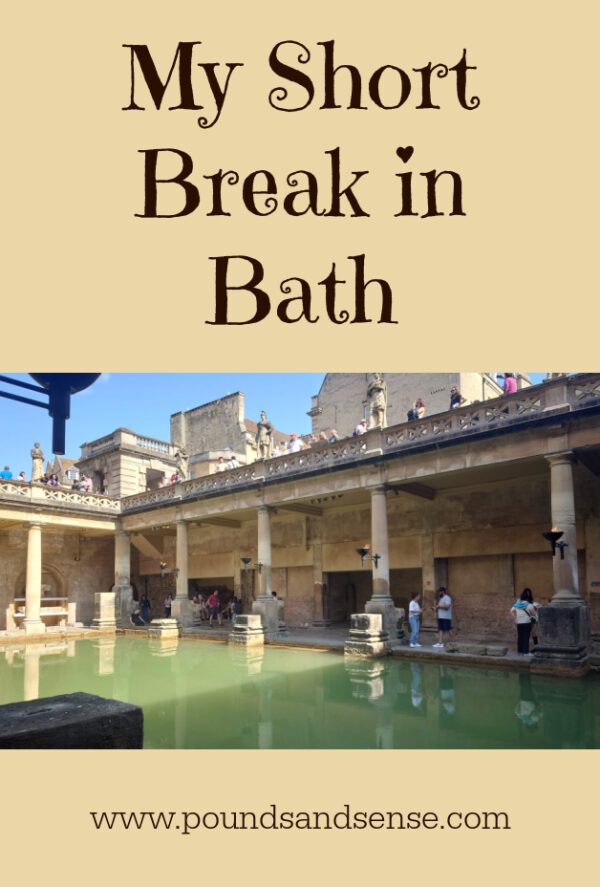
One ‘must see’ attraction in Bath is, of course, the stunning Roman Baths that gave the city its name (see cover photo). They aren’t especially cheap to visit (I paid the discounted price of £25 plus £5 for a guidebook), but are definitely worth it. Collect a free handset as you go in. You can then key in the code numbers displayed around the buildings to hear a commentary about what is on view in any particular area. There is loads to see, so I recommend allowing a couple of hours here at least.

Another top tip for visiting the Baths is to pre-book your ticket. I made the mistake of assuming I could just pay the admission fee and walk in, but that’s not generally the case. To manage numbers, visitors have to book a timed slot. I arrived at about midday but the earliest slot available then was 3.15. So I had to book using my mobile phone and come back later. It wasn’t a problem as there were plenty of other things I wanted to see and do – but if I was going again I’d definitely book my preferred day and time well in advance. Similar advice applies to other popular attractions in Bath, including the Jane Austen Centre and the No. 1 Royal Crescent Museum, incidentally.

Another place I especially enjoyed visiting was Bath Abbey. This church and one-time Benedictine monastery in the centre of Bath goes back to the 7th century, though it has been rebuilt several times since then. It is a fine example of Gothic Perpendicular architecture and particularly noted for its beautiful fan vaulting (see my photo below). There is an admission fee but it is relatively modest at about £6.50 (no over-60s discount, I’m afraid!).
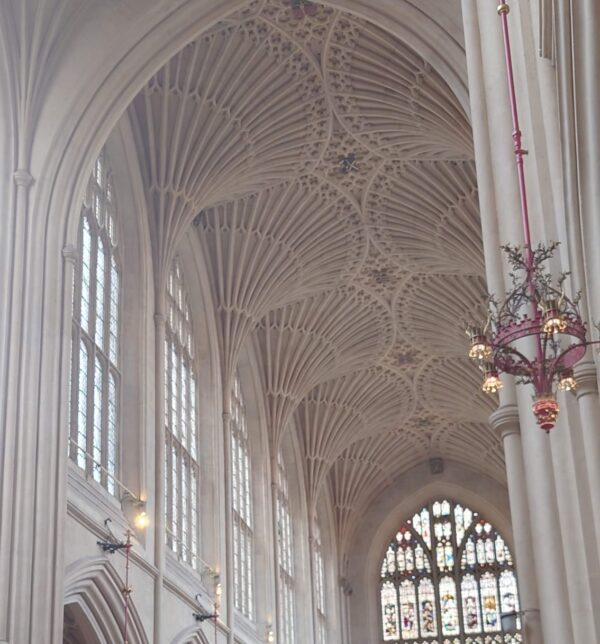
bath abbey fan vaulting

I visited the Abbey with my old friend Jeff, who lives quite near Bath. We were lucky in that when we arrived a free tour of the Abbey was just about to begin, led by a knowledgeable voiunteer guide. We found this interesting and informative, especially when he explained about the Abbey’s new underfloor heating system, which is powered by heat from the spa water!

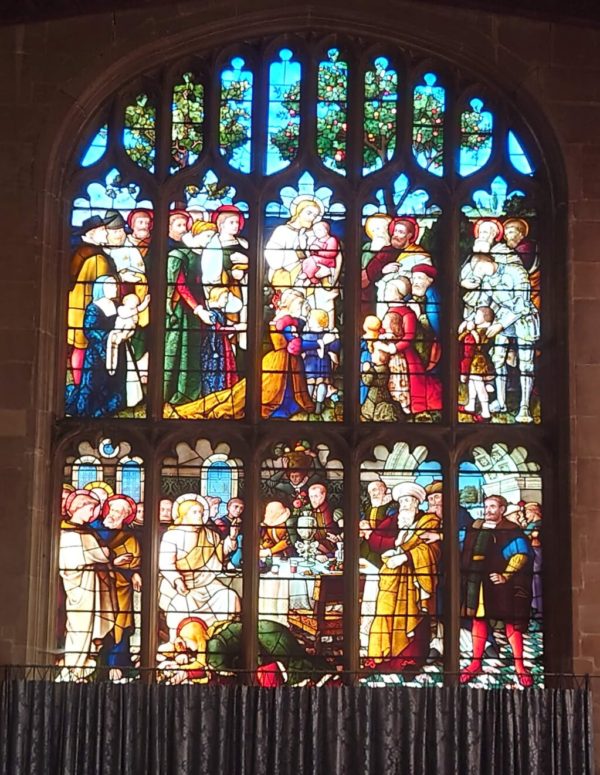
There are some lovely – though not especially old – stained glass windows in the Abbey, as the photo below shows. There are also some informative displays and exhibitions, along with a gift shop and (free) toilets.
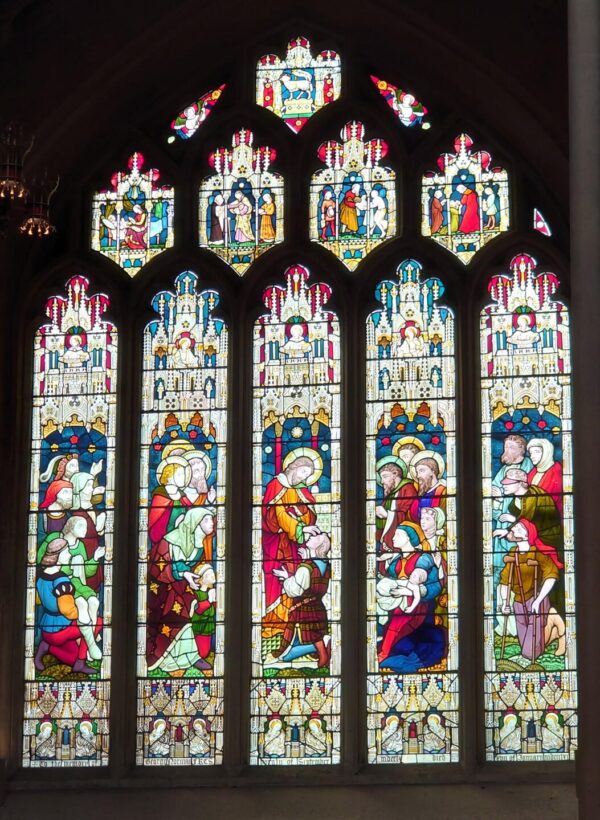
bath abbey stained glass window

Here are a few more quick hints and tips for visitors to Bath, based on my experience…

  • You can download an excellent free map of Bath from this website. I printed this out and found it invaluable for finding my way around.
  • Be sure to take a few 20p coins with you. Quite a few public conveniences require these 😮
  • Keep a close eye on your speed if driving around (or towards) Bath. Many of the roads have a low 20 mph limit.
  • There is also a low emission zone in Bath, though currently charges don’t apply to most private cars and motorbikes.
  • You can’t actually swim in the Roman Baths, as this is set up as a tourist attraction. There are, though, a few places you can swim in spa water, most notably the Thermae Bath Spa. Be aware this costs a minimum of £40 for a two-hour session.
  • As mentioned above, I highly recommend pre-booking visits to popular attractions. Not only will this guarantee admission at your preferred time, it may work out a bit cheaper as well.
  • But don’t miss out, either, on admiring the stunning Georgian architecture of Bath, including the famous Royal Crescent and arguably even more impressive Circus. This is something you can do for free 🙂
  • Something I didn’t do on this visit but would quite like to in future is a boat trip on the River Avon. There are various options here, including this one which combines a boat trip with a short walking tour.

Closing Thoughts

As you may gather, I enjoyed my short break in Bath, and am happy to recommend both the city and the accommodation where I stayed for a short break.

Bath is quite compact but there is plenty to see and do. As well as the historical sites, there are lots of charming cafes and coffee shops, and some highly regarded pubs and restaurants. But it can also be a great place to chill out, with lovely green spaces such as the Royal Victoria Park and adjacent botanical gardens (both free to visit). I shall definitely be returning again before too long!

As always, if you have any comments or questions about this post, please do leave them below. Also, if you have visited Bath yourself and have any additional tips or recommendations, I would love to hear them!
If you enjoyed this post, please link to it on your own blog or social media:
Aberdovey

My Short Break in Aberdovey

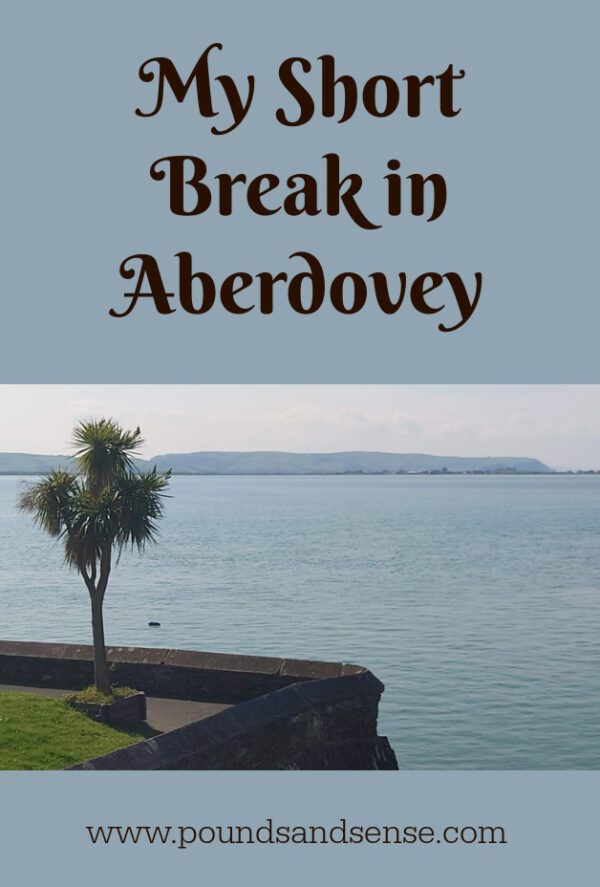
I recently returned from a three-day break in Aberdovey (Aberdyfi in Welsh). This is a small town on the mid-Wales coast. It was the first time I’d been to Aberdovey, though I’d heard good reports about it from friends.

I stayed in a two-bedroom apartment with a wonderful view across the estuary. I booked through Airbnb. I’ll say a bit more about the apartment below.

I should mention that although I travelled (and stayed) on my own, I met up with an old friend from Birmingham there. David recently lost his wife, for whom he had been caring for several years, so I thought he might appreciate a bit of company on his first solo trip away (I enjoyed his company as well, of course). David stayed at a pub/hotel called the Penhelig Arms. He liked it there, though car parking could be a bit of an issue. It appears their car park has been turned into a beer garden!

Aberdovey is about five miles south of Tywyn and 10 miles north of the university town of Aberystwyth. Here is a map of the area from Google Maps…

Accommodation

As mentioned, I stayed at an Airbnb property in Aberdovey. Under Airbnb’s rules I’m not supposed to reveal exactly where it was, but the location was certainly convenient. It was opposite the main car park, beyond which was the sea. The beach was around two minutes’ walk away, and all the restaurants, cafes and shops were within easy walking distance (not that there are very many – Aberdovey is only a small place).

You can read more about where I stayed on this page of the Airbnb website (you can also read my post about booking a holiday with Airbnb here). The apartment had a good-sized master bedroom with a comfortable double bed, and a smaller second bedroom with twin bunk beds. The latter would have been okay for children but adults might find it a bit of a squeeze.

The apartment had a decent-sized bathroom with (unusually these days in my experience) a bath with a shower over it. The shower worked well and there was plenty of hot water. I did try having a bath on my last night and found the taps very stiff, though. Possibly they don’t get used very much! I reported this to the host as I thought she would want to know, but it was no big deal, obviously.

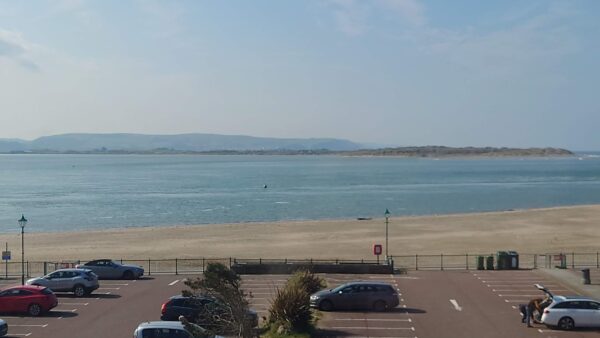
The living room had a stunning view across the estuary (see photo below). It was quite spacious and had a good quality flat-screen TV (though no DVD player). The kitchen area just off the living room had all the facilities you would need/expect, including a toaster, fridge, sink, cooker, dishwasher, and so forth.

Aberdovey

The apartment had gas central heating. As it was April I definitely appreciated this in the evenings and early mornings. There was a main thermostat in the living room and all the radiators also had thermostatic valves.

The apartment had free wifi which worked perfectly during my stay (not always the case in my experience). Although central, the location was quiet and peaceful, and I slept very well.

Finally I should say that communication from my Airbnb host (Irene) was excellent. She sent me very detailed instructions about how to get there, where to park, local amenities, and so on. One big plus was that residents in the apartment can use a council parking permit which allows them to park in the car park opposite (and various other places in Abverdovey) free of charge at any time. I left my car in the car park opposite, which was perfect for me.

Financials

As Pounds and Sense is primarily a money blog, I should say a few words about this.

I paid a total of £480 for my three-night stay. This was made up as follows:

  • £150 x 3 nights = £450
  • Cleaning fee £30

I was charged an initial deposit of £225, with the balance of £255 taken from my card a fortnight before my visit. The total price worked out to £160 a day. Obviously that’s not cheap but I thought it was reasonable bearing in mind the high standard of the accommodation and the convenience of the location.

Things to Do

As mentioned earlier, on this break I met up with an old friend, David. We spent some of the time together and some separately, which worked out well.

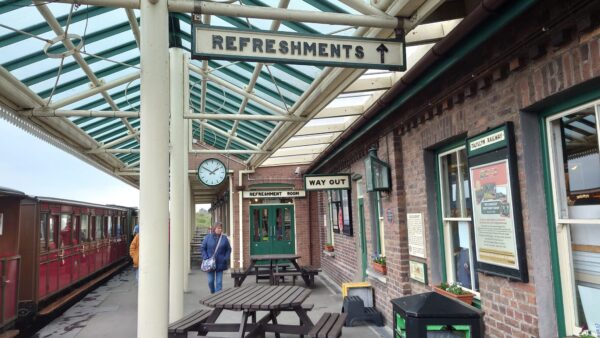
On our first full day we went on the Talyllyn Railway together (see photo below). This is a heritage steam railway that runs inland from the town of Tywyn, a short drive up the coast road from Aberdovey. I last went on the Talyllyn Railway five years ago (as described in this blog post) and was very happy to do so again.

Talyllyn Railway Tywyn Wharf Station

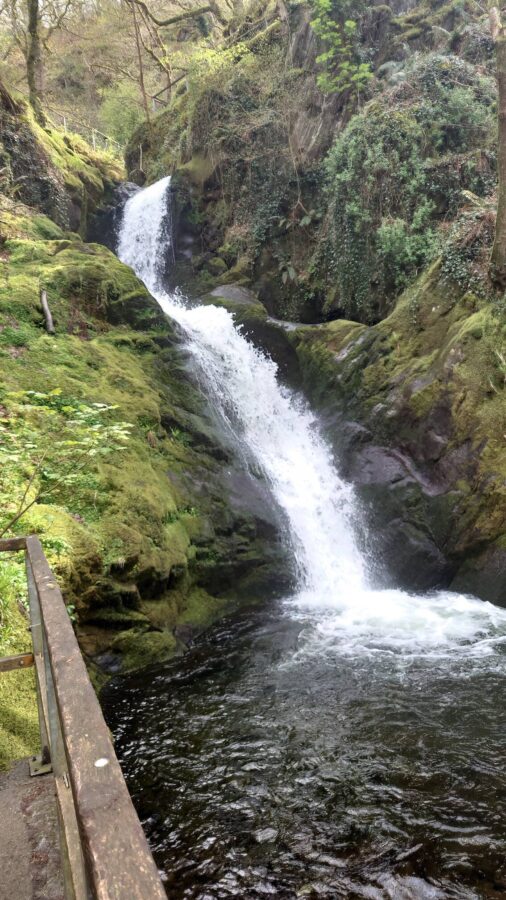
We bought all-day tickets for £25 each and went all the way up the line and back in the morning. We then had lunch (tomato soup and a bread roll, both very good) at the station cafe in Tywyn. After that we travelled part of the way down the line to Dolgoch. Here we disembarked and spent an hour exploring the picturesque woodland with its many streams and waterfalls (see photo below). We then caught the last train back to Tywyn.

Dolgoch

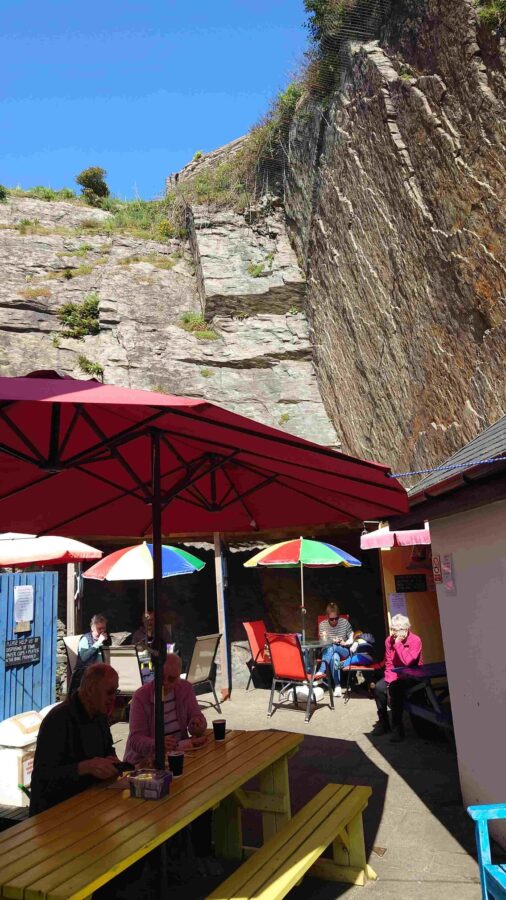
On our second full day we did our own thing. I stayed in Aberdovey, had a good wander round and got to know the place a bit better. I particular recommend the Medina Coffee House (picture below), where I went for both morning coffee and afternoon tea. You can sit inside or out here and enjoy a range of drinks, meals and snacks.

Medina Coffee House

David went to Machynlleth, about 15 minutes drive away. Among other things, he visited the Centre for Alternative Technology (CAT). As a retired builder he was very interested to see some of the innovative building techniques being demonstrated here and said he would like to have stayed longer.

I met up with David each evening for a main meal. On two nights we went to the Penhelig Arms where he was staying. They serve traditional pub food, but none the worse for that. Their prices were very reasonable, and David got a 20 percent discount as a hotel resident, which was a nice touch (they also extended the discount to my meals, which was kind of them).

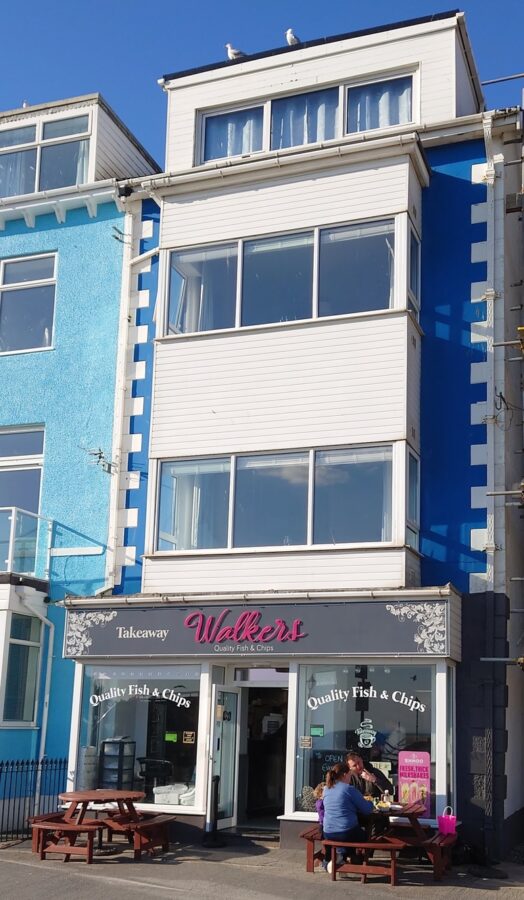
On the other evening we bought fish, chips and mushy peas from Aberdovey’s only chip ship (photo below). This was a stone’s throw from my apartment. We took it back to the apartment and sat watching the sun set over the sea while enjoying our meals. The food, the view and the company were all excellent!

Chip shop

Final Thoughts

As you may gather, I enjoyed my short break in Aberdovey, and am happy to recommend both the town and the accommodation where I stayed for a short break.

Aberdovey is a lovely place to relax and chill out. With its beautiful beach it could also be a good destination for families with young children. Older children and teenagers might find the lack of other entertainments a bit limiting, however. Although it’s not my thing, there are various water sports you can do there, including sailing, canoeing, sailboarding and paddle-boarding. There are also some lovely walks (and cycle rides) from the town.

In addition, the proximity of the Talyllyn Railway, Machynlleth and Aberystwyth offers good opportunities for days out. Aberdovey definitely isn’t a place you would go for the nightlife, though – even the fish-and-chip shop closes at 8 pm!

As always, if you have any comments or questions about this post, please do leave them below.

If you enjoyed this post, please link to it on your own blog or social media:
What You Should Know Before Buying a Holiday Home in Spain

What You Should Know About Buying A Holiday Home in Spain

Today I have a guest post for you about something many of us in icebox Britain would no doubt love to do at the moment.

Buying a Spanish holiday home, both for your own enjoyment and as a potential investment, has many attractions. But there are various important matters to consider before signing on that dotted line.

Learn more below 🏖


If you and your partner have spent many happy years holidaying in Spain, perhaps you’d like to consider investing in a Spanish holiday home?

Not only would a stunning sun-kissed property provide a wonderful place to enjoy your retirement years, but you could also let it out while you are not there and make some additional income. After all, Spain is a highly popular vacation spot with much to recommend it, so you would certainly never be short of guests.

Whatever you would like to use your Spanish holiday property for, there are a few important things you need to be aware of before you start house-hunting on the Costa Blanca…

Many Stunning Locations To Choose From

As you surely already know if you relish a vacation in Spain, the country has a plethora of gorgeous locations to choose from. While on the one hand this is clearly a good thing, on the other, it could make deciding on a particular location rather tricky.

If you’re struggling to settle on one spot, take some time to think about your requirements for the property. For example, if you’re planning to purchase a home solely for your own use, it makes sense to choose a property in a location you particularly love. Alternatively, if you’re buying a home as an investment, you may prefer to think about the locale that draws the biggest number of visitors and has the highest rental prices.

Insurance Is Important

Insuring your Spanish holiday home is of the utmost importance, even if you won’t initially be spending a great deal of time there. After all, you never know what might go wrong – from fire and theft to flood damage or structural damage caused by extreme weather. If you don’t have cover then you could be liable for some truly hefty repair bills.

Fortunately, finding the right holiday home insurance for Spain should be a breeze, thanks to Quotezone.co.uk’s helpful comparison service. You can compare and contrast quotes from a range of UK providers and potentially save yourself a lot of time and money along the way.

You Will Need An NIE

When you buy a property in Spain as a foreigner, you will be required by law to have an NIE number. The authorities will be able to use this number to work out how much tax (if any) you owe each year.

Your NIE number can be applied for at the Spanish Consulate in your country of residence or in Spain itself. You will need to fill out forms and provide various supporting documents. The process can take anywhere between two weeks and two months.

Factor In All The Costs

Before you take the plunge and commit to buying your Spanish holiday home, it’s a good idea to dedicate some time to running through all the potential costs you are likely to incur.

After all, you won’t just be paying the asking price of the home itself. You will also have to pay various associated fees, not to mention mortgage payments, lawyers’ fees and surveyor charges.

There will also be additional annual costs, as you will have to keep the property maintained to a good standard, particularly if you’re letting it out.

To ensure a Spanish holiday home is the right choice for you and won’t prove to be too big a drain on your retirement savings, take some time to pause and reflect on the various costs involved. This will help ensure you choose the option that works best for you.


Thank you to my friends at Quotezone.co.uk for an informative article. If you have ever dreamed of owning a holiday property in Spain, I hope it will give you food for thought.

As always, please feel free to leave any comments or questions below as usual. I would be particularly interested to hear from any readers who have gone ahead and bought a property in Spain or are actively considering it.

This is a collaborative post.

If you enjoyed this post, please link to it on your own blog or social media:
Barmouth

My Short Break in Barmouth

I recently returned from a three-night break in Barmouth in Wales. The town is also known by its Welsh name of Abermaw.

Barmouth is a traditional Welsh seaside resort. I’ve visited a few times over the last few years but haven’t actually stayed there for over 25. I thought it was high time I rectified that!
On this occasion I stayed at Tyr Graig Castle, a hotel I discovered online and booked via Booking.com. I’ll say more about the accommodation below.

Barmouth is about ten miles south of Harlech. The nearest large town is Aberystwyth. Here is a map of the area from Google Maps.

Accommodation

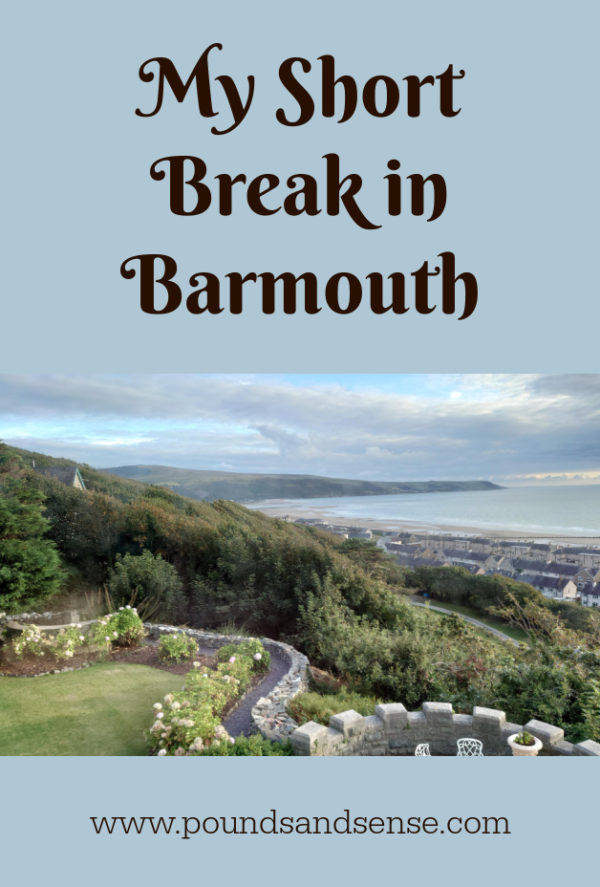
As mentioned above, I stayed at a hotel called Tyr Graig Castle. Unfortunately I neglected to take any photos of the exterior, but you can see the view from my bedroom window in the cover image (including a length of parapet!). There are, of course, more photos on the hotel website.

Tyr Graig Castle is a characterful Victorian building, originally constructed in the late 1890s. it retains the style of the Victorian era, with stained glass windows, wood panelling and highly decorated floors and ceilings.

Tyr Graig is a traditional Welsh name and translates as ‘House on the Rock’. It stands about 200 feet above Barmouth, overlooking Cardigan Bay, across which can be seen the Llyn peninsula and Bardsey Island. The building was completed in 1892 as a family home for W.W. Greener, a famous Birmingham gunsmith. It was designed in the Gothic style that was popular at the time. Its unique shape was chosen by Mr Greener himself. It resembles both a medieval castle and an open double-barrelled shotgun when viewed from above.

I stayed in a first-floor turret room. This had round walls, and windows providing stunning views across the bay. There was a small bathroom with a shower rather than a bath. While generally I found the room perfectly comfortable, I did find the lighting rather dim. There was no ceiling light, just some uplighters on the walls and bedside lamps with low-powered energy-saving bulbs. My eyes are admittedly not the best these days, but I had to use the torch app on my phone in the evening to see well enough to read!

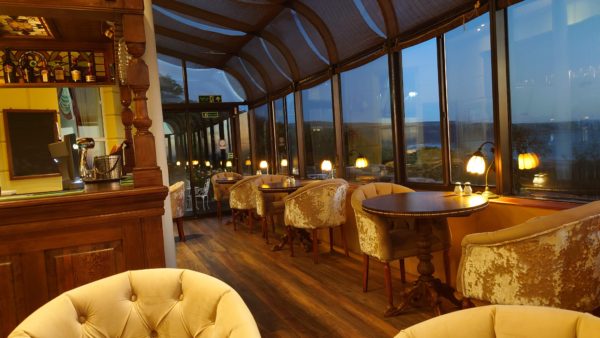
The breakfasts (and optional evening meals) at Tyr Graig Castle are served in the dining room and adjacent conservatory. The latter has wonderful views out to sea and there was a bit of a rush to get one of the four window tables (see photo below). Early risers had a definite advantage here! I was pleased to discover that they recently reinstated the breakfast buffet, where you can help yourself to cereal, fruit, yogurt and so forth. You could then order a cooked breakfast which was brought to your table. These were excellent and set me up for the day 🙂

Tyr Graig Castle conservatory dining room

You could also opt to eat in the restaurant in the evening. Like most guests (as far as I could judge) I chose to do this, as Tyr Graig Castle is a little way out of the town centre and other dining options in the area are limited unless you want to drive. The food was good and the portions were generous. My only slight criticism is that the menu was the same every night. There was a reasonable choice, but a bit more variety day to day (even if just a daily special) would have been appreciated.

The service from both the staff and the charming owners (Mike and Trudy) was uniformly excellent. The hotel had free wifi which worked perfectly during my stay (not always the case in my experience).

  • One other observation is that this is the first time I had stayed in a hotel – as opposed to self-catering – since the days of the pandemic. I was pleased to discover that by and large things are back to normal now. One small difference is that I was asked at check-in if I wanted my room serviced every day. It was the first time I can remember being asked this, as pre-Covid it would have been assumed. But I guess some people are still nervous about having someone else in their room even if they aren’t there at the time. So I do understand why the hotel ask this now.

Financials

As Pounds and Sense is primarily a money blog, I should say a word about this.

I paid £336 for my three-night stay at Tyr Graig Castle, which works out to £112 per night (including VAT). Considering that included a substantial breakfast as well, I thought the price was very reasonable.

The optional evening meals were, of course, extra. The prices were, I would say, good value as well. I paid around £25 a night for my evening meals, which included a main course and dessert (or cheese and biscuits) and coffee. I generally had a small bottle of sparkling water with the meal, but if I had gone for wine or beer, that would obviously have pushed the price up a bit.

Things to Do

I won’t give you a full account of everything I did while I was there, but here are a few highlights.

Harlech

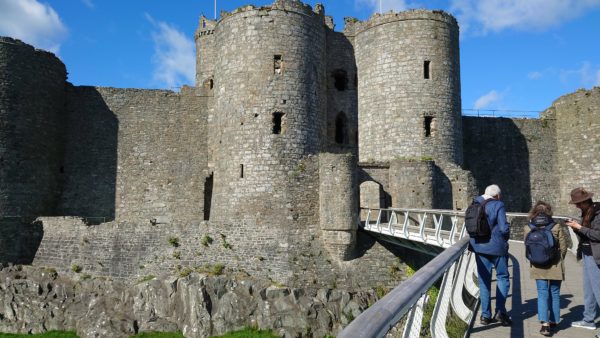
Harlech Castle

Harlech is about 20 minutes’ drive north from Barmouth (or a short train journey on the scenic Cambrian line). I spent my first morning here.

Harlech has some charming shops and cafes, and a long, sandy beach. But it is probably best known for its stunning castle (see photo above).

Harlech Castle was built by Edward I during his invasion of Wales between 1282 and 1289. Since then it has had a long and interesting history, including serving as the home and military HQ of Owen Glendower, the Welsh prince who led a long-running war of independence with England during the late Middle Ages. UNESCO considers Harlech Castle, with three others at Beaumaris, Conwy and Caernarfon, to be one of “the finest examples of late 13th century and early 14th century military architecture in Europe”, and it is classed as a World Heritage Site.

Admission to Harlech Castle costs £8.30 for adults or £7.70 for seniors (over 65). You can also buy a family ticket for two adults and up to three children for £27.40. Children under 5 receive free entry, as do people with disabilities and their companions. All prices are correct as at September 2022.

Harlech Castle is impressive and well worth a visit. You can climb the stone staircases in several of the towers and walk along the battlements (obviously you need to be reasonably fit to do this). From up here you can enjoy spectacular views across the sea and towards the mountains of Snowdonia. At ground level there is a room with some information about the castle and its history. I was glad to have this, as the ticket office had run out of guidebooks in English and only Welsh language ones were available.

I should maybe also mention that Harlech Castle has an excellent cafe with plenty of seating inside and out. I enjoyed a very nice cappuccino and cake here!

Portmeirion

Portmeirion

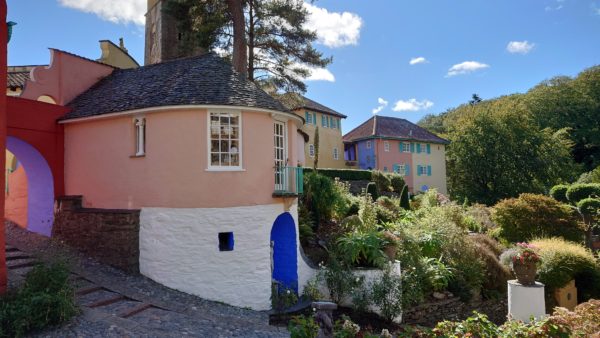
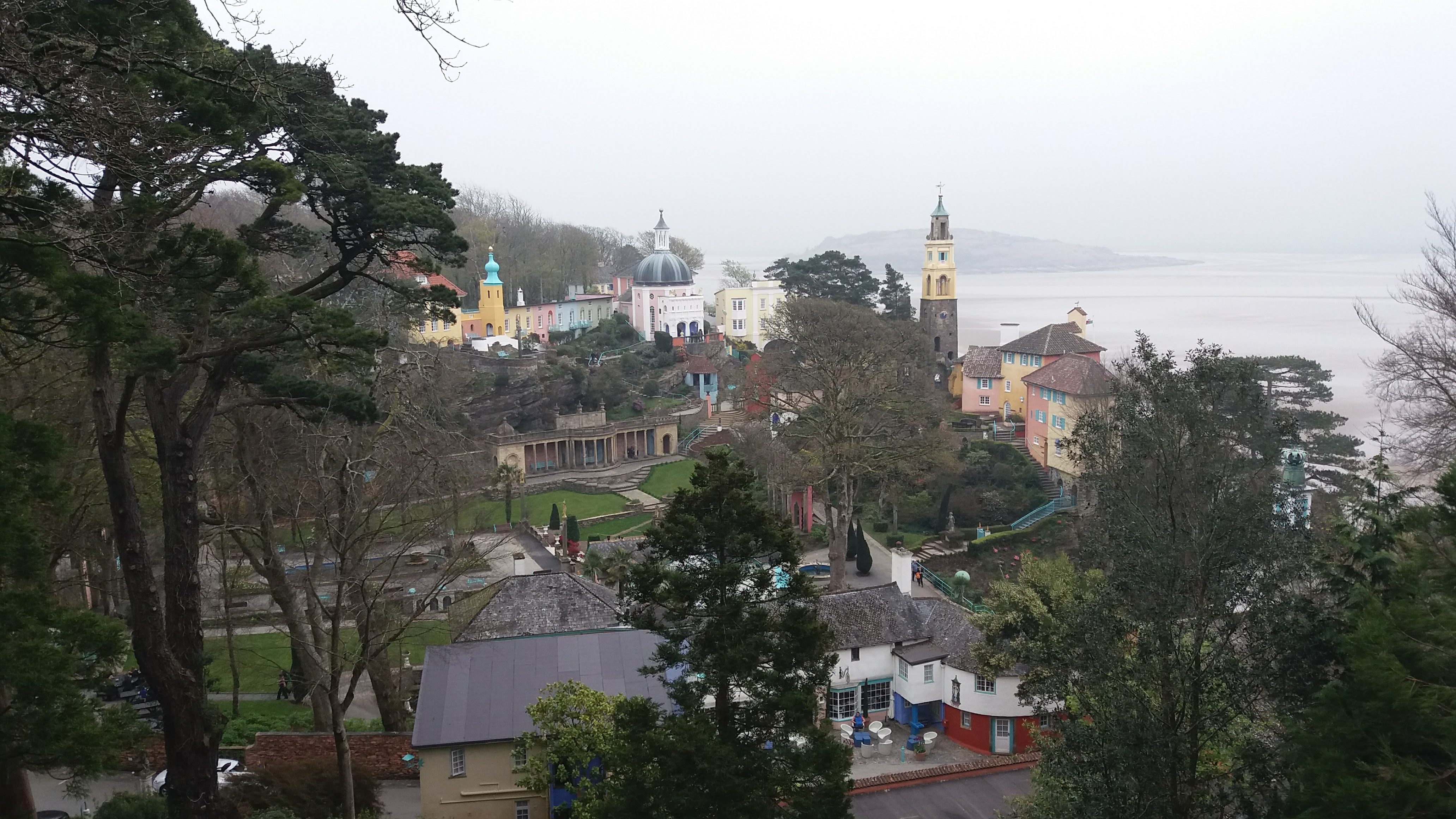
Portmeirion is a beautiful Italianate village created by the architect Clough Williams Ellis. These days it is probably best known as the location for the 1960s cult TV series The Prisoner, starring Patrick McGoohan. I drove here in the afternoon after spending the morning in Harlech. It’s a wonderful place to while away a few hours.

There is an admission fee to get into Portmeirion, At the time of writing (September 2022) this is as follows:

  • Adult £17.00
  • Concessions £13.50 (this applies to anyone aged 60+ or a student with a valid student ID)
  • Children £10.00 (5-15 years)
  • Children (under 5 years) Free

There are also discounted family tickets for various permutations of adults and children.

You can also get free admission (in the afternoon) by booking a minimum two-course lunch at Castell Deudraeth; this is part of the Portmeirion estate, a short walk from the village itself. Free admission to the village is also available if you book a spa treatment or afternoon cream tea there.

More information is available on the Portmeirion website. One thing you may need to know is that they don’t allow dogs (other than guide dogs) into the grounds.

Fairbourne Railway

Fairbourne Railway

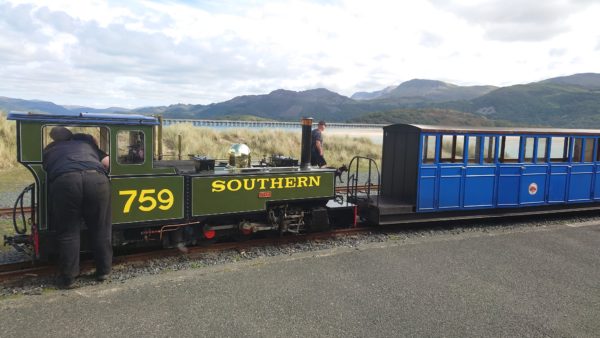
The Fairbourne Railway is a miniature steam railway. It’s a bit of a drive to get there from Barmouth, as you have to cross the estuary, which entails driving several miles inland and back again. However, you can get a ferry (actually a motorboat) from Barmouth seafront that takes you to the far end of the Fairbourne Railway in under ten minutes. This costs the princely sum of £2.50 (September 2022 price) and provides some wonderful views of Barmouth and the railway bridge. Highly recommended!

If you are energetic you can also walk from Barmouth to Fairbourne via the railway bridge (which isn’t open to cars). On this visit I ended up walking to the Fairbourne Railway and then getting a ferry back.

A one-way trip on the Fairbourne Railway costs £7.60. Alternatively you can buy a Day Rover ticket for £11.50 which entitles you to go up and down the line as many times as you like. This is obviously better value! You can choose whether to travel in an open or closed carriage (it all costs the same). There is a small museum at the Fairbourne end of the line with information about the railway’s history and some exhibits. There is also a separate room housing a large model railway. This is free to enter, but you have to insert a coin to watch the train go round 🙂

The ticket office at Fairbourne incorporates a cafe selling drinks, sandwiches and snacks (no cooked meals though). At the Barmouth Ferry end of the line there is also a cafe but this is only open during the peak summer months.

Final Thoughts

I enjoyed my short break in Barmouth and am happy to recommend both the town and the hotel where I stayed for a short break.

As mentioned above, Barmouth is a traditional Welsh seaside resort, and none the worse for that. It has a clean, attractive promenade and a beautiful sandy beach which goes out a long way to the sea. It is hard to imagine it getting overcrowded!

There is plenty to do for families with children, including a funfair and amusement arcades. There are various restaurants and fast food outlets along the seafront. There is also a railway station with regular trains to Pwllheli in one direction and Aberystwyth and beyond in the other. Road connections are good as well.

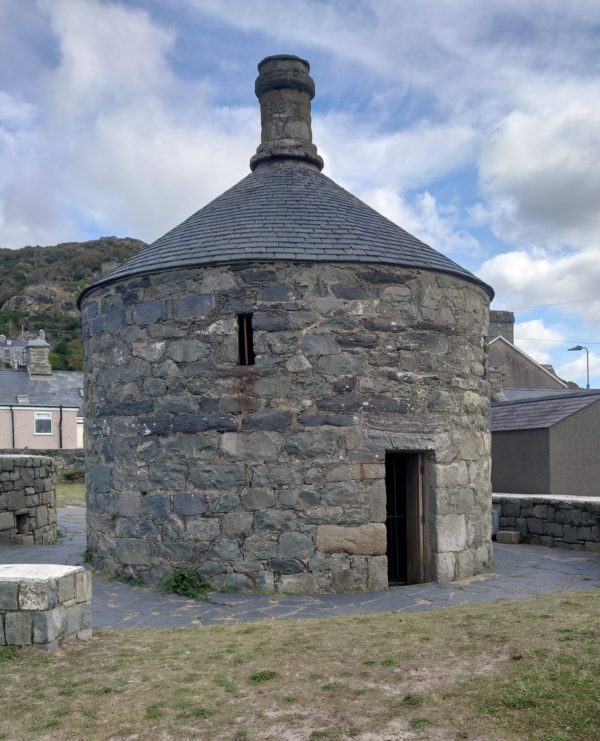
Also worth checking out while you are there are Ty Crwn, a 19th century lockup for drunks and petty offenders (picture below). There is also a small museum near the seafront dedicated to the town’s maritime history. Entry to this is free, though donations are appreciated.

Ty Crwn

Finally, as mentioned above, I recommend taking a stroll across the half-mile-long railway bridge over the Afon Mawddach river. This is the longest timber viaduct in Wales and one of the oldest in regular use in Britain (it opened in 1867). It offers some stunning views across the estuary. You can also walk on to Fairbourne and the Fairbourne Railway (see above).

As always, if you have any comments or questions about this post, please do leave them below.

If you enjoyed this post, please link to it on your own blog or social media:
My Investments Update October 2022

My Investments Update – October 2022

Here is my latest monthly update about my investments. You can read my September 2022 Investments Update here if you like

I’ll begin as usual with my Nutmeg Stocks and Shares ISA. This is the largest investment I hold other than my Bestinvest SIPP (personal pension). Withdrawals from the latter are still on hold, incidentally, to avert the risk of pound-cost ravaging.

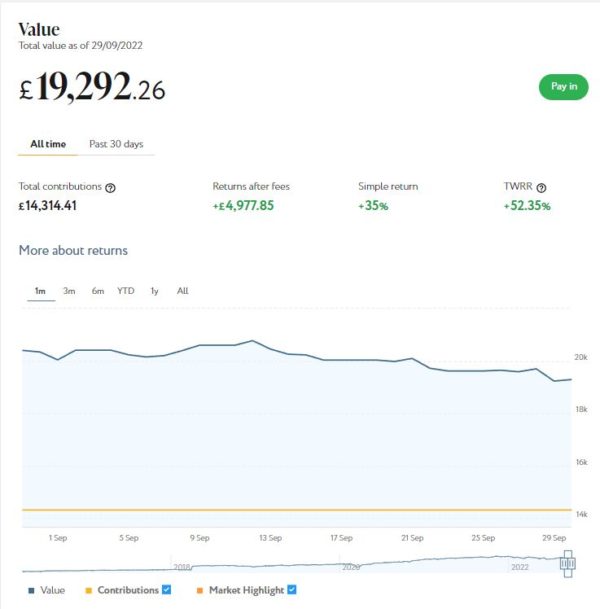
As the screenshot below of performance last month shows, my main portfolio is currently valued at £19,292. Last month it stood at £20,344 so that is a fall of £1,052.

Nutmeg main portfolio October 2022

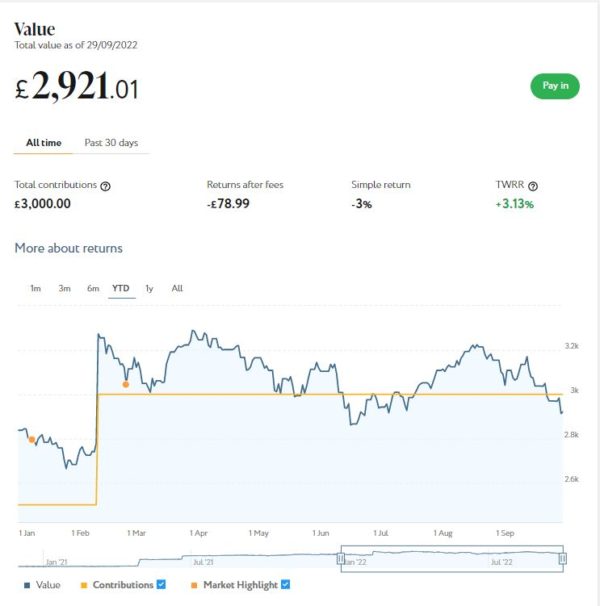
Apart from my main portfolio, I also have a second, smaller pot using Nutmeg’s Smart Alpha option. This is now worth £2,921 compared with £3,091 a month ago, another fall of £170.

Here is a screen capture showing performance since January 2022. As you can see, I topped up this account in February this year.

Nutmeg Smart Alpha October 2022

There is no denying that these falls are disappointing, especially with my Smart Alpha portfolio now worth less in total than I have contributed to it. As I’ve noted previously on PAS, however, you do have to expect ups and downs with equity-based investments. And this year there has been no lack of volatility, caused by rising inflation, the war in Ukraine and the aftermath of the pandemic (among other things).

About my only consolation is that things could have been even worse if – paradoxically – I’d opted for a lower-risk level with my investments. In their latest blog update, Nutmeg reveal that low and medium-risk portfolios actually performed worse overall last month than high-risk ones. I have copied below their explanation for this:

By design, Nutmeg’s low- and medium-risk portfolios have more exposure through ETFs to assets that are priced in sterling and with limited foreign currency exposure. As you will have seen in the headlines this week, the pound hit an all-time low against the dollar with markets initially placing little faith in the chancellor’s tax-cutting and pro-growth agenda.  

This year it has been rewarding to hold foreign currency with sterling particularly weak versus the dollar. Some of our high-risk portfolios have benefited from currency moves, while low- and medium-risk portfolios have not. They haven’t lost money from having low foreign currency exposure, they just haven’t benefited from it.  

Secondly, low- and medium-risk portfolios by design have more exposure – again through ETFs – to government bonds, which in ‘normal’ times are considered something of a safe haven and have much lower volatility than equities. After all, it is still highly unlikely that the UK government would default on its debts.  

In a nutshell (no pun intended) low- and medium-risk Nutmeg portfolios hold a higher proportion of investments in pounds sterling and UK government bonds. These are normally regarded as lower risk, but last month both took a particular hammering. So in comparison nominally higher-risk portfolios like mine actually performed somewhat better.

This is one more reason I’m glad I opted for higher risk levels with my Nutmeg portfolios (9/10 for my main one and 5/5 for my Smart Alpha). If you haven’t yet seen it, you might also like to check out my blog post in which I looked at the performance over time of Nutmeg fully managed portfolios at every risk level from 1 to 10 . I was actually pretty amazed by the difference risk level makes, with higher-risk ports over almost any period of three or more years in the last ten generating significantly better overall returns. If you are investing for the long term (and you almost certainly should) opting for a hyper-cautious low-risk strategy may not be the smartest thing to do.

Since I started investing with Nutmeg in 2016 – and despite everything that has happened this year – I have still made a total net return on capital of £4,977 (35% or 52.35% time-weighted) on my main portfolio. So I can afford to be philosophical about the recent falls. Indeed, I am considering topping up my Nutmeg investments again now while asset values are depressed.

You can read my full Nutmeg review here (including a special offer at the end for PAS readers). If you are looking for a home for your annual ISA allowance, based on my experience over the last six years, they are certainly worth considering.

Moving on, my Assetz Exchange investments continue to perform well. Regular readers will know that this is a P2P property investment platform focusing on lower-risk properties (e.g. sheltered housing). I put an initial £100 into this in mid-February 2021 and another £400 in April. In June 2021 I added another £500, bringing my total investment up to £1,000.

Since I opened my account, my AE portfolio has generated £76.51 in revenue from rental and £63.58 in capital growth, a total of £140.09. That’s a decent rate of return on my £1,000 investment and does illustrate the value of P2P property investment for diversifying your portfolio when equity markets are volatile.

I now have investments in 23 different projects and all are performing as expected, generating rental income and in most cases showing a profit on capital as well. So I am very happy with how this investment has been doing. And it doesn’t hurt that most projects are socially beneficial as well.

  • To control risk with all my property crowdfunding investments nowadays, I invest relatively modest amounts in individual projects. This is a particular attraction of AE as far as i am concerned. You can actually invest from as little as 80p per property if you really want to proceed cautiously.

My investment on Assetz Exchange is in the form of an IFISA so there won’t be any tax to pay on profits, dividends or capital gains. I’ve been impressed by my experiences with Assetz Exchange and the returns generated so far, and intend to continue investing with them. You can read my full review of Assetz Exchange here. You can also sign up for an account on Assetz Exchange directly via this link [affiliate].

Another property platform I have investments with is Kuflink. They continue to do well, with new projects launching almost every day. I currently have around £2,500 invested with them in 14 different projects. To date I have never lost any money with Kuflink, though some loan terms have been extended once or twice. On the plus side, when this happens additional interest is paid for the period in question. At present most of my Kuflink loans are performing to schedule, though two recently had their repayment dates put back by three months.

My loans with Kuflink pay annual interest rates of 6 to 7.5 percent. These days I invest no more than £200 per loan (and often less). That is not because of any issues with Kuflink but more to do with losses of larger amounts on other P2P property platforms in the past. My days of putting four-figure sums into any single property investment are behind me now!

  • Nowadays I mainly opt to reinvest the monthly repayments I receive from Kuflink, which has the effect of boosting the percentage rate of return on the projects in question

Obviously a possible drawback with Kuflink and similar platforms is that your money is tied up in bricks and mortar, so not as easily accessible as cash savings or even (to some extent) shares. They do, however, have a secondary market on which you can offer any loan part for sale (as long as the loan in question is performing and not in arrears). Clearly that does depend on someone else wanting to buy it, but my experience has been that any loan parts offered are typically snapped up very quickly. So if an urgent need arises, withdrawing your money (or part of it) is unlikely to be an issue.

You can read my full Kuflink review here. They offer a variety of investment options, including a tax-free IFISA paying up to 7% interest per year with built-in automatic diversification. Alternatively you can now build your own IFISA, with most loans on the platform (including the one shown above) being IFISA-eligible.

My investment in European crowdlending platform Nibble continues to perform as advertised. My latest investment was in their Legal Strategy. These are loans that are in default and facing legal action. Nibble buy these loans at a heavily discounted rate and then seek to recover as much as possible of the money owed. The minimum investment is 10 euros and the minimum period is six months. I invested 100 euros for 12 months initially at a target annual interest rate of 12.5%.

The Legal Strategy comes with a deposit-back guarantee. This is a guarantee to return the full investment amount at the end of the investment period and a minimum yield of 9% per year. The actual yield depends on how successful recovery efforts prove, so in practice you may end up with a return of anywhere between 9% and 14.5%. All has  gone to plan so far, but I will obviously continue to report on this in the months ahead.

Moving on, I had another article published on the always-excellent Mouthy Money website. This one is entitled My Odd Smart Meter Story and Why Despite This I Still Recommend Them.  In the article I discuss my rather strange experiences with a smart meter, which stopped working after I switched supplier and then rather mysteriously started again two years later! As per the article title, I do still recommend getting a smart meter, especially in these times of soaring energy bills.

Also in September I enjoyed a final (probably) short break of the year in Barmouth in Wales. I stayed at a Victorian Gothic hotel called Tyr Graig Castle. I was lucky with the weather, and enjoyed visiting nearby Harlech and Portmeirion (see cover image) as well as Barmouth itself.

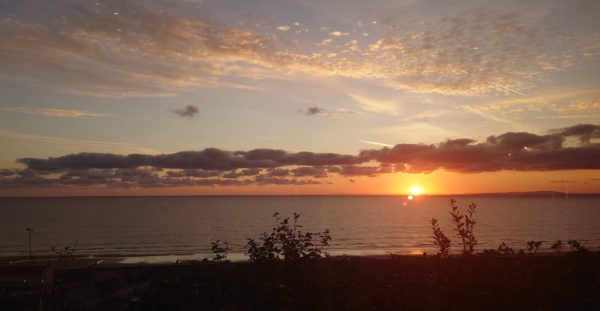
I shall be publishing a full review of my short break in Barmouth soon. In the meantime, here is a photo of a rather splendid sunset taken from the hotel restaurant…

Barmouth sunset

Finally, I know a lot of people are extremely anxious about the cost-of-living crisis. As I said last time, though, it’s important not to panic. I recommend a three pronged-approach of maximizing your income, minimizing your expenditure, and budgeting carefully (using your resources as effectively as possible, in other words).

Bear in mind, also, that a range of government support measures have been announced to mitigate the worst effects of the crisis. This government Help for Households website has a useful summary of all the help available and is regularly updated.

In the meantime, please do check out some of the other posts on Pounds and Sense for additional advice and resources, especially in the Making Money and Saving Money categories.

That’s all for today. As always, if you have any comments or queries, feel free to leave them below. I am always delighted to hear from PAS readers 🙂

Disclaimer: I am not a qualified financial adviser and nothing in this blog post should be construed as personal financial advice. Everyone should do their own ‘due diligence’ before investing and seek professional advice if in any doubt how best to proceed. All investing carries a risk of loss.

Note also that posts may include affiliate links. If you click through and perform a qualifying transaction, I may receive a commission for introducing you. This will not affect the product or service you receive or the terms you are offered, but it does help support me in publishing PAS and paying my bills. Thank you!

If you enjoyed this post, please link to it on your own blog or social media:
My Short Break in Lavenham

My Short Break in Lavenham

I recently returned from a four-night break in Lavenham in Suffolk.

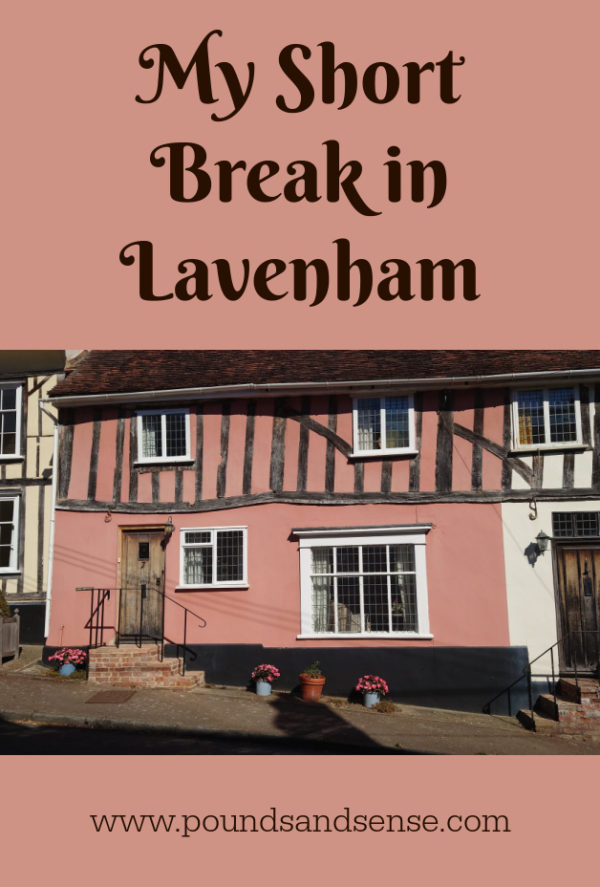
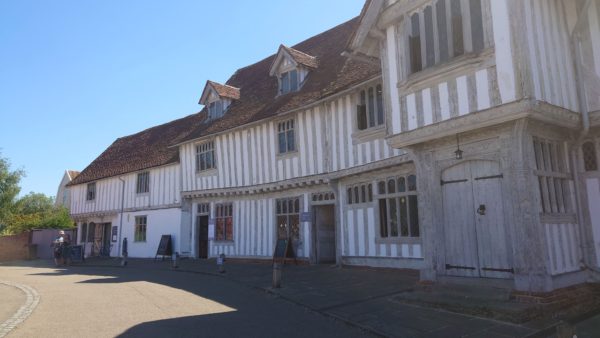
Lavenham is said to be England’s best-preserved medieval town, with over 300 listed, timber-framed houses (see cover image). But I must admit I had never heard of it until I read that my favourite Pink Floyd tribute band, Darkside, were performing there in August. It seemed a great opportunity to see the band and visit somewhere new at the same time. As I live in Staffordshire I normally head west towards Wales for my UK short breaks, so it felt quite strange to be driving east on the A14 instead!

I stayed in a beautiful, self-contained cottage in the heart of Lavenham, which I booked through Airbnb. I’ll say more about the accommodation below.

Lavenham is around five miles north-east of Sudbury. The nearest large town is Bury St Edmunds. Here is a map of the area from Google Maps.

Accommodation

I stayed in a charming, self-catering cottage called The Hay Loft in the centre of Lavenham. It had two bedrooms and bathrooms, so was actually larger than I needed.

I originally booked it so my sister Annie could join me for some of the time. Sadly she broke her wrist in a fall the day before, however, which meant she couldn’t come after all. So I had plenty of room to spread myself out!

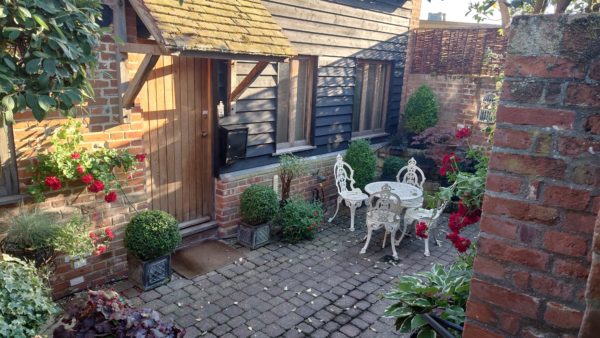
This being an Airbnb property, I am not supposed to say exactly where it is, but I guess I can reveal that it’s in a very convenient, central location. There was plenty of free parking on the road outside and in the village itself. The location was quiet and peaceful (in the evenings especially) and I slept well throughout my stay. You can see a photo of the front of the cottage below.

Cottage

You can read more about the accommodation on this page of the Airbnb website. It had an open-plan lounge/kitchen/dining room on the first floor, and two bedrooms and bathrooms (one ensuite) downstairs. That’s a slightly unusual configuration, but I was actually very grateful for it as my visit coincided with a four-day heatwave. Being downstairs, the bedrooms stayed comfortably cool. Electric fans were thoughtfully provided, though.

The cottage had all the facilities you could want for a short (or longer) stay. The kitchen area was well equipped with a gas cooker, microwave, fridge/freezer, dishwasher, toaster, sink, and so forth.

The cottage had free wifi which worked perfectly during my stay (not always the case in my experience). There was also a small garden at the front, down some steps from the gate. This was well tended and pleasant to sit out in (when it wasn’t too hot!).

Financials

As Pounds and Sense is primarily a money blog, I should say a word about this.

I paid £550 for my four-night stay, which works out to £137.50 per day. I thought that was very reasonable bearing in mind the size and standard of the accommodation and the convenience of the location. Obviously as this was self-catering no meals were included, but there was more space and better facilities than you would get in any comparable hotel or B&B.

Things to Do

I won’t give you a blow-by-blow account of what I did while I was there, but here are a few highlights.

The Guildhall

Lavenham Guildhall

Lavenham Guildhall is an impressive timber-framed building. It was originally built in the early 16th century for the Guild of Corpus Christi, an alliance of wealthy local merchant families. In later years, as Lavenham’s wool trade declined, it served as a bridewell (prison) and workhouse. More recently in WW2 it housed a social club for American troops and also served as a restaurant around that time.

The Guildhall became the property of the National Trust in 1951 and it was subsequently opened to the public as a local history museum. It has a range of interesting exhibits, though I did find some of the material about the building’s use as a prison and workhouse a little depressing. My favourite room housed an exhibition dedicated to Lavenham in WW2, including posters and other interesting documents from that period.

At one end of The Guildhall, with its own entry from the square, is the National Trust tea-room. This serves the usual range of snacks and light lunches. It also has a very pleasant garden outside. You don’t need to pay for admission to the Guildhall to use the tea room or sit in its garden.

Little Hall

Little Hall

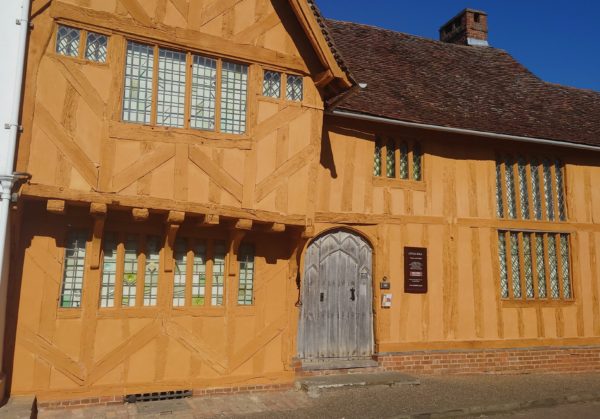
Little Hall is a late 14th century hall house on Lavenham main square. First built in the 1390s as a family house and workplace, it was enlarged, improved and modernised in the mid-1550s, and greatly extended later. By the 1700s it was giving homes to six families. It was restored in the 1920s/30s.

Little Hall was restored by the Gayer-Anderson brothers, who were both soldiers. They filled the house with art and artefacts collected during their extensive travels, many of which can still be seen there. It is privately owned – by a trust, I believe – and open to the public most afternoons for an entry fee of about £5.

I enjoyed visiting Little Hall and hearing about its long and varied history from the volunteer guide. It also has an attractive walled garden. It doesn’t have any refreshment facilities, but then again the Guildhall tea-room is just a stone’s thrown away!

The Church of St Peter and St Paul

Lavenham church

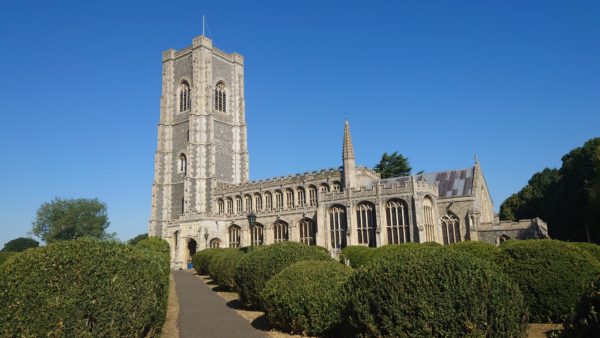
My Airbnb hostess Sheila told me that the Church of St Peter and St Paul was a ‘must see’ in Lavenham and she wasn’t wrong. To quote from the Wikipedia article about it, ‘It is a notable wool church and regarded as one of the finest examples of Late Perpendicular Gothic architecture in England.’

When I arrived a service was just ending and there were quite a few people milling around. While it’s obviously a beautiful building, it is also a busy parish church. I enjoyed browsing in the second-hand bookshop and spent some time admiring pictures by local artists in an exhibition by the main door. But what really impressed me most were the magnificent stained glass windows, such as the one below.

Lavenham church stained glass window

Final Thoughts

As you may gather, I enjoyed my short break in Lavenham and am happy to recommend both the village and the accommodation where I stayed for a short break.

Lavenham is a lovely place to relax and chill out. It is full of beautiful, historic buildings to admire (and photograph) and several you can visit to get a sense of the village’s long history.

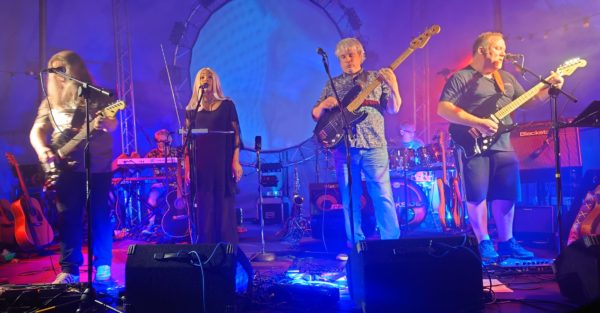
Of course, my initial reason for going was to see Darkside (pictured at the foot of this post), and that was inevitably a highlight for me. The concert took place in a large marquee (‘Lavenham Air Theatre’) in a field between the church and the local tennis club. It was a magical setting as the sun went down and a full moon appeared in the clear summer sky. And yes, the band did perform the classic Pink Floyd album Dark Side of the Moon!

Dark Side of the Moon

Although I didn’t eat out in the evenings, there are some highly regarded pubs and restaurants which if I hadn’t been on my own (and staying in a self-catering cottage) I would certainly have tried. I had lunch at the National Trust tea-room at The Guildhall on two days. Another day I had a delicious light lunch at The Nook, a cosy bookshop-cum-cafe just down the road from the church.

There are also some lovely circular walks from Lavenham (ask at the tourist information office near the Guildhall for more details). And a bit further afield there are other National Trust properties such as Melford Hall and Ickworth, and the historic village of Long Melford. Because it was so hot during my stay I didn’t really want to go out in my car (which doesn’t have working aircon). But if – or more likely when – I return, I will certainly explore this beautiful area a little more widely.

As always, if you have any comments or questions about this post, please do leave them below.

Darkside

If you enjoyed this post, please link to it on your own blog or social media:
My short break in Criccieth

My Short Break in Criccieth

I recently returned from a three-night break in Criccieth. This is a village on the Llyn (or Lleyn) Peninsula in NW Wales. It was the first time I had stayed in Criccieth, although I have visited a few times before.

The place I stayed was a self-contained, self-catering apartment facing the sea-front. I booked it using the website Booking.com. I’ll say more about the accommodation below.

Criccieth is by the coast, roughly half way between Porthmadog (home of the Ffestiniog Railway) and Pwllheli (famed for its Butlins camp, now run by Haven Holidays). Here is a map of the area from Google Maps.

Accommodation

As mentioned, I stayed in a self-catering apartment in Criccieth. This was on the second floor, with a view of the sea from the kitchen/lounge. The owners’ name for the apartment is Foel Wen.

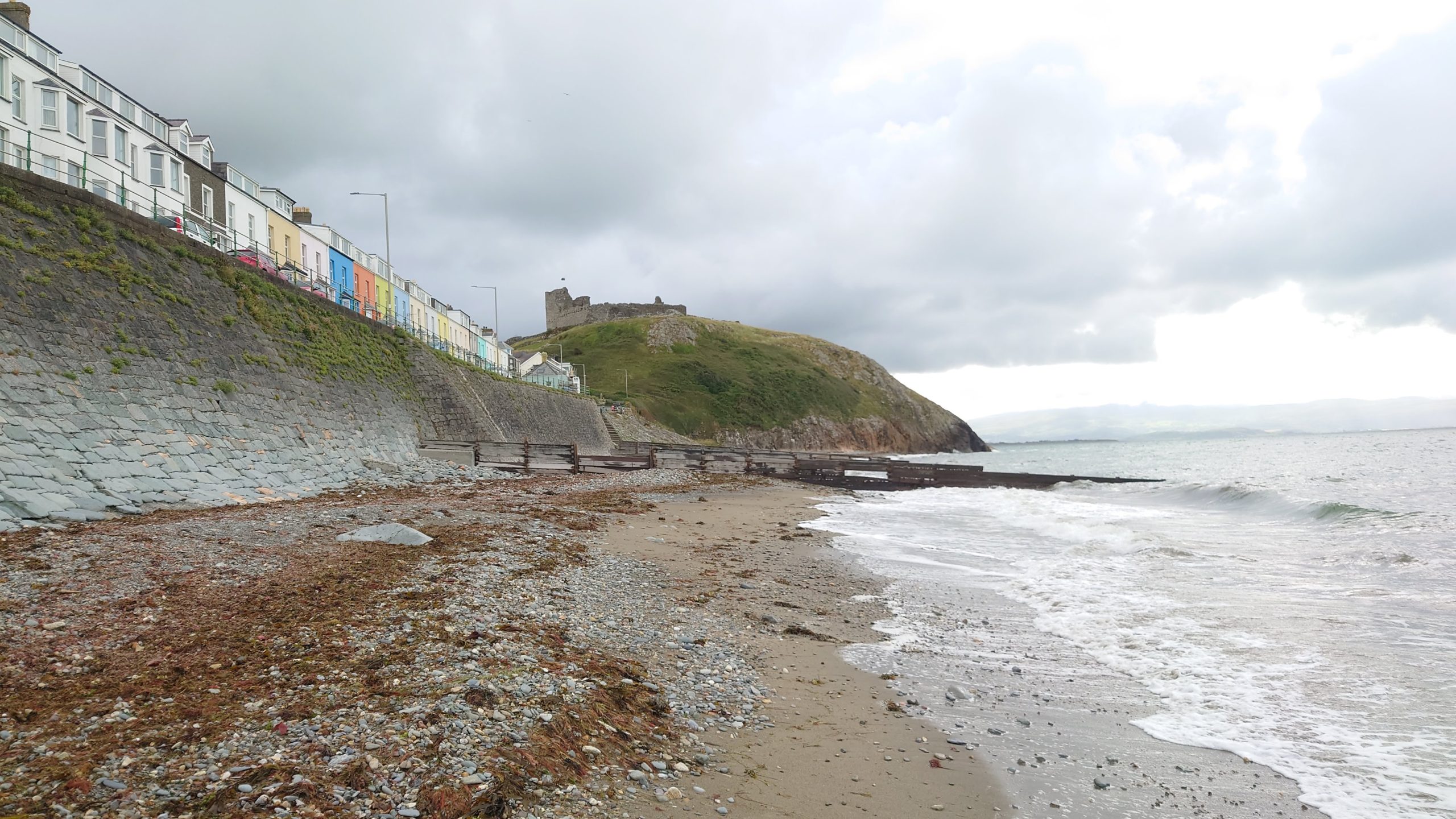
The main Criccieth beach was ten minutes’ walk away, but I was happy where I was. It was quiet, there was plenty of free parking on the road outside, and while it wasn’t the most stunning length of beach, there was a small promenade which was pleasant to walk along in the morning or evening. You can see a photo of the beach opposite my apartment below.

Criccieth beach

You can read more about the accommodation on this page of the Booking.com website. It had a lounge/kitchen at the front, a small bedroom with bunk beds in the middle (which I didn’t use) and the main bedroom at the rear. The bathroom was next to the small bedroom; it was quite compact but fine for a short stay. There was a good-quality modern electric shower but no bath.

The kitchen area was well equipped with an electric cooker, microwave, fridge/freezer, dishwasher, toaster, sink, and so on. On my first and last nights I cooked for myself (Criccieth isn’t exactly crammed with eating places) and on the middle night I got fish, chips and peas from a local takeaway, Castle Fish and Chips, which was excellent 🙂

The apartment had free wifi which worked perfectly during my stay (not always the case in my experience). The location was quiet and peaceful, and I slept very well.

Financials

As Pounds and Sense is primarily a money blog, I should say a word about this.

I paid £355 for my three-night stay, which works out to around £118 per day. I thought that was very reasonable bearing in mind the high standard of the accommodation and the convenience of the location. Obviously as this was self-catering no meals were included, but there was more space and better facilities than you would get in a comparable hotel or B&B.

Things to Do

I won’t give you a blow-by-blow account of what I did while I was there, but here are a few highlights.

Portmeirion

Portmeirion

This is about 15 minutes’ drive from Criccieth (or a short train journey to Minffordd and a ten-minute walk). I spent my first morning here.

Portmeirion is a beautiful Italianate village created by the architect Clough Williams Ellis. These days it is probably best known as the location for the 1960s cult TV series The Prisoner, starring Patrick McGoohan. It is a wonderful place to while away a few hours.

There is an admission fee to get into Portmeirion, At the time of writing (July 2022) this is as follows:

  • Adult £17.00
  • Concessions £13.50 (this applies to anyone aged 60+ or a student with a valid student ID)
  • Children £10.00 (5-15 years)
  • Children (under 5 years) Free

There are also discounted family tickets for various permutations of adults and children.

You can also get free admission (in the afternoon) by booking a minimum two-course lunch at Castell Deudraeth; this is part of the Portmeirion estate, a short walk from the village itself. Free admission to the village is also available if you book a spa treatment or afternoon cream tea there.

More information is available on the Portmeirion website. One thing you may need to know is that they don’t allow dogs (other than guide dogs) into the grounds.

Ffestiniog Railway

Ffestiniog Railway

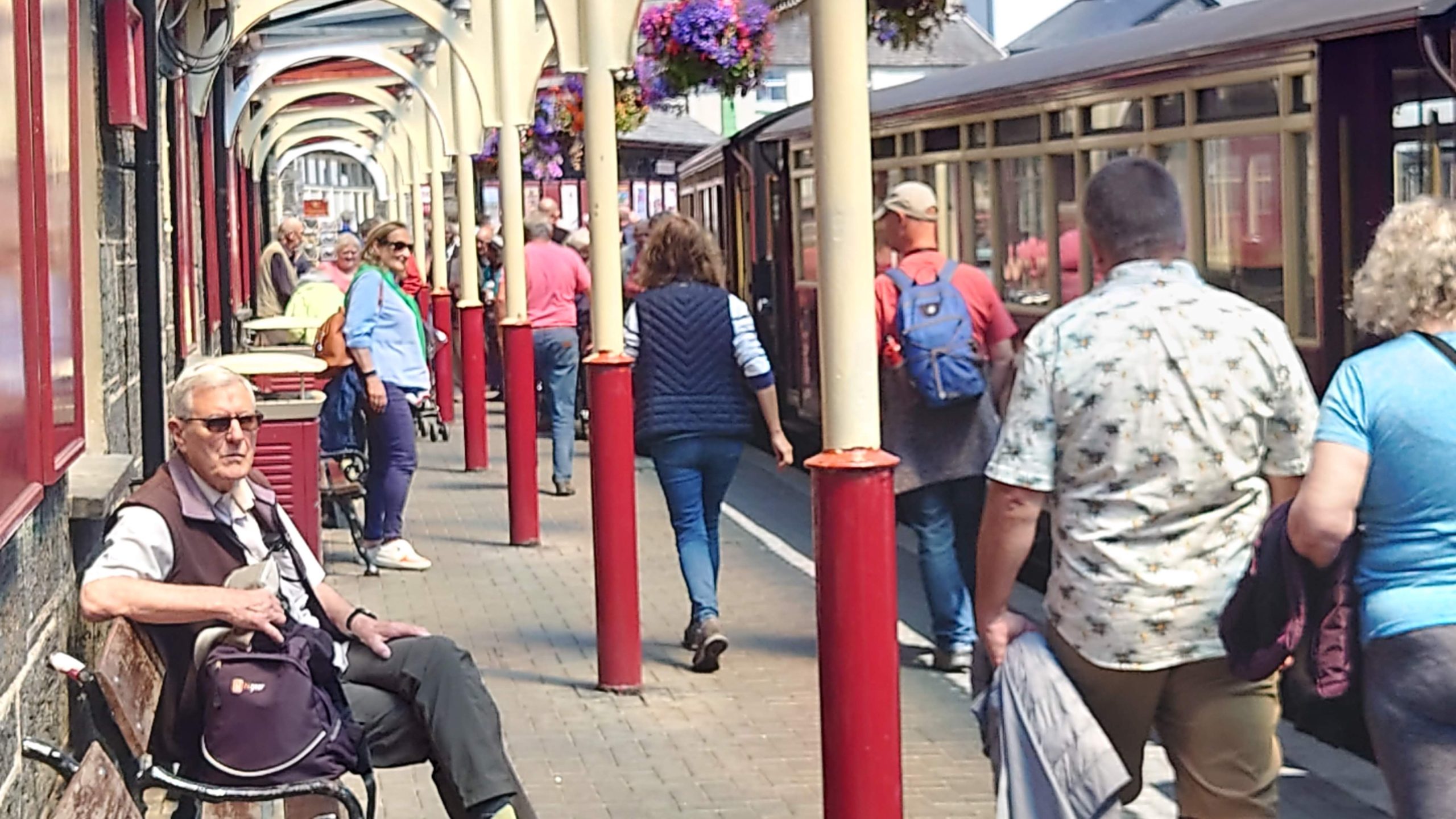
This heritage steam railway has two separate lines, both of which run from Porthmadog.

The Welsh Highland Railway takes you on a scenic two-and-a-quarter hour trip through the heart of Snowdonia to Caernarfon, while the original Ffestiniog Railway takes you on a one-hour trip to Blaenau Ffestiniog. On this occasion I took the shorter journey, but I have done the Welsh Highland Railway trip before and highly recommend it as well. You can get more info on both (and book in advance) via the Ffestiniog Railway website.

The harbour station in Porthmadog has a small car park which quickly gets full, but there is a free car park for people travelling on the railway at the back of the public car park opposite (Llyn Bach). I used that myself on this occasion. There were plenty of spaces when I arrived at around 10 a.m. but I noticed it was full later. So my top tip if going by car is to book a ticket on a morning train rather than leaving it until the afternoon!

  • You can also travel to Porthmadog via the mainline railway if you wish. This is on the beautiful Cambrian Coast line which runs from Pwllheli at one end to Aberdyfi (and beyond) at the other.

Criccieth Castle

Criccieth Castle

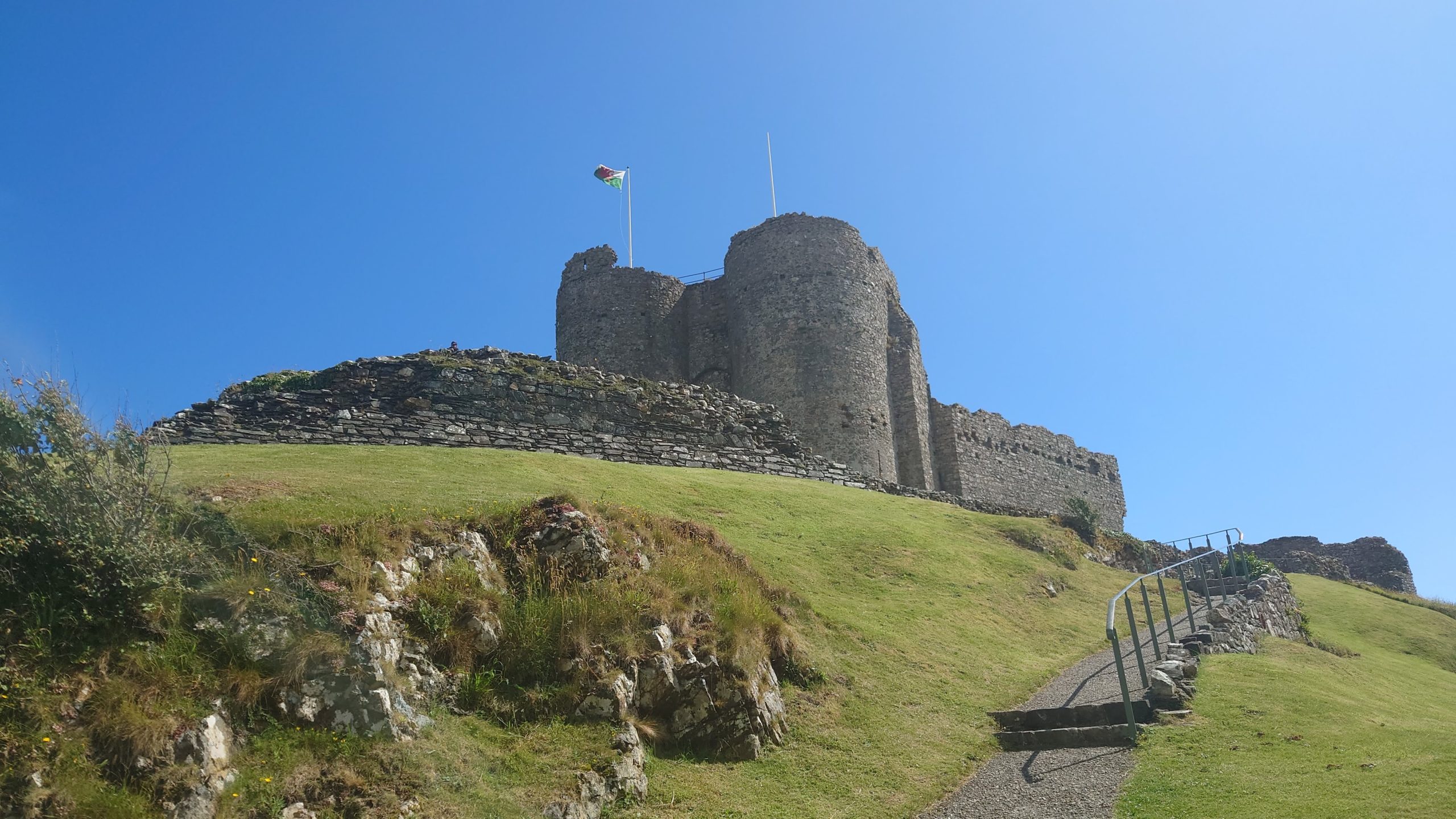
My accommodation was literally five minutes walk from Criccieth Castle, so of course I had to pay it a visit.

The castle itself is a ruin but (as the photo shows) plenty of the walls are still standing. There is also a visitor centre where, as well as buying your ticket and guidebook, you can learn more about the history of the castle and see some relics that have been found there.

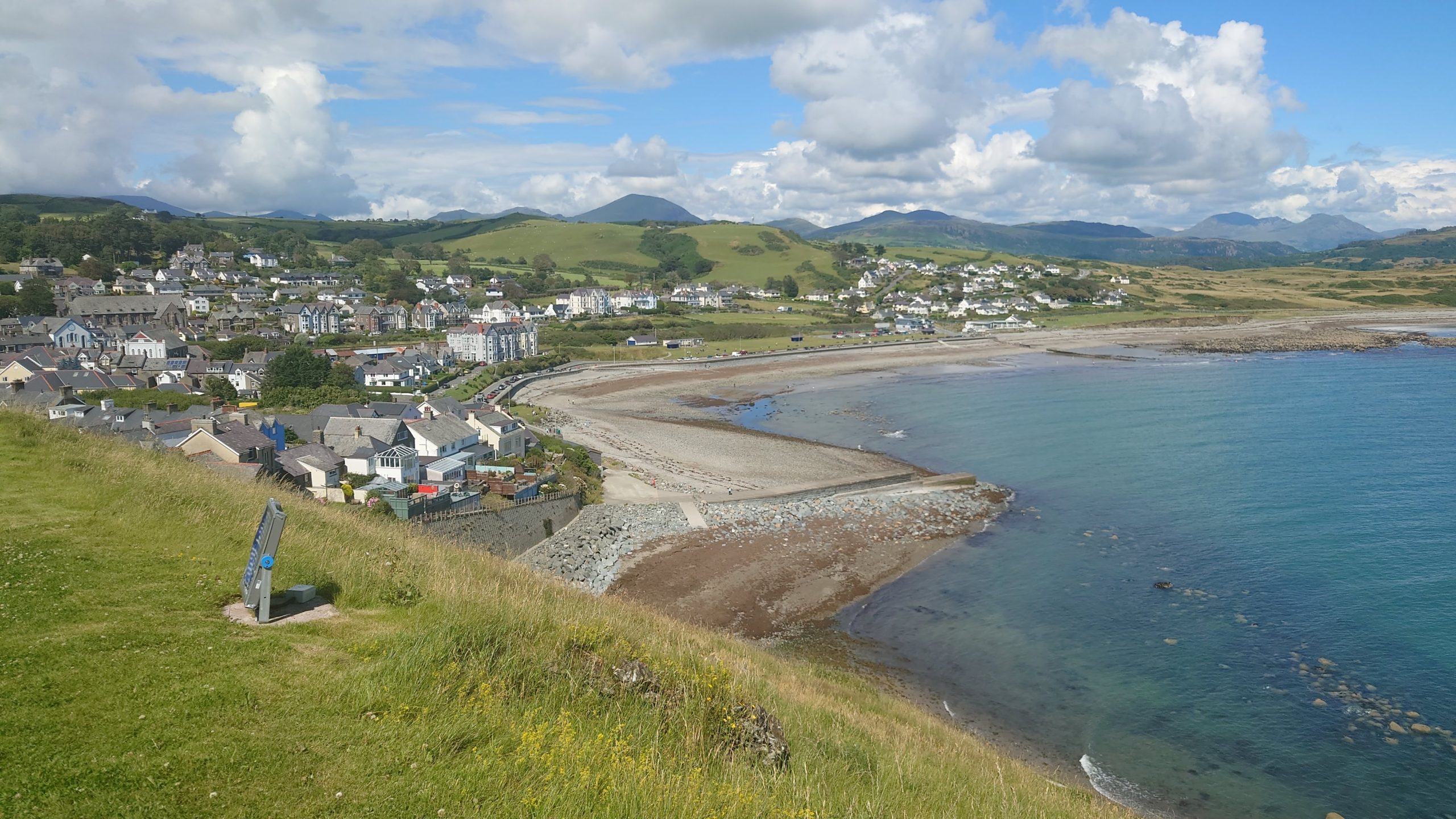
Arguably the best reason for visiting the castle, though, is the spectacular views. The photo below shows the main Criccieth beach. You can even see as far as Harlech Castle from here, although you might need binoculars!

Criccieth

Final Thoughts

As you may gather, I enjoyed my short break in Criccieth, and am happy to recommend both the village and the accommodation where I stayed for a short break.

Criccieth is a lovely place to relax and chill out. It has excellent road and rail connections, and – as mentioned above – there are also some high-quality tourist attractions nearby.

One thing I really enjoyed about this holiday was the number of casual conversations I struck up with other visitors, staff, locals and so on. This applied especially on my Ffestiniog Railway trip, where I ended up chatting with half the people in my carriage! I’d have to say it did help that only a small minority of people are nowadays wearing face-masks. That human contact is something I missed during the pandemic, and as a solo traveller especially it is great to be able to get back to chatting with strangers again 😀

As always, if you have any comments or questions about this post, please do leave them below.

If you enjoyed this post, please link to it on your own blog or social media:
My Investments Update May 2022

My Investments Update – May 2022

Here is my latest monthly update about my investments. You can read my April 2022 Investments Update here if you like

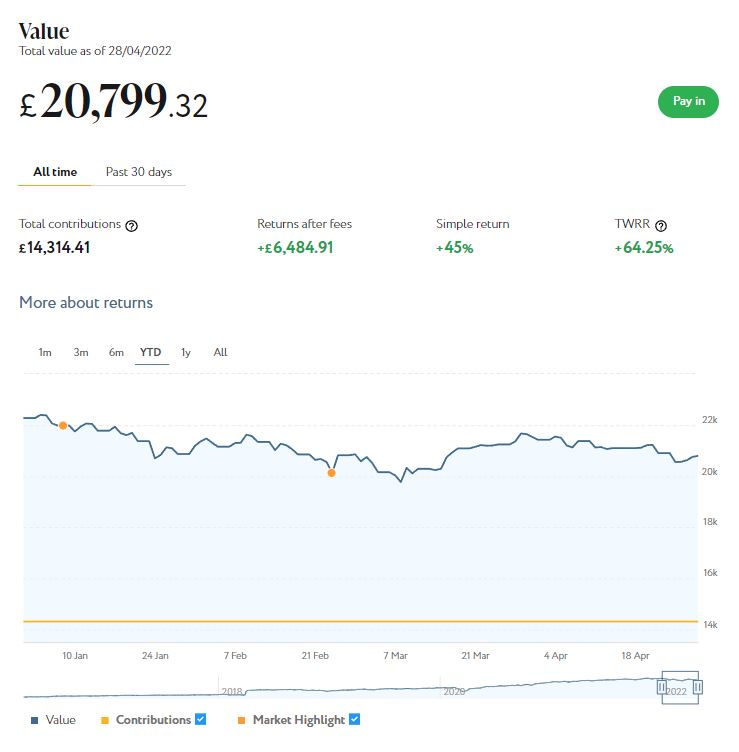
I’ll begin as usual with my Nutmeg Stocks and Shares ISA. This is the largest investment I hold other than my Bestinvest SIPP (personal pension).

As the screenshot below shows, my main portfolio is currently valued at £20,799. Last month it stood at £21,646, so that is a fall of £847.

Nutmeg Main Portfolio May 2022

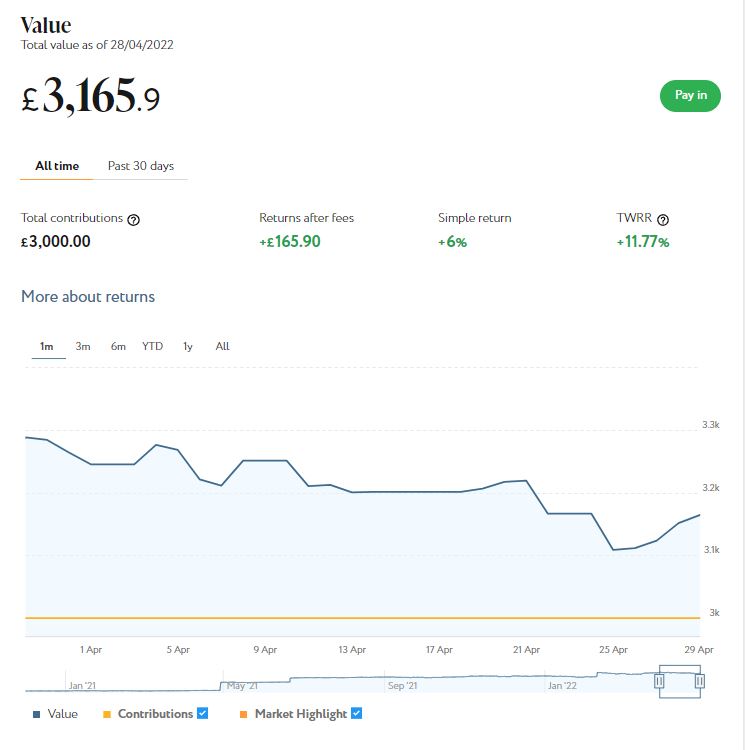
Apart from my main portfolio, I also have a second, smaller pot using Nutmeg’s Smart Alpha option. This is now worth £3,166 compared with £3,286 last month, a fall of £120

Here is a screen capture showing performance over the last month.

Nutmeg Smart Alpha May 2022

Obviously the falls are disappointing (although they come after broadly similar rises the month before). As I’ve noted previously on PAS, you do have to expect ups and downs with equity-based investments, and certainly over the last few months there has been no shortage of volatility in world markets. And it’s also worth noting that since I started investing with Nutmeg in 2016 I have still enjoyed a total return on my main portfolio of 45% (or 64.25% time-weighted).

I should also mention that I selected quite a high risk level for both my Nutmeg accounts (9/10 for the main one and 5/5 for Smart Alpha). This has served me well generally, but I’m sure investors who selected lower risk levels will have seen smaller falls last month.

  • If you also have a Nutmeg portfolio and plan to withdraw from it in the next few months, there is certainly a case for switching to a lower risk level right now.

You can read my full Nutmeg review here (including a special offer at the end for PAS readers). If you are looking for a home for your annual ISA allowance, based on my experience over the last six years, they are certainly worth considering.

If you haven’t yet seen it, check out also my blog post in which I looked at the performance of Nutmeg fully managed portfolios at every risk level from 1 to 10 (as mentioned, my main port is level 9). I was actually pretty amazed by the difference the risk level you choose makes. If you are investing for the long term (and you almost certainly should be) opting for a hyper-cautious low-risk strategy may not be the smartest thing to do.

I won’t go into detail about my Assetz Exchange investments this month. Briefly, though, regular readers will know that this is a P2P property investment platform focusing on lower-risk properties (e.g. sheltered housing). I put an initial £100 into this in mid-February 2021 and another £400 in April. In June 2021 I added another £500, bringing my total investment up to £1,000. Since I opened my account, my AE portfolio has generated £51.50 in revenue from rental and £82.29 in capital growth, a total of £133.79. That’s a decent rate of return on my £1,000 investment and does illustrate the value of P2P property investment for diversifying your portfolio when equity markets are volatile. You can read my full review of Assetz Exchange here. You can also sign up for an account on Assetz Exchange directly via this link [affiliate].

Another property platform I have investments with is Kuflink. They have been doing well recently, with new projects launching almost every day. I currently have over £2,150 invested with them, a significant proportion of which comes from reinvested profits. To date I have never lost any money with Kuflink, although some loan terms have been extended once or twice. On the plus side, when this happens additional interest is paid for the period in question. At present all my Kuflink loans are performing to schedule, with several due to mature in the next few months.

Kuflink recently announced that they were ending their cashback incentive for new members. This used to pay up to £4,000. I know several PAS readers availed themselves of this offer. It’s obviously disappointing it’s now ended, but in a way it’s good news as well. It demonstrates that Kuflink is thriving and they don’t need to offer ‘bribes’ to bring in new investors. As they themselves said in a recent email, ‘We feel now is the right time for us to move away from these campaigns [cashback and refer-a-friend] and utilise the funds within the business to make further enhancements to our products and the platform.’

Even without the cashback incentive, I do still recommend Kuflink and will continue to invest with them. You can read my full Kuflink review here. They offer a variety of investment options, including a tax-free IFISA paying up to 7% interest per year with built-in automatic diversification. Alternatively you can now build your own IFISA, with most loans on the platform being IFISA-eligible.

Another platform in which I have a modest investment is the European crowdlending platform Nibble. This has continued to perform as promised. Several of the loans I invested in have matured and each time I have reinvested the proceeds.

Nibble recently added a new loan category to their offering. This is in the debt collection market; Nibble describe it as their Legal Strategy. This involves investing in loans that are overdue and facing legal action for recovery. Nibble buy these loans at a fraction of their value and then attempt to recover as much of the outstanding debt as possible.

Nibble investors can buy portions of these loans for prices starting at 100 euro (about £84). The company say that investors will receive annual interest rates of between 8 and 14.5% according to how successful their recovery efforts prove. But in any event they offer a ‘buyback guarantee’ that even in the worst case you will receive 8% interest and return of your original investment. I will be trying this out myself soon and also updating my original review, which you can read here if you wish. You can also sign up directly on the Nibble website if you like [affiliate link].

Also this month I wanted to mention that the under-the-radar matched betting opportunity I have described a few times on PAS has closed. My contact there tells me the bookies have tightened up so much on their offers that it is no longer feasible to go on running a free service that makes money for both clients and the company. Final payments went out by the end of April to all existing members (which of course include a number of PAS readers). Again this is obviously disappointing, but I have seen myself that it is getting harder and harder (though not yet impossible) to generate profits from matched betting, especially once you have exhausted the welcome offers.

Anyway, the better news is that the guys behind the business have a new project in the pipeline that will make use of the clever software they developed for the matched betting service. It will work a bit differently from the original programme, but again will be free to join and entirely risk-free for members. They say they expect it to work over a three-month period and generate a one-off payout of between £500 and £1500 per person. In addition, because the new programme will work differently, it will also be open to people who do matched betting themselves (or have done in the past). I will share more details on PAS when I have them – but for now if you would like to be put on my priority list for info, just drop me a line with your email address via my Contact Me page.

Another bit of news is that I have temporarily suspended withdrawals from my Bestinvest SIPP, which is now in drawdown. This is partly in response to volatility in world markets caused by the war in Ukraine and inflation fears (among other things). But also I don’t need the money as much at the moment, as I am now receiving the full state pension. With my other income streams as well, continuing to draw an income from my SIPP would have generated a tax liability, so I thought it better to let the money grow tax-free in my pension fund until I really need it. My personal financial adviser Mike agrees and approves, incidentally 🙂

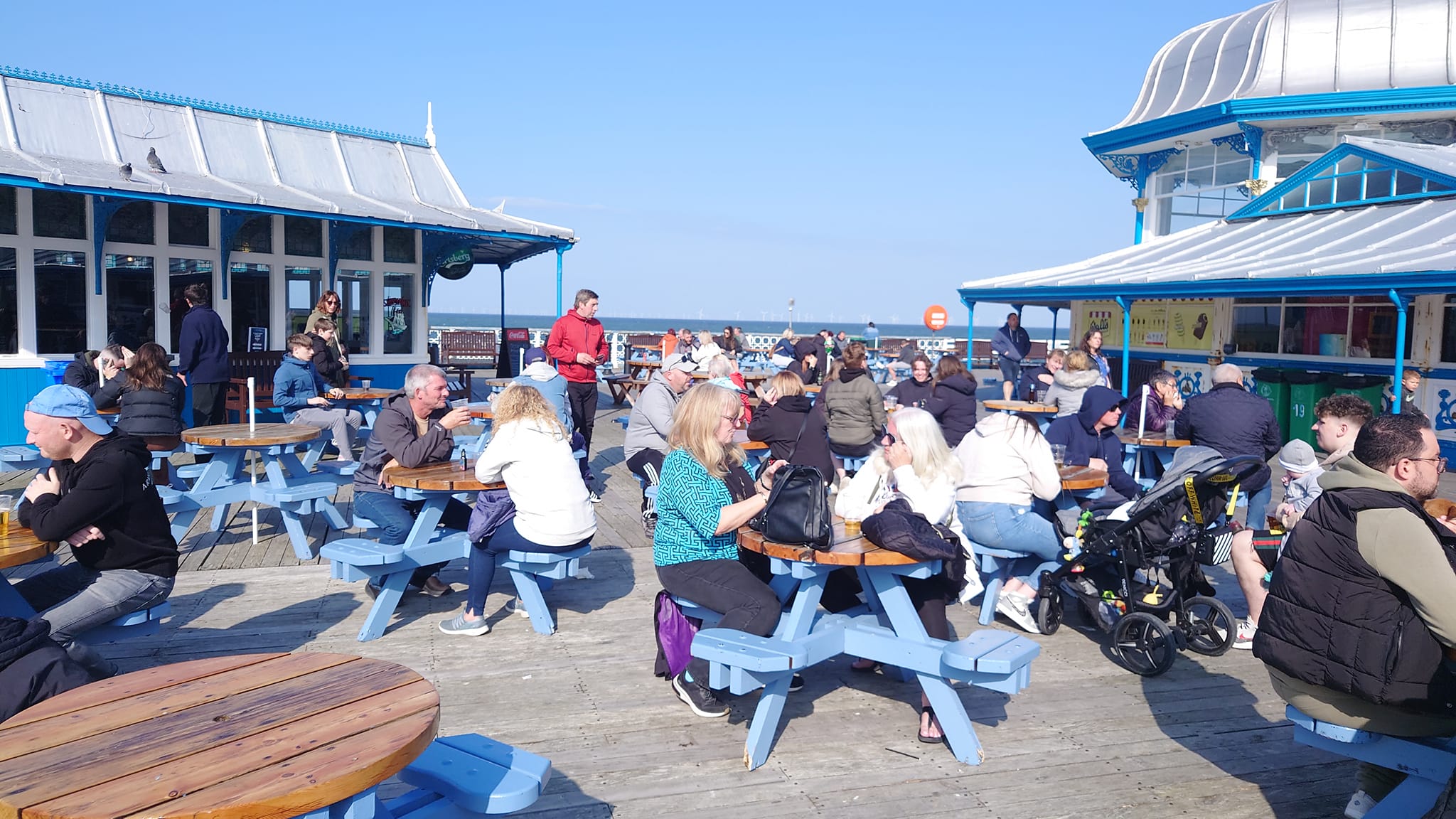
Lastly, I enjoyed my short break in lovely Llandudno a week ago. I was reasonably lucky with the weather, although it was quite windy. But it was great to see the resort almost back to normal after the lockdowns and other disruptions of the last two years. There were plenty of people out and about enjoying the spring sunshine, as this photo taken at the end of the pier shows 🙂

One other thing that struck me in Llandudno was how widely cash was accepted and indeed welcomed. In the Midlands town where I live most businesses don’t seem to want cash any more and insist on payment by card. I actually had to go to a cashpoint in Llandudno to draw more money. I can’t remember the last time I did that at home!

That’s enough for now, so I’ll sign off till next time. I hope you are keeping safe and well, and making the most of the better weather and lifting of Covid restrictions. If you’re planning any UK holidays yourself, don’t forget I have a list of places I have visited and recommend here 🙂

Disclaimer: I am not a qualified financial adviser and nothing in this blog post should be construed as personal financial advice. Everyone should do their own ‘due diligence’ before investing and seek professional advice if in any doubt how best to proceed. All investing carries a risk of loss.

Note also that posts may include affiliate links. If you click through and perform a qualifying transaction, I may receive a commission for introducing you. This will not affect the product or service you receive or the terms you are offered.

If you enjoyed this post, please link to it on your own blog or social media:
How to Cut Your Motoring Costs

How to Cut Your Motoring Costs

Today I’m looking at some ways you may be able to cut the amount you spend on motoring.

Right now, as I’m sure you know, the cost of motoring is rising fast. Fuel prices are obviously a major issue, with the war in Ukraine and economic sanctions on Russia driving up prices that were already increasing anyway.

But in addition, drivers are having to contend with ever-rising road taxes, congestion charges, insurance premiums, repair and servicing bills, and more. And while these costs keep going up, many of us are also having our incomes squeezed.

So today I thought I would share some tips and ideas for cutting your motoring costs…

Travel Light

The more weight you carry around in your car, the worse the fuel economy is likely to be. So empty your boot as much as possible and remove the roof rack if you’re not using it. The latter will also aid fuel economy by reducing air resistance.

Check Your Tyres

According to the RAC, tyres under inflated by 15 psi – a difference you might not notice visually – can use 6% more fuel. Not only that, under-inflated tyres wear out faster, meaning you will need to replace them sooner. 

You can check your tyre pressure at most filling stations or buy an electric pump (like this one maybe). The correct pressure for your tyres will be in the owner’s manual or handbook.

Drive for Fuel Economy

There are many ways you can improve the fuel economy of your car. One of the best and simplest is to avoid braking and accelerating sharply. That means reading the road, anticipating changes in gradients and traffic conditions, and making any necessary adjustments in good time. A good satnav (see example ad below) can help with this.


Another tip is to keep your speed moderate. According to government statistics, driving at a steady 50 mph rather than 70 can improve fuel economy by 25%. For most cars the sweet spot is between 50 and 60 mph. Once you get much over this, fuel economy starts to drop rapidly.

Finally, having lots of electrical devices running – from heating to aircon – can reduce fuel economy as well, especially at lower speeds. So try to keep this to a minimum, but without of course compromising your comfort or safety.

Shop Around for Petrol

Clearly driving miles out of your way to save a penny a litre isn’t likely to be cost-effective. But if you have a choice of local filling stations, it is well worth monitoring them regularly to see which is cheapest.

There are also various websites that can help you check prices locally, though you may have to register with them to view full details. Two to try are Petrolprices.com and GoCompare.

Don’t Fill Your Tank

Petrol is heavy, and the added weight will reduce your car’s fuel economy. Ideally don’t fill your tank more than half-way, though of course this may not always be practical.

Don’t Rev the Engine When Starting

This is something that until recently I was guilty of myself, having grown up in the days when you had to do this to prevent a cold engine from stalling. 

But with modern cars, many of which have computer-controlled ignition systems, it is no longer necessary. If (like me) you still do this habitually, train yourself to turn the ignition and keep your foot well away from the accelerator pedal. This will save petrol and help with fuel economy.

Consider Car Sharing

Car sharing can work well if someone else you know is travelling the same route as you, ideally on a regular basis. You can split the fuel costs and (if you both agree) the driving duties. And as fans of Peter Kay’s Car Share will know, you can make new friends and enjoy some stimulating conversations too!

For one-off journeys, you could try ride-sharing. The website BlaBlaCar lets you search for other drivers who are making a similar journey and have space for you in their vehicle. Alternatively, if you are planning a long journey you can help defray the cost by offering to take one or more paying passengers. Fees are paid in advance via the website, so there is no awkward passing over of cash on the day.

There are also ‘car pool’ companies like ZipCar that offer members the opportunity to hire a car from their fleet when needed for a modest price. If you only require a car now and then, this could be a cost-effective alternative to owning a car yourself.

Shop Around for Motor Insurance

It’s easy to fall into the habit of renewing every year with the same insurer, but there are big savings to be made by shopping around. 

Use a price comparison service such as Go Compare or Confused.com to get quotes from a range of insurers, therefore. But also check cashback sites such as Top Cashback and Quidco, which have some good offers too. For example, Top Cashback are currently offering up to £20 cashback on car insurance from the AA.

One other top tip is to get a quote for fully comprehensive insurance, even if you normally opt for third party, fire and theft (TPFT). Surprisingly, because of the way insurance companies’ algorithms work, comprehensive insurance often comes out cheaper, even though you are actually getting better cover.

Go Electric

Finally, if you haven’t done so already, you could consider going electric (or hybrid).

Electricity prices are going up at the moment too, but you should still save a lot compared with buying petrol or diesel. Electric cars are obviously expensive but prices are starting to come down and there is a growing second-hand market as well. This article from the Buyacar website includes a useful round-up of the pros and cons of electric cars.

If you have any comments or questions – or any other tips for saving money on motoring – please do leave a comment as usual.


If you enjoyed this post, please link to it on your own blog or social media:
My Investments Update - October 2021

My Investments Update – October 2021

As regular readers will know, I recently started posting monthly updates about my investments. These (partly) replace the ‘Coronavirus Crisis Updates’ I was posting from March 2020. You can read my September 2021 Investments Update here if you like

I’ll begin as usual with my Nutmeg Stocks and Shares ISA, as I know many of you like to hear what is happening with this.

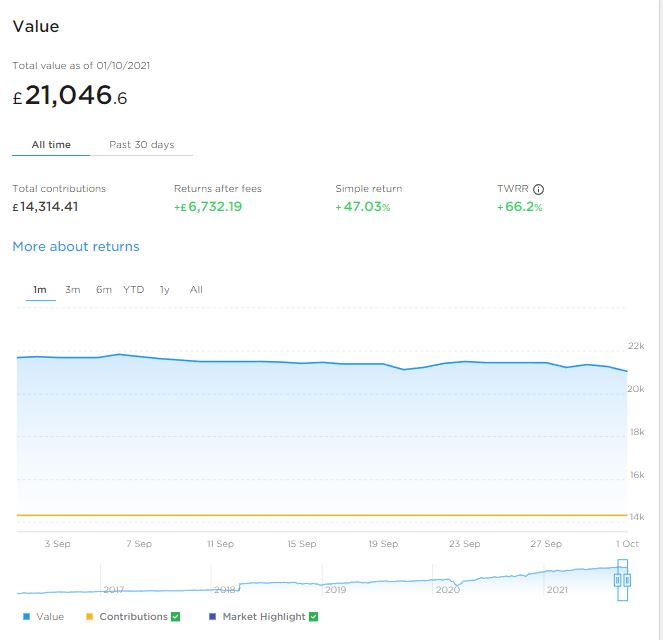
As the screenshot below shows, my main portfolio is currently valued at £21,046. Last month it stood at £21,690, so that is a fall of £644. That is obviously disappointing, but as the value rose by £675 the previous month, I am not going to lose any sleep over it. Most equity-based investments had a rocky ride in September, with my BestInvest SIPP also taking a hit. Stock market investments in general should be regarded as medium- to long-term, and you have to expect some ups and downs in the short term.

Nutmeg Main Portfolio October 2021

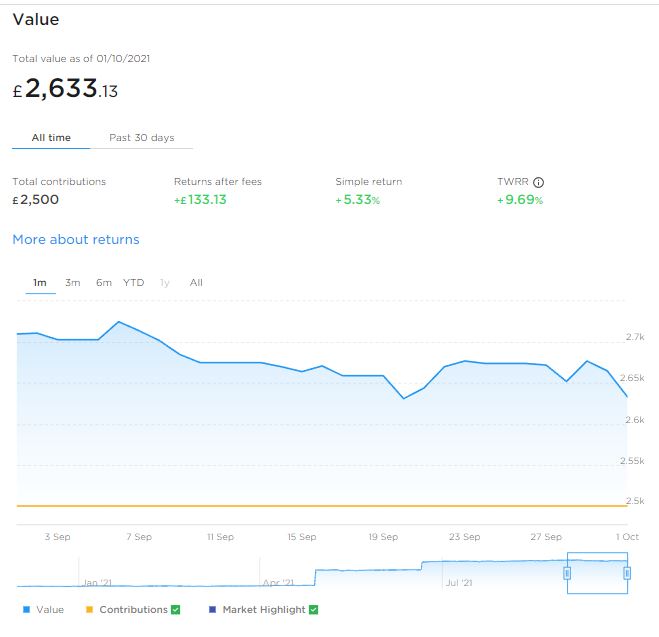
Apart from my main portfolio, I also have a second, smaller pot using Nutmeg’s new Smart Alpha option. This pot also fell in value in September. It is now worth £2,633 compared with £2,710 last month. That’s a fall of £77, though again the value is still higher than it was two months ago. Here is a screen capture showing performance in September 2021.

Nutmeg Smart Alpha portfolio Oct 2021

As I said above, September was a disappointing month for stock market investors generally, and Nutmeg is far from alone in seeing falls. I make no claim to being an expert on the markets, but from what I read this has resulted from various developments that have worried investors, including the withdrawal of fiscal stimulus packages as we come out of the pandemic and a rise in the inflation rate.

The drop in September is still nothing like what happened in March 2020 – at the start of the pandemic – when the value of my Nutmeg portfolio fell by a third in just a few weeks. On that (admittedly worrying) occasion, the value of my investments swiftly bounced back and turned into a good overall profit for the year. I remain optimistic that something similar will happen again as the UK and world economies get back on a more even keel.

So, especially if you are a new investor, I would strongly advise you not to panic. Remember that if you sell up you are simply crystallizing any losses rather than giving the markets a chance to recover. Personally I am considering investing more in my Nutmeg account now while valuations are down. Obviously I am not offering that as financial advice, just sharing my own thoughts and plans at this time.

Anyway, you can read my full Nutmeg review here (including a special offer at the end for PAS readers). If you are still looking for a home for your 2021/22 ISA allowance, based on my experience they are certainly worth considering. If you haven’t yet seen it, check out also my recent blog post in which I looked at the performance of Nutmeg fully managed portfolios at every risk level from 1 to 10 (my main port is level 9). I was actually pretty amazed by the difference the risk level you choose makes.

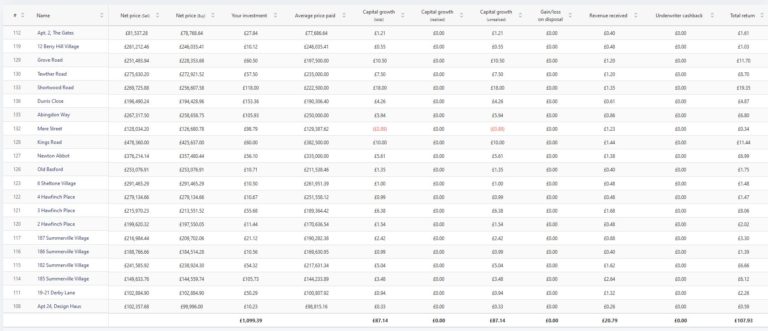
As regular readers will know, this year I am using Assetz Exchange for my IFISA. This is a P2P property investment platform that focuses on lower-risk properties (e.g. sheltered housing on long leases). I put £100 into this in mid-February and another £400 in April. Touch wood, everything has been going well, so in June I added another £500, bringing my total investment on the platform up to £1,000.

Since I opened my account, my portfolio has generated £20.79 in revenue from rental and £87.14 in capital growth, for a total return of £107.93. Here is my current statement:

Assetz Exchange October 2021

As I have noted before, Assetz Exchange has had a big influx of new members, meaning all available investments were quickly snapped up. At the same time, some of the new projects that were due to launch were delayed. Only a small number of new projects went live on the platform in the last month, so I haven’t added any more to my portfolio.

To control risk with all my property crowdfunding investments nowadays, I am investing relatively modest amounts in individual projects. I don’t therefore put more than around £100 into any one project. As you can see, I have a well-diversified portfolio with Assetz Exchange comprising 21 different projects. This is a particular attraction of AE in my view. You can actually invest from as little as 80p per property if you really want to proceed cautiously.

My investment on Assetz Exchange is in the form of an IFISA so there won’t be any tax to pay on profits, dividends or capital gains. I’ve been impressed by my experiences with Assetz Exchange and the returns generated so far, and intend to continue investing with them. You can read my full review of Assetz Exchange here if you like. You can also sign up for an account on Assetz Exchange directly via this link [affiliate].

Another property platform I have some investments with is Kuflink. They appear to have been doing well recently, with new projects launching almost every day. I currently have just over £2,000 invested with them, quite a large proportion of which comes from reinvested profits. To date I have never lost any money with Kuflink, though some loan terms have been extended once or twice. On the plus side, where this happens additional interest is paid for the period in question.

My loans with Kuflink pay annual interest rates of 6 to 7.5 percent. As mentioned above, these days I invest no more than around £100 per loan (and often less). That is not because of any issues with Kuflink but more to do with losses of larger amounts on other P2P property platforms (such as this one). My days of putting four-figure sums into any single property investment are behind me now!

  • Nowadays I mainly opt to reinvest the monthly repayments I receive from Kuflink, which has the effect of boosting the percentage rate of return on the projects in question

You can read my full Kuflink review here. They offer a variety of investment options, including a tax-free IFISA paying up to 7% interest per year with built-in automatic diversification. Alternatively you can now build your own IFISA, with most loans on the platform being IFISA-eligible.

I’d also particularly draw your attention to their revised and more generous cashback offer for new investors. They are now paying cashback on new investments from as little as £500 (it used to be £1,000). And if you are looking to invest larger amounts, you can earn up to a maximum of £4,000 in cashback. That is one of the best cashback offers I have seen anywhere (though admittedly you will need to invest £100,000 or more to receive that!).

Moving on, I have another article on the always-excellent Mouthy Money website. This was for their Meet the Blogger feature. They asked me a number of thought-provoking questions, including what personal finance tip I would give a younger version of myself and what I would do if I was made Chancellor for the day! You can read my answers here.

Finally, it’s not investment-related, but I did just want to mention an act of kindness that saved me several hundred pounds last month, and a lot of anxiety too 🙂

I drove up to Yorkshire for a family reunion with my sisters Liz and Annie (and Liz’s family, who live there). I went just before the fuel crisis broke, and found myself marooned when all the local petrol stations closed after running out of fuel.

I was staying at Hewenden MIll Cottages near Bingley (the cover image shows the bungalow I booked this time). When I explained my predicament to the owners, they immediately said I could stay as long as I liked free of charge until the situation improved. I don’t mind admitting I was almost reduced to tears by the unexpected kindness. I ended up staying for three extra days – double the length of time I originally booked (and paid for).

So I wanted to take this opportunity to publicly thank Janet and Susan and family for their kindness, and give Hewenden Mill Cottages another plug. As some of you may remember, I last went there two years ago and was bowled over by the quality of the accommodation and the stunning location (see sample photo below).

Hewenden Mill

You can read my original review of Hewenden Mill Cottages here. It is the best self-catering accommodation I have ever stayed in, and I am obviously even more impressed now. If you want a short break (or longer) in beautiful Bronte Country, I very much doubt you will find anywhere better. They also host some retreats and residential courses.

As always, if you have any comments or questions about this post, please do leave them below.

If you enjoyed this post, please link to it on your own blog or social media: