Black Friday is fast approaching, and Amazon UK is gearing up for one of the biggest online shopping events of the year.
This year Amazon’s Black Friday Sale extends over 12 days, from Thursday 20 November to Monday 1 December, with thousands of discounts across tech, home, beauty, toys and more.
Here’s what UK shoppers can expect this year – plus some practical tips to help you score the best bargains.
What to Expect From Black Friday 2025
1. Earlier and Longer Sale Periods
In recent years, Amazon has expanded its Black Friday event, and 2025 will follow the same pattern. Early deals began in mid-November, with the main sale (as mentioned above) running from Thursday 20 November to Monday 1 December (Cyber Monday).
Expect:
Daily “Early Black Friday Deals”
Lightning Deals with limited stock and countdown timers
Exclusive Prime-only discounts
2. Strong Discounts in Key Categories
Amazon’s 2025 Black Friday event is likely to feature major discounts on:
● Tech & Electronics Massive reductions are expected on Amazon devices such as Echo speakers, Fire TVs, Ring doorbells and Eero routers. Big-brand TVs, headphones, gaming accessories and laptops are also likely to see significant markdowns.
● Home, Kitchen & Appliances Robotic vacuums, air fryers, espresso machines and cordless vacuums are typically Black Friday favourites, and 2025 should be no exception.
● Fashion & Beauty Deals across premium skincare, grooming, and clothing ranges, including Amazon Fashion, Levi’s, Adidas and a wide variety of brand boutiques.
● Toys, Books & Gifts Perfect timing for Christmas shoppers – expect deals on LEGO, board games, bestselling books and stocking fillers.
Tips to Make the Most of Black Friday 2025
1. Build and Optimize Your Wish List Early
Add items you’re interested in well before Black Friday. Amazon will highlight when prices drop, making it easy to track discounts without constantly refreshing pages.
2. Use the “Watch This Deal” Feature
For Lightning Deals, tap “Watch This Deal” in the app to get notified the moment an offer goes live. Popular items sell out in minutes – even seconds – so alerts are hugely valuable.
3. Check Price History Tools
Not all Black Friday discounts are equal. Tools like CamelCamelCamel and Keepa let you:
Check an item’s historical lowest price
See whether the “deal” is genuinely good
Avoid marketing gimmicks
4. Consider Using Amazon Prime
Prime members get benefits that can help during Black Friday:
Early access to certain limited-time deals
Faster (often free) delivery
Access to Prime-exclusive Lightning Deals
If you’re not already a member, you can take advantage of Amazon’s 30-day free trial. You can always cancel once the Black Friday sale is over if you don’t want to pay for a subscription.
5. Update Payment and Delivery Settings Beforehand
Seconds matter during Black Friday. Make sure:
Your card details are correct
One-click checkout is enabled (if you use it)
Your delivery address is up to date
This reduces friction at checkout, especially for fast-selling items.
6. Set a Spending Limit
Black Friday can be brilliant for bargains but also tempting for impulse purchases. Create:
A realistic budget
A priority list (must-have, nice-to-have, impulse watchlist)
Alerts for items you genuinely need
7. Look Out for Coupons and Voucher Badges
Beyond headline discounts, Amazon often offers:
Tick-box coupons on product pages
Automated discount vouchers
Bundle promotions (e.g. buy two, save extra)
These can stack with Black Friday prices for even bigger savings.
Key Black Friday 2025 Dates
Early Black Friday Deals: Start mid-November
Amazon Black Friday Week: 20–28 November 2025
Black Friday (Main Event): Friday 28 November 2025
Cyber Monday: Monday 1 December 2025
Final Thoughts
Amazon UK’s Black Friday 2025 event will be a major opportunity for shoppers to save on electronics, household essentials, Christmas gifts, and more. With early preparation, smart budgeting and the right tools, you can navigate the sale confidently and secure the best possible deals.
As always, if you have any comments or questions about this post, please do leave them below. I am always delighted to hear from Pounds and Sense readers!
Disclosure: This post includes affiliate links. If you click through and make a purchase, I may receive a commission for introducing you. This will not affect the price you pay or the products or services you receive.
If you enjoyed this post, please link to it on your own blog or social media:
As speculation mounts ahead of Rachel Reeves’ upcoming budget on 26 November 2025, many UK retirees and those approaching retirement are wondering if now is the right time to take a tax-free lump sum from their pension. Already it appears growing numbers have been doing just that in anticipation of a possible tightening of the rules.
The rumoured changes in pension taxation could have significant implications, but should these potential shifts prompt immediate action? Let’s explore the factors you should consider.
What Is the Tax-Free Lump Sum?
In the UK, when you begin accessing your defined contribution pension (typically from age 55, rising to 57 in 2028) you are currently able to take up to 25% of your pension pot tax free, subject to a cap (currently £268,275). This tax-free cash is often used for a home deposit, debt pay-off, investment, or simply a financial cushion in retirement.
The Upcoming Budget and the Rumour Mill
As mentioned above, the Autumn Budget will be delivered by Rachel Reeves, the Chancellor of the Exchequer, on 26 November 2025. Given the government’s fiscal pressures – slow growth, high borrowing, commitments to public services, and so on – pensions (and pension tax reliefs) are under increasing scrutiny.
Among the speculated measures are:
Reducing or limiting the current 25% tax-free cash entitlement.
Adjusting tax relief on pension contributions (for example moving to a flat rate or scaling back higher-rate relief).
Capping salary sacrifice pension arrangements or increasing National Insurance on them.
However, officially there are assurances that the tax-free lump sum rule will not be cut in this Budget. HM Treasury has signalled that while pensions generally are in scope for reform, a “raid” on tax-free cash is off the table for now.
Why Some Are Considering Acting Now
Because of the rumours, many savers are thinking: “If the 25% tax-free rule is reduced or withdrawn in future, better to take it now.” Indeed:
Research shows that nearly 59 % of people are worried about changes to the tax-free cash rule ahead of the Budget.
Before you jump, it’s important to consider the downsides:
Speculation is not policy Rumours abound, but nothing is guaranteed until the Budget is announced and legislation moves through. Acting based purely on speculation introduces risk.
Reduced pension pot = reduced income later Taking cash now reduces the amount left invested in your pension, which could lower your future retirement income or growth potential.
Lost tax-efficient growth and benefits Leaving funds within a pension means continued tax-relief on growth, protected status for certain tax benefits (including potential inheritance tax advantages) until rules change. Withdrawn funds may lose these perks.
Re-investing is complex and possibly taxed If you withdraw and then reinvest elsewhere (e.g., an ISA), the tax treatment, returns and flexibility may differ — and you may fall foul of HMRC rules (e.g., pension “recycling” rules) if you try to put withdrawn cash right back into a pension.
Triggering higher tax or reducing benefits Taking lump sums might push you into a higher income tax band, or reduce eligibility for means-tested benefits. Once you take the amount, you can’t “untake” it.
What You Should Do Rather Than Rush
Pause, but monitor: With the Budget just weeks away, wait for the official announcements.
Review your plan: Think about your retirement timescale, how much income you’ll need, and what role the lump sum will play in that.
Check your immediate needs: If you have pressing expenses (e.g. paying off expensive debt, home adaptations), the lump sum may make sense. If it’s purely “in case rules change”, be cautious.
Seek expert personal advice: Pension decisions are long-term and often irreversible. A qualified financial adviser can assess your whole situation, not just the tax angle.
Keep an eye on transitional protections: If rules change, the government typically layers in protections for those close to retirement. That could mean any changes happen with a delay, not overnight.
So Is Now the Time to Take Your Tax-free Lump Sum?
It depends on your personal circumstances, but in broad terms:
Yes, you might consider taking it now if:
You have an immediate, compelling financial need for the cash.
Your retirement plan is settled, and you won’t harm your long-term income by reducing the pot.
You are comfortable sacrificing some future growth for now.
No, you might be best to wait if:
You’re taking the lump sum purely on the basis of rumoured policy change.
Your retirement income depends significantly on your pension pot size and future growth.
You believe the current tax-free rule will remain (official signs point that way for now) and you want to keep your funds invested tax-efficiently.
Final Thoughts
With the Budget on 26 November 2025, the risk of rule-changes is real, but the specifics are uncertain. While rumours suggest the tax-free lump sum (the 25% rule) could be reduced, the Treasury has publicly said it will not be cut this year. Still, the doubt has already caused many savers to act.
Rather than acting in panic, it’s wise to pause, understand your own retirement plan, and consult an adviser. If you do decide to take your tax-free lump sum before the Budget, make sure it is for a reason aligned with your long-term goals — not simply a reaction to budgetary speculation.
As always, pensions are complex and deeply personal. Changes in tax rules can take time to come into effect; acting too early or for the wrong reason may cost you more in the long run than you save.
As always, if you have any comments or questions about this post, please do leave them below. But bear in mind that I am not a qualified professional adviser and cannot give personal financial advice.
This is a fully revised update of an earlier article.
If you enjoyed this post, please link to it on your own blog or social media:
According to various sources (here, for example) money market funds or MMFs are seeing a surge of interest from UK investors at the moment.
So today I thought I’d explain what MMFs are, their pros and cons, and who should (and perhaps shouldn’t) invest in them. I will also examine some likely reasons for the high level of interest in MMFs just now.
Let’s start with the most basic question, though…
What Are Money Market Funds?
A money market fund is a type of investment fund that invests in short-term, high-quality, liquid debt instruments — such as government treasury bills, bank certificates of deposit, commercial paper and other instruments with very short maturities. In the UK context, many asset managers describe them as a “park your cash” vehicle: not quite a deposit account, but relatively low risk compared to equities or longer-dated bonds.
Because the underlying assets mature quickly (many in weeks or a few months) the fund manager can reasonably anticipate the yield and maintain high liquidity.
In simple terms, you could think of a money market fund as somewhere between “keeping money in a bank account” and “investing for growth in the stock market” — it aims for capital preservation + modest income, rather than big capital gains.
Pros of money market funds
If you’re considering an MMF, here are some of the advantages that frequently show up in analyses:
Lower risk (relatively) Because the underlying holdings are short-dated and usually high credit quality, money market funds tend to carry lower risk than many other types of investment funds. For example, compared to longer-term bond funds or equities, there’s far less exposure to interest-rate/inflation risk and less time for issuers to go horribly wrong.
High liquidity Many funds allow you to redeem on a daily dealing basis (or very frequently) so you can access your money relatively quickly. This makes them useful as a “waiting place” for money or for short-term needs.
Potentially higher return than pure cash savings Especially in a higher interest-rate environment, the yields on money market funds can exceed those of some bank savings accounts or easy-access deposits — for investors willing to accept the (small) additional risk.
Diversification of cash holdings If you keep large sums of cash at one bank, you may be exposed to that institution; a money market fund spreads the credit risk across many issuers.
Use within tax-efficient wrappers In the UK, you can hold money market funds inside a Stocks and Shares ISA or SIPP, which may be advantageous rather than leaving all your money in a conventional cash account.
Cons of money market funds
As always, “lower-risk” doesn’t mean “no risk”, and there are some important drawbacks to bear in mind…
Capital is not guaranteed Unlike deposit accounts covered by the UK’s Financial Services Compensation Scheme (FSCS) (up to £85,000 per institution), investments in money market funds are subject to investment risk. You could get back less than you invested.
Return may not beat inflation Because the returns are modest (given the conservative nature of the underlying assets), there is a risk that inflation will erode the real value of your money over time. In other words: you may earn income, but your purchasing power may still decline.
Interest-rate/yield sensitivity The yield of a money market fund is influenced by short-term interest rates. If interest rates fall, the yield on the fund may drop. If the market is unsettled (or credit spreads widen) the value can move.
Liquidity risk in extreme scenarios While these funds are normally very liquid, in times of market stress there is still a risk of redemption delays, or assets becoming harder to value. Some regulators have highlighted this as a risk.
Limited capital growth potential These funds are designed for preservation and modest income, not high growth. If your goal is expanding your wealth significantly over many years, other assets (equities, long-term bonds, etc.) may suit you better.
Who Should Invest in MMFs?
Here are some scenarios where a money market fund may be a good fit:
If you have short-term needs (e.g. you expect to spend the money within the next 1 to 3 years) and want to avoid exposing it to the ups and downs of equities.
If you’re deciding what to do with funds (e.g. waiting for an investment opportunity) and need a place to park cash that offers a little bit more than a basic savings account, while keeping reasonable access.
If you hold a large sum of cash in an ISA or pension wrapper and you want it to “work a little harder” than a pure deposit, but without taking large risks.
If you have low risk-tolerance and want the bulk of your capital in safer, more liquid form — while still preserving flexibility.
Who Shouldn’t Invest In MMFs (or maybe think twice)?
On the flip side, money market funds may not be appropriate if:
Your investment horizon is long-term (say 5-10+ years) and you’re seeking substantial growth. The conservative nature of money market funds means they are unlikely to match the returns of equity or balanced portfolios over the long term.
You are relying on the investment to outpace inflation significantly. If inflation is high, the modest returns may mean your real-terms wealth declines.
You need instant access or expect frequent withdrawals. While liquidity is good relative to many investments, it is not always instant and sometimes there may be daily dealing only. Check the individual fund terms.
You misunderstand the risk: if you assume it’s the same as a deposit account (with full guarantee), you may be unpleasantly surprised. While risk is lower than many funds, it is not zero.
Examples of Popular UK MMFs
To illustrate what’s out there in the UK market, here are a few examples of well-known money market (or “cash/money-market”) funds. Note: this is for information only and not a product recommendation.
Royal London Short Term Money Market Fund — This fund is often cited as a top choice in the UK short-term money market fund category, with a low ongoing charge and yield of ~4–5% in recent years.
Vanguard Sterling Short‑Term Money Market Fund — Vanguard’s UK money market offering, described as “a low-risk place to park your money” by the provider.
abrdn Sterling Money Market Fund — Another UK-available fund in the segment, targeting short-term money market instruments and relatively modest returns.
When choosing a fund, you’ll want to consider: the fund’s objective, charges (ongoing management charge/OCF), dealing terms (how quickly you can withdraw), liquidity provisions, and whether the yield is appropriate for the risk.
Why Is Interest in MMFs High Right Now?
There are various reasons for this. A major one is a degree of caution among investors at present. Equities and long-duration bonds have had episodes of volatility, inflation remains a concern, and with rising rates the risk of capital losses in interest-sensitive assets is higher. In that context, MMFs — with their short-duration holdings and relatively low volatility — look like a safer option to hold cash or near-cash assets.
Also, with central banks (including the Bank of England) keeping base rates elevated, the returns available from short-term debt and cash-like instruments have increased. For example, one provider (Fidelity) notes that MMFs “made a comeback in 2023 and have remained popular ever since — thanks largely to interest rates remaining higher for longer than expected.”
Because MMFs can be held inside ISAs or pensions, they benefit from the same tax-efficient wrappers as other investment funds. For investors who already use their ISA or SIPP allowance, being able to park cash inside that wrapper via an MMF may be an attractive alternative to leaving it outside the wrapper in a separate (perhaps taxed) savings account.
And finally, many investors have cash allocations in their portfolios (for future investment or awaiting opportunity) or hold money inside tax-efficient wrappers as mentioned above, but may not want to leave it entirely in a low-interest bank account. MMFs provide a way to hold cash within an investment platform, maintain liquidity, and potentially earn slightly more than a basic savings account. For example, AJ Bell notes that one of the appeals is that an investor can hold the MMF inside their S&S ISA or pension without transferring it out to a separate cash savings account.
UPDATE: An additional attraction of MMFs has arisen due to the decision by Chancellor Rachel Reeves in her November 2025 Budget to reduce the annual Cash ISA allowance to £12,000 (with an exception for over-65s). If you would previously have put the full £20,000 into a Cash ISA, you could now put all that money into an MMF within a Stocks and Shares ISA instead. Alternatively you could put the maximum £12,000 into a Cash ISA and the remaining £8,000 into a MMF within a S&S ISA.
Key Takeaways
Money market funds can be a useful tool for parking money (relatively) safely, earning a bit more than a basic savings account, and maintaining liquidity.
They are not risk-free: capital is at risk, and returns may not keep pace with inflation.
They are most useful for short- to medium-term horizons, or as part of a diversified portfolio where some portion of assets is kept in safer, liquid form.
If you’re investing for the long term with a view to growth, you’ll likely need to supplement (or allocate differently) rather than relying solely on MMFs.
You can invest in MMFs directly or via a platform such as AJ Bell or Hargreaves Lansdown.
You can invest within a tax-free wrapper such as a SIPP or S&S ISA, or in a general investment account without tax-free status if you’ve used up your annual £20,000 ISA allowance.
Always read the fund’s Key Investor Information Document (KIID) or factsheet, check charges, underlying holdings and suitability for your goals and time horizon.
Comparison Chart: MMFs vs Bank Deposits vs Cash ISAs
Product type
Typical recent yield / rate*
Key features / caveats
Money Market Funds (UK)
Around ~3.9%-4.3% p.a. (e.g. Premier Miton UK Money Market Class B shows an underlying yield ~3.98%.
Variable yield; invested in short-dated instruments; not guaranteed like a deposit; liquidity good but subject to fund terms. May be held within a tax-free wrapper such as a SIPP or ISA.
UK bank deposits / savings accounts
For easy‐access/variable savings: up to ~4.20% or so.
Usually FSCS-protected up to £85,000; rates may change; access may be immediate or with notice depending on account.
Cash ISAs (UK)
Top easy‐access Cash ISAs: ~4.52% AER or thereabouts.
Tax-free interest; also FSCS-protected as with deposits; you must use your annual ISA allowance (£20,000 in 2025/26) for it to count as an ISA; yield may be variable or fixed term.
*Yields/interest shown are approximate at the time of writing and subject to change.
As the chart shows, if you’re looking for a place to “park” money in the UK, you’re getting broadly similar yields whether you go for a bank savings account, a cash ISA or a money market fund. The differences come down to tax treatment, level of guarantee/risk, which wrapper you use, and ease of access.
For example, a cash ISA is tax-free, which can boost your effective return if you’re a higher rate taxpayer. A bank deposit may offer the FSCS safety net. A money market fund may allow you to invest via your ISA or pension wrapper and keep your cash within your investment portfolio structure, but you must accept that capital preservation isn’t guaranteed.
If you value the FSCS protection and are comfortable with a savings account structure, a bank deposit or savings account/cash ISA might be your preference. If you already have your deposit needs covered and you’re simply looking for a place inside your investment wrapper to hold cash-like assets, a money market fund may fit the bill.
It’s also important to ascertain whether the quoted rate is fixed or variable, check any withdrawal penalties, and consider whether the returns will keep pace with inflation.
As always, if you have any comments or questions about this post, please do leave them below. Bear in mind that I am not a qualified financial adviser and nothing in this article should be construed as personal financial advice. You should always do your own ‘due diligence’ before investing and seek professional advice if in any doubt how best to proceed. All investing carries a risk of loss.
If you enjoyed this post, please link to it on your own blog or social media:
I’ll begin as usual with my Nutmeg Stocks and Shares ISA. This is the largest investment I hold other than my Bestinvest SIPP (personal pension).
As regular readers will know, in June this year I transferred most of the money in my Nutmeg Fully Managed portfolio (just under £25,000) to a new Nutmeg Income Portfolio. I discussed this in detail in this recent post, but basically money in this port is invested to generate an income from share dividends and other sources. This is then paid monthly. Capital appreciation is targeted as well, but these portfolios are aimed primarily at older people (and others) who want/need their investment to generate a regular cash income.
In October my Nutmeg income portfolio generated £64.60 of income, which was duly paid in to my bank account on 24 October 2025. That is down a bit on the £78.20 I received in September, but it means I have now received a total (tax-free) income of £276.83 to date. That’s a bit less than I would have hoped for based on Nutmeg’s projected annual return of just under 5% for income ports at my chosen risk level (five). It’s still too early to draw any significant conclusions from this, though.
My income portfolio grew in value again in October. It’s now worth £26,837 (rounded up) compared with £26,383 at the start of last month, a rise of £454. As the screen capture shows, the port has actually increased by £1,844.36 (7.55%) since I opened it in June this year. That’s clearly good going, though I don’t suppose it will carry on like this indefinitely!
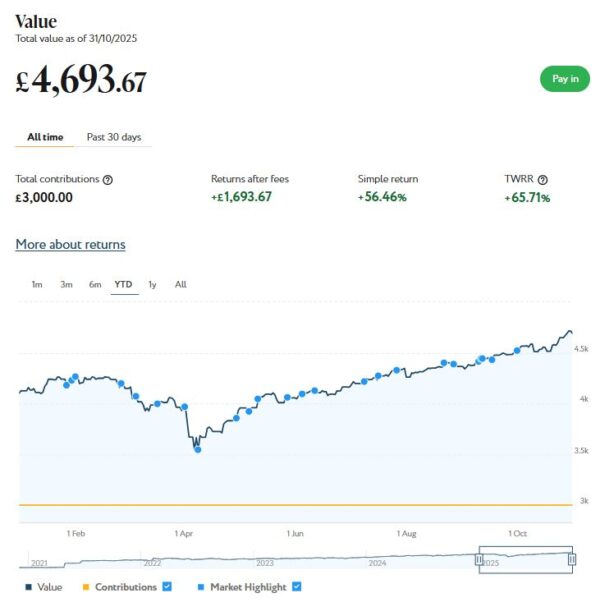
I still have a smaller, growth-oriented pot using Nutmeg’s Smart Alpha option. This is now worth £4,694 (rounded up) compared with £4,524 a month ago, a rise of £170. Here is a screen capture showing performance for the year to date.
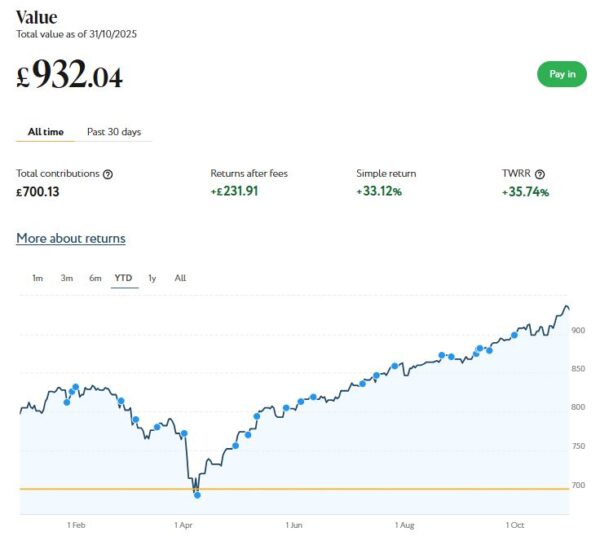
And at the start of December 2023 I invested £500 in one of Nutmeg’s thematic portfolios (Resource Transformation). In March 2024 I also invested a further £200 from referral bonuses (something I no longer receive for reasons I won’t bore you with). As you can see from the YTD screen capture below, this portfolio is now worth £932 compared with £900 last month, a rise of £32.
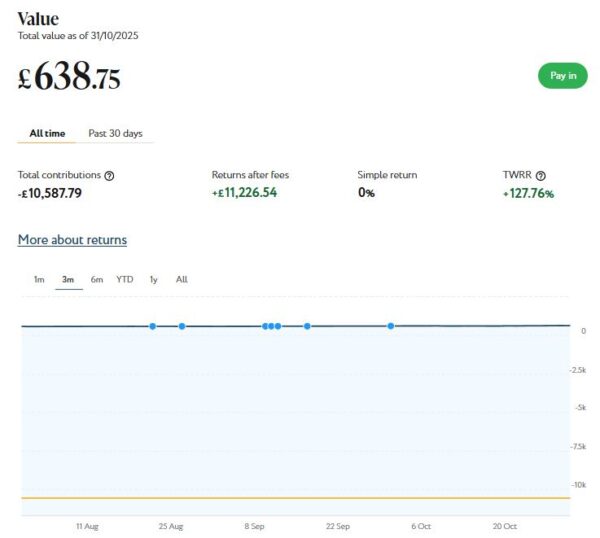
Finally, I still have a small amount left in my original Nutmeg Fully Managed portfolio. I have kept this largely for comparison purposes. This has increased in value from £617 at the start of October to £639 (rounded up) now, a rise of £22.
As you can see, October was another good month for my Nutmeg investments. Overall I was up by £678 or 2.46%. In addition I did, of course, receive £64.60 in income from my income portfolio.
Excluding income generated, the overall value of my Nutmeg investments is up by £2,673 since the start of 2025, so the April 2025 fall (caused largely by Trump’s tariffs) has now fully reversed. I am also up by £3,526 or 11.92% since the start of November last year, again excluding cash income received. All things considered, that’s not a bad result.
As I always have to say, some volatility is to be expected with stock market investments, but over the longer term they tend to even themselves out (and generally perform better than bank savings accounts, although that is never guaranteed). In general the worst thing you can do is panic and sell up when downturns occur (as happened in April this year). You are then crystallizing your losses rather than giving the markets time to recover. This is something I had cause to discuss in this blog post from earlier this year.
You can read my full Nutmeg review here. If you are looking for a home for your annual ISA allowance, based on my overall experience over the last nine years, they are certainly worth considering. They offer self-invested personal pensions (SIPPs), Lifetime ISAs and Junior ISAs as well.
Note that Nutmeg are rebranding as J.P. Morgan Personal Investing and their website will be at www.personalinvesting.jpmorgan.com from this week onward.
Moving on, I also have investments with P2P property investment platform Assetz Exchange. As discussed in this post, the company has rebranded as Housemartin.
My investments with Housemartin continue to generate steady returns. Housemartin focuses on lower-risk properties (e.g. sheltered housing). I put an initial £100 into this in mid-February 2021 and another £400 in April. In June 2021 I added another £500, bringing my total investment up to £1,000.
Since I opened my account, my HM portfolio has generated a respectable £279.58 in revenue from rental income. I have made a small net loss of £19.02 on property disposals. Capital growth generally has slowed, in line with UK property values generally.
At the time of writing, 14 of ‘my’ properties are showing gains, 4 are breaking even, and the remaining 22 are showing losses. My portfolio of 40 properties is currently showing a net decrease in value of £54.00. That means that overall (rental income minus capital value decrease and loss on disposal) I am up by £206.56. That’s still a respectable return on my £1,000 and does illustrate the value of P2P property investments for diversifying your portfolio. And it doesn’t hurt that with Housemartin most projects are socially beneficial as well.
The net fall in capital value of my Housemartin investments is obviously a little disappointing. But it’s important to remember that until/unless I choose to sell the investments in question, it is largely theoretical, based on the latest price at which shares in the property concerned have changed hands. The rental income, on the other hand, is real money (which in my case I’ve reinvested in other HM projects to further diversify my portfolio).
To control risk with all my property crowdfunding investments nowadays, I invest relatively modest amounts in individual projects. This is a particular attraction of Housemartin as far as i am concerned. You can actually invest from as little as £1 per property if you really want to proceed cautiously.
As I noted in this blog post, Housemartin is particularly good if you want to compound your returns by reinvesting rental income. This effectively boosts the interest rate you are receiving. Personally, once I have accrued a minimum of £10 in rental payments, I usually reinvest this money in either a new HM project or one I have already invested in (thus increasing my holding). Over time, even if I don’t invest any more capital, this will ensure my investment with Housemartin grows at an accelerating rate and becomes more diversified as well.
In 2022 I set up an account with investment and trading platform eToro, using their popular ‘copy trader’ facility. I chose to invest $500 (then about £412) copying an experienced eToro trader called Aukie2008 (real name Mike Moest).
In January 2023 I added to this with another $500 investment in one of their thematic portfolios, Oil Worldwide. I also invested a small amount I had left over in Tesla shares.
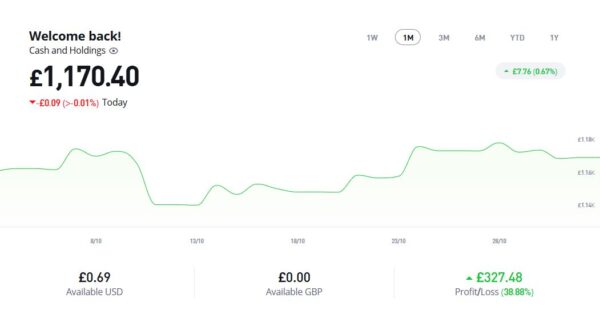
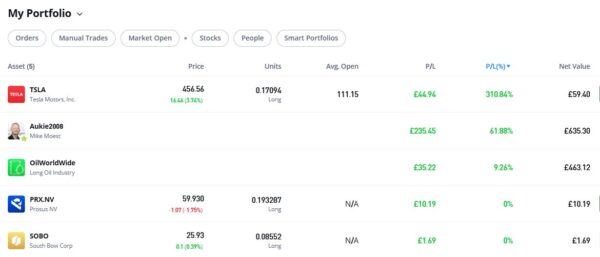
As you can see from the screen captures below, my original investment (total value £888.36 in pounds sterling) is today worth £1,170.40 an overall increase of £282.04 or 31.75%.
Note: eToro now displays the value of investments in your native currency, although you can change this if you wish.
As you can see, my Oil WorldWide investment is in profit, though at 9.26% it is nothing to write home about. My copy trading investment with Aukie2008 has been doing better, with an impressive overall profit of 61.88%. To be fair, I have held this investment a bit longer.
My Tesla shares, which I bought as an afterthought with some spare cash I had in my account, are up again this month. They are showing an overall profit of 310.84% since I bought them. If only I had put a bit more money into this!
You might also notice that I have small holdings in Prosus NV, a Dutch internet group, and South Bow, a Canadian energy infrastructure company. To be honest I don’t understand how I acquired these, but I assume they are some sort of bonus I was awarded. In any event, I am happy to have them in my portfolio.
eToro also offer the free eToro Money app. This allows you to deposit money to your eToro account without paying any currency conversion fees, saving you up to £5 for every £1,000 you deposit. You can also use the app to withdraw funds from your eToro account instantly to your bank account. I tried this myself and was impressed with how quickly and seamlessly it worked. You can read my blog post about eToro Money here. Note that it can also serve as a cryptocurrency wallet, allowing you to send and receive crypto from any other wallet address in the world.
If you would like more information about setting up an eToro account, please click on this no-obligation website link [affiliate]. Don’t forget that you also get a free $100,000 virtual portfolio, which you can use to experiment with trading and investing strategies. I have certainly earned a lot from mine.
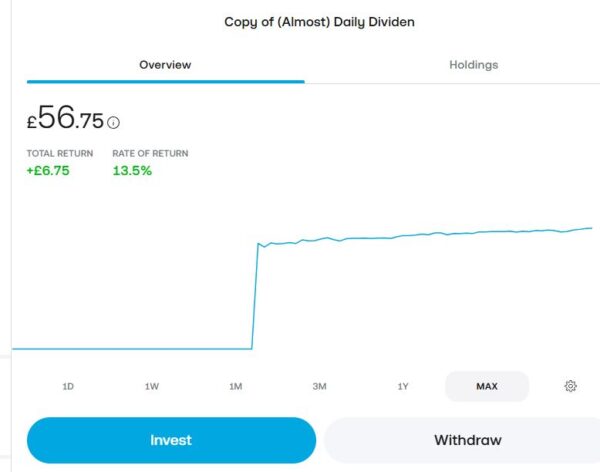
As an experiment, at the start of April this year I put £50 into an investment ISA with Trading 212. As mentioned in my recent blog post about dividend investing, I put it into the (Almost) Daily Dividends Portfolio, a ready-made portfolio or ‘pie’ on Trading 212. As you can see from the screen capture below, my portfolio is now worth £56.75, an increase of £6.75 or 13.5% over the seven-month period. It has even accrued a grand total of 59p in dividends!
I am quite impressed with how this investment has been faring, despite the small amount I put in (which means I may be missing out on some smaller dividends). If I increased my investment I would almost certainly become eligible for more dividends, and even more the longer I remain invested. If I had any spare money at the moment, I would consider doing this. Of course, I do now have an income-focused portfolio with Nutmeg as well (see above).
Moving on, I published various posts on Pounds and Sense in October. I have listed below those that are still relevant.
In Annuity or Drawdown? Weighing Up Your Pension Income Options After 50 I discussed an issue relevant to many PAS readers (and me personally). If – like most of us nowadays – you have a defined-contribution (aka money-purchase) pension, what is the best way to convert this into an income when the time comes? In this article I set out the pros and cons of the two main methods.
How to Save Money on Your Heating Bills This Winter covers a topic many of us are worried about right now. With energy bills soaring, what methods are available to us to save money on our heating and energy bills? Following these tips could save you hundreds of pounds in the months and years ahead.
In Winter Fuel Payment 2025/26 – What Pensioners Need to Know I explained how the rules regarding Winter Fuel Payment have changed this year. The good news is that WFP has been reinstated for most pensioners in 2025/26, but with one major caveat. Read the article for a full explanation of how things now stand and what – if anything – you need to do.
Finally, in How to Prepare for Winter Blackouts I revealed why power cuts are becoming increasingly probable in the UK and what steps you can take to prepare for them. While the prospect of winter blackouts may be daunting, thorough preparation should alleviate many of the challenges. By taking steps now, you can ensure the safety and comfort of your household, no matter what the winter months bring.
I’ll close with a reminder that you can also follow Pounds and Sense on Facebook or Twitter (or X as we have to call it now). Twitter/X is my number one social media platform and I post regularly there. I share the latest news and information on financial matters, and other things that interest, amuse or concern me. So if you aren’t following my PAS account on Twitter/X, you are definitely missing out!
I am also on the BlueSky social media network under the username poundsandsense.bsky.social. Twitter/X remains my primary social media platform, but I also post details of my latest blog posts, third-party articles and other financial news and resources on BlueSky for those who prefer to follow me there.
As always, if you have any comments or questions, feel free to leave them below. I am always delighted to hear from PAS readers
Disclaimer: I am not a qualified financial adviser and nothing in this blog post should be construed as personal financial advice. Everyone should do their own ‘due diligence’ before investing and seek professional advice if in any doubt how best to proceed. All investing carries a risk of loss.
Note also that posts on PAS may include affiliate links. If you click through and perform a qualifying transaction, I may receive a commission for introducing you. This will not affect the product or service you receive or the terms you are offered, but it does help support me in publishing PAS and paying my bills. Thank you!
If you enjoyed this post, please link to it on your own blog or social media:
If you’re looking for ways to ease the pressure of rising energy bills, here’s a scheme you might want to check out. The online price-comparison service Uswitch has launched a new offer giving households up to 25 hours of free electricity this November, via their app. Note that you must have a working smart meter to take part in this.
How the scheme works
Here’s a breakdown of the key steps:
Download the Uswitch app (available for Android and Apple phones) and connect your smart meter. It’s free to join.
Sign up for ‘Power Hours’ by the deadline (you must register by 31 October 2025 to take part in the November campaign).
Choose your free-hours slot: For each weekend in November you’ll select a time slot (either Saturday or Sunday), from 7 am–12 pm or 12 pm–5 pm.
Over the five weekends in November you’ll accumulate up to 25 hours of free electricity — i.e., 5 weekends × 5-hour slot = 25 hours.
After each slot, Uswitch will calculate your usage from your smart meter during that time and apply your ‘free electricity’ value based on your consumption.
Who can claim the free electricity?
The offer is open to anyone with an electricity smart meter in the UK, regardless of who your supplier is.
The key requirements: you must have your smart meter connected in the Uswitch app, and you must sign up by 31 October 2025.
Your supplier and tariff don’t matter — as long as you’re a UK domestic household, you can participate.
How much free electricity can you claim?
You can claim up to 25 hours of free electricity across the five weekends in November — that’s one 5-hour block each weekend.
During each chosen 5-hour slot, your actual electricity use will be measured. The equivalent cost of that usage is then calculated and becomes your ‘free electricity value.’
Importantly, this value isn’t just a notional saving — it’s credited directly to your account once Uswitch has confirmed and processed the data from your smart meter. You can then withdraw the money to your bank account.
The maximum payout is £25 per campaign, or up to £5 per weekend across the five weekends in November 2025.
In other words, the more electricity you use during your Power Hours (within the stated limits), the closer you’ll get to the full £25 benefit.
What does £25 equate to in electricity usage?
Under the current UK electricity unit rate (approx 26.35 pence per kWh for the period 1 October to 31 December 2025):
If electricity costs ~26.35p per kWh, then £1 would buy about 3.80 kWh (i.e., £1 ÷ £0.2635 = ~3.80 kWh)
Therefore, £25 would buy roughly £25 ÷ £0.2635 ≈ 95 kWh of electricity usage
Put another way: if you used 95 kWh during your designated free-hours slots, you’d roughly reach the £25 maximum value (assuming that usage is entirely within the scheme slots and eligible)
On a ‘per-weekend’ maximum of £5, that’s ~£5 ÷ £0.2635 ≈ 19 kWh each weekend.
So, as a rough guide, you’ll want to use around 19 kWh in each 5-hour weekend slot (or a total of ~95 kWh over the five weekends) to come close to extracting the maximum value from this offer. Of course, if you use significantly more or less in that slot, your credited amount might vary (up to the cap of £5/weekend or £25 total).
Why it matters
With energy costs still elevated and many households looking for ways to save, this offer from Uswitch is a timely boost. Even if the ‘free hours’ don’t cover your entire weekend usage, they can help absorb some of the higher-cost usage periods. Also, by signing up you may gain additional insights via the Uswitch app into your energy usage, which may be helpful for long-term savings.
Important things to bear in mind
Make sure your smart meter is already installed and that you have access to it (in-home display or via your supplier) so you can connect it to the app. Uswitch says the set-up takes less than two minutes, and I can confirm this was the case for me.
You must act before the deadline (31 October 2025) if you want to participate in November 2025. After that, you may miss out.
While 25 hours is a fixed maximum, your actual ‘free electricity value’ depends on how much you consume during your chosen slots. If you use very little, the credit will be smaller.
The maximum reward you can earn under this campaign is £25 in total (£5 per weekend).
This offer applies for November 2025 weekends only. It’s a limited-time seasonal offer tied to Uswitch’s ‘Power Hours’ programme. It may be repeated in future months, but that is not guaranteed.
Keep an eye on the terms and conditions for any exclusions or fine print (for example, whether only certain types of smart meters are eligible, deadlines for claiming, etc).
If you’re already in another scheme
If you’re already taking part in a scheme such as EDF Energy’s ‘Sunday Saver’, that does not stop you from joining the Uswitch Power Hours offer — you can take part in both.
However, when you sign up to Power Hours, you’ll also be automatically enrolled in Uswitch’s ‘Reduce and Earn’ sessions, which are part of the National Grid ESO Demand Flexibility Service (DFS) scheme. You can only be registered with one DFS scheme at a time. If you’re enrolled in multiple DFS schemes when a session takes place, there’s a risk you’ll be disqualified from earning money in both until you’ve opted out of all but one. If that happens, simply opt out of your other DFS scheme, and you should be able to rejoin the Reduce & Earn sessions the following day.
Final thoughts
If you’re looking to lighten the load on your energy bill this winter, this scheme is definitely worth considering. By choosing to run higher-usage appliances (washing machine, tumble dryer, hoovering, etc.) during a designated 5-hour block each weekend in November, you’ll get more bang from the offer. Signing up is free, the app is straightforward, and the benefit — a real cash credit of up to £25 you can withdraw to your bank account — is clear.
Plus: with the current unit rate of ~26.35 p/kWh, hitting that £25 maximum means using around 95 kWh across the five weekends, or around 19 kWh each weekend slot. That gives you a practical target to aim for if you’re going to maximize the benefit.
Overall, it seems to me that this scheme from Uswitch offers a range of benefits and no major drawbacks, so I have signed up. I will let Pounds and Sense readers know in due course (by updating this post and/or adding a new one) how it works out for me. If you decide to give it a try as well, don’t hang around, as the closing date to apply for the November scheme is Friday 31 October 2025.
Lastly, a quick reminder that if you switch to EDF Energy (my own energy supplier) via my link below you can get a free £50 credited to your energy account (and so will I). Terms and conditions apply. For more info, click on https://edfenergy.com/quote/refer-a-friend/sunny-koala-9462 [referral link].
As always, if you have any comments or questions about this post, please do leave them below.
If you enjoyed this post, please link to it on your own blog or social media:
As you doubtless know, one of the first acts of the new Labour government last year was to scrap the Winter Fuel Payment (WFP) for all but the very poorest pensioners (those eligible for pension credit).
Such was the outcry they had to backtrack and most pensioners will now receive WFP this winter – but with one major catch. Here’s everything you need to know…
1. What’s changed this year
The good news is that the Winter Fuel Payment has been reinstated for most pensioners. Here’s how it works…
If you were born on or before 21 September 1959 and meet the usual residence criteria, you are eligible for the payment.
For winter 2025/26 a household will normally receive £200 if the oldest person is under 80, or £300 if someone in the household is aged 80 or over.
Payment is automatic for most people — you don’t need to apply, unless perhaps you haven’t received it before.
2. The income threshold – what it means
Although the payment is available again for most, there is a taxable income threshold of £35,000 a year.
If your taxable income is £35,000 or less for the tax year 2025/26, you keep the full amount of the payment.
If your taxable income is over £35,000, you’ll still receive the payment initially, but it will be reclaimed via the tax system (either through your tax code if under PAYE, or via Self Assessment) or you may opt out of receiving the payment. Note that the deadline for opting out of the 2025/26 payment has now passed.
It’s important to note that the threshold applies to each individual, not to the household income. So in a couple living together, if one person’s taxable income is over £35,000 and the other’s is not, the higher earner’s share will be clawed back while the other may keep theirs.
3. What counts towards that £35,000 taxable income?
This is probably the trickiest part, so let’s break it down simply.
What does count (i.e. taxable income elements):
Your State Pension (because this is taxable income).
Interest on savings if it is taxable (e.g. outside an ISA) or dividends from investments (again depending on whether taxable).
Rental income or other taxable income streams.
What does not count:
Income from savings within an ISA (Individual Savings Account) is tax-free and does not count towards the £35,000 threshold.
Tax-free state benefits such as Pension Credit, Attendance Allowance or Personal Independence Payment.
The Winter Fuel Payment itself is tax-free and does not count as income for this threshold.
Capital gains (e.g. profits from sale of property or shares) are not included.
Premium Bond prizes
4. What to do next
Here are some practical pointers for you (or your friends/family):
Check your estimated taxable income for the year 2025/26. If you expect it to be under £35,000, you’re fine for this payment.
If your taxable income is likely to be over £35,000, you’ll still receive the payment (it’s too late now to opt out) but will be required to repay it via the tax system. In future years you might want to opt out of the payment, though many may still prefer to receive it and repay the money later.
If you have savings, consider whether holding them in tax-free vehicles (e.g. ISAs) can help reduce your taxable income, as interest received outside an ISA may count.
Make sure you are receiving any other benefits you may be entitled to (e.g. Pension Credit) — even though Winter Fuel Payment is partly means-tested now, those on very low income will often qualify for multiple sources of support.
Be alert to scams: you do not need to apply for this if you’re eligible, and the government will not ask you by text or email for bank details to “claim” this payment.
5. Quick recap
You are eligible if you reached State Pension age by the “qualifying week” (15–21 September 2025) and meet residence rules.
The payment is worth £200 (if all under 80 in the household) or £300 (if someone 80+) for winter 2025/26 in England & Wales.
Taxable income threshold: £35,000 per person. Under that → you keep it; over that → it will be clawed back.
Taxable income includes pensions, savings interest (outside ISAs), earnings, etc. Doesn’t include ISAs, Pension Credit, Attendance Allowance.
You don’t have to claim unless perhaps you haven’t received before; it’s automatic for most. Payments expected November/December 2025.
As always, if you have any comments or questions about this blog post, do leave them below. Please be aware that I am not a qualified financial adviser and under UK law cannot give personal financial advice.
If you enjoyed this post, please link to it on your own blog or social media:
For older people in particular, heating bills can be among their biggest expenses. And it’s especially important for older people to keep warm, as getting chilled can lower your body’s resistance to infection and – in the worst cases – lead to hypothermia.
In addition, as you doubtless know, gas and electricity bills have gone up considerably in the last year or two. Growing numbers of older people are literally finding themselves in a position where they have to choose between heating and eating 😮
So today I thought I’d set out some ways you may be able to save money on your heating and energy bills. Following these tips could save you hundreds of pounds in the months and years ahead.
Switch Energy Supplier
It’s important to check regularly whether you could save money by switching to a different supplier and/or tariff. The quick and easy way of doing this is via a price comparison website. There are a number of these available, including GoCompare and USwitch.
Just visit the comparison site and enter a few details, including your current supplier and tariff and how much you spend on gas and electricity in the course of a year (it doesn’t have to be exact). The site will then display the best deals currently open to you and how much you might be able to save by switching to them. In most cases you can also start the switching process by clicking on the relevant link. Before you do, though, it’s worth checking on cashback sites like Quidco and Top Cashback, as some energy companies pay cashback via these sites to people switching their supply to them.
If you are one of the 1.1 million households who use oil for heating, you can save money by shopping around for suppliers too. Check out the oil price comparison service BoilerJuice. Type in your postcode and how many litres of heating oil you’re looking to buy, and BoilerJuice will show you quotes from suppliers covering your area.
Switching energy suppliers is generally quick and easy, and can save you hundreds of pounds a year at a stroke. In these challenging times, it should be high on your list of potential money-saving strategies this winter.
Special Offer! If you switch to EDF Energy via my link, you can get a FREE £50 credited to your energy account. Terms and conditions apply. For more info, click on https://edfenergy.com/quote/refer-a-friend/sunny-koala-9462 [referral link].
Get Financial Help
If you’re in certain priority groups, you may be able to get cash payments to help offset your energy bills.
Winter Fuel Payment is a one-off annual payment of £100 to £300 which was previously made to everyone over state pension age. Last year the new Labour government took the decision to cancel WFP for all but the very poorest pensioners (those in receipt of pension credit). Such was the outcry that they had to back-track, so now everyone over state pension age will receive the payment this winter. The only catch is that if you earn more than £35,000 a year, you will be required to pay it back. See this article for more information.
In addition, those on certain welfare benefits (including Pension Credit, Income Support and Universal Credit) may be eligible for Cold Weather Payments. This is £25 for any period of seven consecutive days when temperatures fall below zero. More information can be found on this page of the government website.
You may also be eligible for £150 off your energy bill under the Warm Home Discount Scheme. This is run by some (not all) of the energy companies. If you get the Guaranteed Credit element of Pension Credit you will qualify automatically. But if you’re on a low income and meet the energy supplier’s other criteria, you may also qualify. Contact your supplier directly for more information. The large energy companies such as EDF and British Gas all operate this scheme, but some of the smaller ones don’t. The Warm Home DIscount scheme for 2025/26 opens at the end of October 2025. More information can be found on the official website.
Finally, if you’re on a very low income, you may qualify for help from the Household Support Fund: This is money provided to councils by the government to assist pensioners and others on very low incomes. You will need to contact your local council to find out if you’re eligible.
More Top Tips
Here are some more ways you may be able to save money on your heating and energy bills.
Have your boiler serviced regularly, to ensure it is operating at peak efficiency.
If you have an old boiler that keeps breaking down, the time may have come to replace it. The Energy Saving Trust say that you could save up to up to 40 percent on your gas bill by installing a new ‘A’ rated condensing boiler with a programmer, room thermostat and thermostatic radiator controls.
Upgrading your insulation can also cut bills by reducing the amount of heat going to waste. Depending on your circumstances, you may be able to get a free boiler and/or insulation under the government’s Energy Company Obligation (ECO) scheme. You can apply for this via your energy company. Even if you’re not on a low income, you may be able to get a discount on home insulation, so it’s worth checking to see what’s available.
If your radiators aren’t heating up properly at the top, you may need to bleed them to release air in the pipes. Depending on the radiator, you may need a special key to do this or a flat-bladed screwdriver.
Turn down your thermostat by one degree - this can reduce your heating bill by up to 10%.
Ensure you don’t put furniture right in front of radiators, as this can block heat from entering the room.
Replace old light-bulbs with new energy-saving bulbs. The latest LED bulbs are just as bright as old incandescent bulbs and use a tenth of the energy. They last longer too.
Exclude draughts with heavy curtains and draught excluders by doors.
Turn off heaters in rooms you aren’t using and close the doors to keep heat in.
Place reflective foil behind radiators on exterior walls to bounce heat back into the room.
It can also help to clean behind radiators (using a brush such as this one) to remove dust and dirt.
Don’t leave electrical appliances on standby.
Wash clothes at 30 degrees and try to avoid using tumble driers. Hang washing outside whenever possible or place it over an airer.
Consider investing in a smart thermostat system such as Nest or Hive. This will give you precise, automated control over your heating system, allowing you to use just as much energy as you need and no more. See my blog post about smart thermostats for more information.
If your funds are limited and you have or develop a disability you may be able to get a Disabled Facilities Grant (DFG) from your local authority to pay for adaptations such as stairlifts.
By taking these steps you should be able to cut your heating and energy bills significantly this winter.
If you have any comments or questions about this post, as always, please do leave them below.
This is a fully updated version of my original post on this subject.
If you enjoyed this post, please link to it on your own blog or social media:
We are currently heading into the peak season for flu and other respiratory viruses (including Covid). These infections can be a nuisance at least. And – in the case of older people especially – they can sometimes be life-threatening.
While a balanced diet, regular exercise and adequate sleep remain the cornerstones of good health, certain supplements can provide an extra layer of protection. Here’s a guide to the best supplements to support your immune system during the colder months.
1. Vitamin D
Why it’s essential: With limited sunlight during UK winters, many people experience a drop in their vitamin D levels. This nutrient plays a crucial role in immune function and helps reduce the risk of respiratory infections.
How to take it: Public Health England recommends everyone consider a daily supplement of 10 micrograms (400 IU) of vitamin D during the autumn and winter months. Higher doses may be necessary for those with deficiencies, but consult a healthcare professional first.
2. Vitamin C
Why it’s essential: Vitamin C is known for its immune-boosting properties and its ability to reduce the duration and severity of colds. It’s also a powerful antioxidant that helps protect cells from damage.
How to take it: A daily dose of 500–1,000 mg is generally safe for most people. You can also pair supplementation with dietary sources like oranges, kiwi fruit and bell peppers.
3. Zinc
Why it’s essential: Zinc is vital for immune cell function and has been shown to shorten the duration of cold symptoms when taken early. It also helps your body fight off viruses more effectively.
How to take it: Lozenges containing 10–15 mg of zinc can be taken at the onset of a cold. Long-term supplementation should not exceed 25 mg daily unless advised by a healthcare professional.
4. Probiotics
Why it’s essential: A healthy gut microbiome supports immune function, and probiotics help maintain this balance. Some strains, like Lactobacillus and Bifidobacterium, are particularly effective in reducing the risk of upper respiratory tract infections.
How to take it: Look for a high-quality probiotic supplement with at least 1 billion CFUs (colony-forming units). Yogurt and fermented foods like kimchi and sauerkraut can also be excellent natural sources.
5. Elderberry Extract
Why it’s essential: Elderberries have been traditionally used to fight colds and flu. They are rich in antioxidants and may reduce the severity and duration of symptoms.
How to take it: Elderberry syrup or capsules are common forms. Follow the recommended dosage on the product label, and avoid taking it if you have an autoimmune condition without consulting a doctor.
6. Echinacea
Why it’s essential: Echinacea is a popular herbal remedy that may help prevent and reduce the severity of colds by boosting immune activity.
How to take it: Look for standardised extracts and follow the manufacturer’s dosage guidelines. Echinacea is best taken at the first sign of illness.
7. Omega-3 Fatty Acids
Why it’s essential: Omega-3s, particularly EPA and DHA found in fish oil, have anti-inflammatory properties that support immune function and overall health.
How to take it: Aim for 250–500 mg of combined EPA and DHA daily. Vegetarian or vegan options include algae-based supplements.
8. Garlic Supplements
Why it’s essential: Garlic contains allicin, a compound with antimicrobial and immune-boosting properties. Regular garlic intake has been associated with fewer colds and flu.
How to take it: Opt for aged garlic extract supplements or incorporate fresh garlic into your diet for the best benefits.
Final Tips
Consult a GP or pharmacist: Always check with a healthcare professional before starting new supplements, especially if you’re pregnant, nursing or on medication.
Choose quality brands: Look for products that are third-party tested for purity and potency. A wide range of supplements and vitamins is available from Amazon.
Maintain healthy habits: Supplements work best when combined with a balanced diet, regular exercise, good hygiene and adequate sleep.
By supporting your immune system with the right supplements, you can give yourself a better chance of staying healthy this cold and flu season.
This is a revised update of an annual post.
If you enjoyed this post, please link to it on your own blog or social media:
I’ll begin as usual with my Nutmeg Stocks and Shares ISA. This is the largest investment I hold other than my Bestinvest SIPP (personal pension).
As regular readers will know, in June I transferred most of the money in my Nutmeg Fully Managed portfolio (just under £25,000) to a new Nutmeg Income Portfolio. I discussed this in detail in this recent post, but basically money in this port is invested to generate an income from share dividends and other sources. This is then paid monthly. Capital appreciation is targeted as well, but these portfolios are aimed primarily at older people (and others) who want/need their investment to generate a regular cash income.
In September my Nutmeg income portfolio generated £78.72 of income, which was duly paid in to my bank account on 24 September 2025. That is down a bit on the £134.03 I received in August, but it means I have now received a total (tax-free) income of £212.75 to date. That is in line with Nutmeg’s projected annual return of just under 5% for income ports at my chosen risk level (five). Obviously it is too early to draw any significant conclusions from this, though.
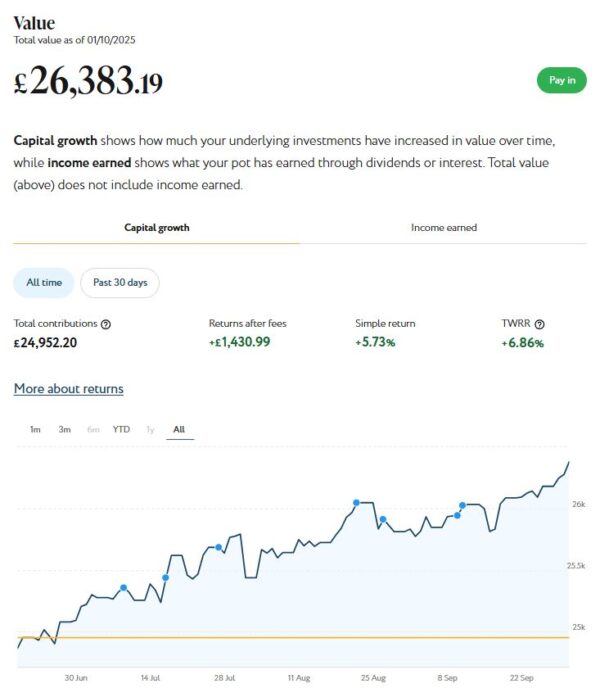
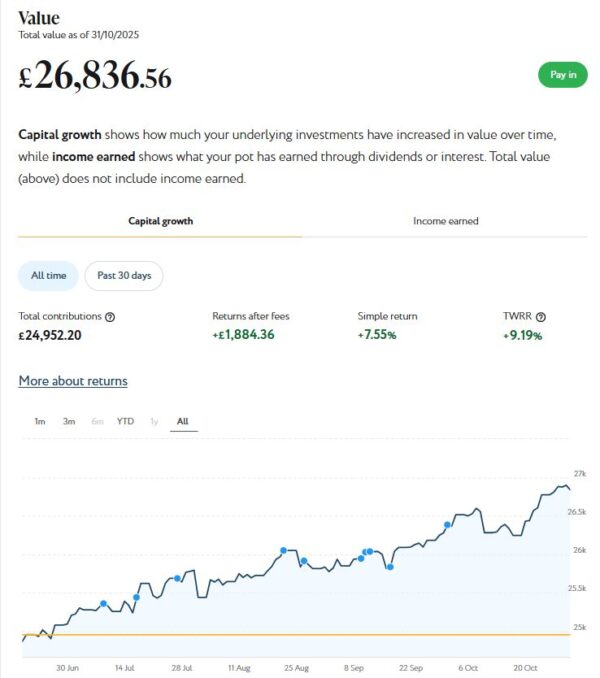
My income portfolio also grew in value in September. It’s now worth £26,383 compared with £25,815 at the start of last month, a rise of £568. As the screen capture shows, the port has actually increased by £1,430.99 (5.73%) since I opened it in June. That’s good going, though I don’t suppose it will carry on like this indefinitely!
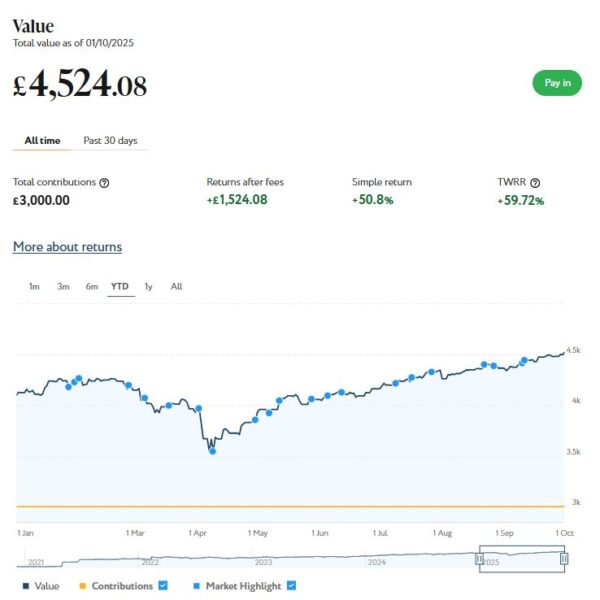
I still have a smaller, growth-oriented pot using Nutmeg’s Smart Alpha option. This is now worth £4,524 compared with £4,368 a month ago, a rise of £156. Here is a screen capture showing performance for the year to date.
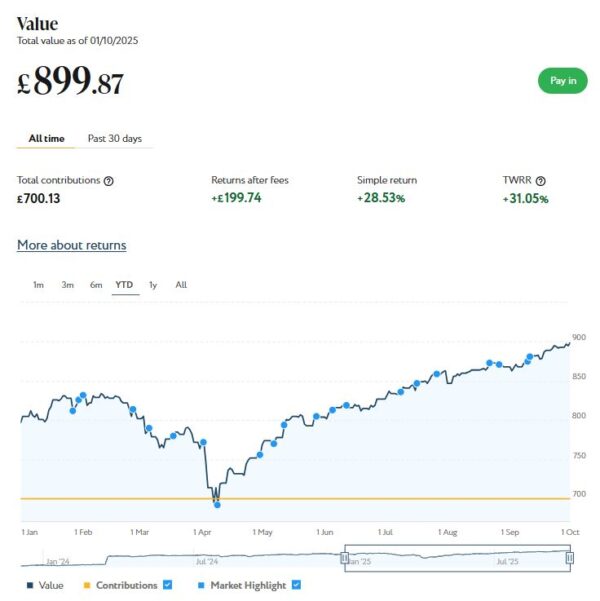
And at the start of December 2023 I invested £500 in one of Nutmeg’s thematic portfolios (Resource Transformation). In March 2024 I also invested a further £200 from referral bonuses (something I no longer receive for reasons I won’t bore you with). As you can see from the YTD screen capture below, this portfolio is now worth £900 (rounded up) compared with £868 last month, a rise of £32.
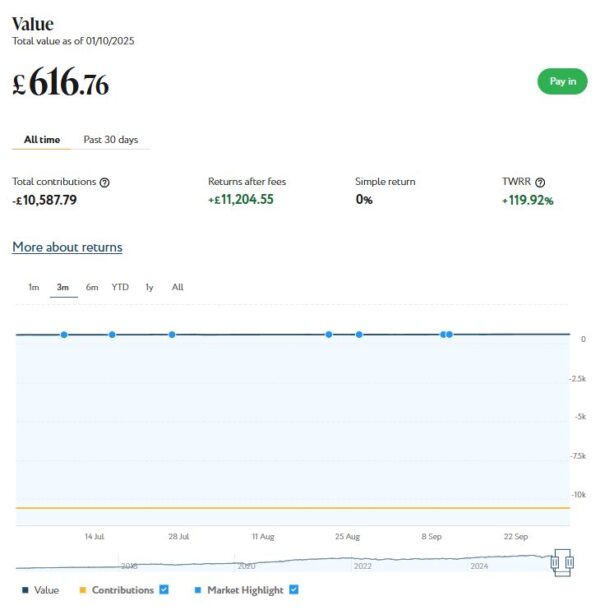
Finally, I still have a small amount left in my original Nutmeg Fully Managed portfolio. I have kept this largely for comparison purposes. This has increased in value from £595 at the start of September to £617 (rounded up) now, a rise of £22.
As you can see, September was a pretty good month for my Nutmeg investments. Overall I was up by £778 or 2.46%. In addition I did, of course, receive £78.72 in income from my income portfolio.
Excluding income generated, the overall value of my Nutmeg investments is up by £1,996 since the start of 2025, so the April 2025 fall (caused largely by Trump’s tariffs) has now fully reversed. I am also up by £3,069 or 10.45% since the start of October last year, again excluding cash income received. All things considered, that’s not a bad result.
As I always have to say, some volatility is to be expected with stock market investments, but over the longer term they tend to even themselves out (and generally perform better than bank savings accounts, although that is never guaranteed). In general the worst thing you can do is panic and sell up when downturns occur (as happened in April this year). You are then crystallizing your losses rather than giving the markets time to recover. This is something I had cause to discuss in this blog post from earlier this year.
You can read my full Nutmeg review here. If you are looking for a home for your annual ISA allowance, based on my overall experience over the last nine years, they are certainly worth considering. They offer self-invested personal pensions (SIPPs), Lifetime ISAs and Junior ISAs as well.
Moving on, I also have investments with P2P property investment platform Assetz Exchange. As discussed in this post, the company has rebranded as Housemartin.
My investments with Housemartin continue to generate steady returns. Housemartin focuses on lower-risk properties (e.g. sheltered housing). I put an initial £100 into this in mid-February 2021 and another £400 in April. In June 2021 I added another £500, bringing my total investment up to £1,000.
Since I opened my account, my HM portfolio has generated a respectable £273.80 in revenue from rental income. I have made a small net loss of £19.02 on property disposals. Capital growth generally has slowed, in line with UK property values generally.
At the time of writing, 16 of ‘my’ properties are showing gains, 7 are breaking even, and the remaining 17 are showing losses. My portfolio of 40 properties is currently showing a net decrease in value of £43.52. That means that overall (rental income minus capital value decrease and loss on disposal) I am up by £211.26. That’s still a respectable return on my £1,000 and does illustrate the value of P2P property investments for diversifying your portfolio. And it doesn’t hurt that with Housemartin most projects are socially beneficial as well.
The net fall in capital value of my Housemartin investments is obviously a little disappointing. But it’s important to remember that until/unless I choose to sell the investments in question, it is largely theoretical, based on the latest price at which shares in the property concerned have changed hands. The rental income, on the other hand, is real money (which in my case I’ve reinvested in other HM projects to further diversify my portfolio).
To control risk with all my property crowdfunding investments nowadays, I invest relatively modest amounts in individual projects. This is a particular attraction of Housemartin as far as i am concerned. You can actually invest from as little as £1 per property if you really want to proceed cautiously.
As I noted in this blog post, Housemartin is particularly good if you want to compound your returns by reinvesting rental income. This effectively boosts the interest rate you are receiving. Personally, once I have accrued a minimum of £10 in rental payments, I usually reinvest this money in either a new HM project or one I have already invested in (thus increasing my holding). Over time, even if I don’t invest any more capital, this will ensure my investment with Housemartin grows at an accelerating rate and becomes more diversified as well.
In 2022 I set up an account with investment and trading platform eToro, using their popular ‘copy trader’ facility. I chose to invest $500 (then about £412) copying an experienced eToro trader called Aukie2008 (real name Mike Moest).
In January 2023 I added to this with another $500 investment in one of their thematic portfolios, Oil Worldwide. I also invested a small amount I had left over in Tesla shares.
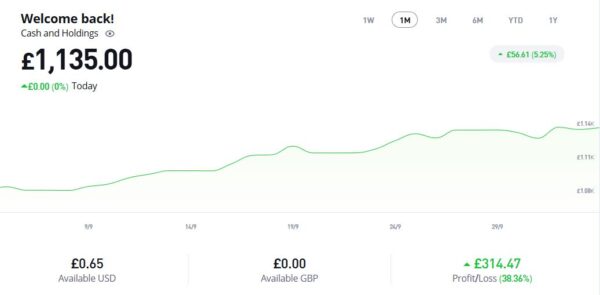
As you can see from the screen captures below, my original investment (total value £888.36 in pounds sterling) is today worth £1,135.00 an overall increase of £246.64 or 27.76%.
Note: eToro now displays the value of investments in your native currency, although you can change this if you wish.
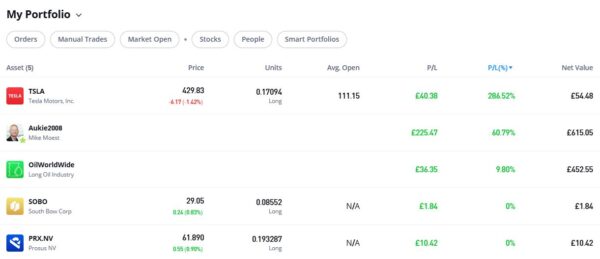
As you can see, my Oil WorldWide investment is in profit, though at 9.80% it is nothing too exciting. My copy trading investment with Aukie2008 has been doing better, with an overall 60.79% profit. To be fair, I have held this investment a bit longer.
My Tesla shares, which I bought as an afterthought with some spare cash I had in my account, are up again this month. They are showing an impressive overall profit of 286.52% since I bought them. If only I had put a bit more money into this!
You might also notice that I have small holdings in Prosus NV, a Dutch internet group, and South Bow, a Canadian energy infrastructure company. To be honest I don’t understand how I acquired these, but I assume they are some sort of bonus I was awarded. In any event, I am happy to have them in my portfolio.
eToro also offer the free eToro Money app. This allows you to deposit money to your eToro account without paying any currency conversion fees, saving you up to £5 for every £1,000 you deposit. You can also use the app to withdraw funds from your eToro account instantly to your bank account. I tried this myself and was impressed with how quickly and seamlessly it worked. You can read my blog post about eToro Money here. Note that it can also serve as a cryptocurrency wallet, allowing you to send and receive crypto from any other wallet address in the world.
If you would like more information about setting up an eToro account, please click on this no-obligation website link [affiliate]. Don’t forget that you also get a free $100,000 virtual portfolio, which you can use to experiment with trading and investing strategies. I have certainly earned a lot from mine.
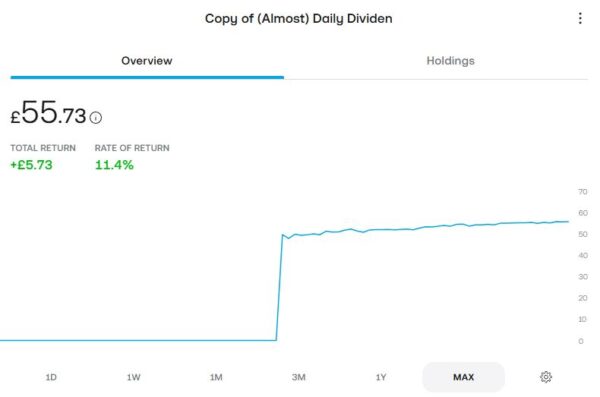
As an experiment, at the start of April this year I put £50 into an investment ISA with Trading 212. As mentioned in my recent blog post about dividend investing, I put it into the (Almost) Daily Dividends Portfolio, a ready-made portfolio or ‘pie’ on Trading 212. As you can see from the screen capture below, my portfolio is now worth £55.73, an increase of £5.73 or 11.4% over the six-month period. It has even accrued a grand total of 50p in dividends!
I am quite impressed with how this investment has been faring, despite the small amount I put in (which means I may be missing out on some smaller dividends). If I increased my investment I would almost certainly become eligible for more dividends, and even more the longer I remain invested. If I had any spare money at the moment, I would consider doing this. Of course, I do now have an income-focused portfolio with Nutmeg as well (see above).
Moving on, I published various posts on Pounds and Sense in September. I have listed below those that are still relevant.
In Get a Free Share Worth Up To £100 With Trading 212, I revealed that this popular offer had reopened. If you have never held an account with Trading 212, you can get a free share worth up to £100 just by signing up with them. You do have to open a Stocks ISA or (non-ISA) Invest account – a Cash ISA won’t qualify you for the free share. This offer is still open but it closes on Monday 6 October 2025 – so if you want to take advantage, you need to get your skates on now.
In Get Your Will Written Free of Charge in October, I pointed out that October is Free Wills Month. This event brings together a group of well-respected charities to offer members of the public aged 55 and over the opportunity to have their wills written or updated free of charge using participating solicitors across the UK. Free Wills Month is now up and running, so see my blog post to find out how you can benefit.
And in Amazon Prime Big Deals Day Is Almost Here I spotlighted the fact that this annual promotional event begins on Tuesday 7 October 2025. This is a special event for Amazon Prime members only. Amazon say they will be offering members their lowest prices of the year on selected products across a wide range of categories, from consumer electronics to groceries. Personally I shall be looking for a new electric shaver this time 🙂
Finally, How Often Should You Really Be Washing Your Bedding? is a syndicated guest post by professional microbiologist Primrose Freestone. Dr Freestone looks at everything from sheets and pillowcases to blankets and duvet covers and even mattresses. Personally I found her expert advice quite eye-opening. I definitely need to do better in future!
I’ll close with a reminder that you can also follow Pounds and Sense on Facebook or Twitter (or X as we have to call it now). Twitter/X is my number one social media platform and I post regularly there. I share the latest news and information on financial matters, and other things that interest, amuse or concern me. So if you aren’t following my PAS account on Twitter/X, you are definitely missing out!
I am also on the BlueSky social media network under the username poundsandsense.bsky.social. Twitter/X remains my primary social media platform, but I also post details of my latest blog posts, third-party articles and other financial news and resources on BlueSky for those who prefer to follow me there.
As always, if you have any comments or questions, feel free to leave them below. I am always delighted to hear from PAS readers
Disclaimer: I am not a qualified financial adviser and nothing in this blog post should be construed as personal financial advice. Everyone should do their own ‘due diligence’ before investing and seek professional advice if in any doubt how best to proceed. All investing carries a risk of loss.
Note also that posts on PAS may include affiliate links. If you click through and perform a qualifying transaction, I may receive a commission for introducing you. This will not affect the product or service you receive or the terms you are offered, but it does help support me in publishing PAS and paying my bills. Thank you!
If you enjoyed this post, please link to it on your own blog or social media:
In case you’ve not heard, Amazon Prime Big Deals Day is almost with us. It extends over two days, Tuesday 7th and Wednesday 8th October 2025.
This is a special event for Amazon Prime members only. Amazon say they will be offering members their lowest prices of the year on selected products across a wide range of categories, from consumer electronics to groceries.
Some of the best deals will be reserved for Amazon’s own products, such as their Kindle e-book readers, Amazon Echo smart speakers and Ring video doorbells and security cameras. Discounts of up to 60% will be on offer for these products. If you’re thinking of buying any of them, Amazon Prime Big Deals Day is definitely the day – or two days – to do it.
There are also some great ‘early deals’ available now. For example, at the time of writing you can buy an Oral-B iO2 electric toothbrush for just £41.99, a 58% discount on the normal price of £100.
I have been a member of Amazon Prime for over ten years now. As a regular Amazon shopper, I find it well worth while for the free one-day delivery on millions of items alone. But as a Prime member you get access to a host of other benefits and services as well, including Amazon Prime Music and Amazon Prime Video.
If you’re thinking of joining Amazon Prime, therefore, I highly recommend doing it in the next few days, so you can benefit from the Prime Big Deals Day offers. Personally I think it’s worth it for the free delivery alone, let alone everything else that’s on offer. But if you wish, you can get a 30-day free trial now, take advantage of the Prime Big Deals Day offers, and then cancel without owing any money. It’s your choice!
You can also see all the latest Prime Big Deals Day offers by clicking here.
As always, if you have any comments about Amazon Prime or Prime Big Deals Day, please do post them below.
Disclosure: This post includes affiliate links. If you click through and make a purchase, I may receive a commission for introducing you. This will not affect the price you pay or the products or services you receive.
If you enjoyed this post, please link to it on your own blog or social media:





 I published various posts on