
Money-Saving Perks and Discounts for Retired People

Money-Saving Perks and Discounts for Retired People in the UK

Retirement can be a wonderful stage of life, bringing more freedom and time to enjoy yourself. But for many people, it can also mean adjusting to a lower income and watching the pennies more carefully than before.

The good news is that there are plenty of money-saving perks and discounts available specifically for retired and older people in the UK. Some are well known, while others fly under the radar. Either way, taking advantage of them can make a real difference to your finances over the course of a year.

Here are some of the best perks and discounts worth knowing about.

Free Bus Passes

One of the best-known benefits for older people is the free bus pass.

In England, you can currently apply for an older person’s bus pass when you reach State Pension age. In Scotland, Wales and Northern Ireland the rules differ slightly, and eligibility may begin earlier.

A bus pass allows free off-peak travel on local buses and can save regular users hundreds of pounds a year. Even if you only use it occasionally, it can still be very handy for shopping trips, appointments or days out.

You can apply via your local council or transport authority website. You can find out more on this government website.

  • If you’re 60 or over and live in London, you can get free travel on buses, trains and other modes of transport in and around London with a 60+ London Oyster photocard.

Senior Railcards

If you travel by train even a few times a year, a Senior Railcard can easily pay for itself.

Available to people aged 60 and over, the card gives one-third off most rail fares across Britain. The annual fee is modest (£35 a year or £80 for three years), and discounts apply to both standard and first-class tickets. You can opt for either a physical card or a digital one to keep on your phone. Unfortunately you can’t have both.

You can buy a Senior Railcard at any staffed station, by phone, or via this website.

Discounts at Restaurants and Cafés

Some restaurant chains, cafés and garden centres offer senior discounts, although they are not always widely advertised.

Examples can include:

  • Reduced-price meals on certain days
  • Smaller “senior portions”
  • Discounted tea-and-cake deals
  • Special offers linked to pensioner clubs or loyalty cards

Independent cafés and local businesses may also offer discounts for older customers, so it never hurts to ask politely.

Cinema Discounts

Cinema trips can become much cheaper once you reach retirement age.

Major cinema chains including Odeon, Vue and Cineworld often offer reduced-price tickets for seniors, especially for daytime screenings. Some cinemas also run dedicated “silver screen” events that include tea, coffee or biscuits in the ticket price.

These can provide both affordable entertainment and a good social outing.

Savings on Prescriptions and Healthcare

In England, prescriptions become free once you reach the age of 60. Prescriptions are already free for everyone in Scotland, Wales and Northern Ireland.

You may also qualify for:

  • Free NHS eye tests
  • Help with dental costs
  • Discounts on glasses and hearing aids

Many opticians additionally offer special deals for pensioners. The Age UK website has more information about this

Council Tax Discounts

This is an area many people overlook.

While there is no general “pensioner discount” for council tax, some retired people may qualify for reductions depending on their circumstances.

Examples include:

  • Single person discount (25%)
  • Council Tax Reduction schemes for people on low incomes
  • Discounts linked to disability adaptations in the home

Rules vary between councils, so it is worth checking your local authority’s website.

Discounts on Leisure Activities

Retired people can often save money on:

  • Gym memberships
  • Swimming sessions
  • Golf clubs
  • Museums and heritage attractions
  • Theatre tickets

For example, Better Leisure Centres offer reduced-price Better Health Senior membership for people aged 66 and over. Members enjoy access to swimming pools and fitness classes, and can also take part in dedicated activities for senior members, from walking football to aqua aerobics. More info can be found here.

Many local councils run discounted leisure schemes for older residents, particularly during off-peak hours.

If you enjoy keeping active in retirement, these savings can add up quickly.

National Trust and English Heritage Memberships

If you enjoy visiting historic houses, gardens and beauty spots, memberships in these organizations can represent excellent value.

Both offer senior membership options, and members receive free entry to hundreds of attractions around the country. Note that in the case of the National Trust you will need to have been a member for at least three years before applying and will have to phone them on 0344 800 1895 and ask (there is no online application form). You will then get 25% off standard membership. With English Heritage the discount is available immediately and worth around 15% for individuals and 22% for joint members.

For keen visitors to historic attractions and gardens, the savings can easily outweigh the annual membership fee.

Retail Discounts for Older Shoppers

Some retailers offer occasional “senior discount days” or loyalty perks for older customers.

These are less common than they once were, but discounts can still sometimes be found at:

  • Department stores
  • Hairdressers
  • Garden centres
  • Charity shops
  • Independent retailers

For example, frozen food specialists Iceland offer senior citizens 10% off on Tuesdays. To be eligible you must be 60 or over. There is no minimum purchase. You just have to show proof of age – e.g. a bus pass – at the till.

Another example is the Boots Over 60s Rewards Scheme. If you’re over 60 and have a Boots Advantage Card, you can get a range of extra benefits, including 8 points for every pound you spend on Boots’ own brands and selected others (normally card-holders only get 4 points per pound spent). You can also get 300 Advantage Card points when you take a free Boots Hearing Health Check. Each Advantage Card point is worth 1p, so 1000 points would be worth £10. You can spend your points online or in store. For more info and to apply, visit Boots’ Over 60s web page.

At other stores, again, it is often worth asking discreetly whether any discounts are available.

Travel Insurance Savings

Travel insurance can become more expensive as we get older, but prices vary enormously between providers.

Shopping around is essential. Specialist insurers aimed at older travellers (e.g. SAGA Travel Insurance and AllClear Travel) can sometimes offer much better value than mainstream companies.

Annual multi-trip policies may also work out cheaper if you take several holidays a year.

Don’t Be Afraid to Ask

One important point is that many discounts for older people are not heavily promoted. Businesses may offer them quietly or only at certain times.

There is absolutely no harm in politely asking:

“Do you offer a senior discount?”

The worst they can say is no — and you may be pleasantly surprised.

Final Thoughts

Retirement does not have to mean giving up the things you enjoy. By making the most of the discounts and perks available to older people, you can stretch your income further while still maintaining a good quality of life.

Even small savings can add up over time. A discounted rail ticket here, a cheaper cinema trip there, and reduced council tax or free prescriptions can collectively save hundreds of pounds a year.

And of course, every pound saved is a pound that can be spent on something you truly value!



If you enjoyed this post, please link to it on your own blog or social media:
Prolific Academic - Ideal Side Hustle for Seniors

Here’s Why Prolific Academic Could Be the Ideal Side Hustle for Seniors

If you’re retired or semi-retired and looking for a flexible way to earn a little extra money from home, Prolific Academic could be the answer you are seeking.

I first wrote about Prolific a while ago in my article Make Money Helping University Researchers with Prolific Academic, and I still believe it’s one of the best side hustles around – especially for older people.

No, you’re not going to make a fortune from it. But you can earn a useful extra income in your spare time, while helping genuine academic researchers and keeping your brain active into the bargain.

What Is Prolific Academic?

Prolific Academic is an online platform that connects researchers – mainly from universities and other academic institutions – with members of the public willing to take part in research studies.

Most studies involve answering questionnaires or surveys, though some include simple games, memory tests, opinion polls, or short interactive tasks. Researchers are generally looking for honest responses from people of all ages and backgrounds, and seniors are often especially valued because they are under-represented in many studies.

Unlike some survey sites, Prolific has built a strong reputation for treating participants fairly. Studies are normally well designed, interesting and clearly explained. You can also see in advance how long each study should take and how much you’ll be paid (see below).

Flexible and Easy to Fit Around Your Life

One of the biggest advantages of Prolific for seniors is the flexibility.

There are no fixed hours, targets or commitments. You simply log in when you want to and choose from whatever studies are available. If you’re busy with holidays, family commitments, gardening, golf, volunteering, or anything else, you can ignore it for days or weeks without any problem.

Equally, if you have a quiet afternoon and fancy earning a few pounds, you can complete several studies in one sitting.

That makes Prolific ideal for retirees who want a side hustle that fits around their lifestyle rather than the other way round.

The Studies Are Often Genuinely Interesting

This is another reason I particularly like Prolific.

Many studies are linked to real academic research in subjects such as psychology, health, behaviour, finance, education, politics, memory, and technology. Some are thought-provoking and even fun.

You may be asked your opinion on current issues, to test a new app or website, or to take part in experiments exploring how people make decisions. I’ve personally found many studies surprisingly engaging.

Of course, there are occasional dull ones too – but because you can pick and choose, you’re free to skip anything that doesn’t appeal.

A Useful Extra Income Stream

Let’s keep expectations realistic: Prolific isn’t a replacement for a salary or pension.

But it can provide a worthwhile supplementary income. Rates typically work out between £8 and £12 per hour, with bonuses sometimes awarded as well. Many users earn enough to cover treats, hobbies, meals out, subscription services, or part of a holiday budget.

Payments are made without any deductions via the online payment platform PayPal. You can request a payout any time your earnings reach £6 or more. Payments are reliable and prompt, which is another reason the platform has developed such a loyal following. And because you decide how much time to devote to it, you remain completely in control.

Good for Keeping Your Brain Active

One thing many retirees discover is that mental stimulation matters just as much as physical activity.

The variety of tasks on Prolific can help keep your brain engaged and alert. Memory exercises, problem-solving tasks, reading comprehension studies, and opinion-based questionnaires all encourage active thinking.

I’m certainly not claiming Prolific is some sort of miracle anti-ageing treatment! But regularly engaging with new ideas and challenges can only be a positive thing.

The Tax Advantage for Small Earners

Another point worth mentioning is the UK government’s £1,000 Trading Allowance.

Under current HMRC rules, if your total income from casual self-employed or side-hustle activities is under £1,000 a year, you generally do not need to declare it or pay tax on it.

That means many casual Prolific users may fall comfortably within this limit.

Obviously everyone’s tax situation is different, and tax rules can change – so if you expect to earn more than this or are unsure about your position, it’s sensible to check the latest HMRC guidance or seek professional advice.

How to Sign Up

If you like the idea of earning a sideline income as a Prolific Academic member, all you need do is visit the Prolific website and click on the Get Paid to Participate box (don’t click the box to sign up as a researcher, obviously!).

An application form will then open requesting various items of information from you, most importantly the PayPal email address via which you want to be paid 💰

Final Thoughts

There are countless so-called “side hustles” being promoted online these days. Many are unrealistic, risky or simply exhausting.

Prolific is refreshingly different.

It’s flexible, straightforward, low-pressure and genuinely interesting. You can do as much or as little as you like, earn a bit of extra money, help academic research and keep mentally active at the same time.

For many seniors, that combination makes it close to the ideal side hustle.

  • Have you tried Prolific Academic yourself and would you recommend it? Or do you have another favourite side hassle you would like to share? I’d love to hear your thoughts. Please comment below as usual 🙂


If you enjoyed this post, please link to it on your own blog or social media:
My Investments Update May 2026

My Investments Update – May 2026

Here is my latest monthly update about my investments. You can read my April 2026 Investments Update here if you like.

I’ll begin as usual with my JP Morgan Personal Investing (previously NutmegStocks and Shares ISA. This is the largest investment I hold other than my Bestinvest SIPP (personal pension).

As regular readers will know, in June last year I transferred most of the money in my former Nutmeg Fully Managed portfolio (just under £25,000) to a new Nutmeg Income Portfolio. I discussed this in detail in this post, but basically money in this port is invested to generate an income from share dividends and other sources. This is then paid monthly. Capital appreciation is targeted as well, but these portfolios are aimed primarily at older people (and others) who want/need their investment to generate a regular cash income.

In April my JPM Investing income portfolio generated £66.11 of income, which was duly paid into my bank account on 24 April 2026. That means I have now received tax-free income of £339.79 in 2026 and a total of £811.25 since I opened the account in June last year. That’s a return on capital of just over 3% to date. That is – to be honest – a bit less than I would have hoped based on JPM’s original projected annual return of just under 5% for income ports at my chosen risk level (five).

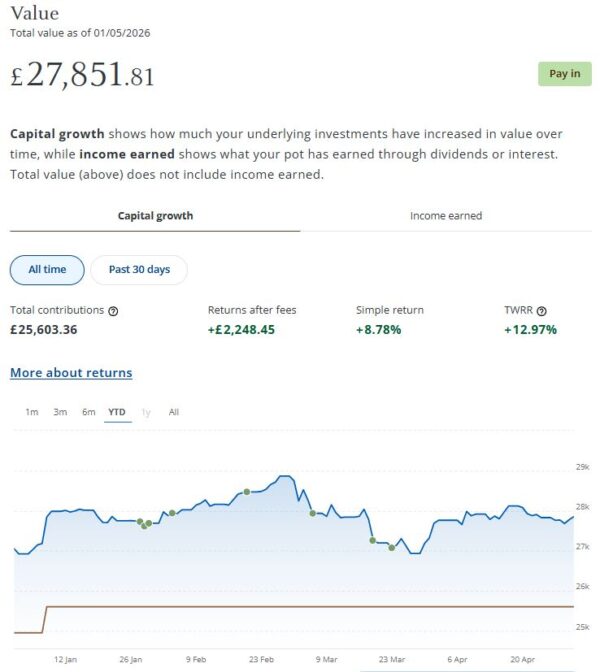
The better news is that my income portfolio increased in value in April (after its bigger fall in March). It’s now worth £27,852 compared with £27,320 at the start of last month, a rise of £532. You don’t need to be an investment expert to know that the volatility recently is due mainly to events in the Middle East. As I always say, you do have to expect ups and downs when investing. As the screen capture below shows, my income port is still up by a respectable £2,248 (8.78%) after fees since I opened it last June.

JPM Income Port May 26

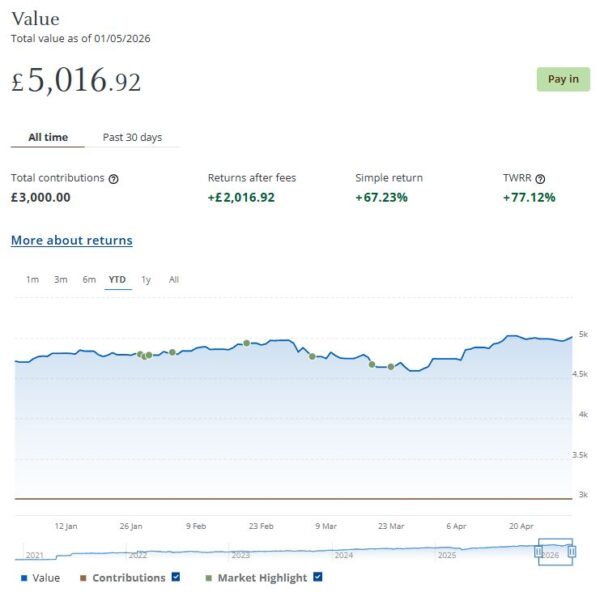
I still have a smaller, growth-oriented pot using JPM Investing’s Smart Alpha option. This is now worth £5,017 (rounded up) compared with £4,646 a month ago, a rise of £371. Here is a screen capture showing performance over the year to date.

JPM Smart Alpha May 26

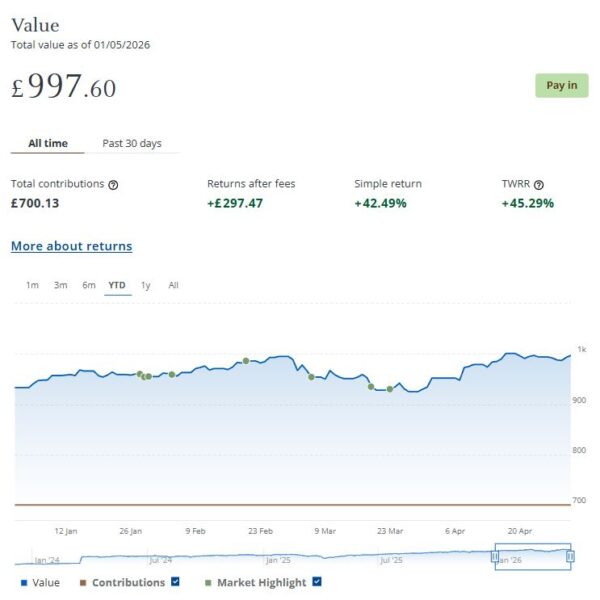
Finally, at the start of December 2023 I invested £500 in one of Nutmeg/JPM’s thematic portfolios (Resource Transformation). In March 2024 I also invested a further £200 from referral bonuses (something I no longer receive). As you can see from the YTD screen capture below, this portfolio is now worth £998 compared with £934 last month, a rise of £64.

Overall in April the value of my JPM investments rose by £967 or 3.02%. In addition I did, of course, receive £66.11 in income from my income portfolio. In total, then, I am £1,033.11 up for the month.

Excluding income generated, the overall value of my JPM investments is up by £4,630 or 15.72% since the start of May 2025. If you add to this the £811.25 of income generated by my Income portfolio to date, that gives a total profit for the last 12 months of £5,441.25 – a pretty good return in these uncertain times.

As I said above, some volatility is always to be expected with stock market investments, but in the longer term they tend to even themselves out (and typically outperform bank savings accounts, although that is never guaranteed). In general the worst thing you can do is panic and sell up when downturns occur (as happened in March). You are then crystallizing your losses rather than giving the markets time to recover. This is something I discussed last year in this blog post. Obviously nobody knows what will happen in the Middle East, but hopefully some sort of resolution will occur soon, if only because US President Trump desperately needs an exit strategy to pacify his critics back home. Once this happens, we will hopefully see world stock markets stabilize again. Though there is of course no guarantee about this.

You can read my full original Nutmeg/JPM review here. If you are looking for a home for your annual ISA allowance, based on my overall experience over the last nine years, they are certainly worth considering. They offer self-invested personal pensions (SIPPs), Lifetime ISAs and Junior ISAs as well.

Moving on, I also have investments with P2P property investment platform Housemartin. As discussed in this post, the company rebranded last year from Assetz Exchange.

My investments with Housemartin continue to generate steady returns. Housemartin focuses on lower-risk properties (e.g. sheltered housing). I put an initial £100 into this in mid-February 2021 and another £400 in April. In June 2021 I added another £500, bringing my total investment up to £1,000.

Since I opened my account, my HM portfolio has generated a respectable £315.21 in revenue from rental income. I have made a small net loss of £17.60 on property disposals. Capital growth generally has slowed, in line with UK property values generally.

At the time of writing, 17 of ‘my’ properties are showing gains, 7 are breaking even, and the remaining 20 are showing losses. My portfolio of 44 properties is currently showing a net decrease in value of £71.59. That means that overall (rental income minus capital value decrease and loss on disposal) I am up by £243.62. That’s still a respectable return on my £1,000 and does illustrate the value of P2P property investments for diversifying your portfolio. And it doesn’t hurt that with Housemartin most projects are socially beneficial as well.

  • A further consideration is that property investments on Housemartin are less likely to be affected by stock market downturns, as happened in March due to the war in the Middle East. This again demonstrates the potential value of such investments for diversifying your portfolio during challenging times.

The net fall in capital value of my Housemartin investments is obviously a little disappointing. But it’s important to remember that until/unless I choose to sell the investments in question, it is largely theoretical, based on the latest price at which shares in the property concerned have changed hands. The rental income, on the other hand, is real money (which in my case I’ve reinvested in other HM projects to further diversify my portfolio).

To control risk with all my property crowdfunding investments nowadays, I invest relatively modest amounts in individual projects. This is a particular attraction of Housemartin as far as i am concerned. You can actually invest from as little as £1 per property if you really want to proceed cautiously.

  • As I noted in this blog post, Housemartin is particularly good if you want to compound your returns by reinvesting rental income. This effectively boosts the interest rate you are receiving. Personally, once I have accrued a minimum of £10 in rental payments, I usually reinvest this money in either a new HM project or one I have already invested in (thus increasing my holding). Over time, even if I don’t invest any more capital, this will ensure my investment with Housemartin grows at an accelerating rate and becomes more diversified as well.

My investment on Housemartin is in the form of an IFISA so there won’t be any tax to pay on profits, dividends or capital gains. I’ve been impressed by my experiences with Housemartin and the returns generated so far, and intend to continue investing with them. You can read my original review of Assetz Exchange/Housemartin here and my article about the rebranding to Housemartin here. You can also sign up for an account directly via this link [affiliate].

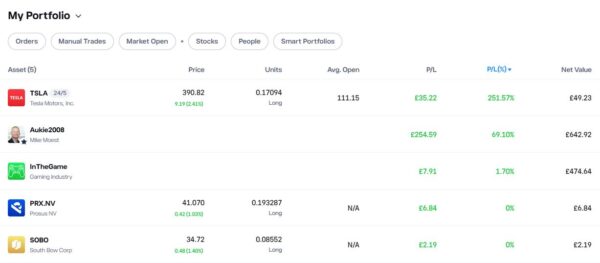
In 2022 I set up an account with investment and trading platform eToro, using their popular ‘copy trader’ facility. I chose to invest $500 (then about £412) copying an experienced eToro trader called Aukie2008 (real name Mike Moest).

In January 2023 I added to this with another $500 investment in one of their thematic portfolios, Oil Worldwide. I also invested a small amount I had left over in Tesla shares.

In January this year, as Oil Worldwide hadn’t exactly been setting the world alight, I decided to switch my entire investment in this to another smart portfolio, InTheGame. This port, focusing on the computer gaming industry, has been the top performer for some time in my eToro virtual portfolio.

Unfortunately just as I switched away from Oil Worldwide, President Trump decided to invade Venezuela. This gave the oil industry a significant boost, which I would otherwise have benefited from. Meanwhile InTheGame went south, partly due to the war in the Middle East. At one point I was down by over 10% on this investment. Fortunately in the last few weeks InTheGame has made an impressive recovery and is now in profit by 7.91%.

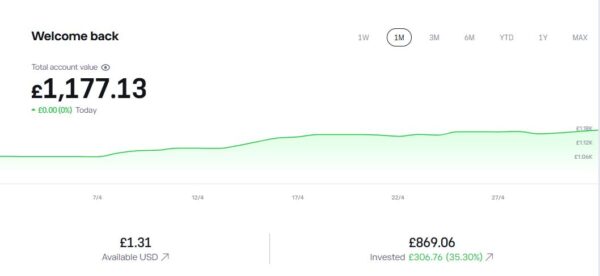
As you can see from the screen captures below, my original eToro investment (total value £888.36 in pounds sterling) is today worth £1,177.13, an overall increase of £288.77 or 25.77%.

  • Note: eToro now displays the value of investments in your native currency, although you can change this if you wish.

Etoro Home May 2026

Etoro port May 2026

You can read my full review of eToro here. You may also like to check out my more in-depth look at eToro copy trading. I also discussed thematic investing with eToro using Smart Portfolios in this post.

As mentioned above, my new investment in InTheGame is currently up by 7.91%. My copy trading investment with Aukie2008 also rose in value in April and is showing an impressive overall profit of 69.10%. Of course, I have held this investment for quite a bit longer.

My Tesla shares, which I purchased as an afterthought with some spare cash I had in my account, are also up this month and showing an overall profit of over 251% since I bought them. If only I had put a bit more money into this!

You might also notice that I have small holdings in Prosus NV, a Dutch internet group, and South Bow, a Canadian energy infrastructure company. To be honest I don’t understand how I acquired these, but I assume they are some sort of bonus I was awarded. In any event, I am happy to have them in my portfolio.

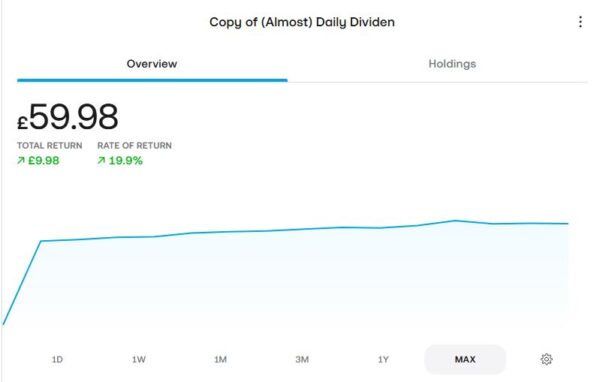
As an experiment, at the start of April 2025 I put £50 into an investment ISA with Trading 212. As mentioned in my blog post about dividend investing, I put it into the (Almost) Daily Dividends Portfolio, a ready-made portfolio or ‘pie’ on Trading 212. As you can see from the screen capture below, my portfolio is now worth £59.98. That’s a small rise of £0.12 since last month and an increase of £9.98 or 19.9% since I opened it just over a year ago. It has even accrued a grand total of £1.16 in dividends, most of which has now been (automatically) reinvested.

Trading 212 Dividends port May 26


I am quite impressed with how this investment has been faring, despite the small amount I put in (which means I may be missing out on some smaller dividends). If I increased my investment I would almost certainly become eligible for more dividends, and even more the longer I remain invested. If I had any spare money at the moment, I would consider doing this. Of course, I do now have an income-focused portfolio with JPM Investing as well (see above).


Moving on, I published various posts on Pounds and Sense in April. I have listed below those that are still relevant.

In What is the Blue Light Card – And How Can It Help You Save Money? I discussed this discount scheme for people working in the emergency services and various other public services. For a modest fee (under £2.50 a year) you can access discounts on everything from restaurants to holidays, concerts and sporting events to insurance. You may also be eligible if you are retired from a qualifying occupation. Find out more in this article.

I also posted Pound-Cost Averaging – A Smart Strategy for Investing in Turbulent Times. In this article I explained how this simple investing strategy works and why it may be particularly relevant in these turbulent times.

Finally in April I published Why Now Could Be the Ideal time to Take Advantage of Your New Tax-Free ISA Allowance. From the start of the new tax year on 6 April 2026, everyone has a new £20,000 tax-free ISA allowance. In this article I revealed why you might want to take advantage of at least some of this allowance sooner rather than later.

I’ll close with my customary reminder that you can also follow Pounds and Sense on Facebook or Twitter (or X as it is now). Twitter/X is my number one social media platform and I post regularly there. I share the latest news and information on financial matters, and other things that interest, amuse or concern me. So if you aren’t following my PAS account on Twitter/X, you are definitely missing out!

  • I am also on the BlueSky social media network under the username poundsandsense.bsky.social. Twitter/X remains my primary social media platform, but I also post details of my latest blog posts, third-party articles and other financial news and resources on BlueSky for those who prefer to follow me there.

As always, if you have any comments or questions, feel free to leave them below. I am always delighted to hear from PAS readers 🙂

Disclaimer: I am not a qualified financial adviser and nothing in this blog post should be construed as personal financial advice. Everyone should do their own ‘due diligence’ before investing and seek professional advice if in any doubt how best to proceed. All investing carries a risk of loss. 

Note also that posts on PAS may include affiliate links. If you click through and perform a qualifying transaction, I may receive a commission for introducing you. This will not affect the product or service you receive or the terms you are offered, but it does help support me in publishing PAS and paying my bills. Thank you!

If you enjoyed this post, please link to it on your own blog or social media: