
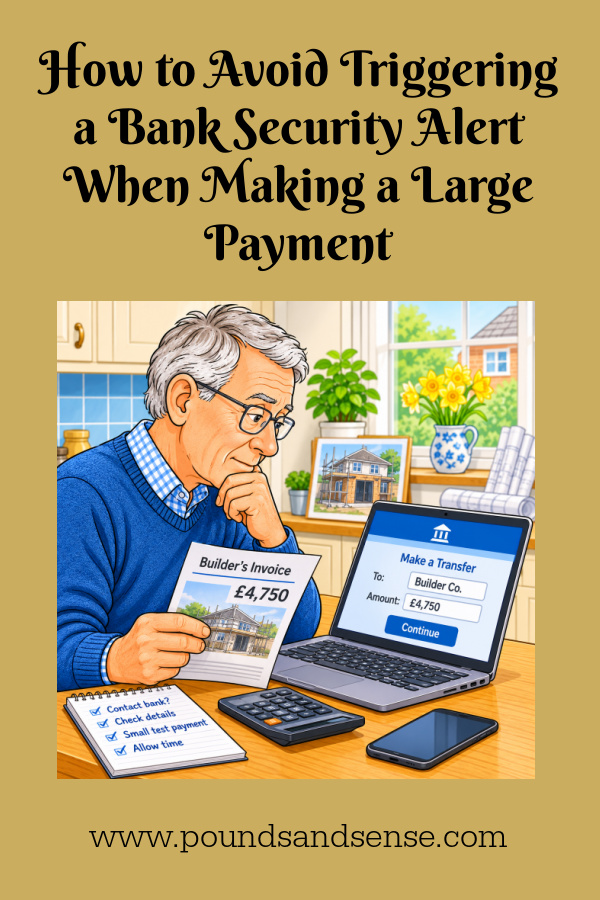
How to Avoid Triggering a Bank Security Alert When Making a Large Payment
Making a substantial payment to someone you haven’t paid before can sometimes set alarm bells ringing at your bank. Here are some simple precautions you can take to reduce the risk of your payment being blocked or your account temporarily frozen.
Table of Contents
When a Routine Payment Becomes a Banking Nightmare
Have you ever needed to make a relatively large payment to someone you haven’t paid before?
Perhaps you’ve employed a builder to carry out some work on your home, bought a new kitchen, commissioned a garden makeover or arranged for a tradesperson to undertake some major repairs.
You agree the price, receive an invoice and prepare to transfer the money from your bank account.
It all seems straightforward. Until, that is, your bank decides something suspicious might be happening.
Banks have sophisticated systems designed to identify unusual transactions and protect customers against fraud. Unfortunately, these systems aren’t infallible. A perfectly legitimate payment can sometimes trigger a security alert, particularly if it’s unusually large or going to someone you’ve never paid before.
I know this from personal experience.
As I explained in my recent article Why You Should Open a Second Bank Account (Even If You’re Happy With Your Current Bank), earlier this year I had my bank account unexpectedly frozen after attempting to make a substantial payment to a builder I hadn’t used before.
I wasn’t being scammed, but my bank’s security systems apparently thought otherwise.
It was a stressful experience, and one that made me realise there are precautions I could have taken beforehand to reduce the risk of this happening.
Here are some suggestions that may help if you’re planning to make a large payment to a new recipient.
1. Contact Your Bank Before Making the Payment
This is probably the most important piece of advice.
If you’re planning to make an unusually large payment, particularly to someone you haven’t paid before, consider contacting your bank in advance.
Explain that you’re planning to make a payment, roughly how much it will be and who the recipient is.
For example, you might say:
“I’m having some building work done at my property and will shortly need to transfer approximately £5,000 to a builder I’ve recently employed. I’ve never paid this person before. Is there anything I should do to make sure the payment goes through smoothly?”
The bank may be able to offer guidance about its payment limits and security procedures. It might also be able to explain whether there are any particular steps you should take before making the transfer.
Some banks may be able to add a note to your account, although you shouldn’t assume this will prevent a subsequent security alert.
The important thing is to give your bank an opportunity to understand the circumstances before an unexpected large transaction appears on its systems.
Make sure you use a genuine bank contact number, such as the one on your debit card or official banking website.
2. Consider Making a Small Test Payment First
This is another useful precaution, particularly when paying someone for the first time. Rather than immediately transferring the entire amount, consider sending a small test payment first.
For example, if you owe a builder £3,000, you might initially transfer £1 or £5. Once the recipient confirms that the money has arrived, you can arrange to send the balance. This has two potential advantages.
First, it gives you an opportunity to check that the bank details you’ve been given are correct. And second, it means you’re not immediately attempting to send a relatively large sum to an entirely new payee.
If you’re doing this, leave a gap of at least 24 hours between the first test payment and the subsequent balance payment. This should reduce any suspicion on the bank’s part that you are acting under duress.
Note that even this isn’t guaranteed to prevent a security alert. Your bank may still question the subsequent larger payment, even if the test transaction went through successfully. Nonetheless, it can definitely reduce the risk. I was told by a staff member at my bank that once an initial payment has gone through, it creates a ‘mandate’ for that payee in your account. This makes it much less likely that any subsequent payment to them will be questioned.
- The Take Five to Stop Fraud campaign also recommends making a small initial payment when paying a company or service provider for the first time, then checking directly with them that it has arrived.
3. Check the Recipient’s Bank Details Carefully
Before transferring any money, make sure you have the correct bank details for the person or business you’re paying.
This might sound obvious, but mistakes can happen. More seriously, criminals sometimes intercept invoices or emails and substitute their own bank details.
This is known as invoice or mandate fraud.
For example, you might receive a genuine invoice from a builder, but a criminal has somehow altered the bank details so that your payment goes into their account instead.
To reduce this risk:
- Obtain the bank details directly from the person or business you’re paying.
- If possible, confirm them in person or over the telephone.
- Make a small test payment first and confirm it was successfully received (as suggested above)
- Don’t automatically trust new bank details supplied in an unexpected email or text.
- If someone tells you their bank details have changed, verify this using a telephone number you already know is genuine.
Be particularly cautious if you’re asked to make a payment urgently or are told not to contact the recipient by telephone.
Remember, even a genuine-looking email can have been intercepted or compromised.
4. Pay Attention to Confirmation of Payee
Most UK banks now offer a service called Confirmation of Payee (CoP).
This checks whether the name you’ve entered for the person or business you’re paying matches the name associated with the receiving bank account.
Depending on the result, you may receive one of the following responses:
- Match: The name and account details appear to correspond.
- Close match: The name is similar but not identical. You may be shown the actual account name.
- No match: The name you’ve entered doesn’t match the account details.
- Unavailable: The bank can’t complete the check.
If you receive a no-match warning, don’t simply ignore it and proceed with the payment.
Contact the intended recipient using independently verified contact details and establish exactly what is wrong.
There can be legitimate reasons for a difference. For example, a builder might trade under a business name but have a personal bank account in their own name. However, you should establish that this is genuinely the case before proceeding.
It’s also important to understand that a successful Confirmation of Payee check doesn’t guarantee that the person you’re paying is trustworthy. It confirms a match between the name and account details, not that the invoice or transaction itself is genuine.
You can find further information about this service on the UK Finance website.
5. Make Sure the Payment Fits Your Bank’s Limits
Banks impose various limits on the amount customers can transfer, particularly when using online or mobile banking.
These limits vary between providers and sometimes between different types of payment.
If you’re planning to make a substantial transfer, check beforehand:
- Your bank’s maximum payment limit.
- Whether there are separate limits for new payees.
- Whether you can increase your limit temporarily.
- Whether you need to use telephone banking or visit a branch for a particularly large payment.
Some banks allow customers to change their payment limits through their banking app, while others require additional security checks.
It’s better to establish these things in advance rather than discover them when you’re trying to settle an important bill.
One other point: don’t deliberately divide a payment into smaller amounts simply to get around your bank’s security checks or transaction limits. That could itself look suspicious and may breach your bank’s terms.
If a payment needs to be made in stages, it’s better to agree a genuine payment schedule with the supplier, based on the work being completed or the terms of your contract.
6. Keep Your Bank Informed About Unusual Financial Activity
A large payment to a new recipient isn’t the only type of transaction that might attract your bank’s attention.
Other examples include:
- Transferring a substantial sum to someone you haven’t paid before.
- Making an unusually large cash withdrawal.
- Sending money to a new overseas account.
- Moving a large amount between your own accounts.
- Making several unusual payments in quick succession.
You don’t need to telephone your bank every time you do something slightly different with your money.
However, if you’re planning a transaction that’s significantly outside your normal banking habits, it may be worth giving the bank advance notice.
This is particularly relevant if you’re retired and normally have a fairly predictable pattern of income and expenditure.
For example, you might usually pay out £1,500 to £2,000 a month but suddenly need to transfer £10,000 to pay for a new roof.
There’s nothing inherently suspicious about this, but it’s quite different from your usual banking activity.
A quick conversation with your bank beforehand may help avoid unnecessary complications.
7. Make Sure Your Bank Can Contact You
This is a simple precaution that’s easy to overlook.
If your bank spots a potentially suspicious transaction, it may try to contact you to establish whether you’ve authorised it.
Make sure the bank has your current mobile telephone number and email address.
Also, if you receive a call claiming to be from your bank, be cautious. Criminals sometimes impersonate bank security departments and use the threat of an account freeze to persuade people to reveal security information or transfer money.
If you’re unsure whether a call is genuine, end it and contact your bank using the number on your debit card or its official website.
Never disclose your PIN, full password or one-time security codes to someone who contacts you unexpectedly.
And remember, a genuine bank will never ask you to transfer your money to a so-called safe account to protect it.
8. Allow Plenty of Time for the Payment
If you’re paying a builder or tradesperson, don’t leave the transfer until the last possible moment.
Although most UK bank transfers are processed very quickly, a payment that’s flagged for investigation may be delayed.
Your bank might need to ask you additional questions or carry out further checks before releasing the money.
This can be particularly inconvenient if you’ve promised to pay a contractor by a particular date or they are waiting for the funds before ordering materials or completing work.
If the payment is substantial, I would suggest arranging it a few days before it’s actually due, allowing time to deal with any unexpected problems.
If the payment is subject to a contract or agreed schedule, make sure you understand the payment terms and don’t transfer money earlier than you need to.
What If Your Bank Still Blocks the Payment?
Even if you follow all the precautions above, there’s no guarantee your bank won’t decide to investigate a transaction.
Banks have legal and regulatory responsibilities to monitor payments and protect customers against financial crime. They may therefore block or delay a payment if something about it raises concerns.
If this happens, try not to panic.
Contact your bank using an official telephone number or its secure banking app.
Explain that you’ve authorised the payment and are happy to provide further information about its purpose and the person you’re paying.
You might be asked questions about the recipient, the reason for the payment and how you know them.
Answer honestly and provide any supporting information requested, such as an invoice, quotation or contract.
If the bank needs additional time to investigate, ask whether it can give you an indication of when the matter might be resolved.
You may also find it helpful to read the MoneyHelper guide to frozen bank accounts.
If you believe your bank has treated you unfairly, you can make a formal complaint and, if necessary, refer the matter to the Financial Ombudsman Service.
Final Thoughts
Making a large payment to someone you’ve never paid before shouldn’t be a particularly stressful experience.
Nevertheless, banks have become increasingly vigilant about fraud, and occasionally their security systems can mistake a perfectly legitimate transaction for something suspicious.
My own experience taught me that it’s worth taking a few simple precautions before making a substantial transfer.
If I were paying a new builder or tradesperson today, I would certainly consider contacting my bank beforehand, checking the recipient’s bank details carefully and making a small test payment before transferring the balance.
None of these steps guarantees that your bank won’t raise an alert, but together they should reduce the risk of unnecessary complications.
If you’re making a particularly large payment, remember that a little preparation is preferable to discovering at the last minute that your bank has decided to intervene.
As I suggested in my previous article, having a second current account with another bank is also a sensible precaution. If your main account is unexpectedly restricted, having access to another source of money can make a difficult situation considerably easier to manage.
- And as I also said in my earlier article, if you’re an older person, taking steps to avoid your account being frozen is doubly important. The repercussions can be even more challenging (and stressful) for older people. And banks may be more likely to step in when they see an unusual transaction by an older customer, as they think it’s more likely they are being scammed.
Have you ever had a legitimate bank transfer blocked or questioned by your bank? Did you find a way to avoid similar problems in future? I’d be interested to hear about your experiences in the comments below.
Disclaimer: This article is for general information only and does not constitute personalised financial advice. Banking procedures and payment limits vary between providers, so check directly with your own bank before making an unusually large transfer.
