Today I’m spotlighting a lesser-known government scheme which, if you’re eligible, can give your finances a valuable boost.
Help to Save is an initiative aimed at helping people on low incomes build up their savings. Offering generous tax-free bonuses, this scheme can provide significant benefits for qualifying individuals.
Here’s everything you need to know.
What is Help to Save?
Help to Save is a government savings scheme designed for people on Universal Credit.
For every £1 you save into your account, the government adds a 50p bonus, effectively giving you a 50% return. You can save up to £50 a month, with bonuses paid out at two key points over the four-year scheme.
How do the Bonuses Work?
Year 2 Bonus: After the first two years, you’ll receive a bonus worth 50% of your highest balance during that period.
Year 4 Bonus: At the end of the four years, you’ll receive a second 50% bonus based on the difference between your highest balance in years 3-4 and years 1-2.
So if, for example, you save the maximum £50 a month for two years, you’ll have £1,200 in your account. The government will then pay you a 50% bonus of £600.
If you continue saving £50 a month for the next two years, your balance excluding bonuses will be £2,400. You will then receive another £600, bringing your total bonuses to £1,200.
Putting it another way, in four years your investment of £2,400 will have accrued £1,200 in tax-free bonuses, giving you a total savings pot of £3,600. No bank savings account will offer you a guaranteed return anywhere near that!
Key Benefits of Help to Save
High returns: As mentioned above, a 50% bonus is significantly higher than any bank savings account interest rate
Flexibility: You can save as little or as much (up to £50 a month) as you like.
No risk: The scheme is government-backed, so there’s no chance of it going bust.
Tax-free: The bonuses are tax-free, and they aren’t treated as income for benefits purposes.
Easy withdrawals: You can withdraw savings any time if you need them (though frequent withdrawals may reduce your future bonuses).
No strings: The scheme is completely free and won’t affect your credit score. In addition, once you have been accepted on Help to Save, it doesn’t matter if your circumstances change.
Who is Eligible?
Recent changes have expanded eligibility for Help to Save to include all working Universal Credit claimants who earned £1 or more in their previous assessment period. The former minimum earnings threshold of £793 per month has been removed.
You must also live in the UK (or meet specific conditions if you live abroad as a Crown servant or member of the armed forces). You must also have a UK bank account.
The Help to Save scheme deadline has also been extended. You can now open an account until April 2027.
Are There Any Age Limits?
There are no specific age restrictions for opening a Help to Save account provided you meet the criteria above. Once you have qualified for the state pension, however, you will not be eligible to receive Universal Credit. That means if you’re coming up to retirement age (currently 66, gradually rising to 67 from 6 May 2026), it’s important to apply for the scheme before you reach that age.
How to Apply
Opening a Help to Save account is straightforward. You can apply online via the official government website or using the HMRC app.
Note that you will need a Government Gateway User ID and password. If you don’t have one of these already, you can create one during the application process.
Closing Thoughts
For those eligible Help to Save offers a valuable opportunity to build a savings pot, with the added advantage of tax-free government bonuses.
The scheme is designed to be simple and flexible, making it easy for individuals to develop a habit of saving and improve their financial security. If you qualify, it’s well worth considering as a step towards achieving a more stable financial future.
For more information and to apply, visit the government website. Don’t miss this chance to turn small, regular savings into a significant financial boost, before the scheme closes to new applicants in April 2027.
As always, if you have any comments or questions about this article, please do leave them below.
If you enjoyed this post, please link to it on your own blog or social media:
Whether you’re just starting, mid-career, or approaching retirement age, getting the right pension advice is crucial to ensure a secure and comfortable future.
Fortunately, there are many places in the UK (both free and paid) that offer pension guidance and tailored advice. In this blog post, we’ll explore reasons why you need pension advice, the best places to get help, and answer some frequently asked questions about pension advisers.
Why Would You Need Pension Advice?
Pensions are a vital part of your financial future, yet many people don’t fully understand how to approach pension problems or what investment options are available. Before we look at where you can find pension advice, here are a few common situations where seeking advice might be a smart move:
Near Retirement – As you approach retirement age, you’ll have to make important decisions such as when to access your pension, how to take your benefits, and how to minimise tax. Professional advice can help you make the most of your savings.
Multiple Pension Pots – If you have changed jobs frequently in the past, you might have multiple pension pots. Getting expert advice can help you trace and consolidate them efficiently, ensuring you don’t lose track of valuable funds.
Pension Transfers – Transferring pensions, especially from defined benefit (DB) schemes, can be risky if not handled carefully. Expert advice is essential to assess the risks and avoid losing valuable benefits.
Investment Choices – If you have a defined contribution (DC) pension, you can choose where your pension contributions are invested. Advice can help match your investment risk profile with your long-term goals.
Places To Get Pension Advice in the UK
Many organisations and platforms in the UK offer pension guidance and advice. Some are free and impartial, while others are professional financial advice services that may charge a fee.
Here’s a breakdown of some places where you can get pension advice:
1. Pension Wise
Pension Wise is a government-backed service offered through MoneyHelper. It offers free and impartial guidance to people aged 50 or over with a defined contribution pension. If you’re unsure about what type of pension pot you have, they have a service that helps determine whether or not you have a defined contribution pension. You can book a free appointment online or over the phone with a pension specialist who will explain how each pension option works, what tax you could pay, and how to identify scams. It also offers a helpline and webchat open Monday to Friday from 9 am to 5 pm.
Pros
Government-backed service
Free online and phone appointments
Suitable for people aged 50 or over with a defined contribution pension pot
Cons
You may not be able to get an appointment if you are under 50 or only have a defined benefit pension
Citizens Advice is an independent organisation in the UK that provides free and confidential guidance on a wide range of financial issues, including pensions. They have a network of local charities in around 1,600 locations across England and Wales with 14,000 volunteers and 8,843 staff. You can contact a guidance specialist online, on the phone, or by visiting your local Citizens Advice branch. Their website is also a helpful resource for general information about state pensions, workplace pensions, personal pensions, and more.
Pros
Around 1,600 locations across the UK
Free face-to-face and phone appointments
A great resource for general pension information
Cons
You may not be able to get an appointment if you are under 50 or only have a defined benefit pension
FinancialAdvisers.co.uk is an online platform with a database of over 60,000 FCA-approved financial advisers and 15,000 firms across the UK. It works by connecting people with a range of financial advisers based on their postcode. Users can enter their postcode in the directory and filter the results by pension and retirement advice to find a list of pension advisers nearby.
In addition, they also offer a ‘Get Matched’ service that matches you with a suitable adviser. By answering a few questions and entering your personal details, it allows you to find an FCA-regulated adviser in your local area and request a guaranteed call back.
Pros
Free directory to find pension advisers near you
Free ‘Get Matched’ service
Most pension advisers listed offer a free initial consultation
Cons
You have to make contact with advisers unless you get matched
As a part of the Chartered Insurance Institute group, the Personal Finance Society (PFS) serves as the UK’s professional body dedicated to the financial planning sector. This organisation is committed to elevating standards and fostering professionalism across the sector, primarily aiming to enhance public trust and confidence.
The Personal Finance Society provides a free search tool on their website, enabling individuals to locate qualified advisers nearby. By inputting their location, users can refine their search based on their specialty, such as retirement pensions and annuities. The tool also allows for filtering options to show only chartered financial planners, specialists in later life and retirement planning, or advisers who can be contacted by email or telephone.
Pros
Free search tool to find advisers in your local area
All listed advisers are qualified and members of the PFS
Most advisers listed offer a free initial consultation
Age UK is a leading charity federation designed to provide support and guidance to older people on a wide range of topics, including pensions. They offer a free and confidential helpline and have specialist advisers at over 120 locations across the UK. The Age UK website provides general information on pension pots, state pensions, workplace pensions, finding old pensions, annuities, how to spot pension scams, and more.
Pros
Free and impartial guidance
Free helpline open 8 am to 7 pm, 365 days a year
Specialist advisers in over 120 locations across the UK
NEST (National Employment Savings Trust) is a popular workplace pension scheme in the UK designed to make automatic enrolment as easy as possible. The scheme was set up by the government and introduced by the Pensions Act 2008. Under the act, all employers in the UK are legally required to put eligible staff into a pension scheme and contribute towards the pension pot. This is to help staff save as much as possible for retirement.
Whatever pension provider you are with, it is worth seeking advice from them. If you’ve been auto-enrolled into a NEST pension scheme, they offer guidance and support on their website in a range of areas, such as how to grow your pension, transfers, contributions, pension tax, and more.
What is the Difference Between Pension Guidance and Advice?
Pension guidance helps you understand your options and make informed decisions, but it doesn’t recommend specific financial products or tell you what to do. It’s usually free and impartial and offered by services like Pension Wise and Citizens Advice. Pension advice, on the other hand, is provided by regulated financial advisers. They assess your financial situation and recommend specific actions or products for a fee.
Is It Worth Paying a Pension Adviser?
It depends on your circumstances. If you’re close to retirement or have multiple pension pots, paying for tailored advice can be a smart investment. A good adviser can help you avoid costly mistakes, optimise your tax position, and choose suitable investments.
How Much Does a Pension Adviser Charge?
Most pension advisers offer a free initial consultation and charge a fee for their services. These fees vary depending on the complexity of your situation and how the adviser charges. Typical fee structures include fixed, percentage-based (0.5% to 2% of the pension value managed), or hourly. Before working with an adviser, it is recommended that you ask about fee disclosure to avoid hidden costs.
Where to Go From Here for Pension Advice
Getting the right pension advice can mean the difference between a comfortable retirement and financial uncertainty. Whether you’re just starting to save, consolidating old pension pots, or deciding how to access your pension funds, it pays to seek help.
Start with free, impartial guidance services to understand your options. If your situation is more complex or you want advice tailored to your retirement goals, consider hiring a regulated financial adviser. With a wealth of resources available, planning for retirement doesn’t have to be daunting.
This is a collaborative post.
If you enjoyed this post, please link to it on your own blog or social media:
Today I’m sharing a guest article on a subject nobody likes to think about, but one that could be crucial to ensuring your financial security in later life..
Sadly, growing numbers of older people are seeing their marriages break down and having to undergo the painful process of divorce. Even if relatively amicable, this is likely to be stressful and emotionally exhausting. And – even worse – any mistakes you make now can have serious consequences for your finances, both now and into the future.
My guest today, Victoria Fellows, a partner and head of family at the Birmingham office of HCR Law, knows this very well. And she has some important advice for anyone who may find themselves in this situation.
Over to Victoria then…
Divorce rates among individuals aged 50 and over – often referred to as ‘silver splitters’ – have been on the rise in the UK over recent decades, with the number of over-60s legally separating doubling since the 1990’s. This trend contrasts with the decline in divorce rates across younger age groups. It can be put down to various factors, such as longer life expectancy, empty nest syndrome and the increasing numbers of financially independent women who are able to support themselves outside marriage.
At the end of 2024, the Law Commission published a scoping report on financial remedies on divorce. This indicated that 60% of the couples who divorced in 2023 had not properly dealt with their finances upon divorce, sometimes thinking it was not worth obtaining an order from the court as they believed they had no assets justifying the expense of formally separating their finances.
So while these couples are now divorced, both parties remain vulnerable to a financial claim application from their former spouse at any point until they remarry or die. The case of Vince v Wyatt illustrated why this was a mistake. The parties had nothing when they divorced and did not bother to get a clean break order. Post separation, Mr Vince became a multi-millionaire through his own business activities. Mrs Wyatt was allowed to bring financial claims against him 20 years after the divorce, resulting in a significant financial award being made in her favour.
Resolving financial issues during a divorce is therefore crucial for both immediate stability and long-term security. This is especially true for silver splitters undergoing ‘grey divorce’ – another term referring to divorces in later life. Unlike their younger counterparts, they will not have years of working life ahead of them to build up savings or pensions. It is therefore crucial that the marital assets are divided fairly to help ensure that both spouses have financial security during their retirement. There is also the possibility that in their fifties or sixties, one spouse will come into a substantial inheritance post-divorce which, without a financial remedy order, the former spouse could make a claim on in the future.
So What Do Financial Agreements Look Like?
As a result of being married, both parties have a number of financial claims that they can make against each other. The orders that a court can make are as follows:
Orders for maintenance pending suit (‘interim’ spousal maintenance)
Periodical payments orders (spousal maintenance for joint lives, specific term and/or a nominal amount)
Lump sum orders
Property adjustment orders
Pension sharing orders
In deciding whether to make any of the above orders, the court must consider all the circumstances. These will include:
a) The income, earning capacity, property and other financial resources of each party or what they are likely to have in the foreseeable future, including any increase in that earning capacity.
b) The financial needs, obligations and responsibilities which each of the parties to the marriage has or is likely to have in the foreseeable future.
c) The standard of living enjoyed by the parties before the breakdown of the marriage.
d) The age of each party to the marriage and duration of the marriage.
e) Any physical or mental disability of either party to the marriage.
f) The contributions which either of the parties have made or are likely to make in the foreseeable future to the welfare of the family, including any contribution by looking after the home or caring for the family.
In every case the court also has to consider whether a ‘clean break’ is appropriate. A clean break is where the parties’ finances are arranged to allow them to separate without any further financial responsibility for each other. While the court must give consideration to this, it does not mean that there can or should be a clean break in every case. This will necessarily depend upon the other factors involved.
How Are Agreements Reached?
There are a number of ways in which financial matters can be resolved:
Discussions directly between the parties if they are able to discuss and agree a financial settlement that both of them are comfortable with.
Mediation where both parties try to reach agreement between themselves with the assistance of a trained mediator.
Negotiation through solicitors. Each party can appoint a solicitor to negotiate on their behalf. This approach is suitable for complex financial situations or when mediation isn’t appropriate.
Other forms of dispute resolution. Arbitration and collaborative law are further alternatives. Arbitration is effectively a ‘private’ process that largely mirrors court proceedings but where the parties have more control in particular in respect of timescales. Collaborative law is a separate process which may only be suitable in certain circumstances. Each person appoints their own collaboratively trained lawyer and both parties and their lawyers meet together to work things out face to face.
Financial remedy proceedings. If all other options fail, it may be necessary for formal court proceedings to be issued to resolve financial matters. An application for financial remedy can only be commenced after a Divorce Petition has been filed with the court. The proceedings usually involve attending court on three occasions. If financial settlement is not agreed at either of the initial two hearings, or in between them, then a final hearing will be listed at which the Judge after hearing evidence makes a decision that is binding on the parties. This would be the most cost-prohibitive option and can end with resolution of financial matters being taken entirely out of the parties’ hands.
Top Tips to Make the Process Easier
Seek professional advice as soon as possible. Consult with financial advisors and solicitors who are experienced in later-life divorce and can help navigate complex financial issues and ensure a fair settlement is not only reached but also incorporated into an order to be approved by the court.
Enter into full financial disclosure to ensure that all assets are disclosed and taken into consideration when looking at overall settlements that plan for short- and long-term financial security. This will take time, so start sorting out your paperwork early. This is likely to include bank statements, pension records and documents relating to any other investments you might have, e.g. premium bonds, stocks and shares, rental income, and so on.
Remember to consider wills and estate planning as divorce does not automatically revoke a will. It’s crucial to update wills to reflect new circumstances and ensure assets are distributed according to current wishes.
Divorcing later in life presents unique challenges, but with careful planning and professional guidance, it is possible to navigate the process and achieve a fair and secure financial settlement.
Victoria Fellows (pictured, below) is a partner and the head of the family team of the Birmingham office of HCR Law.
Many thanks to Victoria and her colleagues at HCR Law for an eye-opening article on this important topic. If you are unfortunate enough to find yourself in this situation, devoting some attention to financial planning now can potentially save you and your family a lot of grief in the future.
As always, if you have any comments or queries about this article, please do leave them below.
If you enjoyed this post, please link to it on your own blog or social media:
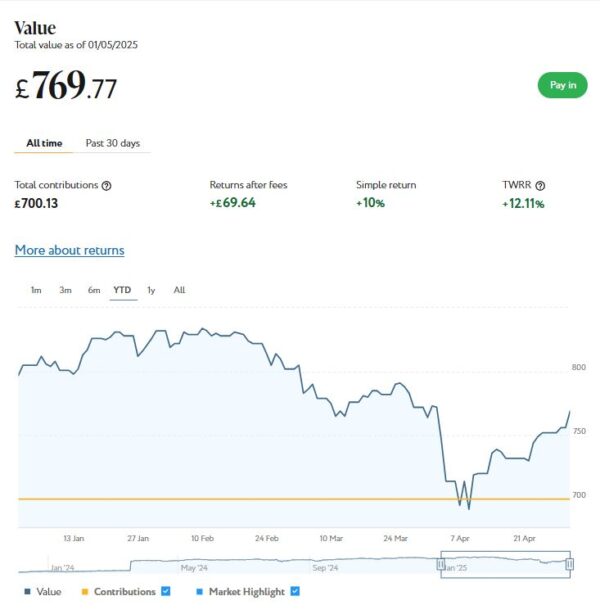
I’ll begin as usual with my Nutmeg Stocks and Shares ISA. This is the largest investment I hold other than my Bestinvest SIPP (personal pension).
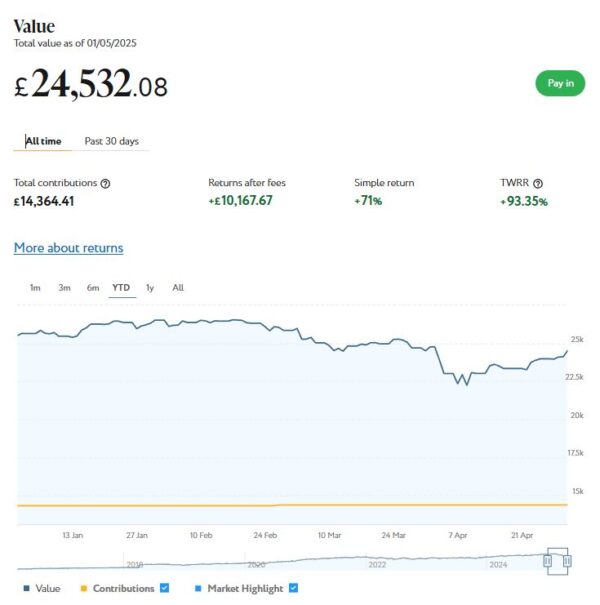
As the screenshot below for the year to date shows, my main Nutmeg portfolio is currently valued at £24,532. Last month it stood at £25,065, so that is a fall of £533.
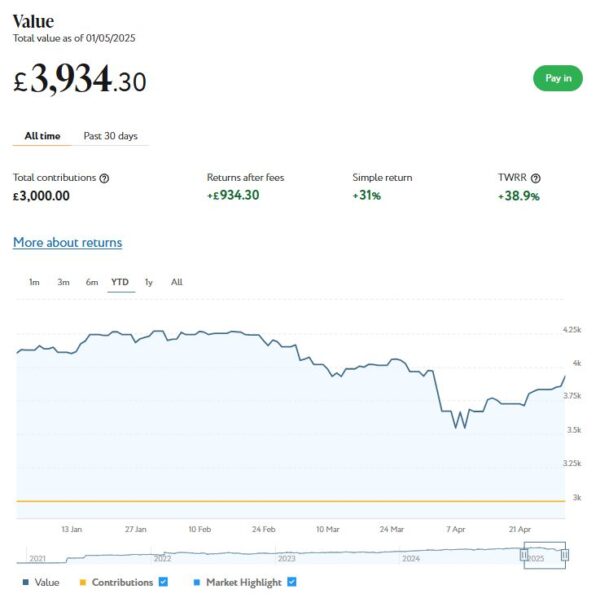
Apart from my main portfolio, I also have a second, smaller pot using Nutmeg’s Smart Alpha option. This is now worth £3,934 compared with £4,027 a month ago, a fall of £93. Here is a screen capture showing performance for the year to date.
Finally, at the start of December 2023 I invested £500 in one of Nutmeg’s new thematic portfolios (Resource Transformation). In March I also invested a further £200 from referral bonuses. As you can see from the YTD screen capture below, this portfolio is now worth £770 compared with £783 last month, a fall of £13.
As you can see, April was a roller-coaster month for my Nutmeg investments. There were some big dips in the early part of the month, followed by a partial but nonetheless welcome recovery. Overall I am down by £639 over the month. This is mostly due to the continuing instability in world markets, caused by the trade tariffs imposed by US President Donald Trump and other economic factors.
Nonetheless, the value of my Nutmeg investments is still up £838 in the last twelve months. And their value has increased by £2,920 or 11.10% since the start of January 2024. So the recent falls do need to be taken in context. Ups and downs are always to be expected with stock market investments, and over time they tend to even themselves out. In general the worst thing you can do is panic and sell up when downturns occur, as you are then crystallizing your losses. This is something I had cause to discuss recently in this blog post.
You can read my full Nutmeg review here. If you are looking for a home for your annual ISA allowance, based on my overall experience over the last eight years, they are certainly worth considering. They offer self-invested personal pensions (SIPPs), Lifetime ISAs and Junior ISAs as well.
Moving on, I also have investments with P2P property investment platform Assetz Exchange. As discussed in this recent post, the company recently rebranded as Housemartin.
My investments with Housemartin continue to generate steady returns. Housemartin focuses on lower-risk properties (e.g. sheltered housing). I put an initial £100 into this in mid-February 2021 and another £400 in April. In June 2021 I added another £500, bringing my total investment up to £1,000.
Since I opened my account, my HM portfolio has generated a respectable £245.97 in revenue from rental income. I have also made a profit of £4.78 on property disposals. Capital growth has slowed, though, in line with UK property values generally.
At the time of writing, 18 of ‘my’ properties are showing gains, 1 is breaking even, and the remaining 18 are showing losses. My portfolio of 37 properties is currently showing a net decrease in value of £54.67. That means that overall (rental income and profit on disposal minus capital value decrease) I am up by £196.08. That’s still a decent return on my £1,000 and does illustrate the value of P2P property investments for diversifying your portfolio. And it doesn’t hurt that with Housemartin most projects are socially beneficial as well.
The net fall in capital value of my Housemartin investments is obviously a little disappointing. But it’s important to remember that until/unless I choose to sell the investments in question, it is largely theoretical, based on the latest price at which shares in the property concerned have changed hands. The rental income, on the other hand, is real money (which in my case I’ve reinvested in other HM projects to further diversify my portfolio).
To control risk with all my property crowdfunding investments nowadays, I invest relatively modest amounts in individual projects. This is a particular attraction of Housemartin as far as i am concerned. You can actually invest from as little as £1 per property if you really want to proceed cautiously.
As I noted in this blog post, Housemartin is particularly good if you want to compound your returns by reinvesting rental income. This effectively boosts the interest rate you are receiving. Personally, once I have accrued a minimum of £10 in rental payments, I reinvest this money in either a new HM project or one I have already invested in (thus increasing my holding). Over time, even if I don’t invest any more capital, this will ensure my investment with Housemartin grows at an accelerating rate and becomes more diversified as well.
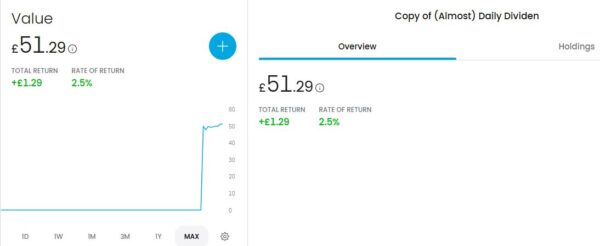
In 2022 I set up an account with investment and trading platform eToro, using their popular ‘copy trader’ facility. I chose to invest $500 (then about £412) copying an experienced eToro trader called Aukie2008 (real name Mike Moest).
In January 2023 I added to this with another $500 investment in one of their thematic portfolios, Oil Worldwide. I also invested a small amount I had left over in Tesla shares.
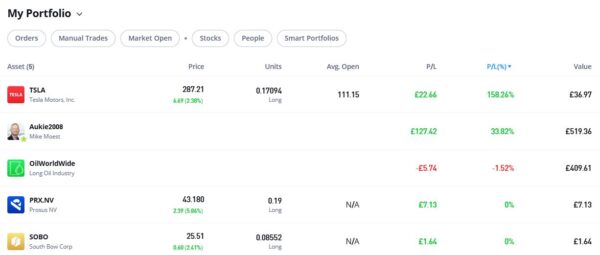
As you can see from the screen captures below, my original investment (total value £888.36 in pounds sterling) is today worth £975.36, an overall increase of £87 or 9.79%.
Note: eToro now displays the value of investments in your native currency, although you can change this if you wish.
As you can see, my Oil WorldWide investment has seen a downturn in April and is actually worth marginally less than when I invested. That’s clearly disappointing after last month’s improvement, but reflects the global economic turmoil caused largely by US President Trump’s tariffs.
Thankfully my copy trading investment with Aukie2008 has been doing better, with an overall 33.82% profit. To be fair, I have held this investment a little longer.
My Tesla shares, which I bought as an afterthought with a bit of spare cash I had in my account, have done particularly well since I bought them, with an overall profit of 158.24%. If only I had put a bit more money into this!
You might also notice that I have small holdings in Prosus NV, a Dutch internet group, and South Bow, a Canadian energy infrastructure company. To be honest I don’t understand how I acquired these, but I assume they are some sort of bonus I was awarded. In any event, I am happy to have them in my portfolio!
eToro also offer the free eToro Money app. This allows you to deposit money to your eToro account without paying any currency conversion fees, saving you up to £5 for every £1,000 you deposit. You can also use the app to withdraw funds from your eToro account instantly to your bank account. I tried this myself and was impressed with how quickly and seamlessly it worked. You can read my blog post about eToro Money here. Note that it can also serve as a cryptocurrency wallet, allowing you to send and receive crypto from any other wallet address in the world.
If you would like more information about setting up an eToro account, please click on this no-obligation website link [affiliate]. Don’t forget that you also get a free $100,000 virtual portfolio, which you can use to experiment with trading and investing strategies. I have certainly earned a lot from mine.
Moving on, as I said last time, I am no longer writing for the Mouthy Money website, as they have decided to take their content creation in-house. From a personal perspective I am obviously disappointed about this, but I had a good run with them and wish them every success going forward. You can still read all the articles I contributed to Mouthy Money over the years by visiting my profile page on the website. How long they will keep this in place I really can’t say!
In April I did have a guest post on my friend Sally Jenkins’ writing blog. Sally asked me some questions about my writing career for a regular feature she runs on her blog. I enjoyed answering the questions, which included “What are the most important qualities required by a writer?” and “What writing resources have you found most useful?” If you have any interest in writing, hopefully you may find this of interest.
I also published several posts on Pounds and Sense in April. I have listed below those that are still relevant
In Why Now Could Be the Ideal Time to Take Advantage of Your New Tax-Free ISA Allowance, I pointed out that everyone received a new £20,000 ISA allowance from the start of the new tax year on 6 April 2025. My article sets out some good reasons for taking advantage of the new allowance sooner rather than later, especially in light of persistent rumours that the government plans to restrict the allowance (for cash ISAs at any rate) in the autumn budget.
Why Has My Bank Abandoned Me? is an opinion piece by a writer friend who has asked to be known at SD. In it she laments the changes at UK banks in recent years that have hit older customers (in particular) hard. I could certainly relate to some of the experiences she describes in her article. Take a look and see if you agree.
I’ve already mentioned my post about Why UK Retirees Shouldn’t Panic Over Trump’s Tariffs and Market Wobbles. In this I pointed out that whilst the recent downturn is disappointing for investors, the worst thing you can do is panic and sell up, as this will crystallize your losses. In this post I draw a parallel with the Covid crash and point out that this was followed by a sustained rise in stock market values. Of course, nobody knows how current events will play out, but hopefully the upward trend seen over the last couple of weeks will continue. In any event, historically stocks and shares have delivered better returns than savings accounts over most periods of five years or longer.
Tow Like a Pro – Caravan Safety Tips From the Experts was a guest post from my friends at Compass, who are specialist leisure and caravan insurers. The post reveals the most common causes of accidents with caravans and sets out some top tips for staying safe when towing one.
Finally, How to Publish Your Book (and Earn Royalties) was a guest post from my writing friend Sally Jenkins (as mentioned earlier I had a guest post published myself on Sally’s blog in April). In her article, which generated a lot of interest, Sally set out the main options for getting a book published and making money from it. She also revealed some resources she has used herself in her successful freelance writing career.
I’ll close with a reminder that you can also follow Pounds and Sense on Facebook or Twitter (or X as we have to call it now). Twitter/X is my number one social media platform and I post regularly there. I share the latest news and information on financial matters, and other things that interest, amuse or concern me. So if you aren’t following my PAS account on Twitter/X, you are definitely missing out.
I am also on the BlueSky social media network under the username poundsandsense.bsky.social. For the time being anyway, Twitter/X will remain my primary social media platform, but I will also post details of my latest blog posts, third-party articles and other financial news and resources on BlueSky for those who prefer to follow me there.
As always, if you have any comments or questions, feel free to leave them below. I am always delighted to hear from PAS readers
Disclaimer: I am not a qualified financial adviser and nothing in this blog post should be construed as personal financial advice. Everyone should do their own ‘due diligence’ before investing and seek professional advice if in any doubt how best to proceed. All investing carries a risk of loss.
Note also that posts on PAS may include affiliate links. If you click through and perform a qualifying transaction, I may receive a commission for introducing you. This will not affect the product or service you receive or the terms you are offered, but it does help support me in publishing PAS and paying my bills. Thank you!
If you enjoyed this post, please link to it on your own blog or social media:
As of 6 April 2025, UK investors have a fresh chance to supercharge their savings and investments with a new £20,000 Individual Savings Account (ISA) allowance.
To maximize the benefits of the new 2025/26 allowance, there’s a strong case for acting swiftly and using at least part of your £20,000 ISA allowance sooner rather than later. This is due to the power of compounding. By investing early, you give your money more time to grow, benefiting from the potential snowball effect of returns generating further returns. So the sooner you invest that £20,000 (assuming you are fortunate enough to have it) the more opportunity it has to multiply over time.
Another reason to use your ISA allowance sooner rather than later is that there are reports that Chancellor Rachel Reeves is considering slashing the tax-free allowance for cash ISAs in particular, potentially to as little as £4,000 a year. It’s probable there will be an announcement about this in the Autumn Budget. Any change is highly unlikely to be backdated, however – so taking advantage of the full allowance now could be a canny move.
In addition to the tax-free ISA allowance remaining at a relatively generous £20,000 (for now), the rules surrounding ISAs have recently undergone a welcome relaxation. One of the most significant changes is the ability to open more than one ISA of the same type (e.g. a stocks and shares ISA) with different providers in the same tax year. This means investors are no longer limited to a single provider for each type of ISA, giving them greater flexibility and choice in managing their investments.
Previously, investors were restricted to opening one cash ISA, one stocks and shares ISA and one innovative finance ISA (IFISA) per tax year. This restriction could prove frustrating for those seeking to diversify their investments or take advantage of new opportunities as the tax year progressed. Now, with the freedom to open multiple ISAs of the same type, investors can shop around for the best rates, terms and investment options without being limited to a single provider for each ISA type. They can also move some or all of their money from one provider to another without jeopardizing its tax-free status.
It’s important to note, however, that while the rules have been relaxed, the overall annual ISA allowance remains fixed at £20,000. This means that any contributions made across multiple ISAs of any type will count towards your total allowance for the tax year. You should still therefore take care not to exceed the annual limit to avoid any potential tax charges.
Cash ISAs offer a secure and accessible way to save, providing a tax-free environment for your savings with the added benefit of easy access to your funds when needed. Meanwhile, stocks and shares ISAs open the door to potential higher returns by investing in a wide range of assets such as equities, bonds, and funds, albeit with a higher level of risk. With a stocks and shares ISA you will never incur any liability for dividend tax, capital gains tax or income tax, even if your investments perform exceptionally well. Of course, there is no guarantee this will happen, but over a longer period stock market investments have typically outperformed cash savings, often by a substantial margin. IFISAs (e.g. from Housemartin) allow you to invest is property crowdfunding and other forms of peer-to-peer finance. They are more specialized, but may appeal to some investors looking to further diversify their portfolios.
In recent years I have invested much of my own annual ISA allowance in a stocks and shares ISA with Nutmeg, a robo-manager platform that has produced good returns for me. You can read my in-depth review of Nutmeg here if you wish.
Closing Thoughts
The start of a new financial year is a great time for UK investors to review their savings and investment strategies. Whether you’re looking to start a new ISA or maximize your contributions to existing accounts, taking action early can set you on the path to optimizing your returns from this important tax-saving opportunity.
By investing sooner rather than later and taking advantage of the increased flexibility in ISA provider options, savers and investors can make the most of their money while minimizing their tax liabilities. So seize this opportunity to build your wealth and protect it from the taxman today!
As always, if you have any comments or questions about this post, please do leave them below.
Disclaimer: I am not a qualified financial adviser and nothing in this blog post should be construed as personal financial advice. Everyone should do their own ‘due diligence’ before investing and seek professional advice if in any doubt how best to proceed. All investing carries a risk of loss.
If you enjoyed this post, please link to it on your own blog or social media:
Today I am sharing something a bit different – an opinion piece by a fellow writer who asks to be known as SD.
In her article, SD expresses her frustration with banks who no longer seem to care about their customers, especially the older ones. I guess this is something many Pounds and Sense readers may be able to relate to.
Over to SD, then…
I just read in the news about yet another banking app outage – this time, with serious consequences. Salaries were delayed, house moves disrupted, and critical money transfers put on hold. Everything ground to a halt, with no clear resolution in sight. And it got me thinking – if AI is so advanced, why can’t it fix outages like this?
Paying bills was stalled, and customers were understandably frustrated. These outages seem to be happening far too often. Yes, it’s 2025, but are our banking systems really ready for a fully digital future?
Not long ago, I was a customer of a high street bank. After years of in-person banking, staff encouraged me to “go digital” and use their app. I was reluctant. As someone who experiences anxiety and panic attacks, I find complex IT systems overwhelming. I’m over 57 – I wasn’t raised in the digital age.
Despite me sharing my concerns, the bank staff didn’t really listen. A sign on the wall said “Not all disabilities are visible”, yet this clearly didn’t apply to me. My local branch, which was always busy, was shut down – ATM and all. Another nearby branch followed suit. There was one left five miles away, but eventually even that became digital only.
When I visited and explained my situation, I was told bluntly that I couldn’t be helped – there were no counters any more. I didn’t need anything complicated. Just a basic, face-to-face banking service. Instead, I was simply dismissed. Invisible disabilities, it seems, were invisible to them too.
So I closed my account and went to another high street bank – only to be met with more unwelcome change. Gone was the polished wood floor and staffed counters. In their place: low, foam seats and whiteboards hiding the old counter space. It felt less like a bank and more like a waiting room.
These trendy seating areas? Not great if you’re elderly or disabled.
Still, I figured sitting here was better than trying to deal with a chatbot. Banks think chatbots are a great innovation, but they’re not yet smart enough to help with specific, real-world banking issues. I’ve tried. It’s frustrating. And I thought AI was supposed to solve problems?
There were only three staff members at the new branch, all run off their feet. When I asked about opening a new account, I was told I needed a smartphone. I declined and walked out.
If they still had real counters and six staff members, people might not mind standing in line. They’d actually get served.
Which brings me back to banking app outages – again. They’re frequent, disruptive, and a growing source of frustration. Yet I was told digital banking was “the future” and that I’d be left behind if I didn’t.
Tell that to the millions of customers now stuck in this digital mess. It’s a financial farce.
Call me a tech dinosaur, but I truly believe shutting down mass branches was one of the worst decisions banks ever made. Staff lost jobs. Customers lost peace of mind.
It all worked just fine – until the banks decided to “modernize”.
Yes, a few banking hubs have popped up. But most town-centre branches now sit empty, derelict, and forgotten. It’s a sad waste of once-useful community spaces.
Many thanks to SD for a thought-provoking (and clearly heart-felt) article.
I do agree that the so-called digital revolution has made life harder for many older people and those with disabilities. Yes, some have taken to banking apps and online banking without major issues. I have a friend in his eighties to whom I had to give a crash course after his wife (who previously handled all their finances) passed away. Despite my concerns he soon got the hang of it and uses his bank’s app like a professional now.
But plenty of older people do struggle, especially with apps and complicated online security systems. And clearly it doesn’t help if your memory and eyesight aren’t as good as they once were. I can understand why so many older folk yearn for times gone by, when you could speak to a real-life individual and they would help you with whatever issues you might be having.
But what do YOU think? Have the banks really abandoned older customers, or do we just need to accept change and “get with the programme”? I’d love to hear your views and experiences, as would SD!
If you enjoyed this post, please link to it on your own blog or social media:
If you’ve been watching the news lately, you’ll probably have seen headlines about stock markets taking a tumble thanks to a wave of tariffs announced by Donald Trump. It’s enough to make any retiree feel uneasy – especially if your pension is tied to the markets.
But before you start panicking or making any big changes, take a deep breath. Here’s what you really need to know.
Table of Contents
What’s Going On?
President Trump’s tariffs are stoking fears of a global trade war. Investors don’t like uncertainty, and the markets are reacting with volatility. There have been drops not just in the US but across the globe, including here in the UK.
For retirees, that can feel personal. If your pension pot or retirement income is invested in stocks and shares, you might be wondering: Am I going to be okay?
Short answer: Yes, if you stay calm and avoid knee-jerk reactions.
Why This Isn’t the Time to Panic
Markets have always had ups and downs. That’s not new. Whether it was the financial crisis of 2008, the Brexit vote, or the COVID crash (see below), every downturn has sooner or later been followed by recovery.
If you sell investments during a dip, you lock in those losses. But if you ride it out, your portfolio has every chance to bounce back, as has happened before. History is on your side.
Speaking of which…
Consider The Covid Crash
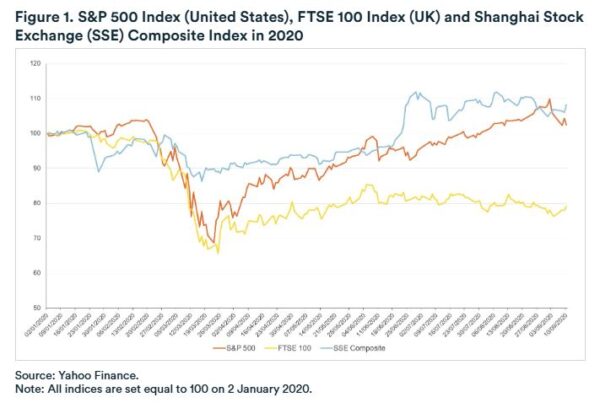
In early 2020 it became clear that COVID was going to be a massive deal, and markets world-wide fell dramatically. And yet by mid-March, as the chart below from Yahoo Finance reveals, they were already recovering.
The recovery in stock market values continued through 2021. If you check out my in-depth review of the Nutmeg robo-adviser investment platform, you can see this for yourself. Overall, the period from March 2020 to December 2021 saw a big rise in the value of my Nutmeg investments. If I had panicked in early 2020 and withdrawn all my money then, I would certainly have been thousands of pounds worse off.
Your Pension Is Built to Withstand This
Most UK pensions – especially workplace and private pensions – are designed for long-term sustainability. They’re usually diversified across different types of assets like stocks, bonds and property. This helps soften the blow when markets get rocky.
If you have a defined benefit pension, you’re likely shielded from market fluctuations altogether. These pensions pay a fixed income and aren’t directly tied to the stock markets.
For those with defined contribution pensions – the majority of us these days – yes, the value can go up and down. But remember, pensions are managed by professionals who adjust strategies to navigate global changes like the current one.
What You Can Do (Instead of Worrying)
Check in with your adviser – They can help you understand how exposed your pension is to current events and whether any changes are needed. See also my article on Why Over-50s May Need an Independent Financial Adviser.
Keep a cash buffer – If possible have a few months’ worth of living expenses in cash or savings, so you’re not forced to sell your investments during market lows.
Stay diversified – A mixture of investments across regions and sectors helps spread risk.
Ignore the noise – Newspaper headlines are designed to grab attention. Focus on your long-term goals instead.
One other point is that, if you’re in the early days of retirement especially, dips can present an opportunity to buy while values are depressed, in the hope of gaining when (hopefully) they recover. This won’t be appropriate for everyone and it’s important to proceed cautiously. Timing the market is notoriously difficult, and if you get this wrong you can lose money rather than making it. But if you are careful (and not overly risk-averse) there are undoubtedly opportunities to be found at these times.
Bottom Line
Trump’s tariffs might be shaking the markets, but your retirement doesn’t have to be shaken with them. Your pension plan is more robust than you might think, and a temporary dip doesn’t mean disaster.
If you’re feeling anxious, that’s normal – but don’t let fear drive your financial decisions. Speak to a financial adviser if you need reassurance (I have one myself) and above all, keep your cool. Retirement is a long game, and a smart strategy will see you through.
As always, if you have any comments or questions about this article, please do leave them below.
DISCLOSURE: I am not a professional financial adviser and nothing in this article should be construed as personal financial advice. If you are uncertain how best to proceed, I strongly recommend speaking to a qualified financial adviser or planner. They will take the time to fully understand your particular circumstances and advise you how best to proceed. All investing carries a risk of loss.
If you enjoyed this post, please link to it on your own blog or social media:
The weather is warming up at last. And that means many Brits will be planning a trip with a caravan, in some cases for the first time.
So today I’m sharing some top tips to ensure you (and your caravan) stay safe and reach your destination without any dramas. This post has been written in association with my friends at Compass, who are specialists in caravan and leisure insurance
As staycations continue to boom across the UK, more and more drivers are taking to the roads with caravans in tow. But with this rise in travel comes a sharp reminder: towing a caravan can be tricky, especially for the inexperienced.
According to recent claims data from Compass, a whopping 60.5% of touring caravan insurance claims are due to accidental damage. With the Easter holidays almost here and thousands of caravan enthusiasts preparing for trips, taking precautions on the road is more important than ever.
The Most Common Causes of Accidental Damage
Accidents often occur during reversing, navigating tight spots, or colliding with stationary objects like posts and curbs. Kevin Minnear, Head of Underwriting at Compass, explains:
“Accidental damage claims typically arise from drivers struggling with visibility and alignment when reversing. Misjudging turn angles or road positioning can result in costly repairs. Swaying at high speeds or during windy conditions is also a major factor, particularly for less experienced drivers.”
Caravan sites, service stations, and even parking areas can become challenging environments for manoeuvring, especially without prior practice or the right equipment.
Top Towing Tips to Help Prevent Accidents
To help you stay safe and avoid unnecessary claims, Compass shares these essential towing safety tips:
Check your towing match: Make sure your vehicle is suitable for towing your caravan. A good rule of thumb is the 85% rule – your caravan’s laden weight should not exceed 85% of your car’s kerb weight.
Distribute weight wisely: Keep heavy items low and close to the axle to maintain balance and reduce the risk of swaying.
Practice makes perfect: Reversing and manoeuvring can be difficult – especially under pressure. Practice in a quiet, open space and consider using a spotter or installing a reversing camera.
Adjust your driving: Towing affects acceleration, braking, and cornering. Drive at moderate speeds, allow for longer stopping distances, and watch out for crosswinds.
Run pre-journey checks: Check tyre pressures, lights, towing connections, wheel nuts, and mirrors before every trip.
Know the law: Ensure you have the correct driving licence and stick to legal speed limits: 60 mph on motorways and dual carriageways, and 50 mph on single carriageways.
Insurance and Training Matter
With accidental damage such a common issue, having the right insurance is crucial. Caravan insurance is separate from car insurance and is necessary to cover damages specific to your caravan.
Minnear adds:
“Many caravan accidents are avoidable with the right precautions. We encourage all caravan owners to familiarize themselves with safe towing practices and ensure their insurance covers what they need. DVSA-accredited towing courses are a great way to build confidence – and some insurers even offer discounts to those who complete them.”
As more Brits embrace caravanning, being informed and prepared is key – not only for protecting your caravan but also for ensuring your family’s safety and that of others on the road.
For more information about specialist caravan and leisure insurance, visit compass.co.uk.
Many thanks again to my friends at Compass for their assistance with this article. If you’re holidaying in a caravan this Easter – or later in the summer – I do hope your journey is both safe and enjoyable.
Happy caravanning!
As always, if you have any comments or questions about this article, please do leave them below.
If you enjoyed this post, please link to it on your own blog or social media:
Today I’m pleased to bring you a guest post from my friend and near-neighbour Sally Jenkins, a successful published fiction and non-fiction author (check out her latest novel Out of Control – a later-life romance perfect for summer holiday reading!).
Many older people (in particular) harbour an ambition to write a book and make money from it. If that includes you, I hope you will find Sally’s article of interest. In it she sets out the main options for getting your book published, and shares some valuable resources she has found.
Over to Sally then…
Everyone has at least one book in them, or so the saying goes. It might be a thriller, a memoir, a collection of poems or short stories, a ‘how-to’ non-fiction manual or something completely different. Finishing that manuscript is a laudable achievement in itself but don’t stop there. It takes guts to send any literary work out into the public arena; however, doing so can lead to an additional passive income stream in the form of royalties that continue to hit your bank account long after you’ve finished writing.
There are three main routes to publication that you might like to consider:
Traditional Publishing
Traditional publishers come in all shapes and sizes, from the giants like Penguin and Hachette to far smaller, less well-known companies who publish in e-book format only.
Traditional publishers bear all the costs of publishing a book, meaning there is no financial risk for the author. These costs may include editing, proofreading, cover design, marketing and the printing of physical copies. The author contributes nothing to these costs and receives a small royalty for each copy of the book sold.
The competition to be signed by a traditional publisher is fierce and only a very small number of authors are taken on. The larger companies will only accept manuscript submissions via a literary agent but it is possible for authors to submit directly to many of the small publishing houses. There is nothing to lose by trying this traditional route but be prepared to develop a thick skin to deal with the probable rejections. A good place to start is an up-to-date copy of the Writers’ and Artists’ Yearbook, which contains a comprehensive list of publishers and literary agents.
Partnership Publishing
In the partnership publishing model, the publisher and the author share the financial risk of publishing the book. This means the author will be asked to make a financial contribution towards the publishing costs. What proportion and how much this means in monetary terms will vary from company to company, so it’s worth approaching more than one partnership publisher and requesting explicit information about their offering. In return for contributing to the publishing costs, the author can expect to receive a higher percentage of royalty payments than under the traditional model.
However, care is needed when choosing a partnership company to work with – there are many rogue or ‘vanity’ publishers out there who will publish anything and charge a lot of money for very little service. Ensure that the company you choose has a manuscript selection process – even if this means you might face rejection as in the traditional model. A true partnership publisher will only publish books that it thinks have merit and will sell. Even so, there is no guarantee that you will recoup all or any of your publishing costs via royalties. Do not spend more than you can afford to lose.
Authors who self-publish carry all the financial risk themselves but retain all the royalties (bar the amount taken by distribution platforms such as Amazon). It is possible to self-publish on Amazon at no cost or you might choose to spend hundreds of pounds depending on what services you buy in. The main services requiring financial outlay will be:
Cover Design – don’t attempt this yourself unless you are a graphic designer with a knowledge of the book covers currently selling in your genre. An amateur cover design will be obvious and off-putting to potential readers.
Editing – a novel (particularly a first novel) may benefit from a full structural edit. This will advise on plot, character development, pace etc. You might also want to consider a sentence level copyedit and/or proofread.
Formatting – some authors pay for this but, with a little patience, anyone who can use Microsoft Word can do this themselves.
Printing – there is no need to pay for a print run of books and hold them in stock.
Amazon (and other companies) use print-on-demand (POD) technology. This means that when someone orders a copy of your book it is printed individually and sent direct to the customer. Authors can also order copies at a reduced rate to sell direct to friends, family or the public at large.
The Alliance of Independent Authors has a directory of reputable editors, cover designers, proofreaders, etc. The directory also lists companies who can offer a complete self-publishing service for authors who don’t want to do any of the leg work – but this can be very expensive. As with partnership publishing, never spend more than you can afford to lose.
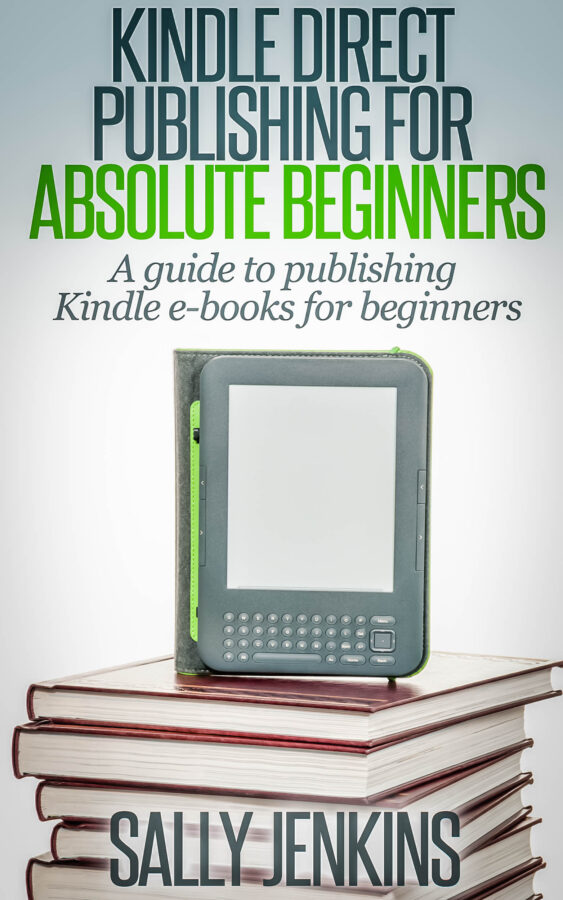
If you would like to know more about low-cost self-publishing via Amazon, the e-book Kindle Direct Publishing for Absolute Beginners (pictured, left) offers a good introduction. If you don’t currently read on Kindle, download the free Kindle app to your laptop, tablet or smartphone.
Whichever publishing route you choose, enjoy the journey and the royalties!
Bio: Sally Jenkins (pictured, right) currently writes uplifting and hopeful novels for the traditional publisher Choc Lit (part of Joffe Books). She has also had a novel published in partnership with The Book Guild and has self-published several books via Amazon KDP. When not at the keyboard, she feeds her addiction to words by working part-time in her local library and running two reading groups. Sally can also be found walking, church-bell ringing and enjoying shavasana in her yoga class. Follow her writing blog at https://sally-jenkins.com/.
If you enjoyed this post, please link to it on your own blog or social media:
Here is my latest monthly update about my investments (slightly earlier than usual due to other commitments). You can read my March 2025 Investments Update here if you like.
I’ll begin as usual with my Nutmeg Stocks and Shares ISA. This is the largest investment I hold other than my Bestinvest SIPP (personal pension).
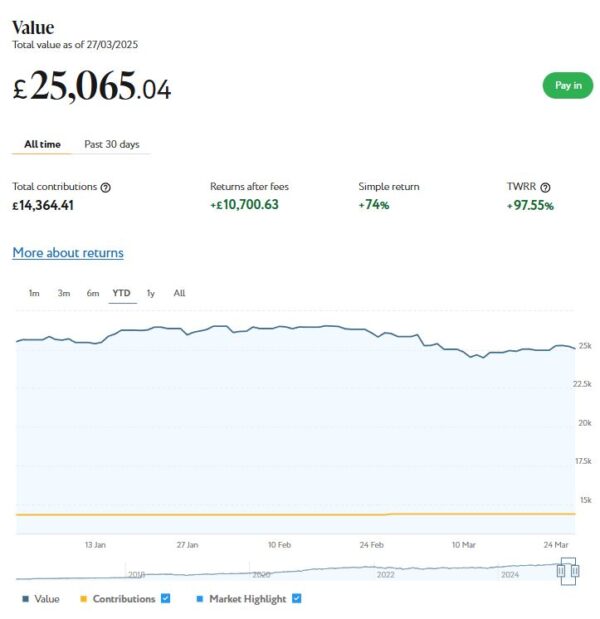
As the screenshot below for the year to date shows, my main Nutmeg portfolio is currently valued at £25,065. Last month it stood at £25,850, so that is a drop of £785.
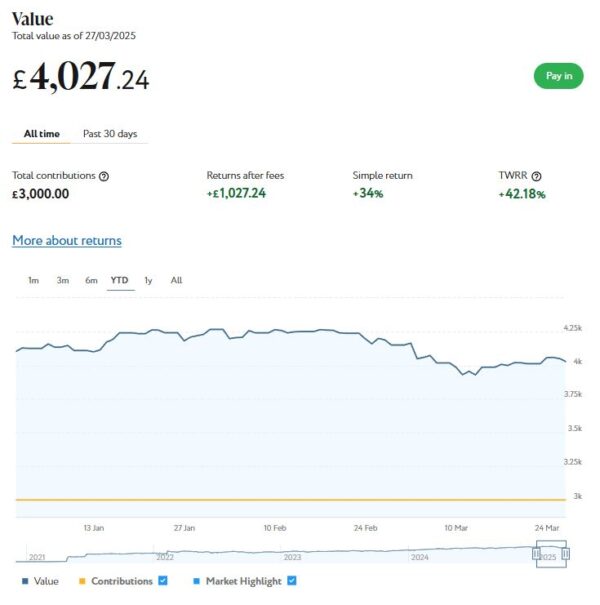
Apart from my main portfolio, I also have a second, smaller pot using Nutmeg’s Smart Alpha option. This is now worth £4,027 compared with £4,151 a month ago, a fall of £124. Here is a screen capture showing performance for the year to date.
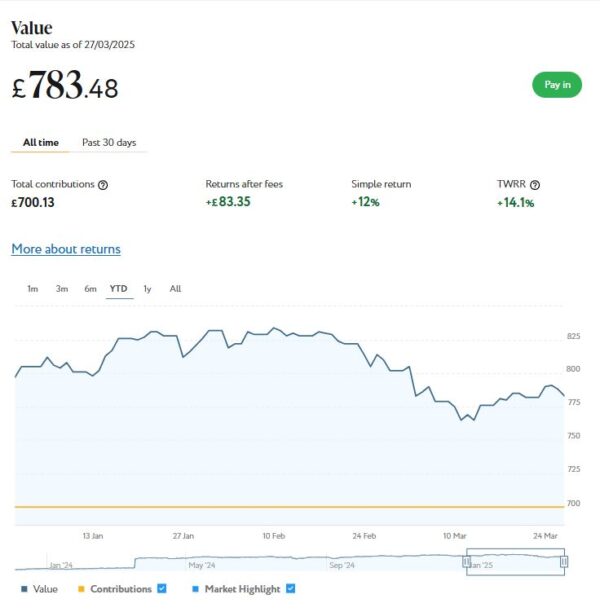
Finally, at the start of December 2023 I invested £500 in one of Nutmeg’s new thematic portfolios (Resource Transformation). In March I also invested a further £200 from referral bonuses. As you can see from the YTD screen capture below, this portfolio is now worth £783 compared with £803 last month, a fall of £20.
As you can see, March has been another disappointing month for my Nutmeg investments. Overall I am down by £929. This is mostly due to the continuing instability in world markets, caused by the the trade tariffs imposed by US President Donald Trump and other economic and social factors.
Nonetheless, the value of my Nutmeg investments is still up £1,477 in the last twelve months. And their value has increased by £3,559 or 13.52% since the start of January 2024. So the recent falls do need to be taken in context. Ups and downs are always to be expected with stock market investments, and over time they tend to even themselves out. In general the worst thing you can do is panic and sell up when downturns occur, as you are then crystallizing your losses. Indeed, I am considering topping up some of my investments now while values are depressed. That’s just how I’m thinking, of course, and doesn’t constitute investment advice!
You can read my full Nutmeg review here. If you are looking for a home for your annual ISA allowance, based on my overall experience over the last eight years, they are certainly worth considering. They offer self-invested personal pensions (SIPPs), Lifetime ISAs and Junior ISAs as well.
Moving on, I also have investments with P2P property investment platform Assetz Exchange. As discussed in this recent post, the company recently rebranded as Housemartin.
My investments with Housemartin continue to generate steady returns. Housemartin focuses on lower-risk properties (e.g. sheltered housing). I put an initial £100 into this in mid-February 2021 and another £400 in April. In June 2021 I added another £500, bringing my total investment up to £1,000.
Since I opened my account, my HM portfolio has generated a respectable £238.70 in revenue from rental income. Capital growth has slowed, though, in line with UK property values generally.
At the time of writing, 15 of ‘my’ properties are showing gains, 2 are breaking even, and the remaining 19 are showing losses. My portfolio of 36 properties is currently showing a net decrease in value of £52.78, meaning that overall (rental income minus capital value decrease) I am up by £185.92. That’s still a decent return on my £1,000 and does illustrate the value of P2P property investments for diversifying your portfolio. And it doesn’t hurt that with Housemartin most projects are socially beneficial as well.
The overall fall in capital value of my Housemartin investments is obviously a little disappointing. But it’s important to remember that until/unless I choose to sell the investments in question, it is largely theoretical, based on the latest price at which shares in the property concerned have changed hands. The rental income, on the other hand, is real money (which in my case I’ve reinvested in other HM projects to further diversify my portfolio).
To control risk with all my property crowdfunding investments nowadays, I invest relatively modest amounts in individual projects. This is a particular attraction of Housemartin as far as i am concerned. You can actually invest from as little as £1 per property if you really want to proceed cautiously.
As I noted in this blog post, Housemartin is particularly good if you want to compound your returns by reinvesting rental income. This effectively boosts the interest rate you are receiving. Personally, once I have accrued a minimum of £10 in rental payments, I reinvest this money in either a new HM project or one I have already invested in (thus increasing my holding). Over time, even if I don’t invest any more capital, this will ensure my investment with Housemartin grows at an accelerating rate and becomes more diversified as well.
In 2022 I set up an account with investment and trading platform eToro, using their popular ‘copy trader’ facility. I chose to invest $500 (then about £412) copying an experienced eToro trader called Aukie2008 (real name Mike Moest).
In January 2023 I added to this with another $500 investment in one of their thematic portfolios, Oil Worldwide. I also invested a small amount I had left over in Tesla shares.
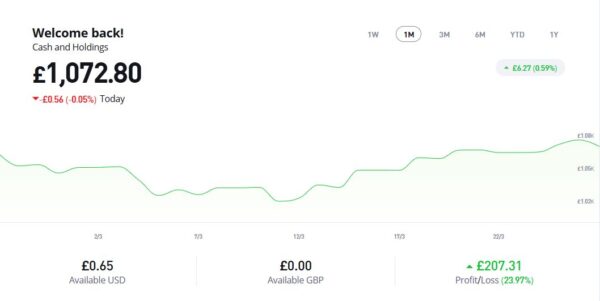
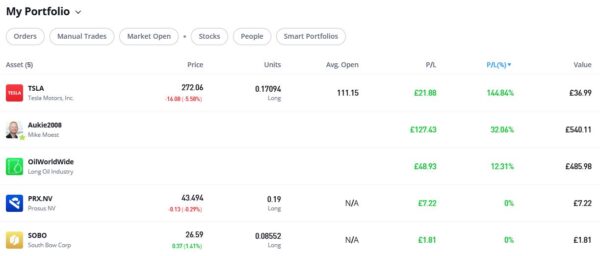
As you can see from the screen captures below, my original investment (total value £888.36 in pounds sterling) is today worth £1,072.80, an overall increase of £184.44 or 20.76%.
Note: eToro now displays the value of investments in your native currency, although you can change this if you wish.
As you can see, my Oil WorldWide investment is currently showing a profit of 12.31%. That’s a welcome improvement since the portfolio was rebalanced by eToro. The investment team at eToro periodically rebalance all smart portfolios to ensure that the mix of investments remains aligned with the portfolio’s goals, and to take advantage of any new opportunities that may present themselves.
My copy trading investment with Aukie2008 has been doing better, with an overall 32.06% profit. To be fair, I have held the latter investment a bit longer.
My Tesla shares, which I bought as an afterthought with a bit of spare cash I had in my account, have done particularly well since I bought them, with an overall profit of 144.84%. If only I had put a bit more money into this!
You might also notice that I have small holdings in Prosus NV, a Dutch internet group, and South Bow, a Canadian energy infrastructure company. To be honest I don’t understand how I acquired these, but I assume they are some sort of bonus I was awarded. In any event, I am happy to have them in my portfolio!
eToro also offer the free eToro Money app. This allows you to deposit money to your eToro account without paying any currency conversion fees, saving you up to £5 for every £1,000 you deposit. You can also use the app to withdraw funds from your eToro account instantly to your bank account. I tried this myself and was impressed with how quickly and seamlessly it worked. You can read my blog post about eToro Money here. Note that it can also serve as a cryptocurrency wallet, allowing you to send and receive crypto from any other wallet address in the world.
If you would like more information about setting up an eToro account, please click on this no-obligation website link [affiliate]. Don’t forget that you also get a free $100,000 virtual portfolio, which you can use to experiment with trading and investing strategies. I have certainly earned a lot from mine.
Moving on, as I said last time, I am no longer writing for the Mouthy Money website, as they have decided to take their content creation in-house. From a personal perspective I am obviously disappointed about this, but I had a good run with them and wish them every success going forward. You can still read all the articles I contributed to Mouthy Money over the years by visiting my profile page on the website. How long they will keep this in place I really can’t say!
I also published several posts on Pounds and Sense in March. Some are no longer relevant, but I have listed the others below.
In Beat the Postage Stamp Price Rise!, I pointed out that stamp prices are rising again on 7th April 2025. This will actually be the the SIXTH rise in the price of first class stamps in just three years. See what prices are going up, along with my recommendations for mitigating the effects of the increases.
And in From Saving to Spending – The Retirement Mindset Shift I discussed a subject that has been on my mind recently as I enter my 70th year. This is how to negotiate the mindset shirt from saving to spending in retirement, and how (hopefully) to get the balance right.
The Pros and Cons of Investing for Dividends discusses a strategy that has been growing in popularity with older investors particularly. Dividend investing offers the potential for generating income combined with capital appreciation. In this post I examine the pros and cons of a dividend investing strategy and set out a few tips and guidelines for those new to this.
Finally, in Spotlight: The Mintos P2P European Investing Platform I take a closer look at Mintos, Europe’s largest P2P investment platform. As well as the ability to generate above-average returns by investing in loans to businesses world-wide, they have added new diversification options, including bonds, ETFs and real estate. And until the end of April they have a bonus offer for anyone investing €1,500 or above on the platform. In my blog post I look at the pros and cons of investing with Mintos and provide more details about their April bonus offer.
One other thing is that we’re currently just over a week away from the end of the 2024/25 financial year. If you still haven’t used all of your 2024/25 £20,000 tax-free ISA allowance, you have just a few days left before it’s gone. It is more important than ever to use all your tax-free allowances while you can, as the government looks set to reduce some of these allowances later in the year. See my recent blog post for more information.
I’ll close with a reminder that you can also follow Pounds and Sense on Facebook or Twitter (or X as we have to call it now). Twitter/X is my number one social media platform and I post regularly there. I share the latest news and information on financial matters, and other things that interest, amuse or concern me. So if you aren’t following my PAS account on Twitter/X, you are definitely missing out.
I am also on the BlueSky social media network under the username poundsandsense.bsky.social. For the time being anyway, Twitter/X will remain my primary social media platform, but I will also post details of my latest blog posts, third-party articles and other financial news and resources on BlueSky for those who prefer to follow me there.
As always, if you have any comments or questions, feel free to leave them below. I am always delighted to hear from PAS readers
Disclaimer: I am not a qualified financial adviser and nothing in this blog post should be construed as personal financial advice. Everyone should do their own ‘due diligence’ before investing and seek professional advice if in any doubt how best to proceed. All investing carries a risk of loss.
Note also that posts on PAS may include affiliate links. If you click through and perform a qualifying transaction, I may receive a commission for introducing you. This will not affect the product or service you receive or the terms you are offered, but it does help support me in publishing PAS and paying my bills. Thank you!
If you enjoyed this post, please link to it on your own blog or social media:












 I also published several posts on




 The recovery in stock market values continued through 2021. If you check out my in-depth


 Bio: Sally Jenkins (pictured, right) currently writes uplifting and hopeful novels for the traditional publisher