property

Why You Should Beware of Going All-In on Electricity

Why You Should Beware of Going ‘All-In’ on Electricity

In my update today, I’m focusing on a topic that has become of growing concern to me in recent months.

Over the past decade, UK households have been encouraged to electrify almost everything. Cars are going electric. Gas boilers are being phased out in favour of heat pumps. Even cooking is increasingly moving from gas to electricity.

On paper, this all fits with the Government’s drive towards Net Zero. But there’s a growing issue that doesn’t get discussed nearly enough: What happens if the electricity supply isn’t always there when you need it?

As we look ahead to the coming years, relying solely on electricity to power and heat your home could leave you exposed – financially and practically.

Growing Pressure on the UK’s Electricity System

Electricity demand in the UK is set to rise sharply. Two of the biggest drivers are:

  • Electric vehicles (EVs) – millions of households charging cars at home, often at similar times of day

  • Electric heat pumps – particularly air-source heat pumps, which draw large amounts of power in cold weather

At the same time, electricity generation is becoming increasingly weather-dependent. Wind and solar are growing fast, but they don’t always produce power when demand is highest – especially during cold, still winter evenings when heating demand peaks.

The National Grid has so far managed to keep the lights on, but it has done so by relying on emergency measures, reserve power contracts and public appeals to reduce usage at peak times. That’s a sign of a system under strain.

The Risk of Power Cuts Is Increasing, Not Decreasing

While widespread blackouts are still relatively rare, the risk of localised or short-term power cuts is rising.

Reasons include:

  • an ageing electricity distribution network

  • rapid increases in peak demand

  • greater reliance on intermittent renewable generation

  • delays and cost overruns in upgrading grid infrastructure

For households that depend entirely on electricity for heating, hot water and cooking, even a short power cut in winter can quickly become a serious problem.

When Electricity Goes Off, Everything Stops

If your home uses electric heating only:

  • heat pumps stop working

  • electric radiators go cold

  • immersion heaters stop producing hot water

  • induction hobs and electric ovens are unusable

By contrast, homes with non-electric power and heating options retain a degree of resilience. That resilience has real value, particularly for older people, families with young children, or anyone living in rural areas where power cuts tend to last longer.

Diversification Isn’t Just for Investments

Regular readers of Pounds and Sense will be familiar with the idea of diversification. You wouldn’t normally put all your savings into a single investment – and the same principle applies to household energy.

Having more than one way to heat your home reduces risk and gives you flexibility when prices spike or supplies are disrupted.

Alternative and Backup Heating Options to Consider

Here are some heating methods that can be used instead of, or alongside, electricity:

Gas Heating (Where Available)

Despite its declining popularity in policy circles, mains gas remains:

  • reliable

  • relatively inexpensive

  • highly controllable

  • independent of the electricity grid (for heat, though central heating boilers still need some power to operate)

A gas boiler can continue to provide warmth during electricity shortages if paired with a simple backup power source, such as a home storage battery or generator. In addition, most free-standing gas fires can operate without any need for electricity.

Wood-Burning or Multi-Fuel Stoves

A solid fuel stove can be an excellent backup heat source:

  • operates independently of electricity

  • provides direct radiant heat

  • can often heat a large living space effectively

Modern stoves are far cleaner and more efficient than older open fires, though fuel storage and local air-quality rules must be considered.

Open Fires and Solid Fuel Fires

While less efficient than stoves, open fires still provide:

  • a non-electric source of heat

  • emergency warmth during prolonged outages

They can also burn a range of fuels, depending on the fireplace and chimney setup. Again, fuel storage and local air-quality rules will need to be considered.

Oil or LPG Heating (Rural Homes)

For off-grid properties, oil or LPG systems offer:

  • independence from the electricity network for fuel supply

  • predictable heating performance in cold weather

They are often criticized on environmental grounds, but from a resilience perspective they remain useful options.

Portable Backup Options

Even smaller measures can help:

  • portable gas heaters (used safely and with ventilation)

  • camping stoves for boiling water

  • thermal storage heaters or insulated hot water tanks

These won’t heat a whole house but can make a big difference during short outages.

Balancing Net Zero with Common Sense

The Government’s rush towards Net Zero is placing enormous pressure on the UK’s energy system. Whether the huge cost and disruption caused can be justified is (in my opinion anyway) arguable. What’s in no doubt, however, is that the transition period will be messy, expensive and uncertain.

Households that move too quickly to an all-electric setup may find themselves exposed to:

  • higher running costs

  • reduced resilience

  • greater vulnerability during supply disruptions

That doesn’t mean rejecting electrification entirely – but it does mean thinking very carefully before putting all your power and heating eggs in one basket.

My Personal Situation

I live in a detached house built about 40 years ago in suburban Staffordshire. I have gas central heating and an electric cooker. I also have a free-standing gas-fire in the lounge. I have solar panels on the roof and a Givenergy home-storage battery, which I bought a couple of years ago.

When I first heard about heat pumps I did look into the possibility of getting one. I soon realised, however, that I didn’t want to go down this route. As discussed above, I didn’t like the thought of becoming too reliant on electricity, especially with the growing likelihood of power outages. Also, the heating pipes in my house are quite narrow and I have been advised that if I were to get a heat pump, the existing pipes would all have to be taken out and replaced as well. Needless to say, that would add considerably to the cost, not to mention the disruption.

In addition, heat pumps generally operate at lower temperatures than gas central heating, meaning they have to be kept on all the time to ensure the house remains at a comfortable temperature. I have also heard it said that in very cold weather they may not be able to provide adequate warmth on their own. So you really do still need a back-up heating option anyway.

With all these considerations (and others), I therefore plan to stick with my present set-up for the foreseeable future. If at some point gas boilers are banned and/or gas is cut off completely, I will obviously have to rethink this. But as I am now 70, realistically that’s unlikely to happen in my lifetime. In the improbable event that it does, I would think about switching to an electric boiler, which could be installed instead of my old gas boiler without all the pipes in the house having to be torn out and replaced. This would be a lot cheaper to buy and less disruptive than switching to a heat pump, though possibly more expensive to run. Looking to the future, other non-heat-pump alternatives are very likely to appear as well.

Obviously, all of this is just my personal opinion. You may disagree, but I thought it might be helpful to explain my thinking on these matters as they stand now.

The Bottom Line

Electric heating will undoubtedly play a major role in the UK’s future. But in my view relying on electricity alone for heating is increasingly risky.

Where possible, having an alternative or supplementary heating source provides:

  • peace of mind

  • practical resilience

  • protection against both power cuts and price shocks

As with personal finance, a bit of diversification can go a very long way.

As always, I welcome any comments or questions on this article.



If you enjoyed this post, please link to it on your own blog or social media:
Park Homes

Why Growing Numbers of Over-50s are Buying Park Homes

Today I’m looking at a growing trend among older people: the switch to park home living.

I am grateful for their assistance with this article to my colleagues at Compass Insurance – leading specialist providers of park home insurance.

What Is Park Home Living?

As the UK faces a growing shortage of accessible single-storey homes, increasing numbers of older people are looking beyond the traditional bungalow. One option gaining real momentum is park home living – a form of permanent, single-storey housing that offers both affordability and a strong sense of community.

But before looking at the attractions, it’s important to clear up a common cause of confusion: park homes are not the same as holiday homes.

Park Homes vs Holiday Parks

Here’s the difference. A park home is a purpose-built, single-storey dwelling designed for full-time, permanent residence. These homes sit on dedicated residential park home sites where year-round living is both allowed and expected. Buyers are purchasing a home intended to be their main address, with all the legal protections that go with that status.

A holiday park, on the other hand, is designed for short-term and seasonal use only. Many holiday parks prohibit full-time occupancy, and even where longer stays are permitted, owners are required to maintain a separate primary residence elsewhere. Holiday lodges and static caravans in these settings are not considered main homes and are insured (and taxed) accordingly.

For older buyers considering a lifestyle shift, this distinction is crucial. Anyone looking for a permanent home must ensure the site is a residential park, not a holiday park with strict occupancy restrictions.

Why Park Homes Are Becoming So Popular

The appeal of park home living has surged in recent years, especially among downsizers, retirees and those seeking more manageable, accessible homes. Several factors are driving this trend:

1. A Severe Shortage of Bungalows

Britain has just 2.7 million bungalows, representing only around 9% of UK housing stock, and new bungalow construction has slowed to a trickle. With average bungalow prices now around £335,000–£340,000 [source], many buyers find themselves priced out of the market.

Park homes, by contrast, cost an average of £144,748 in 2025 – less than half the price of a bungalow.

2. Accessibility Without the Premium Price Tag

For many people over 55, single-storey living is not just desirable but essential. Park homes provide the same ground-floor convenience but at a far more affordable price.

3. Strong Community Spirit

Residential parks tend to have close-knit neighbourhoods, making them especially appealing for people seeking companionship, security and a supportive environment.

4. Low-Maintenance Living

Modern park homes are built to be easy to maintain, with energy-efficient layouts, compact gardens, and contemporary fittings.

5. Financial Advantages

  • No stamp duty on most park home purchases

  • Lower running costs than similarly sized bricks-and-mortar properties

  • Faster transactions, as the buying process is typically more straightforward

For many older buyers, the ability to release equity from a larger property while still owning a modern, comfortable home is a major draw.

A Market on the Rise

According to industry data, average park home values rose 6.7% between 2024 and 2025 – a sign of healthy demand even as availability fell slightly. At the same time, the sector expects new residential sites to launch in the coming months and years to meet growing interest from older buyers.

Site operators report that more over-55s are choosing park homes not just for cost reasons but for lifestyle benefits.

Why Buyers Are Switching

Industry leaders note that many older buyers who previously would have purchased a bungalow are now seeing park homes as a better fit.

Kevin Minnear, Head of Underwriting at Compass Insurance, says: “The bungalow shortage has created a genuine housing crisis for those who need single-storey living. Park homes offer the same accessibility benefits with the added advantages of community living and significantly lower costs. We’re seeing increased interest from buyers who previously would have sought bungalows but are now discovering the superior value and lifestyle that park homes provide.”

Modern park homes tend to be:

  • Move-in ready, with contemporary kitchens and bathrooms

  • Single-storey and accessible, ideal for ageing in place

  • Located in peaceful, often rural surroundings

  • Designed for community living, which many residents value highly

For many older people the shift represents a positive lifestyle change: a modern, manageable home combined with a friendly, secure environment.

Nathan Goodyear, Managing Director of Berkeleyparks, which owns 59 residential park home sites across England and Wales, says: “We’ve seen demand rising amongst an older demographic. People are looking for a spacious, affordable and accessible home, with the added benefit of community and security.

“As new build bungalows become increasingly scarce and older properties often require significant renovation, park home living offers an attractive alternative for those seeking single-storey accommodation. Modern park homes provide spacious, move-in-ready properties with contemporary fittings and appliances, combined with private garden space and access to a supportive community environment.”

A Note on Insurance

Because park homes are built differently from conventional houses, they require specialist insurance tailored to permanent residential use. Policies often include features such as:

  • Cover for alternative accommodation

  • “New for old” replacement options

  • Low standard policy excesses

Anyone considering a move should ensure they obtain cover specifically designed for residential park homes, not holiday caravans or seasonal lodges. As mentioned, my colleagues at Compass Insurance are leading specialists in this sector.

Is Park Home Living Right for You?

For over-50s exploring downsizing options, park homes offer a compelling blend of affordability, accessibility, and community. They fill an important gap in a housing market where bungalows are scarce and expensive, while offering a lifestyle that many residents describe as calmer, friendlier and easier to manage.

However, potential buyers should:

  • Confirm that the site is a residential park, not a holiday park

  • Understand the pitch fee arrangements and site rules

  • Consider long-term affordability and resale factors

  • View several homes and parks to compare quality and atmosphere

For many, park home living represents a modern alternative to the traditional bungalow – and one that is increasingly worth considering as part of a later-life housing plan.

As always, please leave any comments or questions below. I should be particularly interested to hear from anyone considering switching to a park home, or who has already done this.


If you enjoyed this post, please link to it on your own blog or social media:
How to prepare for winter blackouts

How to Prepare for Winter Blackouts

Unfortunately winter blackouts look increasingly probable in the UK.

There are various reasons for this. High among them is the transition away from fossil fuels to electricity. The latter will increasingly come from renewables like wind and solar. While they are (arguably) more environmentally friendly, renewables are less reliable than fossil fuels and produce significantly less power when the sun doesn’t shine or the wind doesn’t blow.

In addition, the growing use of electric vehicles (EVs) and heat pumps is adding to the overall demand for electricity, which current generation and distribution systems are struggling to keep pace with.

Finally, we live in an increasingly dangerous world. Wars in Ukraine and the Middle East threaten our gas and oil supply lines, which in turn may impact on our ability to generate electricity. And – without wanting to sound unduly alarmist – if these wars were to come to Britain’s doorstep, via the actions of terrorists or hostile nations, then attacks (including cyber-attacks) on our energy infrastructure certainly can’t be ruled out.

For ordinary UK residents, it’s therefore vital to prepare for increasingly likely disruptions to the electricity supply. This applies especially if there are young children or older people in the house, as they may be more vulnerable in the event of blackouts.

So here’s a guide to ensure that you are ready and able to cope during outages.

1. Emergency Kit Essentials

  • Lighting: Invest in battery-operated torches and lanterns. Avoid using candles due to fire risks.
  • Batteries: Stock up on various types of batteries for your devices.
  • Power Banks: Keep portable chargers fully charged for your phones and other essential gadgets.
  • First Aid Kit: Ensure it’s well-stocked with basic medical supplies.
  • Manual Tools: Have a manual can opener and basic tools handy.

2. Heating Solutions

  • Layer Up: Wear multiple layers of clothing and use extra blankets to stay warm.
  • Hot Water Bottles: Fill these with hot water before a blackout for lasting warmth.
  • Have Alternatives: Beware of relying entirely on electricity for heating. That obviously includes heat pumps, as they need electricity to function.
  • Fireplaces: If you have a fireplace, stock up on firewood and know how to use it safely. Some other non-electric heating options are discussed in this post.

3. Food and Water Supply

  • Non-Perishable Food: Stock up on canned goods, dried fruits, nuts and other non-perishable items.
  • Cooking: Have a camping stove or a portable gas cooker as a backup. Ensure you have adequate ventilation when using these indoors.
  • Water: Store bottled water in case of disruptions to the water supply. Aim for at least 2 litres per person per day.

4. Communication and Information

  • Battery-Powered Radio: This can be vital for receiving updates during a blackout.
  • Emergency Contacts: Keep a list of emergency phone numbers and contacts handy.
  • Community Networks: Stay in touch with neighbours, especially the elderly or vulnerable, to offer and receive support.

5. Household Preparations

  • Insulation: Check your home’s insulation and draught-proofing to retain heat.
  • Surge Protectors: Use these to protect your electronics from power surges when electricity is restored.
  • Freezers: Keep freezers closed during a blackout to maintain the cold temperature for as long as possible. Group items together to retain cold.
  • Home Battery: If you can afford it, a home storage battery can give your home a backup power source.
  • Uninterruptible Power Supply: A UPS is a device that can keep your wifi router and other essential electronics operating for a limited period in the event of a power cut. You can buy one (such as this) for around £100 from Amazon. They will also help protect connected devices from power surges.
  • Diesel Generator: it may not be particularly ‘green’, but a diesel generator is another relatively inexpensive backup solution.

6. Health and Safety

  • Medication: Ensure you have an adequate supply of essential medications.
  • Medical Devices: If you rely on electrically-powered medical devices, discuss contingency plans with your healthcare provider.
  • Carbon Monoxide Detectors: If using alternative heating methods, ensure you have working carbon monoxide detectors.

7. Entertainment and Activities

  • Books and Board Games: Have these on hand to keep everyone occupied without the need for electricity.
  • Exercise: Stay active indoors to generate body heat and keep spirits up.

8. Transportation and Mobility

  • EVs: If you have an EV, keep it charged.
  • Fuel: If you have a petrol or diesel vehicle, keep its tank topped up (service stations need electricity to operate pumps).
  • Public Transport: Be aware that services may be disrupted, so plan accordingly and have backup options for essential trips if required.

9. Emergency Plans

  • Evacuation: Have a plan for evacuating if necessary. Know your nearest emergency shelter locations.
  • Pets: Make provisions for your pets, including food, water and warmth.
  • Priority Services Register: If there are old and/or vulnerable people in your house, be sure to add your details to the Priority Services Register. This is free, only takes a moment, and should ensure you’re prioritized in the event of blackouts and other emergencies.

10. Stay Informed

  • Weather Updates: Regularly check weather forecasts and be aware of any blackout warnings.
  • Government Advice: Follow advice and updates from government sources and energy providers.

Closing Thoughts

While the prospect of winter blackouts may be daunting, thorough preparation should mitigate many of the challenges. By taking steps now, you can ensure the safety and comfort of your household, no matter what the winter months bring. Stay prepared, stay informed, and support your local community.

As always, if you have any comments or questions about this post, please do leave them below.


If you enjoyed this post, please link to it on your own blog or social media:
My Investments Update - October 2025

My Investments Update – October 2025

Here is my latest monthly update about my investments. You can read my September 2025 Investments Update here if you like.

I’ll begin as usual with my Nutmeg Stocks and Shares ISA. This is the largest investment I hold other than my Bestinvest SIPP (personal pension).

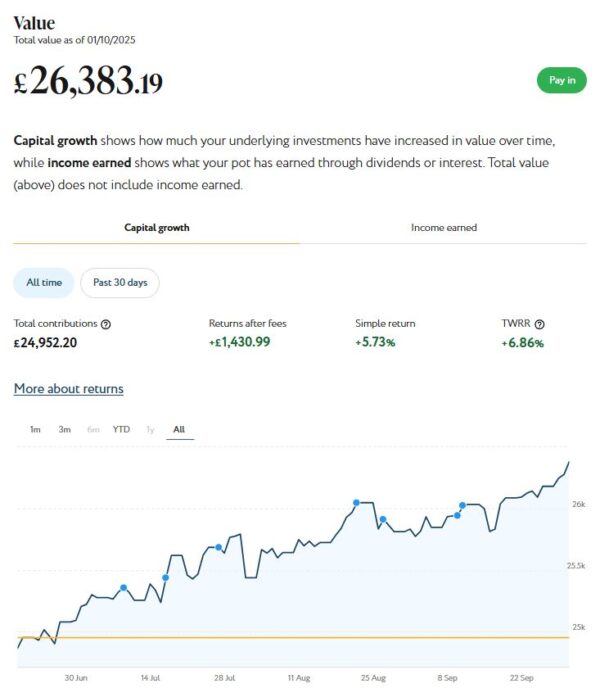
As regular readers will know, in June I transferred most of the money in my Nutmeg Fully Managed portfolio (just under £25,000) to a new Nutmeg Income Portfolio. I discussed this in detail in this recent post, but basically money in this port is invested to generate an income from share dividends and other sources. This is then paid monthly. Capital appreciation is targeted as well, but these portfolios are aimed primarily at older people (and others) who want/need their investment to generate a regular cash income.

In September my Nutmeg income portfolio generated £78.72 of income, which was duly paid in to my bank account on 24 September 2025. That is down a bit on the £134.03 I received in August, but it means I have now received a total (tax-free) income of £212.75 to date. That is in line with Nutmeg’s projected annual return of just under 5% for income ports at my chosen risk level (five). Obviously it is too early to draw any significant conclusions from this, though.

My income portfolio also grew in value in September. It’s now worth £26,383 compared with £25,815 at the start of last month, a rise of £568. As the screen capture shows, the port has actually increased by £1,430.99 (5.73%) since I opened it in June. That’s good going, though I don’t suppose it will carry on like this indefinitely!

Nutmeg Income port October 2025

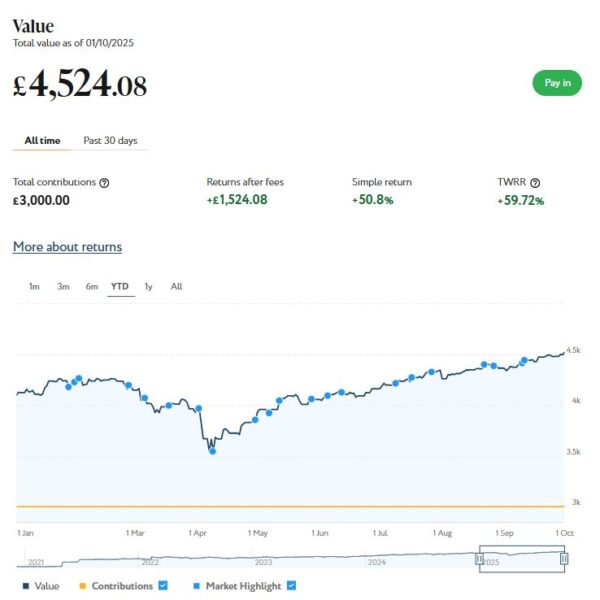
I still have a smaller, growth-oriented pot using Nutmeg’s Smart Alpha option. This is now worth £4,524 compared with £4,368 a month ago, a rise of £156. Here is a screen capture showing performance for the year to date.

Nutmeg Smart Alpha Oct 2025

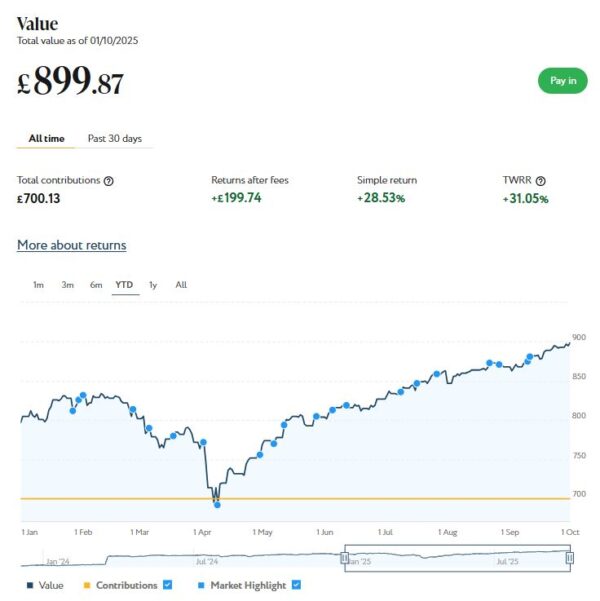
And at the start of December 2023 I invested £500 in one of Nutmeg’s thematic portfolios (Resource Transformation). In March 2024 I also invested a further £200 from referral bonuses (something I no longer receive for reasons I won’t bore you with). As you can see from the YTD screen capture below, this portfolio is now worth £900 (rounded up) compared with £868 last month, a rise of £32.

Nutmeg thematic port Oct 25

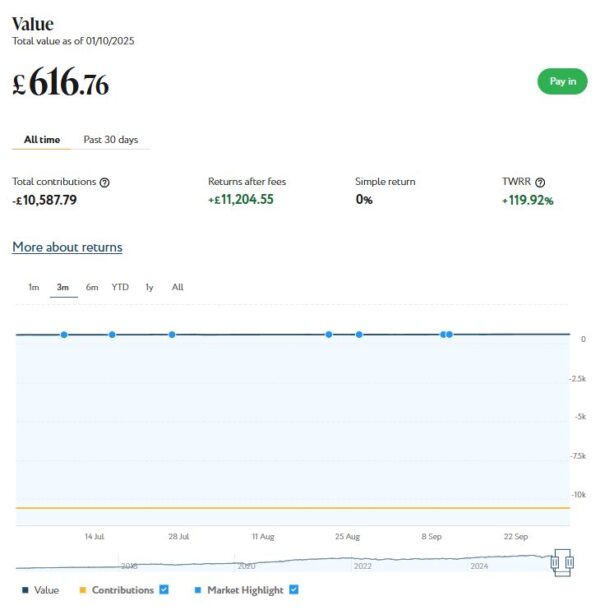
Finally, I still have a small amount left in my original Nutmeg Fully Managed portfolio. I have kept this largely for comparison purposes. This has increased in value from £595 at the start of September to £617 (rounded up) now, a rise of £22.

Nutmeg Fully Managed port Oct 2025

As you can see, September was a pretty good month for my Nutmeg investments. Overall I was up by £778 or 2.46%. In addition I did, of course, receive £78.72 in income from my income portfolio.

Excluding income generated, the overall value of my Nutmeg investments is up by £1,996 since the start of 2025, so the April 2025 fall (caused largely by Trump’s tariffs) has now fully reversed. I am also up by £3,069 or 10.45% since the start of October last year, again excluding cash income received. All things considered, that’s not a bad result.

As I always have to say, some volatility is to be expected with stock market investments, but over the longer term they tend to even themselves out (and generally perform better than bank savings accounts, although that is never guaranteed). In general the worst thing you can do is panic and sell up when downturns occur (as happened in April this year). You are then crystallizing your losses rather than giving the markets time to recover. This is something I had cause to discuss in this blog post from earlier this year.

You can read my full Nutmeg review here. If you are looking for a home for your annual ISA allowance, based on my overall experience over the last nine years, they are certainly worth considering. They offer self-invested personal pensions (SIPPs), Lifetime ISAs and Junior ISAs as well.

Moving on, I also have investments with P2P property investment platform Assetz Exchange. As discussed in this post, the company has rebranded as Housemartin.

My investments with Housemartin continue to generate steady returns. Housemartin focuses on lower-risk properties (e.g. sheltered housing). I put an initial £100 into this in mid-February 2021 and another £400 in April. In June 2021 I added another £500, bringing my total investment up to £1,000.

Since I opened my account, my HM portfolio has generated a respectable £273.80 in revenue from rental income. I have made a small net loss of £19.02 on property disposals. Capital growth generally has slowed, in line with UK property values generally.

At the time of writing, 16 of ‘my’ properties are showing gains, 7 are breaking even, and the remaining 17 are showing losses. My portfolio of 40 properties is currently showing a net decrease in value of £43.52. That means that overall (rental income minus capital value decrease and loss on disposal) I am up by £211.26. That’s still a respectable return on my £1,000 and does illustrate the value of P2P property investments for diversifying your portfolio. And it doesn’t hurt that with Housemartin most projects are socially beneficial as well.

The net fall in capital value of my Housemartin investments is obviously a little disappointing. But it’s important to remember that until/unless I choose to sell the investments in question, it is largely theoretical, based on the latest price at which shares in the property concerned have changed hands. The rental income, on the other hand, is real money (which in my case I’ve reinvested in other HM projects to further diversify my portfolio).

To control risk with all my property crowdfunding investments nowadays, I invest relatively modest amounts in individual projects. This is a particular attraction of Housemartin as far as i am concerned. You can actually invest from as little as £1 per property if you really want to proceed cautiously.

  • As I noted in this blog post, Housemartin is particularly good if you want to compound your returns by reinvesting rental income. This effectively boosts the interest rate you are receiving. Personally, once I have accrued a minimum of £10 in rental payments, I usually reinvest this money in either a new HM project or one I have already invested in (thus increasing my holding). Over time, even if I don’t invest any more capital, this will ensure my investment with Housemartin grows at an accelerating rate and becomes more diversified as well.

My investment on Housemartin is in the form of an IFISA so there won’t be any tax to pay on profits, dividends or capital gains. I’ve been impressed by my experiences with Housemartin and the returns generated so far, and intend to continue investing with them. You can read my full review of Assetz Exchange/Housemartin here and my article about the rebranding to Housemartin here. You can also sign up for an account directly via this link [affiliate].

In 2022 I set up an account with investment and trading platform eToro, using their popular ‘copy trader’ facility. I chose to invest $500 (then about £412) copying an experienced eToro trader called Aukie2008 (real name Mike Moest).

In January 2023 I added to this with another $500 investment in one of their thematic portfolios, Oil Worldwide. I also invested a small amount I had left over in Tesla shares.

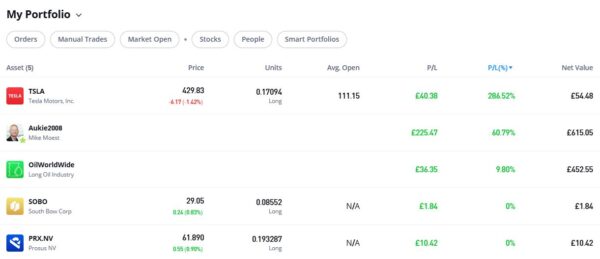
As you can see from the screen captures below, my original investment (total value £888.36 in pounds sterling) is today worth £1,135.00 an overall increase of £246.64 or 27.76%.

  • Note: eToro now displays the value of investments in your native currency, although you can change this if you wish.

Etoro home Oct 25

Etoro port Oct 25

You can read my full review of eToro here. You may also like to check out my more in-depth look at eToro copy trading. I also discussed thematic investing with eToro using Smart Portfolios in this recent post. The latter also reveals why I took the somewhat contrarian step of choosing the oil industry for my first thematic investment with them.

As you can see, my Oil WorldWide investment is in profit, though at 9.80% it is nothing too exciting. My copy trading investment with Aukie2008 has been doing better, with an overall 60.79% profit. To be fair, I have held this investment a bit longer.

My Tesla shares, which I bought as an afterthought with some spare cash I had in my account, are up again this month. They are showing an impressive overall profit of 286.52% since I bought them. If only I had put a bit more money into this!

You might also notice that I have small holdings in Prosus NV, a Dutch internet group, and South Bow, a Canadian energy infrastructure company. To be honest I don’t understand how I acquired these, but I assume they are some sort of bonus I was awarded. In any event, I am happy to have them in my portfolio.

  • eToro also offer the free eToro Money app. This allows you to deposit money to your eToro account without paying any currency conversion fees, saving you up to £5 for every £1,000 you deposit. You can also use the app to withdraw funds from your eToro account instantly to your bank account. I tried this myself and was impressed with how quickly and seamlessly it worked. You can read my blog post about eToro Money here. Note that it can also serve as a cryptocurrency wallet, allowing you to send and receive crypto from any other wallet address in the world.

If you would like more information about setting up an eToro account, please click on this no-obligation website link [affiliate]. Don’t forget that you also get a free $100,000 virtual portfolio, which you can use to experiment with trading and investing strategies. I have certainly earned a lot from mine.

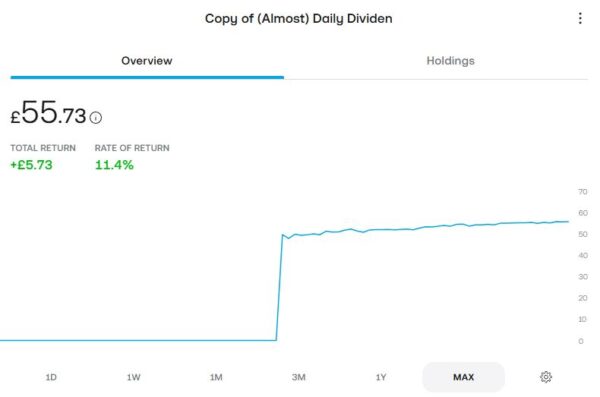
As an experiment, at the start of April this year I put £50 into an investment ISA with Trading 212. As mentioned in my recent blog post about dividend investing, I put it into the (Almost) Daily Dividends Portfolio, a ready-made portfolio or ‘pie’ on Trading 212. As you can see from the screen capture below, my portfolio is now worth £55.73, an increase of £5.73 or 11.4% over the six-month period. It has even accrued a grand total of 50p in dividends!

Trading 212 Dividends ISA Oct 25

I am quite impressed with how this investment has been faring, despite the small amount I put in (which means I may be missing out on some smaller dividends). If I increased my investment I would almost certainly become eligible for more dividends, and even more the longer I remain invested. If I had any spare money at the moment, I would consider doing this. Of course, I do now have an income-focused portfolio with Nutmeg as well (see above).

Moving on, I published various posts on Pounds and Sense in September. I have listed below those that are still relevant.

In Get a Free Share Worth Up To £100 With Trading 212, I revealed that this popular offer had reopened. If you have never held an account with Trading 212, you can get a free share worth up to £100 just by signing up with them. You do have to open a Stocks ISA or (non-ISA) Invest account – a Cash ISA won’t qualify you for the free share. This offer is still open but it closes on Monday 6 October 2025 – so if you want to take advantage, you need to get your skates on now.

In Get Your Will Written Free of Charge in October, I pointed out that October is Free Wills Month. This event brings together a group of well-respected charities to offer members of the public aged 55 and over the opportunity to have their wills written or updated free of charge using participating solicitors across the UK. Free Wills Month is now up and running, so see my blog post to find out how you can benefit.

And in Amazon Prime Big Deals Day Is Almost Here I spotlighted the fact that this annual promotional event begins on Tuesday 7 October 2025. This is a special event for Amazon Prime members only. Amazon say they will be offering members their lowest prices of the year on selected products across a wide range of categories, from consumer electronics to groceries. Personally I shall be looking for a new electric shaver this time 🙂

Finally, How Often Should You Really Be Washing Your Bedding? is a syndicated guest post by professional microbiologist Primrose Freestone. Dr Freestone looks at everything from sheets and pillowcases to blankets and duvet covers and even mattresses. Personally I found her expert advice quite eye-opening. I definitely need to do better in future!

I’ll close with a reminder that you can also follow Pounds and Sense on Facebook or Twitter (or X as we have to call it now). Twitter/X is my number one social media platform and I post regularly there. I share the latest news and information on financial matters, and other things that interest, amuse or concern me. So if you aren’t following my PAS account on Twitter/X, you are definitely missing out!

  • I am also on the BlueSky social media network under the username poundsandsense.bsky.social. Twitter/X remains my primary social media platform, but I also post details of my latest blog posts, third-party articles and other financial news and resources on BlueSky for those who prefer to follow me there.

As always, if you have any comments or questions, feel free to leave them below. I am always delighted to hear from PAS readers 🙂

Disclaimer: I am not a qualified financial adviser and nothing in this blog post should be construed as personal financial advice. Everyone should do their own ‘due diligence’ before investing and seek professional advice if in any doubt how best to proceed. All investing carries a risk of loss. 

Note also that posts on PAS may include affiliate links. If you click through and perform a qualifying transaction, I may receive a commission for introducing you. This will not affect the product or service you receive or the terms you are offered, but it does help support me in publishing PAS and paying my bills. Thank you!

If you enjoyed this post, please link to it on your own blog or social media:
Could a Smart Thermostat Save You Money?

Could a Smart Thermostat Save You Money?

As I write this, the UK is enjoying a period of fine summer weather; but of course autumn and winter will be along soon enough. 

With energy prices continuing to rise, it’s more important than ever to explore ways to cut your home heating costs while staying comfortable. 

An increasingly popular solution is a smart thermostat. But what exactly are these devices and can they really save you money? In this post I’ll try to answer these questions and discuss my own experiences with one.

What is a Smart Thermostat?

A smart thermostat is an internet-connected device that allows you to control your home’s heating (and sometimes cooling) remotely via a smartphone app, tablet or computer. 

They may use advanced technology such as machine learning, motion sensors and geolocation to optimize your heating schedule, based on your habits and preferences.

Unlike traditional thermostats, which require manual adjustment or rely on fixed schedules, smart thermostats can automatically learn your routines and adjust your heating to ensure comfort and energy efficiency.

Smart thermostats will work with most (but not all) boilers, including gas, heating oil and electric boilers. It is also possible to use them with heat pumps, but you will need a special type of smart thermostat that works a bit differently. In this post I will concentrate on smart thermostats for ‘traditional’ heating systems. This article has some useful information about smart thermostats for heat pumps.

Benefits of a Smart Thermostat

Energy savings – Smart thermostats can significantly reduce energy wastage by heating your home only when needed. For example, they can lower the temperature when you’re out and preheat the house before you return. 

Remote control – Forgot to turn off the heating before leaving the house? No problem. With a smart thermostat, you can adjust settings from anywhere using your smartphone.

Insights and reports – Most smart thermostats provide detailed energy usage reports, helping you understand your consumption patterns and identify opportunities to save money.

Smart integrations – Most models integrate with voice assistants like Amazon Alexa, Google Assistant, or Apple HomeKit, allowing for hands-free adjustments.

Top Smart Thermostat Brands

Here are the three most popular smart thermostat brands available in the UK, along with their pros and cons.

1. Nest Thermostat (Google)

Pros

  • sleek design and intuitive interface
  • learns your habits and automatically creates a heating schedule
  • works seamlessly with Google Home and integrates with other smart devices
  • energy-saving features like ‘Eco Mode’ when you’re away

Cons

  • higher up-front cost compared to some competitors
  • limited compatibility with certain heating systems

2. Hive Active Heating (British Gas)

Pros

  • easy to use and install
  • works with a wide range of heating systems
  • excellent app interface with multiple scheduling options
  • offers add-ons like smart radiator valves and light bulbs for a complete smart home experience

Cons

  • lacks advanced learning features compared to Nest
  • some additional features require a monthly subscription

3. Tado Smart Thermostat

Pros

  • strong focus on energy efficiency with geofencing and open-window detection
  • offers granular control with smart radiator valves
  • provides detailed energy-saving reports
  • compatible with almost all UK heating systems

Cons

  • subscription required for premium features like geofencing
  • simpler design might not appeal to those looking for a high-tech aesthetic

My Experience

I got a Hive smart thermostat for my gas central heating in October 2024. I chose this based on the advice of my regular heating engineer, Dave. He has a Hive himself and recommended it for its simplicity and ease of operation. 

I paid Dave to supply and fit the device, for which he charged around £300. If you’re a keen DIY’er it’s perfectly possible to install a smart thermostat yourself, maybe with the aid of an online guide and/or YouTube video. Personally I was happy to leave the manual parts of the job to Dave, though I assisted with the electronic and online aspects.

With a Hive (and I assume other smart thermostats) you basically get three components. There is a hub you have to connect to your router using a cable; the thermostat itself, which I have on the wall of my living room (though you can detach it and move it from room to room if you like); and the main control unit, which is where my old controller used to be in the kitchen. You’ll also want to download the relevant app, so you can control the heating using your phone.

Set up was pretty straightforward. The only delay was when connecting the app. For some reason this took a few tries (Dave told me this was common in his experience), but we got there eventually.

I set up a weekly schedule for my heating and hot water, and after that basically let the thermostat do its thing. I’ve found the insights page on the app really helpful for seeing temperature changes in the house throughout the day and when the heating has cut in and out. This works far more efficiently than my old manual thermostat ever did, and is undoubtedly saving me money by only heating the house to the temperature I require. 

One small issue I experienced was that initially I kept getting a message on the app that the internet connection was weak. After a bit of research I discovered this was being caused by the fact I’d left the Hive hub too close to my router. Once I moved it a couple of feet, the problem vanished and never returned.

Hints and Tips for Making the Most of Your Smart Thermostat

Here are some tips on maximizing the energy-saving potential of your smart thermostat.

1. Let it learn your routine

If your smart thermostat has a learning feature (like the Nest), give it a week or two to adapt to your schedule. Avoid making constant manual adjustments, as this can interfere with its ability to learn.

2. Use geofencing features

Many smart thermostats, such as Tado, use geofencing to adjust the heating when no-one is home. Ensure this feature is activated and that your phone’s location services are enabled for the app.

3. Set realistic temperatures

Aim for a comfortable yet energy-efficient temperature, typically around 18-21°C. Lower the temperature slightly at night or when you’re away to save more.

4. Take advantage of zones

If your system supports zoning (e.g. Hive with smart radiator valves), heat only the rooms you use regularly. For instance, keep bedrooms cooler during the day and focus heat in living areas.

5. Schedule around your lifestyle

Use scheduling tools to preheat your home only when necessary. For example, program the heating to turn on 30 minutes before you wake up or arrive home.

6. Use insights to adjust habits

Review the energy usage reports provided by your thermostat’s app to identify patterns of wastage. Adjust your settings accordingly to reduce unnecessary heating.

7. Integrate with smart home devices

Pair your thermostat with voice assistants like Alexa or Google Assistant for convenient control. You can also integrate it with other smart home devices, such as lights or sensors, for automated routines.

8. Utilize holiday modes

Going away? Use the vacation or holiday mode to keep your home at a low but frost-protecting temperature while minimizing energy use.

9. Check compatibility with your boiler

Ensure your boiler and heating system are compatible with your chosen thermostat. This will avoid efficiency issues and ensure full functionality. Personally I have a traditional heating system with a separate hot water tank, but others will have a more modern combi boiler. It’s essential to purchase the right smart thermostat for your system (Hive have two different versions for traditional and combi systems, for example).

10. Stay updated

Keep your thermostat’s firmware up to date. Manufacturers often release updates to improve efficiency, fix bugs or add new features.

Bonus Tip: Combine with other energy-saving measures

Combine your smart thermostat with energy-efficient practices, such as proper insulation, draught-proofing and using energy-saving curtains, for even greater savings. 

In addition, try turning down your thermostat by one degree. According to the Energy Saving Trust, this can save you up to £145 annually on your heating bills. 

Closing Thoughts

So can a smart thermostat save you money? My short answer is yes – though how much will depend on your usage habits and the size of your household. 

By reducing energy wastage, offering precise temperature control, and providing actionable insights, it is estimated that a smart thermostat can lower your energy bills by 10-20% annually. This can translate to savings of £100-£200 a year.

While the initial investment for a smart thermostat may seem steep (ranging from £100 to £300, plus installation), for most people the long-term savings should outweigh this. Additionally, some energy providers offer discounts or schemes to help with purchase.

A smart thermostat isn’t just about saving money, though. It’s also about convenience, comfort and doing your bit for the environment by reducing your energy consumption. 

Whether you opt for Nest, Hive or Tado, investing in a smart thermostat should set you on the path to a more energy-efficient and comfortable home.

As always, if you have any comments or questions about this post, please do leave them below. 


If you enjoyed this post, please link to it on your own blog or social media:
Investments Update Feb 2025

My Investments Update – February 2025

Here is my latest monthly update about my investments. You can read my January 2025 Investments Update here if you like.

I’ll begin as usual with my Nutmeg Stocks and Shares ISA. This is the largest investment I hold other than my Bestinvest SIPP (personal pension).

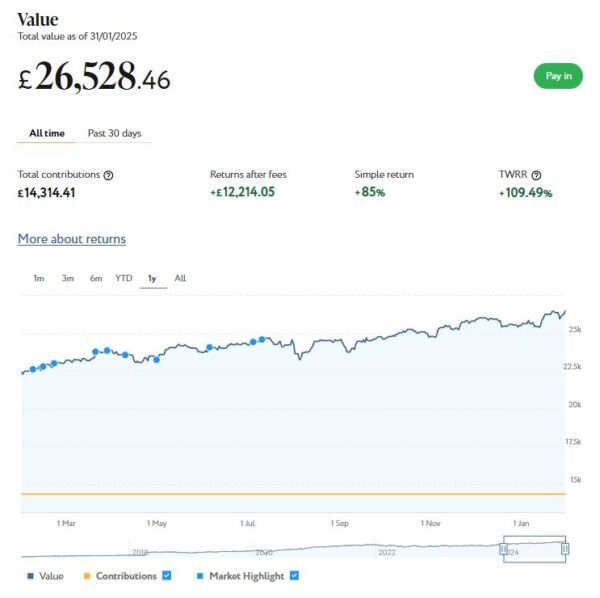
As the screenshot below for the last twelve months shows, my main Nutmeg portfolio is currently valued at £26,528. Last month it stood at £25,513, so that is an impressive rise of £1,015.

Nutmeg main port Feb 2025

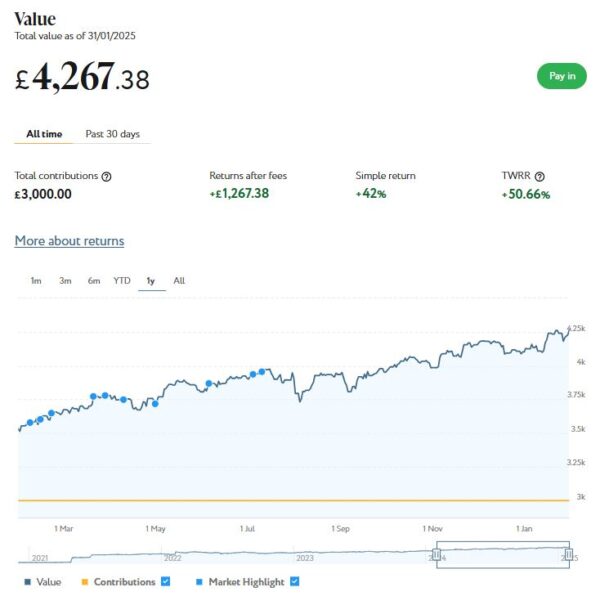
Apart from my main portfolio, I also have a second, smaller pot using Nutmeg’s Smart Alpha option. This is now worth £4,267 compared with £4,103 a month ago, a rise of £164. Here is a screen capture showing performance over the last twelve months.

Nutmeg Smart Alpha Feb 2025

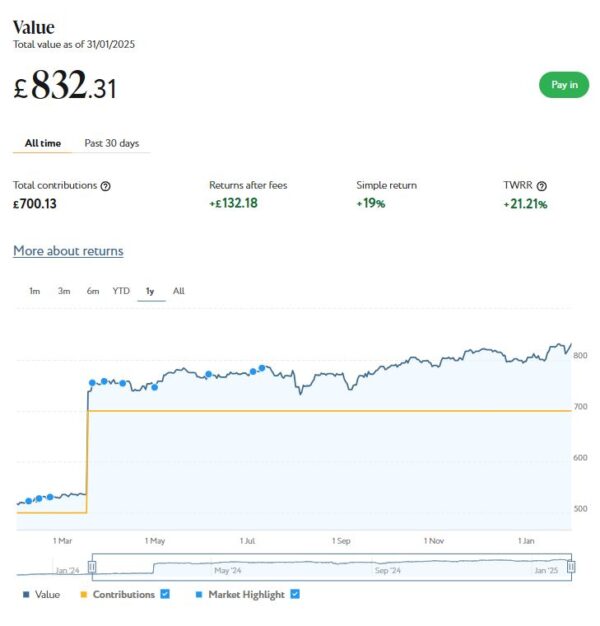
Finally, at the start of December 2023 I invested £500 in one of Nutmeg’s new thematic portfolios (Resource Transformation). In March I also invested a further £200 from referral bonuses. As you can see from the screen capture below, this portfolio is now worth £832 compared with £798 last month, a rise of £34.

Nutmeg Thematic Feb 2025

January has clearly been a good month for my Nutmeg investments. Their overall value has grown by £1,213 or 3.94% since the start of the year. And their value has increased by £5,193 or 19.65% in the twelve months since 31st January 2024.

You can read my full Nutmeg review here. If you are looking for a home for your annual ISA allowance, based on my overall experience over the last eight years, they are certainly worth considering. They offer self-invested personal pensions (SIPPs), Lifetime ISAs and Junior ISAs as well.

Moving on, I also have investments with P2P property investment platform Assetz Exchange. As discussed in this recent post, the company has just rebranded as Housemartin.

My investments with Housemartin continue to generate steady returns. Housemartin focuses on lower-risk properties (e.g. sheltered housing). I put an initial £100 into this in mid-February 2021 and another £400 in April. In June 2021 I added another £500, bringing my total investment up to £1,000.

Since I opened my account, my HM portfolio has generated a respectable £229.98 in revenue from rental income. Capital growth has slowed, though, in line with UK property values generally.

At the time of writing, 15 of ‘my’ properties are showing gains, 2 are breaking even, and the remaining 18 are showing losses. My portfolio of 35 properties is currently showing a net decrease in value of £55.21, meaning that overall (rental income minus capital value decrease) I am up by £174.77. That’s still a decent return on my £1,000 and does illustrate the value of P2P property investments for diversifying your portfolio. And it doesn’t hurt that with Housemartin most projects are socially beneficial as well.

The overall fall in capital value of my Housemartin investments is obviously a little disappointing. But it’s important to remember that until/unless I choose to sell the investments in question, it is largely theoretical, based on the latest price at which shares in the property concerned have changed hands. The rental income, on the other hand, is real money (which in my case I’ve reinvested in other HM projects to further diversify my portfolio).

To control risk with all my property crowdfunding investments nowadays, I invest relatively modest amounts in individual projects. This is a particular attraction of Housemartin as far as i am concerned. You can actually invest from as little as £1 per property if you really want to proceed cautiously.

  • As I noted in this blog post, Housemartin is particularly good if you want to compound your returns by reinvesting rental income. This effectively boosts the interest rate you are receiving. Personally, once I have accrued a minimum of £10 in rental payments, I reinvest this money in either a new HM project or one I have already invested in (thus increasing my holding). Over time, even if I don’t invest any more capital, this will ensure my investment with Housemartin grows at an accelerating rate and becomes more diversified as well.

My investment on Housemartin is in the form of an IFISA so there won’t be any tax to pay on profits, dividends or capital gains. I’ve been impressed by my experiences with Housemartin and the returns generated so far, and intend to continue investing with them. You can read my full review of Assetz Exchange/Housemartin here. You can also sign up for an account directly via this link [affiliate]. Bear in mind that, as from the current financial year (2024/25), you can open more than one IFISA per year.

In 2022 I set up an account with investment and trading platform eToro, using their popular ‘copy trader’ facility. I chose to invest $500 (then about £412) copying an experienced eToro trader called Aukie2008 (real name Mike Moest).

In January 2023 I added to this with another $500 investment in one of their thematic portfolios, Oil Worldwide. I also invested a small amount I had left over in Tesla shares.

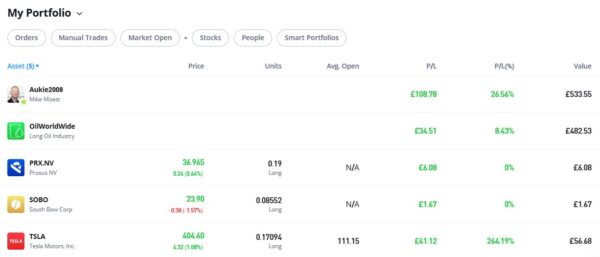
As you can see from the screen captures below, my original investment (total value £888.36 in pounds sterling) is today worth £1,081.19, an overall increase of £192.16 or 21.71%.

  • Note: eToro now displays the value of investments in your native currency, although you can change this if you wish.


Etoro main Feb 2025

eToro port Feb 2025

You can read my full review of eToro here. You may also like to check out my more in-depth look at eToro copy trading. I also discussed thematic investing with eToro using Smart Portfolios in this recent post. The latter also reveals why I took the somewhat contrarian step of choosing the oil industry for my first thematic investment with them.

As you can see, my Oil WorldWide investment is showing a profit of 8.43%. That’s not overly exciting but the portfolio has just been rebalanced by eToro, so hopefully that will improve its performance going forward. The investment team at eToro periodically rebalance all smart portfolios to ensure that the mix of investments remains aligned with the portfolio’s goals, and to take advantage of any new opportunities that may present themselves.

My copy trading investment with Aukie2008 has been doing better, with an overall 26.56% profit. To be fair, I have held the latter investment a bit longer.

My Tesla shares, which I bought as an afterthought with a bit of spare cash I had in my account, have done particularly well in recent months. If only I had put a bit more money into this!

You might also notice that I have small holdings in Prosus NV, a Dutch internet group, and South Bow, a Canadian energy infrastructure company. To be honest I don’t understand how I acquired these, but I assume they are some sort of bonus I have been awarded. In any event, I am happy to have them in my portfolio!

  • eToro also offer the free eToro Money app. This allows you to deposit money to your eToro account without paying any currency conversion fees, saving you up to £5 for every £1,000 you deposit. You can also use the app to withdraw funds from your eToro account instantly to your bank account. I tried this myself and was impressed with how quickly and seamlessly it worked. You can read my blog post about eToro Money here. Note that it can also serve as a cryptocurrency wallet, allowing you to send and receive crypto from any other wallet address in the world.

If you would like more information about setting up an eToro account, please click on this no-obligation website link (affiliate).

I had another article published in January on the excellent Mouthy Money website. This is How to Make Money Through Bank Account Switching. In this article I discussed an easy method for generating handy lump sums by taking advantage of switching incentives offered by some UK banks. The banks are currently battling one another for your custom, and they are offering some enticing cash bonuses (and sometimes other freebies/benefits as well) to get you to sign up.

As I’ve said before, Mouthy Money is a great resource for anyone interested in money-making and money-saving. From the range of articles published in January, I particularly enjoyed 16 Ways to Be More Frugal and Save Money in 2025 by regular MM contributor Shoestring Jane. Jane writes mainly about money saving and frugal living. You can see all of her articles for Mouthy Money via this web page.

I also published several posts on Pounds and Sense in January. Some are no longer relevant, but I have listed the others below.

As mentioned earlier, I published a post titled P2P Property Investment Platform Assetz Exchange Rebrands as Housemartin. In this I discussed the recent rebrand of this P2P property investment platform, which I invest through myself. The post also discusses how the platform has changed since I first featured it here on Pounds and Sense.

In Here’s Why Most Over-50s Need More Protein in Their Diet I discussed a subject that will be relevant to many readers of this blog (which is of course aimed especially at over-50s). I must admit I hadn’t realised just how important this was until I saw the topic being discussed on GB News last month. I wanted to learn more and researched the subject with the aid of AI program ChatGPT. This blog post was the result.

In Take the Plum 52-Week Saving Challenge, I shared a method you can use to set aside a handy lump sum of up to £1,378 in a year. As you may gather, the method involves using the smart money app Plum [affiliate link]. This automates the whole process for you, making saving as easy and painless as possible. Read the article for full details!

Also in January I published a guest post on the subject Dos and Don’ts for Divorce in 2025. Written by an experienced divorce lawyer, this article sets out tips and guidelines to make the divorce process as pain-free as possible if, sadly, your marriage has run its course.

Finally, on a happier note, I published Planning a UK Holiday This Year? Here Are Some Ideas For You. In this article (which I update and republish annually) I set out a range of suggestions for short break (or longer) holidays in the UK, along with links to blog posts I have written about the destinations concerned.

Lastly, a reminder that you can also follow Pounds and Sense on Facebook or Twitter (or X as we have to call it now). Twitter/X is my number one social media platform and I post regularly there. I share the latest news and information on financial matters, and other things that interest, amuse or concern me. So if you aren’t following my PAS account on Twitter/X, you are definitely missing out.

  • I am also on the BlueSky social media network under the username poundsandsense.bsky.social. For the time being anyway, Twitter/X will remain my primary social media platform, but I will also post details of my latest blog posts, third-party articles and other financial news and resources on BlueSky for those who may prefer to follow me there.

That’s all for today. As always, if you have any comments or questions, feel free to leave them below. I am always delighted to hear from PAS readers 🙂

Disclaimer: I am not a qualified financial adviser and nothing in this blog post should be construed as personal financial advice. Everyone should do their own ‘due diligence’ before investing and seek professional advice if in any doubt how best to proceed. All investing carries a risk of loss. 

Note also that posts on PAS may include affiliate links. If you click through and perform a qualifying transaction, I may receive a commission for introducing you. This will not affect the product or service you receive or the terms you are offered, but it does help support me in publishing PAS and paying my bills. Thank you!


Housemartin


If you enjoyed this post, please link to it on your own blog or social media:
P2P Property Investment Platform Assetz Exchange Rebrands as Housemartin

P2P Property Investment Platform Assetz Exchange Rebrands as Housemartin

As regular readers of Pounds and Sense will know, I’m a fan of P2P property investment platform Assetz Exchange and have invested through them myself. AE have recently rebranded as Housemartin, so I thought I should write an update about this.

You can read my original detailed review of Assetz Exchange (as it was then) in this post. Much of this info still applies – so I won’t reproduce it all here – but certain things (as well as the name!) have changed.

Assetz Exchange began as a ‘traditional’ property crowdfunding platform, with investors coming together to buy a property.  They then shared in the rental income received – and any profit if the property was subsequently sold – in proportion to the size of their investment. When I first wrote about Assetz Exchange they offered a variety of investment opportunities, including former show homes and development projects. 

Nowadays, though, the company focuses on supported housing, working closely with charities and other organizations that assist people with physical and cognitive disabilities. These have generally proven the most reliable and hassle-free investments, so Housemartin have understandably chosen to concentrate on this.

Properties are generally let on long leases, with the charities taking responsibility for day-to-day management and maintenance. As mentioned, investors receive a share of the monthly rental received and any profits if/when the properties are sold (you can also potentially sell your holdings online at any time via the exchange, which serves as a secondary market). That puts these investments at the lower-risk end of the property investment spectrum (though there are, of course, still risks involved, and you should ensure you understand these and are comfortable with them before investing).

Assetz Exchange was originally part of the Assetz group of property investment companies that included Assetz Capital. In December 2023 Assetz announced it was withdrawing from the retail marketplace to work with institutional investors only. Partly as a consequence of this, the team behind Housemartin took the decision to part ways with the Assetz group and are no longer affiliated with them. Although they always operated separately from Assetz Capital, Housemartin is now an entirely independent P2P property investment platform. Regarding the name change, the company says:

“The name Housemartin reflects the company’s commitment to delivering robust, hassle-free, quality residential property investment opportunities that reward investors with monthly inflation-linked income. Just as the house martin bird is known for its sociability and adaptability, Housemartin aims to provide investors with an opportunity to pool funds with fellow investors to create much needed quality homes for people requiring support.”

Future Plans

In its new guise as Housemartin, the company has big plans for 2025 and further into the future. They intend to stick to their strategy of working with partners in the supported housing sector, including (for example) Golden Lane Housing, Lets For Life and Halo Housing. A typical current opportunity from the website  is shown below.

Housemartin example investtment

Peter Read, the MD of Housemartin, points out that with interest rates currently falling, this makes the returns of around 7% they can typically offer investors increasingly attractive (and of course there is the potential for capital growth as well). He also points out that rentals are raised every year in line with inflation.

Housemartin are currently launching a fundraising round on the investment platform Crowdcube. They are looking to raise additional capital which will be used to help the company expand and improve its offering. Anyone is welcome to invest via Crowdcube, though as this is a share offer it’s almost certainly riskier than investing via the platform itself, with no clearly defined exit route. Personally I do not plan to invest in Housemartin this way, but you can find out more if you wish by registering on the Crowdcube site.

My Own Experience

I put an initial £100 into the platform in mid-February 2021 and another £400 in April. In June 2021 I added another £500, bringing my total investment up to £1,000.

Since I opened my account, my portfolio has generated a respectable £227.35 in revenue from rental income. Capital growth has slowed, though, in line with UK property values generally.

At the time of writing, 12 of ‘my’ properties are showing gains, 3 are breaking even, and the remaining 20 are showing losses. My portfolio of 35 properties is currently showing a net decrease in value of £62.22, meaning that overall (rental income minus capital value decrease) I am up by £165.13. That’s still a decent return on my £1,000 and does illustrate the value of P2P property investments for diversifying your portfolio. And it doesn’t hurt that with Assetz Exchange the projects are socially beneficial as well.

The overall fall in capital value of my AE investments is obviously a bit disappointing. But it’s important to remember that until/unless I choose to sell the investments in question, it is theoretical, based on the latest price at which shares in the property concerned have changed hands. The rental income, on the other hand, is real money (which in my case I’ve reinvested in other HM projects to further diversify my portfolio).

To control risk with all my property crowdfunding investments nowadays, I invest relatively modest amounts in individual projects. This is a particular attraction of HM as far as i am concerned. You can actually invest from as little as £1 per property if you really want to proceed cautiously.

  • As I noted in this blog post, Housemartin is particularly good if you want to compound your returns by reinvesting rental income. This effectively boosts the interest rate you are getting. Personally, once I have accrued a minimum of £10 in rental payments, I reinvest this money in either a new Housemartin project or one I have already invested in (thus increasing my holding). Over time, even if I don’t invest any more capital, this will ensure my investment with HM grows at an accelerating rate and becomes more diversified as well.

My investment on Housemartin is in the form of an IFISA so there won’t be any tax to pay on profits, dividends or capital gains. I’ve been impressed by my experiences with Housemartin and the returns generated so far, and intend to continue investing with them. If you wish you can also sign up for a no-obligation account on Housemartin directly via this link [affiliate]. Bear in mind that, as from this financial year (2024/25), you can open more than one IFISA per year so long as you don’t exceed your overall £20,000 ISA allowance.

Closing Thoughts

As I said earlier, I am a fan of Housemartin and have been investing with them for several years now. I have also spoken to their MD, Peter Read, on various occasions, and always found him open and honest.

My HM investments have performed well; and as far as I’m aware no investor has ever lost money through the platform. Obviously there are never any guarantees with investing – but if you like the idea of earning higher rates of interest than available from banks while helping vulnerable people secure a much-needed roof over their heads, Housemartin is certainly worth a look.

As always, if you have any queries about this blog post or Housemartin more generally, do leave a comment as usual.

Housemartin logo

Disclosure: As stated in this post, I am an investor with Housemartin and also an affiliate for them. If you click through my link and sign up, I may receive a commission for introducing you. This will not affect in any way the service you receive or the terms you are offered. 

Please be aware also that I am not a professional financial adviser. You should always do your own ‘due diligence’ before investing and seek advice from a qualified adviser if in any doubt how best to proceed. All investing carries a risk of loss.

If you enjoyed this post, please link to it on your own blog or social media:
My Investments Update Dec 2024

My Investments Update – December 2024

Here is my latest monthly update about my investments. You can read my November 2024 Investments Update here if you like.

I’ll begin as usual with my Nutmeg Stocks and Shares ISA. This is the largest investment I hold other than my Bestinvest SIPP (personal pension).

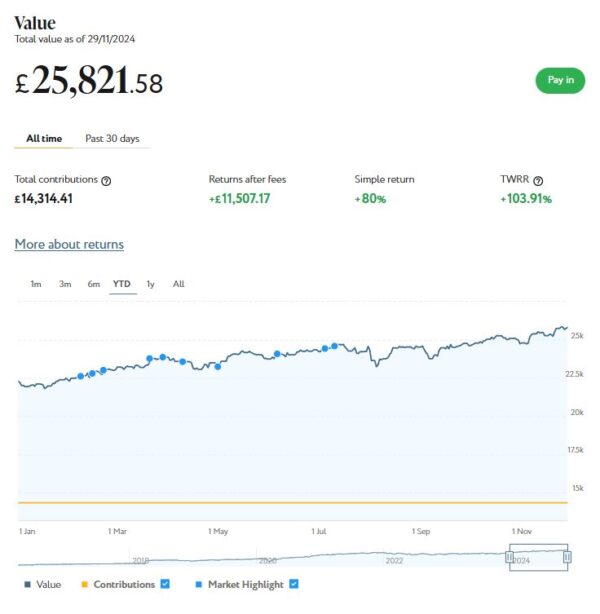
As the screenshot below for the year to date shows, my main Nutmeg portfolio is currently valued at £25,822 (rounded up). Last month it stood at £24,799, so that is an impressive increase of £1,023.

Nutmeg main port Dec 2024

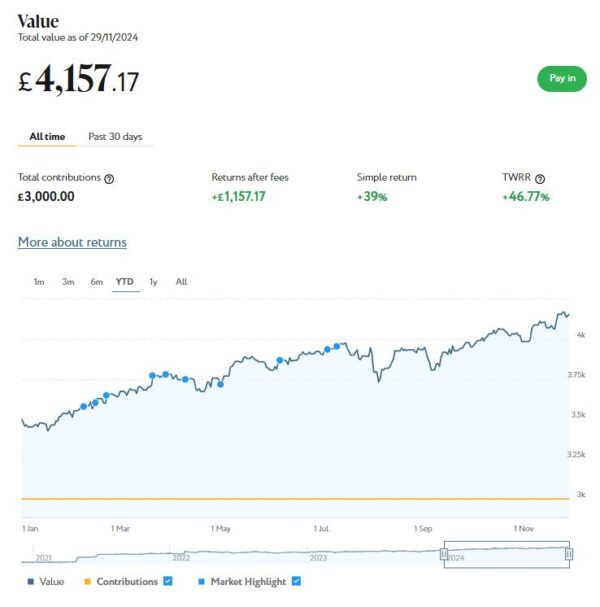
Apart from my main portfolio, I also have a second, smaller pot using Nutmeg’s Smart Alpha option. This is now worth £4,157 compared with £3,988 a month ago, a rise of £169. Here is a screen capture showing performance over the year to date.

Nutmeg Smart Alpha port Dec 2024

Finally, at the start of December 2023 I invested £500 in one of Nutmeg’s new thematic portfolios (Resource Transformation). In March I also invested a further £200 from referral bonuses. As you can see from the YTD screen capture below, this portfolio is now worth £818 (rounded up) compared with £789 last month, a rise of £29.

Nutmeg thematic port Dec 2024

As you can see, November was a good month for my Nutmeg investments. The overall value has risen by £1,221 or 4.13% since the start of November. They are also up by £4,482 or 17.03% since the start of the year.

You can read my full Nutmeg review here. If you are looking for a home for your annual ISA allowance, based on my overall experience over the last eight years, they are certainly worth considering. They offer self-invested personal pensions (SIPPs), Lifetime ISAs and Junior ISAs as well.

  • Note that I am no longer an affiliate for Nutmeg. That means you won’t find any affiliate links in my review (or anywhere else on PAS). And you will no longer see the no-fees-for-six-months offer I used to promote as an affiliate. However, the better news is that you can still get six months free of any management fees by registering with Nutmeg via my Refer a Friend link. I will receive a gift voucher if you do this, which is duly appreciated 🙂

Don’t forget, also, that the current tax year began on 6 April 2024. Despite some predictions to the contraryyou still have a full £20,000 tax-free ISA allowance for 2024/25. As from this year, you can open any number of ISAs with different providers in the same tax year, as long as you don’t exceed your overall £20,000 allowance. So opening a stocks and shares ISA with Nutmeg won’t prevent you from also opening one with another S&S ISA provider (should you wish to) later in the financial year.

Moving on, I also have investments with P2P property investment platform Assetz Exchange. These continue to generate steady returns. Assetz Exchange focuses on lower-risk properties (e.g. sheltered housing). I put an initial £100 into this in mid-February 2021 and another £400 in April. In June 2021 I added another £500, bringing my total investment up to £1,000.

Since I opened my account, my AE portfolio has generated a respectable £220.04 in revenue from rental income. Capital growth has slowed, though, in line with UK property values generally.

At the time of writing, 12 of ‘my’ properties are showing gains, 4 are breaking even, and the remaining 18 are showing losses. My portfolio of 34 properties is currently showing a net decrease in value of £44.11, meaning that overall (rental income minus capital value decrease) I am up by £175.93. That’s still a decent return on my £1,000 and does illustrate the value of P2P property investments for diversifying your portfolio. And it doesn’t hurt that with Assetz Exchange most projects are socially beneficial as well.

The overall fall in capital value of my AE investments is obviously a little disappointing. But it’s important to remember that until/unless I choose to sell the investments in question, it is largely theoretical, based on the latest price at which shares in the property concerned have changed hands. The rental income, on the other hand, is real money (which in my case I’ve reinvested in other AE projects to further diversify my portfolio).

To control risk with all my property crowdfunding investments nowadays, I invest relatively modest amounts in individual projects. This is a particular attraction of AE as far as i am concerned. You can actually invest from as little as 80p per property if you really want to proceed cautiously.

  • As I noted in this blog post, Assetz Exchange is particularly good if you want to compound your returns by reinvesting rental income. This effectively boosts the interest rate you are receiving. Personally, once I have accrued a minimum of £10 in rental payments, I reinvest this money in either a new AE project or one I have already invested in (thus increasing my holding). Over time, even if I don’t invest any more capital, this will ensure my investment with AE grows at an accelerating rate and becomes more diversified as well.

My investment on Assetz Exchange is in the form of an IFISA so there won’t be any tax to pay on profits, dividends or capital gains. I’ve been impressed by my experiences with Assetz Exchange and the returns generated so far, and intend to continue investing with them. You can read my full review of Assetz Exchange here. You can also sign up for an account on Assetz Exchange directly via this link [affiliate]. Bear in mind that, as from this financial year (2024/25), you can open more than one IFISA per year.

In 2022 I set up an account with investment and trading platform eToro, using their popular ‘copy trader’ facility. I chose to invest $500 (then about £412) copying an experienced eToro trader called Aukie2008 (real name Mike Moest).

In January 2023 I added to this with another $500 investment in one of their thematic portfolios, Oil Worldwide. I also invested a small amount I had left over in Tesla shares.

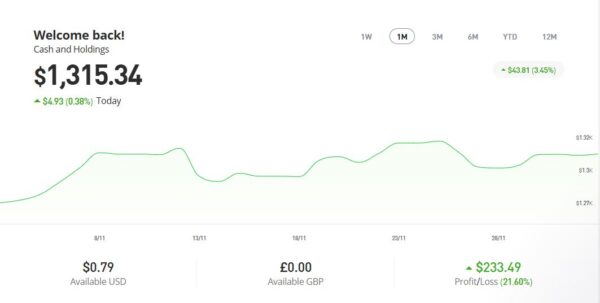
As you can see from the screen captures below, my original investment totalling $1,022.26 is today worth $1,315.34, an overall increase of $293.08 or 28.67%.

eToro main Dec 24

eToro port DEc 24

You can read my full review of eToro here. You may also like to check out my more in-depth look at eToro copy trading. I also discussed thematic investing with eToro using Smart Portfolios in this recent post. The latter also reveals why I took the somewhat contrarian step of choosing the oil industry for my first thematic investment with them.

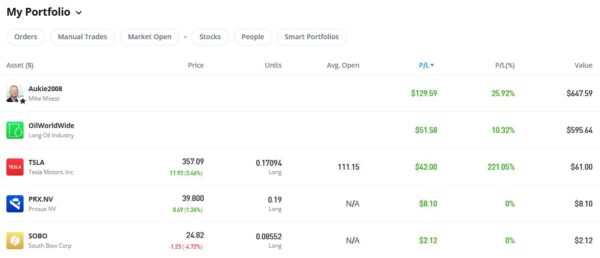
As you can see, my Oil WorldWide investment is showing a respectable if not outstanding profit of 10.32%. My copy trading investment with Aukie2008 has been doing better, with an overall 25.95% profit. To be fair, I have held the latter investment a bit longer.

You might also notice that I have small holdings in Prosus NV, a Dutch internet group, and South Bow, a Canadian energy infrastructure company. To be honest I don’t understand how I acquired these, but I assume they are some sort of bonus I have been awarded. In any event, I am happy to have them in my portfolio!

  • eToro also offer the free eToro Money app. This allows you to deposit money to your eToro account without paying any currency conversion fees, saving you up to £5 for every £1,000 you deposit. You can also use the app to withdraw funds from your eToro account instantly to your bank account. I tried this myself and was impressed with how quickly and seamlessly it worked. You can read my blog post about eToro Money here. Note that it can also serve as a cryptocurrency wallet, allowing you to send and receive crypto from any other wallet address in the world.

I had two more articles published in November on the excellent Mouthy Money website. The first is Ten Ways to Boost Your Bank Balance in the Run-up to Christmas. As Christmas approaches, many of us are feeling the pinch, with the cost of gifts, food and festivities adding up. And that’s before you even factor in the cost of living crisis, tax increases, benefit cuts, and so on. So in this article I set out a variety of ways you may be able to boost your income in the weeks leading up to the big day.

Also in November Mouthy Money published my article Get Fit, Make Money – How to Profit from Fitness Apps. In this article I revealed a variety of methods by which you may be able to get fit and boost your bank balance at the same time.

As I’ve said before, Mouthy Money is a great resource for anyone interested in money-making and money-saving. From the range of articles published in November, I particularly enjoyed this guide to saving money by selling stuff on eBay and other websites by regular MM contributor Shoestring Jane. Jane writes mainly about money saving and frugal living. You can see all of her articles for Mouthy Money via this web page.

I also published (or republished) several posts on Pounds and Sense in November. Some are no longer relevant, but I have listed the others below.

Here’s Why I Changed My Mind About EDF Energy’s ‘Sunday Saver’ Challenge was a follow up to last month’s Here’s Why I’m Not Doing EDF Energy’s ‘Sunday Saver’ Challenge. I got a lot of comments about my earlier article and – as you may gather – that changed my mind somewhat about the scheme. So in this post I explained why I had a rethink, and what happened when I signed up to the challenge myself in November. Please do read the comments by me and others on this post as well.

In Update on my eToro Virtual Portfolio, I brought readers up to date with how my eToro VP has been doing and discussed what lessons could be learned from it. As I say in the article, anyone joining the eToro trading and investing platform automatically gets a $100,000 virtual portfolio in which they can experiment with different investing styles and strategies. I found it very interesting to revisit my VP a year on. I was pleased to discover that since my previous VP update, and despite the fact I hadn’t really paid it much attention, performance had turned around and the port was showing a good profit (unfortunately virtual as well!). As ever there were winners and losers, and these will inform my real-money trading as well.

With Christmas fast approaching, last month I published What Are the Best Video Calling Tools for Older People? For older people (in particular) video calling can provide a great way of connecting with far-flung family and friends if – for whatever reason – they can’t meet in person. In this article I set out the main options available and shared a few hints and tips for making the most of them.

And in Twelve Great Christmas Gift Ideas for Older People (That Aren’t Socks) I set out 12 suggestions for presents for older friends and relatives that – based on my experience as an older person myself – should put a smile on their faces! If you’re struggling for ideas for gifts for older friends and relatives, check this out 🙂

Lastly, a reminder that you can also follow Pounds and Sense on Facebook or Twitter (or X as we have to call it now). Twitter/X is my number one social media platform and I post regularly there. I share the latest news and information on financial (and other) matters, and other things that interest, amuse or concern me. So if you aren’t following my PAS account on Twitter/X, you are definitely missing out.

  • I have also just joined the new BlueSky social media network. My username there is poundsandsense.bsky.social. For the time being at least, Twitter/X will remain my main social media platform, but I will also post details of my latest blog posts, third-party articles and other financial news and resources on BlueSky for those who prefer to follow me there.

That’s all for today. I hope you are keeping safe and warm in the current Arctic weather. As always, if you have any comments or questions, feel free to leave them below. I am always delighted to hear from PAS readers 🙂

Disclaimer: I am not a qualified financial adviser and nothing in this blog post should be construed as personal financial advice. Everyone should do their own ‘due diligence’ before investing and seek professional advice if in any doubt how best to proceed. All investing carries a risk of loss. 

Note also that posts on PAS may include affiliate links. If you click through and perform a qualifying transaction, I may receive a commission for introducing you. This will not affect the product or service you receive or the terms you are offered, but it does help support me in publishing PAS and paying my bills. Thank you!

If you enjoyed this post, please link to it on your own blog or social media:
Here’s Why I’m Not Doing EDF Energy’s ‘Sunday Saver’ Challenge

Here’s Why I’m Not Doing EDF Energy’s ‘Sunday Saver’ Challenge

Recently my energy supplier, EDF Energy, has been sending me invitations to sign up for what it calls its ‘Sunday Saver’ challenge.

The way this works is that you sign up to shift some of your electricity usage on weekdays away from peak hours (4pm-7pm). When you hit your target (which is set individually for each user by EDF), you earn free electricity the following Sunday. 

EDF say, ‘The more you shift, the more you earn – reduce your weekly peak usage by 40% and you could earn up to 16 hours of free electricity per week.’ 

The challenge is due to take place monthly, starting on the first Monday of each month.

At first glance you might think this is a good offer. But as I have looked into it more, my doubts have grown. Here are my main reservations…

  1. To benefit from this scheme you have to cut your daily energy usage every weekday between 4pm and 7pm. That’s quite a long period (three hours), and coincides with when I would normally be cooking my evening meal. To have any realistic chance of cutting my energy use during this time, I would have to eat either ridiculously early or significantly later than normal. For various reasons, including my health, I prefer to eat between 6 and 7 pm and no later. So that in itself is a big ask and would impact drastically on my normal routine.
  2. Free electricity on Sunday sounds great, but the devil is in the detail. EDF say that you will get ‘up to 16 hours’ of free electricity if you meet their targets, but are very vague about what this means in practice. Specifically, they don’t explain how your energy-saving targets are calculated, how any reduction in usage translates to free hours, or when on Sunday you will be able to use the free electricity awarded.
  3. In addition, they say there are ‘fair usage’ limits to how much free electricity you can have. Again, they are vague about what this means in practice. The obvious way to use your free electricity would be to charge your EV, and I strongly suspect limits would be placed on this. As for me, I don’t have an EV and don’t want one, so my options for benefiting from the free electricity would be limited. I could shift use of appliances like my washing machine to Sunday but doubt if I could save more than a few kw/h this way (obviously the exact number would depend on how many free hours I was allocated, which is anyone’s guess). That means my free electricity would likely benefit me by no more than a pound or two. 
  4. Lastly, as a solar panel owner I already get some free electricity anyway. My panels obviously generate less in the winter, but during daylight hours they still produce something. That means any benefit from free electricity on Sundays will be reduced, especially if (as is likely) the free hours are in the day rather than at night.

Overall, then, I am not much enamoured of EDF’s Sunday Saver challenges and won’t be signing up. Ultimately, I am not prepared to make major changes to my day-to-day schedule in pursuit of what will likely be (in my case anyway) minuscule rewards. 

Obviously some will see this differently and I wish them well. And it’s good that EDF (and other companies) are exploring ways to help customers reduce their bills. I do just think this particular one – for me anyway – is a non-starter. 

I would be interested to hear any comments from people doing this challenge (or similar ones from other energy companies) as to whether they find it worthwhile, and whether the benefits really do justify the changes you are required to make.

  • I do still recommend EDF Energy based on my personal experiences with them. And as I’ve said before on PAS, I can offer anyone switching to EDF £50 off their bills if they use my refer-a-friend link at  https://edfenergy.com/quote/refer-a-friend/sunny-koala-9462 when applying. I will also get £50 off my bill if you do this, which is duly appreciated 🙂

UPDATE 22 OCTOBER 2024 – I am indebted to the readers (especially Harry!) who have taken the time to comment on this article and address some of the points raised in my original post. Based on this I have changed my views somewhat and am considering registering for the scheme when it reopens in November. If you’re still wondering whether to take the plunge, please do take the time to read the comments as (like me) they may influence your decision. I will publish an update in due course if I proceed with it next month.

UPDATE 28 NOVEMBER 2024 – Thanks again to everyone who commented on this post. Sorry I couldn’t reply to everyone individually. You may like to know that I just added a new post about why I changed my mind and registered for the EDF ‘Sunday Saver’ Challenge and how I got on in my first month. Please see https://www.poundsandsense.com/heres-why-i-changed-my-mind-about-edf-energys-sunday-saver-challenge/

If you enjoyed this post, please link to it on your own blog or social media:
My Investments Update September 2024

My Investments Update – September 2024

Here is my latest monthly update about my investments. You can read my August 2024 Investments Update here if you like.

I’ll begin as usual with my Nutmeg Stocks and Shares ISA. This is the largest investment I hold other than my Bestinvest SIPP (personal pension).

As the screenshot below for the year to date shows, my main Nutmeg portfolio is currently valued at £24,525 (rounded up). Last month it stood at £24,237, so that is an increase of £288.

Nutmeg main port Sept 2024

Apart from my main portfolio, I also have a second, smaller pot using Nutmeg’s Smart Alpha option. This is now worth £3,937 compared with £3,895 a month ago, a rise of £42. Here is a screen capture showing performance over the year to date.

Nutmeg Smart Alpha port Sept 2024

Finally, at the start of December 2023 I invested £500 in one of Nutmeg’s new thematic portfolios (Resource Transformation). In March I also invested a further £200 from ‘Refer a Friend’ bonuses. As you can see from the YTD screen capture below, this portfolio is now worth £772 compared with £769 last month, a small rise of £3.

Nutmeg thematic port Sept 2024

As you can see from the charts, August was generally a decent month for my Nutmeg investments, despite a hiccup early in the month. Their overall value has risen by £333 or 1.16% since the start of August. They are also up by £2,919 or 11.08% since the start of the year.

You can read my full Nutmeg review here. If you are looking for a home for your annual ISA allowance, based on my overall experience over the last eight years, they are certainly worth considering. They offer self-invested personal pensions (SIPPs), Lifetime ISAs and Junior ISAs as well.

  • Note that I am no longer an affiliate for Nutmeg. That means you won’t find any affiliate links in my review (or anywhere else on PAS). And you will no longer see the no-fees-for-six-months offer I used to promote as an affiliate. However, the better news is that you can still get six months free of any management fees by registering with Nutmeg via my Refer a Friend link. I will receive a gift voucher if you do this, which is duly appreciated 🙂

Don’t forget, also, that the current tax year began on 6 April 2024 and you have a full £20,000 tax-free ISA allowance for 2024/25. In a change to the rules, you can now open any number of ISAs with different providers in the same tax year, as long as you don’t exceed your overall £20,000 allowance. So opening a stocks and shares ISA with Nutmeg won’t prevent you from also opening one with another S&S ISA provider (should you wish to) later in the financial year.

Moving on, I also have investments with the property crowdlending platform Kuflink. They continue to do well, with new projects launching every week. I currently have around £833 invested with them in 7 different projects paying interest rates averaging around 7%. I also have £40 in my Kuflink cash account.

To date I have never lost any money with Kuflink, though some loan terms have been extended once or twice. On the plus side, when this happens additional interest is paid for the period in question.

There is now an initial minimum investment of £1,000 and a minimum investment per project of £500. Kuflink say they are doing this to streamline their operation and minimize costs. I can understand that, though it does mean that the option to test the water with a small first investment has been removed. It also makes it harder for small investors (like myself) to build a well-diversified portfolio on a limited budget.

One possible way around this is to invest using Kuflink’s Auto/IFISA facility. Your money here is automatically invested across a basket of loans over a period from one to five years. Interest rates range from 7% to around 10%, depending on the length of term you choose. Full up-to-date details can be found on the Kuflink website.

You can invest tax-free in a Kuflink Auto IFISA. Or if you have already used your annual ISA allowance elsewhere, you can invest via a taxable Auto account. You can read my full Kuflink review here if you wish.

Moving on, my Assetz Exchange investments continue to generate steady returns. Regular readers will know that this is a P2P property investment platform focusing on lower-risk properties (e.g. sheltered housing). I put an initial £100 into this in mid-February 2021 and another £400 in April. In June 2021 I added another £500, bringing my total investment up to £1,000.

Since I opened my account, my AE portfolio has generated a respectable £200.41 in revenue from rental income. Capital growth has slowed, though, in line with UK property values generally.

At the time of writing, 10 of ‘my’ properties are showing gains, 6 are breaking even, and the remaining 17 are showing losses. My portfolio of 33 properties is currently showing a net decrease in value of £43.69, meaning that overall (rental income minus capital value decrease) I am up by £156.72. That’s still a decent return on my £1,000 and does illustrate the value of P2P property investments for diversifying your portfolio. And it doesn’t hurt that with Assetz Exchange most projects are socially beneficial as well.

The overall fall in capital value of my AE investments is obviously a little disappointing. But it’s important to remember that until/unless I choose to sell the investments in question, it is largely theoretical, based on the most recent price at which shares in the property concerned have changed hands. The rental income, on the other hand, is real money (which in my case I’ve reinvested in other AE projects to further diversify my portfolio).

To control risk with all my property crowdfunding investments nowadays, I invest relatively modest amounts in individual projects. This is a particular attraction of AE as far as i am concerned (especially after Kuflink raised their minimum investment per project to £500). You can actually invest from as little as 80p per property if you really want to proceed cautiously.

  • As I noted in this recent post, Assetz Exchange is particularly good if you want to compound your returns by reinvesting rental income. This effectively boosts the interest rate you are receiving. Personally, once I have accrued a minimum of £10 in rental payments, I reinvest this money in either a new AE project or one I have already invested in (thus increasing my holding). Over time, even if I don’t invest any more capital, this will ensure my investment with AE grows at an accelerating rate and becomes more diversified as well.

My investment on Assetz Exchange is in the form of an IFISA so there won’t be any tax to pay on profits, dividends or capital gains. I’ve been impressed by my experiences with Assetz Exchange and the returns generated so far, and intend to continue investing with them. You can read my full review of Assetz Exchange here. You can also sign up for an account on Assetz Exchange directly via this link [affiliate]. Bear in mind that, as from this financial year (2024/25), you can open more than one IFISA per year.

In 2022 I set up an account with investment and trading platform eToro, using their popular ‘copy trader’ facility. I chose to invest $500 (then about £412) copying an experienced eToro trader called Aukie2008 (real name Mike Moest).

In January 2023 I added to this with another $500 investment in one of their thematic portfolios, Oil Worldwide. I also invested a small amount I had left over in Tesla shares.

As you can see from the screen captures below, my original investment totalling $1,022.26 is today worth $1,303.27 an overall increase of $281.01 or 27.51%.

eToro home Sept 24

eToro Port Sept 24

You can read my full review of eToro here. You may also like to check out my more in-depth look at eToro copy trading. I also discussed thematic investing with eToro using Smart Portfolios in this recent post. The latter also reveals why I took the somewhat contrarian step of choosing the oil industry for my first thematic investment with them.

As you can see, my Oil WorldWide investment is showing 12.85% profit. That’s okay but not spectacular. Obviously my copy trading investment with Aukie2008 has been doing better. The Oil WorldWide port was recently rebalanced by eToro, so I hope this may boost its performance. The investment team at eToro periodically rebalance all smart portfolios to ensure that the mix of investments remains aligned with the portfolio’s goals, and to take advantage of any new opportunities that may present themselves.

You might also notice that I have a small holding in Prosus NV, a Dutch internet group. To be honest I don’t understand how I acquired this, but it may be connected to my copy trading investment with MIke Moest (who is Dutch). In any event, I am happy to have it in my portfolio as well!

  • eToro also offer the free eToro Money app. This allows you to deposit money to your eToro account without paying any currency conversion fees, saving you up to £5 for every £1,000 you deposit. You can also use the app to withdraw funds from your eToro account instantly to your bank account. I tried this myself and was impressed with how quickly and seamlessly it worked. You can read my blog post about eToro Money here. Note that it can also serve as a cryptocurrency wallet, allowing you to send and receive crypto from any other wallet address in the world.

I had three more articles published in August on the excellent Mouthy Money website. The first is Win Fame and (Maybe) Fortune as a TV Quiz Show Contestant. This can be an exciting and occasionally lucrative pastime. I revealed how to find opportunities and apply for them. I also explained how the auditioning process works, and offered some tips on how to boost your chances of success.

Also in August I revealed my Ten Top Tips for Working From Home. This is something I’ve done for over 30 years now, so in this article I set out my top ten tips based on my experience. If you have recently started working from home, or expect to do so in future, you may find this article helpful.

Finally, I wrote an article titled How Understanding Cognitive Dissonance Theory Can Help Us Manage Our Finances Better. This article drew on my experiences of studying psychology back in the 1970s. Developed by psychologist Leon Festinger in 1957, cognitive dissonance theory explores the discomfort we experience when we simultaneously hold conflicting beliefs or attitudes. By understanding this, we can gain insights into our financial behaviour, helping us make more informed decisions and achieve better financial results.

As I’ve said before, Mouthy Money is a great resource for anyone interested in money-making and money-saving. From the variety of articles published in August, I particularly enjoyed How to Save Money on Your Home Removal by regular MM contributor Shoestring Jane. Jane writes mainly about money saving and frugal living. You can see all of her articles for Mouthy Money via this web page.

I also published several posts on Pounds and Sense in August. Some are no longer relevant due to closing dates having passed, but I have listed the others below.

In these challenging times, we all need to ensure our savings stretch as far as possible. So in How to Maximize Your Savings Interest l set out a range of tax-free allowances you can use to help do this. They include the Personal Savings Allowance (PSA), Starting Rate for Savings, Individual Savings Accounts (ISAs), and various others.

I also published How to Win Cash and Prizes in Online Competitions. This can be another tax-free way to boost your finances! In this post I revealed how to find online competitions to enter, why you should set up dedicated ‘comping’ accounts, how to identify potential scams, and more. Good luck if you decide to try this 🤞

As we all know Labour achieved a landslide victory in the general election, and it appears that austerity measures are on the way now. So in How to Reduce the Impact of Tax Rises in Rachel Reeves’ First Budget, I set out some recommended steps to try to protect your finances in the months (and years) ahead. The Chancellor’s first budget is scheduled for 30th October 2024, with tax rises and cuts to public services widely anticipated.

Finally, in August I published What Alternatives Are There to Heat Pumps? The government are currently pushing heat pumps hard in their frantic quest to achieve Net Zero. For a range of reasons, however, they are not suitable for every property. And even if your home might theoretically be suitable, there are good reasons you might not want one (discussed a while ago in this Mouthy Money article). So in this post I set out some possible alternatives you might like to consider instead.

Next, a few odds and ends. I recently invested some money (just over £1,000) in a Scottish wind farm project via a platform called Ripple Energy. The way this works is that you pay a one-off fee towards building the wind farm, and in exchange receive lower-cost, ‘green’ electricity once the wind farm is up and running. This will continue for the life of the wind farm (an estimated 20 years). The original closing date for this was the end of May, but the date was extended and the share offer is still open at the time of writing.

If you’re interested in learning more, you can visit the Ripple website via my referral link. If you decide to invest, you will get a £25 bonus credited to your account when generation starts (and so will I). Note that you will need to invest a minimum of £1,000 to qualify for the £25 bonus, but you can invest from as little as £25 if you like.

Speaking of energy, a quick reminder that if you switch to EDF via my refer-a-friend link (below) you can get a FREE £50 credited to your energy account (and so will I). For more info and to sign up, click on https://edfenergy.com/quote/refer-a-friend/sunny-koala-9462

Finally, I wanted to highlight the decision by the new Labour government to abolish Winter Fuel Payments for all pensioners except those on pension credit. Like many others, I feel this is a terrible decision that will badly impact some of the poorest people in society and quite likely lead to increased deaths by hypothermia in the winter ahead (and others to follow).

it is therefore more important than ever that older people who may be eligible for pension credit apply for it. I recently updated my blog post about pension credit in light of the announcement. If you have older relatives, friends or neighbours, please encourage them to apply if they may be eligible. The application process is not as straightforward as it should be, so they may well appreciate some help with it 🙏

Even so, be aware that only the very poorest pensioners qualify for pension credit. If you have any source of income apart from the state pension, even a tiny one, the chances are you won’t be eligible. I do therefore recommend writing to your MP and asking for this Draconian decision to be reversed. You may also like to sign one of the various petitions that have sprung up, including this one on Change.org and this one from Age UK. The latter is up to almost half a million signatures now.

That’s all for now. If you have any comments or queries about this update, as ever, feel free to leave them below. I am always delighted to hear from PAS readers 🙂

Disclaimer: I am not a qualified financial adviser and nothing in this blog post should be construed as personal financial advice. Everyone should do their own ‘due diligence’ before investing and seek professional advice if in any doubt how best to proceed. All investing carries a risk of loss. Note also that posts on PAS may include affiliate links. If you click through and perform a qualifying transaction, I may receive a commission for introducing you. This will not affect the product or service you receive or the terms you are offered, but it does help support me in publishing PAS and paying my bills. Thank you!

If you enjoyed this post, please link to it on your own blog or social media: