
property

Managing Time and Money in Retirement

Guest Post: How to Manage Your Time and Money in Retirement

Today I have a guest post that may be of interest to many readers of this blog.

It has recently been reported that nearly 100,000 retirees have returned to work due to the cost of living crisis and the realization that they need more money to live in reasonable comfort.

To help those in or nearing retirement, my friends at Equity Release Supermarket have set out some of their top tips for older people on how best to manage their finances, time, and boundaries with loved ones, to support their overall mental and physical well-being.


Many consider retirement to be the first time in their adult lives that they can relax and prioritize doing what they enjoy most.

This new-found freedom can be overwhelming, however, and establishing a new routine can take time. What’s more, as the cost of living crisis continues, those in and approaching retirement likely need to pay closer attention to their personal finances and outgoings.

Mark Gregory, Founder and CEO at Equity Release Supermarket, explains: “We speak to hundreds of over 55s each week and, for many people, the prospect of spending more time with loved ones and being able to offer support to their family is what they look forward to most. We also see how people want to use retirement as an opportunity to pursue budding interests or fulfil personal goals.

As a result, it is important that those in and approaching this stage of their life manage both their time and money, helping to get the most from their retirement plan and budget.

To help, the experts at Equity Release Supermarket have shared steps for retirees to keep on top of their time and finances to ultimately support their well-being and achieve their retirement goals.

Set goals by creating a retirement plan

Whether retirement is a few years away or you’ve already stopped working, we recommend making a retirement plan.

Start by thinking about your long term goals, such as places you want to travel to or whether you’d be interested in learning a new skill in the future. Then, consider what day-to-day activities you enjoy doing, such as spending time with grandchildren or visiting friends, as well as tasks you want to tick off your to-do list. This could include anything from giving your garden a makeover to clearing out old items from the loft.

Mapping out your days, weeks, and even years with goals and activities that will bring you fulfilment will help you organize your priorities for retirement. You could write these goals down in a notepad or even create a vision board.

Regardless of your process, make sure your retirement plan is something you can physically refer to in the future, rather than just having all the ideas up in your head.

Check in with your budget

When it comes to planning your yearly budget, you will need to establish how much money you require for your outgoings and living costs, as well as any big expenses you have planned for retirement. This could be anything from a bucket-list travel destination to supporting a son or daughter in buying their first home.

If possible, you should also aim to create an emergency savings pot, to use for any unexpected expenses.

However, it is important to remember that just because you have set your budget, those figures are not set in stone.

There are many factors that can affect your outgoings, from the ongoing cost of living crisis to personal changes such as marriage, divorce, moving house/downsizing or serious illness. Be flexible with your budget and priorities to accommodate these changes and the impact they may have on your personal finances. You might find that you need to seek out other financial options or guidance to support both your retirement and your loved ones.

It’s also important to continually check whether the money you’ve set aside for big expenses is working for you and your well-being. You might realize that you want to spend more money on things you hadn’t planned for, such as renovating the house or going on a once-in-a-lifetime holiday – in which case, you will need to update your financial plan accordingly.

Communicate with loved ones

Although creating a clear plan for retirement is essential, you also need to be mindful that life does not follow a set path.

From your physical health and mobility to ticking off your travel plans, your goals and potential limitations in retirement will adjust over time – and that’s fine and to be expected.

As difficult as it may be to admit, it can become a burden to spend your free time exactly as planned or support loved ones as much as you hoped. In these instances, it is important to keep communicating with your loved ones and be honest with them, so they can offer you support too. This will help to alleviate any pressure you may be feeling and allow your family and friends to be more accommodating of your situation.

Take care of your physical and mental well-being

It is important to make time in retirement for activities that will aid your well-being, especially as loneliness and depression are increasingly prevalent in later life.

Without the daily company of colleagues, you need to ensure you still get chances to socialize and see friends. Whether it’s arranging a coffee catch-up or joining a new local club, there are plenty of ways to incorporate social activities into the week without spending too much money, seeing both old friends and making new ones.

You can also take up activities that will benefit your physical and mental health at the same time, such as walking or low-impact exercises such as Pilates or yoga.

Think about the future

Although retirement may have been the end goal for your working life, it doesn’t mean you should stop planning for the future.

For example, you can make financial decisions that will save time and money in the long run. This could include minimizing your monthly outgoings to pay off existing mortgages quicker, as well as potentially providing you and your loved ones with more freedom later down the line.

If you’re planning to leave an inheritance to your children or family members, it is also worth considering gifting this money instead. Money gifted through equity release [or otherwise] becomes exempt from inheritance tax, provided that the giver lives for seven years afterwards. This can be a useful strategy for those who want to offer more financial support to loved ones throughout retirement and see the positive impact of this themselves.

So there you have it, five tips for getting the most from retirement. For more information about finances in retirement, visit the Equity Release Supermarket website.


My thoughts

Thanks again to my friends at Equity Release Supermarket for a useful and thought-provoking article.

I do agree it’s important to cultivate a strong social network in retirement, both with existing friends and family and with new friends and connections.

Time and again, studies have found that older people are both mentally and physically healthier when they foster relationships with others and maintain strong social connections. By contrast, social isolation and loneliness in old age have been linked to higher risks of heart disease, obesity, depression, cognitive decline, and so on.

Staying connected is especially important if (like me) you live alone. Social groups such as U3A are inexpensive to join and offer a wide range of activities, from rambling to guitar-playing, bird-watching to music appreciation. It’s well worth checking if there is a U3A group in your area. I recently joined not one but two local U3A groups and plan to write a post about this soon.

it’s also important to pay careful attention to your finances in retirement. On the one hand, you need to watch your income and expenditure to ensure you don’t run out of money in old age. On the other hand, though, you don’t want to deprive yourself without good reason and end up leading an unnecessarily frugal existence in what should be your ‘golden years’.

If you’re unsure about your finances, it can be a good idea to have a chat with a professional financial adviser. You definitely don’t need to be super-wealthy for this. Take a look at my blog post 10 Reasons Over-50s May Need an Independent Financial Adviser for more information. Most advisers (including mine) will be happy to arrange an initial meeting free of charge and without obligation.

As always, if you have any comments or questions about this post, please do leave them below.

If you enjoyed this post, please link to it on your own blog or social media:
My Investments Update - June 2023

My Investments Update: June 2023

Here is my latest monthly update about my investments. You can read my May 2023 Investments Update here if you like

I’ll start as usual with my Nutmeg Stocks and Shares ISA. This is the largest investment I hold other than my Bestinvest SIPP (personal pension).

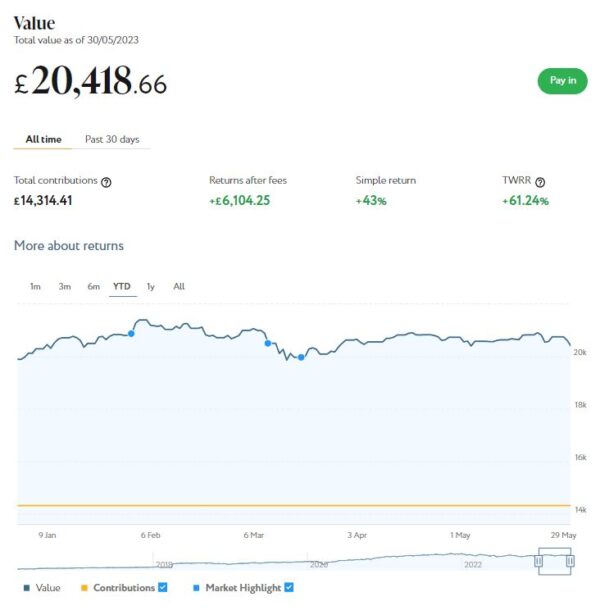
As the screenshot below for the year to date shows, my main Nutmeg portfolio is currently valued at £20,419. Last month it stood at £20,740 so that is a fall of £321.

Nutmeg Main June 2023

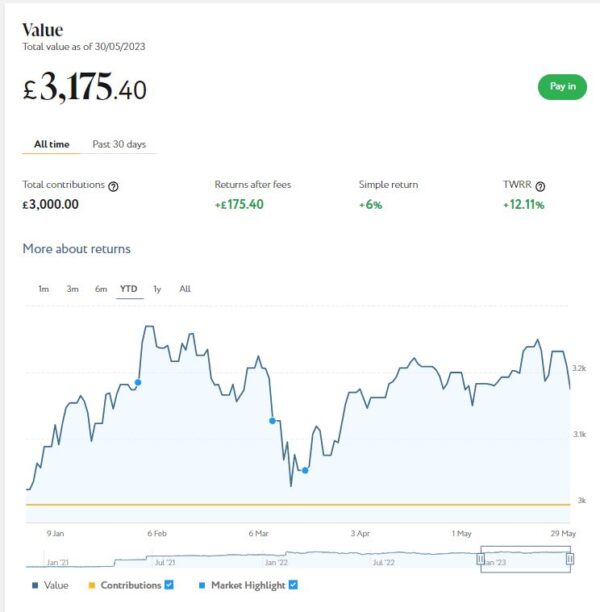
Apart from my main portfolio, I also have a second, smaller pot using Nutmeg’s Smart Alpha option. This is now worth £3,175 compared with £3,201 a month ago, a small decrease of £26. Here is a screen capture showing performance since the start of this year.

Nutmeg Smart Alpha May 2023

As you can see, this has been another up-and-down month for both my Nutmeg pots. Pro rata, though, my Smart Alpha portfolio has again done a bit better than my main portfolio. I am therefore tempted to switch more of my money into it, although there isn’t a massive difference in performance between them.

The net value of all my Nutmeg investments has fallen this month by £347 or 1.45% month on month. That is obviously disappointing, but both pots are still comfortably up on where they were at the start of the year. And their total value has risen by £1,781 (8.16%) since mid-October last year.

Of course, all investing is (or should be) a long-term endeavour. Over a period of years stock market investments such as those used by Nutmeg typically produce better returns than cash accounts, often by substantial margins. But there are never any guarantees, and in in the short to medium term at least, losses are always possible.

  • Also, as you may know, both my Nutmeg pots have quite high risk levels (9/10 main, 5/5 Smart Alpha). If you haven’t yet seen it, you might like to check out my blog post in which I looked at the performance over time of Nutmeg fully managed portfolios at every risk level from 1 to 10 . I was pretty amazed by the difference risk level makes, with higher-risk ports over almost any period of three or more years in the last ten generating significantly better overall returns. If you are investing for the long term (and you almost certainly should be) choosing a hyper-cautious low-risk level might not therefore be the smartest strategy. The one exception is if you plan to withdraw your money soon and don’t want to risk losing too much if there is a sudden downturn.

You can read my full Nutmeg review here (including a special offer at the end for PAS readers). If you are looking for a home for your annual ISA allowance, based on my overall experience over the last seven years, they are certainly worth considering. They offer self-invested personal pensions (SIPPs) and Junior ISAs as well.

Moving on, my Assetz Exchange investments continue to generate steady returns. Regular readers will know that this is a P2P property investment platform focusing on lower-risk properties (e.g. sheltered housing). I put an initial £100 into this in mid-February 2021 and another £400 in April. In June 2021 I added another £500, bringing my total investment up to £1,000.

Since I opened my account, my AE portfolio has generated a respectable £117.63 in revenue from rental income. As I said in last month’s update, capital growth has slowed, though, in line with UK property values generally.

At the time of writing, 7 of ‘my’ properties are showing gains, 4 are breaking even, and the remaining 14 are showing (small) losses. My portfolio is currently showing a net decrease in value of £23.62, meaning that overall (rental income minus capital value decrease) I am up by £94.01. That’s still a decent return on my £1,000 and does illustrate the value of P2P property investments for diversifying your portfolio. And it doesn’t hurt that with Assetz Exchange most projects are socially beneficial as well.

Obviously the fall in capital value of my AE investments is a bit disappointing. But it’s important to bear in mind that unless and until I choose to sell the investments in question, it is largely theoretical. The rental income, on the other hand, is real money (which in my case I have chosen to reinvest in other AE projects to further diversify my portfolio).

I also spoke to the CEO of Assetz Exchange, Peter Read, recently. He made the point that capital values on the platform simply reflect the latest price at which shares in the property concerned have changed hands on their exchange. They do not represent objective or independent valuations of the properties. If you are investing long term with AE, the annual yield from rentals is really a much more important consideration.

Peter also made the point that the current high inflation rate has actually been beneficial for Assetz Exchange investors. That is because properties on the platform generally have an annual review when rentals are increased in line with inflation. That means from the end of the financial year in April, rentals have increased in most cases by around 10%. I don’t want to go into too much detail about this here, but it is a subject I may return to in a future blog post.

To control risk with all my property crowdfunding investments nowadays, I invest relatively modest amounts in individual projects. This is a particular attraction of AE as far as i am concerned. You can actually invest from as little as 80p per property if you really want to proceed cautiously.

My investment on Assetz Exchange is in the form of an IFISA so there won’t be any tax to pay on profits, dividends or capital gains. I’ve been impressed by my experiences with Assetz Exchange and the returns generated so far, and intend to continue investing with them. You can read my full review of Assetz Exchange here. You can also sign up for an account on Assetz Exchange directly via this link [affiliate].

Another property platform I have investments with is Kuflink. They continue to do well, with new projects launching every week. I currently have around £2,500 invested with them in 18 different projects. To date I have never lost any money with Kuflink, though some loan terms have been extended once or twice. On the plus side, when this happens additional interest is paid for the period in question.

My loans with Kuflink pay annual interest rates of 6 to 7.5 percent. These days I invest no more than £200 per loan (and often less). That is not because of any issues with Kuflink but more to do with losses of larger amounts on other P2P property platforms in the past. My days of putting four-figure sums into any single property investment are behind me now! Nowadays I mainly opt to reinvest the monthly repayments I receive from Kuflink, which has the effect of boosting the percentage rate of return on the projects in question

Obviously a possible drawback with Kuflink and similar platforms is that your money is tied up in bricks and mortar, so not as easily accessible as cash savings or even (to some extent) shares. They do, however, have a secondary market on which you can offer any loan part for sale (as long as the loan in question is performing and not in arrears). Clearly that does depend on someone else wanting to buy it, but my experience has been that any loan parts offered are typically snapped up very quickly. So if an urgent need arises, withdrawing your money (or part of it) is unlikely to be an issue.

You can read my full Kuflink review here. They offer a variety of investment options, including a tax-free IFISA paying up to 7% interest per year with built-in automatic diversification. Alternatively you can build your own IFISA, with most loans on the platform being IFISA-eligible.

  • Until 30 June 2023 Kuflink are offering enhanced promotional rates of up to 9.73% (gross annual interest equivalent rate) for their Auto-Invest products (IFISA-eligible). There is limited availability for this offer and it may be withdrawn any time before 30 June 2023 if the limit is reached. For more information, click here [affiliate link].

Last year I set up an account with investment and trading platform eToro, using their popular ‘copy trader’ facility. I chose to invest $500 (then about £412) copying an experienced eToro trader called Aukie2008 (real name Mike Moest).

In January 2023 I added to this with another $500 investment in one of their thematic portfolios, Oil Worldwide. I also invested a small amount I had left over in Tesla shares. My original investment of $1,022.26 is today worth $1,093.00, an overall increase of $70.74 or 6.92%. in these turbulent times I am happy enough with that.

Since last month the price of my Tesla shares has risen and my copy trading portfolio with Aukie2008 has performed steadily. Unfortunately my most recent investment in Oil Worldwide is in the red, though. I am hoping for better things in the months ahead 🙂

You can read my full review of eToro here. You may also like to check out my more in-depth look at eToro copy trading. I also discussed thematic investing with eToro using Smart Portfolios in this recent post. The latter also reveals why I took the somewhat contrarian step of choosing the oil industry for my first thematic investment.

  • eToro also recently introduced the eToro Money app. This allows you to deposit money to your eToro account without paying any currency conversion fees, saving you up to £5 for every £1,000 you deposit. You can also use the app to withdraw funds from your eToro account instantly to your bank account. I tried this myself recently and was impressed with how quickly and seamlessly it worked. You can read my blog post about eToro Money here.

I had two more articles published in May on the excellent Mouthy Money website. The first was How to Save Money With Cashback Sites. If you ever buy anything online, you can almost certainly save money by signing up with these sites, which include Quidco and Top Cashback. You can read about my experiences with them and my top tips in this article.

My other article was Equity Release – Is It Right for You? In these financially challenging times, more and more older people are turning to equity release to release money tied up in their homes. My article explains the main options and sets out a range of points to consider before doing this.

As I’ve said before, Mouthy Money is a great resource for anyone interested in money-making and money-saving I always look forward to reading the articles by my fellow contributors. Shoestring Jane is a particular favourite and I enjoyed reading her recent article How to Start Comping and Win Big!

I also published a number of new posts on Pounds and Sense in May. One of these was about My Short Break in Aberdovey. This is a small town on the mid-Wales coast, between Aberystwyth and Tywyn. It was my first visit to Aberdovey and I recommend it for a chilled-out break – although (as I say in the article) I wouldn’t go there for the nightlife!

Also in May I published Get a Free Share Worth up to £100 with Trading 212. This offer is open until 8th June, so there is still time to take advantage if you haven’t already.

On a similar note, I published Get a Free ETF Share Worth up to £200 with Wealthyhood. Wealthyhood is a DIY wealth-building app aimed especially at people who are new to stock market investing. As from 1 June 2023 they changed their fee structure to make it even more attractive to small investors. It’s worth checking out, even if you only want the free share. This is an ongoing offer, but to qualify you do have to make a £20 minimum investment on the platform.

I also published an article titled Nibble Launches New Legal Strategy for investors. Nibble is a European crowdlending platform open to anyone. They are offering returns of up to 14.5% in their new Legal Strategy, which involves investing in loans that are in default and facing legal action (hence the name, of course). That is obviously higher risk, but NIbble guarantee to pay all investors in this strategy a minimum of 8% up to the maximum 14.5% depending how successful their recovery efforts prove. Average quarterly returns are currently 12.5%.

The other post I published in May was also about equity release. It’s titled Why Are People Opting for Equity Release? The article features some interesting research on why people are opting for equity release in the current economic climate, and what reasons are becoming more common. Definitely worth a look if equity release is on your radar.

One other thing I should mention is that I had an article published a couple of weeks ago in the Daily Telegraph newspaper about my investing experiences. If you read my monthly investment updates on PAS you won’t find too many surprises in it, but here’s a link anyway in case you’d like to check it out. Note that the article is behind a paywall so unless you are a Telegraph subscriber you will only be able to see the start.

Finally in May I enjoyed a short break in Yorkshire visiting my sister Liz and her family. Once again I stayed at the beautiful Hewenden MIll Cottages, between Wilsden and Cullingworth (near Haworth and ‘Bronte country’). If you’re looking for an unusual, rural-based short-break destination, Hewenden could certainly fit the bill. A photo of the old mill building (in which I stayed on a previous visit but not this time) is shown below. There is also a photo of the woodland at Hewenden in the cover image. You can read my original review of Hewenden Mill Cottages here.

Hewenden Mill

That’s all for today. I hope you’re enjoying the better weather and taking the opportunity to get out and about in our beautiful country (or further afield).

As always, if you have any comments or queries, feel free to leave them below. I am always delighted to hear from PAS readers 🙂

If you enjoyed this post, please link to it on your own blog or social media:
Equity Release Reasons

Why Are People Opting for Equity Release?

I have discussed equity release on various occasions on Pounds and Sense, including my article Should You Use Equity Release to Unlock the Value of Your Home?

As you probably know, equity release is a method of unlocking funds tied up in your property. It is open to homeowners aged 55 and over (60 and over in the case of home reversion plans).

In recent years equity release has become increasingly popular, and even rising interest rates have done little to dampen this trend. So today I thought I would look at the main reasons people are opting for equity release. I am indebted to my colleagues from Equity Release Supermarket for providing information (based on their internal data) on the top reasons people are releasing equity, as well as which reasons are seeing the biggest increases.

The table below shows the top reasons people have been using equity release over the last six months.

Rank Reason for equity release
1 Repay mortgage
2 Home improvements
3 Debt consolidation
4 Supplement income
5 New/second home purchase


As the table shows, repaying a mortgage is the number one reason over 55’s have released equity. The data shows that, on average, 21.1% of completed cases planned to pay off an existing mortgage with the money released.

Home improvements are the second most common reason, with an average of 17.9% of borrowers raising money for a renovation project.

Debt consolidation is the third most common reason for equity release, at a slightly lower average of 13.7%. Interestingly, when looking at the data by month, using equity release for debt consolidation peaked at 18% in December 2022.

The data also reveals which reasons for equity release have increased in popularity over the last six months, with home improvements seeing the biggest increase, growing by 7.7%.

Gifting money is becoming an increasingly popular reason to release equity too. In the last four months alone, gifting money that has been released through an equity release scheme has risen by 2%.

Mark Gregory, CEO and Founder of Equity Release Supermarket, has commented on the data:

“Equity release is available for homeowners over the age of 55 who wish to free up some of the money, tax-free, that has been built up in the equity of their home. The interest rate is fixed for life and the plan is repaid when the homeowner dies or moves into long term care.

“It is perhaps unsurprising that repaying a mortgage is the top reason for equity release. As interest rates and living costs continue to rise, borrowers will be looking for ways to reduce their monthly payments. By using an equity release scheme, such as a lifetime mortgage, to pay off your existing interest only mortgage you will no longer need to make monthly payments unless desired. This can help make monthly savings and alleviate financial pressures, especially for those who have seen their mortgage payments rise in recent months due to interest rates.

“It is interesting to see that gifting money through equity release has risen over the last six months. Money gifted through equity release becomes exempt from inheritance tax, provided that the gift giver lives for seven years afterwards. Inheritance tax can significantly reduce the amount of wealth that you may be able to pass on, so we often find that many people turn to equity release as a strategy for reducing the impact it will have on an estate.

“In this uncertain economic climate, it is more important than ever that borrowers are getting advice on what product options are available across the whole equity release market. For anyone considering equity release, we would suggest discussing your plans with one of our equity release advisers.”

My Thoughts

If you’re looking for a way to release money from your property – whether to pay off debts/mortgages, fund specific purchases, assist children or other family members, or just make later life more comfortable – equity release is certainly something you may want to consider. 

The main downside is – of course – that ultimately there will be less money to pass on to your beneficiaries. All reputable providers, however, offer a no-negative-equity guarantee. They may also be able to arrange plans where a certain amount of cash is guaranteed to remain in your estate, if you so wish.

Equity release interest rates in most cases are fixed for life, so you will know from the start the liability you are taking on. Of course, the longer you remain living in your home, the larger the debt eventually payable from your estate will be. 

If you think equity release may be right for you, you will need to discuss this fully with an independent adviser before proceeding. As well as Equity Release Supermarket other well-known firms in this field include Key Equity Release and Age Partnership. The Equity Release Council has a full list of members on its website.

The adviser will discuss your needs and circumstances, and – assuming they think equity release is right for you – make a recommendation from the range of products on the market. You can, of course, speak to two or more different advisers if you wish before making any final decision.

Thank you again to my colleagues at Equity Release Supermarket for their assistance with this post. As always, if you have any comments or questions, please do leave them below as usual.

If you enjoyed this post, please link to it on your own blog or social media:
Aberdovey

My Short Break in Aberdovey

I recently returned from a three-day break in Aberdovey (Aberdyfi in Welsh). This is a small town on the mid-Wales coast. It was the first time I’d been to Aberdovey, though I’d heard good reports about it from friends.

I stayed in a two-bedroom apartment with a wonderful view across the estuary. I booked through Airbnb. I’ll say a bit more about the apartment below.

I should mention that although I travelled (and stayed) on my own, I met up with an old friend from Birmingham there. David recently lost his wife, for whom he had been caring for several years, so I thought he might appreciate a bit of company on his first solo trip away (I enjoyed his company as well, of course). David stayed at a pub/hotel called the Penhelig Arms. He liked it there, though car parking could be a bit of an issue. It appears their car park has been turned into a beer garden!

Aberdovey is about five miles south of Tywyn and 10 miles north of the university town of Aberystwyth. Here is a map of the area from Google Maps…

Accommodation

As mentioned, I stayed at an Airbnb property in Aberdovey. Under Airbnb’s rules I’m not supposed to reveal exactly where it was, but the location was certainly convenient. It was opposite the main car park, beyond which was the sea. The beach was around two minutes’ walk away, and all the restaurants, cafes and shops were within easy walking distance (not that there are very many – Aberdovey is only a small place).

You can read more about where I stayed on this page of the Airbnb website (you can also read my post about booking a holiday with Airbnb here). The apartment had a good-sized master bedroom with a comfortable double bed, and a smaller second bedroom with twin bunk beds. The latter would have been okay for children but adults might find it a bit of a squeeze.

The apartment had a decent-sized bathroom with (unusually these days in my experience) a bath with a shower over it. The shower worked well and there was plenty of hot water. I did try having a bath on my last night and found the taps very stiff, though. Possibly they don’t get used very much! I reported this to the host as I thought she would want to know, but it was no big deal, obviously.

The living room had a stunning view across the estuary (see photo below). It was quite spacious and had a good quality flat-screen TV (though no DVD player). The kitchen area just off the living room had all the facilities you would need/expect, including a toaster, fridge, sink, cooker, dishwasher, and so forth.

Aberdovey

The apartment had gas central heating. As it was April I definitely appreciated this in the evenings and early mornings. There was a main thermostat in the living room and all the radiators also had thermostatic valves.

The apartment had free wifi which worked perfectly during my stay (not always the case in my experience). Although central, the location was quiet and peaceful, and I slept very well.

Finally I should say that communication from my Airbnb host (Irene) was excellent. She sent me very detailed instructions about how to get there, where to park, local amenities, and so on. One big plus was that residents in the apartment can use a council parking permit which allows them to park in the car park opposite (and various other places in Abverdovey) free of charge at any time. I left my car in the car park opposite, which was perfect for me.

Financials

As Pounds and Sense is primarily a money blog, I should say a few words about this.

I paid a total of £480 for my three-night stay. This was made up as follows:

  • £150 x 3 nights = £450
  • Cleaning fee £30

I was charged an initial deposit of £225, with the balance of £255 taken from my card a fortnight before my visit. The total price worked out to £160 a day. Obviously that’s not cheap but I thought it was reasonable bearing in mind the high standard of the accommodation and the convenience of the location.

Things to Do

As mentioned earlier, on this break I met up with an old friend, David. We spent some of the time together and some separately, which worked out well.

On our first full day we went on the Talyllyn Railway together (see photo below). This is a heritage steam railway that runs inland from the town of Tywyn, a short drive up the coast road from Aberdovey. I last went on the Talyllyn Railway five years ago (as described in this blog post) and was very happy to do so again.

Talyllyn Railway Tywyn Wharf Station

We bought all-day tickets for £25 each and went all the way up the line and back in the morning. We then had lunch (tomato soup and a bread roll, both very good) at the station cafe in Tywyn. After that we travelled part of the way down the line to Dolgoch. Here we disembarked and spent an hour exploring the picturesque woodland with its many streams and waterfalls (see photo below). We then caught the last train back to Tywyn.

Dolgoch

On our second full day we did our own thing. I stayed in Aberdovey, had a good wander round and got to know the place a bit better. I particular recommend the Medina Coffee House (picture below), where I went for both morning coffee and afternoon tea. You can sit inside or out here and enjoy a range of drinks, meals and snacks.

Medina Coffee House

David went to Machynlleth, about 15 minutes drive away. Among other things, he visited the Centre for Alternative Technology (CAT). As a retired builder he was very interested to see some of the innovative building techniques being demonstrated here and said he would like to have stayed longer.

I met up with David each evening for a main meal. On two nights we went to the Penhelig Arms where he was staying. They serve traditional pub food, but none the worse for that. Their prices were very reasonable, and David got a 20 percent discount as a hotel resident, which was a nice touch (they also extended the discount to my meals, which was kind of them).

On the other evening we bought fish, chips and mushy peas from Aberdovey’s only chip ship (photo below). This was a stone’s throw from my apartment. We took it back to the apartment and sat watching the sun set over the sea while enjoying our meals. The food, the view and the company were all excellent!

Chip shop

Final Thoughts

As you may gather, I enjoyed my short break in Aberdovey, and am happy to recommend both the town and the accommodation where I stayed for a short break.

Aberdovey is a lovely place to relax and chill out. With its beautiful beach it could also be a good destination for families with young children. Older children and teenagers might find the lack of other entertainments a bit limiting, however. Although it’s not my thing, there are various water sports you can do there, including sailing, canoeing, sailboarding and paddle-boarding. There are also some lovely walks (and cycle rides) from the town.

In addition, the proximity of the Talyllyn Railway, Machynlleth and Aberystwyth offers good opportunities for days out. Aberdovey definitely isn’t a place you would go for the nightlife, though – even the fish-and-chip shop closes at 8 pm!

As always, if you have any comments or questions about this post, please do leave them below.
If you enjoyed this post, please link to it on your own blog or social media:
My investments update February 2023

My Investments Update – February 2023

Here is my latest monthly update about my investments. You can read my January 2023 Investments Update here if you like

I’ll begin as usual with my Nutmeg Stocks and Shares ISA. This is the largest investment I hold other than my Bestinvest SIPP (personal pension), from which I recently started withdrawing again.

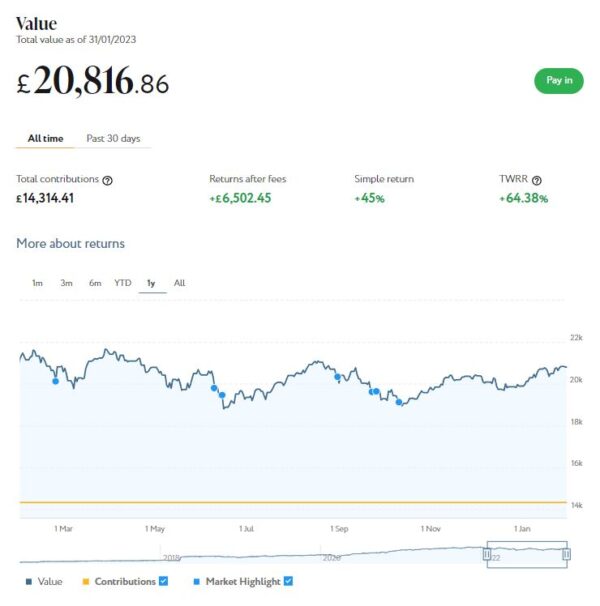
As the screenshot below of performance over the last year shows, my main Nutmeg portfolio is currently valued at £20,817. Last month it stood at £19,898 so that is a rise of £919.

Nutmeg main portfolio February 2023

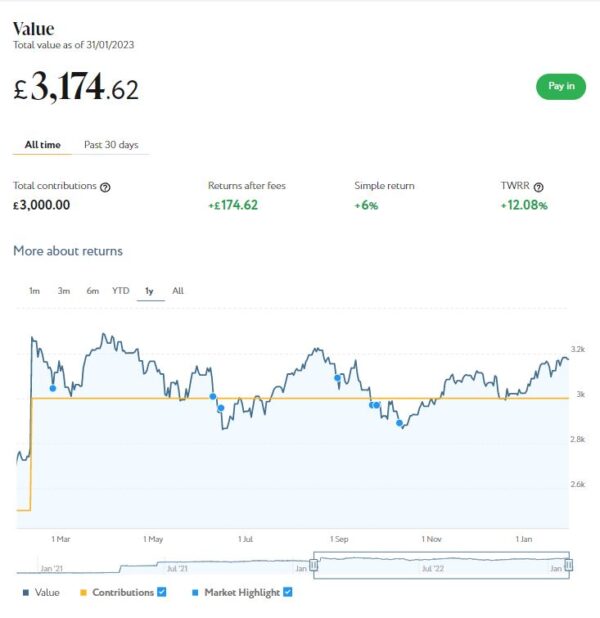
Apart from my main portfolio, I also have a second, smaller pot using Nutmeg’s Smart Alpha option. This is now worth £3,175 compared with £3,023 a month ago, a rise of £152.

Here is a screen capture showing performance over the last year. As you can see from the ochre line, I topped up this account in February 2022.

Nutmeg Smart Alpha February 2023

Clearly 2023 has started well, with the total value of my Nutmeg investments increasing by over £1,000. The strong start for equities in general in 2023 is due to various factors, including inflation rates world-wide starting to fall, the ending of most Covid restrictions in China, and a growing belief that any post-pandemic recession may not be as severe as was once thought. Of course, the war in Ukraine is still a major concern, but if that is resolved in the coming year it should give markets a further boost.

2023 is still likely to be an uncertain year for investors, with more ups and downs very much on the cards. Nonetheless, with share prices generally still below where they were a year ago, there are likely to be opportunities for investors to capitalize in the months ahead. I shall definitely be looking to invest more in Nutmeg and other equity-based platforms in the coming year.

Of course, all investing is (or should be) a long-term endeavour. Over a period of years stock market investments such as those used by Nutmeg typically produce better returns than cash accounts, often by substantial margins. But there are never any guarantees, and in in the short to medium term at least, losses are always possible.

You can read my full Nutmeg review here (including a special offer at the end for PAS readers). If you are looking for a home for your annual ISA allowance, based on my overall experience over the last six years, they are certainly worth considering. They offer self-invested personal pensions (SIPPs) as well.

Moving on, my Assetz Exchange investments continue to generate steady returns. Regular readers will know that this is a P2P property investment platform focusing on lower-risk properties (e.g. sheltered housing). I put an initial £100 into this in mid-February 2021 and another £400 in April. In June 2021 I added another £500, bringing my total investment up to £1,000.

Since I opened my account, my AE portfolio has generated a very respectable £96.79 in revenue from rental income. As I said in last month’s update, capital growth has slowed, though, in line with UK property values generally. Even so, it’s not all bad news. At the time of writing 16 of ‘my’ properties are showing gains, 7 are showing losses, and two are breaking even. My portfolio is currently showing a small net increase in value of £13.36, meaning that overall (rental income plus capital gains) I am up by £110.15. That is still a very decent rate of return on my £1,000 and does illustrate the value of P2P property investments for diversifying your portfolio. And it doesn’t hurt that with Assetz Exchange most projects are socially beneficial as well.

  • To control risk with all my property crowdfunding investments nowadays, I invest relatively modest amounts in individual projects. This is a particular attraction of AE as far as i am concerned. You can actually invest from as little as 80p per property if you really want to proceed cautiously.

My investment on Assetz Exchange is in the form of an IFISA so there won’t be any tax to pay on profits, dividends or capital gains. I’ve been impressed by my experiences with Assetz Exchange and the returns generated so far, and intend to continue investing with them. You can read my full review of Assetz Exchange here. You can also sign up for an account on Assetz Exchange directly via this link [affiliate].

Another property platform I have investments with is Kuflink. They continue to do well, with new projects launching almost every day. I currently have around £2,400 invested with them in 18 different projects (I withdrew £200 in December to help pay for Christmas). To date I have never lost any money with Kuflink, though some loan terms have been extended once or twice. On the plus side, when this happens additional interest is paid for the period in question.

My loans with Kuflink pay annual interest rates of 6 to 7.5 percent. These days I invest no more than £200 per loan (and often less). That is not because of any issues with Kuflink but more to do with losses of larger amounts on other P2P property platforms in the past. My days of putting four-figure sums into any single property investment are behind me now!

  • Nowadays I mainly opt to reinvest the monthly repayments I receive from Kuflink, which has the effect of boosting the percentage rate of return on the projects in question

Obviously a possible drawback with Kuflink and similar platforms is that your money is tied up in bricks and mortar, so not as easily accessible as cash savings or even (to some extent) shares. They do, however, have a secondary market on which you can offer any loan part for sale (as long as the loan in question is performing and not in arrears). Clearly that does depend on someone else wanting to buy it, but my experience has been that any loan parts offered are typically snapped up very quickly. So if an urgent need arises, withdrawing your money (or part of it) is unlikely to be an issue.

You can read my full Kuflink review here. They offer a variety of investment options, including a tax-free IFISA paying up to 7% interest per year with built-in automatic diversification. Alternatively you can now build your own IFISA, with most loans on the platform (including the one shown above) being IFISA-eligible.

Last year I set up an account with investment and trading platform eToro, using their popular ‘copy trader’ facility. I chose to invest $500 (then about £412) copying an experienced eToro trader called Aukie2008 (real name Mike Moest).

In January I added to this with another $500 investment in one of their thematic portfolios. I also invested a small amount I had left over in Tesla shares. My original investment of $1,022.26 is today worth $1,118.62, an increase of $96.36 or 9.63%. in these turbulent times I am very happy with that.

My eToro portfolio February 2023

In any event, I’m looking on this as a long-term investment so won’t be judging it yet. You can read my full review of eToro here. You may also like to check out my recent more in-depth look at eToro copy trading. I shall be publishing a post about my latest investment in an eToro thematic portfolio soon.

  • eToro also recently introduced the eToro Money app. This allows you to deposit money to your eToro account without paying any currency conversion fees, saving you up to £5 for every £1,000 you deposit. You can also use the app to withdraw funds from your eToro account instantly to your bank account. I tried this myself recently and was impressed with how quickly and seamlessly it worked. You can read my blog post about eToro Money here.

I had two more articles published in January on the always-excellent Mouthy Money website. One is A Three-Step Plan to Help Boost Your Finances in 2023. This article actually came out of an online presentation I did a few months ago to a club for older people. I hope you will find the ideas and advice it contains useful.

My other piece was Switch to Profit – How to Make Money Moving Your Bank Account. With the banks now starting to offer switching bonuses again to attract new customers, there are hundreds of pounds to be made by doing this. The article quotes my sister Annie, who is a serial switcher and shares some top tips based on her experiences. Many thanks, Annie!

That’s all for today. I hope you and your family are coping in these undoubtedly challenging times. Don’t forget to check out the government’s Help for Households website, which sets out various types of financial assistance you may be entitled to and is regularly updated.

As always, if you have any comments or queries, feel free to leave them below. I am always delighted to hear from PAS readers 🙂

Disclaimer: I am not a qualified financial adviser and nothing in this blog post should be construed as personal financial advice. Everyone should do their own ‘due diligence’ before investing and seek professional advice if in any doubt how best to proceed. All investing carries a risk of loss.

Note also that posts may include affiliate links. If you click through and perform a qualifying transaction, I may receive a commission for introducing you. This will not affect the product or service you receive or the terms you are offered, but it does help support me in publishing PAS and paying my bills. Thank you!

728x90

If you enjoyed this post, please link to it on your own blog or social media:
How well do British people understand home insurance?

How Well Do British People Understand Home Insurance?

Today I have a collaborative post with my friends at HSBC Life for you. It’s about home insurance and how well people really understand it.

Let’s start with the most basic question, though…

What Is Home Insurance?

Home insurance provides financial protection in the event of something happening to your property (i.e. home) or your possessions. There are two main types of home insurance, contents and buildings.

Contents insurance covers your belongings for loss or damage caused by fire, theft, flood and other disasters. Buildings insurance covers the structure of the building itself, including the walls, floors, ceilings, roof, etc.

While contents insurance is generally optional (though highly recommended), buildings insurance is likely to be compulsory if buying your home with a mortgage. People who are renting will not normally require buildings insurance as this is the landlord’s responsibility, but they may still wish to take out contents insurance.

You can have separate buildings and contents insurance, but if you need both it will usually work out cheaper to get a combined policy. This may also make life simpler when the time comes to make a claim.

Home insurance clearly isn’t the most exciting of subjects, with most people regarding it as a necessary evil. But of course, if the worst happens, having the appropriate insurance cover may stop a misfortune turning into a catastrophe.

HSBC recently commissioned a study from market research company YouGov about people’s attitudes to home insurance. They polled 2,000 people in the survey, the fieldwork for which took place in May 2022.

Survey Results

The main questions asked in the HSBC survey are set out below, along with the results.

What are the main reasons people do or don’t have home insurance?

  • 30% say it is expensive
  • 18% say it is comforting
  • 41% say it gives them peace of mind
  • 49% say it is necessary
  • 31% say it is reassuring

How much time does the average person spends researching their home insurance?

  • 47% up to 1 hour
  • 17% 1-2 hours
  • 7% 1 day to 1 week

Where they do their research, if at all?

  • 60% use price comparison websites
  • 16% recommendations
  • 12% customer reviews

What consideration is most important to them if they do select an insurer?

  • 69% say price
  • 71% say quality of cover
  • 38% say reputation

Even for those who have purchased, do they understand what they’re buying?

  • 72% say they understand what they have purchased
  • 10% say they do not understand

Finally, what proportion have made a claim on their home insurance before?

  • 39% of respondents have made a claim before
  • 61% of respondents have not made a claim before

My Thoughts

One thing the HSBC survey results suggest is that many people don’t fully understand home insurance or give it the careful consideration it merits. In these times of rapidly rising living costs, that could be a serious mistake.

I would offer two main pieces of advice. First, think carefully about what home insurance you require. Do you need both buildings and contents insurance, or just one or the other? Think also how much cover you need, based on the value of your belongings (for contents insurance) and of your property (for buildings insurance). In the latter case, you should insure for total rebuilding costs rather than just market value, as this is what you would have to pay if your house was destroyed by fire, flood or some other disaster.

And second, shop around for your home insurance, as prices vary widely. Using a price comparison service such as GoCompare can be a smart strategy, though bear in mind that not all insurers appear on these platforms (Aviva, Zurich and Direct Line are three that don’t).

I also recommend using cashback sites like Top Cashback, as these frequently offer cashback to people taking out home insurance from companies listed with them. They may also offer cashback to anyone purchasing via a price comparison service listed on the cashback site, giving you the best of both worlds.

  • I’d also highly recommend reading my blog post How I Saved £511.08 on my Annual Home Insurance. And yes, I really did save that much. Though as you’ll see I had clearly been paying over the odds for my home insurance for some time. I had separate buildings and contents insurance which, as mentioned above, typically works out more expensive. What’s more, I had lazily allowed both policies to keep rolling over year after year without checking whether better deals were available. Don’t make the same mistakes I did!

Many thanks again to my friends at HSBC Life for sharing their survey results with me and allowing me to reproduce them.

As always, if you have any comments or questions about this post, please do leave them below.
This is a collaborative post.

If you enjoyed this post, please link to it on your own blog or social media:
Investments January 2023

My Investments Update – January 2023

Happy New Year! Here is my latest monthly update about my investments. You can read my December 2022 Investments Update here if you like

I’ll begin as usual with my Nutmeg Stocks and Shares ISA. This is the largest investment I hold other than my Bestinvest SIPP (personal pension), from which I recently started withdrawing again.

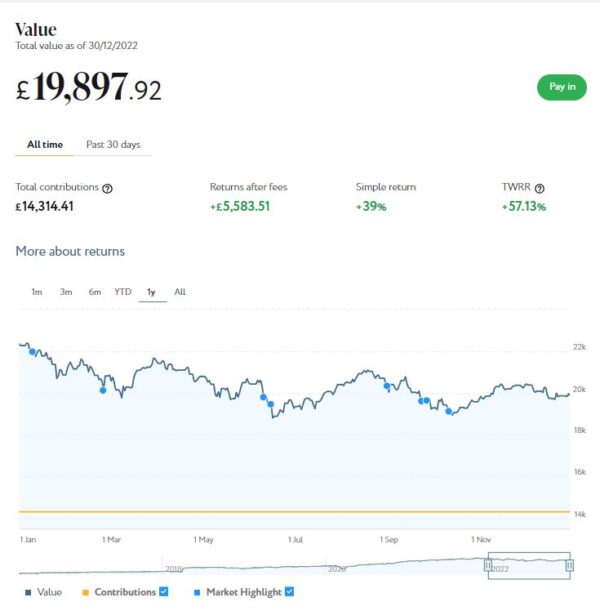
As the screenshot below of performance over the last year shows, my main Nutmeg portfolio is currently valued at £19,898. Last month it stood at £20,391 so that is a fall of £493.

Nutmeg main portfolio Jan 2023

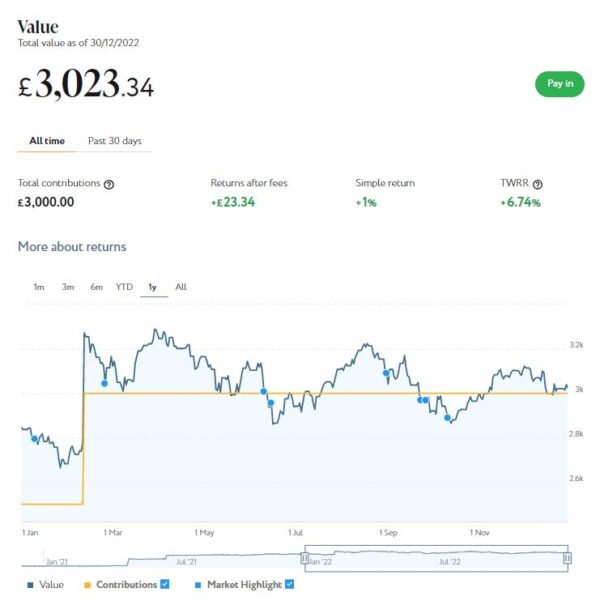
Apart from my main portfolio, I also have a second, smaller pot using Nutmeg’s Smart Alpha option. This is now worth £3,023 compared with £3,114 a month ago, a decrease of £91.

Here is a screen capture showing performance over the last year. As you can see from the ochre line, I topped up this account in February 2022.

Nutmeg Smart Alpha Jan 2023

That is a net month-on-month decrease of £584. That is obviously disappointing, but needs to be set against an increase of £785 the month before.

As the charts above clearly illustrate, 2022 was a volatile year for stock market investments generally. The outlook is still uncertain, but according to this article in the Financial Times the majority view is that stock markets overall will remain flat or see a very modest recovery in 2023. But obviously a lot depends on world events. If the war in Ukraine ends and/or China makes a reasonably smooth recovery from the pandemic, things could improve faster. Probably the best strategy, as this article from Forbes puts it, is to hope for the best but be prepared for the worst!

Overall, my Nutmeg investments are down £2,191 or about 8.7% since the start of 2022. To put this in context, though, in 2021 they rose in value by £3,552. And I am still more than £5,600 ahead since I started investing with Nutmeg in 2016. For my main portfolio that represents a return on capital of 39.01% or 57.13% time-weighted. My Smart Alpha portfolio hasn’t been going as long, but it is at least showing a small profit on the total I have put into it 🙂

Of course, the main lesson from all this is that investing is (or should be) a long-term endeavour. Over a period of years stock market investments such as those used by Nutmeg typically produce better returns than cash accounts, often by substantial margins. But there are never any guarantees, and in in the short to medium term at least, losses are always possible.

You can read my full Nutmeg review here (including a special offer at the end for PAS readers). If you are looking for a home for your annual ISA allowance, based on my overall experience over the last six years, they are certainly worth considering.

Moving on, my Assetz Exchange investments continue to generate good returns. Regular readers will know that this is a P2P property investment platform focusing on lower-risk properties (e.g. sheltered housing). I put an initial £100 into this in mid-February 2021 and another £400 in April. In June 2021 I added another £500, bringing my total investment up to £1,000.

Since I opened my account, my AE portfolio has generated a very respectable £91.61 in revenue from rental income. Capital growth has stalled, though, in line with what is happening in housing markets more generally. While some of ‘my’ properties are still showing gains, others are showing losses on capital. Overall my portfolio is currently showing a small net decrease in value of £7.88.

The latter is obviously a little disappointing, although of course capital values are largely academic unless and until you want to sell. The rental income is still coming in steadily without any issues or dramas. As I’ve said before, £91.61 is a decent rate of return on my £1,000 and does illustrate the value of P2P property investments for diversifying your portfolio when equity markets are volatile. And it doesn’t hurt that with Assetz Exchange most projects are socially beneficial as well.

  • To control risk with all my property crowdfunding investments nowadays, I invest relatively modest amounts in individual projects. This is a particular attraction of AE as far as i am concerned. You can actually invest from as little as 80p per property if you really want to proceed cautiously.

My investment on Assetz Exchange is in the form of an IFISA so there won’t be any tax to pay on profits, dividends or capital gains. I’ve been impressed by my experiences with Assetz Exchange and the returns generated so far, and intend to continue investing with them. You can read my full review of Assetz Exchange here. You can also sign up for an account on Assetz Exchange directly via this link [affiliate].

Another property platform I have investments with is Kuflink. They continue to do well, with new projects launching almost every day. I currently have around £2,400 invested with them in 18 different projects (I withdrew £200 in December to help pay for Christmas). To date I have never lost any money with Kuflink, though some loan terms have been extended once or twice. On the plus side, when this happens additional interest is paid for the period in question.

My loans with Kuflink pay annual interest rates of 6 to 7.5 percent. These days I invest no more than £200 per loan (and often less). That is not because of any issues with Kuflink but more to do with losses of larger amounts on other P2P property platforms in the past. My days of putting four-figure sums into any single property investment are behind me now!

  • Nowadays I mainly opt to reinvest the monthly repayments I receive from Kuflink, which has the effect of boosting the percentage rate of return on the projects in question

Obviously a possible drawback with Kuflink and similar platforms is that your money is tied up in bricks and mortar, so not as easily accessible as cash savings or even (to some extent) shares. They do, however, have a secondary market on which you can offer any loan part for sale (as long as the loan in question is performing and not in arrears). Clearly that does depend on someone else wanting to buy it, but my experience has been that any loan parts offered are typically snapped up very quickly. So if an urgent need arises, withdrawing your money (or part of it) is unlikely to be an issue.

You can read my full Kuflink review here. They offer a variety of investment options, including a tax-free IFISA paying up to 7% interest per year with built-in automatic diversification. Alternatively you can now build your own IFISA, with most loans on the platform (including the one shown above) being IFISA-eligible.

Last year I set up an account with investment and trading platform eToro, using their popular ‘copy trader’ facility. I chose to invest $500 (then about £412) copying an experienced eToro trader called Aukie2008 (real name Mike Moest). My investment has been up and down in the last few months, but it is currently $33 (about £27) in profit. In these turbulent times I am quite happy with that.

In any event, I’m looking on this as a long-term investment so won’t be judging it yet. I am also considering a further investment with eToro, probably in one of their themed portfolios. You can read my full review of eToro here. You may also like to check out my recent more in-depth look at eToro copy trading.

  • You might also like to know that eToro recently introduced the eToro Money app. This allows you to deposit money to your eToro account without paying any currency conversion fees, saving you up to £5 for every £1,000 you deposit. You can also use the app to withdraw funds from your eToro account instantly to your bank account. I tried this myself recently and was impressed with how quickly and seamlessly it worked. You can read my more in-depth article about eToro Money here.

I had two more articles published in December on the always-excellent Mouthy Money website. One addressed the question of whether you can Save Money by Cancelling Your TV Licence. I looked at what this entails and what TV you are still permitted to watch without a licence. I also set out some ways you may be able to save money on your TV licence if cancelling altogether is a bridge too far for you.

My other piece was Why We All Need to Be a Bit More Branson! The title is obviously tongue-in-cheek. But the article sets out my strongly held view that – in these challenging times especially – we can all benefit from being a bit more entrepreneurial. I really enjoyed writing this one, I must admit!

Last month I updated my post about the Warm Home Discount, which this year is being increased from £140 to £150. The eligibility rules are changing somewhat, and I shall probably be one of the people who misses out, which is clearly disappointing. But on the plus side, most people won’t now have to apply for this benefit – if you are eligible, the grant should be applied automatically to your bill by your energy company.

  • The government’s Help for Households website has a helpful summary of all the financial assistance currently available and is regularly updated.

My other posts from December included What Are The Best Video Calling Tools for Older People? and an expert guest post on the subject Why a Passion Investment Could be the Way Forward in Times of Economic Uncertainty. I found the latter quite an eye-opener, as it includes important info about Capital Gains Tax (CGT) I wasn’t previously aware of. The article also sets out some reasons to consider ‘passion investments’ such as fine wines or vintage cars, due to the tax advantages they can confer.

Finally, I published My Top 20 Posts of 2022, which I hope you will check out as well!

That’s all for today. I hope you and your family are coping in these undoubtedly challenging times, and wish you a happy, healthy and prosperous 2023.

As always, if you have any comments or queries, feel free to leave them below. I am always delighted to hear from PAS readers 🙂

Disclaimer: I am not a qualified financial adviser and nothing in this blog post should be construed as personal financial advice. Everyone should do their own ‘due diligence’ before investing and seek professional advice if in any doubt how best to proceed. All investing carries a risk of loss.

Note also that posts may include affiliate links. If you click through and perform a qualifying transaction, I may receive a commission for introducing you. This will not affect the product or service you receive or the terms you are offered, but it does help support me in publishing PAS and paying my bills. Thank you!

If you enjoyed this post, please link to it on your own blog or social media:
What You Should Know Before Buying a Holiday Home in Spain

What You Should Know About Buying A Holiday Home in Spain

Today I have a guest post for you about something many of us in icebox Britain would no doubt love to do at the moment.

Buying a Spanish holiday home, both for your own enjoyment and as a potential investment, has many attractions. But there are various important matters to consider before signing on that dotted line.

Learn more below 🏖


If you and your partner have spent many happy years holidaying in Spain, perhaps you’d like to consider investing in a Spanish holiday home?

Not only would a stunning sun-kissed property provide a wonderful place to enjoy your retirement years, but you could also let it out while you are not there and make some additional income. After all, Spain is a highly popular vacation spot with much to recommend it, so you would certainly never be short of guests.

Whatever you would like to use your Spanish holiday property for, there are a few important things you need to be aware of before you start house-hunting on the Costa Blanca…

Many Stunning Locations To Choose From

As you surely already know if you relish a vacation in Spain, the country has a plethora of gorgeous locations to choose from. While on the one hand this is clearly a good thing, on the other, it could make deciding on a particular location rather tricky.

If you’re struggling to settle on one spot, take some time to think about your requirements for the property. For example, if you’re planning to purchase a home solely for your own use, it makes sense to choose a property in a location you particularly love. Alternatively, if you’re buying a home as an investment, you may prefer to think about the locale that draws the biggest number of visitors and has the highest rental prices.

Insurance Is Important

Insuring your Spanish holiday home is of the utmost importance, even if you won’t initially be spending a great deal of time there. After all, you never know what might go wrong – from fire and theft to flood damage or structural damage caused by extreme weather. If you don’t have cover then you could be liable for some truly hefty repair bills.

Fortunately, finding the right holiday home insurance for Spain should be a breeze, thanks to Quotezone.co.uk’s helpful comparison service. You can compare and contrast quotes from a range of UK providers and potentially save yourself a lot of time and money along the way.

You Will Need An NIE

When you buy a property in Spain as a foreigner, you will be required by law to have an NIE number. The authorities will be able to use this number to work out how much tax (if any) you owe each year.

Your NIE number can be applied for at the Spanish Consulate in your country of residence or in Spain itself. You will need to fill out forms and provide various supporting documents. The process can take anywhere between two weeks and two months.

Factor In All The Costs

Before you take the plunge and commit to buying your Spanish holiday home, it’s a good idea to dedicate some time to running through all the potential costs you are likely to incur.

After all, you won’t just be paying the asking price of the home itself. You will also have to pay various associated fees, not to mention mortgage payments, lawyers’ fees and surveyor charges.

There will also be additional annual costs, as you will have to keep the property maintained to a good standard, particularly if you’re letting it out.

To ensure a Spanish holiday home is the right choice for you and won’t prove to be too big a drain on your retirement savings, take some time to pause and reflect on the various costs involved. This will help ensure you choose the option that works best for you.


Thank you to my friends at Quotezone.co.uk for an informative article. If you have ever dreamed of owning a holiday property in Spain, I hope it will give you food for thought.

As always, please feel free to leave any comments or questions below as usual. I would be particularly interested to hear from any readers who have gone ahead and bought a property in Spain or are actively considering it.

This is a collaborative post.

If you enjoyed this post, please link to it on your own blog or social media:
Ten reasons over-50s may need an independent financial adviser

Ten Reasons Over-50s May Need an Independent Financial Adviser

I’ve mentioned several times on PAS why I believe having an independent financial adviser makes sense, even if – like me – you consider yourself reasonably money-savvy.

So today I thought I would set out some reasons over-50s (in particular) may benefit from having an independent financial adviser (IFA) or at least speaking to one.

This post has been created in association with my colleagues at Unbiased.co.uk, a well-established financial services website that can put you in touch with suitable IFAs in your area.

Reasons for Having an IFA

1. Helping Your Children Through College or University

If you have children, you will naturally want to help them complete their education safely and with a reasonable degree of comfort. Sadly the days of student grants (which I was lucky enough to benefit from in the 1970s) are well behind us now. There are various options for helping finance your children’s college or university education and a financial adviser will be able to explore these with you. They will also explain the pros and cons of the student loans system.

2 – Pension Planning

If you are over 50 you will inevitably be thinking about pension options, including when you can retire and how much income you can expect. An IFA will go through your finances with you and look at ways you may be able to boost your pension pot. From 55 onwards you can normally start to draw your pension, but you shouldn’t do this unless a financial adviser has assured you it will last you through retirement.

3. Investing

Hopefully by your fifties you will be earning a decent salary and may also have paid off your mortgage. You may also receive an inheritance or other windfall. Either way, if you find yourself with some spare cash you will want to invest it to get the best possible returns from it. An IFA will have access to all the latest information about a vast range of investment opportunities. They will guide you towards investments that are suitable for you based on your financial goals, your investment timeframe and your appetite for risk.

4. Starting Your Own Business

Especially at this time of upheaval due to Covid, many people are looking to start their own businesses in mid-life. That may be in response to redundancy or unemployment, or simply in search of a better work/life balance. An IFA can help you with the financial aspects of doing this, including raising money for tools, premises, transport and so on, or perhaps buying a franchise.

5. Emigrating or Retiring Abroad

Another way to revitalize your life may be to start afresh somewhere else, with new challenges and opportunities (and perhaps a better climate as well!). Or you may be looking to move to a favourite vacation destination to enjoy your retirement. Either way, an IFA will be happy to discuss the pros and cons with you, point out all the things you will need to take into account, and assist you with the financial arrangements.

6. Divorce

Sadly middle age sees the largest number of divorces. Your first priority here will be appointing a good solicitor to act on your behalf and protect your interests. Beyond that, though, divorce can have major ramifications for your finances. An IFA can help you assess your situation objectively and plan for a financially secure and stable future.

7. Downsizing

As the children grow up and leave home you may want to move to a smaller property – to make life simpler, save time on housework and free up money for more exciting things. An IFA can help you explore the implications of doing this and make the necessary financial arrangements.

8. Equity Release

If you don’t want to move – and are over 55 – equity release is another option for releasing funds. In recent years it has grown a lot in popularity. There are various possibilities, including home reversion plans and flexible lifetime mortgages. Most now come with a no-negative-equity guarantee, ensuring you won’t end up passing on debts to your next of kin. An IFA can go over the options with you and point out the pros and cons before you contact any providers.

9. Estate Planning

This obviously includes writing your will, but depending on your circumstances it can cover a lot of other things as well. Nobody wants to see all their money and assets falling into the hands of the taxman rather than going to their nearest and dearest. Speaking to an IFA who specializes in estate planning can give peace of mind and ensure that your loved ones are well provided for when you are no longer here yourself.

10. Helping Elderly Relatives

If you have elderly parents (or other relatives) you may find they are increasingly reliant on you for help and support. It may be up to you to arrange care for them and/or set up power of attorney so you can manage their affairs if this becomes necessary. They may also need help with estate planning (see above). An IFA can assist with all these things as well.

Getting a Free Financial Check-Up

Independent financial advisers do of course charge for their services. They are by definition unaffiliated and do not receive commission, so any recommendations they make are based solely on their client’s best interests. As I have said before on PAS, I certainly don’t begrudge paying my own financial adviser, Mike, as he has undoubtedly saved (and made) me a lot more money than he has cost me over the years.

Nonetheless, most IFAs will be happy to see you for an initial financial healthcheck free of charge. This can focus on a particular area of concern, so you could request an investments review, a pension review or a mortgage review. Alternatively, if you’re not sure which aspect of your finances needs more attention – or indeed whether you need advice at all – you could simply request a broad financial healthcheck.

Here’s what. Adrian Kidd, a financial planner at Radcliffe & Newlands, says about his approach on the Unbiased website:

‘I’d generally offer one or possibly two free consultations, taking about an hour, and these can be as specific or as broad as required. When someone books a financial healthcheck with me, I ask them to bring along all their documents relating to their finances – savings, investments, mortgages, loans, insurance, pensions, the works – so I can build up a complete picture of their affairs. I then go through these in more detail after the consultation, and follow up with an email that gives a summary of their overall financial situation.’

In these free check-ups: advisers won’t generally talk to you about products at all. The process of choosing the right products comes later, after the adviser has built up an understanding of you as a person and your financial planning needs. Only then will they recommend products, if asked to do so.

If you follow my link to the Unbiased website, you can complete a short, step-by-step questionnaire designed to identify the best type of financial adviser for your needs. You will then be shown a selection of suitable advisers in your area with contact information. They will be happy to answer any queries you may have and arrange an initial meeting without obligation.

As ever, if you have any comments or questions about this post, please do leave them below.

Disclosure: This is a sponsored post on behalf of Unbiased.co.uk. If you click through my link and end up becoming a client of a financial adviser listed on the Unbiased site, I may receive a commission for introducing you. This will not affect the service you receive or any fees you are charged if you decide to proceed further.

  • This is a fully updated version of a post originally published in 2020.

If you enjoyed this post, please link to it on your own blog or social media:
My Investments Update August 22

My Investments Update – August 2022

Here is my latest monthly update about my investments. You can read my July 2022 Investments Update here if you like

I’ll begin as usual with my Nutmeg Stocks and Shares ISA. This is the largest investment I hold other than my Bestinvest SIPP (personal pension).

As the screenshot below of performance last month shows, my main portfolio is currently valued at £20,407. Last month it stood at £19,357 so that is a (very welcome) rise of £1,050.

Nutmeg Main Portfolio August 2022

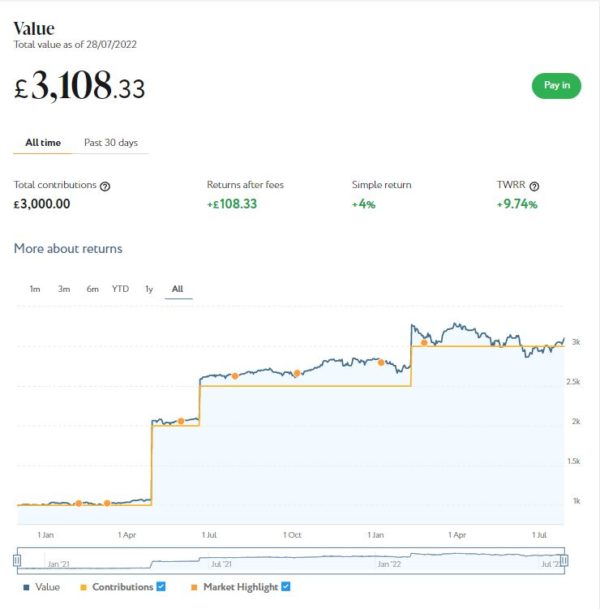
Apart from my main portfolio, I also have a second, smaller pot using Nutmeg’s Smart Alpha option. This is now worth £3,108 compared with £2,942 a month ago, a rise of £166

Here is a screen capture showing performance since January 2022. As you may be able to see, I have topped up this account several times this year.

Nutmeg Smart Alpha portfolio August 2022

The rises in July are obviously encouraging. In particular, it is nice that my Smart Alpha portfolio (which I haven’t had as long) is worth more than I put into it once again!

Nonetheless, this month’s rises still don’t quite cancel out the falls of last month. And the total value of my Nutmeg portfoiio is still around 8% less than it was at the start of 2022.

As I’ve noted previously on PAS, you do have to expect ups and downs with equity-based investments. And this year there has been no lack of volatility in world markets, caused by rising inflation, the war in Ukraine and the aftermath of the pandemic (among other things).

Even so, since I started investing with Nutmeg in 2016 – and despite everything that has happened this year – I have still made a total net return on capital of 42.56% (or 61.15% time-weighted) on my main portfolio.

I should say as well that I selected quite a high risk level for both my Nutmeg accounts (9/10 for the main one and 5/5 for Smart Alpha). This has served me well generally, but I’m sure investors who selected lower risk levels will have seen smaller falls over the last few months. If you also have a Nutmeg portfolio and plan to withdraw from it soon, there may well be a case for switching to a lower risk level now.

You can read my full Nutmeg review here (including a special offer at the end for PAS readers). If you are looking for a home for your annual ISA allowance, based on my experience over the last six years, they are certainly worth considering.

If you haven’t yet seen it, check out also my blog post in which I looked at the performance of Nutmeg fully managed portfolios at every risk level from 1 to 10 (as mentioned, my main port is level 9). I was actually pretty amazed by the difference the risk level you choose makes. If you are investing for the long term (and you almost certainly should be) opting for a hyper-cautious low-risk strategy may not be the smartest thing to do.

I talked about the performance of my Assetz Exchange investment in my July update and also in this recent blog post about ethical investment options. I don’t therefore intend to provide an in-depth report about it on this occasion. I will just say that AE continues to provide steady returns for me, with a lot less ‘excitement’ than my equity-based investments. And as mentioned in my recent post, I like the fact that my money is being used ethically as well (e.g. to provide accommodation for people with learning difficulties or physical disabilities). You can read my full review of Assetz Exchange here. You can also sign up for an account on Assetz Exchange directly via this link [affiliate].

Another property platform I have investments with is Kuflink. They continue to do well, with new projects launching almost every day. I currently have around £2,200 invested with them in 14 different projects. To date I have never lost any money with Kuflink, though some loan terms have been extended once or twice. On the plus side, when this happens additional interest is paid for the period in question. At present all my Kuflink loans are performing to schedule, though two are showing as ‘pending status update’, which may translate to a delay in repayment.

My loans with Kuflink pay annual interest rates of 6 to 7.5 percent. These days I invest no more than £200 per loan (and often less). That is not because of any issues with Kuflink but more to do with losses of larger amounts on other P2P property platforms in the past. My days of putting four-figure sums into any single property investment are behind me now!

  • Nowadays I mainly opt to reinvest the monthly repayments I receive from Kuflink, which has the effect of boosting the percentage rate of return on the projects in question

Obviously a possible drawback with Kuflink and similar platforms is that your money is tied up in bricks and mortar, so not as easily accessible as cash savings or even (to some extent) shares. They do, however, have a secondary market on which you can offer any loan part for sale (as long as the loan in question is performing and not in arrears). Clearly that does depend on someone else wanting to buy it, but my experience has been that any loan parts offered are typically snapped up very quickly. So if an urgent need arises, withdrawing your money (or part of it) is unlikely to be an issue.

You can read my full Kuflink review here. They offer a variety of investment options, including a tax-free IFISA paying up to 7% interest per year with built-in automatic diversification. Alternatively you can now build your own IFISA, with most loans on the platform (including the one shown above) being IFISA-eligible.

My investment in European crowdlending platform Nibble continues to perform as advertised. My latest investment was in their Legal Strategy. These are loans that are in default and facing legal action. Nibble buy these loans at a heavily discounted rate and then seek to recover as much as possible of the money owed. The minimum investment is 10 euros and the minimum period is six months. I invested 100 euros for 12 months initially at a target annual interest rate of 12.5%.

The Legal Strategy comes with a deposit-back guarantee. This is a guarantee to return the full investment amount at the end of the investment period and a minimum yield of 9% per year. The actual yield depends on how successful recovery efforts prove, so in practice you may end up with a return of anywhere between 9% and 14.5%. All has  gone to plan so far, but I will obviously continue to report on this in the months ahead.

As mentioned last time, I recently set up an account with investment and trading platform eToro, using their popular ‘copy trader’ facility. I chose to invest $500 (about £412) copying an experienced eToro trader called Aukie. My investment initially dipped, but as the screen capture below (of the app page on my mobile phone) shows, I am now about $16 in profit. That’s an increase of over 3% in just over a month. Obviously if it continues to do as well as this, I shall be delighted 🙂

eToro portfolio August 2022

In any event I am looking on this as a long-term investment so won’t be judging it yet. I am also considering a further investment with eToro, possibly in one of their themed portfolios. You can read my full in-depth review of eToro here if you like.

Moving on, I had another article published on the always-excellent Mouthy Money website. This one is titled Is Car Leasing Right For You? I found this very interesting to research and it gave me food for thought about what I may do when the time comes to bid goodbye to my current vehicle.

Turning to non-financial matters. I hope you are enjoying the (mostly) fine summer weather and making the most of our greater freedoms as we (hopefully) leave the pandemic behind. I recently enjoyed a day out with my friend Jeff at the National Trust’s Snowshill Manor and Gardens in Gloucestershire (pictured in the cover photo).

It was my first visit and I found it a fascinating place. The manor was owned by Charles Wade, an eccentric ex-Army officer. He used it to house his extensive collection of objects of all kinds, from musical instruments to children’s toys, bicycles to Samurai armour (see my photo below). I will try to find time to write a proper review of my trip to Snowshill soon.

Samurai armour

And on the subject of summer, can I also remind you about the collaborative Summer Giveaway I am sponsoring in association with other UK bloggers. It’s free to enter, and the lucky winner will receive not only an MSpa hot tub worth almost £1,000 but a range of other great prizes as well. The contest closes on 14 August 2022. Here’s a link to my blog post with details of how to enter.

That’s enough for today. As always, if you have any comments or queries, feel free to leave them below. I am always delighted to hear from PAS readers 🙂

Disclaimer: I am not a qualified financial adviser and nothing in this blog post should be construed as personal financial advice. Everyone should do their own ‘due diligence’ before investing and seek professional advice if in any doubt how best to proceed. All investing carries a risk of loss.

Note also that posts may include affiliate links. If you click through and perform a qualifying transaction, I may receive a commission for introducing you. This will not affect the product or service you receive or the terms you are offered, but it does help support me in publishing PAS and paying my bills. Thank you!

If you enjoyed this post, please link to it on your own blog or social media: