
property

Property crowdfunding

Is This a Good Time to Invest in Property Crowdfunding?

Right now it’s difficult for savers and investors to know which way to turn. World stock markets have been in free fall, while bank and building society interest rates are at an all-time low.

Regular readers will know that I’m something of a fan of property crowdfunding and have invested through a number of such platforms (notably The House Crowd, Property Partner, Crowdlords and Kuflink). For anyone seeking half-way decent rates of return, I believe they represent an opportunity worth considering at least, especially in the current uncertain economic climate.

But before I come to that, a few words for those new to this field…

What Is Property Crowdfunding?

As the name says, in property crowdfunding a number of investors pool their money to invest in property and share in the returns pro rata to the size of their investment.

In the last ten years a number of property crowdfunding platforms have been launched to facilitate this. As well as publicizing such opportunities, these companies typically identify suitable properties, advertise and administer projects, and manage properties once they have been purchased. They also distribute payments due to investors from rent received and (eventually) from selling up. Unlike ordinary buy-to-lets, property crowdfunding projects are typically hands-off, passive investments.

There are various methods of property crowdfunding. The traditional method (if you can describe something that’s been around for under ten years as traditional) is equity crowdfunding. Here investors’ money is pooled to buy a house or larger property. Investors then (usually) receive rental income in proportion to the amount they invested plus a share of any capital gains when the property is sold.

The other main method is debt crowdfunding. Here investors lend money to a landlord or property developer so that they can complete a particular project. The money might be used for a bridging loan, or to make improvements to a property prior to selling or remortgaging it. In this type of crowdfunding, the investors never actually own the property. They play a role similar to a bank, lending money and (all being well) being repaid with interest once the project is concluded.

There are also development projects, where investors’ money is used to fund larger-scale property developments. This might involve building a new property (or properties) from scratch, or perhaps converting existing buildings to a new use. Either way, if all goes well, at the conclusion of the development the investors get their capital back along with interest. Development crowdfunding is riskier than equity crowdfunding, but the profits to be made can be bigger.

Property crowdfunding is a form of investment, and like all investments it carries risks. Clearly it’s not as safe as bank or building society savings (which are covered up to £85,000 by the Financial Services Compensation Scheme). All investments are though secured against bricks and mortar, so in the event of a borrower defaulting you should still get your money (or most of it) back once the property concerned has been sold.

The rates of return with property crowdfunding are significantly higher than those from banks and building societies, and they’re also relatively unaffected by fluctuations in the stock market. Property crowdfunding isn’t a way of hedging equity-based investments directly, but it does help spread the risk.

Property and the Coronavirus

These are undoubtedly challenging times for property investors, be they traditional buy-to-let landlords or property crowdfunders.

Even before the virus struck, property prices were at best steady or going down. And measures taken by the government in the last few years, including progressive cuts in mortgage interest tax relief and an additional 3% stamp duty on buy-to-let properties (dubbed ‘The Landlord Tax’) considerably reduced the attraction of buy-to-let for private landlords especially.

The coronavirus crisis has added a whole new layer of difficulty. In particular, measures taken by the government to mitigate the worst effects of the crisis have hit both tenants and property owners hard. Many tenants are obviously suffering financial hardship, and may therefore be having difficulty paying their rent (and other bills). Tenants are, though, currently protected from eviction, and landlords are required to provide rent holidays where appropriate. These measures are sensible and humane, but at a stroke they have reduced or cut entirely many landlords’ income streams, and there is no government scheme to assist them. Obviously I don’t expect many tears to be shed for landlords, but life has undoubtedly become a lot more challenging for them.

In addition, due to social distancing and the lockdown, only limited construction work is continuing. It’s also difficult (or impossible) for surveyors and valuers to do their jobs, or for potential buyers to visit and inspect homes and other properties. All of this means that to a great extent the UK property market has currently ground to a halt.

Despite that, it’s not all bad news. At some point – maybe quite soon – the lockdown restrictions will be eased. The government is (rightly) keen to get the economy moving again as soon as possible. And there are still plenty of people looking to move home, buy property, begin new development projects, and so on. Much as the depressed state of the stock market has presented opportunities for those willing to take a chance on buying now while prices are low, there is certainly a case that property will bounce back in the coming months and years too, rewarding those who invest in the sector now.

Property Crowdfunding Opportunities

Clearly property crowdfunding investors are not immune to the effects of the coronavirus crisis. Developments and sales have been delayed, and in some cases at least rental income has been reduced. It’s quite possible – likely even – that in the longer term the rate of defaults on loans will go up too.

Nonetheless, property crowdfunding investors are unlikely to be as badly affected as private landlords. For one thing, if they are sensibly diversified across a range of properties (and platforms) they won’t be as susceptible as someone with a single buy-to-let. And like all property investors, their money is secured by bricks and mortar, so they will get it back (or most of it) eventually – though in the current crisis, that might take some time. For most property crowdfunding investors at the moment, sitting tight is likely to be the best (or only) option.

As I said above, the crisis is also creating opportunities for those who believe that property will prove to be the resilient investment it has generally been in the past. Rather than prolong this post too much, I will focus my attentions on the four platforms I am currently invested in, and which I am therefore most familiar with.

  • Property Partner

Property Partner is an interesting case. They have just announced that they are suspending all dividend payments for the next three months (potentially longer). This is, of course, mainly money from rent received, which (for reasons stated above) is likely to take a hit in the coming months. Property Partner say they are taking this action to ensure that investors are protected in the longer term and all properties have sufficient cash reserves to cover any necessary expenditure.

As I said in this post a few months ago, many of the properties on Property Partner are coming up to their five-year anniversaries. This is a significant milestone, because after a property has been owned for five years, all investors have the chance to exit at a fair market price (determined by an independent surveyor). Property Partner have said they are suspending this process until June at the earliest.

You can still buy and sell properties on Property Partner’s secondary market, and on the face of it there are some good-value buying opportunities here, with properties listed at up to 25% off their current valuations (see screen capture below).
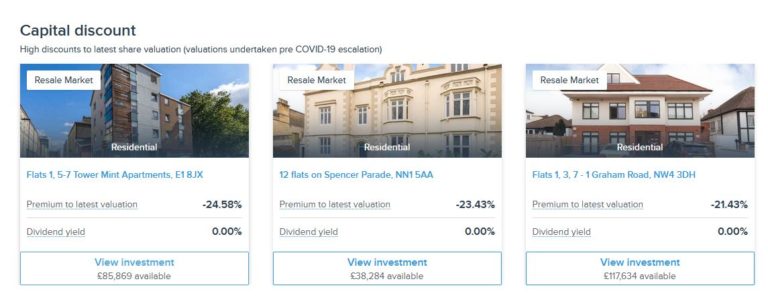
Property Partner secondary market

In theory, you could buy shares in these properties on the secondary market at a big discount, and sell them at their current valuation for a good profit when the five-year sale process is reinstated.

Unfortunately it’s not quite a straightforward as that, though. For one thing, the current valuations were made before the coronavirus crisis hit, so they may no longer be an accurate reflection of a property’s value. In addition, the five-year exit mechanism depends on other investors wanting to buy the shares at the valuation stated. Failing that, the property will be sold on the open market, but that could take a long time in the current economic climate. Neither is there any guarantee what price would be achieved.

My personal view is that I do believe property prices will bounce back but it may not be for quite a while. I am looking seriously at some of the buying opportunities on Property Partner’s secondary market where I think they represent good value in the medium- to long-term, but I am not rushing to invest at the moment.

Please check out my Property Partner review for more information about the platform.

  • Kuflink

Kuflink is another property crowdfunding platform I have a soft spot for. Although I don’t have huge amounts invested with them, so far all of my investments have paid out as promised, with just a short (one-month) delay in one case.

Kuflink is a property loans platform. So far anyway I have not heard of any defaults, although the longer the crisis continues, the greater the risk this may happen. Nonetheless, based on my experiences to date, I am continuing to invest (cautiously) with them. In particular, I like their new secondary market, where you can buy loan parts from other investors who want to sell up early (see screen capture below)
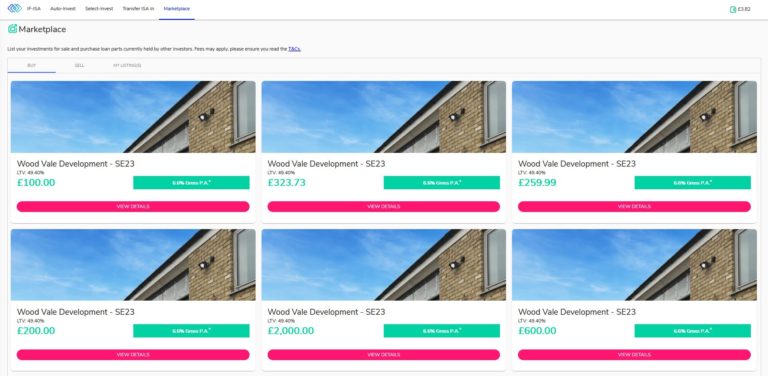
Kuflink secondary market

As you may imagine, this has been happening a lot recently, as many investors have wanted (or needed) to access their capital urgently. This has created short-term buying opportunities which I have been busily taking advantage of. These loan parts typically have only a few months to run, so you can expect to get your capital back quite quickly (and can then reinvest it). Only loans in good standing with monthly repayments up to date may be listed on the secondary market, so that offers some reassurance against default – though of course it is by no means a guarantee.

Secondary market aside, Kuflink also still has a steady stream of new investment opportunities coming to the table. Of all the property platforms, they appear to be the ones least affected by the current crisis. I am not exactly sure how they have achieved this, but obviously I hope they continue to do so!

If you haven’t invested in Kuflink before, it’s also worth mentioning that they have a generous welcome offer which is still operating. You can earn up to £4,000 in cashback with this. See my Kuflink review for full details.

  • The House Crowd

The House Crowd is actually the first property crowdfunding platform I invested with. My experience with them has generally been good, although as mentioned in my House Crowd review there have been some delays and defaults.

Although they started as a traditional crowdfunding platform, The House Crowd have increasingly moved towards development projects, and these have inevitably been hit by the current crisis. THC say that at present they are following a strategy of ‘prudently maintaining The House Crowd platform to ensure its continued and efficient operation as we see our way out of the other side of the lock down.’

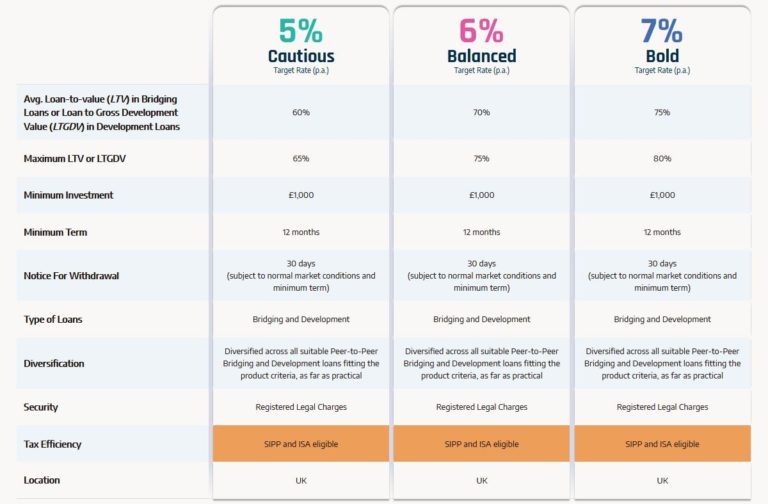
That means there are fewer investment opportunities on THC at the moment. You can though if you wish still invest in their automatically diversified ‘Auto-Invest’ products, with target interest rates of 5% (Cautious) to 7% (Bold), or the new THC Fusion account, which offers even greater diversification with a target interest rate of 4% to 4.5%. More information about these can be read on the House Crowd website.

At the time of writing THC also have a couple of development projects open for investment, including their flagship project The Downs in Altrincham town centre, paying a target rate of 10% per year (see screen capture below).
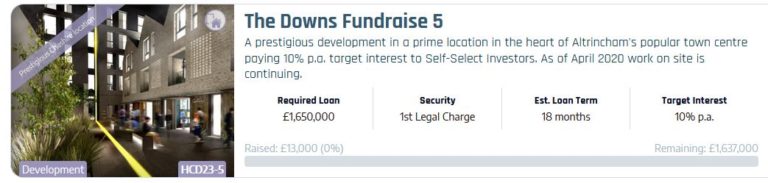
The House Crowd Downs

Personally I am not investing any more money in The House Crowd at the moment, but I am keeping this under review. You can read my full review of The House Crowd here

  • Crowdlords

Finally, Crowdlords say they have experienced a significant reduction in investment levels since February, which they put down to uncertainty caused by the pandemic. They do still have a couple of lending opportunities listed (see capture below), but not much else. I guess like The House Crowd they are hunkering down and waiting for the current restrictions to be lifted and the property market to start moving again.
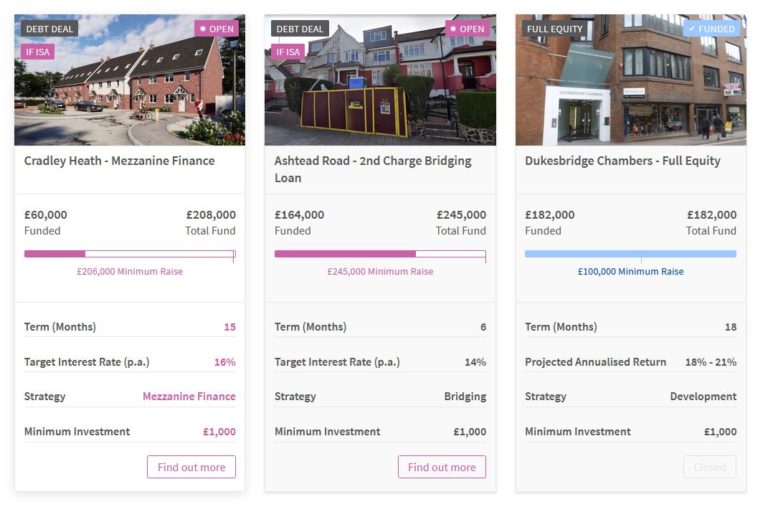
Crowdlords investments

Again, I am not currently planning to invest any more in Crowdlords, but am keeping an eye on any opportunities that may crop up in the months ahead. You can read my full review of Crowdlords here.

Final Thoughts

I thought I’d close by sharing a couple of nuggets of information I found while researching this post.

First, the ratings agency Fitch has downgraded the rating of UK debt to AA-. However, Fitch estimated growth next year would bounce back to 3 percent if the UK can begin to unwind the measures to tackle the health crisis in the second half of the year. The UK’s Coronavirus Job Retention scheme – a three-month programme to support employees hit by the pandemic – will cost about 1.3 per cent of GDP, according to Fitch estimates.

Second, estate agents Knight Frank have predicted that many house sales will be lost this year and the UK’s property market will see little to no growth in 2020. However, a sharp recovery has been predicted for 2021. Liam Bailey, global head of research at Knight Frank, said, “We expect a revival in activity to continue, with volumes next year expected to be 18 per cent above the level seen in 2019.”

All of this (and other sources) suggests that while property markets are in the doldrums now and probably for most of 2020, there is every chance that by next year we will see a recovery. There are undoubtedly good opportunities on offer in property investment now if you agree with this evaluation and are able to be patient in the shorter term.

In any event, if you’re looking for better returns than the banks and lower volatility than the stock markets, then property generally – and property crowdfunding in particular – remains in my view well worth considering as part of a balanced investment portfolio.

As always, if you have any comments or questions about this post, please do leave them below.

Disclosure: I am not a regulated financial adviser and nothing in this post should be construed as individual financial advice. You should always do your own ‘due diligence’ before investing, and seek independent financial advice if in any doubt how best to proceed. All investment carries a risk of loss.

If you enjoyed this post, please link to it on your own blog or social media:
The House Crowd Review

The House Crowd: My Review of this Property Crowdfunding Platform

Regular readers will know that I am something of an enthusiast for property investment (and specifically property crowdfunding). Among other things, I like the fact that you can make money from both rental income and capital growth. And investing in property can be a good way of spreading risk when you have equity-based investments.

The House Crowd was actually the first property crowdfunding company I invested with, starting in 2014. So I thought I would say a few words today about my experiences with the company and the investment opportunities they offer.

History

When I started investing with The House Crowd, they were offering mainly shares in specific properties. Investors pooled their money to buy a property and received a share of the rental income (distributed annually) with their money back – and hopefully a good profit – when the property concerned was sold. Typically a five-year timescale was specified, with investors then able to vote on whether to sell and take their profits or continue for another year (or more).

I still have shares in seven House Crowd properties. There haven’t been any disasters, though in certain cases rental income has been lower than forecast. This was typically due to voids (tenants leaving and not being replaced). There were also a few cases of tenants failing to pay their rent and absconding. And there was one ‘tenant from hell’, who apparently threatened other tenants with a knife so they all left, caused serious damage to the property, and left owing six months’ rent. Reading about this made me glad I invest via property crowdfunding platforms (and REITs) and am not a landlord myself.

One drawback of this type of investment is that it is quite illiquid. If you want your money back before a property is sold, The House Crowd will try to sell your share to another investor. There is no guarantee a buyer will be found, however, and even if one is you will only get the price you paid for your share. There is currently no formal secondary market, as on some other platforms such as Property Partner.

On the plus side, this sort of investment has its attractions from a tax perspective. Rental distributions are paid as dividends. There is currently a £2,000 annual tax-free dividend allowance which many people don’t otherwise use. And even if your dividend income exceeds £2,000, as a basic rate taxpayer you will only pay 7.5% tax on the balance above this. Gains when selling are – of course – treated as capital gains, and again there is a generous annual tax-free CGT allowance (£12,000 in 2019/20).

New Types of Investment

In recent years, recognizing that some investors were being deterred by the lack of liquidity, The House Crowd have introduced other types of investment. One of these is secured loans.  Here money is lent to developers (or THC’s sister company, House Crowd Developments) for short- to medium-term projects, typically between 6 and 18 months.

Obviously you don’t get rental income with these, but you get your money back with interest once the loan is paid off. Interest rates vary, but are typically in the region of 7 to 12% per year. The rate paid generally depends on the LTV (loan to value). The higher the LTV (the loan amount compared with the property value), the riskier the loan, and the higher the interest rate on offer as a result. Some example projects open for investment at the time of writing can be seen in the cover image at the top of this post.

I have invested in loans with The House Crowd as well. The majority have gone well. For example, I invested £5,000 in a development loan for a Welsh property called Croesyceiliog Farm. I got this back with £461.99 interest ten months later.

Other loan investments haven’t gone as smoothly. For example, in 2016 I invested £1,000 in a loan for a property called Caverswall Castle. This was meant to be 12-month loan, but the borrower defaulted and legal action is now being taken to sell the property and repay investors. I still expect to get my money back eventually, but legal proceedings move at a glacial pace. How much interest I will get after all costs are covered I don’t know. At this stage, if I just get my £1,000 back, I will be more than happy.

Secured loans have various attractions for investors, and many property crowdfunding platforms as well as The House Crowd are now offering more opportunities of this nature. They have the advantage of shorter timescales than direct investment and decent rates of return (assuming the borrower doesn’t default). One drawback is that the interest paid when the loan is redeemed is treated as income, so you will have to pay tax on it at your highest marginal rate.

Auto-Invest and IFISA

In recent years The House Crowd have introduced an Auto-Invest product which you can (optionally) hold as an Innovative Finance ISA (IFISA).

As you may know, IFISAs offer the opportunity to invest in P2P lending and get tax-free returns. Everyone has a generous annual ISA allowance of £20,000 (in the current 2019/20 tax year). This can be divided any way you like among the three types of ISA. So if you open a House Crowd IFISA, you can still have cash and stocks and shares ISAs with other providers as well, so long as you don’t invest more than £20,000 in total. Note that you can also only invest in one ISA of each type per financial year.

The House Crowd Auto-Invest product allows you to invest in one of three investment portfolios: Cautious, Balanced or Bold. Each of these comprises a basket of bridging and development loans, providing automatic diversification. The Cautious product has a target return of 5%, the Balanced 6%, and the Bold 7%. Note that these are target rates and they are not guaranteed. I have copied a summary table about the three products from the House Crowd website below .

Auto Invest products from The House Crowd

As you can see, the more ‘adventurous’ the product, the higher the average LTV and the higher the maximum LTV. As mentioned earlier, the higher the LTV (other things being equal) the riskier the loan, and the higher the interest rate on offer as a result.

There is a minimum investment of £1,000 and a minimum 12-month term. After that you can withdraw by giving 30 days’ notice. Your money is protected by a legal charge secured against the borrower’s land/property, which can be possessed and sold in the event of the borrower not repaying.

It is possible to transfer another ISA to the House Crowd IFISA free of charge if it is over £5,000 (there is a £50 transfer fee for ISAs valued from £1,000 to £4,999).

Pros and Cons

As usual, here is my list of pros and cons for The House Crowd.

Pros

1. Well-established property crowdfunding platform with a good track record.

2. Customer service is fast, friendly and helpful.

3. Choice of investment types.

4. Tax-free IFISA option available.

5. Competitive rates of interest.

6. Attractive, user-friendly website.

7. Detailed information provided about loans and investments.

Cons

1. Limited liquidity with no formal secondary market.

2. Rental income (where applicable) only distributed annually.

2. Minimum £1,000 investment.

3. Some loans are currently in default.

4. Can’t open an IFISA if you have already put money in another IFISA this year.

Conclusion

For the most part I have been happy with my experiences with The House Crowd to date. Although (as mentioned above) there have been ups and downs, overall I have still made a good net return from my investments with them.

I like the new Auto-Invest/IFISA option, which is automatically diversified across a range of loans (thus reducing volatility and risk). The minimum 12 month term and withdrawal on 30 days’ notice thereafter is attractive as well. It is, however, important to be aware that the target rates of return quoted are not guaranteed.

You should also bear in mind that investments with The House Crowd do not enjoy the same level of protection as bank and building society savings, which are covered (up to £85,000) by the Financial Services Compensation Scheme. All investments are though secured against bricks and mortar, so in the event of a borrower defaulting you should still get your money (or most of it) back once the property has been sold. But obviously, this may take a while.

The lack of liquidity with property investments generally – and the absence of a formal secondary market with The House Crowd – means you should only invest money you are unlikely to need at short notice. This should be regarded as a medium- to long-term investment, therefore.

Clearly, no-one should put all their spare cash into The House Crowd (or any other investment platform). Nonetheless, it is worth considering as part of a diversified portfolio. Not only are the rates of return significantly higher than those offered by banks and building societies, they are relatively unaffected by fluctuations in the stock market. Property investments aren’t a way of hedging your equity-based investments directly, but they do help spread the risk

  • A further consideration is that with world stock markets in chaos at the moment due to the coronavirus outbreak, now is probably not an ideal time for the average individual to be investing in stocks and shares. P2P lending of the type offered by The House Crowd represents an alternative investment approach that may be less susceptible to the wild ups and downs (mostly downs) on stocks and shares right now..

Welcome Offer

Unfortunately at present there is no welcome offer (or referral scheme) for new investors with The House Crowd. If a welcome offer is launched in future, I will of course post full details here.

If you plan to open an account with The House Crowd after reading this review, I’d still be grateful if you could let me know by sending a message via my contact form or leaving a comment on this post. This may help me persuade THC to set up a referral scheme and/or welcome offer in future 🙂

And of course, if you have any comments or questions about this review, as always, please do leave them below.

Note: This is a fully revised and updated version of my original 2017 review.

Disclosure: I am not a professional financial adviser and nothing in this post should be construed as personal financial advice. You should do your own ‘due diligence’ before making any investment, and seek professional advice from a qualified financial adviser if in any doubt how best to proceed. All investments carry a risk of loss. Finally, in the interests of full disclosure, I should reveal that as well as being an investor with The House Crowd, I also own shares in the company.

If you enjoyed this post, please link to it on your own blog or social media:
Booking a holiday with Airbnb

Booking a Holiday with Airbnb

I recently booked my first ever break with Airbnb.

Of course, I’ve been aware of this person-to-person accommodation booking platform for some time, but till now I’ve avoided using it myself. In the back of my mind were stories I read years ago about people renting out sofas in their living room to make a bit of extra cash. At my age that prospect – the sofa in the living room, I mean – definitely didn’t hold any appeal!

Times change, though, and it’s important to keep up with them. In my case I wanted to book a short break in a part of North Wales that isn’t well served by hotels, the Lleyn Peninsula. Okay, I could have stayed at the Haven Holidays Park (formerly Butlins) in Pwllheli, but I was pretty sure that wouldn’t be my cup of Welsh tea either.

So after researching the relatively few hotels in the Abersoch area where I wanted to stay using Booking.com (affiliate link), I decided it might be time to give Airbnb a try. In recent years, as regular readers will know, I have become more accustomed to booking self-catering accommodation for short breaks, and have realised that in some ways I prefer this to staying in hotels.

In this blog post I thought I’d share my experience of registering with Airbnb and finding and booking accommodation. I hope this might inspire you to try it yourself if you haven’t yet taken the plunge with Airbnb.

  • Of course, you can also become an Airbnb host and make money that way. I haven’t tried this myself, but did cover the subject in another blog post titled Boost Your Income by Renting Out a Room.

Registering with Airbnb

Before you can make a booking with Airbnb, you have to be registered on the website. You can still browse without joining but (as I found out) if you find somewhere you like available on the dates you want, you will have to go back and register and then start the whole process again. This is a frustrating waste of time. It’s free to register and doesn’t take long, so if there is any chance you might want to book through the platform, my advice would be to do this first.

Registering with Airbnb is similar to registering on other booking websites. One thing to be aware of, though, is that as well as your personal details, as proof of ID they also ask you to upload a scan of an official document such as your passport or driving licence with your photo on it. Once you have done this, you have to wait for your ID to be approved. In my case this happened within 15 minutes and I received notification by email.

Once you’ve done all that, you can start searching for your perfect holiday retreat!

Searching Airbnb

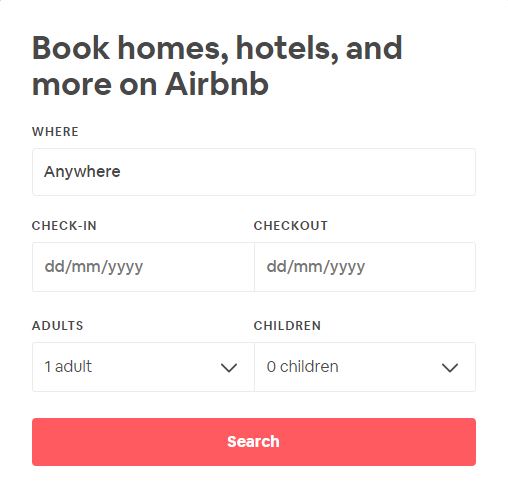
Once you are logged in, you can start your search using the box on the Airbnb front page (see below).

Airbnb search box

As you can see, you have to enter where you wish to go and the dates you want to arrive and depart. You have to choose specific dates, even if (as I was) you are flexible about this. Once you have found somewhere you like, you will be able to see what other dates that accommodation is available. If you want to check all possible places in the area, though, you may need to do a few searches using different dates.

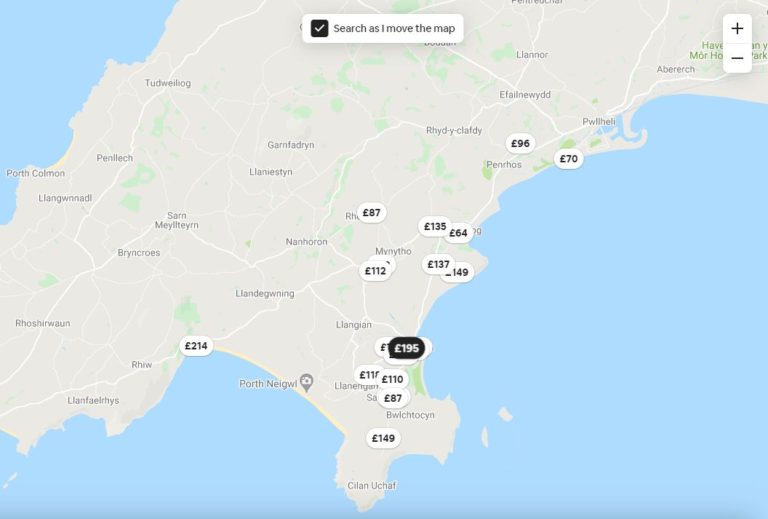
Anyway, once you have entered the relevant details and clicked on search, a new page will open showing you a map of the area in question. Here’s what I got when I searched just now for accommodation near Abersoch in early May (not actually when I am going).

Airbnb Abersoch

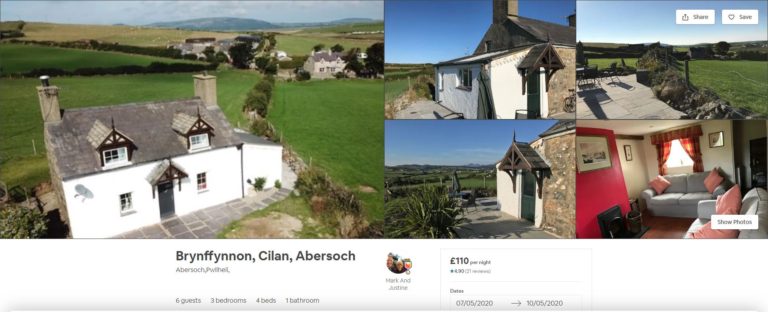
As you may gather, each of the prices in a small oval represents an Airbnb place with availability on the dates in question. The price is the cost per night. Clicking on any of these will bring up brief info about the accommodation in question. If you like the look of this, clicking again will bring up a new page with photos and more. Here’s the top of the page for a cottage I like the sound of, though it would be too large for me alone.

Airbnb cottage

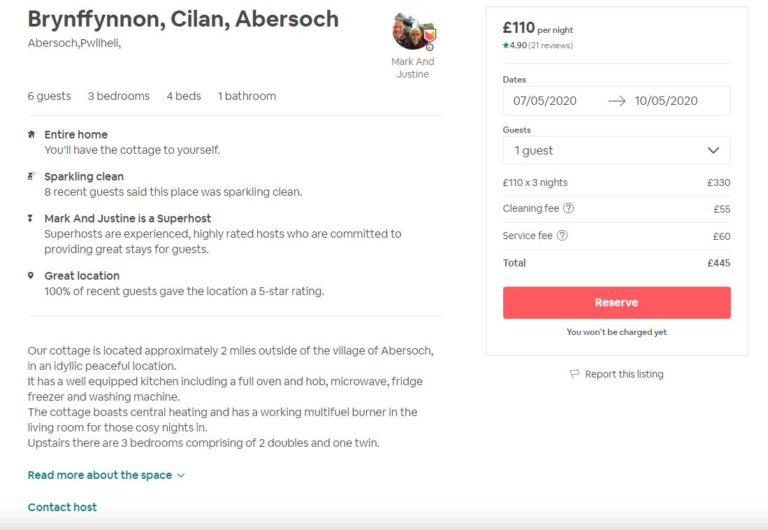
Also on this page are full details about the accommodation and a reservation form – see below.

Airbnb booking form

As you can see, for your money you are getting considerably more than a sofa in someone’s living room 😀 £110 a night seems very reasonable to me for a cottage that can accommodate a family of six.

As you may have noticed, there are some additional charges. Many Airbnb properties – though by no means all – charge a cleaning fee. In addition, you will always be charged a service fee. This goes to Airbnb, and is one way they make their money (they also charge a fee to the property owners).

If you scroll down you will see various other items, including visitor reviews and a calendar showing when the property is (and isn’t) available. Also towards the bottom of the screen you will find the cancellation terms. These are set by the hosts and vary considerably, so be sure to study them carefully. Often you will be able to cancel free of charge until a certain date. After that, you may have to pay the service charge and perhaps part or all of the booking fee as well.

Making Your Booking

If you want to proceed, clicking on Reserve will take you to a new page where you can confirm your booking and provide payment information. This is pretty standard, although one thing you don’t normally have to do on hotel booking sites is write a message of introduction to the property owners (your hosts).

Airbnb provide a ready-written message you can use by default. This is pretty bland, however. I think it’s best to take a few minutes to write something more personal about who you are, why you want to visit the area, and so on. This is especially important if you are new to Airbnb and don’t have any history on the site or reviews written about you (yep, Airbnb hosts review guests as well as vice versa). In theory a host can decline your booking if they don’t like the sound of you, so it’s good to reassure them that you are a normal human being and will treat their property with respect.

And that’s it, basically. When I made my booking it all went through smoothly and I received a thank-you message from the hosts within an hour. I haven’t been on the holiday yet, but will post a review on this blog after my return.

As always, if you have any comments or questions about this post, please do leave them below.

If you enjoyed this post, please link to it on your own blog or social media:
Bricklane review

Bricklane: My Review of This Property Investment Platform

Please be aware that this is a historical post. Bricklane is now closed to new investors and is winding down. Please see the comments below for the latest updates about it.

Today I am looking at another property investment platform, Bricklane.

Unlike Kuflink and Ratesetter, both of which I have discussed previously on this blog, Bricklane is not a platform for peer-to-peer loans. Neither does it arrange crowdfunded investments in specific properties like Crowdlords and Property Partner.

Bricklane is structured as a Real Estate Investment Trust, or REIT for short. For those who don’t know, REITs are property funds that use investors’ money to buy (and manage) property and provide returns in the form of rental income plus capital appreciation.

In order to qualify as a REIT in the UK, companies have to meet certain requirements. The most important are as follows:

  • At least 75% of their profits must come from property rental.
  • At least 75% of the company’s assets must be involved in the property rental business.
  • They must pay out 90% of their rental income to investors.

In exchange for operating within these rules – and to encourage investment in UK real estate – REITs are not required to pay corporation or capital gains tax on their property investments. That helps make REITs profitable for the companies running them, and is how they are able to generate attractive returns for investors.

Normally rental income from REITs is treated as taxable income and taxed at your highest marginal rate. However, if you invest through an ISA or SIPP (Self Invested Personal Pension) no tax is due. You therefore get the best of both worlds – your money isn’t subject to taxation while invested in the REIT, and when it comes back to you in the form of income distributions and profits on sales of shares, you don’t have to pay tax on these either.

Types of Investment

You can invest in Bricklane as a stocks and shares ISA or a SIPP, or failing that in a standard investment account, where you will be liable for tax.

To maximize the benefits from investing in a REIT, I highly recommend going down the SIPP or ISA route, if you haven’t already used up this year’s allowance. As a reminder, everyone has a £20,000 annual ISA allowance (for 2019/20) and you are also only allowed to invest in one cash ISA, one stocks and shares ISA and one Innovative Finance ISA (IFISA) in any one tax year. I invested in a stocks and shares ISA with Bricklane myself.

Bricklane has two property portfolios you can invest in. These are Regional Capitals, which includes properties in Birmingham, Manchester and Leeds. and London, with a portfolio of properties in the capital. The Regional Capitals portfolio has generated a return of 19.3% since it was launched in September 2016 and the London portfolio 8.9% since its launch in July 2017 (figures from the Bricklane website).

As a Bricklane investor, you can choose to invest in either or both portfolios, in any proportion you choose. I opted to put all my money into Regional Capitals, as I believe this is where the biggest growth potential lies. In addition, rental income in this portfolio is higher, and I am also concerned about the possible impact of Brexit on London. You might see this differently, of course!

Bricklane Pros and Cons

Based on my experiences so far – and some online research – here is my list of pros and cons for the Bricklane property investment platform.

Pros

1. Fast, easy sign-up.

2. Well-designed, intuitive website.

3. Low minimum investment of £100.

4. Bricklane take care of all the work involved in buying and managing properties. You just choose which portfolio/s to invest in.

5. REIT structure offers significant tax advantages.

6. Tax-free ISA and SIPP options are available.

7. Possibility to access your money at any time (though this does depend on another investor being willing to buy your shares).

8. Customer service (in my experience anyway) is fast, friendly and helpful.

9. Charges are reasonable, comprising an initial 2% fee (though see my comment below on how you may be able to offset this) and 0.85% annual management fee.

10. Potential to profit through both capital appreciation and rental income.

11. Rental income is paid into your account every three months. You can either withdraw it or reinvest it to compound your returns.

12. Up to £1,500 cashback is available for new investors of £5,000 or more via my referral link (see below).

Cons

1. No detailed information provided about the properties your money is invested in.

2. Can’t invest in an ISA if you have already put money into another stocks and shares ISA this year.

3. 20% tax deduction from rental income at source if you don’t invest via a SIPP or ISA (and additional liability if you are a higher rate taxpayer).

4. Minimum £10,000 investment for a SIPP.

5. Returns over the last few months have been disappointing (see below)

6. No absolute guarantee you will be able to sell your shares when the time comes.

My Experiences

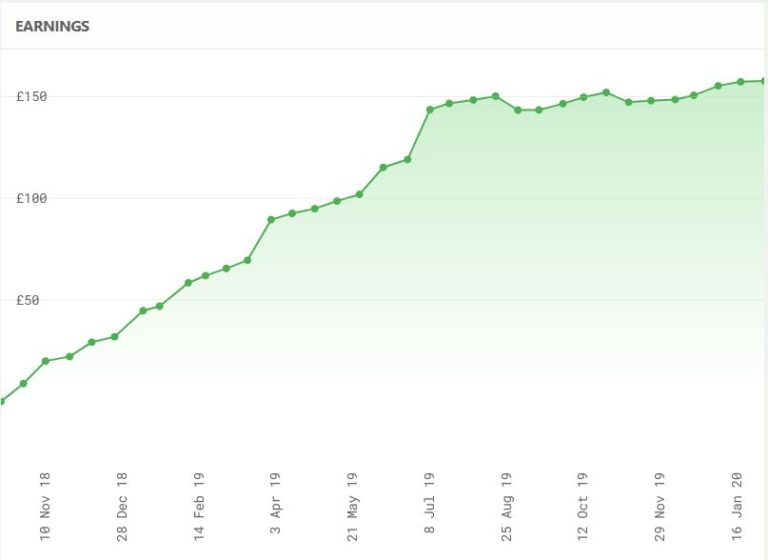
I put £5,000 into a Bricklane Stocks and Shares ISA in October 2018. As mentioned above, I chose to invest in the Regional Capitals rather than the London portfolio. The graph below – taken from my member’s page – shows the earnings generated since I opened my account.

My Bricklane Profits

As you will see, initially my investment performed pretty well. In the first nine months I made about £150, which equates to an annual interest rate of 4% (tax-free). That’s not spectacular, but it still beats most bank and building society accounts by a considerable margin. It is similar to the top rate currently on offer with P2P platform RateSetter in their Max account, although in their case you have to pay a fee equivalent to 90 days’ interest if you wish to withdraw. There is no withdrawal fee with Bricklane.

Since July/August 2019, however, returns have diminished considerably. My earnings between August 2019 and February 2020 were only just over £7, which is clearly a very low percentage rate. Of course, a large part of this is down to the depressed state of the property market caused by uncertainty over Brexit. I am hoping that now this is definitely happening – for better or for worse – my investment will get back on an upward trajectory again. Although recent results have been disappointing, at least the overall value of my portfolio hasn’t gone down (which has happened with some of my other property-related investments).

One other thing I should mention is that in October 2019 I withdrew £1,000 from my account to help fund a new central heating boiler after the old one packed in. This has therefore also reduced my returns a little. Although even if I still had the full £5,000 invested, earnings over the last few months would still have been nothing to write home about.

  • I should add that the withdrawal in question proved straightforward, although it wasn’t instant. I received the money in my bank account about a fortnight after putting in my request.

Conclusion

Clearly the performance of my Bricklane portfolio since last August has been disappointing, though overall I am still better off than I would have been if I had kept my money in a bank or building society.

I am hoping that things will start to improve in the property markets now that the Brexit issue has been resolved. There are some signs of this, although it remains to be seen whether the recovery in property prices will be sustained. For the time being, then, I am sticking with what I have in Bricklane, though I am not planning to top up my investment with them currently.

More generally, my experiences with Bricklane have been good. The sign-up process was fast and simple, and my £125 referral bonus (see below) was credited to my account instantly, completely offsetting (with a bit to spare) the initial 2% charge.

I also like the fact that any investment with Bricklane is automatically diversified across a range of properties, thus reducing volatility and risk. By contrast, with many P2P loan and property crowdfunding platforms, you invest in one loan or property at a time.

It’s also reassuring that you can ask to withdraw your money at any time – this can be an issue with property crowdfunding platforms in particular. As mentioned earlier, this does depend on someone else being willing to buy your shares, but Bricklane say that to date there hasn’t been a problem for anyone wanting to sell. As I said above, I had no issues when I wanted to release £1,000 from my own investment with them.

It is important to note that this is an investment rather than a savings account, and it does not therefore enjoy the same level of protection as bank and building society savings, which are covered (up to £85,000) by the Financial Services Compensation Scheme (FSCS).

Clearly, no-one should put all their spare cash into Bricklane (or any other investment platform). Nonetheless, in my view it is worth considering as part of a diversified portfolio. Not only are the rates of return (other than the last few months) higher than those offered by most banks and building societies, they are less affected than shares by ups and downs in the stock market. Property investments aren’t a way of hedging your equity-based investments directly, but they do help spread the risk.

In addition, the tax treatment of REITs make them a highly tax-efficient investment, especially if you can invest in the form of a SIPP or an ISA.

Welcome Offer

As an existing Bricklane investor, I can offer a special cashback deal for anyone signing up and investing on the platform via my link. If you click through this special invitation link, sign up and invest a minimum of £5,000, you will receive £125 in cashback (and I will get £100). With a £5,000 investment this bonus will cover your initial 2% charge and still leave you £25 in profit 🙂

If you invest more, you will get even more cashback, as follows:

Over £10,000 – £250

Over £20,000 – £500

Over £50,000 – £800

Over £100,000 – £1,500

Not only that, once you are an investor with Bricklane, even if you only start with £100, you will be able to offer the same cashback bonus to your friends and relatives and earn commission yourself as well. There is no limit to the number of people you can introduce through this scheme.

Obviously, this is a generous promotional offer by Bricklane and I assume it won’t be available forever. If you want to take advantage, therefore, don’t wait too long. I will remove this information if/when I hear the offer is no longer valid.

If you have any comments or questions about this Bricklane review, as always, please do leave them below.

Disclosure: this post includes affiliate links. If you click through and make an investment at the website in question, I may receive a commission for introducing you. This has no effect on the terms or benefits you will receive. Please note also that I am not a professional financial adviser. You should do your own ‘due diligence’ before making any investment, and seek professional advice from a qualified financial adviser if in any doubt how best to proceed.

Note: This is a fully revised and updated version of my original Bricklane review from October 2018

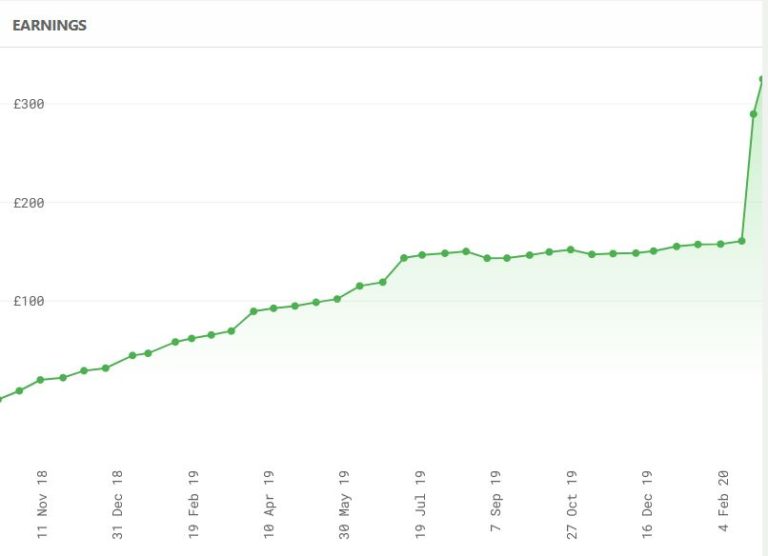
UPDATE 15 March 2020: Having said that my earnings from my Bricklane ISA over the last 6-8 months were disappointing, since the start of February they have shot up by over 100% (see below).

Bricklane March 2020

This doesn’t exactly cancel out the recent falls in my equity-based investments due to the coronavirus, but it does demonstrate the value of having a well-diversified portfolio. And I am obviously feeling more positive about Bricklane as an investment platform now 🙂

One other thing to note is that until the end of April 2020 Bricklane are waiving all investment fees for both new and existing investors. Visit the Bricklane website for more information.

If you enjoyed this post, please link to it on your own blog or social media:
My best investments of 2019

My Best Investments of 2019

One question I get asked fairly frequently as a money blogger is what I think are the best current investment opportunities.

I have to be very careful when responding to this sort of question (and always tell people this). For one thing, I am not a qualified financial adviser, so it would be against the law for me to offer personalized investment advice. And even if I were, I still wouldn’t be allowed to give one-to-one advice without first doing an in-depth fact-find on the person in question.

Of course, this is exactly as it should be. For one thing, everyone’s circumstances are different, and what represents a good investment for me might not be the same for you. It depends on a wide range of factors, including your income and expenditure, your family responsibilities, how much you want to invest, the timescale (and purpose) you are investing for, your age and health, and so forth.

Another important consideration is your attitude to risk. Other things being equal, higher returns come with higher risks. If you’re comfortable with this and willing to accept it in exchange for the chance of better returns, that is of course your decision. On the other hand, if riskier investments would cause you sleepless nights, you are probably better off seeking a safer – if possibly less exciting – home for your money.

In addition, anything I say here is inevitably based on my own experience, and there is no guarantee yours will be the same as mine. I might, for example, have great success with one platform and suffer losses on another. But there is no way of knowing whether your experiences if you invest will be the same as mine. This applies especially if you have to choose specific investments on the platform (as with many P2P/property crowdfunding platforms) rather than putting your money into a pooled fund of some kind.

And, of course – as the financial services ads always say in the small print – past results are no guarantee of future performance…

I don’t want to come across as too negative. I am, after all, a money blogger and investor myself. So what I can – and will – do is talk about my own investing experiences and share information about what has worked well for me this year. It’s then up to you to decide if you want to investigate these opportunities any further. If so, you will need to do your own ‘due diligence’ before deciding how to proceed, perhaps taking professional advice from a qualified financial adviser as well (which I strongly recommend if you are new to investing or at all uncertain).

  • Although I count myself as a reasonably experienced investor, I do still have an independent financial adviser (Mike from Integrity Wealth Solutions). He oversees about half my investments, while the other half I look after myself. He also advises me on my financial situation more generally and answers any questions I can’t answer satisfactorily myself. i will talk more about this in another post. But I wanted to mention it here to show that I am not at all opposed to using a financial adviser and in general recommend it, particularly when starting out in investing.

My Best Investments of 2019

Below I have listed some of my investments that have performed best this year and/or caused me the least stress and hassle! I have included a few lines about each one, and links to any blog posts I have written about them for further info.

(1) Nutmeg

Nutmeg is a robo-advisory platform. I have used it for my Stocks and Shares ISA investments over the last three years. My investment pot has grown steadily, albeit with a few ups and downs, as is to be expected with equity-based investments. At the time of writing my Nutmeg pot has grown by about 40% since i started investing in April 2016, which is certainly a lot better than I could have achieved with a bank savings account. Of course, you shouldn’t normally invest in any equity-based product with anything less than a five-year timescale.

Nutmeg use exchange-traded funds (ETFs) as their investment vehicle. These are discussed in more detail in my in-depth Nutmeg review, which also includes details of what I invested with them and when. Note that my investment has grown by a further £1,100 since that article was published.

(2) Ratesetter

Ratesetter is a P2P lending platform. They don’t pay the highest rates, currently ranging from 3% for instant access to 4% for their Max account (where you pay a release fee of 90 days’ interest if you wish to withdraw). Though better than most bank savings accounts, those rates are clearly nothing spectacular.

One thing I particularly like about Ratesetter, though, is that they have a provision fund that effectively covers investors against defaults. That means you don’t have to worry about diversifying your investments across a range of loans, as is the case with some other P2P lending platforms. Of course, if the whole platform were to collapse the provision fund wouldn’t necessarily save you, but Ratesetter has been going for ten years now and appears professionally and competently run. It has delivered the promised returns to me with no stress or hassle, and I am happy to recommend it based on my experience.

In addition, if you check out my Ratesetter review you can discover how to get a free £20 bonus if you invest a mere £10 with them.

(3) Buy2Let Cars

I took a long time before deciding whether to invest with Buy2Let Cars, as it is quite an unusual investment. Basically what you are doing is putting up the money to buy a car for someone in a responsible job who can’t afford to buy one outright themselves. You then receive monthly repayments over a three-year period, and a final repayment of capital plus interest at the end of the loan. The minimum investment is £7,000, so this is obviously not going to work for everyone. Personally I bought one new car at a price of £14,000 in March 2018. Since then I have been receiving £250 per month in repayments, with a final payment of £8,429 due in month 37. That will give me a total net profit of £3,429 based on an annual interest rate of 10% (the rates on offer can vary but once you have signed an agreement the rate is fixed for the duration of the contract).

There are – of course – various safeguards and protections in place, fully discussed in my Buy2Let Cars review. Buy2Let Cars say that to date they have a 100% repayment record to investors, which appears to be confirmed by their Trust Pilot reviews. This investment has been working very well for me, with payments turning up in my bank account every month like clockwork. I am currently semi-retired, so it is providing a useful extra monthly income for me, with a large lump sum due in 2021, just a few months before I qualify for the state pension 🙂 If you think it might work for you, I recommend checking out my Buy2Let Cars review and speaking to my contact there, Brett Cheeseman, who helpfully answered all the questions I had at the time I invested.

(4) Kuflink

Kuflink offer the opportunity to invest in loans secured against property. These loans are typically made to developers who require short- to medium-term bridging finance, e.g. to complete a major property renovation project, before refinancing with a commercial mortgage.

Kuflink don’t pay the highest rates in this field – their loans are typically at an interest rate of around 7% – but in my view they offer a fair balance between risks and rewards. One thing I like about them is that interest is paid into your account monthly on all loans. I only have a relatively small amount invested, but so far everything has been going well with just the occasional short delay in repayment of capital.

Kuflink currently have a generous welcome offer, with cashback of up to £4,000 for new investors. Take a look at my Kuflink review for more information about this.

(5) Crowdlords

Crowdlords is a property crowdfunding platform. I have been investing with them almost since their launch and have made a good overall profit. Crowdlords pay competitive interest rates (over 20% in some cases) and offer a choice of equity and debt investments. Equity investments are higher risk than debt ones, but offer the potential for bigger returns if all goes well.

My only reservation about Crowdlords is that I currently have two overdue investments with them. In both cases, though, I have received full and reasonable explanations for the delays, and have been told that the money should be in my account within the next few months. Obviously, if that doesn’t happen, I will let Pounds and Sense readers know.

Crowdlords doesn’t have a welcome offer as such, but they do have a Refer a Friend scheme. If you sign up quoting my code, I will share the commission I receive 50:50 with you. Please see my Crowdlords review for more information about this.

So those are the investments that have given me the best returns and/or least stress during 2019. I do have others as well, including Primestox, ZOPA, Bricklane, The Lending Crowd, The House Crowd and Property Partner. Most of these have still made some money but none has really set the world alight.

Only Primestox actually lost me money. This is (or was) a premium food investment platform. They started promisingly and I made good returns on my early investments, but then they were hit by a series of delays and defaults. This happened with three projects I invested in. In the case of two I have received partial repayments with more promised, but in the third I have probably lost my £500. Primestox are no longer advertising investment opportunities, and I assume are re-evaluating their business model.

Property Partner is an interesting case. I have made modest returns on my portfolio this year, partly due to the fact that the property market in general has been in a slump. That said, there haven’t been any issues with delays or defaults, and dividends have been credited to my account every month as promised. It will be interesting to see what happens in 2020 as properties come up to their five-year anniversary and investors have the opportunity to exit at the current market price. As I noted in this recent blog post, this has the potential to create opportunities for both buyers and sellers.

I haven’t included certain other investments in this article. These include my Bestinvest SIPP, which is now in drawdown and holding up well in value. Neither have I included money invested via my financial adviser. This is mostly in funds from Prudential, which again are doing pretty well.

Lastly, I haven’t included the money I ‘invested’ in Football Index. My portfolio has more than doubled in value over 18 months, so in some ways it is my most successful investment of 2019! I am sure luck has played a significant part in this. Nonetheless, if you want to know more about Football Index – and read how you can get a risk-free £50 when signing up – you might like to check out this recent blog post.

I hope you have enjoyed reading this article, which has run on a bit longer than I expected. I hope also it may have given you a few ideas to investigate further if you are in the fortunate position of having money to invest.

As always, if you have any comments or questions about this article, please do post them below.

Disclaimer: As stated above, I am not a professional financial adviser, and nothing in this article should be construed as personal financial advice. You should always do your own ‘due diligence’ before investing, and seek advice from a qualified financial adviser if in any doubt how best to proceed. All investment carries a risk of loss.

If you enjoyed this post, please link to it on your own blog or social media:
Why Property is an Essential Part of the Retirement Planning Jigsaw

Why Property is an Essential Part of the Retirement-Planning Jigsaw

Today I’m sharing some thoughts about the role of property in retirement planning. The post is partly inspired by recent research and insight from retirement planning specialists Just.

In association with Opinium Research, Just surveyed 4,000 adults from all over the UK to discover what they think and feel about property, including their views on owning versus renting, how property affects their attitude to their current and long-term financial plans, whether they thought of their property as a home or an investment, what impact property ownership has across the generations, and more.

When looking at those in their 50s, the research revealed that this age group turned out to be (in some respects anyway) the most pessimistic age group.

Survey Results

The survey threw up some interesting – and in some cases concerning – findings for the 50s age group. Key points arising included the following:

  • Whilst those in their 50s are building up towards retirement, half (47%) feel unprepared and hit a ‘pessimistic peak’.
  • Among homeowners who don’t feel prepared – not having enough to retire on (52%) and not having enough to do what they want (45%) is the biggest concern. Ranking these above other concerns such as debt and handing down wealth to their children.
  • 1 in 4 (23%) don’t know how to fund long term goals. And this goes up to almost half of renters (43%), compared to 16% of homeowners
  • It has become noticeably more difficult to get on the housing ladder – and this affects over a quarter (26%) of people in their 50s, who are still renting.
  • The impact on retirement is one of the biggest concerns for those now unable to buy, as property remains a core component of household wealth.
  • Even those on the property ladder are struggling to juggle their priorities and plan for the future.

You can see more information about the survey, and other findings from it, on Just’s My Home My Future website.

My Thoughts

At the age of 63 I am a little older than this age group, but I can definitely relate to these findings, both in respect of my own experiences and those of friends and relatives.

I believe that property should play an important – and arguably essential – role in every person’s retirement plans. And owning your own property puts you in a far stronger financial position than if you are renting.

One obvious reason for this is that your property can be a source of extra money if and when you need it in retirement. This can work in a variety of ways…

  1. If you own your property and have equity in it (i.e. its value its greater than any outstanding mortgage/s) you can release some of this by downsizing. By selling up and moving somewhere smaller and cheaper, you may be able to release a chunk of cash that can be used to fund major purchases and/or invested to provide you with extra income.
  2. If you don’t want to move, you may be able to use equity release to access some of the money tied up in your home. At one time equity release had a slightly dubious reputation due to the risk of going into negative equity, but nearly all lenders now offer a No Negative Equity Guarantee (NNEG) which ensures a borrower can never owe more than the value of their home. Equity release is nowadays a well accepted – and increasingly popular – method for releasing funds tied up in a property. Modern ‘lifetime mortgages’ in particular offer great flexibility for drawing down funds when you need them, with repayment only required when you die or go into long-term care.
  3. Another option for generating income from your home is to rent a room in it. Under the government’s Rent a Room scheme you can charge up to £7,500 a year in rental without having to pay tax on it. This can work well for people in family homes whose children have flown the nest.
  4. Owning a property also presents other opportunities to generate money from it. An example is renting out your driveway or garage, which I discussed a while ago in this blog post.

For more information on using your property for money, check out this page from the Just website.

My Circumstances

I am fortunate in that I own my home outright. The mortgage I took out with my late partner Jayne was paid off around ten years ago with the aid of a modest windfall. I also have various pensions and investments.

No-one can see what the future holds, but knowing that I could potentially release a substantial sum from my home if the need arises is obviously reassuring – especially in case in my old age I have to go into long-term care.

The latter is obviously a major concern for many older people. A recent report from Just revealed that 88% of people who have organised long-term care for a family member said they were shocked at how expensive care is, and 75% were surprised by how little financial support the state provides.

Further Thoughts

One thing that struck me particularly in Just’s My Home, My Future survey was the number of middle-aged (and older) people who are still renting, often through necessity rather than choice. Just found that non-homeowners in their 50s tend to be those who haven’t been able to buy their home (43%) rather than those who haven’t chosen to buy (21%).

This is clearly a concern for those affected, and for society generally. These people will be cut off from an important potential source of income in later life. If they have to go into long-term care, much of the (considerable) cost may have to be borne by their family, who may or may not have the means to do so.

A serious discussion needs to take place about how social care in Britain is funded, and specifically the balance between what is paid by the state and by the individual. Government policy in this area has been mired in confusion for years – and with the current political turmoil over Brexit it’s hard to see the situation improving any time soon.

In the meantime, it’s clearly desirable for everyone to get on the property ladder as early as they possibly can, so they are able to build up equity in their home and access the additional cash and income property can provide in later life. Whilst it remains unclear how much any of us will need to contribute to the cost of our own care, having a source of money to fund this if needed is all the more vital.

As always, if you have any comments or questions about this post, please do leave them below. I would especially like to hear your thoughts if you are 50 or over on how you plan to fund your retirement and the role you see for property in this. Check out also the #MyHomeMyFuture hashtag for more about this subject on social media.

  • For further advice on planning for retirement, I recommend checking out the government’s Pension Wise website, which includes detailed information about pension saving. If you are over 50 you can also book a free telephone or face-to-face appointment with an adviser who will go through the options with you.

Disclosure: This is a sponsored post on behalf of Just Group plc.

If you enjoyed this post, please link to it on your own blog or social media:
Is it worth getting batteries for your solar panels?

Is It Worth Getting Batteries for Your Solar Panels?

A couple of weeks ago I got home from a short break to find a letter and glossy leaflet on my doormat extolling the benefits of batteries for solar panel owners.

The letter said the company had purchased a list of names of local solar panel owners including my details. That put my back up a bit, as I’m not keen on having my personal information bought and sold. But I guess it’s publicly available info, so there isn’t really anything I can do about it.

Anyway, while I didn’t reply to the sales letter, it did inspire me to do a bit of research into solar energy storage batteries and whether they are worthwhile. That turns out to be quite a difficult question to answer. It doesn’t help that much of the information online comes from solar battery suppliers and installers, who are not exactly unbiased.

So here are my thoughts, based on what I have been able to find out in conjunction with my own experiences as a solar panel owner.

The Idea

The idea behind solar batteries is simple and appealing.

Solar (photovoltaic) panels generate most power when the sun shines, but this is probably not when you need it the most. If they are generating electricity in the day when you are out at work, some of that power is likely to be going to waste. (Yes, you might be able to sell some back to the grid, but most home-owners are paid a – low – ‘deemed’ tariff for this based on the total amount of power their panels generate. It makes no difference to this how much of the electricity generated you use yourself.)

If you have batteries, though, these can be charged by your panels when they are making more electricity than you need, and then used to provide power at other times (e.g. in the evening) when you need it. This should reduce the amount of electricity you have to buy, thus cutting your bills. It may also give you a backup in the event of power cuts (although don’t bank on this – see below).

The Reality

That all sounds great in theory, but the reality is a lot more complicated.

First of all, solar storage batteries are still new and, to a degree, untested technology. They are also expensive. To have batteries supplied and fitted to an existing solar panel installation is likely to cost anywhere from £5,000 to £10,000.

Solar batteries also have limited lifespans. Because the technology is so new, nobody is really sure how long they will last, but I have seen figures of 5 to 15 years quoted. That means you are likely to need to replace your batteries at least once during the 20- to 25-year working life of your solar panels.

It’s also worth bearing in mind that all batteries become less efficient over time, reducing the amount of electricity they are able to store.

My Calculation

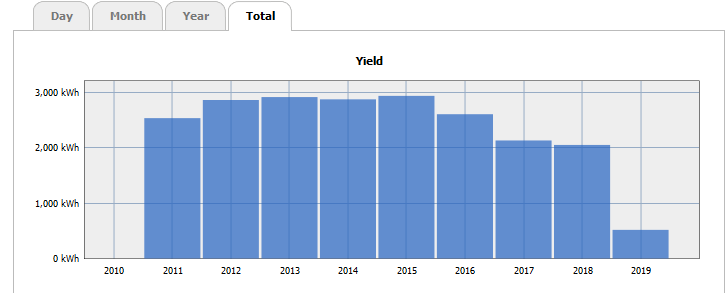
I thought I would look at my own solar panels as an example, to see if the sums added up. First of all, here is a chart showing the total amount of electricity generated by my panels since they were installed in 2011.

Electricity Generated Year by Year Since Installation

As you can see, the maximum my panels have generated is just under 3,000 kWh in 2015 (after that the output declined somewhat, for reasons discussed in this blog post). For the sake of my calculation, though, let’s use a figure of 3,000 kWh for the amount of power my panels generate annually.

Now, to work out how much power could be saved by installing batteries, we need to know what proportion of power generated is surplus to my requirements and currently ‘wasted’. Because I work from home and am here in the day most days, I can’t believe this is any more than 30 percent. In reality it is probably less, but I’ll use 30% for my calculation.

Let’s now assume that batteries would allow me to save the whole of that 30% (in reality that’s highly unlikely for reasons I’ll discuss shortly). That means I would be saving 3,000 kWh x 30% = 900 kWh. The electricity companies in my area currently charge in the region of 20p per kWh (including VAT), so the saving on my bill would theoretically be worth 900 x 20p = £180 a year. Assuming the cost of buying solar batteries and having them installed was an optimistic £5,000, that means it would take 5000/180 = 28 years for the cost to be recouped – well above the expected lifespan of the battery (or the panels, for that matter).

Even if I was out a lot in the day, to the point where I could save 60% of the power generated by my panels if I had batteries, the breakeven period would be 14 years. And remember, this is also assuming the highest possible output from my panels every year and 100% battery efficiency, neither of which will be the case in reality.

Complications

There is one thing you may have noticed that I didn’t account for in my calculation, and that is the fact that electricity prices go up every year. That will, of course, have the effect of increasing the potential savings from batteries and reducing the time it takes to break even. If electricity prices go up dramatically, that will certainly make solar storage batteries more attractive.

On the other hand, there are some negative factors to take into account as well. Here are just some of them.

1. Batteries are not 100% efficient. Some energy is lost charging the battery and then releasing energy from it. The technical term for this is round trip efficiency. Typically this figure is around 80%, meaning that for every 5 kWh going in to your battery, you will only get 4 kWh of useful electricity out.

2. You can only charge a battery to its maximum (100%). If on a sunny day the batteries become fully charged, any surplus energy generated after that will simply go back to the grid.

3. If you discharge a battery fully this can significantly reduce its life expectancy. Technically this is known as Depth of Discharge, or DoD for short. Most manufacturers specify a maximum DoD for optimal performance. For example, if a 10 kWh battery has a (typical) DoD of 90 percent, you shouldn’t use more than 9 kWh of the battery before recharging it. In practice, an electronic charge controller prevents over-discharging (and over-charging) from happening. The effect of this is, of course, to reduce the amount of useful energy a battery can store.

4. Batteries become less efficient over time. This varies according to the type and make of battery, but typically over 10 years efficiency will reduce by 30%. Again, this reduces the amount of electricity batteries can store and the potential savings to be made. If you are unlucky and your battery fails completely just as the warranty expires, you could be looking at a large overall loss.

5. If you use batteries to store power, this may involve sacrificing the payments you would otherwise receive for exporting power back to the grid. This may not matter if you are getting a ‘deemed’ payment based on electricity generated (as is the case for many owners currently). But with the new generation of smart meters which can measure how much electricity you are actually returning to the grid, you will certainly end up making less money this way if you divert excess electricity to batteries instead.

6. As well as the cost of buying and installing solar batteries, there is also VAT to take into account. At the time of writing this is 5%, but it is going up to 20% in October 2019. This would add £1,000 to the price of a £5,000 battery installation.

7. Finally, although solar batteries may give you a backup power source in the event of power cuts, it appears this cannot be relied on. A survey of solar battery owners by The Consumer Association found that several people reported that in the event of a power cut, their batteries stopped working as well. That is despite promises made by sales people that this wouldn’t be the case.

My Conclusions

As I said earlier, this is a complicated field and I make no claim to any special expertise on it. However, based on my own data and research, here are the conclusions I have reached.

1. If you and/or other family members are typically at home in the day, it is doubtful whether you will save enough money by installing batteries to cover the cost, let alone make any profit. The same may apply if you use electricity in the day for other purposes when nobody is there in person, e.g. washing laundry, heating water, running a dishwasher, etc.

2. If nobody is in your home for most of the day and you aren’t using any significant amount of electricity during daylight hours then the savings from batteries may be more worthwhile. But bear in mind that you are still likely to be around (and using electricity) at weekends, early mornings, evenings, holidays, sick days, and so on. And some household appliances such as fridges and freezers go on using electricity all of the time.

3. If the price of energy rises sharply, solar batteries may become a more attractive proposition. However, they are expensive to buy and install, and have various limitations (discussed above) which may reduce the benefit you get from them. They will probably also have a shorter lifespan than your panels, meaning they will need replacing at least once over the lifetime of your panels. And they will in any event decline in efficiency over time.

4. Likewise, if battery prices fall – and the technology improves – that will increase the attractiveness of solar batteries in future. But of course, if you are considering whether to get batteries now, you can only base your decision on what is currently available.

5. If you are buying a new home and/or new solar panels, buying batteries at the same time is likely to be more cost-efficient (and involve less hassle) than retro-fitting them. In this article I am mainly addressing existing solar panel owners.

6. I am also looking at this primarily from a financial standpoint. There is a case to be made for installing batteries to help contribute to the fight against global warming and climate change, although there are obviously also environmental costs involved in battery manufacture. In any event, it is for each individual to decide how important this is to them and whether the environmental benefits of having batteries with their solar panels really do stack up.

7. Some companies are currently making a big push to promote solar batteries, and it does appear to me that some of the claims made on their behalf are exaggerated to say the least. If you are thinking of getting solar batteries, be sure to do your own ‘due diligence’ and don’t believe everything you read on company websites or are told by pushy salespeople. In particular, be very sceptical about pie-in-the-sky estimates over how much money batteries may be able to save you. I found one website claiming that 75% of the power generated by solar panels is typically wasted, which is frankly laughable.

8. Don’t, either, be swayed by arguments that you need to order now before VAT rises to 20% in October. This is (unfortunately) true, but it doesn’t make the case for installing batteries any stronger.

In summary, for most existing solar panel owners, I don’t believe that installing batteries is likely to make economic sense at present. I don’t, therefore, intend to do so myself. If prices come down and the technology improves, however, the equation may change (and reducing or scrapping the VAT would help too). This is something I will continue to monitor, and if I change my mind in future I will of course let Pounds and Sense readers know!

So those are my thoughts, but what do YOU think? I’d love to hear from you, especially if you have solar batteries yourself or are actively considering them. Please feel free to post any comments or questions below.

If you enjoyed this post, please link to it on your own blog or social media:
My Weekend at Hewenden Mill Cottages

My Weekend at Hewenden Mill Cottages

I have just returned after a three-day break at Hewenden Mill Cottages in Yorkshire.

I was there to visit my sister Liz and her family, who live in Wilsden, near Bradford. They don’t really have room for me to stay with them, so I did an internet search and discovered Hewenden Mill Cottages, which was just a mile and a half from them.

At first I assumed that, as these were self-catering cottages, they wouldn’t be suitable for a solo visitor who was only coming for a long weekend. Turns out I was wrong, though. They were very happy to accommodate me for three nights, and the cost was, if anything, cheaper than staying at a hotel (see Financials, below).

Hewenden Mill Cottages is in a secluded location between the villages of Wilsden and Cullingworth. I have embedded a map of the area below (courtesy of Google Maps.

The Accommodation

Hewenden Mill Cottages and Apartments (to give their full title) is based around not one but two old mills which have been converted into holiday cottages.

The main Hewenden Mill complex (which includes the reception, shown in the cover photo above) is easy to access from the B6144 (also called Lane Side). I was staying at Bent’s Mill, however, which is a short distance from Hewenden Mill. It’s a seven-minute walk from one to the other through some picturesque woodland, but unfortunately it’s not possible to drive through this. I have posted a photo of Bent’s Mill below.

Bents Mill

When I arrived I was met at reception by the charming Susan, who told me she was the owners’ daughter. She asked me to follow her in my car as she drove to Bent’s Mill. I was glad to have her as my guide, as the journey involved going on narrow, twisting country lanes, and for my first visit it was reassuring to have her car in front and know I was going the right way. It also came in useful when we turned a corner and met another car coming the opposite way. As there were two of us and only one of them, they had no option but to back up!

I was staying in the Wheel Pit House at one end of Bent’s Mill. As you may gather, this is where the water wheel once stood. It’s no longer there, but you can see the chamber where it was through a window in the entrance hall (or from the outside). You can read more about the Wheel Pit House on this page of the excellent Hewenden Mill Cottages website. Here is my own photo of the exterior.

Wheel Pit House

My accommodation was on three levels. On the ground floor was the front door and entrance hall. Upstairs on the first floor was a double bedroom and bathroom. On the top floor were the kitchen and lounge, from which you could enjoy lovely views of the woodland and mill pond (see photo below).

Hewenden01

I have to say I was very impressed by my cottage. It was spacious and comfortable, with everything you would need for a short stay (or a longer one).

The kitchen included an electric cooker with ceramic hob, fridge, freezer, dishwasher and washing machine – all very clean and modern, and considerably nicer than I have at home!

The cottages have free wifi, and all costs such as electricity and VAT are included in the price. There would have been plenty of room for a couple, and a young child or baby as well. To me as a solo visitor it felt palatial, especially after the compact ‘Forest Retreat’ I stayed in a few weeks ago at Aberdunant Hall. As a matter of interest, I worked out that at Hewenden my accommodation was over six times larger!

A nice touch is that the owners provide a complimentary ‘welcome pack’ of groceries on arrival. This included bread, milk, butter, preserves, orange juice, biscuits, and so on. A selection of breakfast cereals in individual boxes and sachets was also provided, along with coffee and Yorkshire Tea (see below!).

Yorkshire Tea

Hewenden Mill and (especially) Bent’s Mill are a bit off the beaten track and there aren’t any shops close by (though there is a Co-op in Cullingworth about a mile away). As I was mostly eating with my sister and her family that wasn’t an issue for me, but if I’d had to buy some provisions it wouldn’t have been a problem. There are also several takeaways, cafes and restaurants within a mile or two.

Financials

As Pounds and Sense is primarily a money blog, I need to say a few words about this.

I paid £327 (including VAT) for my three-night stay in the Wheel Pit House at Hewenden Mill Cottages, which I thought was very reasonable. I paid an initial £50 deposit when I booked, with the rest due on arrival.

Costs obviously vary according to the accommodation you want, when you want it, and for how long. I did though notice that the longer your stay the cheaper (per day) it works out. While you can book for one or two nights, it becomes much more economical if you are staying for three nights or longer.

The price I paid worked out to £109 a night, which – as I said above – struck me as very reasonable (and cheaper than most of the hotels I have stayed at recently). Of course, unlike most hotels, you don’t get a cooked breakfast, and neither is a daily housekeeping visit included. On the positive side, though, you do get far more space, a fully equipped kitchen, a separate lounge and bedroom, and complete privacy during your stay.

You can check current prices and availability on the Hewenden Mill Cottages website.

Things To Do

Obviously I was visiting family, so I won’t go into detail about everything I did while I was there. However, for the benefit of anyone who may be considering visiting the area, I will mention a few of the local attractions.

First of all, Hewenden Mill is just a few miles from Haworth, the home of the Bronte sisters, Charlotte, Anne and Emily (indeed, the area is sometimes called Bronte Country). If you haven’t visited before, I would say this is a must-see. You can go around the parsonage where the sisters were brought up and wrote their famous novels such as Jane Eyre and Wuthering Heights. The parsonage has been preserved (or restored) largely as it was in their day. I found it quite an emotional experience seeing the family home where the sisters lived, wrote, and tragically all died at an early age

The village with its cobbled high street is also well worth seeing, and there are numerous (enticing) tea and cake shops.

And finally, Haworth has a station on the Keighley and Worth Valley Railway, a heritage steam railway which runs between Keighley and Oxenhope. The line and its stations has been used in numerous period film and television productions, including the film The Railway Children. More information and timetables are available via the KWVR website. You can get a 10% discount on a Day Rover ticket if you buy your ticket more than seven days in advance.

Also nearby is Saltaire, the Victorian model village built by textile magnate and philanthropist Sir Titus Salt to house the workers at his mill. The mill itself is still there, and large parts are open free of charge to the public. Inside is a bookshop, and you can still see some of the old heavy machinery there that was used in the mill. There is also a bustling coffee shop and restaurant, along with displays and exhibitions. The River Aire runs alongside the town (hence the name, of course), and the Leeds and Liverpool Canal too (great for a brisk walk along the towpath!).

And, of course, the whole of the area is incredibly scenic, with lots of scope for country walks, runs or cycle rides, as you prefer. From Hewenden Mill Cottages there are various walks you can take, from a five-minute stroll to Goit Stock Waterfalls (see photo below) to much further afield.

Goit Stock waterfalls

Final Thoughts

As you may gather, I very much enjoyed my stay at Hewenden Mill Cottages and thoroughly recommend them. Obviously, the fact that they are only a short drive from my sister’s home was a big attraction for me. Even if that wasn’t the case, though, I would definitely consider going back for a short break.

There is plenty of choice of accommodation, though at weekends especially it does get popular, so it’s definitely advisable to book a few weeks in advance.

If you want complete peace and seclusion, I can highly recommend staying at Bent’s Mill, where the only noise to be heard is birdsong. My one slight reservation is that, as mentioned earlier, getting there by car involves a somewhat nerve-racking drive along narrow, twisting lanes, where you really hope you don’t meet someone coming in the other direction! it’s perfectly do-able, of course, but if you don’t fancy this particular challenge then staying at the main Hewenden Mill might be a better choice for you.

As always, if you have any comments or questions about Hewenden Mill Cottages, please do post them below.

If you enjoyed this post, please link to it on your own blog or social media:
Have You Tried Nextdoor?

Have You Tried Nextdoor?

Excuse the slightly tongue-in-cheek title. Nextdoor is actually a free social network for local communities.

I’ve been a member for about a year now. In the last few months I have seen the number of people who have signed up in my neighbourhood grow considerably. So I thought today I’d share my thoughts about it.

What Is Nextdoor?

I’ll start by quoting from the Nextdoor website:

Nextdoor is the private social network for you, your neighbours and your community. It’s the easiest way for you and your neighbours to talk online and make all of your lives better in the real world. And it’s free.

People are using Nextdoor to:

  • Borrow a ladder
  • Organise a Neighbourhood Watch Group
  • Track down a trustworthy babysitter
  • Find out who does the best paint job in town
  • Ask for help keeping an eye out for a lost dog
  • Find a new home for an outgrown bike
  • Finally call that nice man down the street by his first name

Nextdoor’s mission is to provide a trusted platform where neighbours work together to build stronger, safer, happier communities, all over the world.

That’s a reasonable summary, I think. It corresponds with the types of uses people in my local area are putting it to, as the screen capture below illustrates.

Nextdoor messages

Here are my personal thoughts and experiences of Nextdoor as a member…

How I Use Nextdoor

As well as keeping an eye on what is going on in my neighbourhood, I have also used Nextdoor as a way of finding reliable tradesmen. This has worked pretty well, although I do find that when you ask for recommendations from your neighbours, what you actually tend to get is a stream of replies from the tradesmen themselves angling for your custom. Of course, it’s quite understandable that tradespeople are cottoning on to the fact that this can be a good way of getting work.

I have also found Nextdoor good for finding local people willing to do smaller jobs that the average tradesman might not be interested in. Here’s an example message I posted recently…

Man (or Woman) with a Ladder Needed

I recently had some scaffolding up at the back of my house. When the scaffolders took it away, they left a couple of short metal tubes near the edge of the roof. Despite several requests they haven’t come back for them and I’m concerned they may cause damage if they fall down. So I just wondered if someone with a ladder might be willing to pop over and remove them for me? Should only be a five-minute job and I’m happy to pay a tenner or donate the money to your favourite charity. Will also give you a review on any relevant website if you’re a tradesperson.

I got a reply on Nextdoor within an hour from the wife of a local roofer. She said her husband would be happy to come and do this for me. We exchanged private messages, and the roofer (Clive Byrne of CMB Roofing – many thanks!) came over that afternoon and removed the offending items for me. As per my message, I paid him £10 and put a review on Google for him. This solved a niggling problem for me with the minimum of hassle, and is a good example of the sort of thing Nextdoor can work well for.

Any Drawbacks?

As with any social network there can be differences of opinion, and worse…

I have seen a few instances where people have been criticised for things they have said or shared on the platform. Sometimes (in my opinion) this may have been justified, but other times I think those concerned have been, shall we say, rather thin-skinned.

One issue that has arisen a few times has been when someone reports suspicious activity and others then criticise them for stereotyping or being too quick to make judgements. I do accept that this can be a difficult issue, but personally I think that if someone observes suspicious, possibly criminal, behaviour, it’s not unreasonable to alert their neighbours about it. But like it or not, if you do this, you can expect to be criciticised by some people.

Unsurprisingly, politics (national and local) is another contentious area. For example, where I live the local council is currently considering a planning application for a KFC drive-through. Some people expressed their disapproval about this quite forcibly, while others argued (equally forcibly) that it would be beneficial for the area. Of course, there’s nothing wrong with a bit of robust argument, but some of the comments became unpleasant and borderline abusive. Some people get hot under the collar when they discover that their neighbours don’t share their views, and it can rather spoil the friendly, community vibe that Nextdoor is trying to promote. Of course, the same thing happens on Facebook and other social networks, but if you join Nextdoor you need to be prepared for this.

Nextdoor is monitored and supervised by what the network calls ‘Local Leads’. These are – as I understand it – ordinary members who have additional powers, e.g. to delete posts that breach the community’s guidelines. I now know who my Local Lead is, but only because I researched this carefully. I haven’t ever seen any posts by them on the platform, much less any evidence of constructive interventions. Maybe all this goes on behind the scenes – I don’t know. I do think Nextdoor could be more up front about who the Local Leads are and how they are chosen.

Finally, it would be wrong not to mention that joining Nextdoor has privacy implications. As a member, you can see the names of people in your local area and (in most cases) their street and house number. And they, of course, will be able to see yours. This information is only available to people in your immediate area and pseudonyms are not allowed. I can understand the reasons for this, but if you are uncomfortable with it, Nextdoor may not be for you. In any event, be careful about sharing personal information in your profile, especially anything you might not want your neighbours to know!

How to Join

If you do decide to give Nextdoor a try, you can sign up for free at https://www.nextdoor.co.uk. Fill in the short form on the front page (see screen capture below) including your postcode, then click on Find Your Neighbourhood. You will then be able to see recent posts by your neighbours, with other information (e.g. a map of your area) available via the left-hand menu.

Nextdoor form

You can also access Nextdoor via a mobile phone app. Versions are available for Apple (via the iTunes App Store) and Android (via Google Play).

Final Thoughts

Although (as stated above) I do have certain reservations about Nextdoor, overall I feel I have benefited from it, and it has certainly increased my awareness of events going on in my neighbourhood. I have also, as mentioned above, found it a useful resource for finding tradespeople and getting recommendations.

I’d love to hear your views about Nextdoor, and also your experiences (good or bad) if you’re already a member. Please do leave any comments below as usual.

If you enjoyed this post, please link to it on your own blog or social media:
Infographic: Transferring Property Ownership After Death

Infographic: Transferring Property Ownership After Death

Today I’m bringing you an infographic created by I Will, a firm of solicitors who specialize in will writing. I published their previous infographic, An Essential Guide to Writing Your Will, back in 2017.

The infographic below is all about what happens with a property when the owner dies. As the graphic says, when the house is in joint ownership (as is typically the case with a married couple) and the surviving partner wants to go on living there, it is usually just a matter of notifying the Land Registry and (if relevant) the mortgage-holder.

If the house was in sole ownership, though – e.g. after the second partner dies – as the graphic says, the situation is more complicated, and there are various important things the executor will need to take into account.

It’s quite a long graphic, so please take a little time to scroll down it, and I’ll see you at the other end!

Thanks again to I Will Solicitors (not an affiliate link) for permission to use their graphic.

The company specializes in Islamic wills, but offers numerous legal services to people of all faiths and none, including Probate, Lasting Power of Attorney, Deputyships, and more. They say, ‘The writing of Sharia-compliant Islamic Wills is our specialty, but we are by no means a “Muslim-only” legal services provider.’

As I have said before on Pounds and Sense, where wills are concerned I strongly recommend using a properly qualified solicitor (and even more so where property is involved). I have had several experiences within my own family where failing to do this has caused serious delays and problems. In my view it really isn’t worth trying to save a few pounds by using a cut-price ‘will-writing service’ or attempting to do it yourself, not to mention all the hassle this can entail.

If you have any comments or questions, as ever, please do post them below.

If you enjoyed this post, please link to it on your own blog or social media: