
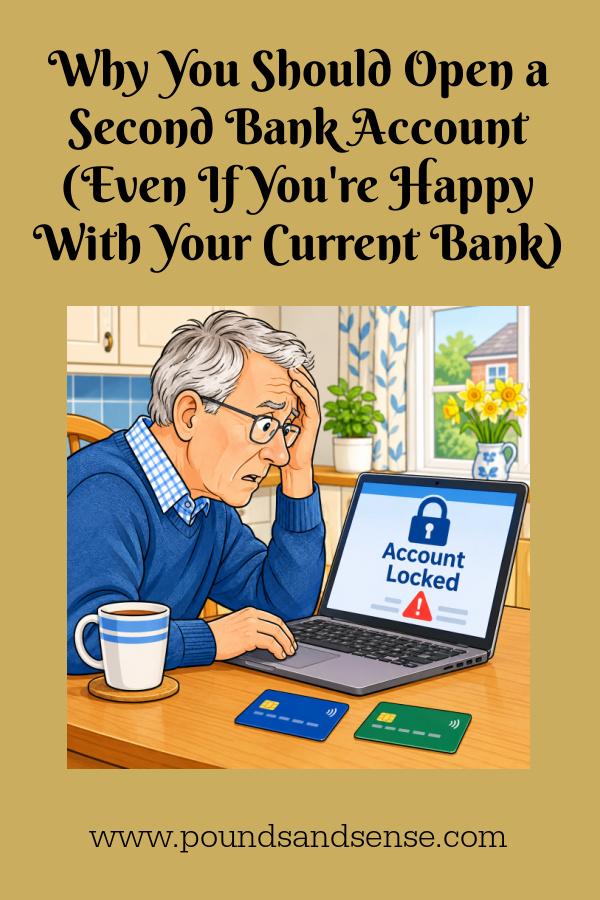
Why You Should Open a Second Bank Account (Even If You’re Happy With Your Current Bank)
Table of Contents
A Recent Experience That Opened My Eyes
Until recently, I hadn’t given much thought to the idea of having a second current account. Like many people, I had been quite happy using my regular bank for everyday transactions, paying bills and managing my money. Then something happened that made me reconsider.
My bank unexpectedly froze my account because its security systems apparently believed I was being scammed. In fact, I wasn’t being scammed at all – I was just trying to pay a tradesman I hadn’t used before. But that didn’t seem to make much difference to the bank.
Suddenly, I found myself unable to access my own money. And embarrassingly I had no way of paying the tradesman, who had done a good job for me and quite reasonably expected me to settle his bill.
What followed was a deeply unpleasant and stressful experience. I had to contact the bank’s security department by phone and effectively plead with them to restore access to my account. Although the problem was eventually resolved, I was left feeling shocked by how easily I could be locked out of my own finances.
Now, I fully understand that banks have a duty to protect customers against fraud. Scams are a major problem, particularly when criminals trick people into transferring their savings to fraudulent accounts.
Nevertheless, when a bank gets it wrong, the consequences for an innocent customer (or tradesman) can be serious.
The experience brought home to me just how vulnerable we can be if we rely entirely on a single bank account.
My conclusion? Having a second current account, preferably with a completely different bank, is a precaution well worth considering.
And, as I discovered when looking into the subject, there are several other good reasons for doing this too.
1. Protection Against Unexpected Account Freezes
This is the main reason I now recommend having a backup bank account.
Banks use sophisticated systems to detect potentially fraudulent transactions. These can identify unusual spending patterns, large transfers or payments to unfamiliar recipients.
Unfortunately, such systems aren’t infallible.
Sometimes perfectly legitimate transactions can trigger fraud warnings, resulting in payments being blocked or, in more serious cases, accounts being temporarily frozen.
You might be making a large purchase, transferring money between your own accounts or simply doing something that doesn’t fit your normal spending pattern.
The bank may decide to intervene, even if you know perfectly well what you’re doing.
In some circumstances, banks are legally obliged to investigate suspicious activity and may be unable to explain fully why an account has been restricted.
If your only current account is frozen, you could find yourself unable to buy groceries, pay bills or access money for everyday expenses.
Having a second account with another bank, containing a reasonable emergency balance, could make a huge difference.
It won’t necessarily resolve the problem with your main bank, but at least you should still have access to some money while matters are sorted out.
- It’s also possible that if you’re an older customer, your bank may regard you as at greater risk of being scammed. They may therefore decide to intervene in circumstances where a younger person’s transactions might not be questioned. The incident I am referring to happened soon after my 70th birthday. While I can’t prove that my age was a factor, I can’t help but be suspicious.
2. A Backup When Banking Technology Goes Wrong
Banking technology has improved enormously in recent years. Most of us can now manage our finances through websites and smartphone apps without ever visiting a branch.
Unfortunately, technology sometimes fails.
Banks occasionally suffer IT outages that prevent customers from logging in, transferring money or making card payments.
Such problems can last for hours and occasionally longer.
Imagine being at a supermarket checkout or trying to pay for a train ticket, only to discover that your bank’s systems aren’t working.
If you have a debit card linked to another bank account, you may be able to use that instead.
For this reason, I would suggest choosing a second account with a different banking group, rather than simply opening another account with your existing provider.
It may also be worth having cards from different payment networks, such as Visa and Mastercard, where possible.
That way, you’re less dependent on any single bank or payment system.
3. Protection Against Lost, Stolen or Compromised Cards
Another reason to consider a second account is the possibility of losing your debit card or having it stolen.
If this happens, you’ll obviously need to contact your bank immediately to cancel the card.
Although replacement cards are normally issued quite quickly, you could still face several days without a working debit card.
Similarly, if your bank suspects your card details have been compromised, it may cancel the card as a precaution.
Having another debit card linked to a separate bank account means you should still be able to make purchases and withdraw cash.
This could be particularly valuable if you’re away from home or travelling abroad.
4. It Can Help You Manage Your Money More Effectively
A second bank account isn’t just useful in emergencies. It can also help with everyday budgeting.
For example, you might use one account for regular commitments such as:
- Mortgage or rent payments
- Council tax
- Gas, electricity and water bills
- Insurance premiums
- Other Direct Debits and standing orders
Your second account could then be used for everyday spending, including groceries, entertainment, travel and other purchases.
This separation can make it easier to see how much money you have available to spend without accidentally using funds earmarked for essential bills.
Alternatively, you could use your second account specifically for discretionary spending, transferring a fixed amount into it each month.
For anyone trying to keep a closer eye on their finances in retirement, this could be a useful arrangement.
5. You May Be Able to Earn Extra Interest or Other Benefits
Different banks offer different benefits, and having more than one current account allows you to take advantage of these.
Some accounts pay interest on credit balances, while others offer cashback on household bills or spending.
There are also packaged accounts offering benefits such as travel insurance or breakdown cover, although these usually charge a monthly fee.
And some banks offer cash incentives to customers who switch an existing current account to them.
However, it’s important to read the small print.
Switching bonuses may require you to pay in a certain amount each month, set up Direct Debits or meet other conditions.
Also, a full switch using the Current Account Switch Service (CASS) normally closes the account you’re switching from. If you want to keep your main account, don’t accidentally switch that one!
Personally, I would regard any financial perks as a bonus rather than the main reason for opening a second account. The peace of mind is potentially worth far more.
- The Moneysaving Expert website run by consumer finance guru Martin Lewis has a regularly updated page devoted to bank switching offers which is worth checking out. As mentioned above, however, if you’re trying to set up a second bank account, look for a provider that doesn’t require you to switch away from your current bank.
6. Extra Protection If a Bank Gets Into Financial Difficulties
Although UK banks are closely regulated, bank failures can and do happen.
Fortunately, eligible deposits held with UK-authorised banks and building societies are protected by the Financial Services Compensation Scheme (FSCS).
As of November 2026, the standard FSCS deposit protection limit is £120,000 per eligible person, per authorised financial institution.
This limit increased from £85,000 in December 2025.
If you have substantial savings, spreading your money between different authorised banks may therefore provide additional protection.
One important point to remember is that different banking brands sometimes share the same banking licence. If they do, your deposits with those brands are generally added together for FSCS purposes.
You can check your protection using the FSCS website.
Of course, the FSCS is designed to protect your money if a financial institution fails. It doesn’t prevent your bank from temporarily freezing an account.
Nevertheless, having money with more than one banking institution can provide an additional layer of financial security.
7. It Could Be Particularly Useful for Older People
I believe there are some especially good reasons for people approaching or enjoying retirement to consider having a second current account.
Many retired people receive their State Pension, private pensions and other income into a single account. This same account may also be used to pay all their regular bills.
If access is unexpectedly restricted, the disruption can be considerable.
Some older customers may also find it more difficult to resolve problems quickly, particularly if they aren’t comfortable using banking apps or online chat services.
And while banks are right to be alert to scams targeting older customers, it’s important that legitimate transactions aren’t unnecessarily obstructed.
A second account can provide a useful financial safety net.
I would also suggest making sure you know how to contact both banks by telephone, particularly if you normally manage your money online.
How Much Money Should You Keep in Your Second Account?
There’s no single correct answer here. It will depend on your circumstances, spending patterns and financial resources.
However, I would suggest keeping enough money in your backup account to cover at least a week or two of essential spending, and ideally longer if you can afford it.
For some people, that might mean £200 or £300. Others might prefer to keep £500, £1,000 or more readily available.
The important thing is that the account contains enough money to be genuinely useful if your main account becomes inaccessible.
If you don’t have much spare cash, don’t worry. Even a modest balance could help you buy food, pay for transport or cover other urgent expenses.
You could gradually build up the balance over time.
One further suggestion is to make an occasional small transaction using the backup account. This will help ensure it remains active and that you know how to access it when needed.
What Should You Look for in a Second Bank Account?
If your main aim is to have a reliable backup, I would suggest looking for the following features.
No monthly fee: There are plenty of current accounts that don’t charge a regular fee, so there’s generally no need to pay for an emergency backup.
A different banking group: This reduces the risk of both accounts being affected by the same bank-specific problems.
FSCS protection: Ideally, choose a UK-authorised bank covered by the Financial Services Compensation Scheme.
A debit card: This is essential if you want to use the account for everyday purchases or cash withdrawals during an emergency.
Convenient access: Depending on your preferences, this could mean a good mobile app, straightforward online banking, telephone banking or access to a local branch.
Reasonable customer service: If something goes wrong, you want to know that you’ll be able to contact someone who can help.
It’s worth comparing a few accounts before deciding. You don’t necessarily need an account with lots of bells and whistles. For backup purposes, simplicity and reliability are arguably more important.
Are There Any Disadvantages to Having Two Bank Accounts?
In fairness, having a second current account isn’t entirely without drawbacks.
There will be another account to monitor, another debit card to keep safe and potentially another set of login details to remember.
You’ll also need to keep track of where your money is held, particularly if you use both accounts regularly.
Some current accounts have conditions attached, such as minimum monthly deposits or fees for certain services.
And applying for several current accounts in a short period could affect your credit file, particularly if overdraft facilities are involved.
It’s also worth remembering that having two accounts doesn’t make you immune from fraud. Both accounts need appropriate security precautions.
Finally, a second bank account isn’t a complete solution to every financial emergency. A widespread payment-system outage could affect several banks simultaneously, and an account restriction won’t necessarily be resolved simply because you have money elsewhere.
Nevertheless, I believe these disadvantages are relatively minor compared with the potential benefits.
What If Your Bank Freezes Your Account?
If you ever find yourself in the position I experienced, there are some practical steps you can take.
- Contact your bank promptly. Use the telephone number on your debit card, the official banking app or the bank’s website. Don’t rely on contact details supplied in an unexpected text message or email.
- Ask to speak to the relevant security or fraud department. Explain the situation calmly and clearly, and ask what information is required to resolve the problem.
- Keep a record of everything. Note the dates and times of conversations, the names of people you speak to and what you’re told.
- Explain any urgent financial difficulties. If the freeze is preventing you from buying essentials or paying important bills, make this clear.
- Consider making a formal complaint. If you believe the bank has acted unreasonably or caused unnecessary distress, you can use its complaints procedure.
- Contact the Financial Ombudsman Service if necessary. If your complaint isn’t resolved satisfactorily, or the relevant response deadline passes, you may be able to refer it to the independent Financial Ombudsman Service free of charge.
The Ombudsman can consider whether the bank acted fairly and, in appropriate circumstances, may require it to compensate you for financial losses, distress or inconvenience. You can find further information on the Financial Ombudsman Service website.
Final Thoughts
My recent experience of having my bank account unexpectedly frozen was a real eye-opener.
Until then, I had taken it for granted that the money in my current account would always be available whenever I needed it.
I now know that isn’t necessarily the case.
Of course, banks have an important responsibility to protect customers against fraud. But their systems aren’t perfect, and innocent customers can sometimes find themselves caught up in security procedures that are stressful, inconvenient and difficult to resolve.
For me, the lesson is clear.
Having a second current account with a different bank is a simple and potentially valuable precaution.
It doesn’t have to cost anything, and you don’t need to move all your banking arrangements around.
Just having another account with a working debit card and some emergency funds could save you a great deal of trouble if something unexpected happens.
As the old saying goes, it’s unwise to put all your eggs in one basket. Perhaps that applies to bank accounts as well!
- Do you have more than one current account? Have you ever experienced problems with a bank unexpectedly freezing your account or blocking a legitimate payment? I’d be very interested to hear about your experiences in the comments below.
Disclaimer: This article is for general information only and does not constitute personalised financial advice. Banking products, terms and eligibility requirements can change, so always check the latest information before opening an account.
