

Electric Boilers with Thermal Batteries: Could This Be a Better Way to Heat Your Home?
If you’re looking for alternatives to a gas or oil boiler, you’ve probably heard of heat pumps. These are increasingly popular, thanks to government support and their potential to reduce both heating bills and carbon emissions.
Heat pumps aren’t suitable for every property, however. Some homes (like mine) need expensive upgrades to their radiators or pipework, while others lack the outdoor space needed for an external unit. And some homeowners simply don’t fancy the disruption involved in installing one.
There is another option that is starting to attract attention: electric boilers with thermal batteries.
These systems combine electric heating with the ability to store heat for later use. By charging up when electricity is cheap, often overnight, they aim to provide affordable heating throughout the day without burning gas or oil.
They could be particularly interesting for people who want to retain their existing central-heating system, as well as homeowners with solar panels or access to time-of-use electricity tariffs.
But how do they work, what are their advantages and disadvantages, and could one be right for your home?
Let’s take a closer look.
Table of Contents
What is an electric boiler with a thermal battery?
A conventional electric boiler uses electricity to heat water, which is then circulated through radiators or underfloor heating. Although simple and free from on-site combustion, ordinary electric boilers can be expensive to run because electricity is often much dearer per unit of energy than gas.
A heat battery boiler takes a different approach.
Instead of generating all its heat at the moment it is needed, it uses electricity to charge a thermal store. The stored heat is then released gradually, supplying the home’s central-heating system when required.
One example is the ZEB heat battery boiler made by British company tepeo. It uses electricity to heat a ceramic core, which stores energy until the heating system calls for it.
The important difference is that you can buy electricity when it is cheap and use the stored heat later, when electricity prices may be much higher.
This is broadly similar in principle to a traditional night-storage heater, but with the heat stored centrally and distributed through the home’s existing wet central-heating system.
How does the system work?
The process is relatively straightforward.
- Charge the battery. Electricity heats the thermal store, ideally during cheaper off-peak periods overnight or at other times when electricity prices are low.
- Store the heat. The insulated thermal store retains the energy until it is needed.
- Heat the home. The system transfers heat into the central-heating circuit, warming radiators or underfloor heating in much the same way as a conventional boiler.
- Recharge as necessary. Smart controls can estimate how much heat the home will need and decide when to charge the store again.
Depending on the model, the controls may take account of your electricity tariff, weather forecasts and previous heating patterns.
The aim is to avoid buying large quantities of electricity during expensive peak periods, without leaving you sitting in a cold house.
There is one important qualification. The stored heat is finite. During a particularly cold spell, or if your home needs more heat than anticipated, the system may need to charge again during the day. This could increase running costs.
Also, space heating and domestic hot water are not necessarily provided by the same unit. Depending on the system you choose, you may need a separate hot-water cylinder or thermal store.
The main advantages
1. You may be able to keep your existing radiators and pipework
One of the biggest attractions is that a heat battery boiler can often be installed as a replacement for the heating function of an existing boiler, using the property’s current central-heating circuit.
This may make it attractive to owners of older homes where installing a heat pump would involve substantial alterations.
However, the existing radiators, pipework, electrical supply and overall heat demand still need to be assessed. Retaining your radiators does not automatically mean every property will be suitable.
2. Potentially lower running costs with a suitable electricity tariff
The main financial attraction is the ability to charge the thermal battery when electricity is cheap.
Some energy suppliers offer time-of-use tariffs with discounted periods, often overnight. Others offer several cheaper charging windows or prices that vary according to demand.
A smart heat battery can be programmed to make use of these periods, reducing the amount of electricity purchased at full daytime rates.
The savings will depend on the difference between cheap and peak electricity prices, how much heat your home needs, and how successfully the system can store enough energy to cover that demand.
It is not guaranteed to be cheaper than gas heating or a heat pump, so it is important to compare realistic estimates for your own home.
3. No outdoor unit
Unlike an air-source heat pump, a heat battery boiler does not need a large outdoor unit.
That can be useful if you have a small garden, limited outdoor space, planning constraints or simply don’t want equipment installed outside your property.
The main unit is installed indoors, although it needs a suitable location with adequate space, access and a sufficiently strong, level supporting surface.
4. A way to move away from gas or oil
A heat battery boiler does not burn fossil fuels inside the home. This means no gas combustion at the property and no boiler flue of the usual kind.
For households wishing to move away from gas, oil or LPG, it offers another route to electric heating without necessarily changing the entire radiator system.
The environmental benefit depends partly on how the electricity is generated. Charging when renewable electricity is plentiful can help reduce emissions, although electricity generation is not carbon-free at all times.
5. Potential benefits for solar-panel owners
If you have solar panels, a thermal battery may offer another way to use some of the electricity they generate.
For example, a system might be able to charge during periods of surplus solar generation, where its controls and configuration allow this. The stored heat could then be used later.
However, there is an important seasonal limitation. Solar generation is usually highest in summer, when space heating demand is low. In winter, when heating demand is greatest, solar panels generally produce less electricity.
Consequently, solar panels should be seen as a possible additional benefit rather than a guarantee of cheap winter heating.
The disadvantages and drawbacks
Although heat battery boilers have some attractive features, there are several things to consider before investing.
1. Electricity is still the source of the heat
A thermal battery can change when you buy electricity, but it cannot make electricity cheaper in itself.
Unlike a heat pump, which can deliver several units of heat for each unit of electricity consumed, a direct electric heating system typically produces approximately one unit of heat for each unit of electricity used.
Thermal storage can reduce costs by allowing you to take advantage of cheaper electricity, but it does not deliver the same multiplier effect as a heat pump. This distinction matters particularly if you have a large, poorly insulated home with substantial heating requirements.
And, of course, you will still be vulnerable to power cuts and blackouts. Admittedly the stored heat may give you a degree of resilience, though this will depend on whether your heating system can still operate in the absence of mains electricity. As I noted in this recent post, power cuts and blackouts are becoming more probable, due largely to the transition to renewables. So there may still be a case for having a non-electric backup heat source as well, e.g. a solid-fuel fire or gas fire.
2. Installation costs can be significant
A heat battery boiler is a relatively substantial piece of equipment, and the installed price will depend on the system, property and work required.
You should obtain a detailed quotation covering the equipment, installation, controls, any electrical upgrades and any changes needed to provide domestic hot water.
Do not compare the purchase price alone. Ask for an estimate of total ownership costs, including servicing, maintenance and expected electricity consumption.
Government grants may help eligible households with the initial expense, but you should confirm the current rules and your eligibility before relying on any subsidy.
3. The thermal battery has a limited capacity
A battery can only store a certain amount of heat.
If your home has a high heat demand, or temperatures fall sharply, the stored energy may not last until the next cheap charging period.
Smart controls can help by anticipating demand, but they cannot overcome the physical limits of the store. Additional charging at more expensive times may sometimes be necessary.
This is one reason why insulation, draught-proofing and an accurate assessment of your home’s heat loss remain important.
4. You need suitable indoor space
Although there is no outdoor unit, the thermal battery itself can be bulky and heavy.
For example, the tepeo ZEB is a floor-standing unit with a substantial ceramic core. It needs an appropriate location and adequate access for installation.
You should also check whether you will need additional space for a hot-water cylinder or another domestic hot-water solution, particularly if you currently have a compact combi boiler.
5. You may need to change your electricity tariff
To get the most from a thermal battery, you will generally want an electricity tariff with sufficiently cheap charging periods.
Not every tariff offers the same benefits, and some attractive off-peak rates come with relatively high prices at other times.
Check the full tariff, including standing charges, peak rates, eligibility conditions and any restrictions. If you also charge an electric vehicle, you may need to consider how its charging schedule interacts with your home-heating requirements.
6. It is a relatively new option for many households
Heat battery boilers are less familiar than conventional boilers and heat pumps. That means it is particularly important to investigate the manufacturer’s track record, the availability of qualified installers, warranties and after-sales support.
Ask for references or case studies from homes similar to yours, and look beyond headline claims about potential savings.
Electric boiler with a thermal battery versus a heat pump
Both technologies can help households move away from fossil-fuel heating, but they work in different ways.
| Feature | Heat battery boiler | Heat pump |
|---|---|---|
| How it works | Uses electricity to store heat for later | Moves heat from the outside air or ground into the home |
| Electricity use | Usually around one unit of electricity per unit of heat delivered, allowing for system losses | Typically delivers several units of heat per unit of electricity |
| Existing radiators | May often be retained, subject to assessment | May need larger radiators or other adjustments |
| Outdoor unit | Not required | Usually required for an air-source heat pump |
| Cheap electricity | Can charge during off-peak periods | Can also benefit from suitable tariffs and smart controls |
| Indoor space | Requires space for the thermal battery | Requires indoor equipment and, depending on the system, hot-water storage |
| Potential running costs | Depends heavily on tariff and heating demand | Potentially attractive because of its high efficiency, but depends on installation and tariffs |
Neither option is automatically right for everyone. A heat pump may be more economical over the long term for a suitable property, particularly where it can operate efficiently at lower water temperatures. A heat battery boiler may be attractive where avoiding major alterations or installing outdoor equipment is a priority.
It is worth getting comparative quotations rather than assuming one technology will always be cheaper.
What are the running costs?
It’s impossible to provide precise figures for running costs, as clearly it depends on your home, your annual energy consumption, and the electricity tariffs you are able to access. Leading UK heat battery supplier tepeo does though have a calculator on its website that allows you to get a rough cost estimate and comparison with your existing heating system.
The screen captures below show the results when I tried this for my own home. I use approximately 4000 kWh of gas per year, putting me in the relatively low user category.
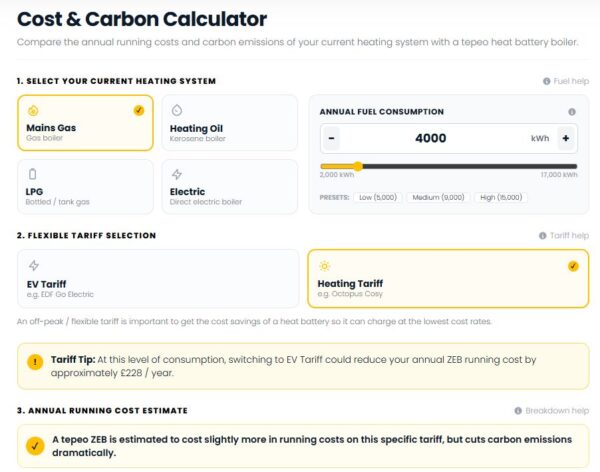
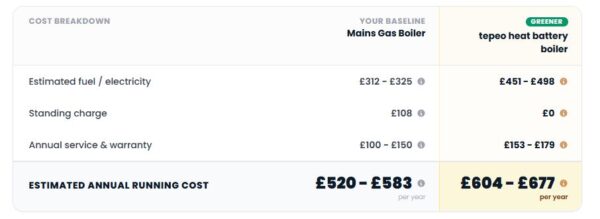
As you can see, for the type of variable tariff I’m able to access as a non-EV user, the cost of a heat battery system works out a little more expensive. But I wouldn’t regard the difference as a deal-breaker if I was minded to switch from my existing gas boiler (which I’m not at the moment).
Also, the calculator doesn’t allow you to enter details of the particular time-of-use tariff you use (I am currently on EDF FreePhase, which is more economical for me than the Octopus Cosy shown in the calculator). So it is perfectly possible that you – or I – could achieve higher savings (or lower extra costs) than the calculator indicates.
- If you’re interested in switching to EDF Energy, you can currently get a £50 bonus credited to your account when you switch via my refer-a-friend link. Terms and conditions apply.
Anyway, if you want to get a rough idea of the running costs of a battery boiler system, the tepeo calculator is well worth checking out. Please note that I am not especially endorsing tepeo, just using it as an example. Other battery boiler suppliers (such as Sunamp) also exist.
What about government grants?
Government support can make a substantial difference to the cost of changing your heating system.
The Boiler Upgrade Scheme has traditionally helped eligible households in England and Wales install heat pumps and certain other low-carbon heating systems. Heat batteries have also been the subject of government support developments.
Before making a decision, check the latest eligibility rules, grant amounts and application arrangements on the official GOV.UK website. Do not assume that a grant advertised by a manufacturer is a government payment available to everyone: it may be a temporary company offer or a grant-matching arrangement.
You can start with the official Boiler Upgrade Scheme guidance on GOV.UK.
Is a heat battery boiler right for you?
This technology is worth investigating if:
- You want to move away from gas, oil or LPG heating.
- Your home already has a wet central-heating system that you would prefer to retain.
- Installing a heat pump would be difficult, disruptive or unattractive.
- You can access an electricity tariff with useful off-peak charging periods.
- Your property has suitable indoor space for the equipment.
- Your heating requirements fall within the system’s capabilities.
It may be less attractive if your home has very high heating demand, you cannot access a suitable tariff, or you are already well placed to install an efficient heat pump at a competitive cost.
If you have solar panels, ask specifically how the proposed system can use surplus generation and whether that feature is included in the quoted installation.
What should you ask before buying?
Before committing yourself, I would suggest asking an installer the following questions:
- Is my home suitable, taking account of its size, insulation and heat loss?
- Can my existing radiators and pipework be retained?
- What will happen to my domestic hot water, especially if I currently have a combi boiler?
- How much will the complete installation cost?
- What annual electricity consumption do you estimate for my property?
- What tariff assumptions underpin the estimated running costs?
- How often might the system need to charge during expensive daytime periods?
- Can it make use of my solar-panel surplus?
- What servicing, warranty and after-sales support are included?
- Am I eligible for any current government grant or other financial assistance?
Ideally, obtain an independent assessment or a second quotation, and compare the estimated annual costs with those of retaining your existing boiler and installing a suitable heat pump.
Final thoughts
Electric boilers with thermal batteries are an interesting addition to the options available to homeowners looking for alternatives to conventional gas or oil heating.
Their main attraction is straightforward: store heat when electricity is cheap, then use it when you need it. For suitable homes, this could offer a way to retain familiar central heating while reducing reliance on fossil fuels and avoiding some of the complications associated with installing a heat pump.
However, thermal storage is not a substitute for efficiency. The electricity needed to heat your home still has to be paid for, and a heat battery boiler will not necessarily match the running costs of a well-designed heat pump.
For homeowners whose properties are difficult to adapt, or who particularly value a straightforward replacement for their existing boiler, it is certainly an option worth exploring.
As with any major home-heating investment, the best approach is to look at the whole picture: installation costs, likely energy bills, available tariffs, maintenance and how well the technology suits your property.
That way, you can decide whether a heat battery boiler is a genuinely cost-effective solution for your home, rather than simply an intriguing new technology.
As always, if you have any comments or questions about this article, please do leave them below.
