
property

My Investments Update July 2022

My Investments Update – July 2022

Here is my latest monthly update about my investments. You can read my June 2022 Investments Update here if you like

I’ll begin as usual with my Nutmeg Stocks and Shares ISA. This is the largest investment I hold other than my Bestinvest SIPP (personal pension).

As the screenshot below of performance last month shows, my main portfolio is currently valued at £19,357. Last month it stood at £20,512 so, after another challenging month, that is a fall of £1,155.

Nutmeg main portfolio July 2022

Apart from my main portfolio, I also have a second, smaller pot using Nutmeg’s Smart Alpha option. This is now worth £2,942 compared with £3,119 last month, a fall of £177

Here is a screen capture showing performance over the last month.

Nutmeg Smart Alpha portfolio July 2022

There is no denying these are disappointing results. Though as I’ve noted previously on PAS, you do have to expect ups and downs with equity-based investments. And over the last few months there’s been no lack of volatility in world markets, caused by rising inflation, the war in Ukraine and the aftermath of the pandemic (among other things).

  • It is, however, worth noting that since I started investing with Nutmeg in 2016, and despite everything that has happened this year, I have still made a total net return on capital of 28.79% (or 52.94% time-weighted).

While performance this year has clearly been disappointing, I have no doubt there will be an uptick at some stage, and am considering topping up now while asset values are low. I definitely don’t plan to sell up, as that would only crystallize my losses this year and leave me unable to take advantage when – as I fully expect – things turn around again.

I should also mention that I selected quite a high risk level for both my Nutmeg accounts (9/10 for the main one and 5/5 for Smart Alpha). This has served me well generally, but I’m sure investors who selected lower risk levels will have seen smaller falls over the last few months. If you also have a Nutmeg portfolio and plan to withdraw from it soon, there is certainly a good case for switching to a lower risk level now.

You can read my full Nutmeg review here (including a special offer at the end for PAS readers). If you are looking for a home for your annual ISA allowance, based on my experience over the last six years, they are certainly worth considering.

If you haven’t yet seen it, check out also my blog post in which I looked at the performance of Nutmeg fully managed portfolios at every risk level from 1 to 10 (as mentioned, my main port is level 9). I was actually pretty amazed by the difference the risk level you choose makes. If you are investing for the long term (and you almost certainly should be) opting for a hyper-cautious low-risk strategy may not be the smartest thing to do.

I talked about the performance of my Kuflink and Assetz Exchange investments in my June update and also in this recent blog post. I don’t therefore plan to provide in-depth reports about them on this occasion. I will just say that both are continuing to provide steady returns for me, with a lot less ‘excitement’ than my equity-based investments!

As I said a few weeks ago, in these turbulent times I believe P2P/crowdlending platforms such as the two mentioned are well worth considering. Not only are the rates of return higher than those on offer from banks and building societies, they are relatively unaffected by ups and downs in the stock markets. P2P loans aren’t a way of hedging your equity-based investments directly, but they do help spread the risk.

  • To be clear, nobody should put all their spare cash into Kuflink, Assetz Exchange or any other P2P/crowdlending platform, but in my view (and experience) they are certainly worth considering as part of a diversified portfolio. 

My investment in European crowdlending platform Nibble (as mentioned last time) continues to perform as advertised. My latest investment was in their Legal Strategy. These are loans that are in default and facing legal action. Nibble buy these loans at a heavily discounted rate and then seek to recover as much as possible of the money owed. The minimum investment is 10 euros and the minimum period is six months. I invested 100 euros for 12 months initially at a target annual interest rate of 12.5%.

The Legal Strategy comes with a deposit-back guarantee. This is a guarantee to return the full investment amount at the end of the investment period and a minimum yield of 9% per year. The actual yield depends on how successful recovery efforts prove, so in practice you may end up with a return of anywhere between 9% and 14.5%. All has  gone to plan so far, but I will obviously continue to report on this in the months ahead.

Also as mentioned last time, I also recently set up an account with investment and trading platform eToro, using their popular ‘copy trader’ facility. I chose to invest $500 (about £412) copying an experienced eToro trader called Aukie. As of today my investment has fallen to $473, which I guess in the current circumstances isn’t too bad. In any event I am looking on this as a long-term investment so obviously won’t be judging it yet. I am also considering a further investment with eToro, possibly in one of their themed portfolios.

Moving on, I had another article published on the always-excellent Mouthy Money website. This one is titled Starting Your Own Business With a Franchise. If you harbour an ambition to be your own boss, a franchise can be a great way of achieving this. My article sets out some hints and tips for choosing the right opportunity and making the most of it.

Finally, I enjoyed a short break in Criccieth, North Wales, at the end of June. I won’t go into detail about this here, as I plan to write a separate blog post about it soon [now published}. But I will say it was a very enjoyable, relaxing holiday, and I definitely hope to return there before too long. I stayed in a lovely sea-front apartment about five minutes’ walk from Criccieth Castle. Here is a photo taken from the castle showing the main beach…

Criccieth

That’s all for today. As always, if you have any comments or queries, feel free to leave them below. I am always delighted to hear from PAS readers 🙂


If you enjoyed this post, please link to it on your own blog or social media:
How to Get a Self Employed Mortgage

How to Get a Self-Employed Mortgage

As of April 2022 there were 4.21 million self-employed people in the UK (source: Statista). Being your own boss clearly has many attractions, but it can have drawbacks as well. And one of these is the potential for complications when the time comes to apply for a mortgage.

So today I am sharing some tips for freelancers and other self-employed people to make this process as painless as possible. I am indebted to my friends from Suffolk Building Society for their assistance with this.

I should start by clarifying that in this article I am not only addressing freelancers operating as sole traders but also people trading in partnerships or as limited companies. Mortgage lenders tend to group everyone in these categories together under a ‘self-employed’ banner.

Suffolk Building Society’s Head of Mortgages, Charlotte Grimshaw, says: “Nowadays, many more mortgage providers are inclined to lend to freelancers than perhaps they once were. Some providers offer specific self-employed mortgages, while others offer freelancers access to standard mortgage products, as long as they meet certain criteria. So if you don’t see any ‘freelance’ mortgage products it doesn’t necessarily mean the provider won’t lend to you.”

Suffolk Building Society has collated a list of useful points to help freelancers be better informed, should they need to apply for a mortgage.

Considerations For All Freelancers

  • Many people, but especially freelancers, gravitate to their bank to obtain a mortgage in the belief that their bank will understand their finances and will be more likely to lend. This is not necessarily the case, especially for freelancers whose finances may be more complex than an average mortgage applicant’s. Finding a specialist mortgage lender who can understand your business gives a much higher chance of a successful application.
  • Lenders will understand that different industries make payments in different ways i.e. a videographer may be paid at the end of a project, whereas a marketing consultant may invoice once a month. As long as the freelancer is being paid in what is considered a ‘normal’ way for that industry, lenders tend to take a favourable view.
  • There is generally no minimum age for freelancers to apply for a residential mortgage, whereas buy-to-let mortgages often have a minimum age of 21, 25, or even 30. If someone has a proven history and deposit, their age should not hold their application back.
  • Similarly, there is no legal maximum age limit for freelancers to apply for a mortgage, but lenders will set their own criteria.
  • If freelancing is a side hustle (as opposed to an individual’s main source of income) most lenders’ standard position is to use 50% of their freelancing work in affordability calculations and the individual should be prepared to provide tax returns as evidence that this income is sustainable.

For Freelancers Running a Limited Company

  • Two years of company accounts are usually required for freelancers running their own business – some lenders may consider less.
  • Make sure company accounts are filed on time – late filing could ring alarm bells with the lender.
  • Different lenders will have different affordability criteria and may base their mortgage offer on salary and dividend, net profit or retained profit. It is worth speaking to an accountant to properly understand the relevant figures before applying for a mortgage.
  • If a freelancer has switched their business model from sole trader to limited company but doesn’t have two years’ worth of accounts, the lender may take a favourable view if the individual is in a similar industry or sector.
  • Some lenders will take the average of two years’ accounts, others will base their lending decision on the worst year – whether that be year one or two. Freelancers who have had a particularly poor year (e.g. due to the impact of the Covid pandemic) but can explain why will still be considered for a mortgage.
  • Freelancers who are concerned about having a poor year before applying for a mortgage can ask their accountant for an estimated projections letter to support their case.

For Freelancers Operating as a Sole Trader

  • Two years of operating as a sole trader is usually the minimum required to apply for a mortgage. Some lenders will prefer more and some will accept less but two years is a good rule of thumb.
  • Keep all paperwork related to freelance work – from contracts, to bank statements, invoices and remittance notes, as a lender may ask to see it.
  • It can be helpful, but not always essential, to have a separate bank account to keep track of business expenses and income away from personal finances. If not, be ready and able to clearly demonstrate the difference in personal and business funds.
  • Lenders may use a day rate calculation such as five times the value of daily contracts, multiplied by 46 or 48 weeks (to allow for some downtime/holiday etc). The S302 form will be used as a way to calculate previous earnings based on submission to HMRC, so this needs to be available.
  • If the applicant’s freelance work is in the same sector as their previous employed job, then an application can sometimes be supported by evidence of PAYE income in the form of P60 forms.

For Freelancers Operating Under an Umbrella Company

  • There are mortgage providers who will lend to freelancers who use an umbrella company but it is usually best to engage the services of a specialist mortgage broker for advice on this front, as the application can be more complex. Much of the guidance above still applies in terms of demonstrating clarity of earnings and stability of contracts.

Final Thoughts

Charlotte Grimshaw from Suffolk Building Society concludes: “Having been made redundant during the pandemic, many people turned to freelancing and in most cases, they haven’t looked back as they embrace the autonomy and freedom of being their own boss – but some may be a little concerned if they need to apply for a mortgage for the first time or remortgage their existing property. However, the barriers that freelancers once faced in getting a mortgage are coming down, as lenders embrace different, and often multiple, sources of income.

“There are plenty of mortgage products for freelancers out there but start by researching ‘self employed mortgages’ rather than ‘mortgages for freelancers’. Don’t get too bogged down in worrying about whether your business structure will be suitable for a specific lender as most are adept at understanding the different ways freelancers are paid – just make sure your finances are organised, comprehensive and up to date.”

Many thanks again to Charlotte and her colleagues at Suffolk Building Society for their help with this article. If you are self-employed and considering applying for a mortgage, I hope you will find it helpful. Naturally, SBS offer self-employed mortgages themselves. You can find out more on this page of their website if you wish.

As always, if you have any comments or questions about this post, please do leave them below.

If you enjoyed this post, please link to it on your own blog or social media:
Is It Time for Investors to Look Again at P2P?Crowdlending Platforms?

Is It Time for Investors to Look Again at P2P/Crowdlending Platforms?

There isn’t much doubt this year has been a challenging one for stock market investors.

The war in Ukraine, rising inflation, and lingering fallout from the pandemic have all conspired to damage investor confidence. As a result, what we’re seeing now is a bear market, with share values falling across the board. How long this will continue I don’t know, though one thing I can say for certain is that there will be an upswing sooner or later. 

I have witnessed this with my own equity investments and it hasn’t been pretty. My Nutmeg Stocks and Shares ISA has fallen by 11% in value since January 2022. My Bestinvest SIPP (personal pension) has fallen by a roughly similar amount (I’ve suspended withdrawals from it as a result, to avert the risk of pound-cost ravaging). I’m not panicking about this, as all equity investments have their ups and downs. And since I started both of these investments, I am still well up overall.

There is indeed an argument that now could be a good time to invest, while asset values are depressed. Nonetheless, I do of course understand why many people are wary of investing in stocks and shares at the moment, as markets may well have further to fall.

So today I thought I’d talk about an alternative approach that has fallen out of favour in the last year or two, but still has the potential to generate good returns for your money even when stock markets are in turmoil.

P2P/Crowdlending

I am, of course, talking about P2P/crowdlending. A few years ago these platforms were being touted as an exciting new alternative to banks, allowing individuals the opportunity to club together to buy property or lend to people/businesses. Investors could then benefit from interest paid, rentals received and/or capital gains made.

While initially everything went well, Covid in particular put a big spoke in the P2P sector’s wheel. More borrowers went into default, and platforms struggled to stay afloat as a result. Some (e.g. The House Crowd and Lendy) went bust. Others (e.g. Zopa and Ratesetter) decided to withdraw from P2P lending. Still others (e.g. Bricklane and Crowdlords) continue to operate but have closed to new investors and begun a process of winding down. 

While that might sound depressingly negative, it’s not all doom and gloom. A number of P2P/crowdlending platforms are still running and indeed thriving. Three I have investments with myself are Kuflink, Assetz Exchange and Property Partner. 

Interestingly, these are all property investment platforms. Kuflink offers secured loans to property developers, while the other two are more ‘conventional’ property crowdfunding platforms where investors jointly purchase a property and share pro rata in rental received and any capital gains on sales. P2P platforms that lend directly to individuals and businesses without the security of property are a lot scarcer nowadays than they used to be.

Regular PAS readers will know I have money in all three platforms mentioned above and am still actively investing in two of them (I am gradually winding down my Property Partner portfolio, though I do still recommend them). One big attraction of property platforms is that investment outcomes are not directly linked to the performance of stock markets. Yes, where the economy is rocky, this might ultimately impact on some commercial properties. Overall, though, these platforms are much less affected by market fluctuations than equity-based investments. That means they can offer an attractive alternative at times (like now) of high volatility.

In this article I’d like to highlight my two current favourite P2P/crowdlending platforms, Kuflink and Assetz Exchange. I will say a word about each and explain why I am still enthusiastic about them and continue to invest with them.

Kuflink

Kuflink offers opportunities to invest in loans secured against property. These loans are typically made to developers who require short- to medium-term bridging finance, e.g. to complete a major property renovation project, before refinancing with a commercial mortgage. They offer three types of investment, as follows:

  • Select-Invest (individual loans)
  • Auto-Invest
  • Tax-free IFISA (Innovative Finance ISA)

Auto Invest and IFISAs both automatically invest your money across a number of loans and pay a fixed interest rate, typically between 5 and 7%. You can choose a 1-year, 3-year or 5-year term, and interest is paid annually. The Auto-Invest product is basically the same as the IFISA, but without the tax-free wrapper. Self-Invest loans can also be put in an IFISA, with most (not all) loans on the platform being eligible.

I have been investing with Kuflink for nearly five years now. My experiences have been entirely positive and my investments have been generating the promised returns. I started cautiously with them, but have gradually built up the amount I have invested. Although – like all property P2P platforms – they were adversely affected by the pandemic, they appear to have come through it strongly, with new loans now being added almost daily.

There have been no defaults so far on any of my loans, and Kuflink say on their website that to date nobody has lost a penny on their platform. I have experienced short delays with loans being repaid, but in such cases you continue to earn interest, of course.

Although Kuflink don’t pay the highest rates in P2P lending, I think the returns on offer are realistic and sustainable. The steady expansion of the platform seems to testify to this, as does the fact that they have received several industry awards. .

Kuflink are also highly rated on the independent TrustPilot website, with an average 4.7 out of 5 (‘Excellent’). At the time of writing 80% of reviewers award them the maximum five-star rating, which is among the highest figures I have seen for a financial services platform.

As with all P2P lending, your money doesn’t enjoy the same level of protection as bank and building society accounts, which are covered (up to £85,000) by the Financial Services Compensation Scheme. Nonetheless, the rates of return on offer are significantly better than those from most financial institutions. And the fact that all loans are secured against bricks and mortar – and Kuflink themselves have cash invested in them – clearly offers some reassurance.

From my experience, Self-Select loans tend to fill up quickly. On the positive side, this shows investors have confidence in Kuflink and want to invest through the platform. On the minus side, it means there are typically no more than two or three new loans open for investment at any time.

You can read my full review of Kuflink in this blog post, or sign up directly here if you wish [affiliate link].

Assetz Exchange

Assetz Exchange is a P2P property investment platform focusing on lower-risk properties (e.g. sheltered housing). I put an initial £100 into this in mid-February 2021 and another £400 in April. In June 2021 I added another £500, bringing my total investment up to £1,000.

Since I opened my account, my AE portfolio has generated £59.49 in revenue from rental and £60.93 in net capital growth, a total of £120.42. That’s a decent rate of return on my £1,000 investment and does illustrate the value of P2P property investment for diversifying your portfolio when equity markets are volatile (as at the moment).

I now have investments in 23 different projects and all are performing as expected, generating rental income and – in all but three cases – showing a profit on capital. So I am very happy with how this investment has been doing. And it doesn’t hurt that most projects are socially beneficial as well.

To control risk with all my property crowdfunding investments nowadays, I invest relatively modest amounts in individual projects. This is a particular attraction of AE as far as I am concerned. You can actually invest from as little as 80p per property if you really want to proceed cautiously.

My investment on Assetz Exchange is in the form of an IFISA so there won’t be any tax to pay on profits, dividends or capital gains. I’ve been impressed by my experiences with Assetz Exchange and the returns generated so far, and intend to continue investing with them. You can read my full review of Assetz Exchange here. You can also sign up for an account on Assetz Exchange directly via this link [affiliate].

Final Thoughts

Clearly, no-one should put all their spare cash into Kuflink, Assetz Exchange or any other P2P/crowdlending platform. Nonetheless, in my view it’s certainly worth considering as part of a diversified portfolio. Not only are the rates of return higher than those currently on offer from banks and building societies, they are relatively unaffected by ups and downs in the stock markets. P2P loans aren’t a way of hedging your equity-based investments directly, but they definitely do help spread the risk.

If you have any comments or questions about this post, as always, please do leave them below.

Disclosure: I am not a registered financial adviser and nothing in this post should be construed as personal financial advice. You should always do your own ‘due diligence’ before investing, and seek advice from a qualified financial adviser if in any doubt how best to proceed. All investing carries a risk of loss.

This post (and others on PAS) includes affiliate links. If you click through and perform a qualifying transaction, I may receive a commission for introducing you. This will not affect the product or service you receive or any fees you may pay.

If you enjoyed this post, please link to it on your own blog or social media:
My Investments Update June 2022

My Investments Update – June 2022

Here is my latest monthly update about my investments. You can read my May 2022 Investments Update here if you like

I’ll begin as usual with my Nutmeg Stocks and Shares ISA. This is the largest investment I hold other than my Bestinvest SIPP (personal pension).

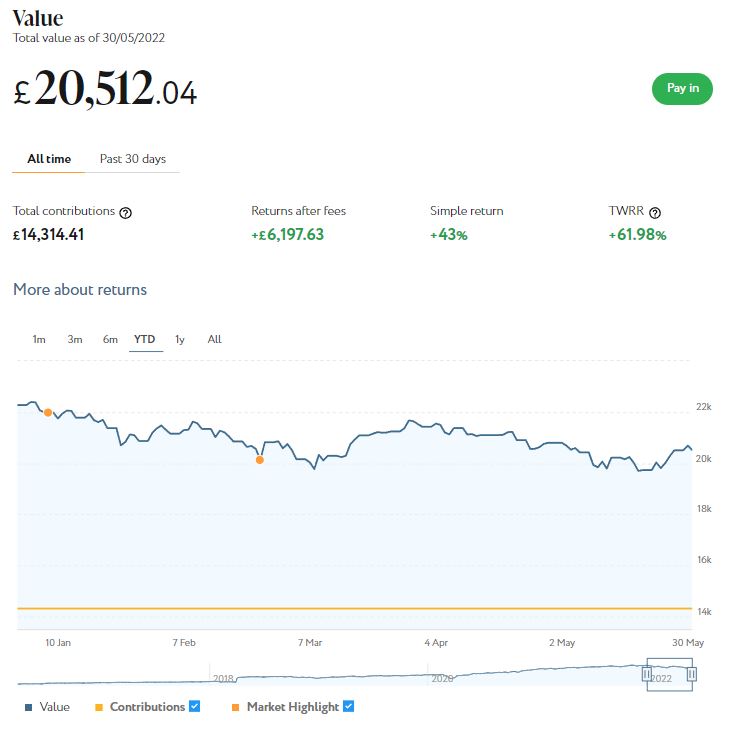
As the screenshot below of performance in the year to date shows, my main portfolio is currently valued at £20,512. Last month it stood at £20,799 so, after a roller-coaster month, that is a fall of £287.

Nutmeg Main Portfolio June 2022

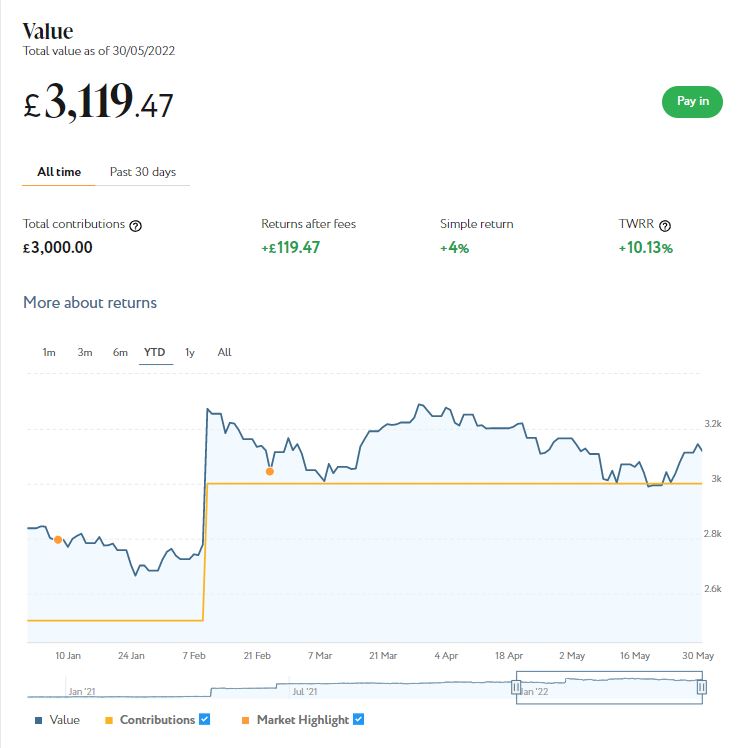
Apart from my main portfolio, I also have a second, smaller pot using Nutmeg’s Smart Alpha option. This is now worth £3,119 compared with £3,166 last month, a fall of £47

Here is a screen capture showing performance this year.

Nutmeg Smart Alpha June 2022

Obviously the continuing falls are disappointing (though much smaller than last month). As I’ve noted previously on PAS, you do have to expect ups and downs with equity-based investments, and certainly over the last few months there has been no shortage of volatility in world markets. And it’s also worth noting that since I started investing with Nutmeg in 2016 I have still enjoyed a total return of 36.48% (or 62.07% time-weighted).

I should also mention that I selected quite a high risk level for both my Nutmeg accounts (9/10 for the main one and 5/5 for Smart Alpha). This has served me well generally, but I’m sure investors who selected lower risk levels will have seen smaller falls over the last two months.

  • If you also have a Nutmeg portfolio and plan to withdraw from it in the next few months, there is certainly a case for switching to a lower risk level right now.

You can read my full Nutmeg review here (including a special offer at the end for PAS readers). If you are looking for a home for your annual ISA allowance, based on my experience over the last six years, they are certainly worth considering.

If you haven’t yet seen it, check out also my blog post in which I looked at the performance of Nutmeg fully managed portfolios at every risk level from 1 to 10 (as mentioned, my main port is level 9). I was actually pretty amazed by the difference the risk level you choose makes. If you are investing for the long term (and you almost certainly should be) opting for a hyper-cautious low-risk strategy may not be the smartest thing to do.

Moving on, my Assetz Exchange investments continue to perform well. Regular readers will know that this is a P2P property investment platform focusing on lower-risk properties (e.g. sheltered housing). I put an initial £100 into this in mid-February 2021 and another £400 in April. In June 2021 I added another £500, bringing my total investment up to £1,000.

Since I opened my account, my AE portfolio has generated £57.24 in revenue from rental and £92.28 in capital growth, a total of £149.52. That’s a decent rate of return on my £1,000 investment and does illustrate the value of P2P property investment for diversifying your portfolio when equity markets are volatile (as at the moment).

I now have investments in 22 different projects and all are performing as expected, generating rental income and – in every case but one – showing a profit on capital. So I am very happy with how this investment has been doing. And it doesn’t hurt that most projects are socially beneficial as well.

  • To control risk with all my property crowdfunding investments nowadays, I invest relatively modest amounts in individual projects. This is a particular attraction of AE as far as i am concerned. You can actually invest from as little as 80p per property if you really want to proceed cautiously.

My investment on Assetz Exchange is in the form of an IFISA so there won’t be any tax to pay on profits, dividends or capital gains. I’ve been impressed by my experiences with Assetz Exchange and the returns generated so far, and intend to continue investing with them. You can read my full review of Assetz Exchange here. You can also sign up for an account on Assetz Exchange directly via this link [affiliate].

Another property platform I have investments with is Kuflink. They have been doing well recently, with new projects launching almost every day. I currently have over £2,150 invested with them, quite a large proportion of which comes from reinvested profits. To date I have never lost any money with Kuflink, though some loan terms have been extended once or twice. On the plus side, when this happens additional interest is paid for the period in question. At present all my Kuflink loans are performing to schedule, though one is showing as ‘pending a status update’. I suspect this may translate to a delay in repayment. We shall see.

My loans with Kuflink pay annual interest rates of 6 to 7.5 percent. These days I invest no more than around £150 per loan (and often less). That is not because of any issues with Kuflink but more to do with losses of larger amounts on other P2P property platforms in the past. My days of putting four-figure sums into any single property investment are behind me now!

  • Nowadays I mainly opt to reinvest the monthly repayments I receive from Kuflink, which has the effect of boosting the percentage rate of return on the projects in question

Obviously a possible drawback with Kuflink and similar platforms is that your money is tied up in bricks and mortar, so not as easily accessible as cash savings or even (to some extent) shares. They do, however, have a secondary market on which you can offer any loan part for sale (as long as the loan in question is performing and not in arrears). Clearly that does depend on someone else wanting to buy it, but my experience has been that any loan parts offered are typically snapped up very quickly. So if an urgent need arises, withdrawing your money (or part of it) is unlikely to be an issue.

You can read my full Kuflink review here. They offer a variety of investment options, including a tax-free IFISA paying up to 7% interest per year with built-in automatic diversification. Alternatively you can now build your own IFISA, with most loans on the platform (including the one shown above) being IFISA-eligible.

  • I also recently published a blog post about another P2P property investment platform called BLEND. Like Kuflink, they offer the opportunity to invest in secured loans to experienced property developers. They offer (on average) somewhat higher rates of return than Kuflink, though arguably with a little more risk. As well as my blog post about BLEND, you can also check out what they have to offer on their website [affiliate link].

As mentioned last time, I invested some more money in European crowdlending platform Nibble last month. On this occasion I invested in their Legal Strategy. The loans in question are in default and facing legal action. Nibble buy these loans at a heavily discounted rate and then seek to recover as much as possible of the money owed. The minimum investment is 10 euro and the minimum period is six months.

The Legal Strategy comes with a deposit-back guarantee. This is a guarantee to return the full investment amount at the end of the investment period and a minimum yield of 9% per annum. The actual yield will depend on how successful recovery efforts prove, so in practice you may end up with a return of anywhere between 9% and 14.5%. All is going well so far, but I will obviously continue to report on this in the months ahead.

One other thing I wanted to mention is that I have just opened an account with online share trading/investment platform eToro. I’ve been planning to do this for a while, with a view to reviewing it on PAS. I’m finding it quite different from other online investment platforms I have used such as Bestinvest.

As well as commission-free share trading, eToro offer a popular copy-trading feature, where you can copy the trades of other successful investors automatically. You can also practise with a virtual portfolio of $100,000. I put some of this into Platinum on the eToro commodities market and initially its value soared. But then it went right down again. So I am not the investment genius I thought I was at first 😀 It’s all very interesting, though. If you’d like to check out eToro for yourself, here’s an invitation link [affiliate]. And keep an eye open for my full review in due course.

728x90

Moving on, I have two more articles on the always-excellent Mouthy Money website. The first concerns Two Important State Benefits Many Older People Are Missing Out On. And the second is on the subject Could You Make Money as a Blogger? I have been blogging for over twenty years now, initially about freelance writing and now about personal finance. So I had plenty to talk about in this article!

  • Incidentally, Mouthy Money currently have a vacancy for a graduate-level personal finance reporter. This is a one-year paid internship working partly from home and partly from MM’s London office. If you know anyone who might be interested in this opportunity, please do draw it to their attention.

Finally, there has been a lot of talk about the cost of living crisis this month. As you may know, Chancellor Rishi Sunak announced a raft of measures to try to mitigate the worst effects of this.

Whatever your political or economic views, I do think he has been quite generous to older people in particular. Not only will those of us receiving the state pension get £400 off our household energy bills, we will also receive an extra £300 on top of our usual Winter Fuel Allowance (that means I’ll get £500 this year).

Many pensioners will also qualify for the £150 bonus for those on non-means-tested disability benefits such as Attendance Allowance. And they may also get the £650 cost of living payment going to anyone receiving various means-tested benefits (everyone getting pension credit will qualify for this, for example). Some households will receive a total of £1,500 in additional benefits through these measures, which should certainly help in these challenging times. .

If you would like to know more about the latest round of financial support from the government, Martin Lewis has a good summary on his Moneysaving Expert website. The government has also published a web page which sets out all the help that may be available for those on lower incomes.

That’s enough for today, so I’ll close by wishing you a very happy Jubilee Holiday. Whatever you are doing in the next few days – going away or staying home with family and friends – I do hope you have a relaxing and enjoyable time. As ever, if you have any comments or queries, please feel free to leave them below. I always love hearing from my readers 🙂

Jubilee

Disclaimer: I am not a qualified financial adviser and nothing in this blog post should be construed as personal financial advice. Everyone should do their own ‘due diligence’ before investing and seek professional advice if in any doubt how best to proceed. All investing carries a risk of loss.

Note also that posts may include affiliate links. If you click through and perform a qualifying transaction, I may receive a commission for introducing you. This will not affect the product or service you receive or the terms you are offered, but it does help support me in publishing PAS and paying my bills. Thank you!

If you enjoyed this post, please link to it on your own blog or social media:
Equity Release 3

Can I Rent Out My House With Equity Release?

This is the third in a series of collaborative articles on the subject of equity release. This one looks at the important question of whether you can still rent out your house (or part of it) if you take equity release.


As the equity release industry expands, UK-based older homeowners are being offered more flexible retirement mortgage solutions to combat the problem of insufficient funds in retirement.

While equity release is a fantastic product, there are some terms and conditions that may put limitations on what you do with your property.

74% of UK-based retirees own homes, and many of those live in large family properties where the kids have moved out. With the chance to make up to £7,500 tax-free a year through the government’s Rent-a-Room scheme (including qualifying Airbnb lets), renting out a room or your whole property can be a great way for retirees to generate extra income.

But if equity release is something you’re considering, the big question is, can you rent out your house after taking equity release?

Equity release expert John Lawson of SovereignBoss explores this topic in the following report to help you understand all the equity release criteria to ensure you make a sound decision.

What is Equity Release?

Equity release is a financial product designed for older homeowners to unlock the cash in their property while still living there.

What’s great about these products is that repayments are completely voluntary and there is no risk of foreclosure. Instead, the loan and any compound interest are repaid when the last homeowner passes away or enters long-term care. Money taken through equity release is tax-free and can be used for any purpose.

Finally, equity release borrowers can opt to release their money in a lump sum, place it in a drawdown facility, or receive it as a monthly income.

Lodgers v. Tenants and Equity Release

One of the key components to an equity release loan is that you need to live in your home for at least six months a year and it must be considered your primary residence. Does this mean you can welcome lodgers or tenants?

There are some key differences between the two:

  • A Tenant – A tenant generally has more rights than a lodger due to a Tenancy Agreement. The landlord will need to get permission to enter the rented space and must conduct regular gas safety checks (if gas is connected). Once a contract is signed, a landlord can evict the tenant after six months, providing acceptable practices are followed. A landlord will also need to return the tenant’s deposit as per The Tenancy Deposit Scheme (TDS).
  • A Lodger – On the other hand, a lodger can be removed from the property at any time, given ‘sufficient’ notice. This is usually 28 days but can be less. A big difference between a tenant and a lodger is that a licence is signed instead of a lease agreement. The document will set out the terms and conditions of the agreement and the rules of the property.

Very importantly, the general rule with equity release is that homeowners may have lodgers but not tenants. (1)

Can I Rent Out My Home with Equity Release While I’m on Holiday?

In short, no. As per the logic above, you may not rent out your home while you’re on holiday, even if you live in the property for only six months a year. That being said, these rules could differ from one lender to the next. Therefore, should you receive income from renting out your home for half a year while moving to your holiday home, it’s worth consulting your financial adviser to see if they can find an equity release plan that permits this.

Airbnb and the Rent-a-Room Scheme with Equity Release

The great news is that Airbnb and the Rent-a-Room scheme are both considered to be lodger agreements, so you can rent out one or more rooms in your home using one (or both) of these options. With the UK being a popular tourist destination, this is a great form of retirement income, and you have the opportunity to mingle with guests and entertain people from across the world.

Of course, some areas are more popular than others for this. But even if you don’t live in a tourist hot-spot, there may still be a demand for short-term accommodation for people attending business meetings, conferences, sporting events, concerts, and so on.

In Conclusion

Equity release is a great way to gain access to property wealth, but can limit your opportunities to make money through rentals. It’s therefore important to weigh up the pros and cons carefully.

Your best bet is to discuss your future plans and intentions with your financial adviser. In general, as stated above, you can’t rent out your home once you’ve unlocked equity. But you can usually make extra income by taking lodgers, and that can be a great way to keep you busy (and supplement your pension) during your retirement years.

This is a collaborative post.

If you enjoyed this post, please link to it on your own blog or social media:
Equity Release 2

How Will Rising Interest Rates Affect the Short Term Future of the Equity Release Market?

This is the second in a three-part series of collaborative posts about equity release. This article looks at the likely effect of rising interest rates on the equity release market.


The equity release industry is booming. Homeowners from across the UK may find the financial freedom they desire by unlocking one of these attractive products.

If you’re a homeowner over 55 and haven’t heard of equity release, you need to do your research. These products allow you to access cash tied up in your property for any purpose you wish. No tax is payable on this money, and you will never be obliged to move out of your home.

John Lawson from SovereignBoss has done extensive research on the future of the equity release interest rates. He has discovered that after reaching an all-time low in March 2021, equity release interest rates are rising. The big question is, how significant will the rate increase be, and will this have a short-term effect on the industry as a whole? Let’s take a look at what Mr Lawson has to say.

Interest Rate Increase

When interest rates rise, the equity release sector is inevitably impacted as well. In March 2021 interest rates hit a historic low, with some homeowners having the opportunity to unlock equity with fixed rates as low as 2.3%. This unprecedented rate drop was exciting because it wasn’t much more expensive for a homeowner to opt for an equity release than it was to have a traditional mortgage. Plus, with no repayments required in one’s lifetime, retired homeowners could save a fortune by eliminating monthly mortgage payments. (1)

Recently interest rates have increased slightly but are still quite low. Current rates range between 2.9% and 6.4%. The interest rates you achieve will be lender-dependent, but they will also be determined by your age, health condition and property value.

Experts predict that interest rates are set to rise until 2024. And with the latest announcement by the Equity Release Council (see below), now could be the cheapest opportunity to access the cash tied up in your property through an equity release mortgage.

New Compulsory Optional Repayments

In addition to interest rates rising but still being stable, on 31st March 2021, the Equity Release Council enforced guidance on lenders to offer all their lifetime mortgage clients the option for penalty-free voluntary repayments. This means that homeowners can now repay up to 40% of the amount borrowed each year.

The exact offer you receive will depend on the lender you select. But in principle, if you have the means to do so, you could pay off your equity release plan within three to 10 years, restoring your property’s value.

But that’s not all. Once you’ve released equity, there is no risk of foreclosure. You can stop and start making repayments whenever you wish. Voluntary repayments are a great idea if you can afford them, as they reduce the overall cost of your loan by preventing compound interest.

So How Badly Will the Industry Be Affected?

With interest rates still reasonable and the above announcement by the Equity Release Council, the industry is set for another record-breaking year. Eighty percent of experts agree that the industry’s value is rising, and we at Sovereign Boss are excited to see further innovation from lenders and the Equity Release Council.

In Conclusion

Whether now is the best time to opt for an equity release product is very personal. You will need to consult a financial advisor who will help you determine the best course of action for your needs. If it’s in your interest to unlock equity at this stage, however, you’re likely to find a fantastic deal, with product flexibility better than ever.

So, while interest rates are rising, they’re not too much of an issue at this stage. And there is certainly no indication that there will be any short-term impact on the equity release industry. On the contrary, we are set for another record-breaking year.

That being said, it’s too early to predict the long-term impact that interest rates increase will have on the industry. But SovereignBoss considers it their responsibility to keep you updated with the latest industry trends.

This is a collaborative post.

If you enjoyed this post, please link to it on your own blog or social media:
Why Does the Equity Release Industry Look Set to Boom This Year?

Why Does the Equity Release Industry Look Set to Boom This Year?

Today I have the first in a series of three collaborative posts on the subject of equity release. This one examines the growing popularity of equity release and why it looks set to boom in the year ahead.


The equity release industry saw a massive expansion in 2021, with a record-breaking sum of over £4.8 billion being unlocked by retirees across the UK. This unprecedented growth has been welcomed amid a global pandemic, as the Equity Release Council helps regulate a retirement product that has given many retirees the means to a desperately needed income in these tough economic times.

Mark Patterson, the equity release expert from EveryInvestor, joins the ranks of fellow industry authorities in predicting that 2022 is set to be another record-breaking year. Let’s take a look at what’s expected and determine if unlocking equity is a good idea over the next few months.

What Is Equity Release?

Equity release is a widely popular financial product for UK-based homeowners older than 55. In a nutshell, it gives you the opportunity to use your property’s equity but still live at home. With a third of UK retirees having less than £10,000 in retirement savings, equity release offers a lifeline to many. What’s more, the money can be used for any purpose.

According to figures from the Equity Release Council (ERC), equity release clients borrowed a total of £4.8 billion last year, a 24% rise on 2020’s figure.

Why is the Equity Release Industry Growing Amid a Tough Economy?

While many industries have crumbled in the wake of Covid 19, the equity release sector has grown tremendously. This is for several reasons, including:

  • Equity release provides financial security in a tough economic time.
  • The Equity Release Council has made the industry safe and is shifting a historically bad reputation.
  • Interest rates hit an all-time low in March 2021, and homeowners have received the best deals yet, with fixed-for-life interest rates.
  • Finally, growth inspires growth. As the industry expands, lenders offer more flexible products with bonus features, such as a free valuation or no completion fee.

What’s Predicted for 2022?

The future of equity release looks bright in 2022, and 80% of experts predict growth, with some believing this will be vastly beyond regular inflation. There are some key industry features that are likely to impact the industry (1).

First, the Equity Release Council announced on 31 January 2022 that all equity release lenders must offer the opportunity for voluntary loan and interest repayments. This announcement is welcome for potential borrowers, as voluntary repayments can vastly reduce the cost of your loan, yet there’s no obligation or risk of foreclosure.

On a slightly less positive note, equity release interest rates will rise in 2022 and should continue to do so until 2024. However, this could actually mean further industry growth. Rates are set to rise only slightly, and homeowners applying now will likely begin their equity release plans before we see any further increases.

Should I Unlock Equity from My Home at This Time?

With the market as it stands, it is a good idea to unlock equity if you’ve been planning to do so. However, it’s more complicated than just looking at the state of the industry.

Whether or not you should unlock equity from your home will depend on your personal circumstances and stage of life. What’s great is that equity release is safe; it’s overseen by the Equity Release Council and regulated by the Financial Conduct Authority (FCA).

However, to determine if it’s a good idea to unlock equity from your home, you should speak to a financial adviser. After all, seeking advice is compulsory when opting for an equity release product. The team at EveryInvestor will always encourage a whole-market financial adviser as they have an overview of the whole equity release market.

In Conclusion

Between flexible plans, the opportunity for voluntary repayments, and interest rates still low, now is a great time to release your property value through equity release. With another record-breaking year ahead of us, the industry is booming, and many more retirees are set to sign up to an equity release plan. Could you be next?

This is a collaborative post.

If you enjoyed this post, please link to it on your own blog or social media:
My Investments Update March 2022

My Investments Update – March 2022

Here is my latest monthly update about my investments. You can read my February 2022 Investments Update here if you like

I’ll begin as usual with my Nutmeg Stocks and Shares ISA, as I know many of you like to hear what is happening with this.

As the screenshot below shows, my main portfolio is currently valued at £20,859. Last month it stood at £20,870, so that is a modest fall of £11.

Nutmeg main portfolio March 2022

Apart from my main portfolio, I also have a second, smaller pot using Nutmeg’s Smart Alpha option. This is now worth £3,166 compared with £2,682 last month. However, that includes an extra £500 I deposited in February. If you deduct this from the current value that gives a figure of £2,666, a net fall of £16.

Here is a screen capture showing performance over the last month.

Nutmeg Smart Alpha March 2022

Obviously a big factor affecting equity prices this month has been the situation in Ukraine. The orange dot on both charts above shows the date when Russia invaded.

The war in Ukraine is above all a human tragedy, but inevitably it has serious implications for investors as well. So far, as you can see from the charts, the invasion hasn’t had a major impact on my Nutmeg investments (there was actually a bigger fall the previous month, due partly to tensions in Ukraine but also to economic factors like rising inflation). But obviously, if things go badly in the coming weeks, there could be bigger losses to come.

Even so, I intend to stay calm and avoid any panic reaction. I certainly don’t intend to crystallize my losses since the start of 2022 by selling up. I have already topped up my investment once while asset values are depressed and intend to do so again before this year’s ISA allowance ends in April.

As I have said before on PAS, all equity investments should be regarded as medium to long term. And it is worth noting that since I started investing with Nutmeg in 2016 I have still enjoyed a total return on my main portfolio of 45.72% (or 64.72% time-weighted). I should also mention that I selected quite a high risk level for both my Nutmeg accounts (9/10 for the main one and 5/5 for Smart Alpha). This has served me well generally, but I’m sure investors who selected lower risk levels will have seen smaller falls over the last couple of months.

  • If you also have a Nutmeg portfolio and plan to withdraw from it in the next few months, there is certainly a good case for switching to a lower risk level right now.

You can read my full Nutmeg review here (including a special offer at the end for PAS readers). If you are still looking for a home for your 2021/22 ISA allowance, based on my experience over the last six years, they are certainly worth considering.

If you haven’t yet seen it, check out also my blog post in which I looked at the performance of Nutmeg fully managed portfolios at every risk level from 1 to 10 (as mentioned, my main port is level 9). I was actually pretty amazed by the difference the risk level you choose makes. If you are investing for the long term (and you almost certainly should be) opting for a hyper-cautious low-risk strategy may not be the smartest thing to do.

As regular readers will know, this year I am using Assetz Exchange for my IFISA. This is a P2P property investment platform that focuses on lower-risk properties (e.g. sheltered housing on long leases). I put an initial £100 into this in mid-February 2021 and another £400 in April. Everything went well, so in June 2021 I added another £500, bringing my total investment on the platform up to £1,000.

Since I opened my account, my Assetz Exchange portfolio has generated £44.26 in revenue from rental and £74.68 in capital growth, a total of £118.94. That’s a decent rate of return on my £1,000 investment and does illustrate the value of P2P property investment for diversifying your portfolio when equity markets are volatile.

I won’t bother publishing a statement on this occasion as it’s not hugely different from last time. The bottom line is that I (still) have investments in 21 different projects with them and all are performing as expected, generating income and – in every case now – showing a profit on capital. So I am very happy with how this investment has been doing.

  • To control risk with all my property crowdfunding investments nowadays, I invest relatively modest amounts in individual projects. This is a particular attraction of AE as far as i am concerned. You can actually invest from as little as 80p per property if you really want to proceed cautiously.

As mentioned, my investment on Assetz Exchange is in the form of an IFISA so there won’t be any tax to pay on profits, dividends or capital gains. I’ve been impressed by my experiences with Assetz Exchange and the returns generated so far, and intend to continue investing with them. You can read my full review of Assetz Exchange here. You can also sign up for an account on Assetz Exchange directly via this link [affiliate].

Another property platform I have investments with is Kuflink. They have been doing well recently, with new projects launching almost every day. I currently have over £2,100 invested with them, quite a large proportion of which comes from reinvested profits. To date I have never lost any money with Kuflink, though some loan terms have been extended once or twice. On the plus side, when this happens additional interest is paid for the period in question. At present all my Kuflink loans are performing to schedule.

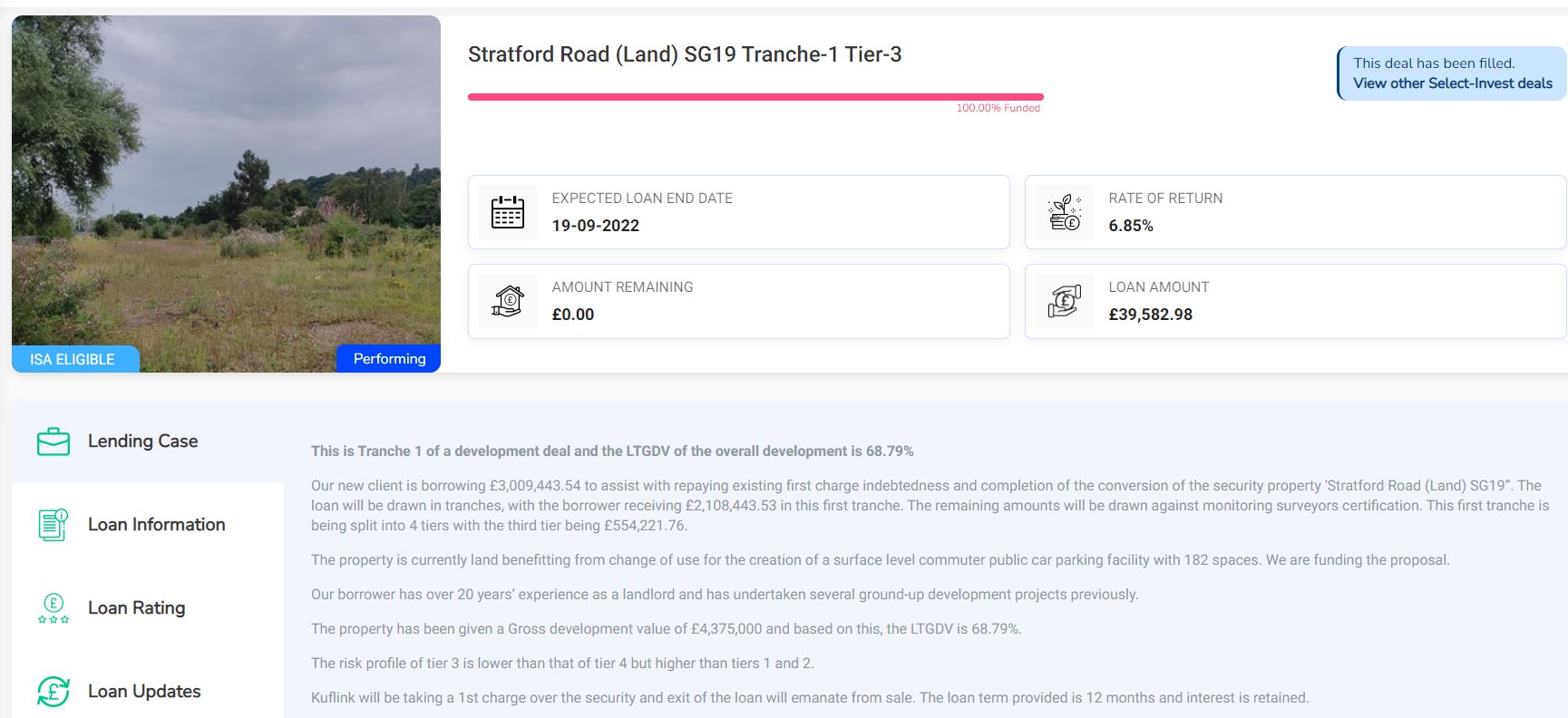
Another of my Kuflink investments reached maturity in the last few weeks and I reinvested the capital released. You can see a screen capture of the new project below, a loan to convert some waste ground in the Stevenage district into a car park. It was a different sort of project from those I have previously invested in, but the case set out on the website seemed convincing.

Kuflink investment Stevenage

My loans with Kuflink pay annual interest rates of 6 to 7.5 percent. As mentioned above, these days I invest no more than around £150 per loan (and often less). That is not because of any issues with Kuflink but more to do with losses of larger amounts on other P2P property platforms in the past. My days of putting four-figure sums into any single property investment are behind me now!

  • Nowadays I mainly opt to reinvest the monthly repayments I receive from Kuflink, which has the effect of boosting the percentage rate of return on the projects in question

You can read my full Kuflink review here. They offer a variety of investment options, including a tax-free IFISA paying up to 7% interest per year with built-in automatic diversification. Alternatively you can now build your own IFISA, with most loans on the platform (including the one shown above) being IFISA-eligible.

I’d also particularly draw your attention to Kuflink’s revised and more generous cashback offer for new investors [affiliate link]. They are now paying cashback on new investments from as little as £500 (it used to be £1,000). And if you are looking to invest larger amounts, you can earn up to a maximum of £4,000 in cashback. That is one of the best cashback offers I have seen anywhere (though admittedly you will need to invest £100,000 or more to receive that!).

  • I also recently published a blog post about another P2P property investment platform called BLEND. Like Kuflink, they offer the opportunity to invest in secured loans to experienced property developers. They offer (on average) somewhat higher rates of return than Kuflink, though arguably with a little more risk. As well as my blog post about BLEND, you can also check out what they have to offer on their website [affiliate link].

Moving on, I have another article on the always-excellent Mouthy Money website. This is quite a personal one in which I set out my views about the FIRE (Financial Independence, Retire Early) movement. For various reasons set out in the article I am not a fan of this. You can read my article here 🙂

I also recommend reading the article on Mouthy Money by my blogging colleague Finance Dee titled Panicked About the Stock Market? Why It Pays to Keep Calm and Carry On. Dee’s views very much reflect my own on this subject.

That’s more than enough for now, so I’ll sign off till next time. I hope you are keeping safe and well, and (if you live in England especially) are enjoying the more relaxed Covid restrictions that now apply. Here’s looking forward to a more normal spring and summer than the last two years. If you’re planning any UK short breaks, don’t forget I have a list of places I have visited and recommend here 🙂

Disclaimer: I am not a qualified financial adviser and nothing in this blog post should be construed as personal financial advice. Everyone should do their own ‘due diligence’ before investing and seek professional advice if in any doubt how best to proceed. All investing carries a risk of loss.

Note also that this post includes affiliate links (disclosed). If you click through and perform a qualifying transaction, I may receive a commission for introducing you. This will not affect the product or service you receive or the terms you are offered.

If you enjoyed this post, please link to it on your own blog or social media:
Investments Update Feb 2022

My Investments Update – February 2022

Here is my latest monthly update about my investments. You can read my January 2022 Investments Update here if you like

I’ll begin as usual with my Nutmeg Stocks and Shares ISA, as I know many of you like to hear what is happening with this.

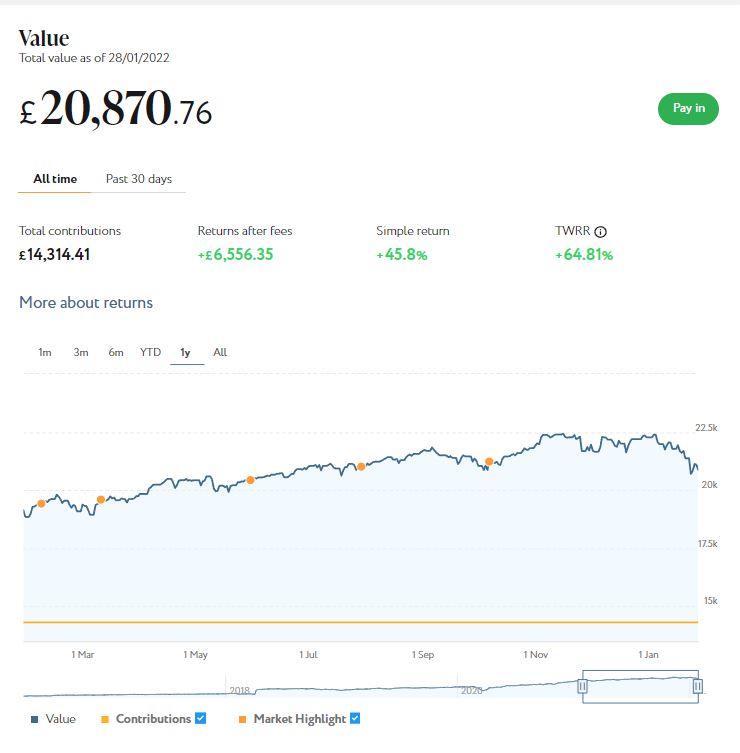
As the screenshot below shows, my main portfolio is currently valued at £20,870. Last month it stood at £22,275, so that is a fall of £1,405.

Nutmeg Main Portfolio Feb 2022

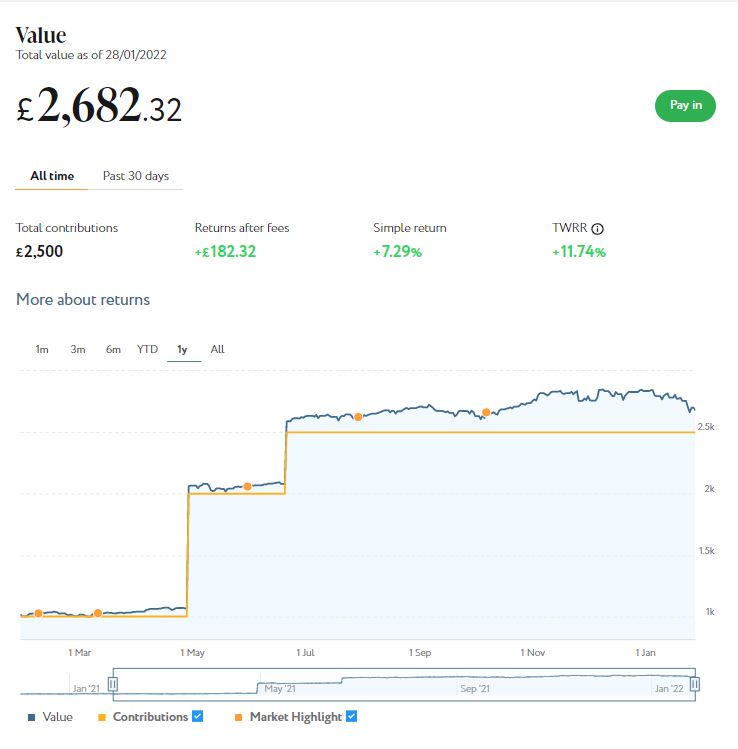
Apart from my main portfolio, I also have a second, smaller pot using Nutmeg’s Smart Alpha option. This is now worth £2,682 compared with £2,837 last month, a net fall of £155. Here is a screen capture showing performance over the last year.

Nutmeg Smart Alpha Feb 2022

There is no denying 2022 has got off to a disappointing start as far as these investments are concerned. Overall, they take the value of my portfolio back to where it was at the end of June 2021.

It is though worth noting that since I started investing with Nutmeg in 2016 I have still enjoyed a total return on my main portfolio of 45.8% (or 64.81% time-weighted). I should also mention that I have selected quite a high risk level for both my Nutmeg accounts (9/10 for the main one and 5/5 for Smart Alpha). This has served me well generally, but I’m sure investors who selected lower risk levels will have seen smaller falls this month.

Of course, it’s not just Nutmeg investors who have had a bad month. Equities generally have taken a tumble in the last few weeks. Commentators have varying opinions about this, but two reasons are typically mentioned: (1) the rising tensions (and threat of war) in Ukraine; and (2) rising inflation rates allied with the removal of monetary stimulus measures as we come out of the pandemic. Obviously nobody knows for sure which way things will go, but this recent post from the Nutmeg blog sets out some grounds for cautious optimism over the year ahead.

Personally I intend to take advantage of the current dip by topping up my Nutmeg investment while asset values are depressed. I plan to add to my Smart Alpha holding, as overall this has been doing slightly better than my main portfolio. I’m also conscious that the end of the 2021/22 tax year will soon be upon us. That means the end of the current year’s ISA allowance, so it really is a case of use it or lose it!

  • The above is just my view, of course, and should not be construed as personal financial advice for anyone else to follow.

You can read my full Nutmeg review here (including a special offer at the end for PAS readers). If you are still looking for a home for your 2021/22 ISA allowance, based on my experience over the last six years, they are certainly worth considering.

If you haven’t yet seen it, check out also my blog post in which I looked at the performance of Nutmeg fully managed portfolios at every risk level from 1 to 10 (as mentioned, my main port is level 9). I was actually pretty amazed by the difference the risk level you choose makes. If you are investing for the long term (and you almost certainly should be) opting for a hyper-cautious low-risk strategy may not be the smartest thing to do.

As regular readers will know, this year I am using Assetz Exchange for my IFISA. This is a P2P property investment platform that focuses on lower-risk properties (e.g. sheltered housing on long leases). I put an initial £100 into this in mid-February 2021 and another £400 in April. Everything went well, so in June 2021 I added another £500, bringing my total investment on the platform up to £1,000.

Since I opened my account, my Assetz Exchange portfolio has generated £37.18 in revenue from rental and £91.19 in capital growth, for a total return of £128.37. That’s an increase of £35.99 on last month alone, and does I guess illustrate the potential value of P2P property investment for diversifying your portfolio when equity markets are volatile.

I won’t bother publishing a statement on this occasion as it’s not massively different from last time. The bottom line is that I (still) have investments in 21 different projects with them and all are performing as expected, generating income and – in every case now – showing a profit on capital. So I am very happy with how this investment has been doing.

  • To control risk with all my property crowdfunding investments nowadays, I invest relatively modest amounts in individual projects. This is a particular attraction of AE as far as i am concerned. You can actually invest from as little as 80p per property if you really want to proceed cautiously.

As mentioned, my investment on Assetz Exchange is in the form of an IFISA so there won’t be any tax to pay on profits, dividends or capital gains. I’ve been impressed by my experiences with Assetz Exchange and the returns generated so far, and intend to continue investing with them. You can read my full review of Assetz Exchange here. You can also sign up for an account on Assetz Exchange directly via this link [affiliate].

Another property platform I have investments with is Kuflink. They have been doing well recently, with new projects launching almost every day. I currently have just over £2,000 invested with them, quite a large proportion of which comes from reinvested profits. To date I have never lost any money with Kuflink, though some loan terms have been extended once or twice. On the plus side, when this happens additional interest is paid for the period in question.

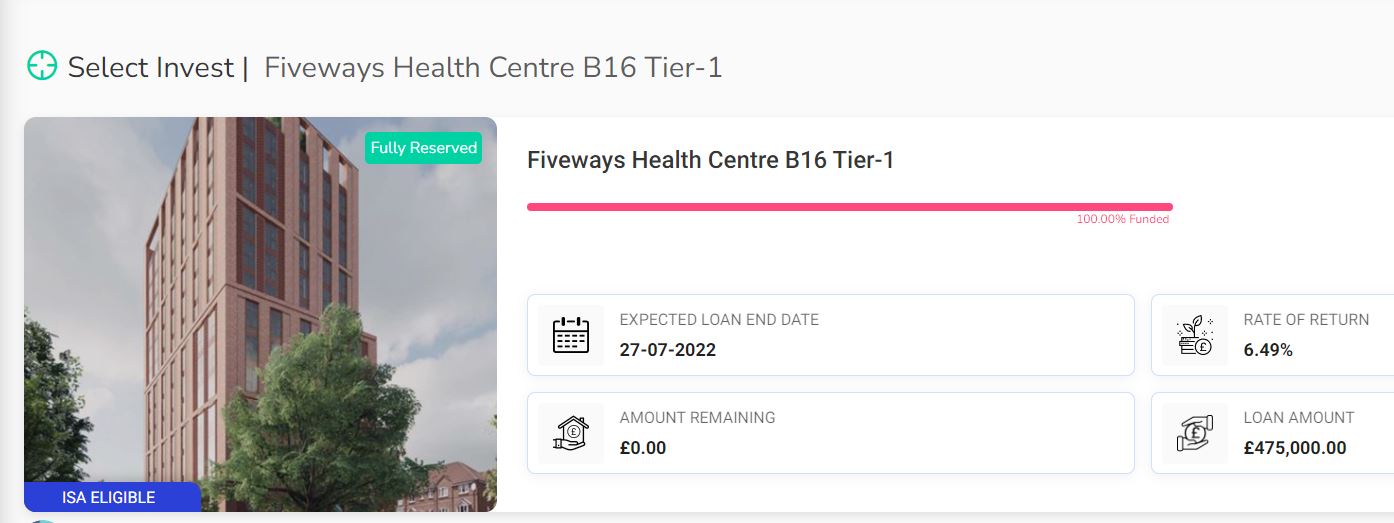
Several of my Kuflink investments reached maturity in the last few weeks and I reinvested the capital released. Here is one of the new projects I invested in, a loan to convert a disused medical centre in Five Ways, Birmingham into residential accommodation. It looked a solid investment, and I also liked the fact that it was redeveloping a derelict building in Birmingham, a city where I lived for around twenty years.

My loans with Kuflink pay annual interest rates of 6 to 7.5 percent. As mentioned above, these days I invest no more than around £150 per loan (and often less). That is not because of any issues with Kuflink but more to do with losses of larger amounts on other P2P property platforms in the past. My days of putting four-figure sums into any single property investment are behind me now!

  • Nowadays I mainly opt to reinvest the monthly repayments I receive from Kuflink, which has the effect of boosting the percentage rate of return on the projects in question

You can read my full Kuflink review here. They offer a variety of investment options, including a tax-free IFISA paying up to 7% interest per year with built-in automatic diversification. Alternatively you can now build your own IFISA, with most loans on the platform (including the one shown above) being IFISA-eligible.

I’d also particularly draw your attention to Kuflink’s revised and more generous cashback offer for new investors [affiliate link]. They are now paying cashback on new investments from as little as £500 (it used to be £1,000). And if you are looking to invest larger amounts, you can earn up to a maximum of £4,000 in cashback. That is one of the best cashback offers I have seen anywhere (though admittedly you will need to invest £100,000 or more to receive that!).

  • I also recently published a blog post about another P2P property investment platform called BLEND. Like Kuflink, they offer the opportunity to invest in secured loans to experienced property developers. They offer (on average) somewhat higher rates of return than Kuflink, though arguably with a little more risk. As well as my blog post about BLEND, you can also check out what they have to offer on their website [affiliate link].

Next up, I wanted to give another plug for an excellent low-key sideline-earning opportunity I have mentioned previously on Pounds and Sense. This opportunity is based on matched betting, a sideline I have pursued for several years myself. Several PAS readers (including my sister Annie!) have signed up for this and are now enjoying a tax-free, hassle-free sideline income from it 🙂

I have been asked not to divulge too many details about this publicly, for good reasons I will explain privately to anyone who may be interested (and no, it’s not illegal!). It doesn’t require any financial outlay and is risk-free and entirely hands-off (once you have set up your account). No knowledge of betting is required and you don’t have to place any bets yourself (this is all done by the company’s clever software). You just have to set up a separate bank account for bets to go through, but running the account is entirely financed by the company.

The company has changed its terms somewhat for new members. You now get a larger £100 initial reward payment once your account is up and running, and then £25 every month you remain a member. I think this is a good move personally, as setting up the account does involve a little work on your part (though it’s certainly not like going down the mines). So the £100 in effect compensates you for your time, and once it’s done you continue to get £25 a month for no effort at all.

The company is constantly developing its offering, partly in response to feedback from PAS readers. They recently launched a new mobile-friendly website to make it even easier for new members to sign up (once you’re up and running you shouldn’t need to use the website at all). They also recently incorporated an Open Banking app so that members don’t have to provide their online banking info to the company, as some people were concerned about this.

Please note that this opportunity is only open to honest, trustworthy people who haven’t done matched betting before and have no more than two accounts already with online bookmakers. For more information (and to receive a no-obligation invitation) drop me a line including your email address via my Contact Me page. And yes, I will receive a reward for introducing you, but this will not affect the service or the rewards you receive.

  • In the interests of full transparency, I should say that if you do matched betting yourself, you may be able to make more money than that being offered by the company. However, you will have to research the techniques in detail, place all bets yourself, and probably subscribe to a matched betting advisory service such as Profit Accumulator [affiliate link]. This opportunity is really for those who want an easy way to make some extra money without the hassle (or expense) of learning/applying matched-betting methods themselves.

Moving on, I have another article on the always-excellent Mouthy Money website. Coincidentally, this is about my experiences with P2P property investment over the last few years, both good and not-so-good. Do check it out! 🙂

I was also quoted by Jackie Annett of the Express newspaper in this article about working after retirement. It’s a short but interesting read, especially if you’re coming up to retirement (or already there) yourself.

That’s more than enough for now, so I’ll sign off till next time. I hope you are keeping safe and well, and (if you live in England especially) are enjoying the more relaxed Covid restrictions that now apply. Here’s hoping that normal life across the whole of the UK will be able to resume very soon!

Disclaimer: I am not a qualified financial adviser and nothing in this blog post should be construed as personal financial advice. Everyone should do their own ‘due diligence’ before investing and seek professional advice if in any doubt how best to proceed. All investing carries a risk of loss.

Note also that this post includes affiliate links (disclosed). If you click through and perform a qualifying transaction, I may receive a commission for introducing you. This will not affect the product or service you receive or the terms you are offered.

If you enjoyed this post, please link to it on your own blog or social media:
Kuflink Review

Kuflink: My Review of this P2P Property Investment Platform

Today I am looking at P2P property investment platform Kuflink.

I have been investing with Kuflink for five years now, so this is a fully updated repost of my original review.

What is Kuflink?

Kuflink is an online platform offering opportunities to invest in loans secured against property. These loans are typically made to developers who require short- to medium-term bridging finance, e.g. to complete a major property renovation project, before refinancing with a commercial mortgage.

Kuflink offer three types of investment, as follows:

  1. Select-Invest (individual loans)
  2. Auto-Invest
  3. Tax-free IFISA (Innovative Finance ISA)

Auto Invest and IFISAs both automatically invest your money across a number of loans and pay a fixed interest rate, typically between 7 and 9%. You can choose a 1-year, 2-year or 3-year term, and interest is paid annually (it is automatically reinvested at the end of each year with the two-year and three-year products). The Auto-Invest product is basically the same as the IFISA, but without the tax-free wrapper.

  • At one time only the Auto-Invest option was available for IFISAs, but nowadays you can choose your own investments if you prefer. The great majority of Self-Select loans on the Kuflink platform are IFISA-eligible. If you check out the Self-Select listings on the Kuflink website (see image below), this will tell you whether any particular loan is IFISA-eligible or not.

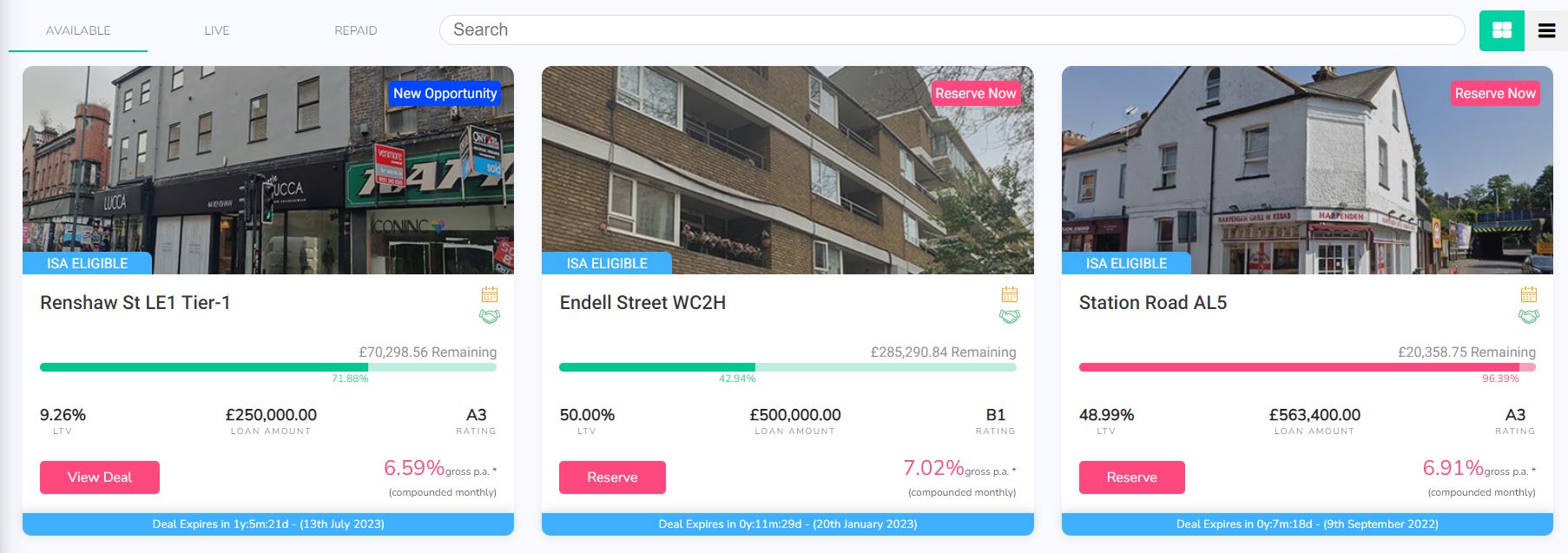
Individual Select-Invest loans pay interest rates varying between about 6 and 7.2%, depending largely on the LTV of the loan (loan to value, a measure of how secure the loan would be in the event of a default). The higher the LTV, the riskier the loan, and – other things being equal – the higher the interest rate paid in consequence. You can see a screen capture below of three Select-Invest loans available on the platform at the time of writing.

Kuflink investments January 2022

As a reasonably experienced P2P investor, I put my money into Select-Invest loans. These typically have a duration of six months to a year and (as mentioned above) pay interest from around 6 to 7.20 percent. That obviously isn’t as much as some P2P property platforms (e.g. BLEND), but I think it represents a fair balance between risk and reward. Kuflink also invest in every loan themselves up to 5% of the value of each loan – so, as the expression goes, they have skin in the game.

My Kuflink Review

I found signing up with Kuflink a quick and easy process. They do the obligatory money-laundering checks, but in my case anyway this was all done electronically behind the scenes. I uploaded a copy of my passport and was approved almost immediately. I started by depositing £500, but you can start with as little as £100 if you like.

Initially I put my money into a 12-month loan paying 7% annual interest. One good feature I didn’t grasp initially is that with Select-Invest loans interest is paid monthly. So once a month I receive interest payments on all the loans I am currently invested in. This is paid into a wallet, from which you can either withdraw to your bank account or reinvest.

  • Kuflink recently introduced an option to have monthly loan repayments automatically reinvested rather than paid into your account as cash. This effectively boosts your interest rate by the power of compounding, as you then receive interest on the reinvested payments as well. Currently this option is available for most, but not all, loans on the platform. You can see which of your loans compounding is available for via your Kuflink dashboard.

I have continued to invest in Kuflink, and have also reinvested in new loans when the original ones were paid off. Another good feature is that money invested in a loan but not yet released to the borrower attracts interest which is paid as cashback once the loan has gone live.

There have been no defaults so far on any of my loans, and Kuflink say on their website that to date nobody has lost a penny on their platform. I have experienced short delays with loans being repaid, but in such cases you continue to earn interest, of course.

Secondary Market

A new feature on Kuflink I like is the Marketplace (secondary market). Here you can buy loan parts from other investors who want to sell up early. You can also put up for sale any (or all) of your own loan parts.

The number of loan parts listed in the Marketplace went up in the early months of the pandemic, as many investors understandably wanted (or needed) to access their cash. This created short-term buying opportunities which I was happy to take advantage of. Loan parts offered via the Marketplace typically have only a few months to run, so you can expect to get your capital back quickly (and can then reinvest it if you wish). Only loans in good standing with monthly repayments up to date may be listed on the  Marketplace, so that offers some reassurance against default – though of course it is by no means a guarantee.

In recent months the number of loan parts listed on the Marketplace has reduced considerably. And those that are tend to be snapped up quickly. As a would-be investor this is slightly disappointing, but it does indicate that people are keen to take advantage of the opportunities on offer. It also means that if you want (or need) to exit a loan early, accessing your money should be a quick and easy process.

Pros and Cons

Based on my experiences, here is my list of pros and cons for the Kuflink investment platform.

Pros

1. Easy sign-up process.

2. Low minimum investment.

3. All loans secured against property.

4. Choice of investments and approaches.

5. Manual and auto-invest options.

6. Kuflink invest in all loans themselves, so they have a strong incentive to ensure they are safe and secure.

7. They also cover the first 5% of losses on any loan before investors are affected (although this has never happened yet).

8. Money invested but not yet released to the borrower attracts interest which is paid as cashback once the loan has gone live.

9. In-depth information is provided on the website about all loans, so you can see exactly how your money will be used (and by whom).

10. There have been (according to Kuflink) no investor losses to date.

11. Customer service (in my experience anyway) is fast, friendly and helpful.

12. There is a 14-day cooling off period for new investors.

13. Marketplace (secondary market) for buying and selling loan parts.

14. No charges to investors lending on the primary market and only a 0.25% fee if you resell a loan part on the secondary market.

15. On most loans you can opt to reinvest monthly repayments to boost your net interest rate.

16. Tax-free IFISA option available.

Cons

1. Rates paid aren’t the highest in P2P lending.

2. Delays with some loans being repaid (although investors do earn extra interest if this happens).

3. No mobile app [UPDATE FEB 2023 – An app is now available.]

Conclusion

Overall, my experiences with Kuflink so far have been entirely positive and my investments have been generating the promised returns. I started cautiously with them, but have gradually built up the amount I have invested on the platform. Although – like all property P2P platforms – they were adversely affected by the pandemic, they appear to have come through it strongly, with new loans now being added almost daily.

As mentioned above, although Kuflink don’t pay the highest rates in P2P lending, I think the returns on offer are realistic and sustainable. The steady expansion of the platform seems to testify to this, as does the fact that they have received several industry awards. These include Best Alternative Business Funding Provider in the Business Moneyfacts Awards in both 2018 and 2019 and Best Service From an Alternative Funding Provider in 2020.

Kuflink are also highly rated on the independent TrustPilot website, with an average 4.6 out of 5 (‘Excellent’). At the time of writing 82% of reviewers award them the maximum five-star rating, which is among the highest figures I have seen for a financial services platform.

As with all P2P lending, your money does not enjoy the same level of protection as bank and building society accounts, which are covered (up to £85,000) by the Financial Services Compensation Scheme. Nonetheless, the rates of return on offer are significantly better than those from most financial institutions. And the fact that all loans are secured against bricks and mortar – and Kuflink themselves have cash invested in them – clearly offers some reassurance.

From my experience, Self-Select loans tend to fill up quickly. On the positive side, this shows investors have confidence in Kuflink and want to invest through the platform. On the minus side, it means there are typically no more than two or three new loans open for investment at any time.

Clearly, no-one should put all their spare cash into Kuflink (or any other P2P investment platform). Nonetheless, it is certainly worth considering as part of a diversified portfolio. Not only are the rates of return much higher than those offered by banks and building societies, they are relatively unaffected by ups and downs in the stock market. P2P loans aren’t a way of hedging your equity-based investments directly, but they do help spread the risk.

If you have any comments or questions about this review or Kuflink in general, as always, please do leave them below.

Disclosure: As stated above, I am an investor with Kuflink myself, and if you invest £500 or more via my link above I will receive a bonus for introducing you. Money is at risk. You should always do your own ‘due diligence’ before investing, and seek advice from a qualified financial adviser if in any doubt how best to proceed.

If you enjoyed this post, please link to it on your own blog or social media: