
Making Money

Posts about making money from a 60-plus perspective. This includes sideline earning opportunities of all types.

Can you make money from matched betting?

Can You Still Make Money From Matched Betting?

Recently I have published several posts on Pounds and Sense about tax-free ways of boosting your income. One is Tax-Free Ways to Boost Your Finances and another How to Win Cash and Prizes in Online Competitions.

For the sake of completeness, though, I thought I should publish (or more accurately republish) a post about matched betting. This is something I did for several years and earned about £3,000 (tax-free!) from. I am not doing it as much these days, for reasons I’ll explain below. But if you’ve never done it before, I do still recommend matched betting as a way of making some quick tax-free cash.

So Why Am I Doing Less?

There are two main reasons. The first is that since I started matched betting around six years ago I have had my account restricted (or gubbed, as we say in the business) by many online bookmakers. That obviously makes it harder to take advantage of the offers matched bettors need in order to generate their guaranteed profits.

My second reason is that during the pandemic, with many sporting events cancelled, there were far fewer matched betting opportunities. Thankfully that is behind us now and normal life (more or less) has resumed. Even so, the bookies are more cautious than they once were, and offers are somewhat thinner on the ground.

I still do a small amount of matched betting but keep it very low-key. There are only a few good online bookmakers I can now use, and I’d like to go on flying under their radar for as long as possible before they ban me!

If you are new to matched betting – or have let it fall by the wayside – then as stated above I do still recommend it. But be aware that it may not be quite as profitable as it was pre-Covid.

But let’s start with a recap of the basics…

What is Matched Betting?

Matched betting is a method for making risk-free profits by taking advantage of offers made by online bookmakers.

The best offers are those made to attract new clients. Here’s an example. The bookmakers Sky Bet offer £30 in free bets (3 x £10) for new online customers. To get this, you have to open an account with them and deposit a minimum of £5. You then have to place a minimum 5p bet at odds of evens (2.0) or better. Once you have done this, Sky Bet will immediately credit you with £30 worth of free bets.

So how do you turn this into a guaranteed profit? Well, that’s the clever bit. You make use of a website called an exchange (Smarkets and Betfair are two of the better known). These sites allow anyone to lay a bet (i.e. bet that the outcome in question won’t happen). By backing with a bookmaker and laying the same bet at an exchange you can ensure that however the event pans out, you will only make a small loss or occasionally a tiny profit (depending on the odds available).

With a normal bet this is obviously of limited value, as the two bets more or less cancel each other out. But when your first bet qualifies you for a second (and in Sky Bet’s case much larger) free bet, it suddenly becomes a lot more interesting. Here’s an example…

Let’s say Wolverhampton Wanderers are about to play Spurs in the Premier League. You can back Wolves to win with Sky Bet at 4.75 (15/4 in the more traditional but less useful fractional style) and lay them with Smarkets at 4.80. If you put £5 on Wolves with Sky Bet and at the same time lay Wolves to the appropriate stakes (something I’ll come to shortly) you can ensure that whether they do or don’t win, your net loss will be just 13p (allowing for Smarkets’ standard 2% commission charge). The lay bet covers you for the draw as well, as in effect you are betting that Wolves won’t win – so if Spurs win or the match ends in a draw, the lay bet will pay out.

But now, because you are a new member, Sky Bet will give you £30 worth of free bets. You can back and lay these again to generate a guaranteed profit. For the sake of simplicity let’s say you use the same market, Wolves v. Spurs, although you certainly don’t have to. At the odds mentioned, and backing to the correct stakes, if you use all three £10 free bets you can guarantee yourself a net profit of £23.05 however the match pans out. Subtract the 13p loss from your qualifying bet, and once the dust has settled you will have made a risk-free (and tax-free) £22.92. If your bet loses with the bookie, your profit will be in the exchange (remember, this is a free bet so it hasn’t cost you anything). If the bet wins at the bookie, you will lose money at the exchange, but your winnings with the bookie will exceed this, giving you the same net profit either way.

Those are the bare bones of matched betting. Of course, there’s more to it than that, but most matched betting opportunities boil down to this. You place an initial qualifying bet and lay it to ensure (at worst) a small net loss, and then back and lay the free bet you receive to make yourself a guaranteed profit.

  • One or two people have asked me whether matched betting is legal. The answer is a clear yes. It’s fair to say the bookies don’t like it, though. And if they suspect you are doing it, they may close or limit your account. As mentioned above, this is called ‘gubbing’ and it is an occupational hazard for matched bettors. As a matter of interest, I had to change the example used at the start of an earlier version of this blog post after being threatened with legal action by the bookmaker in question.

How Do You Get Started?

You can, of course, do all this yourself, researching opportunities and comparing odds to find the most profitable matched betting opportunities. When you are starting out, though – and especially if you are new to online betting – it obviously helps a lot to get some instruction and guidance.

Fortunately there are some excellent online services that will do all this for you and provide step-by-step instructions. You can apply these even if you have never placed a bet in your life before. Here’s the service I recommend for beginners to matched betting…

Outplayed

Outplayed (formerly Profit Accumulator) is a dedicated matched betting website. You can get a 7-day free trial which gives you access to over 60 welcome offers of the type mentioned above. If you wish to continue, you can then pay a fee (currently £39.95 a month) to become a ‘Platinum’ member and get access to Outplayed’s full range of betting offers and services.

As well as detailed instructions on offers, Outplayed also provide various online tools you can use. Their oddsmatcher, for example, helps you find markets where the back and lay odds are as close as possible, so you can minimize your losses on qualifying bets and maximize the value of your free bets. They also have calculators where you enter the back and lay odds and how much you want to bet at the bookmaker. The calculator then reveals how much you need to lay at the exchange to guarantee a set profit (or qualifying loss) with either outcome.

A further advantage of joining Outplayed is that you get access to the members-only community forum, where you can get any questions you may have answered by more experienced members and/or the Outplayed team.

For more information about Outplayed and its different membership levels, just click through this link [affiliate].

  • If you are at all sceptical about the Outplayed service, you might like to check out the reviews on the independent Trust Pilot website. They currently average 4.7 out of 5 stars, with 89% of respondents awarding them a five star (‘Excellent’) rating. That is among the highest average ratings I can recall seeing on Trust Pilot.

What Happens When You’ve Exhausted the Welcome Offers?

This was something I wondered about before I started, and I know other people do as well.

First of all, it will take you quite a long time to work through all the offers on the Outplayed website. Not all are as simple and straightforward as the Sky Bet offer mentioned above, but nonetheless if you follow the step-by-step instructions they can all generate a healthy profit for you.

After that, you can move on to ‘reload’ offers. These are offers made by bookmakers for existing members to encourage them to keep coming back and using their service. Reload offers work in a wide range of ways. Some provide a guaranteed profit if you apply them correctly, while others may sometimes make a small qualifying loss but other times produce a much larger profit, generating a good net profit overall. Reload offers are also listed on the Outplayed website and updated every day.

Is Matched Betting for Everyone?

In principle anyone can do matched betting, but it is probably more suitable for some people than others. In particular, it will help if you have a small amount of capital to get started – at least £50, preferably £100 or more.

If you have less you can still do it, but it will take longer to build up your earnings. Remember that you will need money to fund your qualifying bets at the bookmaker sites and also your exchange account. You don’t lose this money – it simply moves between bookie and exchange according to how events pan out – and you can always withdraw it if required. But to operate as a matched bettor you do need to have some ‘working capital’.

Another requirement to make a success of matched betting is that you need to be organized and methodical. Matched betting is not difficult once you grasp the basic concept, but if you make a mistake it is possible to lose money doing it. Initially at least it’s important to take it slowly and steadily and follow the instructions on Outplayed (if you have signed up with them) to the letter. It helps to be reasonably numerate as well, although the actual calculations are done for you by the oddsmatching tool and calculators.

And finally, if you think you might get drawn in to gambling through matched betting, you may be better giving it a miss. This applies especially if you have ever had a gambling problem in the past. To emphasize again, matched betting is NOT gambling if you do it properly and follow the correct procedures. But if you are tempted to go off-piste and start placing random bets, the likelihood is that you WILL lose money overall.

Final Thoughts

If you are looking for a tax-free sideline earning opportunity, matched betting can certainly fit the bill. Done properly it is risk free, and (as mentioned earlier) I have made around £3,000 from it myself.

For reasons discussed in this blog post I don’t recommend matched betting as a substitute for a full-time job. In these challenging times, however, if you need another tax-free string to your money-making bow, it can certainly perform that role. But be aware that the first few months are likely to be the most profitable. After that, as you run out of welcome offers (and are perhaps ‘gubbed’ by some bookies) it will get harder.

As always, if you have any comments or questions about this post or matched betting more generally, please do leave them below.

  • This is a fully updated version of an earlier post.

Disclosure: This post includes affiliate links. If you click through and make a purchase, I may receive a commission for introducing you. This will not affect the price you pay or the service you receive.


If you enjoyed this post, please link to it on your own blog or social media:
How to win cash and prizes in online competitions

How to Win Cash and Prizes in Online Competitions

In a recent post I talked about tax-free ways to boost your finances. It occurs to me that I omitted an important one, however – entering prize draws and competitions. In the UK anyway, cash and prizes acquired this way are normally tax-free.

In recent years the internet has opened up a host of opportunities for entering (and winning) competitions from home. Whether you’re a seasoned ‘comper’ or a newbie eager to try your luck, I hope you will find the tips, resources and advice in this post useful…

1. Finding the Right Competitions

The first step towards winning is finding the competitions themselves. Here are some ways to discover them:

  • Competition Websites: Sites like Competition Database, Loquax, and The Prize Finder list numerous competitions in the UK.
  • Social Media: Follow brands, influencers (e.g. Superlucky Di) and competition-focused groups on Facebook, Twitter/X and Instagram. Search for relevant hashtags, e.g. #competition #prize #giveaway. Many businesses also run exclusive competitions for their social media followers.
  • Email Newsletters: Subscribe to newsletters from your favourite brands and competition websites to receive alerts about the latest contests.

2. Setting up Dedicated Comping Accounts

It’s best to set up dedicated email and social media accounts for your comping. Inevitably you will receive growing volumes of promotional material and even (regrettably) spam. Using separate, dedicated accounts will ensure your personal accounts don’t get cluttered up.

  • Check Email Regularly: To save time, you can search for relevant words and phrases like Congratulations, Winner and Runner-up.
  • Set up Accounts on Facebook, Instagram and Twitter/X just for Comping: Some competitions require you to ‘like’ or follow a particular brand on social media in order to enter.
  • Don’t Sign Up for Further Info: Avoid ticking the box to receive more information when entering a competition, unless you are really sure you want this. Doing so can result in your inbox swiftly  being overrun.

3. Understanding the Rules

Each competition has its own set of rules and regulations. Carefully read the terms and conditions to understand:

  • Eligibility: Ensure you meet the requirements (e.g. age, location).
  • Entry Limits: Some competitions allow multiple entries, while others are strictly one per person.
  • Closing Dates: Note the end date to ensure you don’t miss out.

4. Crafting Winning Entries

Certain types of competition require more than just luck. Here’s how to stand out:

  • Skill-based Competitions: These might ask for a slogan, recipe, or photo. Be creative and original. Research past winners to understand what judges are looking for.
  • Tie-breakers: If there’s a question to answer, put some thought into it. A unique and clever response can be your ticket to winning.

5. Maximising Your Entries

To increase your chances, enter as many competitions as possible. Here’s how:

  • Set a Schedule: Dedicate time each day or week to entering competitions.
  • Use Autofill Tools: Tools like RoboForm can save time by automatically filling out your details for you.
  • Keep Track: Maintain a list or (preferably) spreadsheet of entered competitions to avoid duplicates and track deadlines.

6. Avoiding Scams

While many competitions are legitimate, some are not. Protect yourself by:

  • Verifying the Source: Only enter competitions from reputable websites or brands.
  • Not Paying Fees: Genuine competitions won’t ask you to pay to enter.
  • Checking Reviews: Look up the competition and the company running it to ensure they have a good reputation.

7. Networking with Fellow Compers

Join online communities and forums such as MoneySavingExpert or dedicated Facebook groups (such as this one) where members share tips, winning stories and new competition finds. Networking with other compers can provide valuable insights and motivation.

8. Celebrating Wins, Big and Small

Not every prize will be a jackpot, but every win counts. Celebrate all victories, whether it’s a small voucher or a large cash prize. Sharing your wins on social media or competition forums can also encourage others and attract positive attention.

9. Staying Persistent

Winning competitions requires patience and perseverance. Don’t get discouraged if you don’t win straight away. Keep entering regularly, and your persistence will eventually pay off.

Closing Thoughts

Winning cash and prizes through online competitions is a fun and potentially rewarding hobby. By keeping organised, being creative, and staying wary of scams, you can significantly boost your chances of success. So get out there, start entering, and who knows? You might just land that dream holiday or big tax-free cash prize sooner than you think 😎🍾🏖

Happy comping, and may the odds be ever in your favour!

If you enjoyed this post, please link to it on your own blog or social media:
Home Based Business Ideas

Twenty Great Ways to Make Extra Money From Home

Although the rate of inflation has fallen in recent months, for many the cost of living crisis continues to bite.

So today I thought I would set out some ways you may be able to make a few pounds extra to boost your finances. None of these is likely to make you a fortune, but together they can certainly help keep your bank balance ticking over.

I have linked to relevant posts on Pounds and Sense for further information where appropriate. I have direct experience of all the methods set out below and therefore know that they work and are not scams.

1. Prolific Academic

Prolific Academic is a platform used by academic researchers world-wide to recruit participants for online studies/surveys. These are varied and often surprisingly interesting. They require anything from two minutes to an hour to complete, with payments based on how long (on average) they take. I’ve earned over £600 to date from Prolific. For more information, see my blog post Make Money and Help Academic Researchers With Prolific Academic.

2. MobileXpression

If you have a smartphone, this is an easy way to make money from it. Just install this app (which tracks your browsing anonymously) and every few weeks you will receive a £20 Amazon voucher for your trouble (Amazon vouchers are pretty much as good as money, as you can of course buy almost anything there). You can read my full review of the MobileXpression app in this post.

3. Shop and Scan

Shop and Scan is a market research programme run by Kantar Worldpanel. Anyone can apply to become a panelist, and when you are accepted (which may be immediate or after a few weeks) you receive a barcode scanner and guidebook in the post. You are then required to scan all your shopping when you bring it home (or it’s delivered) and scan and submit your receipts. For doing this you get points. When you have enough, these can be converted into vouchers for a wide range of online stores (again, I normally pick Amazon). You can earn extra points by performing other tasks such as completing online questionnaires, so it doesn’t take long to earn enough points for a £10 voucher. For more information, see my blog post Make Money From Your Shopping With ShopandScan.

4. The Viewers

The Viewers is another market research company always looking for new members for its (paid) audience panel. As the name suggests, they research people’s TV viewing habits via surveys and focus groups. They pay participants in cash (via PayPal) or Amazon vouchers. They run ‘real world’ focus groups in large cities, and online studies of various types. For more information, see my blog post Make Money Watching TV With The Viewers.

5. People for Research

This is another opportunity to make money taking part in consumer research. People for Research are constantly recruiting people to take part in studies. Some of these take place in large cities (London and Bristol especially) but many are done remotely via the phone or the internet. The studies cover a huge range of topics and are for the most part interesting and enjoyable. But the best thing is that they are fairly (and sometimes generously) recompensed – usually in cash, though sometimes Amazon vouchers. For more information, see my blog post Earn a Sideline Income with People for Research.

6. Y Live

Y Live (previously called Populus Live) is a survey website that wants your opinions and pays cash for them. You can sign up free of charge and will then receive email notifications any time they have a survey you may be eligible for. Each survey is worth a set number of points. Once you have accrued 50 points you will be paid £50 (each point is worth £1, in other words). Admittedly it can take a little while to reach the payment threshold, but £50 is undoubtedly a useful sum when you receive it. For more information, see my blog post Make Extra Money From Y Live.

7. Selling on eBay

One great way to generate quick extra cash is to have a clear-out of things you no longer need and put them up for sale on eBay. All sorts of things sell here, and if you have never tried selling via the site you will be pleasantly surprised by how easy it is. What’s more, as long as you are selling your own possessions (and not buying stuff to resell) it’s tax-free too. For more tips about this, see Twelve Top Tips for Selling on eBay, a guest post on PAS by my money blogging colleague Luci Olivia.

8. Matched Betting

In the last year or two matched betting has undoubtedly become harder, partly due to the pandemic and partly to bookmakers becoming less generous with their offers. If you haven’t yet tried matched betting, though, there is still money to be made.

For those who don’t know, matched betting involves taking advantage of online bookmaker offers (especially welcome offers) to generate a guaranteed profit. It is emphatically not the same as gambling (which I don’t recommend at all). As per my blog post Can You Make Money from Matched Betting? if you are new to this field I recommend starting with the matched betting support and advisory service Outplayed [referral link] previously called Profit Accumulator. You can earn up to £45 (tax free) by taking advantage of the offers available to free members. You could then leave it at that or sign up as a full member with unlimited profit potential.

9. Free Share Offers

Various online share trading platforms offer free shares to anyone opening an account with them. One of my favourites is Trading 212, which periodically offers anyone who signs up and deposits a minimum of £1 a free share. This is chosen at random but could be worth up to £100. You can sell this after three days if you wish and withdraw the proceeds (including your initial deposit) after 30 days. For more information on Trading 212, including how to get your free share when the offer is open, see my blog post Get a Free Share Worth Up to £100 With Trading 212. Another service offering free shares is the online wealth-building platform Wealthyhood. Learn here how you can get a free ETF share worth up to £200 by signing up with Wealthyhood.

10. Selling Your Old Tech

Most of us have old gadgets we no longer use that are just gathering dust. They include mobile phones, tablets, laptops, cameras, games consoles, and even desktop computers. They may still work, but we have replaced them with new and (hopefully) better products. If that sounds like you, there are lots of ways you can make money from your old tech, even if (in many cases) it doesn’t work any more. Check out my blog post How to Make Money From Your Old Tech for a range of methods for doing this.

11. Freelance Writing

This is a subject close to my heart, as for many years I was a full-time freelance writer (I’m semi-retired now). It’s a competitive field, but there is still lots of money to be made. You don’t need to be Shakespeare either, just have a reasonable grasp of written English and be willing and able to write what the market wants. Check out my blog post My Top Ten Tips for Making Money as a Freelance Writer here. You can also read my posts Should You Write a Book? and How to Publish Your Own E-book on Kindle.

12. Cashback Websites

I’ve mentioned cashback sites a few times on PAS. These are sites such as Top Cashback and Quidco, where any time you make a purchase with a certain online store, if you go via the cashback site, you get some money refunded to your account. Obviously you aren’t actually making money in this case – but if you were going to make the purchase anyway you get some money back, and over time this can add up to a tidy sum. In addition, there are some offers listed on the sites where you can get ‘cashback’ without actually making a purchase. For more information, see my blog posts Save Money With Cashback Sites and Six Ways to Make Money With Cashback Sites.

13. Comping

Okay, comping, or entering consumer competitions, isn’t a guaranteed way of making a sideline income. Nonetheless, there are stacks of cash and prizes on offer at any time, and somebody has to win them. There’s no reason it couldn’t be you! There are lots that you can enter online – just check out competition listing website Loquax, for example. For hints and tips on getting started, see How to Win Cash and Prizes in Consumer Competitions, a guest post on PAS by Cora Harrison. I also highly recommend the book Superlucky Secrets by my UK blogging colleague Di Coke (also known as Superlucky Di). You can read my review of this in-depth guide to comping here.

14. Free Online Lotteries

This is obviously another opportunity where returns are not guaranteed. Nonetheless, there are various online lotteries you can enter free with a chance of winning (in most cases) cash prizes. Typically you have to return to the lottery site every day to see if you are a winner. My favourite such site is Pick My Postcode [referral link]. This site offers multiple chances to win every day, with prizes ranging from £10 to over £1,000. I have a particular soft spot for PMP, as back in the days when it was called Free Postcode Lottery, I was lucky enough to win £614.53 on it. You can learn more in my blog post titled How to Cash in on Free Lottery Websites.

15. Website Testing

If you enjoy trying new apps and websites and putting them through their paces, there are various sites that will pay you for doing this and reporting back. One such site site with a strong community angle is Crowdville. For more information about this, see my blog post Make Money Testing Apps and Websites with Crowdville. Other sites you might like to check out include Testing Time and Respondent.

16. Blogging

I make money this way, and there’s no reason you couldn’t as well. Blogging is by no means a get-rich-quick opportunity. But if you are prepared to put some time and effort in, the rewards will come. You can blog about any subject you like (though some subjects are easier to make money from than others). Once your blog is up and running you can earn from it in various ways, including advertising, affiliate marketing, sponsored posts, and so on. To get an idea how this works, check out this guest post by Ruth Hinds titled Five Things You Really Need to Know About How to Make Money from Blogging.

17. Online Design and Print

This is a great home-based sideline earning opportunity. No special skills are needed beyond a little imagination; although if you do have art and design skills, so much the better. I’m talking here about designing and selling clothes and other products, from tee-shirts to tote bags, hoodies to coffee mugs. By designing I mean coming up with slogans and/or graphics to adorn these products that will appeal to a particular target market. This opportunity has been opened up by web-based companies such as TeeMill that allow you to design and sell your products online. They provide all the back-end services, including taking payments and fulfilling orders. They charge you a set fee for this, which is covered from the fee paid by your customer. You charge your customers a bit more, and your profit is (of course) the difference between the two. For more information, see my blog post How to Make Money with Online Design and Print.

18. Virtual Assistant Work

There is a steady demand for virtual assistants who can perform a wide variety of tasks from home via the internet. The sorts of things VAs do may include research, writing, proofreading and editing, graphic design, publicity, data entry, programming and other technical tasks, and much more. Social media management is another very popular area. You can read my in-depth blog post on how to make money as a virtual assistant here.

19. Fiverr.com

As you may know, Fiverr is US-based site that lets anyone advertise ‘gigs’ they are willing to perform for five dollars (hence the name, of course). Gigs range from the serious (e.g. write a press release) to the creative (e.g. write a customized solo piano track) to the downright quirky (e.g. write a message, name or URL in chocolate). Most gigs are services delivered electronically, though there is nothing to stop you selling physical products if you wish (you can charge extra for postage). Obviously $5 isn’t a lot, but if you can perform your gig in just a few minutes it can still work out as a decent hourly rate. It’s also possible to charge additional amounts for ‘extras’ such as rapid delivery or upgraded features. See my blog post How to Make Money on Fiverr for much more information about this.

20. Investing for Income

This is obviously a different angle from the preceding ideas. If you have money in the bank earning a derisory rate of interest (or nothing at all), however, you might like to consider investing some to provide an additional income stream for you.

This is obviously a huge subject and I can’t go into detail about it here. There are lots of possibilities, though. One would be to invest some of your money in dividend-paying shares. This subject was covered in an excellent guest post for my blog by Lewys Lew titled How to invest For Income From High Yield Share Dividends.

Of course, you should research any possible investment carefully and be prepared to lose money in the short term at least (see below). Note also that some companies – e.g. the big banks and oil companies – cut their dividends during the Covid crisis, so it’s important to pick your sectors carefully.

  • Regular readers will know I am also a big fan of the robo-adviser investment platform Nutmeg (recently renamed JP Morgan Personal Investing). They are primarily aimed at helping people build a savings (or pensions) pot rather than providing an income, but you can of course withdraw money from your account as and when you wish. You can read my full review of Nutmeg/JPM Personal Investing) here.

Of course, all investment carries a risk of loss, so you should always do your own ‘due diligence’ and take professional advice if in any doubt before deciding to invest. You should also ensure you have enough cash and/or easily accessible savings to get you through a period of three to six months in case of emergencies.

As always, if you have any comments or questions about this post, please do leave them below. And keep reading Pounds and Sense for more money-saving and money-making ideas in the weeks and months ahead.

Disclosure: Some of the links in this post (and elsewhere on PAS) include my referral links. That means if you click through and make a purchase (or perform some other defined action) I may receive a commission for introducing you. This will not affect the price you pay or the products/services you are offered. 

This is an update of my original post on this subject.

If you enjoyed this post, please link to it on your own blog or social media:
Make extra money from Y Live

Make Extra Money From Y Live

Today I’m spotlighting a survey website that wants your opinions and pays cash for them 🙂

The site in question is Y Live. It was previously called Populus Live. You can sign up free of charge, and will then receive email notifications any time they have a survey you may be eligible for.

Each survey is worth a set number of ‘points’. Once you have accrued 50 points you will be sent a cheque for £50 (each point is worth £1, in other words).

The notification emails state how long the survey is expected to take and how many points it is worth. In general, you get 1 point for a five-minute survey, 2 points for a ten-minute one, and so on.

Bear in mind, though, that the timings are Y Live’s estimates, and may not correspond with how long they actually take to complete. For example, I find that ‘five-minute’ surveys can sometimes take ten minutes or longer. Of course, that does reduce the effective hourly rate you receive.

On the other hand, the surveys are generally straightforward and easy to do (though watch out for the attention-checkers). It’s quite possible you will be quicker to complete them than I am.

On occasion you may find yourself screened out of a survey, e.g. if you are not in the target group they are interested in. In that case you won’t be awarded any points, but will get one entry in their monthly prize draw for £250.

Clearly nobody is going to earn a fortune from Y Live, but in my view (and experience) it can make a very worthwhile addition to your sideline-earning portfolio.

As always, if you have any comments or questions about Y Live, please do post them below.

Note: This is an update of an earlier post.

If you enjoyed this post, please link to it on your own blog or social media:
HMRC Crackdown on Side Hustles - Truth and Fiction

HMRC Crackdown on Side Hustles – Truth and Fiction

As you may have heard, from January 1, 2025, digital platforms like eBay, Etsy and Airbnb will be required to collect additional information from sellers, including number of sales and amount of income generated.

This data will be automatically shared with HM Revenue & Customs (HMRC) by January 31, 2025, covering the 2024 calendar year. HMRC will then compare this against their records to see if any tax may be due.

This news has caused some consternation on messageboards and social media, with many who have ‘side hustles’ to help pay the bills worried they may be hit by an unexpected tax demand. Some of this concern may be justified, but (thankfully) much of it isn’t.

So today I thought I’d explain what’s actually happening and how you can minimize your tax liability from side hustles and reduce the risk of unwanted attention from the taxman (while staying within the law, of course).

So What’s Happening?

Digital platforms will automatically share seller information with HMRC if a seller has made 30 or more sales a year or earned over €2,000 (approximately £1,700).

The reporting threshold is set in Euro as this is a multi-national initiative by the Organisation for Economic Co-operation and Development (OECD) which aims to tackle tax evasion globally. The new rules apply to various digital platforms, defined as any app, website or software connecting sellers to consumers of goods and services.

It’s important to understand that this is a reporting change and not a change in tax law. If you didn’t have to declare certain earnings or pay tax on them before, that remains the case now. In particular, if you are selling personal possessions you no longer want/need – as opposed to items you bought with a view to selling them for profit – that wouldn’t normally count as trading and no tax would be due.

The other important exemption is that everyone in the UK has an annual trading allowance of £1,000. This means you are allowed to make up to £1,000 (gross) per year from self-employed work including side hustles. If your total annual income by this means is below £1,000, there is no need to declare it to HMRC or pay tax on it (even if you have a separate day job). Note, however, that in the case of online auction trading, that £1,000 is income before any platform fees and other selling costs are deducted.

If your taxable earnings from a side hustle are over £1,000 a year, you will need to notify HMRC via a self-assessment tax return. You will then be required to pay income tax on this, unless your total taxable earnings from all sources are below the personal tax-free allowance (currently £12,570).

Top Tips

As promised, here are some tips to help you negotiate the rules surrounding side hustles, minimize any potential tax liability, and reduce the chances of attracting unwanted attention from HMRC, all while staying within the law.

  • Keep careful records of all your business activities. That includes activities that you don’t believe count as trading, e.g. selling your unwanted possessions. You may need this info if you are challenged by HMRC.
  • In particular, keep a running record of total sales and number of transactions on platforms such as eBay. If you’re having a clear-out, it won’t be hard to exceed the 30-item or €2,000 limit that will trigger a report to HMRC. As mentioned above, if you’re just selling your old stuff, there shouldn’t be any tax liability. But you might understandably prefer to avoid having to field queries from HMRC about your selling activities.
  • It might therefore be a good idea to use a variety of platforms for selling your stuff rather than just one. So instead of just eBay, use other similar sites such as Facebook Marketplace, Gumtree, Vinted, Craigslist, Ziffit, eBid, and so on. Aim to keep your total sales on any one platform to under 30 and under €2,000 in total.
  • If you are selling items you have made yourself (e.g. clothing or jewellery) on websites like Etsy, be aware that this will also usually count as trading and any profits may be taxable. Again you can claim the £1,000 trading allowance, though.
  • If you think what you are doing counts as trading, monitor when your gross annual income (or turnover if you prefer) is approaching £1,000. At this point you might prefer to ‘shut up shop’ until the following year. Otherwise you will need to declare your earnings to the taxman and (if required) pay tax on them.
  • Be aware that cashback earned through websites such as Quidco and Top Cashback is not taxable. Neither is the cashback paid with certain bank accounts.
  • Note also that lottery and competition prizes are not generally taxable in the UK. Neither are gambling wins (not that I recommend this) or any profits made through matched betting.

I hope this article will have clarified the situation for you if you’re pursuing a side hustle or considering doing so. As I said earlier, the tax rules haven’t changed, but with the new reporting regime it’s more important than ever to understand what the tax and trading rules are and ensure you stay within them.

If you have any comments or queries, as always, feel free to leave them below. Please note that I am not a tax professional, however, and cannot answer detailed questions about your personal financial circumstances. As I said in this blog post a while ago, if you need advice with tax matters, in my view a qualified accountant should always be your first port of call.

If you enjoyed this post, please link to it on your own blog or social media:
My Top 20 Posts of 2023

My Top 20 Posts of 2023

As is customary for bloggers at this time of year, here are the top twenty posts on Pounds and Sense in 2023, based on comments, page-views and social media shares. They are in no particular order. I have excluded any posts that are no longer relevant.

I hope you will enjoy revisiting these posts, or seeing them for the first time if you are new to PAS.

All posts in the list below should open in a new tab/window when you click on the link concerned.

  1. Planning a UK Holiday This Year? Here Are Some Ideas For You!
  2. What Are Smart Portfolios on eToro?
  3. Nutmeg Review: My Experiences with this Robo-Adviser Investment Platform
  4. Make a Sideline Income Renting Out Your Driveway or Garage
  5. Two Places You Really Shouldn’t Turn for Tax Advice (and One You Definitely Should)
  6. Guest Post: Investing in Classic Cars
  7. Will You Get the Warm Home Discount?
  8. Here’s Why Older Pensioners Especially Should Apply for Pension Credit
  9. Spotlight: eToro Trading and Investment Platform
  10. Investing Basics for Beginners
  11. Twenty Great Ways to Make Extra Money From Home
  12. What Are the Best Video Calling Tools for Older People?
  13. Five Things I Have Learned From My eToro Virtual Portfolio
  14. Get a Free ETF Share Worth up to £200 With Wealthyhood
  15. What Is U3A and Is It For You?
  16. Save Money on Your Shopping with JamDoughnut!
  17. Guest Post: Make Money From Speaking!
  18. Over 60s Discounts – New Website Helping Older People Save Money
  19. Get a Free Share Worth up to £100 with Trading 212
  20. How to Make More Money From National Grid Powersaving Events

I’ll be taking a break from blogging over the festive period (though I’ll still be around on X/Twitter and Facebook). I’ll therefore close by wishing you a Very Merry Christmas (strikes and cost-of-living crisis permitting) and for all of us a brighter, more prosperous new year 🍾

If you have any comments or questions, of course, feel free to leave them below as usual.

Xmas tree

If you enjoyed this post, please link to it on your own blog or social media:
How to Make More Money from National Grid Powersaving Events

How to Make More Money From National Grid Powersaving Events

For the second winter in a row, some energy companies are offering incentives to customers to reduce their electricity use during periods of peak demand. Payments are made to those who succeed in doing this.

Most large energy companies – and some smaller ones – are running schemes, though some by invitation only. At the time of writing they include British Gas, EDF, Octopus Energy, E-on, Ovo Energy, Shell Energy, Scottish Power and Utilita. You can see a regularly updated list on this page of the Moneysavingexpert website.

If you aren’t with one of these companies, however, you may still be able to benefit by signing up with an app-based service such as Loop Energy or Power Rewards.

  • Don’t, though, be tempted to sign up for more than one scheme at a time. That is against National Grid’s rules and could see you being banned from receiving ANY payments.

This programme is part of a broader initiative from the National Grid Electricity System Operator (ESO), the organization responsible for transporting electricity around England, Scotland and Wales and keeping homes and businesses powered. The aim is to balance supply and demand, thus reducing the need to fire-up fossil-fuel plants and (in the worst case) avoiding power cuts.

During cost-cutting events, National Grid ESO pays participating suppliers a certain amount for each unit (kWh) of electricity saved by any of their users signed up to schemes. Suppliers then pass some or all of this payment on to customers.

One thing all schemes have in common is you must have a smart meter capable of sending half-hourly readings. Smart meters are of course somewhat controversial, and for various reasons not everybody wants one. If you wish to benefit from this particular opportunity, however, having a smart meter is essential. For the record I do have a smart meter and believe it has saved me money. But I do of course respect those who have differing views about this.

How It Works

To make money from these schemes you will be asked to reduce your electricity (not gas) consumption during certain periods. This is most commonly around the evening peak time of 4 pm to 7 pm, but exact times vary depending on the supplier concerned and the needs of National Grid.

The duration of events varies but in my experience is typically an hour or 90 minutes. But I understand they could be anywhere between 30 minutes and three hours.

You are unlikely to make a fortune from these schemes, but could earn up to £100 (or more) over the course of the winter. Payments vary from around £2.50 to £4.50 per unit (kWh) saved, the rate depending on what National Grid is paying. The actual rate you receive will also depend on how much of the payments from National Grid your supplier chooses to pass on.

One other important point is that you may be expected to reduce your usage by a certain minimum amount (e.g. 40%) from your average in order to receive a payment. If you cut your usage by less than this, unfortunately you may not qualify for any payment on that occasion.

You will be required to opt in to the scheme run by your energy supplier (or other provider). You will likely also have to opt in to specific energy-saving events, with advance notifications sent via email and mobile phones.

How to Maximize Your Returns

Here are a few tips and ideas for cutting your electricity use during power-saving events and maximizing the returns you receive…

  • Turn off as many lights as possible, including outside lights (easily forgotten).
  • Turn off all mains-powered computers, printers and other electronic devices (again, easily forgotten).
  • Avoid cooking with electricity during events.
  • Avoid using other high-energy-consumption devices such as dishwashers and washing machines.
  • Obviously, avoid using electric heating if possible. If there’s no alternative, heat up the room/s you will be in beforehand and close all doors, windows and curtains to keep the warmth in.
  • Avoid taking electric showers while events are in progress.
  • Be sure no electrical devices have been left on to charge.
  • Switch off the TV and watch instead on your laptop/tablet using its internal battery.
  • Avoid boiling the kettle as this uses a lot of electricity (albeit for a short period). Make a flask of coffee/tea beforehand and drink from that during the event.
  • Avoid opening fridge/freezer doors during events. But you can also switch off fridges and freezers entirely to save more. This should be perfectly safe for up to three hours.
  • If it’s feasible, arrange to go out during some or all of the power-saving event. This is the easiest way to save as much electricity as possible!
  • Create a checklist of things to do at each event to save power. You can also use this after the event to ensure you remember to turn things like fridges and freezers back on again.

One other slightly left-field idea is to use high-energy devices such as washing machines and electric cookers MORE during evening peak times when there isn’t a power-saving event happening. That will boost your average energy consumption at this time, giving you the opportunity to save more when a power-saving event comes along. Obviously you shouldn’t use high-energy devices more than you would overall. But if you can shift your usage to peak times when power-saving events are typically scheduled, this should help you save more when events occur.

I hope this post has given you some ideas for how to maximize your returns from these schemes. As always, if you have any comments or questions, please do leave them below. I’d also be very pleased to receive any other tips for making more money from power-saving events.

  • Don’t forget, you can also get a FREE £50 credited to your energy account when you switch to EDF Energy via my affiliate link. Terms and conditions apply.

EDF Energy

This is a fully updated version of my original 2022 post on this subject.

If you enjoyed this post, please link to it on your own blog or social media:
Guest Post: Make Money From Speaking!

Guest Post: Make Money From Speaking!

Today I am pleased to bring you a guest post from my friend and near-neighbour, Sally Jenkins.

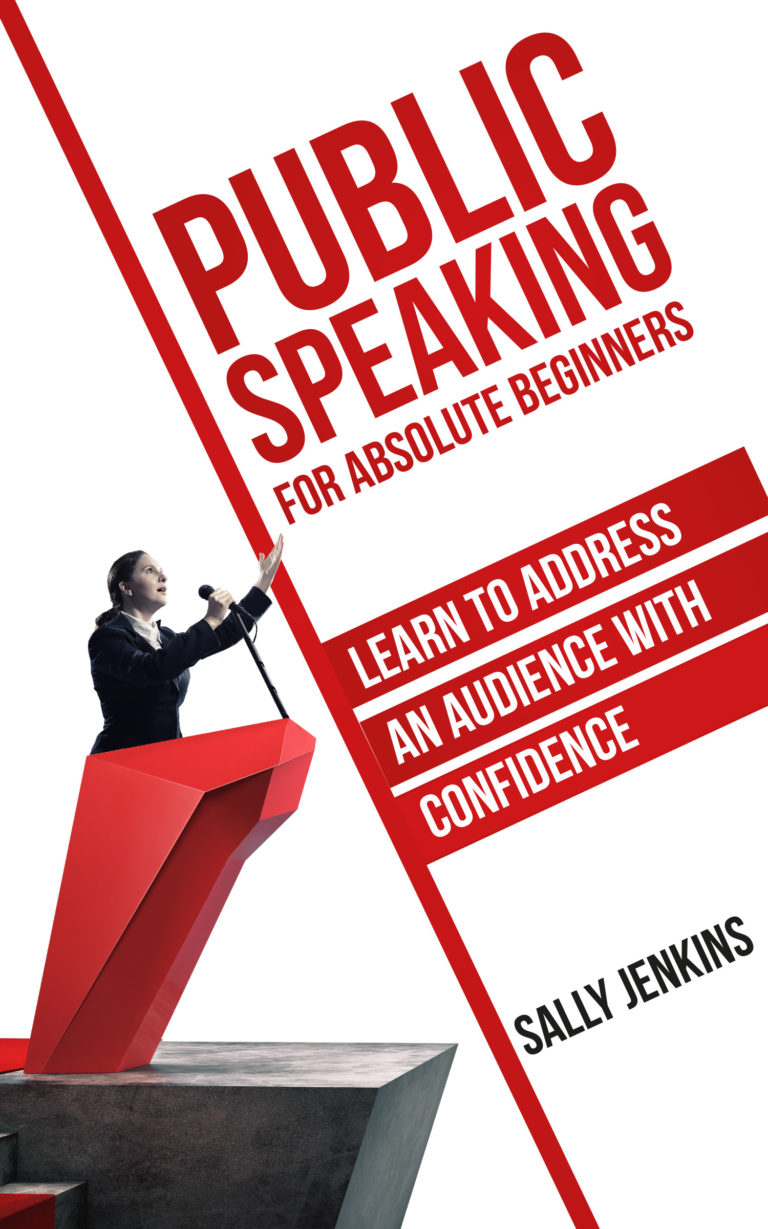
Sally is a successful author of both fiction and non-fiction. She also regularly gives talks about writing and related subjects (including to my local U3A group). Sally has also written a book called Public Speaking for Absolute Beginners (pictured below).

Public Speaking for Absolute Beginners

Public speaking can be a good paying sideline for retired and semi-retired people. As well as the financial benefits, it can offer an enjoyable opportunity to talk about your hobbies and interests, or your current or former career. I’ve also known people who have done public speaking as a method of raising money for charities or other causes close to their heart. Although the pandemic and lockdowns temporarily put paid to most public speaking work, as life has returned to normal the opportunities are definitely out there again.

Over to Sally then…


Wouldn’t it be great to make extra money by following your passion? A hobby that pays makes ‘working’ a pleasure. Unfortunately, things like stamp-collecting, rambling and local history rarely turn a profit, but there is a way to make them pay: share your specialist knowledge with others.

Community organisations such as the WI, Probus and independent Leisure and Learning clubs struggle to find speakers for their meetings. I speak about novel-writing at many such groups and am always asked if I know of any other speakers open for bookings. These are paid gigs. How much you charge, how far you travel and what type of bookings you take are all up to you. Depending on the policy of the organisation, these events may also give you the opportunity to sell produce from your hobby. For example, I sell copies of my books, but a creator of conserves might sell jam and marmalade or an artist, his paintings.

Below are some tips for starting a speaking career:

  • Collate enough material for a 45-minute talk and sort it into a logical sequence. Include stories that will capture the listener rather than a lot of heavy facts.
  • Refine the material into minimal bullet-pointed notes. It’s important to talk freely around each bullet point rather than read from a manuscript. Reading makes eye contact with the audience difficult and hand gestures to illustrate your words are almost impossible.
  • Think about any visual aids; these add variety and colour to a talk. When I talk about thriller-writing I produce some ‘murder weapons’ – a rolling-pin, a (blunt) knife and a packet of tablets. The conserve creator might show her jam pan and specialist thermometer. The artist might have a range of brushes to discuss.
  • Practise! Producing a successful talk is like an iceberg. At least 90% of the work is in the preparation beforehand. However, once you’ve perfected your performance, you can give that same talk many times to different groups.
  • Don’t be surprised if you are handed a microphone to use. This often happens in large halls or where several audience members are hard of hearing. Hold it at a consistent distance from your mouth and don’t turn your face away from it. Practise at home by holding a wooden spoon – this will give you an idea of what it’s like to talk with only one free hand.
  • Join a speakers club to get feedback on your speaking technique. Look at the Association of Speakers’ Clubs or the Toastmasters websites to find one near you.
  • Enquire at your local church hall about community groups who meet there and use speakers.
  • Do a couple of small bookings for free and ask for feedback from the audience. Once you’re confident, don’t make a habit of speaking for free (unless it’s a charitable cause) because that makes it harder for other speakers to ask for a fee.
  • Register on a speakers’ website such as Public Speakers Corner.

Receiving a cheque at the end of a talk is good but public speaking brings other benefits, such as the opportunity to meet new people and share your knowledge. It will improve your everyday confidence as well. When you can speak in front of an audience, complaining in a shop or restaurant is less daunting, putting your point of a view in a meeting is easier and making small talk with strangers at a party is no problem.

There is much more information on public speaking in Public Speaking for Absolute Beginners, including advice on constructing a speech plus chapters on Speaking Engagements, Weddings and the Eulogy. Public Speaking for Absolute Beginners is available from Amazon in Kindle and paperback format.

Sally Jenkins is an author and speaker. In 2018 she reached the national final of the Association of Speakers Clubs Speech Competition. Follow her on Twitter @sallyjenkinsuk or Facebook.


Many thanks to Sally Jenkins (pictured) for an interesting and inspiring article. Although as I said to her, I hope she never gets stopped by the police on the way to one ofSally Jenkins her public-speaking gigs and asked why she has all those ‘murder weapons’ in her bag!


I have done a bit of speaking myself, both for work reasons (in the long-ago days when I had a proper job) and to talk about writing or blogging. I always get nervous beforehand, but once I start I normally enjoy it and get a buzz from doing it.

I would maybe add one more tip to Sally’s list and that is to compile a list of topics you can speak about (with appropriate visual aids, of course). You can then offer potential bookers a ‘menu’ they can choose from. This has the benefit that if they don’t like one idea, they may well go for another. It also means you can potentially get repeat bookings, maybe on a regular basis, speaking on a different subject each time. This certainly happens with some of the speakers who are booked by my local U3A.

As always, if you have any questions about this article, for Sally or for me, please do post them below.

This is a fully updated version of an original post from 2019.

If you enjoyed this post, please link to it on your own blog or social media:
Make a sideline income renting out your driveway

Make a Sideline Income Renting Out Your Driveway

Today I’m sharing a sideline money-making opportunity that – if you’re in a position to do it – can bring in a steady income for very little effort.

The shortage of parking spaces in many towns and cities has created an opportunity for anyone who has a driveway (or garage) they aren’t using all the time.

One of the best-known operators in this field is JustPark. Through their website and mobile app, they put drivers in touch with home-owners and businesses who have parking spaces (and/or EV charging spaces) available near their destination. They say they help over 10 million drivers a year find parking spaces at over 45,000 UK locations.

Listing your space is free and you can set your own price based on how long the driver wishes to stay. JustPark will suggest an appropriate price based on your location and the facilities you are offering, but you aren’t obliged to accept this.

JustPark charges space-owners a 3% fee on one-off bookings (so if you charge £10 they will take 30p, meaning you receive £9.70). For longer term or rolling bookings over two months, they charge space-owners a higher fee of 20% for the first month, with the fee reverting to the standard 3% after that.

JustPark also make money from drivers, adding up to 25% of the space-owner’s asking price to the fee charged. They say, however, that charges to drivers are still typically 30% lower than ad hoc street parking (if you can find it), which makes the service attractive to motorists as well.

One big attraction of JustPark is that they handle all the admin on your behalf. All payments are made via the website, and space-owners can withdraw earnings via PayPal or direct to their bank account. JustPark also ensure you still get paid even if the booker doesn’t turn up.

JustPark say that the money you earn from renting out your parking space is included in the property trading income allowance introduced by the government in April 2017 –  so you can make up to £1,000 per year completely tax-free (and no need to declare it to the taxman).

All drivers using the service have to register on the site, so you know exactly who will be using your space on any given day. There is also a rating system so you can see any comments other users of the service have made about them. Space-owners are also rated by drivers, incidentally.

You can offer spaces by the day, week or month, and set any restrictions you wish on when your space is available. Anyone is welcome to advertise spaces on JustPark, but the locations in most demand are those near airports, stations and stadiums, and in major cities. According to one recent article in the Daily Mail, people in such areas are making more than £4,000 a year doing this. Even if that doesn’t apply to you, though, you can still earn from a few hundred pounds a year to £1000 or more by this means.

  • Obviously the pandemic and working from home reduced demand for parking spaces. But with life returning to normal now, demand for parking spaces is steadily increasing again.

Of course, if you don’t have a suitable space to offer, you won’t be able to benefit from this opportunity. You could still use JustPark to save money on your own parking costs, though. Either way, the service is well worth checking out 🙂

  • Another option for cheaper parking is Your Parking Space. Over 60s can get an exclusive 10% discount on this service through my friends at Over 60s Discounts.

Disclosure: As well as being a registered user of JustPark I am an affiliate for them and will therefore receive a small commission if you click through any of my links and sign up. This will not affect the money you earn through the site and/or any savings you make if you use them to find parking spaces.


Cover image by courtesy of BingAI.

This is a fully revised and updated version of my original article on this subject.

If you enjoyed this post, please link to it on your own blog or social media:
My Investments Update July 2023

My Investments Update – July 2023

Here is my latest monthly update about my investments. You can read my June 2023 Investments Update here if you like

I’ll start as usual with my Nutmeg Stocks and Shares ISA. This is the largest investment I hold other than my Bestinvest SIPP (personal pension).

As the screenshot below for the year to date shows, my main Nutmeg portfolio is currently valued at £21,044. Last month it stood at £20,419 so that is a rise of £625.

Nutmeg Main JUly 2023

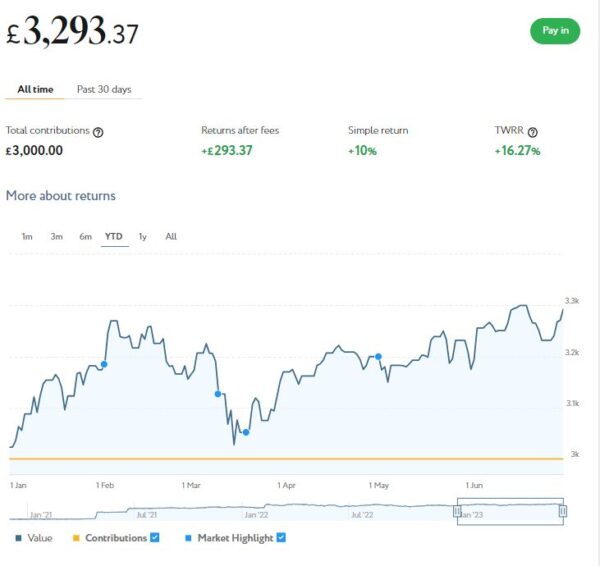
Apart from my main portfolio, I also have a second, smaller pot using Nutmeg’s Smart Alpha option. This is now worth £3,293 compared with £3,175 a month ago, an increase of £118. Here is a screen capture showing performance since the start of this year.

Nutmeg Smart Alpha July 23

This has clearly been a better month for both my Nutmeg pots. Their total value has risen by £743 or 3.15% month on month. Since the start of 2023 the net value of my Nutmeg investments has grown by £1,417 or 6.18%.

Of course, all investing is (or should be) a long-term endeavour. Over a period of years stock market investments such as those used by Nutmeg typically produce better returns than cash accounts, often by substantial margins. But there are never any guarantees, and in in the short to medium term at least, losses are always possible.

  • Also, as you may know, both my Nutmeg pots have quite high risk levels (9/10 main, 5/5 Smart Alpha). If you haven’t yet seen it, you might like to check out my blog post in which I looked at the performance over time of Nutmeg fully managed portfolios at every risk level from 1 to 10 . I was pretty amazed by the difference risk level makes, with higher-risk ports over almost any period of three or more years in the last ten generating significantly better overall returns. If you are investing for the long term (and you almost certainly should be) choosing a hyper-cautious low-risk level might not therefore be the smartest strategy. The one exception is if you plan to withdraw your money soon and don’t want to risk losing too much if there is a sudden downturn.

You can read my full Nutmeg review here (including a special offer at the end for PAS readers). If you are looking for a home for your annual ISA allowance, based on my overall experience over the last seven years, they are certainly worth considering. They offer self-invested personal pensions (SIPPs) and Junior ISAs as well.

Moving on, my Assetz Exchange investments continue to generate steady returns. Regular readers will know that this is a P2P property investment platform focusing on lower-risk properties (e.g. sheltered housing). I put an initial £100 into this in mid-February 2021 and another £400 in April. In June 2021 I added another £500, bringing my total investment up to £1,000.

Since I opened my account, my AE portfolio has generated a respectable £124.53 in revenue from rental income. As I said in last month’s update, capital growth has slowed, though, in line with UK property values generally.

At the time of writing, 12 of ‘my’ properties are showing gains, 2 are breaking even, and the remaining 12 are showing losses. My portfolio is currently showing a net decrease in value of £15.53, meaning that overall (rental income minus capital value decrease) I am up by £109. That’s still a decent return on my £1,000 and does illustrate the value of P2P property investments for diversifying your portfolio. And it doesn’t hurt that with Assetz Exchange most projects are socially beneficial as well.

Obviously the fall in capital value of my AE investments is slightly disappointing. But it’s important to bear in mind that unless and until I choose to sell the investments in question, it is largely theoretical. The rental income, on the other hand, is real money (which in my case I have chosen to reinvest in other AE projects to further diversify my portfolio).

I also spoke to the CEO of Assetz Exchange, Peter Read, recently. He made the point that capital values on the platform simply reflect the latest price at which shares in the property concerned have changed hands on their exchange. They do not represent objective or independent valuations of the properties. If you are investing long term with AE, the annual yield from rentals is really a much more important consideration.

Peter also made the point that the current high inflation rate has actually been beneficial for Assetz Exchange investors. That is because properties on the platform generally have an annual review when rentals are increased in line with inflation. That means from the end of the financial year in April, rentals have increased in most cases by around 10%. Assetz Exchange recently published a blog post about this which is worth a read.

To control risk with all my property crowdfunding investments nowadays, I invest relatively modest amounts in individual projects. This is a particular attraction of AE as far as i am concerned. You can actually invest from as little as 80p per property if you really want to proceed cautiously.

My investment on Assetz Exchange is in the form of an IFISA so there won’t be any tax to pay on profits, dividends or capital gains. I’ve been impressed by my experiences with Assetz Exchange and the returns generated so far, and intend to continue investing with them. You can read my full review of Assetz Exchange here. You can also sign up for an account on Assetz Exchange directly via this link [affiliate].

Another property platform I have investments with is Kuflink. They continue to do well, with new projects launching every week. I currently have around £2,500 invested with them in 17 different projects. To date I have never lost any money with Kuflink, though some loan terms have been extended once or twice. On the plus side, when this happens additional interest is paid for the period in question.

My loans with Kuflink pay annual interest rates of 6 to 7.5 percent. These days I invest no more than £200 per loan (and often less). That is not because of any issues with Kuflink but more to do with losses of larger amounts on other P2P property platforms in the past. My days of putting four-figure sums into any single property investment are behind me now! Nowadays I mainly opt to reinvest the monthly repayments I receive from Kuflink, which has the effect of boosting the percentage rate of return on the projects in question

Obviously a possible drawback with Kuflink and similar platforms is that your money is tied up in bricks and mortar, so not as easily accessible as cash savings or even (to some extent) shares. They do, however, have a secondary market on which you can offer any loan part for sale (as long as the loan in question is performing and not in arrears). Clearly that does depend on someone else wanting to buy it, but my experience has been that any loan parts offered are typically snapped up very quickly. So if an urgent need arises, withdrawing your money (or part of it) is unlikely to be an issue.

You can read my full Kuflink review here. They offer a variety of investment options, including a tax-free IFISA paying up to 7% interest per year with built-in automatic diversification. Alternatively you can build your own IFISA, with most loans on the platform being IFISA-eligible.

  • Until 31 July 2023 Kuflink are offering enhanced promotional rates of up to 9.73% (gross annual interest equivalent rate) for their Auto-Invest products (IFISA-eligible). There is limited availability for this offer and it may be withdrawn any time before 31 July 2023 if the limit is reached. For more information, click here [affiliate link].

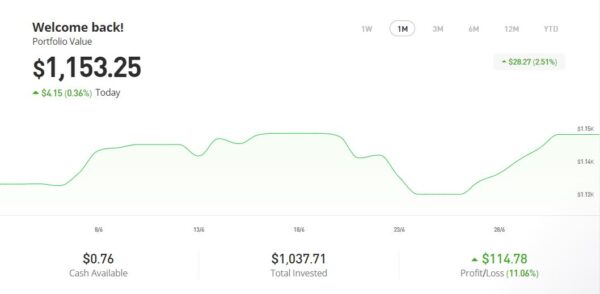
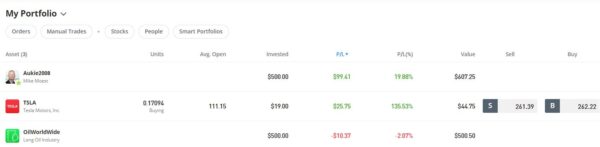
Last year I set up an account with investment and trading platform eToro, using their popular ‘copy trader’ facility. I chose to invest $500 (then about £412) copying an experienced eToro trader called Aukie2008 (real name Mike Moest).

In January 2023 I added to this with another $500 investment in one of their thematic portfolios, Oil Worldwide. I also invested a small amount I had left over in Tesla shares.

As you can see from the screen capture below, my original investment of $1,022.26 is today worth $1,153.25, an overall increase of $130.99 or 12.81%. in these turbulent times I am very happy with that.

eToro July 2023

Since last month the price of my Tesla shares has risen substantially and my copy trading portfolio with Aukie2008 has also done well (though less spectacularly). My most recent investment in Oil Worldwide has risen a bit this month but it’s still slightly down on when I invested. The Oil Worldwide portfolio has just been rebalanced by eToro, so I am hoping for better things in the months ahead 🙂

You can read my full review of eToro here. You may also like to check out my more in-depth look at eToro copy trading. I also discussed thematic investing with eToro using Smart Portfolios in this recent post. The latter also reveals why I took the somewhat contrarian step of choosing the oil industry for my first thematic investment.

  • eToro also recently introduced the eToro Money app. This allows you to deposit money to your eToro account without paying any currency conversion fees, saving you up to £5 for every £1,000 you deposit. You can also use the app to withdraw funds from your eToro account instantly to your bank account. I tried this myself recently and was impressed with how quickly and seamlessly it worked. You can read my blog post about eToro Money here.

I had two more articles published in June on the excellent Mouthy Money website. The first was 10 Great Ways to Save Money on Amazon. Amazon is Britain’s – and the world’s – favourite online store. Prices on Amazon are generally competitive, but over the years I’ve discovered a variety of ways to ensure you get the best value for money from them. So in this article I set out my top ten tips for saving money on Amazon

My other article was Do You Need a Personal Financial Adviser? In this article I discuss the different types of financial adviser and what they do. I also revealed why – despite being a money blogger and considering myself reasonably financially savvy – I have a personal financial adviser myself.

As I’ve said before, Mouthy Money is a great resource for anyone interested in money-making and money-saving I always look forward to reading the articles by my fellow contributors. Shoestring Jane is a particular favourite and I enjoyed reading her recent article concerning how you can Save Money by Reducing Food Waste.

I also published several new posts on Pounds and Sense in June. One of these was My Short Break in Bath. Bath is, of course, a historic city on the River Avon, about 12 miles from Bristol. I went there for three days in June, the first time I had been for over 30 years. In my post I discuss the self-catering apartment where I stayed and reveal some of the things I did and saw. I also share a few top tips for visitors to Bath. The cover image shows the famous Pulteney Bridge, one of Bath’s best-known landmarks.

Also in June I published a guest post titled How to Manage Your Time and Money in Retirement. This came from my friends at Equity Release Supermarket and I thought it was very informative. I also added some thoughts of my own, as you will see.

I also published a post based on a survey of Britons’ investing habits. This addressed questions such as what are the main barriers stopping people investing and where do people get their investment advice from. I thought the results were quite eye-opening. Take a look if you haven’t already.

Finally, I wanted to highlight that the free share offers described in last month’s update are both still open if you haven’t done them yet. The opportunity to Get a Free Share Worth up to £100 with Trading 212 was reopened after closing briefly. It is now on offer till 27 July 2023.

The opportunity to Get a Free ETF Share Worth up to £200 with Wealthyhood is also still open but the terms have changed slightly. To remind you, Wealthyhood is a DIY wealth-building app aimed especially at people who are new to stock market investing. As from 1 June 2023 they changed their fee structure to make it (even) more attractive to small investors. They have now increased the minimum investment to qualify for the free share offer from £20 to £50 – but on the plus side, they guarantee that your free ETF share will be worth at least £10.

That’s all for today. I hope you’re enjoying the summer months and taking the opportunity to get out and about in our beautiful country (or further afield).

As always, if you have any comments or queries, feel free to leave them below. I am always delighted to hear from PAS readers 🙂

Disclaimer: I am not a qualified financial adviser and nothing in this blog post should be construed as personal financial advice. Everyone should do their own ‘due diligence’ before investing and seek professional advice if in any doubt how best to proceed. All investing carries a risk of loss.

Note also that posts may include affiliate links. If you click through and perform a qualifying transaction, I may receive a commission for introducing you. This will not affect the product or service you receive or the terms you are offered, but it does help support me in publishing PAS and paying my bills. Thank you!

If you enjoyed this post, please link to it on your own blog or social media: