Saving Money

Posts about saving money from a 60-plus perspective, including cashback schemes, deals sites, discount offers, and so on.

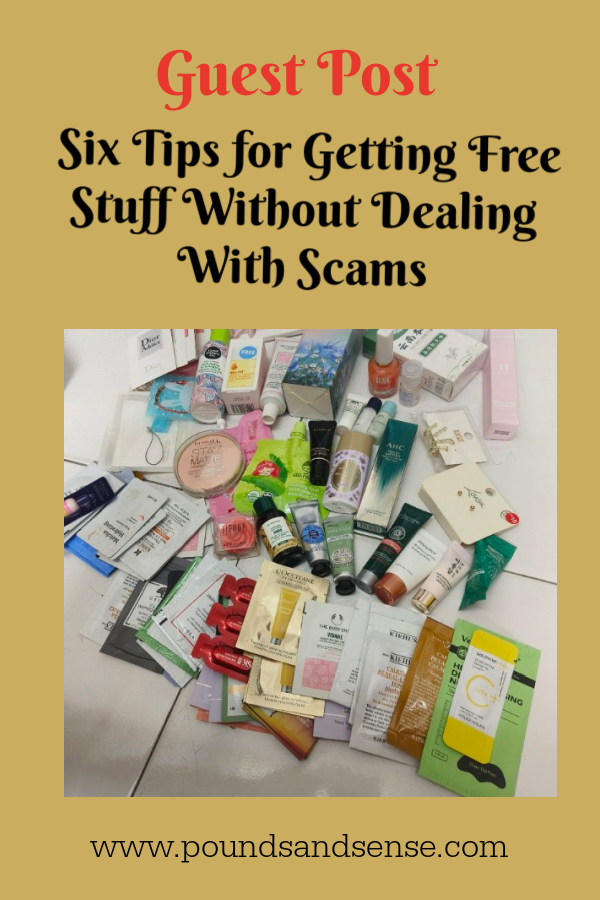
Guest Post: Six Tips for Getting Free Stuff Without Dealing With Scams

Guest Post: Six Tips for Getting Free Stuff Without Dealing With Scams

Today I have a guest post for you on a subject I’m sure will resonate with many Pounds and Sense readers.

We all love a freebie, but how do you ensure that by providing your details you aren’t opening the floodgates to a torrent of spam? Read and follow the tips below from my friends at All Free Stuff. And don’t forget to sign up for their free email newsletter to get details of all the latest free offers daily!


It’s completely possible for you to get free stuff. There are plenty of opportunities out there.

That said, for every legitimately free thing you can get, there are two complete scams set up to get your personal information at the cost of a few free samples. If you want to get free stuff without dealing with scams, try the following steps.

1. Set up a ‘spam catcher’ e-mail. This e-mail account is one you have no plans on using for normal correspondence, but rather the address you give out for giveaways and promotions. You can also use it when you register with a company that wants your e-mail address in exchange for free gifts. If you give the company your primary e-mail address, you’ll be swamped with a mass of promotional e-mails. It won’t take long for you to abandon your e-mail account in despair if this starts to happen.

2. Avoid giving personal information. You should never give out more than your name, e-mail address, physical address, and birthday. And you should be careful about giving away all of those, as well. If you can, try using a fake name or a PO Box. The more personal information you give out, the easier it will be for other companies to get that information. In addition, some websites ask for your credit card number ‘just to ensure you’re a real person’. Once they have your credit card information, you can’t make them forget it.

3. Be realistic about what you expect. If the deal seems too good to be true, it almost certainly is. It’s certainly possible the giveaway is legitimate, and if that’s the case then they should have company contact information readily available. You should also check the internet to see if you can find information. If the offer is that great, then plenty of people will be talking about it. Of course, if it’s a scam you’re liable to find discussion about that, too.

4. Visit only legitimate websites for samples. Manufacturers’ sites are generally trustworthy, whereas some retail-specific sites are not.

5. Write to the manufacturers of products you enjoy using. Companies are always happy to give a few freebies to customers willing to go out of their way to make their voice heard. It builds goodwill and often garners more customers. And all for the cost of a few free samples.

6. Learn to use coupons properly. It can take a huge amount of patience to learn to coupon well. That said, good couponing can save you so much you may even get free groceries. Couponing is a fairly big deal, so you can find plenty of websites that can help you learn. There are also many grocery stores or manufacturer sites that will keep you informed of what great deals and amazing coupons are available.

These are some of the best ways to get free stuff without dealing with scams. Do you have any other tips yourself? Please do leave them below!

Disclosure: This is a sponsored post.
If you enjoyed this post, please link to it on your own blog or social media:
Secret Savings Accounts

Saving for a Rainy Day or a Stormy Breakup? The Surprising Facts About Secret Savings Accounts

A recent study conducted by Smart Money People reveals that one in ten people in a serious relationship, including marriage, civil partnerships, or cohabitation, maintain a secret savings account.

The research for the study was undertaken by Opinium on behalf of Smart Money People from 12 to 16 January 2024 among 2,000 UK adults aged 18 and over.

The SMP study highlights the prevalence of this practice among those in their 30s, with 30% acknowledging having such an account. Additionally, women are reported to be more likely than men to save secretly, indicating potential gender-related financial dynamics within relationships.

The reasons for maintaining a secret savings account vary, with the most common explanations being that individuals already had the account before entering the relationship (38%) or the desire to maintain financial independence (37%). However, a surprising 22% of respondents with a secret savings account admit to using it as an emergency break-up fund, anticipating potential costs associated with leaving a relationship, such as moving expenses or repurchasing shared assets like a car.

Interestingly, over half (51%) of those with a break-up fund also have a joint savings account with someone other than their partner, introducing an additional layer of complexity to the financial dynamics within relationships.

The study sheds light on the impact of financial matters on relationship stability, revealing that 18% of adults believe a lack of financial compatibility has contributed to a break-up in the past. The biggest savings-related causes of friction for those currently in a relationship are having different opinions on savings habits or when it’s okay to use savings (28%). This underscores the importance of aligning financial goals and strategies within a relationship.

Financial compatibility is considered crucial by 95% of couples living together, emphasizing the significance of shared financial values. Despite this, 10% of individuals still maintain secret savings accounts, illustrating a potential disparity between stated beliefs and actual financial behaviour.

The study indicates that half of people in relationships do not save the same amount of money as their partner, primarily due to unequal earnings (65%). An additional one-third attribute the difference in savings to disparate spending habits, with 40% of these individuals maintaining secret savings accounts.

In terms of relationship longevity, the research suggests that couples with joint savings accounts feel more financially compatible (90%) compared to those without. The data encourages open and honest discussions about money within relationships, emphasizing the importance of navigating financial decisions together.

Commenting on the findings, Jacqueline Dewey, CEO of Smart Money People, said, “Many people may already have methods of saving that work well for them prior to a new relationship, so although long-term partnerships bring about new joint financial goals, this shouldn’t negate any personal goals for each individual.

“Having different outlooks and opinions on savings isn’t necessarily a deal-breaker, but finding the most suitable ways to manage this is important.”

In summary, the SMP study highlights the complexities of financial dynamics within relationships, emphasizing the need for open communication, shared financial goals and mutual understanding, in order to maintain a healthy and long-lasting partnership.

Many thanks to my friends at Smart Money People for allowing me to share the results of their research. You can check out Smart Money People’s guide to the best savings accounts here.

If you have any comments or questions about this article, please do share them below as usual.

If you enjoyed this post, please link to it on your own blog or social media:
AER

What is AER and Why is it Important to Savers and Investors?

I recently posted about the importance of compounding to investors. In the article I pointed out that compounding, when combined with the magic of compound interest, is a powerful tool for building wealth and long-term financial success.

Compounding involves earning interest on both your initial investment and the accumulated interest from previous periods. In other words, it’s the process of generating earnings from an asset’s reinvested earnings. The more frequently your money is compounded, the faster it grows. And the longer your money remains invested, the more significant the compounding effect becomes.

A reader asked me if the effect of compounding is equivalent to getting a higher annual interest rate. The answer to that is yes, if interest is compounded more than once a year. The more times per year interest is compounded, the higher the effective annual rate becomes. The official term for this is AER, or annual equivalent rate.

In this article I thought I would explain AER in a bit more detail, as it is a very important concept for savers and investors to grasp.

What is AER?

Annual Equivalent Rate (AER) is a standardized way of expressing the interest rate on savings or investment products over a one-year period. It allows investors to compare the potential returns on different financial products on a like-for-like basis. AER takes into account the effect of compounding, providing a more accurate representation of the overall return on an investment.

Why is AER Important?

AER is crucial for investors as it helps them make more informed decisions when comparing different savings and investment options. While nominal interest rates may seem attractive at first glance, they can be misleading. AER provides a more accurate reflection of the actual return on an investment by factoring in the compounding of interest over time.

Example

Let’s consider two savings accounts:

  1. Savings Account A offers a nominal interest rate of 7% per annum, compounded annually.
  2. Savings Account B offers a nominal interest rate of 7% per annum, compounded quarterly.

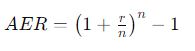
To compare these accounts accurately, we can use the AER formula:

AERformula

Where:

  • is the nominal interest rate (as a decimal)
  • is the number of compounding periods per year

For Account A:

For Account B:Capture B7

In this example, even though both accounts have the same nominal interest rate, Account B has a higher AER due to the more frequent compounding.

Let’s now add a third savings account, Account C, again with a nominal annual interest rate of 7% but this time compounded monthly. We can calculate the AER for Account C using the formula as before:

Formula C7

As you can see, the AER is higher again due to the increased frequency of compounding. If compounding was even more frequent (e.g. daily) the difference would be even more pronounced. In addition, the longer the period over which you invest, the greater the difference frequency of compounding will make.

While AER is often considered with regard to savings accounts, it also applies to investments. As I said in my earlier post, with a property crowdlending platform like Assetz Exchange [referral link] which pays monthly dividends (and has low minimum investments), you can keep reinvesting the income you receive to boost the returns you make.

Closing Thoughts

Understanding AER is crucial for UK savers and investors as it provides a standardized measure to compare the true potential returns of different financial products.

By taking into account the compounding effect, AER offers a more accurate picture of overall returns on investments. When evaluating savings or investment opportunities, always look beyond nominal interest rates and consider the AER to make informed decisions that align with your financial goals. And take any opportunity that arises to reinvest your returns to harness the power of compounding to grow your wealth faster.

As ever, if you have any comments or questions about this post, please do leave them below.

Disclaimer: I am not a qualified financial adviser and nothing in this blog post should be construed as personal financial advice. Everyone should do their own ‘due diligence’ before investing and seek professional advice if in any doubt how best to proceed. All investing carries a risk of loss.

If you enjoyed this post, please link to it on your own blog or social media:
Take the Penny Challenge!

Take The Penny Challenge to Save £667.95 by This Time Next Year!

Today I wanted to share with you a clever money-saving idea I came across on the excellent Wow Free Stuff website.

The Penny Challenge offers a painless way to save money every day – so in a year’s time you will have the substantial sum of £667.95 stashed away. That’s money you could spend on anything you like.

How It Works

The challenge itself is very simple.

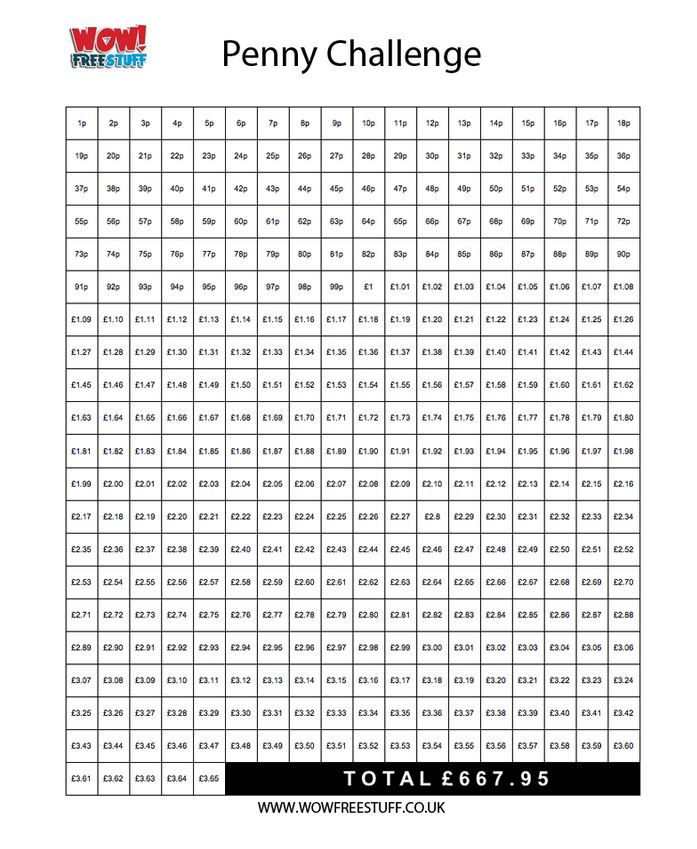
On the first day you put aside one penny. Each day after that you add another penny to the amount you save. So on the second day you save 2p, on the third day 3p, and so on.

Over the course of a year (365 days) the amount you have to save each day is shown in the grid below.

Penny Saving Challenge

As you will see, by the last day of the challenge you will have to find £3.65 – still an easily affordable sum. And once you have done that, you will have a total savings pot of £667.95.

This would be a great way to get your money-saving started painlessly in 2024. It will ensure that by January 2025 you have a handy sum set aside to pay for any large purchase you have set your heart on, and maybe treat yourself to a post-Christmas holiday as well!

Please let me know if you decide to take the Penny Challenge by posting a comment below. And, of course, if you have any other comments or queries about it, feel free to post them also.

Note: This is an updated version of a sponsored post for which I received a fee.

If you enjoyed this post, please link to it on your own blog or social media:
My Top 20 Posts of 2023

My Top 20 Posts of 2023

As is customary for bloggers at this time of year, here are the top twenty posts on Pounds and Sense in 2023, based on comments, page-views and social media shares. They are in no particular order. I have excluded any posts that are no longer relevant.

I hope you will enjoy revisiting these posts, or seeing them for the first time if you are new to PAS.

All posts in the list below should open in a new tab/window when you click on the link concerned.

  1. Planning a UK Holiday This Year? Here Are Some Ideas For You!
  2. What Are Smart Portfolios on eToro?
  3. Nutmeg Review: My Experiences with this Robo-Adviser Investment Platform
  4. Make a Sideline Income Renting Out Your Driveway or Garage
  5. Two Places You Really Shouldn’t Turn for Tax Advice (and One You Definitely Should)
  6. Guest Post: Investing in Classic Cars
  7. Will You Get the Warm Home Discount?
  8. Here’s Why Older Pensioners Especially Should Apply for Pension Credit
  9. Spotlight: eToro Trading and Investment Platform
  10. Investing Basics for Beginners
  11. Twenty Great Ways to Make Extra Money From Home
  12. What Are the Best Video Calling Tools for Older People?
  13. Five Things I Have Learned From My eToro Virtual Portfolio
  14. Get a Free ETF Share Worth up to £200 With Wealthyhood
  15. What Is U3A and Is It For You?
  16. Save Money on Your Shopping with JamDoughnut!
  17. Guest Post: Make Money From Speaking!
  18. Over 60s Discounts – New Website Helping Older People Save Money
  19. Get a Free Share Worth up to £100 with Trading 212
  20. How to Make More Money From National Grid Powersaving Events

I’ll be taking a break from blogging over the festive period (though I’ll still be around on X/Twitter and Facebook). I’ll therefore close by wishing you a Very Merry Christmas (strikes and cost-of-living crisis permitting) and for all of us a brighter, more prosperous new year 🍾

If you have any comments or questions, of course, feel free to leave them below as usual.

Xmas tree

If you enjoyed this post, please link to it on your own blog or social media:
How to Make More Money from National Grid Powersaving Events

How to Make More Money From National Grid Powersaving Events

For the second winter in a row, some energy companies are offering incentives to customers to reduce their electricity use during periods of peak demand. Payments are made to those who succeed in doing this.

Most large energy companies – and some smaller ones – are running schemes, though some by invitation only. At the time of writing they include British Gas, EDF, Octopus Energy, E-on, Ovo Energy, Shell Energy, Scottish Power and Utilita. You can see a regularly updated list on this page of the Moneysavingexpert website.

If you aren’t with one of these companies, however, you may still be able to benefit by signing up with an app-based service such as Loop Energy or Power Rewards.

  • Don’t, though, be tempted to sign up for more than one scheme at a time. That is against National Grid’s rules and could see you being banned from receiving ANY payments.

This programme is part of a broader initiative from the National Grid Electricity System Operator (ESO), the organization responsible for transporting electricity around England, Scotland and Wales and keeping homes and businesses powered. The aim is to balance supply and demand, thus reducing the need to fire-up fossil-fuel plants and (in the worst case) avoiding power cuts.

During cost-cutting events, National Grid ESO pays participating suppliers a certain amount for each unit (kWh) of electricity saved by any of their users signed up to schemes. Suppliers then pass some or all of this payment on to customers.

One thing all schemes have in common is you must have a smart meter capable of sending half-hourly readings. Smart meters are of course somewhat controversial, and for various reasons not everybody wants one. If you wish to benefit from this particular opportunity, however, having a smart meter is essential. For the record I do have a smart meter and believe it has saved me money. But I do of course respect those who have differing views about this.

How It Works

To make money from these schemes you will be asked to reduce your electricity (not gas) consumption during certain periods. This is most commonly around the evening peak time of 4 pm to 7 pm, but exact times vary depending on the supplier concerned and the needs of National Grid.

The duration of events varies but in my experience is typically an hour or 90 minutes. But I understand they could be anywhere between 30 minutes and three hours.

You are unlikely to make a fortune from these schemes, but could earn up to £100 (or more) over the course of the winter. Payments vary from around £2.50 to £4.50 per unit (kWh) saved, the rate depending on what National Grid is paying. The actual rate you receive will also depend on how much of the payments from National Grid your supplier chooses to pass on.

One other important point is that you may be expected to reduce your usage by a certain minimum amount (e.g. 40%) from your average in order to receive a payment. If you cut your usage by less than this, unfortunately you may not qualify for any payment on that occasion.

You will be required to opt in to the scheme run by your energy supplier (or other provider). You will likely also have to opt in to specific energy-saving events, with advance notifications sent via email and mobile phones.

How to Maximize Your Returns

Here are a few tips and ideas for cutting your electricity use during power-saving events and maximizing the returns you receive…

  • Turn off as many lights as possible, including outside lights (easily forgotten).
  • Turn off all mains-powered computers, printers and other electronic devices (again, easily forgotten).
  • Avoid cooking with electricity during events.
  • Avoid using other high-energy-consumption devices such as dishwashers and washing machines.
  • Obviously, avoid using electric heating if possible. If there’s no alternative, heat up the room/s you will be in beforehand and close all doors, windows and curtains to keep the warmth in.
  • Avoid taking electric showers while events are in progress.
  • Be sure no electrical devices have been left on to charge.
  • Switch off the TV and watch instead on your laptop/tablet using its internal battery.
  • Avoid boiling the kettle as this uses a lot of electricity (albeit for a short period). Make a flask of coffee/tea beforehand and drink from that during the event.
  • Avoid opening fridge/freezer doors during events. But you can also switch off fridges and freezers entirely to save more. This should be perfectly safe for up to three hours.
  • If it’s feasible, arrange to go out during some or all of the power-saving event. This is the easiest way to save as much electricity as possible!
  • Create a checklist of things to do at each event to save power. You can also use this after the event to ensure you remember to turn things like fridges and freezers back on again.

One other slightly left-field idea is to use high-energy devices such as washing machines and electric cookers MORE during evening peak times when there isn’t a power-saving event happening. That will boost your average energy consumption at this time, giving you the opportunity to save more when a power-saving event comes along. Obviously you shouldn’t use high-energy devices more than you would overall. But if you can shift your usage to peak times when power-saving events are typically scheduled, this should help you save more when events occur.

I hope this post has given you some ideas for how to maximize your returns from these schemes. As always, if you have any comments or questions, please do leave them below. I’d also be very pleased to receive any other tips for making more money from power-saving events.

  • Don’t forget, you can also get a FREE £50 credited to your energy account when you switch to EDF Energy via my affiliate link. Terms and conditions apply.

EDF Energy

This is a fully updated version of my original 2022 post on this subject.

If you enjoyed this post, please link to it on your own blog or social media:
Over 60s Discounts Review

Over 60s Discounts – New Website Helping Older People Save Money

A quickie today spotlighting a site that I know will be of interest to many readers of this blog. Coincidentally, it’s run by a near-neighbour of mine in south Staffordshire.

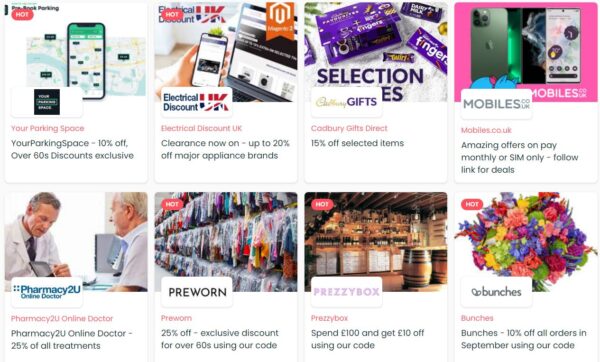
As the name suggests, Over 60s Discounts lists discounts, deals, vouchers and concessions for people in the UK aged 60 and over. Many of these are exclusive to Over 60s Discounts.

Over 60s Discounts operates on a membership basis, but the good news is that it is free to join. Once you are registered, you will be able to browse the latest discount offers on the website and also have them sent to you by email. If you see an offer you like, all you have to do is click ‘Get Code’. You will then be provided with a voucher code to use at checkout on the brand’s website. Printable vouchers and e-vouchers, which you can use in-store, are also provided.

There are some great deals on offer, as you can see from the sample selection below.

Top Offers on Over 60s Discounts

If you’re 60 or over, I highly recommend checking out Over 60s Discounts. It’s a new website and obviously still evolving, but already it offers an impressive range of deals, discounts and concessions. If you’re looking to make your money go a little further in the current cost-of-living crisis, it will definitely help you achieve this.

As always, if you have any comments or questions about this post, please do post them below.


If you enjoyed this post, please link to it on your own blog or social media:
JamDoughnut review

Save Money on Your Shopping with JamDoughnut!

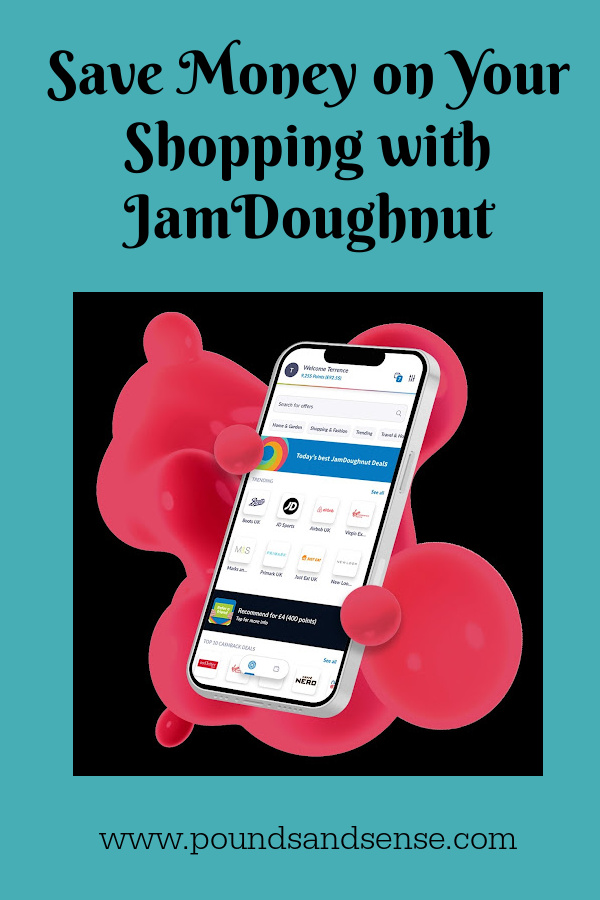
Today I’m reviewing an app called JamDoughnut which can help you save money on your shopping. 

What is JamDoughnut?

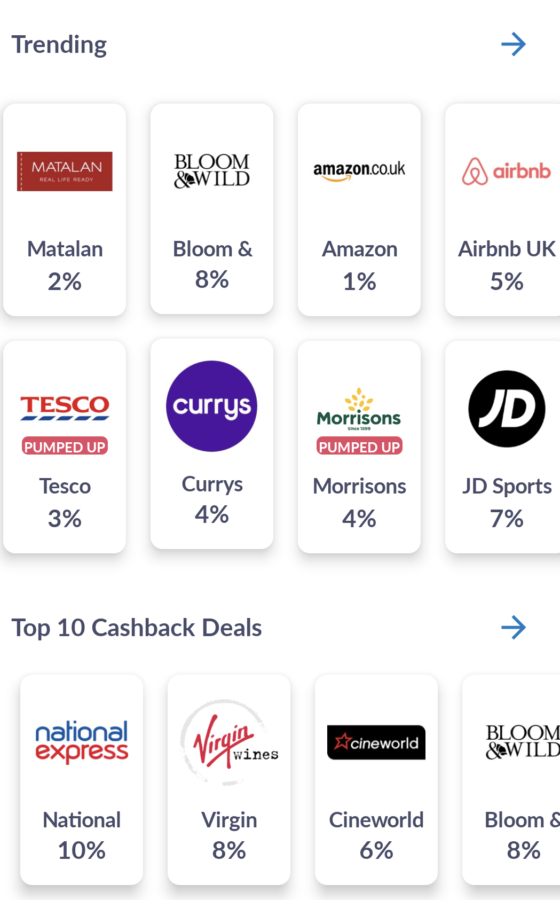
JamDoughnut is an instant cashback app that allows users to earn cashback when they spend money with over 150 leading supermarkets, restaurants and shops (see sample screenshot below).

JamDoughnut sample offers

Rather than cashback on specific purchases (as with sites like Quidco), you get cashback of up to 20% when you purchase gift cards from retailers on the app. These gift cards can then be used just like money, both online and in-store (in most cases). 

How Does It Work?

The first step is to download the JamDoughnut app to your mobile phone from Google Play for Android or the Apple iStore. Open the app and follow the instructions to create an account (don’t forget to enter my referral code GBGN to get a 200 points [£2] bonus – see below). This should only take a couple of minutes.

Then check the list of retailers on the app and find one you shop with regularly. Most of the big supermarkets (with the exception of Waitrose) are included, for example. 

You can even get cashback on Amazon gift cards, though admittedly only at a rate of 1% at the time of writing.

Once you have found a suitable retailer, buy a gift card for that retailer using the app. This is straightforward and you can get cards of up to £100 in value. 

Once your gift card purchase has gone through, cashback will be credited to your account in the form of points (100 points = £1). In my experience this normally happens instantly. Once you have earned 1000 points, representing £10 cashback, you can withdraw the money to your bank account. 

Note that there is a standard 30p transaction fee when making a withdrawal via bank transfer, and more than that if you use Apple Pay or Google Pay (so I don’t recommend doing that). So it may be best to let cashback build up a bit before withdrawing, to reduce the impact of the transaction fee. Alternatively you can withdraw in the form of a gift voucher (e.g. an Amazon voucher). In that case no charges are payable and you also get bonus points added to your account 🙂

In most cases, as mentioned, you can use gift cards either online or in-store. In the latter case, you can show/scan the code on your mobile phone at the checkout, or you can take a printed version with you and use that. 

You can use gift cards for full or part payment. If you don’t use the whole amount on the gift card in one go, you can use what remains towards another purchase at a later date.

Other Benefits

Another attraction of JamDoughnut is that you can use the app in addition to your existing cards and loyalty programme points, allowing you to earn and/or save even more.

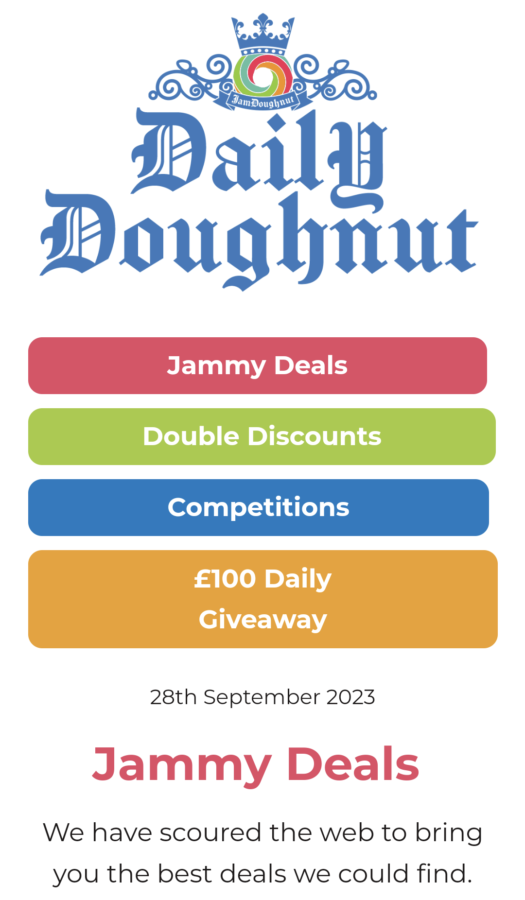
In addition, JamDoughnut offers a range of other benefits. These include a daily £100 (10 x £10) giveaway, free competitions, ‘Jammy Deals’, double discounts, and more. These are all listed on the ‘Daily Doughnut’ page of the app (see below).

JamDoughnut extras

Finally, if you’re so inclined, you can invite friends and relatives to join JamDoughnut using the ‘refer-a-friend’ scheme. If someone signs up using your referral code (see below), not only will they get an extra 200 points (worth £2) when they buy their first gift card, you will receive a bonus as well when they cash out for the first time (400 points, equivalent to £4).

Special Bonus Offer

Speaking of which, if you download the JamDoughnut app via this blog post and enter my referral code GBGN when requested, then (as mentioned above) you will get an extra 200 points (£2) when you use the app to buy a gift card for the first time – bringing.you that much closer to receiving your first £10+ cashback payment!

Closing Thoughts

In summary, I think JamDoughnut is a great little app and I have been pleased to add it to my armoury of money-saving tools and resources. 

I do most of my grocery shopping at my local Morrisons, which is currently offering 4% cashback on JD gift card purchases – so in effect I am getting a 4% discount on all my shopping there. 

And I am still getting all the benefits of my Morrisons Card too, including special discounts and regular £5 vouchers. In these challenging times, this really does help my money go a little bit further 🙂

As always, if you have any comments or questions about this JamDoughnut review, please do leave them below.

If you enjoyed this post, please link to it on your own blog or social media:
English Heritage Discount Offer

English Heritage Discount Offer

A quickie today to let you know that until the end of August 2023, you can get a massive 25 percent off the cost of a new English Heritage membership if you pay by annual direct debit. This applies to all types of membership, including Over-65s (which is already discounted).

English Heritage looks after nearly 400 historic sites and buildings across England, including Stonehenge, Hadrian’s Wall, Dover Castle, the Iron Bridge in Telford (see cover photo), and more. Members get free admission to all properties. Other benefits include free parking in car parks owned by English Heritage, free or reduced-price admission to hundreds of special events, and free entry to properties for up to six children per member. You also receive a free members’ handbook and a magazine (published three times a year).

A further attraction of joining English Heritage is that they have reciprocal arrangements with Scottish Heritage and CADW in Wales. Members therefore get reduced or free admission to most properties owned by these organizations as well.

You can get current membership prices from the English Heritage website. Family, Joint, Individual and Lifetime memberships are available. To claim the current special offer discount, you have to enter the code IMAGINE50 on the online form when applying.

In my case I qualified for Over-65 membership. This would normally cost £63 a year, but with my 25% discount it was reduced to £47.25. Of course, the discount price is for one year only, but you can always cancel the direct debit before it’s due to renew if you wish.

There are various English Heritage sites near where I live. Later this week I am planning to visit Boscobel House in Staffordshire, which is only around 30 minutes’ drive from where I live. Although I have only just joined, I received a temporary membership card by email prior to my full membership pack arriving in the post. So I will be saving at least £11 straight away!

  • I duly visited Boscobel House on Thursday 18 August. My temporary membership was accepted without quibble, so I saved £11 on admission and also £3 on parking. I also discovered another benefit of English Heritage membership which I couldn’t see mentioned on the website. Once you have been a member for a year or more, you qualify for a 10% discount on any purchases in their shops or tea rooms.

English Heritage obviously has some similarities with the National Trust, but it’s an entirely separate organization and only operates in England (though see my comments above about reciprocal arrangements with organizations in Wales and Scotland).

I know from messages on social media that some people have been deterred from joining or rejoining the National Trust due to their controversial stance on some current issues (see this article, for example). So far anyway, English Heritage seem to have stuck to their core remit of looking after heritage sites and properties and avoided divisive political messaging. For those who have resigned from the National Trust or no longer wish to join, English Heritage may therefore offer an attractive alternative. Of course, there is nothing to stop you joining both if you wish!

As always, if you have any questions or comments about this post, please do leave them below.

If you enjoyed this post, please link to it on your own blog or social media:
Make a sideline income renting out your driveway

Make a Sideline Income Renting Out Your Driveway

Today I’m sharing a sideline money-making opportunity that – if you’re in a position to do it – can bring in a steady income for very little effort.

The shortage of parking spaces in many towns and cities has created an opportunity for anyone who has a driveway (or garage) they aren’t using all the time.

One of the best-known operators in this field is JustPark. Through their website and mobile app, they put drivers in touch with home-owners and businesses who have parking spaces (and/or EV charging spaces) available near their destination. They say they help over 10 million drivers a year find parking spaces at over 45,000 UK locations.

Listing your space is free and you can set your own price based on how long the driver wishes to stay. JustPark will suggest an appropriate price based on your location and the facilities you are offering, but you aren’t obliged to accept this.

JustPark charges space-owners a 3% fee on one-off bookings (so if you charge £10 they will take 30p, meaning you receive £9.70). For longer term or rolling bookings over two months, they charge space-owners a higher fee of 20% for the first month, with the fee reverting to the standard 3% after that.

JustPark also make money from drivers, adding up to 25% of the space-owner’s asking price to the fee charged. They say, however, that charges to drivers are still typically 30% lower than ad hoc street parking (if you can find it), which makes the service attractive to motorists as well.

One big attraction of JustPark is that they handle all the admin on your behalf. All payments are made via the website, and space-owners can withdraw earnings via PayPal or direct to their bank account. JustPark also ensure you still get paid even if the booker doesn’t turn up.

JustPark say that the money you earn from renting out your parking space is included in the property trading income allowance introduced by the government in April 2017 –  so you can make up to £1,000 per year completely tax-free (and no need to declare it to the taxman).

All drivers using the service have to register on the site, so you know exactly who will be using your space on any given day. There is also a rating system so you can see any comments other users of the service have made about them. Space-owners are also rated by drivers, incidentally.

You can offer spaces by the day, week or month, and set any restrictions you wish on when your space is available. Anyone is welcome to advertise spaces on JustPark, but the locations in most demand are those near airports, stations and stadiums, and in major cities. According to one recent article in the Daily Mail, people in such areas are making more than £4,000 a year doing this. Even if that doesn’t apply to you, though, you can still earn from a few hundred pounds a year to £1000 or more by this means.

  • Obviously the pandemic and working from home reduced demand for parking spaces. But with life returning to normal now, demand for parking spaces is steadily increasing again.

Of course, if you don’t have a suitable space to offer, you won’t be able to benefit from this opportunity. You could still use JustPark to save money on your own parking costs, though. Either way, the service is well worth checking out 🙂

  • Another option for cheaper parking is Your Parking Space. Over 60s can get an exclusive 10% discount on this service through my friends at Over 60s Discounts.

Disclosure: As well as being a registered user of JustPark I am an affiliate for them and will therefore receive a small commission if you click through any of my links and sign up. This will not affect the money you earn through the site and/or any savings you make if you use them to find parking spaces.


Cover image by courtesy of BingAI.

This is a fully revised and updated version of my original article on this subject.

If you enjoyed this post, please link to it on your own blog or social media: