
I recently received an email telling me about a new (free) cashback site called My Money Pocket. As a fan of cashback sites I was very happy to check it out.
My Money Pocket is a UK site. It is therefore entering an arena currently dominated by what might be called the Big Two here, Quidco and Top Cashback.
As with those two sites, My Money Pocket offers members the chance to earn cashback by following links to a variety of online retailers. These are affiliate/referral links, and My Money Pocket receives commission for any purchases made by people clicking through them. My Money Pocket then shares this commission with the member concerned.
Getting Started
Before you can use My Money Pocket to get cashback, you do (of course) need to register on the site. All they require for this is your email address and a password. On the plus side, that makes signing up very quick and easy. On the minus side, I find it slightly odd that they don’t ask for your name, which means you can’t see this when you are signed in. That could be problematic if you share your computer with other family members, as you may not know which of you is actually logged in!
I did ask My Money Pocket why they don’t ask for a name when registering, and they said it was to avoid privacy issues. Personally, though, I would much sooner see “Welcome, Nick” (or whatever) at the top of the screen to reassure me that I am actually signed in to my own account.
Once you are logged in you can start earning cashback by clicking through the links provided to a wide range of online stores. Most of these are also available with Top Cashback and Quidco, but the cashback rates (and terms) are different – better in some cases, worse in others. As with all things shopping related, it really does pay to shop around!
The website looks bright and welcoming, but a large area at the top is taken up by an offers carousel, which personally I find a bit obtrusive. I thought the site navigation was okay, but not quite as intuitive as the Big Two. I would prefer a traditional tabbed navigation menu of the sort that is used on Top Cashback and Quidco (and many other websites), but maybe I am just being a bit old-fashioned.
There is a drop-down Categories menu at the top left of the screen. This takes you to cashback offers in the following categories:
Fashion
Food and Drink
Health and Beauty
Electricals
Travel
Broadband
Entertainment and Leisure
Utilities
Gifts
Mobile
Home and Garden
Free Cashback
Gaming
Shopping
Office and Business
Sport
Gambling
Within most of these categories there are sub-categories as well. Incidentally, ‘Free Cashback’ lists offers where you don’t have to spend money to get cashback – for example, you might just have to request a quotation for your car insurance.
As with Top Cashback and Quidco, once you have made a purchase with one of the merchants on My Money Pocket, you will then have to wait for your cashback to be tracked, approved, paid and credited to your My Money Pocket account. You will then be able to withdraw this money, either to your bank account (through BACS) or via PayPal.
One other feature is that you can refer other people to My Money Pocket and receive £5 cashback yourself when they have earned a minimum of £10 in cashback. Note that all links in this blog post include my referral code 🙂
Final Thoughts
It’s early days for My Money Pocket and the site is still to some extent a work in progress. Nonetheless, there is nothing to lose by signing up for free now and checking out the deals on offer. As I said earlier, I would recommend checking and comparing My Money Pocket, Top Cashback and Quidco to see which site is currently offering the best terms for any retailer you intend to buy from.
As always, if you have any questions or comments about this post, please do leave them below.
If you enjoyed this post, please link to it on your own blog or social media:
Today I am reviewing an e-book (and bonuses) titled The Best 10 Low Cost Home Business Plans by my UK blogging colleague Gerri Spiers. Gerri was kind enough to send me a free review copy.
As the name suggests, this is a guide for anyone hoping to set up their own business, whether to escape a job they dislike or simply to provide a route out of unemployment. Many of these businesses could also be run part-time to provide a sideline income and/or to fit in with childcare or other caring responsibilities. They could also work for older people or people with disabilities who may not want (or be able to cope with) a full-time job.
The Best 10 Low Cost Home Business Plans is a downloadable 112-page ebook in the standard PDF format. It is professionally written and presented, with illustrations where appropriate. There are also clickable hyperlinks to relevant websites and resources (this is a particular benefit of the ebook format, of course).
It wouldn’t be fair to Gerri to reveal exactly what all the businesses are. However, what I can say is that they are generally the type of business I see many ordinary people in my area running today, and they address a large target audience that clearly needs such services. These are not, for the most part, online businesses, but real-world local services for which there is a proven demand. They are definitely not get-rich-quick schemes. You will need to be prepared to roll up your sleeves and put in some hard yards – but if you do this, the rewards should definitely come.
Although (as per the title) these can be run as home-based businesses, many will also involve going out and about to meet clients, provide services, negotiate with suppliers, and so forth. As the title indicates, none of these businesses would be expensive to set up.
For each plan, Gerri sets out what the business involves, whom it is best suited for, the skills and/or qualifications required, and how much you may be able to earn. She also sets out a range of useful resources, organisations to join, and so on. The resources are predominantly UK based – not surprisingly, as Gerri lives here – but many of the plans would work just as well in other parts of the world too.
Gerri also goes into some detail about how to market the business in question. The book is particularly strong on this, with sensible, practical suggestions that will raise awareness of your business and help attract more clients to it.
In the opening chapter the book sets out some general advice about setting up a business. This is concise but sensible, and links are provided to additional resources for further information. Finally, the book closes with a chapter of useful websites, and some inspirational final thoughts that will have you champing at the bit to get started 🙂
One small criticism is that, while there is a table of contents at the front of the ebook, it is not hyperlinked to the chapters in question. For ease of reference and navigation this would have been helpful.
Bonuses
In addition to the main ebook, buyers get two bonus items.
The first of these is a 92-page PDF ebook titled 50 Tried and Tested Hacks to Help Grow Your Online Business (see picture below).
I was slightly surprised that the title of this ebook refers to online business, whereas the main guide is more about running a ‘real world’ business. It is, however an in-depth guide to promotional techniques that can be used to promote any type of business.
Each of the 50 ‘Hacks’ takes up one to three pages. In them Gerri sets out a particular marketing strategy or tactic followed by a single paragraph ‘takeaway’ which sums it up. For example, one suggested strategy is to offer a number of differently priced upsells. The takeaway for this is: ‘Offer a range of differently priced upsells to customers to increase the total of each sale. Upsells are complimentary or additional options on an offer a customer is already purchasing. Include at least one.’
I thought there were some great tips in this bonus guide, and some – such as using the word ‘only’ when quoting prices – that seemed to me rather stating the obvious. But then again, I am a 63-year-old semi-retired copywriter, so maybe what is obvious to me isn’t as obvious to someone who is just starting out!
One thing I did like about the bonus guide is that (unlike the main ebook) the table of contents at the front has active links.
The third and final bonus is a downloadable cashflow forecast spreadsheet, in Microsoft Excel format. Anyone who is planning on starting a new business should have one of these, as it will indicate the predicted flow of money in and out of the business, and highlight when and how any possible cashflow problems may occur. In addition, if you are applying for a loan from your bank or a grant (if you can find anyone offering these now!) you will need to provide one of these as part of your business plan.
Final Thoughts
Overall, I was very impressed with The Best 10 Low Cost Home Business Plans. If you are considering setting up a business from home and looking for some realistic ideas that won’t cost a fortune, there is no doubt you will find much to inspire you here. The plans are varied and don’t generally require any special skills or training. Whatever your background, whether you are male or female, old or young, you are bound to find one idea – and probably more – that could form the basis of a successful, money-making business for you.
The guide (and bonuses) should also represent a valuable resource once you have started your business, with lots of practical tips and techniques you can use to attract more clients for your business and grow your income.
Today I am reviewing a book (and Kindle e-book) called SuperLucky Secrets. It’s by my fellow UK blogger Di Coke, also known as SuperLucky Di.
SuperLucky Secrets is a guide to ‘comping’ – in other words, entering consumer competitions in the hope of winning cash and prizes.
Di is a highly successful comper, having won over £300,000 worth of prizes, including a Volkswagen Beetle, £7,500 cash and an all-expenses-paid trip to Brazil. She also regularly talks about comping on TV and radio, including BBC Breakfast, ITV Weekend and The Morning Show.
I am grateful to Di for offering me a review copy of the brand new (2019) edition of SuperLucky Secrets.
The book’s sub-title is 100 Tips for Winning Competitions, Contests and Sweepstakes. I must admit I was slightly concerned that it would be a book of 100 comping tips in more or less random order. Thankfully that isn’t the case, though. This is a well-organized and comprehensive guide to the art (or science) of comping.
The printed copy of SuperLucky Secrets that I received has 195 pages, plus some pages (e.g. the index at the back) that aren’t numbered. The book is organized in nine main chapters, as follows:.
The Basics
Get Organized
Tips for Finding Competitions
Tips for Entering Competitions
Tips for Winning Competitions
Tools of the Trade
Finding Your Wins
Tips for Staying Motivated
Don’t Even Think About It! [Mistakes to avoid, in other words]
There is also a glossary, a list of useful resources, and an alphabetical index.
I thought SuperLucky Secrets was very well written and edited (or self-edited). As a semi-retired professional writer and editor myself, things like typos and spelling or grammatical mistakes tend to leap out at me. I didn’t notice any in this book, so much respect to Di for that. In my experience it’s rare to read a self-published book that is written and produced to such a high standard. As my eyes aren’t what they once were, I was pleased to see a clear, sensible-sized typeface used as well!
Within each chapter there are a number of sections, each corresponding to one of the 100 tips referred to in the sub-title. In the chapter titled The Basics, for example, there are sections headed Get Online, Write a Wish List, Put in the Effort, Be Super Social, Always Read the Rules, and Believe You’ll Win.
The book takes you through everything you need to know to get started in a hobby that is enjoyable and intellectually stimulating, and that can generate a steady stream of cash and prizes as well.
Di doesn’t, however, pretend that all of this will just fall into your hands. You will need to be well organized and patient (especially at first), as you will be facing plenty of competition from other compers, and it also takes time for contests to be judged and winners notified.
As Di says in her Introduction, ‘Be patient. Some people think they can start comping on Monday and have prizes arriving by Friday!’ And she adds, ‘A brand new comper will take a while to get into the swing of things, but don’t give up if you’re not winning.’
As someone who used to enter competitions years ago, I thought there might be more emphasis on slogan contests, but Di says these have largely gone out of fashion among promoters now. There are still a few and Di highly recommends entering them, as this is one type of competition where you really can use skill to improve your chances of success. She shares some good tips on creating slogans, including some clever (and amusing) winning slogans of her own.
Di also recommends seeking out less well publicized competitions and ones where you have to buy some sort of qualifier, as this will greatly reduce the number of entries yours will have to compete against. And she sets out a range of online tools and resources (mostly free) that can help you find and enter more competitions and boost your chances of winning them.
Overall, if comping is a pastime that appeals to you and you would like to learn more, I highly recommend SuperLucky Secrets, especially in this brand new 2019 edition.
You might also like to check out Di’s blog at https://superlucky.me. You can sign up for her free email newsletter for compers via her blog.
As always, if you have any questions or comments about SuperLucky Secrets, please do post them below.
If you enjoyed this post, please link to it on your own blog or social media:
Today I am reviewing a Kindle e-book by my fellow UK money blogger Kathy Cakebread titled How to Make Money Using Your Mobile. Kathy was kind enough to offer me a free review copy.
As you may gather from the name, this e-book is aimed at anyone who would like to boost their income using their mobile phone, generally by installing and using certain apps.
According to Amazon How to Make Money Using Your Mobile has 96 pages, though in practice of course that will depend on the device you are reading on and the font size selected.
My first impression was that it was well written and attractively presented. That being said, I was a little disappointed that there is no table of contents at the front. That makes it harder to navigate than it ought to be.
The book lists money-making apps in six categories as follows:
Survey Apps
Make Money Through Receipts
Get Paid to Shop
Make Money Doing What You’re Good At
Earn Money Through Cashback
Ways That Influencers Can Make Money
46 apps are described in total: 24 in survey apps, 4 in receipts apps, 9 in get paid to shop, 4 in make money doing what you’re good at, 3 in cashback apps, and 2 in influencers.
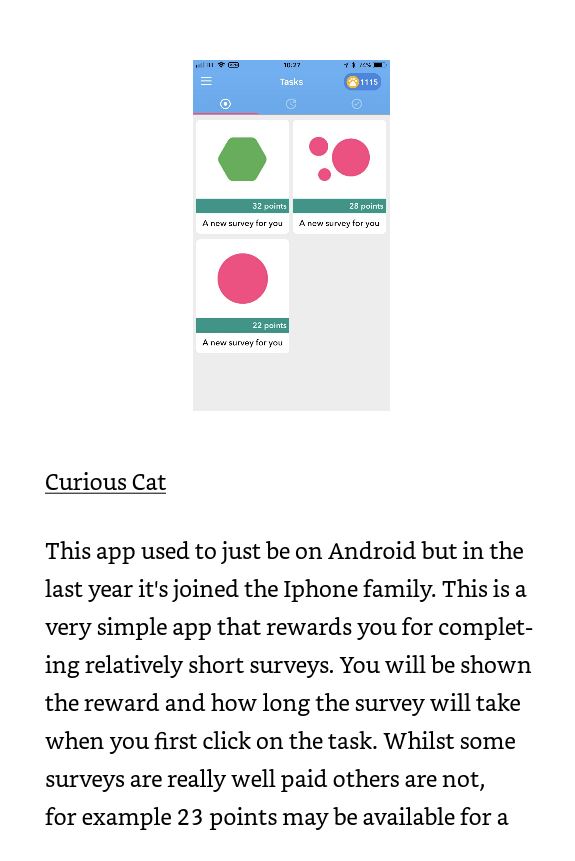
Within each category a number of apps/opportunities are presented. Kathy uses a standard format throughout for this, which is sensible. She starts with a phone screen capture of the app in question followed by a one- to three-paragraph description. Here’s a typical example…
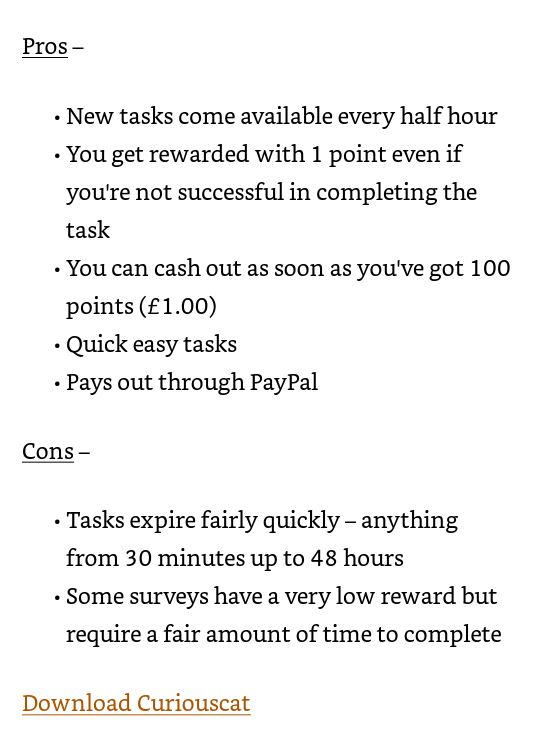
The description is followed by a list of pros and cons for the app in question, and (in most cases) a download link. Again, here is an example:
In some cases the download link takes you to the website for the app, but in others it takes you to to the Apple (iOS) App Store. It is a pity there aren’t also links to the Google Play Store for Android users (like myself). This means the book is probably best suited for iPhone users. Android users can benefit from it as well, but they may have to search for the relevant app themselves in the Google Play Store.
On the plus side, I was amazed by the number of sideline-earning apps Kathy has identified. Some, of course, I knew about already, but many I didn’t. I can see I will be busy for some time checking out all these money-making resources!
I like the concise, well-written descriptions, which tell you everything you need to decide whether an app may be of interest. The list of pros and cons is also invaluable. Kathy appears to have tried all these apps herself (which would be a full-time job, I’d have thought) and she shares her advice and experiences using every app, good and not so good!
As the book’s subtitle, Get a side income for extra treats for you and your family, indicates, you won’t make a fortune from these apps or even (probably) enough for a full-time living. But you can definitely earn a valuable sideline income. Some pay in cash – usually via PayPal – while others pay you in Amazon (or other store) gift vouchers. (Personally, I’m a big fan of MobileXpression, which I wrote about in this blog post. It keeps on churning out £20 Amazon vouchers for me every few weeks, for doing no more than keeping the app installed on my phone.)
As indicated earlier, I did think the book could be better organised. In particular, I would like to have seen a table of contents at the front, with the content organised under proper chapter headings and hyperlinked. That would make it much easier to use as a reference resource. It would also be good if the apps described in each chapter were arranged in alphabetical order rather than (I assume) randomly.
Overall, though, How to Make Money Using Your Mobile is a great little e-book, and anyone hoping to boost their income is bound to find something of interest – and value – in it. At the current modest asking price of £2.99 (or free on Kindle Unlimited) it would make a good value addition to your sideline-earning library.
I have just returned after a three-day break in the Welsh coastal town of Aberystwyth.
It was actually my third visit to Aberystwyth. I first went there a couple of years ago on the recommendation of friends, and liked it so much I have gone every year since.
On previous occasions I stayed at the Marine Hotel on the seafront overlooking the North Beach. The Marine is a traditional seaside hotel and I do like and recommend it, even though the reception staff can be a bit glum 😀
This time I fancied a change, though. I have been impressed by my recent forays into self-catering (especially on my recent visit to Yorkshire), so I decided to see what was available in that line in Aberystwyth. I ended up booking three nights at the Seabrin apartments, pictured below.
Seabrin is situated overlooking the seafront at the quieter South Beach, not far from the harbour. I have embedded a map of the area below (courtesy of Booking.com).
There are actually three apartments at Seabrin, all self-catering (at one time the owners offered B&B, but for various reasons they no longer do so).
The top floor apartment is the smallest and has one double bed. The second floor apartment (which I stayed in) has a double bed and a single bed, all in the same room. The first floor apartment is the largest with two bedrooms, so can easily accommodate three or four people. All three apartments have sea views.
The owners, Marise and Wilf, live on the ground floor, so they are usually around if you need anything.
I found my apartment comfortable and spacious. There was a lounge with TV and DVD player and a bay window with wonderful views overlooking the beach and sea. I spent quite a bit of time just sitting here looking out, hoping to see dolphins in the bay. Marise told me that dolphins had been spotted the week before, but the sea was probably just a little too rough while I was there. It was still wonderfully relaxing, though.
There was a separate kitchen, well equipped with electric cooker, dishwasher, microwave, fridge/freezer, and so on. The bedroom was at the back of the house, with a good-sized shower room a couple of steps down from it. The separate WC with wash hand basin was outside the bedroom at the end of a short corridor. It’s a slightly eccentric layout, but does mean that if there are two of you, one can take a shower while the other is, er, washing their hands.
The decor in the apartment was a little quirky – the glittering glass-covered kitchen wall reminded me of a nightclub – but obviously for a few days that’s not a problem. There were lots of books around the apartment which made me feel at home, and a selection of videos too.
As far as eating is concerned, Seabrin is only a short walk from the town centre, so there are plenty of restaurants nearby and shops for buying provisions. There is a large Marks and Spencer’s with a food hall, where I bought a couple of ready meals. On my last night I intended to eat out, but couldn’t get a table at The Olive Branch, the Greek restaurant I have been to before. I ended up getting a takeaway meal from The Seafront Palace (just round the corner from The Olive Branch) instead. I ordered Sweet and Sour Chicken Hong Kong Style with Egg Fried Rice. It was delicious, so I highly recommend it if you visit Aberystwyth and fancy a Chinese!
Seabrin has free wifi, which worked perfectly during my stay (not always the case in my experience). The location is quiet and peaceful, and I slept very well.
Financials
As Pounds and Sense is primarily a money blog, I should say a few words about this.
I paid £375 for my three-night stay in the one bedroom apartment at Seabrin, which I thought was reasonable. I paid an initial 70% deposit of £262.50 when I booked (in March 2019), with the balance of £112.50 payable a month before my holiday dates. Note that these payments are not refundable if you cancel, so you need to be pretty sure you are going before putting your money down. Or take out separate holiday cancellation insurance, of course.
Costs obviously vary according to the accommodation you want, when you want it, and for how long. The price I paid worked out to £125 a night, which – as I said above – seemed reasonable bearing in mind the location and what you get for your money. Of course, unlike most hotels, you don’t get a cooked breakfast, and neither is a daily housekeeping visit included. On the positive side, though, you do get much more space, a fully equipped kitchen, a separate lounge and bedroom, and complete privacy during your stay.
One other thing to bear in mind is that Seabrin do not allow dogs in the property or children under the age of 12.
You can check current prices and availability on the Booking.com website. You can book this way (which I did) or directly with the property. The latter method may or may not work out cheaper.
Things to Do
I shan’t give you a blow-by-blow account of what I did while I was there. However, I will highlight a few of my favourite attractions in and around Aberystwyth.
1. Constitution Hill
This is the famous promontory at the northern end of Aberystwyth (see cover photo). If you’re feeling energetic you can walk up it, or for a few pounds you can take the historic Cliff Railway. A standard return ticket on this costs £5, but over-60s pay just £3.50.
At the top you can enjoy spectacular panoramic views across Aberystwyth. You can also visit the Camera Obscura, which on a bright sunny day is very impressive (not so much when it’s cloudy, though). I also recommend a coffee and slice of cake at the Consti Cafe. They serve excellent cappuccinos, and also have free wifi which works without having to log in. I’ve spent an hour in here just enjoying coffee and Welsh cakes and reading my newspaper 🙂
2. Vale of Rheidol Railway
This heritage steam railway will take you on an hour-long journey from Aberystwyth along the beautiful Rheidol Valley to Devils Bridge. You can read more about it on the railway’s website and book tickets as well. It’s possible to upgrade to first class for £3 on the day (one-way only), but having done this I’d have to say I don’t see much point. I actually found the standard class carriages (and seats) more comfortable.
Devils Bridge itself is well worth a look if you have time before getting the train back. Three bridges were built here, one on top of the other (at different times, obviously). There are two walks you can take for a small fee. The Punch Bowl walk costs £1 and gives you a chance to view the three bridges and the the stream that flows under them. The other, longer walk takes you the other way from the bridges, past some stunning waterfalls. This costs a maximum of £4 at the time of writing, though there are some discounts for older people and children. As for why the place is called Devils Bridge, I’ll leave you to find that out for yourself!
3. Ceredigion Museum
The Ceredigion Museum in the centre of Aberystwyth is free to visit and a great option for a rainy day. It’s in a beautifully preserved Edwardian theatre, with many of the original fixtures and fittings still in place. There are fascinating displays here on all aspects of Welsh life and Welsh history.
4. Bwlch Nant yr Arian
I visited this ‘forest centre’ a few miles out of Aberystwyth on the A44 for the first time this year. There are various scenic trails you can walk (or run) from the centre, and a number of mountain biking trails as well. The highlight for me, though, was the Red Kite feeding, which takes place at 3 pm every day in the summer. Once their food has been put out, the skies fill with these magnificent birds (I counted over 100). Whether or not bird-watching is your thing normally, it’s something to marvel at. Here’s a link to the website for more info. And yes, there’s a nice coffee shop as well!
Final Thoughts
As you may gather, I enjoyed my short break in Aberystwyth staying at Seabrin Apartments, and am happy to recommend both the town and the accommodation for a short break. Aberystwyth is a bit quieter and less commercialized than Llandudno (though I also like it there), and the fact that it’s a university town means it has quite a cosmopolitan feeling. It’s a good place to chill out, but there are lots of interesting things to see and do as well.
As always, if you have any comments or questions about this post, please do leave them below.
If you enjoyed this post, please link to it on your own blog or social media:
I was there to visit my sister Liz and her family, who live in Wilsden, near Bradford. They don’t really have room for me to stay with them, so I did an internet search and discovered Hewenden Mill Cottages, which was just a mile and a half from them.
At first I assumed that, as these were self-catering cottages, they wouldn’t be suitable for a solo visitor who was only coming for a long weekend. Turns out I was wrong, though. They were very happy to accommodate me for three nights, and the cost was, if anything, cheaper than staying at a hotel (see Financials, below).
Hewenden Mill Cottages is in a secluded location between the villages of Wilsden and Cullingworth. I have embedded a map of the area below (courtesy of Google Maps.
The Accommodation
Hewenden Mill Cottages and Apartments (to give their full title) is based around not one but two old mills which have been converted into holiday cottages.
The main Hewenden Mill complex (which includes the reception, shown in the cover photo above) is easy to access from the B6144 (also called Lane Side). I was staying at Bent’s Mill, however, which is a short distance from Hewenden Mill. It’s a seven-minute walk from one to the other through some picturesque woodland, but unfortunately it’s not possible to drive through this. I have posted a photo of Bent’s Mill below.
When I arrived I was met at reception by the charming Susan, who told me she was the owners’ daughter. She asked me to follow her in my car as she drove to Bent’s Mill. I was glad to have her as my guide, as the journey involved going on narrow, twisting country lanes, and for my first visit it was reassuring to have her car in front and know I was going the right way. It also came in useful when we turned a corner and met another car coming the opposite way. As there were two of us and only one of them, they had no option but to back up!
I was staying in the Wheel Pit House at one end of Bent’s Mill. As you may gather, this is where the water wheel once stood. It’s no longer there, but you can see the chamber where it was through a window in the entrance hall (or from the outside). You can read more about the Wheel Pit House on this page of the excellent Hewenden Mill Cottages website. Here is my own photo of the exterior.
My accommodation was on three levels. On the ground floor was the front door and entrance hall. Upstairs on the first floor was a double bedroom and bathroom. On the top floor were the kitchen and lounge, from which you could enjoy lovely views of the woodland and mill pond (see photo below).
I have to say I was very impressed by my cottage. It was spacious and comfortable, with everything you would need for a short stay (or a longer one).
The kitchen included an electric cooker with ceramic hob, fridge, freezer, dishwasher and washing machine – all very clean and modern, and considerably nicer than I have at home!
The cottages have free wifi, and all costs such as electricity and VAT are included in the price. There would have been plenty of room for a couple, and a young child or baby as well. To me as a solo visitor it felt palatial, especially after the compact ‘Forest Retreat’ I stayed in a few weeks ago at Aberdunant Hall. As a matter of interest, I worked out that at Hewenden my accommodation was over six times larger!
A nice touch is that the owners provide a complimentary ‘welcome pack’ of groceries on arrival. This included bread, milk, butter, preserves, orange juice, biscuits, and so on. A selection of breakfast cereals in individual boxes and sachets was also provided, along with coffee and Yorkshire Tea (see below!).
Hewenden Mill and (especially) Bent’s Mill are a bit off the beaten track and there aren’t any shops close by (though there is a Co-op in Cullingworth about a mile away). As I was mostly eating with my sister and her family that wasn’t an issue for me, but if I’d had to buy some provisions it wouldn’t have been a problem. There are also several takeaways, cafes and restaurants within a mile or two.
Financials
As Pounds and Sense is primarily a money blog, I need to say a few words about this.
I paid £327 (including VAT) for my three-night stay in the Wheel Pit House at Hewenden Mill Cottages, which I thought was very reasonable. I paid an initial £50 deposit when I booked, with the rest due on arrival.
Costs obviously vary according to the accommodation you want, when you want it, and for how long. I did though notice that the longer your stay the cheaper (per day) it works out. While you can book for one or two nights, it becomes much more economical if you are staying for three nights or longer.
The price I paid worked out to £109 a night, which – as I said above – struck me as very reasonable (and cheaper than most of the hotels I have stayed at recently). Of course, unlike most hotels, you don’t get a cooked breakfast, and neither is a daily housekeeping visit included. On the positive side, though, you do get far more space, a fully equipped kitchen, a separate lounge and bedroom, and complete privacy during your stay.
Obviously I was visiting family, so I won’t go into detail about everything I did while I was there. However, for the benefit of anyone who may be considering visiting the area, I will mention a few of the local attractions.
First of all, Hewenden Mill is just a few miles from Haworth, the home of the Bronte sisters, Charlotte, Anne and Emily (indeed, the area is sometimes called Bronte Country). If you haven’t visited before, I would say this is a must-see. You can go around the parsonage where the sisters were brought up and wrote their famous novels such as Jane Eyre and Wuthering Heights. The parsonage has been preserved (or restored) largely as it was in their day. I found it quite an emotional experience seeing the family home where the sisters lived, wrote, and tragically all died at an early age
The village with its cobbled high street is also well worth seeing, and there are numerous (enticing) tea and cake shops.
And finally, Haworth has a station on the Keighley and Worth Valley Railway, a heritage steam railway which runs between Keighley and Oxenhope. The line and its stations has been used in numerous period film and television productions, including the film The Railway Children. More information and timetables are available via the KWVR website. You can get a 10% discount on a Day Rover ticket if you buy your ticket more than seven days in advance.
Also nearby is Saltaire, the Victorian model village built by textile magnate and philanthropist Sir Titus Salt to house the workers at his mill. The mill itself is still there, and large parts are open free of charge to the public. Inside is a bookshop, and you can still see some of the old heavy machinery there that was used in the mill. There is also a bustling coffee shop and restaurant, along with displays and exhibitions. The River Aire runs alongside the town (hence the name, of course), and the Leeds and Liverpool Canal too (great for a brisk walk along the towpath!).
And, of course, the whole of the area is incredibly scenic, with lots of scope for country walks, runs or cycle rides, as you prefer. From Hewenden Mill Cottages there are various walks you can take, from a five-minute stroll to Goit Stock Waterfalls (see photo below) to much further afield.
Final Thoughts
As you may gather, I very much enjoyed my stay at Hewenden Mill Cottages and thoroughly recommend them. Obviously, the fact that they are only a short drive from my sister’s home was a big attraction for me. Even if that wasn’t the case, though, I would definitely consider going back for a short break.
There is plenty of choice of accommodation, though at weekends especially it does get popular, so it’s definitely advisable to book a few weeks in advance.
If you want complete peace and seclusion, I can highly recommend staying at Bent’s Mill, where the only noise to be heard is birdsong. My one slight reservation is that, as mentioned earlier, getting there by car involves a somewhat nerve-racking drive along narrow, twisting lanes, where you really hope you don’t meet someone coming in the other direction! it’s perfectly do-able, of course, but if you don’t fancy this particular challenge then staying at the main Hewenden Mill might be a better choice for you.
As always, if you have any comments or questions about Hewenden Mill Cottages, please do post them below.
If you enjoyed this post, please link to it on your own blog or social media:
Excuse the slightly tongue-in-cheek title. Nextdoor is actually a free social network for local communities.
I’ve been a member for about a year now. In the last few months I have seen the number of people who have signed up in my neighbourhood grow considerably. So I thought today I’d share my thoughts about it.
Nextdoor is the private social network for you, your neighbours and your community. It’s the easiest way for you and your neighbours to talk online and make all of your lives better in the real world. And it’s free.
People are using Nextdoor to:
Borrow a ladder
Organise a Neighbourhood Watch Group
Track down a trustworthy babysitter
Find out who does the best paint job in town
Ask for help keeping an eye out for a lost dog
Find a new home for an outgrown bike
Finally call that nice man down the street by his first name
Nextdoor’s mission is to provide a trusted platform where neighbours work together to build stronger, safer, happier communities, all over the world.
That’s a reasonable summary, I think. It corresponds with the types of uses people in my local area are putting it to, as the screen capture below illustrates.
Here are my personal thoughts and experiences of Nextdoor as a member…
How I Use Nextdoor
As well as keeping an eye on what is going on in my neighbourhood, I have also used Nextdoor as a way of finding reliable tradesmen. This has worked pretty well, although I do find that when you ask for recommendations from your neighbours, what you actually tend to get is a stream of replies from the tradesmen themselves angling for your custom. Of course, it’s quite understandable that tradespeople are cottoning on to the fact that this can be a good way of getting work.
I have also found Nextdoor good for finding local people willing to do smaller jobs that the average tradesman might not be interested in. Here’s an example message I posted recently…
Man (or Woman) with a Ladder Needed
I recently had some scaffolding up at the back of my house. When the scaffolders took it away, they left a couple of short metal tubes near the edge of the roof. Despite several requests they haven’t come back for them and I’m concerned they may cause damage if they fall down. So I just wondered if someone with a ladder might be willing to pop over and remove them for me? Should only be a five-minute job and I’m happy to pay a tenner or donate the money to your favourite charity. Will also give you a review on any relevant website if you’re a tradesperson.
I got a reply on Nextdoor within an hour from the wife of a local roofer. She said her husband would be happy to come and do this for me. We exchanged private messages, and the roofer (Clive Byrne of CMB Roofing – many thanks!) came over that afternoon and removed the offending items for me. As per my message, I paid him £10 and put a review on Google for him. This solved a niggling problem for me with the minimum of hassle, and is a good example of the sort of thing Nextdoor can work well for.
Any Drawbacks?
As with any social network there can be differences of opinion, and worse…
I have seen a few instances where people have been criticised for things they have said or shared on the platform. Sometimes (in my opinion) this may have been justified, but other times I think those concerned have been, shall we say, rather thin-skinned.
One issue that has arisen a few times has been when someone reports suspicious activity and others then criticise them for stereotyping or being too quick to make judgements. I do accept that this can be a difficult issue, but personally I think that if someone observes suspicious, possibly criminal, behaviour, it’s not unreasonable to alert their neighbours about it. But like it or not, if you do this, you can expect to be criciticised by some people.
Unsurprisingly, politics (national and local) is another contentious area. For example, where I live the local council is currently considering a planning application for a KFC drive-through. Some people expressed their disapproval about this quite forcibly, while others argued (equally forcibly) that it would be beneficial for the area. Of course, there’s nothing wrong with a bit of robust argument, but some of the comments became unpleasant and borderline abusive. Some people get hot under the collar when they discover that their neighbours don’t share their views, and it can rather spoil the friendly, community vibe that Nextdoor is trying to promote. Of course, the same thing happens on Facebook and other social networks, but if you join Nextdoor you need to be prepared for this.
Nextdoor is monitored and supervised by what the network calls ‘Local Leads’. These are – as I understand it – ordinary members who have additional powers, e.g. to delete posts that breach the community’s guidelines. I now know who my Local Lead is, but only because I researched this carefully. I haven’t ever seen any posts by them on the platform, much less any evidence of constructive interventions. Maybe all this goes on behind the scenes – I don’t know. I do think Nextdoor could be more up front about who the Local Leads are and how they are chosen.
Finally, it would be wrong not to mention that joining Nextdoor has privacy implications. As a member, you can see the names of people in your local area and (in most cases) their street and house number. And they, of course, will be able to see yours. This information is only available to people in your immediate area and pseudonyms are not allowed. I can understand the reasons for this, but if you are uncomfortable with it, Nextdoor may not be for you. In any event, be careful about sharing personal information in your profile, especially anything you might not want your neighbours to know!
How to Join
If you do decide to give Nextdoor a try, you can sign up for free at https://www.nextdoor.co.uk. Fill in the short form on the front page (see screen capture below) including your postcode, then click on Find Your Neighbourhood. You will then be able to see recent posts by your neighbours, with other information (e.g. a map of your area) available via the left-hand menu.
You can also access Nextdoor via a mobile phone app. Versions are available for Apple (via the iTunes App Store) and Android (via Google Play).
Final Thoughts
Although (as stated above) I do have certain reservations about Nextdoor, overall I feel I have benefited from it, and it has certainly increased my awareness of events going on in my neighbourhood. I have also, as mentioned above, found it a useful resource for finding tradespeople and getting recommendations.
I’d love to hear your views about Nextdoor, and also your experiences (good or bad) if you’re already a member. Please do leave any comments below as usual.
If you enjoyed this post, please link to it on your own blog or social media:
It was the first time I had stayed at Aberdunant Hall (as I’ll call it from now on), but I know the area pretty well. I used to stay at the Tremeifion Hotel just across the estuary from Portmeirion, but unfortunately this closed last year. So I went online to research alternatives in the area and discovered Aberdunant Hall. It had generally excellent reviews, so I decided to check it out for myself.
Aberdunant Hall is about four miles from Porthmadog, near a small town called Prenteg. I have embedded a map of the area below (courtesy of Booking.com).
With the help of my satnav I had no difficulty finding Aberdunant Hall. On the main road there is a gatehouse and you have to turn in here and follow a narrow, winding road through some scenic woodlands before you reach the hotel.
The hotel is actually quite small – it has only about a dozen rooms for guests – and the reception area is basically a desk in the dining room. A friendly and helpful young man took my details and showed me to my room.
I say my room, but I had actually opted to stay in what the hotel describe as a Forest Retreat. This is a small cluster of wooden cabins a few minutes’ walk from the main hotel. Here is a photo to give you an idea. Mine was at the top of the hill, in the middle of this picture. You can see the view from my balcony in the cover image (above).
The Forest Retreats are certainly compact (the website says they they measure 14 ft by 10 ft). There is a fold-down bed which when pushed up reveals a sofa with a mirror above it (the mirror in mine was cracked, unfortunately). There is a small but well-equipped kitchenette by the door and a bathroom with a shower cubicle at the back.
You also get a balcony with a table and chairs. I know if I had been staying with my late partner Jayne, I would have ended up being banished here quite often while she was getting dressed and ready! There isn’t much space for hanging clothes or putting things away, so I wouldn’t recommend this type of accommodation if you are planning to stay any longer than a few days.
If you are in one of the Forest Retreats – or any other accommodation in the hotel and holiday park – you have the option of eating at the hotel restaurant if you wish (you will need to book in advance). I ate there on the first night and enjoyed an excellent meal of potato and leek soup, smoked haddock with poached eggs and spinach, and vanilla cheesecake with a strawberry topping. The other two nights I cooked my own meals, but that was just for convenience (and to save a few pounds) really.
A cooked breakfast is included in the price you pay. This is basically a self-service buffet, though a waitress was around to answer questions, fix the drinks machine and toaster when they broke down, and deal with any special requests (e.g. vegetarian/vegan options). I enjoyed the breakfasts. I rather prefer the buffet style, as you can choose exactly what you have and when you have it (e.g. I prefer to have my toast at the end). It would have been nice if scrambled eggs had been available as well as fried, but that’s a very minor criticism.
Although you don’t get any sea views at Aberdunant Hall, the country park location is undoubtedly picturesque. As well as trees and plants, the park (which also houses lots of static caravans and lodges) is criss-crossed with small streams. My Forest Retreat was wonderfully peaceful, and I slept very well while was I was there.
Financials
As Pounds and Sense is primarily a money blog, I should say a few words about this.
I paid £395 (including VAT) for my three-night stay in a Forest Retreat at Aberdunant Hall, which I thought was reasonable. My three-course meal in the restaurant including a drink came to £29.75, which again I didn’t think excessive.
There are plenty of other accommodation options at Aberdunant Hall. They include a variety of rooms in the hotel itself, from a basic single room starting at £85 a night to a Victorian-style luxury room with four-poster bed starting at £185 a night. Or if you prefer to stay in the park rather than the main hotel, you can book a Woodland Escape Suite. These are over twice the size of the Forest Retreats and cost from £185 a night. I like the sound of them, even though they are (of course) really aimed at couples. You can see all the accommodation options at Aberdunant Hall Hotel on this page of their website.
One comment I would make is that – a little surprisingly – there is no shop on the site. So if you are planning to cater for yourself at least some of the time, you may want to bring some provisions with you. The nearest shopping centre is Porthmadog, about four miles away. This has a large Tesco and a variety of other shops.
Finally, I should mention that (as I often do) I booked this break via Booking.com. I like this site for a number of reasons, including the fact that it shows you what rooms are available on any given dates for your accommodation and even suggests alternative dates if your first choices are unavailable. But you can, of course, also book directly with the hotel if you prefer. I find there isn’t usually much difference in price one way or the other.
Things To Do
Aberdunant Hall is on the edge of Snowdonia, so there is no shortage of things to do in the area. As well as walking, there are some popular tourist attractions as well. Here are the main places I visited and things I did while I was there…
1. Portmeirion
This is about twenty minutes’ drive from Aberdunant Hall and I spent my first morning here. Portmeirion is a beautiful Italianate village created by the architect Clough Williams Ellis. These days it is probably best known as the location for the 1960s cult TV series The Prisoner, starring Patrick McGoohan. It is a wonderful place to while away a few hours. I recommend taking one of the guided tours that start near the entrance and run more or less continuously through the day. I also recommend the woodland train, which offers an effortless way of exploring the wooded area behind the village and includes a photo stop at a viewpoint above the village (see below). There is an admission fee to get into Portmeirion, but you can save a pound or two by booking at least a day in advance on the website.
2. Festiniog Railway
This heritage steam railway has two separate lines, both of which run from Porthmadog. The Welsh Highland Railway takes you on a two-and-a-quarter hour trip through the heart of Snowdonia to Caernarfon, while the original Festiniog Railway takes you on a one-hour trip to Blaenau Festiniog. As I only had the afternoon I took the shorter journey, but I have done the Welsh Highland Railway trip before and highly recommend it as well. You can get more info on both (and book in advance if you wish) via the Festiniog Railway website.
3. Snowdon Mountain Railway
On my second day I drove to Llanberis, which is about 40 minutes by car from Aberdunant Hall. At Llanberis you can get the Snowdon Mountain Railway, which will take you all the way to the peak of the highest mountain in Wales. This is a very popular attraction, so I highly recommend booking in advance, which you can do via the website. I was fortunate that on the day I went the weather was perfect and so was the visibility. Here’s a photo I took on the summit, although no photo can really do justice to the amazing views in all directions.
4. Electric Mountain
This is another tourist attraction in Llanberis, so I thought I’d combine the two. Electric Mountain is actually the Dinorweg hydro-electric power station. For a modest fee you can take a one-hour guided tour on a mini-bus which takes you deep into the mountain. I found this interesting and informative, and the engineering on display is undoubtedly impressive. No photos of this, as they don’t allow you to take cameras or mobile phones on the tour, presumably in case you are planning a spot of industrial espionage. You can book tours in advance on the website. At the time of my visit they were renovating the visitor centre, so visitors had to collect their tickets and assemble for the tour at a portacabin in the car park.
Closing Thoughts
i enjoyed my visit to Aberdunant Hall and would certainly consider going again. I am not sure if I would stay in a Forest Retreat another time, though. Even for me, as a solo visitor, it felt cramped. If you are going as a couple, I’d imagine that staying more than a day or two could put quite a strain on your relationship!
There are many positives, though. The woodland location is peaceful and picturesque, and allows easy access to Snowdonia and the Lleyn peninsula. All the staff I met were charming, and the food was very good as well. Although I’ve been a little disparaging about the size of the Forest Retreats, mine was spotlessly clean and had all the facilities needed for a short stay, including a cooker, fridge and microwave.
As always, if you have any comments or questions about this post, please do leave them below.
If you enjoyed this post, please link to it on your own blog or social media:
Today I wanted to give you a heads-up about a market research company that is always looking for new members for its (paid) audience panel.
As the name suggests, The Viewers researches people’s TV viewing habits. They regularly run studies about this and pay participants in cash (via PayPal) or Amazon vouchers.
One type of study they run is focus groups. These are typically held in large cities. They generally last 90 minutes and involve discussing current and planned TV programmes in a small group led by a researcher. You can expect to be paid at least £40 (cash in hand) plus free refreshments for a 90-minute group discussion, and often more if the project involves tasks to complete before or after the discussion.
The Viewers also run online focus groups, which (obviously) you can do from the comfort of your own home. Payment is similar to the physical focus groups, though without the refreshments!
They also run a variety of other studies and surveys. A recent one I took involved tuning my TV to a number of Freeview channels and taking photos of what was on the channels in question, including the station logo at the top of the screen (see sample photo below). I used my mobile phone camera to do this, and uploaded the photos to the website as instructed.
This whole task took me about 20 minutes and I received a £5 Amazon voucher in payment (I could have opted for a slightly smaller amount in cash, but as I’m always buying stuff from Amazon, a voucher was just as good for me).
As well as these paid studies, The Viewers also run some shorter ones where payment takes the form of prize draw entries. Here’s one I was sent recently by email:
You could be suitable to share your thoughts on a TV actor or actress. Those taking part will initially be entered into a prize draw with some participants invited to an optional longer paid survey within the next week. If you would prefer not to hear about prize draw surveys, please update your research and communication preferences towards the bottom of this email.
Reward: Entry into this project’s prize draw with 1 x £50 flexi e-gift card and 10 x £10 flexi e-gift cards up for grabs. These can be spent at Amazon, Argos, Cineworld, M&S, Pizza Express, Tesco & more.
Additional prize draw: All taking part (including those who don’t qualify) will also be entered into our additional May prize draw which runs across all surveys with 1st prize of £100 amazon voucher, 2nd prize of £50 amazon voucher and 5 runner up £10 amazon vouchers!
Time required: 5 minutes (approx)
There is no obligation to do these (or any) studies, as there is no guaranteed reward. But if I’m not busy with other things I tend to, as they are usually quite interesting and take no more than five minutes to complete.
Obviously, if you never watch TV, The Viewers isn’t going to be for you. But you don’t have to be a telly addict either. On the website, they say, ‘ We want to speak to all manner of viewers, from ardent fans of a programme to those who just catch the odd bit of TV. Please just be completely honest when registering and you will be contacted when a project is right for you.’
Clearly nobody is going to make a fortune from The Viewers, but it can be a great addition to your portfolio of sideline-earning opportunities, and the studies are generally interesting and enjoyable as well.
To register with The Viewers, click on this link (or any of the links in this post) and click on the Join Now button. Enter your details and you will then receive emails from them any time they have a study you may be eligible for. In my experience, payments (or online gift vouchers) normally arrive within a week.
As always, if you have any comments or questions about The Viewers, please do post them below.
If you enjoyed this post, please link to it on your own blog or social media:
I recently spent a weekend at Lake Vyrnwy, a few miles over the border from Shropshire into Wales. I had wanted to visit the area since watching a TV programme a few months ago about the history of the lake.
Lake Vyrnwy is actually a man-made lake (or reservoir if you prefer). It was created to provide a water supply for Liverpool in the 19th century. It’s about 25 miles from Oswestry. I’ve embedded a Google Map below showing the area.
My Hotel
I stayed at the Lake Vyrnwy Hotel and Spa (pictured below), which is near the dam at the western end of the lake. I booked on the Booking.com website.
The hotel dates back to 1890 – it was originally built to accommodate senior managers and engineers on the construction project. Since then it has been extended several times, although as recently as the 1970s it was still owned by the water company (it’s now in private hands). The hotel doesn’t make as much of its interesting history as it could, in my opinion.
Anyway, I pushed the metaphorical boat out and booked a Premier Lake View Room via Booking.com. The view certainly didn’t disappoint, as the cover photo (taken from my balcony) indicates.
My room was on the top floor, up various flights of stairs. One thing to bear in mind if you plan to stay here is that there is no lift in the main hotel, though I was told there is one in the spa (which I didn’t go in, partly because you have to pay extra – see below).
My room was spacious and comfortable, with all the features you might expect from a four-star hotel, including tea and coffee-making equipment, flat-screen TV, refrigerator, walk-in shower, and so forth. There was also good free wifi in the room, and in the public areas of the hotel too (just as well, as there was no mobile phone signal!).
I had my breakfast and evening meals in the hotel. Breakfast was included in the fee I paid. Evening meals were extra, though to be honest there isn’t really anywhere else to eat in the vicinity (apart from a couple of cafes that aren’t open in the evening anyway).
A lot of people rave about the food at the Lake Vyrnwy Hotel. Personally I thought it was good but not exceptional. It was let down by little things, e.g. at breakfast on the first day the muffin with my Eggs Benedict was burnt. I went for the full Welsh breakfast the next day, and on my final day decided to chance the Eggs Benedict again. This time the muffin wasn’t burnt but dense and tasteless – I’m guessing it had come straight out of the freezer. I’ve had much better Eggs Benedicts at my local Wetherspoons. For the money I was paying I’d have expected better really.
You have two dining options at the Lake Vyrnwy Hotel: the restaurant and ‘less formal’ brasserie. My top tip would be to stick to the restaurant and give the brasserie a miss. On my second night I tried it and found it crowded (it’s in a small room and the tables are pushed close together) and noisy. There were also young children running around apparently unsupervised. Okay, the brasserie might be a bit cheaper, but the main restaurant offers a much more relaxed, civilised dining experience, and much better views across the lake as well.
Financials
As Pounds and Sense is primarily a money blog, I should say a few words about this.
For my Premier Lake View Room (with single occupancy) I was charged £589 including VAT for three nights. Obviously I could have booked a cheaper room without the lake view, but in my opinion it would be a shame to stay at the Lake Vyrnwy Hotel and not have this.
Evening meals in the restaurant were charged at £27 for two courses or £35 for three (there were supplements for certain dishes such as sirloin steak). You do also get a complimentary ‘taster’ of fresh soup with home-made focaccia bread, which I enjoyed and recommend.
At the brasserie you order from an A La Carte menu, so the price depends on what you choose.
As mentioned earlier, the hotel also has a spa, for which you have to pay an extra £10 a day admission charge. The spa has a thermal suite, including a sauna, steam room, ice fountain, whirlpool, and tepidarium (no swimming pool though). It offers various treatments at extra cost, including massages, facials, manicures, pedicures, and so on..
Activities
One thing I should mention before describing what I did is that when I visited – the weekend before Easter – it was bitterly cold. The temperatures typically didn’t rise above 4 or 5 degrees, and when you factor in the wind chill as well, it was probably around freezing. I was very glad I remembered to take my quilted winter coat, gloves, scarf and woolly hat!
First Day
On my first day I walked to the dam down the precipitous bridle path from the hotel (I asked the receptionists how many guests they lost on this – they laughed but didn’t reply).
The dam is undoubtedly impressive and leads to a small tourist area with a visitor centre; this is a good place to start your exploration. A short film plays constantly inside with alternating English and Welsh narration. It tells you about the history of the lake, and the various plants and animals that live around (and on) it today. Nature conservation is quite a major theme around the lake.
Also in the village is an RSPB shop and a bird hide that is well worth a visit (see picture below). There is also a friendly cafe called The Old Barn, and Artisans, a cafe and shop where you can also hire bicycles. I had planned to do this myself, but the very cold weather dissuaded me. I did see quite a few – admittedly much younger – people cycling around the lake, though.
A short distance away is a sculpture park, and I recommend this if you fancy an enjoyable walk that isn’t too taxing. The sculptures are all made of wood, and some are quite striking. This one is called Mother Earth, for example.
In the afternoon I walked the opposite way from the hotel to the Victorian Straining Tower (picture below). This Gothic-style building filters the lake water through mesh before it starts its journey to Liverpool. Unfortunately it’s not open to the public, but you can admire it from the road. It’s a pity there isn’t an explanation board, just a forbidding ‘Keep Out’ notice.
Second Day
On my second day I decided to drive around the lake, stopping at points of interest along the way. There is a good (if narrow) road all round the lake, about 12 miles in total.
I had picked up a leaflet from the hotel reception about walks in the area, and decided to do the two-mile round trip to Rhiwargor Falls. This walk starts near the east end of the lake at a convenient car park. Despite the cold I enjoyed this. I didn’t see another soul on foot the whole time, although I did come eye to eye with a few sheep…
The waterfall is pretty impressive, and I imagine if it has rained recently it is even more so. Here is a video I recorded.
On the way back I stopped at another bird hide on the side of the lake, but there wasn’t a lot to see. I spotted a Canada goose and three mandarin ducks and duly logged them on the whiteboard. I erased the previous recorded sighting of six pterodactyls, as I suspected this wasn’t entirely genuine.
In the afternoon I took a short walk from the hotel to visit a church I had noticed before. This turned out to be St Wddyn’s (pictured below).
St Wddyn’s was built in 1880 to replace the original church of that name that was flooded (along with the rest of the old village of Llanwddyn) when the lake was filled. It is a quiet, peaceful place with some beautiful stained glass windows. It is well worth a visit if you are staying at the hotel, as it’s barely 10 minutes’ walk away. Again, I didn’t see another living soul while I was there.
Closing Thoughts
So that was my visit to Lake Vyrnwy. I didn’t hang about on my last day, as it was still very cold, and the wind was getting up as well.
I thought the area was beautiful and unspoiled (if you can say that about a man-made reservoir) and the hotel itself very good despite my minor reservations.
It’s probably not a place to take young children as there wouldn’t be a great deal to occupy them. But if you enjoy beautiful scenery and (especially) if you like walking, running or cycling, it would make a great short break destination. The Lake Vyrnwy Hotel and Spa is also a popular venue for people celebrating their honeymoon or anniversary, or wanting some serious pampering in the Spa. In view of the many steps and lack of lifts it’s probably not ideal if you’re physically infirm, though.
If you like the idea of visiting the Lake Vyrnwy Hotel and Spa, if you follow any of the links in this article you can get a £15 discount via the Booking.com website. This is credited to your card once you have completed your break. I will also receive £15 as a reward for introducing you 🙂
As always, if you have any comments or questions about Lake Vyrnwy or the hotel, please do post them below.
Note: You can get the £15 discount on Booking.com wherever you go on your next visit, be it Lake Vyrnwy or elsewhere. Just click on my link and follow the instructions!
If you enjoyed this post, please link to it on your own blog or social media: