Today I’m spotlighting a new UK high-speed broadband service called Cuckoo.
They are aiming to shake up the world of broadband internet with great-value prices, first-rate customer service, and a social conscience too 🙂
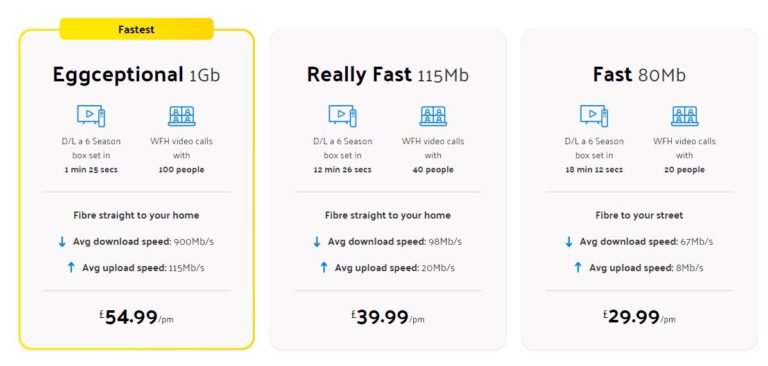
Cuckoo currently have three different customer offers based on speed. Briefly they are as follows:
Eggceptional (1 Gb) – £54.99 a month
Really Fast (115 Mb) – £39.99 a month
Fast (80 Mb) – £29.99 a month
You can see more detailed information from the Cuckoo website in the screen capture below.
Signing up is straightforward via the website and takes just a couple of minutes. Your router will then arrive in the post with full instructions for setting it up. If an engineer is needed (usually it isn’t) Cuckoo will arrange a convenient time for them to come. This is summed up in the graphic from the company website below.
As mentioned, Cuckoo is also a company with a social conscience. They take 1% of each bill and use it to help bring the Internet to places where it’s needed most. That includes conflict zones, natural disaster sites and developing communities. Customers get to choose which project they wish to to support under the Cuckoo Compass scheme.
Finally, Cuckoo aims to deliver top-notch customer service from their team of UK-based customer-support ‘Eggsperts’. Cuckoo have an impressive Trustpilot average rating of 4.6 (‘Excellent’), with 76% of people at the time of writing giving them a full five stars.
For much more information, please check out the Cuckoo website. And of course, if you have any comments or questions about this post, please feel free to leave them below as usual.
Disclosure: This sponsored post includes affiliate links. If you click through and end up making a purchase, I may receive a commission for introducing you. This will not affect the price you pay or the product or service you receive.
If you enjoyed this post, please link to it on your own blog or social media:
Today I am spotlighting BLEND, a peer-to-peer property platform that lends to established businesses (mostly experienced property developers). BLEND’s loan-based crowdfunding platform was founded by a team of former investment bankers with substantial experience in real estate and finance.
What Does BLEND Offer?
BLEND offers individuals the chance to invest in loans secured against property. They specialize in loans in geographical areas that banks and other lending platforms typically pay less attention to, e.g. Northern Ireland, though they fund projects across the whole of the UK. Loans are typically for small developments or building renovation/conversion projects. Some examples are shown in the screen capture below.
As mentioned above, all loans are secured against property. The LTV (loan-to-value ratio) is usually quite low, giving greater security for investors. Interest rates on offer range from 7 to 12 percent.
BLEND has some similarities with Kuflink, which I reviewed in this blog post a while ago (and invest in myself). Both offer the opportunity to invest in secured loans. Kuflink typically offers lower interest rates, however, between 5 and 7 percent. The risk level with Kuflink loans is (arguably) lower, but it should be said that BLEND so far has an unblemished record, with no loans in arrears or default.
The minimum investment on BLEND is £1,000, which means it is really aimed at high net worth and professional investors. It’s also worth noting that only a small number of new loans tends to be available at any given time and they typically sell out very quickly.
Using the AutoLend feature is recommended to ensure that you don’t miss out when a new loan comes on to the market.
Secondary Market
One drawback with any type of property investment is that it’s not as liquid as (say) equity-based investments. BLEND does offer a way around this with its secondary market, however.
Lenders who wish to liquidate early can sell their loan parts on the secondary market. Note that finding a buyer on the secondary market may take time and there is always a risk of no-one wanting to buy your loan part. You can start selling a loan in multiples of £1,000 on the secondary market as soon as funds have been released to the borrower.
Unlike the primary market, as a lender you will be charged a secondary market fee of 0.60% (or £6 for every £1,000 of capital) on capital outstanding. BLEND only charge this upon the successful resale of the loan portion you have listed in the secondary market. The secondary market is free for buyers.
Pros and Cons
A full list of Pros and Cons for BLEND is shown below.
Pros
1. Easy sign-up process
2. Well designed, user-friendly website
3. All loans secured against property
4. Low LTV ratios for added security
5. Manual and auto-invest options
6. In-depth info provided on the website about loans, so you can see exactly how your money will be used (and by whom)
7. No investor losses to date
8. Marketplace (secondary market) for buying and selling loan parts
9. No charges to investors lending on the primary market and only a 0.6% fee if you resell a loan part on the secondary market
10. Rates of return of up to 12% are at the upper end for P2P lending
11. Can invest via a SIPP or SSAS (private pension scheme)
Cons
1. Minimum investment of £1,000
2. Limited supply of new loans to invest in
3. No tax-free IFISA option
Final Thoughts
With a minimum investment of £1,000 (per project), BLEND obviously won’t be suitable for everyone. But if you have that sort of money available, the promised returns of up to 12 percent are undoubtedly enticing.
I like the fact that BLEND are very selective in the projects they back, even if that does mean the flow of new opportunities is limited. It’s also good that they perform in-depth ‘due diligence’ on every loan and publish full details about this on the website, including independent valuations. This means investors know exactly what the potential risks and rewards of a project are.
The absence of any charges to investors (apart from on the secondary market) is another big plus. And the presence of a secondary market offers the opportunity to exit loans early if your circumstances change (though, as noted above, you aren’t guaranteed to find a buyer).
BLEND is probably at the riskier end of the P2P property spectrum, but in my opinion the returns on offer fairly reflect this. Risks are also mitigated by generally low LTV ratios and the detailed research mentioned above. The fact that no loan has so far gone into default or even into arrears is impressive, though there is of course no guarantee this couldn’t happen in future. It does offer some reassurance though.
Finally, BLEND has an average Trustpilot rating of 4.6 (‘Excellent’), with 95% of people awarding them a maximum five stars rating. This is among the highest ratings I have seen for an investment platform on Trustpilot.
As always, if you have any questions or comments about this post or P2P property investment more generally, please do leave them below.
Disclaimer: I am not a qualified financial adviser and nothing in the article above should be construed as personal financial advice. You should always do your own ‘due diligence’ before investing and seek professional advice if in any doubt how best to proceed. All investing carries a risk of loss.
Please note also that this post includes affiliate links. If you click through and perform a qualifying transaction, I may receive a commission for introducing you. This will not affect in any way the terms you are offered or the product/service you receive.
If you enjoyed this post, please link to it on your own blog or social media:
I’ll begin as usual with my Nutmeg Stocks and Shares ISA, as I know many of you like to hear what is happening with this.
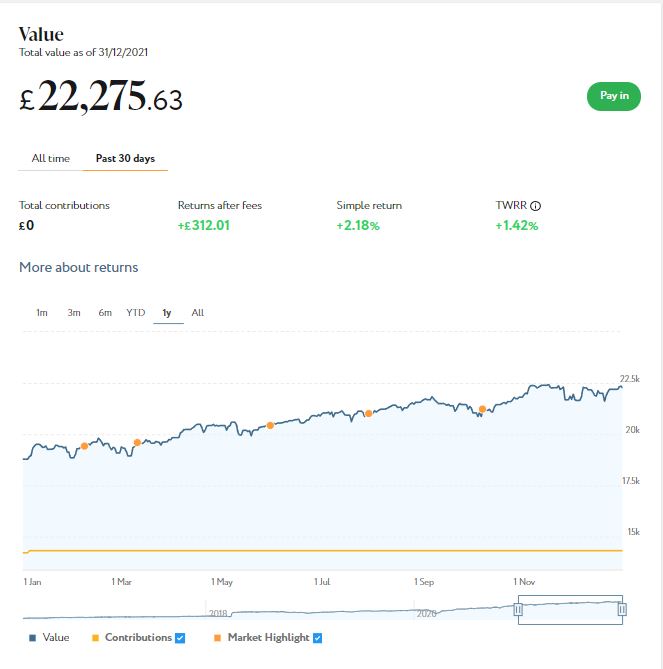
As the screenshot below shows, my main portfolio is currently valued at £22,275. Last month it stood at £21,963, so that is a rise of £312. Obviously in these uncertain times I am very happy with that.
Apart from my main portfolio, I also have a second, smaller pot using Nutmeg’s Smart Alpha option. This is now worth £2,837 compared with £2,795 last month, a net monthly increase of £42. Again that’s a good result, pro rata slightly better than my main portfolio. Here is a screen capture showing performance over the last year.
You can read my full Nutmeg review here (including a special offer at the end for PAS readers). If you are still looking for a home for your 2021/22 ISA allowance, based on my experience they are certainly worth considering.
As regular readers will know, this year I am using Assetz Exchange for my IFISA. This is a P2P property investment platform that focuses on lower-risk properties (e.g. sheltered housing on long leases). I put an initial £100 into this in mid-February 2021 and another £400 in April. Everything went well, so in June 2021 I added another £500, bringing my total investment on the platform up to £1,000.
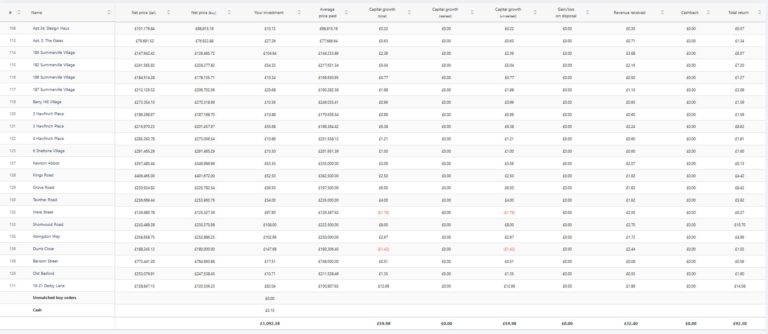
Since I opened my account, my portfolio has generated £32.40 in revenue from rental and £59.98 in capital growth, for a total return of £92.38. Here is my current statement:
To control risk with all my property crowdfunding investments nowadays, I am investing relatively modest amounts in individual projects. I don’t therefore put more than around £150 into any one project. As you can see, I have a well-diversified portfolio with Assetz Exchange comprising 21 different projects. This is a particular attraction of AE in my view. You can actually invest from as little as 80p per property if you really want to proceed cautiously.
As a matter of interest, I have also included a capture of my Assetz Exchange dashboard below. As you will see, this shows an average AER (Annual Equivalent Rate) yield of 5.38%. That is better than I could have got in interest from almost any savings account at the moment and doesn’t include capital growth either. Of course, money in Assetz Exchange is not protected by the Financial Services Compensation Scheme (FSCS), which covers all deposits with registered UK banks and building societies up to £85,000.
Another property platform I have investments with is Kuflink. They have been doing well recently, with new projects launching almost every day. I currently have just over £2,000 invested with them, quite a large proportion of which comes from reinvested profits. To date I have never lost any money with Kuflink, though some loan terms have been extended once or twice. On the plus side, when this happens additional interest is paid for the period in question.
My loans with Kuflink pay annual interest rates of 6 to 7.5 percent. As mentioned above, these days I invest no more than around £150 per loan (and often less). That is not because of any issues with Kuflink but more to do with losses of larger amounts on other P2P property platforms (such as this one). My days of putting four-figure sums into any single property investment are behind me now!
Nowadays I mainly opt to reinvest the monthly repayments I receive from Kuflink, which has the effect of boosting the percentage rate of return on the projects in question
You can read my full Kuflink review here. They offer a variety of investment options, including a tax-free IFISA paying up to 7% interest per year with built-in automatic diversification. Alternatively you can now build your own IFISA, with most loans on the platform being IFISA-eligible.
I’d also particularly draw your attention to their revised and more generous cashback offer for new investors [affiliate link]. They are now paying cashback on new investments from as little as £500 (it used to be £1,000). And if you are looking to invest larger amounts, you can earn up to a maximum of £4,000 in cashback. That is one of the best cashback offers I have seen anywhere (though admittedly you will need to invest £100,000 or more to receive that!).
I have also been investigating another P2P property investment platform called BLEND recently. Like Kuflink, they offer the opportunity to invest in secured loans to experienced property developers. They offer (on average) somewhat higher rates of return than Kuflink, though arguably with a bit more risk. Watch out for my in-depth blog post about them soon. You can also check out what they have to offer on their website [affiliate link].
Moving on, I have another article on the always-excellent Mouthy Money website. This is about how to save money on your water bills. I enjoyed researching this and some of the things I found out were quite eye-opening 🙂
That’s all for now, so please stay safe and warm in these challenging times. And as I said last time, don’t let scare stories in the mainstream media freak you out. It is now increasingly apparent that while the Omicron variant is more transmissible, it also tends to produce less severe illness. I am increasingly optimistic that as 2022 continues the virus will loom less large in our lives. But Covid will be with us forever, so we really do need to learn to live with it and start getting back to normal now.
As ever, if you have any questions or comments about this post, please do leave them below.
Disclaimer: I am not a qualified financial adviser and nothing in this blog post should be construed as personal financial advice. Everyone should do their own ‘due diligence’ before investing and seek professional advice if in any doubt how best to proceed. All investing carries a risk of loss.
Note also that this post includes affiliate links (disclosed). If you click through and perform a qualifying transaction, I may receive a commission for introducing you. This will not affect the product or service you receive or the terms you are offered.
If you enjoyed this post, please link to it on your own blog or social media:
As is customary for bloggers at this time of year, here are the top twenty posts on Pounds and Sense in 2021, based on comments, page-views and social media shares. They are in no particular order. I have excluded any posts that are no longer relevant.
I hope you will enjoy revisiting these posts, or seeing them for the first time if you are new to PAS. Don’t forget, you can always subscribe using the box on the right to be notified of new posts as soon as they appear.
All posts in the list below should open in a new tab/window when you click on the link concerned.
I’ll be taking a break from blogging over the festive period (though I’ll still be around on Twitter and Facebook). I’ll therefore close by wishing you a very merry Christmas (Covid and the government permitting), and for all of us a far better new year 🙂
If you have any comments or questions, of course, feel free to leave them below as usual.
If you enjoyed this post, please link to it on your own blog or social media:
If you like saving money – at this expensive time of the year especially – have you considered shopping at an online auction house?
To be clear, I am not talking about eBay here (much as I love them). Rather I’m talking about more traditional auction houses, who nowadays conduct much or even all of their business online.
An example is Simon Charles. They have four auction centres in the Greater Manchester area and are one of the largest auction houses in Europe. Partly in response to Covid, they now conduct all of their auctions online. Anyone in the UK (or further afield) can therefore bid on them.
Disclosure: I have received assistance with this article from Simon Charles Auctioneers, but don’t have any other connection with them, commercial or otherwise.
Of course, auctions are typically associated with expensive art at one extreme and complete tat at the other. This is not invariably the case, though. While these types of auction houses do exist, there are many that specialize in other areas.
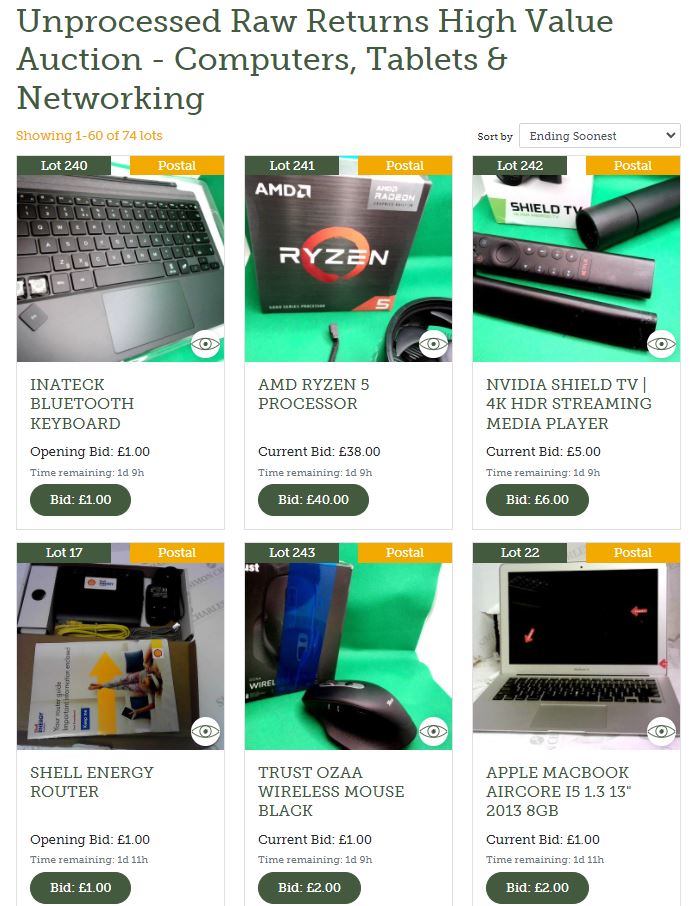
Simon Charles Auctioneers specializes in new, used and returned goods provided to them by high-end retailers. Many of these items are in excellent condition, often still in their original packaging. And with very low or no reserve prices, they can often be snapped up for ridiculously low prices. Here is a screen capture from the Simon Charles website showing some examples…
As you will see, all of the items above have a ‘Postal’ tag at the top right. This means they can be sent by post for a small additional fee. In practice most items sold at SC auctions can be sent by post within the UK. Those that can’t, typically because of their size or weight, are marked for collection only.
In common with other auction houses (and eBay) Simon Charles do impose some additional charges. All lots sold with them are subject to a 18.5% + VAT buyers premium, all lots sold online are subject to 5% + VAT internet fee, and all lots unless otherwise specified are subject to 20% VAT on the hammer price of the item. So it is important to bear these charges in mind when bidding on an item, along with postal costs if you aren’t able to collect your purchase/s in person.
It’s also important to remember that lots sold this way may not be brand new. The products sold at Simon Charles come from high street and online retailers, wholesalers and distributors across the UK. They are in a range of different conditions, from brand new to customer-returned or faulty. They say they don’t always have the chance to test and check items and all products are therefore ‘sold as seen’. But they do have viewing times available to come and check the condition (these times can be found by clicking the Book Viewing button on the auction catalogue or lot page). In these times of Covid, social distancing and masks are required for viewings, which must be booked in advance.
If it’s not possible for you to view in person, they also have an ‘Ask a Question’ feature on each item, so you can gain a better understanding of the product before bidding.
I asked my contact at Simon Charles why they believe buying this way can be better than eBay. Here’s the reply I received: ‘The main benefit of buying from auction over eBay is that our stock tends to be cheaper than eBay. The fact that we’re selling all the stock ourselves means that if you were to buy several lots you could combine shipping, decreasing overall costs. Also, at Simon Charles we work with several large retailers to bring their overstock and returns to auction. These goods aren’t influenced by a price point and can therefore be offered from a much lower amount than someone on eBay might be willing to sell.’
Final Thoughts
I must admit that I had never really thought about buying this way before, but can certainly see the attraction. There are undoubtedly bargains to be had if you are looking for Christmas/birthday gifts or just want to save some money. But I can also see that this method might particularly appeal to small traders looking for stock to resell on market stalls or even on eBay and similar websites. Obviously, if you are a trader registered for VAT, you would be able to reclaim this part of the cost.
In any event, I should like to thank my friends at Simon Charles Auctioneers for bringing this opportunity to my attention. If you have any comments or questions, as always, please do post them below.
If you enjoyed this post, please link to it on your own blog or social media:
Today I am reviewing a children’s book called Grandpa’s Fortune Fables. An ebook copy of this was kindly sent to me by the author, Will Rainey.
Grandpa’s Fortune Fables contains a series of short stories, each following from the last. The central character is a 13-year-old girl called Gail. Over the course of the book she shares a number of lessons she has learned from her Grandpa about money with a boy named Boris (no relation to our PM, I’m sure!).
Boris starts off by bullying Gail, whom he calls a ‘dork’, but she stands up to him and in time they become friends. Gail shares her Grandpa Jack’s money-saving and money-making advice with Boris. He is eager to learn, as his family have always been bad with money.
We learn that Gail’s Grandpa travelled to a (mythical) far-away island, where he learned how to look after his money and became a very wealthy man. Gail has been following his advice and even at her young age is now quite wealthy herself.
Each chapter is essentially a fable illustrating one particular lesson Gail learned from her Grandpa. So one concerns the dangers of Get Rich Quick schemes, another the importance of saving and reinvesting your money, and so on. There are also chapters on the subject of paying tax (‘The Money BIrds’) and the value of donating some of your money to charity.
At the core of Grandpa’s Fortune Fables are three key principles. I hope Will won’t mind if I reproduce them below:
1. Keep one out of every ten seeds you receive 2. Plant the seeds you keep 3. Let your trees GROW
As you may gather, the fables in the book all derive ultimately from the application of these three principles.
Grandpa’s Fortune Fables is designed to teach children about saving, investing and entrepreneurship in an entertaining but informative way (and parents/grandparents may learn some useful lessons too). The stories are all very much of the here and now – even the pandemic and lockdowns get a brief mention (to illustrate how unforeseen events can impact upon specific investments). It’s all very cleverly written, with some charming cartoon-style illustrations as well (see example below).
In my view Grandpa’s Fortune Fables would make a great Christmas/birthday gift for any child aged around 8 to 12 (it could also work for younger and older children). I like how each chapter ends with questions to provoke further thought and discussion. In addition, by correctly answering the multiple-choice questions in each chapter, a letter is revealed. If the child gets all the letters right, they spell out a message which can win them a prize. This is a great idea and a good incentive for reading every chapter (not that such an incentive would likely be needed).
Grandpa’s Fortune Fables is available in print or e-book versions from Amazon (just click on any of the links in this review), or you can order it from any good bookshop. At the time of writing the price is £9.99 for the print version or £3.99 for the e-book. I note that this title is currently number one on Amazon’s best-seller list for children’s books about money and saving, which doesn’t surprise me at all.
Thanks again to Will Rainey for sending me a review copy of his excellent book. If you have any comments or questions – for me or for Will – please do post them below.
Disclosure: As mentioned above, I received a free ebook version of Grandpa’s Fortune Fables for review purposes. In addition, this review includes Amazon affiliate links. If you click through to Amazon and make a purchase, I will receive a small commission for introducing you. This will not affect the price you pay or the product/service you receive.
If you enjoyed this post, please link to it on your own blog or social media:
As regular readers will know, I recently started posting monthly updates about my investments. These partly replace the ‘Coronavirus Crisis Updates’ I was posting from March 2020. You can read my November 2021 Investments Update here if you like
I’ll begin as usual with my Nutmeg Stocks and Shares ISA, as I know many of you like to hear what is happening with this.
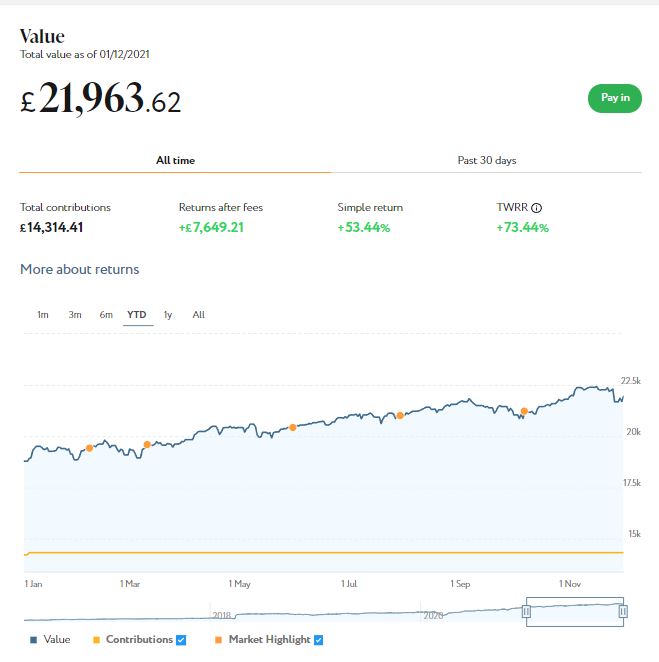
As the screenshot below shows, my main portfolio is currently valued at £21,963. Last month it stood at £21,940, so that is a modest rise of £23. Those figures don’t tell the whole story, though. In the early part of November, the value of this portfolio rose as high as £22,398. Unfortunately then news of the new Omicron variant spooked the markets and share prices fell dramatically. In the last few days there has been a modest recovery, resulting in the small month-on-month gain referred to above.
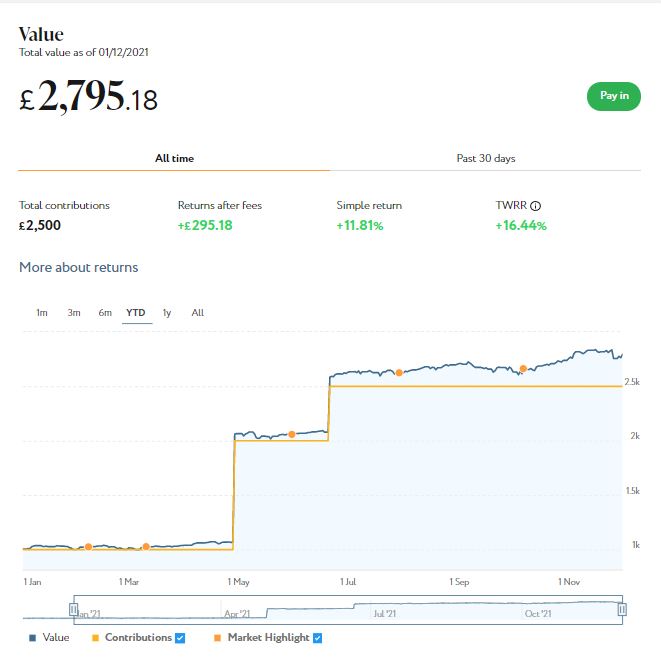
Apart from my main portfolio, I also have a second, smaller pot using Nutmeg’s Smart Alpha option. This has followed a similar trajectory, though it has actually done a bit better than my main pot. It is now worth £2,795 compared with £2,756 last month, a net monthly increase of £39. Here is a year-to-date screen capture showing performance to the start of December 2021.
As I always say, you shouldn’t judge the performance of any equity-based investment on a month-by-month basis. But in these strange times I remain very happy with how my Nutmeg investments are doing. Hopefully the initial panic over Omicron may prove to have been excessive (it may help that there is growing evidence that this new variant typically causes only a mild illness). That being the case, I remain optimistic that the modest recovery in the markets over the last few days will continue.
You can read my full Nutmeg review here (including a special offer at the end for PAS readers). If you are still looking for a home for your 2021/22 ISA allowance, based on my experience they are certainly worth considering. If you haven’t yet seen it, check out also my blog post in which I looked at the performance of Nutmeg fully managed portfolios at every risk level from 1 to 10 (my main port is level 9). I was actually pretty amazed by the difference the risk level you choose makes. If you are investing for the long term (and you almost certainly should) in my view opting for a hyper-cautious low-risk strategy may not be the smartest thing to do.
As regular readers will know, this year I am using Assetz Exchange for my IFISA. This is a P2P property investment platform that focuses on lower-risk properties (e.g. sheltered housing on long leases). I have invested a total of around £1,000 in AE so far (I began with £100 in February 2021 and topped up twice).
Since I opened my account, my portfolio has generated £29.50 in revenue from rental and £45.86 in capital growth, for a total return of £75.36. I won’t bother publishing a statement on this occasion as it’s not massively different from last time. The bottom line is that I (still) have investments in 21 different projects with them and all are performing as expected, generating income and in most cases showing a profit on capital. So I am very happy with how this investment has been going.
To control risk with all my property crowdfunding investments nowadays, I invest relatively modest amounts in individual projects. This is a particular attraction of AE as far as i am concerned. You can actually invest from as little as 80p per property if you really want to proceed cautiously.
Another property platform I have some investments with is Kuflink [referral link]. They appear to be doing well, with new projects launching almost every day. I currently have just over £2,000 invested with them, quite a large proportion of which comes from reinvested profits. To date I have never lost any money with Kuflink, though some loan terms have been extended once or twice. On the plus side, where this happens additional interest is paid for the period in question.
My loans with Kuflink pay annual interest rates of 6 to 7.5 percent. As mentioned above, these days I invest no more than around £100 per loan (and often less). That is not because of any issues with Kuflink but more to do with losses of larger amounts on other P2P property platforms (such as this one). My days of putting four-figure sums into any single property investment are behind me now!
Nowadays I mainly opt to reinvest the monthly repayments I receive from Kuflink, which has the effect of boosting the percentage rate of return on the projects in question
You can read my full Kuflink review here. They offer a variety of investment options, including a tax-free IFISA paying up to 7% interest per year with built-in automatic diversification. Alternatively you can now build your own IFISA, with most loans on the platform being IFISA-eligible.
I’d also particularly draw your attention to their revised and more generous cashback offer for new investors. They are now paying cashback on new investments from as little as £500 (it used to be £1,000). And if you are looking to invest larger amounts, you can earn up to a maximum of £4,000 in cashback. That is one of the best cashback offers I have seen anywhere (though admittedly you will need to invest £100,000 or more to receive that!).
Kuflink has some similarities with Assetz Exchange (see above). However, it’s important to note that with Kuflink you are investing in loans secured by property, whereas with Assetz Exchange your money is going into actual bricks and mortar. Kuflink loans typically pay around 7% annual interest. With Assetz Exchange projected yields from rental are generally a bit lower at around 5%, but you do of course have the potential for capital appreciation as well. There is also an argument that investments on AE are more secure as properties are typically rented out to organizations such as housing associations which are publicly funded. But I should emphasize that over the years I have been investing with Kuflink I have never lost any money with them and I understand nobody else has either. That is of course no guarantee it couldn’t happen in the future, but personally I find it quite reassuring.
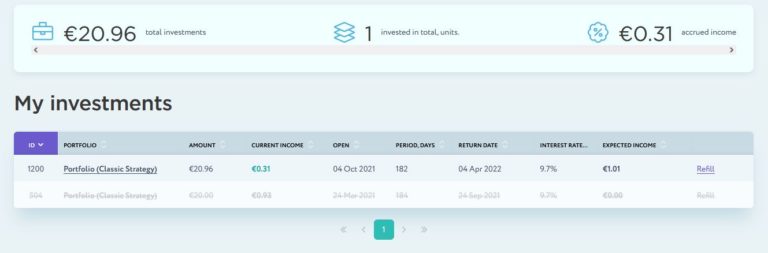
I haven’t mentioned my trial investment on European loan crowdfunding platform Nibble for a while, so thought I should remedy that this month. This has been proceeding without any issues. My initial test investment of 20 euros matured in September so I reinvested the entire sum at the same annual interest rate of 9.7 percent (see screen capture below).
I get weekly updates from Nibble confirming how much interest has been added to my account. Money has been a bit tight recently so I haven’t topped up my initial investment. Once I start getting my state pension (see below), however, I should have more available to invest, and Nibble is definitely on my list. My full review of Nibble can be found here.
Moving on, I have another article on the always-excellent Mouthy Money website. This is about how to save money on your motoring costs. I enjoyed researching this and learned some new and surprising things while doing so!
Finally, as I mentioned in this blog post, December 2021 marks a landmark for me, as I shall reach my 66th birthday and qualify for the new state pension. I am due to get my first payment on Christmas Eve. Tempting though it is, I probably won’t be blowing it all on a big party! 🎈🎈🎈
That’s all for now, so please stay safe (and warm) in these challenging times. And please don’t let scare stories in the mainstream media freak you out. At the time of writing hospitalizations and deaths from Covid in the UK have actually been falling steadily for weeks. So despite what the fear-mongers would have you believe, it really isn’t all bad news!
Have a lovely Christmas, enjoy socializing with friends and family, and I’ll be back again with another investments update at the start of 2022.
As always, if you have any comments or questions about this post, please do leave them below.
If you enjoyed this post, please link to it on your own blog or social media:
Hot chocolate must be the ultimate cold weather comfort drink – and what with everything in the news just now, we all need a bit of that at the moment!
So I have joined forces with some of my fellow UK bloggers to bring you the chance of winning a fantastic Hotel Chocolat Velvetiser, worth around £100.
When you need a morning boost or a flavanol-rich post-gym pick me up, you’re just 2.5 minutes away from barista-grade hot chocolate. Or curl up on the couch with a velvety and indulgent cup in the evening. Whatever your lifestyle, the Velvetiser delivers.
Just choose your flavour. Add our flakes of real chocolate to your choice of dairy, plant milk or water. Then press the button and let the patented velvetising process deliver luxurious cloud-like chocolate velvet.
Your Velvetiser takes up the same space as a kettle and adjusts easily for a left and right hand pour. It might not be suitable for dishwashers but as it’s so quick and easy to clean, why wait? Just pop out the whisk and rinse the non-stick coating with water and you’re ready for the next cup.
The classic copper clad Velvetiser is chic, stylish and on-trend, with looks good enough to grace any kitchen countertop. And we even supply a pair of podcups that just fit into the palm of your hand. So you can cradle that chocolate goodness as you savour every sip. Rich, creamy and decadent, why not indulge yourself with the ultimate in hot chocolate?
In these challenging times we all need and deserve a treat, so here’s your chance to win one of these amazing machines just in time for Christmas!
This giveaway has been organized by my blogging colleague Emma Drew (with a small amount of help from myself), so I should like to thank her very much for this. More details provided by Emma herself, along with instructions on how to enter, can be found below.
The Bloggers Taking Part
This giveaway couldn’t happen without the bloggers below taking part and contributing towards the prize. Please take a moment to visit them and show your support.
This prize is a copper Hotel Chocolat Velvetiser with 2 x Everything + Milky Pouch + Classic Pouch + 500ml Chocolate Cream Liqueur.
Terms and Conditions
1. There is one top prize of the Hotel Chocolat velvetiser and 2 x Everything + Milky Pouch + Classic Pouch + 500ml Chocolate Cream Liqueur.
2. There are no runner up prizes.
3. Open to UK residents aged 18 and over, excluding all bloggers involved with running the giveaway
4. Closing date for entries is midnight on 12.12.2021
5. The same Rafflecopter widget appears on all the blogs involved, but you only need to enter on one blog
6. Entrants must log in to the Rafflecopter widget, and complete one or more of the tasks – each completed task earns one entry in the prize draw
7. Tweeting about the giveaway via the Rafflecopter widget will earn five bonus entries into the prize draw.
8. One winner will be chosen at random.
9. The winner will be informed by email within 7 days of the closing date and will need to respond within 28 days with their delivery address, or a replacement winner will be chosen.
10. The winners’ names will be published in the Rafflecopter widget (unless the winner objects to this).
11. The prizes will be dispatched within 14 days of the winner confirming their details.
12. The promoter is Drew Media LTD t/a www.MakeMoneyWithoutAJob.com
13. By participating in this prize draw, entrants confirm they have read, understood and agree to be bound by these terms and conditions
ENTER NOW
Simply complete any or all of the Rafflecopter entry widget options below to be entered. You can also tweet about the giveaway daily to earn bonus entries. a Rafflecopter giveaway
One final small point is that if a winning entry comes from following someone on social media, the organizer (Emma Drew) will check before awarding the prize that the winner is still following the account in question. If they aren’t, they will be disqualified and a new winner drawn. So, please, don’t follow and immediately unfollow, as your entry won’t then count.
Good luck, and here’s hoping we can all look forward to better and brighter times soon 🙂
If you enjoyed this post, please link to it on your own blog or social media:
Today I have a sponsored guest post for you on behalf of Top Subscription Boxes. On their website they advertise a huge range of subscription box services.
With these services, you receive a new and exciting product (or selection of products) every month. You can subscribe for as long or as short as you want (subject to minimum subscriptions). And as you will see, there is something to suit every taste and budget!
Whether you want to send someone special a gift they will really enjoy or just treat yourself (you deserve it!), the subscription box services listed below could provide the perfect solution. We tried all of these ourselves before bringing the very best together in one place.
So without further ado, let’s get started!
Glossybox
Whenever it comes to beauty and make-up subscription boxes. Glossybox always takes the top spot. Glossybox allows you to treat yourself with a perfect combination of deluxe and full-sized beauty product samples from top brands.
Each month they send you a great-value box loaded with the latest make-up products, tools and beauty creams – and it will only cost you £13.25 per month.
In their previous boxes they have featured well-known brands like La Mer, Nars, pedigree French brands such as La Roche Posay, and impressive budget make-up from the likes of Rimmel.
Beer Bods
Beer Bods is known as the UK’s #1 craft beer subscription service. They send you a box of 8 beers every two months. So basically you receive one beer a week, along with the story behind that beer. All subscribers receive the same beer at one time, and you can join in a live online tasting every Thursday at 9 pm. So you can enjoy a new beer with new friends every week and compare notes with them. The bi-monthly subscription will cost you £24.
Arena Flowers
Nothing can be better than seeing fresh flowers in the morning. They make you feel calm and give your day the perfect start.
Arena Flowers is a leading ethical floristry service. They deliver exciting bouquets through their monthly subscription service.
They’ve been sending out their beautiful bouquets for the last 14 years and have achieved the milestone of 10 million deliveries. Every bouquet you receive is hand-tied and arranged by one of their expert florists to create a unique bouquet just for you. You can subscribe by paying just £17 a week.
Gadget Discovery Club
The Gadget Discovery Club allows you to treat yourself or your loved ones by sending them subscription boxes containing 4 innovative gadgets they didn’t know they needed!
They say that every gadget they’ll deliver to your doorstep will help you to upgrade your home, entertainment or lifestyle. The subscription box contains everything from tech wearables to smart home devices, including Samsung/Philips kits and Google home speakers.
You just need to sign up and select your preferences so they can send you the latest exciting gadgets based on your profile. They offer a monthly subscription or you can also choose a yearly plan. The monthly option will cost you £33 per month.
BakedIn Baking Club
The BakedIn Baking Club is a baking subscription service that delivers a different recipe each month straight to your door. Once you’ve subscribed to this service, you will receive a beautiful baking box with a step-by-step recipe guide, along with all the dry ingredients you need and some extras too.
BakedIn allows you to make your favourite muffins, biscuits, cakes and cookies, to share with your family and friends. If you are one of those people who loves baking, then this is the subscription box service for you. The price is £7.50 a month.
Good luck, and we hope you find the perfect subscription box service for you or your loved ones!
Thank you to my friends at Top Subscription Boxes for some eye-opening suggestions. I would definitely like to try some of these services myself! They would also, of course, make excellent Christmas or birthday presents. Please do click through to their website and check out the other subscription box services as well!
As always, if you have any comments or questions, please do post them below.
If you enjoyed this post, please link to it on your own blog or social media:
This year I have had five vaccines in total. Three of them were for Covid-19, including my booster jab earlier this month. The other two were a flu jab and a pneumonia jab ( the latter is offered by the NHS to everyone reaching the age of 65 in Britain).
You will gather from the above that I am not an anti-vaxxer (though as my Twitter followers will know, I do have reservations about the effectiveness of lockdowns, vaccine passports and mask mandates in combatting the spread of Covid-19).
But while I accept the need for vaccines for older people especially, I know some do get side-effects from them. The most common is an aching arm. This can be very painful and make activities such as driving difficult, though thankfully for most it usually lasts no more than a day or two.
My personal experience with vaccines this year is that I got the worst side-effects from the flu jab, including waking up in the night shivering and feeling sick. With my two Oxford-AstraZeneca jabs I had almost no side-effects, and the same applies to the pneumonia vaccine. With my booster jab, however – which was Pfizer – my arm started aching quite badly and I got a stiff shoulder as well.
In my vaccine journey this year I have found a couple of things that have really helped me minimize side-effects, so I thought I would share them today.
1. Prophylactic Paracetamol
Taking paracetamol is widely recommended if you get an aching arm and/or other side effects from the vaccines. I now take a couple at bedtime on the day I have had the jab, even if at that point I have no side-effects. I continue this the next day, taking them at four-hourly intervals (you shouldn’t take them any more frequently than that) until I am confident that I won’t be getting any side-effects or they have largely subsided.
One thing you shouldn’t do is take paracetamol before having the jab as it is possible this may reduce its efficacy. Not much research appears to have been done about this, but to be on the safe side it’s best avoided.
2. Gentle Arm Exercises
I tried this with my recent Pfizer jab, and was genuinely amazed by how effective it proved in easing stiffness and pain in my arm and shoulder. Friends I have recommended this to have been impressed by how effective it proved for them as well.
The exercises I use can be found on the aptly-named Sheltering Arms website. There are five in all, with short videos to illustrate them. They are simple, easy exercises and you don’t have to do them all if you don’t want to. As I had a stiff shoulder, I also threw in some shoulder rotations (basically rotating the shoulders upwards and backwards, then down and forward again, as was recommended to me a few years ago by a physio). I found this very effective as well.
I kept doing the exercises for a few minutes throughout the day and noticed an improvement within hours. By the end of the day, my arm and shoulder were pretty much back to normal.
Obviously I am no medic, but I understand that gently exercising the vaccinated arm helps disperse the vaccine throughout your body and reduces local muscle soreness. That being the case, it would appear a good idea to start doing these exercises even before any pain or stiffness occurs, again as a prophylactic measure. At my next jab, I intend to start soon after leaving the vaccination centre!
I would also recommend that you don’t do what I have done in the past, which is spend hours hunched over a keyboard after having your jab in case you can’t do this later. That could well reduce the opportunity for the vaccine to disperse and may add to any stiffness you experience later. Get your keyboarding out of the way before you go for your jab!
I hope you find these ideas helpful and they work as well for you as they have for me. Please feel free to leave any comments or questions below as usual. I’d also be interested to hear about your own experiences with ‘vaccine arm’ and any other methods you have found helpful for addressing the problem.
Please bear in mind that I don’t have any medical training and can’t give personalized advice, only share what has worked for me. Obviously if you get more serious side-effects from the vaccine, you should contact a medical professional as soon as possible. This NHS website page has more information.
If you enjoyed this post, please link to it on your own blog or social media:


 As mentioned, Cuckoo is also a company with a social conscience. They take 1% of each bill and use it to help bring the Internet to places where it’s needed most. That includes conflict zones, natural disaster sites and developing communities. Customers get to choose which project they wish to to support under the Cuckoo Compass scheme.