
Gold has a reputation few other investments can match. It’s shiny, timeless, and often seen as a financial “safe haven” – especially when inflation is rising or the stock market is shaky. The growing popularity of gold among investors in recent months is testimony to this.
But is investing in gold the right move for you?
In this post, I’ll cover:
The pros and cons of investing in gold
The main ways to invest (even if you’re a beginner)
And how to get started easily in the UK
Why Invest in Gold?
For centuries, gold has been viewed as a store of value. Unlike cash, which can lose its buying power over time, gold tends to hold its worth – especially during times of economic uncertainty.
In 2025, with inflation still a concern and markets volatile and unpredictable, more UK savers and investors than ever are thinking about adding gold to their portfolios. But like any asset, it has both upsides and downsides.
✅ Pros of Investing in Gold
🔒 1. A Hedge Against Inflation
As prices rise and the pound’s purchasing power shrinks, gold often increases in value. That’s why many investors use it as a hedge against inflation.
🌍 2. A Safe Haven in Uncertain Times
Gold tends to perform well during economic turbulence, financial crises or geopolitical shocks. When confidence in markets wobbles, gold often shines.
📊 3. Portfolio Diversification
Gold doesn’t typically move in the same direction as stocks or bonds, so adding it to your portfolio can reduce overall risk.
💷 4. High Liquidity
Whether it’s gold coins, bars or gold ETFs, gold can usually be bought and sold easily in the UK through dealers or online investment platforms.
🧱 5. It’s a Physical, Tangible Asset
Physical gold appeals to those who like to see and touch what they own. It can feel more secure than digital investments.
❌ Cons of Investing in Gold
🚫 1. No Income
Gold doesn’t pay interest, dividends or rent. You only make money if the price rises and you sell at a profit.
🔐 2. Storage and Security Costs
If you buy physical gold, you’ll need to store it safely – at home, in a bank, or with a specialist provider. This can add ongoing costs.
📉 3. Short-Term Price Fluctuations
Gold prices can be volatile in the short term, reacting to interest rates, currency shifts and global events.
💰 4. Capital Gains Tax (CGT)
If you make a profit on gold, you might pay CGT – unless you buy UK legal tender coins like Britannias or Sovereigns, which are CGT-free.
💸 5. Premiums and Dealer Fees
When buying physical gold, you’ll usually pay a premium above the market (spot) price, plus delivery and possibly VAT (on some bars or non-investment gold).
🛠️ How to Start Investing in Gold
1. 🪙 Buy Physical Gold (Coins or Bars)
If you want to hold gold directly, coins and bars are your best bet.
Coins like Britannias and Sovereigns are CGT-exempt and easy to sell.
Bars are available in various weights (from 1g to 1kg) and may offer better value per gram.
✅ You can even hold gold ETFs in a Stocks and Shares ISA to shield your gains from tax. See also my recent blog post about ETFs and how to invest in them.
3. ⛏️ Buy Shares in Gold Mining Companies
Prefer businesses over bullion? Invest in gold miners like:
Fresnillo (listed on the London Stock Exchange)
Barrick Gold
Newmont Corporation
⚠️ These company shares are higher risk – they’re influenced by more than just the gold price, e.g. management performance, debt, and political factors.
4. 🖥️ Use a Digital Gold Account
Want exposure to gold without the hassle of storage? Try digital gold platforms.
Gold futures and options allow speculation on gold price movements — but they’re complex, leveraged, and risky.
🛑 Definitely not suitable for beginners!
🧠 Closing Thoughts: Is Gold Right for You?
Gold can be a smart addition to your investment mix – especially if you’re worried about inflation, market crashes and/or want to diversify your portfolio.
But it’s not perfect. It doesn’t generate income, and short-term prices can be unpredictable.
A sensible approach? Treat gold as a long-term insurance policy, not a get-rich-quick plan. Many financial advisers recommend allocating around 5–10% (at most) of your portfolio to gold.
If you’re just getting started, two good options are:
Gold coins like Britannias or Sovereigns
A low-cost gold ETF inside a tax-exempt Stocks & Shares ISA
And remember: if you’re not sure, speak to a financial adviser before making any big investment decisions.
💬 Over to You
Have you invested in gold – or are you thinking about it?
Share your thoughts or questions in the comments below 👇
Disclaimer: I am not a qualified financial adviser and nothing in this article should be construed as personal financial advice. You should always do your own “due diligence” before investing and seek advice from a financial services professional if in any doubt before proceeding. All investing carries a risk of loss.
If you enjoyed this post, please link to it on your own blog or social media:
Today I am looking at the new income investing option recently introduced by UK robo-adviser platform Nutmeg. This is designed for people who want to receive a regular monthly income while keeping their money invested (and hopefully still growing).
As a long-term Nutmeg investor myself (you can read my in-depth review here), I have already taken advantage of this opportunity. I will discuss my personal experience (so far) in more detail below. But first, here’s how it works in a nut(meg)shell, how it compares with Nutmeg’s traditional growth portfolios, and who might benefit the most.
How Nutmeg’s Income Portfolios Work
Powered by J.P. Morgan Asset Management (JPMAM)
Nutmeg has collaborated with JPMAM to construct five risk‑rated portfolios, built around actively managed income-focused ETFs – including the JP Morgan Equity Premium Income strategy – so you’re investing in income-optimized assets while staying diversified.
2. Five Risk Levels to Suit You
You can choose from five different risk levels, ranging from 1 (cautious) to 5 (adventurous), based on your circumstances, goals and appetite for risk. Each level offers a different blend of equity and bond exposure to balance income generation with capital stability.
Here’s a table describing Nutmeg’s five income portfolio risk levels in simple terms…
Risk Level
Description
Equity Exposure
Income Potential
Capital Risk
1 – Cautious
Prioritizes stability over returns
Low
Low
Very Low
2 – Conservative
Aims for modest, steady income with minimal volatility
Low to Moderate
Low to Medium
Low
3 – Balanced
Balanced mix of bonds and equities for moderate income and risk
Moderate
Medium
Moderate
4 – Growth-Oriented
Greater focus on equity income for higher payouts
Moderate to High
Medium to High
Moderate to High
5 – Adventurous
Maximizes income potential with higher risk tolerance
High
High
High
📌 Note: All portfolios are actively managed and diversified, but the mix of assets changes based on your selected risk level. Income smoothing and monthly payouts are available across all five.
3. Monthly Payouts with Optional Smoothing
One standout feature is income smoothing. This spreads out income across the year, so you receive consistent monthly payments – even if dividends or yields vary from month to month. This feature is optional, however – you can turn smoothing off if you’d rather receive income as it’s earned every month.
4. No Nutmeg Management Fee for 2025
These portfolios are available via ISA or General Investment Accounts (non-ISA) and have no Nutmeg management fee for the rest of 2025, though underlying ETF costs apply. A minimum investment of £10,000 is required.
5. Capital Remains Invested
Your core investment stays fully invested in the market – providing the potential for capital preservation or growth alongside the monthly income stream.
Income vs Growth – What’s the Difference?
The difference between the two approaches is summed up in the table below.
Income Portfolio
Growth Portfolio
Objective
Provide regular monthly income
Maximize long‑term capital growth
Payouts
Paid out monthly, with optional smoothing
Reinvested automatically for compounding
Yield Focus
Uses dividend and income-focused ETFs
Focus on market growth; income secondary
Suitability
Later-stage savers, retirees, cash flow needs
Long-term goals like retirement, wealth accumulation
While Nutmeg’s growth-oriented portfolios reinvest dividends to compound, the income portfolios are specifically structured to generate ongoing monthly payments. This is ideal for those needing a regular income rather than capital appreciation (though some capital appreciation will hopefully occur as well).
Who Are These Portfolios Best For?
Retirees or near‑retirees needing a dependable income stream without selling assets.
Those reducing work hours or with varied income, using the monthly payouts to smooth out earnings.
Investors frustrated with traditional bond/dividend returns – Nutmeg’s own research shows 69% of UK investors prioritize income, yet many are unhappy with current options.
Investors seeking simplicity – You set your risk level once and Nutmeg then handles asset selection, portfolio rebalancing and (optional) income smoothing. As with all Nutmeg investments, you can change your risk level later if you wish (though some extra costs may be incurred when doing so).
Pros and Considerations
👍 Pros:
Monthly income stream without selling investments
Income smoothing for consistent payouts
Actively managed by experts at JPMAM
No Nutmeg fees until 2026
⚠️ Considerations:
Requires £10,000 minimum to start
Still carries investment risk – capital isn’t guaranteed
Fund fees apply for underlying ETFs
If you’re focused purely on capital growth, growth portfolios with reinvestment may outperform long-term
My Experience
As you will know if you read my July 2025 Investments Update, in June I transferred most of the money in my Nutmeg Fully Managed portfolio (just under £25,000) to a new Nutmeg Income Portfolio. As my money was already invested via a Stocks and Shares ISA, my new income portfolio will enjoy that status as well, meaning income payments will be made without any deductions for tax. Likewise, any capital appreciation will not be taxable.
I selected a risk level of 5 (the maximum). That aligns with the risk level of my other Nutmeg investments, which should make it easier to compare them. More importantly, though, I have other investments that are lower risk, including my Bestinvest SIPP (personal pension) and – of course – my state pension. With my Nutmeg investments I hope to maximize their income and growth potential and am comfortable taking a few more risks to this end. As I have other, less risky investments, any reversals with Nutmeg shouldn’t be disastrous. Obviously as I get older – or if my circumstances change – I may revisit this.
For similar reasons, I chose not to select the ‘smoothing’ option. The income from my Nutmeg income portfolio will be in addition to other regular income streams I already have, so I can’t see any particular reason to have these payments smoothed out. Obviously I will monitor this and might change my mind in future, but for now I quite like the idea of having a variable extra payment each month. If it’s large, I may allow myself a few extra treats that month. If it’s small, I will adjust my expenditure accordingly.
Of course, the above is solely my personal perspective and should not be construed as financial advice. Everyone’s circumstances are different. You should always do your own ‘due diligence’ before investing and seek professional advice if uncertain how best to proceed. All investing carries a risk of loss.
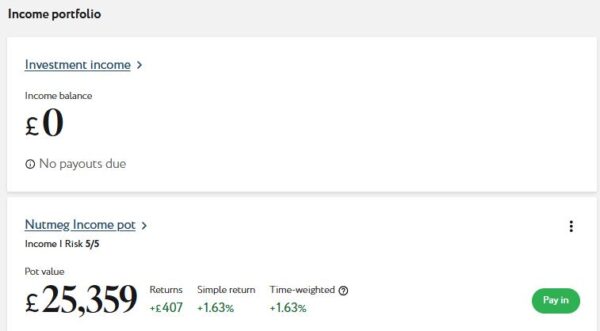
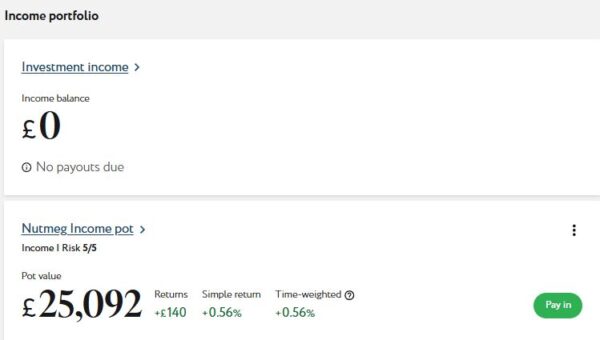
As the screenshot below shows, my Income portfolio is already showing a profit of over £400, which is obviously welcome. It hasn’t yet generated any income, but that is unsurprising. It can take a while for investments to qualify for dividend payments, so I am keeping my expectations modest, initially at least 🙂
I will update PAS readers on how my Nutmeg income portfolio performs in my future monthly investments updates.
Closing Thoughts
In my view, Nutmeg’s new Income Investing portfolios are a valuable addition for UK investors seeking a regular income, backed by diversified, actively managed ETFs. They offer monthly, optionally smoothed payouts, managed via Nutmeg’s simple, user-friendly interface. The fact that there is no initial Nutmeg management fee through 2025 is a further attraction.
If your priorities include current cash flow, retirement‑style income, or smoothing irregular income, this could be a good fit. If you’re younger or focused on maximizing long-term growth via compounding, however, Nutmeg’s established growth portfolios (e.g. Smart Alpha) remain compelling options.
If you have any comments or questions about this post – or Nutmeg more generally – please do leave them below. As always, bear in mind that I am not a qualified financial adviser and cannot offer personalized financial advice. As with all investments, your capital is at risk and there are no guarantees of profit. If in any doubt, consider speaking with a financial services professional.
If you enjoyed this post, please link to it on your own blog or social media:
I’ll begin as usual with my Nutmeg Stocks and Shares ISA. This is the largest investment I hold other than my Bestinvest SIPP (personal pension).
A major change in June was that I transferred most of the money in my Nutmeg Fully Managed portfolio (£25,000) to the new Nutmeg Income Portfolio. I will talk more about this is in a separate post, but basically money in this portfolio is invested to generate an income from dividends and other sources. This is then paid monthly. Capital appreciation is targeted as well, but basically these portfolios are aimed at older people (and others) who want/need their investment to generate a regular cash income.
As the screenshot below shows, my Income portfolio has only just been set up, though it’s already showing a small profit. It hasn’t yet generated any income for me, but that is unsurprising. Income is due to be paid in cash to my bank account on the 24th of each month, so hopefully I may have some income accrued by then (check out next month’s Update to find out). Of course, it can take a while for an investor to qualify for dividend payments, so I am keeping my expectations modest, initially at least!
You do have the option to select a ‘smoothing’ option, where Nutmeg works out your likely monthly income from the size (and performance) of your investment and pays the same amount every month from then onward. For various reasons I have opted not to do this for now, however.
Finally, you can select a risk level from 1 to 5 for your Income Portfolio. After some thought I selected the maximum 5. Depending on how things go, I may reduce this in future.
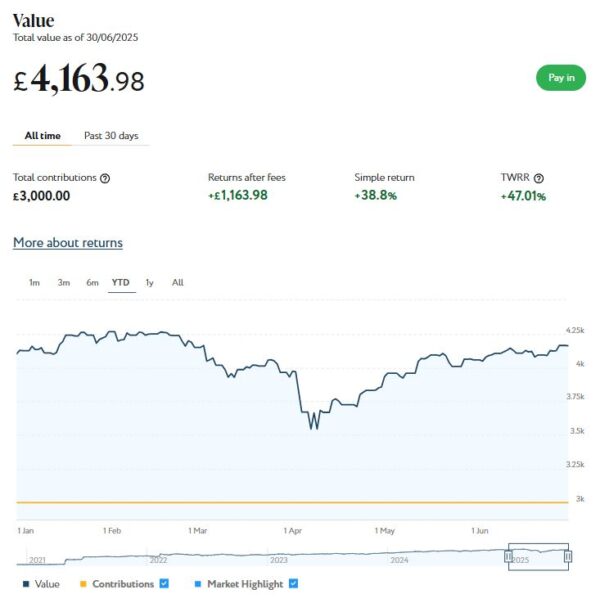
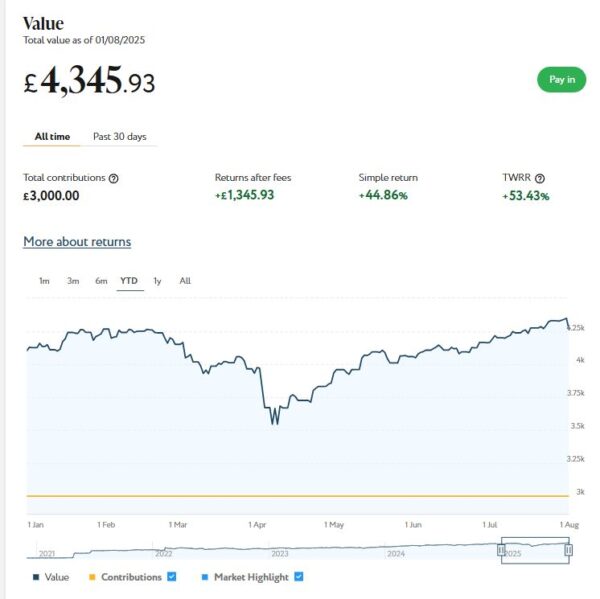
I still have a smaller growth-oriented pot using Nutmeg’s Smart Alpha option. This is now worth £4,164 (rounded up) compared with ££4,059 a month ago, a rise of £105. Here is a screen capture showing performance for the year to date.
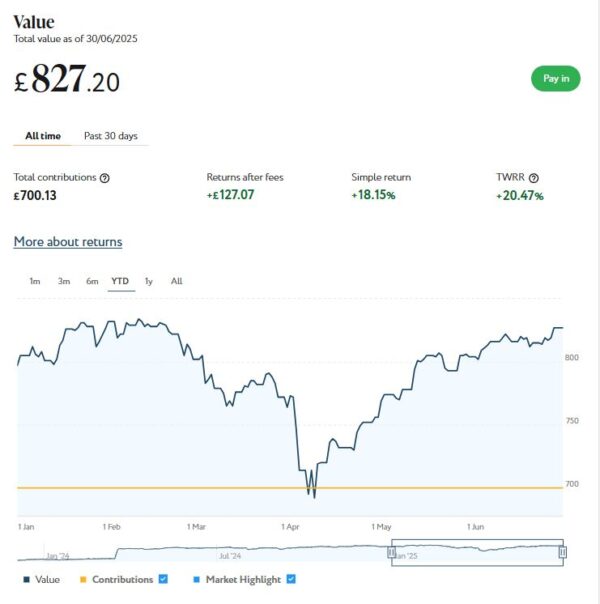
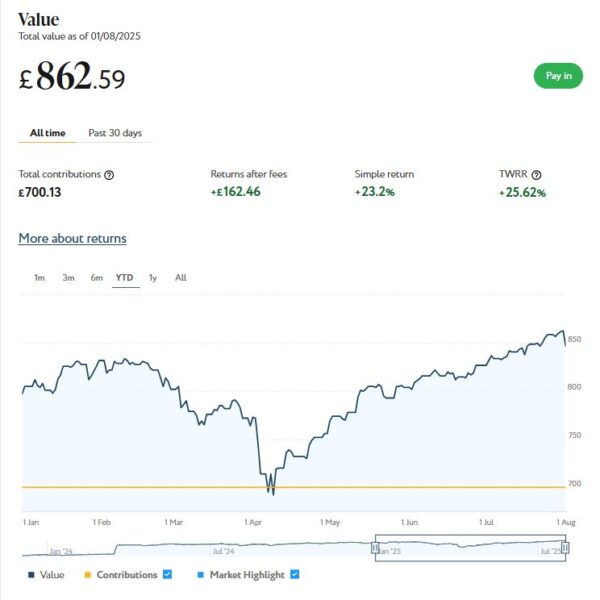
And at the start of December 2023 I invested £500 in one of Nutmeg’s thematic portfolios (Resource Transformation). In March 2024 I also invested a further £200 from referral bonuses. As you can see from the YTD screen capture below, this portfolio is now worth £827 compared with £804 last month, a rise of £23.
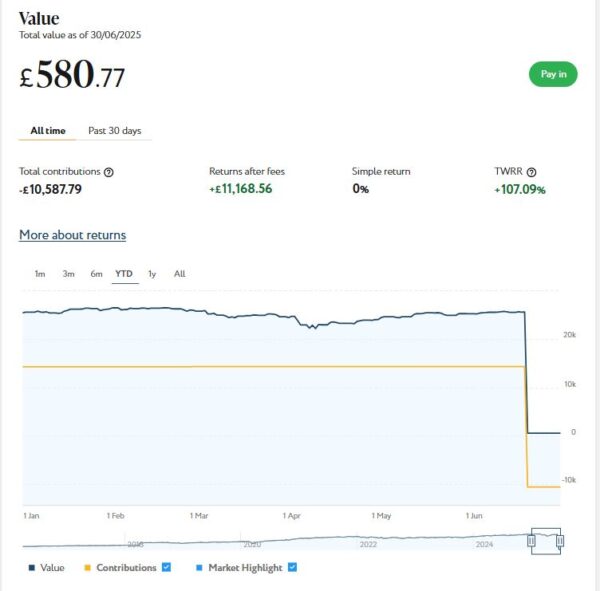
Finally, I still have a small amount left in my original Nutmeg Fully Managed portfolio. I have kept this largely for comparison purposes. Here’s a screen capture of how it stands now.
As you can see, June was another decent month for my Nutmeg investments. Overall I was up by £478 or 1.58%.
I am up by £236 since the start of 2025, so the April 2025 fall (caused largely by Trump’s tariffs) has now completely reversed. I am also up by £1,750 or 6.05% since the start of July last year. Considering the recent volatility of the markets (and world affairs generally) that’s not a bad result.
As I always have to say, some volatility is to be expected with stock market investments, but over the longer term they tend to even themselves out (and generally perform better than bank savings accounts, although that is never guaranteed). In general the worst thing you can do is panic and sell up when downturns occur (as happened in April). You are then crystallizing your losses rather than giving the markets time to recover. This is something I had cause to discuss recently in this blog post.
You can read my full Nutmeg review here. If you are looking for a home for your annual ISA allowance, based on my overall experience over the last eight years, they are certainly worth considering. They offer self-invested personal pensions (SIPPs), Lifetime ISAs and Junior ISAs as well.
My investments with Housemartin continue to generate steady returns. Housemartin focuses on lower-risk properties (e.g. sheltered housing). I put an initial £100 into this in mid-February 2021 and another £400 in April. In June 2021 I added another £500, bringing my total investment up to £1,000.
Since I opened my account, my HM portfolio has generated a respectable £256.94 in revenue from rental income. I have also made a net profit of £0.57 on property disposals. Capital growth has slowed, though, in line with UK property values generally.
At the time of writing, 16 of ‘my’ properties are showing gains, 2 are breaking even, and the remaining 18 are showing losses. My portfolio of 36 properties is currently showing a net decrease in value of £53.93. That means that overall (rental income and profit on disposal minus capital value decrease) I am up by £203.58. That’s still a decent return on my £1,000 and does illustrate the value of P2P property investments for diversifying your portfolio. And it doesn’t hurt that with Housemartin most projects are socially beneficial as well.
The net fall in capital value of my Housemartin investments is obviously a little disappointing. But it’s important to remember that until/unless I choose to sell the investments in question, it is largely theoretical, based on the latest price at which shares in the property concerned have changed hands. The rental income, on the other hand, is real money (which in my case I’ve reinvested in other HM projects to further diversify my portfolio).
To control risk with all my property crowdfunding investments nowadays, I invest relatively modest amounts in individual projects. This is a particular attraction of Housemartin as far as i am concerned. You can actually invest from as little as £1 per property if you really want to proceed cautiously.
As I noted in this blog post, Housemartin is particularly good if you want to compound your returns by reinvesting rental income. This effectively boosts the interest rate you are receiving. Personally, once I have accrued a minimum of £10 in rental payments, I usually reinvest this money in either a new HM project or one I have already invested in (thus increasing my holding). Over time, even if I don’t invest any more capital, this will ensure my investment with Housemartin grows at an accelerating rate and becomes more diversified as well. I did, however, withdraw £50 from my earnings in June to assist my cashflow in what was an expensive month for me 😮
In 2022 I set up an account with investment and trading platform eToro, using their popular ‘copy trader’ facility. I chose to invest $500 (then about £412) copying an experienced eToro trader called Aukie2008 (real name Mike Moest).
In January 2023 I added to this with another $500 investment in one of their thematic portfolios, Oil Worldwide. I also invested a small amount I had left over in Tesla shares.
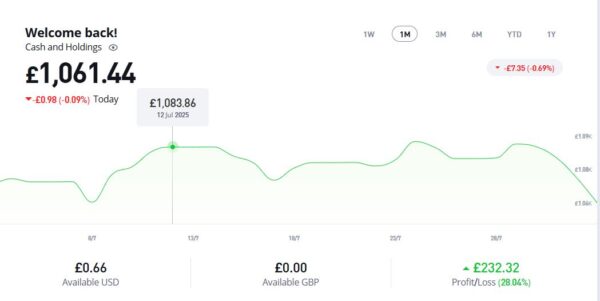
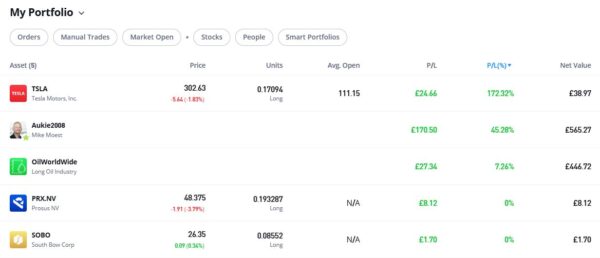
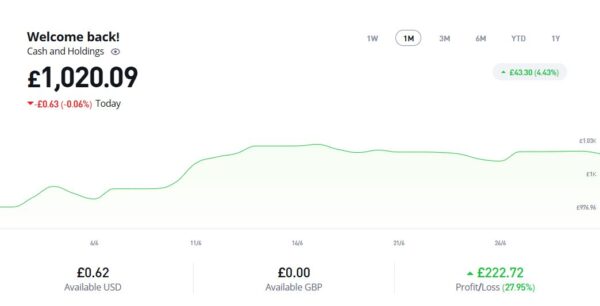
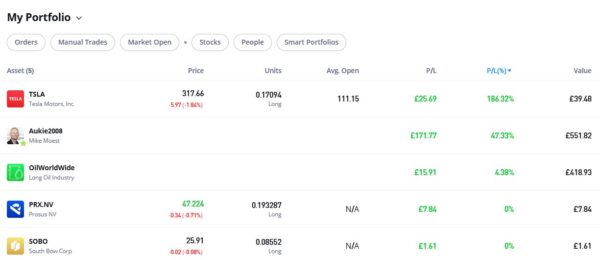
As you can see from the screen captures below, my original investment (total value £888.36 in pounds sterling) is today worth £1,020.09, an overall increase of £131.73 or 14.83%.
Note: eToro now displays the value of investments in your native currency, although you can change this if you wish.
As you can see, my Oil WorldWide investment is back in profit now. But my copy trading investment with Aukie2008 has been doing a lot better, with an overall 47.31% profit. To be fair, I have held this investment a little longer.
My Tesla shares, which I bought as an afterthought with some spare cash I had in my account, are down a bit this month. But they are still showing an overall profit of 186.32% since I bought them. If only I had put a bit more money into this!
You might also notice that I have small holdings in Prosus NV, a Dutch internet group, and South Bow, a Canadian energy infrastructure company. To be honest I don’t understand how I acquired these, but I assume they are some sort of bonus I was awarded. In any event, I am happy to have them in my portfolio!
eToro also offer the free eToro Money app. This allows you to deposit money to your eToro account without paying any currency conversion fees, saving you up to £5 for every £1,000 you deposit. You can also use the app to withdraw funds from your eToro account instantly to your bank account. I tried this myself and was impressed with how quickly and seamlessly it worked. You can read my blog post about eToro Money here. Note that it can also serve as a cryptocurrency wallet, allowing you to send and receive crypto from any other wallet address in the world.
If you would like more information about setting up an eToro account, please click on this no-obligation website link [affiliate]. Don’t forget that you also get a free $100,000 virtual portfolio, which you can use to experiment with trading and investing strategies. I have certainly earned a lot from mine.
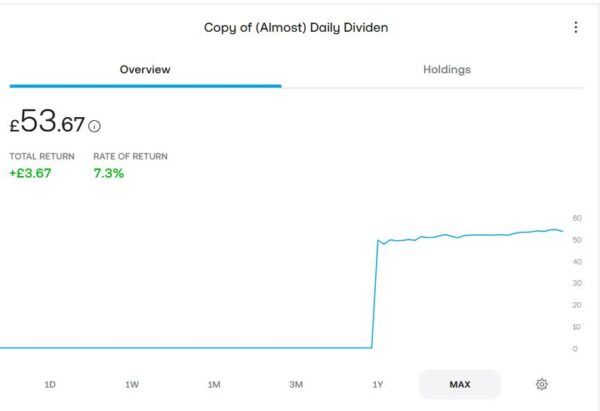
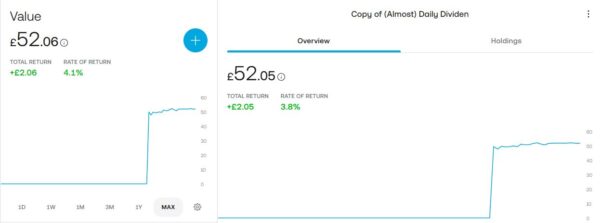
As an experiment, I recently put £50 into an investment ISA with Trading 212. As mentioned in my recent blog post about dividend investing, I put it into the (Almost) Daily Dividends Portfolio, a ready-made portfolio or ‘pie’ on Trading 212. As you can see from the screen capture below, my portfolio is now worth £52.06, an increase of £2.06 or 4.12% (by my calculation) over the three-month period. It has even accrued a grand total of 18p in dividends!
I am quite impressed with how this investment has been faring, despite the small amount I put in (which means I may be missing out on some smaller dividends) and also because you need to have held shares for a certain period to qualify for dividend payments. If I increased my investment I would almost certainly become eligible for more dividends, and even more the longer I remain invested. If I had any spare money at the moment, I would consider doing this. Of course, I do now have a dividend-focused portfolio with Nutmeg as well (see above).
Moving on, I published various posts on Pounds and Sense in June. I have listed below those that are still relevant.
The Many Benefits of Learning a Musical Instrument in Later Life isn’t about personal finance. But as someone who has actually done this (ukulele) it’s a subject I feel quite passionate about. In this article I set out the many (sometimes surprising) benefits of learning to play an instrument as a senior, and offered a few tips based on my personal experience.
In What Are Bonds and How Can You Invest in Them, I explain what bonds are and their pros and cons compared with other investment vehicles. As I say in the article, bonds can play a key role in a well-rounded portfolio, especially for those – including many older people – who are seeking predictable, regular income and/or lower risk.
In How to Reduce Your Water Bills I discussed various ways you may be able to cut your water bill, including getting a water meter and (if you’re on a low income) applying for a reduced-rate social tariff. With water bills rising substantially in many parts of the country, it’s well worth checking what options you may have to cut them.
Is It Worth Getting Over 50 Life Insurance? is another sponsored post. It focuses on a type of life insurance specifically designed for people aged over 50. Such policies offer a guaranteed, fixed cash payout when the policyholder dies. Over 50 life insurance policies are generally “whole of life”, meaning they last until you pass away, as long as you keep up with premium payments. They’re often used to help cover funeral expenses, outstanding debts, or to leave a small inheritance.
Finally, How Social Tariffs Can Help You Reduce Your Household Bills looks at discounted tariffs that may be available for people on low incomes and/or certain means-tested benefits. Specifically, it covers broadband, water bills and energy bills. Do check this out if you are struggling with these bills at the moment.
I’ll close with a reminder that you can also follow Pounds and Sense on Facebook or Twitter (or X as we have to call it now). Twitter/X is my number one social media platform and I post regularly there. I share the latest news and information on financial matters, and other things that interest, amuse or concern me. So if you aren’t following my PAS account on Twitter/X, you are definitely missing out.
I am also on the BlueSky social media network under the username poundsandsense.bsky.social. Twitter/X remains my primary social media platform, but I will also post details of my latest blog posts, third-party articles and other financial news and resources on BlueSky for those who prefer to follow me there.
As always, if you have any comments or questions, feel free to leave them below. I am always delighted to hear from PAS readers
Disclaimer: I am not a qualified financial adviser and nothing in this blog post should be construed as personal financial advice. Everyone should do their own ‘due diligence’ before investing and seek professional advice if in any doubt how best to proceed. All investing carries a risk of loss.

Note also that posts on PAS may include affiliate links. If you click through and perform a qualifying transaction, I may receive a commission for introducing you. This will not affect the product or service you receive or the terms you are offered, but it does help support me in publishing PAS and paying my bills. Thank you!
If you enjoyed this post, please link to it on your own blog or social media:
When people think about investing, their minds often jump to stocks and shares. But bonds – a less glamorous but more stable option – can play a key role in a well-rounded investment portfolio, especially for those seeking predictable, regular income and/or lower risk.
In this article, I’ll reveal what bonds are, how to invest in them, and the main pros and cons to consider.
What Are Bonds?
A bond is essentially a loan from you to a government or company. In return, they pay you interest (known as the “coupon”) over a set period (typically annually or semi-annually). When the bond reaches the end of its term (maturity), you get your original investment back.
There are several types of bonds, including:
Government bonds (gilts) – issued by the UK government
Corporate bonds – issued by companies
Inflation-linked bonds – designed to rise with inflation
Foreign bonds – issued by overseas governments or companies
How to Invest in Bonds
There are a few ways you can invest in bonds:
1. Buy Individual Bonds
You can buy gilts or corporate bonds directly through:
The London Stock Exchange
Brokers such as Hargreaves Lansdown or AJ Bell
The UK Debt Management Office for new gilt issues
Buying individual bonds gives you control, but requires a higher initial investment and comes with more risk if the issuer defaults.
2. Bond Funds
Instead of picking individual bonds, you can invest in a fund that holds a basket of bonds:
Bond Unit Trusts and OEICs (Open-Ended Investment Companies)
Bond ETFs (Exchange Traded Funds) – such as iShares UK Gilts or Vanguard Global Bond ETF
These offer instant diversification and lower entry costs, and can be held in tax-efficient wrappers like Stocks & Shares ISAs or Self-Invested Personal Pensions (SIPPs).
WiseAlpha is a UK fractional bond platform that allows retail investors to buy fractional corporate bonds – essentially, small slices of high-yield bonds that are normally only accessible to institutional investors. This opens up access to a wide range of corporate bonds from major companies (e.g. Travelodge, HSBC and Asda) without the need for thousands of pounds to get started. This can be a good middle ground if you want more control over your bond investments than is offered by a fund but don’t have the capital required to buy full bonds.
See also the comparison table of UK bond platforms at the end of this article. This also reveals which platforms allow you to buy bonds within a tax-efficient ISA
Pros of Investing in Bonds
1. Reliable Income
Most bonds pay regular interest, making them a good source of steady income, especially for retirees.
2. Lower Risk Than Shares
Bonds are generally less volatile than stocks, so they can act as a buffer during market downturns.
3. Capital Preservation
If held to maturity and the issuer doesn’t default, you’ll get your money back.
4. Tax Efficiency
UK government gilts are free from Capital Gains Tax, and interest from bonds can be tax-free if held within an ISA or pension.
Cons of Investing in Bonds
1. Inflation Risk
Fixed bond payments may lose value in real terms if inflation rises sharply.
2. Interest Rate Risk
When interest rates go up, bond prices usually go down. If you need to sell before maturity, you could get back less than you paid.
3. Credit Risk
With corporate bonds, there’s always a risk the company could default on payments.
4. Lower Returns Compared to Stocks
Over the long term, bonds typically offer lower returns than equities.
Who Are Bonds Suitable For?
Bonds can be a great choice if:
You’re approaching or in retirement and want regular income
You want to reduce your overall portfolio risk
You’re saving for the medium term and prefer more stability
Younger investors, or those with a higher risk appetite, may prefer a smaller bond allocation in favour of higher-growth assets like equities.
Bonds vs Dividend Investing: Which is Better?
Both bonds and dividend-paying shares (as discussed in this recent blog post) can provide regular income. But they do so in different ways, and each has its own risks and benefits.
Here’s how they compare:
Feature
Bonds
Dividend Stocks
Income Type
Fixed interest (coupon)
Variable dividend payments
Predictability
High – payments are usually fixed
Medium – dividends can fluctuate or be cut
Capital Risk
Lower if held to maturity
Higher – share prices can be volatile
Inflation Protection
Limited (unless using inflation-linked bonds)
Better – companies may increase dividends over time
Tax Treatment
Interest taxable outside ISA/SIPP
Subject to dividend tax outside ISA/SIPP*
Growth Potential
Very limited
Potential for capital gains and increasing income
Ease of Access
Widely accessible via funds or platforms
Also widely accessible via funds or direct shares
Note: *There is a tax-free personal allowance for dividend income of £500 a year (2025/26)
Which One Should You Choose?
Choose bonds if your priority is stability, capital preservation, and predictable income, especially in the short to medium term.
Choose dividend stocks if you’re comfortable with a bit more risk and want potential for both income and long-term growth.
Many investors choose to hold both as part of a diversified portfolio, using bonds for stability and equities for growth and rising income.
Final Thoughts
Investing in bonds can bring balance to your portfolio, reduce volatility and provide income. Whether you go for government gilts, corporate bonds, or a diversified bond fund, it’s important to understand the risks and benefits and how bonds fit with your investment goals.
And as always – consider holding your bonds in an ISA or pension for maximum tax efficiency.
Comparison Table: UK Bond Investment Platforms
Platform
Bond Types Available
Minimum Investment
Suitable For
ISA Available
Notes
Hargreaves Lansdown
Gilts, Corporate Bonds, Bond Funds, ETFs
£100+
Beginners to experienced investors
✅ Yes
Well-established platform with wide fund and bond choice
Unique access to high-yield bonds from major companies
Note: *As of now, WiseAlpha does not offer an ISA wrapper, so income and gains may be taxable depending on your personal circumstances.
Please bear in mind as always that I am not a registered financial adviser and cannot offer personal financial advice. You should always do your own ‘due diligence’ before investing and seek professional advice if in any doubt how best to proceed. All investing carries a risk of loss.
If you enjoyed this post, please link to it on your own blog or social media:
I’ll begin as usual with my Nutmeg Stocks and Shares ISA. This is the largest investment I hold other than my Bestinvest SIPP (personal pension).
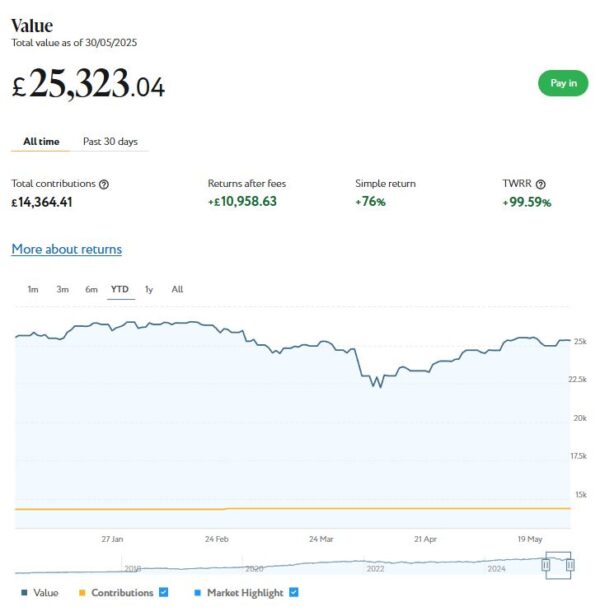
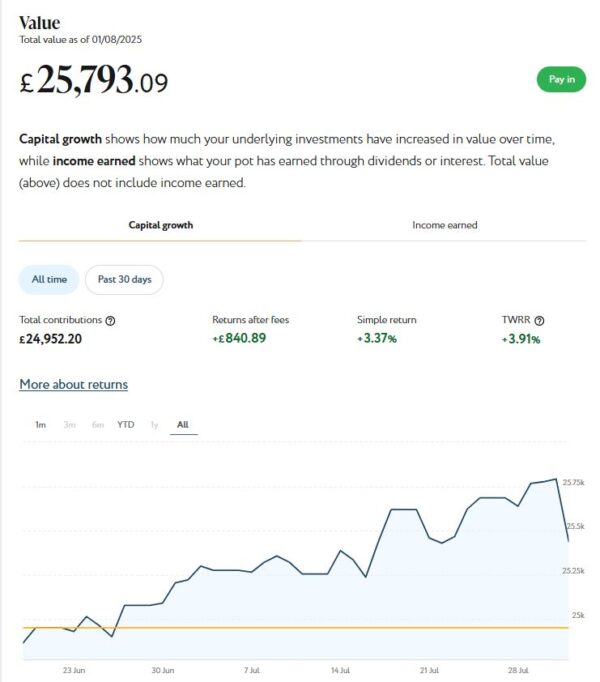
As the screenshot below for the year to date shows, my main Nutmeg portfolio is currently valued at £25,323. Last month it stood at £24,532, so that is a rise of £791.
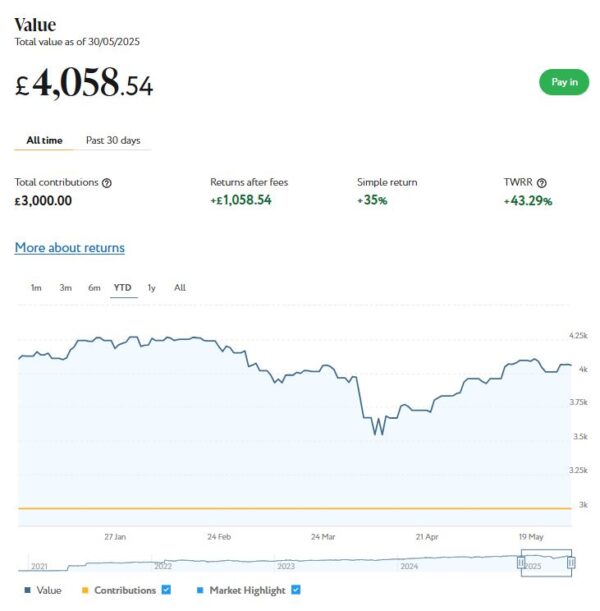
Apart from my main portfolio, I also have a second, smaller pot using Nutmeg’s Smart Alpha option. This is now worth £4,059 (rounded up) compared with £3,934 a month ago, a rise of £125. Here is a screen capture showing performance for the year to date.
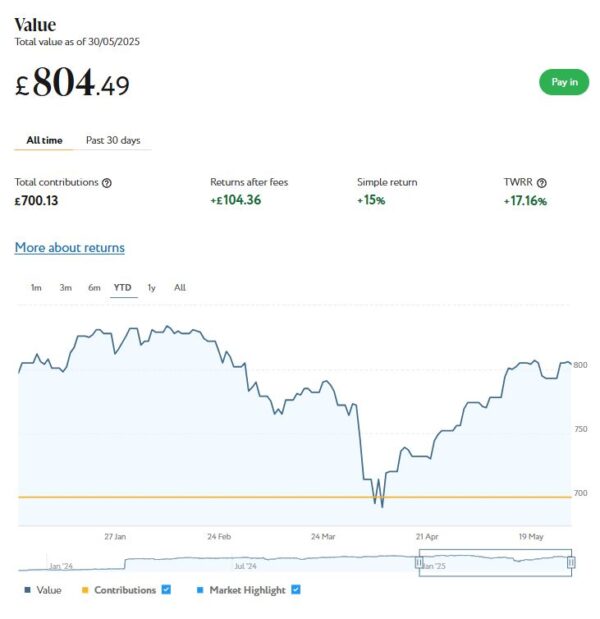
Finally, at the start of December 2023 I invested £500 in one of Nutmeg’s new thematic portfolios (Resource Transformation). In March 2024 I also invested a further £200 from referral bonuses. As you can see from the YTD screen capture below, this portfolio is now worth £804 compared with £770 last month, a rise of £34.
As you can see, May was a good month for my Nutmeg investments. Overall I was up by £950 or 3.25%.
I am still down slightly since the start of 2025, with the value of my investments decreasing by £242 or 0.08% since 1st January. On the other hand, their value has grown by £1,813 or 6.39% since the end of May last year. So, as I always say, the recent ups and downs do need to be taken in context. Some volatility is always to be expected with stock market investments, and over time they tend to even out. In general the worst thing you can do is panic and sell up when downturns occur (as happened in early April). You are then crystallizing your losses rather than giving the markets time to recover. This is something I had cause to discuss recently in this blog post.
You can read my full Nutmeg review here. If you are looking for a home for your annual ISA allowance, based on my overall experience over the last eight years, they are certainly worth considering. They offer self-invested personal pensions (SIPPs), Lifetime ISAs and Junior ISAs as well.
Moving on, I also have investments with P2P property investment platform Assetz Exchange. As discussed in this recent post, the company recently rebranded as Housemartin.
My investments with Housemartin continue to generate steady returns. Housemartin focuses on lower-risk properties (e.g. sheltered housing). I put an initial £100 into this in mid-February 2021 and another £400 in April. In June 2021 I added another £500, bringing my total investment up to £1,000.
Since I opened my account, my HM portfolio has generated a respectable £251.16 in revenue from rental income. I have also made a net profit of £0.57 on property disposals. Capital growth has slowed, though, in line with UK property values generally.
At the time of writing, 16 of ‘my’ properties are showing gains, 3 are breaking even, and the remaining 18 are showing losses. My portfolio of 37 properties is currently showing a net decrease in value of £47.34. That means that overall (rental income and profit on disposal minus capital value decrease) I am up by £204.39. That’s still a decent return on my £1,000 and does illustrate the value of P2P property investments for diversifying your portfolio. And it doesn’t hurt that with Housemartin most projects are socially beneficial as well.
The net fall in capital value of my Housemartin investments is obviously a little disappointing. But it’s important to remember that until/unless I choose to sell the investments in question, it is largely theoretical, based on the latest price at which shares in the property concerned have changed hands. The rental income, on the other hand, is real money (which in my case I’ve reinvested in other HM projects to further diversify my portfolio).
To control risk with all my property crowdfunding investments nowadays, I invest relatively modest amounts in individual projects. This is a particular attraction of Housemartin as far as i am concerned. You can actually invest from as little as £1 per property if you really want to proceed cautiously.
As I noted in this blog post, Housemartin is particularly good if you want to compound your returns by reinvesting rental income. This effectively boosts the interest rate you are receiving. Personally, once I have accrued a minimum of £10 in rental payments, I reinvest this money in either a new HM project or one I have already invested in (thus increasing my holding). Over time, even if I don’t invest any more capital, this will ensure my investment with Housemartin grows at an accelerating rate and becomes more diversified as well.
In 2022 I set up an account with investment and trading platform eToro, using their popular ‘copy trader’ facility. I chose to invest $500 (then about £412) copying an experienced eToro trader called Aukie2008 (real name Mike Moest).
In January 2023 I added to this with another $500 investment in one of their thematic portfolios, Oil Worldwide. I also invested a small amount I had left over in Tesla shares.
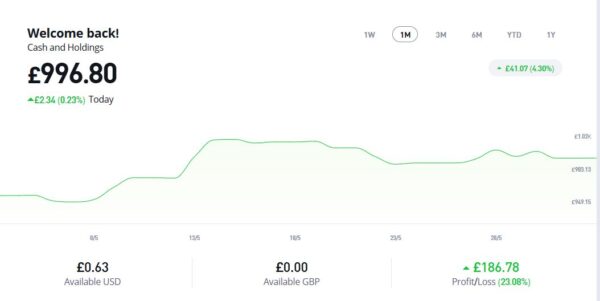
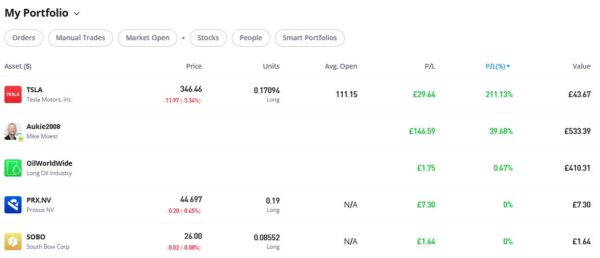
As you can see from the screen captures below, my original investment (total value £888.36 in pounds sterling) is today worth £996.80, an overall increase of £108.44 or 12.21%.
Note: eToro now displays the value of investments in your native currency, although you can change this if you wish.
As you can see, my Oil WorldWide investment has recovered a bit since last time and is at least back in profit now, although it’s not exactly setting the world on fire (excuse the bad joke).
Thankfully my copy trading investment with Aukie2008 has been doing better, with an overall 39.64% profit. To be fair, I have held this investment a little longer.
My Tesla shares, which I bought as an afterthought with a bit of spare cash I had in my account, have done particularly well since I bought them, with an overall profit of 211.13%. If only I had put a bit more money into this! As a matter of interest, I do find it quite strange that my Tesla shares keep going up in value, despite all the stories in the press and social media about consumers boycotting Tesla. Go figure.
You might also notice that I have small holdings in Prosus NV, a Dutch internet group, and South Bow, a Canadian energy infrastructure company. To be honest I don’t understand how I acquired these, but I assume they are some sort of bonus I was awarded. In any event, I am happy to have them in my portfolio!
eToro also offer the free eToro Money app. This allows you to deposit money to your eToro account without paying any currency conversion fees, saving you up to £5 for every £1,000 you deposit. You can also use the app to withdraw funds from your eToro account instantly to your bank account. I tried this myself and was impressed with how quickly and seamlessly it worked. You can read my blog post about eToro Money here. Note that it can also serve as a cryptocurrency wallet, allowing you to send and receive crypto from any other wallet address in the world.
If you would like more information about setting up an eToro account, please click on this no-obligation website link [affiliate]. Don’t forget that you also get a free $100,000 virtual portfolio, which you can use to experiment with trading and investing strategies. I have certainly earned a lot from mine.
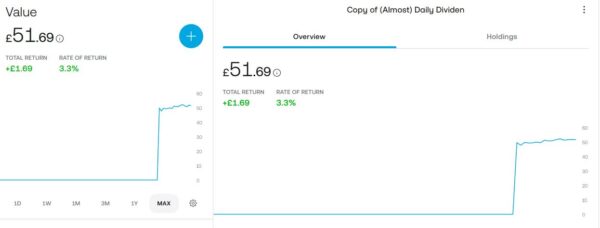
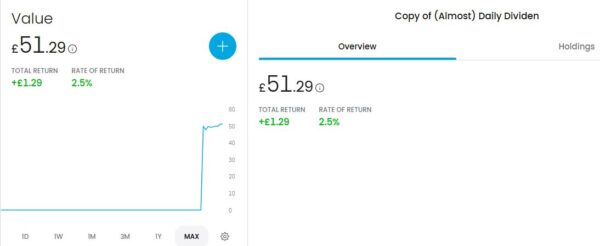
As a bit of an experiment, I recently put £50 into an investment ISA with Trading 212. As mentioned in my recent blog post about dividend investing, I put it into the (Almost) Daily Dividends Portfolio, a ready-made portfolio or ‘pie’ on Trading 212. As you can see from the screen capture below, my portfolio is now worth £51.69, an increase of 3.3% over the two-month period. It has even accrued a grand total of 9p in dividends!
I am quite impressed with how this investment has been faring, despite the small amount I put in (which means I may be missing out on some smaller dividends) and also because you need to have held shares for a certain period to qualify for dividend payments. If I increased my investment I would almost certainly become eligible for more dividends, and would qualify for more the longer I remain invested. If I had any spare money at the moment, I would certainly consider doing this!
Moving on, I published various posts on Pounds and Sense in May. I have listed below those that are still relevant
Why a Financial Remedy Order is Essential on Your Divorce is another guest post from my friends at HCR Law. If you are unfortunate enough to be in this position, this article contains important advice and information on how to ensure your personal financial security going forward.
Where to Get Pension Advice contains important information for anyone who may be coming up to retirement age, which of course includes many Pounds and Sense readers. This collaborative article includes details of six potential sources of pension advice, including the pros and cons of each.
Could You Benefit From Help to Save spotlights a lesser-known government scheme which, if you’re eligible, can give your finances a valuable boost. It’s an initiative aimed at helping people on low incomes (typically those receiving Universal Credit) build up their savings. Offering generous tax-free bonuses, this scheme can provide significant benefits for qualifying individuals.
How to Save Money on Rail Fares With Split Ticketing discusses a money-saving hack that savvy travellers can use to reduce their rail-fare costs – often by a substantial margin. Split ticketing involves breaking a journey into two or more smaller segments, purchasing separate tickets for each segment rather than one through-ticket. With the help of apps such as those discussed in the article, the process becomes simple and automated.
Finally, in What Are ETFs And How Can You Invest in Them? I shine a spotlight on these increasingly popular investment vehicles, explaining what they are, how you can invest in them, and how you can maximize the benefit by investing via tax-free ISAs.
I’ll close with a reminder that you can also follow Pounds and Sense on Facebook or Twitter (or X as we have to call it now). Twitter/X is my number one social media platform and I post regularly there. I share the latest news and information on financial matters, and other things that interest, amuse or concern me. So if you aren’t following my PAS account on Twitter/X, you are definitely missing out.
I am also on the BlueSky social media network under the username poundsandsense.bsky.social. Twitter/X remains my primary social media platform, but I will also post details of my latest blog posts, third-party articles and other financial news and resources on BlueSky for those who prefer to follow me there.
As always, if you have any comments or questions, feel free to leave them below. I am always delighted to hear from PAS readers
Disclaimer: I am not a qualified financial adviser and nothing in this blog post should be construed as personal financial advice. Everyone should do their own ‘due diligence’ before investing and seek professional advice if in any doubt how best to proceed. All investing carries a risk of loss.
Note also that posts on PAS may include affiliate links. If you click through and perform a qualifying transaction, I may receive a commission for introducing you. This will not affect the product or service you receive or the terms you are offered, but it does help support me in publishing PAS and paying my bills. Thank you!
If you enjoyed this post, please link to it on your own blog or social media:
Today I am focusing on Exchange Traded Funds, or ETFs for short. These have become increasingly popular among investors seeking a simple, low-cost way to build diversified portfolios. But what exactly are ETFs, and how can you invest in them, especially in a tax-efficient way?
What Is an ETF?
An ETF is a type of investment fund that holds a collection of assets – such as stocks, bonds, or commodities – and trades on stock exchanges much like individual shares.
Most ETFs are designed to track the performance of a specific index, such as the FTSE 100, S&P 500, or MSCI World Index.
Because they bundle together a broad range of assets, ETFs offer instant diversification. If you buy an ETF tracking the FTSE 100, for example, you’re essentially investing in the 100 largest companies listed on the London Stock Exchange.
Why Choose ETFs?
Low cost: ETFs usually have lower management fees than actively managed funds, because they typically follow a passive investment strategy.
Diversification: A single ETF can give you exposure to hundreds or even thousands of securities across sectors or regions.
Liquidity: As ETFs are traded on stock exchanges, they can be bought or sold during market hours just like individual shares.
Potential for dividends as well as capital appreciation: If the value of shares in an ETF goes up, so does the value of your holding. Likewise, if the underlying shares pay dividends, these are either distributed to ETF investors as cash or reinvested to boost the value of your holding.
Transparency: Most ETFs publish their holdings daily, so you always know what you’re investing in.
Are There Any Drawbacks to ETFs?
While ETFs offer many benefits, they’re not without potential downsides:
Market Risk: Like all investments, ETFs can go down in value. If the underlying assets perform poorly, so will the ETF.
Tracking Error: Some ETFs may not perfectly replicate the performance of their target index due to fees or imperfect replication strategies.
Liquidity Issues: While most ETFs are highly liquid, some niche or low-volume ETFs can have wider bid-ask spreads, making it more expensive to trade them.
Over-Diversification: While diversification is usually a strength, owning too many overlapping ETFs can lead to a diluted portfolio that mirrors the overall market without any clear investment direction.
Currency Risk: If you invest in ETFs that hold assets in foreign currencies, exchange rate fluctuations can impact your returns. Of course, this applies equally to other types of investment as well.
Understanding the risks and how they relate to your investment goals is key to making informed decisions.
How to Invest in ETFs
Choose a Platform: First, you’ll need to open an account with a brokerage or investment platform that offers access to ETFs. Popular UK platforms include Hargreaves Lansdown, AJ Bell and Interactive Investor. InvestEngine specializes in ETFs and offers commission-free trading in a wide range. Trading 212 and eToro are other popular platforms that offer commission-free ETF trading.
Select Your ETFs: Decide on the asset classes and regions you want exposure to. For example, you could choose a global equity ETF, a UK government bond ETF, or a sector-specific ETF (such as technology, healthcare or renewables).
Place Your Order: ETFs can be bought and sold like shares. You can place a market order (buy at the current price) or a limit order (buy only at a specific price).
Monitor and Rebalance: Over time, you may need to adjust your portfolio to maintain your desired level of risk and diversification.
Consider Automated Services: If you don’t want to pick your own ETFs, many platforms offer ready-made portfolios (though these may entail extra fees and charges). Robo-adviser platforms such as Nutmeg – which I use myself – invest your money in ETFs and offer fully managed and fixed allocation portfolios.
Using an ISA for Tax Efficiency
One of the most tax-effective ways to invest in ETFs in the UK is through a Stocks and Shares ISA.
An ISA (Individual Savings Account) allows you to invest up to £20,000 per tax year (as of 2025/26) without paying any tax on your investment returns. The benefits of investing in ETFs via an ISA include:
No Capital Gains Tax: Any profit you make from selling ETFs within an ISA is tax-free.
No Dividend Tax: Any dividends paid by ETFs held in an ISA are also tax-free.
No Income Tax: Likewise, no Income Tax is due on returns from your investments.
Simplicity: There is no need to declare ISA investments on your tax return.
Final Thoughts
ETFs are a powerful tool for building a diversified, cost-effective investment portfolio. Whether you’re a beginner or an experienced investor, they offer flexibility and efficiency. And by investing through an ISA, UK investors can enjoy significant tax advantages, maximizing their returns and helping their money go further
Always take into account your investment goals and tolerance for risk. And do your own ‘due diligence’ – or consult a financial adviser – before investing. All investments carry a risk of loss.
As ever, if you have any comments or questions about this article, please do post them below. Bear in mind that I am not a qualified financial adviser and cannot provide personalized financial advice.
If you enjoyed this post, please link to it on your own blog or social media:
I’ll begin as usual with my Nutmeg Stocks and Shares ISA. This is the largest investment I hold other than my Bestinvest SIPP (personal pension).
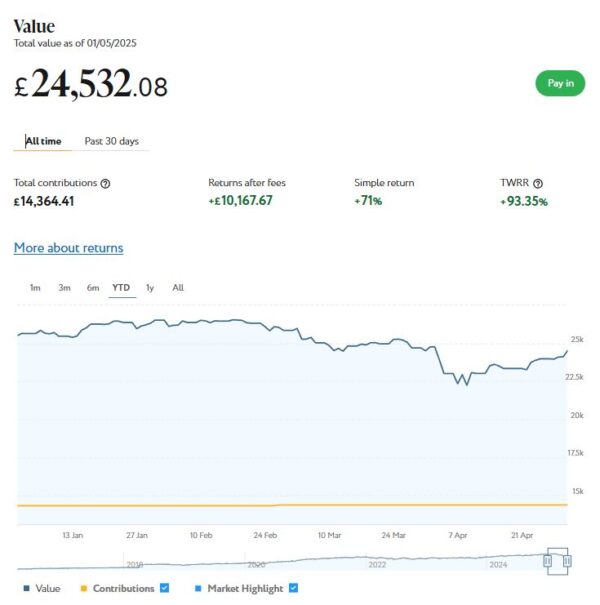
As the screenshot below for the year to date shows, my main Nutmeg portfolio is currently valued at £24,532. Last month it stood at £25,065, so that is a fall of £533.
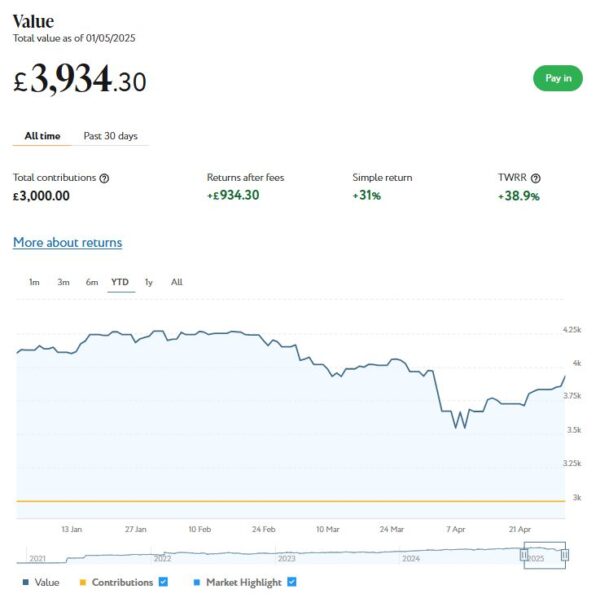
Apart from my main portfolio, I also have a second, smaller pot using Nutmeg’s Smart Alpha option. This is now worth £3,934 compared with £4,027 a month ago, a fall of £93. Here is a screen capture showing performance for the year to date.
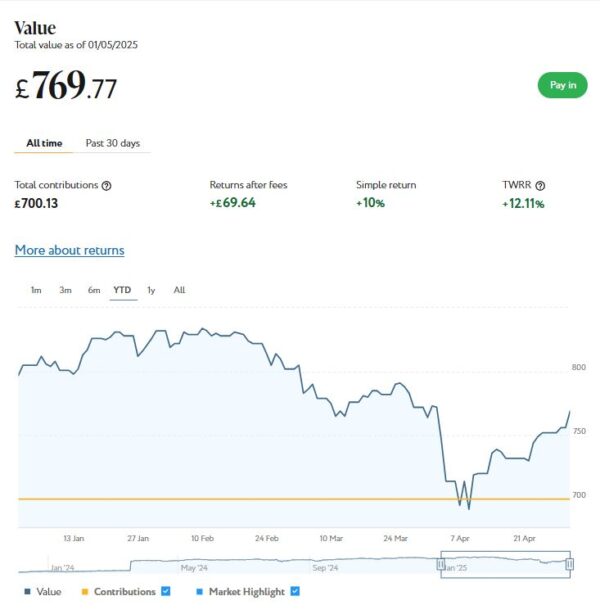
Finally, at the start of December 2023 I invested £500 in one of Nutmeg’s new thematic portfolios (Resource Transformation). In March I also invested a further £200 from referral bonuses. As you can see from the YTD screen capture below, this portfolio is now worth £770 compared with £783 last month, a fall of £13.
As you can see, April was a roller-coaster month for my Nutmeg investments. There were some big dips in the early part of the month, followed by a partial but nonetheless welcome recovery. Overall I am down by £639 over the month. This is mostly due to the continuing instability in world markets, caused by the trade tariffs imposed by US President Donald Trump and other economic factors.
Nonetheless, the value of my Nutmeg investments is still up £838 in the last twelve months. And their value has increased by £2,920 or 11.10% since the start of January 2024. So the recent falls do need to be taken in context. Ups and downs are always to be expected with stock market investments, and over time they tend to even themselves out. In general the worst thing you can do is panic and sell up when downturns occur, as you are then crystallizing your losses. This is something I had cause to discuss recently in this blog post.
You can read my full Nutmeg review here. If you are looking for a home for your annual ISA allowance, based on my overall experience over the last eight years, they are certainly worth considering. They offer self-invested personal pensions (SIPPs), Lifetime ISAs and Junior ISAs as well.
Moving on, I also have investments with P2P property investment platform Assetz Exchange. As discussed in this recent post, the company recently rebranded as Housemartin.
My investments with Housemartin continue to generate steady returns. Housemartin focuses on lower-risk properties (e.g. sheltered housing). I put an initial £100 into this in mid-February 2021 and another £400 in April. In June 2021 I added another £500, bringing my total investment up to £1,000.
Since I opened my account, my HM portfolio has generated a respectable £245.97 in revenue from rental income. I have also made a profit of £4.78 on property disposals. Capital growth has slowed, though, in line with UK property values generally.
At the time of writing, 18 of ‘my’ properties are showing gains, 1 is breaking even, and the remaining 18 are showing losses. My portfolio of 37 properties is currently showing a net decrease in value of £54.67. That means that overall (rental income and profit on disposal minus capital value decrease) I am up by £196.08. That’s still a decent return on my £1,000 and does illustrate the value of P2P property investments for diversifying your portfolio. And it doesn’t hurt that with Housemartin most projects are socially beneficial as well.
The net fall in capital value of my Housemartin investments is obviously a little disappointing. But it’s important to remember that until/unless I choose to sell the investments in question, it is largely theoretical, based on the latest price at which shares in the property concerned have changed hands. The rental income, on the other hand, is real money (which in my case I’ve reinvested in other HM projects to further diversify my portfolio).
To control risk with all my property crowdfunding investments nowadays, I invest relatively modest amounts in individual projects. This is a particular attraction of Housemartin as far as i am concerned. You can actually invest from as little as £1 per property if you really want to proceed cautiously.
As I noted in this blog post, Housemartin is particularly good if you want to compound your returns by reinvesting rental income. This effectively boosts the interest rate you are receiving. Personally, once I have accrued a minimum of £10 in rental payments, I reinvest this money in either a new HM project or one I have already invested in (thus increasing my holding). Over time, even if I don’t invest any more capital, this will ensure my investment with Housemartin grows at an accelerating rate and becomes more diversified as well.
In 2022 I set up an account with investment and trading platform eToro, using their popular ‘copy trader’ facility. I chose to invest $500 (then about £412) copying an experienced eToro trader called Aukie2008 (real name Mike Moest).
In January 2023 I added to this with another $500 investment in one of their thematic portfolios, Oil Worldwide. I also invested a small amount I had left over in Tesla shares.
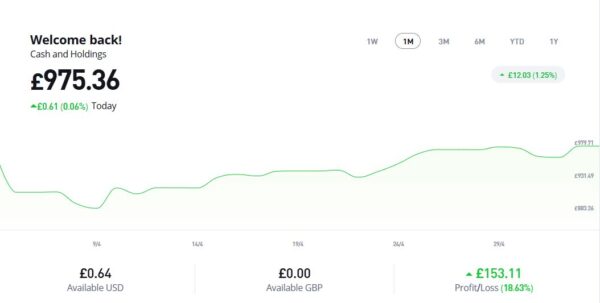
As you can see from the screen captures below, my original investment (total value £888.36 in pounds sterling) is today worth £975.36, an overall increase of £87 or 9.79%.
Note: eToro now displays the value of investments in your native currency, although you can change this if you wish.
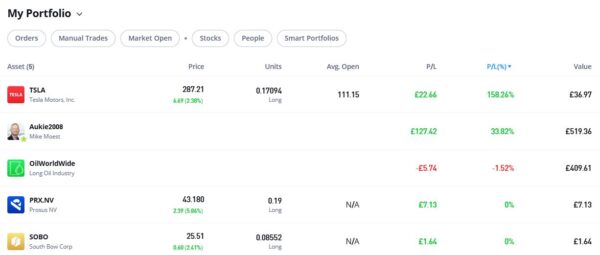
As you can see, my Oil WorldWide investment has seen a downturn in April and is actually worth marginally less than when I invested. That’s clearly disappointing after last month’s improvement, but reflects the global economic turmoil caused largely by US President Trump’s tariffs.
Thankfully my copy trading investment with Aukie2008 has been doing better, with an overall 33.82% profit. To be fair, I have held this investment a little longer.
My Tesla shares, which I bought as an afterthought with a bit of spare cash I had in my account, have done particularly well since I bought them, with an overall profit of 158.24%. If only I had put a bit more money into this!
You might also notice that I have small holdings in Prosus NV, a Dutch internet group, and South Bow, a Canadian energy infrastructure company. To be honest I don’t understand how I acquired these, but I assume they are some sort of bonus I was awarded. In any event, I am happy to have them in my portfolio!
eToro also offer the free eToro Money app. This allows you to deposit money to your eToro account without paying any currency conversion fees, saving you up to £5 for every £1,000 you deposit. You can also use the app to withdraw funds from your eToro account instantly to your bank account. I tried this myself and was impressed with how quickly and seamlessly it worked. You can read my blog post about eToro Money here. Note that it can also serve as a cryptocurrency wallet, allowing you to send and receive crypto from any other wallet address in the world.
If you would like more information about setting up an eToro account, please click on this no-obligation website link [affiliate]. Don’t forget that you also get a free $100,000 virtual portfolio, which you can use to experiment with trading and investing strategies. I have certainly earned a lot from mine.
Moving on, as I said last time, I am no longer writing for the Mouthy Money website, as they have decided to take their content creation in-house. From a personal perspective I am obviously disappointed about this, but I had a good run with them and wish them every success going forward. You can still read all the articles I contributed to Mouthy Money over the years by visiting my profile page on the website. How long they will keep this in place I really can’t say!
In April I did have a guest post on my friend Sally Jenkins’ writing blog. Sally asked me some questions about my writing career for a regular feature she runs on her blog. I enjoyed answering the questions, which included “What are the most important qualities required by a writer?” and “What writing resources have you found most useful?” If you have any interest in writing, hopefully you may find this of interest.
I also published several posts on Pounds and Sense in April. I have listed below those that are still relevant
In Why Now Could Be the Ideal Time to Take Advantage of Your New Tax-Free ISA Allowance, I pointed out that everyone received a new £20,000 ISA allowance from the start of the new tax year on 6 April 2025. My article sets out some good reasons for taking advantage of the new allowance sooner rather than later, especially in light of persistent rumours that the government plans to restrict the allowance (for cash ISAs at any rate) in the autumn budget.
Why Has My Bank Abandoned Me? is an opinion piece by a writer friend who has asked to be known at SD. In it she laments the changes at UK banks in recent years that have hit older customers (in particular) hard. I could certainly relate to some of the experiences she describes in her article. Take a look and see if you agree.
I’ve already mentioned my post about Why UK Retirees Shouldn’t Panic Over Trump’s Tariffs and Market Wobbles. In this I pointed out that whilst the recent downturn is disappointing for investors, the worst thing you can do is panic and sell up, as this will crystallize your losses. In this post I draw a parallel with the Covid crash and point out that this was followed by a sustained rise in stock market values. Of course, nobody knows how current events will play out, but hopefully the upward trend seen over the last couple of weeks will continue. In any event, historically stocks and shares have delivered better returns than savings accounts over most periods of five years or longer.
Tow Like a Pro – Caravan Safety Tips From the Experts was a guest post from my friends at Compass, who are specialist leisure and caravan insurers. The post reveals the most common causes of accidents with caravans and sets out some top tips for staying safe when towing one.
Finally, How to Publish Your Book (and Earn Royalties) was a guest post from my writing friend Sally Jenkins (as mentioned earlier I had a guest post published myself on Sally’s blog in April). In her article, which generated a lot of interest, Sally set out the main options for getting a book published and making money from it. She also revealed some resources she has used herself in her successful freelance writing career.
I’ll close with a reminder that you can also follow Pounds and Sense on Facebook or Twitter (or X as we have to call it now). Twitter/X is my number one social media platform and I post regularly there. I share the latest news and information on financial matters, and other things that interest, amuse or concern me. So if you aren’t following my PAS account on Twitter/X, you are definitely missing out.
I am also on the BlueSky social media network under the username poundsandsense.bsky.social. For the time being anyway, Twitter/X will remain my primary social media platform, but I will also post details of my latest blog posts, third-party articles and other financial news and resources on BlueSky for those who prefer to follow me there.
As always, if you have any comments or questions, feel free to leave them below. I am always delighted to hear from PAS readers
Disclaimer: I am not a qualified financial adviser and nothing in this blog post should be construed as personal financial advice. Everyone should do their own ‘due diligence’ before investing and seek professional advice if in any doubt how best to proceed. All investing carries a risk of loss.
Note also that posts on PAS may include affiliate links. If you click through and perform a qualifying transaction, I may receive a commission for introducing you. This will not affect the product or service you receive or the terms you are offered, but it does help support me in publishing PAS and paying my bills. Thank you!
If you enjoyed this post, please link to it on your own blog or social media:
As of 6 April 2026, UK investors have a fresh chance to supercharge their savings and investments with a new £20,000 Individual Savings Account (ISA) allowance.
To maximize the benefits of the new 2026/27 allowance, there’s a strong case for acting swiftly and using at least part of your £20,000 ISA allowance sooner rather than later. This is due to the power of compounding. By investing early, you give your money more time to grow, benefiting from the potential snowball effect of returns generating further returns. So the sooner you invest that £20,000 (assuming you are fortunate enough to have it) the more opportunity it has to multiply over time.
In addition to the tax-free ISA allowance remaining at a relatively generous £20,000 (for now – see below), the rules surrounding ISAs have undergone a welcome relaxation in recent years. One of the most significant changes is the ability to open more than one ISA of the same type (e.g. a stocks and shares ISA) with different providers in the same tax year. This means investors are no longer limited to a single provider for each type of ISA, giving them greater flexibility and choice in managing their investments.
Previously, investors were restricted to opening one cash ISA, one stocks and shares ISA and one innovative finance ISA (IFISA) per tax year. This restriction could prove frustrating for those seeking to diversify their investments or take advantage of new opportunities as the tax year progressed. Now, with the freedom to open multiple ISAs of the same type, investors can shop around for the best rates, terms and investment options without being limited to a single provider for each ISA type. They can also move some or all of their money from one provider to another without jeopardizing its tax-free status.
It’s important to remember, however, that while the rules have been relaxed, the overall annual ISA allowance remains fixed at £20,000. This means that any contributions made across multiple ISAs of any type will count towards your total allowance for the tax year. You should still therefore take care not to exceed the annual limit, to avoid any potential tax charges.
Note that from April 2027 the Cash ISA allowance has been reduced from £20,000 to £12,000 per year for savers under the age of 65. Until then it remains at £20,000 a year for all savers, though.
Cash ISAs offer a secure and accessible way to save, providing a tax-free environment for your savings with the added benefit of easy access to your funds when needed. Meanwhile, stocks and shares ISAs open the door to potential higher returns by investing in a wide range of assets such as equities, bonds, and funds, albeit with a higher level of risk. With a stocks and shares ISA you will never incur any liability for dividend tax, capital gains tax or income tax, even if your investments perform exceptionally well. Of course, there is no guarantee this will happen, but over a longer period stock market investments have typically outperformed cash savings, often by a substantial margin. IFISAs (e.g. from Housemartin, with whom I invest myself) allow you to invest is property crowdfunding and other forms of peer-to-peer finance. They are more specialized, but may appeal to some investors looking to further diversify their portfolios.
In recent years I have invested much of my own annual ISA allowance in a stocks and shares ISA with JP Morgan Personal Investing (previously Nutmeg), a robo-manager platform that has produced good returns for me. You can read how my Housemartin and JPM investments (and others) are faring in my monthly investment updates such as this one.
Closing Thoughts
The start of a new financial year is a good time for UK investors to review their savings and investment strategies. Whether you’re looking to start a new ISA or maximize your contributions to existing accounts, taking action early can set you on the path to optimizing your returns from this important tax-saving opportunity.
By investing sooner rather than later and taking advantage of the increased flexibility in ISA provider options, savers and investors can make the most of their money while minimizing their tax liabilities. So grasp this opportunity to build your wealth and protect it from the taxman today!
As always, if you have any comments or questions about this post, please do leave them below.
Disclaimer: I am not a qualified financial adviser and nothing in this blog post should be construed as personal financial advice. Everyone should do their own ‘due diligence’ before investing and seek professional advice if in any doubt how best to proceed. All investing carries a risk of loss.
If you enjoyed this post, please link to it on your own blog or social media:
If you’ve been watching the news lately, you’ll probably have seen headlines about stock markets taking a tumble thanks to a wave of tariffs announced by Donald Trump. It’s enough to make any retiree feel uneasy – especially if your pension is tied to the markets.
But before you start panicking or making any big changes, take a deep breath. Here’s what you really need to know.
What’s Going On?
President Trump’s tariffs are stoking fears of a global trade war. Investors don’t like uncertainty, and the markets are reacting with volatility. There have been drops not just in the US but across the globe, including here in the UK.
For retirees, that can feel personal. If your pension pot or retirement income is invested in stocks and shares, you might be wondering: Am I going to be okay?
Short answer: Yes, if you stay calm and avoid knee-jerk reactions.
Why This Isn’t the Time to Panic
Markets have always had ups and downs. That’s not new. Whether it was the financial crisis of 2008, the Brexit vote, or the COVID crash (see below), every downturn has sooner or later been followed by recovery.
If you sell investments during a dip, you lock in those losses. But if you ride it out, your portfolio has every chance to bounce back, as has happened before. History is on your side.
Speaking of which…
Consider The Covid Crash
In early 2020 it became clear that COVID was going to be a massive deal, and markets world-wide fell dramatically. And yet by mid-March, as the chart below from Yahoo Finance reveals, they were already recovering.
The recovery in stock market values continued through 2021. If you check out my in-depth review of the Nutmeg robo-adviser investment platform, you can see this for yourself. Overall, the period from March 2020 to December 2021 saw a big rise in the value of my Nutmeg investments. If I had panicked in early 2020 and withdrawn all my money then, I would certainly have been thousands of pounds worse off.
Your Pension Is Built to Withstand This
Most UK pensions – especially workplace and private pensions – are designed for long-term sustainability. They’re usually diversified across different types of assets like stocks, bonds and property. This helps soften the blow when markets get rocky.
If you have a defined benefit pension, you’re likely shielded from market fluctuations altogether. These pensions pay a fixed income and aren’t directly tied to the stock markets.
For those with defined contribution pensions – the majority of us these days – yes, the value can go up and down. But remember, pensions are managed by professionals who adjust strategies to navigate global changes like the current one.
What You Can Do (Instead of Worrying)
Check in with your adviser – They can help you understand how exposed your pension is to current events and whether any changes are needed. See also my article on Why Over-50s May Need an Independent Financial Adviser.
Keep a cash buffer – If possible have a few months’ worth of living expenses in cash or savings, so you’re not forced to sell your investments during market lows.
Stay diversified – A mixture of investments across regions and sectors helps spread risk.
Ignore the noise – Newspaper headlines are designed to grab attention. Focus on your long-term goals instead.
One other point is that, if you’re in the early days of retirement especially, dips can present an opportunity to buy while values are depressed, in the hope of gaining when (hopefully) they recover. This won’t be appropriate for everyone and it’s important to proceed cautiously. Timing the market is notoriously difficult, and if you get this wrong you can lose money rather than making it. But if you are careful (and not overly risk-averse) there are undoubtedly opportunities to be found at these times.
Bottom Line
Trump’s tariffs might be shaking the markets, but your retirement doesn’t have to be shaken with them. Your pension plan is more robust than you might think, and a temporary dip doesn’t mean disaster.
If you’re feeling anxious, that’s normal – but don’t let fear drive your financial decisions. Speak to a financial adviser if you need reassurance (I have one myself) and above all, keep your cool. Retirement is a long game, and a smart strategy will see you through.
As always, if you have any comments or questions about this article, please do leave them below.
DISCLOSURE: I am not a professional financial adviser and nothing in this article should be construed as personal financial advice. If you are uncertain how best to proceed, I strongly recommend speaking to a qualified financial adviser or planner. They will take the time to fully understand your particular circumstances and advise you how best to proceed. All investing carries a risk of loss.
If you enjoyed this post, please link to it on your own blog or social media:
Here is my latest monthly update about my investments (slightly earlier than usual due to other commitments). You can read my March 2025 Investments Update here if you like.
I’ll begin as usual with my Nutmeg Stocks and Shares ISA. This is the largest investment I hold other than my Bestinvest SIPP (personal pension).
As the screenshot below for the year to date shows, my main Nutmeg portfolio is currently valued at £25,065. Last month it stood at £25,850, so that is a drop of £785.
Apart from my main portfolio, I also have a second, smaller pot using Nutmeg’s Smart Alpha option. This is now worth £4,027 compared with £4,151 a month ago, a fall of £124. Here is a screen capture showing performance for the year to date.
Finally, at the start of December 2023 I invested £500 in one of Nutmeg’s new thematic portfolios (Resource Transformation). In March I also invested a further £200 from referral bonuses. As you can see from the YTD screen capture below, this portfolio is now worth £783 compared with £803 last month, a fall of £20.
As you can see, March has been another disappointing month for my Nutmeg investments. Overall I am down by £929. This is mostly due to the continuing instability in world markets, caused by the the trade tariffs imposed by US President Donald Trump and other economic and social factors.
Nonetheless, the value of my Nutmeg investments is still up £1,477 in the last twelve months. And their value has increased by £3,559 or 13.52% since the start of January 2024. So the recent falls do need to be taken in context. Ups and downs are always to be expected with stock market investments, and over time they tend to even themselves out. In general the worst thing you can do is panic and sell up when downturns occur, as you are then crystallizing your losses. Indeed, I am considering topping up some of my investments now while values are depressed. That’s just how I’m thinking, of course, and doesn’t constitute investment advice!
You can read my full Nutmeg review here. If you are looking for a home for your annual ISA allowance, based on my overall experience over the last eight years, they are certainly worth considering. They offer self-invested personal pensions (SIPPs), Lifetime ISAs and Junior ISAs as well.
Moving on, I also have investments with P2P property investment platform Assetz Exchange. As discussed in this recent post, the company recently rebranded as Housemartin.
My investments with Housemartin continue to generate steady returns. Housemartin focuses on lower-risk properties (e.g. sheltered housing). I put an initial £100 into this in mid-February 2021 and another £400 in April. In June 2021 I added another £500, bringing my total investment up to £1,000.
Since I opened my account, my HM portfolio has generated a respectable £238.70 in revenue from rental income. Capital growth has slowed, though, in line with UK property values generally.
At the time of writing, 15 of ‘my’ properties are showing gains, 2 are breaking even, and the remaining 19 are showing losses. My portfolio of 36 properties is currently showing a net decrease in value of £52.78, meaning that overall (rental income minus capital value decrease) I am up by £185.92. That’s still a decent return on my £1,000 and does illustrate the value of P2P property investments for diversifying your portfolio. And it doesn’t hurt that with Housemartin most projects are socially beneficial as well.
The overall fall in capital value of my Housemartin investments is obviously a little disappointing. But it’s important to remember that until/unless I choose to sell the investments in question, it is largely theoretical, based on the latest price at which shares in the property concerned have changed hands. The rental income, on the other hand, is real money (which in my case I’ve reinvested in other HM projects to further diversify my portfolio).
To control risk with all my property crowdfunding investments nowadays, I invest relatively modest amounts in individual projects. This is a particular attraction of Housemartin as far as i am concerned. You can actually invest from as little as £1 per property if you really want to proceed cautiously.
As I noted in this blog post, Housemartin is particularly good if you want to compound your returns by reinvesting rental income. This effectively boosts the interest rate you are receiving. Personally, once I have accrued a minimum of £10 in rental payments, I reinvest this money in either a new HM project or one I have already invested in (thus increasing my holding). Over time, even if I don’t invest any more capital, this will ensure my investment with Housemartin grows at an accelerating rate and becomes more diversified as well.
In 2022 I set up an account with investment and trading platform eToro, using their popular ‘copy trader’ facility. I chose to invest $500 (then about £412) copying an experienced eToro trader called Aukie2008 (real name Mike Moest).
In January 2023 I added to this with another $500 investment in one of their thematic portfolios, Oil Worldwide. I also invested a small amount I had left over in Tesla shares.
As you can see from the screen captures below, my original investment (total value £888.36 in pounds sterling) is today worth £1,072.80, an overall increase of £184.44 or 20.76%.
Note: eToro now displays the value of investments in your native currency, although you can change this if you wish.
As you can see, my Oil WorldWide investment is currently showing a profit of 12.31%. That’s a welcome improvement since the portfolio was rebalanced by eToro. The investment team at eToro periodically rebalance all smart portfolios to ensure that the mix of investments remains aligned with the portfolio’s goals, and to take advantage of any new opportunities that may present themselves.
My copy trading investment with Aukie2008 has been doing better, with an overall 32.06% profit. To be fair, I have held the latter investment a bit longer.
My Tesla shares, which I bought as an afterthought with a bit of spare cash I had in my account, have done particularly well since I bought them, with an overall profit of 144.84%. If only I had put a bit more money into this!
You might also notice that I have small holdings in Prosus NV, a Dutch internet group, and South Bow, a Canadian energy infrastructure company. To be honest I don’t understand how I acquired these, but I assume they are some sort of bonus I was awarded. In any event, I am happy to have them in my portfolio!
eToro also offer the free eToro Money app. This allows you to deposit money to your eToro account without paying any currency conversion fees, saving you up to £5 for every £1,000 you deposit. You can also use the app to withdraw funds from your eToro account instantly to your bank account. I tried this myself and was impressed with how quickly and seamlessly it worked. You can read my blog post about eToro Money here. Note that it can also serve as a cryptocurrency wallet, allowing you to send and receive crypto from any other wallet address in the world.
If you would like more information about setting up an eToro account, please click on this no-obligation website link [affiliate]. Don’t forget that you also get a free $100,000 virtual portfolio, which you can use to experiment with trading and investing strategies. I have certainly earned a lot from mine.
Moving on, as I said last time, I am no longer writing for the Mouthy Money website, as they have decided to take their content creation in-house. From a personal perspective I am obviously disappointed about this, but I had a good run with them and wish them every success going forward. You can still read all the articles I contributed to Mouthy Money over the years by visiting my profile page on the website. How long they will keep this in place I really can’t say!
I also published several posts on Pounds and Sense in March. Some are no longer relevant, but I have listed the others below.
In Beat the Postage Stamp Price Rise!, I pointed out that stamp prices are rising again on 7th April 2025. This will actually be the the SIXTH rise in the price of first class stamps in just three years. See what prices are going up, along with my recommendations for mitigating the effects of the increases.
And in From Saving to Spending – The Retirement Mindset Shift I discussed a subject that has been on my mind recently as I enter my 70th year. This is how to negotiate the mindset shirt from saving to spending in retirement, and how (hopefully) to get the balance right.
The Pros and Cons of Investing for Dividends discusses a strategy that has been growing in popularity with older investors particularly. Dividend investing offers the potential for generating income combined with capital appreciation. In this post I examine the pros and cons of a dividend investing strategy and set out a few tips and guidelines for those new to this.
Finally, in Spotlight: The Mintos P2P European Investing Platform I take a closer look at Mintos, Europe’s largest P2P investment platform. As well as the ability to generate above-average returns by investing in loans to businesses world-wide, they have added new diversification options, including bonds, ETFs and real estate. And until the end of April they have a bonus offer for anyone investing €1,500 or above on the platform. In my blog post I look at the pros and cons of investing with Mintos and provide more details about their April bonus offer.
One other thing is that we’re currently just over a week away from the end of the 2024/25 financial year. If you still haven’t used all of your 2024/25 £20,000 tax-free ISA allowance, you have just a few days left before it’s gone. It is more important than ever to use all your tax-free allowances while you can, as the government looks set to reduce some of these allowances later in the year. See my recent blog post for more information.
I’ll close with a reminder that you can also follow Pounds and Sense on Facebook or Twitter (or X as we have to call it now). Twitter/X is my number one social media platform and I post regularly there. I share the latest news and information on financial matters, and other things that interest, amuse or concern me. So if you aren’t following my PAS account on Twitter/X, you are definitely missing out.
I am also on the BlueSky social media network under the username poundsandsense.bsky.social. For the time being anyway, Twitter/X will remain my primary social media platform, but I will also post details of my latest blog posts, third-party articles and other financial news and resources on BlueSky for those who prefer to follow me there.
As always, if you have any comments or questions, feel free to leave them below. I am always delighted to hear from PAS readers
Disclaimer: I am not a qualified financial adviser and nothing in this blog post should be construed as personal financial advice. Everyone should do their own ‘due diligence’ before investing and seek professional advice if in any doubt how best to proceed. All investing carries a risk of loss.
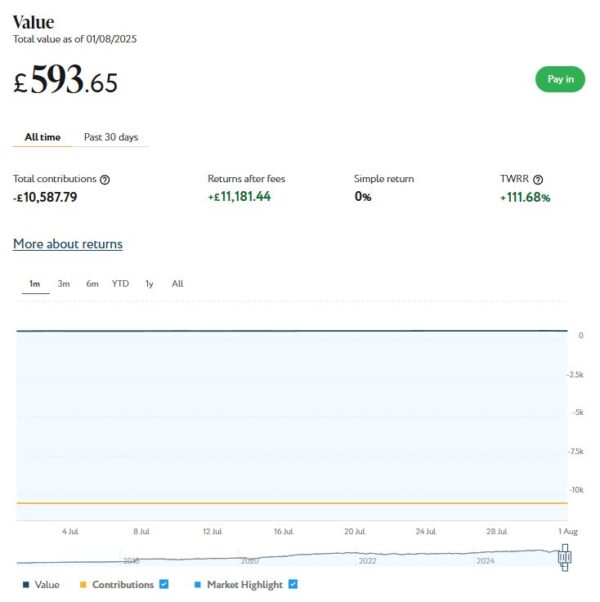
Note also that posts on PAS may include affiliate links. If you click through and perform a qualifying transaction, I may receive a commission for introducing you. This will not affect the product or service you receive or the terms you are offered, but it does help support me in publishing PAS and paying my bills. Thank you!
If you enjoyed this post, please link to it on your own blog or social media: