Wood-Burning Stoves and Solid-Fuel Fires: Could They Help Keep Your Home Warm in a Power Cut?
With winter approaching, many householders are thinking about how to keep their homes warm without facing ever-higher energy bills. Recent discussions about heat pumps and the possibility of electricity outages have also prompted questions about how resilient our home heating systems really are.
One option worth considering is solid-fuel heating – burning wood, manufactured fuel or other suitable solid fuels to produce heat.
For some households, a wood-burning stove or traditional fireplace can provide welcome supplementary heating (this may be especially relevant in homes with heat pumps, as they can struggle to provide sufficient warmth if the weather gets really cold). It might also offer a degree of reassurance if the electricity supply fails during a cold snap.
Solid-fuel heating isn’t suitable for everyone, however. Installation can be expensive, fuel needs to be stored, and burning wood and other solid fuels has environmental and health implications. Some modern appliances also depend on electricity, meaning they may not work during a power cut.
So what are the options, and what should you consider before investing in one?
Table of Contents
1. Wood-burning stoves
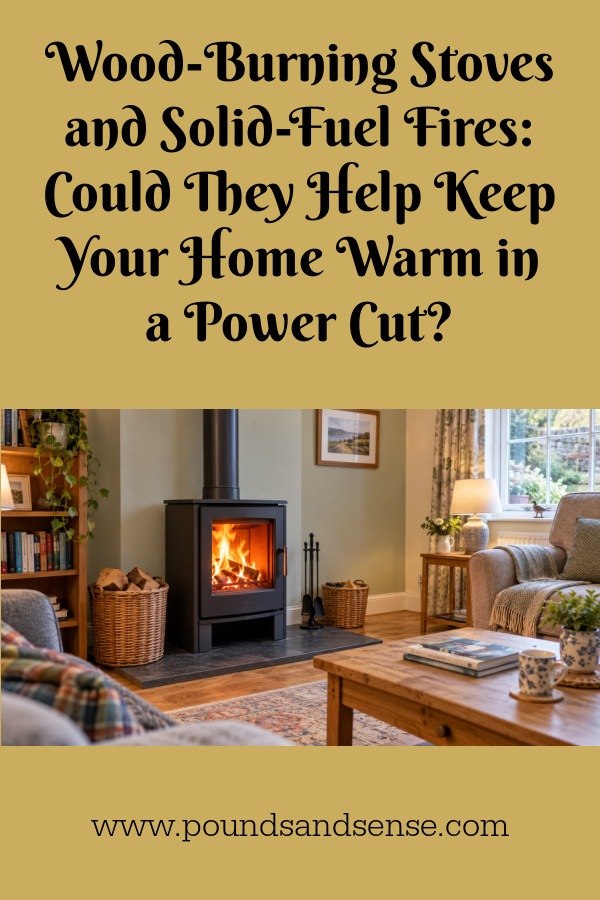
A modern wood-burning stove is probably the first thing many people think of when considering solid-fuel heating.
How it works: Logs are burned inside an enclosed metal or cast-iron appliance, with the smoke and combustion gases carried outside through a chimney or suitable flue. The stove radiates heat into the room, while some warmth also circulates through the surrounding air.
Wood-burning stoves are generally much more efficient than traditional open fires. They can provide substantial heat to the room in which they are installed, making them useful if you want to warm the main living area without necessarily heating every room in the house.
Advantages
- Potentially independent of mains electricity. Many conventional log burners work without electricity, although you should check the specific appliance and installation.
- Effective local heating. A suitably sized stove can make a living room feel warm and comfortable even if the central heating is turned down.
- A renewable fuel option. Wood can be renewable when sourced from sustainably managed forests, although its overall environmental impact depends on how it is produced, transported and burned.
- A degree of fuel flexibility. Householders who buy and store seasoned logs can have fuel available in advance rather than relying entirely on electricity or gas deliveries.
Disadvantages
- Installation costs. A stove, hearth, flue or chimney alterations, ventilation and professional installation can add up to several thousand pounds, particularly where no suitable chimney exists.
- Fuel storage. Logs need a dry, accessible storage space. Buying, moving and loading them can also be physically demanding.
- Regular maintenance. Stoves need cleaning, servicing and chimney sweeping.
- Air pollution. Even modern stoves release fine particles into the air. Dry wood and a well-maintained, efficient appliance help reduce emissions, but do not eliminate them.
A wood-burning stove is most attractive where a suitable chimney already exists, there is enough room for fuel storage, and the household expects to use it regularly.
If your main aim is simply to have a backup heating source for the occasional power cut, the installation cost may be difficult to justify.
2. Multi-fuel stoves
A multi-fuel stove looks similar to a wood-burning stove but is designed to burn a wider range of fuels.
Depending on the model, these might include logs, approved smokeless solid fuels and manufactured fuel briquettes.
The important point is that not every stove can burn every type of solid fuel. Always follow the manufacturer’s instructions, and check the rules applying to your home.
Advantages
- More choice of fuel, potentially useful if supplies or prices change.
- Similar heating benefits to a wood-burning stove.
- Many models can operate without mains electricity.
Disadvantages
- Installation and maintenance costs are similar to those of a wood-burning stove.
- Different fuels have different storage requirements, prices and environmental impacts.
- Some fuels produce more pollution than others, and not all are permitted in every location.
In England, for example, smoke control areas restrict what you can burn. Wood and other unauthorised fuels generally require an appropriately Defra-exempt appliance, while authorised fuels can be used in accordance with the rules. Check with your local council before purchasing an appliance.
You can find further information in the government’s guide to smoke control area rules.
3. Traditional open fireplaces
Many older British homes have an open fireplace, even if it has been covered over or rarely used.
If you already have a working fireplace and chimney, you might wonder whether reopening it would provide a useful source of backup heat.
An open fire can certainly produce warmth, and it may be possible to use it without electricity. However, it has significant disadvantages compared with a modern enclosed stove.
Advantages
- You may already have the fireplace and chimney, reducing the initial outlay if they are suitable and safe to use.
- An open fire can provide heat without relying on mains electricity.
- It offers a familiar and attractive focal point in a living room.
Disadvantages
- Much of the heat can escape up the chimney rather than warming your home.
- Open fires are generally less efficient than enclosed stoves.
- They produce substantial smoke and fine-particle pollution.
- Sparks and embers can escape into the room, creating additional fire risks.
- The chimney must be inspected and maintained before use.
If you have an existing fireplace, it is worth having it assessed by a suitably qualified professional before lighting a fire in it.
For someone planning a new installation, a modern enclosed stove will generally be a better heating choice than a traditional open fire.
4. Pellet stoves and biomass heating
Another option is a wood-pellet stove. Instead of logs, it burns small compressed pellets made from wood or other suitable biomass materials.
Pellet stoves can feed fuel automatically from a hopper and regulate their output, making them more convenient than manually loading logs.
However, there is an important drawback if your concern is electricity outages.
Most conventional pellet stoves need electricity to operate their electronic controls, fans and fuel-feeding mechanisms. They may therefore stop working during a power cut unless a suitable backup power arrangement is available.
Larger biomass boilers can also burn wood pellets or other biomass fuels to provide central heating and hot water. These are more complex installations and commonly rely on electricity for pumps and controls.
Pellet stoves and biomass boilers can be worth investigating if you want a more automated form of solid-fuel heating. But if your priority is to keep one room warm during a power cut, a conventional stove that can operate without electricity may be more appropriate.
5. What about coal and other solid fuels?
Solid-fuel heating has a long history in Britain, and coal fires were once commonplace. Today, however, traditional house coal is no longer a practical option for most householders in England, following restrictions on its sale for domestic use.
Manufactured smokeless fuels and certain other authorised fuels remain available, subject to the rules governing the appliance and location.
These fuels may be useful in a compatible multi-fuel stove or fireplace. Some can be easier to store than logs, although their cost and environmental impact vary.
It is important not to assume that a fuel advertised as smokeless produces no pollution. Nor should you burn household rubbish, painted or treated wood, old furniture or other unsuitable materials. These can release harmful pollutants and may damage your appliance or chimney.
For more information on choosing appropriate fuels, see the government’s Burn Better, Breathe Better guidance.
Could a solid-fuel fire keep you warm during a power cut?
This is an important question, particularly if you are concerned about winter electricity outages.
A conventional wood-burning stove or suitable open fire can continue producing heat when the electricity supply fails. That can be a real advantage if your normal heating system depends on electricity.
However, there are several qualifications.
First, not every solid-fuel appliance is independent of electricity. Pellet stoves and systems with powered fans, pumps or controls may stop working. Check the manufacturer’s instructions rather than assuming that burning fuel means the appliance will work without mains power.
Second, a stove heats a particular area rather than automatically heating the whole house. If you have a stove in your living room, it may keep that room reasonably comfortable while bedrooms and bathrooms remain cold. Heat will travel to other rooms to some extent, but this depends on your home’s layout and insulation.
Third, a power cut can affect other parts of your heating system. If a solid-fuel boiler or stove is connected to radiators or a central heating circuit, pumps and controls may require electricity. Some systems need specific arrangements to operate safely during a power failure. Never assume you can simply continue firing a boiler or stove connected to a water circuit when the power stops.
Finally, a fire is not a substitute for a wider emergency plan. You will still need lighting, a way to prepare food and hot drinks, and a means of keeping warm if the fire cannot be used safely.
For a household that already owns a suitable stove, keeping an adequate supply of dry fuel may be a sensible precaution. Installing one solely to prepare for a hypothetical outage is a much bigger decision.
The costs: is solid-fuel heating economical?
The cost depends heavily on what you already have.
If you own a home with a sound, suitable chimney and an existing stove, the main expenses may be fuel, servicing and chimney sweeping.
If you are starting from scratch, the cost can be considerably higher. You may need a stove, a suitable flue, a hearth, ventilation improvements and building-regulations compliance. A straightforward installation can cost a few thousand pounds, while more complicated projects may cost substantially more.
You should also budget for the fuel itself. Logs need to be properly dried, and buying enough to last a winter can involve a sizeable initial outlay. Storage space, delivery charges and the effort involved in handling the fuel all matter.
It is worth comparing the cost of useful heat rather than simply comparing the price of a bag of logs with the price of a unit of electricity or gas.
A stove may be economical when it regularly heats a room that would otherwise require expensive heating. But if you only light it occasionally, the cost of installation and maintenance may outweigh any savings.
And if you already have an efficient heat pump, adding a stove will not necessarily reduce your overall heating costs. The result depends on the cost of the fuel, the efficiency of the equipment and how you use it.
Environmental and health considerations
Solid-fuel heating has benefits and drawbacks that are sometimes overlooked in discussions about energy security.
Wood can be a renewable resource, but burning it releases carbon dioxide and other pollutants. The overall climate impact depends on factors including how the wood is sourced, whether forests are sustainably managed, and the time taken for replacement trees to absorb carbon.
There is also a more immediate issue: air quality.
Domestic wood burning is a significant source of fine particulate matter in the UK. These tiny particles can affect respiratory and cardiovascular health, and the risks are particularly relevant to people with existing health problems.
Modern, well-designed stoves generally produce less pollution than older stoves and open fires, but they do not eliminate the problem.
If you choose to burn wood:
- Use properly dried wood with a moisture content of 20% or less, ideally carrying the Ready to Burn certification.
- Never burn painted, treated or chemically contaminated wood.
- Use an appliance designed for the fuel you intend to burn.
- Have the appliance serviced regularly and the chimney swept at least annually, following the advice appropriate to your appliance and fuel.
- Ensure the room has adequate ventilation.
You should also consider your neighbours. Smoke from a domestic chimney can affect nearby homes, particularly in built-up areas.
Safety must come first
Any appliance that burns solid fuel needs to be installed and used correctly.
If you are considering a new stove, use a competent installer who can ensure the installation complies with the relevant building regulations. In the UK, HETAS is one recognised source of information and a directory of registered installers.
A suitable carbon monoxide alarm is essential, alongside working smoke alarms. Follow the manufacturer’s guidance on alarm placement and testing.
Never use a barbecue, camping stove or outdoor fire inside your home as an emergency heating or cooking device. These can cause dangerous carbon monoxide build-up.
Also remember that a stove or fire needs appropriate ventilation and a properly functioning chimney or flue. Modern homes that have been made more airtight may require particular attention to the air supply.
Finally, make sure you can safely manage the fuel, ash and maintenance. Carrying heavy logs, bending to load a stove and handling hot ash may not suit everyone, particularly as we get older.
Is solid-fuel heating right for you?
A solid-fuel appliance is more likely to make sense if:
- You have a suitable chimney or can install an appropriate flue.
- You want regular supplementary heat in a particular room.
- You have enough space to store fuel safely and keep it dry.
- You are comfortable with the work involved in lighting, tending and cleaning a fire.
- You are prepared to meet the installation, maintenance and fuel costs.
- You have checked the relevant local rules and considered the environmental implications.
It is less likely to be a sensible investment if you live in a flat without a suitable flue, have limited storage space, rarely need supplementary heat, or would find handling logs and maintaining a stove difficult.
It may also be unnecessary if your main concern is the occasional power cut. Other measures, such as warm clothing, blankets, draught-proofing and having a plan to stay elsewhere if your home becomes too cold, may be more practical and less expensive.
Final thoughts
Solid-fuel heating is not a universal solution to rising energy costs or concerns about electricity outages. It has real disadvantages, particularly in terms of installation costs, maintenance and air pollution.
Nevertheless, a suitable wood-burning stove or multi-fuel appliance can provide useful supplementary heat and, in the right circumstances, a source of warmth that does not depend on mains electricity.
For some households, particularly those with an existing fireplace or stove, it may be a worthwhile option to consider. For others, the costs and practical drawbacks will outweigh the benefits.
As with heat pumps, solar panels and home batteries, the best decision depends on your home, your budget and your priorities. The aim should not be to install every possible heating technology, but to find a safe, affordable and practical way to keep your home warm.
What do you think? Do you have a wood-burning stove or open fire, or have you considered installing one as a backup heating source? I’d be interested to hear about your experiences in the comments below.
