My September Update

My Coronavirus Crisis Experience: September Update

Regular readers will know that I have been posting about my personal experience of the coronavirus crisis since lockdown started (you can read my August update here if you like).

As previously I will discuss what has been happening with my finances and my life generally over the last few weeks. I will try to avoid being too repetitive, as I have obviously published a few of these updates now and not everything changes that much from one update to the next!

As always, I will start with the money side of things.

Financial

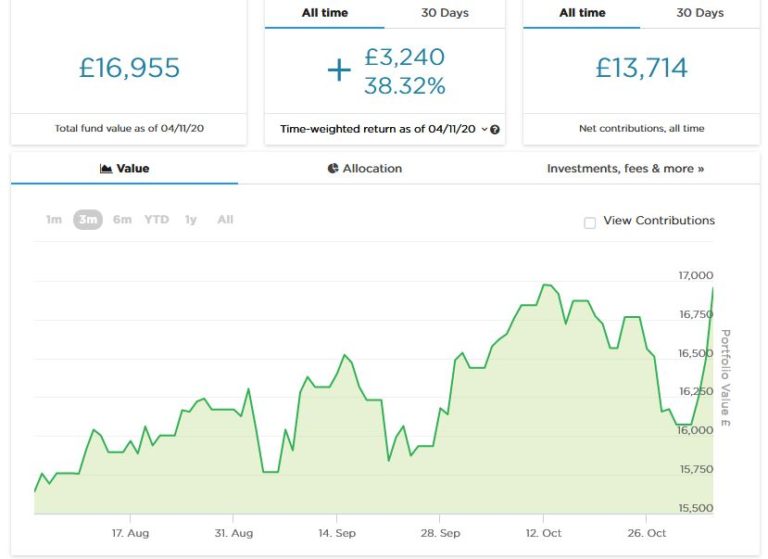
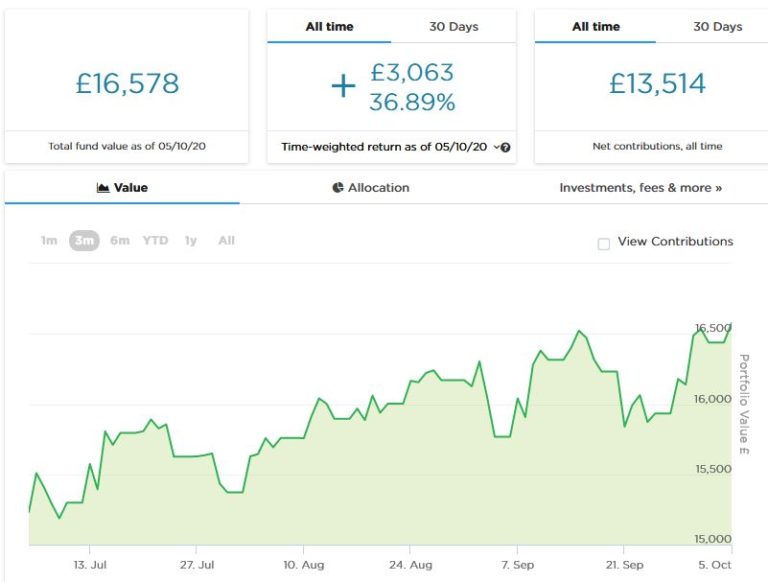
As usual, I’ll start with my Nutmeg stocks and shares ISA. This has gone up and down over the last few weeks, but is currently at £16,041. At one point it was as high as £16,270, but it’s still over £400 up on last month, so I’m not complaining. Here is a screen capture covering the last three months…

You can read my in-depth Nutmeg review here if you like.

My two Buy2LetCars investments are still delivering the promised monthly returns without any hassle. I was pleased that Buy2LetCars also chose to feature me and my blog posts about the company in their email newsletter last month. That brought me a few more readers, so a special welcome if you are one of them! Again, if you’d like to learn more, you can read my review of Buy2LetCars here and my more recent article about the company here.

There is nothing particular to report about my Property Partner or Kuflink investments, both of which are ticking along satisfactorily. As regards The House Crowd, another of their properties in which I hold a share has just been sold, so that is around £2,000 in capital I am expecting back in the next month or two. Unfortunately I am not expecting to make any profit on these two investments, though I have of course received rental payouts – or dividends if you prefer – from these properties over the time I’ve held shares in them.

As regards Crowdlords – which I discussed last month – I wrote asking about two investments I still have with them, Kennington Road eco-houses and Trent House. I had received no information from Crowdlords about either of these projects since before lockdown in March, which I found disappointing.

I received a prompt and courteous reply from Crowdlords co-founder, Richard Bush. He told me that the properties in question were proving difficult to exit from and the situation had been complicated by the change in their FCA status. He added: ‘Prior to the FCA announcement we were about to launch new investments for both of these properties, giving those that wish to leave an exit option and others who like income-based investments to take over, alongside mortgages. This is still our plan, though at the same time we will also try and sell both properties…Once we’re back up and running with Equity and Mezzanine investments we will turn our attention to the BTL’s (including Kennington Road) and still hope to have an exit option available by the end of the year. In the meantime Trent House will continue to earn 6% p.a interest.’

So I guess that is somewhat reassuring, but I’m still not holding my breath about seeing any return from either of these projects any time soon. It’s a shame because I’ve always liked Crowdlords and had good returns from my other investments with them. But obviously these are unprecedented times and property markets generally have been struggling. I will wait to see what new offering the company comes up with, but it will have to be very enticing indeed to persuade me to invest with them again.

As mentioned last time, I applied for the second (and final) round of SEISS (Self Employed Income Support Scheme) payments in mid-August and duly received payment a few days latter. I haven’t seen any complaints or problems about the administration of the SEISS programme and think HMRC deserve a lot of credit for how smoothly it has run. I do know there were issues over eligibility, however, so my commiserations go to any self-employed people who – for no fault of their own – failed to qualify.

In any event, if you are self-employed and eligible for a SEISS payment, applications are open now, so don’t delay!

Personal

In the last few weeks I have done a few things for the first time since lockdown in March. For one, I took advantage of the government’s Eat Out to Help Out scheme to enjoy a couple of pub lunches (okay, one was more of a pub brunch). It was great to be doing something more normal again and catch up with old friends I hadn’t seen since the start of the year. And paying half-price was a nice bonus!

It was obviously a different experience from the usual. When my friend and I arrived for our pub lunch, we were met by a man at the door who checked our booking and showed us to our table (no chance to pick our own as we would normally). One thing I noticed was that no staff were wearing masks and only a few customers. As a mask sceptic this didn’t bother me, but again I was struck by the incongruity of a situation where you can be in a pub surrounded by other diners for a couple of hours with almost nobody masked, then go to a supermarket and be forced to put one on while there (unless you’re exempt, of course).

In any event, I really enjoyed my pub lunch and catching up with my friend. We couldn’t pay cash as we would normally – nobody wants cash nowadays in case it’s contaminated – so my friend paid on his card and I later forwarded my half to him via PayPal. That was a first!

I also went to Birmingham to meet another old friend for brunch at one of the Wetherspoons pubs there. It felt odd to be on the streets in Brum and see so many people wearing masks in the open. Nobody does this in the small town where I live, but I guess it’s a bit different in big cities. Anyway, my friend arrived before me and was directed to a table at the back of the pub. I then had to wander around the tables looking for him behind various protective screens, feeling like a voyeur or a spy. But thankfully I found him eventually!

The instructions on the table told us to order via the Wetherspoons app. That task fell to me, as my friend doesn’t have a smartphone. I managed to do it after signing in to the pub’s free WiFi. I saw several people struggling with this, though. They either ended up hailing a passing waitress or gave up and ordered at the bar.

Anyway, the app worked well for me, and I was impressed by the speed with which cutlery was brought to our table, shortly followed by our meals (two all-day breakfasts). We both also ordered coffee with limitless refills. I was pleased to discover that this was still on offer, though you are now supposed to ask a staff member for a new mug before going to the coffee machine again. I did this, but I don’t think anyone else did.

I have just returned form a short break in Minehead on the Somerset coast (my cover image shows the harbour with the Butlins camp in the background!). I won’t say too much about this here as I plan to do a separate post about it soon. But I will say it was an enjoyable and relaxing break, only slightly marred by the fact that many of the attractions were closed due to Covid. I did manage to visit the nearby Dunster Castle (pictured below), which is owned by the National Trust. Sadly only some areas were open to the public, with various restrictions due to the virus. But on the plus side, because visitor numbers were being limited, I had plenty of space to appreciate what was actually on view!

Dunster Castle

Going back to masks and such matters, I have been wearing a full face shield in supermarkets (I’m not going to other shops till masks are voluntary again, though I might make an exception if the shop clearly states that they welcome non-mask-wearers). I find this a good compromise as it is much easier to breathe through than a cloth mask, and I haven’t yet been challenged by any staff members or self-appointed mask police. I also recently obtained a half-face shield which covers you from the nose downward. That makes it more portable, and also means your vision isn’t impaired (shields are made of clear plastic, but with my eyesight I struggle a bit reading lists of ingredients through them). In case you are interested, here’s an Amazon ad (affiliate) for some half-face shields similar to the type I bought.

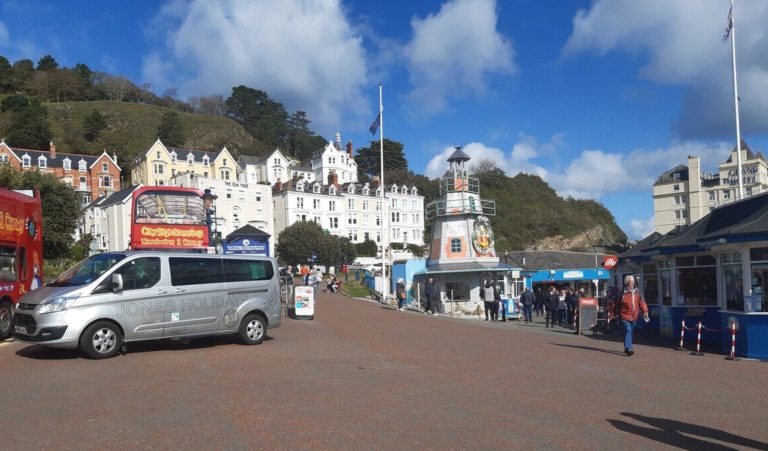
I am looking forward to another late summer break in a couple of weeks’ time. I shall be going to Llandudno in North Wales, one of my favourite UK holiday destinations. I shall be staying in a self-catering apartment and am looking forward to shopping for food without having to put a mask on (Wales so far having sensibly resisted the pressure to make masks mandatory in shops). More about that next time!

And that’s it really. Recent reports are indicating an uptick in the virus among young people especially, and of course the doom-mongers are out in force again. Nonetheless, I think there are still plenty of reasons to stay positive. Hospital admissions and deaths are thankfully still at very low levels. And in my personal opinion we are very unlikely to see a ‘second wave’ anywhere near as bad as the first. Of course, it’s important to continue taking sensible precautions such as hand-washing and using sanitizing gel, along with social distancing (if you can keep up with the ever-changing rules). Personally I think that any marginal benefits from wearing masks are more than offset by the way people misuse them in practice. But I’d better not go on any more about that!

I hope you and your loved ones are staying safe and sane during this crazy time. As ever, if you have any comments or questions about this post, please do leave them below.

If you enjoyed this post, please link to it on your own blog or social media:
Self-employment

Ten Things I Have Learned About Self-Employment Over 30 Years

Yes, it’s true. I’ve been self-employed for over 30 years now (barring a short barren spell 20 years ago when I took a temporary job at the University of Wolverhampton to help make ends meet).

I worked primarily as a freelance writer, but also as a freelance proofreader and editor. As regular readers will know I am semi-retired these days, though still available for small to medium-sized projects that I can fit in around my other commitments 🙂

Inevitably over the last 30 years I’ve learned a few things about self-employment, so I thought today I’d share some of them here. I hope this will be helpful to anyone who may be contemplating going down this route.

1. You Need an Accountant

This is actually my top tip to anyone starting out in self-employment. Tax is complicated (Shock! Horror!) and there really is no substitute for getting advice from a professional in the field.

Yes, you can do your own book-keeping (and there is no shortage of clever software to help with this). But an accountant will do so much more. They will help you set up your record-keeping system, answer any queries you may have, draw up and submit annual accounts for you, and help if (for example) HMRC raise any queries about your tax return. True, an accountant will cost you a few hundred pounds a year, but I have never for one second resented this. It is money well spent for the peace of mind it gives you alone.

  • Just one example. Some years ago I was offered a five-figure sum by a publisher in exchange for all rights in some online courses I had created. It seemed a good deal, but before signing on the dotted line thought I should run it past my accountant first. He pointed out that with one or two minor changes to the wording of the contract – which the publishers were happy to make – the fee would be regarded by HMRC as a capital gain rather than taxable income. As I had no other taxable gains that year I was able to keep the entire sum I was paid. Without my accountant’s advice, I could easily have ended up paying thousands of pounds in unnecessary tax.

So get an accountant before you do anything else – you know it makes sense. See also my recent blog post that goes into more detail about why you need one.

2. Controlling Workflow is Crucial

One thing you will soon discover if you take the road of self-employment is that it’s a very short distance from having too little work to too much (and back again). In a conventional job you will have colleagues to share the load, and a manager to complain to if it all gets too much. As a self-employed person, managing your workload is all down to you.

There is no doubt this can be stressful at times. One minute you are worrying about not having enough work to pay the bills. The next you are agonizing over how to keep all your clients happy and meet their deadlines without spreading yourself too thinly and burning yourself out.

There is no easy answer to this; it’s just one of those things all self-employed people have to manage as best they can. One thing I have found helpful, though, is building a network of trusted people in the same field as me. Then when I am feeling swamped I can ask if they would be interested in taking over some work from me – and vice versa, if they are very busy they may pass some of their excess work my way. This can be very helpful in smoothing out your workflow, although you need to be sure that anyone you recommend to a client will do a good job for them.

3. Business Is About People

Obviously to run a successful self-employed business, you need to be competent (and ideally better than that) at whatever it is you do.

Beyond that, however, business is about building and nurturing relationships. This is especially important in terms of getting repeat business, which for most self-employed people is crucial to maintaining a steady workflow (see above).

For any given job, there will be plenty of other people who could do it just as well as you (maybe even better). So you need to come across as someone who is pleasant and trustworthy as well as capable of doing the work. Once you have built a good working relationship with a client, chances are they will keep coming back to you in future, and recommend you to their friends or colleagues as well.

You don’t have to become best mates with everyone you work for, but making the effort to connect with them and build a good relationship will undoubtedly pay off many times over.

4. You Need to Network

However good you are at your work, no client is going to beat a path to your door. You need to network

Obviously social media like Twitter and Facebook can be a big help here. But it’s good to put yourself about in the flesh too. If you are a freelance writer, for example, join your local writers’ circle, go on writers’ courses and conferences, volunteer to give talks, apply for residencies, and run classes in adult education. All of this will help raise your profile, and make it more likely that potential clients will get in touch with you.

And also under this heading I’d add, build up your network of useful contacts. These can come from all sorts of places: business colleagues and former colleagues, suppliers, clients, people you meet on courses, people you connect with via social media, and so on. Many of the new opportunities that have come my way over the years did so as a result of networking.

5. Don’t Rely Solely on the Internet

The internet is a wonderful thing, and there are lots of great resources on it for the self-employed. It can also be great for marketing your services. However, there was no internet at all when I was starting out, and it didn’t hold me back!

I find that young people especially tend to rely heavily on the internet and sometimes forget about other, more traditional media. If I was starting out as a freelance today, one thing I would certainly do is approach potential clients directly by letter and even by phone call. This can be a lot more effective than sending an email, which will probably end up in their spam folder anyway.

I would also scour job ads in newspapers and magazines, looking for businesses who are hiring in related fields to my own specialism. They might well be in need of freelance assistance as well, and a speculative application could turn up a regular source of work. Again, this is a strategy that has worked well for me in the past.

6. You Must Be Reliable

This is one of the most important qualities any client wants. He/she wants to be confident that you will deliver your product or service by the agreed deadline. If the deadline passes and you haven’t met it, for business clients especially it can create all sorts of problems for them.

If you can see you’re going to have problems meeting a deadline, therefore, DON’T just cross your fingers and hope for the best. Tell your client. Given sufficient notice they may be able to make alternative arrangements. But if you don’t tell them in advance, it may be too late for this. Don’t then expect them to offer you any work in future.

7. You Must Be Accessible

Clients may sometimes need to contact you at short notice, e.g. to check a specification or request a progress update. You don’t have to be always just a phone call away (though that won’t hurt), but it should be possible for a client to contact you by some means and get a reply within 24 hours. Always aim to have your mobile with you, therefore, and check this and your email regularly, preferably at least twice a day.

And if you’re going away on holiday for more than a day or two, it’s a courtesy to let regular clients know, especially if you are in the middle of a job for them!

8. Don’t (Usually) Argue

OK, this one is a bit controversial. If you disagree with a client’s choice, you can say so. But don’t push it. At the end of the day, whoever pays the piper calls the tune.

Here’s an example from my own experience. In my capacity as a newsletter editor I was pitched an idea by a semi-regular contributor. Normally I liked his ideas, but for various reasons I couldn’t use this one, so I turned it down with a polite explanation. I then received a long, aggrieved email telling me quite forcibly that I was wrong and he was right, concluding with words to the effect, ‘I think I know our readership by now.’ As you might guess, I didn’t commission many more articles from him after that…

9. Be Friendly but Professional

As I said above, it’s good to build relationships with clients. Over a period of time you will inevitably get to know one another quite well, and genuine friendships often result.

However, remember that the client is also – in effect – your employer, so it’s important to remain professional in all your dealings with them. Don’t assume that because ‘John’ or ‘Mary’ is your buddy, they won’t mind if you palm them off with inferior work or take other liberties with them.

Another example here (all names changed to protect those concerned). A few years ago one of my regular clients, a guy I’ll call Phil, was looking for an additional freelance writer. I recommended a woman named Clare to him, whom I’d worked with on a couple of projects.

All seemed to go well at first, and then I heard that he had dropped Clare quite suddenly. As I knew Phil pretty well, I asked him what had happened. He was a bit reticent at first, but then he told me, ‘We’re a family company, Nick, and we choose the people we work with very carefully.’

A little more probing finally revealed that he had been on the phone to Clare one day, and she casually dropped the F-bomb into their conversation two or three times. Phil hadn’t said anything to her at the time, but I guess he was a bit shocked by this. Anyway, he decided that he couldn’t work with her any more.

I must admit, I don’t know why Clare did this. Maybe she wanted to show she was “one of the boys”, or maybe she’d just been watching too many Hollywood movies. In any event, it was exactly the wrong tack to take with Phil, who abhors bad language in any form. And so it cost Clare the opportunity of a continuing source of well-paid work.

That’s perhaps an extreme example, but it does illustrate an important point. A good, friendly relationship with a client can be very rewarding for both parties, but you should never let it become an excuse for behaving unprofessionally.

10. Keep Updating Your Skills!

Whatever line of business you’re in, you will need to keep updating your skills and even learning new ones.

That has certainly applied for me. When I set out as a freelance writer/editor, I was using an Amstrad PCW computer/word processor. It had no internal storage, no mouse, and used its own dedicated operating system called Locoscript. It came with a slow and cranky dot matrix printer, and had literally no bells and whistles. It had a key with the word OPTIONS on it, and when you pressed this a message came up on the screen saying NO OPTIONS. That summed it up really!

After a couple of years – maybe a bit longer – I realised I would have to dump my PCW and get a ‘proper’ home computer. This came with a mouse and used an early version of Windows (probably 3.1). I then had to learn a whole new set of skills, which I did largely through trial and error and reading books (the internet not being a thing then).

Over the years since I have had to acquire many more new skills, including how to proofread and edit electronically, how to do basic HTML coding, how to build and update a WordPress website, how to do search engine optimization and use social media to market my services, and much more. I also had to keep up with the latest software so I could deliver the services my clients needed using the software they used themselves.

If you’re in a normal job, your employer will generally arrange training for you when the need arises (and of course pay for it). As a self-employed person, once again, it’s all down to you. You will need to stay up to date with developments in your field and arrange training when necessary (or take time out to teach yourself) and pay your own costs (which are at least allowable against tax). If you don’t do this, you are likely to find yourself left high and dry as the world moves on and your old skills are no longer relevant.

Obviously this applies especially in fields such as mine that require the use of modern electronic technology. But whatever your field – even gardening or window-cleaning – there will inevitably be changes in fashion/tastes, technology, legal requirements, custom and practice, and so forth. It is essential to stay aware of what is going on in your chosen field, update your skills and learn new ones as required.

I do hope you find these tips helpful. If you have any comments or questions – or any other useful tips for people new to self-employment – feel free to add them below as comments.

If you enjoyed this post, please link to it on your own blog or social media:
Bloggers August Giveaway

Win a £100 M&S Hamper in the Bloggers August Giveaway!

Autumn is on the way, but before it arrives here’s a chance to make the summer of 2020 even more memorable 😉

Along with a number of my fellow UK bloggers, I am offering one lucky winner the chance to win a £100 hamper of their choice from Marks and Spencer – for example, this Windsor Hamper with Prosecco and red wine (pictured above)..

The competition is being promoted by my blogging colleague Emma Drew and is (of course) free to enter. Full details provided by Emma can be found below. Basically you just have to open the Rafflecopter widget and complete the simple tasks described. Each completed task will then earn you one entry in the giveaway.

The Bloggers

The following bloggers have all teamed together to contribute towards this competition, offering you a fantastic prize.

Please show your support by visiting some of the bloggers taking part just by clicking on the name of the blog below.

What To Watch | Unique Young Mum | Charlotte Musha | Tweet Your Trip | Side Hustle Directory | Koody | Socially Rach | Adventures Of a Riot Grrl | Nishi V | Hawkes At Home | Digital Frogs | Becca Blogs It Out | Jass V | Craft Hustle Directory | Thrifty Chap | Our House Our Home | Money Saving Superhero | The Financial Wilderness | Photographyish | Peggy May | Girls Just Wanna Have Funds | Pounds and Sense | Mum on a Budget | Her Home Biz | Simple Happy Home | The Money Whisperer | Love Panda | Love Dogs | Easy Peasy Gardens | Money Money Money | 360 Mum | A Little Luxury For Me | Mind Over Money Matters | Enjoy England For Less | Alice in Sheffield | Funding Her Freedom | Mama In Progress | A Rose Tinted World | So Nostalgic | Lindy Loves | Francesca’s Growing Patch | WotAWoman Diary | Deborah Stansil | Reinventing Neesha | That Copper Life | Patty Finds Deals | Pink Steel | My Debt Diary | Drewmies | Thrifty Husband

The Prize

Up for giveaway is a £100 M&S hamper of your choice.

With plenty to choose from, you can pick yourself a lovely treat!

Rules and How to Enter

1. There is one top prize of a £100 M&S hamper of the winner’s choosing.
2. There are no runner up prizes
3. Open to UK residents aged 18 and over, excluding all bloggers involved with running the giveaway
4. Closing date for entries is midnight on 31.08.20
5. The same Rafflecopter widget appears on all the blogs involved, but you only need to enter on one blog
6. Entrants must log in to the Rafflecopter widget, and complete one or more of the tasks – each completed task earns one entry in the prize draw
7. Tweeting about the giveaway via the Rafflecopter widget will earn five bonus entries into the prize draw.
8. 1 winner will be chosen at random.
9. The winner will be informed by email within 7 days of the closing date and will need to respond within 28 days with their delivery address, or a replacement winner will be chosen.
10. The winners’ names will be published in the Rafflecopter widget (unless the winner objects to this).
11. The prizes will be dispatched within 14 days of the winner confirming their address.
12. The promoter is www.EmmaDrew.info
13. By participating in this prize draw, entrants confirm they have read, understood and agree to be bound by these terms and conditions

To enter simply complete any or all of the Rafflecopter entry widgets below

a Rafflecopter giveaway

One last small point is that if a winning entry comes from following someone on social media, Emma will check before awarding the prize that the winner is still following the account in question. If they aren’t, they will be disqualified and a new winner drawn. So, please, don’t follow and immediately unfollow, as your entry won’t then count.

Good luck, and I really do hope you win this fabulous prize. But even if you don’t, I hope you enjoy entering and discovering some other amazing UK bloggers!

As always, if you have any comments or questions about this post, please do leave them below.

If you enjoyed this post, please link to it on your own blog or social media:
Three Ways Over 75s Can Avoid Paying for a TV Licence

Three Ways Over 75s Can Avoid Paying for a TV Licence

As you probably know by now, from 1st August 2020 people over 75 in the UK lost their automatic right to a free TV licence and now have to pay the same £157.50 a year as everyone else. This was originally due to happen in June 2020, but it was postponed due to the coronavirus pandemic.

For many old people, TV is their main (or only) source of company. Suddenly having to find this quite large sum out of (in many cases) a very limited income may cause them financial difficulties or downright hardship. Some may even have to choose between watching television and paying their heating bills.

Whether you blame the government or the BBC for this parlous situation – and in my view both are culpable – many over-75s will struggle with this, at a time when many are already suffering terrible stress and isolation due to the pandemic. So in this post I will be setting out three ways they may be able to get out of paying this ‘TV tax’.

I hope that this will be helpful if you are over 75 yourself, or if you have relatives, friends or neighbours in this age group.

I’ll start with the best method if you are eligible….

1. Claim Pension Credit

Pension credit is a state benefit for people above retirement age who are on a low income. It can be paid to single people or to couples. It is usually paid weekly, though you can also choose to have it paid fortnightly or monthly if you prefer. Anyone over 75 receiving pension credit is automatically eligible for a free TV licence.

Along with attendance allowance – which I discussed in this recent post – pension credit is one of the most under-claimed benefits. According to the Department for Work and Pensions, around 40 percent of eligible people, or two in five, fail to claim it. That’s an estimated 1.5 million eligible households in the UK who are missing out.

Pension credit actually comes in two parts – guarantee credit and savings credit. Guarantee credit boosts your weekly income to £167.25 if you’re single or £255.25 if you’re a couple (all figures correct as of March 2020). You may be eligible for guarantee credit if you have reached state pension age and your total income is less than these amounts (even if you own your own home). If you have under £10,000 in savings and investments this will not be taken into consideration. If you have over £10,000, it will be assumed that you earn £1 a week per £500 of savings and investments (equivalent to an interest rate of 10.4% – if only!). This will be added to your total income when working out your eligibility.

Savings credit is meant to be a reward for those who have saved for their retirement. It’s worth up to £13.73 a week for a single person or £15.35 for couples. To qualify, you must have a minimum income of £144.38 a week if you’re single, and £229.67 a week if you’re in a couple. For every £1 by which your income exceeds this amount, you get 60p of savings credit – up to the £13.73/£15.35 maximum. If your income is less than the £144.38/£229.67 savings credit threshold, you won’t qualify. Savings Credit is only available to people who reached state pension age before 6 April 2016. Couples where only one partner reached state pension age before 6 April 2016 can also retain savings credit if the older partner had reached 65 and qualified for savings credit before that date AND they have remained continuously entitled to it ever since. Whether you receive guarantee credit or savings credit or both, that will qualify you for a free TV licence.

It’s worth adding that if you pay mortgage interest or have other housing costs, have caring responsibilities, are responsible for a child, or are severely disabled, you may be entitled to more pension credit. If you receive attendance allowance or carers credit, for example, this may boost the amount you’re entitled to. The rules surrounding all this are complicated, but the government has provided a free online calculator you can use to work out whether you qualify and how much you might get. This is for guidance only, however. You can’t apply via the calculator and there is no guarantee that you will receive the amount it shows you.

To actually apply you will need to phone the DWP’s Pension Credit helpline on 0800 991234. You will need your National Insurance number, information about your income, savings and investments and your bank account details. The person you speak to will then take you through the application process. This is a subject I discussed in more detail in this blog post, as I recently helped an older friend to do this successfully.

As well as the money – which can amount to thousands of pounds a year – if you receive pension credit you will be entitled to a range of additional benefits. A free TV licence if you are over 75 is just one of them. You may also get:

  • reduced council tax (or free if you are awarded guarantee credit)
  • free NHS dental treatment
  • help towards the cost of glasses
  • help with the cost of travel to hospital
  • cold weather payments
  • automatic entitlement to the Warm Home Discount
  • help with rent
  • free home insulation and boiler grants
  • extra money if you’re a carer

Even if you only receive a small amount of pension credit, you will be eligible for all of the above. So it really is well worth applying if there is any chance you may qualify. As mentioned above, you can check first using the free online calculator here and then apply by phoning the DWP’s Pension Credit helpline on 0800 991234.

2. Cancel Your TV Licence

If you don’t qualify for pension credit and the free licence that comes with it, you may wish to opt out of paying for a TV licence altogether.

There is no legal requirement to possess a TV licence just because you own a TV.  But if you don’t have a licence it’s against the law to watch (or record) most live broadcasts. This also applies to watching on other types of device such as tablets and smartphones. It also applies if you watch via a cable service or satellite TV.

Obviously you aren’t allowed to watch live TV on any of the BBC’s channels, neither can you watch catch-up TV on the BBC iPlayer. In addition, you are not allowed to watch ANY live TV on other channels, even those broadcast from overseas. And you aren’t allowed to record live broadcasts by any TV service even if you don’t watch them till later.

So what ARE you allowed to watch without a licence? You can still watch catch-up TV on other (non-BBC) channels such as ITV Player and Demand 5. You can also watch subscription services such as Amazon Prime TV and Netflix.

You are also allowed to listen to BBC radio and all other radio stations, as radio is not covered by the TV licence.

If you decide to cancel your TV licence, you can do so by going to this page of the TV Licensing website and clicking where it says ‘Tell us you don’t need a licence’. You should also cancel any direct debit you may have set up with your bank.

Note that if you are found ‘cheating’ and watching TV that requires a licence, you could be fined up to £1,000 and even face imprisonment if you fail to pay. So it is best not to cancel your TV licence unless you are sure you aren’t going to need it in future.

3. Get a Black and White TV Licence

Okay, I am cheating slightly here. You do still have to pay for a black-and-white licence, but the annual cost is just £53, so it’s over £100 cheaper.

Black-and-white TVs are available from specialist suppliers and also sold on the online auction site eBay. If you don’t mind returning to monochrome you can save over £100 a year this way. Again, you can cancel your colour licence and apply for a black-and-white licence via the TV Licensing website.

Finally, I would comment that the whole situation regarding TV licensing is currently under review. In particular, the over-75s licence debacle has highlighted the inherent unfairness of a system where people are required to pay for a TV licence even if they only ever watch non-BBC channels. It is therefore possible that in future the BBC may be required to switch to a subscription model like Netflix, meaning that people won’t have to pay a licence fee at all. In my personal opinion this would be a better, fairer system. It would also force the BBC to up its game by producing more shows the paying public really want to see.

I hope you have found this post interesting. As ever, if you have any comments or questions, please do leave them below.

If you enjoyed this post, please link to it on your own blog or social media:
August update

My Coronavirus Crisis Experience: August Update

Regular readers will know that I have been posting about my personal experience of the coronavirus crisis since lockdown started (you can read my July update here if you like).

I said I hoped that update might be my final one, but in light of events over the last few weeks that may have been a bit optimistic. So I have decided to continue publishing monthly updates for a while longer.

As previously I will discuss what has been happening with my finances and my life generally over the last few weeks. As always, I will start with the money side of things.

Financial

Again, things haven’t changed dramatically since my update last month. Here’s the latest chart showing how my Nutmeg stocks and shares ISA is faring…

Nutmeg August 2020

Through July there have been ups and downs, but as of today my Nutmeg ISA is £400 up compared with my last update in early July. This represents a good overall recovery after it lost over a third of its value early in the pandemic (admittedly I helped things along by investing another £1,000 when the markets were near their lowest point). Even allowing for this extra £1,000, my portfolio is now a little above where it was before the crisis started.

I remain cautiously optimistic that the recovery will continue over the longer term. Obviously, if there is a big ‘second wave’ of the virus all bets are off, but personally I think this is unlikely. And even if it does happen, the NHS is much better placed to cope. So I plan to stay in the markets and continue to invest cautiously where I see value. I haven’t put any more money into my Nutmeg ISA just yet but will probably do so soon. Do take a look at my in-depth Nutmeg review if you haven’t already.

My monthly payments from my two Buy2LetCars investments (totalling around £420) continue to appear in my bank account every month like clockwork. I have had no issues at all with this platform, and am glad also to be supporting key workers by providing reasonably priced transport for them. Again, if you’d like to learn more, you can read my review of Buy2LetCars here and my more recent article about the company here. The minimum investment is £7,000 so this opportunity isn’t going to be for everyone – but if I had that sort of money burning a hole in my pocket right now, I wouldn’t hesitate to invest through them again. Each car generates a monthly income, with a large lump sum at the end of the three-year term. Interest rates range from 7 to 12 percent per year.

My other equity-based investments generally continue to do about as well as could be expected. As I said last time, my Bestinvest SIPP hasn’t lost any significant value when you allow for the fact that it’s in drawdown and I am currently withdrawing £200 a month from it. I’m not claiming any special skills as a stock picker, but having a broad range of funds in my portfolio has undoubtedly served me well. Years ago, also, I decided to invest some of my pension money in specialist healthcare funds, and these have done better than average over the last few months.

My property crowdfunding investments are still sluggish, though I was pleased to hear that Property Partner are recommencing the five-year anniversary process, starting on 1st October 2020. They also intend to start paying out dividends again on some properties from 30 September 2020 (though only those with strong enough financial reserves to justify this). Properties on their resale market are currently selling at up to 20% below the independent pre-Covid valuations, so theoretically there could be short-term profit opportunities here. But of course, there is no guarantee that properties will still sell at pre-Covid prices. I am not intending to invest any more on the PP resale market at this time, though I might review that if the initial five-year sales pass off successfully.

My Kuflink investments are still ticking along nicely, and it has been reassuring to see a steady stream of new loans going live on the platform over the last few weeks. I have been investing modestly in them, along with loan portions that have just a few months left to run via the Kuflink Marketplace. See my Kuflink review here for more information. Their up-to-£4,000 cashback offer for new investors is still open, incidentally.

I also have property crowdfunding investments with The House Crowd and Crowdlords. As mentioned last time, one of my House Crowd properties is in the process of being sold, so I should get around £1,000 from that. Checking on the THC website today, I see the buyer has now requested vacant possession, meaning the tenant has to be given notice to leave. So I am not expecting the sale to go through any time soon, especially as tenants have been given additional protection due to the pandemic (quite rightly, of course). They are continuing to pay rent, so this should at least help to defray some of the sale costs.

I received an email from Crowdlords a couple of weeks ago which came as a shock. It said that, ‘following recent announcements by the FCA to propose permanent changes of the mass-marketing of speculative illiquid securities, Crowdlords is ceasing all FCA regulated activity with immediate effect.’ The message went on to say that they are ‘currently exploring our options regarding the types of investments we will offer in the future and we will be in touch very soon with more details as appropriate.’

As regards existing CL investments – of which I have two – these will continue to be managed by Crowdlords. It is, though, disappointing that there have been no updates about either of my CL investments since before the pandemic, either on the website or by email. My investments are in bricks and mortar so I have no doubt I will get my money back eventually, hopefully with profits. But again, I’m not holding my breath. I will be writing to Crowdlords to see if any further information is available and will add an update here or in next month’s update as seems appropriate.

  • One other thing I have mentioned before is that I still have a few invitations available for an unusual sideline-earning opportunity based on matched betting. I have been asked not to divulge too many details about it on the blog for very good reasons I will explain privately to anyone who may be interested (and no, it’s not illegal!). What I can say is that it doesn’t require any financial outlay, is entirely hands-off, and will provide an income of £50 a month. No knowledge of betting is required, and you won’t have to place any bets yourself. Just note that the opportunity is only open to people who haven’t done matched betting before and have no more than two accounts already with online bookmakers. For more info (and receive a no-obligation invitation) drop me a line including your email address via my Contact Me page 🙂

Personal

As I’ve said before, I live on my own since my partner, Jayne, passed away a few years ago. I am lucky to live in a fairly large house with a good-sized garden, so being mostly confined to home hasn’t been as big a challenge for me as I’m sure it has for some. Also, I am well used to working from home, having done this for the last 30 years or so.

As you may know, I am a semi-retired freelance writer and editor (age 64). I’ve had very little work since the lockdown started, and was duly grateful to receive some financial support from the government’s SEISS scheme. I also intend to apply for the second tranche of SEISS payments when applications open on August 17th.

  • I am still available for freelance writing, editing or proofreading work, although not taking on book-length projects any more. Feel free to drop me a line if you think my services might be of interest to you 🙂

Last time I said it appeared the worst of the pandemic was behind us and things were starting to feel more normal again. I do still believe this, but of course in recent weeks there have been local ‘spikes’ leading to restrictions being reimposed in the areas concerned (including Leicester, my old university city). This has led to media scare stories about an imminent ‘second wave’ of the virus, for which there is still no actual evidence. I prefer to believe Professor Karol Sikora about this. He says such local upticks are entirely to be expected at this stage of the pandemic and should be controllable with the aid of track and trace and other suitable measures in affected areas.

One thing that has happened nationally in England since my last update is that face coverings have been made mandatory in shops and supermarkets. As you may know, I am very dubious about this. The evidence that masks offer any real benefit in this setting is weak at best. What’s more, many people misuse them, typically fiddling with them and re-using them without washing them (if that’s possible). Doing this can actually increase the risk of transmitting the virus. In addition, there are growing reports about people contracting other serious lung conditions through long-term use of masks.

What’s more, the imposition of mandatory masks has changed the atmosphere in shops and supermarkets, which had been starting to feel more relaxed. The tension in the air when shopping is palpable now. Although shop staff have generally displayed commonsense and tact when enforcing the rules, that hasn’t stopped some self-appointed ‘mask police’ from harassing people they think are breaking the rules.

I witnessed a particularly unsavoury incident in my local Morrisons, when a man confronted a woman who was shopping without a mask. He screamed insults at her, removing his own mask to do so – whether to berate her more effectively or (heaven forbid) ‘to see how she liked it’. The woman’s child was clearly distressed by the incident, and it left a bad taste in my mouth too.

For the record, while face coverings are now mandatory in shops, people with medical or psychological conditions that are exacerbated by masks don’t have to wear them (neither do they have to provide proof of this). My own suggestion, FWIW, would be for supermarkets to have a designated hour that is strictly ‘masks only’, so that people whose sensibilities are offended by others not wearing masks don’t have to see this. The rest of the time commonsense can be applied and people who can’t wear masks can be left to get on with their shopping without fear of being harangued by staff or other customers.

Personally I have a mild lung condition which means it is inadvisable for me to wear a tight face covering for more than a few minutes. I can be in the supermarket for over an hour when shopping for elderly friends as well as myself, and I’m not willing to put my health at risk for no good reason by wearing a mask for that long. So I am now wearing a clear plastic face shield/visor, which allows me to breathe but still provides a physical barrier. I think that’s a reasonable compromise personally. As a matter of interest, here is a link to the ones I ordered from Amazon, which I highly recommend [affiliate link].

You can also buy badges and lanyards from the Disability Horizons online shop which clearly show your mask exempt status (see picture below). There is no requirement to wear anything like this, but some people may wish to do so to reduce the likelihood of being challenged.

Mask exemption

I understand the government hoped that making masks mandatory in shops would encourage more people to go, but I don’t see that myself, and evidence appears to confirm that the opposite is the case. Personally I have found shopping a far less enjoyable experience since this measure was introduced, and am now going to the shops as little as possible. Their loss is Amazon’s gain, I’m afraid.

Moving on, I just had my first haircut since March, which was very much needed and appreciated. I have also been enjoying swimming again at my local David Lloyd club. It’s been great to be doing something normal again, and staff and management there have been doing a brilliant job. They are taking mitigation measures to protect against the virus, but these are generally unobtrusive and sensible (no mandatory masks for members or staff anywhere). The last time I went I also enjoyed a half-price cappuccino and cake in their coffee shop, by courtesy of the government’s Eat Out to Help Out scheme.

I am looking forward to my short break in Minehead at the start of September, which I booked before this crisis happened. I am also still mulling over whether to try to book a couple of days away in Wales. August is filling up now, including meeting friends I haven’t seen for ages, so this may have to wait till later in September. A weekend in Llandudno or Aberystwyth could definitely be on the cards.

Finally, I’m sure you’re dying to know, so I’m on the ninth and final season of Bergerac now. Jim has left the Jersey police and is living in France with new squeeze Danielle. The show did lose something when it moved away from Jersey, though of course the writers found plenty of opportunities to bring our hero back to the island. Some good new characters were introduced in the final series, notably the inimitable Roger Sloman playing Jim’s replacement, Inspector Deffand, with lip-curling disdain. I shall be sorry when I finish this box set. I do have others lined up, and am also mulling over subscribing to Britbox, mainly so I can relive my childhood with all the classic Doctor Who episodes there!

So that has been my experience of the coronavirus crisis to date. I do of course appreciate that I am in a fortunate position compared with many others, and hope you and your family are coping in these strange and worrying times. Here’s hoping that things continue to improve and we can all return in due course to something approximating normal life.

As ever, I’d love to hear your thoughts and experiences. If you have any comments or questions, as always, please do post them below.

If you enjoyed this post, please link to it on your own blog or social media:
Get smart security for your home with Boundary

Get Smart Security for Your Home With Boundary

Today I’m talking about the important subject of home security.

Obviously it’s not something anyone likes to think about, but the risk of being burgled is very real. It is estimated that a burglary is committed every 40 seconds in the UK (it’s impossible to give exact figures as many such crimes aren’t reported). That means in the time it takes you to read this article, four homes are likely to have been burgled.

Of course, there are certain precautions you can take to reduce the chances of becoming a victim yourself. These include:

  • Keep all windows and doors locked even when you’re at home.
  • Keep garages and sheds locked as well, especially if they contain tools or other items that might be useful to a burglar.
  • Try to vary your daily routine so that burglars (who often live nearby) don’t notice and take advantage.
  • Avoid mentioning holiday plans too widely (especially not on Facebook or other social media).
  • Install timers on lights so they go on and off in a seemingly random way while you are out.
  • Install security lighting that will detect visitors (invited or uninvited) and illuminate them.

These and similar measures can reduce the likelihood of a burglar targeting your property. But of course, they are unlikely to be sufficient alone. You need a burglar alarm, and ideally a complete home security system. Like this one, perhaps…

Boundary Smart Security

If you’re reading this blog, chances are you have a burglar alarm already. But especially if it was fitted a few years ago, it may not be as effective as you hope.

Older alarm systems are easily defeated by determined, professional burglars. And especially if you live in a nice house and have an expensive car or other signs of wealth, you could well be targeted by such individuals. You need a modern smart security system to provide both maximum protection from burglars and the peace of mind that comes from this.

Boundary aims to provide UK residents with state-of-the-art home security at an affordable price. Their new high-tech Boundary Alarm system is based around a central hub (see cover image, above) that wirelessly connects to each Boundary device in your home and allows you to control them from anywhere using a single smartphone app. It’s a sophisticated system that can still be installed by anyone and set up easily (though optionally you can pay for professional installation if you prefer).

You can customize your alarm system as you wish with door and window sensors that detect exactly when any door or window opens in your home and set off an alarm. You can also incorporate infra-red motion detectors (wireless and pet-safe) that will detect any human movement when you’re not at home. Other features include a key tag to easily arm and disarm the system when you’re coming and going, and a 95-decibel siren (pictured below) to alert your neighbours if your home is broken into.

Boundary outdoor siren

Plans

Boundary offer four different plans, with no long term contracts, cancellation fees or hidden costs. Full details can be viewed on the Boundary website, but briefly they are as follows…

Lite – This is the lowest cost option, with no ongoing fees. It covers two users, two sensors, the Boundary app, smart home integration and Boundary Neighbourhoods (once this service is launched). The latter is a ‘neighbourhood watch’ dashboard to allow people in local areas to connect online to share details of crime and suspicious activity. You will have the option to link your Boundary alarm so that if it goes off, your neighbours will automatically be notified.

Starter – This includes all the features above and others, including push notifications when the alarm goes off, alarm-set reminders when you leave the property, occupied home simulation (requiring smart light bulbs), and so on. This plan costs £4 a month.

Plus – This includes all the features above plus an extended three-year warranty, automated keyholder calling, partial setting (e.g. downstairs only), and more. This costs £8 a month.

Complete – This also includes police response. When the alarm goes off, a security guard at an alarm receiving centre (ARC) will be automatically notified and will immediately verify whether your home is being burgled. If confirmed, the security guard will request a police response and notify the property owner and/or nominated key holders. The complete plan also includes an annual maintenance visit by an engineer. The cost of this plan is £25 a month. Note that with this plan professional installation is mandatory.

Boundary is still in pre-launch phase and right now you can get a voucher for £50 off the price of any system costing £450 or more just by signing up to their newsletter using the form on their website (screen capture below). There is of course no obligation to use this – but if you’re at all interested, I recommend signing up now to get your hands on the £50 discount code.

Boundary newsletter sign-up

Self-install alarm systems are due to be sent out by the end of August, while for those who choose professional installation, the company say that currently they expect delivery and installation to take place in October.

You can ask for a no-obligation quotation via the website to get a price for a system tailored to your exact needs, with no nasty surprises further down the line. At the very least, if you think Boundary Alarm could be the answer to your home security needs, do sign up now for their email newsletter and £50 off voucher.

Note: This is a fully updated repost of my original article from April 2020.

Disclosure: This post includes my referral link, so if you click through and make a purchase, I may receive a commission for introducing you. This will not affect the price you pay or the service you receive.

If you enjoyed this post, please link to it on your own blog or social media:
Should You Keep Your Santander 123 Lite Account?

Should You Keep Your Santander 123 Lite Account?

In this post in May 2020 I revealed why I was switching my Santander 123 account to a 123 Lite account.

At that time they were cutting their interest rate from 1.5 to 1 percent and I calculated it was no longer worth paying the £5 a month fee. So I switched to a 123 Lite account costing just £1 a month.

Admittedly with this account you don’t receive any interest, but you do still get cashback on your direct debits at the same rates. I worked out that overall I would be almost £30 a year better off with a 123 Lite account (obviously the exact figure would depend on the direct debits you have)..

Since then Santander has cut the interest rate paid on a standard 123 account again, to just 0.6% from August 2020. That made the decision to switch even more clear-cut for me.

October 2020 Changes

Santander have just announced further changes to their fees and cashback rates. These will apply from 27 October 2020.

The main change is that the fee for a Santander 123 Lite account will be doubling from £1 to £2 a month. Cashback rates for direct debit payments will be changing as well. The main changes are as follows:

  • Water bill cashback will go up from one percent to three percent
  • Communications bill cashback (phones/broadband/TV packages) will be reduced from three percent to one percent.
  • Cashback paid on other household bills (such as gas, electricity, council tax, etc.) will remain unchanged.

The changes are detailed in the table below, which I have copied from the Santander website…

Santander 123 Lite cashback changes

Effect of the Changes

Below I have copied the list of monthly cashback payments from my post in May 2020. Obviously my finances are somewhat different now, but I thought it would be best to use this to provide a clear (and fair) comparison. At this time I still had an ordinary 123 account, so the screen capture below includes interest as well.

Cashback and Interest paid

By my calculation, the cashback due to me under the new regime would be as follows:

  • Water – £0.81 (up £0.54)
  • Gas and Electricity – £2.84 (unchanged)
  • Council Tax – £1.61 (unchanged)
  • Comms (mobile phone and broadband) – £0.37 (down £0.74)

Overall, then, my monthly cashback will fall from £5.83 to £5.63 in October 2020. That’s a drop of 20p a month – disappointing but not exactly devastating.

If you deduct the new £2 a month fee, overall I will be making 5.63 – 2.00 = £3.63 a month or £43.56 a year. On my average £1,800 balance, that works out as a notional interest rate of 2.4%. That may not sound a lot, but it is still far better than most other instant access accounts. Of course, rather than interest the account pays cashback, but in money terms the effect is the same.

  • As a matter of interest, if I were to reduce the average balance in my Santander account to £900 while still earning the same cashback, that would effectively double the rate of return I receive. Perversely, with the Santander Lite account, the lower the average balance you can keep while still servicing your direct debits, the better the percentage return on your capital you will get 🙂

Obviously the numbers are likely to work out differently for you. I do, though, highly recommend taking a few moments to complete a calculation such as the one above using your own cashback figures. Most people are likely to earn less cashback under the new regime, as their water bills (with cashback rising) are likely to be lower than the cost of their phone, internet and TV packages (cashback falling). As in my case, though, it may not make a huge difference overall.

What If You Still Have a Standard 123 Account?

The monthly fee for a regular Santander 123 account will remain at £5 and it will continue to pay 0.6 percent interest, up to a maximum of £20,000.

The cashback terms will change along with 123 Lite accounts, however, meaning most people will receive a bit less cashback after October 27 2020.

Using myself as an example again, if I still had a regular 123 account I would be receiving £5.63 cashback and £0.90 interest per month on my average £1,800 balance (with the 0.6% interest rate that applies from August). That’s a total of £6.53 a month. Subtract the £5 fee from this, and my net returns from the account would be £1.53 a month or £18.36 a year. That’s less than half what I would get with a 123 Lite account, and works out as a return on capital of marginally over 1.00%

Again, if you have a regular 123 account I recommend completing a calculation such as the one above to see if you would be better off with a 123 Lite account. Unless you have a very high average balance (in which case you should probably be investing some and/or putting some in an interest-paying savings account) the 123 Lite account will almost certainly win.

  • To cover the £60 a year charges alone at the current interest rate of 0.6%, you would need to keep an average balance of £10,000 in the account.

If you want to switch from a regular 123 account to 123 Lite, as I mentioned in my earlier article, it is a very simple process. Just log in to your account and select the option to ‘upgrade’. You will have to answer a few quick questions and click to confirm. In a short time – next day in my case – you should receive an email confirming you are now the proud owner of a Santander 123 Lite account. The account will still have the same sort code and account number and the same PIN number, and you will be able to log in via the app or website just as before.

Conclusion

It is clearly disappointing that Santander are doing this, though they say that rising costs have left them with little option.

But even after the October changes, I still find that having a Santander 123 Lite current account makes sense for me and will continue to do so. I may, however, try to reduce the average balance I keep in the account by moving some money to an alternative, interest-paying savings account.

As always, if you have any comments or questions about this post, please do leave them below,.

If you enjoyed this post, please link to it on your own blog or social media:
How to Make Money Selling Arts and Crafts Items on Etsy Part 2

Part 2: How to Make Money Selling Arts and Crafts Items on Etsy

In my last post I revealed how you can make money selling arts and crafts on Etsy, even if you don’t have any artistic skills or talents. I discussed how Etsy works and the types of product that are sold on it (and to whom). I also set out some suggestions for choosing products you could sell from an Etsy shop yourself.

Today I’m going to take you through the practicalities of setting up your shop on Etsy, listing your first item, taking photos, writing descriptions, promoting your shop to boost sales, and more.

Setting Up Your Shop

Before you can open an Etsy shop, you first have to join the site as a buyer. This is simple enough. Just click on the Register tab at the top of the Etsy homepage and enter the information required.

You have to provide a user name, and one tip here is to pick a name containing one or two of the keywords you want to target. This can help ensure that your shop is listed high in the search results for the keyword/s in question.

You can then set up your shop by clicking on Sell on Etsy. This is a simple, step-by-step process, and as mentioned last time no fee is charged. No coding is required either – it’s basically just a matter of providing some information and making a few choices.

Many new sellers agonize over their shop design, but it’s not worth wasting too much time on this. Most potential buyers will arrive via a search that takes them straight to a specific product listing, so this is where most of your effort should go.

Nonetheless, you do need to make some decisions about your shop’s overall look, so my advice would be to choose something simple but functional. You can always refine it later once you have made your first few sales.

One thing you should add at an early stage, however, is a banner or logo. This will be part of your branding, so it needs to be attractive and relevant to your product.

Unless you have skills in this area, it’s best to outsource logo design to someone who specializes in this. If you want to keep costs to a minimum, there are people on Fiverr.com who will create one for just $5 (about £4.00). At that price you could get a few done and choose the one you like best.

Your First Listing

My top tip here is to start small. Initially it is likely that only friends and family will see your shop, so there is no need to worry about offering a huge product range from day one.

In addition, if you spend hours making your products in a variety of sizes and colours and nobody wants to buy them, imagine how disappointed you will be. Much better to choose one particular product to start with, and make your listing for this the best it can be.

Product listings have two main components: the photo and the description. The photo is by far the most important, so let’s start by looking at that.

Taking Product Photos

The good news is you don’t need an expensive DSLR camera to take your product photos. A modern smartphone can produce more than acceptable results. Taking photos that sell well is an art, however, so here are some tips to get you started…

  • Keep backgrounds plain and simple. The product should always be the star of the show.
  • On the other hand, a strategically chosen prop (or props) can make even ordinary items look special.
  • Use natural light if possible. This nearly always looks better than artificial.
  • But if natural light isn’t available, use spotlights to ensure the product is brightly lit.
  • For small items, get as close as you can while ensuring the product remains in focus.
  • Use a tripod or stand to ensure your photos are as sharp as possible.
  • Look at the photos in successful Etsy shops and see what you can learn from them.
  • Try also searching on Pinterest for Etsy – this will produce image boards crammed with product photos from the site.
  • Take lots of photos and use only the best. Digital cameras and smartphones don’t use expensive film, so take full advantage of this!

Another benefit of digital photography is that you can easily edit photos, e.g. to sharpen or crop them. There are various free photo editing tools online, including Canva and (my personal favourite) PicMonkey. If you’re using a smartphone, there are many free and low-cost photo-editing apps you can download.

Finally, you can also do some basic editing when you upload photos to your Etsy shop. Your member’s page will show a preview of how the photo will look, with edit options allowing you to crop, rotate and add filters.

Once you have your photo looking exactly how you want, click to save it. All that is left then is…

Adding a Description

While it’s not as crucial as the photo, having a good description is important too.

There’s no need to write reams about your product – the image will do most of the talking for you – but you still need to answer any obvious questions a potential buyer might have.

One good tactic is to study how similar products are sold in other shops. A quick keyword search on Etsy should unearth plenty of such shops for you.

Obviously, you shouldn’t copy descriptions word for word, but they will help you see the sort of points you should be covering. The chances are that the sellers have included those details in their listings because their customers have asked about them.

Note down also any words your competitors use regularly, such as rustic, customized or handmade, and try to incorporate at least some in your own listings. It can also be good to suggest possible uses for your product, e.g. ‘These make great gifts for bridesmaids’ or whatever.

Check your work for spelling and grammatical mistakes, and ensure that the description sounds as enticing as possible. Once you’ve done all that, there is just one other matter you need to attend to…

Pricing

This is something many new Etsy sellers find challenging, but essentially it’s a simple process.

Start by working out what it will cost you to produce and sell an item. That means adding up the cost of materials and adding Etsy’s listing and transaction fees. Obviously you won’t know the exact transaction fee until you have worked out your final price, so use your best guess initially.

Next you need to decide how much you want to earn per hour. Time is money, so the cost of your item will need to reflect this. Let’s say you aim to make £12 an hour, and it takes you half an hour to create your product. That means to make £12 an hour, you will need to make 12/2 = £6 from each item you sell.

Finally, I recommend adding an extra amount – say 10 percent – for profit. All real world businesses budget to make a profit, and even if you’re working part-time from your kitchen table, you should do likewise. Profits can be set against overheads such as heating and lighting, and can also be invested in tools to make you more productive. Or you can simply take them as additional earnings, of course!

Once you’ve come up with a total, the final thing you should do is compare this with what others are charging for comparable products. Ideally you should aim to be selling for a slightly lower price, initially at least, to make your items more attractive to potential buyers. That may mean reducing your target earnings a little, or finding ways to produce items more quickly.

Like other aspects of your operation, such as photos and descriptions, it is important to test various price levels and see which produces the best returns overall.

Promoting Your Shop

If you have followed all the steps above, it shouldn’t be long before potential buyers start arriving at your Etsy shop. But there are plenty of things you can do to attract more visitors and get the sales flowing. Below I have listed a variety of methods, some free, some paid for.

  • Set up a Facebook fan page for your shop, with links to the items you are selling and other content that may interest potential buyers.
  • Set up a Pinterest board as well, with photos of your products linking to the sales pages in question. This can be a powerful marketing tool for products that are visually appealing.
  • You should also create an Instagram account on which to post photos of your arts and crafts products, again with a link back to your Etsy shop.
  • Consider investing some money in paid advertising. You could spend a few pounds boosting your Facebook fan page posts, for example, so they reach a much larger target audience.
  • Google Adwords is another advertising medium you could consider if your product is something people regularly search for using keywords. You won’t usually be able to show pictures using this method, of course.
  • Share links to your Etsy shop and individual product listings on Twitter. You may wish to set up a Twitter account specifically for your shop as well.
  • You can also pay to have your listings show up more prominently in search results on Etsy.

As sales start coming in, it’s important to keep in touch with your customers and answer any questions they ask promptly. This will help you get good reviews and ratings on Etsy, and may also turn some buyers into loyal customers who keep coming back for more. Plus the feedback you get can be invaluable for deciding what new products to offer in future. Etsy is in many ways a community of buyers and sellers, so grasp every opportunity to take advantage of this.

Final Thoughts

You won’t make a fortune from Etsy, but if you like arts and crafts, it can be a great way of earning money while doing something you enjoy.

It’s free to get started, and you can do it part-time or full-time. Etsy even lets you put up the virtual shutters on your shop for a week or two, if you want to go and spend some of your profits on a well-earned holiday. Check it out today, then take get out your scissors, your wire-cutters or your paintbrushes, and get crafting!

As always, if you have any comments or questions about this post, please do leave them below.

If you enjoyed this post, please link to it on your own blog or social media:
Etsy Arts and Crafts

Part 1: How to Make Money Selling Arts and Crafts Items on Etsy

If you enjoy arts and crafts, did you know you could make money selling them on Etsy? In this two-part series, I’ll be revealing how you can do this to generate a second income or even a full-time living.

For anyone who may not know, Etsy is a website where anyone can set up an online store for handmade craft items. You can also sell ‘vintage’ items that are at least twenty years old, and art and craft supplies.

That means Etsy has a particular appeal to anyone with a creative talent. Even if you don’t, however, you can still sell items made by other people. You could even offer products sourced through online auctions, car boot sales, second-hand shops, and so on.

  • Right now, as you may imagine, there is a huge demand for attractive face masks and coverings. This could be a great product to offer on Etsy at the moment, although of course you will be facing some serious competition!

All About Etsy

Etsy started in New York in 2005 and has grown in leaps and bounds ever since. It is now a world-wide operation with offices round the globe.

Today Etsy has over 46 million active buyers and 2.69 million sellers. As of October 2019, 60 million products were listed for sale on the site (source: http://expandedramblings.com/index.php/etsy-statistics).

One thing to note about Etsy is that a high proportion of users are women. Etsy doesn’t publish any figures itself, but an estimated 86% are female. One study reported that the typical Etsy customer was ‘an 18–34-year-old college-educated white female with no children, who makes less than $60,000 a year’.

Of course, that is a broad generalization, and in practice both buyers and sellers may be from other demographic groups as well. But it is still important to bear in mind that this is the typical profile of the potential buyers you will be targeting.

What Sells on Etsy?

Etsy is a marketplace for handmade craft items. Just a few examples include jewellery, tote bags, key chains, scarves, clothing, scented candles, duvet covers, sandals, mugs, soaps, cosmetics, phone cases, kitchen and garden accessories, and many more.

Many sellers offer buyers the opportunity to personalize their purchases. For example, they may be able to have their name and/or photograph incorporated in the design. Custom portraits (human or pets), usually created from photos, are also very popular.

Vintage items, especially clothing and jewellery, sell well too. And there are many people making good money on Etsy selling art and craft supplies, from beads to jewellery-making tools, yarns to knitting patterns.

How Does It Work?

Anyone can join Etsy and set up an online shop on the website. It’s easy to do, and no technical expertise is required.

Even better, there is no charge for creating a shop either. There are just a few fees you will have to pay once you’re up and running. One is a listing fee of 16p per item to have it displayed in your shop for four months. There is also a 5% transaction fee and a payment processing fee of 4% plus 20p.

Obviously these costs must be taken into account when pricing products (discussed next time). But they are still a lot less than the overheads you would have to pay if running a bricks-and-mortar store.

There are various ways you can collect payment in your shop, but the simplest (and most popular) is Direct Checkout. This will allow you to accept payments by credit or debit card, PayPal, Apple Pay, bank transfer, and more. If you use Direct Checkout, Etsy will accept payments on your behalf and transfer your earnings (less fees) to your bank on a fortnightly basis.

It is, of course, up to you to arrange shipping of purchases and you can charge what you like for this. You will also need to liaise with your customers and follow up any queries.

Other than that, all you have to do is make your products and count your profits!

Choosing What to Sell

This is clearly a crucial decision, and it isn’t something to rush. Spend some time browsing the Etsy website to see what the most successful shops are selling. You can get some idea how successful a shop is by noting how many reviews it has received and how many times it has been favourited.

Don’t make the mistake of choosing a product to sell simply because you like it. And, especially, don’t fall into the trap of thinking you need to offer something new or original.

On the contrary, there is much to be said for looking for products that are selling well on Etsy and offering something similar yourself. Remember that people will be actively searching for things such as tee-shirts, bracelets and handbags. By contrast, if you are selling a ‘pink thingumijig’ or some other unique item, nobody will be searching for that, so attracting potential buyers will be much harder.

Here are a few more tips for deciding what to sell…

  • Other things being equal, try to choose small items that are easy to pack. The lighter the better as well, as this will keep postal costs down.
  • But try to avoid choosing items that are delicate or fragile. We all know what can happen to them in the mail!
  • Consider whether products can be customized or (even better) personalized in some way. As already mentioned, such items are very popular on Etsy.
  • Choose something you like and enjoy making. If it sells well you’ll be making large numbers, so don’t pick something you will quickly get bored with.
  • Choose something that photographs well too, as people make buying decisions largely based on this. More about photography shortly.
  • Ensure that the supplies or raw materials you need are easy to obtain. You don’t want to have to close your shop because your only supplier has shut down.
  • Finally, think about the cost of your time. If making the product in question is very time-consuming, will you be able to charge buyers enough to make it worth your while?

Naturally, if you have a particular creative talent, you will want to sell products that capitalize on this.

Even so, it’s important to think carefully about the matters above, and see how you could channel your skills into making something that not only showcases your talents but will also sell well and make you a decent profit.

Of course, whatever decision you make now isn’t set in stone. If your first choice product doesn’t sell, you can always try again with something else. Your only costs will be the raw materials and Etsy’s (low) listing fees. Even once you are selling successfully, you should be constantly refining your product range and looking for new things you can offer your customers.

Next time I will take you through opening your Etsy shop, pricing products, taking photos, promoting your shop, and more.

If you enjoyed this post, please link to it on your own blog or social media:
Defying the Mask Dictate

Guest Post: Defying the Mask Dictate

Today I have a guest post for you from my old friend John Goss, who blogs at All the Goss.

John blogs about a range of subjects, including politics and media. In this post he writes about the government’s recent decision to make face masks in shops compulsory in England and why he believes this is a mistake. The post struck a chord with me, so I asked John for permission to republish it on PAS, which he kindly gave me. At the end of the post I will add a few thoughts of my own on the subject.

Over to John, then…


It is not for me to tell others how to behave. For myself, however, I am unable to wear a face mask because of a medical condition.

Maskaphobia is a lot more common than people may think. It can start in childhood, get further endorsed in the dentist’s chair, by horror movies and scary images – an example might be the image of an executioner or a “wild animal in a black mask” to quote one of my favourite poets, George Ivanov (1894-1958). The condition is serious.

It has been announced that the wearing of face masks in shops will be compulsory from 24 July. This will make it intolerable for maskaphobes. Other people wearing masks can only cause more stress for this growing sector of the population. Other illnesses as well as maskaphobia are made worse by the wearing of masks.

So is this directive from the government necessary? The graph below charts the falling number of deaths where Covid-19 has been reported from 1 May to 7 July. I think people can see for themselves that this sudden imposition of face masks is a simple test to see just how simple, gullible and pliable to government dictates the UK populace is.

Covid deaths to 7 July

People with disabilities, including deaf, blind and paranoid, may suffer adversely from mask apparel. Other medical conditions which are exacerbated by the wearing of masks include asthma and respiratory illnesses. People with high blood-pressure should not wear masks because added CO2 will increase their blood-pressure. Nearly everyone will have some condition which the wearing of face-masks will make worse.

Mine is not maskaphobia. Well not yet, though I do feel a strong aversion to masks, which is growing by the day. For me it is something else.

Medical conditions are private between you and your GP. You do not need to tell any third party what yours is. Explaining that you have one should be sufficient.


Many thanks again to John for allowing me to republish his post. You can read more of John’s work at https://johnplatinumgoss.com.

Regular readers of Pounds and Sense will know (e.g. from this post) that I am also opposed to the imposition of mandatory face coverings in shops and supermarkets. In my view any benefits they may confer are marginal at best. What’s more, if incorrectly used (as many do) they can actually increase the risk of transmission. On my last visit to my local Morrisons I saw several people fiddling with their masks and one actually hold it to his face and then touch items on the shelves with the same hand. If you were deliberately trying to transmit the virus, you could hardly do better than that.

I am also concerned that – contrary to what the government appears to believe – this measure will not encourage people to go out and shop. Indeed, the reverse is true. For example, a recent Twitter poll of over 43,000 people by Martin Lewis of Moneysavingexpert fame found that significantly more people said they would be less likely to go to the shops if masks are compulsory than those saying it would make this more likely.

Of course, PAS is aimed especially at older people and people with disabilities, and I am particularly concerned about the impact this measure will have on them. Here is one typical comment from Martin Lewis’s survey…

As someone who wouldn’t be wearing one on health grounds it makes me more anxious that I’d be subject to ridicule/online ‘calling out’ and abuse. So while it’s in force I won’t go to a shop unless life & death in a bid to look after my mh [mental health]

At a time when many of us are experiencing extreme stress and other mental health worries, it seems wrong to me that as a result of this measure many people feel they are being forced back into isolation.

I would like to close by endorsing again what John says in his article. If you have a medical or psychological condition that is exacerbated by wearing a mask, you do NOT have to wear one. Neither do you have to provide proof of the condition, or even explain to shop staff (or anyone else) what it is.

Although it’s not essential, if you would like a way of showing you are exempt from the requirement to wear a mask – for medical or psychological reasons – you can buy a badge/lanyard (see picture below) from.the Disability Horizons online shop. This has no official status (not that this is needed) but may reduce the likelihood of your being challenged.

Mask exemption

As always, if you have any comments or questions about this post, please do leave them below.

If you enjoyed this post, please link to it on your own blog or social media: