reviews

What Are Smart Portfolios on eToro?

What Are Smart Portfolios on eToro?

In my post today I’m focusing on the trading and investment platform eToro. I originally reviewed eToro in this post.

eToro is a Israeli fintech company based in Cyprus. The company also has registered offices in the UK, US and Australia. It is a hugely popular platform with 25 million customers from over 140 countries across the world.

eToro is regulated and authorised in the UK by the Financial Conduct Authority (FCA) and is covered by the Financial Services Compensation Scheme (FSCS). That means if eToro were to go bust any deposits with them up to £85,000 would be protected. Of course, the FSCS doesn’t protect you if you lose money simply due to your investments performing poorly.

eToro offers a wide range of investment products, from individual shares to cryptocurrencies, commodities to ETFs, currency pairs to copy trading. Today, though, I’m focusing on investing in thematic portfolios (referred to on eToro as Smart Portfolios). I recently invested in one of these myself and will talk more about this later. But before that, let’s start by answering the most basic question…

What Is Thematic Investing?

Thematic investing is a term you are likely to hear a lot more in the coming months. I know for a fact that at least one other major investment platform is planning to roll out this option soon.

There is no generally accepted official definition of thematic investing. It has some similarities with sector investing, but is more wide-ranging. To quote Wikipedia, ‘Thematic investing is a form of investment which aims to identify macro-level trends, and the underlying investments that stand to benefit from the materialisation of those trends.’ Thematic funds and portfolios tend to span a variety of sectors and pick companies within those sectors that are relevant to the chosen theme.

Thus, a healthcare-themed fund might invest in pharmaceutical companies, hospital companies, health insurance companies, nursing homes, surgical equipment manufacturers and other high-tech and information technology companies operating in the healthcare field.

Thematic investing involves assembling a collection of companies in an area you predict will generate above-average returns over the long term. Themes can be based on a concept such as ageing populations or the switch to renewables, or a narrower sub-sector such as robotics or driverless cars. Obviously, if the trend in question continues, a fund or portfolio based on it is likely to do well.

Thematic Investing on eToro

eToro offers a growing range of thematic portfolios you can invest in. As mentioned above, they are referred to on the platform as Smart Portfolios.

Most Smart Portfolios are created and managed by experts on the eToro investment team, taking into account factors such as balance, exposure, potential yield, risk and so on. In addition, there are some created and managed by eToro’s partners, including specialist investment firms and high-profile investors such as Warren Buffet.

An important question for investors is whether these portfolios are actively managed or passive. In fact, eToro say it’s a mixture of both. On the one hand, Smart Portfolios are not generally updated on a daily basis. However, they are regularly rebalanced and fine-tuned by the eToro investment team. Rebalancing is a means of ensuring that each portfolio is regularly realigned to match the original asset allocation plan and optimized for best results. Rebalancing periods differ from portfolio to portfolio, with details about this on each portfolio’s info page.

Some examples of eToro Smart Portfolios are listed below:

  • Cloud Computing
  • Crypto Portfolio
  • Renewable Energy
  • Dividend Growth – high-dividend-yielding companies
  • Cannabis Care – medical marijuana
  • Metaverse Life – virtual worlds
  • China Tech – technology leaders in China
  • Diabetes-Med – diabetes care stocks
  • Oil World Wide – long oil industry
  • Travel Kit – travel and leisure

The minimum investment in an eToro Smart Portfolio is $500 (about £416 at the time of writing). The reason for this is that when you invest in a Smart Portfolio, eToro automatically duplicates all trades in proportion to the size of your investment. eToro has a minimum investment size of $1 and if a trade would work out less than that pro rata it will not be executed. Setting a minimum investment of $500 therefore ensures that there are enough funds to open all the positions needed for the investment.

When assets that are eligible for dividend payments are held via a Smart Portfolio, these dividends are added to the portfolio’s cash balance. When the portfolio is rebalanced, these sums are then reinvested in the portfolio’s holdings.

How to Invest in an eToro Smart Portfolio

Before you can start investing, you will of course need to register for an account with eToro and deposit some funds with them. I talked about this in my original eToro review. I also recommend opening an eToro Money account (as discussed in this blog post), as this will speed up the process and ensure any costs are kept to a minimum).

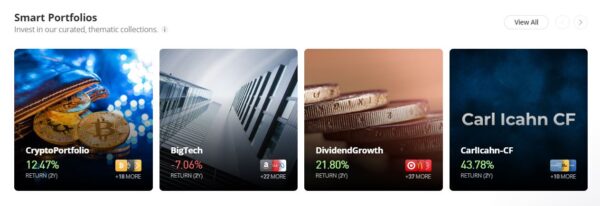
Once you have done this, you can check out eToro’s range of Smart Portfolios by clicking on Discover in the left-hand menu of your dashboard when logged on. When you do this and scroll down a bit, you should see a section like the one below…

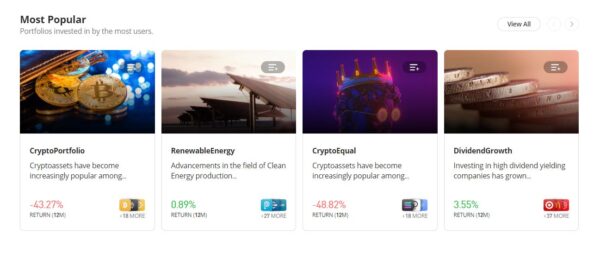
Click on View All and you will be taken to a page listing Smart Portfolios in various categories. The top one is Most Popular. When I tried this today, the section concerned looked like this…

Most popular Portfolios

Again, you can see all the portfolios in this category by clicking on View All. Further down the page are sections for other categories, including Tech Focused, Crypto Based and Created by Partners. There is also a filter tool allowing you to search for Smart Portfolios covering particular interests – from utilities to medical technology, cryptocurrencies to media services.

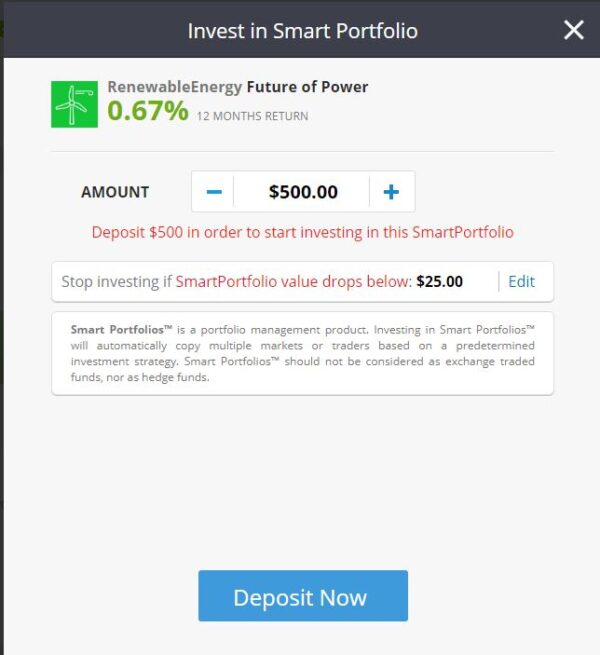
Once you have found a Smart Portfolio you want to invest in, all you need to do is go to the page for the SP in question and click on Invest in the top-right-hand corner. A pop-up box should then appear…

SP invest box

You can of course change the amount in the top box if you want to invest more than the minimum $500.

One other choice you have to make here concerns the Stop Loss figure. If the value of your portfolio falls below this, the Stop Loss will automatically close your investment and return the remaining money to your eToro balance. You can set this figure anywhere between 5% and 95%. My top tip is not to set this figure too high, as even a brief ‘wobble’ will then trigger the stop loss and crystallize your losses. Personally I wouldn’t set this figure any higher than 70% ($350 with a $500 investment). But it’s your decision, of course, based on your tolerance for risk.

Once you are happy with the settings, click on Deposit Now and your investment in the Smart Portfolio in question will be made.

  • If any of the above sounds at all daunting, don’t forget that everyone on eToro also gets a $100,000 virtual portfolio to practise with. You can invest using this virtual money to see how the process works and what returns you make.

My Experience with eToro Smart Portfolios

On 4th January this year (2023) I invested $500 in the Oil Worldwide smart portfolio. This SP focuses on the world’s leading oil-related companies, oil-related ETFs (exchange traded funds) and direct oil price derivatives.

I know this might seem rather a contrarian choice in these eco-aware times, but it seems to me that oil will still have a vital role to play in the world economy for many years to come. Plus the big oil companies are making huge profits at the moment, so I figured I might as well grab a share of that!

In addition, with oil companies currently out of favour with (some) investors, I thought there might be value to be found investing in this sector. These are large, successful companies, and they are increasingly diversifying from ‘black gold’ to renewables as well. And finally, this particular SP has a good recent profit record on eToro (much better than most crypto portfolios, for instance).

Obviously I have only been invested for just over a month to date. Even so, the value of my SP has risen to $513.62 at the time of writing, an increase of 2.66 percent. I am quite happy with that. In any event, I’m looking on this as a long-term investment so won’t be judging it yet.

Closing Thoughts

If you are looking for an interesting – and rather different – investment opportunity, thematic investing with eToro Smart Portfolios is certainly worth considering. They allow you to back your opinions on probable trends in the years ahead, and profit if the trends in question do indeed come to pass.

Of course, as with all investing, there is never any guarantee you will make money. And you could lose money if trends falter or go into reverse. In addition, unexpected events can torpedo any trend – just look what happened to the leisure and tourism industry in 2020 when the pandemic struck. It’s therefore essential to diversify your investments as much as possible and avoid the cardinal sin of putting all your investment eggs in one basket.

  • Remember, also, that investing is (or should be) a long-term exercise. The value of your investments can go down as well as up, and in the short- to medium-term at least you could end up getting back less than you put in. Ideally you should have a time-frame of five years or longer for any equity-based investment. In any event, you should avoid investing money you may need at short notice in the next year or two.

Nonetheless, eToro Smart Portfolios are a welcome addition to the platform’s range of investment products. And with eToro’s low fees, easy-to-use website and good social investing features, it’s a site all investors should at least check out.

For more information about eToro, please see my original eToro review and also my posts about copy trading on eToro and the eToro Money app. You can also if you wish sign up directly on the eToro website via this link [affiliate].

I will continue to update Pounds and Sense readers about the performance of my eToro investments in my monthly updates (such as this one).

As always, if you have any questions or comments about this post or eToro more generally, please do post them below.

Disclaimer: I am not a qualified financial adviser and nothing in this blog post should be construed as personal financial advice. Everyone should do their own ‘due diligence’ before investing and seek professional advice if in any doubt how best to proceed. All investing carries a risk of loss.

Note also that this post includes affiliate links. If you click through and perform a qualifying transaction, I may receive a commission for introducing you. This will not affect the product or service you receive or the terms you are offered.

728x90

If you enjoyed this post, please link to it on your own blog or social media:
My investments update February 2023

My Investments Update – February 2023

Here is my latest monthly update about my investments. You can read my January 2023 Investments Update here if you like

I’ll begin as usual with my Nutmeg Stocks and Shares ISA. This is the largest investment I hold other than my Bestinvest SIPP (personal pension), from which I recently started withdrawing again.

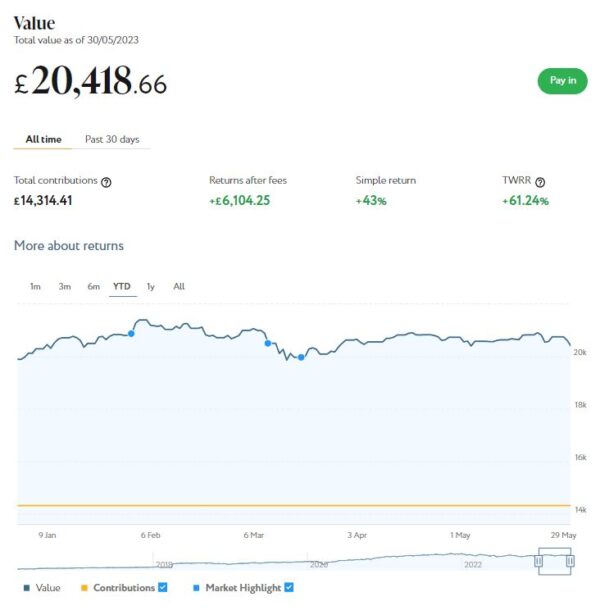
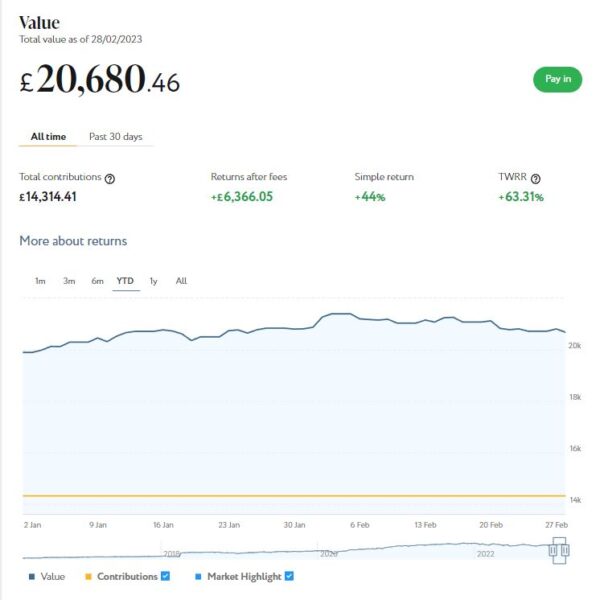
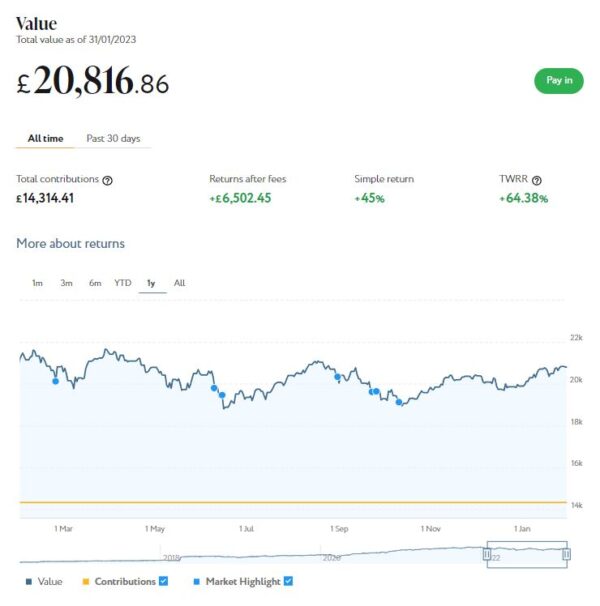
As the screenshot below of performance over the last year shows, my main Nutmeg portfolio is currently valued at £20,817. Last month it stood at £19,898 so that is a rise of £919.

Nutmeg main portfolio February 2023

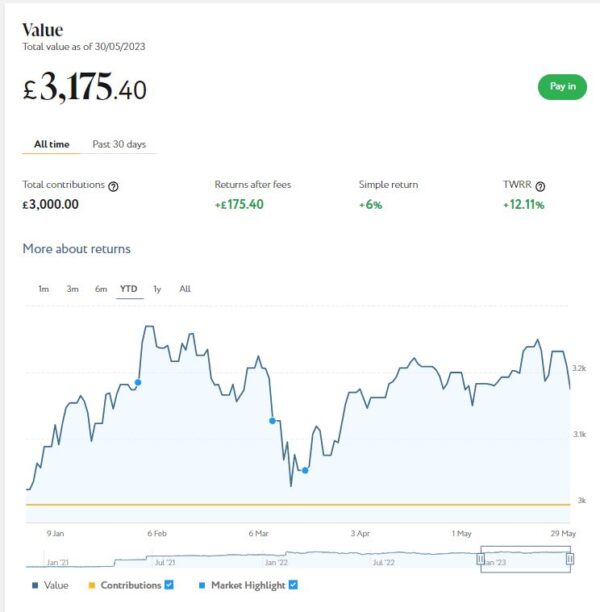
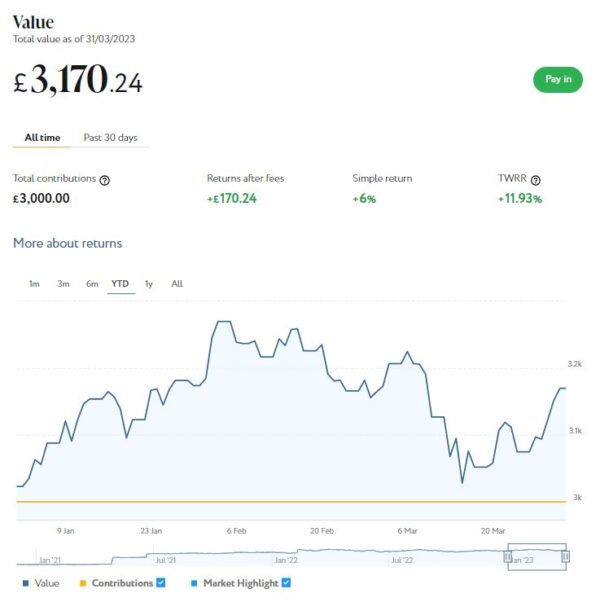
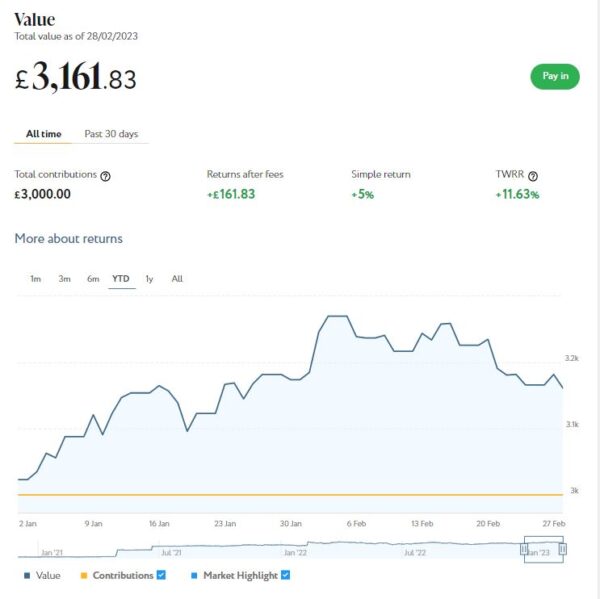
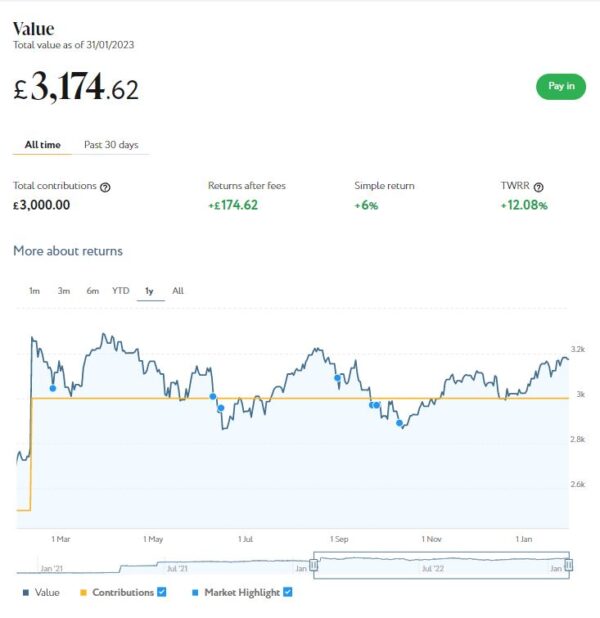
Apart from my main portfolio, I also have a second, smaller pot using Nutmeg’s Smart Alpha option. This is now worth £3,175 compared with £3,023 a month ago, a rise of £152.

Here is a screen capture showing performance over the last year. As you can see from the ochre line, I topped up this account in February 2022.

Nutmeg Smart Alpha February 2023

Clearly 2023 has started well, with the total value of my Nutmeg investments increasing by over £1,000. The strong start for equities in general in 2023 is due to various factors, including inflation rates world-wide starting to fall, the ending of most Covid restrictions in China, and a growing belief that any post-pandemic recession may not be as severe as was once thought. Of course, the war in Ukraine is still a major concern, but if that is resolved in the coming year it should give markets a further boost.

2023 is still likely to be an uncertain year for investors, with more ups and downs very much on the cards. Nonetheless, with share prices generally still below where they were a year ago, there are likely to be opportunities for investors to capitalize in the months ahead. I shall definitely be looking to invest more in Nutmeg and other equity-based platforms in the coming year.

Of course, all investing is (or should be) a long-term endeavour. Over a period of years stock market investments such as those used by Nutmeg typically produce better returns than cash accounts, often by substantial margins. But there are never any guarantees, and in in the short to medium term at least, losses are always possible.

You can read my full Nutmeg review here (including a special offer at the end for PAS readers). If you are looking for a home for your annual ISA allowance, based on my overall experience over the last six years, they are certainly worth considering. They offer self-invested personal pensions (SIPPs) as well.

Moving on, my Assetz Exchange investments continue to generate steady returns. Regular readers will know that this is a P2P property investment platform focusing on lower-risk properties (e.g. sheltered housing). I put an initial £100 into this in mid-February 2021 and another £400 in April. In June 2021 I added another £500, bringing my total investment up to £1,000.

Since I opened my account, my AE portfolio has generated a very respectable £96.79 in revenue from rental income. As I said in last month’s update, capital growth has slowed, though, in line with UK property values generally. Even so, it’s not all bad news. At the time of writing 16 of ‘my’ properties are showing gains, 7 are showing losses, and two are breaking even. My portfolio is currently showing a small net increase in value of £13.36, meaning that overall (rental income plus capital gains) I am up by £110.15. That is still a very decent rate of return on my £1,000 and does illustrate the value of P2P property investments for diversifying your portfolio. And it doesn’t hurt that with Assetz Exchange most projects are socially beneficial as well.

  • To control risk with all my property crowdfunding investments nowadays, I invest relatively modest amounts in individual projects. This is a particular attraction of AE as far as i am concerned. You can actually invest from as little as 80p per property if you really want to proceed cautiously.

My investment on Assetz Exchange is in the form of an IFISA so there won’t be any tax to pay on profits, dividends or capital gains. I’ve been impressed by my experiences with Assetz Exchange and the returns generated so far, and intend to continue investing with them. You can read my full review of Assetz Exchange here. You can also sign up for an account on Assetz Exchange directly via this link [affiliate].

Another property platform I have investments with is Kuflink. They continue to do well, with new projects launching almost every day. I currently have around £2,400 invested with them in 18 different projects (I withdrew £200 in December to help pay for Christmas). To date I have never lost any money with Kuflink, though some loan terms have been extended once or twice. On the plus side, when this happens additional interest is paid for the period in question.

My loans with Kuflink pay annual interest rates of 6 to 7.5 percent. These days I invest no more than £200 per loan (and often less). That is not because of any issues with Kuflink but more to do with losses of larger amounts on other P2P property platforms in the past. My days of putting four-figure sums into any single property investment are behind me now!

  • Nowadays I mainly opt to reinvest the monthly repayments I receive from Kuflink, which has the effect of boosting the percentage rate of return on the projects in question

Obviously a possible drawback with Kuflink and similar platforms is that your money is tied up in bricks and mortar, so not as easily accessible as cash savings or even (to some extent) shares. They do, however, have a secondary market on which you can offer any loan part for sale (as long as the loan in question is performing and not in arrears). Clearly that does depend on someone else wanting to buy it, but my experience has been that any loan parts offered are typically snapped up very quickly. So if an urgent need arises, withdrawing your money (or part of it) is unlikely to be an issue.

You can read my full Kuflink review here. They offer a variety of investment options, including a tax-free IFISA paying up to 7% interest per year with built-in automatic diversification. Alternatively you can now build your own IFISA, with most loans on the platform (including the one shown above) being IFISA-eligible.

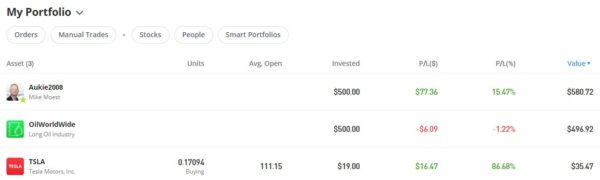
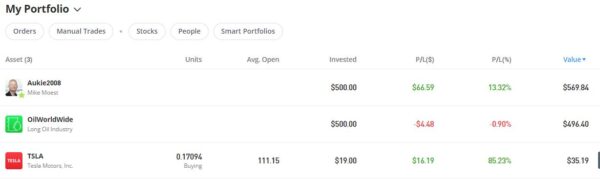
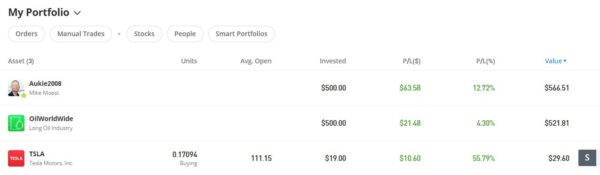
Last year I set up an account with investment and trading platform eToro, using their popular ‘copy trader’ facility. I chose to invest $500 (then about £412) copying an experienced eToro trader called Aukie2008 (real name Mike Moest).

In January I added to this with another $500 investment in one of their thematic portfolios. I also invested a small amount I had left over in Tesla shares. My original investment of $1,022.26 is today worth $1,118.62, an increase of $96.36 or 9.63%. in these turbulent times I am very happy with that.

My eToro portfolio February 2023

In any event, I’m looking on this as a long-term investment so won’t be judging it yet. You can read my full review of eToro here. You may also like to check out my recent more in-depth look at eToro copy trading. I shall be publishing a post about my latest investment in an eToro thematic portfolio soon.

  • eToro also recently introduced the eToro Money app. This allows you to deposit money to your eToro account without paying any currency conversion fees, saving you up to £5 for every £1,000 you deposit. You can also use the app to withdraw funds from your eToro account instantly to your bank account. I tried this myself recently and was impressed with how quickly and seamlessly it worked. You can read my blog post about eToro Money here.

I had two more articles published in January on the always-excellent Mouthy Money website. One is A Three-Step Plan to Help Boost Your Finances in 2023. This article actually came out of an online presentation I did a few months ago to a club for older people. I hope you will find the ideas and advice it contains useful.

My other piece was Switch to Profit – How to Make Money Moving Your Bank Account. With the banks now starting to offer switching bonuses again to attract new customers, there are hundreds of pounds to be made by doing this. The article quotes my sister Annie, who is a serial switcher and shares some top tips based on her experiences. Many thanks, Annie!

That’s all for today. I hope you and your family are coping in these undoubtedly challenging times. Don’t forget to check out the government’s Help for Households website, which sets out various types of financial assistance you may be entitled to and is regularly updated.

As always, if you have any comments or queries, feel free to leave them below. I am always delighted to hear from PAS readers 🙂

Disclaimer: I am not a qualified financial adviser and nothing in this blog post should be construed as personal financial advice. Everyone should do their own ‘due diligence’ before investing and seek professional advice if in any doubt how best to proceed. All investing carries a risk of loss.

Note also that posts may include affiliate links. If you click through and perform a qualifying transaction, I may receive a commission for introducing you. This will not affect the product or service you receive or the terms you are offered, but it does help support me in publishing PAS and paying my bills. Thank you!

728x90

If you enjoyed this post, please link to it on your own blog or social media:
What is an eToro Money Account?

What is an eToro Money Account and How Can it Save You Money?

Regular readers will know that I joined the online trading and investment platform eToro earlier this year and have become a fan of it.

You can purchase a wide range of investment products on eToro, including individual company shares, ETFs, commodities, cryptocurrencies, thematic portfolios, and so on. You can also avail yourself of their popular copy trading facility, where you sign up to automatically copy the trades of an experienced (and hopefully successful!) eToro investor.

My own investments on eToro now comprise a thematic portfolio, a copy-trading portfolio, and a few shares in Tesla (basically because I had a spare $20 burning a hole in my account!). I will write more about thematic portfolios in a future post. Today, though, I want to talk about eToro Money.

What is eToro Money?

eToro Money is a recently-launched e-money account for eToro investors. It can be managed via a mobile phone app. It is free to set up and there are no ongoing charges.

The key attraction of eToro Money is that it allows you to deposit to your eToro investment account without paying the usual currency conversion fee. This can save you up to £5 per £1,000 compared with depositing directly to eToro using a bank debit card.

Essentially what happens is that you deposit to your eToro Money account with your bank debit card using the account details provided. This money then appears instantly in your eToro Money account and you can use it to invest on anything on eToro when you are ready.

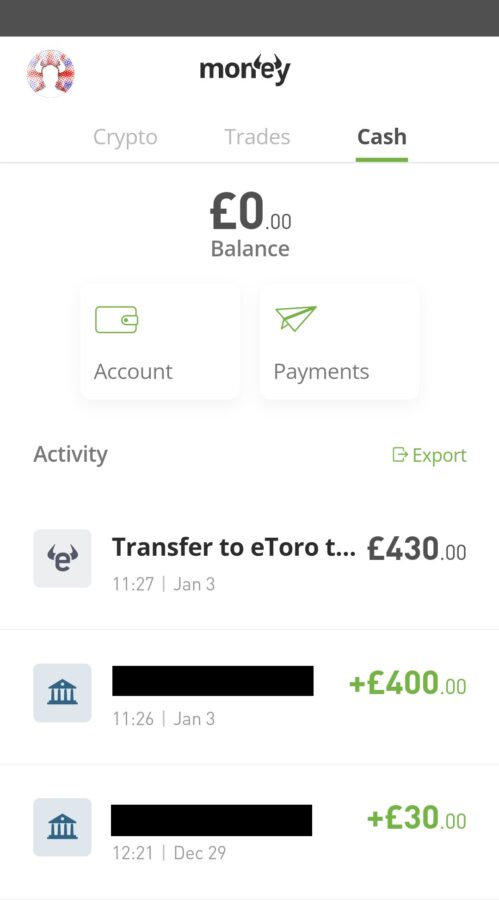
When I tried this myself, I was impressed by how straightforward the process was, and in particular the speed with which the money showed up in my account (it really did seem to appear instantly). Using it to invest on the eToro platform was then straightforward. Of course, eToro operates in US Dollars, so I worked out in advance roughly how much I would need to deposit in GB pounds to get the $500 I was aiming to invest (I transferred £430 in total to be on the safe side). The money was then converted at a fair rate with no fees or charges. You can see these transactions listed in the screen capture of the app on my phone below. I have redacted my account name for security reasons.

eToro Money app

You can also use eToro Money to withdraw funds from your eToro account. I haven’t tried this yet, but again eToro promise that the process is instant and I have no reason to doubt that. There are modest fees for withdrawing from eToro and you will still have to pay them, but having an eToro Money account keeps costs as low as possible. As I noted in my original review, eToro’s fees are very reasonable and they don’t generally impose any transaction charges.

Other Features

As well as managing your main (‘fiat’) currency in eToro Money, you can also securely store, send and receive most popular cryptocurrencies. eToro Money incorporates the functionality of the previous eToro Wallet app for cryptocurrencies, while offering additional features as well.

You can also use your eToro Money account to send money to and receive money from friends and family, set up direct debits, manage your household expenses, and so forth.

The eToro Money Debit Card

This is a further benefit of eToro Money some may wish to take advantage of. It is a debit card linked to your eToro Money account which you can use in the same way as a bank debit card to fund purchases, exchange currencies, and so on. They claim to offer market leading exchange rates across the globe.

To qualify for an eToro Money debit card, you must be a member of the eToro Club. Anyone with over $5,000 in realised equity on eToro is eligible for this. Realised equity in this context means the combined value of the available funds in your eToro account plus the original amount invested in all your holdings. So if you have $1,000 in cash in your account and have invested $4,000 in shares and other investments on the platform, you will have $5,000 in realised equity and qualify for a free eToro Money debit card if you want one.

Closing Thoughts

For most users the primary benefit of an eToro Money account will be to eliminate the currency conversion fee when depositing on eToro. It also speeds up the process of depositing to the platform and withdrawing from it.

While eToro Money is not a fully-fledged online banking service, you can also use it to send payments and/or set up direct debits. In that respect, it is a bit like PayPal. Though you will need to know the sort code and account number of the person or business you want to pay. An email address alone (as with PayPal) won’t cut it!

As mentioned above, if you have $5,000 or more in realised equity on eToro you are also entitled to an Etoro Money debit card if you wish. You can read more about this on the eToro Money website.

Overall, I think anyone who plans to invest via eToro should seriously consider opening an eToro Money account to reduce costs and speed up depositing and withdrawing. They will obviously then have the opportunity to take advantage of the other benefits too.

To set up an eToro Money account, the best option is to download the eToro Money app from Google Play (Android) or the App Store (Apple) and follow the instructions in the app. Obviously you should have an account on eToro already in order to use eToro Money.

If you have any questions or comments about this post, as always, please do leave them below.

728x90


Disclaimer: I am not a qualified financial adviser and nothing in this blog post should be construed as personal financial advice. Everyone should do their own ‘due diligence’ before investing and seek professional advice if in any doubt how best to proceed. All investing carries a risk of loss.

Note also that posts on Pounds and Sense may include affiliate links. If you click through and perform a qualifying transaction, I may receive a commission for introducing you. This will not affect the product or service you receive or the terms you are offered.

If you enjoyed this post, please link to it on your own blog or social media:
Investments January 2023

My Investments Update – January 2023

Happy New Year! Here is my latest monthly update about my investments. You can read my December 2022 Investments Update here if you like

I’ll begin as usual with my Nutmeg Stocks and Shares ISA. This is the largest investment I hold other than my Bestinvest SIPP (personal pension), from which I recently started withdrawing again.

As the screenshot below of performance over the last year shows, my main Nutmeg portfolio is currently valued at £19,898. Last month it stood at £20,391 so that is a fall of £493.

Nutmeg main portfolio Jan 2023

Apart from my main portfolio, I also have a second, smaller pot using Nutmeg’s Smart Alpha option. This is now worth £3,023 compared with £3,114 a month ago, a decrease of £91.

Here is a screen capture showing performance over the last year. As you can see from the ochre line, I topped up this account in February 2022.

Nutmeg Smart Alpha Jan 2023

That is a net month-on-month decrease of £584. That is obviously disappointing, but needs to be set against an increase of £785 the month before.

As the charts above clearly illustrate, 2022 was a volatile year for stock market investments generally. The outlook is still uncertain, but according to this article in the Financial Times the majority view is that stock markets overall will remain flat or see a very modest recovery in 2023. But obviously a lot depends on world events. If the war in Ukraine ends and/or China makes a reasonably smooth recovery from the pandemic, things could improve faster. Probably the best strategy, as this article from Forbes puts it, is to hope for the best but be prepared for the worst!

Overall, my Nutmeg investments are down £2,191 or about 8.7% since the start of 2022. To put this in context, though, in 2021 they rose in value by £3,552. And I am still more than £5,600 ahead since I started investing with Nutmeg in 2016. For my main portfolio that represents a return on capital of 39.01% or 57.13% time-weighted. My Smart Alpha portfolio hasn’t been going as long, but it is at least showing a small profit on the total I have put into it 🙂

Of course, the main lesson from all this is that investing is (or should be) a long-term endeavour. Over a period of years stock market investments such as those used by Nutmeg typically produce better returns than cash accounts, often by substantial margins. But there are never any guarantees, and in in the short to medium term at least, losses are always possible.

You can read my full Nutmeg review here (including a special offer at the end for PAS readers). If you are looking for a home for your annual ISA allowance, based on my overall experience over the last six years, they are certainly worth considering.

Moving on, my Assetz Exchange investments continue to generate good returns. Regular readers will know that this is a P2P property investment platform focusing on lower-risk properties (e.g. sheltered housing). I put an initial £100 into this in mid-February 2021 and another £400 in April. In June 2021 I added another £500, bringing my total investment up to £1,000.

Since I opened my account, my AE portfolio has generated a very respectable £91.61 in revenue from rental income. Capital growth has stalled, though, in line with what is happening in housing markets more generally. While some of ‘my’ properties are still showing gains, others are showing losses on capital. Overall my portfolio is currently showing a small net decrease in value of £7.88.

The latter is obviously a little disappointing, although of course capital values are largely academic unless and until you want to sell. The rental income is still coming in steadily without any issues or dramas. As I’ve said before, £91.61 is a decent rate of return on my £1,000 and does illustrate the value of P2P property investments for diversifying your portfolio when equity markets are volatile. And it doesn’t hurt that with Assetz Exchange most projects are socially beneficial as well.

  • To control risk with all my property crowdfunding investments nowadays, I invest relatively modest amounts in individual projects. This is a particular attraction of AE as far as i am concerned. You can actually invest from as little as 80p per property if you really want to proceed cautiously.

My investment on Assetz Exchange is in the form of an IFISA so there won’t be any tax to pay on profits, dividends or capital gains. I’ve been impressed by my experiences with Assetz Exchange and the returns generated so far, and intend to continue investing with them. You can read my full review of Assetz Exchange here. You can also sign up for an account on Assetz Exchange directly via this link [affiliate].

Another property platform I have investments with is Kuflink. They continue to do well, with new projects launching almost every day. I currently have around £2,400 invested with them in 18 different projects (I withdrew £200 in December to help pay for Christmas). To date I have never lost any money with Kuflink, though some loan terms have been extended once or twice. On the plus side, when this happens additional interest is paid for the period in question.

My loans with Kuflink pay annual interest rates of 6 to 7.5 percent. These days I invest no more than £200 per loan (and often less). That is not because of any issues with Kuflink but more to do with losses of larger amounts on other P2P property platforms in the past. My days of putting four-figure sums into any single property investment are behind me now!

  • Nowadays I mainly opt to reinvest the monthly repayments I receive from Kuflink, which has the effect of boosting the percentage rate of return on the projects in question

Obviously a possible drawback with Kuflink and similar platforms is that your money is tied up in bricks and mortar, so not as easily accessible as cash savings or even (to some extent) shares. They do, however, have a secondary market on which you can offer any loan part for sale (as long as the loan in question is performing and not in arrears). Clearly that does depend on someone else wanting to buy it, but my experience has been that any loan parts offered are typically snapped up very quickly. So if an urgent need arises, withdrawing your money (or part of it) is unlikely to be an issue.

You can read my full Kuflink review here. They offer a variety of investment options, including a tax-free IFISA paying up to 7% interest per year with built-in automatic diversification. Alternatively you can now build your own IFISA, with most loans on the platform (including the one shown above) being IFISA-eligible.

Last year I set up an account with investment and trading platform eToro, using their popular ‘copy trader’ facility. I chose to invest $500 (then about £412) copying an experienced eToro trader called Aukie2008 (real name Mike Moest). My investment has been up and down in the last few months, but it is currently $33 (about £27) in profit. In these turbulent times I am quite happy with that.

In any event, I’m looking on this as a long-term investment so won’t be judging it yet. I am also considering a further investment with eToro, probably in one of their themed portfolios. You can read my full review of eToro here. You may also like to check out my recent more in-depth look at eToro copy trading.

  • You might also like to know that eToro recently introduced the eToro Money app. This allows you to deposit money to your eToro account without paying any currency conversion fees, saving you up to £5 for every £1,000 you deposit. You can also use the app to withdraw funds from your eToro account instantly to your bank account. I tried this myself recently and was impressed with how quickly and seamlessly it worked. You can read my more in-depth article about eToro Money here.

I had two more articles published in December on the always-excellent Mouthy Money website. One addressed the question of whether you can Save Money by Cancelling Your TV Licence. I looked at what this entails and what TV you are still permitted to watch without a licence. I also set out some ways you may be able to save money on your TV licence if cancelling altogether is a bridge too far for you.

My other piece was Why We All Need to Be a Bit More Branson! The title is obviously tongue-in-cheek. But the article sets out my strongly held view that – in these challenging times especially – we can all benefit from being a bit more entrepreneurial. I really enjoyed writing this one, I must admit!

Last month I updated my post about the Warm Home Discount, which this year is being increased from £140 to £150. The eligibility rules are changing somewhat, and I shall probably be one of the people who misses out, which is clearly disappointing. But on the plus side, most people won’t now have to apply for this benefit – if you are eligible, the grant should be applied automatically to your bill by your energy company.

  • The government’s Help for Households website has a helpful summary of all the financial assistance currently available and is regularly updated.

My other posts from December included What Are The Best Video Calling Tools for Older People? and an expert guest post on the subject Why a Passion Investment Could be the Way Forward in Times of Economic Uncertainty. I found the latter quite an eye-opener, as it includes important info about Capital Gains Tax (CGT) I wasn’t previously aware of. The article also sets out some reasons to consider ‘passion investments’ such as fine wines or vintage cars, due to the tax advantages they can confer.

Finally, I published My Top 20 Posts of 2022, which I hope you will check out as well!

That’s all for today. I hope you and your family are coping in these undoubtedly challenging times, and wish you a happy, healthy and prosperous 2023.

As always, if you have any comments or queries, feel free to leave them below. I am always delighted to hear from PAS readers 🙂

Disclaimer: I am not a qualified financial adviser and nothing in this blog post should be construed as personal financial advice. Everyone should do their own ‘due diligence’ before investing and seek professional advice if in any doubt how best to proceed. All investing carries a risk of loss.

Note also that posts may include affiliate links. If you click through and perform a qualifying transaction, I may receive a commission for introducing you. This will not affect the product or service you receive or the terms you are offered, but it does help support me in publishing PAS and paying my bills. Thank you!

If you enjoyed this post, please link to it on your own blog or social media:
My Top 20 Posts of 2022

My Top 20 Posts of 2022

As is customary for bloggers at this time of year, here are the top twenty posts on Pounds and Sense in 2022, based on comments, page-views and social media shares. They are in no particular order. I have excluded any posts that are no longer relevant.

I hope you will enjoy revisiting these posts, or seeing them for the first time if you are new to PAS.

All posts in the list below should open in a new tab/window when you click on the link concerned.

  1. Ten Reasons Over-50s May Need an Independent Financial Adviser
  2. Can You Still Make Money From Matched Betting?
  3. Nibble Review – A New European Crowdfunding Platform Open To Everyone
  4. How to Cut Your Motoring Costs
  5. Kuflink: My Review of This P2P Property Investment Platform
  6. How to Save Money by Saving Energy
  7. Nutmeg Review: My Experiences with this Robo-Adviser Investment Platform
  8. Make a Sideline Income Renting Out Your Driveway or Garage
  9. How to Reduce Your Water Bills
  10. Could You Be a Holiday Let Landlord?
  11. Will You Get the Warm Home Discount?
  12. Is It Time for Investors to Look Again at Crowdlending/P2P Platforms?
  13. Spotlight: eToro Trading and Investment Platform
  14. How to Start Copy Trading With eToro
  15. Twenty Great Ways to Make Extra Money From Home
  16. What Are the Best Video Calling Tools for Older People?
  17. Three Ethical Investment Options for You to Consider
  18. Get a Free ETF Share Worth up to £200 With Wealthyhood
  19. Why a Passion Investment Could Be the Way Forward in Times of Economic Uncertainty
  20. How to Track Investments With Microsoft Excel

I’ll be taking a break from blogging over the festive period (though I’ll still be around on Twitter and Facebook). I’ll therefore close by wishing you a Very Merry Christmas (strikes and cost-of-living crisis permitting) and for all of us a much better new year 🍾

If you have any comments or questions, of course, feel free to leave them below as usual.

If you enjoyed this post, please link to it on your own blog or social media:
My Investments Update december 2022

My Investments Update – December 2022

Here is my latest monthly update about my investments. You can read my November 2022 Investments Update here if you like

I’ll begin as usual with my Nutmeg Stocks and Shares ISA. This is the largest investment I hold other than my Bestinvest SIPP (personal pension). I will discuss the latter a bit further down.

As the screenshot below of performance last month shows, my main Nutmeg portfolio is currently valued at £20,391. Last month it stood at £19,733 so that is a rise of £658.

Nutmeg Main Portfolio Dec 2022

Apart from my main portfolio, I also have a second, smaller pot using Nutmeg’s Smart Alpha option. This is now worth £3,114 compared with £2,987 a month ago, an increase of £127.

Here is a screen capture showing performance since January 2022. As you can see, I topped up this account in February this year.

Nutmeg Smart Alpha December 2022

That is an overall month-on-month increase of £785. Furthermore since mid-October the total value of my Nutmeg investments has risen by £2,007 or around 8%. Anyone who was brave enough to invest in Nutmeg around the middle of October will therefore be looking at a substantial profit now. Of course, it’s always easy to spot an  investment opportunity with 20/20 hindsight!

In my case, while the recent rises are very welcome, my Nutmeg investments are still down £1,607 or about 6.5% since the start of the year. To put this in context, though, in 2021 they rose by £3,552 (over 21%). And overall, I am still over £6,000 ahead since I started investing with Nutmeg in 2016. For my main portfolio that represents a return on capital of 42% or 51.03% time-weighted.

Of course, the real point of this is that investing is (or should be) a long-term endeavour. Over a period of years stock market investments such as those used by Nutmeg typically produce better returns than cash accounts, often by substantial margins. But there are never any guarantees, and in in the short to medium term at least, losses are always possible.

You can read my full Nutmeg review here (including a special offer at the end for PAS readers). If you are looking for a home for your annual ISA allowance, based on my experience over the last six years, they are certainly worth considering.

Moving on, my Assetz Exchange investments continue to perform well. Regular readers will know that this is a P2P property investment platform focusing on lower-risk properties (e.g. sheltered housing). I put an initial £100 into this in mid-February 2021 and another £400 in April. In June 2021 I added another £500, bringing my total investment up to £1,000.

Since I opened my account, my AE portfolio has generated £88.30 in revenue from rental and £17.59 in capital growth, a total of £105.89. That’s a decent rate of return on my £1,000 investment and does illustrate the value of P2P property investment for diversifying your portfolio when equity markets are volatile.

I now have investments in 23 different projects and all are performing as expected, generating rental income and in most cases showing a profit on capital as well. So I am very happy with how this investment has been doing. And it doesn’t hurt that most projects are socially beneficial as well.

  • To control risk with all my property crowdfunding investments nowadays, I invest relatively modest amounts in individual projects. This is a particular attraction of AE as far as i am concerned. You can actually invest from as little as 80p per property if you really want to proceed cautiously.

My investment on Assetz Exchange is in the form of an IFISA so there won’t be any tax to pay on profits, dividends or capital gains. I’ve been impressed by my experiences with Assetz Exchange and the returns generated so far, and intend to continue investing with them. You can read my full review of Assetz Exchange here. You can also sign up for an account on Assetz Exchange directly via this link [affiliate].

Another property platform I have investments with is Kuflink. They continue to do well, with new projects launching almost every day. I currently have around £2,600 invested with them in 14 different projects. To date I have never lost any money with Kuflink, though some loan terms have been extended once or twice. On the plus side, when this happens additional interest is paid for the period in question. At present most of my Kuflink loans are performing to schedule, though two recently had their repayment dates put back by three months.

My loans with Kuflink pay annual interest rates of 6 to 7.5 percent. These days I invest no more than £200 per loan (and often less). That is not because of any issues with Kuflink but more to do with losses of larger amounts on other P2P property platforms in the past. My days of putting four-figure sums into any single property investment are behind me now!

  • Nowadays I mainly opt to reinvest the monthly repayments I receive from Kuflink, which has the effect of boosting the percentage rate of return on the projects in question

Obviously a possible drawback with Kuflink and similar platforms is that your money is tied up in bricks and mortar, so not as easily accessible as cash savings or even (to some extent) shares. They do, however, have a secondary market on which you can offer any loan part for sale (as long as the loan in question is performing and not in arrears). Clearly that does depend on someone else wanting to buy it, but my experience has been that any loan parts offered are typically snapped up very quickly. So if an urgent need arises, withdrawing your money (or part of it) is unlikely to be an issue.

You can read my full Kuflink review here. They offer a variety of investment options, including a tax-free IFISA paying up to 7% interest per year with built-in automatic diversification. Alternatively you can now build your own IFISA, with most loans on the platform (including the one shown above) being IFISA-eligible.

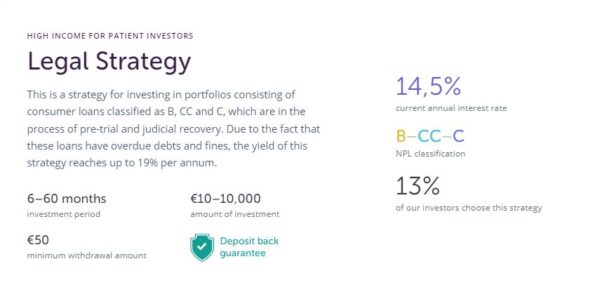
My investment in European crowdlending platform Nibble continues to perform as advertised. My latest investment was in their Legal Strategy. These are loans that are in default and facing legal action. Nibble buy these loans at a heavily discounted rate and then seek to recover as much as possible of the money owed. The minimum investment is 10 euros and the minimum period is six months. I invested 100 euros for 12 months initially at a target annual interest rate of 12.5%.

The Legal Strategy comes with a deposit-back guarantee. This is a guarantee to return the full investment amount at the end of the investment period and a minimum yield of 9% per year. The actual yield depends on how successful recovery efforts prove, so in practice you may end up with a return of anywhere between 9% and 14.5%. All has  gone to plan so far, but I will obviously continue to report on this in the months ahead.

Earlier this year I set up an account with investment and trading platform eToro, using their popular ‘copy trader’ facility. I chose to invest $500 (then about £412) copying an experienced eToro trader called Aukie2008 (real name Mike Moest). My investment has been up and down in the last few months, but it is currently $38 (about £31) in profit. In these turbulent times I am quite happy with that.

In any event, I’m looking on this as a long-term investment so won’t be judging it yet. I am also considering a further investment with eToro, possibly in one of their themed portfolios. You can read my full review of eToro here. You may also like to check out my recent more in-depth look at eToro copy trading.

Moving on, earlier I mentioned my Bestinvest SIPP (personal pension). This is now in drawdown, but regular readers will know that I suspended withdrawals from it in May this year to reduce the risk of  pound-cost ravaging. I was able to do this because since December 2021 I have been receiving the state pension. And in association with my other income streams this has given me enough to live on (though by no means in luxury).

Anyway, with the cost of living crisis starting to bite, and energy bills shooting up at an alarming rate, I decided the time had come to resume taking payments from my SIPP. Plus, with the markets seemingly on an upward trajectory, the risk of pound-cost ravaging appeared to have receded.

I therefore asked Bestinvest to reinstate my payments from this month, though at a lower rate of £100 a month. One of the attractions of flexible drawdown pensions such as those from Bestinvest is that you can increase or decrease withdrawals at any time or even (as I did) suspend them completely. Obviously if you draw an excessive amount there is a risk of depleting your fund too quickly, so it runs out before you do. But Bestinvest sent me some reassuring projections that in any feasible scenario this was unlikely to happen in my case even if I live to the age of 99 (as I fully intend to 😀 ).

One other consideration I had with my SIPP is that withdrawals from it are taxable, whereas withdrawals from some of my other investments (e.g. Nutmeg ISA) are not. With the state pension also being taxable, this means withdrawing larger amounts from my SIPP would result in a portion of the money being grabbed by the taxman, which seems a waste. While I do of course accept that taxes have to be paid, I prefer to minimize my liability as much as possible (which we are all perfectly entitled to do).

I had two more articles published in November on the always-excellent Mouthy Money website. One of them was Win Fame and (Maybe) Fortune as a Quiz Show Contestant. This is something I have done myself in the past and enjoyed writing about again for MM. It can be a lot of fun, and any prizes you win are tax-free under UK law.

My other article was How to Cash in on Your Old Tech. Most of us have old technology we no longer use gathering dust in cupboards and drawers. This articles sets out ways you can make some much-needed cash out of this.

Obviously energy bills are a particular concern for many people at the moment, so I hope you are getting all the help you are entitled to. Everyone should be receiving a monthly rebate of £66 on their energy bill (going up to £67 in the new year). If you’re not, chase it up with your energy supplier.

I also recently updated my post about the Warm Home Discount, which this year is being increased from £140 to £150. The eligibility rules are changing somewhat, and I shall probably be one of the people who misses out, which is clearly disappointing. But on the plus side, most people won’t now have to apply for this benefit – if you are eligible, it should be applied automatically to your bill by your energy company.

  • The government’s Help for Households website has a helpful summary of all the financial assistance currently available and is regularly updated.

Please do check out as well some of the other posts on Pounds and Sense for advice and resources, especially in the Making Money and Saving Money categories.

  • Don’t forget, also, that there are currently two opportunities to claim a free share available. One is with Wealthyhood and the other with Trading 212 (the links will take you to the relevant blog posts). The current Trading 212 offer closes on 29 December 2022, so don’t delay if you want to take advantage of this one. As far as I know the Wealthyhood offer is open indefinitely, but that could always change, of course 🙂

That’s all for today. I hope you and your family are coping in these challenging times and wish you the happiest Christmas possible. I shall of course continue to update this blog over the coming weeks, and will return with a further update about my investments at the start of January.

As always, if you have any comments or queries, feel free to leave them below. I am always delighted to hear from PAS readers 🙂
Disclaimer: I am not a qualified financial adviser and nothing in this blog post should be construed as personal financial advice. Everyone should do their own ‘due diligence’ before investing and seek professional advice if in any doubt how best to proceed. All investing carries a risk of loss.

Note also that posts may include affiliate links. If you click through and perform a qualifying transaction, I may receive a commission for introducing you. This will not affect the product or service you receive or the terms you are offered, but it does help support me in publishing PAS and paying my bills. Thank you!


If you enjoyed this post, please link to it on your own blog or social media:
Review: Extreme Frugality by Jane Berry

Review: Extreme Frugality by Jane Berry

Today I’m reviewing a new book called Extreme Frugality by my blogging colleague Jane Berry, also known as Shoestring Jane.

Jane runs a popular blog called Shoestring Cottage which follows her journey towards making a creative, happy and sustainable life on much less. She also runs a YouTube channel as Shoestring Jane, where she shares her thrifty life and money-saving ideas. And she is also a writer for the estimable Mouthy Money site, to which I am a regular contributor myself.

The full title of the book is Extreme Frugality – Save Money Like Your Grandma: How to live a creative, happy and sustainable life on much less. The book is available from Amazon UK in both print and Kindle e-book form. It is quite a substantial volume, with 289 pages.

Extreme Frugality is divided into 13 main chapters, as follows:

Chapter 1: Frugal Foundations

Chapter 2: Stuff, Stuff and More Stuff

Chapter 3: Cooking and Eating Like Grandma

Chapter 4: Granny’s advice – ‘Make do & Mend’ and ‘Waste Not, Want Not’

Chapter 5: Buying Second-Hand and Getting Everything for Less

Chapter 6: Slashing Your Monthly Bills

Chapter 7: Making a Frugal Home

Chapter 8: The Frugal Cleaner

Chapter 9: The Frugal Garden

Chapter 10: Frugal Fashion: Dress for Less

Chapter 11: Frugal Fun and Travel

Chapter 12: A Frugal Christmas

Chapter 13: Health and Well-being on a Budget

There is also a section of references and resources at the end.

As you may gather, Extreme Frugality aims to show you how to develop thrifty habits (as our grandparents had to). The author says the purpose of doing this is to cushion you against hard times, be creative with what you have, buy just what you need, and eliminate waste from your home.

As a one-time professional writer and editor myself, I was impressed by the high standard to which Extreme Frugality has been produced. The style is clear and accessible, and the content neatly set out without any unnecessary typographical or design gimmicks.

Obviously in the current cost-of-living crisis we are all having to tighten our belts, so the advice in the book is very apposite at present. There are also plenty of suggestions for preventing waste, so the book should appeal to anyone concerned with their environmental impact as well.

It’s hard to pick out highlights as every chapter is packed with valuable tips and advice, but I especially enjoyed Chapter 6, which takes you through a wide range of methods for slashing monthly bills, including energy, water, Council Tax, broadband and so on. The advice in this chapter alone could easily save you thousands of pounds a year. But all the chapters contain useful advice, ideas and information. Even as a money blogger myself, I don’t mind admitting I learned a lot from it.

In summary, Extreme Frugality is a great guide for anyone looking to save money and reduce waste in these challenging times. It would also make an excellent gift for a friend or family member. I am happy to give it my highest recommendation.

As always, if you have any comments or questions about this post, please do leave them below.

Disclosure: I was sent a free copy of Extreme Frugality (in PDF form) to review. Please be aware also that this post (and others on PAS) includes affiliate links. If you click through one of these and make a purchase or perform some other defined action, I may receive a commission for introducing you. This will not affect in any way the price you pay or the product or service you receive.

If you enjoyed this post, please link to it on your own blog or social media:
My Investments Update Nov 22

My Investments Update – November 2022

Here is my latest monthly update about my investments. You can read my October 2022 Investments Update here if you like

I’ll begin as usual with my Nutmeg Stocks and Shares ISA. As I only updated my full review of Nutmeg last week, however, I will keep it fairly brief today.

Nutmeg is the largest investment I hold other than my Bestinvest SIPP (personal pension). Withdrawals from the latter are still on hold to avert the risk of pound-cost ravaging.

My main Nutmeg portfolio, which I opened back in 2016, is currently valued at £19,733. Last month it stood at £19,292 so that is a rise of £441. My smaller Smart Alpha investment (opened in 2020) is currently valued at £2,987. Last month it stood at £2,921, so that is a rise of £66. My total Nutmeg investments have therefore increased by £507 month on month.

While the rise in October is of course welcome, my Nutmeg investments are still down by about 11% in value since the start of the year. As I said in my recent Nutmeg review, that’s clearly disappointing, but it’s still a lot less than the amount by which they went up in 2021 alone. And I am still over £5,400 in profit overall. I am therefore philosophical about this, recognising that all investments have their ups and downs and Nutmeg is hardly alone in seeing a drop in values this year. But I do understand why people who started investing with them in the last twelve months or so may be feeling disappointed. You might like to read this recent article on the Nutmeg blog where they discuss the performance of Nutmeg portfolios in 2022 and examine the outlook going forward.

  • There is actually an argument that now may be a good opportunity to invest while asset values are depressed. At some point we will see a recovery and people who invest at the present time will be well placed to benefit from this. Of course, nobody knows for sure when the recovery will happen or how much further asset values might fall first. Nonetheless, I am certainly considering adding further to my Nutmeg investments in the coming months.

Moving on, my Assetz Exchange investments continue to perform well. Regular readers will know that this is a P2P property investment platform focusing on lower-risk properties (e.g. sheltered housing). I put an initial £100 into this in mid-February 2021 and another £400 in April. In June 2021 I added another £500, bringing my total investment up to £1,000.

Since I opened my account, my AE portfolio has generated £81.40 in revenue from rental and £30.80 in capital growth, a total of £112.20. That’s a decent rate of return on my £1,000 investment and does illustrate the value of P2P property investment for diversifying your portfolio when equity markets are volatile.

I now have investments in 23 different projects and all are performing as expected, generating rental income and in most cases showing a profit on capital as well. So I am very happy with how this investment has been doing. And it doesn’t hurt that most projects are socially beneficial as well.

  • To control risk with all my property crowdfunding investments nowadays, I invest relatively modest amounts in individual projects. This is a particular attraction of AE as far as i am concerned. You can actually invest from as little as 80p per property if you really want to proceed cautiously.

My investment on Assetz Exchange is in the form of an IFISA so there won’t be any tax to pay on profits, dividends or capital gains. I’ve been impressed by my experiences with Assetz Exchange and the returns generated so far, and intend to continue investing with them. You can read my full review of Assetz Exchange here. You can also sign up for an account on Assetz Exchange directly via this link [affiliate].

Another property platform I have investments with is Kuflink. They continue to do well, with new projects launching almost every day. I currently have around £2,600 invested with them in 17 different projects. To date I have never lost any money with Kuflink, though some loan terms have been extended once or twice. On the plus side, when this happens additional interest is paid for the period in question. At present most of my Kuflink loans are performing to schedule, though five have had their repayment dates put back.

My loans with Kuflink pay annual interest rates of 6 to 7.5 percent. These days I invest no more than £200 per loan (and often less). That is not because of any issues with Kuflink but more to do with losses of larger amounts on other P2P property platforms in the past. My days of putting four-figure sums into any single property investment are behind me now!

  • Nowadays I mainly opt to reinvest the monthly repayments I receive from Kuflink, which has the effect of boosting the percentage rate of return on the projects in question

Obviously a possible drawback with Kuflink and similar platforms is that your money is tied up in bricks and mortar, so not as easily accessible as cash savings or even (to some extent) shares. They do, however, have a secondary market on which you can offer any loan part for sale (as long as the loan in question is performing and not in arrears). Clearly that does depend on someone else wanting to buy it, but my experience has been that any loan parts offered are typically snapped up very quickly. So if an urgent need arises, withdrawing your money (or part of it) is unlikely to be an issue.

You can read my full Kuflink review here. They offer a variety of investment options, including a tax-free IFISA paying up to 7% interest per year with built-in automatic diversification. Alternatively you can now build your own IFISA, with most loans on the platform (including the one shown above) being IFISA-eligible.

My investment in European crowdlending platform Nibble continues to perform as advertised. My latest investment was in their Legal Strategy. These are loans that are in default and facing legal action. Nibble buy these loans at a heavily discounted rate and then seek to recover as much as possible of the money owed. The minimum investment is 10 euros and the minimum period is six months. I invested 100 euros for 12 months initially at a target annual interest rate of 12.5%.

The Legal Strategy comes with a deposit-back guarantee. This is a guarantee to return the full investment amount at the end of the investment period and a minimum yield of 9% per year. The actual yield depends on how successful recovery efforts prove, so in practice you may end up with a return of anywhere between 9% and 14.5%. All has  gone to plan so far, but I will obviously continue to report on this in the months ahead.

Earlier this year I set up an account with investment and trading platform eToro, using their popular ‘copy trader’ facility. I chose to invest $500 (then about £412) copying an experienced eToro trader called Aukie. Unsurprisingly my investment has been up and down in the last few months, but it is currently about $8 in profit. In these turbulent times I am quite happy with that.

In addition, since I started on eToro, the pound has weakened against the US dollar, so my investment has benefited from this. My $508 US is now worth around £440 in UK pounds, so I am effectively £28 up overall. I am not claiming this as a particular benefit of eToro, but it does demonstrate how exchange rate fluctuations can sometimes work in your favour!

In any event, I’m looking on this as a long-term investment so won’t be judging it yet. I am also considering a further investment with eToro, possibly in one of their themed portfolios. You can read my full in-depth review of eToro here. I am also planning to publish a more in-depth look at eToro copy trading on the blog soon.

Moving on, I had another article published on the always-excellent Mouthy Money website. This one is entitled How to Save Money on Petrol. I was actually commissioned to write this when petrol prices were peaking. Since then they have fallen back somewhat, but with no end in sight to the war in Ukraine prices could easily shoot back up again. In the article I discuss my favourite website for monitoring petrol prices locally and also set out my top tips for cutting your petrol (or diesel) consumption.

As a matter of interest, Mouthy Money recently asked if I could increase the number of articles I write for them (so I guess I must be doing something right!). From November they will be publishing two articles a month from me. While they don’t pay me a fortune, the extra cash will undoubtedly help a lot in the cold winter months ahead.

Obviously energy bills are a particular concern for many people at the moment, so I hope you are getting all the help you are entitled to. By now everyone should have received the first instalment (£66) of the £400 rebate all UK residents are due on their energy bills for the next six months. If not, chase it up with your energy supplier.

  • I am with EDF, and they are crediting the rebate payments to my bank account once my monthly direct debit has been taken. Other energy suppliers are doing it differently, e.g. deducting the rebate from monthly direct debits before they are taken. This article from the popular Moneysavingexpert website explains how different energy suppliers are applying the rebate.

I also received a letter last week confirming that, as I receive the state pension, I shall be getting an enhanced Winter Fuel Payment of £500 in November or December this year, which will be very welcome as well 🙏

In the last few years I also qualified for the Warm Home Discount, which this year is being increased from £140 to £150. The rules are changing, however, and I suspect I shall be one of the people who misses out. The full new rules still haven’t been announced, but I will update my blog post about WHD as soon as I know more.

  • As I’ve said previously, the government’s Help for Households website has a helpful summary of all the financial assistance currently available and is regularly updated.

Please do check out as well some of the other posts on Pounds and Sense for advice and resources, especially in the Making Money and Saving Money categories.

  • Don’t forget, also, that there are currently two opportunities to claim a free share available. One is with Wealthyhood and the other with Trading 212 (the links will take you to the relevant blog posts). The Trading 212 offer closes on 8 November 2022, so don’t delay if you want to take advantage of this one. As far as I know the Wealthyhood offer is open indefinitely, but that could always change, of course 🙂

That’s all for today. As always, if you have any comments or queries, feel free to leave them below. I am always delighted to hear from PAS readers 🙂

Disclaimer: I am not a qualified financial adviser and nothing in this blog post should be construed as personal financial advice. Everyone should do their own ‘due diligence’ before investing and seek professional advice if in any doubt how best to proceed. All investing carries a risk of loss.

Note also that posts may include affiliate links. If you click through and perform a qualifying transaction, I may receive a commission for introducing you. This will not affect the product or service you receive or the terms you are offered, but it does help support me in publishing PAS and paying my bills. Thank you!


If you enjoyed this post, please link to it on your own blog or social media:
Barmouth

My Short Break in Barmouth

I recently returned from a three-night break in Barmouth in Wales. The town is also known by its Welsh name of Abermaw.

Barmouth is a traditional Welsh seaside resort. I’ve visited a few times over the last few years but haven’t actually stayed there for over 25. I thought it was high time I rectified that!

On this occasion I stayed at Tyr Graig Castle, a hotel I discovered online and booked via Booking.com. I’ll say more about the accommodation below.

Barmouth is about ten miles south of Harlech. The nearest large town is Aberystwyth. Here is a map of the area from Google Maps.

Accommodation

As mentioned above, I stayed at a hotel called Tyr Graig Castle. Unfortunately I neglected to take any photos of the exterior, but you can see the view from my bedroom window in the cover image (including a length of parapet!). There are, of course, more photos on the hotel website.

Tyr Graig Castle is a characterful Victorian building, originally constructed in the late 1890s. it retains the style of the Victorian era, with stained glass windows, wood panelling and highly decorated floors and ceilings.

Tyr Graig is a traditional Welsh name and translates as ‘House on the Rock’. It stands about 200 feet above Barmouth, overlooking Cardigan Bay, across which can be seen the Llyn peninsula and Bardsey Island. The building was completed in 1892 as a family home for W.W. Greener, a famous Birmingham gunsmith. It was designed in the Gothic style that was popular at the time. Its unique shape was chosen by Mr Greener himself. It resembles both a medieval castle and an open double-barrelled shotgun when viewed from above.

I stayed in a first-floor turret room. This had round walls, and windows providing stunning views across the bay. There was a small bathroom with a shower rather than a bath. While generally I found the room perfectly comfortable, I did find the lighting rather dim. There was no ceiling light, just some uplighters on the walls and bedside lamps with low-powered energy-saving bulbs. My eyes are admittedly not the best these days, but I had to use the torch app on my phone in the evening to see well enough to read!

The breakfasts (and optional evening meals) at Tyr Graig Castle are served in the dining room and adjacent conservatory. The latter has wonderful views out to sea and there was a bit of a rush to get one of the four window tables (see photo below). Early risers had a definite advantage here! I was pleased to discover that they recently reinstated the breakfast buffet, where you can help yourself to cereal, fruit, yogurt and so forth. You could then order a cooked breakfast which was brought to your table. These were excellent and set me up for the day 🙂

Tyr Graig Castle conservatory dining room

You could also opt to eat in the restaurant in the evening. Like most guests (as far as I could judge) I chose to do this, as Tyr Graig Castle is a little way out of the town centre and other dining options in the area are limited unless you want to drive. The food was good and the portions were generous. My only slight criticism is that the menu was the same every night. There was a reasonable choice, but a bit more variety day to day (even if just a daily special) would have been appreciated.

The service from both the staff and the charming owners (Mike and Trudy) was uniformly excellent. The hotel had free wifi which worked perfectly during my stay (not always the case in my experience).

  • One other observation is that this is the first time I had stayed in a hotel – as opposed to self-catering – since the days of the pandemic. I was pleased to discover that by and large things are back to normal now. One small difference is that I was asked at check-in if I wanted my room serviced every day. It was the first time I can remember being asked this, as pre-Covid it would have been assumed. But I guess some people are still nervous about having someone else in their room even if they aren’t there at the time. So I do understand why the hotel ask this now.

Financials

As Pounds and Sense is primarily a money blog, I should say a word about this.

I paid £336 for my three-night stay at Tyr Graig Castle, which works out to £112 per night (including VAT). Considering that included a substantial breakfast as well, I thought the price was very reasonable.

The optional evening meals were, of course, extra. The prices were, I would say, good value as well. I paid around £25 a night for my evening meals, which included a main course and dessert (or cheese and biscuits) and coffee. I generally had a small bottle of sparkling water with the meal, but if I had gone for wine or beer, that would obviously have pushed the price up a bit.

Things to Do

I won’t give you a full account of everything I did while I was there, but here are a few highlights.

Harlech

Harlech Castle

Harlech is about 20 minutes’ drive north from Barmouth (or a short train journey on the scenic Cambrian line). I spent my first morning here.

Harlech has some charming shops and cafes, and a long, sandy beach. But it is probably best known for its stunning castle (see photo above).

Harlech Castle was built by Edward I during his invasion of Wales between 1282 and 1289. Since then it has had a long and interesting history, including serving as the home and military HQ of Owen Glendower, the Welsh prince who led a long-running war of independence with England during the late Middle Ages. UNESCO considers Harlech Castle, with three others at Beaumaris, Conwy and Caernarfon, to be one of “the finest examples of late 13th century and early 14th century military architecture in Europe”, and it is classed as a World Heritage Site.

Admission to Harlech Castle costs £8.30 for adults or £7.70 for seniors (over 65). You can also buy a family ticket for two adults and up to three children for £27.40. Children under 5 receive free entry, as do people with disabilities and their companions. All prices are correct as at September 2022.

Harlech Castle is impressive and well worth a visit. You can climb the stone staircases in several of the towers and walk along the battlements (obviously you need to be reasonably fit to do this). From up here you can enjoy spectacular views across the sea and towards the mountains of Snowdonia. At ground level there is a room with some information about the castle and its history. I was glad to have this, as the ticket office had run out of guidebooks in English and only Welsh language ones were available.

I should maybe also mention that Harlech Castle has an excellent cafe with plenty of seating inside and out. I enjoyed a very nice cappuccino and cake here!

Portmeirion

Portmeirion

Portmeirion is a beautiful Italianate village created by the architect Clough Williams Ellis. These days it is probably best known as the location for the 1960s cult TV series The Prisoner, starring Patrick McGoohan. I drove here in the afternoon after spending the morning in Harlech. It’s a wonderful place to while away a few hours.

There is an admission fee to get into Portmeirion, At the time of writing (September 2022) this is as follows:

  • Adult £17.00
  • Concessions £13.50 (this applies to anyone aged 60+ or a student with a valid student ID)
  • Children £10.00 (5-15 years)
  • Children (under 5 years) Free

There are also discounted family tickets for various permutations of adults and children.

You can also get free admission (in the afternoon) by booking a minimum two-course lunch at Castell Deudraeth; this is part of the Portmeirion estate, a short walk from the village itself. Free admission to the village is also available if you book a spa treatment or afternoon cream tea there.

More information is available on the Portmeirion website. One thing you may need to know is that they don’t allow dogs (other than guide dogs) into the grounds.

Fairbourne Railway

Fairbourne Railway

The Fairbourne Railway is a miniature steam railway. It’s a bit of a drive to get there from Barmouth, as you have to cross the estuary, which entails driving several miles inland and back again. However, you can get a ferry (actually a motorboat) from Barmouth seafront that takes you to the far end of the Fairbourne Railway in under ten minutes. This costs the princely sum of £2.50 (September 2022 price) and provides some wonderful views of Barmouth and the railway bridge. Highly recommended!

If you are energetic you can also walk from Barmouth to Fairbourne via the railway bridge (which isn’t open to cars). On this visit I ended up walking to the Fairbourne Railway and then getting a ferry back.

A one-way trip on the Fairbourne Railway costs £7.60. Alternatively you can buy a Day Rover ticket for £11.50 which entitles you to go up and down the line as many times as you like. This is obviously better value! You can choose whether to travel in an open or closed carriage (it all costs the same). There is a small museum at the Fairbourne end of the line with information about the railway’s history and some exhibits. There is also a separate room housing a large model railway. This is free to enter, but you have to insert a coin to watch the train go round 🙂

The ticket office at Fairbourne incorporates a cafe selling drinks, sandwiches and snacks (no cooked meals though). At the Barmouth Ferry end of the line there is also a cafe but this is only open during the peak summer months.

Final Thoughts

I enjoyed my short break in Barmouth and am happy to recommend both the town and the hotel where I stayed for a short break.

As mentioned above, Barmouth is a traditional Welsh seaside resort, and none the worse for that. It has a clean, attractive promenade and a beautiful sandy beach which goes out a long way to the sea. It is hard to imagine it getting overcrowded!

There is plenty to do for families with children, including a funfair and amusement arcades. There are various restaurants and fast food outlets along the seafront. There is also a railway station with regular trains to Pwllheli in one direction and Aberystwyth and beyond in the other. Road connections are good as well.

Also worth checking out while you are there are Ty Crwn, a 19th century lockup for drunks and petty offenders (picture below). There is also a small museum near the seafront dedicated to the town’s maritime history. Entry to this is free, though donations are appreciated.

Ty Crwn

Finally, as mentioned above, I recommend taking a stroll across the half-mile-long railway bridge over the Afon Mawddach river. This is the longest timber viaduct in Wales and one of the oldest in regular use in Britain (it opened in 1867). It offers some stunning views across the estuary. You can also walk on to Fairbourne and the Fairbourne Railway (see above).

As always, if you have any comments or questions about this post, please do leave them below.

If you enjoyed this post, please link to it on your own blog or social media:
My Investments Update October 2022

My Investments Update – October 2022

Here is my latest monthly update about my investments. You can read my September 2022 Investments Update here if you like

I’ll begin as usual with my Nutmeg Stocks and Shares ISA. This is the largest investment I hold other than my Bestinvest SIPP (personal pension). Withdrawals from the latter are still on hold, incidentally, to avert the risk of pound-cost ravaging.

As the screenshot below of performance last month shows, my main portfolio is currently valued at £19,292. Last month it stood at £20,344 so that is a fall of £1,052.

Nutmeg main portfolio October 2022

Apart from my main portfolio, I also have a second, smaller pot using Nutmeg’s Smart Alpha option. This is now worth £2,921 compared with £3,091 a month ago, another fall of £170.

Here is a screen capture showing performance since January 2022. As you can see, I topped up this account in February this year.

Nutmeg Smart Alpha October 2022

There is no denying that these falls are disappointing, especially with my Smart Alpha portfolio now worth less in total than I have contributed to it. As I’ve noted previously on PAS, however, you do have to expect ups and downs with equity-based investments. And this year there has been no lack of volatility, caused by rising inflation, the war in Ukraine and the aftermath of the pandemic (among other things).

About my only consolation is that things could have been even worse if – paradoxically – I’d opted for a lower-risk level with my investments. In their latest blog update, Nutmeg reveal that low and medium-risk portfolios actually performed worse overall last month than high-risk ones. I have copied below their explanation for this:

By design, Nutmeg’s low- and medium-risk portfolios have more exposure through ETFs to assets that are priced in sterling and with limited foreign currency exposure. As you will have seen in the headlines this week, the pound hit an all-time low against the dollar with markets initially placing little faith in the chancellor’s tax-cutting and pro-growth agenda.  

This year it has been rewarding to hold foreign currency with sterling particularly weak versus the dollar. Some of our high-risk portfolios have benefited from currency moves, while low- and medium-risk portfolios have not. They haven’t lost money from having low foreign currency exposure, they just haven’t benefited from it.  

Secondly, low- and medium-risk portfolios by design have more exposure – again through ETFs – to government bonds, which in ‘normal’ times are considered something of a safe haven and have much lower volatility than equities. After all, it is still highly unlikely that the UK government would default on its debts.  

In a nutshell (no pun intended) low- and medium-risk Nutmeg portfolios hold a higher proportion of investments in pounds sterling and UK government bonds. These are normally regarded as lower risk, but last month both took a particular hammering. So in comparison nominally higher-risk portfolios like mine actually performed somewhat better.

This is one more reason I’m glad I opted for higher risk levels with my Nutmeg portfolios (9/10 for my main one and 5/5 for my Smart Alpha). If you haven’t yet seen it, you might also like to check out my blog post in which I looked at the performance over time of Nutmeg fully managed portfolios at every risk level from 1 to 10 . I was actually pretty amazed by the difference risk level makes, with higher-risk ports over almost any period of three or more years in the last ten generating significantly better overall returns. If you are investing for the long term (and you almost certainly should) opting for a hyper-cautious low-risk strategy may not be the smartest thing to do.

Since I started investing with Nutmeg in 2016 – and despite everything that has happened this year – I have still made a total net return on capital of £4,977 (35% or 52.35% time-weighted) on my main portfolio. So I can afford to be philosophical about the recent falls. Indeed, I am considering topping up my Nutmeg investments again now while asset values are depressed.

You can read my full Nutmeg review here (including a special offer at the end for PAS readers). If you are looking for a home for your annual ISA allowance, based on my experience over the last six years, they are certainly worth considering.

Moving on, my Assetz Exchange investments continue to perform well. Regular readers will know that this is a P2P property investment platform focusing on lower-risk properties (e.g. sheltered housing). I put an initial £100 into this in mid-February 2021 and another £400 in April. In June 2021 I added another £500, bringing my total investment up to £1,000.

Since I opened my account, my AE portfolio has generated £76.51 in revenue from rental and £63.58 in capital growth, a total of £140.09. That’s a decent rate of return on my £1,000 investment and does illustrate the value of P2P property investment for diversifying your portfolio when equity markets are volatile.

I now have investments in 23 different projects and all are performing as expected, generating rental income and in most cases showing a profit on capital as well. So I am very happy with how this investment has been doing. And it doesn’t hurt that most projects are socially beneficial as well.

  • To control risk with all my property crowdfunding investments nowadays, I invest relatively modest amounts in individual projects. This is a particular attraction of AE as far as i am concerned. You can actually invest from as little as 80p per property if you really want to proceed cautiously.

My investment on Assetz Exchange is in the form of an IFISA so there won’t be any tax to pay on profits, dividends or capital gains. I’ve been impressed by my experiences with Assetz Exchange and the returns generated so far, and intend to continue investing with them. You can read my full review of Assetz Exchange here. You can also sign up for an account on Assetz Exchange directly via this link [affiliate].

Another property platform I have investments with is Kuflink. They continue to do well, with new projects launching almost every day. I currently have around £2,500 invested with them in 14 different projects. To date I have never lost any money with Kuflink, though some loan terms have been extended once or twice. On the plus side, when this happens additional interest is paid for the period in question. At present most of my Kuflink loans are performing to schedule, though two recently had their repayment dates put back by three months.

My loans with Kuflink pay annual interest rates of 6 to 7.5 percent. These days I invest no more than £200 per loan (and often less). That is not because of any issues with Kuflink but more to do with losses of larger amounts on other P2P property platforms in the past. My days of putting four-figure sums into any single property investment are behind me now!

  • Nowadays I mainly opt to reinvest the monthly repayments I receive from Kuflink, which has the effect of boosting the percentage rate of return on the projects in question

Obviously a possible drawback with Kuflink and similar platforms is that your money is tied up in bricks and mortar, so not as easily accessible as cash savings or even (to some extent) shares. They do, however, have a secondary market on which you can offer any loan part for sale (as long as the loan in question is performing and not in arrears). Clearly that does depend on someone else wanting to buy it, but my experience has been that any loan parts offered are typically snapped up very quickly. So if an urgent need arises, withdrawing your money (or part of it) is unlikely to be an issue.

You can read my full Kuflink review here. They offer a variety of investment options, including a tax-free IFISA paying up to 7% interest per year with built-in automatic diversification. Alternatively you can now build your own IFISA, with most loans on the platform (including the one shown above) being IFISA-eligible.

My investment in European crowdlending platform Nibble continues to perform as advertised. My latest investment was in their Legal Strategy. These are loans that are in default and facing legal action. Nibble buy these loans at a heavily discounted rate and then seek to recover as much as possible of the money owed. The minimum investment is 10 euros and the minimum period is six months. I invested 100 euros for 12 months initially at a target annual interest rate of 12.5%.

The Legal Strategy comes with a deposit-back guarantee. This is a guarantee to return the full investment amount at the end of the investment period and a minimum yield of 9% per year. The actual yield depends on how successful recovery efforts prove, so in practice you may end up with a return of anywhere between 9% and 14.5%. All has  gone to plan so far, but I will obviously continue to report on this in the months ahead.

Moving on, I had another article published on the always-excellent Mouthy Money website. This one is entitled My Odd Smart Meter Story and Why Despite This I Still Recommend Them.  In the article I discuss my rather strange experiences with a smart meter, which stopped working after I switched supplier and then rather mysteriously started again two years later! As per the article title, I do still recommend getting a smart meter, especially in these times of soaring energy bills.

Also in September I enjoyed a final (probably) short break of the year in Barmouth in Wales. I stayed at a Victorian Gothic hotel called Tyr Graig Castle. I was lucky with the weather, and enjoyed visiting nearby Harlech and Portmeirion (see cover image) as well as Barmouth itself.

I shall be publishing a full review of my short break in Barmouth soon. In the meantime, here is a photo of a rather splendid sunset taken from the hotel restaurant…

Barmouth sunset

Finally, I know a lot of people are extremely anxious about the cost-of-living crisis. As I said last time, though, it’s important not to panic. I recommend a three pronged-approach of maximizing your income, minimizing your expenditure, and budgeting carefully (using your resources as effectively as possible, in other words).

Bear in mind, also, that a range of government support measures have been announced to mitigate the worst effects of the crisis. This government Help for Households website has a useful summary of all the help available and is regularly updated.

In the meantime, please do check out some of the other posts on Pounds and Sense for additional advice and resources, especially in the Making Money and Saving Money categories.

That’s all for today. As always, if you have any comments or queries, feel free to leave them below. I am always delighted to hear from PAS readers 🙂
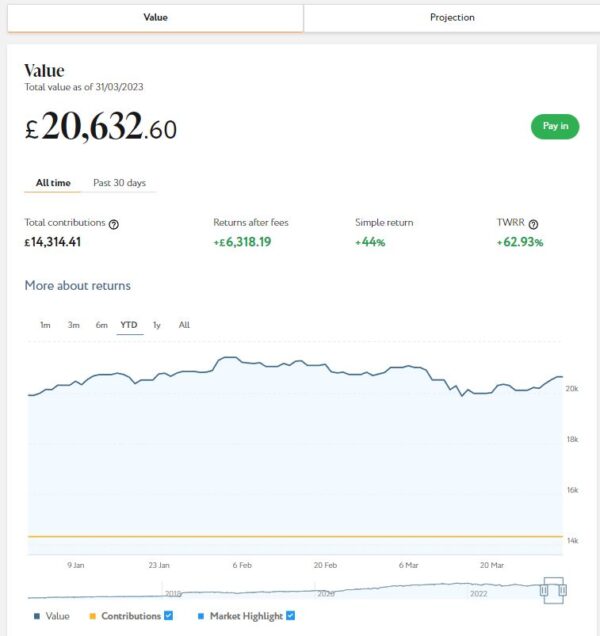
Disclaimer: I am not a qualified financial adviser and nothing in this blog post should be construed as personal financial advice. Everyone should do their own ‘due diligence’ before investing and seek professional advice if in any doubt how best to proceed. All investing carries a risk of loss.

Note also that posts may include affiliate links. If you click through and perform a qualifying transaction, I may receive a commission for introducing you. This will not affect the product or service you receive or the terms you are offered, but it does help support me in publishing PAS and paying my bills. Thank you!

If you enjoyed this post, please link to it on your own blog or social media: