A quickie today spotlighting a site that I know will be of interest to many readers of this blog. Coincidentally, it’s run by a near-neighbour of mine in south Staffordshire.
As the name suggests, Over 60s Discounts lists discounts, deals, vouchers and concessions for people in the UK aged 60 and over. Many of these are exclusive to Over 60s Discounts.
Over 60s Discounts operates on a membership basis, but the good news is that it is free to join. Once you are registered, you will be able to browse the latest discount offers on the website and also have them sent to you by email. If you see an offer you like, all you have to do is click ‘Get Code’. You will then be provided with a voucher code to use at checkout on the brand’s website. Printable vouchers and e-vouchers, which you can use in-store, are also provided.
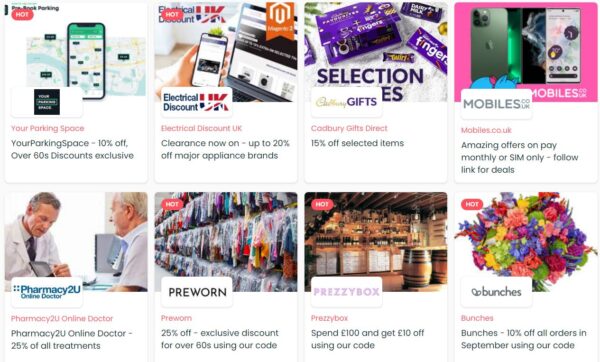
There are some great deals on offer, as you can see from the sample selection below.
If you’re 60 or over, I highly recommend checking out Over 60s Discounts. It’s a new website and obviously still evolving, but already it offers an impressive range of deals, discounts and concessions. If you’re looking to make your money go a little further in the current cost-of-living crisis, it will definitely help you achieve this.
As always, if you have any comments or questions about this post, please do post them below.
If you enjoyed this post, please link to it on your own blog or social media:
I’ll start as usual with my Nutmeg Stocks and Shares ISA. This is the largest investment I hold other than my Bestinvest SIPP (personal pension).
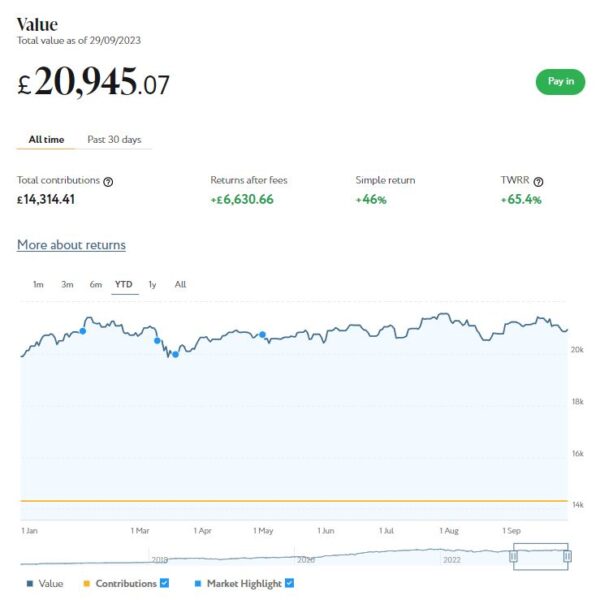
As the screenshot below for the year to date shows, my main Nutmeg portfolio is currently valued at £20,945. Last month it stood at £21,188 so that is a fall of £243.
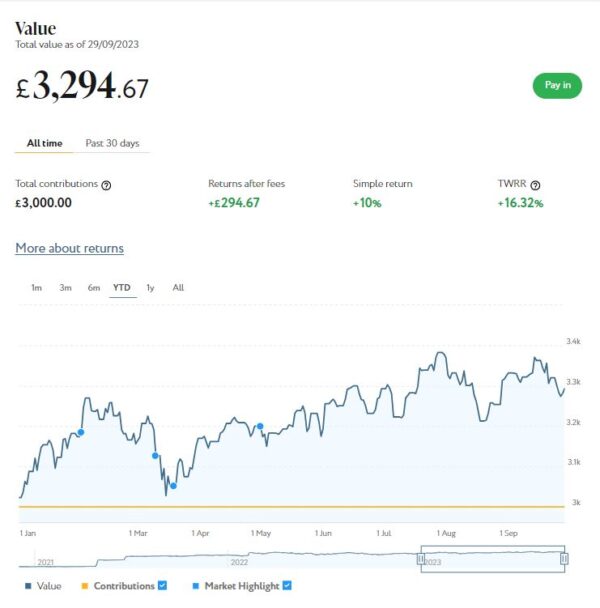
Apart from my main portfolio, I also have a second, smaller pot using Nutmeg’s Smart Alpha option. This is now worth £3,295 compared with £3,325 a month ago, a fall of £30. Here is a screen capture showing performance since the start of this year.
The net value of all my Nutmeg investments has fallen this month by £273 or 1.11% month on month. That’s obviously a bit disappointing, but both pots are still comfortably up on where they were at the start of the year. Their total value has risen by £1,320 (5.76%) since 1st January 2023.
Of course, all investing is (or should be) a long-term endeavour. Over a period of years stock market investments such as those used by Nutmeg typically produce better returns than cash accounts, often by substantial margins. But there are never any guarantees, and in in the short to medium term at least, losses are always possible.
You can read my full Nutmeg review here (including a special offer at the end for PAS readers). If you are looking for a home for your annual ISA allowance, based on my overall experience over the last seven years, they are certainly worth considering. They offer self-invested personal pensions (SIPPs) and Junior ISAs as well.
I also have investments with the property crowdlending platform Kuflink. They continue to do well, with new projects launching every week. I currently have around £2,000 invested with them in 15 different projects paying interest rates typically around 7%. I also have just over £100 in my cash account after another loan was recently repaid.
To date I have never lost any money with Kuflink, though some loan terms have been extended once or twice. On the plus side, when this happens additional interest is paid for the period in question.
As mentioned last time, Kuflink recently changed their terms and conditions. As from Monday 21st August there is an initial minimum investment of £1,000 and a minimum investment per project of £500.
Kuflink say they are doing this to streamline their operation and minimize costs. I can understand that, though it does mean the option to ‘test the water’ with a small first investment has been removed. It will also make it harder for small investors (like myself) to build a well-diversified portfolio on a limited budget. As mentioned, my current portfolio of £2,145 comprises 17 different investments ranging from £50 to £200. If I was starting out again now, that same amount of money would only stretch to four deals!
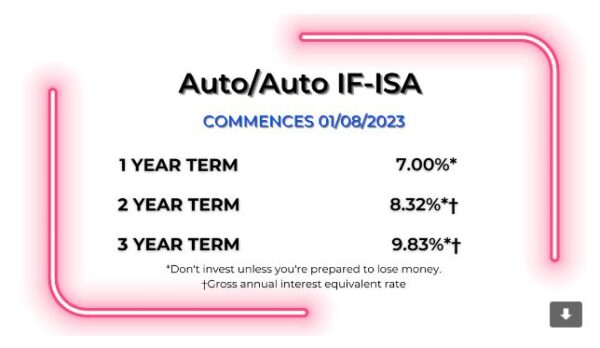
One possible way around this is to invest using Kuflink’s Auto/IFISA facility. Your money here is automatically invested across a basket of loans over a period from one to three years. The rates on offer from August 1 2023 are shown in the graphic below.
As you may gather, you can invest tax-free in a Kuflink Auto IFISA. Or if you have already used your annual iFISA allowance elsewhere, you can invest via a taxable Auto account. You can read my full Kuflink review here if you wish.
Moving on, my Assetz Exchange investments continue to generate steady returns. Regular readers will know that this is a P2P property investment platform focusing on lower-risk properties (e.g. sheltered housing). I put an initial £100 into this in mid-February 2021 and another £400 in April. In June 2021 I added another £500, bringing my total investment up to £1,000.
Since I opened my account, my AE portfolio has generated a respectable £141.06 in revenue from rental income. As I said in last month’s update, capital growth has slowed, though, in line with UK property values generally.
At the time of writing, 8 of ‘my’ properties are showing gains, 2 are breaking even, and the remaining 16 are showing losses. My portfolio is currently showing a net decrease in value of £31.41, meaning that overall (rental income minus capital value decrease) I am up by £109.65. That’s still a decent return on my £1,000 and does illustrate the value of P2P property investments for diversifying your portfolio. And it doesn’t hurt that with Assetz Exchange most projects are socially beneficial as well.
Obviously the fall in capital value of my AE investments is disappointing. But it’s important to remember that until/unless I choose to sell the investments in question, it is largely theoretical, based on the most recent price at which shares in the property concerned have changed hands. The rental income, on the other hand, is real money (which in my case I have chosen to reinvest in other AE projects to further diversify my portfolio).
To control risk with all my property crowdfunding investments nowadays, I invest relatively modest amounts in individual projects. This is a particular attraction of AE as far as i am concerned (especially now that Kuflink have raised their minimum investment per project to £500). You can actually invest from as little as 80p per property if you really want to proceed cautiously.
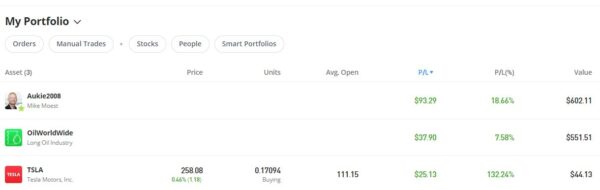
Last year I set up an account with investment and trading platform eToro, using their popular ‘copy trader’ facility. I chose to invest $500 (then about £412) copying an experienced eToro trader called Aukie2008 (real name Mike Moest).
In January 2023 I added to this with another $500 investment in one of their thematic portfolios, Oil Worldwide. I also invested a small amount I had left over in Tesla shares.
My original investment totalling $1,022.26 is today worth $1,193.36, an overall increase of $171.10 or 16.73%. in these turbulent times I am quite happy with that.
I thought it might also be interesting to update you on how my eToro virtual portfolio is faring (I wrote about my virtual portfolio a few weeks ago in this blog post). Overall, this is down by $2558 in value, largely due to some big losses experimenting with commodity trading (I decided this wasn’t for me). It is very interesting to see which investments in my virtual portfolio have been doing well and which poorly, though.
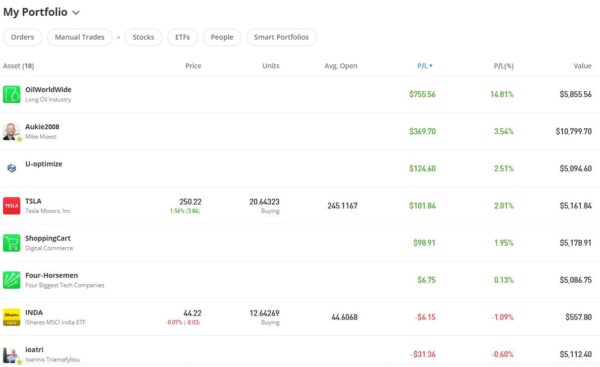
I can’t get all of the investments in this port into a single screen capture, but here are the top performers…
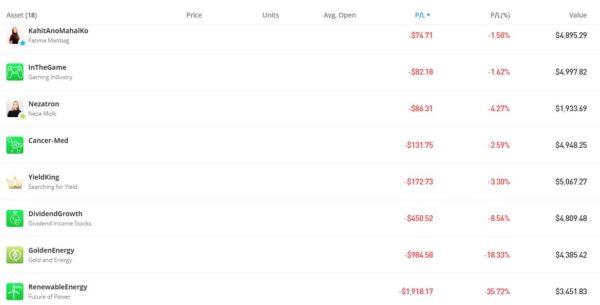
And here are the worst-performing ones…
As you can see, the best performing investment in my virtual portfolio is Oil Worldwide. This continues to forge ahead since it was rebalanced in July by eToro. The second best is my copy trading portfolio with Aukie2008. I am obviously glad I have both of these in my real money portfolio as well!
By contrast, the two renewables smart portfolios I hold, Golden Energy and Renewable Energy, are currently showing substantial (thankfully virtual) losses.
Renewable Energy has actually lost over 35% in value since I notionally invested in it. This certainly does seem to confirm that investing in renewables is risky and by no means a guaranteed route to profit, despite all the green energy hype at the moment. I am tempted to suggest that Just Buy Oil might be a better strategy 😉
eToro also recently introduced the eToro Money app. This allows you to deposit money to your eToro account without paying any currency conversion fees, saving you up to £5 for every £1,000 you deposit. You can also use the app to withdraw funds from your eToro account instantly to your bank account. I tried this myself and was impressed with how quickly and seamlessly it worked. You can read my blog post about eToro Money here.
I had two more articles published in September on the excellent Mouthy Money website. The first was Will a Heat Pump Save You Money? The government is pushing heat pumps hard as a method for achieving its Net Zero target, but do the sums add up for hard-pressed consumers? In this article I took a ‘deep dive’ into the pros and cons of heat pumps and set out my personal views on whether or not they represent good value for money.
I also wrote Get Your Will Written Free of Charge in October. For those who may not know, October is Free Wills Month, when some solicitors in England and Scotland offer members of the public aged 55 and over the chance to have their wills written or updated free of charge. In my article I explain how the scheme works, and also explain why I believe everyone should have their will drawn up by a qualified solicitor.
As I’ve said before, Mouthy Money is a great resource for anyone interested in money-making and money-saving. I particularly like the ‘Deals of the Week’ feature compiled by Jordon Cox (‘Britain’s Coupon Kid’) which lists all the best current money-saving offers for savvy shoppers. Check out the latest edition here
I also published two new posts on Pounds and Sense in September (I was away quite a lot last month, which didn’t leave much time for blogging!).
The first was a revised and updated guest post by my friend and near-neighbour Sally Jenkins titled Make Money From Public Speaking.
Sally is a successful author and makes a steady sideline income speaking about writing and related subjects (including a little while ago to my local U3A group!). I added a few thoughts of my own at the end of the article. There is definitely money to be made in this field; so if it’s something that might appeal to you, do check it out.
My other post last month was a review of a new money-saving shopping app called JamDoughnut. This app lets you earn cashback on gift vouchers from over 150 shops and restaurants, for which you get up to 20% cashback. You can then use the gift vouchers as money at the retailer concerned and pocket the cashback. Read Save Money on Your Shopping With JamDoughnut for more info (and a special bonus offer!).
The opportunity to get a free share worth up to £100 by signing up Trading 212 is now closed (for the time being anyway). I hope you took advantage if eligible and your free share is doing well. The opportunity to Get a Free ETF Share Worth up to £200 with Wealthyhood is still open. This DIY wealth-building app is aimed especially at people new to stock market investing. The minimum investment to qualify for the free share offer was raised recently from £20 to £50 – but on the plus side, they now guarantee that your free ETF share will be worth at least £10.
Finally, a quick reminder that you can also follow Pounds and Sense on Facebook or Twitter (or X as we have to learn to call it now). Twitter/X is my number one social media platform these days and I post regularly there. I share the latest news and information on financial (and other) matters, and other things that interest, amuse or concern me. So if you aren’t following my PAS account, you are definitely missing out!
That’s all for today. As always, if you have any comments or queries, feel free to leave them below. I am always delighted to hear from PAS readers
Disclaimer: I am not a qualified financial adviser and nothing in this blog post should be construed as personal financial advice. Everyone should do their own ‘due diligence’ before investing and seek professional advice if in any doubt how best to proceed. All investing carries a risk of loss.
Note also that posts may include affiliate links. If you click through and perform a qualifying transaction, I may receive a commission for introducing you. This will not affect the product or service you receive or the terms you are offered, but it does help support me in publishing PAS and paying my bills. Thank you!
If you enjoyed this post, please link to it on your own blog or social media:
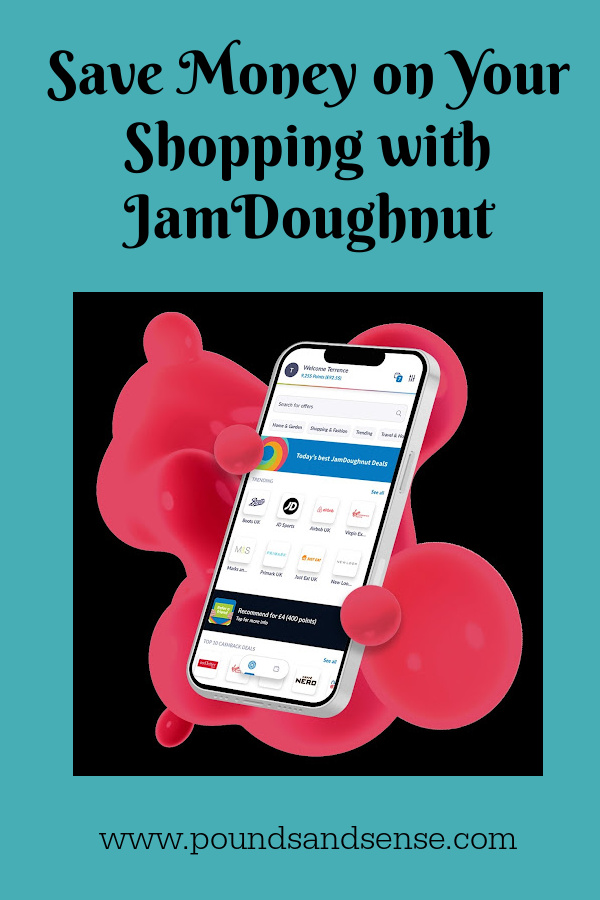
Today I’m reviewing an app called JamDoughnut which can help you save money on your shopping.
What is JamDoughnut?
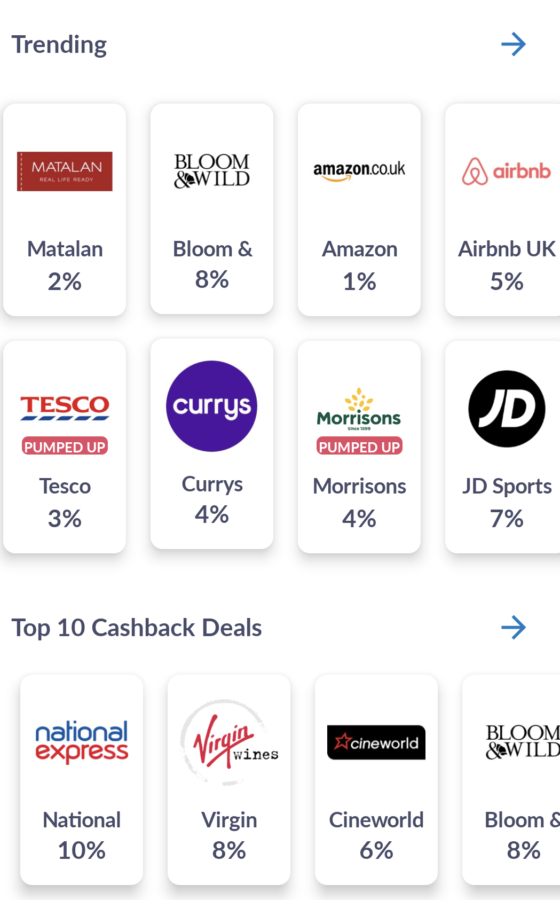
JamDoughnut is an instant cashback app that allows users to earn cashback when they spend money with over 150 leading supermarkets, restaurants and shops (see sample screenshot below).
Rather than cashback on specific purchases (as with sites like Quidco), you get cashback of up to 20% when you purchase gift cards from retailers on the app. These gift cards can then be used just like money, both online and in-store (in most cases).
How Does It Work?
The first step is to download the JamDoughnut app to your mobile phone from Google Play for Android or the Apple iStore. Open the app and follow the instructions to create an account (don’t forget to enter my referral code GBGN to get a 200 points [£2] bonus – see below). This should only take a couple of minutes.
Then check the list of retailers on the app and find one you shop with regularly. Most of the big supermarkets (with the exception of Waitrose) are included, for example.
You can even get cashback on Amazon gift cards, though admittedly only at a rate of 1% at the time of writing.
Once you have found a suitable retailer, buy a gift card for that retailer using the app. This is straightforward and you can get cards of up to £100 in value.
Once your gift card purchase has gone through, cashback will be credited to your account in the form of points (100 points = £1). In my experience this normally happens instantly. Once you have earned 1000 points, representing £10 cashback, you can withdraw the money to your bank account.
Note that there is a standard 30p transaction fee when making a withdrawal via bank transfer, and more than that if you use Apple Pay or Google Pay (so I don’t recommend doing that). So it may be best to let cashback build up a bit before withdrawing, to reduce the impact of the transaction fee. Alternatively you can withdraw in the form of a gift voucher (e.g. an Amazon voucher). In that case no charges are payable and you also get bonus points added to your account 🙂
In most cases, as mentioned, you can use gift cards either online or in-store. In the latter case, you can show/scan the code on your mobile phone at the checkout, or you can take a printed version with you and use that.
You can use gift cards for full or part payment. If you don’t use the whole amount on the gift card in one go, you can use what remains towards another purchase at a later date.
Other Benefits
Another attraction of JamDoughnut is that you can use the app in addition to your existing cards and loyalty programme points, allowing you to earn and/or save even more.
In addition, JamDoughnut offers a range of other benefits. These include a daily £100 (10 x £10) giveaway, free competitions, ‘Jammy Deals’, double discounts, and more. These are all listed on the ‘Daily Doughnut’ page of the app (see below).
Finally, if you’re so inclined, you can invite friends and relatives to join JamDoughnut using the ‘refer-a-friend’ scheme. If someone signs up using your referral code (see below), not only will they get an extra 200 points (worth £2) when they buy their first gift card, you will receive a bonus as well when they cash out for the first time (400 points, equivalent to £4).
Special Bonus Offer
Speaking of which, if you download the JamDoughnut app via this blog post and enter my referral code GBGN when requested, then (as mentioned above) you will get an extra 200 points (£2) when you use the app to buy a gift card for the first time – bringing.you that much closer to receiving your first £10+ cashback payment!
Closing Thoughts
In summary, I think JamDoughnut is a great little app and I have been pleased to add it to my armoury of money-saving tools and resources.
I do most of my grocery shopping at my local Morrisons, which is currently offering 4% cashback on JD gift card purchases – so in effect I am getting a 4% discount on all my shopping there.
And I am still getting all the benefits of my Morrisons Card too, including special discounts and regular £5 vouchers. In these challenging times, this really does help my money go a little bit further 🙂
As always, if you have any comments or questions about this JamDoughnut review, please do leave them below.
If you enjoyed this post, please link to it on your own blog or social media:
I’ll start as usual with my Nutmeg Stocks and Shares ISA. This is the largest investment I hold other than my Bestinvest SIPP (personal pension).
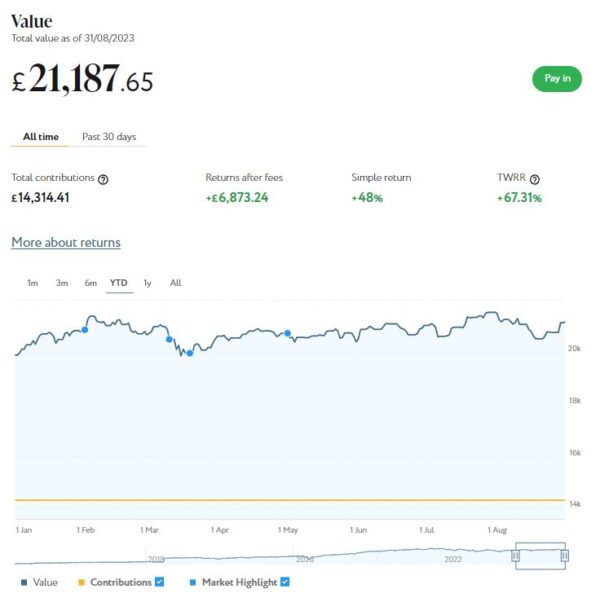
As the screenshot below for the year to date shows, my main Nutmeg portfolio is currently valued at £21,188. Last month it stood at £21,548 so that is a fall of £360.
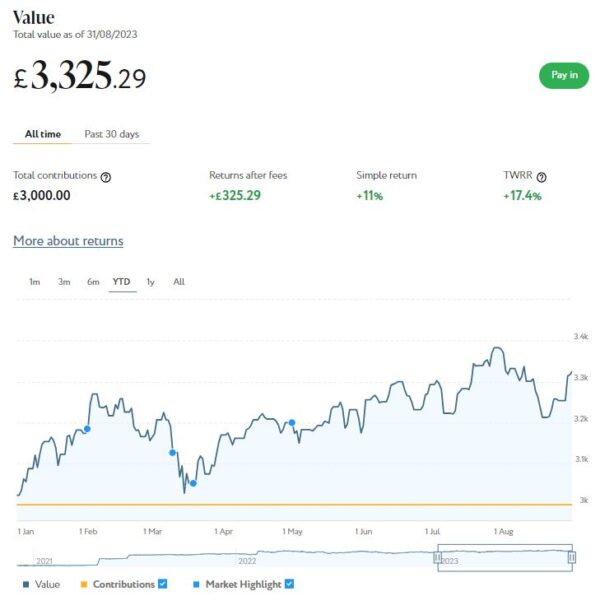
Apart from my main portfolio, I also have a second, smaller pot using Nutmeg’s Smart Alpha option. This is now worth £3,325 compared with £3,383 a month ago, a fall of £58. Here is a screen capture showing performance since the start of this year.
The net value of all my Nutmeg investments has fallen this month by £418 or 1.68% month on month. That’s obviously a bit disappointing, but both pots are still comfortably up on where they were at the start of the year. Their total value has risen by £1,592 (6.95%) since 1st January 2023.
Of course, all investing is (or should be) a long-term endeavour. Over a period of years stock market investments such as those used by Nutmeg typically produce better returns than cash accounts, often by substantial margins. But there are never any guarantees, and in in the short to medium term at least, losses are always possible.
You can read my full Nutmeg review here (including a special offer at the end for PAS readers). If you are looking for a home for your annual ISA allowance, based on my overall experience over the last seven years, they are certainly worth considering. They offer self-invested personal pensions (SIPPs) and Junior ISAs as well.
I also have investments with the property crowdlending platform Kuflink. They continue to do well, with new projects launching every week. I currently have £2,145 invested with them in 17 different projects paying interest rates typically around 7%. I also have just over £100 in my cash account after another loan was repaid. I am currently considering whether to withdraw this money or (in due course) reinvest it.
To date I have never lost any money with Kuflink, though some loan terms have been extended once or twice. On the plus side, when this happens additional interest is paid for the period in question.
As mentioned last time, Kuflink recently changed their terms and conditions. As from Monday 21st August there is an initial minimum investment of £1,000 and a minimum investment per project of £500. I wondered if this would also apply to their secondary market and this does indeed seem to be the case. When I checked just now, there was only one loan on offer for under £500 (£413) and all the others were £500 or more.
Kuflink say they are doing this to streamline their operation and minimize costs. I can understand that, though it does mean the option to ‘test the water’ with a small first investment has been removed. It will also make it harder for small investors (like myself) to build a well-diversified portfolio on a limited budget. As mentioned, my current portfolio of £2,145 comprises 17 different investments ranging from £50 to £200. If I was starting out again now, that same amount of money would only stretch to four deals!
One possible way around this is to invest using Kuflink’s Auto/IFISA facility. Your money here is automatically invested across a basket of loans over a period from one to three years. The rates on offer from August 1 2023 are shown in the graphic below.
As you may gather, you can invest tax-free in a Kuflink Auto IFISA. Or if you have already used your annual iFISA allowance elsewhere, you can invest via a taxable Auto account. You can read my full Kuflink review here if you wish.
Moving on, my Assetz Exchange investments continue to generate steady returns. Regular readers will know that this is a P2P property investment platform focusing on lower-risk properties (e.g. sheltered housing). I put an initial £100 into this in mid-February 2021 and another £400 in April. In June 2021 I added another £500, bringing my total investment up to £1,000.
Since I opened my account, my AE portfolio has generated a respectable £134.95 in revenue from rental income. As I said in last month’s update, capital growth has slowed, though, in line with UK property values generally.
At the time of writing, 9 of ‘my’ properties are showing gains, 1 is breaking even, and the remaining 16 are showing losses. My portfolio is currently showing a net decrease in value of £28.83, meaning that overall (rental income minus capital value decrease) I am up by £106.12. That’s still a decent return on my £1,000 and does illustrate the value of P2P property investments for diversifying your portfolio. And it doesn’t hurt that with Assetz Exchange most projects are socially beneficial as well.
Obviously the fall in capital value of my AE investments is disappointing. But it’s important to remember that until/unless I choose to sell the investments in question, it is largely theoretical, based on the most recent price at which shares in the property concerned have changed hands. The rental income, on the other hand, is real money (which in my case I have chosen to reinvest in other AE projects to further diversify my portfolio).
Also, as I noted last time, the recent high inflation rate has actually been beneficial for Assetz Exchange investors. That is because properties on the platform generally have an annual review when rentals are increased in line with inflation. That means from the end of the financial year in April, rentals have increased in most cases by around 10%. Assetz Exchange recently published a blog post about this which is worth a read.
To control risk with all my property crowdfunding investments nowadays, I invest relatively modest amounts in individual projects. This is a particular attraction of AE as far as i am concerned (especially now that Kuflink have raised their minimum investment per project to £500). You can actually invest from as little as 80p per property if you really want to proceed cautiously.
Last year I set up an account with investment and trading platform eToro, using their popular ‘copy trader’ facility. I chose to invest $500 (then about £412) copying an experienced eToro trader called Aukie2008 (real name Mike Moest).
In January 2023 I added to this with another $500 investment in one of their thematic portfolios, Oil Worldwide. I also invested a small amount I had left over in Tesla shares.
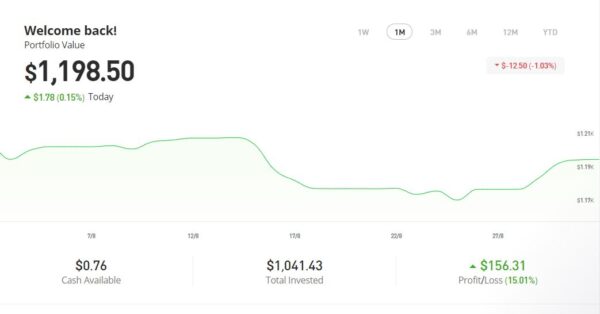
As you can see from the screen capture below, my original investment of $1,022.26 is today worth $1,198.50, an overall increase of $176.24 or 15.05%. in these turbulent times I am very happy with that.
In the last month my copy trading portfolio with Aukie2008 has fallen in value, though I am not too concerned about this as the investment is still well up overall. My Tesla shares have again done well (thank you, Elon Musk). I am also pleased that Oil Worldwide continues to forge ahead since it was rebalanced in July by eToro. Looking at my eToro virtual portfolio, I can see that Oil Worldwide is still doing much better than the two renewables smart portfolios I hold, which are currently showing substantial (thankfully virtual) losses. Make of this what you will!
eToro also recently introduced the eToro Money app. This allows you to deposit money to your eToro account without paying any currency conversion fees, saving you up to £5 for every £1,000 you deposit. You can also use the app to withdraw funds from your eToro account instantly to your bank account. I tried this myself and was impressed with how quickly and seamlessly it worked. You can read my blog post about eToro Money here.
I had three more articles published in August on the excellent Mouthy Money website. The first was Can You Make Money From Holiday Lets? This is a dream for many people, and there is no doubt you can make a valuable extra income this way (not to mention the opportunity to enjoy cheap holidays at the property yourself!). In my article I set out some key things you need to be aware of.
I also wrote How to Become an Amazon Vine Reviewer. This is a subject close to my heart. I’ve been an Amazon Vine reviewer for over ten years and in some ways it’s been the most profitable sideline I’ve ever had. You don’t get paid for Amazon Vine reviews, but you do get to keep the items concerned (my most valuable so far being a £1200 gaming laptop). In my article I spill the beans on how the scheme works and suggest how you might get an invitation to become a ‘Vine Voice’ yourself.
My third article was Play Your Supermarket Loyalty Cards Right. In this article I explained why stores use loyalty cards and their pros and cons for customers. I also described the leading loyalty cards in the UK (including Tesco Clubcard, Nectar, Morrisons, Boots, and so on), covering how they work in practice and how to get the most from them.
As I’ve said before, Mouthy Money is a great resource for anyone interested in money-making and money-saving. I particularly like the ‘Deals of the Week’ feature compiled by Jordon Cox (‘Britain’s Coupon Kid’) which lists all the best current money-saving offers for savvy shoppers. Check out the latest edition here
I also published several new posts on Pounds and Sense in August. The deadlines on some of these have now passed, so I hope you took advantage at the time! You might, however, still want to check out What is U3A and Is It For You?
U3A stands for University of the Third Age. It is a non-profit organization offering a range of leisure activities for retired and semi-retired people. I recently joined my local U3A myself, and in this post set out my experiences and impressions, for the benefit of anyone else who might be interested in joining now or in future.
In other news, the Trading 212 free share offer is back. If you haven’t done this before, you can get a free share worth up to £100. You just have to sign up on the website and deposit a minimum of £1 into your account. This offer is running till 27 September 2023. See Get a Free Share Worth up to £100 with Trading 212 for more info.
The opportunity to Get a Free ETF Share Worth up to £200 with Wealthyhood is also still open. Wealthyhood is a DIY wealth-building app aimed especially at people new to stock market investing. As from June 2023 they changed their fee structure to make it (even) more attractive to small investors. They have increased the minimum investment to qualify for the free share offer from £20 to £50 – but on the plus side, they guarantee that your free ETF share will be worth at least £10.
Finally, a quick reminder that you can also follow Pounds and Sense on Facebook or Twitter (or X as we have to learn to call it now). Twitter/X is my number one social media platform these days and I post regularly there. I share the latest news and information on financial (and other) matters, and other things that interest, amuse or concern me. So if you aren’t following my PAS account, you are definitely missing out!
As a matter of interest, I recently paid £100 for Twitter/X premium membership. Although I do like the snazzy blue tick, my main reason was to get continued access to the scheduling tool Tweetdeck (now called X-pro) which became subscriber-only last month. I was accused the other day of ‘selling out’ to Elon Musk for doing this. But personally I don’t begrudge the money, as the extra tools and features make working with Twitter much easier and more enjoyable. And if my money helps keep the platform afloat, that’s an additional benefit in my book.
That’s all for today. As always, if you have any comments or queries, feel free to leave them below. I am always delighted to hear from PAS readers
Disclaimer: I am not a qualified financial adviser and nothing in this blog post should be construed as personal financial advice. Everyone should do their own ‘due diligence’ before investing and seek professional advice if in any doubt how best to proceed. All investing carries a risk of loss.
Note also that posts may include affiliate links. If you click through and perform a qualifying transaction, I may receive a commission for introducing you. This will not affect the product or service you receive or the terms you are offered, but it does help support me in publishing PAS and paying my bills. Thank you!
If you enjoyed this post, please link to it on your own blog or social media:
Today I’m spotlighting Mintos, a European crowdlending platform based in Latvia but open to people in the UK. You may have seen my earlier post on Investing Basics for Beginners, which was sponsored by MIntos.
With Mintos, your money is invested in loans to businesses and private individuals arranged by Mintos’s partner lending companies around the world. Mintos act as intermediaries between lenders and borrowers. They aim to ensure that both groups act responsibly and loans are repaid in a timely way.
Currently Mintos offer the opportunity to invest in agricultural loans, business loans, car loans, car rentals, invoice financing, mortgage loans, personal loans, pawnbroking loans and short-term loans.
You can begin investing with just €50 (around £43). Since 2015, investors with Mintos have earned a 9.54% net return per year on average. Of course, past performance is no guarantee of how any investment platform will do in future. Currently, however, interest rates on the platform are averaging around 12.50%.
What Guarantees Are There?
To ensure security, Mintos provides a return-on-investment guarantee. If a loan instalment remains unpaid 60 days after becoming due, Mintos say they will repay the investment at face value with any accrued interest.
Mintos further insist that all lenders on their platform maintain 5-10% of any loan on the platform themselves. This means that in the event of a default, the lender will lose some of their own money also. So they have ‘skin in the game’, as the expression goes 🙂
The other main risk, of course, is the collapse of the platform itself. While this could happen, it’s worth noting that Mintos is licensed and supervised by Latvijas Banka, the central bank of Latvia, and a member of the Latvian national InvestorCompensation Scheme. If Mintos fails to provide investment services, retail investors are entitled to compensation of 90% of the irrevocable loss resulting from the non-provision, up to a limit of €20 000.
In addition, as is generally the case with crowdlending/P2P platforms, your assets are held quite separately from Mintos’s assets.
Investing in Euro
As Mintos is a European operation, you will need to invest in euro and your returns will be paid in this currency. That obviously adds a layer of complication for UK residents, but there are various ways round this. If you have a UK bank account you will normally be able to make (and receive) payments in euro, but may be charged a transaction fee.
You could use your own bank to fund your account initially, but if you become a regular investor with Mintos you might want to use a service/account that charges lower fees. You could use a money transfer service such as Paysera or Wise (formally TransferWise). These will enable you to transfer funds between Mintos and your own bank account with (potentially) lower charges and a more favourable exchange rate.
Another option would be to open a euro account with a provider such as Starling. This will allow you to receive and make payments in both sterling and euro, again at a lower overall cost.
Opening an Account
To open a Mintos account, your first step will be to click on Create Account at the top of the Mintos homepage. There are then certain preliminary steps you will need to take…
Verify your identity and answer some questions about yourself
This is necessary to comply with anti-money laundering laws and KYC (Know Your Customer) requirements.
Take the Suitability & Appropriateness assessment
As a licensed investment firm, Mintos are required to ensure that the products they offer are suitable and appropriate for investors. Based on your answers, they will make certain methods of investing available to you and set a responsible investment limit for your account. You can retake the assessment at any time if your situation changes.
Transfer funds to your Mintos account (see above)
Once this has been done, you can start investing. You have various options here. The simplest is to use one of Mintos’s automated strategies. These work as follows:
Choose a strategy that matches your preference: Diversified, Conservative, or High-yield.
Your strategy will buy small fractions of many different loans or Sets of Notes from different lending companies around the world.
You will be shown the weighted average interest rate of available investments before you invest.
Mintos can (if you wish) reinvest your returns so your money can work continuously and earn even more interest.
You can get your investment back any time by cashing out funds from your Mintos strategy.
You can start or stop your strategy at any time.
Your exposure is capped at 15% per lending company.
Alternatively, you can use a custom strategy, where you choose from a huge range of available investments yourself. You can filter by more than 20 different investing criteria and diversify your portfolio according to your preferences. You can do this entirely manually or create a custom automated investing strategy based on the rules you set.
When you want to withdraw money, your Mintos Core portfolio will automatically sell investments in your portfolio to other investors. Selling may take from a couple of minutes to a few days, depending on demand from other investors at the time. Note that loans which are in default cannot be cashed out this way, and you will have to wait until the loan in question is back in good stead or the 60-day guarantee (see above) kicks in. In some circumstances you may be able to sell loans which are unavailable for cashing out on Mintos’s secondary market, for which a 0.85% fee will be charged. This article on the MIntos website has more information about the cashing out rules and restrictions.
Special Bonus!
Until 30 November 2023, if you click through any link to Mintos in this article and invest €1000 or more, you will get a €50 instant bonus and a 1% bonus of your average investment in the first 90 days.
If you invest €5000, for example, in addition to the returns advertised (currently averaging 12.5%), you will also receive a €50 instant bonus and a further 1% bonus of €50 after 90 days. Effectively that’s an extra 2% bonus. Remember, this special offer closes on 30 November 2023.
If you have any comments or questions, as always, please do leave them below.
Disclosure: I am not a registered financial adviser and nothing in this article should be construed as personal financial advice. You should always do your own ‘due diligence’ before investing, and if in any doubt seek advice from a registered financial adviser before proceeding. All investing carries a risk of loss.
This post includes affiliate links. If you click through and make an investment (or perform some other designated action) I may receive a commission for introducing you. This will not affect the product or service you receive or any charges you may pay. Note also that the special bonus referred to in this article is only available if you click through one of my links. It will not apply if you go to the Mintos website directly.
If you enjoyed this post, please link to it on your own blog or social media:
Today I’m sharing a sideline money-making opportunity that – if you’re in a position to do it – can bring in a steady income for very little effort.
The shortage of parking spaces in many towns and cities has created an opportunity for anyone who has a driveway (or garage) they aren’t using all the time.
One of the best-known operators in this field is JustPark. Through their website and mobile app, they put drivers in touch with home-owners and businesses who have parking spaces (and/or EV charging spaces) available near their destination. They say they help over 10 million drivers a year find parking spaces at over 45,000 UK locations.
Listing your space is free and you can set your own price based on how long the driver wishes to stay. JustPark will suggest an appropriate price based on your location and the facilities you are offering, but you aren’t obliged to accept this.
JustPark charges space-owners a 3% fee on one-off bookings (so if you charge £10 they will take 30p, meaning you receive £9.70). For longer term or rolling bookings over two months, they charge space-owners a higher fee of 20% for the first month, with the fee reverting to the standard 3% after that.
JustPark also make money from drivers, adding up to 25% of the space-owner’s asking price to the fee charged. They say, however, that charges to drivers are still typically 30% lower than ad hoc street parking (if you can find it), which makes the service attractive to motorists as well.
One big attraction of JustPark is that they handle all the admin on your behalf. All payments are made via the website, and space-owners can withdraw earnings via PayPal or direct to their bank account. JustPark also ensure you still get paid even if the booker doesn’t turn up.
JustPark say that the money you earn from renting out your parking space is included in the property trading income allowance introduced by the government in April 2017 – so you can make up to £1,000 per year completely tax-free (and no need to declare it to the taxman).
All drivers using the service have to register on the site, so you know exactly who will be using your space on any given day. There is also a rating system so you can see any comments other users of the service have made about them. Space-owners are also rated by drivers, incidentally.
You can offer spaces by the day, week or month, and set any restrictions you wish on when your space is available. Anyone is welcome to advertise spaces on JustPark, but the locations in most demand are those near airports, stations and stadiums, and in major cities. According to one recent article in the Daily Mail, people in such areas are making more than £4,000 a year doing this. Even if that doesn’t apply to you, though, you can still earn from a few hundred pounds a year to £1000 or more by this means.
Obviously the pandemic and working from home reduced demand for parking spaces. But with life returning to normal now, demand for parking spaces is steadily increasing again.
Of course, if you don’t have a suitable space to offer, you won’t be able to benefit from this opportunity. You could still use JustPark to save money on your own parking costs, though. Either way, the service is well worth checking out 🙂
Another option for cheaper parking is Your Parking Space. Over 60s can get an exclusive 10% discount on this service through my friends at Over 60s Discounts.
Disclosure: As well as being a registered user of JustParkI am an affiliate for them and will therefore receive a small commission if you click through any of my links and sign up. This will not affect the money you earn through the site and/or any savings you make if you use them to find parking spaces.
Cover image by courtesy of BingAI.
This is a fully revised and updated version of my original article on this subject.
If you enjoyed this post, please link to it on your own blog or social media:
Today I have a collaborative post for you in association with my friends at European crowdlending platform Mintos.
The article sets out some basic principles for anyone who may be considering investing for the first time.
Introduction
if you’re looking to build long-term wealth and create the financial means to achieve life-long goals, investing can be the key to doing this. To get you started, we’ve put together an overview of what investing is, what people invest in, how people invest, and what you might need to start your investment journey.
Key takeaways
Investing can be an effective way to build long-term wealth and unlock financial freedom.
When you invest, you can expect to earn a profit on the money you have invested, otherwise known as an investment return.
Investment returns compound (grow bigger and bigger) each time you reinvest them, helping you achieve financial goals faster.
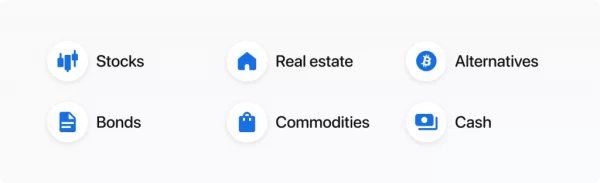
Investments are referred to as assets; they are grouped into asset classes, e.g. cash, stocks, bonds, real estate, commodities, and alternatives.
Anyone can start investing, regardless of experience or financial situation. Even just a little money can go a long way.
What Is Investing?
Whether consciously or not, we invest our time and energy throughout our lives, whether it’s on getting a university degree or learning to cook a new recipe. Typically we do these things because we expect them to bring us value in future, e.g. landing our dream job after finishing university.
With investing money, the concept is similar – you put your money into something with the expectation that you’ll make a profit from this in the future.
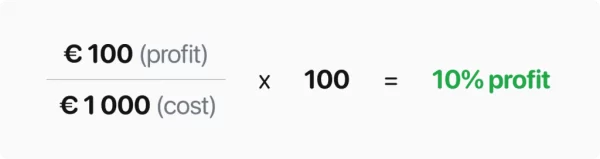
The profit you earn from investments is commonly referred to as a return. This is often expressed as a percentage. For example, if you invest €1000 in something and at the end of the investment period, you get back €1100, then your profit would be €100, giving you a 10% return on your investment.
Why Do People Invest?
For many years people have used investing as a means to build their wealth. The reason long-term investing is so effective is because of compound growth. Investment returns compound (grow bigger and bigger) each time they are reinvested, helping you achieve your financial goals faster.
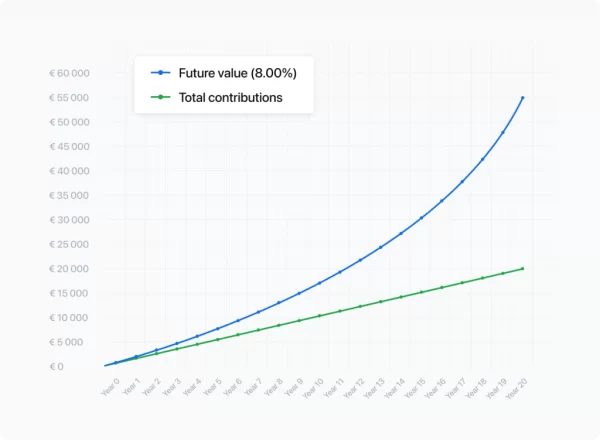
For example, if you invest €100 a month over the next 20 years at an 8% interest rate, each year your funds will grow at a faster pace (see chart below). The idea is that by the end of the investment period, you will have significantly more money than if you’d added the same amount to a savings account.
For many, investing provides the means to pay for education, home ownership, cars, travel, retirement, and so on. So people often look to investing because it can provide them with opportunities.
What Do People Usually Invest In?
When you own something of value that can be converted to money, it’s described as an asset. Assets can be liquid, meaning they can be quickly converted to money, or illiquid, where it’s more time-consuming and complex to turn them into money.
In the investment market, assets are categorized into asset classes. These are groups of assets with similar characteristics. Some examples of popular asset classes are:
Where to Start?
As you can see, there are many different ways of investing. How people choose often comes down to prior experience and financial objectives. Although the investment landscape may seem vast, there are options to suit everybody.
A great way to get started is to set investment goals. Once you have some clarity around your goals and budget, you can begin to research which assets or asset classes will suit your financial objectives and risk appetite.
Investment platforms that offer simple, automated investing strategies can be an easy place to begin. These strategies are built using expert analysis and data, reducing the need for prior expertise or in-depth research. An example here is Wealthyhood.
Investments in Exchange Traded Funds or ETFs (large investment portfolios investors can buy shares in) are also relatively straightforward. They’re managed by investment firms and require no work from an investor’s perspective. One example of a robo-adviser investment platform that uses ETFs is Nutmeg.
Or, if you’d like more control, you can research and make individual investment decisions yourself using brokers or self-investment platforms such as eToro.
Some investors only have one asset, such as a real estate (property) investment. Others own many different assets, forming what’s known as an investment portfolio.
When creating a portfolio, it’s important not to put all your eggs in one basket. It can be beneficial to invest smaller amounts across multiple assets, so your lower-risk investments balance the higher-risk ones – an investment strategy known as diversification. Doing this can increase the chances you’ll achieve the returns you expected while reducing the risk of significant losses.
Many investment platforms only require small amounts to get started. For example, on Mintos you can begin investing with just €50 (around £43). When you invest responsibly, even a little money can go a long way and bring you closer to achieving your financial goals.
As mentioned earlier, Mintos is a European crowdlending platform. Your money is invested in loans to businesses and private individuals arranged by MIntos’s partner lending companies from around the world.
As Mintos is a European operation, you will need to invest in euro and your returns will be paid in this currency. That obviously adds a layer of complication for UK residents, but there are various ways around this. If you have a UK bank account you will normally be able to make (and receive) payments in euro, but may be charged a transaction fee.
You could use your own bank to fund your account initially, but if you become a regular investor with Mintos you might want to use a service/account that charges lower fees. You could use a money transfer service such as Paysera or Wise (formally TransferWise). These will enable you to transfer funds between Mintos and your own bank account with (potentially) lower charges and a more favourable exchange rate.
Another option would be to open a euro account with a provider such as Starling. This will allow you to receive and make payments in both sterling and euro, again at a lower overall cost.
If you’d like to check out the options for inventors on Mintos – and learn more about how they operate and how risks are managed – please see this page of their website. Since 2015, investors with Mintos have earned a 9.54% net return per year on average. Of course, past performance is no guarantee of how any investment platform will do in future.
Special Bonus!
Until 30 August 2023, if you click through any link to Mintos in this article and invest €1000 or more, you will get a €50 instant bonus and a 1% bonus of your average investment in the first 90 days.
If you invest €5000, for example, in addition to the returns advertised, you will also receive a €50 instant bonus and a further 1% bonus of €50 after 90 days.
Thank you again to my friends at Mintos for their assistance with this article. If you have any comments or questions, as always, please do leave them below.
Disclosure: This is a collaborative post in association with Mintos. I am not a registered financial adviser and nothing in this article should be construed as personal financial advice. You should always do your own ‘due diligence’ before investing, and if in any doubt seek advice from a registered financial adviser before proceeding. All investing carries a risk of loss.
This post includes affiliate links. If you click through and make an investment (or perform some other designated action) I may receive a commission for introducing you. This will not affect the product or service you receive or any charges you may pay. Note also that the special bonus referred to in this article is only available if you click through one of my links and will not apply if you go to the Mintos website directly.
If you enjoyed this post, please link to it on your own blog or social media:
eToro is a Israeli fintech company based in Cyprus. The company also has registered offices in the UK, US and Australia. It is a hugely popular platform with 25 million customers from over 140 countries across the world.
eToro is regulated and authorised in the UK by the Financial Conduct Authority (FCA) and is covered by the Financial Services Compensation Scheme (FSCS). That means if eToro were to go bust any deposits with them up to £85,000 would be protected. Of course, the FSCS doesn’t protect you if you lose money simply due to your investments performing poorly.
eToro offers a wide range of investment products, from individual shares to cryptocurrencies, commodities to ETFs, currency pairs to copy trading, and thematic investing via smart portfolios. Today, though, I’m focusing on a feature that doesn’t require any outlay at all. This is the facility to operate a $100,000 virtual portfolio on the platform, to familiarise yourself with how it works and test out trading and investing strategies.
I have been an eToro investor for around a year now. I started with a virtual portfolio, but as regular readers will know I have also invested some real money. I do still use my virtual portfolio, however, and have learned a number of valuable lessons from it. So I thought today I’d set out some of these.
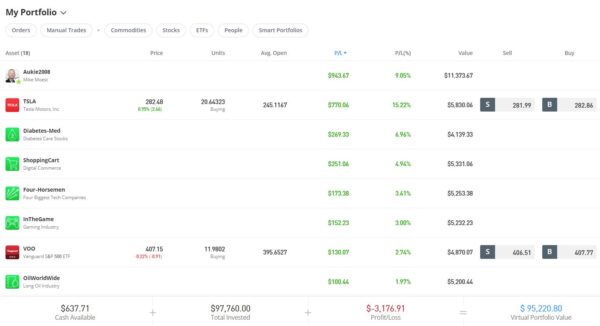
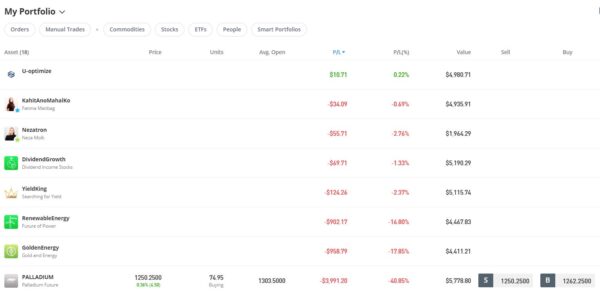
I’ll start by showing you some data on how my virtual portfolio has been performing. As I have quite a lot of different investments in this, I have taken two separate screen captures showing first the best performing and then the worst performing. As you will see, I am down a bit overall, but I’m not upset about that as obviously I have been experimenting to try to assess what works and what doesn’t.
Best Performing Investments
Worst Performing Investments
Some Lessons Learned
I hope you found the screen captures of my virtual portfolio interesting. They include most of my current investments apart from one or two in the middle. I can’t discuss every investment in detail here, but as promised here are some of the lessons that I have drawn from my experiences to date.
Copy trading can be profitable
As you can see, the best performing investment in my virtual portfolio is copy trading Aukie2008 (Mike Moest). This has generated a profit of almost $1000 for me. Regular readers will know that I also invested some real money following this trader and have done well from this too.
I am obviously a fan of the copy trading feature on eToro, though naturally some traders do better than others. When I was starting out I also considered investing some real money following a trader called Nezatron (of course, I wasn’t the least bit influenced by the fact that she is an attractive blonde…). But as you can see above, the results she has achieved over the last year aren’t nearly as impressive.
Another option for investors on eToro is commodities. These range from precious metals through to food products, including the famous (or infamous) pork bellies.
It’s important to understand that when trading in these markets, you are essentially betting on whether the price will go up or down in future. The mechanism for doing this is something called Contracts for Difference, or CFDs for.short.
CFDs are leveraged investment products. That means you can make a lot of money if they go the way you predict but also lose a lot if they go the opposite way.
In my virtual portfolio I have tried commodity trading three times. The first time was with Nickel and I made a big profit. The next was Gold, and I lost all the money I had made with Nickel and a bit besides. Finally, as you can see, I opened a ‘buy’ trade with the rare metal Palladium. This trade also went the wrong way, so I am currently sitting on a loss of almost $4000. Obviously I am glad that isn’t real money!
If you’re wondering why my Nickel and Gold trades aren’t showing in my screen captures, it’s because the stop-profit and stop-loss limits respectively were reached and the trades closed out. You are obliged to set stop profits and stop losses on the eToro platform, though you can of course adjust them subsequently if you wish..
To be fair to eToro, they have warnings across the site that trading with CFDs is extremely risky. But trying it myself (in virtual form) really has brought home to me the risk you are running, especially if you don’t fully understand what you’re doing. Indeed, if it wasn’t for my commodity-trading experiments, my virtual portfolio would be well in profit by now.
If, despite this, you still want to find out more about commodity trading using CFDs, the eToro website has a useful introductory guide here. As for me, I am not planning to try it again any time soon!
You can’t always trust ‘the wisdom of the crowd’
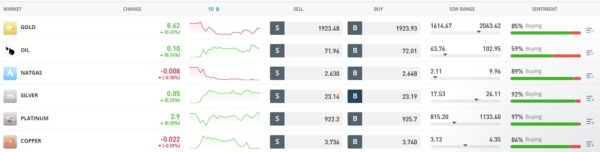
You might wonder how I chose which commodities to invest in. Well, eToro shows you what proportion of investors at any time are buying a particular commodity (i.e. forecasting its price will rise) and what proportion are selling (i.e. forecasting it will fall). Here is a screen capture illustrating this.
No doubt naïvely, I assumed that if a very high proportion of investors are ‘buying’ a particular commodity, doing likewise should be profitable. As mentioned, though, while that worked on the first occasion I tried it, it didn’t on the second or third. So while this information might be useful in some circumstances, my experiences indicate that it is definitely not to be relied upon.
Investing in renewables isn’t a one-way bet
You might also assume (as I did) that in the current (alleged) climate crisis and manic quest to achieve Net Zero, investing in renewables ought to be a profitable strategy.
To test this, I invested in two eToro smart portfolios in this sector. One is called Renewable Energy and the other Golden Energy. As you can see from my earlier screen capture, both have performed poorly and are at the bottom of my list (just above Palladium). I am currently down about $1000 on each.
In a somewhat ironic twist, my investment in a smart portfolio called Oil Worldwide is actually showing a small profit. Regular readers will be aware that I also have some real money in Oil Worldwide.
I don’t really know why companies in the renewable energy sector should be under-performing (on eToro at any rate). But again it does make the point that what may appear to be ‘nailed-on’ profitable investments can still end up losing money. There is never any guarantee!
As you can see, one of the best performing investments in my virtual portfolio was Diabetes-Med. This is a smart portfolio covering companies in the field of diabetes care, treatment and prevention. As someone who has previously been diagnosed prediabetic, I had a particular interest in this. And with diabetes on the rise across the world, it did seem to me it was a sector with good profit potential.
Another of my more profitable investments was Cancer-Med. Again I had personal reasons for wanting to invest in this, as my partner Jayne died from cancer and I have been treated for prostate cancer myself. Obviously a lot of research money goes into cancer, and successful treatments can prove extremely lucrative for the companies concerned.
AI, or artificial intelligence, is a major talking point at the moment. While some concerns have been expressed about its potential downsides, businesses are investing heavily in this field and the potential profits to be made appear huge. eToro doesn’t currently have an AI smart portfolio as such. You can, however, invest in four big tech companies (Microsoft, Amazon, Apple and Google) via the Four Horsemen smart portfolio. All four of these companies are currently pouring vast amounts of money into AI research.
My investment in Four Horsemen has generated a decent (virtual) profit for me so far and I don’t see that changing any time soon. I may well be investing some real money in this smart portfolio before long.
Obviously if you wish you can also invest in any of these companies individually via eToro. But the Four Horsemen smart portfolio provides a convenient method for investing in all four, with the portfolio regularly rebalanced to ensure that investors’ funds are divided proportionately among them.
Final Thoughts
So those are five lessons I have learned from my eToro virtual portfolio. I don’t claim any of them are particularly earth-shattering or that they represent deep universal truths. But I have found all of them valuable in different ways and they will certainly inform my investing in future.
If you are interested in investing and/or trading, I do therefore recommend setting up an eToro virtual portfolio and trying different strategies with it. I shall continue to do so myself, alongside my real investments in eToro and elsewhere.
As always, if you have any comments or questions about this article – or eToro more generally – please do post them below.
Disclaimer: I am not a professional financial adviser and nothing in this post should be construed as personal financial advice. You should always do your own ‘due diligence’ before investing, and seek professional advice if in any doubt how best to proceed. All investing carries a risk of loss.
Please note also that this post includes refer-a-friend links. If you click through and make a purchase or investment, I may receive a bonus for introducing you. This will not affect in any way the price you pay or the product/service you receive. In some instances bonuses and other promotional incentives may only be available if you click through my link.
If you enjoyed this post, please link to it on your own blog or social media:
I recently returned from a three-day break in the historic city of Bath. It was the first time in over 30 years I’d been to Bath, so it’s fair to say I was approaching it with fresh eyes!
I stayed in a one-bedroom self-catering apartment in a large multi-occupied property called Elmbrook. This was about twenty minutes’ walk from the centre of Bath. I arranged it through Booking.com. I’ll say a bit more about the apartment below.
For those who don’t know, Bath is on the River Avon, about 12 miles from Bristol. Here is a map of the area from Google Maps…
Accommodation
As mentioned, I stayed in a self-catering apartment in a property called Elmbrook. This was on the Weston Road, a short but pleasant walk from the centre of Bath via the Royal Victoria Park and botanical gardens.
You can read more about where I stayed on this page of the Booking.com website (and see photos). One big attraction for me was that a reserved (and free) off-road parking space was available. In Bath – as in many popular tourist areas – finding somewhere to park can be tricky.
The apartment had a good-sized master bedroom with a comfortable double bed. It had a small but perfectly adequate bathroom with a modern power shower (though, somewhat ironically, no bath). The shower worked well and there was plenty of hot water.
The lounge was quite spacious. It was at the front of the house and had a small patio leading from it. Although I didn’t use the patio during my stay, the patio door provided a quick and convenient method for getting my luggage from and to the car! The lounge had a good-quality flat-screen TV and a DVD player with a small selection of DVDs.
The kitchen was at the back of the apartment and had all the facilities you would need or expect, including a modern electric oven and hob, microwave, toaster, fridge, sink, dishwasher, washing machine, and so forth.
The apartment had central heating on a thermostat, though as it was June I didn’t need this. It had free wifi which worked perfectly during my stay (not always the case in my experience). The location was quiet and peaceful, and I slept very well.
Finally I should say that communication from my Booking.com hosts (Nigel and Alison) was excellent. Nigel sent me detailed instructions about how to get there and how to get in (I used the key safe, though he offered to meet me in person if I preferred). They also left me a welcome letter and a basket of goodies, including a bottle of wine, muesli, milk, ground coffee, and so on. That was a kind gesture and obviously much appreciated.
Financials
As Pounds and Sense is primarily a money blog, I should say a few words about this.
I paid a total of £351 (including VAT) for my three-night visit, which works out to £117 a day. I thought that was very reasonable bearing in mind the high standard of the accommodation and the convenience of the location.
Obviously as it was self-catering no meals were included and neither was there a daily housekeeping visit. But on the plus side, I got a lot more space and facilities than I would have had at a hotel, and complete privacy throughout my stay. I’d have to admit that these days I prefer to go self-catering when possible, even if I do miss hotel breakfasts a bit!
Things to Do
I won’t give you a blow-by-blow account of everything I did on my visit. I will share some highlights and personal recommendations, though.
The first thing I did was book a ticket on the Hop On, Hop Off open-top sightseeing buses. My ticket cost me just under £20 after my over-60s discount and a small reduction for booking online. The most you will pay is £22.50, though.
A ticket allows you unlimited travel on two routes, the City Tour and the Skyline Tour. As you would expect, the City Tour takes you round all the main attractions in or near the centre, including the Royal Crescent, The Circus, Bath Abbey, the Roman Baths, Theatre Royal, and so on. You can listen to a commentary that tells you some interesting facts about Bath and its history. Earphones are provided for no extra charge, and you can choose from ten different languages (including English, naturally!). I found this a great way of getting my bearings.
The Skyline Tour takes you further afield, through some of the beautiful countryside surrounding Bath. It affords some wonderful views over the city, and you get to see a range of other interesting locations, including the university, the American museum and two National Trust parks and gardens. Again, an informative commentary is available. On both tours you can get on or off at any of the stops along the route. It’s worth noting that tickets are nominally valid for 24 hours, but I was told you can use them any time over a two-day period, which potentially makes them even better value. I definitely recommend doing this.
One ‘must see’ attraction in Bath is, of course, the stunning Roman Baths that gave the city its name (see cover photo). They aren’t especially cheap to visit (I paid the discounted price of £25 plus £5 for a guidebook), but are definitely worth it. Collect a free handset as you go in. You can then key in the code numbers displayed around the buildings to hear a commentary about what is on view in any particular area. There is loads to see, so I recommend allowing a couple of hours here at least.
Another top tip for visiting the Baths is to pre-book your ticket. I made the mistake of assuming I could just pay the admission fee and walk in, but that’s not generally the case. To manage numbers, visitors have to book a timed slot. I arrived at about midday but the earliest slot available then was 3.15. So I had to book using my mobile phone and come back later. It wasn’t a problem as there were plenty of other things I wanted to see and do – but if I was going again I’d definitely book my preferred day and time well in advance. Similar advice applies to other popular attractions in Bath, including the Jane Austen Centre and the No. 1 Royal Crescent Museum, incidentally.
Another place I especially enjoyed visiting was Bath Abbey. This church and one-time Benedictine monastery in the centre of Bath goes back to the 7th century, though it has been rebuilt several times since then. It is a fine example of Gothic Perpendicular architecture and particularly noted for its beautiful fan vaulting (see my photo below). There is an admission fee but it is relatively modest at about £6.50 (no over-60s discount, I’m afraid!).
I visited the Abbey with my old friend Jeff, who lives quite near Bath. We were lucky in that when we arrived a free tour of the Abbey was just about to begin, led by a knowledgeable voiunteer guide. We found this interesting and informative, especially when he explained about the Abbey’s new underfloor heating system, which is powered by heat from the spa water!
There are some lovely – though not especially old – stained glass windows in the Abbey, as the photo below shows. There are also some informative displays and exhibitions, along with a gift shop and (free) toilets.
Here are a few more quick hints and tips for visitors to Bath, based on my experience…
You can download an excellent free map of Bath from this website. I printed this out and found it invaluable for finding my way around.
Be sure to take a few 20p coins with you. Quite a few public conveniences require these 😮
Keep a close eye on your speed if driving around (or towards) Bath. Many of the roads have a low 20 mph limit.
There is also a low emission zone in Bath, though currently charges don’t apply to most private cars and motorbikes.
You can’t actually swim in the Roman Baths, as this is set up as a tourist attraction. There are, though, a few places you can swim in spa water, most notably the Thermae Bath Spa. Be aware this costs a minimum of £40 for a two-hour session.
As mentioned above, I highly recommend pre-booking visits to popular attractions. Not only will this guarantee admission at your preferred time, it may work out a bit cheaper as well.
But don’t miss out, either, on admiring the stunning Georgian architecture of Bath, including the famous Royal Crescent and arguably even more impressive Circus. This is something you can do for free 🙂
As you may gather, I enjoyed my short break in Bath, and am happy to recommend both the city and the accommodation where I stayed for a short break.
Bath is quite compact but there is plenty to see and do. As well as the historical sites, there are lots of charming cafes and coffee shops, and some highly regarded pubs and restaurants. But it can also be a great place to chill out, with lovely green spaces such as the Royal Victoria Park and adjacent botanical gardens (both free to visit). I shall definitely be returning again before too long!
As always, if you have any comments or questions about this post, please do leave them below. Also, if you have visited Bath yourself and have any additional tips or recommendations, I would love to hear them!
If you enjoyed this post, please link to it on your own blog or social media:
Today I am sharing some interesting data from my friends at HSBC regarding British people’s investing habits.
This information comes from a survey conducted last year by Sticky and Censuswide on behalf of HSBC. The survey was conducted online, with a total sample size of 2018 adults. It reveals how and why people in the UK are investing, and (very importantly) why many are not.
The research revealed that nearly two-thirds of people had some form of savings (64%), with more than one in three (36%) saying they had investments. Nearly half (47%) believed investing was a better way of achieving future financial goals in the current financial climate.
More than half of people (53%) who said they would like to invest but haven’t yet said they didn’t know how to begin. Just over 1 in 3 Brits are currently investing, so almost two-thirds are not.
Saving vs Investing
Somewhat reassuringly, two-thirds of people in the survey said they currently have savings (64%) and just under three-quarters (72%) said they have enough money put away to cover three months’ living expenses despite increases in the cost of living.
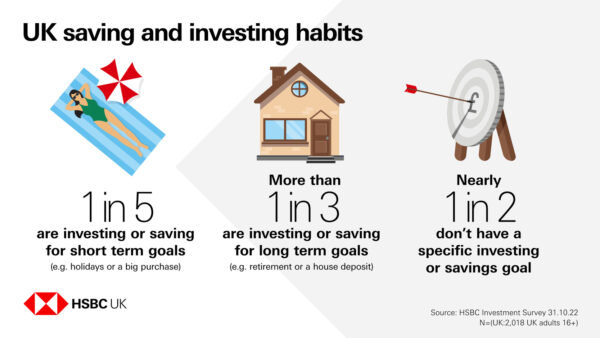
The main reasons people have for saving and investing are summed up in the infographic below…
As you can see, nearly half of people in the HSBC survey (46%) didn’t have a particular goal for their saving or investing – but those who did have a target were much more likely to be saving for something long-term (37%) like a house deposit or their retirement than short-term goals like holidays or other large purchases (20%).
In general, of course, saving for short-term goals is best done through cash savings accounts – but for long-term goals, typically five years or more ahead, investing is likely to produce better overall returns.
Investment Choices
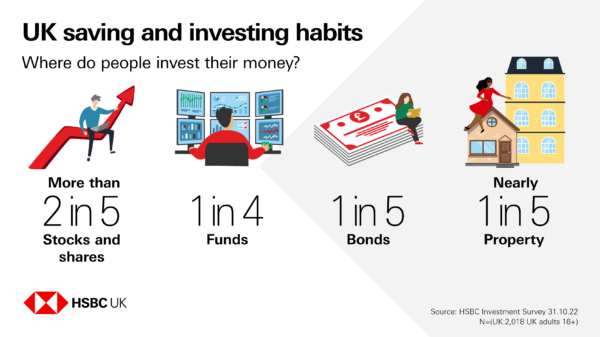
The infographic below shows the main ways people in the UK are currently investing.
As you can see, the most popular investment is stocks and shares (44%), followed by funds (25%), bonds (20%) and property (19%).
When people were asked how they’d decided to invest, the most common reason given for choosing stocks and shares was the expectation of good returns (34%). Bonds were most often seen as a “safe” investment (38%).
Meanwhile, the reason for choosing funds was more equally balanced between being seen as offering good returns (34%) and being “safe” (30%), with the same being true of property (39% good return, 35% “safe”).
Barriers to Investing
When people were asked why they hadn’t chosen to invest, the most common answer (45%) was thinking they didn’t have enough money to do so. But nearly a quarter (23%) said they didn’t know enough about how to invest, ahead of the one in five (21%) who said they would worry about losing all their money.
For those who said they were scared of losing money, the main driver of those worries was the fact that investments can go down as well as up (40%). But that was followed by concerns about the need for access to their cash – with 37% saying they might need their money at short notice, and another 30% stating that their financial situation meant they couldn’t lock away money for a long time.
Those who chose to invest in jewellery and alternatives (wine, art, whisky, etc) were the most likely to say they had done so because they had expertise in that area (25%).
Investment Knowledge
When it comes to detailed financial knowledge, more than one in three (34%) said they didn’t feel they had enough information about investing. And those who wanted more help with their financial planning were most likely to need information about where to invest (25%), followed by support on types of investments (22%), the cost of investing (20%), and which investments are more or less risky (20%).
People who said they already received some information on investing were most likely to get that from their family (17%), their bank (16%), friends (15%) and social media (15%) – all ahead of financial newspapers (13%) and financial blogs (11%).
Nearly a quarter (24%) said they’d like to receive more information about investing from their bank as the primary source of information, ahead of getting help from investors (16%), social media (13%), family (11%) and financial blogs (11%) or financial newspapers (11%).
My Thoughts
Many thanks to my friends from HSBC for allowing me to share and discuss their data and graphics.
I’m not surprised that many people are wary of investing, as the subject isn’t generally taught in schools and the huge number and variety of potential investments can be bewildering.
What I find a little more surprising (and concerning) is that many more people have investments in the form of stocks and shares (46%) rather than funds (25%). I suspect this may partly be to do with people having a few shares they acquired from the big privatizations of the past such as BT and British Gas. There may also be a number who have shares through employee share schemes. Nonetheless – as I said in this recent guest post for the popular Money Talk blog – as an investment individual shares are a lot more volatile and risky. If you are new to investing, I highly recommend starting off with a collective investment such as a tracker fund or robo-adviser platform (see below). This will give you much broader diversification, which helps mitigate the risks involved.
As I’ve said before, if you suddenly find yourself in possession of a large lump sum (perhaps through an inheritance) there is a strong case for seeking advice from a trained and experienced independent financial adviser. You might like to check out my blog post on why, despite being a money blogger and considering myself reasonably financially savvy, I still have an IFA myself.
If you just want to get started in investing, there are various low-cost and relatively low-risk options you could consider. Regular readers will know that I am a fan of the robo-adviser platform Nutmeg, with whom I have been investing since 2016. Even with the recent turmoil in the markets caused by the pandemic etc., I have made an overall return of 37 percent from my investments with them. You can read my in-depth review of Nutmeg here if you wish.
Another possibility might be the wealth-building platform Wealthyhood, which is aimed especially at novice investors. You can get started on this with as little as £20 – and right now they are offering a free ETF share worth up to £200 to new investors, which should get you off to a good start! You can see my blog post about Wealthyhood and their special offer here.
Of course, all investing carries a risk of loss, in the short- to medium-term especially. You should therefore always do your own ‘due diligence’ before investing and seek professional advice if in any doubt how best to proceed.
As always, if you have any comments or questions about this post, please do leave them below.
Disclaimer: I am not a professional financial adviser and nothing in this post should be construed as personal financial advice.
If you enjoyed this post, please link to it on your own blog or social media: