
reviews

Investments Update Feb 2022

My Investments Update – February 2022

Here is my latest monthly update about my investments. You can read my January 2022 Investments Update here if you like

I’ll begin as usual with my Nutmeg Stocks and Shares ISA, as I know many of you like to hear what is happening with this.

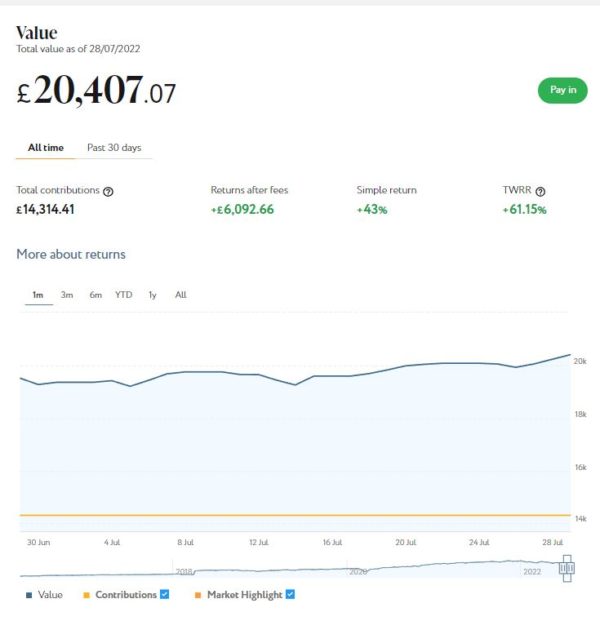
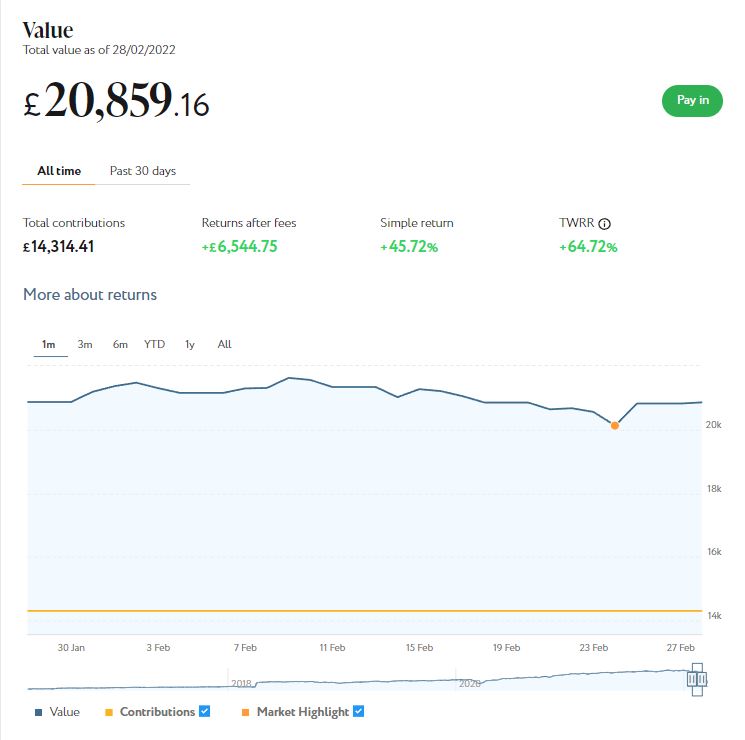
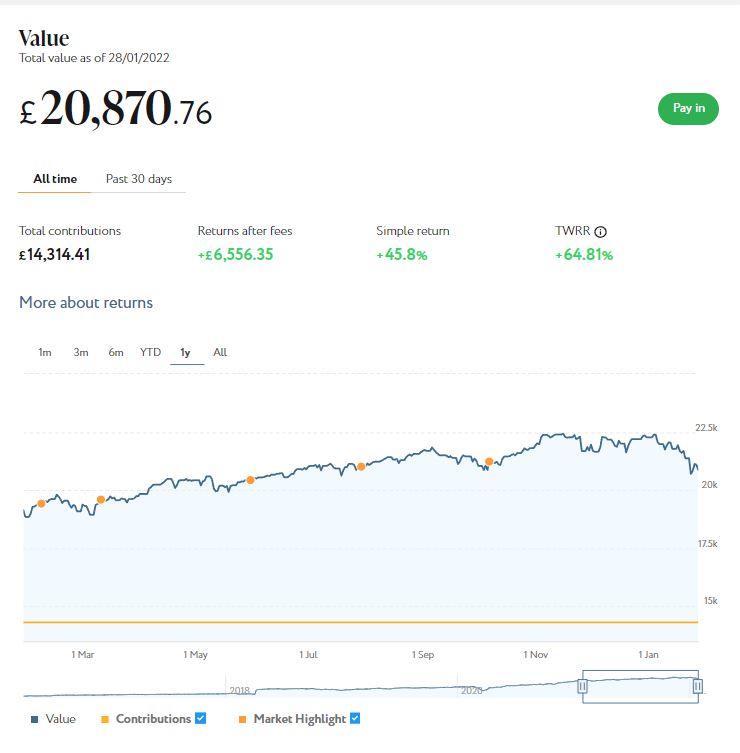
As the screenshot below shows, my main portfolio is currently valued at £20,870. Last month it stood at £22,275, so that is a fall of £1,405.

Nutmeg Main Portfolio Feb 2022

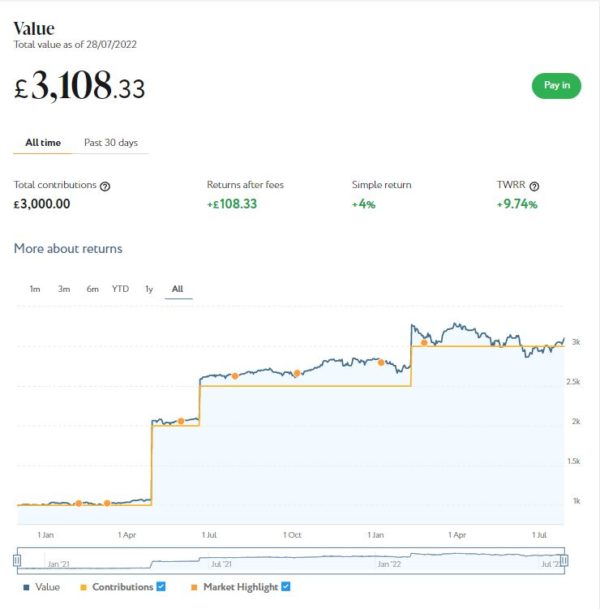
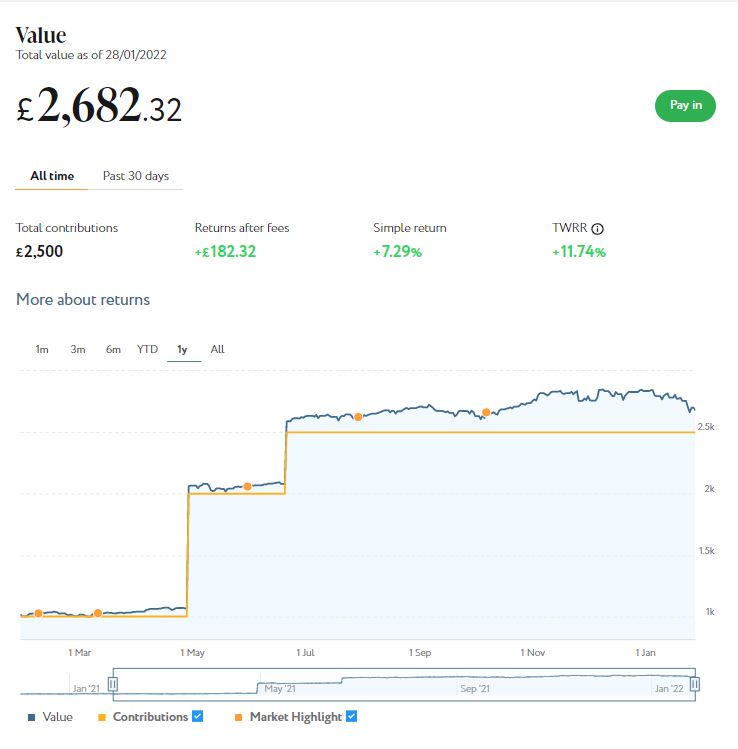
Apart from my main portfolio, I also have a second, smaller pot using Nutmeg’s Smart Alpha option. This is now worth £2,682 compared with £2,837 last month, a net fall of £155. Here is a screen capture showing performance over the last year.

Nutmeg Smart Alpha Feb 2022

There is no denying 2022 has got off to a disappointing start as far as these investments are concerned. Overall, they take the value of my portfolio back to where it was at the end of June 2021.

It is though worth noting that since I started investing with Nutmeg in 2016 I have still enjoyed a total return on my main portfolio of 45.8% (or 64.81% time-weighted). I should also mention that I have selected quite a high risk level for both my Nutmeg accounts (9/10 for the main one and 5/5 for Smart Alpha). This has served me well generally, but I’m sure investors who selected lower risk levels will have seen smaller falls this month.

Of course, it’s not just Nutmeg investors who have had a bad month. Equities generally have taken a tumble in the last few weeks. Commentators have varying opinions about this, but two reasons are typically mentioned: (1) the rising tensions (and threat of war) in Ukraine; and (2) rising inflation rates allied with the removal of monetary stimulus measures as we come out of the pandemic. Obviously nobody knows for sure which way things will go, but this recent post from the Nutmeg blog sets out some grounds for cautious optimism over the year ahead.

Personally I intend to take advantage of the current dip by topping up my Nutmeg investment while asset values are depressed. I plan to add to my Smart Alpha holding, as overall this has been doing slightly better than my main portfolio. I’m also conscious that the end of the 2021/22 tax year will soon be upon us. That means the end of the current year’s ISA allowance, so it really is a case of use it or lose it!

  • The above is just my view, of course, and should not be construed as personal financial advice for anyone else to follow.

You can read my full Nutmeg review here (including a special offer at the end for PAS readers). If you are still looking for a home for your 2021/22 ISA allowance, based on my experience over the last six years, they are certainly worth considering.

If you haven’t yet seen it, check out also my blog post in which I looked at the performance of Nutmeg fully managed portfolios at every risk level from 1 to 10 (as mentioned, my main port is level 9). I was actually pretty amazed by the difference the risk level you choose makes. If you are investing for the long term (and you almost certainly should be) opting for a hyper-cautious low-risk strategy may not be the smartest thing to do.

As regular readers will know, this year I am using Assetz Exchange for my IFISA. This is a P2P property investment platform that focuses on lower-risk properties (e.g. sheltered housing on long leases). I put an initial £100 into this in mid-February 2021 and another £400 in April. Everything went well, so in June 2021 I added another £500, bringing my total investment on the platform up to £1,000.

Since I opened my account, my Assetz Exchange portfolio has generated £37.18 in revenue from rental and £91.19 in capital growth, for a total return of £128.37. That’s an increase of £35.99 on last month alone, and does I guess illustrate the potential value of P2P property investment for diversifying your portfolio when equity markets are volatile.

I won’t bother publishing a statement on this occasion as it’s not massively different from last time. The bottom line is that I (still) have investments in 21 different projects with them and all are performing as expected, generating income and – in every case now – showing a profit on capital. So I am very happy with how this investment has been doing.

  • To control risk with all my property crowdfunding investments nowadays, I invest relatively modest amounts in individual projects. This is a particular attraction of AE as far as i am concerned. You can actually invest from as little as 80p per property if you really want to proceed cautiously.

As mentioned, my investment on Assetz Exchange is in the form of an IFISA so there won’t be any tax to pay on profits, dividends or capital gains. I’ve been impressed by my experiences with Assetz Exchange and the returns generated so far, and intend to continue investing with them. You can read my full review of Assetz Exchange here. You can also sign up for an account on Assetz Exchange directly via this link [affiliate].

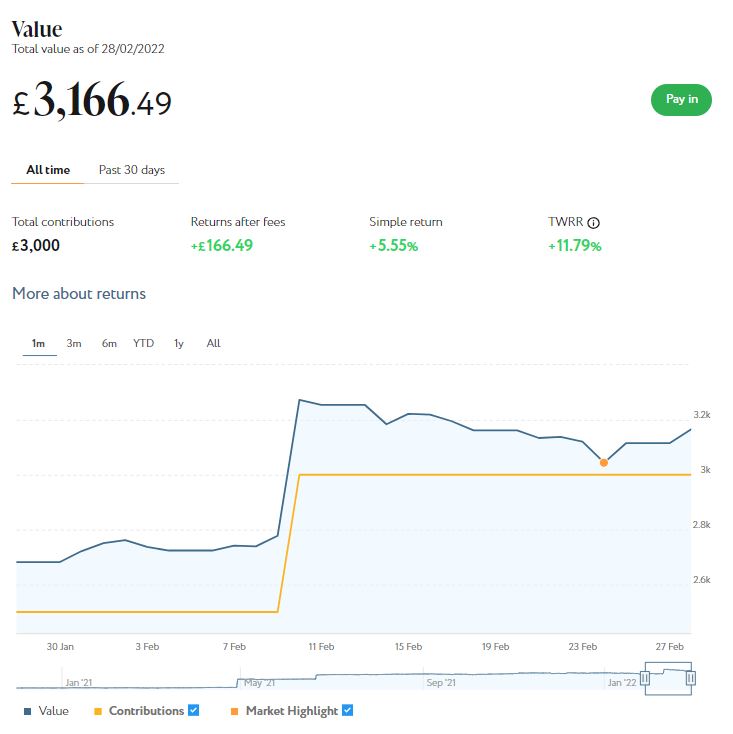
Another property platform I have investments with is Kuflink. They have been doing well recently, with new projects launching almost every day. I currently have just over £2,000 invested with them, quite a large proportion of which comes from reinvested profits. To date I have never lost any money with Kuflink, though some loan terms have been extended once or twice. On the plus side, when this happens additional interest is paid for the period in question.

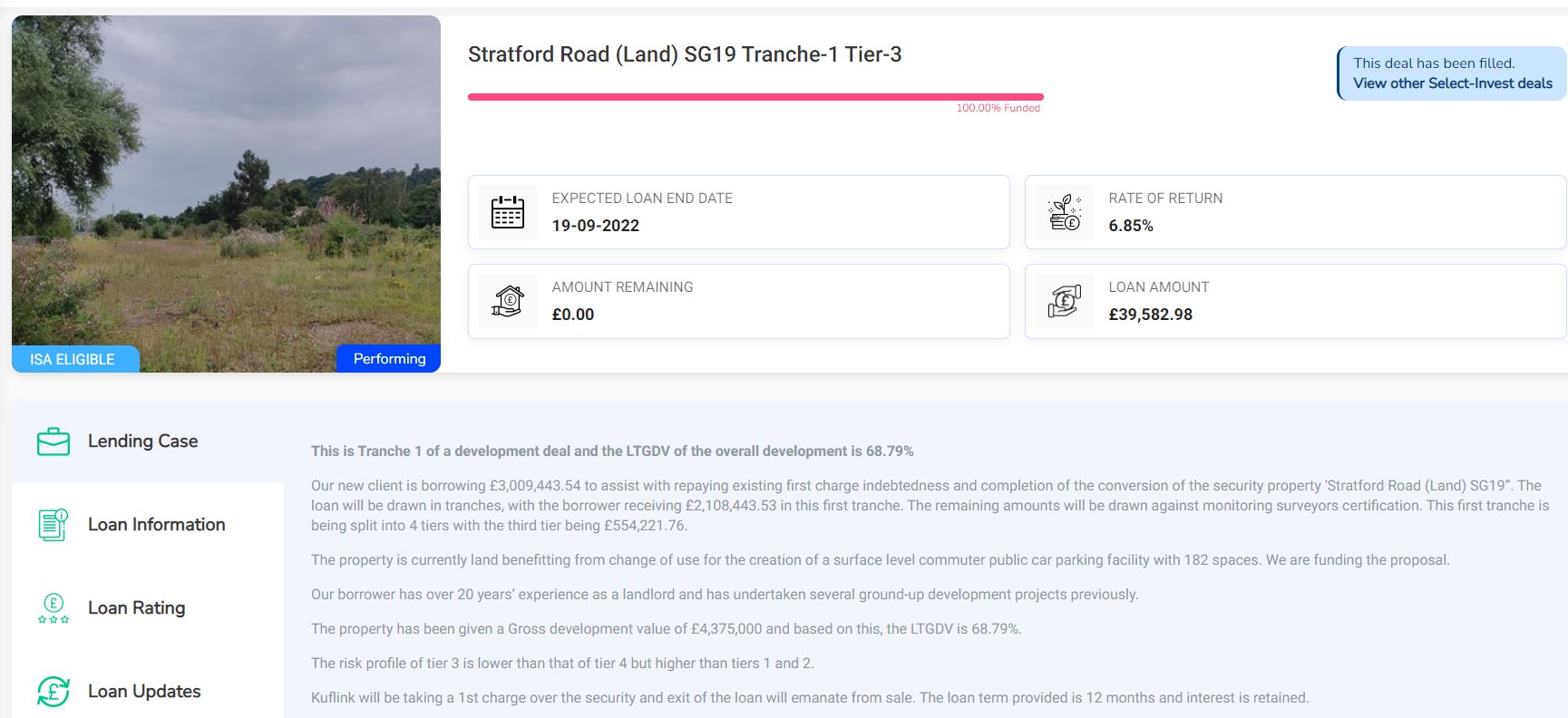
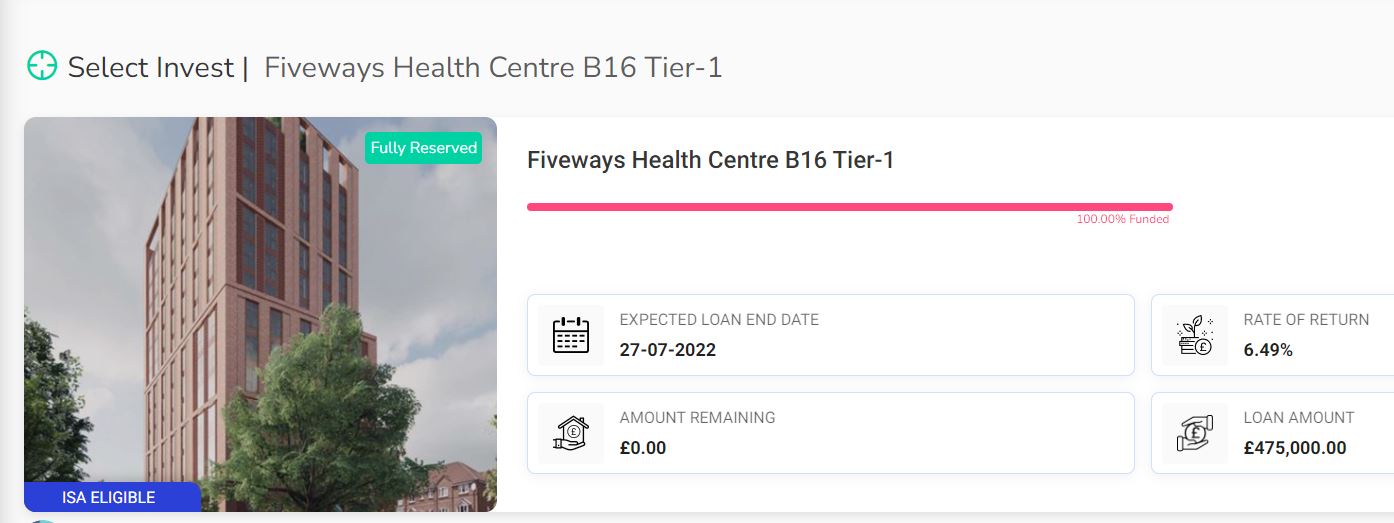
Several of my Kuflink investments reached maturity in the last few weeks and I reinvested the capital released. Here is one of the new projects I invested in, a loan to convert a disused medical centre in Five Ways, Birmingham into residential accommodation. It looked a solid investment, and I also liked the fact that it was redeveloping a derelict building in Birmingham, a city where I lived for around twenty years.

My loans with Kuflink pay annual interest rates of 6 to 7.5 percent. As mentioned above, these days I invest no more than around £150 per loan (and often less). That is not because of any issues with Kuflink but more to do with losses of larger amounts on other P2P property platforms in the past. My days of putting four-figure sums into any single property investment are behind me now!

  • Nowadays I mainly opt to reinvest the monthly repayments I receive from Kuflink, which has the effect of boosting the percentage rate of return on the projects in question

You can read my full Kuflink review here. They offer a variety of investment options, including a tax-free IFISA paying up to 7% interest per year with built-in automatic diversification. Alternatively you can now build your own IFISA, with most loans on the platform (including the one shown above) being IFISA-eligible.

I’d also particularly draw your attention to Kuflink’s revised and more generous cashback offer for new investors [affiliate link]. They are now paying cashback on new investments from as little as £500 (it used to be £1,000). And if you are looking to invest larger amounts, you can earn up to a maximum of £4,000 in cashback. That is one of the best cashback offers I have seen anywhere (though admittedly you will need to invest £100,000 or more to receive that!).

  • I also recently published a blog post about another P2P property investment platform called BLEND. Like Kuflink, they offer the opportunity to invest in secured loans to experienced property developers. They offer (on average) somewhat higher rates of return than Kuflink, though arguably with a little more risk. As well as my blog post about BLEND, you can also check out what they have to offer on their website [affiliate link].

Next up, I wanted to give another plug for an excellent low-key sideline-earning opportunity I have mentioned previously on Pounds and Sense. This opportunity is based on matched betting, a sideline I have pursued for several years myself. Several PAS readers (including my sister Annie!) have signed up for this and are now enjoying a tax-free, hassle-free sideline income from it 🙂

I have been asked not to divulge too many details about this publicly, for good reasons I will explain privately to anyone who may be interested (and no, it’s not illegal!). It doesn’t require any financial outlay and is risk-free and entirely hands-off (once you have set up your account). No knowledge of betting is required and you don’t have to place any bets yourself (this is all done by the company’s clever software). You just have to set up a separate bank account for bets to go through, but running the account is entirely financed by the company.

The company has changed its terms somewhat for new members. You now get a larger £100 initial reward payment once your account is up and running, and then £25 every month you remain a member. I think this is a good move personally, as setting up the account does involve a little work on your part (though it’s certainly not like going down the mines). So the £100 in effect compensates you for your time, and once it’s done you continue to get £25 a month for no effort at all.

The company is constantly developing its offering, partly in response to feedback from PAS readers. They recently launched a new mobile-friendly website to make it even easier for new members to sign up (once you’re up and running you shouldn’t need to use the website at all). They also recently incorporated an Open Banking app so that members don’t have to provide their online banking info to the company, as some people were concerned about this.

Please note that this opportunity is only open to honest, trustworthy people who haven’t done matched betting before and have no more than two accounts already with online bookmakers. For more information (and to receive a no-obligation invitation) drop me a line including your email address via my Contact Me page. And yes, I will receive a reward for introducing you, but this will not affect the service or the rewards you receive.

  • In the interests of full transparency, I should say that if you do matched betting yourself, you may be able to make more money than that being offered by the company. However, you will have to research the techniques in detail, place all bets yourself, and probably subscribe to a matched betting advisory service such as Profit Accumulator [affiliate link]. This opportunity is really for those who want an easy way to make some extra money without the hassle (or expense) of learning/applying matched-betting methods themselves.

Moving on, I have another article on the always-excellent Mouthy Money website. Coincidentally, this is about my experiences with P2P property investment over the last few years, both good and not-so-good. Do check it out! 🙂

I was also quoted by Jackie Annett of the Express newspaper in this article about working after retirement. It’s a short but interesting read, especially if you’re coming up to retirement (or already there) yourself.

That’s more than enough for now, so I’ll sign off till next time. I hope you are keeping safe and well, and (if you live in England especially) are enjoying the more relaxed Covid restrictions that now apply. Here’s hoping that normal life across the whole of the UK will be able to resume very soon!

Disclaimer: I am not a qualified financial adviser and nothing in this blog post should be construed as personal financial advice. Everyone should do their own ‘due diligence’ before investing and seek professional advice if in any doubt how best to proceed. All investing carries a risk of loss.

Note also that this post includes affiliate links (disclosed). If you click through and perform a qualifying transaction, I may receive a commission for introducing you. This will not affect the product or service you receive or the terms you are offered.

If you enjoyed this post, please link to it on your own blog or social media:
Kuflink Review

Kuflink: My Review of this P2P Property Investment Platform

Today I am looking at P2P property investment platform Kuflink.

I have been investing with Kuflink for five years now, so this is a fully updated repost of my original review.

What is Kuflink?

Kuflink is an online platform offering opportunities to invest in loans secured against property. These loans are typically made to developers who require short- to medium-term bridging finance, e.g. to complete a major property renovation project, before refinancing with a commercial mortgage.

Kuflink offer three types of investment, as follows:

  1. Select-Invest (individual loans)
  2. Auto-Invest
  3. Tax-free IFISA (Innovative Finance ISA)

Auto Invest and IFISAs both automatically invest your money across a number of loans and pay a fixed interest rate, typically between 7 and 9%. You can choose a 1-year, 2-year or 3-year term, and interest is paid annually (it is automatically reinvested at the end of each year with the two-year and three-year products). The Auto-Invest product is basically the same as the IFISA, but without the tax-free wrapper.

  • At one time only the Auto-Invest option was available for IFISAs, but nowadays you can choose your own investments if you prefer. The great majority of Self-Select loans on the Kuflink platform are IFISA-eligible. If you check out the Self-Select listings on the Kuflink website (see image below), this will tell you whether any particular loan is IFISA-eligible or not.

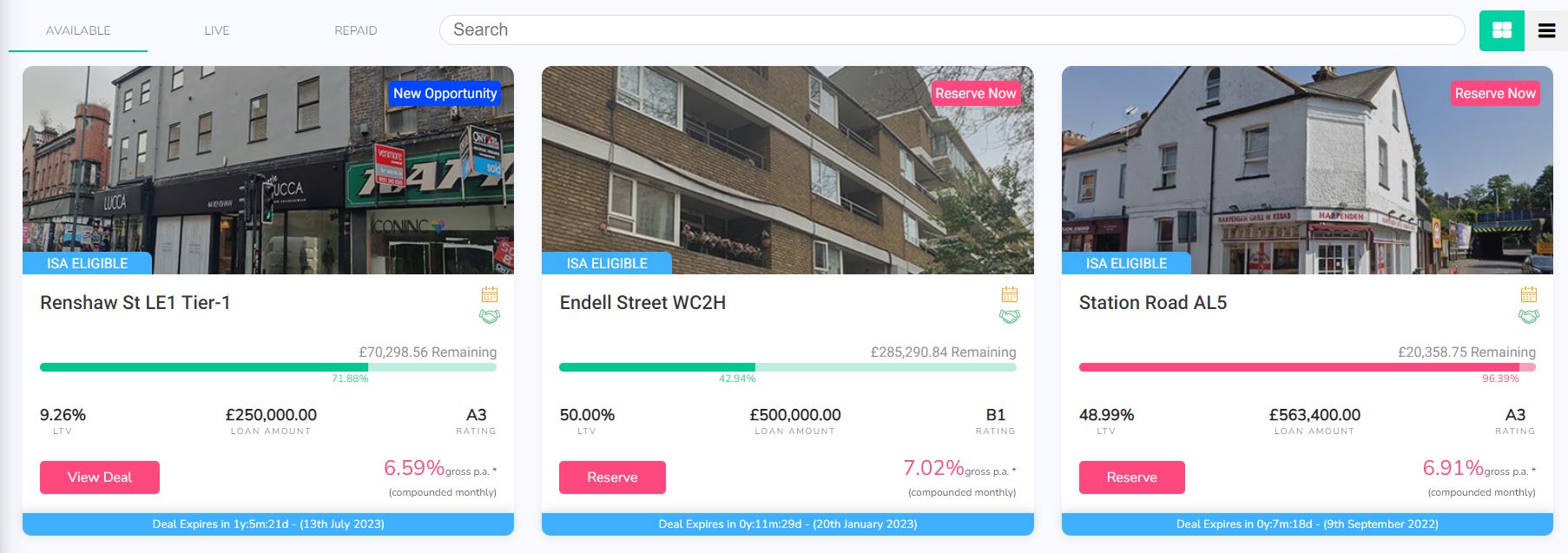
Individual Select-Invest loans pay interest rates varying between about 6 and 7.2%, depending largely on the LTV of the loan (loan to value, a measure of how secure the loan would be in the event of a default). The higher the LTV, the riskier the loan, and – other things being equal – the higher the interest rate paid in consequence. You can see a screen capture below of three Select-Invest loans available on the platform at the time of writing.

Kuflink investments January 2022

As a reasonably experienced P2P investor, I put my money into Select-Invest loans. These typically have a duration of six months to a year and (as mentioned above) pay interest from around 6 to 7.20 percent. That obviously isn’t as much as some P2P property platforms (e.g. BLEND), but I think it represents a fair balance between risk and reward. Kuflink also invest in every loan themselves up to 5% of the value of each loan – so, as the expression goes, they have skin in the game.

My Kuflink Review

I found signing up with Kuflink a quick and easy process. They do the obligatory money-laundering checks, but in my case anyway this was all done electronically behind the scenes. I uploaded a copy of my passport and was approved almost immediately. I started by depositing £500, but you can start with as little as £100 if you like.

Initially I put my money into a 12-month loan paying 7% annual interest. One good feature I didn’t grasp initially is that with Select-Invest loans interest is paid monthly. So once a month I receive interest payments on all the loans I am currently invested in. This is paid into a wallet, from which you can either withdraw to your bank account or reinvest.

  • Kuflink recently introduced an option to have monthly loan repayments automatically reinvested rather than paid into your account as cash. This effectively boosts your interest rate by the power of compounding, as you then receive interest on the reinvested payments as well. Currently this option is available for most, but not all, loans on the platform. You can see which of your loans compounding is available for via your Kuflink dashboard.

I have continued to invest in Kuflink, and have also reinvested in new loans when the original ones were paid off. Another good feature is that money invested in a loan but not yet released to the borrower attracts interest which is paid as cashback once the loan has gone live.

There have been no defaults so far on any of my loans, and Kuflink say on their website that to date nobody has lost a penny on their platform. I have experienced short delays with loans being repaid, but in such cases you continue to earn interest, of course.

Secondary Market

A new feature on Kuflink I like is the Marketplace (secondary market). Here you can buy loan parts from other investors who want to sell up early. You can also put up for sale any (or all) of your own loan parts.

The number of loan parts listed in the Marketplace went up in the early months of the pandemic, as many investors understandably wanted (or needed) to access their cash. This created short-term buying opportunities which I was happy to take advantage of. Loan parts offered via the Marketplace typically have only a few months to run, so you can expect to get your capital back quickly (and can then reinvest it if you wish). Only loans in good standing with monthly repayments up to date may be listed on the  Marketplace, so that offers some reassurance against default – though of course it is by no means a guarantee.

In recent months the number of loan parts listed on the Marketplace has reduced considerably. And those that are tend to be snapped up quickly. As a would-be investor this is slightly disappointing, but it does indicate that people are keen to take advantage of the opportunities on offer. It also means that if you want (or need) to exit a loan early, accessing your money should be a quick and easy process.

Pros and Cons

Based on my experiences, here is my list of pros and cons for the Kuflink investment platform.

Pros

1. Easy sign-up process.

2. Low minimum investment.

3. All loans secured against property.

4. Choice of investments and approaches.

5. Manual and auto-invest options.

6. Kuflink invest in all loans themselves, so they have a strong incentive to ensure they are safe and secure.

7. They also cover the first 5% of losses on any loan before investors are affected (although this has never happened yet).

8. Money invested but not yet released to the borrower attracts interest which is paid as cashback once the loan has gone live.

9. In-depth information is provided on the website about all loans, so you can see exactly how your money will be used (and by whom).

10. There have been (according to Kuflink) no investor losses to date.

11. Customer service (in my experience anyway) is fast, friendly and helpful.

12. There is a 14-day cooling off period for new investors.

13. Marketplace (secondary market) for buying and selling loan parts.

14. No charges to investors lending on the primary market and only a 0.25% fee if you resell a loan part on the secondary market.

15. On most loans you can opt to reinvest monthly repayments to boost your net interest rate.

16. Tax-free IFISA option available.

Cons

1. Rates paid aren’t the highest in P2P lending.

2. Delays with some loans being repaid (although investors do earn extra interest if this happens).

3. No mobile app [UPDATE FEB 2023 – An app is now available.]

Conclusion

Overall, my experiences with Kuflink so far have been entirely positive and my investments have been generating the promised returns. I started cautiously with them, but have gradually built up the amount I have invested on the platform. Although – like all property P2P platforms – they were adversely affected by the pandemic, they appear to have come through it strongly, with new loans now being added almost daily.

As mentioned above, although Kuflink don’t pay the highest rates in P2P lending, I think the returns on offer are realistic and sustainable. The steady expansion of the platform seems to testify to this, as does the fact that they have received several industry awards. These include Best Alternative Business Funding Provider in the Business Moneyfacts Awards in both 2018 and 2019 and Best Service From an Alternative Funding Provider in 2020.

Kuflink are also highly rated on the independent TrustPilot website, with an average 4.6 out of 5 (‘Excellent’). At the time of writing 82% of reviewers award them the maximum five-star rating, which is among the highest figures I have seen for a financial services platform.

As with all P2P lending, your money does not enjoy the same level of protection as bank and building society accounts, which are covered (up to £85,000) by the Financial Services Compensation Scheme. Nonetheless, the rates of return on offer are significantly better than those from most financial institutions. And the fact that all loans are secured against bricks and mortar – and Kuflink themselves have cash invested in them – clearly offers some reassurance.

From my experience, Self-Select loans tend to fill up quickly. On the positive side, this shows investors have confidence in Kuflink and want to invest through the platform. On the minus side, it means there are typically no more than two or three new loans open for investment at any time.

Clearly, no-one should put all their spare cash into Kuflink (or any other P2P investment platform). Nonetheless, it is certainly worth considering as part of a diversified portfolio. Not only are the rates of return much higher than those offered by banks and building societies, they are relatively unaffected by ups and downs in the stock market. P2P loans aren’t a way of hedging your equity-based investments directly, but they do help spread the risk.

If you have any comments or questions about this review or Kuflink in general, as always, please do leave them below.

Disclosure: As stated above, I am an investor with Kuflink myself, and if you invest £500 or more via my link above I will receive a bonus for introducing you. Money is at risk. You should always do your own ‘due diligence’ before investing, and seek advice from a qualified financial adviser if in any doubt how best to proceed.

If you enjoyed this post, please link to it on your own blog or social media:
Cuckoo broadband internet

Cuckoo – A New High Speed Broadband Service for Everyone!

Today I’m spotlighting a new UK high-speed broadband service called Cuckoo.

They are aiming to shake up the world of broadband internet with great-value prices, first-rate customer service, and a social conscience too 🙂

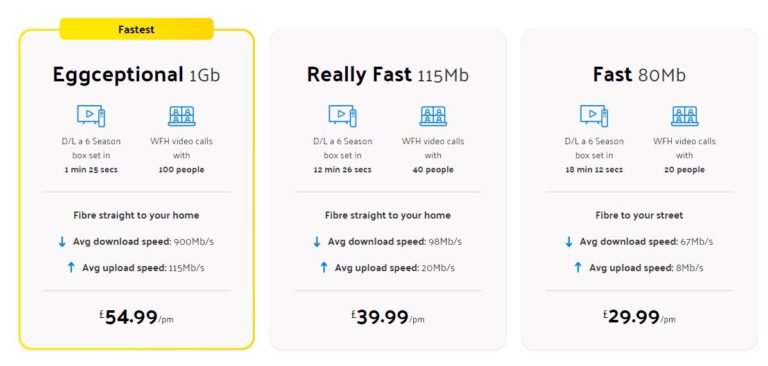
Cuckoo currently have three different customer offers based on speed. Briefly they are as follows:

Eggceptional (1 Gb) – £54.99 a month

Really Fast (115 Mb) – £39.99 a month

Fast (80 Mb) – £29.99 a month

You can see more detailed information from the Cuckoo website in the screen capture below.

Cuckoo Internet Speeds

Signing up is straightforward via the website and takes just a couple of minutes. Your router will then arrive in the post with full instructions for setting it up. If an engineer is needed (usually it isn’t) Cuckoo will arrange a convenient time for them to come. This is summed up in the graphic from the company website below.

Cuckoo SignupAs mentioned, Cuckoo is also a company with a social conscience. They take 1% of each bill and use it to help bring the Internet to places where it’s needed most. That includes conflict zones, natural disaster sites and developing communities. Customers get to choose which project they wish to to support under the Cuckoo Compass scheme.

Finally, Cuckoo aims to deliver top-notch customer service from their team of UK-based customer-support ‘Eggsperts’. Cuckoo have an impressive Trustpilot average rating of 4.6 (‘Excellent’), with 76% of people at the time of writing giving them a full five stars.

For much more information, please check out the Cuckoo website. And of course, if you have any comments or questions about this post, please feel free to leave them below as usual.

Disclosure: This sponsored post includes affiliate links. If you click through and end up making a purchase, I may receive a commission for introducing you. This will not affect the price you pay or the product or service you receive.

If you enjoyed this post, please link to it on your own blog or social media:
The Blend Network P2P Property Investment Platform

Spotlight: The Blend Network P2P Property Investment Platform

Today I am spotlighting BLEND, a peer-to-peer property platform that lends to established businesses (mostly experienced property developers). BLEND’s loan-based crowdfunding platform was founded by a team of former investment bankers with substantial experience in real estate and finance.

What Does BLEND Offer?

BLEND offers individuals the chance to invest in loans secured against property. They specialize in loans in geographical areas that banks and other lending platforms typically pay less attention to, e.g. Northern Ireland, though they fund projects across the whole of the UK. Loans are typically for small developments or building renovation/conversion projects. Some examples are shown in the screen capture below.

BLEND network projects

As mentioned above, all loans are secured against property. The LTV (loan-to-value ratio) is usually quite low, giving greater security for investors. Interest rates on offer range from 7 to 12 percent.

BLEND has some similarities with Kuflink, which I reviewed in this blog post a while ago (and invest in myself). Both offer the opportunity to invest in secured loans. Kuflink typically offers lower interest rates, however, between 5 and 7 percent. The risk level with Kuflink loans is (arguably) lower, but it should be said that BLEND so far has an unblemished record, with no loans in arrears or default.

The minimum investment on BLEND is £1,000, which means it is really aimed at high net worth and professional investors. It’s also worth noting that only a small number of new loans tends to be available at any given time and they typically sell out very quickly.

  • Using the AutoLend feature is recommended to ensure that you don’t miss out when a new loan comes on to the market.

Secondary Market

One drawback with any type of property investment is that it’s not as liquid as (say) equity-based investments. BLEND does offer a way around this with its secondary market, however.

Lenders who wish to liquidate early can sell their loan parts on the secondary market. Note that finding a buyer on the secondary market may take time and there is always a risk of no-one wanting to buy your loan part. You can start selling a loan in multiples of £1,000 on the secondary market as soon as funds have been released to the borrower.

Unlike the primary market, as a lender you will be charged a secondary market fee of 0.60% (or £6 for every £1,000 of capital) on capital outstanding. BLEND only charge this upon the successful resale of the loan portion you have listed in the secondary market. The secondary market is free for buyers.

Pros and Cons

A full list of Pros and Cons for BLEND is shown below.

Pros

1. Easy sign-up process

2. Well designed, user-friendly website

3. All loans secured against property

4. Low LTV ratios for added security

5. Manual and auto-invest options

6. In-depth info provided on the website about loans, so you can see exactly how your money will be used (and by whom)

7. No investor losses to date

8. Marketplace (secondary market) for buying and selling loan parts

9. No charges to investors lending on the primary market and only a 0.6% fee if you resell a loan part on the secondary market

10. Rates of return of up to 12% are at the upper end for P2P lending

11. Can invest via a SIPP or SSAS (private pension scheme)

Cons

1. Minimum investment of £1,000

2. Limited supply of new loans to invest in

3. No tax-free IFISA option

Final Thoughts

With a minimum investment of £1,000 (per project), BLEND obviously won’t be suitable for everyone. But if you have that sort of money available, the promised returns of up to 12 percent are undoubtedly enticing.

I like the fact that BLEND are very selective in the projects they back, even if that does mean the flow of new opportunities is limited. It’s also good that they perform in-depth ‘due diligence’ on every loan and publish full details about this on the website, including independent valuations. This means investors know exactly what the potential risks and rewards of a project are.

The absence of any charges to investors (apart from on the secondary market) is another big plus. And the presence of a secondary market offers the opportunity to exit loans early if your circumstances change (though, as noted above, you aren’t guaranteed to find a buyer).

BLEND is probably at the riskier end of the P2P property spectrum, but in my opinion the returns on offer fairly reflect this. Risks are also mitigated by generally low LTV ratios and the detailed research mentioned above. The fact that no loan has so far gone into default or even into arrears is impressive, though there is of course no guarantee this couldn’t happen in future. It does offer some reassurance though.

Finally, BLEND has an average Trustpilot rating of 4.6 (‘Excellent’), with 95% of people awarding them a maximum five stars rating. This is among the highest ratings I have seen for an investment platform on Trustpilot.

As always, if you have any questions or comments about this post or P2P property investment more generally, please do leave them below.

Disclaimer: I am not a qualified financial adviser and nothing in the article above should be construed as personal financial advice. You should always do your own ‘due diligence’ before investing and seek professional advice if in any doubt how best to proceed. All investing carries a risk of loss.

Please note also that this post includes affiliate links. If you click through and perform a qualifying transaction, I may receive a commission for introducing you. This will not affect in any way the terms you are offered or the product/service you receive.

If you enjoyed this post, please link to it on your own blog or social media:
My Investments Update January 2022

My Investments Update – January 2022

Happy New Year! I hope you had an enjoyable festive season, not marred too much by Covid and/or government restrictions.

As usual, here is my latest monthly update about my investments. You can read my December 2021 Investments Update here if you like

I’ll begin as usual with my Nutmeg Stocks and Shares ISA, as I know many of you like to hear what is happening with this.

As the screenshot below shows, my main portfolio is currently valued at £22,275. Last month it stood at £21,963, so that is a rise of £312. Obviously in these uncertain times I am very happy with that.

Nutmeg January 2022 main portfolio

Apart from my main portfolio, I also have a second, smaller pot using Nutmeg’s Smart Alpha option. This is now worth £2,837 compared with £2,795 last month, a net monthly increase of £42. Again that’s a good result, pro rata slightly better than my main portfolio. Here is a screen capture showing performance over the last year.

Nutmeg January 2022 Smart Alpha

You can read my full Nutmeg review here (including a special offer at the end for PAS readers). If you are still looking for a home for your 2021/22 ISA allowance, based on my experience they are certainly worth considering.

If you haven’t yet seen it, check out also my blog post in which I looked at the performance of Nutmeg fully managed portfolios at every risk level from 1 to 10 (my main port is level 9). I was actually pretty amazed by the difference the risk level you choose makes. If you are investing for the long term (and you almost certainly should be) opting for a hyper-cautious low-risk strategy actually may not be the smartest thing to do.

As regular readers will know, this year I am using Assetz Exchange for my IFISA. This is a P2P property investment platform that focuses on lower-risk properties (e.g. sheltered housing on long leases). I put an initial £100 into this in mid-February 2021 and another £400 in April. Everything went well, so in June 2021 I added another £500, bringing my total investment on the platform up to £1,000.

Since I opened my account, my portfolio has generated £32.40 in revenue from rental and £59.98 in capital growth, for a total return of £92.38. Here is my current statement:

Assetz Exchange Jan 22

To control risk with all my property crowdfunding investments nowadays, I am investing relatively modest amounts in individual projects. I don’t therefore put more than around £150 into any one project. As you can see, I have a well-diversified portfolio with Assetz Exchange comprising 21 different projects. This is a particular attraction of AE in my view. You can actually invest from as little as 80p per property if you really want to proceed cautiously.

As a matter of interest, I have also included a capture of my Assetz Exchange dashboard below. As you will see, this shows an average AER (Annual Equivalent Rate) yield of 5.38%. That is better than I could have got in interest from almost any savings account at the moment and doesn’t include capital growth either. Of course, money in Assetz Exchange is not protected by the Financial Services Compensation Scheme (FSCS), which covers all deposits with registered UK banks and building societies up to £85,000.

Assetz Exchange dashboard

My investment on Assetz Exchange is in the form of an IFISA so there won’t be any tax to pay on profits, dividends or capital gains. I’ve been impressed by my experiences with Assetz Exchange and the returns generated so far, and intend to continue investing with them. You can read my full review of Assetz Exchange here if you like. You can also sign up for an account on Assetz Exchange directly via this link [affiliate].

Another property platform I have investments with is Kuflink. They have been doing well recently, with new projects launching almost every day. I currently have just over £2,000 invested with them, quite a large proportion of which comes from reinvested profits. To date I have never lost any money with Kuflink, though some loan terms have been extended once or twice. On the plus side, when this happens additional interest is paid for the period in question.

My loans with Kuflink pay annual interest rates of 6 to 7.5 percent. As mentioned above, these days I invest no more than around £150 per loan (and often less). That is not because of any issues with Kuflink but more to do with losses of larger amounts on other P2P property platforms (such as this one). My days of putting four-figure sums into any single property investment are behind me now!

  • Nowadays I mainly opt to reinvest the monthly repayments I receive from Kuflink, which has the effect of boosting the percentage rate of return on the projects in question

You can read my full Kuflink review here. They offer a variety of investment options, including a tax-free IFISA paying up to 7% interest per year with built-in automatic diversification. Alternatively you can now build your own IFISA, with most loans on the platform being IFISA-eligible.

I’d also particularly draw your attention to their revised and more generous cashback offer for new investors [affiliate link]. They are now paying cashback on new investments from as little as £500 (it used to be £1,000). And if you are looking to invest larger amounts, you can earn up to a maximum of £4,000 in cashback. That is one of the best cashback offers I have seen anywhere (though admittedly you will need to invest £100,000 or more to receive that!).

  • I have also been investigating another P2P property investment platform called BLEND recently. Like Kuflink, they offer the opportunity to invest in secured loans to experienced property developers. They offer (on average) somewhat higher rates of return than Kuflink, though arguably with a bit more risk. Watch out for my in-depth blog post about them soon. You can also check out what they have to offer on their website [affiliate link].

Moving on, I have another article on the always-excellent Mouthy Money website. This is about how to save money on your water bills. I enjoyed researching this and some of the things I found out were quite eye-opening 🙂

That’s all for now, so please stay safe and warm in these challenging times. And as I said last time, don’t let scare stories in the mainstream media freak you out. It is now increasingly apparent that while the Omicron variant is more transmissible, it also tends to produce less severe illness. I am increasingly optimistic that as 2022 continues the virus will loom less large in our lives. But Covid will be with us forever, so we really do need to learn to live with it and start getting back to normal now.

As ever, if you have any questions or comments about this post, please do leave them below.

Disclaimer: I am not a qualified financial adviser and nothing in this blog post should be construed as personal financial advice. Everyone should do their own ‘due diligence’ before investing and seek professional advice if in any doubt how best to proceed. All investing carries a risk of loss.

Note also that this post includes affiliate links (disclosed). If you click through and perform a qualifying transaction, I may receive a commission for introducing you. This will not affect the product or service you receive or the terms you are offered.

If you enjoyed this post, please link to it on your own blog or social media:
Review: Grandpa's Fortune Fables

Review: Grandpa’s Fortune Fables

Today I am reviewing a children’s book called Grandpa’s Fortune Fables. An ebook copy of this was kindly sent to me by the author, Will Rainey.

Grandpa’s Fortune Fables contains a series of short stories, each following from the last. The central character is a 13-year-old girl called Gail. Over the course of the book she shares a number of lessons she has learned from her Grandpa about money with a boy named Boris (no relation to our PM, I’m sure!).

Boris starts off by bullying Gail, whom he calls a ‘dork’, but she stands up to him and in time they become friends. Gail shares her Grandpa Jack’s money-saving and money-making advice with Boris. He is eager to learn, as his family have always been bad with money.

We learn that Gail’s Grandpa travelled  to a (mythical) far-away island, where he learned how to look after his money and became a very wealthy man. Gail has been following his advice and even at her young age is now quite wealthy herself.

Each chapter is essentially a fable illustrating one particular lesson Gail learned from her Grandpa. So one concerns the dangers of Get Rich Quick schemes, another the importance of saving and reinvesting your money, and so on. There are also chapters on the subject of paying tax (‘The Money BIrds’) and the value of donating some of your money to charity.

At the core of Grandpa’s Fortune Fables are three key principles. I hope Will won’t mind if I reproduce them below:

1. Keep one out of every ten seeds you receive
2. Plant the seeds you keep
3. Let your trees GROW

As you may gather, the fables in the book all derive ultimately from the application of these three principles.

Grandpa’s Fortune Fables is designed to teach children about saving, investing and entrepreneurship in an entertaining but informative way (and parents/grandparents may learn some useful lessons too). The stories are all very much of the here and now – even the pandemic and lockdowns get a brief mention (to illustrate how unforeseen events can impact upon specific investments). It’s all very cleverly written, with some charming cartoon-style illustrations as well (see example below).

In my view Grandpa’s Fortune Fables would make a great Christmas/birthday gift for any child aged around 8 to 12 (it could also work for younger and older children). I like how each chapter ends with questions to provoke further thought and discussion. In addition, by correctly answering the multiple-choice questions in each chapter, a letter is revealed. If the child gets all the letters right, they spell out a message which can win them a prize. This is a great idea and a good incentive for reading every chapter (not that such an incentive would likely be needed).

Grandpa’s Fortune Fables is available in print or e-book versions from Amazon (just click on any of the links in this review), or you can order it from any good bookshop. At the time of writing the price is £9.99 for the print version or £3.99 for the e-book. I note that this title is currently number one on Amazon’s best-seller list for children’s books about money and saving, which doesn’t surprise me at all.

Thanks again to Will Rainey for sending me a review copy of his excellent book. If you have any comments or questions – for me or for Will – please do post them below.

Disclosure: As mentioned above, I received a free ebook version of Grandpa’s Fortune Fables for review purposes. In addition, this review includes Amazon affiliate links. If you click through to Amazon and make a purchase, I will receive a small commission for introducing you. This will not affect the price you pay or the product/service you receive.

If you enjoyed this post, please link to it on your own blog or social media:
My Investments Update December 2021

My Investments Update – December 2021

As regular readers will know, I recently started posting monthly updates about my investments. These partly replace the ‘Coronavirus Crisis Updates’ I was posting from March 2020. You can read my November 2021 Investments Update here if you like

I’ll begin as usual with my Nutmeg Stocks and Shares ISA, as I know many of you like to hear what is happening with this.

As the screenshot below shows, my main portfolio is currently valued at £21,963. Last month it stood at £21,940, so that is a modest rise of £23. Those figures don’t tell the whole story, though. In the early part of November, the value of this portfolio rose as high as £22,398. Unfortunately then news of the new Omicron variant spooked the markets and share prices fell dramatically. In the last few days there has been a modest recovery, resulting in the small month-on-month gain referred to above.

Nutmeg Main Portfolio Dec 2021

Apart from my main portfolio, I also have a second, smaller pot using Nutmeg’s Smart Alpha option. This has followed a similar trajectory, though it has actually done a bit better than my main pot. It is now worth £2,795 compared with £2,756 last month, a net monthly increase of £39. Here is a year-to-date screen capture showing performance to the start of December 2021.

Nutmag Smart Alpha pot Dec 2021

As I always say, you shouldn’t judge the performance of any equity-based investment on a month-by-month basis. But in these strange times I remain very happy with how my Nutmeg investments are doing. Hopefully the initial panic over Omicron may prove to have been excessive (it may help that there is growing evidence that this new variant typically causes only a mild illness). That being the case, I remain optimistic that the modest recovery in the markets over the last few days will continue.

You can read my full Nutmeg review here (including a special offer at the end for PAS readers). If you are still looking for a home for your 2021/22 ISA allowance, based on my experience they are certainly worth considering. If you haven’t yet seen it, check out also my blog post in which I looked at the performance of Nutmeg fully managed portfolios at every risk level from 1 to 10 (my main port is level 9). I was actually pretty amazed by the difference the risk level you choose makes. If you are investing for the long term (and you almost certainly should) in my view opting for a hyper-cautious low-risk strategy may not be the smartest thing to do.

As regular readers will know, this year I am using Assetz Exchange for my IFISA. This is a P2P property investment platform that focuses on lower-risk properties (e.g. sheltered housing on long leases). I have invested a total of around £1,000 in AE so far (I began with £100 in February 2021 and topped up twice).

Since I opened my account, my portfolio has generated £29.50 in revenue from rental and £45.86 in capital growth, for a total return of £75.36. I won’t bother publishing a statement on this occasion as it’s not massively different from last time. The bottom line is that I (still) have investments in 21 different projects with them and all are performing as expected, generating income and in most cases showing a profit on capital. So I am very happy with how this investment has been going.

  • To control risk with all my property crowdfunding investments nowadays, I invest relatively modest amounts in individual projects. This is a particular attraction of AE as far as i am concerned. You can actually invest from as little as 80p per property if you really want to proceed cautiously.

As mentioned, my investment on Assetz Exchange is in the form of an IFISA so there won’t be any tax to pay on profits, dividends or capital gains. I’ve been impressed by my experiences with Assetz Exchange and the returns generated so far, and intend to continue investing with them. You can read my full review of Assetz Exchange here if you like. You can also sign up for an account on Assetz Exchange directly via this link [affiliate].

Another property platform I have some investments with is Kuflink [referral link]. They appear to be doing well, with new projects launching almost every day. I currently have just over £2,000 invested with them, quite a large proportion of which comes from reinvested profits. To date I have never lost any money with Kuflink, though some loan terms have been extended once or twice. On the plus side, where this happens additional interest is paid for the period in question.

My loans with Kuflink pay annual interest rates of 6 to 7.5 percent. As mentioned above, these days I invest no more than around £100 per loan (and often less). That is not because of any issues with Kuflink but more to do with losses of larger amounts on other P2P property platforms (such as this one). My days of putting four-figure sums into any single property investment are behind me now!

Nowadays I mainly opt to reinvest the monthly repayments I receive from Kuflink, which has the effect of boosting the percentage rate of return on the projects in question

You can read my full Kuflink review here. They offer a variety of investment options, including a tax-free IFISA paying up to 7% interest per year with built-in automatic diversification. Alternatively you can now build your own IFISA, with most loans on the platform being IFISA-eligible.

I’d also particularly draw your attention to their revised and more generous cashback offer for new investors. They are now paying cashback on new investments from as little as £500 (it used to be £1,000). And if you are looking to invest larger amounts, you can earn up to a maximum of £4,000 in cashback. That is one of the best cashback offers I have seen anywhere (though admittedly you will need to invest £100,000 or more to receive that!).

Kuflink has some similarities with Assetz Exchange (see above). However, it’s important to note that with Kuflink you are investing in loans secured by property, whereas with Assetz Exchange your money is going into actual bricks and mortar. Kuflink loans typically pay around 7% annual interest. With Assetz Exchange projected yields from rental are generally a bit lower at around 5%, but you do of course have the potential for capital appreciation as well. There is also an argument that investments on AE are more secure as properties are typically rented out to organizations such as housing associations which are publicly funded. But I should emphasize that over the years I have been investing with Kuflink I have never lost any money with them and I understand nobody else has either. That is of course no guarantee it couldn’t happen in the future, but personally I find it quite reassuring.

I haven’t mentioned my trial investment on European loan crowdfunding platform Nibble for a while, so thought I should remedy that this month. This has been proceeding without any issues. My initial test investment of 20 euros matured in September so I reinvested the entire sum at the same annual interest rate of 9.7 percent (see screen capture below).

Nibble Dec 21

I get weekly updates from Nibble confirming how much interest has been added to my account. Money has been a bit tight recently so I haven’t topped up my initial investment. Once I start getting my state pension (see below), however, I should have more available to invest, and Nibble is definitely on my list. My full review of Nibble can be found here.

Moving on, I have another article on the always-excellent Mouthy Money website. This is about how to save money on your motoring costs. I enjoyed researching this and learned some new and surprising things while doing so!

I’d also like to remind you that I am participating in not one but two pre-Christmas giveaways. One of these offers the chance to win a Hotel Chocolat Velvetiser kit worth around £150 in total. And the other giveaway has an amazing prize of cash and goods from homeware brand Arca valued at over £1,000 in total. Do check them both out (if you haven’t already) and get your entries in. It would be great if a Pounds and Sense reader were to win one (or both) of these great prizes 🙂

Finally, as I mentioned in this blog post, December 2021 marks a landmark for me, as I shall reach my 66th birthday and qualify for the new state pension. I am due to get my first payment on Christmas Eve. Tempting though it is, I probably won’t be blowing it all on a big party! 🎈🎈🎈

That’s all for now, so please stay safe (and warm) in these challenging times. And please don’t let scare stories in the mainstream media freak you out. At the time of writing hospitalizations and deaths from Covid in the UK have actually been falling steadily for weeks. So despite what the fear-mongers would have you believe, it really isn’t all bad news!

Have a lovely Christmas, enjoy socializing with friends and family, and I’ll be back again with another investments update at the start of 2022.

As always, if you have any comments or questions about this post, please do leave them below.

If you enjoyed this post, please link to it on your own blog or social media:
The UK's Top Subscription Boxes

Guest Feature: The UK’s Top Subscription Boxes!

Today I have a sponsored guest post for you on behalf of Top Subscription Boxes. On their website they advertise a huge range of subscription box services.

With these services, you receive a new and exciting product (or selection of products) every month. You can subscribe for as long or as short as you want (subject to minimum subscriptions). And as you will see, there is something to suit every taste and budget!


Whether you want to send someone special a gift they will really enjoy or just treat yourself (you deserve it!), the subscription box services listed below could provide the perfect solution. We tried all of these ourselves before bringing the very best together in one place.

So without further ado, let’s get started!

Glossybox

Whenever it comes to beauty and make-up subscription boxes. Glossybox always takes the top spot. Glossybox allows you to treat yourself with a perfect combination of deluxe and full-sized beauty product samples from top brands.

Each month they send you a great-value box loaded with the latest make-up products, tools and beauty creams – and it will only cost you £13.25 per month.

In their previous boxes they have featured well-known brands like La Mer, Nars, pedigree French brands such as La Roche Posay, and impressive budget make-up from the likes of Rimmel.

Beer Bods

Beer Bods is known as the UK’s #1 craft beer subscription service. They send you a box of 8 beers every two months. So basically you receive one beer a week, along with the story behind that beer. All subscribers receive the same beer at one time, and you can join in a live online tasting every Thursday at 9 pm. So you can enjoy a new beer with new friends every week and compare notes with them. The bi-monthly subscription will cost you £24.

Arena Flowers

Nothing can be better than seeing fresh flowers in the morning. They make you feel calm and give your day the perfect start.

Arena Flowers is a leading ethical floristry service. They deliver exciting bouquets through their monthly subscription service.

They’ve been sending out their beautiful bouquets for the last 14 years and have achieved the milestone of 10 million deliveries. Every bouquet you receive is hand-tied and arranged by one of their expert florists to create a unique bouquet just for you. You can subscribe by paying just £17 a week.

Gadget Discovery Club

The Gadget Discovery Club allows you to treat yourself or your loved ones by sending them subscription boxes containing 4 innovative gadgets they didn’t know they needed!

They say that every gadget they’ll deliver to your doorstep will help you to upgrade your home, entertainment or lifestyle. The subscription box contains everything from tech wearables to smart home devices, including Samsung/Philips kits and Google home speakers.

You just need to sign up and select your preferences so they can send you the latest exciting gadgets based on your profile. They offer a monthly subscription or you can also choose a yearly plan. The monthly option will cost you £33 per month.

BakedIn Baking Club

The BakedIn Baking Club is a baking subscription service that delivers a different recipe each month straight to your door. Once you’ve subscribed to this service, you will receive a beautiful baking box with a step-by-step recipe guide, along with all the dry ingredients you need and some extras too.

BakedIn allows you to make your favourite muffins, biscuits, cakes and cookies, to share with your family and friends. If you are one of those people who loves baking, then this is the subscription box service for you. The price is £7.50 a month.

Good luck, and we hope you find the perfect subscription box service for you or your loved ones!


Thank you to my friends at Top Subscription Boxes for some eye-opening suggestions. I would definitely like to try some of these services myself! They would also, of course, make excellent Christmas or birthday presents. Please do click through to their website and check out the other subscription box services as well!

As always, if you have any comments or questions, please do post them below.

If you enjoyed this post, please link to it on your own blog or social media:
A Christmas Gift Guide for Older People

A Christmas Gift Guide for Older People

Christmas is barely six weeks away, and it’s a safe bet more of us than ever will be shopping online this year.

Pounds and Sense is aimed at the over-50s, so today I thought I’d set out a selection of products you can buy online suitable for people in this age category. Though in my view most would be very well received by younger people too 🙂

Quite a few of these are things I’ve received for free this year as an Amazon Vine reviewer. Others are simply products that I’ve bought for myself – or friends or relatives – and am very happy to recommend to others.

  • Please note that I am using some affiliate links in this article, so if you click through and make a purchase, I may receive a commission for introducing you. Of course, this will not affect the price you pay or the product you receive.

(1) Music Hat

Music hat

My first thought when I received this unisex beanie hat to review for Amazon Vine was that it was just a novelty product – but it turned out to be a lot better than I anticipated!

The hat itself is made of stretchable acrylic and is warm and comfortable. It’s available in a range of colours to suit all tastes. And in addition to keeping your head warm in the winter, it boasts an LED light at the front and built-in Bluetooth earphones.

The LED light has three brightness settings, with the brightest illuminating the area in front of you quite impressively. I’ve found this useful for putting the bins out at night and (on a lower setting) to ensure I can be seen when walking at night along poorly lit roads and pavements.

The stereo headphones are surprisingly good quality. Obviously you wouldn’t expect super high fidelity, but for listening to music or podcasts on the go, they are more than adequate. Setting up a Bluetooth connection with my Android smartphone was easy, and I’ve been enjoying listening to my choice of music on my daily walks. In theory you can also use the hat for making and receiving phone calls, though I haven’t tried that myself. Even if you only use it for listening to music, though, it’s still a very nice piece of kit. And for around £20 at the time of writing, this unisex beanie hat won’t break the bank either!

I also got this two-light beanie hat (without built-in earphones) for my sister Annie. At this time of year she has to walk home in the dark from her job at a prison, and she goes running in the evening sometimes as well. Annie sent me the following mini-review: ‘That fluorescent hat is actually really good! Very bright front and back light. Great for being seen by others so makes you feel safe at dusk (I don’t run in the dark nowadays so much). Nice snug fit especially round the ears and easy to put the lights on (front and back) even when it’s on your head! Have had lots of positive comments. Definitely recommended!’

Running Hat

(2) Fruit Wines

Clives Wines

I am not much of a drinker these days, but I will always make an exception for these delicious fruit wines, especially at Christmas!

Clive’s Wines is a small, family-run company based barely a mile from where I live. They offer a range of high-quality fruit wines, including damson, cherry, raspberry, strawberry, elderflower, plum and (my personal favourite) gooseberry. For special occasions they also offer a premium sparkling ‘Rhubling’ made with rhubarb.

You can order individual bottles and gift packs online for delivery anywhere in the mainland UK and Europe, with free delivery for orders of over £60 in the UK. If you are looking for an unusual gift that will also support a small local business, I can promise that you (and the lucky recipient) won’t be disappointed 🙂

  • You do, of course, have to be over 18 to order any product containing alcohol.

(3) Hand Warmer and Power Bank

Handwarmer

I have two of these devices now (the first came my way as an Amazon Vine reviewer). As you may gather, they are dual-purpose devices, serving both as a hand-warmer and a power bank for charging your phone or tablet.

The product pictured above is the OCOOPA Rechargeable Handwarmer and Power Bank. This has a powerful 10,000 mAh battery and doesn’t therefore need frequent recharging. You can have three levels of heat (though I find the lowest is more than sufficient for me). It only takes a few hours to charge fully and can charge up my Android phone in under an hour.

Currently I am using this device more as a power bank than as a hand warmer, but that may change if and when sub-zero winter weather conditions arrive. For under £30. it would make a nice, practical gift for any older person (especially if they suffer from cold hands!).

(4) Amazon Echo

Echo Show

Unless you’ve been on Mars for the last few years, I’m sure you’ve heard of these devices. There is a growing family now. The picture above is of an Echo Show, which also has a visual display. I have one of these in my kitchen and use it all the time. I also have an Echo Dot in the bedroom, a standard Echo in the living room, and a tiny Echo Flex in my office. And I’m still thinking of getting more!

I use my Echo devices primarily for listening to music and radio. But I also regularly use them for checking the weather forecast, getting news updates (‘Alexa, read my flash briefing’), asking random questions (‘Alexa, how far is the Earth from the Moon?’), checking the time, setting alarms and timers, finding out what’s on TV, and much more. Alexa has become part of my life now, and I have to admit I actually miss her when I am away. How sad is that? 😀

In my view an Amazon Echo device would make a great gift for any older person, even if they aren’t at all tech-savvy (though they do of course need wifi to work). Once the device has been set up – which is easy enough – you can control it entirely using your voice, just using the ‘wake word’ (Alexa by default, though you can change it if you like) to activate it.

For an older person living alone especially, having an Amazon Echo device can provide companionship as well as reassurance in the event of an emergency (you can ask Alexa to call any of your contacts for you, though currently you can’t get it to phone 999). And an Echo is a present that will go on giving through Christmas and well beyond. Highly recommended.

  • Amazon often have some great offers on Echo/Alexa devices in their Black Friday sale.

(5) Christmas Hampers

Traditional Treats Hamper

This is quite a traditional Christmas gift, but none the worse for that. I have been sending Christmas hampers to various elderly relatives for many years, and they are always well received. The hampers include a selection of luxury food and drink that people on a limited budget wouldn’t typically buy for themselves. I often get quite in-depth feedback about what they liked or disliked about this year’s hamper and whether it was better or worse than last year’s!

There are various suppliers you can order hampers online from (Marks and Spencer have a good selection, for example). But these days I normally order from Amazon. They have a vast range from a variety of merchants, and you can easily search for the type of hamper you want (including by price, with/without alcohol, vegan/vegetarian, and so on).

Amazon also sell hampers aimed specifically at older people, such as the Traditional Treats Hamper (from Clearwater Hampers) pictured above. This costs £49 at the time of writing and includes luxury chocolates, a tin of afternoon tea, hand-baked lemon biscuits, rhubarb and custard sweets, almond biscuit thins, clotted cream fudge, and more. Guaranteed to put a smile on the face of any grandparent 😀

Of course, there are lots of other options as well, for younger folk as well as older ones. Prices range from around £20 to £200 or more if you really want to push the boat out!

(6) Red Letter Days Vouchers

Red Letter Days Afternoon Teas

Red Letter Days sell gift vouchers for a huge range of experience days, for single people or for couples.

Among other things, they include luxury spa days, hotel mini-breaks, afternoon tea (see picture above), driving experiences (e.g. supercar driving, go karting, truck driving), sky diving, hot air ballooning, river cruises, visits to historic houses/gardens, restaurant meals, and many more. Some will obviously appeal more to younger folk, but there are plenty that are equally suitable for all ages (and plenty of older people still enjoy a bit of thrill-seeking as well!).

In the last 18 months many of us have have spent months on end cooped up in our homes. So the chances are your friends or relatives will really appreciate the chance to enjoy an exciting (or relaxing) experience day such as these.

(7) Salter Electronic Scales

Salter Aquatronic ScalesFinally, here’s a great, inexpensive gift for anyone who enjoys cooking.

I was lucky enough to get these Salter Aquatronic digital kitchen scales as an Amazon Vine reviewer, and have been using them regularly ever since.

No bowl is provided with these scales, but because of the way they work you don’t need one. You can place any container you like on the scales and press the button to zero the display (so the scales disregard the container’s weight). You can then add your ingredient and the weight (or liquid volume if you prefer) will be shown. If you want to add more ingredients, you can zero the display again before doing so. Once you get the hang of this, it’s amazingly quick and simple. I use it all the time now, and even weighed a parcel on it recently 😀 I also like the way it hardly takes up any space at all in my kitchen when stored on its side.

So there you are – seven great ideas for Christmas gifts you can buy online that any older person would be delighted to receive (and a lot more exciting than slippers or socks!). As always, if you have any comments or questions about this post, please do leave them below.

Note: this is a fully updated version of an annual post.

If you enjoyed this post, please link to it on your own blog or social media:
Top Ten Personal Finance Podcasts

Top 10 Personal Finance Podcasts (Infographic)

Today I am sharing some information about personal finance podcasts. This is not a subject I previously knew very much about, so I am grateful to my friends at All Finance Tax for supplying the excellent infographic and some of the other info below.

What is a Podcast?

A podcast is like a series of radio programmes on a particular theme or topic, from politics to cycling. You can subscribe for free using a suitable app on your smartphone (or other internet-enabled device). You can then listen whenever and wherever you like, via headphones, earphones, through speakers, in the car, on the train, and so on.

Podcasts are a booming medium and one of the major trends of the last five years. There are now podcast shows on nearly every topic you can think of. And with the rise of both independent and conglomerate podcast production studios, it seems likely this new medium will be in our lives for many years to come.

In the same way people were once passionate about certain radio shows, podcasts have the same dedicated followings, thanks to hosts who become familiar audio friends. Some even run live events. As a medium, podcasts are incredibly accessible, with few barriers beyond an internet connection and a smartphone or other device that can stream audio. No matter where you are or what you’re doing, podcasts offer content that educates, inspires and entertains. If you have never listened to a podcast before, the BBC Sounds podcasts page is one good place to start.

How to Listen to a Podcast

The easiest way to find and listen to podcasts is by using an app on your smartphone.

If you have an iPhone, it will have a built-in app called Apple Podcasts. This works very well and allows you to search for and subscribe to any of a huge range of podcasts. All you have to do then is open the app any time you want to listen and choose the episode you require.

Android owners can use the free Google Podcasts app. You can download this from the Google Play Store if you don’t have it already. It is not as user-friendly as the Apple app and doesn’t have as many features, but will certainly get you started. There are also other free or inexpensive apps you can download from Google Play such as the highly-rated Pocket Casts or Castbox.FM.

Finance Podcasts

One genre with a surprisingly large, dedicated listenership is finance. While to some that might sound a dry, unpromising subject, the podcast medium has enabled content to be reinvented with an unexpected, creative approach.

With hosts ranging from seasoned finance professionals to novice FIRE (financial independence) enthusiasts, podcasts allow people who would never previously have been interested in finance – or perhaps even have been intimidated by the topic – to access valuable information presented in an engaging, inclusive way.

All Finance Tax rounds up the top finance podcasts in the infographic guide below. Find out about the must-listen shows, including podcasts about:

  • Entrepreneurship
  • Billionaire case studies
  • Female-led finance
  • Personal and couples’ finance
  • Start-ups
  • And more!

With snapshots of real reviews plus the best episodes to start with, this resource will help you find the right show for your personal interests and needs regardless of your outlook on finance. Read on for the full list of finance podcasts to start your listening journey!

10 Top Personal Finance Podcasts Infographic

Many thanks again to my friends at All Finance Tax for their help with this article. I have listed below all the podcasts recommended in the infographic, with links to their homepages (or another website) where you can find out more. You can also listen to the podcasts on the web via these pages, though using an app on your smartphone (as discussed earlier) may be more convenient generally.

Couple Money Podcast

Money for the Rest of Us

So Money with Farnoosh

The Fairer Cents

The Tim Ferriss Show

The Ramsey Show

The Mad Fientist

The Investor’s Podcast

The Creative Rebels (Podchaser page)

Planet Money

One more I would add is the Ask Martin Lewis podcast from BBC Radio Five Live. Martin is, of course, a well-known personal finance guru (and founder of the hugely popular MoneySavingExpert website). Although I can take or leave his TV shows, his podcasts are less gimmicky and include valuable, accessible advice on all aspects of personal finance (not including investing).

As always, if you have any comments or questions about this post, please do leave them below. I’d also love to hear about any personal finance podcasts not mentioned above which you enjoy and recommend!

If you enjoyed this post, please link to it on your own blog or social media: