
Recently my energy supplier, EDF Energy, has been sending me invitations to sign up for what it calls its ‘Sunday Saver’ challenge.
The way this works is that you sign up to shift some of your electricity usage on weekdays away from peak hours (4pm-7pm). When you hit your target (which is set individually for each user by EDF), you earn free electricity the following Sunday.
EDF say, ‘The more you shift, the more you earn – reduce your weekly peak usage by 40% and you could earn up to 16 hours of free electricity per week.’
The challenge is due to take place monthly, starting on the first Monday of each month.
At first glance you might think this is a good offer. But as I have looked into it more, my doubts have grown. Here are my main reservations…
To benefit from this scheme you have to cut your daily energy usage every weekday between 4pm and 7pm. That’s quite a long period (three hours), and coincides with when I would normally be cooking my evening meal. To have any realistic chance of cutting my energy use during this time, I would have to eat either ridiculously early or significantly later than normal. For various reasons, including my health, I prefer to eat between 6 and 7 pm and no later. So that in itself is a big ask and would impact drastically on my normal routine.
Free electricity on Sunday sounds great, but the devil is in the detail. EDF say that you will get ‘up to 16 hours’ of free electricity if you meet their targets, but are very vague about what this means in practice. Specifically, they don’t explain how your energy-saving targets are calculated, how any reduction in usage translates to free hours, or when on Sunday you will be able to use the free electricity awarded.
In addition, they say there are ‘fair usage’ limits to how much free electricity you can have. Again, they are vague about what this means in practice. The obvious way to use your free electricity would be to charge your EV, and I strongly suspect limits would be placed on this. As for me, I don’t have an EV and don’t want one, so my options for benefiting from the free electricity would be limited. I could shift use of appliances like my washing machine to Sunday but doubt if I could save more than a few kw/h this way (obviously the exact number would depend on how many free hours I was allocated, which is anyone’s guess). That means my free electricity would likely benefit me by no more than a pound or two.
Lastly, as a solar panel owner I already get some free electricity anyway. My panels obviously generate less in the winter, but during daylight hours they still produce something. That means any benefit from free electricity on Sundays will be reduced, especially if (as is likely) the free hours are in the day rather than at night.
Overall, then, I am not much enamoured of EDF’s Sunday Saver challenges and won’t be signing up. Ultimately, I am not prepared to make major changes to my day-to-day schedule in pursuit of what will likely be (in my case anyway) minuscule rewards.
Obviously some will see this differently and I wish them well. And it’s good that EDF (and other companies) are exploring ways to help customers reduce their bills. I do just think this particular one – for me anyway – is a non-starter.
I would be interested to hear any comments from people doing this challenge (or similar ones from other energy companies) as to whether they find it worthwhile, and whether the benefits really do justify the changes you are required to make.
I do still recommend EDF Energy based on my personal experiences with them. And as I’ve said before on PAS, I can offer anyone switching to EDF £50 off their bills if they use my refer-a-friend link at https://edfenergy.com/quote/refer-a-friend/sunny-koala-9462 when applying. I will also get £50 off my bill if you do this, which is duly appreciated 🙂
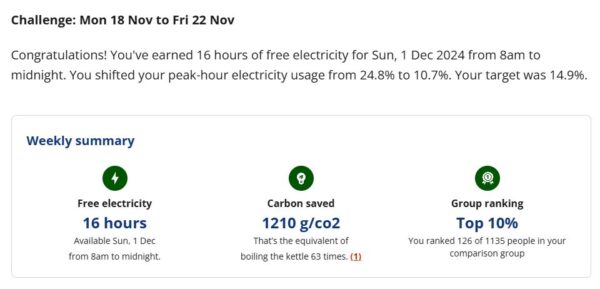
UPDATE 22 OCTOBER 2024 – I am indebted to the readers (especially Harry!) who have taken the time to comment on this article and address some of the points raised in my original post. Based on this I have changed my views somewhat and am considering registering for the scheme when it reopens in November. If you’re still wondering whether to take the plunge, please do take the time to read the comments as (like me) they may influence your decision. I will publish an update in due course if I proceed with it next month.
UPDATE 28 NOVEMBER 2024 – Thanks again to everyone who commented on this post. Sorry I couldn’t reply to everyone individually. You may like to know that I just added a new post about why I changed my mind and registered for the EDF ‘Sunday Saver’ Challenge and how I got on in my first month. Please see https://www.poundsandsense.com/heres-why-i-changed-my-mind-about-edf-energys-sunday-saver-challenge/
If you enjoyed this post, please link to it on your own blog or social media:
I’ll begin as usual with my Nutmeg Stocks and Shares ISA. This is the largest investment I hold other than my Bestinvest SIPP (personal pension).
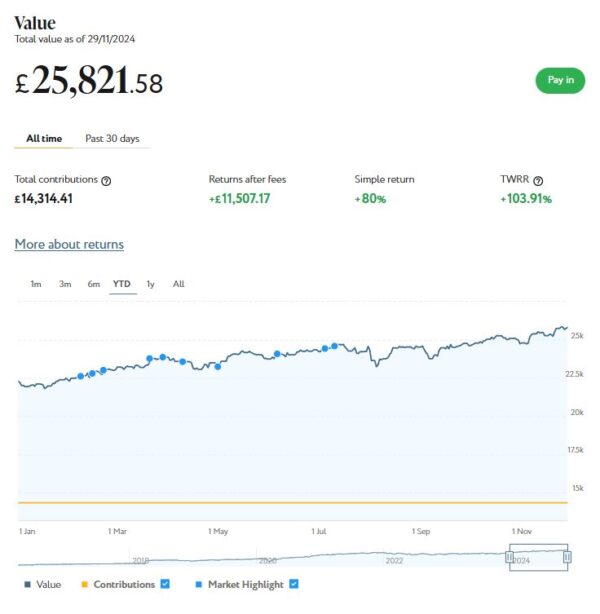
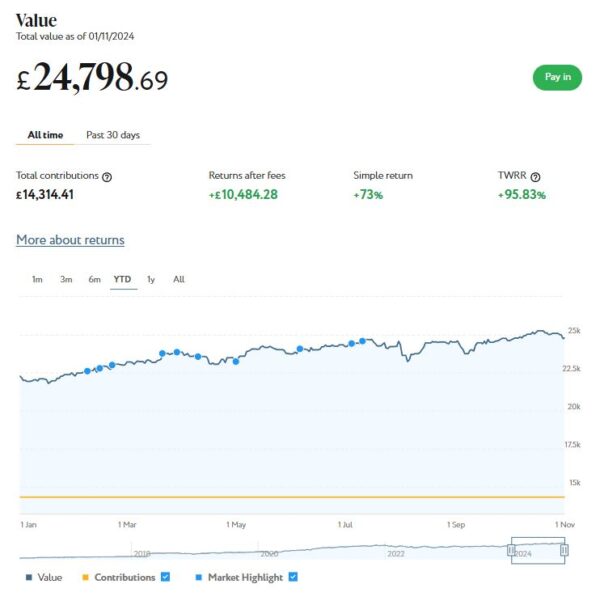
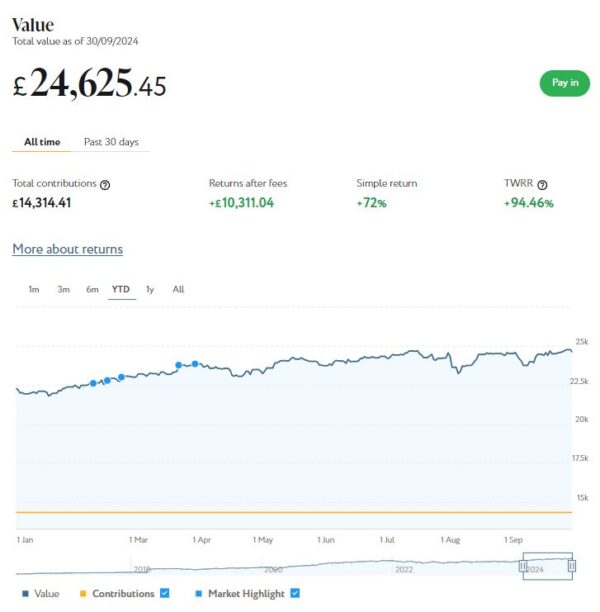
As the screenshot below for the year to date shows, my main Nutmeg portfolio is currently valued at £24,625. Last month it stood at £24,525, so that is an increase of £100.
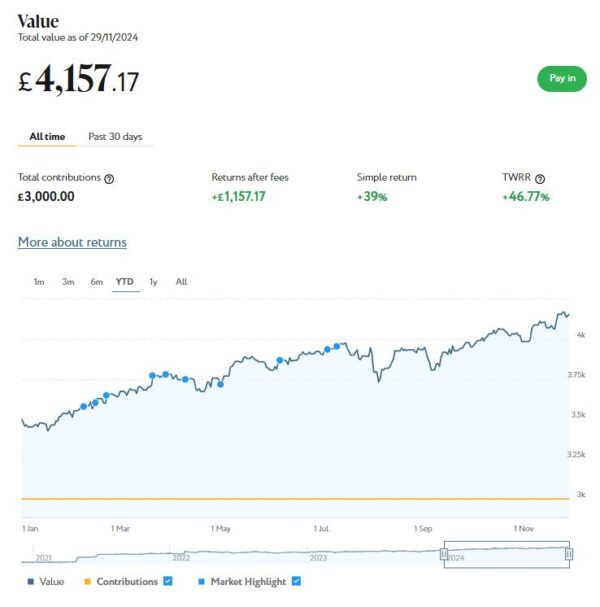
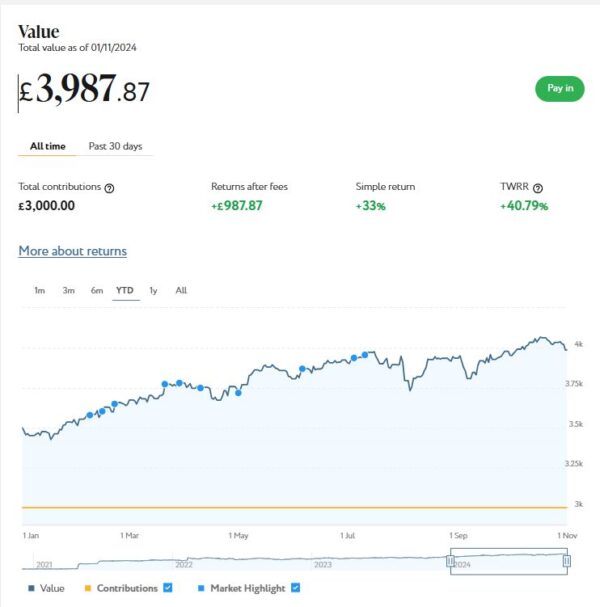
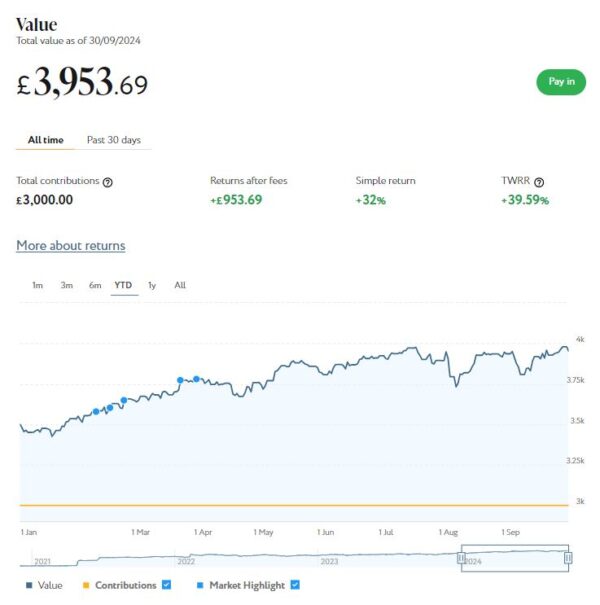
Apart from my main portfolio, I also have a second, smaller pot using Nutmeg’s Smart Alpha option. This is now worth £3,954 (rounded up) compared with £3,937 a month ago, a rise of £17. Here is a screen capture showing performance over the year to date.
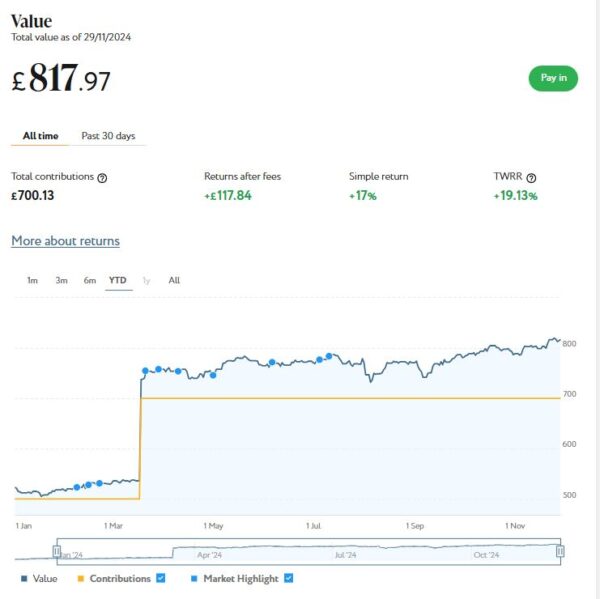
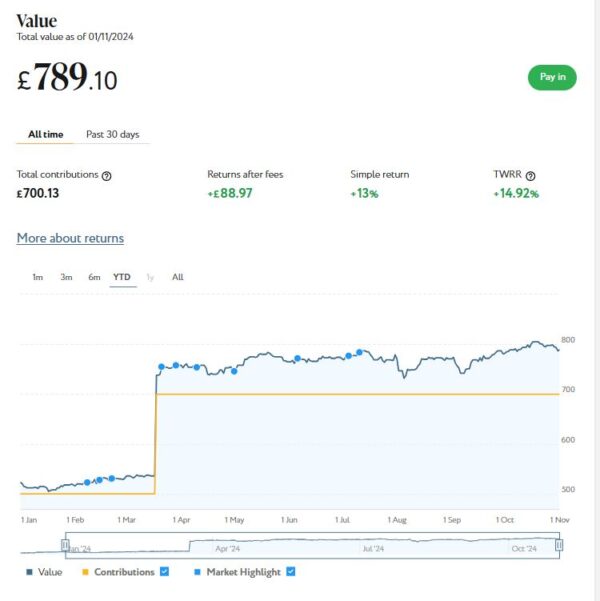
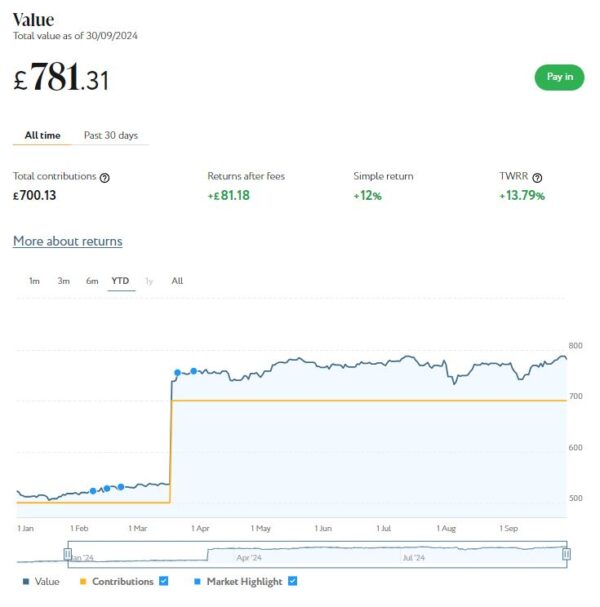
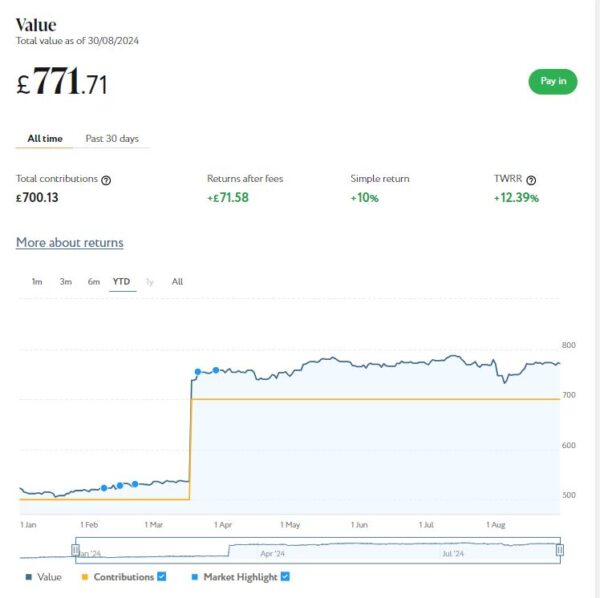
Finally, at the start of December 2023 I invested £500 in one of Nutmeg’s new thematic portfolios (Resource Transformation). In March I also invested a further £200 from ‘Refer a Friend’ bonuses. As you can see from the YTD screen capture below, this portfolio is now worth £781 compared with £772 last month, a small rise of £9.
As you can see, September was another decent though unspectacular month for my Nutmeg investments. Their overall value has risen by £126 or 0.43% since the start of September. They are also up by £3,045 or 11.57% since the start of the year.
You can read my full Nutmeg review here. If you are looking for a home for your annual ISA allowance, based on my overall experience over the last eight years, they are certainly worth considering. They offer self-invested personal pensions (SIPPs), Lifetime ISAs and Junior ISAs as well.
Note that I am no longer an affiliate for Nutmeg. That means you won’t find any affiliate links in my review (or anywhere else on PAS). And you will no longer see the no-fees-for-six-months offer I used to promote as an affiliate. However, the better news is that you can still get six months free of any management fees by registering with Nutmeg via my Refer a Friend link. I will receive a gift voucher if you do this, which is duly appreciated
Don’t forget, also, that the current tax year began on 6 April 2024 and you have a full £20,000 tax-free ISA allowance for 2024/25. In a change to the rules, you can now open any number of ISAs with different providers in the same tax year, as long as you don’t exceed your overall £20,000 allowance. So opening a stocks and shares ISA with Nutmeg won’t prevent you from also opening one with another S&S ISA provider (should you wish to) later in the financial year.
Moving on, I also have investments with the property crowdlending platform Kuflink. They continue to do well, with new projects launching every week. I currently have around £833 invested with them in 7 different projects paying interest rates averaging around 7%. I also have £40 in my Kuflink cash account.
To date I have never lost any money with Kuflink, though some loan terms have been extended once or twice. On the plus side, when this happens additional interest is paid for the period in question.
There is now an initial minimum investment of £1,000 and a minimum investment per project of £500. Kuflink say they are doing this to streamline their operation and minimize costs. I can understand that, though it does mean that the option to test the water with a small first investment has been removed. It also makes it harder for small investors (like myself) to build a well-diversified portfolio on a limited budget.
One possible way around this is to invest using Kuflink’s Auto/IFISA facility. Your money here is automatically invested across a basket of loans over a period from one to five years. Interest rates range from 7% to around 10%, depending on the length of term you choose. Full up-to-date details can be found on the Kuflink website.
You can invest tax-free in a Kuflink Auto IFISA. Or if you have already used your annual ISA allowance elsewhere, you can invest via a taxable Auto account. You can read my full Kuflink review here if you wish.
Moving on, my Assetz Exchange investments continue to generate steady returns. Regular readers will know that this is a P2P property investment platform focusing on lower-risk properties (e.g. sheltered housing). I put an initial £100 into this in mid-February 2021 and another £400 in April. In June 2021 I added another £500, bringing my total investment up to £1,000.
Since I opened my account, my AE portfolio has generated a respectable £208.97 in revenue from rental income. Capital growth has slowed, though, in line with UK property values generally.
At the time of writing, 11 of ‘my’ properties are showing gains, 5 are breaking even, and the remaining 17 are showing losses. My portfolio of 33 properties is currently showing a net decrease in value of £42.75, meaning that overall (rental income minus capital value decrease) I am up by £166.22. That’s still a decent return on my £1,000 and does illustrate the value of P2P property investments for diversifying your portfolio. And it doesn’t hurt that with Assetz Exchange most projects are socially beneficial as well.
The overall fall in capital value of my AE investments is obviously a little disappointing. But it’s important to remember that until/unless I choose to sell the investments in question, it is largely theoretical, based on the latest price at which shares in the property concerned have changed hands. The rental income, on the other hand, is real money (which in my case I’ve reinvested in other AE projects to further diversify my portfolio).
To control risk with all my property crowdfunding investments nowadays, I invest relatively modest amounts in individual projects. This is a particular attraction of AE as far as i am concerned (especially after Kuflink raised their minimum investment per project to £500). You can actually invest from as little as 80p per property if you really want to proceed cautiously.
As I noted in this recent post, Assetz Exchange is particularly good if you want to compound your returns by reinvesting rental income. This effectively boosts the interest rate you are receiving. Personally, once I have accrued a minimum of £10 in rental payments, I reinvest this money in either a new AE project or one I have already invested in (thus increasing my holding). Over time, even if I don’t invest any more capital, this will ensure my investment with AE grows at an accelerating rate and becomes more diversified as well.
My investment on Assetz Exchange is in the form of an IFISA so there won’t be any tax to pay on profits, dividends or capital gains. I’ve been impressed by my experiences with Assetz Exchange and the returns generated so far, and intend to continue investing with them. You can read my full review of Assetz Exchange here. You can also sign up for an account on Assetz Exchange directly via this link [affiliate]. Bear in mind that, as from this financial year (2024/25), you can open more than one IFISA per year.
In 2022 I set up an account with investment and trading platform eToro, using their popular ‘copy trader’ facility. I chose to invest $500 (then about £412) copying an experienced eToro trader called Aukie2008 (real name Mike Moest).
In January 2023 I added to this with another $500 investment in one of their thematic portfolios, Oil Worldwide. I also invested a small amount I had left over in Tesla shares.
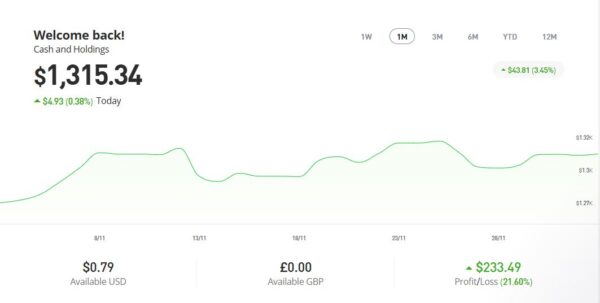
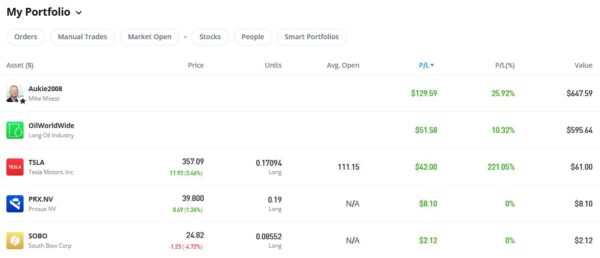
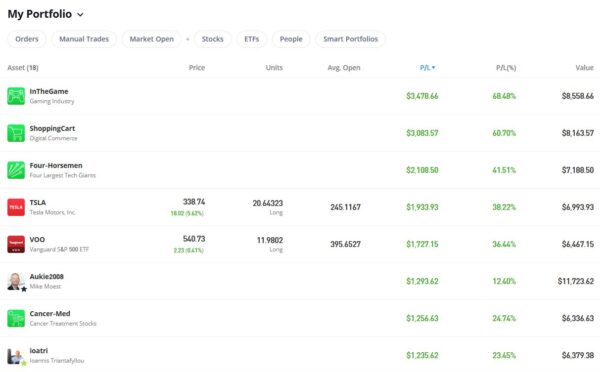
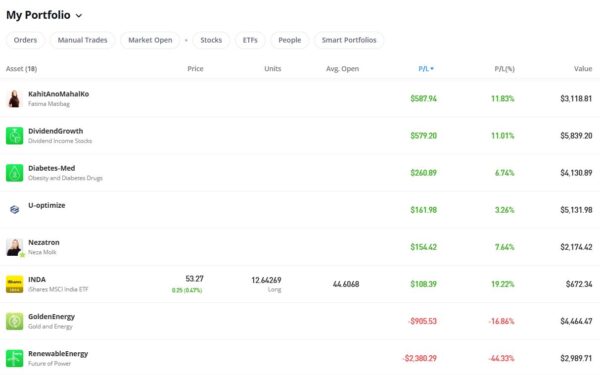
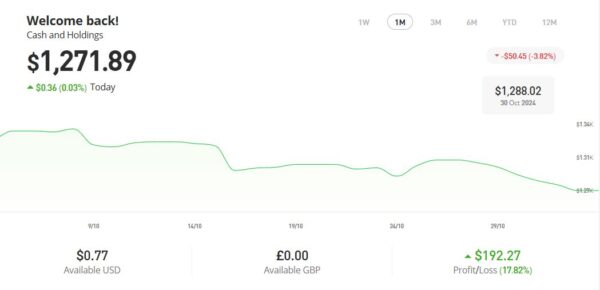
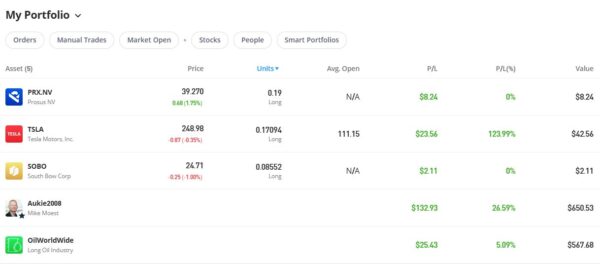
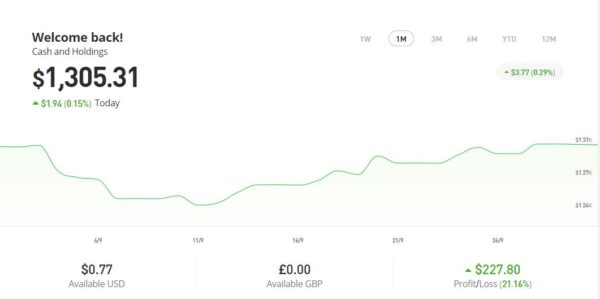
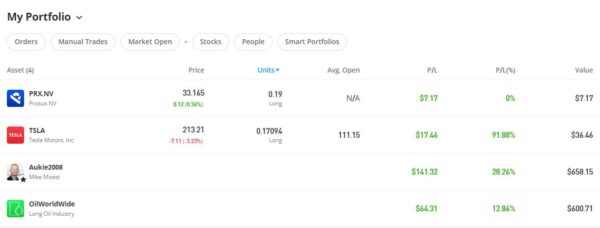
As you can see from the screen captures below, my original investment totalling $1,022.26 is today worth $1,305.31 an overall increase of $283.05 or 27.69%.
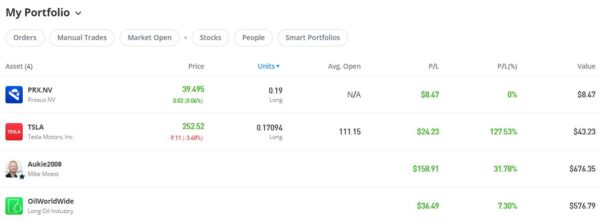
As you can see, my Oil WorldWide investment is showing 7.30% profit. That’s okay but not spectacular. Obviously my copy trading investment with Aukie2008 has been doing much better. The Oil WorldWide port was recently rebalanced by eToro, so I hope this may boost its performance. The investment team at eToro periodically rebalance all smart portfolios to ensure that the mix of investments remains aligned with the portfolio’s goals, and to take advantage of any new opportunities that may present themselves.
As a matter of interest, since I wrote the above war has effectively broken out in the Middle East. This has led to fears that oil supplies from the region will be compromised and the price of oil will rise. As a consequence of this (I assume) the value of my Oil Worldwide investment has gone up. I say this not to gloat over the tragedy that is unfolding in the area, but to highlight the fact that a diversified portfolio can often help to hedge against economic downturns resulting from world events.
You might also notice that I have a small holding in Prosus NV, a Dutch internet group. To be honest I don’t understand how I acquired this, but it may be connected to my copy trading investment with MIke Moest (who is Dutch). In any event, I am happy to have it in my portfolio as well!
eToro also offer the free eToro Money app. This allows you to deposit money to your eToro account without paying any currency conversion fees, saving you up to £5 for every £1,000 you deposit. You can also use the app to withdraw funds from your eToro account instantly to your bank account. I tried this myself and was impressed with how quickly and seamlessly it worked. You can read my blog post about eToro Money here. Note that it can also serve as a cryptocurrency wallet, allowing you to send and receive crypto from any other wallet address in the world.
I had three more articles published in September on the excellent Mouthy Money website. The first is Are Electric Boilers Better Than Heat Pumps?. As you doubtless know, the government are pushing heat pumps hard as a means of achieving their Net Zero goals. They are definitely not a one-size-fits-all solution, though. In this article I highlighted an alternative that may be more suitable for some, electric boilers. These are cheaper, smaller and quieter than heat pumps (though their running costs may be higher). You can read all about the pros and cons of heat pumps versus electric boilers in the article.
Also in September I revealed How to Get Free Stuff Online. In this article, I explained how you can get your hands on a wide range of freebies online, from samples and giveaways to promotional offers and rewards programmes – all without having to spend a single penny!
Finally, in September I discussed How to Save Money With Cashback Sites. If you ever buy anything online, you can almost certainly save by signing up with these sites. In this article I revealed how they work and set out some hints and tops for making the most of them.
As I’ve said before, Mouthy Money is a great resource for anyone interested in money-making and money-saving. From the variety of articles published in September, I particularly enjoyed Secondhand September: Good for Your Purse and the Planet by regular MM contributor Shoestring Jane. Jane writes mainly about money saving and frugal living. You can see all of her articles for Mouthy Money via this web page.
I also published (or republished) several posts on Pounds and Sense in September. Some are no longer relevant due to closing dates having passed, but I have listed the others below.
In Can You Still Make Money From Matched Betting? I discussed this tax-free money-making opportunity. As I said in the article, this is something I did for several years and earned about £3,000 from. I am not doing it nearly as much these days, for reasons explained in the article. But if you’ve never done it before, I do still highly recommend it as a way of making some quick tax-free cash. The article explains what matched betting is and how to get started.
The price of stamps is rising again on Monday 7 October 2024. That is the second price rise this year, after they also went up in April. So in How to Beat the Postage Stamp Price Rise, I revealed just how much (some) prices are rising and suggested ways to mitigate this.
In case you didn’t know, October is Free Wills Month. So in Get Your Will Written Free of Charge in October, I discussed how you can use this no-strings scheme to get your will written free at a range of participating solicitors across the UK. There are only limited slots available, so I recommend moving quickly if you want to take advantage of this opportunity.
Also in September I published How to Save Money on Your Heating Bills This Winter. As you doubtless know, gas and electricity bills have gone up considerably in the last year or two. And many older people will no longer get Winter Fuel Payments, as the new Labour government have opted to restrict this to just the very poorest pensioners (those in receipt of Pension Credit). So in this article I set out a range of ways you may be able to save money on your heating and energy bills. Following these tips could save you hundreds of pounds in the months and years ahead.
Finally, I published Amazon Big Deals Day is Almost Here. This annual event extends over two days, Tuesday 8th and Wednesday 9th October 2024. It is is a special event for Amazon Prime members only. Amazon say they will be offering members their lowest prices of the year on selected products from leading brands including Philips, Logitech, Oral-B, Braun, Tefal, Ghd, Swarovski, Bosch, Shark, and so on.
Next, some odds and ends. First up, Trading 212 recently reopened their free share offer, so I have updated my post Get a Free Share Worth Up to £100 With Trading 212. This explains how, if you haven’t done so already, you can get a free share when you open a new Invest or Stocks ISA with Trading 212. Note that opening a Cash ISA with T212 alone will not qualify you for a free share, but of course you can do both. My advice is to start by opening a Stocks ISA or (non-ISA) Invest account to qualify for your free share and apply (if you wish) for the Cash ISA after that. This new free share offer closes on 6 November 2024.
A few months ago I invested just over £1,000 in a Scottish wind farm project via a platform called Ripple Energy. The way this works is that you pay a fee towards building the wind farm, and in exchange receive lower-cost, ‘green’ electricity once the wind farm is up and running. This will continue for the life of the wind farm (an estimated 20 years). The original closing date for this was the end of May, but the date was extended and the share offer is still open at the time of writing. You can pay by 12 monthly instalments rather than a single lump sum if you like. If you’re interested in learning more, you can visit the Ripple website via my referral link. If you decide to invest, you will get a £25 bonus credited to your account when generation starts (and so will I). Note that you will need to invest a minimum of £1,000 to qualify for the £25 bonus, but you can invest from as little as £25 if you wish.
Speaking of energy, a quick reminder that if you switch to EDF Energy via my refer-a-friend link (below) you can get a FREE £50 credited to your energy account (and so will I). For more info and to sign up, click on https://edfenergy.com/quote/refer-a-friend/sunny-koala-9462
Finally, I wanted to highlight (again) the decision by the new government to abolish Winter Fuel Payments for all pensioners except those on pension credit. Like many others, I feel this is a terrible decision that will badly impact some of the poorest people in society and quite likely lead to increased deaths by hypothermia in the winter ahead (and others to follow).
it is therefore more important than ever that older people who may be eligible for pension credit apply for it. I recently updated my blog post about pension credit in light of the announcement. If you have older relatives, friends or neighbours, please encourage them to apply if they may be eligible. The application process is not as straightforward as it should be, so they may well appreciate some help with it
Even so, be aware that only the very poorest pensioners qualify for pension credit. If you get the full new state pension, even with no other source of income, you likely won’t qualify. I do therefore recommend writing to your MP and asking for this Draconian decision to be reversed. You may also like to sign one of the various petitions that have sprung up, including this one on Change.org and this one from Age UK. The former has over 100,000 signatures now and the latter over half a million.
That’s all for now. If you have any comments or queries about this update, as ever, feel free to leave them below. I am always delighted to hear from PAS readers
Disclaimer: I am not a qualified financial adviser and nothing in this blog post should be construed as personal financial advice. Everyone should do their own ‘due diligence’ before investing and seek professional advice if in any doubt how best to proceed. All investing carries a risk of loss. Note also that posts on PAS may include affiliate links. If you click through and perform a qualifying transaction, I may receive a commission for introducing you. This will not affect the product or service you receive or the terms you are offered, but it does help support me in publishing PAS and paying my bills. Thank you!
If you enjoyed this post, please link to it on your own blog or social media:
I’ll begin as usual with my Nutmeg Stocks and Shares ISA. This is the largest investment I hold other than my Bestinvest SIPP (personal pension).
As the screenshot below for the year to date shows, my main Nutmeg portfolio is currently valued at £24,525 (rounded up). Last month it stood at £24,237, so that is an increase of £288.
Apart from my main portfolio, I also have a second, smaller pot using Nutmeg’s Smart Alpha option. This is now worth £3,937 compared with £3,895 a month ago, a rise of £42. Here is a screen capture showing performance over the year to date.
Finally, at the start of December 2023 I invested £500 in one of Nutmeg’s new thematic portfolios (Resource Transformation). In March I also invested a further £200 from ‘Refer a Friend’ bonuses. As you can see from the YTD screen capture below, this portfolio is now worth £772 compared with £769 last month, a small rise of £3.
As you can see from the charts, August was generally a decent month for my Nutmeg investments, despite a hiccup early in the month. Their overall value has risen by £333 or 1.16% since the start of August. They are also up by £2,919 or 11.08% since the start of the year.
You can read my full Nutmeg review here. If you are looking for a home for your annual ISA allowance, based on my overall experience over the last eight years, they are certainly worth considering. They offer self-invested personal pensions (SIPPs), Lifetime ISAs and Junior ISAs as well.
Note that I am no longer an affiliate for Nutmeg. That means you won’t find any affiliate links in my review (or anywhere else on PAS). And you will no longer see the no-fees-for-six-months offer I used to promote as an affiliate. However, the better news is that you can still get six months free of any management fees by registering with Nutmeg via my Refer a Friend link. I will receive a gift voucher if you do this, which is duly appreciated
Don’t forget, also, that the current tax year began on 6 April 2024 and you have a full £20,000 tax-free ISA allowance for 2024/25. In a change to the rules, you can now open any number of ISAs with different providers in the same tax year, as long as you don’t exceed your overall £20,000 allowance. So opening a stocks and shares ISA with Nutmeg won’t prevent you from also opening one with another S&S ISA provider (should you wish to) later in the financial year.
Moving on, I also have investments with the property crowdlending platform Kuflink. They continue to do well, with new projects launching every week. I currently have around £833 invested with them in 7 different projects paying interest rates averaging around 7%. I also have £40 in my Kuflink cash account.
To date I have never lost any money with Kuflink, though some loan terms have been extended once or twice. On the plus side, when this happens additional interest is paid for the period in question.
There is now an initial minimum investment of £1,000 and a minimum investment per project of £500. Kuflink say they are doing this to streamline their operation and minimize costs. I can understand that, though it does mean that the option to test the water with a small first investment has been removed. It also makes it harder for small investors (like myself) to build a well-diversified portfolio on a limited budget.
One possible way around this is to invest using Kuflink’s Auto/IFISA facility. Your money here is automatically invested across a basket of loans over a period from one to five years. Interest rates range from 7% to around 10%, depending on the length of term you choose. Full up-to-date details can be found on the Kuflink website.
You can invest tax-free in a Kuflink Auto IFISA. Or if you have already used your annual ISA allowance elsewhere, you can invest via a taxable Auto account. You can read my full Kuflink review here if you wish.
Moving on, my Assetz Exchange investments continue to generate steady returns. Regular readers will know that this is a P2P property investment platform focusing on lower-risk properties (e.g. sheltered housing). I put an initial £100 into this in mid-February 2021 and another £400 in April. In June 2021 I added another £500, bringing my total investment up to £1,000.
Since I opened my account, my AE portfolio has generated a respectable £200.41 in revenue from rental income. Capital growth has slowed, though, in line with UK property values generally.
At the time of writing, 10 of ‘my’ properties are showing gains, 6 are breaking even, and the remaining 17 are showing losses. My portfolio of 33 properties is currently showing a net decrease in value of £43.69, meaning that overall (rental income minus capital value decrease) I am up by £156.72. That’s still a decent return on my £1,000 and does illustrate the value of P2P property investments for diversifying your portfolio. And it doesn’t hurt that with Assetz Exchange most projects are socially beneficial as well.
The overall fall in capital value of my AE investments is obviously a little disappointing. But it’s important to remember that until/unless I choose to sell the investments in question, it is largely theoretical, based on the most recent price at which shares in the property concerned have changed hands. The rental income, on the other hand, is real money (which in my case I’ve reinvested in other AE projects to further diversify my portfolio).
To control risk with all my property crowdfunding investments nowadays, I invest relatively modest amounts in individual projects. This is a particular attraction of AE as far as i am concerned (especially after Kuflink raised their minimum investment per project to £500). You can actually invest from as little as 80p per property if you really want to proceed cautiously.
As I noted in this recent post, Assetz Exchange is particularly good if you want to compound your returns by reinvesting rental income. This effectively boosts the interest rate you are receiving. Personally, once I have accrued a minimum of £10 in rental payments, I reinvest this money in either a new AE project or one I have already invested in (thus increasing my holding). Over time, even if I don’t invest any more capital, this will ensure my investment with AE grows at an accelerating rate and becomes more diversified as well.
My investment on Assetz Exchange is in the form of an IFISA so there won’t be any tax to pay on profits, dividends or capital gains. I’ve been impressed by my experiences with Assetz Exchange and the returns generated so far, and intend to continue investing with them. You can read my full review of Assetz Exchange here. You can also sign up for an account on Assetz Exchange directly via this link [affiliate]. Bear in mind that, as from this financial year (2024/25), you can open more than one IFISA per year.
In 2022 I set up an account with investment and trading platform eToro, using their popular ‘copy trader’ facility. I chose to invest $500 (then about £412) copying an experienced eToro trader called Aukie2008 (real name Mike Moest).
In January 2023 I added to this with another $500 investment in one of their thematic portfolios, Oil Worldwide. I also invested a small amount I had left over in Tesla shares.
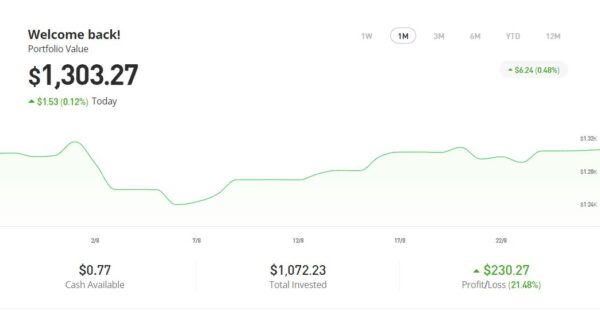
As you can see from the screen captures below, my original investment totalling $1,022.26 is today worth $1,303.27 an overall increase of $281.01 or 27.51%.
As you can see, my Oil WorldWide investment is showing 12.85% profit. That’s okay but not spectacular. Obviously my copy trading investment with Aukie2008 has been doing better. The Oil WorldWide port was recently rebalanced by eToro, so I hope this may boost its performance. The investment team at eToro periodically rebalance all smart portfolios to ensure that the mix of investments remains aligned with the portfolio’s goals, and to take advantage of any new opportunities that may present themselves.
You might also notice that I have a small holding in Prosus NV, a Dutch internet group. To be honest I don’t understand how I acquired this, but it may be connected to my copy trading investment with MIke Moest (who is Dutch). In any event, I am happy to have it in my portfolio as well!
eToro also offer the free eToro Money app. This allows you to deposit money to your eToro account without paying any currency conversion fees, saving you up to £5 for every £1,000 you deposit. You can also use the app to withdraw funds from your eToro account instantly to your bank account. I tried this myself and was impressed with how quickly and seamlessly it worked. You can read my blog post about eToro Money here. Note that it can also serve as a cryptocurrency wallet, allowing you to send and receive crypto from any other wallet address in the world.
I had three more articles published in August on the excellent Mouthy Money website. The first is Win Fame and (Maybe) Fortune as a TV Quiz Show Contestant. This can be an exciting and occasionally lucrative pastime. I revealed how to find opportunities and apply for them. I also explained how the auditioning process works, and offered some tips on how to boost your chances of success.
Also in August I revealed my Ten Top Tips for Working From Home. This is something I’ve done for over 30 years now, so in this article I set out my top ten tips based on my experience. If you have recently started working from home, or expect to do so in future, you may find this article helpful.
Finally, I wrote an article titled How Understanding Cognitive Dissonance Theory Can Help Us Manage Our Finances Better. This article drew on my experiences of studying psychology back in the 1970s. Developed by psychologist Leon Festinger in 1957, cognitive dissonance theory explores the discomfort we experience when we simultaneously hold conflicting beliefs or attitudes. By understanding this, we can gain insights into our financial behaviour, helping us make more informed decisions and achieve better financial results.
As I’ve said before, Mouthy Money is a great resource for anyone interested in money-making and money-saving. From the variety of articles published in August, I particularly enjoyed How to Save Money on Your Home Removal by regular MM contributor Shoestring Jane. Jane writes mainly about money saving and frugal living. You can see all of her articles for Mouthy Money via this web page.
I also published several posts on Pounds and Sense in August. Some are no longer relevant due to closing dates having passed, but I have listed the others below.
In these challenging times, we all need to ensure our savings stretch as far as possible. So in How to Maximize Your Savings Interest l set out a range of tax-free allowances you can use to help do this. They include the Personal Savings Allowance (PSA), Starting Rate for Savings, Individual Savings Accounts (ISAs), and various others.
I also published How to Win Cash and Prizes in Online Competitions. This can be another tax-free way to boost your finances! In this post I revealed how to find online competitions to enter, why you should set up dedicated ‘comping’ accounts, how to identify potential scams, and more. Good luck if you decide to try this 🤞
As we all know Labour achieved a landslide victory in the general election, and it appears that austerity measures are on the way now. So in How to Reduce the Impact of Tax Rises in Rachel Reeves’ First Budget, I set out some recommended steps to try to protect your finances in the months (and years) ahead. The Chancellor’s first budget is scheduled for 30th October 2024, with tax rises and cuts to public services widely anticipated.
Finally, in August I published What Alternatives Are There to Heat Pumps? The government are currently pushing heat pumps hard in their frantic quest to achieve Net Zero. For a range of reasons, however, they are not suitable for every property. And even if your home might theoretically be suitable, there are good reasons you might not want one (discussed a while ago in this Mouthy Money article). So in this post I set out some possible alternatives you might like to consider instead.
Next, a few odds and ends. I recently invested some money (just over £1,000) in a Scottish wind farm project via a platform called Ripple Energy. The way this works is that you pay a one-off fee towards building the wind farm, and in exchange receive lower-cost, ‘green’ electricity once the wind farm is up and running. This will continue for the life of the wind farm (an estimated 20 years). The original closing date for this was the end of May, but the date was extended and the share offer is still open at the time of writing.
If you’re interested in learning more, you can visit the Ripple website via my referral link. If you decide to invest, you will get a £25 bonus credited to your account when generation starts (and so will I). Note that you will need to invest a minimum of £1,000 to qualify for the £25 bonus, but you can invest from as little as £25 if you like.
Speaking of energy, a quick reminder that if you switch to EDF via my refer-a-friend link (below) you can get a FREE £50 credited to your energy account (and so will I). For more info and to sign up, click on https://edfenergy.com/quote/refer-a-friend/sunny-koala-9462
Finally, I wanted to highlight the decision by the new Labour government to abolish Winter Fuel Payments for all pensioners except those on pension credit. Like many others, I feel this is a terrible decision that will badly impact some of the poorest people in society and quite likely lead to increased deaths by hypothermia in the winter ahead (and others to follow).
it is therefore more important than ever that older people who may be eligible for pension credit apply for it. I recently updated my blog post about pension credit in light of the announcement. If you have older relatives, friends or neighbours, please encourage them to apply if they may be eligible. The application process is not as straightforward as it should be, so they may well appreciate some help with it
Even so, be aware that only the very poorest pensioners qualify for pension credit. If you have any source of income apart from the state pension, even a tiny one, the chances are you won’t be eligible. I do therefore recommend writing to your MP and asking for this Draconian decision to be reversed. You may also like to sign one of the various petitions that have sprung up, including this one on Change.org and this one from Age UK. The latter is up to almost half a million signatures now.
That’s all for now. If you have any comments or queries about this update, as ever, feel free to leave them below. I am always delighted to hear from PAS readers
Disclaimer: I am not a qualified financial adviser and nothing in this blog post should be construed as personal financial advice. Everyone should do their own ‘due diligence’ before investing and seek professional advice if in any doubt how best to proceed. All investing carries a risk of loss. Note also that posts on PAS may include affiliate links. If you click through and perform a qualifying transaction, I may receive a commission for introducing you. This will not affect the product or service you receive or the terms you are offered, but it does help support me in publishing PAS and paying my bills. Thank you!
If you enjoyed this post, please link to it on your own blog or social media:
Yes, it’ s time for another exciting giveaway here on Pounds and Sense. This one has a ‘back to school’ theme. In most parts of the UK, of course, this occurs in early September. Scottish schools generally return a bit earlier, around mid-August.
Again I have clubbed together with some of my fellow UK bloggers to provide a plethora of great prizes. And the best news is, it’s entirely free to enter. The giveaway is open now and will close on September 1st 2024.
The prizes have been hand-picked for children and young people returning to school this autumn, so they should be ideal for your children or grandchildren. But if you want to keep any for yourself, we promise we won’t tell!
This event has (again) been organized by Rowena Becker, who blogs at My Balancing Act. No small amount of effort has been involved in arranging and co-ordinating it, so many thanks again to Rowena for her hard work and dedication.
Without further ado, then, I’ll hand you over to Rowena to introduce the giveaway…
Back to School Giveaway
Get ready for an exciting opportunity as some of the top UK bloggers unite to bring you a fantastic back-to-school giveaway! We’ve teamed up to offer one lucky winner a fabulous collection of school essentials that will make heading back to the classroom a breeze.
From stylish lunch bags and durable water bottles, to school shoes and jackets, this giveaway promises to equip you with some great goodies to kick off the school year in style. Join us in this collaborative celebration and enter for your chance to win these amazing prizes. Let’s make this school year the best one yet!
In order to be able to bring you this incredible giveaway, some of the UK’s top bloggers got together. A massive thank you to all involved! The bloggers taking part are:
Start-Rite Shoes is giving one lucky winner the chance to win a pair of school shoes for their child.
The foundation of any school uniform is a quality fitted pair of shoes, but there is nothing uniform about a Start-Rite school shoe! With 12 new styles added to their school shoe collection this season, Start-Rite is more prepared than ever to protect your children’s feet. No one size fits all, as every pair of feet has individual requirements to ensure healthy physical development.
Whether you’re looking to support wide or narrow feet, a high instep, or shoes that double for a special occasion, Start-Rite has a style to suit every child.
EcoSplash Fleece Lined Jacket Navy from Muddy Puddles
Gear up for the ultimate back-to-school season with Muddy Puddles’ in our back-to-school giveaway! Included in the prize bundle is a top-tierkids waterproof jacket that ensures your young adventurers are ready for any weather.
This navy raincoat features an impressive waterproof rating of 10,000mm to keep your child dry during heavy downpours, perfect for rainy days. Crafted from durable, breathable fabric made from recycled plastic bottles, it’s both eco-friendly and long-lasting. The soft fleece lining provides extra warmth, while the jacket’s design makes it easy to layer across various seasons. Fully taped seams offer robust protection against the elements, and reflective details enhance visibility in low-light conditions for added safety. Plus, it’s machine washable at 30 degrees for easy care.
Muddy Puddles has your kids covered for back to school with theirback to school jackets, waterproofs, and more—ensuring every rainy walk to school, puddle-jumping session, and chilly playground adventure is tackled in style and comfort!
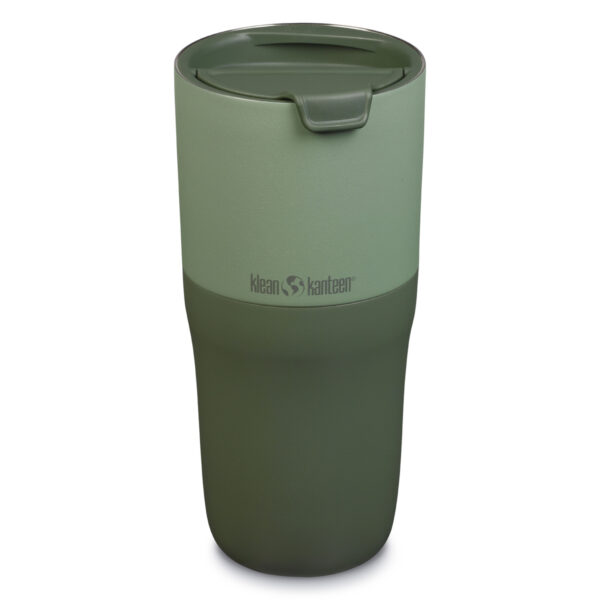
Smash lunch bag and water bottle set
Gear up for the school year with an essential lunch bag and water bottle set! TheSmash Lunch Bag is your kids perfect lunchtime companion, designed with full insulation and an antibacterial lining to ensure their meals are as fresh as possible. Made from premium neoprene, this lunch bag is not only fully washable but also brings a splash of personality and fun to every meal.
Stay hydrated in style with theSmash Twin Wall Soda Bottle. Made from durable stainless steel, this sustainable bottle features a sleek design and a removable cap, making it an ideal everyday accessory. It’s BPA-free, food-safe, non-toxic, and offers a smart, twin-walled construction.
Create-a-Space™ Storage Centre from Learning Resources
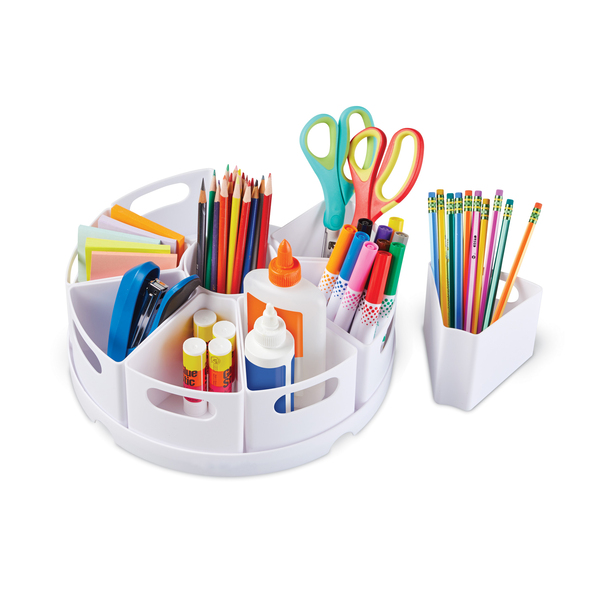
Introducing a stylish addition to any back-to-school setup: the Create-a-Space™ Storage Centre from Learning Resources, which is part of our exclusive giveaway prize bundle! Perfectly blending modern design with practicality, this white 10-piece set will seamlessly fit into any décor theme, whether at home or in the classroom.
The carousel-style design features 8 removable containers, providing the perfect solution for organising essentials like glue sticks, crayons, pens and more. Keep your workstation clutter-free and enjoy a space that is as functional as it is chic with this versatile storage centre.
LittleLife Flip-Top Water Bottle!
Family active outdoors brand, LittleLife, is giving one person their choice of aflip-top water bottle, perfect for the school day.
Made from impact-resistant Tritan copolyester, a watertight lid and holding 550ml, these bottles are durable and fit fuss-free into your child’s school rucksack or backpack. LittleLife’s water bottles also come with a chew-resistant straw to avoid lingering tastes and odours due to being BPA-free.
Brainstorm Toys Children’s 14cm Desktop World Globe
Discover new horizons with the Brainstorm Toys Children’s 14cm Desktop World Globe, a shining star in our back-to-school giveaway prize bundle! This compact yet high-quality globe is a treasure trove of knowledge, showcasing detailed political boundaries, natural wonders like lakes, rivers, and deserts, as well as capitals and major cities.
Perfect for curious minds, this globe is ideal for home or school, making it a must-have for any aspiring explorer. The sturdy base ensures stability, while its easy rotation allows young adventurers to seamlessly explore different areas of the world. Enhance your child’s learning experience and ignite curiosity with this engaging educational tool.
Little Brian Scribble Paint Sticks
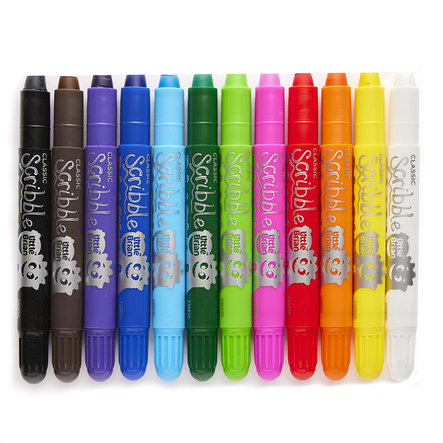
Unleash your creativity withScribble Paint Sticks by Little Brian, a standout addition to our giveaway prize bundle! These innovative paint sticks are perfect for adding intricate details and patterns to your artwork, thanks to their finer tip. Featuring 12 vibrant classic colours, they bring your child’s artistic visions to life with ease. Enjoy a mess-free painting experience where paint twists up and down just like a glue stick and dries in under 60 seconds. Whether you’re working on paper, card, wood, or glass, these versatile paint sticks make it simple to explore your creativity without the clean-up hassle.
How to Enter
You can enter this Back to School Giveaway by completing as many Rafflecopter widget entry options below as you like. All entries will be collated, and one winner will be randomly chosen via Rafflecopter.
The giveaway will run from 4 pm 23rd August 2024 to 8 pm 1st September 2024.
The winner will be notified by email from rowena@mybalancingact.co.uk
The winner will have 7 days to respond, after which time we reserve the right to select an alternative winner.
This prize draw is in no way sponsored, endorsed or administered by, or associated with, Facebook, Instagram, X, YouTube, BlogLovin or Pinterest or any other social media platform.
Prizes open to over 18s only. Age verification may be required to receive some prizes.
Some or all of the prizes may take a few weeks to arrive.
If any prizes are out of stock then we will do our best to find a suitable replacement but cannot guarantee it.
Anyone who unfollows before the giveaway ends or doesn’t complete the required entry action will be disqualified.
The prize is non-transferable, non-refundable and cannot be exchanged for monetary value.
We may be using a parcel service or Royal Mail for some of the prizes and their standard compensation will apply in the event of loss or damage.
Some items may be sent directly by the supplier and we do not have responsibility if these go missing and we cannot replace such items.
In the unlikely event that one of the companies withdraws a prize, we cannot offer an alternative.
The winner’s name will be stated on some or all of our bloggers’ websites and announced on Twitter/X and other social media channels. It will also be displayed on the Rafflecopter entry form. By entering this prize draw, you give your permission for this.
Please note the winner may have the same name as you so if you see your name displayed, be aware that you are not the winner unless you have been notified by us.
There may be some delays in receiving prizes.
Good luck, and I hope a Pounds and Sense reader wins this fabulous prize bundle!
Note: This post (and others on Pounds and Sense) includes affiliate links. If you click through and make a purchase or perform some other specified action, I may receive a commission for introducing you. This will have no effect on the product or service you receive or the price you pay for it, but it does help me pay my bills. Thank you!
If you enjoyed this post, please link to it on your own blog or social media:
Today I’m sharing a post I originally wrote for my friends at Mouthy Money. It’s an important topic so, by agreement with Mouthy Money, I am publishing it here as well.
As you are probably aware, the UK government is currently pushing heat pumps hard in its quest to achieve Net Zero. As I said in my earlier article for Mouthy Money, however, they are definitely not a one-size-fits-all solution for home (or business) heating.
Even the government admits heat pumps are unsuitable for around 4 million UK homes, for a variety of reasons including lack of outside space and planning restrictions. Industry estimates suggest the real number is closer to 8 million [source].
Even if your home is theoretically suitable for a heat pump, there are good reasons why you might not want one. As previously discussed, these include the high initial cost, the potential noise issues, and the fact they work less well in cold weather (just when you need them most!).
For heat pumps to operate effectively, properties must be well insulated, and bigger pipes and radiators are likely to be needed. This can add considerably to the cost, not to mention the disruption caused. In my personal view heat pumps are best suited to new-build homes that can be designed around them.
So today I thought I would set out a range of other home heating solutions you might want to consider. I will also set out some points to take into account before making any decision.
Heat Pump Alternatives
1. Gas boilers
Gas boilers have been a staple in UK homes for decades, and they remain a very popular choice for heating. They provide reliable and instant heat, making them particularly suitable for homes with high hot water demand. While they rely on fossil fuels, modern condensing boilers are more energy-efficient, helping to reduce carbon emissions (and costs) compared to older models.
2. Oil boilers
For properties not connected to the gas grid, oil boilers offer a viable alternative. They work similarly to gas boilers but use heating oil stored in a tank on the property. While oil prices can fluctuate, modern oil boilers are highly efficient and can provide consistent warmth to homes in rural areas or those without access to natural gas.
In future oil boilers may be converted to run on hydrotreated vegetable oil (HVO), which is a renewable and 100% biodegradable alternative [source].
3. Biomass boilers
Biomass boilers use organic materials such as wood pellets, chips or logs to generate heat. They’re a sustainable option, as wood is a renewable resource.
Biomass boilers can be integrated into existing heating systems and may be eligible for government incentives such as Green Deal, making them an attractive choice for environmentally conscious homeowners.
4. LPG (liquefied petroleum gas) boilers
LPG is a clean-burning fossil fuel typically stored in a tank on the property, providing a reliable source of heating and hot water. LPG boilers function similarly to natural gas boilers, offering instant heat and efficient performance. They’re particularly popular in rural areas where mains gas is unavailable, providing homeowners with a convenient and cost-effective alternative for heating their homes.
5. Electric heating systems
Electric heating systems come in many different forms, including electric radiators, storage heaters and underfloor heating. They also include low-emission infrared panels.
While electricity prices can be higher than gas or oil, advances in technology have led to more energy-efficient electric heating options. They are often easier – and therefore cheaper – to install and require less maintenance compared to traditional boiler systems. They can be a good choice for smaller properties and those with limited space.
6. Air conditioning systems
Traditionally associated with cooling, modern air conditioning systems can also provide heating during colder months through a process known as reverse cycle or heat pump technology.
These systems extract heat from the outdoor air and transfer it indoors, offering both heating and cooling capabilities in a single unit. While more common in warmer climates, air conditioning systems are becoming increasingly popular for heating purposes in the UK due to their energy efficiency and versatility.
7. Electric boiler systems
Electric boilers function similarly to gas or oil boilers but use electricity as their primary energy source. They heat water for central heating and domestic hot water supply, offering a clean and convenient heating solution. They can normally be used with the same radiators as gas boilers, unlike heat pumps which (as mentioned above) typically require the installation of bigger radiators and pipes.
Electric boilers are compact, quiet, and emit no emissions on-site, making them suitable for properties where space or ventilation is limited. While electricity costs may be higher than some other options, electric boiler systems can be an efficient and low-maintenance option.
The MInistry of Defence recently decided to opt for electric boilers rather than heat pumps as a more cost-effective solution for barracks and other military installations [source].
8. Hybrid heating systems
Hybrid heating systems combine two or more heating technologies to optimize energy efficiency and performance. For instance, a hybrid system might pair a gas boiler with a heat pump or integrate solar thermal panels with a conventional boiler. These systems offer flexibility and can adapt to changing energy demands, providing homeowners with both reliability and sustainability.
9. Solid fuel stoves
Solid fuel stoves, such as wood-burning or multi-fuel stoves, provide both warmth and ambiance to homes. They’re particularly popular in rural areas where homeowners have access to firewood or other solid fuels. While they require manual operation and regular maintenance, solid fuel stoves can significantly reduce heating costs and add character to any living space.
10. District heating networks
In urban areas, district heating networks supply heat to multiple buildings from a central source, such as a combined heat and power (CHP) plant or biomass facility. This communal approach to heating can be more efficient and cost-effective than individual heating systems, offering residents a sustainable and reliable heat supply without the need for on-site boilers or heat pumps.
Considerations When Choosing an Alternative
When exploring alternatives to heat pumps, various factors need to be considered.
Cost: Evaluate the initial investment, ongoing maintenance costs, and potential savings (or otherwise) on energy bills.
Space and suitability: Consider the available space for installation and the specific requirements of each heating system.
Energy efficiency: Look for heating solutions with high energy efficiency to minimize running costs and environmental impact.
Fuel availability: Assess the availability and accessibility of fuel sources in your area.
Control options: Explore the available control features, such as programmable thermostats or smart technology integration, for convenient operation and efficient energy management.
Lifestyle factors: Some heating methods (e.g. electric) are good if you are out and about a lot but want rapid warmth when you get home. Other methods (including heat pumps) are better suited to those who are around more in the day and like to keep their home at a fairly constant temperature.
Political and economic factors: Bear in mind that the government is keen to achieve its Net Zero targets, and as a result some heating options may become more costly in future and harder (or even impossible) to access. That applies to fossil fuels in particular; although realistically it is hard to see fuels such as gas being banned entirely any time soon.
Finally, I’d like to sound a note of caution about putting all your home heating eggs in one metaphorical basket, especially that of electricity.
As the UK transitions from fossil fuels towards (supposedly) greener electricity, power cuts are likely to become more frequent and longer. The growing use of heat pumps and EVs will add to the demand for electricity from a distribution network that is already struggling to cope. And renewable energy sources such as solar and wind, while they might be more environmentally friendly, produce significantly less electricity when the sun doesn’t shine or the wind doesn’t blow.
If you’re entirely reliant on electricity for your home heating, this could make you vulnerable in the event of outages (especially relevant if there are older people in the house). In my view there is much to be said for having a backup heating source, e.g. solid fuel, to keep your home warm if the mains electricity fails. Of course, this applies with regard to heat pumps as well, as they require electricity to function.
It’s also worth noting that in Scandinavian countries, where heat pumps are more common, most families have an additional source of heating as well as heat pumps to get them through the coldest months.
A home battery system, as discussed in this recent article, can also reduce your vulnerability in case of power cuts, especially when combined with solar panels.
Closing Thoughts
In summary, while the government and energy companies are pushing heat pumps hard, they are far from the only possible home heating solution, either now or in future.
If you’re considering upgrading your heating, take time to evaluate all the options and don’t be unduly swayed by the heat pump hype (and even misinformation). While these devices can work well for new-builds in particular, they are definitely not the only option.
By exploring alternatives such as gas and oil boilers, biomass systems, electric boilers, LPG boilers, solid fuel stoves, and others, you should be able to find a heating solution to suit your budget, your lifestyle, your priorities and your property size and character.
Good luck, and please do stay warm!
As always, if you have any comments or questions about this article, please do post them below.
I’ll begin as usual with my Nutmeg Stocks and Shares ISA. This is the largest investment I hold other than my Bestinvest SIPP (personal pension).
As the screenshot below for the year to date shows, my main Nutmeg portfolio is currently valued at £24,237 (rounded up). Last month it stood at £24,250, so that is a small decrease of £13.
Apart from my main portfolio, I also have a second, smaller pot using Nutmeg’s Smart Alpha option. This is now worth £3,895 compared with £3,911 a month ago, a fall of £16. Here is a screen capture showing performance over the year to date.
Finally, at the start of December 2023 I invested £500 in one of Nutmeg’s new thematic portfolios (Resource Transformation). In March I also invested a further £200 from ‘Refer a Friend’ bonuses. As you can see from the all-time screen capture below, this portfolio is now worth £769 compared with £772 last month, a small decrease of £3.
As you can see from the charts, July was an up-and-down month for my Nutmeg investments. Their overall value has fallen by a modest £32 or 0.11% since the start of July.
Although any fall is disappointing, short-term ups and downs are very much very much to be expected with stock market investments. And it is worth observing that the overall value of my Nutmeg investments is still up by £2,586 or 9.82% since the start of the year.
You can read my full Nutmeg review here. If you are looking for a home for your annual ISA allowance, based on my overall experience over the last eight years, they are certainly worth considering. They offer self-invested personal pensions (SIPPs), Lifetime ISAs and Junior ISAs as well.
You may like to note that I am no longer an affiliate for Nutmeg. That means you won’t find any affiliate links in my review (or anywhere else on PAS). And you will no longer see the no-fees-for-six-months offer I used to promote as an affiliate. However, the better news is that you can still get six months free of any management fees by registering with Nutmeg via my Refer a Friend link. I will receive a gift voucher if you do this, which is duly appreciated
Don’t forget, also, that the new tax year began on 6 April 2024 and and you have a whole new £20,000 tax-free ISA allowance for 2024/25. In a change to the rules, you can now open any number of ISAs with different providers in the same tax year, as long as you don’t exceed your overall £20,000 allowance. So opening a stocks and shares ISA with Nutmeg won’t prevent you from also opening one with another S&S ISA provider (should you so wish) later in the financial year.
Moving on, I also have investments with the property crowdlending platform Kuflink. They continue to do well, with new projects launching every week. I currently have around £833 invested with them in 7 different projects paying interest rates averaging around 7%. Last month I withdrew £500 from completed loans and now have £40 remaining in my Kuflink cash account.
To date I have never lost any money with Kuflink, though some loan terms have been extended once or twice. On the plus side, when this happens additional interest is paid for the period in question.
There is now an initial minimum investment of £1,000 and a minimum investment per project of £500. Kuflink say they are doing this to streamline their operation and minimize costs. I can understand that, though it does mean that the option to test the water with a small first investment has been removed. It also makes it harder for small investors (like myself) to build a well-diversified portfolio on a limited budget.
One possible way around this is to invest using Kuflink’s Auto/IFISA facility. Your money here is automatically invested across a basket of loans over a period from one to five years. Interest rates range from 7% to around 10%, depending on the length of term you choose. Full up-to-date details can be found on the Kuflink website.
You can invest tax-free in a Kuflink Auto IFISA. Or if you have already used your annual ISA allowance elsewhere, you can invest via a taxable Auto account. You can read my full Kuflink review here if you wish.
Moving on, my Assetz Exchange investments continue to generate steady returns. Regular readers will know that this is a P2P property investment platform focusing on lower-risk properties (e.g. sheltered housing). I put an initial £100 into this in mid-February 2021 and another £400 in April. In June 2021 I added another £500, bringing my total investment up to £1,000.
Since I opened my account, my AE portfolio has generated a respectable £195.87 in revenue from rental income. As I said in last month’s update, capital growth has slowed, though, in line with UK property values generally.
At the time of writing, 13 of ‘my’ properties are showing gains, 5 are breaking even, and the remaining 15 are showing losses. My portfolio is currently showing a net decrease in value of £28.74, meaning that overall (rental income minus capital value decrease) I am up by £167.13. That’s still a decent return on my £1,000 and does illustrate the value of P2P property investments for diversifying your portfolio. And it doesn’t hurt that with Assetz Exchange most projects are socially beneficial as well.
The overall fall in capital value of my AE investments is obviously a little disappointing. But it’s important to remember that until/unless I choose to sell the investments in question, it is largely theoretical, based on the most recent price at which shares in the property concerned have changed hands. The rental income, on the other hand, is real money (which in my case I’ve reinvested in other AE projects to further diversify my portfolio).
To control risk with all my property crowdfunding investments nowadays, I invest relatively modest amounts in individual projects. This is a particular attraction of AE as far as i am concerned (especially after Kuflink raised their minimum investment per project to £500). You can actually invest from as little as 80p per property if you really want to proceed cautiously.
As I noted in this recent post, Assetz Exchange is particularly good if you want to compound your returns by reinvesting rental income. This effectively boosts the interest rate you are receiving. Personally, once I have accrued a minimum of £10 in rental payments, I reinvest this money in either a new AE project or one I have already invested in (thus increasing my holding). Over time, even if I don’t invest any more capital, this will ensure my investment with AE grows at an accelerating rate and becomes more diversified as well.
My investment on Assetz Exchange is in the form of an IFISA so there won’t be any tax to pay on profits, dividends or capital gains. I’ve been impressed by my experiences with Assetz Exchange and the returns generated so far, and intend to continue investing with them. You can read my full review of Assetz Exchange here. You can also sign up for an account on Assetz Exchange directly via this link [affiliate]. Note that as from this financial year (2024/25), you can open more than one IFISA per year.
In 2022 I set up an account with investment and trading platform eToro, using their popular ‘copy trader’ facility. I chose to invest $500 (then about £412) copying an experienced eToro trader called Aukie2008 (real name Mike Moest).
In January 2023 I added to this with another $500 investment in one of their thematic portfolios, Oil Worldwide. I also invested a small amount I had left over in Tesla shares.
As you can see from the screen captures below, my original investment totalling $1,022.26 is today worth $1,303.60 an overall increase of $281.34 or 27.52%.
As you can see, my Oil WorldWide investment is showing just over 12% profit. That’s okay but not spectacular. Obviously my copy trading investment with Aukie2008 has been doing better. The Oil WorldWide port was recently rebalanced by eToro, so I hope this may boost its performance. The investment team at eToro periodically rebalance all smart portfolios to ensure that the mix of investments remains aligned with the portfolio’s goals, and to take advantage of any new opportunities that may present themselves.
eToro also offer the free eToro Money app. This allows you to deposit money to your eToro account without paying any currency conversion fees, saving you up to £5 for every £1,000 you deposit. You can also use the app to withdraw funds from your eToro account instantly to your bank account. I tried this myself and was impressed with how quickly and seamlessly it worked. You can read my blog post about eToro Money here. Note that it can also serve as a cryptocurrency wallet, allowing you to send and receive crypto from any other wallet address in the world.
I had two more articles published in June on the excellent Mouthy Money website. The first is Seven Ways to Make Money From Your Garden. In this article I set out seven ways you can make money from your garden (if you’re lucky enough to have one). None of these is likely to make you a fortune, but they can all help your finances stretch further in these challenging times.
Also in July I revealed how you can Make a Sideline Income Renting Out Your Driveway. If you have a parking space or driveway that sits empty most of the day, turning it into a source of passive income is easier than you might think. In this article I explained how you can get started and make the most from this opportunity.
As I’ve said before, Mouthy Money is a great resource for anyone interested in money-making and money-saving. From the wide range of articles published in July, I particularly enjoyed Five Ways Tracking Your Spending Can Improve Your Finances by regular MM contributor Shoestring Jane. Jane writes mainly about money saving and frugal living, and this article is a good example of her work. You can see all of Jane’s articles for Mouthy Money via this web page.
I also published several posts on Pounds and Sense in June. Some are no longer relevant due to closing dates having passed, but I have listed the others below.

How to Protect Your Savings and Investments Under a Labour Government was originally written and published before the general election. I revised and updated it after Labour’s widely anticipated victory, but the advice remains largely the same. A significant part of this involves making the most of tax-free opportunities such as ISAs and (to an extent) pensions, but various other methods and strategies are suggested as well. Nothing that has happened since Labour came into power has suggested to me that the advice in the article needs changing.
Also in July I published Ten Tax-Free Ways to Boost Your Finances. As you may have heard, UK citizens currently bear the highest tax burden since WW2. And with the new government looking to raise more money to pay for its ambitious spending plans, there is no sign of that changing any time soon. So in this article I set out some ways you may be able to boost your finances without increasing your tax liability. As you’ll see, doing this needn’t involve complicated investment strategies or seeking ‘loopholes’ in tax law. The article sets out ten perfectly legal ways you can boost your finances without having to worry about the taxman.
Next, a few odds and ends. I recently invested some money (just over £1,000) in a Scottish wind farm project via a platform called Ripple Energy. The way this works is that you pay a one-off fee towards building the wind farm, and in exchange receive lower-cost, ‘green’ electricity once the wind farm is up and running. This will continue for the life of the wind farm (an estimated 20 years). The original closing date for this was the end of May, but the date was extended and the share offer is still open at the time of writing.
If you’re interested in learning more, you can visit the Ripple website via my referral link. If you then decide to invest yourself, you will get a £25 bonus credited to your account when generation starts (and so will I). Note that you will need to invest a minimum of £1,000 to qualify for the £25 bonus, but you can invest from as little as £25 if you like.
Speaking of energy, a quick reminder that if you switch to EDF via my refer-a-friend link (below) you can get a FREE £50 credited to your energy account (and so will I). For more info and to sign up, click on https://edfenergy.com/quote/refer-a-friend/sunny-koala-9462
Finally, I wanted to highlight the decision by the new government to abolish Winter Fuel Payments for all pensioners except those on pension credit. Like many others, I feel this is a terrible decision that will badly impact some of the poorest people in society and quite likely lead to increased deaths by hypothermia in the winter ahead (and others to follow).
it is therefore more important than ever that older people who may be eligible for pension credit apply for it. I recently updated my blog post about pension credit in light of the announcement. If you have older relatives, friends or neighbours, please encourage them to apply if they may be eligible. The application process is not as straightforward as it should be, so they may well appreciate some help with it 🙏
Even so, be aware that only the very poorest pensioners qualify for pension credit. If you get the full state pension and/or a private pension (even just a tiny one) the chances are you won’t be eligible. I do therefore recommend writing to your MP and asking for this Draconian decision to be rescinded. You may also like to sign one of the various petitions that have sprung up, including this one on Change.org and this one from Age UK.
Sorry to end on a downbeat note. At least in this cold, damp, depressing summer we are currently enjoying a few days of warm sunshine, so I hope you have been able to get out and make the most of it. I am sure normal service will be resumed soon!
As always, if you have any comments or queries, feel free to leave them below. I am always delighted to hear from PAS readers
Disclaimer: I am not a qualified financial adviser and nothing in this blog post should be construed as personal financial advice. Everyone should do their own ‘due diligence’ before investing and seek professional advice if in any doubt how best to proceed. All investing carries a risk of loss. Note also that posts on PAS may include affiliate links. If you click through and perform a qualifying transaction, I may receive a commission for introducing you. This will not affect the product or service you receive or the terms you are offered, but it does help support me in publishing PAS and paying my bills. Thank you!
If you enjoyed this post, please link to it on your own blog or social media:
Here is my latest monthly update about my investments. Note that this month due to other commitments I am publishing this post a few days early. You can read my June 2024 Investments Update here if you like.
I’ll begin as usual with my Nutmeg Stocks and Shares ISA. This is the largest investment I hold other than my Bestinvest SIPP (personal pension).
As the screenshot below for the year to date shows, my main Nutmeg portfolio is currently valued at £24,250. Last month it stood at £23,744, so that is an increase of £506.
Apart from my main portfolio, I also have a second, smaller pot using Nutmeg’s Smart Alpha option. This is now worth £3,911 compared with £3,808 a month ago, a rise of £103. Here is a screen capture showing performance over the year to date.
Finally, at the start of December 2023 I invested £500 in one of Nutmeg’s new thematic portfolios (Resource Transformation). In March I also invested a further £200 from ‘Refer a Friend’ bonuses. As you can see from the screen capture below, this portfolio is now worth £772 compared with £766 last month, a small rise of £6.
As you can see from the charts, June was generally a decent month for my Nutmeg investments. Their overall value has risen by £615 or 2.18% since the start of June. They are also up by £2,618 or 9.95% in the six months since the start of the year.
You can read my full Nutmeg review here. If you are looking for a home for your annual ISA allowance, based on my overall experience over the last eight years, they are certainly worth considering. They offer self-invested personal pensions (SIPPs), Lifetime ISAs and Junior ISAs as well.
You may like to note that I am no longer an affiliate for Nutmeg. That means you won’t find any affiliate links in my review (or anywhere else on PAS). And you will no longer see the no-fees-for-six-months offer I used to be able to promote as an affiliate. However, the better news is that you can still get six months free of any management fees by registering with Nutmeg via my Refer a Friend link. I will receive a gift voucher if you do this, which is duly appreciated
Don’t forget, also, that the new tax year began on 6 April 2024 and and you now have a whole new £20,000 tax-free ISA allowance for 2024/25. In a change to the rules, you can now open any number of ISAs with different providers in the same tax year, as long as you don’t exceed your overall £20,000 allowance. So opening a stocks and shares ISA with Nutmeg won’t prevent you from also opening one with another S&S ISA provider (should you so wish) later in the financial year.
Moving on, I also have investments with the property crowdlending platform Kuflink. They continue to do well, with new projects launching every week. I currently have around £833 invested with them in 7 different projects paying interest rates averaging around 7%. I also have £540 in my Kuflink cash account after another loan was recently repaid. I am still considering whether to reinvest this money with Kuflink or withdraw it and invest the money elsewhere.
To date I have never lost any money with Kuflink, though some loan terms have been extended once or twice. On the plus side, when this happens additional interest is paid for the period in question.
There is now an initial minimum investment of £1,000 and a minimum investment per project of £500. Kuflink say they are doing this to streamline their operation and minimize costs. I can understand that, though it does mean that the option to test the water with a small first investment has been removed. It also makes it harder for small investors (like myself) to build a well-diversified portfolio on a limited budget.
One possible way around this is to invest using Kuflink’s Auto/IFISA facility. Your money here is automatically invested across a basket of loans over a period from one to five years. Interest rates range from 7% to around 10%, depending on the length of term you choose. Full up-to-date details can be found on the Kuflink website.
You can invest tax-free in a Kuflink Auto IFISA. Or if you have already used your annual ISA allowance elsewhere, you can invest via a taxable Auto account. You can read my full Kuflink review here if you wish.
Moving on, my Assetz Exchange investments continue to generate steady returns. Regular readers will know that this is a P2P property investment platform focusing on lower-risk properties (e.g. sheltered housing). I put an initial £100 into this in mid-February 2021 and another £400 in April. In June 2021 I added another £500, bringing my total investment up to £1,000.
Since I opened my account, my AE portfolio has generated a respectable £188.95 in revenue from rental income. As I said in last month’s update, capital growth has slowed, though, in line with UK property values generally.
At the time of writing, 12 of ‘my’ properties are showing gains, 2 are breaking even, and the remaining 16 are showing losses. My portfolio is currently showing a net decrease in value of £32.84, meaning that overall (rental income minus capital value decrease) I am up by £156.11. That’s still a decent return on my £1,000 and does illustrate the value of P2P property investments for diversifying your portfolio. And it doesn’t hurt that with Assetz Exchange most projects are socially beneficial as well.
The overall fall in capital value of my AE investments is obviously a little disappointing. But it’s important to remember that until/unless I choose to sell the investments in question, it is largely theoretical, based on the most recent price at which shares in the property concerned have changed hands. The rental income, on the other hand, is real money (which in my case I’ve reinvested in other AE projects to further diversify my portfolio).
To control risk with all my property crowdfunding investments nowadays, I invest relatively modest amounts in individual projects. This is a particular attraction of AE as far as i am concerned (especially after Kuflink raised their minimum investment per project to £500). You can actually invest from as little as 80p per property if you really want to proceed cautiously.
As I noted in this recent post, Assetz Exchange is particularly good if you want to compound your returns by reinvesting rental income. This effectively boosts the interest rate you are receiving. Personally, once I have accrued a minimum of £10 in rental payments, I reinvest this money in either a new AE project or one I have already invested in (thus increasing my holding). Over time, even if I don’t invest any more capital, this will ensure my investment with AE grows at an accelerating rate and becomes more diversified as well.
My investment on Assetz Exchange is in the form of an IFISA so there won’t be any tax to pay on profits, dividends or capital gains. I’ve been impressed by my experiences with Assetz Exchange and the returns generated so far, and intend to continue investing with them. You can read my full review of Assetz Exchange here. You can also sign up for an account on Assetz Exchange directly via this link [affiliate]. Note that as from this financial year (2024/25), you can open more than one IFISA per year.
In 2022 I set up an account with investment and trading platform eToro, using their popular ‘copy trader’ facility. I chose to invest $500 (then about £412) copying an experienced eToro trader called Aukie2008 (real name Mike Moest).
In January 2023 I added to this with another $500 investment in one of their thematic portfolios, Oil Worldwide. I also invested a small amount I had left over in Tesla shares.
As you can see from the screen captures below, my original investment totalling $1,022.26 is today worth $1,288.64 an overall increase of $266.38 or 26.06%.
As you can see, my Oil WorldWide investment is showing just under 12% profit. That’s okay but not spectacular. Obviously my copy trading investment with Aukie2008 has been doing better. The Oil WorldWide port is currently being rebalanced by eToro, so I am hoping this may boost its performance. The investment team at eToro periodically rebalance all smart portfolios to ensure that the mix of investments remains aligned with the portfolio’s goals, and to take advantage of any new opportunities that may present themselves.
eToro also offer the free eToro Money app. This allows you to deposit money to your eToro account without paying any currency conversion fees, saving you up to £5 for every £1,000 you deposit. You can also use the app to withdraw funds from your eToro account instantly to your bank account. I tried this myself and was impressed with how quickly and seamlessly it worked. You can read my blog post about eToro Money here. Note that it can also serve as a cryptocurrency wallet, allowing you to send and receive crypto from any other wallet address in the world.
I had three more articles published in June on the excellent Mouthy Money website. The first is How to Save Money on Your Purchases by Haggling. In this I set out a range of tips for saving money by haggling. As I say in the article, you might think this is an ancient practice reserved for bustling bazaars or flea markets in distant lands. But it’s actually a skill that can serve you well in everyday life, even in the modern shopping landscape of the UK.
Also in Mouthy Money last month I revealed How to Cash in on Your Old Gadgets. In this article I described various ways you may be able make money from your old tech (mobile phones, tablets, cameras, satnavs, games consoles, and so on) even if – in some cases – it’s no longer working.
My third article in Mouthy Money in June was Could You Save Money With Home Wind Power? In this article I looked at home wind turbines – what they are, how they work, and the pros and cons of installing one. I also revealed an alternative way of saving money through wind power by investing in a wind farm with Ripple Energy (something I have done myself – see below).
As I’ve said before, Mouthy Money is a great resource for anyone interested in money-making and money-saving. From the wide range of articles published in June, I particularly enjoyed Things We Can Learn From Other Countries About Money by MM’s editor, Edmund Greaves. Ed has lived and worked in various countries around the world, from Argentina to South Africa. He has some eye-opening observations about attitudes to money in these different countries and what we in Britain can learn from them.
I also published several posts on Pounds and Sense in June. Some are no longer relevant due to closing dates having passed, but I have listed the others below.
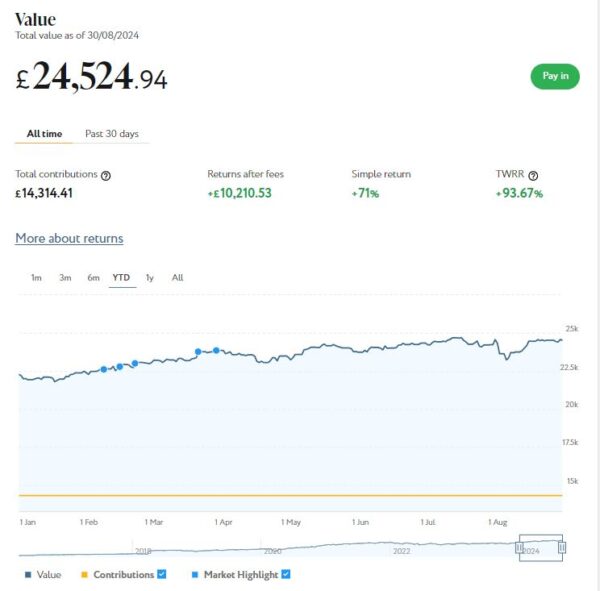
In How to Ensure You Can Cast Your Vote in the General Election, I set out some tips to ensure you are able to cast your vote in the General Election on 4th July 2024. Among other things, I highlighted some issues that older people may face. I also discussed the requirement to bring some form of photo ID to the polling station with you.
Also in June I published How to Protect Your Savings and Investments Under a Labour Government. With the likelihood of this increasing, in this post I set out some hints and tips to help preserve your assets in light of the tax and other economic changes that Labour may introduce. Of course, many of these tips would apply equally to a new government of any persuasion in these challenging times.
Another post was my Review of the New Trading 212 Cash ISA. This new product from the popular Trading 212 platform has been generating a lot of interest, so in this post I took a closer look, setting out the pros and cons as I see them. I also explained why I have opened a Trading 212 Cash ISA myself
A little to my surprise, Trading 212 also reopened their free share offer last month, so I updated and republished my blog post Get a Free Share Worth Up to £100 With Trading 212. This explains how, if you haven’t done so already, you can get a free share when you open a new Invest or Stocks ISA with Trading 212. Note that opening a Cash ISA alone will not qualify you for a free share, but of course you can do both. My advice is to start by opening a Stocks ISA or (non-ISA) Invest account to qualify for your free share, and apply for the Cash ISA after that.
Finally, I published Could You Benefit From Help to Save? This is a government-backed savings account that offers a generous bonus to low-income earners. Launched in September 2018, it aims to encourage regular savings by offering a 50% bonus on the amount saved over four years. There are no age limits to apply, but you must be in receipt of one of three work-related benefits. See my blog post for more information.
Next, a few odds and ends. Last time I mentioned that I recently invested some money (just over £1,000) in a Scottish wind farm project via a platform called Ripple Energy. The way this works is that you pay a one-off fee towards building the wind farm, and in exchange receive lower-cost, ‘green’ electricity once the wind farm is up and running. This will continue for the life of the wind farm (an estimated 20 years). The original closing date for this was the end of May, but the date was extended and the share offer is still open at the time of writing.
If you’re interested in learning more, you can visit the Ripple website via my referral link. If you then decide to invest yourself, you will get a £25 bonus credited to your account when generation starts (and so will I). Note that you will need to invest a minimum of £1,000 to qualify for the £25 bonus, but you can invest from as little as £25 if you like.
Also as mentioned last time, I recently invested a small amount (£500) via a property loan investment platform called Crowdstacker. I have followed Crowdstacker for some time but never got around to investing with them. They are somewhat similar to Kuflink, but their minimum investment per project is lower (just £100) which makes building a diversified portfolio easier. In addition, rates of return are higher, typically 12% to 16%. Obviously higher returns are generally associated with higher risks, and it’s important to bear this in mind when investing – though as all loans are secured against property, you do have some protection. All investments are available in the form of a tax-free IFISA within your overall £20,000 annual ISA allowance.
Crowdstacker doesn’t have a referral programme as far as I know, so I am just sharing this info out of interest. If anyone has any questions or comments about Crowdstacker, feel free to leave them below as usual.
Finally, my usual reminder that you can also follow Pounds and Sense on Facebook or Twitter/X. Twitter/X is my number one social media platform these days and I post regularly there. I share the latest news and information on financial (and other) matters, and other things that interest, amuse or concern me. So if you aren’t following my PAS account, you are definitely missing out!
That’s all for today, except to remind you to get out and vote on 4th July. I know apathy holds sway across large parts of the country right now, but unless you cast your vote in the general election you can’t really complain about how things turn out subsequently!
As always, if you have any comments or queries, feel free to leave them below. I am always delighted to hear from PAS readers
Disclaimer: I am not a qualified financial adviser and nothing in this blog post should be construed as personal financial advice. Everyone should do their own ‘due diligence’ before investing and seek professional advice if in any doubt how best to proceed. All investing carries a risk of loss. Note also that posts on PAS may include affiliate links. If you click through and perform a qualifying transaction, I may receive a commission for introducing you. This will not affect the product or service you receive or the terms you are offered, but it does help support me in publishing PAS and paying my bills. Thank you!
If you enjoyed this post, please link to it on your own blog or social media:
Trading 212, a well-known platform in the UK for trading stocks and shares, recently introduced a new product to its lineup: the Trading 212 Cash ISA.
This addition comes as part of the company’s efforts to diversify its offerings and cater to a broader range of financial needs. Today I’ll be delving into the details of this new product, highlighting its pros and cons. I’ll also reveal why I decided to open a Trading 212 Cash ISA myself.
Let’s start with the basics though…
What is a Cash ISA?
A Cash ISA (Individual Savings Account) is a tax-free savings account where the interest earned is not subject to income tax. Each tax year, individuals can deposit up to a certain limit, which for the 2025/26 tax year is £20,000. Cash ISAs are a popular choice for those looking to save money without the risk associated with investments in the stock market.
Pros and Cons of the Trading 212 Cash ISA
Pros
Tax-Free Interest: Like all ISAs, the interest earned in a Trading 212 Cash ISA is completely tax-free. This makes it an attractive option for savers looking to maximize their returns without the burden of paying income tax on their earnings.
Competitive Interest Rate: The current rate is 5.07% per annum, which puts it at or near the top of the Best Buy tables. This includes a special introductory bonus of 0.72% for the first 12 months, after which it reduces to 4.35%. Rates are variable and can fluctuate based on market conditions, so it’s possible they will fall in future. The platform will want to remain competitive with other financial institutions, however.
No Fees: The Trading 212 Cash ISA is an entirely fee-free account.
User-Friendly Platform: Trading 212 is known for its intuitive and user-friendly interface. The same ease of use applies to their Cash ISA, making it simple for users to manage their savings, check balances and track interest earned. You can manage your account via the Trading 212 website or an app on your phone.
Low Minimum Investment: You can start with as little as £1 if you like. There is no upper limit other than the annual £20,000 ISA allowance (for all ISAs you hold).
Security: Funds held in a Trading 212 Cash ISA are protected under the Financial Services Compensation Scheme (FSCS) up to £85,000 per individual. This provides peace of mind to savers, knowing their money is secure.
Accessibility: You can withdraw whenever you want and as often as you want.
Daily Interest Payments: Interest is credited to your account daily and added to your account at the end of each month (before that it is shown as ‘pending’). There is no need to wait up to a year to receive interest as with some other savings accounts.
Integration with Other Products: For existing Trading 212 users, the Cash ISA seamlessly integrates with other accounts and products on the platform such as the Trading 212 Stocks and Shares ISA and general investment account.
Easy Transfers: You can transfer in your ISA from another provider and you’ll be able to freely transfer between your Trading 212 Stocks and Shares ISA as well.
Flexible ISA: You can withdraw from it and return your funds in the same tax year without it counting twice against your annual ISA allowance. For example, if you invest £10,000 and then withdraw £5,000, you can still invest £15,000 in that tax year (the remaining £10,000 of your £20,000 allowance plus return of the £5,000 you withdrew). Not all cash ISAs currently offer this.
Cons
Interest Rate Variability: As mentioned above, while Trading 212 currently offers a competitive rate, this may change and it may not always be the highest on the market. It’s always a good idea to compare rates with other providers to ensure you are getting the best deal. That obviously applies especially if you are reading this article some time after it was first published (though I will endeavour to update it from time to time).
Not Instant Access: You can withdraw money any time via the website or app but it may take up to three days to arrive in your bank account. So it is quick access but not instant.
No High Street Presence: Trading 212 operates entirely online. They do have a customer service department which you can contact by phone or email. They are not set up to provide telephone banking, though.
Limited Track Record: As a fairly new product, the Trading 212 Cash ISA does not have a long track record. Some more cautious savers might prefer established Cash ISA providers with a proven history.
No Investment Growth: Unlike a Stocks and Shares ISA, a Cash ISA does not offer the potential for investment growth. While it is safer, it may yield lower returns in the long term compared with investment-based ISAs. Of course, there is no reason why you can’t have both.
Inflation Risk: The interest earned on a Cash ISA may not always keep pace with inflation, potentially diminishing the real value of savings over time.
Contribution Limits: The annual contribution limit of £20,000 applies across all ISAs. If you are already investing in a Stocks and Shares ISA or other type of ISA, the amount you can contribute to a Cash ISA will be reduced.
APR vs APY
One other thing to note is that the interest rate quoted by Trading 212 is described as APY. This is short for annual percentage yield. This is another term for AER (annual equivalent rate) which I discussed a while ago in this blog post.
What this means is that the rate quoted by Trading 212 – currently 5.07% for the first 12 months – incorporates the compounding of interest payments. As mentioned above, in the Trading 212 Cash ISA interest is credited daily, and once it is in your account you get interest on the interest as well. That is obviously a good thing, but it does mean the advertised APY already accounts for this. If the interest rate was quoted instead as an APR, it would actually be slightly lower.
Does this matter? Well, yes and no. If you keep your money in the account for a full year, you will get the full rate of interest quoted (as APY). But if you withdraw it earlier – after six months, say – you won’t receive exactly half of this, as the compounding effect won’t have had as long to work. So instead of half the quoted 5.07% (currently) for six months, you would receive marginally less. It would only make a very small difference, but is worth bearing in mind if you are saving for a short-term goal in particular.
My Own Example
As mentioned above, I opened a Trading 212 Cash ISA myself. I already had a Trading 212 General Investment account, so that made the decision easier. But I was also attracted by the competitive interest rate and the fact that interest was calculated daily.
A further consideration is that there is now no limit to the number of different ISAs you can open (as long as you don’t exceed the overall £20,000 annual limit). So opening a Trading 212 Cash ISA doesn’t preclude opening another Cash ISA with a different provider later in the year if circumstances change. It is also easier now to transfer money from one ISA to another.
I have a Santander Edge bank account which comes with a linked Edge Savings account (non-ISA). At the time this was paying a market-leading 7% (AER) on balances of up to £4,000 (it’s now reduced to 4.41%). I had maxed this out, however, so was looking for an alternative, tax-efficient home for the balance of my short- to medium-term savings (the other savings offers from Santander were a lot less appealing). The Trading 212 Cash ISA seemed ideal for me, therefore. I started by depositing £25 and as that went fine I added another £1,500. Interest has been credited every day as promised, and as of 5 May 2025 my original £1,525 has grown to £1,584.05 (see screen capture below). Note that the total quoted includes £0.93 in pending interest accrued so far during May, which (as mentioned above) will be credited to my account at the end of the month.
Conclusion
In my view, the Trading 212 Cash ISA is an enticing addition to the range of financial products available to UK savers.
It combines the tax-free benefits of a traditional ISA with the user-friendly experience Trading 212 is known for. And the interest rate (at present anyway) is very competitive. But obviously you should weigh up the pros and cons set out above carefully before deciding if it’s right for you. As always, it’s wise to compare options and consider your financial goals – both short and longer term – before proceeding.
As always, if you have any comments or questions about this post, please do leave them below.
Disclaimer: I am not a professional financial adviser and nothing in this post should be construed as personal financial advice. You should always do your own ‘due diligence’ before investing and take professional advice if in any doubt how best to proceed.
If you enjoyed this post, please link to it on your own blog or social media:
Summer is here (just about!) so it’s time for another exciting giveaway on Pounds and Sense. This one is themed around Father’s Day, which this year is on Sunday June 16th.
I have clubbed together with some of my fellow UK bloggers to provide a bunch of great prizes guaranteed to put a grin on any dad’s face. And the best news is, it’s entirely free to enter! The giveaway is open now and will close at 11.45 am on Sunday June 16th.
This event has (again) been organized by Rowena Becker, who blogs at My Balancing Act. No small amount of effort has been involved in arranging and co-ordinating it, so many thanks again to Rowena for her hard work and dedication.
Without further ado, then, I’ll hand you over to Rowena to introduce the giveaway…
The Giveaway
This Father’s Day, prepare to delight the special man in your life with an extraordinary giveaway brought to you by a collaboration of top UK bloggers. We’ve joined forces to curate a bundle of prizes that promises not only to impress but also to provide moments of joy. This giveaway is your chance to give your dad something truly special this Father’s Day. Just head to the bottom of this post for details on how to enter and join us in celebrating the incredible men in our lives with a gift that stands out from the rest. Don’t miss this opportunity to make Father’s Day unforgettable this year!
Meet the Bloggers
In order to be able to bring you this incredible giveaway, some of the UK’s top bloggers got together. A massive thank you to our bloggers! The bloggers taking part are:
Celebrate Father’s Day in style with theOpinel Barbecue Set! This timeless set is the perfect companion for socialising and dining with friends, offering a blend of practicality and elegance. Crafted in France using eco-friendly local materials, the set includes three essential utensils:
N°12B Folding Knife: Featuring a 16cm stainless steel blade and a durable beechwood handle sourced from French forests, this knife is equipped with a safety collar for secure locking in open and closed positions. Complete with a built-in bottle opener, this versatile tool is a must-have for any outdoor gathering.
Spatula+: Crafted from stonewashed finish stainless steel, this spatula attaches to the N°12B knife handle and secures in place with the safety collar. With a generous 8.5cm x 20cm surface area, it simplifies food handling with its narrow angle and beveled edges for precise scraping and separating.
XL Tongs: Measuring 40cm in length, these stonewashed stainless steel tongs ensure easy and safe food handling. Their asymmetrical heads offer versatility, allowing you to grip both large and small items effortlessly, while the grid-lifting slot enhances convenience during grilling sessions.
Don’t miss this chance to win this exceptional Opinel Barbecue Set for the dad in your life!
Team GB: Jokesaws Medals in the Making 1000 piece Jigsaw
Prepare for excitement with “Medals in the Making” – a vibrant 1000 piece jigsaw puzzle, included in our Father’s Day Giveaway prize bundle. Join Team GB in a whirlwind of Olympic events featuring skateboarders, swimmers, cyclists, and sprinters. This officially licensed puzzle is part of Gibson Puzzle’s humorous Jokesaws range, promising entertainment and laughter as you piece together this energetic scene painted by Phil Dobson. Get your dad ready for a fun challenge filled with hidden gems and jokes! The perfect gift this Father’s day!
African Shea Black Soap 120g from Aviela
Introducing the luxuriousAfrican Shea Black Soap 120g as a delightful addition to our Father’s Day prize bundle, making it a perfect gift choice. Handcrafted with care, this gentle cleansing soap bar is enriched with pure Shea Butter, Cocoa Pod Ash, and nourishing natural oils like Coconut and Neem. Its moisturizing formula, rich in essential fatty acids and vitamins, effectively cleanses while soothing the skin, offering a pampering experience for dads.
African Orange Hand and Body Wash from Evolve Organic Beauty
Presenting the indulgentAFRICAN ORANGE AROMATIC HAND & BODY WASH (250ml) as a luxurious addition to our Father’s Day prize bundle, offering a perfect gift choice. Formulated with natural Coconut and Sugar Extracts, this aromatic wash gently cleanses and hydrates while preserving the skin’s pH balance. Enriched with Organic Aloe Vera, it nourishes and soothes, leaving a delightful scent of blood orange, vanilla, black pepper, and cedarwood. Treat dad to this organic hand wash for a pampering and comforting experience.
Kanoodle® Ultimate Champion from Learning Resources
Our lucky winner will get to experience the thrill of the #KanoodleChallenge as it’s part of our Father’s Day prize bundle, offering a chance to become theKanoodle Ultimate Champion! With 500 diverse 2D and 3D puzzle challenges, this game will delight dads seeking a stimulating mental workout. Perfect for gifting, it combines fun, logic, and portability in one exciting package.
How to Enter
You can enter the Giveaway by completing as many Rafflecopter widget entry options below as you like. All entries will be collected, and one winner will be randomly chosen via Rafflecopter. Good luck!
The giveaway will run from 3 pm 8th June 2024 to 11.45 am 16th June 2024.
The winners will be notified by email from rowena@mybalancingact.co.uk
The winner will have 7 days to respond after which time we reserve the right to select an alternative winner.
This prize draw is in no way sponsored, endorsed or administered by, or associated with, Facebook, Instagram, X, YouTube, BlogLovin or Pinterest or any other social media platform.
Prize open to over 18s only. Age verification may be required to receive some prizes.
Some or all of the prizes may take a few weeks to arrive.
If any prizes are out of stock then we will do our best to find a suitable replacement but cannot guarantee it.
Anyone who unfollows before the giveaway ends or doesn’t complete the required entry action will be disqualified.
The prize is non-transferable, non-refundable and cannot be exchanged for monetary value.
We may be using a parcel service or Royal Mail for some of the prizes and their standard compensation will apply in the event of loss or damage.
Some items may be sent directly by the supplier and we do not have responsibility if these go missing and we cannot replace these.
In the unlikely event, one of the companies withdraws a prize, we cannot offer an alternative.
The winner’s name will be stated on some or all of our bloggers’ websites and announced on Twitter and other social media channels. It will also be displayed on the Rafflecopter entry form. By entering this prize draw, you give your permission for this.
Please note the winner may have the same name as you so if you see your name displayed, be aware that you are not the winner unless you have been notified by us. There may be some delays in receiving prizes.
Good luck, and I hope a Pounds and Sense reader wins this fabulous prize bundle!
If you enjoyed this post, please link to it on your own blog or social media:
I’ll begin as usual with my Nutmeg Stocks and Shares ISA. This is the largest investment I hold other than my Bestinvest SIPP (personal pension).
As the screenshot below for the year to date shows, my main Nutmeg portfolio is currently valued at £23,744. Last month it stood at £23,502, so that is an increase of £242.
Apart from my main portfolio, I also have a second, smaller pot using Nutmeg’s Smart Alpha option. This is now worth £3,808 (rounded up) compared with £3,760 a month ago, a rise of £48. Here is a screen capture showing performance over the year to date.
Finally, at the start of December 2023 I invested £500 in one of Nutmeg’s new thematic portfolios (Resource Transformation). In March I also invested a further £200 from ‘Refer a Friend’ bonuses. As you can see from the screen capture below, this portfolio is now worth £766 (rounded up) compared with £755 last month, a small rise of £11.
As you can see from the charts, May was an up-and-down month for my Nutmeg investments. In the the middle of the month all my portfolios were up substantiaily, but since then they have fallen back a bit. Overall, however, I am still up by £301 over the month, so it could be worse! It’s also worth observing that their overall value has risen by £1,693 or 6.85% since the start of the year (not counting the £200 bonus I invested in my thematic portfolio in March).
You can read my full Nutmeg review here. If you are looking for a home for your annual ISA allowance, based on my overall experience over the last eight years, they are certainly worth considering. They offer self-invested personal pensions (SIPPs), Lifetime ISAs and Junior ISAs as well.
You may like to note that, for various reasons I won’t go into here, I am no longer an affiliate for Nutmeg. That means you won’t find any affiliate links in my review (or anywhere else on PAS). And you will no longer see the no-fees-for-six-months offer I used to be able to promote as an affiliate. However, the better news is that you can still get six months free of any management fees by registering with Nutmeg via my Refer a Friend link. I will receive a gift voucher if you do this, which is duly appreciated 🙂
Don’t forget, also, that the new tax year began on 6 April 2024 and and you now have a whole new £20,000 tax-free ISA allowance for 2024/25. In a change to the rules, you can now open any number of ISAs with different providers in the same tax year, as long as you don’t exceed your overall £20,000 allowance. So opening a stocks and shares ISA with Nutmeg won’t prevent you from also opening one with another S&S ISA provider (should you so wish) later in the financial year.
Moving on, I also have investments with the property crowdlending platform Kuflink. They continue to do well, with new projects launching every week. I withdrew £250 from my Kuflink account last month after a couple of loans were repaid. I currently have around £1,330 invested with them in 8 different projects paying interest rates averaging around 7%. I also have £20 remaining in my Kuflink cash account.
To date I have never lost any money with Kuflink, though some loan terms have been extended once or twice. On the plus side, when this happens additional interest is paid for the period in question.
There is now an initial minimum investment of £1,000 and a minimum investment per project of £500. Kuflink say they are doing this to streamline their operation and minimize costs. I can understand that, though it does mean that the option to test the water with a small first investment has been removed. It also makes it harder for small investors (like myself) to build a well-diversified portfolio on a limited budget.
One possible way around this is to invest using Kuflink’s Auto/IFISA facility. Your money here is automatically invested across a basket of loans over a period from one to five years. Interest rates range from 7% to around 10%, depending on the length of term you choose. Full up-to-date details can be found on the Kuflink website.
You can invest tax-free in a Kuflink Auto IFISA. Or if you have already used your annual ISA allowance elsewhere, you can invest via a taxable Auto account. You can read my full Kuflink review here if you wish.
Moving on, my Assetz Exchange investments continue to generate steady returns. Regular readers will know that this is a P2P property investment platform focusing on lower-risk properties (e.g. sheltered housing). I put an initial £100 into this in mid-February 2021 and another £400 in April. In June 2021 I added another £500, bringing my total investment up to £1,000.
Since I opened my account, my AE portfolio has generated a respectable £184.78 in revenue from rental income. As I said in last month’s update, capital growth has slowed, though, in line with UK property values generally.
At the time of writing, 11 of ‘my’ properties are showing gains, 1 is breaking even, and the remaining 18 are showing losses. My portfolio is currently showing a net decrease in value of £31.44, meaning that overall (rental income minus capital value decrease) I am up by £153.34. That’s still a decent return on my £1,000 and does illustrate the value of P2P property investments for diversifying your portfolio. And it doesn’t hurt that with Assetz Exchange most projects are socially beneficial as well.
The overall fall in capital value of my AE investments is obviously a little disappointing. But it’s important to remember that until/unless I choose to sell the investments in question, it is largely theoretical, based on the most recent price at which shares in the property concerned have changed hands. The rental income, on the other hand, is real money (which in my case I’ve reinvested in other AE projects to further diversify my portfolio).
To control risk with all my property crowdfunding investments nowadays, I invest relatively modest amounts in individual projects. This is a particular attraction of AE as far as i am concerned (especially after Kuflink raised their minimum investment per project to £500). You can actually invest from as little as 80p per property if you really want to proceed cautiously.
As I noted in this recent post, Assetz Exchange is particularly good if you want to compound your returns by reinvesting rental income. This effectively boosts the interest rate you are receiving. Personally, once I have accrued a minimum of £10 in rental payments, I reinvest this money in either a new AE project or one I have already invested in (thus increasing my holding). Over time, even if I don’t invest any more capital, this will ensure my investment with AE grows at an accelerating rate and becomes more diversified as well.
My investment on Assetz Exchange is in the form of an IFISA so there won’t be any tax to pay on profits, dividends or capital gains. I’ve been impressed by my experiences with Assetz Exchange and the returns generated so far, and intend to continue investing with them. You can read my full review of Assetz Exchange here. You can also sign up for an account on Assetz Exchange directly via this link [affiliate]. Note that as from this financial year (2024/25), you can open more than one IFISA per year.
In 2022 I set up an account with investment and trading platform eToro, using their popular ‘copy trader’ facility. I chose to invest $500 (then about £412) copying an experienced eToro trader called Aukie2008 (real name Mike Moest).
In January 2023 I added to this with another $500 investment in one of their thematic portfolios, Oil Worldwide. I also invested a small amount I had left over in Tesla shares.
As you can see from the screen captures below, my original investment totalling $1,022.26 is today worth $1,301.38 an overall increase of $279.12 or 27.30%.
eToro also offer the free eToro Money app. This allows you to deposit money to your eToro account without paying any currency conversion fees, saving you up to £5 for every £1,000 you deposit. You can also use the app to withdraw funds from your eToro account instantly to your bank account. I tried this myself and was impressed with how quickly and seamlessly it worked. You can read my blog post about eToro Money here. Note that it can also serve as a cryptocurrency wallet, allowing you to send and receive crypto from any other wallet address in the world.
I had four more articles published in April on the excellent Mouthy Money website. The first is Earn Extra Money From Online Surveys. In this article I highlight how anyone can use this method to boost their bank balance for very little effort. I set out five well-established online survey sites I use myself to get you started.
Also in April Mouthy Money published my article How to Start a Business with a Franchise. In this I discussed the various attractions of starting a business with a franchise. And I shared some tips on choosing the best franchise for you and how to get the most out of it.
Also in Mouthy Money last month I revealed How to Track Down Old Investments and Bank Accounts using a platform called Gretel. Gretel is quick and easy to use, and free of charge for individuals (Gretel make their money from the banks and other financial institutions they work with). As well as using it for yourself, you can track down lost and missing assets for people you are associated with. Examples might include deceased persons where you are acting as executor, or people for whom you have financial power of attorney.
Finally, Mouthy Money published my article Should You Get Home Storage Batteries? In this I made the point that only a few years ago home storage batteries were very costly and hard for most people to justify. Times have changed, however, with the price of batteries falling while the cost of electricity has risen dramatically. So in this article I examined the case for purchasing a battery energy storage system (or BESS as it’s sometimes called). This applies principally if you have solar PV panels (or plan to get them) but may still be relevant to you even if you don’t.
As I’ve said before, Mouthy Money is a great resource for anyone interested in money-making and money-saving. I am a particular fan of my fellow MM contributor and money blogger Shoestring Jane. She writes mainly about money saving and frugal living. Her latest article sets out various ways you may be able to Save Money in the Sunshine. Let’s hope we actually get some soon! You can see all of Jane’s articles for Mouthy Money via this web page.
I also published several posts on Pounds and Sense in May. In My Short Break on the Isle of Man I talked about my recent holiday on this lovely and under-appreciated island between England and Ireland. It’s less than an hour by plane from most UK airports, or you can get a ferry from Liverpool or Heysham. I went on a heritage-railway-themed break with Newmarket Travel, which I thoroughly enjoyed and recommend. Read the article for more details
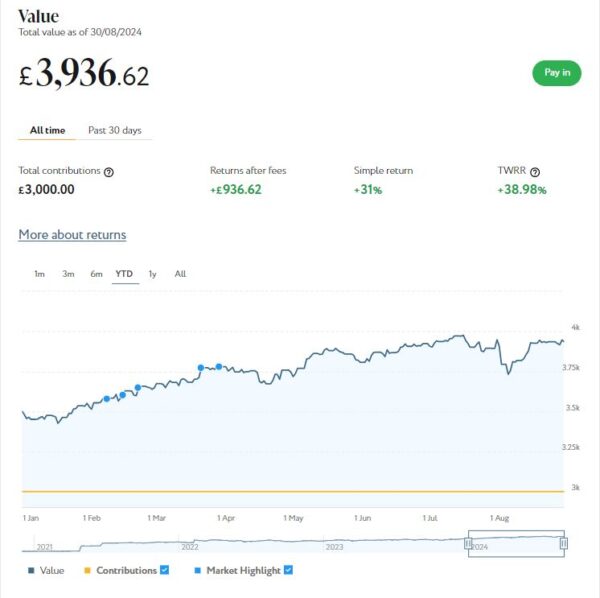
Also in May I published Twenty Great Ways to Make Extra Money From Home. This is a fully revised and updated version of my original post of this title. As you will gather, it sets out twenty ways you may be able to make a few pounds extra every month to help boost your finances. None of these methods is likely to make you a fortune, but together they can certainly help keep your bank balance ticking over.
Finally, with an eye to the General Election on Thursday 4th July 2024, I published How to Apply for a Postal Vote. As Pounds and Sense is aimed primarily at over-fifties, I wanted to encourage my readers to apply for a postal vote if this might help them exercise their democratic right to vote. Having a postal vote means that if ill health, frailty or disability prevent you getting to a polling station, you still have the chance to express your political preference. Likewise, you won’t have to worry about obstacles such as bad weather or lack of transport to get to the polling station. There is still time to apply for a postal vote if you wish but you need to move smartly now. This article will tell you everything you need to know.
Also this year I became a regular contributor to Over 60s Discounts. You can read my latest article here: Set Sail for the Sun! Ten Tips for Older Cruisers. As you will gather, this is intended for older people (especially) who are considering going on a cruise – maybe for the first time – to help them get the most from it.
I highly recommend registering at Over 60s Discounts, by the way – they list a growing range of discounts and bonuses for older people, including some that are unique to O60D.
Next, a few odds and ends. One is that I recently invested some money (just over £1,000) in a Scottish wind farm project via a platform called Ripple Energy. The way this works is that you pay a one-off fee towards building the wind farm, and in exchange receive lower-cost, ‘green’ electricity once the wind farm is up and running. This will continue for the life of the wind farm (an estimated 20 years).
If you’re interested in learning more, you can visit the Ripple website via my referral link. If you then decide to invest yourself, you will get a £25 bonus credited to your account when generation starts (and so will I). Note that you will need to invest a minimum of £1,000 to qualify for the £25 bonus, but you can invest from as little as £25 if you like.
Also, I recently invested a small amount (£500) via a property loan investment platform called Crowdstacker. I have followed Crowdstacker for some time but never got around to investing with them. They are somewhat similar to Kuflink, but their minimum investment per project is lower (just £100) which makes building a diversified portfolio easier. In addition, rates of return are higher, typically 12% to 16%. Obviously higher returns are generally associated with higher risks, and it’s important to bear this in mind when investing – though as all loans are secured against property, you do have some protection. All investments are available in the form of a tax-free IFISA within your overall £20,000 annual ISA allowance.
Crowdstacker doesn’t have a referral programme as far as I know, so I am just sharing this info out of interest. If anyone has any questions or comments about Crowdstacker, feel free to leave them below as usual.
In addition, you might remember that a few weeks ago I published a post about a service called Gubbed. This is a no-cost, no-risk opportunity to make at least £1,000 (tax-free). I just need to mention that for operational reasons Gubbed have temporarily stopped taking on new clients. This will not affect existing clients (including several PAS readers), who will still receive their guaranteed minimum £1,000 payouts in due course. But for the time being I have removed any advertising for Gubbed from Pounds and Sense. I will of course let readers know via Facebook and Twitter/X (see below) when they reopen to new clients.
Finally, my usual reminder that you can also follow Pounds and Sense on Facebook or Twitter/X. Twitter/X is my number one social media platform these days and I post regularly there. I share the latest news and information on financial (and other) matters, and other things that interest, amuse or concern me. So if you aren’t following my PAS account, you are definitely missing out!
That’s all for today. As always, if you have any comments or queries, feel free to leave them below. I am always delighted to hear from PAS readers
Disclaimer: I am not a qualified financial adviser and nothing in this blog post should be construed as personal financial advice. Everyone should do their own ‘due diligence’ before investing and seek professional advice if in any doubt how best to proceed. All investing carries a risk of loss. Note also that posts on PAS may include affiliate links. If you click through and perform a qualifying transaction, I may receive a commission for introducing you. This will not affect the product or service you receive or the terms you are offered, but it does help support me in publishing PAS and paying my bills. Thank you!

If you enjoyed this post, please link to it on your own blog or social media: