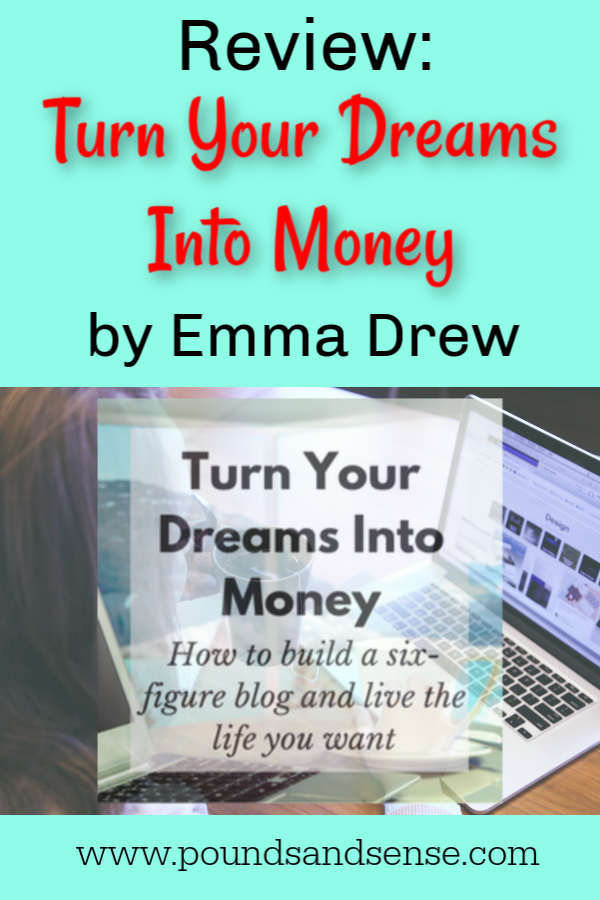
Turn Your Dreams Into Money is an online course for anyone who would like to make money as a blogger. It is sub-titled ‘How to build a six-figure blog and live the life you want’.
The course has been created by my colleague Emma Drew, one of the UK’s most successful bloggers. In a few years Emma went from being homeless and penniless to being a six-figure blogger. She now blogs full time at EmmaDrew.info and employs her husband in the business.
The course is hosted on the popular Teachable platform.
Before You Start – Tutorials for Brand New Bloggers
Laying the Foundations For A WILDLY Successful Blog
Protecting Your Blog
Writing Kick-Ass Blog Posts
Images For Your Blog
How to Get Traffic to Your Blog
Becoming a Social Media Whizz
Pinterest
Growing & Serving Your Tribe
The Money Is In The List
The Business of Blogging
Making Money With Affiliate Marketing
Make Money With Sponsored Posts
Make Money With Adverts
Products to Sell
Make Money as a Brand Ambassador
Improving Your Top Ten Posts
Dealing With Trolls
How to Continue Growing Your Business
Blogging Hacks
Affiliate Section for Turn Your Dreams Into Money
Each section is further divided into anywhere from one to thirteen parts. Each part contains instructional text (with graphics where relevant), and in some cases a PDF and/or a video.
As an example, the section titled ‘Improving Your Top Ten Posts’ is in five parts, starting with ‘Why You Should Improve Your Top Ten Posts’ and finishing with ‘Improving Your Top Ten Posts Checklist’. There are also two instructional videos. One of these explains how to identify your top ten posts, while in the other we watch Emma as she goes about improving one of her own top posts. I thought both the written content and the videos were of a high professional standard.
Another feature I particularly liked is the PDF workbook for students to print out and complete. The workbook is referred to throughout the course, and is a great way to ensure you take on board Emma’s advice and apply it to your own blog.
As you will gather, Turn Your Dreams Into Money is a comprehensive guide to every aspect of setting up and running a money-making blog. Emma strongly recommends creating a self-hosted blog using the popular WordPress platform, which I agree with (my blogs Pounds and Sense and Entrepreneur Writer are both hosted this way).
There is a section about setting up a self-hosted WordPress blog which covers the essentials, including recommended plug-ins, how many (and what) categories to have, legal requirements, and so on. If you are brand new to WordPress, however, you might want to do some additional studying on the technical aspects yourself. Of course, there is lots of information about this available free online, and I also recommend this regularly updated ebook by Dr Andy Williams about setting up a WordPress site, which I found very helpful myself when starting out.
Where the course is especially strong is about marketing and monetizing your blog. Although I am a fairly experienced blogger myself, I found this a real eye-opener. There are some great resources listed, some of which I hadn’t come across before. It is very informative to see which ones Emma uses herself and have proved to be successful (and profitable) for her.
A further benefit of signing up is that you get access to Emma’s private Facebook group for students on the course, where you can discuss all aspects of blogging with fellow students (and Emma herself).
Turn Your Dreams Into Money costs £197 at the time of writing. Obviously that’s not cheap, but if it helps you set up a profitable blog that generates a growing monthly income, then it will clearly be money very well spent.
For a limited period, I can also offer readers of my blog a £50 discount if they enter the coupon code POUNDS when ordering. This should change the price showing to £147 (if it doesn’t work, please get back to me). And as an extra bonus for anyone buying via my link, I am giving away not one but two mini-reports by yours truly. One is titled ‘50 Niche Blog Topics With Big Earning Potential’ and the other ‘How to Write Irresistible Titles for Blog Posts‘. To get your hands on both of these valuable resources for bloggers, just message me with your receipt/order number for Turn Your Dreams Into Money. I will then send you the reports by email 🙂
As always, if you have any comments or questions about Turn Your Dreams Into Money, please do post them below.
Disclosure: This post includes affiliate links. If you click through and make a purchase, I may receive a commission for introducing you. This will not affect the terms you are offered or the price you are charged.
If you enjoyed this post, please link to it on your own blog or social media:
NOTE: This competition is now closed. The winner has been announcedin this blog post!
The third Monday in January has been dubbed Blue Monday. It’s meant to be the most depressing day of the year, with cold days, dark nights, and a payday that still feels a million miles away.
So today, to cheer everyone up, I am running a giveaway for some delicious Bahlsen Choco Moments biscuits. This is – of course – a sponsored post.
Choco Moments are the ultimate indulgent snack. With a thick coating of rich chocolate over a crunchy biscuit base, they are the perfect melt-in-your-mouth treat to pick you up on a bad day.
They are available in two delicious flavours: Choco Moments Crunchy Hazelnut (my favourite) combines smooth, creamy milk chocolate with warm hazelnut crunch and is mouth-wateringly more-ish; while Choco Moments Crunchy Mint perfectly balances deep notes of dark chocolate with lively and refreshing crunchy mint.
To be in with a chance of winning A WHOLE SIX PACKETS of Choco Moments biscuits (both flavours included) just leave a comment below by 9 am on Friday 31st January 2019 saying why Bahlsen biscuits cheer you up. I will pick a winner at random and arrange to send them the prize.
Just one comment per person, please, and allow a few hours for me to approve your comment if you haven’t commented on my blog before. This competition is open to UK residents only.
Please check back here (or on the PAS Facebook page) after 1st February 2019 to see if you are the winner and claim your prize (you could also subscribe via the box in the right-hand column to be notified about all new posts). Due to online privacy rules I won’t be able to contact you otherwise. Note also that once the competition has closed it will not be possible to leave any further comments on this post.
If the winner doesn’t claim their prize within seven days, I reserve the right to pick another winner at random instead.
Finally, even if you don’t win this time, don’t be blue. Bahlsen Choco Moments biscuits are available at an RRP of just £1.99 in Sainsbury’s and Waitrose supermarkets!
Good luck, enjoy your coffee/tea and Bahlsen Choco Moments, and remember that from today onward the year can only improve 🙂
Disclosure: as stated above, this is a sponsored post. I am receiving some delicious Bahlsen Choco Moments biscuits as a thank-you for posting it
Comments on this post are now closed.
If you enjoyed this post, please link to it on your own blog or social media:
Today I want to share some information about the trading allowance, a modest but useful tax-free allowance.
The trading allowance doesn’t appear to be widely known about, but can be particularly relevant for retired and semi-retired people. Though those in full-time work may also be able to benefit from it.
This allowance was introduced in the Finance Act (No. 2) 2017, which from April 2017 brought in a £1,000 trading allowance and £1,000 rental allowance. The trading allowance is likely to be the more beneficial of the two (at least, unless or until the much more generous £7,500 Rent-a-Room allowance is abolished) so in this post I will focus on that.
The trading allowance means that from April 2017 individuals with a trading income of £1,000 or less in a tax year do not need to declare or pay tax on this money. Trading income can include money from online activities such as auction trading, blogging, completing online surveys, and so on. It would also include casual work such as gardening or DIY.
So long as you earn under £1,000 a year from these activities, the good news is you don’t have to declare it to HMRC or pay income tax on it. For people who only earn small amounts of income from trading – perhaps on an ad hoc basis – that means there is no more worry about if, how or when to declare it to the authorities. I know many older people worry about whether they will get into trouble if, for example, they do a small DIY job for a neighbour and are paid £50 for it. The trading allowance can remove this source of concern.
An important point to note is that the £1,000 refers to gross income. If you intend to claim the trading allowance, you aren’t allowed to deduct any costs incurred (as of course you would in a normal self-employed business).
If you earn over £1,000 gross from trading you can still use the trading allowance if you wish. You then simply deduct £1,000 from your gross income and that will give your taxable income. Alternatively, you can choose the traditional method of deducting all business-related expenses from your gross income and paying tax (if due) on the balance. Clearly if you have a high level of expenses, the latter is likely to be the more cost-effective choice. Here are a few examples that may help make this clearer.
1. Graham is retired and supplements his pension doing part-time gardening for his neighbours, for which he earns £900 a year. This is under £1,000, so he does not have to declare this money to HMRC or pay any tax on it.
2. Jill has a part-time job working for an employer and in her spare time runs a blog, from which she makes a gross income of £1,500 a year. She has £600 of blog-related expenses. Although her net income from her blog is under £1,000, because the gross income is over this figure she is obliged to register as self-employed with HMRC. She then has the option of deducting the £1,000 trading allowance from her £1,500 gross income, giving her a taxable income of £500. Alternatively she can choose to deduct her £600 of expenses from her gross income of £1,500, leaving her with a taxable income of £900. Clearly, in this case she is better off claiming the trading allowance.
3. Mary works full-time as a shop assistant but also has a sideline buying and selling collectibles on eBay. Her gross income from her eBay trading is £2,500 and she has trading costs of £1,250. Again, as her gross income is over £1,000, she has to register with HMRC. She then has the choice of deducting the £1,000 trading allowance from her gross trading income of £2,500, giving her a taxable income of £1,500. Alternatively she can deduct the £1,250 of expenses from her £2,500 gross income, leaving her with a taxable income of £1,250. Clearly, in this case, not claiming the trading allowance is the better option.
You are allowed to decide for yourself which option is more beneficial to you each year, so it is very important to keep careful records of all your trading income and expenditure.
Note also that everyone is entitled to claim the trading allowance however much they earn as an employee (if you are already self-employed you will probably be unable to claim it, though – see below).
Bear in mind also that everyone has a tax-free annual income allowance anyway – the basic personal allowance is £11,850 in the current tax year, going up to £12,500 in 2019/20. The trading allowance is only therefore likely to be relevant in financial terms if your total taxable income from all sources exceeds this. But you will of course still have the benefit of not needing to worry about notifying HMRC or registering with them if your gross trading income is under £1,000..
As ever, there are a few other complications…
You can claim the trading allowance if you have another paid job for an employer, full-time or part-time. You can’t, however, claim it if you also do freelance work for your employer.
In addition, if you run a separate self-employed business, it is unlikely you will be able to claim the trading allowance as well (your accountant should be able to advise you about this – see also this useful article from Accountancy Age).
There is only one trading allowance per person. Even if you have two separate sources of income from trading, for the purposes of claiming the allowance the total income from them must be lumped together. However, you can allocate the £1,000 allowance across both activities in whatever proportion you wish.
Although you don’t have to declare trading income below £1,000 per tax year to HMRC, you may still have to declare it if you are receiving other welfare benefits such as Universal Credit.
Only individuals can claim this allowance, not partnerships or limited companies.
Further Reading
Here are a few additional resources you may find helpful, starting with the government’s own website devoted to this allowance.
As always, if you have any comments or questions about this post, please do leave them below (although bear in mind that I am not a qualified financial adviser or tax expert and cannot provide personal financial advice).
If you enjoyed this post, please link to it on your own blog or social media:
Today I want to bring to your attention a new opportunity to earn a sideline income, from a company called Maru Voice UK.
Maru has been running successfully for some time in the United States and Canada, and has just opened its online community and survey panel to UK residents.
Members can join Maru Voice UK for free and are then able to earn points by completing consumer surveys and taking part in online discussions. You get between 50 and 500 points per survey, and once you have accrued 1000 points can redeem them for a £10 gift card from Amazon, iTunes or a range of other retailers.
In addition to earning points and vouchers, members can also earn prize draw entries. Just for registering with Maru Voice UK you will be entered into a draw to win a £1000 cash prize.
To be clear, nobody is going to make a fortune from Maru Voice UK or any other survey site. It is, however, a genuine, easy way to make a bit extra every month (Amazon vouchers in particular are as good as cash, bearing in mind the huge range of things you can buy there!).
In addition, your opinions will reach the companies and policymakers who will shape the UK’s future, so they really will be heard and make a difference.
If you have any comments or questions about Maru Voice UK, please do post them below. Otherwise, you can click through this link or any of the others in this post to sign up.
Disclosure: I am an affiliate for Maru Voice UK, so if you click through and join the panel via my link I will receive a small commission for introducing you. This will not affect the terms and conditions you are offered in any way.
If you enjoyed this post, please link to it on your own blog or social media:
Today I am pleased to bring you a guest post from my money blogging colleague Jennifer Kempson. Jennifer blogs at https://mamafurfur.com.
In her article Jennifer sets out some strategies to ensure you have enough money to enjoy your retirement, even if it’s not too far away!
Over to Jennifer, then…
They say hindsight is a wonderful thing, and truly as we reach the later years of working life and approach retirement, we may secretly wish we had made our retirement resources a priority and regarded them as a key resource to help fulfil our passions and achieve our long-term ambitions.
Money, much like health and energy, is one resource that we will look back on and wish we had taken better care of during our younger days, so we can look forward with pleasure and excitement to when the time-freedom of retirement allows us to do whatever we dream of.
Reading this right now you may feel that it is too late for you to recover your potential financial security for your retirement, but I’m excited to share with you a few ways that you can invest in your future even when retirement is on the horizon in the next 10-15 years.
Make a plan and start seeing it happen!
Firstly, I will say that I am a firm believer in “putting your own oxygen mask on before anyone else”. And the very best investment financially or otherwise you can make for your future is to sort your own financial security as a top priority.
You absolutely need to write down your financial goals and desired experiences for your retirement, and start getting excited about this and be as specific as possible, so that you know exactly how much money you will require to make it happen.
Like time spent with our children and loved ones, if we master our relationship with money and the way we feel about it today, this will have a huge compounding effect on our short- and long-term happiness in future. I talk more about the habits and thoughts that can reshape your relationship with money in my new book, The Master Money Blueprint, which sets out the 26 timeless money principles and habits that I believe can change your financial future.
Pay off your liabilities as soon as possible
One of the most beneficial things you can do for your financial future is to become as debt-free as possible.
Make better money relationship habits starting today and commit to overpaying on everything you have as a liability against your name.
This could include your mortgage or car payments, and is especially crucial if you have credit card debts or loans. Commit to paying these down as quickly as possible and never returning to debt again.
A home with its mortgage completely paid off will provide you with safety and security in future, and when the time comes can be left to loved ones. But more important than that would be the mindset that your home is secure and safe for your happiness both now and in the future.
I like to use a great principle called The 10% Rule, mentioned in more detail in my book and on my blog at www.mamafurfur.com. This can and should be applied to every debt you have – any outstanding mortgage, car payments, loans, etc.
Commit to paying 10% over the monthly repayment required each month as a default. That small action will do two things. Firstly, you will not really notice too much discomfort. For a mortgage of, say, £400 a month, finding a further £40 could be as simple as giving up that gym membership and going for walk with friends, getting some free weights in the house, learning yoga from YouTube, and so on. It could be giving up all the unused packages from cable TV for a few months to see if you really miss it. It could be starting a small sideline business at home to make some extra money, or saving on your food and shopping purchases by eating one less takeaway a week. The choices are limitless.
That action of paying 10% more each month means you will make the equivalent of 1.2 extra payments towards reducing your debts per year. For a 25-year mortgage, for example, this could result in the debt being fully paid off in just over 22 years instead. That is a nearly three years off your home loan from a small change without causing too much stress to your day-to-day living. The second benefit is to your mindset, which is priceless – you will quickly see that money really is a resource to deploy based on your goals and long-term plans. Overpaying then becomes a joy, as much as it might be difficult to see that at the start, but the smallest actions usually do change us for the better when we let them.
An investment ISA (Individual Savings Account) allows you to save up to £20k tax free in stocks and shares every year. This type of savings account could allow you to create a passive income to supplement a pension. You can have a cash ISA and an investment ISA if you wish, as long as you don’t exceed the £20k annual total contributions allowance.
Investments in ISAs are not liable for income tax or dividends tax. Neither do you have to pay capital gains tax when you sell them. They are available from most banks and investment companies.
Like any type of investing, we need to purchase funds based on our goals, requirements for the money long term, and our tolerance for risk.
Investment returns are not guaranteed. However, generally you can expect to see a 4% return on your investments if you pick solid mutual funds (collections of stocks purchased together, spreading your money across a wide range of similar companies) such as Vanguard’s LifeStrategy 100% Equity Fund or reliable low-cost index funds such as the S&P 500. It is also not uncommon to see growth rates of an average of 9.5-10%.
At the later part of your life, if you are hoping to use the power of compound interest and the stock market to gain higher returns than a normal savings account, then I strongly advise doing as much research as you can into the funds you decide to pick.
With investments, we need to assume we are leaving them a minimum of 5-10 years before withdrawing the money, and must not let the ups and downs of the stock market test our emotions.
The value of the stocks once we purchase them is only relevant once we need to sell them, so best mindset practices say to ignore the current day value until you absolutely need them.
Another benefit of using an investment ISA is that you will have access within a few days to your money should your circumstances change and you find you need the money sooner.
I strongly recommend every adult has an investment ISA, as it is currently one of the few ways to get high-interest returns on your long-term savings. It could even allow you to build a substantial ‘pot’ that allows you to achieve complete financial freedom for you and your family in future.
I call an investment ISA a passive income source, as the money generated is created by companies returning some of their profits in dividends, and/or the value of the stocks and shares purchased going up.
We do not have to exchange our time for this income, therefore it is completely passive and grows without any effort from ourselves. The beauty of the stock market is that our money will remain active until we choose to sell our stocks, so it will continue to create more income for us in the background. We can simply withdraw a small portion of it each year to live off, and some of the increase will still remain, adding to our wealth total despite the withdrawn money.
Let’s look at some examples of what we could potentially end up with if we took out an investment ISA even with a short-term goal of accessing the money within 10 years. I will use a withdrawal rate (how much we draw from our account every year as a source of income) of 3.75%. This is regarded as a good average by most financial advisors and institutions.
Starting with no savings at all at age 50, if we contributed the maximum of £20k a year to an Investment ISA with a withdrawal rate of 3.75% a year on average and saw only a 4% return on investment, then using the power of compound interest and reinvesting any dividends or growth, we would have at age 60 a total investment pot of around £246k. If we withdraw 3.75% of this a year, as stated above, after 10 years we could withdraw £9.2k a year of interest (tax free). That would mean an extra £800+ in your pocket every month through your investment ISA savings alone.
Leave the amount until you are officially retiring at age 65, after 15 years of consistent effort and contributions, we could see approximately £411k with an income of £15k a year or £1200 in our pocket every month.
If we were to see a 10% return on investment each year, the total fund within 15 years of maxing out our contributions would be approximately £696k and an income of £65k a year tax free! That is probably more than any retirement could use up, and of course this is purely using our investments as a source of income and not including a state or employer pension. That means you could end up being able to use the interest generated from your investments each year to live off indefinitely!
Another great point to remember is that an ISA is per individual, so if you are a couple you can open one each and double your achievements together.
What better gift than your time and freedom back to use as you wish could you give yourself and your loved ones?!
If you would like to know more about the basics of the stock market, or how to use an investment ISA to retire earlier than planned, please check out my blog posts here:
Master your money and create your best life – your greatest investment in your future!
Make it a priority to learn how to master your money and use it to direct and create your best life.
Successful people in every walk of life leave clues along the way, so however you feel inspired to live your life, do it with style and use money as the tool to get there, taking your loved ones along with you for the ride.
Think of your upcoming retirement as an opportunity to explore new opportunities and even business ideas. Learn as many new skills as you can in areas that make your future life seem exciting, and watch as the world really opens up to you to design the life you always wanted in your retirement.
Here’s to a great future ahead on your terms, with money as an abundant resource to fuel it!
About the author
Jennifer Kempson, aka Mamafurfur, is a 30-something Scottish working mum with a passion to help others create the work-life balance and lifestyle they desire with time and financial freedom, sharing smarter spending, saving and lifestyle strategies.
Outside of her blog, she recently released her first book titled The Master Money Mindset: How to Master Your Money and Create a Powerful Money Mindset, sharing 26 timeless money principles that will allow you to design and shape your future using money as the resource it should be. The book is available on Amazon Kindle and as a paperback now.
Currently voted UK Money Vlogger (Youtube Creator) 2018, and finalist for the UK Blog Awards Finance Blog of the Year 2019.
Many thanks to Jennifer (right) for a valuable and thought-provoking guest post. Please do check out her blog at www.mamafurfur.com and her YouTube channel at www.youtube.com/c/mamafurfur.
I do agree with Jennifer about the value and importance of paying down your debts. Not only will this reduce the capital outstanding, even more importantly it will reduce the interest you have to pay on that capital in future. Other things being equal it’s best to pay off high-interest loans first (though check whether there are any penalties for doing this). Mortgage rates are historically low at the moment so paying extra every month won’t have as big a benefit, but of course there is still much to be said for going mortgage-free as early as possible.
I also agree with Jennifer about the value of saving as much as possible using ISAs. And for long-term saving especially, you are likely to get much better returns from investment (stocks and shares) ISAs than cash ISAs. Do just bear in mind that pension contributions are another great way of saving for retirement, and you get tax relief from the government up front on them.
Finally, I do of course appreciate that not everyone is going to be able to save £20,000 a year into their ISAs. Whatever you can find, however, putting it into ISAs (and pensions) will ensure you get the maximum benefit in years to come. And the earlier you start, the more time your savings and investments will have to weather any ups and downs in the financial markets and grow. You can read some ideas for boosting your income so you can afford to save more for retirement in the Making Money category on my blog.
As always, if you have any comments or questions about this post, please do leave them below.
If you enjoyed this post, please link to it on your own blog or social media:
By courtesy of my friends at Wow Free Stuff, I’d like to offer you the chance to win a Burt’s Bees Natural Gift Set just like the one below.
This attractive gift set contains beeswax-based natural skin-care products, including lip salve and hand salve. On average, Burt’s Bees products are 99% natural, with over half their products 100% natural. They contain no petrochemicals, phthalates, parabens or sodium lauryl sulfate (SLS), and are not tested on animals.
I thought today I’d share some of my favourite ways of making a bit of extra cash.
These are methods I have discussed previously on Pounds and Sense, so I have linked to some other relevant posts from the blog where appropriate.
1. Prolific Academic
Prolific Academic is a platform used by academic researchers world-wide to recruit participants for online studies and surveys. These are varied and interesting, and I’ve earned almost £300 to date by doing them. For more information, see my blog post Make Money and Help Academic Researchers With Prolific Academic.
2. Matched Betting
Don’t be put off by the name. Matched betting isn’t gambling. Rather, it’s a way of taking advantage of bookmaker special offers (mostly online) to generate a risk-free profit. I’ve made about £2,000 (tax-free) from matched betting, and know of other people who have made five-figure sums.
I’ve written about matched betting on various occasions on Pounds and Sense. You can read my introductory article Can You Make Money From Matched Betting? here. Note that for beginners I highly recommend subscribing to the Profit Accumulator advisory service, which has in-depth video tutorials and valuable (arguably essential) online tools for matched bettors, such as calculators and odds-matchers.
3. Online Auction Selling
There are lots of ways to make money from online auctions, generally using the world’s favourite online auction site eBay. The simplest method is to sell items from around the house you no longer need, from children’s toys and games to clothing and collectables. If you want to go beyond this, though, you can buy items cheaply from wholesalers or other sources and sell them on for profit (note that income generated this way is potentially taxable). Check out this guest post Twelve Top Tips for Selling on eBay by my fellow money blogger Luci Oliver.
4. Renting Out a Room
This is undoubtedly an old-school method, but if you have a room in your home you’re not currently using, you could make steady money from it by taking in a lodger. The government encourages this through its Rent a Room Scheme, which lets you make up to £7,500 a year tax-free by renting out a room in your home. If you don’t want a full-time lodger, another option is to take people on short stays using the well-known Airbnb platform or one of its rivals. See my blog post Boost Your Income by Renting Out a Room for more information.
5. Blogging
Could 2019 be the year you start your own money-making blog? I do, and there’s no reason you couldn’t as well!
If you’re not quite sure what to blog about, ask yourself the following two questions:
1) Are you at least curious about the topic?
You don’t have to be an expert or 100% passionate about your blog topic to generate income. But you do need to be at least curious to learn, because if you don’t enjoy learning about your blogging topic, it’ll show in your writing, and you’ll run out of ideas. Nobody reads blogs that have no character or point of view.
2) Are other bloggers already making money in your niche?
It’s important to pick a niche that is proven to make money. The easiest way to see which blog niches are profitable is to see how many other bloggers are active in the niche in question. If nobody is competing in your space, there’s a very good chance the market is too small or unprofitable. Don’t be afraid of competition. Your experiences and distinct voice will make your blog unique. You can stand out even in a saturated market.
This is another thing I do myself – indeed, for many years I was a full-time freelance writer (I’m semi-retired now). It’s a competitive field, but there is still plenty of money to be made. You don’t need to be Shakespeare either, just have a reasonable grasp of written English and be willing and able to write what the market wants. Check out My Top Ten Tips for Making Money as a Freelance Writer here. You can also read my posts Should You Write a Book? and How to Publish Your Own E-book on Kindle.
7. MobileXpression App
If you have a smartphone, this is a really easy way to make money from it. Just install this app (which tracks your browsing anonymously) and every few weeks you will receive a £20 Amazon voucher for your trouble (Amazon vouchers are pretty much as good as money, as you can buy almost anything there!). You can read my full review of the MobileXpression app in this post.
8. Become a Viewing Agent with Viewber
If you have a bit of time available in the day and/or at weekends, you could earn a sideline income as a viewing agent for Viewber. This company recruits freelance viewing agents to conduct property viewings on behalf of local estate agents who don’t have the staff available to do it themselves. As a Viewber (the name is also used by the company to describe its viewing agents) you will be asked to attend a property at a specified date and time to show a potential buyer or tenant round. You will receive a set fee and travel expenses for doing this. This opportunity is open to anyone and you don’t need any experience in estate agency. For full details, see my post Earn a Sideline Income as a Viewing Agent With Viewber.
9. Be a TV or Movie Extra
This is another opportunity that won’t make you rich but can certainly generate a useful sideline income and provide a lot of fun into the bargain. As an extra, you’ll make some money, get a chance to see how movies and TV shows are made, and even become immortalized on screen. For more information (including my own experiences!) see my post Earn a Sideline Income as a TV or Movie Extra.
10. Offer Your Home as a TV or Movie Location
If you don’t fancy appearing in films or TV shows yourself, maybe your home could do the job for you? Obviously this opportunity won’t be suitable for everyone. You need to live somewhere with characteristics or features that might be in demand by a production company. You definitely don’t need to live in a stately home, though. A huge range of properties is required, so wherever you live there’s a chance it could be the perfect location for an upcoming project. Read my blog post Lights! Camera! Action! How to Make Money Offering Your Home as a TV or Film Location for the full scoop!
So there you are – twelve great ways you can generate a sideline income in 2019. For many other sideline (or in some cases full-time) earning opportunities, just click through this link to the Making Money category on Pounds and Sense.
Good luck, and as always if you have any comments or questions about this post, please do leave them below.
Disclosure: This post (and others on Pounds and Sense) includes affiliate links. If you click through and make a purchase at the website in question, I may receive a commission for introducing you. This has no effect whatsoever on the terms or benefits you will receive.
If you enjoyed this post, please link to it on your own blog or social media:
As is customary for bloggers at this time of year, here are the top posts on Pounds and Sense in 2018, based on comments, page-views and social media shares. They are in no particular order. I have excluded any posts that are no longer relevant.
I hope you will enjoy revisiting these posts, or seeing them for the first time if you are new to PAS. Don’t forget, you can always subscribe using the box on the right to be notified of new posts as soon as they appear.
Just wanted to take this opportunity to wish all my readers a happy and peaceful Christmas, and a fulfilling and prosperous new year.
Pounds and Sense was launched in December 2016, so it has been going for two years now. Thank you to everyone who has visited the blog during this time, and especially to all those people who have commented on my posts and/or signed up to be notified of new ones. You can do that by entering your name and email address in the ‘Subscribe’ box on the right (hint, hint!).
I hope you have found at least some of my posts of value, and they have helped you to save money and make money in these financially uncertain times. If you have any comments or suggestions for topics I ought to cover in the coming months, please do leave a comment below or contact me directly. The same applies if you would like to guest post on the blog or work with me on sponsored posts or promotions.
I’ll be back with more advice, tips and information (and biscuits!) soon, but for now I hope you and your family have a wonderful festive season. I’ll leave you with one of my all-time favourite Christmas songs, by Greg Lake.
If you enjoyed this post, please link to it on your own blog or social media:
Today I’m pleased to bring you a guest post on how to save money on your television watching by using free (and low-cost) services rather than expensive cable and satellite TV packages.
It’s by Or Goren, who runs Cord Busters,a UK blog for people who want to ditch their expensive cable/satellite TV bills and become – as Or calls it – cord cutters.
Over to Or, then…
We live at what many call ‘The Golden Age of TV’ – with numerous high-quality programmes (and plenty of reality TV nonsense, if that’s your cup of tea), it seems like there’s always something good to watch. But the abundance of TV comes with a high price tag – the high price tag…
Many homes treat Sky (or competing pay-TV offers like Virgin Media, BT, etc.) as if it’s the default – and only – way to watch TV. We’ve come to take those £40-50-60/month contracts for granted, and we assume it’s too much of a hassle to find other – cheaper – ways to enjoy TV.
Luckily, this golden age of TV has also brought with it new ways to watch TV, that don’t involve long-term, pricey contracts. From Freeview to Netflix, here are some of the methods you can use to still enjoy lots of good programmes – without paying too much.
Cut Your Cable TV Cord
Cord cutting is a term that crossed the pond over from the US. It basically means getting rid of your pricey cable TV (or satellite TV, in Sky’s case) plans, and moving to cheaper pay-as-you-go alternatives that usually involve TV that streams over your broadband connection.
The first step is to actually cancel your Sky (or similar) plan. If you’re still under contract, you’ll have to wait for it to end (or pay a fine) – so pay close attention to the relevant dates. In any case, it’s probably best to try some of the methods mentioned here, before you actually cancel Sky – to see if they fit your home and your lifestyle.
Freeview – 100% Free TV
The easiest and most cost-effective way to watch TV in the UK is via Freeview. It’s a joint venture of the BBC, Sky, ITV, Channel 4 and Arqiva, that provides over-the-air access to more than 100 TV and radio channels (including the BBC, ITV, Channel 4, Channel 5 and plenty of others), without ANY monthly payments.
Despite what some pay-TV companies would have you believe, you don’t need THEIR equipment to watch Freeview. You only need two things:
A TV aerial: If you don’t have one on your roof (many still do), you can use a very simple indoor aerial (a good one will cost around £10-20). How well it’ll work depends on the reception in the area where you live – you can check the estimated coverage with the Digital UK Postcode Checker.
A Freeview Receiver: If you bought your telly after 2010, it should already have a Freeview receiver built-in. So you just connect your TV to the aerial – let it scan for channels – and that’s it, you have all the Freeview channels right there, with a convenient Electronic Programme Guide that lets you see what’s on, 8 days ahead.
If, however, your telly is older, or if you want more advanced features, you can buy a dedicated Freeview box.
Some Freeview boxes are also recorders, and you can use them to record TV programmes via the electronic (on-screen) guide. Then, you can watch those recorded programmes whenever you wish, and even fast-forward the adverts. (You can see some of the Freeview boxes I recommend here.)
If Freeview reception isn’t good enough where you live, there’s also Freesat – it’s a similar service that relies on satellite dishes. If you have a Sky dish, you can – in most cases – use that same dish to watch Freesat. You’ll just need to buy a Freesat receiver – but again, there are no monthly costs for the service itself.
Internet-Based TV
If you want more TV than what Freeview has to offer – there are still cheaper alternatives to Sky. You’ve probably heard of Netflix – which is a service that streams TV programmes and movies to your telly (or your computer, or your mobile phone), using your broadband connection.
Netflix (which currently costs £7.99/m for their most popular tier) has a library of thousands of TV programmes and movies. Another competing service is Amazon Prime Video, which you can get either by being an Amazon Prime subscriber (£79/year) or by paying £5.99/month.
In order to be able to watch these internet-based streaming services on your telly, you need a device that will stream the content to it.
One option is to buy a Smart TV, which is capable of connecting to your broadband service (either via WiFi or with a cable to your router), and comes with some of the popular streaming apps, such as Netflix and Amazon.
You can also buy a dedicated streamer that connects to your telly. While some are a bit complicated and fiddly to use, the Amazon Fire TV is quite user-friendly, comes with a remote control, and can even be operated with your voice.
NOW TV – Sky, but For Less
Some people still swear by Sky TV’s programming. There’s a good reason for that – Sky has the rights to many of the hottest TV shows from America, and it’s hard to get those elsewhere.
However, there’s still a way to save money – even if you want Sky’s channels and programmes – and that’s their NOW TV service.
NOW TV was supposed to be Sky’s answer to Netflix, and indeed it’s a similar service: for a cheap monthly fee (and no long-term contract), you get access to a library of TV box-sets, movies, and even Sky Sports (depending on which plan you subscribe to).
Just like Netflix, NOW TV streams via your broadband – so you’ll either need a Smart TV that supports NOW TV, or a dedicated streamer. They also sell their own NOW TV streaming sticks.
Unlike Netflix and Amazon Prime Video, NOW TV has different “passes”, depending on the content you’re interested in: £7.99/month for the TV package, £9.99/month for the Cinema package, £2.99/month for the Kids package, and £33.99/month for Sky Sports.
Once you get over the hesitation of installing these devices, you’ll open up a whole new world of TV streaming, with premium content from all around the world. And while most of the content does incur a monthly cost, it’s still a lot cheaper than a cable-TV contract. Plus, it’s flexible – you can cancel Netflix, for example, whenever you want – and re-subscribe with the touch of a button.
Happy Cord Cutting!
Many thanks to Or for a great money-saving article. Don’t forget to check out his Cord Busters website.
I agree with everything Or says, and am pleased to reveal that I am a ‘cord cutter’ myself. I recently bought a Toshiba 32″ Smart TV, but also use an Amazon Fire TV stick and a Chromecast device (both of which I also recommend).
I have so far resisted the siren call of Netflix, but I do have Amazon Prime. I originally subscribed to this service for the free next day deliveries, but increasingly take advantage of the free films and TV shows as well. Currently I am reliving, well, not exactly my youth but my early middle age, by watching 1990/2000s cult horror series Buffy, The Vampire Slayer, after I discovered that all seven series were available free for Prime members. Incidentally, if you are interested in giving Amazon Prime a 30-day free trial without obligation, here’s a link you can follow (affiliate).
If you are currently paying up to £50 a month for a cable or pay-TV service, you could save hundreds of pounds a year by switching to free or lower-cost services such as those described in the article. So why not take the plunge and join the growing crowd of people who (like myself) have ‘cut the cord’ and are saving money every month as a result.
As always, if you have any comments or questions about this article, for me or for Or 🙂 please do post them below.
If you enjoyed this post, please link to it on your own blog or social media: