
property

How to reduce the impact of Rachel Reeves first budget

How to Reduce the Impact of Tax Rises in Rachel Reeves’ First Budget

Updated and expanded 13 October 2024

The first budget under new Labour Chancellor Rachel Reeves is scheduled for Wednesday 30 October 2024.

Speculation is rife about potential tax rises aimed at addressing the country’s economic challenges. But while tax increases appear inevitable, there is still time to take proactive steps to minimize their impact on your finances.

Here are some tips for how to prepare for and reduce the burden of potential tax hikes.

1. Maximize Tax-Efficient Savings and Investments

One of the most effective ways to protect yourself from higher taxes is by taking full advantage of tax-efficient savings and investment vehicles. These include:

  • ISA Allowances: The annual ISA (Individual Savings Account) allowance is currently £20,000. Money saved in an ISA grows tax-free, meaning you won’t pay any income tax, dividend tax or capital gains tax (CGT) on any profits made. As well as Cash ISAs, you can invest in Stocks and Shares ISAs and Innovative Finance ISAs (IFISAs).
  • Personal Savings Allowance (PSA): Basic rate taxpayers can earn up to £1,000 in savings interest tax-free. Higher rate taxpayers get a reduced allowance of £500.
  • Starting Rate for Savings: For those with a low overall income, the starting rate for savings can be especially beneficial. If your total income (excluding savings interest) is less than £17,570, you may qualify for the starting rate for savings, which can provide up to an additional £5,000 in tax-free interest. This is discussed in more detail in my recent post How to Maximize Your Tax-Free Savings Interest.
  • Premium Bonds: These offer a chance to win tax-free prizes each month. While the odds of a big win may be slim, any winnings are tax-free. Some other National Savings and Investments products, like certain Savings Certificates, also offer tax-free interest.
  • Venture Capital Schemes: For those willing to take more risk, schemes like the Enterprise Investment Scheme (EIS) and Seed Enterprise Investment Scheme (SEIS) offer significant tax reliefs, including income tax relief and capital gains tax exemption on profits.

2. Diversify Your Investments

Diversification remains a cornerstone of sound investment strategy, especially in times of political and economic uncertainty. By spreading your investments across different asset classes – such as equities, bonds and property – you can reduce the risk of any single investment adversely affecting your portfolio. Consider international diversification as well to hedge against possible downturns in the UK economy.

3. Consider Using a ‘Bed and ISA’ Strategy

If you hold a lot of investments outside an ISA or other tax shelter, this can be a good strategy to reduce your tax liability.

Bed-and-ISA involves selling taxable stocks and shares and then repurchasing them within an ISA wrapper. This allows you to transfer investments into a tax-protected environment, where future gains and income will be sheltered from tax. Note that you cannot transfer taxable stocks and shares directly into an ISA, but Bed-and-ISA performs the same function.

On the minus side, Bed-and-ISA may incur some costs in terms of transaction fees and any difference (spread) between selling and buying prices. You may also become liable for CGT if any profits realized exceed your annual tax-free allowance. The long-term benefits can be substantial, however. This applies especially if – as seems likely – tax-free CGT allowances are reduced and the rates payable are increased. Of course, the Conservatives started doing this when they were in power.

4. Rebalance Your Portfolio Towards Tax-Efficient Assets

Different types of investments are subject to different levels of tax. It’s important to rebalance your portfolio to favour assets that could be less impacted by tax hikes.

  • Dividends: The tax-free dividend allowance for 2024/25 is £500, and anything above this is taxed at rates of 8.75% (basic rate taxpayers), 33.75% (higher rate), and 39.35% (additional rate). If dividend tax rises further, you may want to limit investments in dividend-paying stocks outside of tax-free wrappers like ISAs and pensions (see above).
  • Capital Gains: The capital gains tax (CGT) allowance has dropped to £3,000 for the 2024/25 tax year, and there are fears it could be cut further. Consider selling assets to crystallize gains while you can still use your allowance, or shift investments into tax-free vehicles like ISAs using the ‘Bed and ISA’ (or ‘Bed and Pension’) strategy discussed above..You can also offset capital gains with capital losses. If you have investments that have performed poorly, selling them to realize a loss can help offset gains elsewhere in your portfolio. Remember that CGT only applies when a profit (or loss) is actually realised.
  • Bonds: Government and corporate bonds are often seen as lower-risk investments and may be less vulnerable to tax increases than equity income streams. You might want to consider including more bonds in your portfolio.
  • Commodities: Gold and other commodities have traditionally been seen as a safe haven in times of economic upheaval. There are risks, however, and it’s important to do your own ‘due diligence’ and seek professional advice before going down this route.

5. Use Your Pension Allowance

Pensions are one of the most tax-efficient ways to save for the future. Contributions receive tax relief at your marginal income tax rate, which means for every £100 you contribute, the government effectively adds £20 for basic-rate taxpayers, £40 for higher-rate taxpayers, and £45 for additional-rate taxpayers.

Consider increasing your pension contributions to mitigate the impact of other tax rises. Just be sure to keep within the current £60,000 annual pension contribution limit. Note that for those earning over £260,000 (adjusted income), the tax-free allowance tapers. More info about this can be found on the government website.

If you’re self-employed, consider setting up or increasing contributions to a private pension or Self-Invested Personal Pension (SIPP) to take full advantage of these benefits.

6. Plan for Inheritance Tax (IHT) Rises

Inheritance tax has long been a controversial topic, and it may well increase under the new government. Currently, the IHT threshold is £325,000, with an additional £175,000 allowance if you’re passing your main home to direct descendants. Anything above this is currently taxed at 40%.

To mitigate IHT risks:

  • Consider making gifts: You can give away up to £3,000 per year tax-free, with additional allowances for wedding gifts and gifts from surplus income. Gifts between spouses are normally exempt from CGT or IHT, allowing you to transfer assets and take advantage of both partners’ allowances.
  • Set up a trust: Placing assets in a trust may help reduce IHT liabilities.
  • Life insurance policies: Some people take out policies specifically designed to cover future IHT bills. Always seek professional advice, however, as trusts and insurance policies can be complex.

7. Review Your Income Structure

Reeves may target income tax thresholds and reliefs, particularly for higher earners. Reviewing how your income is structured could help mitigate the impact.

  • Salary Sacrifice Schemes: Consider participating in salary sacrifice schemes, where you give up part of your salary in exchange for benefits like pension contributions, childcare vouchers, or cycle-to-work schemes. This will reduce your taxable income.
  • Dividend Income: If you run a business or own shares, taking income as dividends can be more tax-efficient than a salary, particularly if the dividend tax rates remain lower than income tax rates. Any good accountant will be able to advise you.
  • Spousal Income Splitting: If your spouse is in a lower tax bracket, transferring income-generating assets to them can reduce your overall tax burden. This is particularly useful for rental income or dividends from jointly held investments.

8. Prepare for Property Tax Changes

Property taxes, including stamp duty and council tax, could see reforms or increases. Here’s how to plan.

  • Bring Forward Property Transactions: If you’re considering buying (or selling) property, it may be wise to do so before any potential stamp duty increases are announced. Locking in current rates could save you significant costs.
  • Consider Downsizing: If you anticipate increased council tax rates or other property-related taxes, downsizing to a smaller home could reduce your future tax liabilities and lower your overall living costs. And, of course, doing this should release some of the equity in your property, which you can then use to help maintain your standard of living.

9. Enhance Charitable Giving

If Reeves increases income tax or reduces the thresholds for higher tax rates, charitable giving can become a more attractive option.

  • Gift Aid: Donations made under Gift Aid are tax-efficient, as charities can claim an additional 25% from the government. Higher-rate taxpayers can claim back the difference between the basic rate and higher rate of tax on their donations.
  • Donor-Advised Funds: These funds allow you to make a charitable contribution, receive an immediate tax deduction, and then recommend grants from the fund over time. It’s a strategic way to manage charitable giving while benefiting from tax relief.

10. Stay Informed and Seek Professional Advice

Tax planning can be complex, especially in an uncertain economic environment. Staying informed about potential changes in the budget and seeking professional financial advice can help you adapt your strategy to minimize your tax liabilities effectively.

  • Monitor Budget Announcements: Keep an eye on the budget and any subsequent economic statements to understand how proposed changes might affect you. Quick responses can sometimes yield significant tax savings.
  • Consult a Financial Adviser: A qualified financial adviser can help tailor a tax-efficient strategy to your individual circumstances, taking into account your income, assets, and long-term financial goals.

Closing Thoughts

While tax rises in Rachel Reeves’ first budget may be inevitable, UK residents have various strategies at their disposal to mitigate the impact.

By taking advantage of tax-efficient investments, restructuring income and staying informed, you can protect your wealth and ensure that any tax increases have a minimal effect on your financial well-being. As always, professional advice tailored to your specific situation is invaluable in navigating these changes effectively.

If you have any comments or questions about this post, please do leave them below. But bear in mind that I am not a qualified tax adviser and cannot provide personal financial advice. All investing carries a risk of loss.


If you enjoyed this post, please link to it on your own blog or social media:
What alternatives are there to heat pumps?

What Alternatives Are There to Heat Pumps?

Today I’m sharing a post I originally wrote for my friends at Mouthy Money. It’s an important topic so, by agreement with Mouthy Money, I am publishing it here as well.

As you are probably aware, the UK government is currently pushing heat pumps hard in its quest to achieve Net Zero. As I said in my earlier article for Mouthy Money, however, they are definitely not a one-size-fits-all solution for home (or business) heating.

Even the government admits heat pumps are unsuitable for around 4 million UK homes, for a variety of reasons including lack of outside space and planning restrictions. Industry estimates suggest the real number is closer to 8 million [source].

Even if your home is theoretically suitable for a heat pump, there are good reasons why you might not want one. As previously discussed, these include the high initial cost, the potential noise issues, and the fact they work less well in cold weather (just when you need them most!). 

For heat pumps to operate effectively, properties must be well insulated, and bigger pipes and radiators are likely to be needed. This can add considerably to the cost, not to mention the disruption caused. In my personal view heat pumps are best suited to new-build homes that can be designed around them.

So today I thought I would set out a range of other home heating solutions you might want to consider. I will also set out some points to take into account before making any decision.

Heat Pump Alternatives

1. Gas boilers

Gas boilers have been a staple in UK homes for decades, and they remain a very popular choice for heating. They provide reliable and instant heat, making them particularly suitable for homes with high hot water demand. While they rely on fossil fuels, modern condensing boilers are more energy-efficient, helping to reduce carbon emissions (and costs) compared to older models.

2. Oil boilers

For properties not connected to the gas grid, oil boilers offer a viable alternative. They work similarly to gas boilers but use heating oil stored in a tank on the property. While oil prices can fluctuate, modern oil boilers are highly efficient and can provide consistent warmth to homes in rural areas or those without access to natural gas.

  • In future oil boilers may be converted to run on hydrotreated vegetable oil (HVO), which is a renewable and 100% biodegradable alternative [source].

3. Biomass boilers

Biomass boilers use organic materials such as wood pellets, chips or logs to generate heat. They’re a sustainable option, as wood is a renewable resource.

Biomass boilers can be integrated into existing heating systems and may be eligible for government incentives such as Green Deal, making them an attractive choice for environmentally conscious homeowners.

4. LPG (liquefied petroleum gas) boilers

LPG is a clean-burning fossil fuel typically stored in a tank on the property, providing a reliable source of heating and hot water. LPG boilers function similarly to natural gas boilers, offering instant heat and efficient performance. They’re particularly popular in rural areas where mains gas is unavailable, providing homeowners with a convenient and cost-effective alternative for heating their homes.

5. Electric heating systems

Electric heating systems come in many different forms, including electric radiators, storage heaters and underfloor heating. They also include low-emission infrared panels.

While electricity prices can be higher than gas or oil, advances in technology have led to more energy-efficient electric heating options. They are often easier – and therefore cheaper – to install and require less maintenance compared to traditional boiler systems. They can be a good choice for smaller properties and those with limited space.

6. Air conditioning systems

Traditionally associated with cooling, modern air conditioning systems can also provide heating during colder months through a process known as reverse cycle or heat pump technology. 

These systems extract heat from the outdoor air and transfer it indoors, offering both heating and cooling capabilities in a single unit. While more common in warmer climates, air conditioning systems are becoming increasingly popular for heating purposes in the UK due to their energy efficiency and versatility.

7. Electric boiler systems

Electric boilers function similarly to gas or oil boilers but use electricity as their primary energy source. They heat water for central heating and domestic hot water supply, offering a clean and convenient heating solution. They can normally be used with the same radiators as gas boilers, unlike heat pumps which (as mentioned above) typically require the installation of bigger radiators and pipes.

Electric boilers are compact, quiet, and emit no emissions on-site, making them suitable for properties where space or ventilation is limited. While electricity costs may be higher than some other options, electric boiler systems can be an efficient and low-maintenance option.

  • The MInistry of Defence recently decided to opt for electric boilers rather than heat pumps as a more cost-effective solution for barracks and other military installations [source].

8. Hybrid heating systems

Hybrid heating systems combine two or more heating technologies to optimize energy efficiency and performance. For instance, a hybrid system might pair a gas boiler with a heat pump or integrate solar thermal panels with a conventional boiler. These systems offer flexibility and can adapt to changing energy demands, providing homeowners with both reliability and sustainability.

9. Solid fuel stoves

Solid fuel stoves, such as wood-burning or multi-fuel stoves, provide both warmth and ambiance to homes. They’re particularly popular in rural areas where homeowners have access to firewood or other solid fuels. While they require manual operation and regular maintenance, solid fuel stoves can significantly reduce heating costs and add character to any living space.

10. District heating networks

In urban areas, district heating networks supply heat to multiple buildings from a central source, such as a combined heat and power (CHP) plant or biomass facility. This communal approach to heating can be more efficient and cost-effective than individual heating systems, offering residents a sustainable and reliable heat supply without the need for on-site boilers or heat pumps.

Considerations When Choosing an Alternative

When exploring alternatives to heat pumps, various factors need to be considered. 

Cost: Evaluate the initial investment, ongoing maintenance costs, and potential savings (or otherwise) on energy bills.

Space and suitability: Consider the available space for installation and the specific requirements of each heating system.

Energy efficiency: Look for heating solutions with high energy efficiency to minimize running costs and environmental impact. 

Fuel availability: Assess the availability and accessibility of fuel sources in your area.

Control options: Explore the available control features, such as programmable thermostats or smart technology integration, for convenient operation and efficient energy management.

Lifestyle factors: Some heating methods (e.g. electric) are good if you are out and about a lot but want rapid warmth when you get home. Other methods (including heat pumps) are better suited to those who are around more in the day and like to keep their home at a fairly constant temperature.

Political and economic factors: Bear in mind that the government is keen to achieve its Net Zero targets, and as a result some heating options may become more costly in future and harder (or even impossible) to access. That applies to fossil fuels in particular; although realistically it is hard to see fuels such as gas being banned entirely any time soon.

Finally, I’d like to sound a note of caution about putting all your home heating eggs in one metaphorical basket, especially that of electricity.

As the UK transitions from fossil fuels towards (supposedly) greener electricity, power cuts are likely to become more frequent and longer. The growing use of heat pumps and EVs will add to the demand for electricity from a distribution network that is already struggling to cope. And renewable energy sources such as solar and wind, while they might be more environmentally friendly, produce significantly less electricity when the sun doesn’t shine or the wind doesn’t blow. 

If you’re entirely reliant on electricity for your home heating, this could make you vulnerable in the event of outages (especially relevant if there are older people in the house). In my view there is much to be said for having a backup heating source, e.g. solid fuel, to keep your home warm if the mains electricity fails. Of course, this applies with regard to heat pumps as well, as they require electricity to function.

It’s also worth noting that in Scandinavian countries, where heat pumps are more common, most families have an additional source of heating as well as heat pumps to get them through the coldest months.

  • A home battery system, as discussed in this recent article, can also reduce your vulnerability in case of power cuts, especially when combined with solar panels.

Closing Thoughts

In summary, while the government and energy companies are pushing heat pumps hard, they are far from the only possible home heating solution, either now or in future. 

If you’re considering upgrading your heating, take time to evaluate all the options and don’t be unduly swayed by the heat pump hype (and even misinformation). While these devices can work well for new-builds in particular, they are definitely not the only option.

By exploring alternatives such as gas and oil boilers, biomass systems, electric boilers, LPG boilers, solid fuel stoves, and others, you should be able to find a heating solution to suit your budget, your lifestyle, your priorities and your property size and character.

Good luck, and please do stay warm! 

As always, if you have any comments or questions about this article, please do post them below.

This article was first published in Mouthy Money.

If you enjoyed this post, please link to it on your own blog or social media:
My Investments Update June 2024

My Investments Update – June 2024

Here is my latest monthly update about my investments. You can read my May 2024 Investments Update here if you like

I’ll begin as usual with my Nutmeg Stocks and Shares ISA. This is the largest investment I hold other than my Bestinvest SIPP (personal pension).

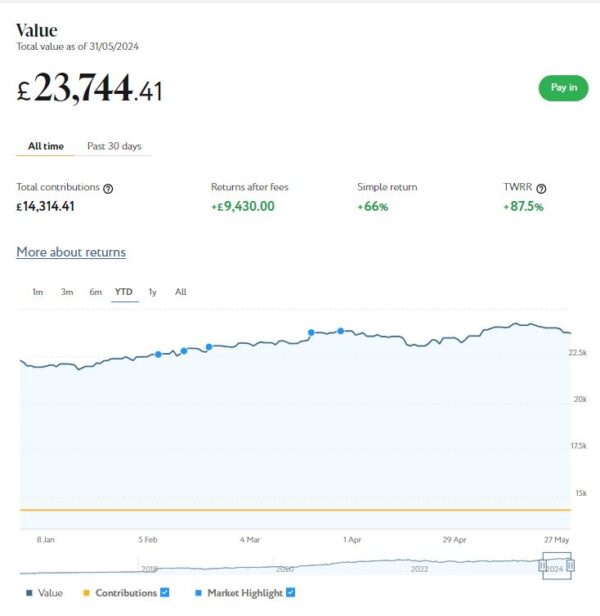
As the screenshot below for the year to date shows, my main Nutmeg portfolio is currently valued at £23,744. Last month it stood at £23,502, so that is an increase of £242.

Nutmeg main port June 24

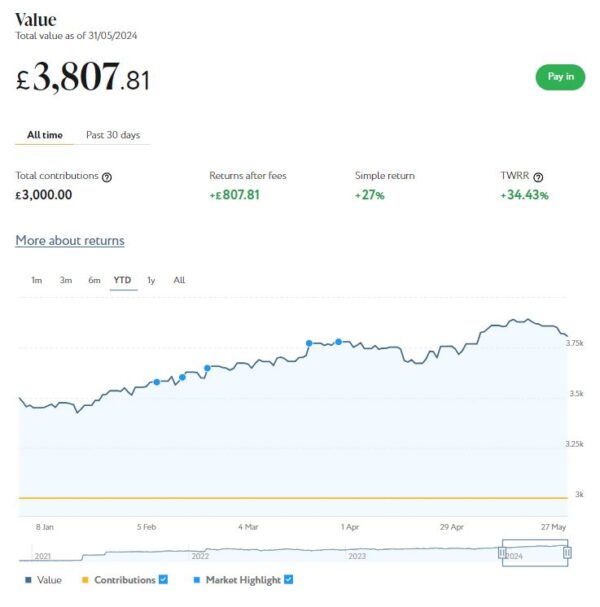
Apart from my main portfolio, I also have a second, smaller pot using Nutmeg’s Smart Alpha option. This is now worth £3,808 (rounded up) compared with £3,760 a month ago, a rise of £48. Here is a screen capture showing performance over the year to date.

Nutmeg Smart Alpha June 2024

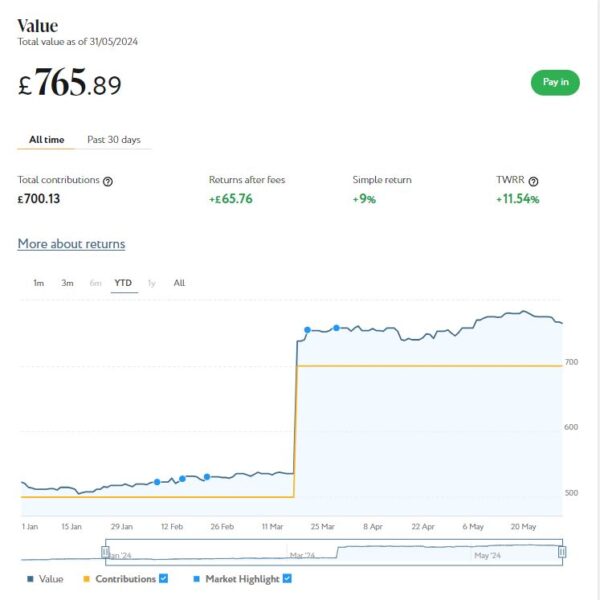
Finally, at the start of December 2023 I invested £500 in one of Nutmeg’s new thematic portfolios (Resource Transformation). In March I also invested a further £200 from ‘Refer a Friend’ bonuses. As you can see from the screen capture below, this portfolio is now worth £766 (rounded up) compared with £755 last month, a small rise of £11.

Nutmeg thematic port June 2024

As you can see from the charts, May was an up-and-down month for my Nutmeg investments. In the the middle of the month all my portfolios were up substantiaily, but since then they have fallen back a bit. Overall, however, I am still up by £301 over the month, so it could be worse! It’s also worth observing that their overall value has risen by £1,693 or 6.85% since the start of the year (not counting the £200 bonus I invested in my thematic portfolio in March).

You can read my full Nutmeg review here. If you are looking for a home for your annual ISA allowance, based on my overall experience over the last eight years, they are certainly worth considering. They offer self-invested personal pensions (SIPPs), Lifetime ISAs and Junior ISAs as well.

  • You may like to note that, for various reasons I won’t go into here, I am no longer an affiliate for Nutmeg. That means you won’t find any affiliate links in my review (or anywhere else on PAS). And you will no longer see the no-fees-for-six-months offer I used to be able to promote as an affiliate. However, the better news is that you can still get six months free of any management fees by registering with Nutmeg via my Refer a Friend link. I will receive a gift voucher if you do this, which is duly appreciated 🙂

Don’t forget, also, that the new tax year began on 6 April 2024 and and you now have a whole new £20,000 tax-free ISA allowance for 2024/25. In a change to the rules, you can now open any number of ISAs with different providers in the same tax year, as long as you don’t exceed your overall £20,000 allowance. So opening a stocks and shares ISA with Nutmeg won’t prevent you from also opening one with another S&S ISA provider (should you so wish) later in the financial year.

Moving on, I also have investments with the property crowdlending platform Kuflink. They continue to do well, with new projects launching every week. I withdrew £250 from my Kuflink account last month after a couple of loans were repaid. I currently have around £1,330 invested with them in 8 different projects paying interest rates averaging around 7%. I also have £20 remaining in my Kuflink cash account.

To date I have never lost any money with Kuflink, though some loan terms have been extended once or twice. On the plus side, when this happens additional interest is paid for the period in question.

There is now an initial minimum investment of £1,000 and a minimum investment per project of £500. Kuflink say they are doing this to streamline their operation and minimize costs. I can understand that, though it does mean that the option to test the water with a small first investment has been removed. It also makes it harder for small investors (like myself) to build a well-diversified portfolio on a limited budget.

One possible way around this is to invest using Kuflink’s Auto/IFISA facility. Your money here is automatically invested across a basket of loans over a period from one to five years. Interest rates range from 7% to around 10%, depending on the length of term you choose. Full up-to-date details can be found on the Kuflink website.

You can invest tax-free in a Kuflink Auto IFISA. Or if you have already used your annual ISA allowance elsewhere, you can invest via a taxable Auto account. You can read my full Kuflink review here if you wish.

Moving on, my Assetz Exchange investments continue to generate steady returns. Regular readers will know that this is a P2P property investment platform focusing on lower-risk properties (e.g. sheltered housing). I put an initial £100 into this in mid-February 2021 and another £400 in April. In June 2021 I added another £500, bringing my total investment up to £1,000.

Since I opened my account, my AE portfolio has generated a respectable £184.78 in revenue from rental income. As I said in last month’s update, capital growth has slowed, though, in line with UK property values generally.

At the time of writing, 11 of ‘my’ properties are showing gains, 1 is breaking even, and the remaining 18 are showing losses. My portfolio is currently showing a net decrease in value of £31.44, meaning that overall (rental income minus capital value decrease) I am up by £153.34. That’s still a decent return on my £1,000 and does illustrate the value of P2P property investments for diversifying your portfolio. And it doesn’t hurt that with Assetz Exchange most projects are socially beneficial as well.

The overall fall in capital value of my AE investments is obviously a little disappointing. But it’s important to remember that until/unless I choose to sell the investments in question, it is largely theoretical, based on the most recent price at which shares in the property concerned have changed hands. The rental income, on the other hand, is real money (which in my case I’ve reinvested in other AE projects to further diversify my portfolio).

To control risk with all my property crowdfunding investments nowadays, I invest relatively modest amounts in individual projects. This is a particular attraction of AE as far as i am concerned (especially after Kuflink raised their minimum investment per project to £500). You can actually invest from as little as 80p per property if you really want to proceed cautiously.

  • As I noted in this recent post, Assetz Exchange is particularly good if you want to compound your returns by reinvesting rental income. This effectively boosts the interest rate you are receiving. Personally, once I have accrued a minimum of £10 in rental payments, I reinvest this money in either a new AE project or one I have already invested in (thus increasing my holding). Over time, even if I don’t invest any more capital, this will ensure my investment with AE grows at an accelerating rate and becomes more diversified as well.

My investment on Assetz Exchange is in the form of an IFISA so there won’t be any tax to pay on profits, dividends or capital gains. I’ve been impressed by my experiences with Assetz Exchange and the returns generated so far, and intend to continue investing with them. You can read my full review of Assetz Exchange here. You can also sign up for an account on Assetz Exchange directly via this link [affiliate]. Note that as from this financial year (2024/25), you can open more than one IFISA per year.

In 2022 I set up an account with investment and trading platform eToro, using their popular ‘copy trader’ facility. I chose to invest $500 (then about £412) copying an experienced eToro trader called Aukie2008 (real name Mike Moest).

In January 2023 I added to this with another $500 investment in one of their thematic portfolios, Oil Worldwide. I also invested a small amount I had left over in Tesla shares.

As you can see from the screen captures below, my original investment totalling $1,022.26 is today worth $1,301.38 an overall increase of $279.12 or 27.30%.

Etoro Home June 2024

Etoro port JUne 24

You can read my full review of eToro here. You may also like to check out my more in-depth look at eToro copy trading. I also discussed thematic investing with eToro using Smart Portfolios in this recent post. The latter also reveals why I took the somewhat contrarian step of choosing the oil industry for my first thematic investment with them.

  • eToro also offer the free eToro Money app. This allows you to deposit money to your eToro account without paying any currency conversion fees, saving you up to £5 for every £1,000 you deposit. You can also use the app to withdraw funds from your eToro account instantly to your bank account. I tried this myself and was impressed with how quickly and seamlessly it worked. You can read my blog post about eToro Money here. Note that it can also serve as a cryptocurrency wallet, allowing you to send and receive crypto from any other wallet address in the world.

I had four more articles published in April on the excellent Mouthy Money website. The first is Earn Extra Money From Online Surveys. In this article I highlight how anyone can use this method to boost their bank balance for very little effort. I set out five well-established online survey sites I use myself to get you started.

Also in April Mouthy Money published my article How to Start a Business with a Franchise. In this I discussed the various attractions of starting a business with a franchise. And I shared some tips on choosing the best franchise for you and how to get the most out of it.

Also in Mouthy Money last month I revealed How to Track Down Old Investments and Bank Accounts using a platform called Gretel. Gretel is quick and easy to use, and free of charge for individuals (Gretel make their money from the banks and other financial institutions they work with). As well as using it for yourself, you can track down lost and missing assets for people you are associated with. Examples might include deceased persons where you are acting as executor, or people for whom you have financial power of attorney.

Finally, Mouthy Money published my article Should You Get Home Storage Batteries? In this I made the point that only a few years ago home storage batteries were very costly and hard for most people to justify. Times have changed, however, with the price of batteries falling while the cost of electricity has risen dramatically. So in this article I examined the case for purchasing a battery energy storage system (or BESS as it’s sometimes called). This applies principally if you have solar PV panels (or plan to get them) but may still be relevant to you even if you don’t.

As I’ve said before, Mouthy Money is a great resource for anyone interested in money-making and money-saving. I am a particular fan of my fellow MM contributor and money blogger Shoestring Jane. She writes mainly about money saving and frugal living. Her latest article sets out various ways you may be able to Save Money in the Sunshine. Let’s hope we actually get some soon! You can see all of Jane’s articles for Mouthy Money via this web page.

I also published several posts on Pounds and Sense in May. In My Short Break on the Isle of Man I talked about my recent holiday on this lovely and under-appreciated island between England and Ireland. It’s less than an hour by plane from most UK airports, or you can get a ferry from Liverpool or Heysham. I went on a heritage-railway-themed break with Newmarket Travel, which I thoroughly enjoyed and recommend. Read the article for more details 🙂

Also in May I published Twenty Great Ways to Make Extra Money From Home. This is a fully revised and updated version of my original post of this title. As you will gather, it sets out twenty ways you may be able to make a few pounds extra every month to help boost your finances. None of these methods is likely to make you a fortune, but together they can certainly help keep your bank balance ticking over.

Finally, with an eye to the General Election on Thursday 4th July 2024, I published How to Apply for a Postal Vote. As Pounds and Sense is aimed primarily at over-fifties, I wanted to encourage my readers to apply for a postal vote if this might help them exercise their democratic right to vote. Having a postal vote means that if ill health, frailty or disability prevent you getting to a polling station, you still have the chance to express your political preference. Likewise, you won’t have to worry about obstacles such as bad weather or lack of transport to get to the polling station. There is still time to apply for a postal vote if you wish but you need to move smartly now. This article will tell you everything you need to know.

Also this year I became a regular contributor to Over 60s Discounts. You can read my latest article here: Set Sail for the Sun! Ten Tips for Older Cruisers. As you will gather, this is intended for older people (especially) who are considering going on a cruise – maybe for the first time – to help them get the most from it.

I highly recommend registering at Over 60s Discounts, by the way – they list a growing range of discounts and bonuses for older people, including some that are unique to O60D.

Next, a few odds and ends. One is that I recently invested some money (just over £1,000) in a Scottish wind farm project via a platform called Ripple Energy. The way this works is that you pay a one-off fee towards building the wind farm, and in exchange receive lower-cost, ‘green’ electricity once the wind farm is up and running. This will continue for the life of the wind farm (an estimated 20 years).

If you’re interested in learning more, you can visit the Ripple website via my referral link. If you then decide to invest yourself, you will get a £25 bonus credited to your account when generation starts (and so will I). Note that you will need to invest a minimum of £1,000 to qualify for the £25 bonus, but you can invest from as little as £25 if you like.

Also, I recently invested a small amount (£500) via a property loan investment platform called Crowdstacker. I have followed Crowdstacker for some time but never got around to investing with them. They are somewhat similar to Kuflink, but their minimum investment per project is lower (just £100) which makes building a diversified portfolio easier. In addition, rates of return are higher, typically 12% to 16%. Obviously higher returns are generally associated with higher risks, and it’s important to bear this in mind when investing – though as all loans are secured against property, you do have some protection. All investments are available in the form of a tax-free IFISA within your overall £20,000 annual ISA allowance.

Crowdstacker doesn’t have a referral programme as far as I know, so I am just sharing this info out of interest. If anyone has any questions or comments about Crowdstacker, feel free to leave them below as usual.

In addition, you might remember that a few weeks ago I published a post about a service called Gubbed. This is a no-cost, no-risk opportunity to make at least £1,000 (tax-free). I just need to mention that for operational reasons Gubbed have temporarily stopped taking on new clients. This will not affect existing clients (including several PAS readers), who will still receive their guaranteed minimum £1,000 payouts in due course. But for the time being I have removed any advertising for Gubbed from Pounds and Sense. I will of course let readers know via Facebook and Twitter/X (see below) when they reopen to new clients.

UPDATE 5 June 2024 – Gubbed have now reopened to new applications. Here’s a link to my blog post about this opportunity again.

Finally, my usual reminder that you can also follow Pounds and Sense on Facebook or Twitter/X. Twitter/X is my number one social media platform these days and I post regularly there. I share the latest news and information on financial (and other) matters, and other things that interest, amuse or concern me. So if you aren’t following my PAS account, you are definitely missing out!

That’s all for today. As always, if you have any comments or queries, feel free to leave them below. I am always delighted to hear from PAS readers 🙂

Disclaimer: I am not a qualified financial adviser and nothing in this blog post should be construed as personal financial advice. Everyone should do their own ‘due diligence’ before investing and seek professional advice if in any doubt how best to proceed. All investing carries a risk of loss. Note also that posts on PAS may include affiliate links. If you click through and perform a qualifying transaction, I may receive a commission for introducing you. This will not affect the product or service you receive or the terms you are offered, but it does help support me in publishing PAS and paying my bills. Thank you!
If you enjoyed this post, please link to it on your own blog or social media:
Investments Update March 2024

My Investments Update March 2024

Here is my latest monthly update about my investments. You can read my February 2024 Investments Update here if you like

I’ll begin as usual with my Nutmeg Stocks and Shares ISA. This is the largest investment I hold other than my Bestinvest SIPP (personal pension).

As the screenshot below for the last 12 months shows, my main Nutmeg portfolio is currently valued at £ £22,994. Last month it stood at £22,386 so that is a welcome increase of £608.

Nutmeg main port March 2024

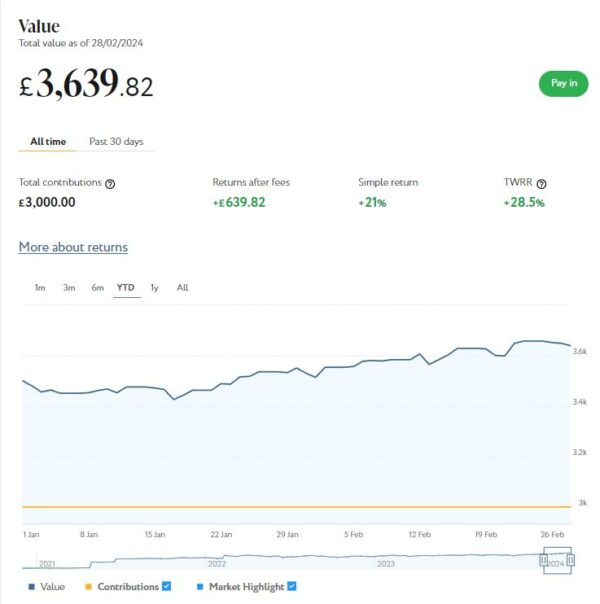
Apart from my main portfolio, I also have a second, smaller pot using Nutmeg’s Smart Alpha option. This is now worth £3,640 compared with £3,530 a month ago, a rise of £110. Here is a screen capture showing performance over the last 12 months.

Nutmag Smart Alpha port March 2024

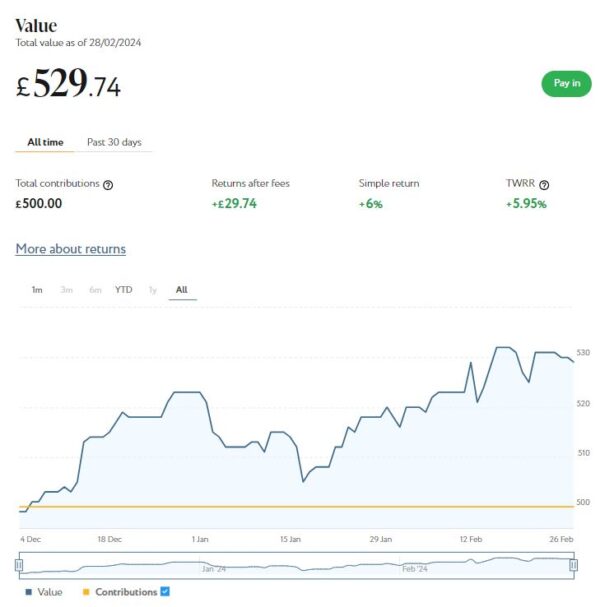
Finally, at the start of December 2023 I invested £500 in one of Nutmeg’s new thematic portfolios (Resource Transformation). As you can see from the screen capture below, this is now worth £530, an increase of £11 since last month and £30 or 6% over the three-month period since I first invested.

Nutmeg thematic port Mar 2024

February was obviously a good month for my Nutmeg investments. Overall I was up £737 or 2.79%. In these turbulent times I am more than happy with that.

You can read my full Nutmeg review here. If you are looking for a home for your annual ISA allowance, based on my overall experience over the last seven years, they are certainly worth considering. They offer self-invested personal pensions (SIPPs), Lifetime ISAs and Junior ISAs as well.

  • Don’t forget, the current tax year ends on 5 April 2024 and after that the 2023/24 tax-free ISA allowance of £20,000 will be gone forever!

I also have investments with the property crowdlending platform Kuflink. They continue to do well, with new projects launching every week. I currently have around £1,570 invested with them in 10 different projects paying interest rates averaging around 7%. I also have £14 in my Kuflink cash account.

To date I have never lost any money with Kuflink, though some loan terms have been extended once or twice. On the plus side, when this happens additional interest is paid for the period in question.

There is now an initial minimum investment of £1,000 and a minimum investment per project of £500. Kuflink say they are doing this to streamline their operation and minimize costs. I can understand that, though it does mean that the option to test the water with a small first investment has been removed. It also makes it harder for small investors (like myself) to build a well-diversified portfolio on a limited budget.

One possible way around this is to invest using Kuflink’s Auto/IFISA facility. Your money here is automatically invested across a basket of loans over a period from one to five years. Interest rates range from 7% to around 10%, depending on the length of term you choose. Full up-to-date details can be found on the Kuflink website.

You can invest tax-free in a Kuflink Auto IFISA. Or if you have already used your annual iFISA allowance elsewhere, you can invest via a taxable Auto account. You can read my full Kuflink review here if you wish.

Moving on, my Assetz Exchange investments continue to generate steady returns. Regular readers will know that this is a P2P property investment platform focusing on lower-risk properties (e.g. sheltered housing). I put an initial £100 into this in mid-February 2021 and another £400 in April. In June 2021 I added another £500, bringing my total investment up to £1,000.

Since I opened my account, my AE portfolio has generated a respectable £168.53 in revenue from rental income. As I said in last month’s update, capital growth has slowed, though, in line with UK property values generally.

At the time of writing, 10 of ‘my’ properties are showing gains, 4 are breaking even, and the remaining 15 are showing losses. My portfolio is currently showing a net decrease in value of £40.01, meaning that overall (rental income minus capital value decrease) I am up by £128.52. That’s still a decent return on my £1,000 and does illustrate the value of P2P property investments for diversifying your portfolio. And it doesn’t hurt that with Assetz Exchange most projects are socially beneficial as well.

The overall fall in capital value of my AE investments is obviously a little disappointing. But it’s important to remember that until/unless I choose to sell the investments in question, it is largely theoretical, based on the most recent price at which shares in the property concerned have changed hands. The rental income, on the other hand, is real money (which in my case I’ve reinvested in other AE projects to further diversify my portfolio).

To control risk with all my property crowdfunding investments nowadays, I invest relatively modest amounts in individual projects. This is a particular attraction of AE as far as i am concerned (especially now that Kuflink have raised their minimum investment per project to £500). You can actually invest from as little as 80p per property if you really want to proceed cautiously.

  • As I noted in this recent post, Assetz Exchange is particularly good if you want to compound your returns by reinvesting rental income. This effectively boosts the interest rate you are receiving. Personally, once I have accrued a minimum of £10 in rental payments, I reinvest this money in either a new AE project or one I have already invested in (thus increasing my holding). Over time, even if I don’t invest any more capital, this will ensure my investment with AE grows at an accelerating rate.

My investment on Assetz Exchange is in the form of an IFISA so there won’t be any tax to pay on profits, dividends or capital gains. I’ve been impressed by my experiences with Assetz Exchange and the returns generated so far, and intend to continue investing with them. You can read my full review of Assetz Exchange here. You can also sign up for an account on Assetz Exchange directly via this link [affiliate].

In 2022 I set up an account with investment and trading platform eToro, using their popular ‘copy trader’ facility. I chose to invest $500 (then about £412) copying an experienced eToro trader called Aukie2008 (real name Mike Moest).

In January 2023 I added to this with another $500 investment in one of their thematic portfolios, Oil Worldwide. I also invested a small amount I had left over in Tesla shares.

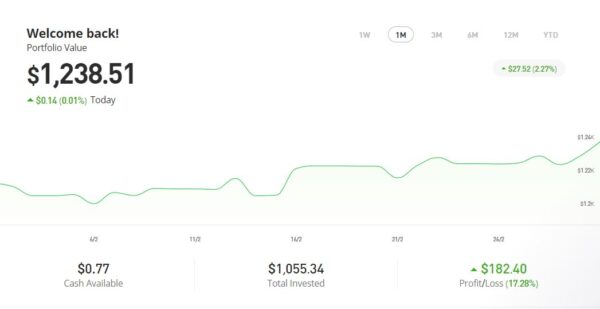
As you can see from the screen captures below, my original investment totalling $1,022.26 is today worth $1,238.51, an overall increase of $216.25 or 21.15%.

eToro Welcome March 2024

eToro port March 2024

You can read my full review of eToro here. You may also like to check out my more in-depth look at eToro copy trading. I also discussed thematic investing with eToro using Smart Portfolios in this recent post. The latter also reveals why I took the somewhat contrarian step of choosing the oil industry for my first thematic investment with them.

  • eToro also offer the free eToro Money app. This allows you to deposit money to your eToro account without paying any currency conversion fees, saving you up to £5 for every £1,000 you deposit. You can also use the app to withdraw funds from your eToro account instantly to your bank account. I tried this myself and was impressed with how quickly and seamlessly it worked. You can read my blog post about eToro Money here. Note that it can also serve as a cryptocurrency wallet, allowing you to send and receive crypto from any other wallet address in the world.

I had three more articles published in January on the excellent Mouthy Money website. The first is How to Save Money on Motoring. Like everything else in life the cost of motoring is going up and up, so in this article I set out a variety of ways – from ride-sharing to driving for fuel economy – you may be able to reduce it.

Also in February Mouthy Money published Are You Making the Most of Your Annual ISA Allowance?. As mentioned earlier, the 2023/24 tax year ends in just a few weeks’ time. And after that the £20,000 tax-free ISA allowance for that year will be gone forever. In this article I describe the different types of ISA – Cash ISA, Stocks and Shares ISA, Innovative Finance ISA (IFISA) and Lifetime ISA (LISA) – and explain how they work and the differences between them. I also provide some tips and advice for making the most of your annual ISA allowance.

My final article published on Mouthy Money last month was Can You Save Money on Your Shopping with JamDoughnut? Regular PAS readers will know that I am a fan of the JamDoughnut app, which enables you to save up to 20% on purchases with a growing range of retailers. The article also reveals how you can get a £2 head-start by using my referral code.

As I’ve said before, Mouthy Money is a great resource for anyone interested in money-making and money-saving. I am a particular fan of my fellow MM contributor and money blogger Shoestring Jane. She writes mainly about money saving and frugal living. Her latest article Frugal Skills to Save You Money sets out a selection of life skills that can save you money (and aren’t hard to learn). You can see all of Jane’s articles for Mouthy Money via this web page.

I also published several posts on Pounds and Sense in February. I won’t bother mentioning those that are no longer relevant now, but the others are listed below.

In Get Your Will Written Free of Charge in March I revealed how you can get your will written (or updated) free of charge during Free Wills Month. This regular event supports a range of leading charities. Obviously the hope is that you will include a bequest to charity in your will, but there is absolutely no obligation to do this. Free Wills Month is now up and running. If you want to take advantage and get your will written free, I recommend acting now as there are only limited spots available.

Also in March I published a guest post titled Building Your Own Home – It’s Not Just for the Super Rich! This post was written on behalf of Suffolk Building Society, who are trying to raise awareness of the self-build option in the UK. As they say in the article, they can provide mortgages to purchase land suitable for self-build projects. SBS emphasize that this option is suitable and available for ‘ordinary people’, not just the super-rich folk you see on TV shows like Grand Designs!

I also published Saving for a Rainy Day or a Stormy Breakup? The Surprising Facts About Secret Savings Accounts. This post is based on some eye-opening research from my friends at Smart Money People, which revealed (among other things) that one in ten people in a serious relationship, including marriage, civil partnerships, or cohabitation, maintain a secret savings account. Find out more in this post.

Finally, in What is AER and Why Is It Important to Savers and Investors? I revealed what AER is and why both savers and investors need to understand it. This was really a follow-up to my article last month about the importance of compounding to investors. The article reveals how more frequent compounding increases AER (annual equivalent rate) and includes the formula used to calculate this.

  • Also, from January this year I became a regular contributor to the new Over 60s Discounts website. You can read my latest article here: Who Cares for the Carers? This is about help available for unpaid carers in the UK, both financial and practical. I highly recommend registering at Over 60s Discounts, by the way – they list a growing range of discounts and bonuses for older people, including some that are unique to O60D.

One other thing is that this month I switched my Santander 123 Lite current account to a Santander Edge current account. I will try to find time to write a separate post about this soon. But briefly, my main reason was because having an Edge current account allows you to open an Edge savings account, which offers a market-leading 7% interest rate (AER) for amounts of up to £4,000 for one year (it then falls to 4.5% AER).

The Santander Edge account has slightly higher fees (£3 a month as opposed to £2) and the cashback on offer is slightly less. However, when I crunched the numbers, the value of having an Edge savings account easily outweighed this. Though I am fortunate in that I had £4,000 I could put into it immediately from another, lower-paying savings account. If I hadn’t had that, it wouldn’t have been worth switching to the Edge account.

Finally, a quick reminder that you can also follow Pounds and Sense on Facebook or Twitter/X. Twitter/X is my number one social media platform these days and I post regularly there. I share the latest news and information on financial (and other) matters, and other things that interest, amuse or concern me. So if you aren’t following my PAS account, you are definitely missing out!

That’s all for today. As always, if you have any comments or queries, feel free to leave them below. I am always delighted to hear from PAS readers 🙂

Disclaimer: I am not a qualified financial adviser and nothing in this blog post should be construed as personal financial advice. Everyone should do their own ‘due diligence’ before investing and seek professional advice if in any doubt how best to proceed. All investing carries a risk of loss.
Note also that posts may include affiliate links. If you click through and perform a qualifying transaction, I may receive a commission for introducing you. This will not affect the product or service you receive or the terms you are offered, but it does help support me in publishing PAS and paying my bills. Thank you!

If you enjoyed this post, please link to it on your own blog or social media:
Building Your Own Home - Its Not Just for the Super-Rich!

Building Your Own Home – It’s Not Just for the Super-Rich!

Today I have a guest post for you on behalf of my friends at Suffolk Building Society

SBS are keen to demystify self-build and show it’s not just for wealthy people on Grand Designs!

As part of this, they recently commissioned research which highlights the misconceptions that still exist about self-build. The research was undertaken among 2,000 UK adults by Opinium on behalf of Suffolk Building Society. 

Read on to discover how self-build may be more accessible than you think…


According to research from Suffolk Building Society, over two-thirds (69%) of potential self-builders do not know that some mortgage lenders will allow them to borrow to purchase land where planning permission has been granted.

Correspondingly, concern over financing a project was the number one barrier for those interested in self-build: other concerns were around seeking planning permission and difficulties in finding suitable land.

The Society believes the lack of awareness about being able to borrow for land may discourage people from considering self-build. Many incorrectly believe they either need to be sufficiently cash-rich to fund the land themselves before applying for a self-build mortgage, or be gifted a plot from land-owning family members.

Suffolk Building Society is aiming to normalize self-build and, in doing so, wants more people to know that self-build is a viable option for those with modest budgets. Its recent research found that over half (54%) of those who are considering a self-build at some point in the future believe that self-build is still reserved only for the very wealthy.

Richard Norrington, Chief Executive at Suffolk Building Society said: “Self-build television series undoubtedly make for great viewing, but they do set the bar remarkably high. One could easily assume that self-build is only for those with unlimited time and deep pockets. 

“Self-build is considered a fairly standard route to home ownership in countries such as Hungary, France, and Sweden, and with better education and awareness, self-build could become more mainstream here in the UK too.”

Who Is Considering Self Build and Why?

The cost of living crisis has not significantly dampened people’s appetite for self-build: a third of people are still considering self-build, which is only a small decrease from 35% last time this survey was undertaken in July 2020.

The propensity to consider a self-build decreases with age: younger people in their 20s (60%) and 30s (56%) are significantly more interested than those in their 50s (16%) and 60s (7%), dispelling the myth that self-build is a project for retirement.

Of those considering self-build, 31% would prefer to go for a completely new build, 27% said they would opt for a knockdown/rebuild project, and 21% said they would undertake a major renovation to an existing property.

The main motivation cited by over a quarter (28%) was the ability to design the layout of their own home, but this is a significant drop from 51% in 2020. There was a broader range of reasons evident in this year’s research, including self-build being a more affordable way of creating an ideal home (15%) and having a home in the right location (12%). One in ten (9%) of those considering a self-build are doing so to create a home suitable for multiple generations under one roof.

Over four in five (83%) want to make eco-friendly decisions about their future property. However, of these, seven in ten would only prioritize this if it was within their budget. This is, of course, reflective of the current economic environment.

Self Build Register Awareness

The Self-build and Custom Housebuilding Act 2015 requires each relevant local authority to keep a register of individuals who are seeking to acquire serviced plots of land in the authority’s area for their self-build project.

Data published on 31 March 2023 showed a decline in individuals joining the Self Build Registers, which tallies with the research from Suffolk Building Society:

Only one in five potential self-builders (21%) are signed up to the Self Build Register and 41% of those considering self-build had not even heard of the Self Build Register. 

Richard Norrington said: “The National Custom and Self Build Association campaigned diligently for the Self Build Registers in a bid to facilitate a greater number of self-build homes. But so far, this has not been realized. The Registers need promoting alongside resources that help people understand all that a self-build entails as, despite the current economic uncertainty, there is clearly still an appetite for self-build.

“As a country, we need to normalize self-build, encouraging regular people to build good homes, thus helping to reduce the housing shortage in the process and improving the collective carbon footprint of our housing stock. 

“There are undoubtedly more hurdles in this process than in a standard house purchase – particularly at the moment with high labour and material costs. However, being able to design a property that meets your needs both in terms of function and aesthetics is hugely rewarding. We would like more people to know that some lenders are ready and willing to lend on land as well as for the build itself; and secondly, that self-build is more accessible than they might have previously thought.”


Many thanks to Suffolk Building Society for allowing me to reproduce their research – and comments about it – here.

If you would like more info about self-build mortgages from SBS, you can visit the relevant page of their website via this link. SBS say that although 80% of their members are in the east of England, the rest live across the UK.

As always, if you have any comments or questions about this article, please do leave them below.

If you enjoyed this post, please link to it on your own blog or social media:
Investments Update November 2023

My Investments Update – November 2023

Here is my latest monthly update about my investments. You can read my October 2023 Investments Update here if you like

I’ll start as usual with my Nutmeg Stocks and Shares ISA. This is the largest investment I hold other than my Bestinvest SIPP (personal pension).

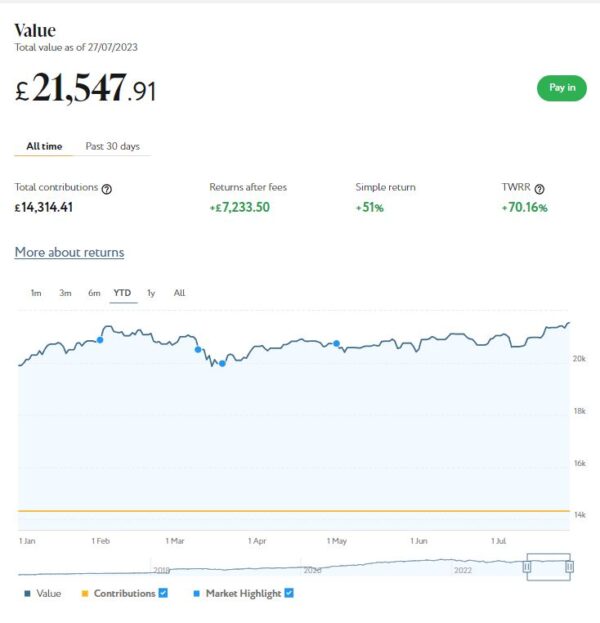
As the screenshot below for the year to date shows, my main Nutmeg portfolio is currently valued at £20,214. Last month it stood at £20,945 so that is a fall of £731.

Nutmeg main port Nov 23

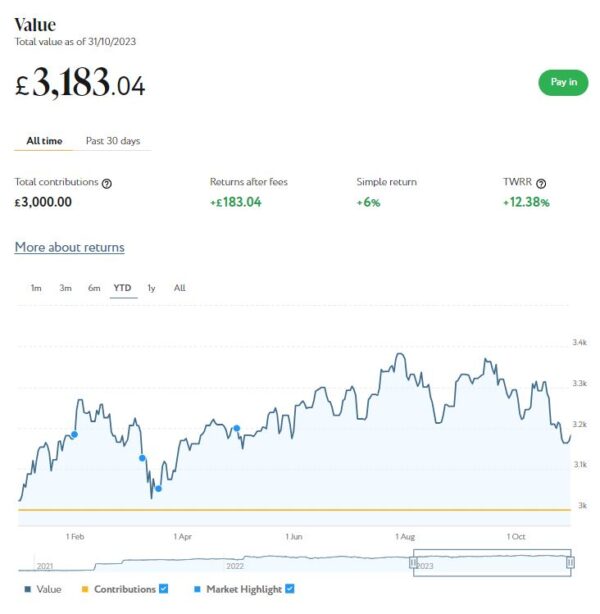
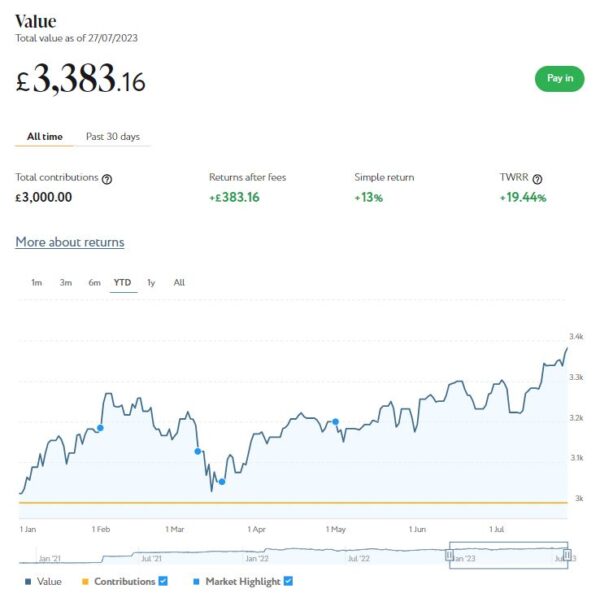
Apart from my main portfolio, I also have a second, smaller pot using Nutmeg’s Smart Alpha option. This is now worth £3,183 compared with £3,295 a month ago, a fall of £112. Here is a screen capture showing performance since the start of this year.

Nutmeg Smart Alpha pot Nov 2023

The net value of all my Nutmeg investments has fallen this month by £843 or 3.47% month on month. That’s obviously disappointing, but both pots are still up on where they were at the start of the year. Their total value has risen by £476 (2.08%) since 1st January 2023. I’m not saying that’s anything to cheer about, but due to world events nearly all stock market investments have taken a hit in the last few weeks, and Nutmeg is no exception.

As I always say, investing is (or should be) a long-term endeavour. Over a period of years stock market investments such as those used by Nutmeg typically produce better returns than cash accounts, often by substantial margins. But there are never any guarantees, and in in the short to medium term at least, losses are always possible.

As you may know, I recently revised and updated my full Nutmeg review. This was mainly to incorporate details of their new thematic investment option, but I took the opportunity to update some other information and performance stats as well.

As it says in the updated review, the new thematic style provides a globally diversified, risk adjusted portfolio with a tilt (up to 20% of equity exposure) towards your chosen theme. The majority of the portfolio will be actively managed by Nutmeg’s investment team, whilst the ’tilted’ part of the portfolio will be made up of ETFs that their investment team believes will deliver the best returns from the trend in question (to be reviewed annually).

Currently three themes are available, these being Technical Innovation, Resource Transformation and Evolving Consumer. For more details about what each of these comprises, check out the Nutmeg website.

Nutmeg thematic portfolios are only available on Risk Level 5 or above. There’s a minimum investment of £100 for Junior ISAs and Lifetime ISAs or £500 for stocks and shares ISAs and pensions. There is a 0.75% management fee.

I do quite like the new thematic styles on Nutmeg and may well be investing in one myself. They are similar in concept to the so-called smart portfolios on eToro, which I discussed in this recent blog post. Nutmeg’s thematic styles appear to be more broadly diversified, however, so may be a good choice for those who are new to thematic investing and want to dip a cautious toe in the water first.

You can read my full Nutmeg review here (including a special offer at the end for PAS readers). If you are looking for a home for your annual ISA allowance, based on my overall experience over the last seven years, they are certainly worth considering. They offer self-invested personal pensions (SIPPs), Lifetime ISAs and Junior ISAs as well.

I also have investments with the property crowdlending platform Kuflink. They continue to do well, with new projects launching every week. I currently have around £1,400 invested with them in 12 different projects paying interest rates typically around 7%. I also have just over £600 in my cash account after several loans were recently repaid.

To date I have never lost any money with Kuflink, though some loan terms have been extended once or twice. On the plus side, when this happens additional interest is paid for the period in question.

As mentioned last time, Kuflink recently changed their terms and conditions. There is now an initial minimum investment of £1,000 and a minimum investment per project of £500.

Kuflink say they are doing this to streamline their operation and minimize costs. I can understand that, though it does mean the option to ‘test the water’ with a small first investment has been removed. It will also make it harder for small investors (like myself) to build a well-diversified portfolio on a limited budget.

One possible way around this is to invest using Kuflink’s Auto/IFISA facility. Your money here is automatically invested across a basket of loans over a period from one to three years. The rates currently on offer are shown in the graphic below.

Kuflink Auto IFISA

As you may gather, you can invest tax-free in a Kuflink Auto IFISA. Or if you have already used your annual iFISA allowance elsewhere, you can invest via a taxable Auto account. You can read my full Kuflink review here if you wish.

Moving on, my Assetz Exchange investments continue to generate steady returns. Regular readers will know that this is a P2P property investment platform focusing on lower-risk properties (e.g. sheltered housing). I put an initial £100 into this in mid-February 2021 and another £400 in April. In June 2021 I added another £500, bringing my total investment up to £1,000.

Since I opened my account, my AE portfolio has generated a respectable £145.22 in revenue from rental income. As I said in last month’s update, capital growth has slowed, though, in line with UK property values generally.

At the time of writing, 6 of ‘my’ properties are showing gains, 2 are breaking even, and the remaining 16 are showing losses. My portfolio is currently showing a net decrease in value of £37.80, meaning that overall (rental income minus capital value decrease) I am up by £107.42. That’s still a decent return on my £1,000 and does illustrate the value of P2P property investments for diversifying your portfolio. And it doesn’t hurt that with Assetz Exchange most projects are socially beneficial as well.

Obviously the fall in capital value of my AE investments is disappointing. But it’s important to remember that until/unless I choose to sell the investments in question, it is largely theoretical, based on the most recent price at which shares in the property concerned have changed hands. The rental income, on the other hand, is real money (which in my case I have chosen to reinvest in other AE projects to further diversify my portfolio).

To control risk with all my property crowdfunding investments nowadays, I invest relatively modest amounts in individual projects. This is a particular attraction of AE as far as i am concerned (especially now that Kuflink have raised their minimum investment per project to £500). You can actually invest from as little as 80p per property if you really want to proceed cautiously.

My investment on Assetz Exchange is in the form of an IFISA so there won’t be any tax to pay on profits, dividends or capital gains. I’ve been impressed by my experiences with Assetz Exchange and the returns generated so far, and intend to continue investing with them. You can read my full review of Assetz Exchange here. You can also sign up for an account on Assetz Exchange directly via this link [affiliate].

Last year I set up an account with investment and trading platform eToro, using their popular ‘copy trader’ facility. I chose to invest $500 (then about £412) copying an experienced eToro trader called Aukie2008 (real name Mike Moest).

In January 2023 I added to this with another $500 investment in one of their thematic portfolios, Oil Worldwide. I also invested a small amount I had left over in Tesla shares.

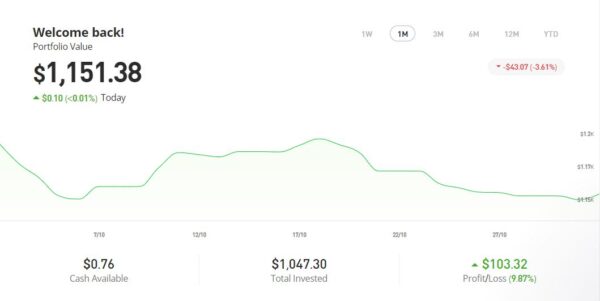
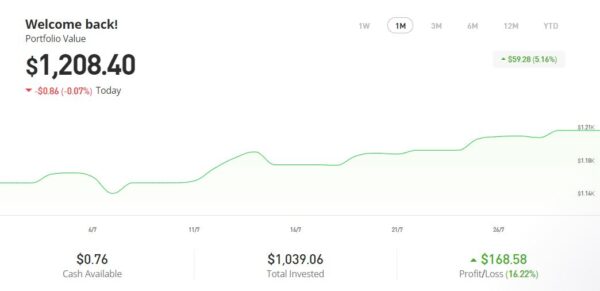
As you can see from the screen captures below, my original investment totalling $1,022.26 is today worth $1,151.38, an overall increase of $129.12 or 12.63%. in these turbulent times I am happy enough with that.

eToro portfolio 1

eToro portfolio 2

Incidentally, if you’re wondering what the bottom item in the list is (PRX.NV), it’s a partial share in Dutch internet company Prosus NV. I don’t honestly know where this has come from – it’s not something I deliberately bought. I assume it may be some sort of bonus from eToro, or maybe it’s connected with my copy trading account with Dutch investor Mike Moest. But I’m happy to have it in my portfolio, obviously!

You can read my full review of eToro here. You may also like to check out my more in-depth look at eToro copy trading. I also discussed thematic investing with eToro using Smart Portfolios in this recent post. The latter also reveals why I took the somewhat contrarian step of choosing the oil industry for my first thematic investment.

  • eToro also recently introduced the eToro Money app. This allows you to deposit money to your eToro account without paying any currency conversion fees, saving you up to £5 for every £1,000 you deposit. You can also use the app to withdraw funds from your eToro account instantly to your bank account. I tried this myself and was impressed with how quickly and seamlessly it worked. You can read my blog post about eToro Money here.

I had two more articles published in October on the excellent Mouthy Money website. The first was How to Make Money From Retail Deal Arbitrage. This is a relatively under-used approach to online auction trading (though you don’t necessarily have to use online auctions at all). It normally proceeds one item at a time, so you don’t need large amounts of space (or capital) for stock. You can ramp it up to multiple items later if you like, though.

I also wrote Could You Make Money as a Freelance Proofreader and Editor. This can be a great sideline, or even a full-time business, for anyone who enjoys working with words. No special tools or equipment are required, so it’s quick, cheap and easy to get started. It’s reasonably paid, and you can work from home at hours to suit yourself. It’s also suitable for older people and people with disabilities (with the one proviso that it becomes harder if – as in my own case – your eyesight isn’t as good as it once was).

I also updated my article published last month titled Will a Heat Pump Save You Money? This is obviously a hot topic and one where policy is constantly changing. I thought I should update it with the latest information about government bribes – sorry, incentives – to get one. Do take a look if you haven’t already!

As I’ve said before, Mouthy Money is a great resource for anyone interested in money-making and money-saving. I particularly like the ‘Deals of the Week’ feature compiled by Jordon Cox (‘Britain’s Coupon Kid’) which lists all the best current money-saving offers for savvy shoppers. Check out the latest edition here 🙂

I am also a fan of my fellow MM contributor and money blogger Shoestring Jane. She writes mainly about money saving and frugal living. Her articles – such as this one on Frugal Swaps to Save You Money – are always worth a read. You can see all her articles for Mouthy Money via this web page.

I also published various posts on Pounds and Sense in October. I won’t bother to mention those that are out of date now, but the rest are listed below.

Exploring the Potential of Investing in Alternative Rental Properties was a guest post by my colleague Jackie Edwards. Jackie is a semi-retired property developer and restorer. In her article she presents the case for businesses and individuals to invest in rental properties for the growing over-50s market. At the end of the article I also suggest an alternative method for those whose pockets may not be as deep to invest in this field.

I also republished my post about the opportunity to Get a Free Share Worth up to £100 with Trading 212. This reopened after closing briefly. It is now available till 27 November 2023.

I also published Will You Get the Warm Home Discount? The 2023/24 WHD scheme opened in October. As last year, those eligible will receive a £150 discount off their energy bills. Most people no longer have to apply for WHD and should receive it automatically. Read the article to learn more, along with other support towards the cost of your energy bills that you may also qualify for.

Finally, I published a short post about Over 60s Discounts, a new website dedicated to helping older people save money. It’s free to sign up, and there are loads of savings, discounts and concessions on offer. Read my blog post for more info, and check out the website yourself!

On other matters, the opportunity to Get a Free ETF Share Worth up to £200 with Wealthyhood is still open. This DIY wealth-building app is aimed especially at people new to stock market investing. The minimum investment to qualify for the free share offer was raised recently from £20 to £50 – but on the plus side, they now guarantee that your free ETF share will be worth at least £10. What’s more, for the next two months Wealthyhood say they will plant a tree for every new account opened, so what’s not to like 🙂 🏝

Another thing that happened in October is that I finally got some of my money back from the Bricklane property REIT. I invested several thousand pounds in this a few years ago. At first all went well, but then came the Grenfell Tower tragedy followed by the cladding scandal.

Bricklane (or more precisely investors such as me) owned a number of properties which required (expensive) remedial work. Bricklane didn’t go into liquidation, but they felt they had no option but to sell their entire property portfolio and distribute whatever funds were generated (after all costs had been covered) to investors.

Anyway, to cut a long story short, investors in the Bricklane London fund (including me) should all now have been repaid. I got about £880 of my £1,000 investment back, which I suppose isn’t too bad considering. The Bricklane Regional Capitals fund, in which I also invested, is taking a bit longer to wind up, and I am not expecting to see any return from this until some time next year.

Finally, a quick reminder that you can also follow Pounds and Sense on Facebook or Twitter (or X as we have to learn to call it now). Twitter/X is my number one social media platform these days and I post regularly there. I share the latest news and information on financial (and other) matters, and other things that interest, amuse or concern me. So if you aren’t following my PAS account, you are definitely missing out!

That’s all for today. As always, if you have any comments or queries, feel free to leave them below. I am always delighted to hear from PAS readers 🙂

Disclaimer: I am not a qualified financial adviser and nothing in this blog post should be construed as personal financial advice. Everyone should do their own ‘due diligence’ before investing and seek professional advice if in any doubt how best to proceed. All investing carries a risk of loss.
Note also that posts may include affiliate links. If you click through and perform a qualifying transaction, I may receive a commission for introducing you. This will not affect the product or service you receive or the terms you are offered, but it does help support me in publishing PAS and paying my bills. Thank you!

If you enjoyed this post, please link to it on your own blog or social media:
Investing in Alternative Rental Properties

Guest Post: Exploring the Potential of Investing in Alternative Rental Properties

Today I have a guest article for you by my colleague Jackie Edwards

Jackie is a professional property investor and property restorer. In her article below she sets out the case for investing in alternative rental properties – in particular, for the growing over-50s market.

Over to Jackie then…


While discussion around the mortgage and rental market often focuses on younger people – particularly first-time buyers and millennials – just as important are the over 50s. 

A 2022 report in The Guardian sheds light on an alarming trend: individuals over 50 are finding themselves compelled into room-sharing arrangements, a consequence of being priced out of independent living options. The data supports this unsettling shift, citing a steep 114% surge in room search enquiries from people aged 45-55, compounded by a staggering 239% uptick in enquiries from those in the 55-64 age bracket. 

Despite being often well-experienced and highly skilled, these individuals find themselves at the mercy of a punishing housing market. This situation signals a promising investment opportunity for businesses and individuals prepared to invest in accommodation tailored for those aged over 50. Already, a handful of forward-thinking schemes across the nation are demonstrating this growing potential.

What’s Required

Of course, a range of factors need to be considered when providing bespoke housing to over-50s. Disability, for example. According to the Office of National Statistics, the incidence rate of disability increases significantly after the age of 50, and it becomes more likely that the applicant will need adaptations to their accommodation.

As anyone living with a disability will know, it can be difficult to find accessible housing. According to disability advocates Eachother.org.uk, only 9% of UK rentals are suitable for people with a disability. Landlords that can prepare and provide accessible accommodation, at reasonable asking prices, will be providing a valuable service which is very much in demand.

What a Rental Requires

With that in mind, it’s important to consider the specific needs of the 50s-and-over market. According to PropertyRoad.co.uk, 15% of all rentals are now occupied by people over 50, an increase of 61% from the previous recorded figures in 2012. This may not necessarily be a bad thing, however.

In the Guardian’s survey of the renting situation, an interesting factor was highlighted. While many older people are pushed into renting as a result of rising costs, many others actually prefer the flexibility of not being tied to a mortgage and, crucially, the feeling of community that comes with communal living. 

One scheme the Evening Standard highlights is a house sharing scheme that specifically matches up younger and older people, with company the key factor, but with a degree of agreement from the younger party to assist with chores and housework.

Intermediate Rent

As highlighted by ShareToBuy.com, intermediate rent is a scheme where renters agree to charge lower rentals (generally at least 20% below the standard private market rates in the area) in exchange for longer-term contracts. For the younger generation who may be looking to move around a lot, these schemes are less attractive. For over 50s, who are happy in one area and looking for something affordable for the medium to long term, it may well be an excellent option. 

What is crucial is that landlords and property businesses offer these properties more widely in bespoke packages for over 50s. Currently the market in such properties is very limited, though a few smaller companies and organizations have embraced this challenge. They include Cohabitas, certain schemes on Spareroom, Flatmates.co.uk and RoomPortal.

More needs to be done with alternative rental accommodation for this niche – yet rapidly growing – demographic. A lot of focus is placed on millennials, but much more needs to be done for older renters, to help them find high-quality and long-lasting accommodation. For landlords and businesses who want to generate a stable rental income while also offering a valuable service to older individuals, this could represent a very appealing proposition.

About the author: A career in property investing led Jackie Edwards to develop a passion for restoring old homes. And even in her free time, she’s renovating her own with her husband. They’re both semi-retired (though by no means retirement age) and to keep her interest alive Jackie writes articles on home and lifestyle. In any free time she has, she’s walked by her two dogs Barker and Corbett and she volunteers for a local foodbank.


Many thanks to Jackie for an interesting and thought-provoking article. 

Obviously not everyone will have the money to invest in alternative rental accommodation directly. If, however, you are attracted to the idea of investing in this sector, a more affordable option is presented by Assetz Exchange

Assetz Exchange is a P2P property crowdfunding platform. They focus on lower-risk, socially beneficial accommodation, such as supported housing for people with physical or mental disabilities. 

Properties are bought jointly by investors under the usual crowdfunding/P2P model. Most are then leased to charities and housing associations. This means they are securely funded and there is a low risk of defaults.

Of course, defaults could still happen in certain circumstances – but as investors jointly own the property in question, ultimately you could still expect to get your capital (or most of it) back when the property is sold.

I have been investing with Assetz Exchange since February 2021 and have gradually built up the amount I have with them. I put an initial £100 into AE in February 2021 and another £400 in April. In June 2021 I added another £500, bringing my total investment up to £1,000. Since I opened my account, my AE portfolio has generated £143.56 in revenue from rentals. That’s a decent rate of return on my £1,000 (staged) investment and does illustrate the value of P2P property investment for diversifying your portfolio when equity markets are volatile (as at the moment).

I now have investments in 23 different projects and all are generating rental income as expected. Capital values have declined slightly overall – in line with the UK property market generally – but of course this isn’t really relevant until or unless you want to sell up. Overall I am very happy with how my AE investment has been doing, and the fact that projects are generally beneficial to society as well.

To control risk with all my property crowdfunding investments nowadays, I invest relatively modest amounts in individual projects. This is a particular attraction of AE as far as I am concerned. You can actually invest from as little as 80p per property if you really want to proceed cautiously.

My investment on Assetz Exchange is in the form of an IFISA so there won’t be any tax to pay on profits, dividends or capital gains. I’ve been impressed by my experiences with Assetz Exchange and the returns generated so far, and intend to continue investing with them. You can read my full review of Assetz Exchange here. You can also sign up for an account on Assetz Exchange directly via this link [affiliate].

As always, if you have any comments or questions about this article, you are very welcome to post them below. 

Disclaimer: I am not a qualified financial adviser and nothing in this blog post should be construed as personal financial advice. Everyone should do their own ‘due diligence’ before investing and seek professional advice if in any doubt how best to proceed. All investing carries a risk of loss.

Note also that posts may include affiliate links. If you click through and perform a qualifying transaction, I may receive a commission for introducing you. This will not affect the product or service you receive or the terms you are offered, but it does help support me in publishing PAS and paying my bills. Thank you!

If you enjoyed this post, please link to it on your own blog or social media:
English Heritage Discount Offer

English Heritage Discount Offer

A quickie today to let you know that until the end of August 2023, you can get a massive 25 percent off the cost of a new English Heritage membership if you pay by annual direct debit. This applies to all types of membership, including Over-65s (which is already discounted).

English Heritage looks after nearly 400 historic sites and buildings across England, including Stonehenge, Hadrian’s Wall, Dover Castle, the Iron Bridge in Telford (see cover photo), and more. Members get free admission to all properties. Other benefits include free parking in car parks owned by English Heritage, free or reduced-price admission to hundreds of special events, and free entry to properties for up to six children per member. You also receive a free members’ handbook and a magazine (published three times a year).

A further attraction of joining English Heritage is that they have reciprocal arrangements with Scottish Heritage and CADW in Wales. Members therefore get reduced or free admission to most properties owned by these organizations as well.

You can get current membership prices from the English Heritage website. Family, Joint, Individual and Lifetime memberships are available. To claim the current special offer discount, you have to enter the code IMAGINE50 on the online form when applying.

In my case I qualified for Over-65 membership. This would normally cost £63 a year, but with my 25% discount it was reduced to £47.25. Of course, the discount price is for one year only, but you can always cancel the direct debit before it’s due to renew if you wish.

There are various English Heritage sites near where I live. Later this week I am planning to visit Boscobel House in Staffordshire, which is only around 30 minutes’ drive from where I live. Although I have only just joined, I received a temporary membership card by email prior to my full membership pack arriving in the post. So I will be saving at least £11 straight away!

  • I duly visited Boscobel House on Thursday 18 August. My temporary membership was accepted without quibble, so I saved £11 on admission and also £3 on parking. I also discovered another benefit of English Heritage membership which I couldn’t see mentioned on the website. Once you have been a member for a year or more, you qualify for a 10% discount on any purchases in their shops or tea rooms.

English Heritage obviously has some similarities with the National Trust, but it’s an entirely separate organization and only operates in England (though see my comments above about reciprocal arrangements with organizations in Wales and Scotland).

I know from messages on social media that some people have been deterred from joining or rejoining the National Trust due to their controversial stance on some current issues (see this article, for example). So far anyway, English Heritage seem to have stuck to their core remit of looking after heritage sites and properties and avoided divisive political messaging. For those who have resigned from the National Trust or no longer wish to join, English Heritage may therefore offer an attractive alternative. Of course, there is nothing to stop you joining both if you wish!

As always, if you have any questions or comments about this post, please do leave them below.

If you enjoyed this post, please link to it on your own blog or social media:
My Investments Update August 2023

My Investments Update – August 2023

Here is my latest monthly update about my investments. You can read my July 2023 Investments Update here if you like

I’ll start as usual with my Nutmeg Stocks and Shares ISA. This is the largest investment I hold other than my Bestinvest SIPP (personal pension).

As the screenshot below for the year to date shows, my main Nutmeg portfolio is currently valued at £21,548. Last month it stood at £21,044 so that is a rise of £504.

Nutmeg main portfolio August 2023

Apart from my main portfolio, I also have a second, smaller pot using Nutmeg’s Smart Alpha option. This is now worth £3,383 compared with £3,293 a month ago, an increase of £90. Here is a screen capture showing performance since the start of this year.

Nutmeg Smart Alpha August 2023

This has clearly been another good month for both my Nutmeg pots. Their total value has risen by £594 or 2.44% month on month. Since the start of 2023 the net value of my Nutmeg investments has grown by £2,010 or 8.78%. Compared with mid-October last year that’s an impressive rise of £3,118 or 14.29%.

Of course, all investing is (or should be) a long-term endeavour. Over a period of years stock market investments such as those used by Nutmeg typically produce better returns than cash accounts, often by substantial margins. But there are never any guarantees, and in in the short to medium term at least, losses are always possible.

  • Also, as you may know, both my Nutmeg pots have quite high risk levels (9/10 main, 5/5 Smart Alpha). If you haven’t yet seen it, you might like to check out my blog post in which I looked at the performance over time of Nutmeg fully managed portfolios at every risk level from 1 to 10 . I was pretty amazed by the difference risk level makes, with higher-risk ports over almost any period of three or more years in the last ten generating significantly better overall returns. If you are investing for the long term (and you almost certainly should be) choosing a hyper-cautious low-risk level might not therefore be the smartest strategy. The one exception is if you plan to withdraw your money soon and don’t want to risk losing too much if there is a sudden downturn.

You can read my full Nutmeg review here (including a special offer at the end for PAS readers). If you are looking for a home for your annual ISA allowance, based on my overall experience over the last seven years, they are certainly worth considering. They offer self-invested personal pensions (SIPPs) and Junior ISAs as well.

I also have investments with the property crowdlending platform Kuflink. They continue to do well, with new projects launching every week. I currently have £2,185 invested with them in 18 different projects paying interest rates typically around 7%. To date I have never lost any money with Kuflink, though some loan terms have been extended once or twice. On the plus side, when this happens additional interest is paid for the period in question.

Last month a couple of my Kuflink loans were repaid, so I got my capital back with interest. I decided to withdraw about half of the proceeds to help pay for a couple of big purchases. The other half I reinvested in short-term loans on Kuflink’s secondary marketplace.

I heard this month that Kuflink are changing their terms and conditions. Specifically, from Monday 21st August there will be an initial minimum investment of £1,000 and a minimum investment per project of £500.

Kuflink say they are doing this to streamline their operation and minimize costs. I can understand their reasoning, though it does mean the option to ‘test the water’ with a small first investment has been removed. It will also make it harder for small investors (like myself) to build a well-diversified portfolio on a limited budget. As mentioned, my current portfolio of £2,185 comprises 18 different investments ranging from £50 to £200. Once the minimum £500 per project limit applies, the same amount of money would only stretch to four!

One possible way around this is to invest using Kuflink’s Auto/IFISA facility. Your money here is automatically invested across a basket of loans over a period from one to three years. The rates on offer from August 1 2023 are shown in the graphic below.

Kuflink Auto IFISA

As you may gather, you can invest tax-free in a Kuflink Auto IFISA. Or if you have already used your annual iFISA allowance elsewhere, you can invest via a taxable Auto account.

You can read my full Kuflink review here. Note that I haven’t updated the information there about minimum investments as yet, but will do so shortly. You can of course still invest smaller amounts than £500 until the August 21st deadline.

Moving on, my Assetz Exchange investments continue to generate steady returns. Regular readers will know that this is a P2P property investment platform focusing on lower-risk properties (e.g. sheltered housing). I put an initial £100 into this in mid-February 2021 and another £400 in April. In June 2021 I added another £500, bringing my total investment up to £1,000.

Since I opened my account, my AE portfolio has generated a respectable £128.32 in revenue from rental income. As I said in last month’s update, capital growth has slowed, though, in line with UK property values generally.

At the time of writing, 12 of ‘my’ properties are showing gains, 1 is breaking even, and the remaining 13 are showing losses. My portfolio is currently showing a net decrease in value of £17.46, meaning that overall (rental income minus capital value decrease) I am up by £110.86. That’s still a decent return on my £1,000 and does illustrate the value of P2P property investments for diversifying your portfolio. And it doesn’t hurt that with Assetz Exchange most projects are socially beneficial as well.

Obviously the fall in capital value of my AE investments is slightly disappointing. But it’s important to bear in mind that unless and until I choose to sell the investments in question, it is largely theoretical. The rental income, on the other hand, is real money (which in my case I have chosen to reinvest in other AE projects to further diversify my portfolio).

I also spoke to the CEO of Assetz Exchange, Peter Read, recently. He made the point that capital values on the platform simply reflect the latest price at which shares in the property concerned have changed hands on their exchange. They do not represent objective or independent valuations of the properties. If you are investing long term with AE, the annual yield from rentals is really a much more important consideration.

Peter also made the point that the current high inflation rate has actually been beneficial for Assetz Exchange investors. That is because properties on the platform generally have an annual review when rentals are increased in line with inflation. That means from the end of the financial year in April, rentals have increased in most cases by around 10%. Assetz Exchange recently published a blog post about this which is worth a read.

To control risk with all my property crowdfunding investments nowadays, I invest relatively modest amounts in individual projects. This is a particular attraction of AE as far as i am concerned (especially now that Kuflink have raised their minimum investment per project to £500). You can actually invest from as little as 80p per property if you really want to proceed cautiously.

My investment on Assetz Exchange is in the form of an IFISA so there won’t be any tax to pay on profits, dividends or capital gains. I’ve been impressed by my experiences with Assetz Exchange and the returns generated so far, and intend to continue investing with them. You can read my full review of Assetz Exchange here. You can also sign up for an account on Assetz Exchange directly via this link [affiliate].

Last year I set up an account with investment and trading platform eToro, using their popular ‘copy trader’ facility. I chose to invest $500 (then about £412) copying an experienced eToro trader called Aukie2008 (real name Mike Moest).

In January 2023 I added to this with another $500 investment in one of their thematic portfolios, Oil Worldwide. I also invested a small amount I had left over in Tesla shares.

As you can see from the screen capture below, my original investment of $1,022.26 is today worth $1,208.40, an overall increase of $186.14 or 18.20%. in these turbulent times I am very happy with that.

eToro August 23

eToro August 23 2

In the last month my Tesla shares and my copy trading portfolio with Aukie2008 have both done well. I am also pleased that my investment in Oil Worldwide is back in profit again. This has happened since the Oil Worldwide portfolio was rebalanced by eToro – which is, of course, as I hoped 🙂

You can read my full review of eToro here. You may also like to check out my more in-depth look at eToro copy trading. I also discussed thematic investing with eToro using Smart Portfolios in this recent post. The latter also reveals why I took the somewhat contrarian step of choosing the oil industry for my first thematic investment.

  • eToro also recently introduced the eToro Money app. This allows you to deposit money to your eToro account without paying any currency conversion fees, saving you up to £5 for every £1,000 you deposit. You can also use the app to withdraw funds from your eToro account instantly to your bank account. I tried this myself recently and was impressed with how quickly and seamlessly it worked. You can read my blog post about eToro Money here.

I had two more articles published in July on the excellent Mouthy Money website. The first was How to Make Money Selling Photos to Stock Photography Services. If you enjoy photography – even if only on your mobile phone – this is definitely an opportunity you should check out.

My other article was How to Find Out What Your State Pension Will Be. The state pension is a very important component of most people’s income in later life (including mine). In this article I discuss changes to the state pension age and explain how to check when you will become eligible and how much you are on track to receive. I also discuss what options you may have if your projected pension is less than you hoped.

As I’ve said before, Mouthy Money is a great resource for anyone interested in money-making and money-saving. I particularly like the ‘Deals of the Week’ feature compiled by Jordon Cox (‘Britain’s Coupon Kid’) which lists all the best current money-saving offers for savvy shoppers. Check out the latest edition here 🙂

I also published several new posts on Pounds and Sense in July. One of these was Make a Sideline Income Renting Out Your Driveway. As I explain in the article, this is a money-making opportunity that – if you’re in a position to do it – can bring you a steady income for very little effort.

Also in July I published an article explaining why it was Time to Use or Exchange Your Old Non-Barcoded Postage Stamps. That deadline has now passed, but if you still have any ordinary non-barcoded stamps lying around, as the article explains, you can still exchange them using Royal Mail’s ‘Swap Out’ scheme.

Investing Basics for Beginners is a collaborative post with my friends at the European crowdlending platform Mintos. The article sets out some basic principles for anyone who may be considering investing for the first time (though it may also be of interest to more experienced investors).

Finally in July I published Five Things I Have Learned from my eToro Virtual Portfolio. Anyone with an eToro account gets a $100,000 virtual account to practise trading and investing with. I have found this interesting and enjoyable, not to mention educational. In the article I set out five lessons learned from my virtual account that have helped inform my real-life investing decisions. I am considering publishing a further update about my virtual portfolio and how it’s doing, if there is sufficient interest in this.

Lastly, I would mention that the opportunity to Get a Free ETF Share Worth up to £200 with Wealthyhood is still open. To remind you, Wealthyhood is a DIY wealth-building app aimed especially at people new to stock market investing. As from June 2023 they changed their fee structure to make it (even) more attractive to small investors. They have now increased the minimum investment to qualify for the free share offer from £20 to £50 – but on the plus side, they guarantee that your free ETF share will be worth at least £10.

That’s all for today. I hope you’re enjoying the summer, even though July has been a damp squib in Britain compared with June. If you’re looking for some ideas for short breaks, don’t forget to check out my blog post listing some of my favourite UK holiday destinations. Here’s hoping the warm, sunny weather makes a reappearance soon…

rainy beach

As always, if you have any comments or queries, feel free to leave them below. I am always delighted to hear from PAS readers 🙂

Disclaimer: I am not a qualified financial adviser and nothing in this blog post should be construed as personal financial advice. Everyone should do their own ‘due diligence’ before investing and seek professional advice if in any doubt how best to proceed. All investing carries a risk of loss.

Note also that posts may include affiliate links. If you click through and perform a qualifying transaction, I may receive a commission for introducing you. This will not affect the product or service you receive or the terms you are offered, but it does help support me in publishing PAS and paying my bills. Thank you!

Cover image courtesy of BingAI.


If you enjoyed this post, please link to it on your own blog or social media:
My Short Break in Bath

My Short Break in Bath

I recently returned from a three-day break in the historic city of Bath. It was the first time in over 30 years I’d been to Bath, so it’s fair to say I was approaching it with fresh eyes!

I stayed in a one-bedroom self-catering apartment in a large multi-occupied property called Elmbrook. This was about twenty minutes’ walk from the centre of Bath. I arranged it through Booking.com. I’ll say a bit more about the apartment below.

For those who don’t know, Bath is on the River Avon, about 12 miles from Bristol. Here is a map of the area from Google Maps…

Accommodation

As mentioned, I stayed in a self-catering apartment in a property called Elmbrook. This was on the Weston Road, a short but pleasant walk from the centre of Bath via the Royal Victoria Park and botanical gardens.

You can read more about where I stayed on this page of the Booking.com website (and see photos). One big attraction for me was that a reserved (and free) off-road parking space was available. In Bath – as in many popular tourist areas – finding somewhere to park can be tricky.

The apartment had a good-sized master bedroom with a comfortable double bed. It had a small but perfectly adequate bathroom with a modern power shower (though, somewhat ironically, no bath). The shower worked well and there was plenty of hot water.

The lounge was quite spacious. It was at the front of the house and had a small patio leading from it. Although I didn’t use the patio during my stay, the patio door provided a quick and convenient method for getting my luggage from and to the car! The lounge had a good-quality flat-screen TV and a DVD player with a small selection of DVDs.

The kitchen was at the back of the apartment and had all the facilities you would need or expect, including a modern electric oven and hob, microwave, toaster, fridge, sink, dishwasher, washing machine, and so forth.

The apartment had central heating on a thermostat, though as it was June I didn’t need this. It had free wifi which worked perfectly during my stay (not always the case in my experience). The location was quiet and peaceful, and I slept very well.

Finally I should say that communication from my Booking.com hosts (Nigel and Alison) was excellent. Nigel sent me detailed instructions about how to get there and how to get in (I used the key safe, though he offered to meet me in person if I preferred). They also left me a welcome letter and a basket of goodies, including a bottle of wine, muesli, milk, ground coffee, and so on. That was a kind gesture and obviously much appreciated.

Financials

As Pounds and Sense is primarily a money blog, I should say a few words about this.

I paid a total of £351 (including VAT) for my three-night visit, which works out to £117 a day. I thought that was very reasonable bearing in mind the high standard of the accommodation and the convenience of the location.

Obviously as it was self-catering no meals were included and neither was there a daily housekeeping visit. But on the plus side, I got a lot more space and facilities than I would have had at a hotel, and complete privacy throughout my stay. I’d have to admit that these days I prefer to go self-catering when possible, even if I do miss hotel breakfasts a bit!

Things to Do

I won’t give you a blow-by-blow account of everything I did on my visit. I will share some highlights and personal recommendations, though.

The first thing I did was book a ticket on the Hop On, Hop Off open-top sightseeing buses. My ticket cost me just under £20 after my over-60s discount and a small reduction for booking online. The most you will pay is £22.50, though.

A ticket allows you unlimited travel on two routes, the City Tour and the Skyline Tour. As you would expect, the City Tour takes you round all the main attractions in or near the centre, including the Royal Crescent, The Circus, Bath Abbey, the Roman Baths, Theatre Royal, and so on. You can listen to a commentary that tells you some interesting facts about Bath and its history. Earphones are provided for no extra charge, and you can choose from ten different languages (including English, naturally!). I found this a great way of getting my bearings.

The Skyline Tour takes you further afield, through some of the beautiful countryside surrounding Bath. It affords some wonderful views over the city, and you get to see a range of other interesting locations, including the university, the American museum and two National Trust parks and gardens. Again, an informative commentary is available. On both tours you can get on or off at any of the stops along the route. It’s worth noting that tickets are nominally valid for 24 hours, but I was told you can use them any time over a two-day period, which potentially makes them even better value. I definitely recommend doing this.

One ‘must see’ attraction in Bath is, of course, the stunning Roman Baths that gave the city its name (see cover photo). They aren’t especially cheap to visit (I paid the discounted price of £25 plus £5 for a guidebook), but are definitely worth it. Collect a free handset as you go in. You can then key in the code numbers displayed around the buildings to hear a commentary about what is on view in any particular area. There is loads to see, so I recommend allowing a couple of hours here at least.

Another top tip for visiting the Baths is to pre-book your ticket. I made the mistake of assuming I could just pay the admission fee and walk in, but that’s not generally the case. To manage numbers, visitors have to book a timed slot. I arrived at about midday but the earliest slot available then was 3.15. So I had to book using my mobile phone and come back later. It wasn’t a problem as there were plenty of other things I wanted to see and do – but if I was going again I’d definitely book my preferred day and time well in advance. Similar advice applies to other popular attractions in Bath, including the Jane Austen Centre and the No. 1 Royal Crescent Museum, incidentally.

Another place I especially enjoyed visiting was Bath Abbey. This church and one-time Benedictine monastery in the centre of Bath goes back to the 7th century, though it has been rebuilt several times since then. It is a fine example of Gothic Perpendicular architecture and particularly noted for its beautiful fan vaulting (see my photo below). There is an admission fee but it is relatively modest at about £6.50 (no over-60s discount, I’m afraid!).

bath abbey fan vaulting

I visited the Abbey with my old friend Jeff, who lives quite near Bath. We were lucky in that when we arrived a free tour of the Abbey was just about to begin, led by a knowledgeable voiunteer guide. We found this interesting and informative, especially when he explained about the Abbey’s new underfloor heating system, which is powered by heat from the spa water!

There are some lovely – though not especially old – stained glass windows in the Abbey, as the photo below shows. There are also some informative displays and exhibitions, along with a gift shop and (free) toilets.

bath abbey stained glass window

Here are a few more quick hints and tips for visitors to Bath, based on my experience…

  • You can download an excellent free map of Bath from this website. I printed this out and found it invaluable for finding my way around.
  • Be sure to take a few 20p coins with you. Quite a few public conveniences require these 😮
  • Keep a close eye on your speed if driving around (or towards) Bath. Many of the roads have a low 20 mph limit.
  • There is also a low emission zone in Bath, though currently charges don’t apply to most private cars and motorbikes.
  • You can’t actually swim in the Roman Baths, as this is set up as a tourist attraction. There are, though, a few places you can swim in spa water, most notably the Thermae Bath Spa. Be aware this costs a minimum of £40 for a two-hour session.
  • As mentioned above, I highly recommend pre-booking visits to popular attractions. Not only will this guarantee admission at your preferred time, it may work out a bit cheaper as well.
  • But don’t miss out, either, on admiring the stunning Georgian architecture of Bath, including the famous Royal Crescent and arguably even more impressive Circus. This is something you can do for free 🙂
  • Something I didn’t do on this visit but would quite like to in future is a boat trip on the River Avon. There are various options here, including this one which combines a boat trip with a short walking tour.

Closing Thoughts

As you may gather, I enjoyed my short break in Bath, and am happy to recommend both the city and the accommodation where I stayed for a short break.

Bath is quite compact but there is plenty to see and do. As well as the historical sites, there are lots of charming cafes and coffee shops, and some highly regarded pubs and restaurants. But it can also be a great place to chill out, with lovely green spaces such as the Royal Victoria Park and adjacent botanical gardens (both free to visit). I shall definitely be returning again before too long!

As always, if you have any comments or questions about this post, please do leave them below. Also, if you have visited Bath yourself and have any additional tips or recommendations, I would love to hear them!

If you enjoyed this post, please link to it on your own blog or social media: