FI Money (as I’ll call it for short from now on) is a self-published paperback of 222 pages (it’s also available as a Kindle ebook). It is organized into 28 main chapters plus additional material. I won’t list all the chapters here, but here are the first ten to give you a flavour of the content (and style).
Force yourself to smile
YouTube obsession
Your relationship with money
Overthinker
Understanding our ‘Chimp’ emotions
Goals written down
Crystal clear goals
Stress less
Mental training
How NOT to invest
FI Money is a personal account of one man’s journey towards financial independence (the FI referred to in the title). It is a self-development book, but as Peter says in the Introduction it isn’t the usual success story typically associated with such books. He says, ‘I am a work in progress, similar to a building under construction.’
The chapters are generally quite short. They are well written and broken up with bullet-points, headings, To Do lists, and so on. Peter focuses on different aspects of his quest for financial independence, with a particular emphasis on buy-to-let. As this is not something I have ever got into myself (apart from some investments on property crowdfunding platforms) I was particularly intrigued by this. Peter talks about his experiences with refreshing honesty and is not afraid to disclose some of the mistakes he has made along the way. If you’re thinking of investing in buy-to-let yourself, there are some valuable lessons to be learned here.
The book covers many other subjects as well, including property renovation, tax, investing, keeping records, and more. I particularly enjoyed Chapter 10 ‘How NOT to Invest’ which focuses on some of Peter’s less successful investments. These include Premium Bonds (like me he’s not a fan), Bitcoin and other cryptocurrencies, and a particularly ill-advised buy-to-let project early in his career. There are some salutary lessons to be learned from all this (and a few laughs to be had as well!).
In addition to the practical advice, FI Money has a particular emphasis on the psychological aspects of achieving financial independence – the money mindset, as Peter calls it. He is a firm believer in building your financial knowledge, but also adopting the right emotional and practical disciplines and carefully planning and managing your journey towards FI. There is a lot of food for thought in the book from someone who really has been on this particular journey himself (or at least is well on the way there).
As mentioned earlier, Peter also runs a personal finance blog called Duffmoney. This is well worth a read as well, and will give you a flavour of Peter’s style and his attitude towards investing and money matters generally.
As always, if you have any comments or questions about this review, please do post them below.
Disclosure: In common with many posts on Pounds and Sense, this review includes affiliate links. If you click through and make a purchase, I may receive a fee for introducing you. This will not affect in any way the price you pay or the product or service you receive.
If you enjoyed this post, please link to it on your own blog or social media:
Here is my latest monthly Coronavirus Crisis Update. Regular readers will know I’ve been posting these updates since the first lockdown started a year ago now (you can read my February 2021 update here if you like).
I plan to continue these updates until we are clearly over the pandemic and something resembling normal life has resumed. Obviously, I very much hope that will be sooner rather than later.
As ever, I will begin by discussing financial matters and then life more generally over the last few weeks.
Financial
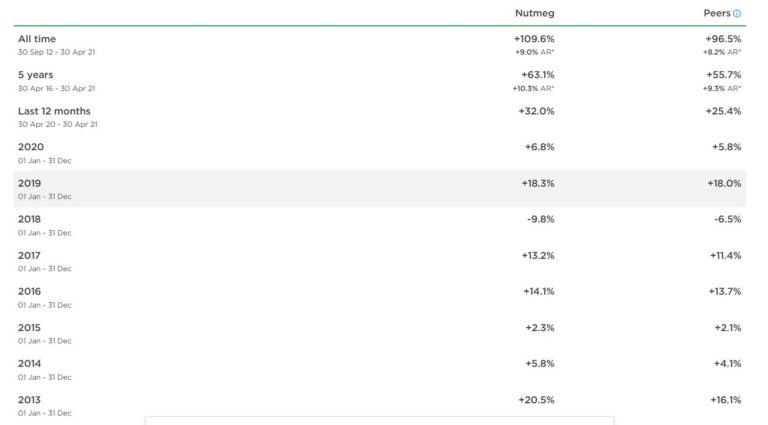
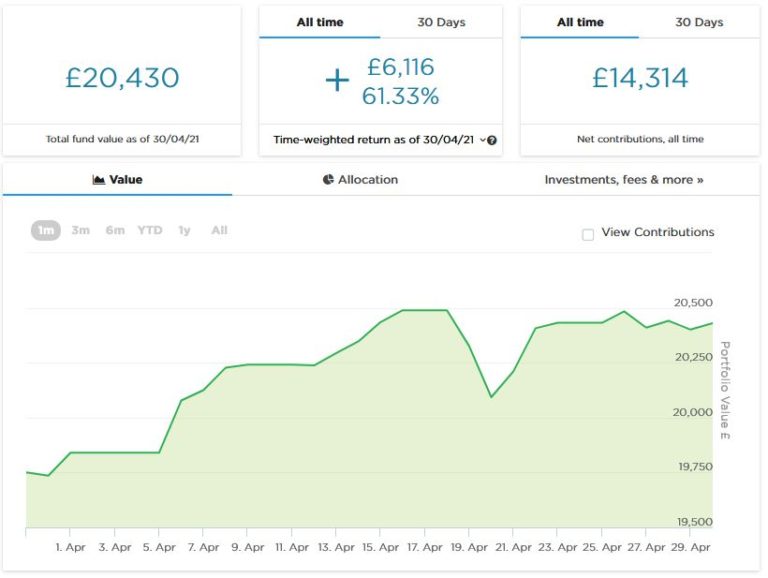
I’ll begin as usual with my Nutmeg stocks and shares ISA, as I know many of you like to hear what is happening with this.
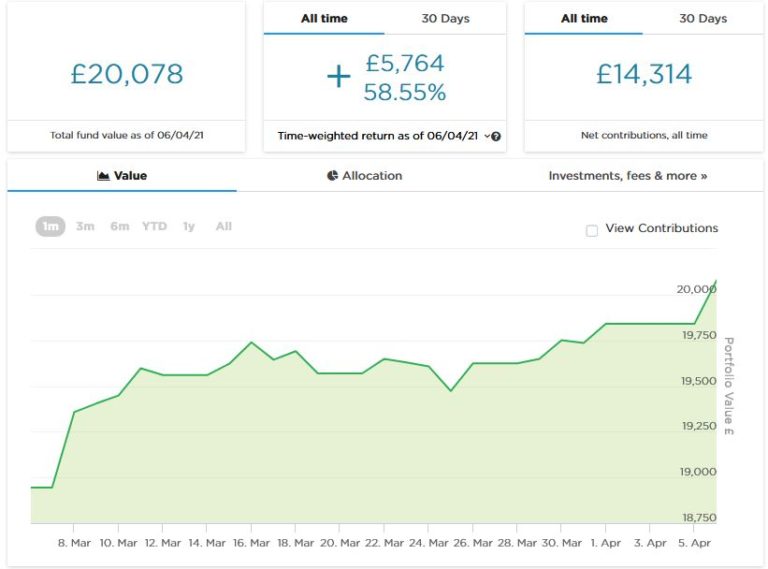
As the screenshot below shows, since last month’s update my main portfolio has been through some ups and downs. It is currently valued at £19,155. Last month it stood at £19,008, so it is at least up a little (£147) overall.
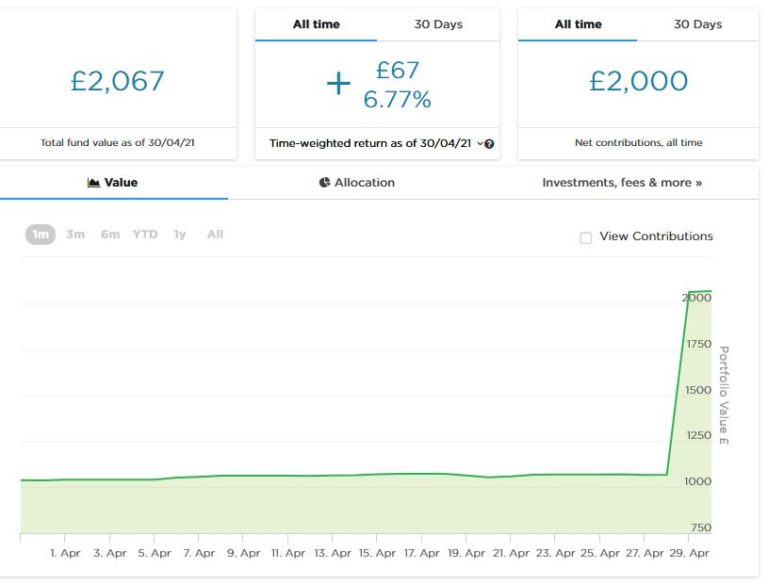
As you may recall, three months ago I put £1,000 into a second Nutmeg pot to try out Nutmeg’s new Smart Alpha option. The value of this pot rose as high as £1,040 in mid-February, though it currently stands at a more modest £1,007. Here is a screen capture showing performance to date, though obviously it is much too early to draw any conclusions from this.
I mentioned last time that my first investment with P2P property investment platform Property Partner reached its five-year anniversary, at which point investors can vote to sell their shares or continue for another five years. Along with just under half of the other investors, I voted to sell my shares.
The shares of everyone who wanted to sell were duly put up for sale on the platform. Unfortunately, though, there were few buyers, so with a substantial number of shares unsold, the property has been put up for sale on the open market. That means there will be a period of several months – possibly longer – before a buyer is found, and there is no guarantee that the independent valuation price will be achieved.
That is obviously disappointing, though as I only have a very small amount invested in this property (about £50) I’m not going to lose any sleep over it. In my view Property Partner didn’t make much effort to market these shares to investors. I suspect the same may be the case with at least some of the other properties coming up to their five-year anniversaries. It may be that Property Partner are happy to get some of the smaller houses and apartments off their books, especially the city-based ones for which demand has fallen as a result of the pandemic. Currently I have another small investment going through the five-year process. I voted to sell my shares in this too, but suspect the outcome will be the same.
As I have noted before on PAS, shares in many properties on Property Partner are currently available on the secondary market at a discount to the independent valuation price Based on my experiences to date, however, I would advise caution about regarding this as a buying opportunity. If properties that are relisted attract little interest from existing PP investors, they will have to be sold on the open market. In that case you are likely to have a long wait until you see any return on your investment, and there is no guarantee of an overall profit even then. I shan’t therefore be investing on the Property Partner secondary market for the foreseeable future.
That wasn’t the only disappointing financial news last month. Property crowdfunding investment platform The House Crowd unexpectedly announced that it was going into administration. I still have some investments with THC, though thankfully not as many as I did two or three years ago.
Apart from one small loan – which I accepted some time ago had gone south – my remaining investments are in traditionally crowdfunded properties, all of which are currently up for sale. The money is therefore secured by bricks and mortar, so I expect to get at least some of it back (and have of course been receiving dividend payments from rent received). As with other property crowdfunding platforms, each THC property is owned and managed by a separate Special Purpose Vehicle (SPV), which gives it legal protection from claims against THC by creditors. How this will pan out in practice remains to be seen, but I note that the administrators have said that their appointment is ‘not expected to have a material impact on investors.’
So I am being philosophical about this and awaiting further developments. These have undoubtedly been tough times for property investors, and regular readers will know that I also recently lost money with another property crowdfunding platform called Crowdlords. Overall, when you allow for my successful property investments and rental income, I am more or less breaking even, but even so (as I have said on the blog before) I am a lot more cautious about this type of investment nowadays.
Personal
February was another long, cold month, but at least there are signs of better times ahead now. The vaccine roll-out continues to go well and case numbers are dropping rapidly, giving us all hope for a return to something approximating normal life in the weeks and months ahead.
And, of course, we are heading into the spring now, with longer, brighter days and – eventually – the prospect of some warmer ones!
One thing that always lifts my spirit at this time of year – and especially in the current circumstances – is the arrival of spring flowers. In my garden I have crocuses and snowdrops out at the moment, and it won’t be long until the daffodils are in bloom. Here’s a photo of a flower bed in my front garden…
I had my first Covid jab in February, at the Whitemore Lakes mass vaccination centre near Lichfield. It was run by a team of NHS staff, military and volunteers. Everyone was friendly and efficient. The only slight blip came when I was checking in. I happened to notice that the clerk had put ‘female’ on my form, doubtless due to my lockdown hair. She was embarrassed when I pointed this out, but of course I couldn’t just say nothing. I shall be very pleased when we are allowed to visit hairdressers again!
I received the Oxford-Astra Zeneca vaccine. After I had a bad reaction to my last flu jab (fever and nausea) I was prepared for something similar with this, but thankfully that didn’t happen. Apart from very slight soreness in my arm the next day, I had no side-effects at all. I hope I am just as lucky with my second jab, which I have already booked for May.
Also on a medical theme. I had my latest trip to the eye clinic at Queens Hospital Burton last week. Regular readers will know that last autumn I was diagnosed with a perforated retina in my left eye. My first laser treatment was only partly successful, so Iast time I received a (more powerful) top-up treatment. This visit was to check if it had been successful, and I was pleased and relieved to hear that it had. So once again I need to express my thanks and gratitude to all the staff there, and especially to Mr Brent, the consultant who performed my final laser treatment and gave me the good news this time. I have been told that if something like this happens once it increases the chances of it happening again, so I have to be on the lookout for any potentially worrying changes to my eyesight in future. But that aside I am lucky that this problem was detected early before anything more drastic (e.g. a detached retina) occurred – so big thanks to my optician at Vision Express Lichfield as well!
As I write this update, the schools are just about to reopen to all students. I am delighted about that, as I know that it has been a tough time for many children. While some schools have been very good about running online classes, these can never be a complete substitute for face-to-face teaching. I also know from speaking to friends that some schools have been less supportive, simply sending pupils written lessons or assignments to complete on their own. That is obviously less than ideal for younger children especially.
I do think it is regrettable that the government has advised that secondary school children should wear masks in classrooms. The same applies to the mandatory twice-weekly testing. In my view these measures will achieve little apart from traumatizing young people and making it harder for them to learn. I understand these measures have been introduced partly to placate the teaching unions and some worried parents, but hope they will be swiftly withdrawn when (as I fully expect) there is no big ‘spike’ in virus cases following the return. Okay, I’ll get off my soapbox now!
As always, I hope you are staying safe and sane during these challenging times. If you have any comments or questions, please do post them below.
If you enjoyed this post, please link to it on your own blog or social media:
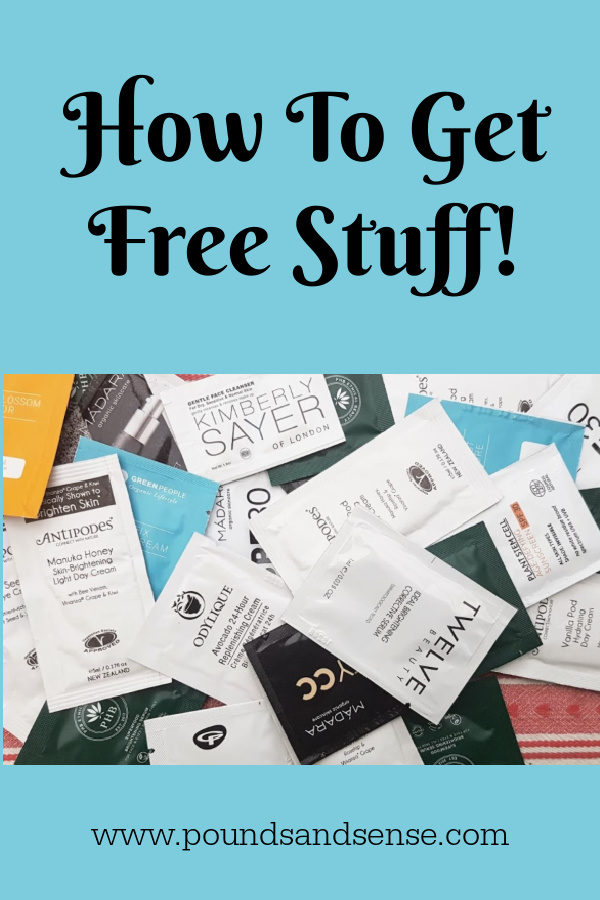
The world is an expensive place, so it’s no wonder many people are obsessed with getting freebies.
However, when entering the freebie-hunting world it is important that you adhere to certain rules in order to make the most of it. This article will set out some top tips for novice freebie-hunters – and you may learn a thing or two as a seasoned freebie-hunter as well.
If It Sounds Too Good To Be True, It Probably Is
The excitement of (potentially) getting a freebie from a favourite brand can easily cloud your judgement.
According to Karen Newman at Mega Free Stuff, the majority of transactions have both an upside and a downside; however, when a transaction is free the downside is temporarily forgotten. ‘Free’ provides people with a strong emotional charge, where the individual perceives the item on offer to be more valuable than it actually is. This basically means that the person will set aside common sense if they are being offered a freebie.
Some companies are willing to give freebies, but fans of a brand are often willing to sell their soul (or at least provide all sorts of valuable personal information) in exchange for a minute sample. This is detrimental, and it is essential that you know how big the sample is and what exactly you will be getting. Be sure the freebie is genuine and always read the terms and conditions before applying for any offers.
If You Do Not Ask, You Will Not Receive
It is always worthwhile writing letters or sending emails to companies asking if they have any samples available for you to try. This may seem obnoxious and pointless to some, but those who complete this task have often received large boxes of free items or discount vouchers from the companies as a means of gaining feedback on their products. Furthermore, if you do not like a product, be honest about this. In many cases companies are happy to offer replacement freebies (plus an extra item) if their products do not meet with the user’s approval.
Do Not Expect Too Much
A full-sized freebie is a rare occurrence, with the majority of free products being delivered in small envelopes or tiny sachets. Of course, the primary goal is not to obtain a full-sized freebie but a free sample to see if you enjoy the product for a future purchase.
Furthermore, do not expect to receive all free items applied for. Even if you have claimed a free sample noted as available online, it is unlikely that you will get a 100% return. In fact, the most you can expect is approximately 70%. Do not give up hope and keep applying, and soon you will be enjoying masses of freebies. Once again, though, be sure to check that any freebie is worthwhile, and always read the terms and conditions regarding the size and number of samples.
Do Not Feel Guilty
While some individuals may feel a degree of guilt about asking for freebies, this is completely unnecessary. The company sending a freebie is not losing millions of pounds on the free products; in fact, they are benefiting from the free item. Think about it – for every sample sent out, there is the potential of a new customer. If you receive a free sample and like it, there is every chance you will make a future purchase of that product and might even become a regular customer.
Set Up a Second Email Address
One important – but often neglected – tip is to set up a second email address. To avoid receiving spam mail to your primary address, use this second address to claim freebies and enter competitions.
We have found an amazing competition here, where you can have the chance to win one of 20 Lindt chocolate Easter Eggs (see picture below). This competition ends on 1st April 2021.
Disclosure: This is a sponsored post for which I am receiving a fee.
If you enjoyed this post, please link to it on your own blog or social media:
Today I am looking at The Good Retirement Guide, an annual guide published by Kogan Page. I bought the current 2021 edition, which was published last month.
The Good Retirement Guide 2021 is 318 pages long. The text is fairly dense but broken up by plenty of headings and bullet-point lists. There are 14 chapters and an alphabetical index at the back. The chapter titles are as follows:
Are You Looking Forward to Retirement?
Money and Budgeting
Pensions
Tax
Investment
Your Home
Leisure Activities
Starting Your Own Business
Looking for Paid Work
Voluntary Work
Health
Holidays
Caring for Elderly Parents
No-one is Immortal
The chapter titles are pretty self-explanatory. The book attempts to cover every aspect of making the most of your senior years. The style is clear and readable, and additional resources are signposted as appropriate.
In contrast with Sod 60! which I also reviewed recently, The Good Retirement Guide covers the financial aspects of later life in some detail. I thought the information about pensions and benefits in particular was very good and tells you most of what you need to know.
Some of the other chapters are a bit less comprehensive. The one on leisure activities, for example, lists various things you might like to do – or take up – in retirement, but the information is frequently sketchy and can verge on stating the obvious. Here is what it has to say about poetry, for example:
There is an increasing enthusiasm for poetry and poetry readings in clubs, pubs and other places of entertainment. Special local events may be advertised in your neighbourhood.
And apart from a mention for the Poetry Society and a link to their website, that is all you get on this subject 🙂
I don’t want to appear too harsh. Obviously in a wide-ranging book like this, it can be hard to judge the degree of detail appropriate to any particular topic. At least by mentioning a wide range of possibilities, the book may give you some ideas about activities you might like to pursue further in retirement.
The health-related content is a bit of a mixed bag. Some subjects are covered in reasonable depth, others less so. There is just half a page devoted to keeping fit, for example, with a further couple of paragraphs about yoga and Pilates. On the other hand, there is some good information (and advice) on health insurance, long-term care plans, and so forth. Again, this illustrates that the book’s primary focus is on the financial aspects of retirement.
One thing that did surprise me is that although this 2021 edition of The Good Retirement Guide was only published last month, there is no mention of the pandemic in it. You will search in vain for Coronavirus or Covid-19 in the index. I know there can be long lead times in publishing, but in an annual guide you might think they could have inserted a section about it somewhere. Maybe we will have to wait for the 2022 version?
Even so, a lot of the subjects discussed in the guide – holidays, for example – have been seriously impacted by the pandemic. The advice and procedures for travel abroad in particular may be very different even after the pandemic is officially over.
Final Thoughts
Overall, I thought The Good Retirement Guide 2021 was a helpful book for people approaching retirement. As I’ve said above, it has a strong emphasis on financial matters, and is well worth reading for that alone. Some of the other content is a bit hit-and-miss, and the surprising lack of any mention of the pandemic means that at times it reads like a guide to an alternate world where Covid never happened. Of course, none of us really knows what the ‘new normal’ will be in future. We can but hope it will be not too far removed from the old normal we remember and which this book – despite the 2021 in its title – basically depicts.
As always, if you have any thoughts or questions about this post, please do leave them below.
Disclosure: As with many posts on Pounds and Sense, this post includes affiliate links. If you click through and make a purchase, I may receive a modest commission for introducing you. This will not affect in any way the price you pay or the product or service you receive.
If you enjoyed this post, please link to it on your own blog or social media:
As I write this we are still stuck in what feels like everlasting lockdown. But with the successful vaccine roll-out and rapidly falling case numbers – not to mention spring on the way – there are at least a few rays of hope on the horizon.
Anyway, to cheer you up, I’ve joined forces with some of my fellow UK bloggers to put together a giveaway with a top-of-the-range Dyson Airwrap worth £450 for the lucky winner.
As a mere male I must admit I had never heard of this before. But as I have read up about it now, I can tell you that the Dyson Airwrap is a high-tech hair-styling device. It harnesses an aerodynamic phenomenon called the Coanda effect, which curves air to attract and wrap hair to the barrel. So it styles using a flow of air, not extreme heat. This reduces the risk of heat-damage to your hair.
As I am currently sporting a mop of ‘lockdown hair’, I reckon I could probably do with one of these myself!
One lucky winner will win themselves the highly coveted Dyson Airwrap worth a whopping £450! The Dyson Airwrap is currently the hottest tool on the market and with it’s hefty price tag it’s not accessible for many.
The Dyson Airwrap comes with six hair styling attachments to dry, curl, wave and smooth hair. The Airwrap with intelligent heat control measures airflow temperature over 40 times a second and regulates heat, to ensure it always stays below 150°C.
The Dyson Airwrap also comes with a tan storage case to store your Airwrap and its attachments safely.
How to Enter
To enter simply complete all or any of the Rafflecopter entry options below. The more you complete, the more chances you have of winning.
The competition ends at midnight on Sunday 14th March and a winner will be drawn on Monday 15th March. If for any reason the chosen prize is out of stock at the time of the draw, the winner will be able to select an alternative prize up to the same value.
For full entry terms and conditions please see the Rafflecopter widget below.
One final small point is that if a winning entry comes from following someone on social media, the organizer (my colleague Neesha Rees) will check before awarding the prize that the winner is still following the account in question. If they aren’t, they will be disqualified and a new winner drawn. So, please, don’t follow and immediately unfollow, as your entry won’t then count.
Good luck, and here’s hoping we can all look forward to brighter times (and better hair) soon 🙂
If you enjoyed this post, please link to it on your own blog or social media:
In brief, Property Partner is a property crowdfunding platform. For the most part they specialize in ‘traditional’ property crowdfunding rather than loan or development finance.
Properties are bought and managed by Property Partner on investors’ behalf. Investors then receive a share of the rental income as dividends, and a share of any profits (plus return of their capital) when the property is sold.
Property Partner launched in January 2015. That date is significant, because after a property has been on the platform for five years, all investors get the chance to exit at a fair market price (determined by an independent surveyor). Due to the pandemic the five-year anniversary process was temporarily put on hold, but it is now proceeding again, albeit with delays as they work through the backlog.
How it operates is that in the run-up to the fifth anniversary of a property, all investors have the opportunity to say if they want to exit their investment at the valuation price or stay on for another five-year term (less than this if they subsequently exit via the resale market, of course).
All investors who have opted to leave will then have their shares pooled and put up for sale on Property Partner at the price stated. New investors are then able to buy these shares.
So long as all shares are sold, the original investors get their money (including any net profits) and the property continues under Property Partner’s management. If all shares don’t sell, however, Property Partner offer the property for sale on the open market. Investors then have to wait until the property is sold before getting their money back. As anyone who has been involved with buying or selling property will know, this is likely to take several months (quite possibly longer in the current circumstances).
The Opportunity
As Property Partner themselves have been pointing out, a number of properties that are coming up to their fifth anniversary are currently trading on the resale market at well below their latest valuation. Here is just one example:
This property in Tower Hill, London (not one I own shares in myself) is due to go through the fifth-anniversary process in April 2021 (or possibly a bit later due to the backlog). At the time of writing shares are available on the secondary market at a price of 91p, which is 28.28% below the latest valuation of £126.88. In theory, then, you could buy shares now and in the next few months sell up for a substantial short-term gain.
Of course, in practice it’s not as simple as that. Here are some reasons:
Nobody knows yet what the final five-year valuation will be. If it is lower than the current valuation (which is perfectly possible in the current economic climate) the net profit will be reduced, perhaps substantially.
There is no guarantee that the shares of all investors who wish to exit will actually sell on the platform. If they don’t, as mentioned, you could have a long wait before the property is sold on the open market. In addition, if this happens there is no guarantee that the property will sell at the valuation price. If it goes for less than this, your returns will be reduced accordingly.
There are platform fees to take into account. In particular, there is a 1% fee for buying on the secondary market and a further 0.5% stamp duty reserve tax charge. Thankfully there are no exit fees, though.
And finally, the number of shares available for any property on the secondary market is limited. Obviously the number you can buy depends on how many shares other investors want to sell at the price in question.
On the plus side, for the length of time you hold the shares you may receive monthly dividends at a rate between 1.5% and 6% per year (though dividend payments on some properties are currently suspended due to Covid). This will offset the fees mentioned above; but if you only intend to hold the shares for a few months it probably won’t cover them completely. Bear in mind that an Assets Under Management (AUM) fee is now deducted from dividends as well.
As an investor with Property Partner since almost the beginning (the cover image shows a property in Torquay I own shares in – I plan to retire there one day 😀 ), I am awaiting the five-year exit for my investments with considerable interest.
My personal circumstances have changed since I started investing with the platform, so I intend to take the opportunity to offload at least some of ‘my’ properties. Indeed, I have already voted to sell my shares in the first property I ever invested in with Property Partner (20 Phillimore Close) and am waiting to see how this pans out. I will update this post in due course once I know.
Nonetheless, I am still considering investing short term on the resale market to take advantage of the opportunity the five-year anniversary presents. In particular, I have already topped up my investments in some of the properties I already hold but am planning to dispose of.
I will, though, be cautious until I have a better idea how the first few five-year anniversaries have passed, so I can see if all shares put up by investors sell on Property Partner, or if they have to sell the properties concerned on the open market. As mentioned earlier, the latter route will clearly take longer and there is no guarantee what price would be achieved.
Would I recommend someone who is currently an investor in Property Partner to look into this? Yes, certainly. Whatever your current circumstances, you need to be aware of what is going on with any properties you hold with Property Partner. And if you wish to sell, you should definitely consider taking advantage of the five-year exit mechanic. Equally, if you have money available to invest, you could check out the opportunities buying now on the resale market – though do bear in my mind my cautionary comments above.
If you haven’t joined Property Partner, and you like the idea of investing some of your portfolio in property, the platform is certainly worth a look. As older properties come back on the market for new investors, there will be no shortage of opportunities in the months ahead. And my understanding is that, as the original costs of acquisition have been amortised, there will be less costs to cover from investors, thus boosting the potential returns from the properties in question.
In addition, as these properties have a five-year history already, you will be able to check how they have been performing in terms of dividends generated and capital appreciation. This is no guarantee of how well or badly they will do in the future, of course.
Take a look at my Property Partner review for much more information about the platform and how it works. Also, if you do decide to invest in Property Partner, there is a welcome bonus offer. For convenience I have copied details below from my review.
Welcome Offer
As an existing Property Partner investor, I can offer a special bonus for anyone joining via my link. If you click through this special invitation link, sign up and invest a minimum of £2,000 within 60 days, you will receive an extra bonus as follows (and so will I):
Not only that, once you are an investor with Property Partner, you will be able to offer the same bonus to your friends and relatives and earn commission yourself. There is no limit to the number of people you can introduce through this scheme.
If you have any comments or questions about this post, as always, please do leave them below.
Note: This is a fully updated version of a post published in 2019.
Disclosure: this post includes referral links. If you click through and make an investment, I may receive a commission for introducing you. This has no effect on the terms or benefits you will receive. Please note also that I am not a professional financial adviser. You should do your own ‘due diligence’ before making any investment, and seek professional advice from a qualified financial adviser if in any doubt how best to proceed. Be aware that all investments carry a risk of loss.
If you enjoyed this post, please link to it on your own blog or social media:
Here is my latest Coronavirus Crisis Update. Regular readers will know I have been posting these since the first lockdown started in the spring of 2020 (you can read my January 2021 update here if you like).
I plan to continue these updates until we are clearly over the pandemic and something resembling normal life has resumed. Obviously, I very much hope that will be sooner rather than later.
As ever, I will begin by discussing financial matters and then life more generally over the last few weeks.
Financial
I’ll begin as usual with my Nutmeg stocks and shares ISA, as I know many of you like to hear what is happening with this.
As the screenshot below shows, since last month’s update my main portfolio has been through some ups and downs. It is currently valued at £19,008. Last month it stood at £18,886, so it is at least up a little (£122) overall.
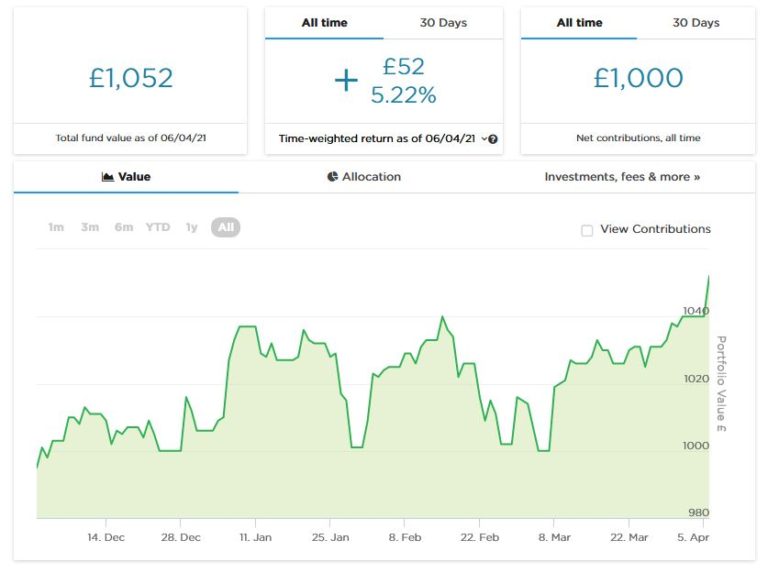
As you may recall, two months ago I put £1,000 into a second Nutmeg pot to try out Nutmeg’s new Smart Alpha option. The value of this pot rose as high as £1,037 in mid-January, though it currently stands at a more modest £1,010. Here is a screen capture showing performance to date, though obviously it is far too early to draw any conclusions from this.
Incidentally, I was recently asked by Nutmeg to contribute an article about my ‘Investing Journey’ for their blog. This was published in early January and you can read it here if you like. In the original version I was more explicit about why I left the charity I used to work for (basically a personality clash with the new Director who saw me as a rival). Nutmeg presumably decided this might ruffle a few feathers – even 25 years on! – so they changed it to something blandly neutral. Anyway, I thought I should let you know, as the opening section reads a little oddly now 🙂
The Nutmeg article brought quite a few new subscribers to this blog – so if that includes you, welcome to Pounds and Sense! I do hope you find my posts interesting.
Moving on, I had an email this week from the peer-to-peer lending platform RateSetter saying that all their lending activity is being transferred to Metro Bank (which now owns RateSetter). All investor accounts are therefore closing at the start of April, with investors’ money being returned to them in full along with all interest due.
I know some RateSetter investors are unhappy about this, but personally in these turbulent times I’m just glad to be getting my money back with interest. I originally invested £1,000 in September 2018 with an eye to claiming the £100 new investor bonus. The latter was duly credited to my account a year later, so by April I expect there to be a total of around £1,180 in my account. That equates to an annual interest rate of around 7%, which I am perfectly happy with.
This last year has undoubtedly been tough for P2P lending companies, with rising default rates and withdrawal requests along with reduced demand for loans. This has caused some platforms to experience cashflow problems and bad publicity. The only other one I have any money left with is ZOPA, which has also had a challenging year. I have only a few hundred pounds left in ZOPA as I switched some time ago from reinvesting repayments to withdrawing them. I’m not sure I can see much of a future for P2P lending in the UK, but of course in these unique times anything is possible. I don’t foresee myself putting any more money into P2P lending for a while, though.
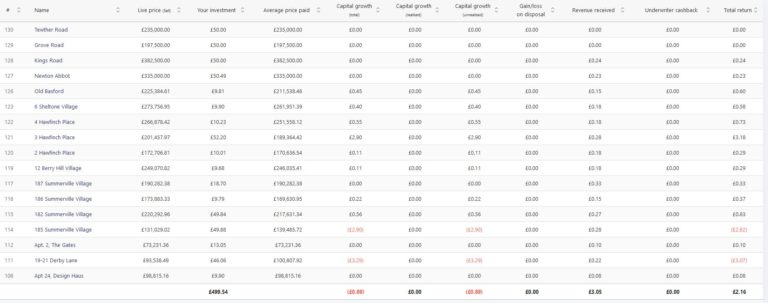
I also heard recently from Property Partner. As you may know, this is a property crowdfunding platform. A few years ago, when I was investing regularly in property crowdfunding, I put around £5,000 into twenty or so properties on this platform.
Anyway, the email revealed that the first property I bought shares in has now reached its fifth anniversary. All investors therefore have the opportunity to sell up at the current independent valuation or else continue for a further five years. I voted to sell my shares, since (as mentioned in this recent post) I am currently trying to reduce the total amount I have invested in property crowdfunding.
The way the five-year anniversary process works is that all shares owned by investors who want to sell are bundled together and put up for sale on the Property Partner site. Assuming they are all bought by other investors, everyone who voted to sell then gets their money back at the current valuation. If that doesn’t happen, Property Partner put the property concerned up for sale. But obviously that is likely to take months and there is no guarantee the valuation price will be achieved. So you might end up getting back less than anticipated (or perhaps more in a best-case scenario).
Obviously I’m hoping this process goes smoothly and I get my money back soon. I would comment, though, that many of the properties that are coming up to their five-year anniversary are on offer on the resale market at well under the current valuation price. So if you are of a speculative persuasion, there is an opportunity to buy shares now at a discount and maybe make a quick-ish profit through selling up via the five-year anniversary process. I must admit I am tempted to try this, but haven’t made a decision yet!
Moving on, my two Buy2LetCars investments are still delivering the promised monthly returns without any fuss. As I am semi-retired but don’t yet qualify for the state pension, the £450 or so I receive from them every month represents a major part of my monthly income currently. I am also looking forward to receiving a substantial lump-sum payment in April when my first investment with them matures.
As I’ve said before, investors with Buy2LetCars put up the money to finance a car for a key worker such as a nurse or police officer. They then receive 36 monthly capital repayments followed by a final balancing payment of interest and capital. If you are looking for an income-producing investment with a substantial lump sum payment after three years – and you like the idea of doing a bit of good with your money too – they are well worth checking out (and likewise if you’re a key worker looking for a lease car yourself). If you’d like to learn more, you can read my review of Buy2LetCars here and my more recent article about the company here. And here is a link to Wheels4Sure, their car-leasing website. Note that you can’t invest with Buy2LetCars through an ISA, so the interest part of the final payment will have some tax deducted. Depending on your circumstances, you may be able to reclaim this.
Finally, several more readers have now signed up with the low-key matched betting opportunity mentioned in some previous updates. New members are still being accepted, but the company has had to reduce their payouts slightly. New members now receive £50 a month for the first six months, reducing to £25 a month thereafter. Considering that this opportunity is cost-free, risk-free and hands-free, that’s still a pretty good deal, though 🙂
As I said above, this opportunity is based on matched betting, a sideline-earning opportunity I have been pursuing for several years myself. I was asked not to divulge too many details about it publicly, for good reasons I will explain privately to anyone who may be interested (and no, it’s not illegal!). As I said above, it doesn’t require any financial outlay, is entirely hands-off, and will provide a passive income of £50 a month for the first six months and £25 a month thereafter.
No knowledge of betting is required, and you don’t have to place any bets yourself (this is all done by the company’s clever software). You just have to set up a separate bank account for bets to go through, but running the account is entirely financed by the company. Please note that this opportunity is only open to honest, trustworthy people who haven’t done matched betting before and have no more than two accounts already with online bookmakers. For more info (and to receive a no-obligation invitation) drop me a line including your email address via my Contact Me page.
Personal
I don’t know about you, but January to me has felt a very long month. It’s been cold, damp and depressing, with the whole country stuck in what seems like a never-ending lockdown.
As you may know, I live on my own since my partner, Jayne, passed away a few years ago. I am lucky to live in a fairly large house with a good-sized garden, so being mostly confined to home hasn’t been as big a challenge for me as I’m sure it has for some. Also, I am well used to working from home, having done this for the last 30 years or so. Even so, being unable to see friends and family has been hard for me, as has the closure of my local swimming pool (which I used to visit twice a week). And I appreciate that in many ways I am one of the lucky ones. I don’t have any major financial worries, and I’m not trying to home-school any children!
I did have a ‘day out’ at the end of January when I had to go to the eye clinic at Burton Hospital for a follow-up appointment. As regular readers will know, in the autumn I was diagnosed with a perforated retina in the left eye. I had laser treatment for this, and my January appointment was to assess how successful it had been.
As it turned out, there was some good news and some bad. The consultant told me that the treatment had been three-quarters successful. In one area it hadn’t ‘taken’, meaning I needed top-up treatment. He administered this then and there. I guess he cranked up the laser a bit, as unlike my first treatment it was somewhat painful and I had a headache for a couple of days afterwards. I have to go back at the start of March for what I very much hope will be a final check-up. Keep your fingers crossed for me!
Because they put drops in my eyes at these appointments, I can’t drive. I therefore took a taxi to the hospital and caught the train back. On previous occasions the trains have been very quiet, but there were noticeably more passengers this time. The roads too seemed pretty busy. I get the impression that people are (understandably) becoming fed up with lockdown now and the government’s Stay At Home message isn’t being as well complied with. Not a criticism, just an observation.
I am still aiming to go out for a walk once a day, though with some of the bad weather in January, I have missed a few. Here is a photo of my front garden about a fortnight ago 😮
On the plus side, I do enjoy watching the snow as long as I don’t have any essential trips to make. And I like to go for a walk in it once it has fallen. It was lovely to see (and hear) the local children getting out their sledges and enjoying some much-needed fun during these difficult times.
As far as evening entertainment is concerned, I finished my box-set of the tongue-in-cheek detective series Agatha Raisin and am happy to recommend that. On a similar note, I am enjoying the new (second) series of The Mallorca Files, which is currently on BBC iPlayer. It is just a shame that because of the pandemic they were only able to record six episodes.
Also, inspired by this post by my fellow blogger Caz, I have been investigating what is on offer on Amazon Prime Video. I have Amazon Prime mainly for the fast, free deliveries. But of course members do get access to a range of free films and TV series as well.
Anyway, I found a couple of series I really enjoyed. Being a Star Trek fan, I had to check out Lower Decks, a cartoon series focusing on the junior ranks on board one of the Federation’s least illustrious starships, the USS Cerritos. This has some great laugh-out-loud moments but some good stories as well. There are plenty of allusions to familiar Star Trek tropes that will keep any fan of the franchise amused. Watch out also for an appearance by an evil incarnation of Microsoft’s infamous ‘Office Assistant’ Clippy!
Of course, if you’re a Star Trek fan and haven’t yet seen Star Trek: Picard featuring the great Patrick Stewart as the eponymous hero, you should definitely watch this on Amazon Prime Video as well 🙂
The other series I enjoyed is Undone. Indeed, this is one of the best things I’ve seen on TV for quite a while. It’s almost impossible to describe, but it’s an animation that combines elements of mystery, comedy, romance, science fiction/fantasy, and more. And all with stunning, almost psychedelic, imagery, and strong acting and characterization. Here’s a screen capture that will give you some idea of the style. If you watch nothing else on Amazon Prime Video, give this a try..
Going back to the pandemic, there has at least been some good news this month. The vaccine roll-out has been going well – I’ve just heard that 10 million people have now had their first injection – and the number of new cases has been falling rapidly. As a 65-year-old I have not yet been called for vaccination but assume this is likely to happen fairly soon.
I do hope these developments will allow lockdown and other restrictions to be eased in the coming weeks, as in my view they are causing grave harm to people’s physical and mental well-being. In particular, I would like to see schools reopen, along with swimming pools and gyms. I would also like to see pubs, restaurants and hotels allowed to reopen before many have to close their doors for good. In the (slightly) longer term I would like to see all restrictions lifted so that normal life can resume. I am not a fan of mandatory masks and would like to see them made optional for those who believe they offer some useful protection from the virus (personally I have never been convinced of this).
As always, I hope you are staying safe and sane during these challenging times. If you have any comments or questions, please do post them below.
If you enjoyed this post, please link to it on your own blog or social media:
As you may know, this is a best-selling book by Claire Parker and Sir Muir Gray, published by Bloomsbury. I bought a hardback copy from Amazon. A slightly cheaper ebook version for Kindle is also available.
Sir Muir Gray is also the author of Sod 70!, a similar healthy living guide aimed at the over-70s.
Review
Sod 60! is 232 pages long. The text – which is very readable – is broken up by lots of sub-headings, diagrams and cartoon-style illustrations (by David Mostyn). There are nine main chapters, each covering an aspect of how to live well in your sixties. The chapter titles are as follows:
Getting Older Doesn’t Matter – Getting Active and Getting Attitude Does
Keeping Active is Fitness Friendly
Your Attitude and Its Soulmates: Mind and Mood
Keeping Your Metabolism Healthy
Take Care of Your…Bits
Rhythm and Blues
Stuff Happens
Decisions, Decisions
Health Care: Choosing and Using It Wisely
Some of those chapter titles are self-explanatory, others less so. For example, Chapter 5 ‘Take Care of Your…Bits’ isn’t about what you might think. It actually covers looking after different parts of your body, from your brain to your feet. Sexual health is then covered in Chapter 6, ‘Rhythm and Blues’. Those both seem pretty odd choices of chapter title to me, but I suppose the aim was to help give the book a ‘quirky’ personality.
That small criticism aside, the style of the book is friendly and relatable. It’s also down to earth and practical, and I like the way that the text is interspersed with exercises, resolutions, and so on. It is very much a hands-on, practical guide.
Sod 60! concerns the importance of looking after your body and mind as you grow older. The authors stress the need to stay as active as you can, both physically and mentally.
Chapter 2 includes a range of physical exercises to try, and also sets out some general principles for exercising healthily as you get older. I thought this was one of the most useful chapters in the book.
Chapter 3, which focuses on attitude, mind and mood, is also very good. It looks at the importance of keeping a positive attitude, and staying connected with friends and family, your neighbours, local community, and so on. It also discusses maintaining a good relationship with your partner (assuming you have one). Getting enough sleep and dealing with stress are covered as well, though not in great detail.
Chapter 4 ‘Keeping your Metabolism Healthy’ focuses on diet and weight. The authors advocate following a balanced and varied Mediterranean-style diet, with plenty of fresh fruit and vegetables. That seems eminently sensible to me. I wouldn’t say there was much in this chapter I hadn’t heard before, and some of the advice such as avoiding sugary drinks struck me as stating the obvious. But this is of course very important to long-term health, so I guess it had to be said.
Chapter 5, as I’ve already mentioned, focuses on different organs/parts of the body. It discusses how to keep each one healthy, and warning signs to look out for as you get older. It also covers age-related changes and what you may be able to do to help prevent problems. Having a good diet, staying active, giving up smoking and reducing alcohol intake all crop up quite frequently. Again, there were no huge surprises for me here.
Chapter 6 is about sexual health and related matters such as bladder and (for men) prostate problems. On the sexual side, the advice could be broadly summed up in five words: Use it or lose it! The advice on matters such as urinary incontinence is – to be honest – a bit depressing, but nonetheless important to be aware of.
Chapter 7 ‘Stuff Happens’ is also a bit depressing, though again it covers some important topics. These include how to deal with the problems later life can throw at you, including depression, isolation, bereavement, serious illness, and so on. There is some excellent advice here, especially on the importance of cultivating and maintaining a support network of friends, relatives, health professionals, and so on.
Finally, Chapters 8 and 9 are both about healthcare and could easily have been combined in my opinion. They look at such matters as how to navigate healthcare decisions, self-care to prevent (or at least mitigate) serious health problems, drugs and vaccinations, and so forth.
In Conclusion
Overall I thought Sod 60! was a useful guide for sixty-somethings though maybe not an earth-shattering one. The book covers a range of issues that anyone in their sixties will need to think about and prepare for. It was first published in 2016, so there is no reference to the Coronavirus pandemic. The advice in the book still applies and in some ways is even more cogent now. With the UK still in lockdown at the time of writing, for example, we all need our support networks more than ever at the moment…
Sod 60! is really a ‘mind and body’ book. It doesn’t cover financial issues such as pensions and benefits (and indeed doesn’t claim to). And it doesn’t have much to say about the challenges and opportunities retirement can bring, or the pros and cons of carrying on working. For advice on these and similar matters, something like the annual Good Retirement Guide (which I hope to review soon) would be good. And keep on reading Pounds and Sense, of course!
If you want a readable and entertaining guide to making the most of your sixties and preserving your physical and mental health, though, Sod 60! would certainly fit the bill. It would also make a great (and relatively inexpensive) birthday or Christmas gift for anyone in this age category.
As ever, if you have any comments or questions about this post, please do leave them below.
Disclosure: As with many posts on Pounds and Sense, this post includes affiliate links. If you click through and make a purchase, I may receive a modest commission for introducing you. This will not affect in any way the price you pay or the product or service you receive.
If you enjoyed this post, please link to it on your own blog or social media:
This isn’t an easy post to write, but I like to be honest with readers about my investing failures as well as successes. So here’s the sad story of one failed investment…
How It Happened
About a week before Christmas 2020 I got a cryptic email from the property crowdfunding platform Crowdlords directing me to their website for information about one of my investments. The email didn’t give anything away, but I had a premonition it wasn’t going to be good news.
Anyway, I followed the link to the Crowdlords site and logged in. The update concerned a property development I had invested £3,000 in back in 2016. Originally this was referred to as Seven Eco-Apartments (CL Number Four), but latterly it has been described simply as Kennington Road.
There was a long, involved explanation of what had been going on with the development. But the bottom line was that it had failed completely and investors were going to lose not just some but all of their money.
At first I wasn’t entirely sure I had read this correctly, so I emailed Crowdlords for confirmation. I received a quick reply from Richard Bush, co-founder of Crowdlords. Among other things, he said:
‘Kennington Road is one of two investments (from 72 we’ve completed to date) which have suffered from a very unusual combination of factors – delays, cost overruns, lost sales due to Covid and then further delays getting back to the market only to find the values have dropped. The perfect storm, almost.’
So there it was. At a stroke I had lost £3,000. As you may imagine, I felt pretty sick about this. I have subsequently heard from other people who lost much larger (five-figure) sums on the projects concerned (I’m not sure what the other project was). But that was no consolation, of course. About the only positive thing I can say is that I have had other Crowdlords investments which did deliver the promised returns. But even so, I am well down on my investments via the platform overall.
While it’s tempting to blame Crowdlords for the losses, I accept they are not directly responsible. Clearly they – along with many other businesses – have been the victims of unique and challenging circumstances in 2020. I do, though, think their communications with investors could have been a lot better, especially when it was becoming clear that problems were mounting. While they were quick enough to notify investors about successes – and new projects requiring investment – I couldn’t help feeling that failing projects were being swept quietly under the carpet. To be fair, Crowdlords aren’t the only investment platform I have noticed this with.
I do think it would be a nice gesture if Crowdlords were to offer modest ex-gratia compensation payments from their own profits to investors who have lost all their money. Even a book token would be nice. But realistically, I will be surprised if this happens now.
Lessons Learned
So what lessons have I learned from this experience? I’ll try to sum them up below.
Be a Sceptical Investor
Perhaps I’m stating the obvious here. But when I started investing in property crowdfunding it was pretty new and I found the concept intriguing and exciting. At that point, of course, there hadn’t been any failures to take the shine off. Plus I had recently come into some money through an inheritance and was looking for interesting and profitable ways to invest it.
Looking back now, I can see that I was a bit too ready to buy into the property crowdfunding idea, and put too much faith (and money) in it. I am not saying property crowdfunding can’t work (many of my investments did pay off). Nowadays, however, I am a lot more sceptical when assessing such projects and the claims made about them by their promoters.
It’s important to remember that property crowdfunding platforms are all in business to make a profit. To put it bluntly, they make their money by persuading potential investors to part with theirs.
There is nothing automatically wrong about that – all businesses do it – but it’s essential to examine any potential investment carefully and objectively before opening your wallet. That includes ensuring you understand exactly what the project entails and what the risks for investors are. Which brings me neatly to my second lesson…
Know What You are Getting Into
Property crowdfunding investment opportunities take many different forms.
In ‘traditional’ property crowdfunding a group of investors jointly purchase a property. They then receive rental income pro rata to their investment and a share of any profits when the property concerned is sold. With this type of investment, your money is effectively secured by bricks and mortar, so you are unlikely to lose your shirt. On the other hand, problems (from bad tenants to fire or flood) can arise leading to lower rental income than anticipated and/or delays in selling up. And obviously, if the value of the property doesn’t rise, you may not get all your capital back, let alone any profit on sale.
Development projects, which may launch with no more than a set of architect’s plans, are even riskier. If you invest in a development project (such as Kennington Road), while you may ultimately make a bigger profit, there is a real risk of the project failing completely for any number of reasons. In this case (as I discovered) you risk losing your entire investment sum.
Finally, there are platforms such as Kuflink that allow people to invest in loans secured against property (including bridging loans). If such loans are not repaid, the property can be sold to pay off the debt, so again you shouldn’t lose your entire investment. But even so, the legal processes involved can be time-consuming and expensive; and again you may end up losing some of your capital after all costs are paid off. And even if it doesn’t go that far, there are quite often delays in repaying loans (especially at the moment) meaning you don’t get your money back when you expect it.
So my second lesson is to be very clear what type of property crowdfunding you are investing in and what the risks are. And be especially cautious about investing in development projects, which are by nature more speculative and carry a greater risk of losing all your money.
Spread the Risk
This is of course an important principle in all investing but one that applies especially to property crowdfunding.
If you invest £3,000 in one project (as I did with Kennington Road) unless you’re Bill Gates that’s putting a lot of eggs in one basket. When I started in property crowdfunding I put as much as £5,000 into a single project. That is definitely not something I would do any more.
I am not investing as much in property crowdfunding as I did originally, but where I am still doing it I generally put no more than £100 into a single project. If I lose that money in a worst-case scenario, obviously that is not going to hit my finances nearly as hard. My approach nowadays is to have larger numbers of small investments spread across multiple platforms. This spreads the risk while still giving me control over what I invest in.
It’s interesting to note that most of the remaining property crowdfunding platforms (some have gone to the wall or are no longer serving private investors) also now offer some form of shared investment with automatic diversification. An example mentioned earlier is Kuflink, who offer an ‘Auto-Invest’ account paying up to 7% interest per year. Investments are automatically spread across a wide range of projects on the platform. If you want an easy way to diversify your property crowdfunding investments, this approach has some merit. Personally I prefer to build a diversified portfolio myself (which you can also do with Kuflink), but the automated approach is worth considering if you don’t have the time or inclination for that.
If you want to make use of your ISA allowance with Kuflink, you will need to open an Auto-Invest IFISA with them. You can’t create an ISA and choose your own investments, for reasons I’m not clear about.
Remember the Big Picture
Finally, it’s important always to remember that property crowdfunding is just one way of investing your money. It is also – as I have indicated – a relatively high-risk one.
So if you are going to include property crowdfunding investments in your overall portfolio, it should only comprise a fairly small part of it – I suggest no more than 10 percent. The rest of your money can then be spread across a variety of other investment types to provide good diversification. And as I have noted before, you should also have at least three months’ of income in easily accessible form in case of sudden, unexpected emergencies.
When I first started in property crowdfunding I made the mistake of putting about a third of my money into this type of investment. I am down to around 20% now, which is still (in my view) too much, but some money is tied up in long-term projects where an exit currently looks some way off. But at least hopefully there won’t be any more complete write-offs now.
Closing Thoughts
So that is the story of my failed £3,000 property crowdfunding investment and the lessons I have learned from it.
I am trying to be philosophical and remember that many of my other property crowdfunding investments have made money for me. Nonetheless, in retrospect I wish I had taken a more cautious approach initially. If I had simply put all the money into my Nutmeg stocks and shares ISA, for example, I don’t doubt that financially I would be better off overall.
Nonetheless, I do still believe in the property crowdfunding concept and am happy to have some money still in it. As I’ve said before in Pounds and Sense, property is relatively less affected by ups and downs in the economy than stocks and shares. Property investments don’t provide a method for hedging your equity investments directly, but they do offer an extra element of diversification and spreading of your financial risks. And alright, I will admit that a part of me does rather enjoy (for example) having a small amount invested in student accommodation in Leicester, my old university city 🙂
As always, if you have any comments or questions about this post, please do leave them below.
Disclaimer: Please be aware that I am not a qualified financial adviser and nothing in this blog post should be construed as personal financial advice. You should always do your own ‘due diligence’ before investing and seek professional advice if in any doubt how best to proceed. All investing carries a risk of loss.

If you enjoyed this post, please link to it on your own blog or social media:
Today I’m discussing a subject that will be relevant to any of you who have blogs yourself or are thinking of starting one.
I’ve been blogging for almost twenty years now. I started off blogging about freelance writing and moved on to personal finance with Pounds and Sense. I make money from my blog by various means, but the most important (and lucrative) is through collaborations with businesses and agencies on sponsored posts, sponsored links, and so on.
Companies are always on the lookout for ‘influencers’ who can help get their message across to their target audience. They have budgets for this purpose, but before sending any money your way they will almost certainly want to see your blog’s media kit (also known as a press kit). If you don’t have one – or it’s not up to scratch – you can expect to lose out on many paying opportunities.
So What Goes Into a Media Kit?
As a blogger, your media kit is an advertisement for you and your blog and the services you can offer. It will typically consist of one or two pages you can send (or hand out) to anyone enquiring about potential advertising opportunities or collaborations
A good media kit will ensure you create a strong and professional first impression. Everybody’s media kit is different, but here are some things you should consider including in yours…
Biography
In this section you provide a brief account of yourself, including such things as your age, location, occupational background, hobbies and interests, family, and so on. Companies want to know whom they will be working with, to reassure themselves that you and your blog will be a good fit for their target audience. Let your personality shine through, therefore, quirks and all! You should also include a good-quality portrait-style photo of yourself (see the example in the header image).
Blog Description
In this section you talk about your blog itself – the subjects you cover, your target readership, and any other information that may interest potential advertisers. You may also wish to include your blog’s logo.
Stats
Advertisers want to know the size and nature of the audience you can deliver for them. So it’s important to share some key stats, including such things as total unique views, social media following, email newsletter subscribers, and so forth. Clearly you will want to pick the most impressive-looking stats – so if you don’t have many Instagram followers (for example) just leave that out. But don’t exaggerate either. Clients can and will check your stats, and if they don’t appear to correspond with the figures you have quoted, they are unlikely to want to proceed further
Collaboration Options
Here you list ways brands can collaborate or advertise with you. Some possibilities include:
Sponsored Posts
Sponsored Links
Product Reviews
Contests and Giveaways
Banner Ads
Social Media Campaigns
You can also include prices for these services in your media kit if you like. Personally I don’t do this, as I like to leave room to negotiate over price.
Testimonials
If you have worked for business clients before, I would strongly recommend including any testimonials you may have received. And don’t be afraid to ask for testimonials after a successful collaboration. This type of social proof provides invaluable reassurance for would-be clients that you can deliver on your promises and achieve good results for them.
Contact Information
The most important one of all! Don’t forget to include your contact details so that potential clients can get back to you. You will probably want to include your email address, phone numbers (home and mobile), postal address, and so on.
Media Kit Design
As a blogger you aren’t necessarily expected to have an all-singing, all dancing, media kit, but the smarter and more professional it looks, the better. Your kit should work both electronically (e.g. as an email attachment) and when printed out in colour.
Fortunately you don’t need to be a design guru to produce a great-looking media kit. There are lots of free and inexpensive templates available, which you can edit and personalize to your heart’s content. A great place to look for such templates is the Design Bundles website – just put “Media Kits” in the search box on that website.
Win a Design Bundle!
Here’s a great opportunity to win a media kit template and any other design resources you would like too 🙂
My friends at Design Bundles are running a giveaway to win a prize worth £100. This comprises a £50 credit for Design Bundles to use on Media Kit templates and any other products you’d like from them, along with a four-month premium subscription to Canva. As you probably know, Canva is a brilliant design website you can use to create a media kit and other amazing graphics for your blog as well. You can enter via the Rafflecopter widget below.
Anyone world-wide can enter. All fields are optional, so you can choose which ones you’d like to complete. But obviously, the more you do, the better your chances of winning.
The contest is open now and will close at midnight on Tuesday 26th January 2021. The winner will be contacted by the end of that week to arrange their prize.
Good luck in the giveaway, and with creating an attractive and compelling media kit!
As always, if you have any comments or questions about this post, please do leave them below.
Disclosure: This is a sponsored post for which I am receiving a fee.
If you enjoyed this post, please link to it on your own blog or social media: